check engine MITSUBISHI OUTLANDER SPORT 2014 3.G Workshop Manual
[x] Cancel search | Manufacturer: MITSUBISHI, Model Year: 2014, Model line: OUTLANDER SPORT, Model: MITSUBISHI OUTLANDER SPORT 2014 3.GPages: 384, PDF Size: 46.94 MB
Page 332 of 384
Rear axle oil (All-wheel drive models) Vehicle care and maintenance 9-11
9
N00915200269
Whenever the oil level is checked, add oil as necessary to maintain the proper level.Fill or change oil according to the table.
N00938600299
The windshield and rear window washer fluidreservoir is in the engine compartment.
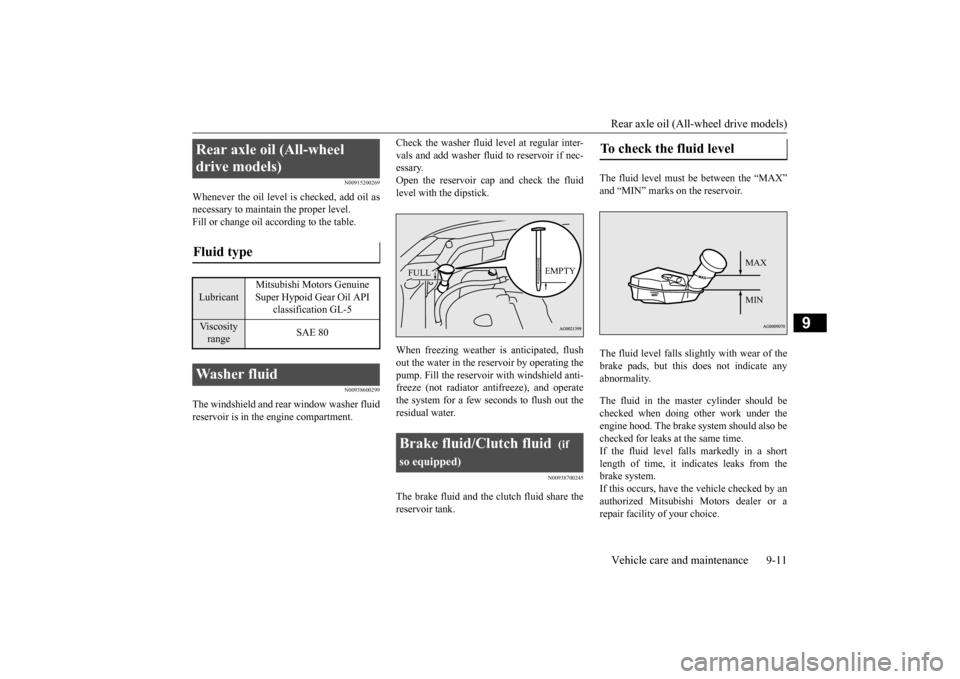
Check the washer fluid level at regular inter- vals and add washer fluid to reservoir if nec- essary. Open the reservoir cap and check the fluidlevel with the dipstick. When freezing weather is anticipated, flush out the water in the reservoir by operating the pump. Fill the reservoir with windshield anti-freeze (not radiator antifreeze), and operatethe system for a few seconds to flush out the residual water.
N00938700245
The brake fluid and the clutch fluid share the reservoir tank.
The fluid level must be between the “MAX” and “MIN” marks on the reservoir. The fluid level falls slightly with wear of the brake pads, but this does not indicate any abnormality. The fluid in the master cylinder should be checked when doing other work under theengine hood. The brake
system should also be
checked for leaks at the same time. If the fluid level falls markedly in a shortlength of time, it indicates leaks from the brake system. If this occurs, have the vehicle checked by anauthorized Mitsubishi Motors dealer or a repair facility of your choice.
Rear axle oil (All-wheel drive models) Fluid type Lubricant
Mitsubishi Motors Genuine Super Hypoid Gear Oil API
classification GL-5
Viscosity range
SAE 80
Washer fluid
Brake fluid/Clutch fluid
(if
so equipped)FULL
EMPTY
To check the fluid level
MAX MIN
BK0202700US.bo
ok 11 ページ 2013年3月28日 木曜日 午前11時54分
Page 333 of 384
Battery 9-12 Vehicle care and maintenance
9
Use the brake fluid conforming to DOT 3 or DOT 4. The reservoir cap must be tightlysealed to keep dirt and water out.
N00939100930
The condition of the battery is very important for quick starting and to keep the vehicle’s electrical system working properly. Check thebattery regularly. If battery performance is suspect, have the battery and charging system tested by an authorized Mitsubishi Motors dealer or arepair facility of your choice.
N00901600031
The battery is weaker in cold temperatures.This has to do with its chemical and physicalproperties and is why a very cold battery, especially one with a low charge, will have a hard time starting your vehicle.It is recommended that you have your battery and charging system checked by an autho- rized Mitsubishi Motors dealer or a repairfacility of your choice before the start of cold weather. If necessary, have it charged. This will guarantee more reliable starting, and lon-ger battery life.
N00901701101
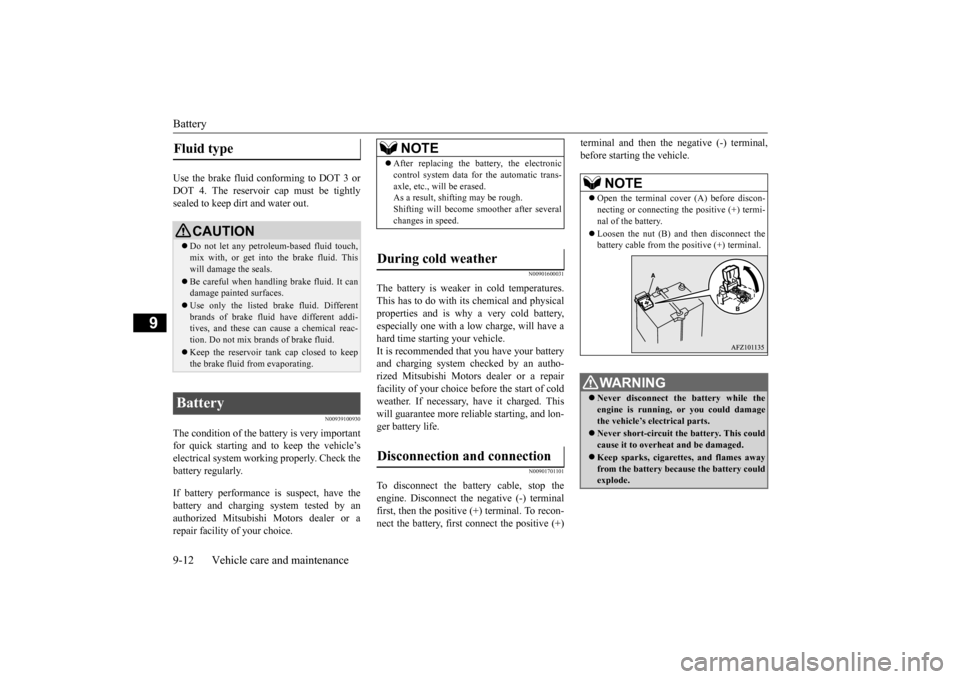
To disconnect the battery cable, stop theengine. Disconnect the negative (-) terminal first, then the positive (+) terminal. To recon- nect the battery, first connect the positive (+)
terminal and then the negative (-) terminal, before starting the vehicle.
Fluid type
CAUTION Do not let any petroleum-based fluid touch, mix with, or get into the brake fluid. This will damage the seals. Be careful when handling brake fluid. It can damage painted surfaces. Use only the listed brake fluid. Different brands of brake fluid have different addi-tives, and these can cause a chemical reac- tion. Do not mix brands of brake fluid. Keep the reservoir tank cap closed to keep the brake fluid from evaporating.
Battery
NOTE
After replacing the battery, the electronic control system data for the automatic trans- axle, etc., will be erased. As a result, shifting may be rough. Shifting will become smoother after severalchanges in speed.
During cold weather Disconnection and connection
NOTE
Open the terminal cover (A) before discon- necting or connecting the positive (+) termi- nal of the battery. Loosen the nut (B) and then disconnect the battery cable from the positive (+) terminal.WA R N I N G Never disconnect the battery while the engine is running, or you could damage the vehicle’s electrical parts. Never short-circuit the battery. This could cause it to overheat and be damaged. Keep sparks, cigarettes, and flames away from the battery because the battery couldexplode.
BK0202700US.bo
ok 12 ページ 2013年3月28日 木曜日 午前11時54分
Page 341 of 384
Clutch pedal free play (if so equipped) 9-20 Vehicle care and maintenance
9
N00940000320
In some areas of the country, snow tires are required for winter driving. If snow tires arerequired in your area, you must choose snow tires of the same size and type as the original tires provided with your vehicle. Snow tiresshould also be installed on all four wheels. Otherwise your safety and vehicle handling can be reduced.Even where laws may permit it, snow tiresshould not be operated at sustained speeds over 75 mph (120 km/h).
N00940100116 N00940201101
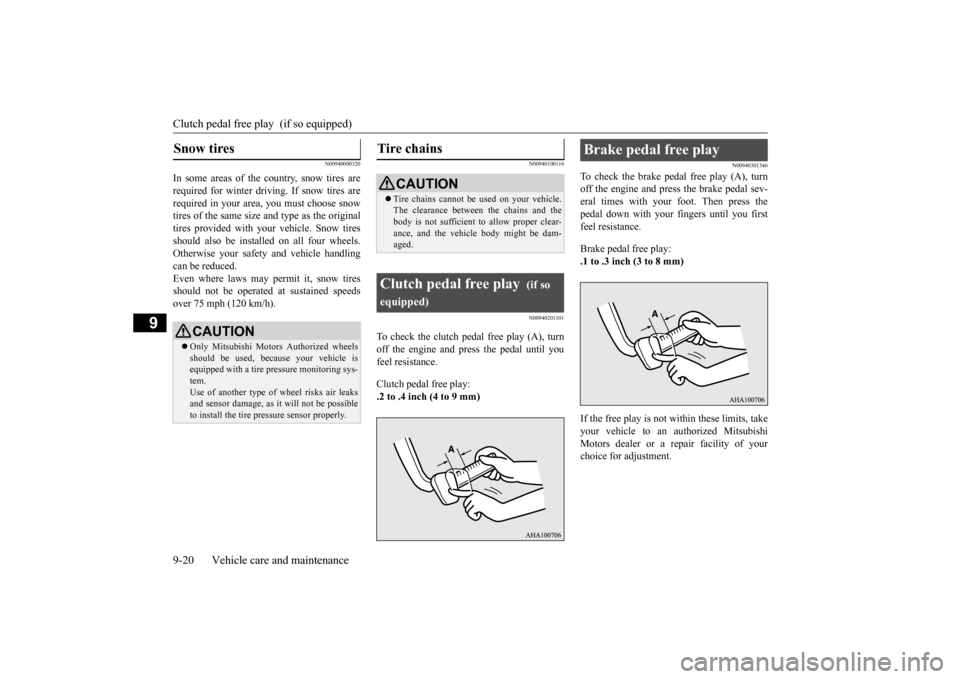
To check the clutch pedal free play (A), turn off the engine and press the pedal until you feel resistance. Clutch pedal free play: .2 to .4 inch (4 to 9 mm)
N00940301346
To check the brake pedal free play (A), turnoff the engine and press the brake pedal sev-eral times with your foot. Then press the pedal down with your fingers until you first feel resistance. Brake pedal free play: .1 to .3 inch (3 to 8 mm) If the free play is not within these limits, take your vehicle to an authorized Mitsubishi Motors dealer or a repair facility of your choice for adjustment.
Snow tires
CAUTION Only Mitsubishi Motors Authorized wheels should be used, because your vehicle isequipped with a tire pressure monitoring sys- tem. Use of another type of wheel risks air leaksand sensor damage, as it will not be possible to install the tire pressure sensor properly.
Tire chains
CAUTION Tire chains cannot be used on your vehicle. The clearance between the chains and the body is not sufficient to allow proper clear- ance, and the vehicle body might be dam-aged.
Clutch pedal free play
(if so
equipped)
Brake pedal free play
BK0202700US.bo
ok 20 ページ 2013年3月28日 木曜日 午前11時54分
Page 343 of 384
General maintenance 9-22 Vehicle care and maintenance
9
N00940900228
Spark plugs must fire properly for good engine performance and emission-control.Do not reuse them by cleaning or regapping. Change them at the mileage listed in the “WARRANTY AND MAINTENANCEMANUAL”.
N00941000040
Check the hose surfaces for any heat andmechanical damage, hard and brittle rubber,cracking, tears, cuts and abrasions. Pay spe- cial attention to the hoses closest to high heat sources such as the exhaust manifold. Checkall the hose connections, such as clamps and couplings, to make sure they are secure and that there are no leaks. If you see any wear ordamage, replace the hoses immediately.
N00950100050
Have the valve clearance checked at anauthorized Mitsubishi Motors dealer at themileage specified in the “WARRANTY AND MAINTENANCE MANUAL”. If the engine sounds abnormally loud, haveadjustments made by an authorized Mitsubishi Motors dealer.
N00941300173
Check these regularly for damage or leaks in the fuel lines and connections. Check the fuel tank filler cap for damage or looseness. Pay special attention to the fuel lines closest to
high heat sources such as the exhaust mani- fold.
N00941400187
If the fuel-vapor vent line is clogged or dam- aged, the fuel-vapor mixture will escape, pol- luting the air.Have the system checked at an authorized Mitsubishi Motors dealer at the mileage spec- ified in the “WARRANTY AND MAINTE-NANCE MANUAL”.
N00941500247
The next pages list the maintenance servicerecommended by Mitsubishi Motors Corpo- ration. In addition to the general maintenance that needs to be performed at the times listed,
NOTE
To meet government regulations and pro- mote cleaner air, your vehicle is equipped with an onboard diagnostic system (OBD). The engine electronic control module that controls OBD functions stores various data(especially about the exhaust emissions). This data will be erased if the battery cable is disconnected, which could make a rapiddiagnosis difficult. Do not disconnect the battery cable when the engine malfunction indicator (“SERVICE ENGINE SOON” or“Check engine light”) is ON.
Spark plugs
NOTE
Use the spark plugs listed under “Engine specifications” on page 11-4 or plugs that are exactly the same. Other plugs could causeengine damage, performance problems or radio noise.
Fuel hoses Intake valve clearance Fuel system (tank, pipe line and connection, and fuel tank filler cap)
WA R N I N G If you see a fuel leak or if you smell fuel, do not run the engine. Any spark (includ- ing from the ignition), flame or smokingmaterial could cause an explosion or fire. Call an authorized Mitsubishi Motors dealer or a repair facility of your choicefor assistance.
Evaporative emission control system (except evaporative emission canister) General maintenance
BK0202700US.bo
ok 22 ページ 2013年3月28日 木曜日 午前11時54分
Page 344 of 384
General maintenance
Vehicle care and maintenance 9-23
9
there are other parts which do not usually need regular maintenance. But, if any of these parts stops working prop- erly, your vehicle performance could suffer.Have these items checked if you notice a problem with them. See your authorized Mitsubishi Motors dealer for assistance, if you have any questions.
N00941600059
Good brakes are essential for safe driving. Check the brake pads for wear. For good braking performance, replace the brake padswith the same type pads as the originals.
N00941700076
Brake hoses and tubing should be checkedfor: Severe surface cracking, scuffing or worn spots. If the fabric casing of the hose is showing through any cracks or worn spotsin the rubber hose cover, the hose should be replaced. The brakes can fail if the hose wears through. Improper installation may cause twisting, or wheel, tire or chassis interference.
N00941800077
Check the following parts for damage and grease leaks: Ball joint boots of the front suspension and steering linkage Bellows on both ends of the drive shaft
N00942200094
The best way to keep carbon monoxide gas from entering inside your vehicle is to have the engine exhaust system properly serviced. Have a competent mechanic inspect the com-plete exhaust system and nearby body areas for broken, damaged, deteriorated, or mispo- sitioned parts if you notice any of the follow-ing: A change in the sound of the exhaust sys- tem The smell of exhaust fumes inside the vehicle
The underside or rear of the vehicle is damaged
Also check the exhaust system each time the vehicle is raised for lubrication, oil changes, or required service. Any open seams or looseconnections could let dangerous exhaust fumes seep into the luggage compartment and passenger compartments. Check for holes or exhaust gas leaks caused by corrosion or damage. Check the joints and connections for looseness or exhaust gas leaks. Check the rubber hangers and brackets for damage.
N00942500101
The hood lock release mechanism and hood safety catch should be checked, cleaned, and oiled when needed for easy movement and tostop rust and wear. Use Multipurpose Grease NLGI Grade 2 sparingly for all sliding parts of the hood latch and release lever. Work thegrease into the hood lock mechanism until all the movable surfaces are covered.
Disc brake pads Brake hoses
Ball joint, steering linkage seals and drive shaft boots Exhaust system
WA R N I N G Carbon monoxide gas from your vehicle’s exhaust is poisonous. Breathing these fumes can cause unconsciousness or death.
Check for any of the following conditions: Hood lock release mechanism and safety catch
BK0202700US.bo
ok 23 ページ 2013年3月28日 木曜日 午前11時54分
Page 349 of 384
Fuses 9-28 Vehicle care and maintenance
9
Replace the borrowed fuse with a fuse that has the correct capacity as soon as possible.
N00954900128
1. Before replacing a fuse, always turn offthe electrical item concerned to the fuseand turn the ignition switch to the “OFF”position or put the operation mode in OFF.
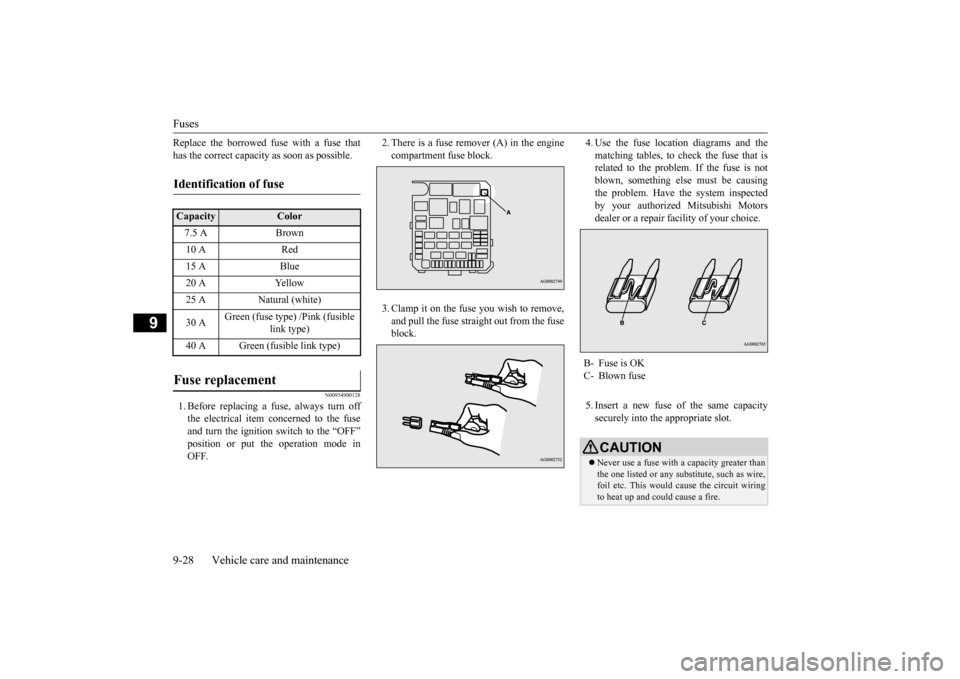
2. There is a fuse remover (A) in the engine compartment fuse block. 3. Clamp it on the fuse you wish to remove, and pull the fuse straight out from the fuse block.
4. Use the fuse location diagrams and the matching tables, to check the fuse that is related to the problem. If the fuse is not blown, something else must be causingthe problem. Have the system inspected by your authorized Mitsubishi Motors dealer or a repair facility of your choice. 5. Insert a new fuse of the same capacity securely into the appropriate slot.
Identification of fuse Capacity
Color
7.5 A Brown10 A Red15 A Blue20 A Yellow25 A Natural (white) 30 A
Green (fuse type) /Pink (fusible
link type)
40 A Green (fusible link type)
Fuse replacement
B- Fuse is OK C- Blown fuse
CAUTION Never use a fuse with a capacity greater than the one listed or any substitute, such as wire,foil etc. This would cause the circuit wiring to heat up and could cause a fire.
BK0202700US.bo
ok 28 ページ 2013年3月28日 木曜日 午前11時54分
Page 363 of 384
Cleaning the outside of your vehicle 9-42 Vehicle care and maintenance
9
N00946200047
Small cracks and scratches in the paint coat should be touched up as soon as possible withtouch-up paint to prevent corrosion. Check body areas facing the road or the tires carefully for damage to the paint caused byflying stones, etc. The
paint code number for
your vehicle can be found on the vehicle information code plate in the engine compart-ment.
N00946300194
Use a sponge or chamois to clean these parts.If a vehicle wax sticks to a gray or blackrough surface of the bumper, molding or lights, the surface may appear white in color. In this case, wipe it off using lukewarm waterand a soft cloth or chamois.
N00946400052
To prevent spots and corrosion of chrome parts, wash with water, dry thoroughly, and apply a nonabrasive automotive wax. If thechrome is severely damaged or pitted, use a commercially available chrome polish.
N00946500183
1. Remove dirt using a wet sponge.2. Use a mild detergent on any dirt that can- not be removed easily with water.Rinse off the detergent after washing the wheel. 3. Dry the wheel thoroug
hly using a chamois
leather or a soft cloth.
N00946600054
The window glass can
usually be cleaned
using only a sponge and water. Glass cleaner can be used to remove wax, oil, grease, dead insects, etc. After washing the glass, wipe itdry with a clean, dry, soft cloth.
N00946700068
Use a soft cloth and gl
ass cleaner to remove
grease, dead insects, etc., from the wiper blades. Replace the wiper blades when they no longerclean the windshield and rear window prop- erly.
Damaged paint Cleaning plastic parts
CAUTION Do not use a scrubbing brush or other rough scrubber as these may damage the plastic surface. Do not use wax containing compounds (pol- ishing powder) which may damage the plas-tic surface.
Do not let plastic parts get soiled with gaso- line, oil, brake fluids
, engine oils, greases,
paint thinner, and sulfuric acid (battery elec- trolyte), as such substances will cause stains, cracks, or discoloration.If any of these get on a plastic part, wipe them up with a soft cloth or chamois and a mild solution of soap and water. Then rinsethem immediately with water.
Chrome parts Aluminum wheels
(if so equipped)
CAUTION
CAUTION Do not use a brush or other hard implement on the wheels. Do not use any cleaner that contains an abra- sive substance or is acidic or alkaline. Doingso could cause the coating on the wheels to peel or become discolored or stained. Do not directly apply hot water using a steam cleaner or by any other means. Contact with seawater or road salt used for de-icing can cause corrosion. Rinse off such substances as soon as possible.
Window glass Wiper blades
BK0202700US.bo
ok 42 ページ 2013年3月28日 木曜日 午前11時54分