sensor MITSUBISHI OUTLANDER SPORT 2014 3.G Owners Manual
[x] Cancel search | Manufacturer: MITSUBISHI, Model Year: 2014, Model line: OUTLANDER SPORT, Model: MITSUBISHI OUTLANDER SPORT 2014 3.GPages: 384, PDF Size: 46.94 MB
Page 17 of 384
Fuel selection 3-2 General information
3
N00301001919
Your vehicle is designed to use unleaded gas- oline only. It is equipped with a fuel tankfiller pipe especially designed to accept only a small diameter unleaded gasoline dispens- ing nozzle. In the United States, fuel suppliers are required by law to add detergents to their gas-
oline to minimize fuel-injector fouling and minimize intake-valve deposits. Detergent gasoline helps keep your engine in tune and your emission-control system working prop-erly. Your vehicle is designed to operate on unleaded gasoline having a minimum octanenumber of 87 [(MON+RON)/2] or 91 RON. Gasoline sold at some service stations con- tains oxygenates such as ethanol, although the oxygenates may not be identified by those names. Oxygenates are required in someareas of the country. Such fuel can be used in your vehicle. A mixture of up to 10% ethanol (grain alco- hol) and 90% unleaded gasoline may be used in your vehicle, provided the octane numberis at least as high as that recommended for unleaded gasoline.
Do not operate your vehicle on gasoline con- taining methanol (wood alcohol). Using thistype of alcohol could adversely affect the vehicle’s performance and damage critical parts of the vehicle’s fuel system. Many areas of the country require the use of cleaner burning fuel referred to as “Reformu- lated Gasoline”.Reformulated gasoline contains oxygenates and is specially blended to reduce vehicle emissions and improve air quality.Mitsubishi Motors Cor
poration strongly sup-
ports the use of reformulated gasoline. Prop- erly blended reformulated gasoline has noadverse effect on vehicle performance or the durability of engine and fuel system. MMT is a manganese-containing metallic additive that is blended into some gasolinesto increase the octane number. Mitsubishi Motors Corporation recommends using gaso- lines without MMT.
Fuel selection
WA R N I N G Gasoline is highly flammable and explo- sive. You could be burned, seriouslyinjured or killed when handling it. When- ever you refuel your vehicle, stop the engine and keep flames, sparks, andsmoking materials away from the vehicle. Always handle fuel in well-ventilated out- door areas.CAUTION Using leaded gasoline in your vehicle will damage the engine, catalytic converter, and the oxygen sensors. Also, using leaded gaso-line is illegal, and will void your warranty coverage of the engine, catalytic converter, and oxygen sensors.
Gasoline detergent additives
Octane requirement Oxygenated gasoline Ethanol (Gasohol)
Methanol Reformulated gasoline MMT (methylcyclopentadienyl manganese tricarbonyl)
BK0202700US.bo
ok 2 ページ 2013年3月28日 木曜日 午前11時54分
Page 30 of 384
Extending a luggage compartment Seat and restraint systems 4-9
4
N00405500105
N00417801056
The passenger and luggage compartments can be joined by folding the seatback forward. This is useful for carrying long objects.The seatbacks can be folded with the rear seat release button.
Extending a luggage com- partment
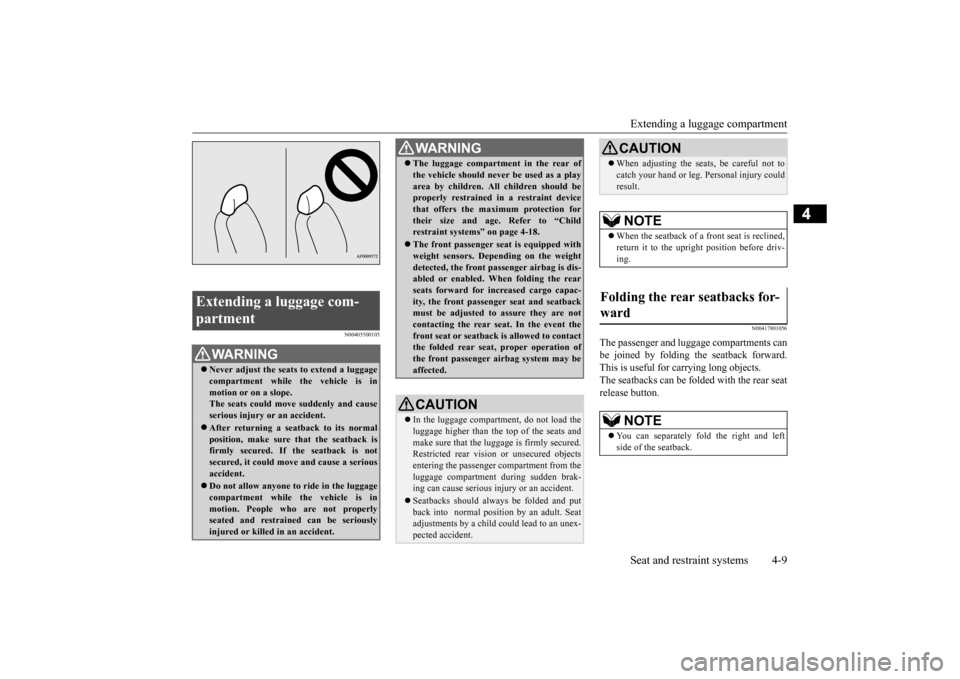
WA R N I N G Never adjust the seats to extend a luggage compartment while the vehicle is inmotion or on a slope. The seats could move suddenly and cause serious injury or an accident. After returning a seatback to its normal position, make sure that the seatback isfirmly secured. If the seatback is not secured, it could move and cause a serious accident. Do not allow anyone to ride in the luggage compartment while the vehicle is inmotion. People who are not properly seated and restrained can be seriously injured or killed in an accident.
The luggage compartment in the rear of the vehicle should never be used as a play area by children. All children should be properly restrained in a restraint device that offers the maximum protection fortheir size and age. Refer to “Child restraint systems” on page 4-18. The front passenger seat is equipped with weight sensors. Depending on the weight detected, the front passenger airbag is dis-abled or enabled. When folding the rear seats forward for increased cargo capac- ity, the front passenger seat and seatbackmust be adjusted to assure they are not contacting the rear seat. In the event the front seat or seatback is allowed to contactthe folded rear seat, proper operation of the front passenger airbag system may be affected.CAUTION In the luggage compartme
nt, do not load the
luggage higher than the top of the seats and make sure that the luggage is firmly secured. Restricted rear vision or unsecured objects entering the passenger compartment from the luggage compartment during sudden brak-ing can cause serious injury or an accident. Seatbacks should always be folded and put back into normal position by an adult. Seat adjustments by a child could lead to an unex- pected accident.WA R N I N G
When adjusting the seats, be careful not to catch your hand or leg. Personal injury could result.NOTE
When the seatback of a front seat is reclined, return it to the upright position before driv- ing.
Folding the rear seatbacks for- ward
NOTE
You can separately fold the right and left side of the seatback.CAUTION
BK0202700US.bo
ok 9 ページ 2013年3月28日 木曜日 午前11時54分
Page 38 of 384
Seat belt use during pregnancy
Seat and restraint systems 4-17
4
N00406800134
Seat belts work for ev
eryone, including preg-
nant women. Like all occupants, pregnantwomen are more likely to be seriously injured or killed in an accident if they do not wear seat belts.
N00417700641
The driver’s and front passenger’s seats eachhave a seat belt equipped with a pre-tensioner system.
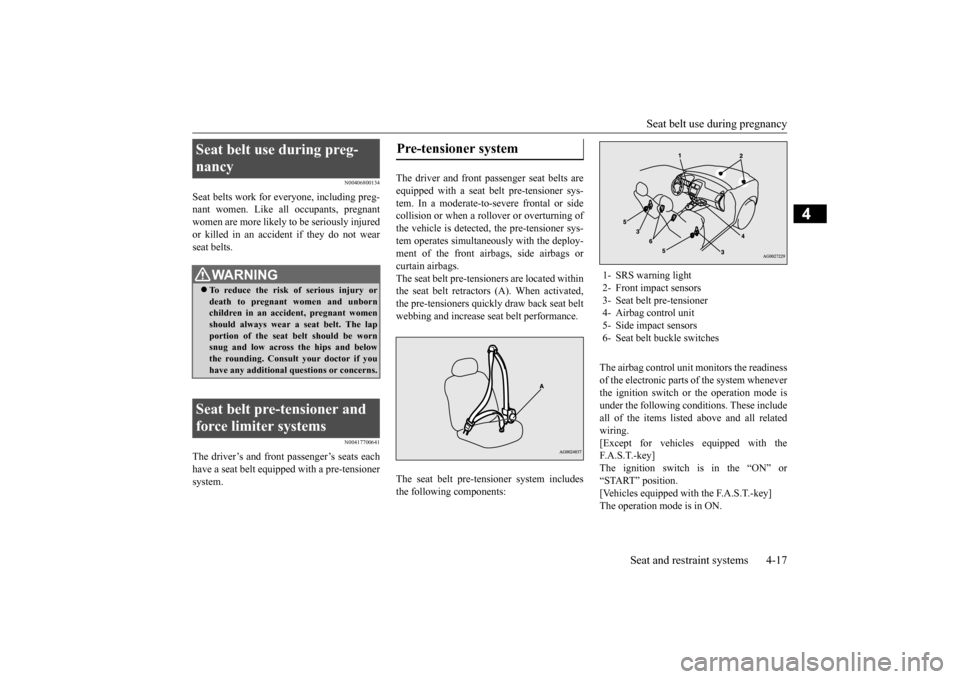
The driver and front passenger seat belts are equipped with a seat belt pre-tensioner sys-tem. In a moderate-to-severe frontal or side collision or when a rollover or overturning of the vehicle is detected, the pre-tensioner sys-tem operates simultaneously with the deploy- ment of the front airbags, side airbags or curtain airbags.The seat belt pre-tensioners are located withinthe seat belt retractors (A). When activated, the pre-tensioners quickly draw back seat belt webbing and increase seat belt performance. The seat belt pre-tensioner system includes the following components:
The airbag control unit monitors the readiness of the electronic parts of the system wheneverthe ignition switch or the operation mode isunder the following conditions. These include all of the items listed above and all related wiring.[Except for vehicles equipped with the F. A . S . T. - k e y ] The ignition switch is in the “ON” or“START” position. [Vehicles equipped with the F.A.S.T.-key] The operation mode is in ON.
Seat belt use during preg- nancy
WA R N I N G To reduce the risk of serious injury or death to pregnant women and unbornchildren in an accident, pregnant women should always wear a seat belt. The lap portion of the seat belt should be wornsnug and low across the hips and below the rounding. Consult your doctor if you have any additional questions or concerns.
Seat belt pre-tensioner and force limiter systems
Pre-tensioner system
1- SRS warning light 2- Front impact sensors3- Seat belt pre-tensioner 4- Airbag control unit 5- Side impact sensors6- Seat belt buckle switches
BK0202700US.bo
ok 17 ページ 2013年3月28日 木曜日 午前11時54分
Page 47 of 384
Supplemental Restraint System (SRS) - airbag 4-26 Seat and restraint systems
4
retractors for automatic locking when in the Automatic Locking Retractor function. The entire seat belt assembly should be replaced if the webbing shows any obvious cuts, tears, increase in thickness in any sec-tion of the webbing from broken fibers, or severe fading from sunlight. All of these con- ditions indicate a weakening of the belt,which may adversely affect seat belt perfor- mance in an accident.
N00407701759
This vehicle is equipped with a Supplemental Restraint System (SRS), which includes air-bags for the driver and passengers. The SRS front airbags are designed to supple- ment the primary protection of the driver and
front passenger seat belt systems by provid- ing those occupants with protection against head and chest injuries in certain moderate to severe frontal collisions. The SRS front air-bags, together with sensors at the front of the vehicle and sensors attached to the front seats, form an advanced airbag system. The SRS driver’s knee airbag is designed to supplement the primary protection of the driver’s seat belt system. It can reduce the forward movement of the driver’s lower legsand provide increased overall body protectionin certain moderate to severe frontal colli- sions. The SRS side airbags and the curtain airbags are also designed to supplement the seat belts.The SRS side airbags provide the driver and front passenger with protection against chest injuries by deploying the bag on the sideimpacted in moderate to severe side impact collisions. The SRS curtain airbags provide the driver and passengers on the front seatand rear outboard seat with protection against head injuries by deploying a bag on the side impacted in moderate to severe side impactcollisions and by deploy
ing both bags when a
rollover is detected. The SRS airbags are NOT a substitute for use of the seat belts. For maximum protection inall types of accidents, seat belts must
ALWAYS be worn by everyone who drives or rides in this vehicl
e (with infants and small
children in an appropriate child restraint sys- tem in the rear seat, and older children buck-led in the rear seat). Refer to “Child restraint systems” on page 4-18.
WA R N I N G Do not attempt to repair or replace any part of the seat belt assemblies. This work should be done by an authorized Mitsubishi Motors dealer. Failure to havean authorized Mitsubishi Motors dealer perform the work could reduce the effec- tiveness of the belts and could result in aserious injury or death in an accident.
Supplemental Restraint Sys- tem (SRS) - airbag
WA R N I N G IT IS VERY IMPORTANT TO ALWAYS WEAR YOUR SEAT BELT PROPERLY EVEN WITH AN AIRBAG.• Seat belts help keep the driver and pas-sengers properly positioned. This reduces the risk of injury in all collisions,and reduces the risk of serious injuries or death when the airbags inflate. During sudden braking just before a col-lision, an unrestrained or improperly restrained driver or passengers can move forward into direct contact with, orwithin close proximity to, the airbag when it begins to inflate. The beginning stage of airbag inflation isthe most forceful and can cause serious injuries or death if the occupant comes in contact with the airbag at this time.• Seat belts reduce the risk of injury inrear impact collisions, and in lower- speed frontal collisions because the air- bags are not designed to inflate in thosesituations.• Seat belts reduce the risk of beingthrown from your vehicle in a collision or rollover.
BK0202700US.bo
ok 26 ページ 2013年3月28日 木曜日 午前11時54分
Page 49 of 384
Supplemental Restraint System (SRS) - airbag 4-28 Seat and restraint systems
4
N00407800450
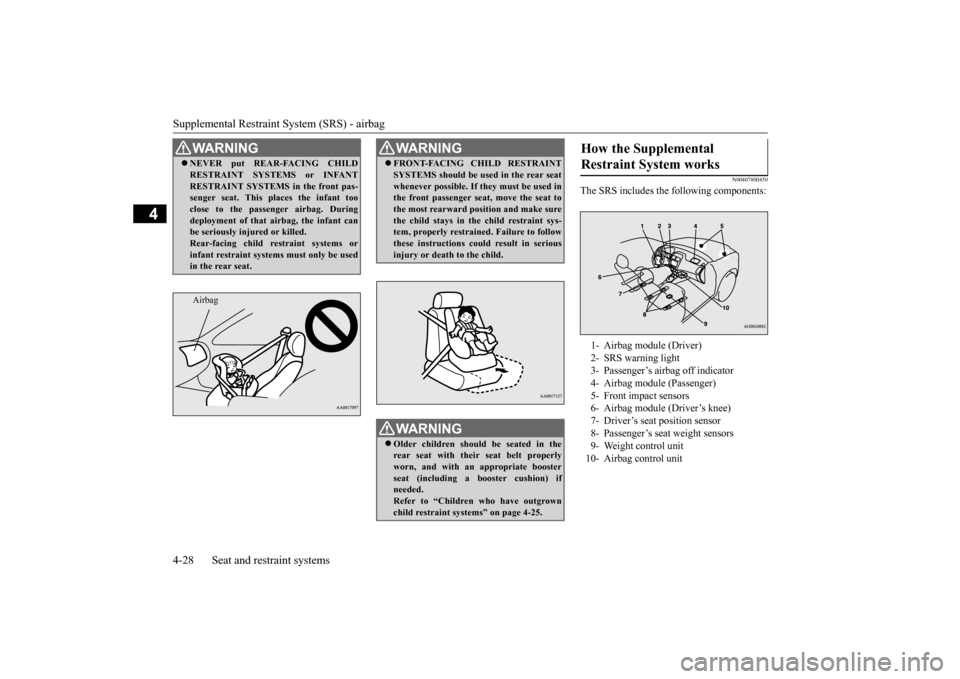
The SRS includes the following components:
WA R N I N G NEVER put REAR-FACING CHILD RESTRAINT SYSTEMS or INFANT RESTRAINT SYSTEMS in the front pas- senger seat. This places the infant too close to the passenger airbag. Duringdeployment of that airbag, the infant can be seriously injured or killed. Rear-facing child restraint systems orinfant restraint systems must only be used in the rear seat.Airbag
WA R N I N G FRONT-FACING CHILD RESTRAINT SYSTEMS should be used in the rear seat whenever possible. If they must be used in the front passenger seat, move the seat to the most rearward position and make surethe child stays in the child restraint sys- tem, properly restrained. Failure to follow these instructions could result in seriousinjury or death to the child.WA R N I N G Older children should be seated in the rear seat with their seat belt properlyworn, and with an appropriate booster seat (including a booster cushion) if needed.Refer to “Children who have outgrown child restraint systems” on page 4-25.
How the Supplemental Restraint System works 1- Airbag module (Driver) 2- SRS warning light3- Passenger’s airbag off indicator4- Airbag module (Passenger) 5- Front impact sensors 6- Airbag module (Driver’s knee)7- Driver’s seat position sensor 8- Passenger’s seat weight sensors 9- Weight control unit10- Airbag control unit
BK0202700US.bo
ok 28 ページ 2013年3月28日 木曜日 午前11時54分
Page 50 of 384
Supplemental Restraint System (SRS) - airbag
Seat and restraint systems 4-29
4
The airbag control unit monitors the readiness of the electronic parts of the system whenever the ignition switch or the operation mode is under the following conditions. These includeall of the items listed above and all relatedwiring. [Except for vehicles equipped with the F. A . S . T. - k e y ] The ignition switch is in the “ON” or “START” position. [Vehicles equipped with the F.A.S.T.-key]The operation mode is in ON. The airbags will operate under the same con- ditions as the airbag control unit.
When the impact sensors detect a sufficient front or side impact to deploy the airbag(s), the appropriate airbag(s) will be deployed. When the airbag control unit detects rollover of the vehicle, curtain airbags will bedeployed. When airbags deploy, some smoke is released accompanied by a loud noise. The smoke is not harmful, but do not intentionally inhalethe smoke as it may cause temporary irrita-tion to people with respiratory problems. An inflated airbag will deflate quickly, so you may not even notice that the airbag was inflated.Airbag inflation does not prevent the driver from seeing or being able to steer the vehicle, and does not prevent people from leaving thevehicle.
N00418600243
This vehicle is equipped with an event datarecorder (EDR).
The main purpose of an EDR is to record, in certain crash or near crash-like situations, such as an airbag deployment or hitting a road obstacle, data that will assist in under-standing how a vehicle’s systems performed. The EDR is designed to record data related to vehicle dynamics and safety systems for ashort period of time, typically 30 seconds or less. The EDR in this vehicle is designed to record such data as: How various systems in your vehicle were operating; Whether or not the driver and passenger safety belts were buckled/fastened; How far (if at all) the driver was depress- ing the accelerator and/or brake pedal; and, How fast the vehicle was traveling.
These data can help provide a better under- standing of the circumstances in which crashes and injuries occur.
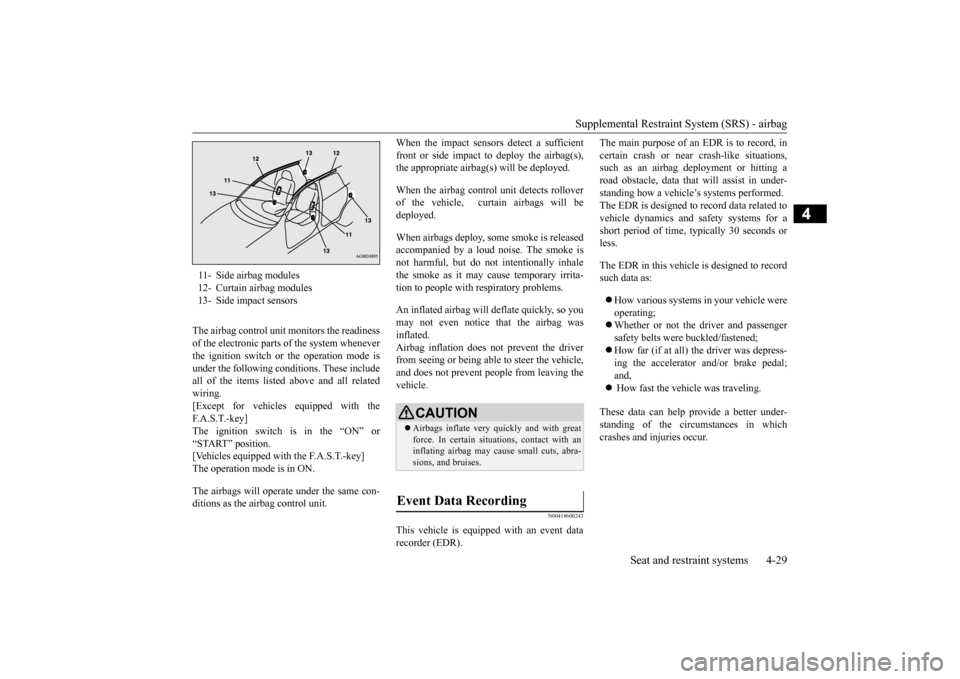
11- Side airbag modules 12- Curtain airbag modules13- Side impact sensors
CAUTION Airbags inflate very quickly and with great force. In certain situations, contact with an inflating airbag may cause small cuts, abra- sions, and bruises.
Event Data Recording
BK0202700US.bo
ok 29 ページ 2013年3月28日 木曜日 午前11時54分
Page 51 of 384
Supplemental Restraint System (SRS) - airbag 4-30 Seat and restraint systems
4
To read data recorded by an EDR, special equipment is required, and access to the vehi- cle or the EDR is needed. In addition to the vehicle manufacturer, other parties, such aslaw enforcement, that have the special equip- ment, can read the information if they have access to the vehicle or the EDR.
N00417900177
The driver’s seat position sensor is attachedto the seat rail and provides the airbag controlunit with information on the seat’s fore-aft position. The airbag control unit controls deployment of the driver’s front airbag inaccordance with the information it receives from this sensor. If there is a problem involving the driver’sseat position sensor, the SRS warning light in the instrument panel will come on. Refer to
“SRS warning light/display” on page 4-32.
N00418000322
The passenger’s seat weight sensors are attached to the seat rails and provide the air- bag control unit with information regarding the weight on the front passenger seat. Theairbag control unit controls deployment of the passenger’s front airbag in accordance with the information it receives from this sensor.
The passenger’s front airbag will not deploy in an impact when the weight on the seat is sensed to be less than approximately 66 pounds (30 kg). In this case, the passengerairbag off indicator will come on. Refer to “Passenger’s airbag off indicator” on page 4-31.If there is a problem involving the passenger seat weight sensors, the SRS warning light in the instrument panel will come on. Refer to“SRS warning light/display” on page 4-32.
NOTE
EDR data are recorded by your vehicle only if a non-trivial crash situation occurs; no data are recorded by the EDR under normal driv- ing conditions and no personal data (e.g., name, gender, age, and crash location) arerecorded. However, other parties, such as law enforcement, could combine the EDR data with the type of personally identifyingdata routinely acquired during a crash inves- tigation.
Driver’s seat position sensor
WA R N I N G If the SRS warning light or warning dis- play comes on, have the vehicle inspectedby an authorized Mitsubishi Motors dealer as soon as possible. Please observe the following instructions to ensure that the driver’s seat position sensor can operate correctly.• Adjust the seat to the correct position,and sit well back against the seatback.Refer to “Front seats” on page 4-3.• Do not recline the seatback more thannecessary when driving.• Do not place metallic objects or luggageunder the front seat.
If the vehicle is involved in a severe impact, have the SRS sensors inspected by an authorized Mitsubishi Motors dealer as soon as possible.
Passenger’s seat weight sensors
WA R N I N G If any of the following conditions occur, you should have your vehicle inspected by an authorized Mitsubishi Motors dealer assoon as possible:• The SRS warning light does not initiallycome on when the ignition switch or the operation mode is under the following conditions.• [Except for vehicles equipped with theF. A . S . T. - k e y ]The ignition switch is in the “ON” or “START” position. [Vehicles equipped with the F.A.S.T.-key] The operation mode is in ON.• The SRS warning light does not go outafter several seconds.• The SRS warning light comes on whileyou are driving.
BK0202700US.bo
ok 30 ページ 2013年3月28日 木曜日 午前11時54分
Page 52 of 384
Supplemental Restraint System (SRS) - airbag
Seat and restraint systems 4-31
4
N00418100280
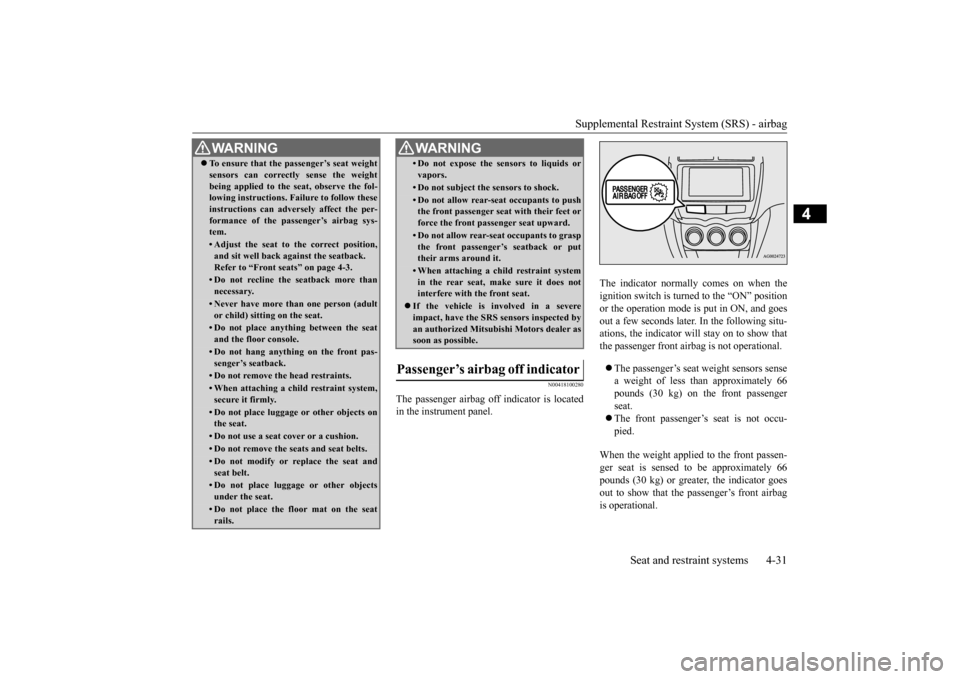
The passenger airbag off indicator is located in the instrument panel.
The indicator normally comes on when the ignition switch is turned to the “ON” position or the operation mode is put in ON, and goesout a few seconds later. In the following situ- ations, the indicator will stay on to show that the passenger front airbag is not operational. The passenger’s seat weight sensors sense a weight of less than approximately 66pounds (30 kg) on the front passenger seat. The front passenger’s seat is not occu- pied.
When the weight applied to the front passen- ger seat is sensed to be approximately 66 pounds (30 kg) or greater, the indicator goesout to show that the passenger’s front airbag is operational.
To ensure that the passenger’s seat weight sensors can correctly sense the weight being applied to the seat, observe the fol- lowing instructions. Failure to follow these instructions can adversely affect the per-formance of the passenger’s airbag sys- tem.• Adjust the seat to the correct position,and sit well back against the seatback. Refer to “Front seats” on page 4-3.• Do not recline the seatback more thannecessary.• Never have more than one person (adultor child) sitting on the seat.• Do not place anything between the seatand the floor console.• Do not hang anything on the front pas-senger’s seatback.• Do not remove the head restraints.• When attaching a child restraint system, secure it firmly.• Do not place luggage or other objects onthe seat.• Do not use a seat cover or a cushion.• Do not remove the seats and seat belts.• Do not modify or replace the seat and seat belt.• Do not place luggage or other objectsunder the seat.• Do not place the floor mat on the seatrails.WA R N I N G
• Do not expose the sensors to liquids or vapors.• Do not subject the sensors to shock.• Do not allow rear-seat occupants to pushthe front passenger seat with their feet or force the front passenger seat upward.• Do not allow rear-seat occupants to graspthe front passenger’s seatback or puttheir arms around it.• When attaching a child restraint systemin the rear seat, make sure it does not interfere with the front seat.
If the vehicle is involved in a severe impact, have the SRS sensors inspected by an authorized Mitsubishi Motors dealer assoon as possible.
Passenger’s airbag off indicator
WA R N I N G
BK0202700US.bo
ok 31 ページ 2013年3月28日 木曜日 午前11時54分
Page 54 of 384
Supplemental Restraint System (SRS) - airbag
Seat and restraint systems 4-33
4
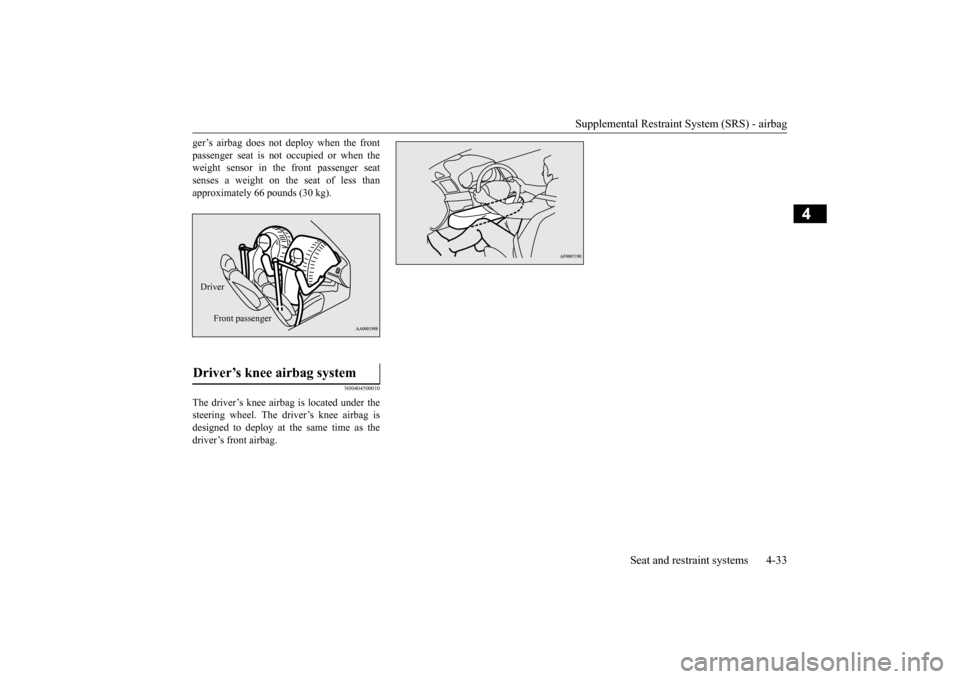
ger’s airbag does not deploy when the front passenger seat is not occupied or when the weight sensor in the front passenger seat senses a weight on the seat of less thanapproximately 66 pounds (30 kg).
N00404500010
The driver’s knee airbag is located under thesteering wheel. The driver’s knee airbag isdesigned to deploy at the same time as the driver’s front airbag.Driver’s knee airbag system Driver
Front passenger
BK0202700US.bo
ok 33 ページ 2013年3月28日 木曜日 午前11時54分
Page 106 of 384
Outside rearview mirrors
Features and controls 5-43
5
Normally, use the automatic mode. When the ignition switch is turned to the “ON” position or the operation mode is put in ON, thereflection factor of the mirror is automatically changed.
N00512200206
Adjust the outside rearview mirrors only aftermaking any seat adjustments so as to have a clear view to the rear of the vehicle.
N00549100131
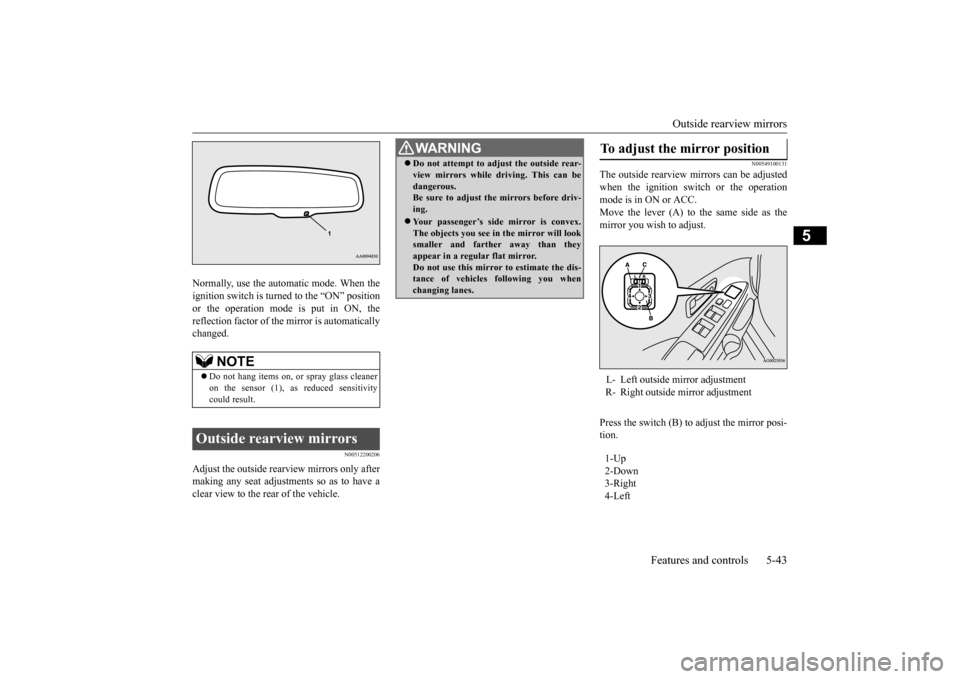
The outside rearview mirrors can be adjustedwhen the ignition switch or the operationmode is in ON or ACC. Move the lever (A) to the same side as the mirror you wish to adjust. Press the switch (B) to adjust the mirror posi- tion.
NOTE
Do not hang items on, or spray glass cleaner on the sensor (1), as reduced sensitivity could result.
Outside rearview mirrors
WA R N I N G Do not attempt to adjust the outside rear- view mirrors while driving. This can be dangerous. Be sure to adjust the mirrors before driv- ing. Your passenger’s side mirror is convex. The objects you see in the mirror will looksmaller and farther away than they appear in a regular flat mirror. Do not use this mirror to estimate the dis-tance of vehicles following you when changing lanes.
To adjust the mirror position L- Left outside mirror adjustment R- Right outside mirror adjustment 1-Up 2-Down 3-Right4-Left
BK0202700US.bo
ok 43 ページ 2013年3月28日 木曜日 午前11時54分