Tow MITSUBISHI PAJERO 1996 2.G User Guide
[x] Cancel search | Manufacturer: MITSUBISHI, Model Year: 1996, Model line: PAJERO, Model: MITSUBISHI PAJERO 1996 2.GPages: 302, PDF Size: 48.23 MB
Page 56 of 302
Downloaded from www.Manualslib.com manuals search engine --------------
ISTUIMET JA TURVAVYDT' , .' '. ," . . SEAT AND' SEAT BELTS ' , !.' , . " , , ." ~ . . ~.
Paatuet
Korkeuden saato (Tyyppi 1 )
Saada paantuen korkeus sellaiseksi, etta
tuen keskus on silmien korkeudella , niin
lahella takaraivo kuin mahdollista
loukkaantumisvaaran vahentamiseksi mah
dollisessa yhteenajossa .
Paantuld nostetaan vetamalla sita
ylaspain
Tuki lasketaan -liikuttamalla sita alaspain
painaen samalla,
lukitusnappulaa nuolen
suuntaan. Saadan jalkeen tyanna
paantukea alas ja varmista etta se lukkiutuu.
Tyyppi l/Type 1
Paantuen saato eteenpain tai taaksepain (Tyyppi 2)
Eteenpain saata tapahtuu vetamalla tukea itseasi kohti.
Taaksepain saata tapahtuu vetamalla tuki itsea kohti aariasentoon ja vapauttamalla se.
, ... ", /" 7 .-:wqtrt~.'~
g;::. ,'VA ROITUS
. (1). ·Paantuet suojaavat ainoastaun huolellisesti saa
'," d~~ina. (2), Jos'selan ja selkanojan vi!lliin asetetaan esim. tyyny, , ei tuesta ole todellista hyotya onnettomuuden sat-
." •. 'tuessa. ' " ... _ ... .'._ .. _ ... _____ ....
T yyppi 2fT ype 2
69E0097
Headrestraints EG26A·B
Adjustment of the height (Type 1 )
Adjust the headrestraint height so that
the centre of the restraint is as close as possible to eye level to reduce the
chance of injury in the event of collision.
To raise the headrestraint move it up
ward. To lower the restraint move it downward while pushing the height ad
justing knob in the direction of the arrow. After adjustment push the headr e
straint downward and make sure that it is locked.
Adjusting headrestraint forward or backward (Type 2)
Pull the headrestraint toward you to adjust it forward. To adjust
it backward, pull the headrestraint all the way towards you and
then release it.
& CAUTION . , .
(1) The head restraints can only protect you if they are correctly adjusted. (2) If a cushion or the like is placed between your back and the seatback. the head restraint will barely pro-tect you in the event of an accident. .
61
Page 60 of 302
Downloaded from www.Manualslib.com manuals search engine ISTUIMET JATURVAVYOT .' ,", SEAT-AND SEAT BELTS : , '" ' , 1
AVAAMINEN
Painakaa soljessa olevaa painiketta pitiien toisella kiidellii levystii kiinni.
HUOM Vyon kelautuessa automaattisesti takai
sin pitiikiiii levystii kiinni, jotta liike ei olisi liian nopea .
Lantiovyot
Lantiovyo siiiidetiiiin pitiimiillii vyotii ja lukkolevyii oikeassa kulmassa toisiinsa niihden ja sitten vetiimiillii vyotii kuvan
mukaan tiukasti kiiyttiijiin ympiirille.
1-Kiristys 2-,Loysiitkiiii
Ottakaa lukkolevy kiiteenne ja tyontiikiiii se solkeen, kunnes kuuluu "naksahdus".
HUOM Keskilantiovyon soljessa ja laatassa on
merkki "CENTER".
Tarkastakaa merkintii ennen kuin
kiiytiitte keskilantiovyotii.
2 69P0137
TO UNFASTEN
Hold the plate and push the button on
the buckle.
NOTE
As the belt retracts
automatically, keep
the plate held while retracting so that the
belt stows slowly.
Lap belts
The lap belts should be adjusted by holding the belt and latch plate at right angles to each other, and then pulling
the belt as shown in the illustration to a
snug fit around the occupant.
1-Tighten 2-Loosen
Holding the latch plate by hand, insert
the latch plate into the buckle until a "click" is heard.
NOTE
The
buckle and plate of the centre lap
belt are marked with "CENTER".
Be sure to check the marking before
wearing the centre lap belt.
65
Page 93 of 302
Downloaded from www.Manualslib.com manuals search engine MITTARISTO JA HALLINTALAITTEET '. . INSTRUMENTS & CONTROLS
Lyhdyn pesulaittem katkaisin* HE02A·Bc
Lyhdyn pesulaite toimii virtalukon "ON " -asennossa , jos valokytkin on
asennossa .
Nappia kerran painettaess a suihkuaa pe
sunestetta lasille
puolen sekunnin
ajan.
HUOM (1) Tarkastakaa pesulaite ajoittain varmistaaksenne, etta pesu
nestetta suihkuaa lasille.
(2) Mikali pesunesteen loppumisen merkkivalo syttyy, taytta
kaa sailib niin nopeasti kuin mahdollista.
Tuulilasin pyyhkijoiden ja pesulaiteen
katkaisin
HE13A ·B
Tuulilasin pyyhkija ja pesulaite toimivat virtalukon "ON" -ja "ACC" -a sennossa. Tuulilasin pyyhkijat ja pesulaite toimivat vipua kaantamalla .
Kun vedatte vipua itseanne kohti Iyhyen aikaa, pyyhkijat toimi
vat kerran. (Huurteen pyyhkimistoiminta)
98
68E0055
NOTE
Headlight washer switch* EE02A·Bc
The headlight washer can be operated with the ignition switch at the "ON" position and the light switch at the on
position.
Push the
button once and the washer fluid will be sprayed on to the headlights for about 0.5 seco nd.
(1) Check the headlight wash ers periodically to confirm that the washer fluid is being sprayed properly on to th e
headlight lenses. (2) If the low- h eadlight washer fluid warning lamp illumi
nates , fill the tank with washer fluid at the earliest opportunity,
Windscreen wiper and washer switch EE13A·B
The windscreen wiper and washer can be operated with the ignition switch in the "ON" or "ACe" position. Move the switch to operate the windscreen wipers or spray the washer fluid. Lightly pulling the lever toward you causes the wipers to operate once (misting function).
Page 94 of 302
Downloaded from www.Manualslib.com manuals search engine M,I"rtI;'ARIS:r6,JA HALLINTALAITTEET.' ,",,' '. ',,' " INSTRUMENTS & 'CONTROLS t ;.>,' "" .. , '~~1\., ,~~""'~I~~I.\\,,,,·. " '. ,<,~' .'" ~ ~ ; ,.' ;"-f, "
OFF -Pois paalta
I NT -Jaksoittainen toiminta'
1 - Hidas
2 -
Nopea
Ajoneuvoissa joissa on saadettavat jaksoittain toimivat tuulilasin pyyhkijat, pyyhkimien lepoajan pituus voidaan saataa 3 sekunnista 12 sekuntiin vain
kiertamalla saatonappulaa.
Kun
haluatte pidentaa taukoaikaa,
kaantakaa nappulaa itseanne kohti.
Tuulilasin pesulaite
Pesunestetta suihkuaa lasille kun vipua kaannetaan nuolen osoittamaan suun
taan. Pyyhkimet toimivat automaattisesti
ailloin kun nestetta auihkutetaan.
68E0049
68EO050
Windscreen wipers
OFF -Off I NT-Intermittent operation'
1 -Slow 2- Fast
On vehicles
with the variable intermittent type, the intermittent intervals are
adjustable from 3 to 12 seconds by turning the adjusting knob. Turn the knob toward you to extend the
intermittent intervals .
Windscreen washer
The washer fluid will be sprayed onto
the windscreen by moving the lever in
the direction of the arrow, The wipers operate automatically while the washer fluid is being sprayed.
99
Page 102 of 302

Downloaded from www.Manualslib.com manuals search engine /faynnistys ja ajo
Sisaanajo5uosituksia ••••••••••••••••••\
••••••••••••••••••\
•••••••• 108 Polttoaineen kaytto (bensiinkayttoiset ajoneuvot) ••••••••••••••• •• 110 Katalysaattori ••••••••••••••••••\
••••••••••••••••••\
••••••••.••••• 112 Taloudellinen ajo ••••••••••••••••••\
••••••••••••••••• 0 •••••••••••• 113 Paravaunun hinaanline n ••••••••••••••••••\
••••••••••••••••••\
•••••• 114 Virtalukko •••••••••••••••••••••••••••••\
•••••••••••••••••••••••• 117 Ohjauspyodin lukitseminen ja lukon avaaminen •••••••••••••••••••• 118 Moottorin kaynnistaminen ••••••••••••••••••••••••••••••••••••••• 119 Dieselkayttoiset ajoneuvot • • • • •• •••••• • •• •• • •• •• ••••• ••• •• • • • ••• '21 Macttorin kierrosluvun saatonuppi' ••••••••••••••••••\
•••••••••••• 122 Kasivalintainen vaihteisto ••.••••••••••••••••\
••••••••••••••••••\
••• 123 Vaihtaminen ••••••••••••••••••\
•••••••••••••••••••••••••••••\
•••• 124 Automaattivaihteisto •••••••••••••••••••••••••\
••••••••••••••••••• 127 V alitsimen asennot ••••••••••••••••••\
••••••••••••••••••\
•••••••••• 128 Ylivaihteen saatokytkin ••••••••••••••••••\
••••••••••••••••••\
•••••• '29 Ohituskiihdytys ••••••••••••••••••\
••••••••••••••••••\
••••••••••••• 132 Pysahtyminen ••••••••••••••••••\
••••••••••••••••••\
•••••••••••••• 132 Pysak6iminen •••• • • • • • • • • • • • • . • • • • • • • • • • • • • • • • • • • • • • • • • • • • • • • •• 132 Saadettav3super·nelipyoraveto· • ••••••••••••••••••••••••••••••••• 133 Vaihtovivun asento ja 2 /4 -nelipyoravedon merkkivalo ••••••••••••••• 134 Jakovaihteiston vivun kflytto ••••••••••••••••••••••••••••••••••••\
• 136 Osa-aikainen nelipyoraveto ••••••••••••••••••\
••••••••••••••••••••• 139 Vaihtovivun asento ja 2/4 -pyoravedon ll1erkkivalo •••••••••••••••••• 140 Jakovaihteiston vivun kaytto (Ka sisaatoisilla na p alukoilla varustetut ajoneuvot) •••.••••.••.•••••••••\
•• , ••••••• , •. , ••••••••• 142 Vivun kayto (Automaattisilla napalukoilla varustetut ajoneuvot) •••.. 143 Napaluko t' ••••••••••••.••• •••••••• •••••••••••••••••••••••••• ' •• 144 Automaattiset napalukot ••••••••••••••••••••••••••••••••••••••••• 145 Takatasauspyoraston lukko ••••••••••••••••••\
••••••••••••••••••\
••• 148 Esimerkkeja takatasaupyoraston lukon tehokkaasta kaytosta •••••••• . 152 Esimerkkeja takatasauspyoniston luko n virheellisesta kayt6sta ••••••• 153 Oikea nelipy6 ravetoajo ••••••••••••••••••\
••••••••••••••••••\
•••••.• 155 Pysak6intijarru ••••••••••••••••••\
••••••••••••••••••\
••••••••••••• 160 Pysak6inti ••••••••••••••••••\
••••••••••••••••••\
••••••••••••••••• 161
Jarrutus •••••••••••••••••••••••••••\
••••••••••••••••••\
•••••••••• 162 lukkiutumisen estava jarrujarjes telma (A.B.S)' •••••••••••••••••••• 165 Ohjauspy6ran korkeude n saato .................................... 170 Ohjaustehostinjarjestelnla ••••••••••••••••••••••••••••••••••••••• 170 T austapeili •••••.••••• ,.......................................... 171
S ahkbtoimiset taustapeilit ••••••••••••••••••\
••••.•••••••••••••••• 171 Automaattinen nopeuden sa~lto ••••••••••••••••••••••••••••••••••\
172 3 muodo n saadettava iskunvainlennin' •••••••••••••••••••••••••••• 178
Starting and driving
Running-in recomnlendations ••••••••••••••••••\
••••••••••••••••••\
109 Fuel usage (Petrol powered vehicles) .............................. 110 Catalytic converter ••••••••••••••••••\
••••••••••••••••••\
•••••••••• 112 Econolnical driving ••••••••••••••••••\
•••••••••••••••••••••••••••• 11 3
Traile r towing •••••••••• •••••••••••••••••••••••••••\
••••••••••••• 114 Ignition switch •••••••• •••••••••••••••••••••••••••••••••••••••••• 117 How to loc k and unlock the s teering wheel •••.••••••••••••••••••• 118 Starting the engine ••••••••••••••••••••••••••••••••••••••••••••• 119 Diese l-powered vehicles •••••••• ' •••••••••••••••••••••••••••••••• 1 21 Engine rpm adjustment knob' ••••••••••••••••••\
••••••••••••••.•• 1 22 Manual transnlission ............................................. 123 Changing gears ••••••••••••••••••••••••••••••••••.•• •••••••••••• 124 Automatic transmission •••••••.••••••••••••••••••••••\
•••••••••••• 127 Selector positions ••••••••••••••••••••••••••••••••••••••••••••• •• 128 Overdrive control switch •••••••••••••• •• •••••.•••• •••••••••••••• 129 Passing acceleration •••••••••••••••••••••••••••••••••••\
•••••••••• 132 Waiting •••••••••••••••••••••••••••••••••••••••••••••••••••••••• 1 32
P arking ••••••••••••••••••••\
•••••••••••••••••••••••••••••••••••• 132 Super se lect 4WD' •••••••••••••••••••••••••••••••••••••••••••••• 133 Shift lever position and 2WO/4WO operation indication lamp ••••••• 135 Transfer shift lever operation •.••••.•••..••• ,...... .. ............ 136 Part tinlC 4WO' ••••• " •••••••••••••••••• ••••••••••••••••••••••• 139 Shift lever position and 2WO/4WO operation indication lamp ••••••• 141 Transfer shift lever operation (Vehicle s equipped with manual free-wheeling hubs) . ' •.•••.• ', ...••..• , ••••••••••••••••••\
••••••• 142 lever operation (vehic les equipped with automatiC free- w he eling hubs) " ••••• , ••.•••......•. " .•••• ' •••••••••••••••• 143 Free-wheeling hubs' •••••••••••..••• ' ••••••.••••••••••••\
••••••••• 144 Automatic free-w heeling hubs •••• , .••.• , •••••••••••••••• ••.••• •• 145 Rea r differential lock' ••••••••••••••••••••••••••••••• , ••••••• •••• 148 Examples of effective use of the re ar differential lock ••••••••••••••. 152 Examples of incorrect u se of the rear differential lock •••••••••••••• 153 Correct four-wheel drive operation ••••••••••••••••••\
•••••••••••• 155 Parking brake ••••••••••• ••••••••• ' ••••••••••••••••••\
•••••••••••• 160 Parking •••••••••••••••••••••••••••••••••••••••••••••••••••••••• 161 Braking ••••••••••••••••••\
••••••••••••••••••\
••••••••••••••••••\
•• 162 Anti-skid brake systenl (A.B .S .)' ••••••••••••••••••\
••••••••••••••• 165 Steering wheel height adjustmen t ................................. 170 Power steering sy ste m ' •...•..••.•••••••••.•.••••••••••••••••••• 170 Inside rear-view mirror •••••.•••••••••••••••••••••••••••••••••••• 171 Electric remote-controlled outside rear-view mirro rs' ••••••••••••••• 171 Auto-s peed (cruise) control' ••••••••••••••••••\
••••••••••••••••••\
• 172
3 -mode variable shock absorber' •••••••••••••••••••••.•••\
••••• ••• 178
Page 104 of 302
Downloaded from www.Manualslib.com manuals search engine KAVNNISTYS JA AJO STARTING AND DRIVING
Running-in
dations
recommen-
EA01A·A
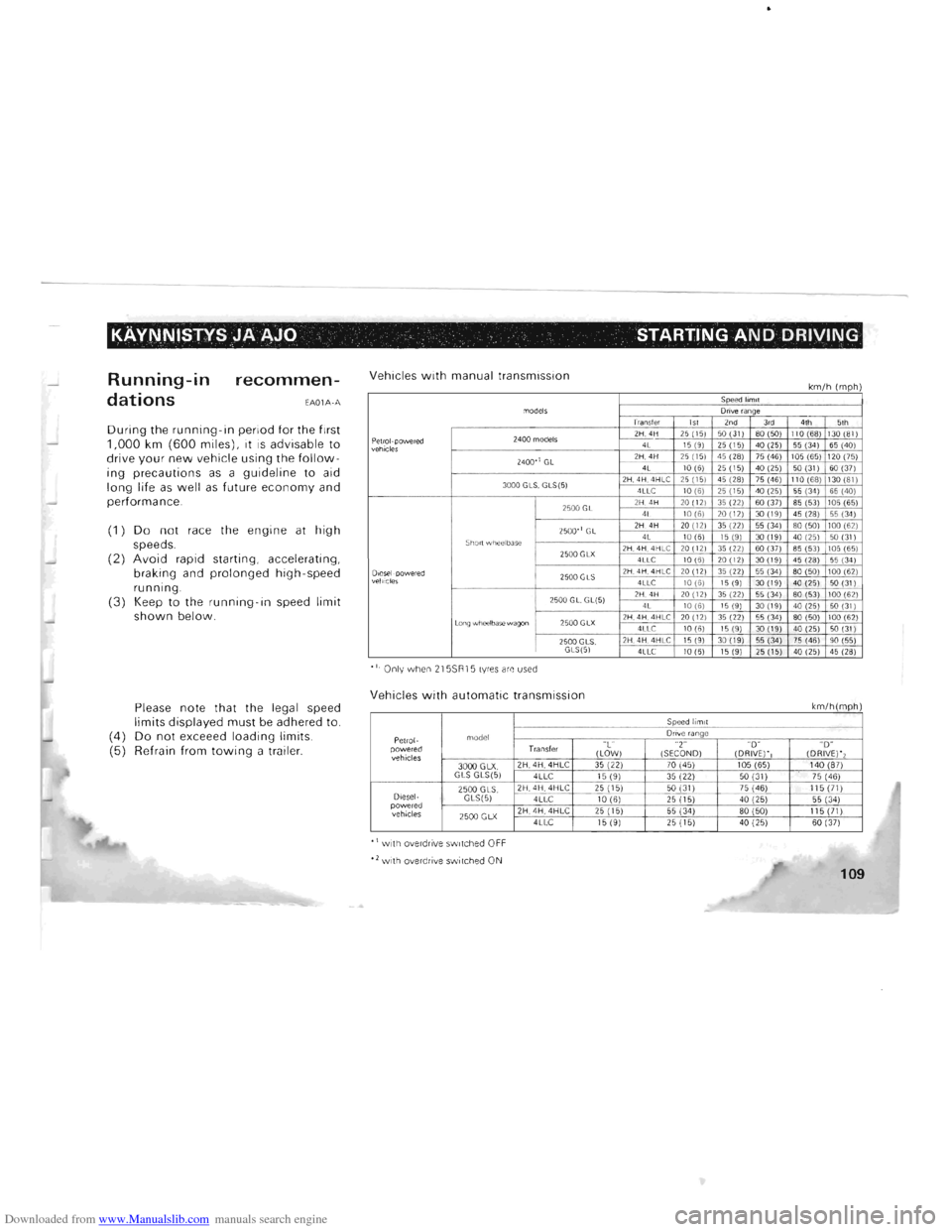
During the running-in period for the first
1 ,000 km (600 miles) , it is advisable to drive your new vehicle using the follow
ing precautions as a guideline to aid long life as well as future economy and
performance.
(1) Do not race the engine at high speeds . (2) Avoid rapid starting, accelerating ,
braking and prolonged high-speed running. (3) Keep to the running-in speed limit shown below.
Please note that the legal speed limits displayed must be adhered to. (4) Do not exceeed loading limits.
(5) Refrain from towing a trailer. Vehicles
with manual
transmission
models Transfer 1st
2400 models ~H 25 (15) Petrol-powered 15 (9) vehicles 4L
2400 .1
GL 2H.4H 25 (15)
4L 10 (6)
3000 GLS. GLS(5) 2H.
4H. 4HLC 25 (15)
2500 GL
2500 .1
GL
Shon wheelbase 2500 GLX
Diesel-powered 2500 GLS vehicles
2500 GL GL(5)
Long wheelbase wagon 2500 GLX
2500 GLS.
GLS(5)
.1. Only when 215SR15 tyres are used
Vehicles with automatic transmission
Petrol-model
p owered
vehicles 3000 GLX. GLS GLS(5)
2500 GLS.
Diesel-
powered GLS(5)
vehicles 2500 GLX
•
I with overd rive switched OFF
. , w ith overdrive switched
ON
Transfer
2H. 4H. 4HLC
4LLC
2H. 4H. 4HLC
4LLC 2H. 4H. 4HLC
4LLC
T ' (LOW) 35 (22)
1 5 (9)
25 (15)
1 0 (6)
25 (15) 15 (9)
4LLC 10 (6) 2H 4H 20 (12)
4L 10 (6) 2H 4H 20 (12)
4L 10 (6) 2H. 4H . 4HLC 20 (12)
4LLC 10 (6) 2 H . 4 H , 4HLC 20 (12)
4LLC 10 (6) 2H .4H 20 (12)
4L 10 (6) 2H. 4H. 4HLC 20 (12)
4LLC 10 (6)
2H. 4H. 4HLC )5 (9)
4LLC 10 (6)
Speed limit
Dnve range
''2'' (SECOND) 70 (45)
35 (22)
50 (31) 25 (15) 55 (34) 25 ( 15)
km/h (mph) Speed limit Dnve range 2nd 3,d 41h 51h 50
(31) 80 (50) 110 (68) 130 (81) 25 (15) 40 (25) 55 (34)
65 (40)
45 (28) 75 (46) 105 (65) 120 (75)
25 (15) 40 (25) 50 (31) 60 (37)
45 (28) 75 (46)
110 (68) 130 (81)
25 (15) 40 (25) 55 (34)
65 (40) 35 (22) 60 (37) 85 (53) 105 (65)
20 (12) 30 (19) 45 (28) 55 (34) 35 (22) 55 (34) 80 (50) 100 (62) 15 (9) 30 (19) 40 (25) 50 (31) 35 (22) 60 (37) 85 (53) 105 (65) 20 (12) 30 (19) 45 (28) 55 (34) 35 (22) 55 (34) 80 (50) 100 (62) 15 (9) 30 (19)
40 (25) 50 (31) 35 (22) 55 (34) 80 (53) 100 (62) 15 (9)
30 (19) 40 (25) 50 (31) 35 (22) 55 (34) 80 (50) 100 (62) 15 (9) 30 (19) 40 (25) 50 (31)
30 (1 9) 55 (34) 75 (46) 90 (55) 15 (9) 25 (15) 40 (25) 45 (28)
km/h(mph)
'0--0-(ORIVE)', (DRIVE)" 105 (65) 140 (87)
50 (31) 75 (46)
75 (46) 115 (71)
40 (25) 55 (34)
80 (50)
115 (71)
40 (25) 60 (37)
109
Page 109 of 302
Downloaded from www.Manualslib.com manuals search engine KAYNNI,STYS JA AJO STARTING AND DRIVING
(5) Nopeur
M itii suurempi on nopeus, sitii enemmii n polttoainetta
moottori kiiyttiiii. Viilttiikiiii huippunopeuksilla ajamista,
sil lii
pienikin kaasun viihennys siiiistiiii huomattavan
miiiiriin polttoainetta.
(6) Pyorien ilmanpaine Tarkastakaa pyorien ilmanpaine siiiinnoilisin viiliajoin. Ma
tala paine lisiiii kitkaa ja polttoaineenkulutusta aiheuttaen niiin myos renkaiden ennenaikaista kulumista. (7) Kuormitus Alkiiii pitiiko tarpeettomia esineitii matkatavaratilassa. Li
siipaino lisiiii polttoaineenkulutusta huomattavasti, erityi
sesti kaupunkiajossa useine pysiiyksineen ja liikkelle liih
toineen.
Viilttiikiia myos tarpeetonta tavaroiden kuljetusta
kattotelineessii koska siitii aiheutuva ilmanvastus lisiiii
polttoaineenku lutusta. (8) Kylman moottorin kaynnistys Kylmiin moottorin kiiynnistys vaatii enemmiin polttoainetta, mutta myos lampimiin moottorin joutokiiynti kuluttaa turhaan polttoainetta. Liihtekiiii ajamaan melko pian moottorin kiiynnistyksen jiilkeen.
Paravaunun hinaaminen HC2 1AOFJ
Jos hinaatte periivaunua, tulee teidiin asennuttaa maanne la
kien vaatimukset tayttiiva hinauskoukku valtuutetussa MITSU
B I SH I huoltokorjaamossa . Hinausta koskevat siiiinnokset saat
tavat vaihdella maasta maahan, joten nou-dattakaa oman maanne siiiidoksiii. Hinatessanne perii-vaunua kiinnittiikiiii h~miota seuraaviin asioihin:
114
(5) Speed The higher the vehicle speed, the more fuel consumed. Avoid driving at full speed. Even a slight release of the
accelerator pedal will save a significant amount of fuel. (6) Tyre inflation pressure Check the tyre inflation pressure at regular intervals . Low tyre inflation pressures increase road resistance and fuel consumption. I n addition, low tyre pressures adversely
affect tyre wear and driving control. (7) Load Do not drive with unnecessary articles in the luggage compartment. Especially during city driving where frequent starting and stopping is necessary , the increased weight of the vehicle will greatly affect fuel consumption. Also avoid driving with unnecessary luggage, etc., on the roof; the
increased air resistance will cause more fuel consumption. (8) Cold engine starting Starting of a cold engine consumes more fuel. Unnecessary
fuel consumption is also caused by keeping a hot engine running. After the engine is started , begin driving soon.
Trailer towing FC21AOOa
In order to tow a trailer with your vehicle , have a trailer towing device that meets all pertinent regulations in your area mounted at an authorized MITSUBISHI dealer .
The regulations concerning the towing of a trailer may differ from country to country. It is recommended that you obey the
regulations in your area.
If you are going to tow a trailer , pay careful attention to the following points.
Page 110 of 302
Downloaded from www.Manualslib.com manuals search engine '"-----------~~
KAYNNISTVS JA,AJO " ' :" ,,' , ':,',' .,,', I, , ' • ,STARTING ANO DRIVING' , -",'_"..:"'-~'., ~'. ¥ •• , '," ~ :.1,",-~, "',; ";~" .'" ,..... q ~'l, • ,
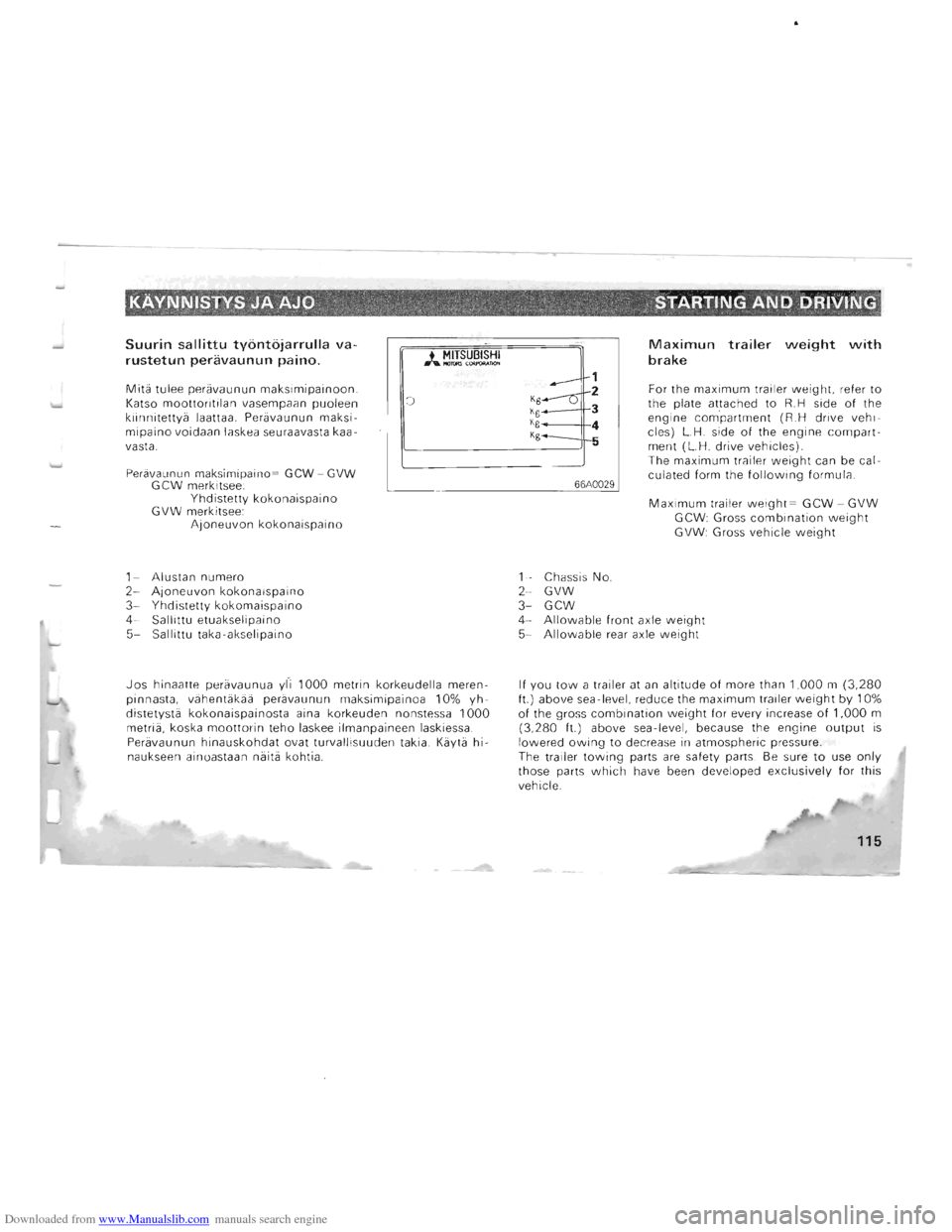
Suurin sallittu tyontojarrulla va
rustetun peravaunun paino,
Mita tulee peravaunun maksimipainoon,
Katso moottoritilan vasempaan puoleen kiinnitettya laattaa , Peravaunun maksimipaino voidaan laskea seuraavasta kaa
vasta,
Periivaunun maksimipaino = GCW -GVW
GCW merkitsee: Yhdistetty kokonaispaino GVW merkitsee: Ajoneuvon kokonaispaino
1-Alustan numero 2-Ajoneuvon kokonaispaino 3 -Yhdistetty kokomaispaino 4 -Sallittu etuakselipaino 5-Sallittu taka-akselipaino
_ ..
~!!!lS~)j!
0
Jos hinaatte peravaunua yli 1000 metrin korkeudella meren
pinnasta , vahentakaa peravaunun maksimipainoa 10% yhdistetysta kokonaispainosta aina korkeuden nonstessa 1000 metria, koska moottorin teho laskee ilmanpaineen laskiessa.
Peravaunun hinauskohdat ovat turvallisuuden takia. Kayta hi
naukseen ainoastaan naita kohtia.
..
--
1
Ks----z5 1--2
3 Kg Kg 4 Kg_ f--5
66AOO29
1- Chassis No. 2-GVW 3 -GCW
Maximun trailer weight with
brake
For the maximum trailer weight refer to the plate attached to R.H side of the
e ngine com'partment (R.H drive vehicles) L.H. side of the engine compartment (L,H. drive vehicles) .
The maximum trailer weight can be cal
culated form the following formula .
Maximum trailer weight= GCW -GVW GCW: Gross combination weight
GVW: Gross vehicle weight
4-Allowable front axle weight 5-Allowable rear axle weight
If you tow a trailer at an altitude of more than 1,000 m (3,280 ft,) above sea-level, reduce the maximum trailer weight by 10% of the gross combination weight for every increase of 1,000 m (3,280 ft.) above sea-level, because the engine output is lowered owing to decrease in atmospheric pressure.
The trailer towing parts are safety parts. Be sure to use only
those parts which have been developed exclusively for this
vehicle .
Page 111 of 302
Downloaded from www.Manualslib.com manuals search engine KAYNNISTYS JA AJO . STARTING AND DRIVING
Suurin sallittu vetokoukun palloniveleen kohdistuva
kuormitus
Alkaa koskaan ylittakb Teknillisissa tiedoissa ilmoitettua sail it
tua kuormitusta. (Katsokaa sivua 115.)
Kayttovihjeita
(1) Alkaa antako kytkimen luistaa (ajoneuvoissa joissa on
kasivaihteisto ainoastaan). alk aaka lisatkb kayn-nistaessanne tarpeettomasti moottorin nopeutta. (2) Alkaa ylittakb nopeutta, joka on suosite ltu peravaunua
hinattaessa .
(3) Valttaaksenne tybntbjarrusta johtuvia tbytaisyja painakaa jarrupoljinta ensin kevyesti ja sitten voimakkaammin. (4) Saadaksenne tayden hybdyn moottorijarrusta vaihtakaa
pienemmalle ennen alamakea . (5) Peravaunun hinaaminen tuottaa lisarasitusta rungolle, jarruille, kytkimelle ja alustalle. (6) Peravaunun paino ja suurempi kitka ja ilmanvastus lisaavat polttoaineenku lutusta.
lisavarotoimenpiteita ajoneuvoille joissa on auto
maattinen vaihteisto
Asentoa "2" suositellaan kaytettavaksi rinteissa tai alhal-sella nopeudella ajettaessa. Kayttakaa asentoa "L" vuoristoteilla,
koska silloin moottorijarru toimii parhaiten edesauttaen nain
jarrujarjestelmaa. Varmistakaa kuitenkin etta nopeus ei ylita valitulle vaihteelle asetettua nopeusrajoiutsta.
Mita tulee maksiminopeuteen, katso kohtaa "Mahdollinen ajonopeU(>" sivulta 131.
116
Maximum trailer-nose weight
Never exceed the maximun trailer-nose weight as listed in the specifications. (Refer to page 115.)
Operating hints
(1) Do not let the clutch slip (vehicles with a manual transmission only) and do not increase the engine speed more than necessary when starting. (2) Be sure that the driving speed does not exceed the maximum speed for trailer operation. (3) To prevent shocks from the overrun brake, depress the brake pedal lightly at first and then more strongly. (4) To make full use of engine braking, change to a lower gear
before descending a slope . (5) The body, brakes, clutch, and chassis will be under addi tional strain when towing a trailer . (6) The heavier weight and the higher rolling and air resistance
w ill increase fuel consumption.
Additional precautions for vehicles equipped with
an automatic transmission
It is recommended the "2" position on slopes or at low speed.
Us e the "L " position in mountainous areas in order to make
better use of engine braking and to assist the brake system. However, be sure that the speed does not exceed the maximum speed limit for the selected gear.
For
maximum speed, refer to the description of the "Possible driving speed" on page 131.
Page 173 of 302

Downloaded from www.Manualslib.com manuals search engine MUKAVUUTTA MATKANTEKOON' FOR PLEASANT DRIVING
,,J-(Ala-asento) Ilmaa virtaa ainoastaan etu ja ta
kaosan jalkatilaan .
(Ala -asento/h uu rteen poisto)
Ilmaa virtaa ainoastaan takaosan
jalkatilaan,
tuulilasille ja ovilaseille.
~-(Huurteenpoisto)
HUOM
IImaa virtaa ainoastaan tuulilasille ja ovilaseille .
(1) Huurre poistetaan tehokkaasti suuntaamalla
keista tuleva ilmavirta ovilaseille ja
keskisuulakkeet. Aseta
ilmanvalintavipu asentoon (~ ). sivusuulak
sulkemalla (2) Ala asennossa ja kahden tason asennossa jonkin verran
ilmaa virtaa tuutilasille ja etuosan ovilaseille.
fJIl
· .". .. . It .
'/
.-,,*
NOTE
,,; -(Foot position) Air flows exclusively to the front and rear leg areas.
(Foot/demister position) Air flows exclusively to the rear
leg area, windshield and door windows.
"iW -(Demistor position) Air flows exclusively to the windshield and door windows.
(1) To effectively demist, direct the air flow from the side
ventilators toward the door windows and close the centre
ventilators .. Be sure to place the air selection lever at the (~) position. (2) At the foot and foot/face positions. a small amount of air will be directed to the windshield and the front door windows.
197