warning MITSUBISHI PAJERO IV 2011 Owners Manual
[x] Cancel search | Manufacturer: MITSUBISHI, Model Year: 2011, Model line: PAJERO IV, Model: MITSUBISHI PAJERO IV 2011Pages: 377, PDF Size: 29.43 MB
Page 314 of 377
WARNING
l Do not open the radiator cap while the en-
gine is hot.
The coolant system is under pressure and
any hot coolant escaping could cause se-
vere burns.
Anti-freeze
The engine coolant
contains an ethylene glycol anti-
corrosion agent. The cylinder head and water pump
housing are cast aluminium alloy, and periodic
changing of the engine coolant is necessary to pre-
vent corrosion of these parts.
Use “DIA QUEEN SUPER LONG LIFE COOL-
ANT” or equivalent.
MITSUBISHI Genuine Coolant has excellent pro-
tection against corrosion and rust formation of all
metals including aluminium and can avoid block-
ages in the radiator, heater, cylinder head, engine
block, etc.
Because of the necessity of this anti-corrosion
agent, the coolant must not be replaced with plain
water even in summer. The required concentration
of anti-freeze differs depending on the expected am-
bient temperature. Ambient
temperature (mini-
mum) °C -15 -20 -25 -30 -35 -50 Anti-freeze
concentra- tion % 30 35 40 45 50 60 CAUTION
l
Do not use
alcohol or methanol anti-
freeze or any engine coolants mixed with
alcohol or methanol anti-freeze. The use
of an improper anti-freeze can cause cor-
rosion of the aluminium components.
l For effective anti-corrosion and anti-
freeze performance, keep the anti-freeze
concentration within the range of 30 to
60 %.
Concentrations exceeding 60 % will re-
sult in a reduction of both the anti-freeze
and cooling performance thus adversely
affecting the engine.
l Do not top up with water only.
During cold weather
The concentration should
be checked before the
start of cold weather and anti-freeze added to the
system if necessary to prevent damage to engine
and radiator due to freezing. Washer fluid
E01000700656
Windscreen washer fluid
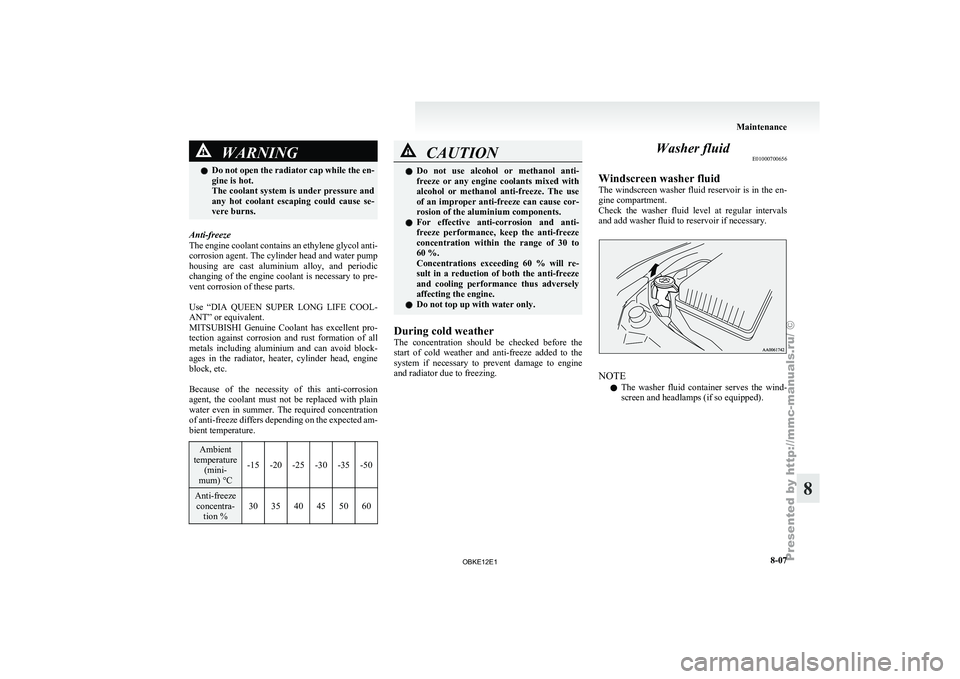
The windscreen washer
fluid reservoir is in the en-
gine compartment.
Check the washer fluid level at regular intervals
and add washer fluid to reservoir if necessary. NOTE
l The
washer fluid
container serves the wind-
screen and headlamps (if so equipped). Maintenance
8-07 8
OBKE12E1
Page 315 of 377
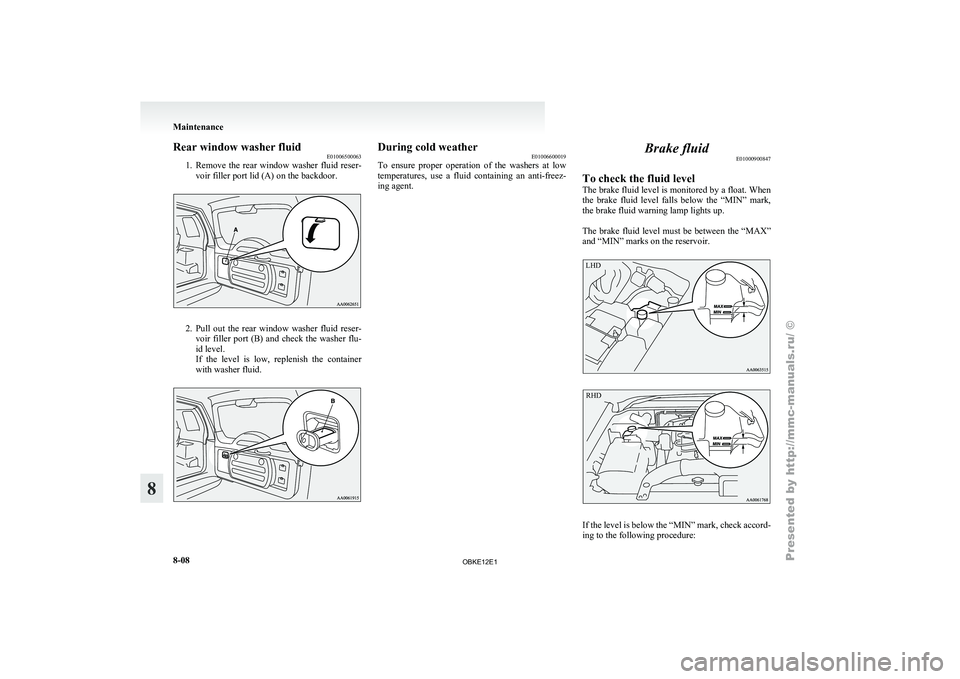
Rear window washer fluid
E01006500063
1. Remove the rear
window washer fluid reser-
voir filler port lid (A) on the backdoor. 2. Pull out the rear window washer fluid reser-
voir filler
port (B) and check the washer flu-
id level.
If the level is low, replenish the container
with washer fluid. During cold weather
E01006600019
To ensure proper
operation of the washers at low
temperatures, use a fluid containing an anti-freez-
ing agent. Brake fluid
E01000900847
To check the fluid level
The brake fluid
level is monitored by a float. When
the brake fluid level falls below the “MIN” mark,
the brake fluid warning lamp lights up.
The brake fluid level must be between the “MAX”
and “MIN” marks on the reservoir.
LHD
RHD If the level is below the “MIN” mark, check accord-
ing to the following procedure:Maintenance
8-08
8
OBKE12E1
Page 317 of 377
If the fluid level falls markedly in a short length of
time, it indicates leaks from the clutch system.
If this occurs,
we recommend you to have the vehi-
cle checked.
Fluid type
Brake fluid conforming to DOT 3 or DOT 4 should
be used.
The reservoir cap must be fully tightened to avoid
contamination from foreign matter or moisture.
DO NOT ALLOW PETROLEUM-BASED FLUID
TO CONTACT, MIX WITH, OR OTHERWISE
CONTAMINATE THE BRAKE FLUID. SEAL
DAMAGE WILL RESULT. WARNING
l Take
care
in
handling brake fluid as it is
harmful to the eyes, may irritate your
skin and also damage painted surfaces.
Wipe up any spills immediately. Power steering fluid
E01001100484
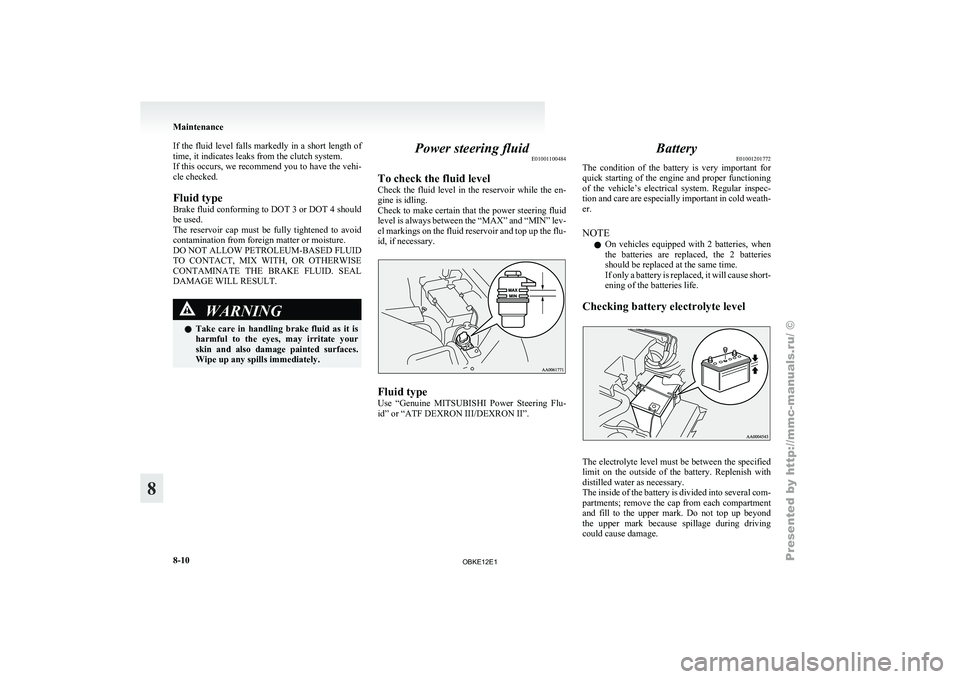
To check the fluid level
Check the fluid
level in the reservoir while the en-
gine is idling.
Check to make certain that the power steering fluid
level is always between the “MAX” and “MIN” lev-
el markings on the fluid reservoir and top up the flu-
id, if necessary. Fluid type
Use “Genuine
MITSUBISHI
Power Steering Flu-
id” or “ATF DEXRON III/DEXRON II”. Battery
E01001201772
The condition of
the battery is very important for
quick starting of the engine and proper functioning
of the vehicle’s electrical system. Regular inspec-
tion and care are especially important in cold weath-
er.
NOTE
l On vehicles equipped with 2 batteries, when
the batteries are replaced, the 2 batteries
should be replaced at the same time.
If only a battery is replaced, it will cause short-
ening of the batteries life.
Checking battery electrolyte level The electrolyte level must be between the specified
limit on the
outside of the battery. Replenish with
distilled water as necessary.
The inside of the battery is divided into several com-
partments; remove the cap from each compartment
and fill to the upper mark. Do not top up beyond
the upper mark because spillage during driving
could cause damage. Maintenance
8-10
8
OBKE12E1
Page 318 of 377
Check the electrolyte level at least once every
4 weeks, depending on the operating conditions.
If the battery
is not used, it will discharge by itself
with time.
Check it once every 4 weeks and charge with low
current as necessary.
During cold weather
The capacity of the battery is reduced at low tem-
peratures. This is an inevitable result of its chemi-
cal and physical properties.
This is why a very cold battery, particularly one
that is not fully charged, will only deliver a fraction
of the starter current which is normally available.
We recommend you to have the battery checked be-
fore the start of cold weather and, if necessary,
have it charged or replaced.
This does not only ensure reliable starting, but a bat-
tery which is kept fully charged also has a longer life.
Disconnection and connection
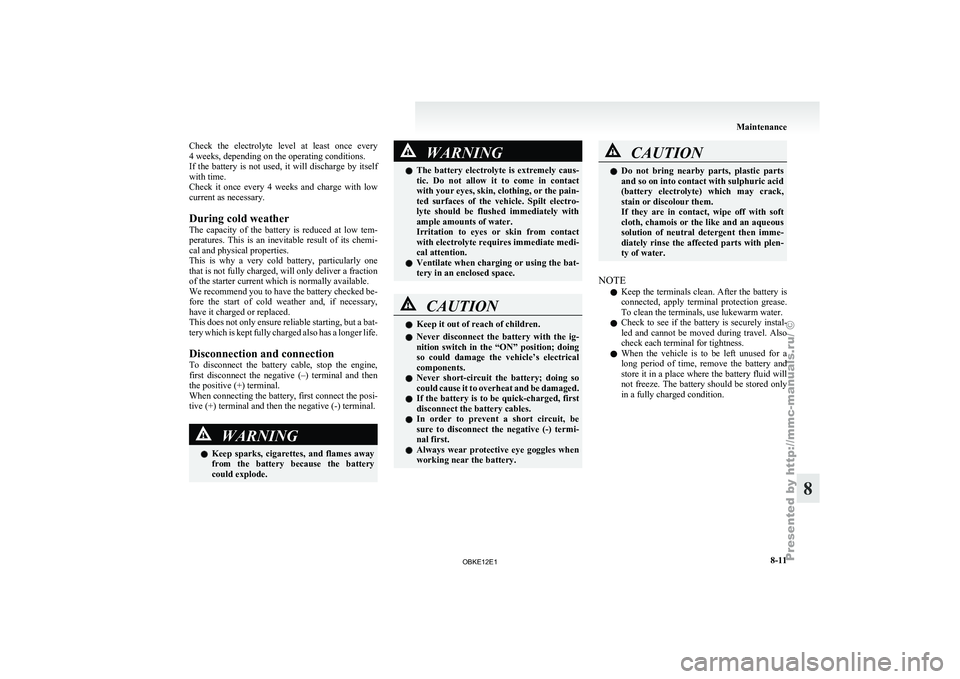
To disconnect the battery cable, stop the engine,
first disconnect the negative (–) terminal and then
the positive (+) terminal.
When connecting the battery, first connect the posi-
tive (+) terminal and then the negative (-) terminal. WARNING
l Keep sparks,
cigarettes,
and flames away
from the battery because the battery
could explode. WARNING
l The battery electrolyte
is extremely caus-
tic. Do not allow it to come in contact
with your eyes, skin, clothing, or the pain-
ted surfaces of the vehicle. Spilt electro-
lyte should be flushed immediately with
ample amounts of water.
Irritation to eyes or skin from contact
with electrolyte requires immediate medi-
cal attention.
l Ventilate when charging or using the bat-
tery in an enclosed space. CAUTION
l
Keep it out of reach of children.
l Never
disconnect the
battery with the ig-
nition switch in the “ON” position; doing
so could damage the vehicle’s electrical
components.
l Never short-circuit the battery; doing so
could cause it to overheat and be damaged.
l If the battery is to be quick-charged, first
disconnect the battery cables.
l In order to prevent a short circuit, be
sure to disconnect the negative (-) termi-
nal first.
l Always wear protective eye goggles when
working near the battery. CAUTION
l
Do not bring
nearby parts, plastic parts
and so on into contact with sulphuric acid
(battery electrolyte) which may crack,
stain or discolour them.
If they are in contact, wipe off with soft
cloth, chamois or the like and an aqueous
solution of neutral detergent then imme-
diately rinse the affected parts with plen-
ty of water.
NOTE l Keep
the terminals
clean. After the battery is
connected, apply terminal protection grease.
To clean the terminals, use lukewarm water.
l Check to see if the battery is securely instal-
led and cannot be moved during travel. Also
check each terminal for tightness.
l When the vehicle is to be left unused for a
long period of time, remove the battery and
store it in a place where the battery fluid will
not freeze. The battery should be stored only
in a fully charged condition. Maintenance
8-11 8
OBKE12E1
Page 319 of 377
Tyres
E01001300239WARNING
l Driving with
tyres that are worn, dam-
aged or improperly inflated can lead to a
loss of control or blow out of the tyres
which can result in a collision with seri-
ous or fatal injury. Maintenance
8-12
8
OBKE12E1
Page 325 of 377
NOTE
l Do
not allow
the wiper arm to fall onto the
window glass; it could damage the glass.
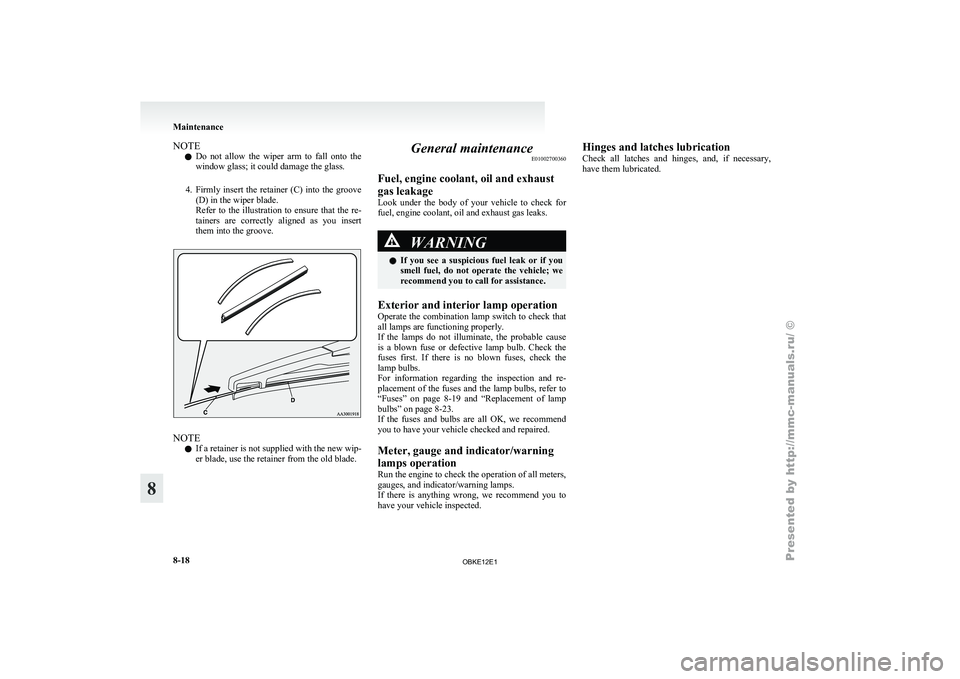
4. Firmly insert the retainer (C) into the groove (D) in the wiper blade.
Refer to the illustration to ensure that the re-
tainers are correctly aligned as you insert
them into the groove. NOTE
l If
a retainer
is not supplied with the new wip-
er blade, use the retainer from the old blade. General maintenance
E01002700360
Fuel, engine coolant, oil and exhaust
gas leakage
Look under
the
body of your vehicle to check for
fuel, engine coolant, oil and exhaust gas leaks. WARNING
l If
you
see
a suspicious fuel leak or if you
smell fuel, do not operate the vehicle; we
recommend you to call for assistance.
Exterior and interior lamp operation
Operate the combination
lamp switch to check that
all lamps are functioning properly.
If the lamps do not illuminate, the probable cause
is a blown fuse or defective lamp bulb. Check the
fuses first. If there is no blown fuses, check the
lamp bulbs.
For information regarding the inspection and re-
placement of the fuses and the lamp bulbs, refer to
“Fuses” on page 8-19 and “Replacement of lamp
bulbs” on page 8-23.
If the fuses and bulbs are all OK, we recommend
you to have your vehicle checked and repaired.
Meter, gauge and indicator/warning
lamps operation
Run the engine to check the operation of all meters,
gauges, and indicator/warning lamps.
If there is anything wrong, we recommend you to
have your vehicle inspected. Hinges and latches lubrication
Check all
latches
and hinges, and, if necessary,
have them lubricated. Maintenance
8-18
8
OBKE12E1
Page 326 of 377
For cold and snowy weather
E01002800299
Ventilation slots
The ventilation slots
in front of the windscreen
should be kept clear of leaves or brushed clear after
heavy snowfall, so that the operation of the heating
and ventilation systems will not be impaired.
Weatherstripping
To prevent freezing of the weatherstripping on the
doors, bonnet, etc., they should be treated with sili-
cone grease.
Additional equipment
It is a good idea to carry a shovel or a short-han-
dled spade in the vehicle during the winter so that
you can clear away snow if you get stranded. A
small hand-brush for sweeping snow off the vehi-
cle and a plastic scraper for the windscreen and
rear window are also useful. Fusible links
E01002900434
The fusible links
will melt to prevent a fire if a
large current attempts to flow through certain elec-
trical systems.
In case of a melted fusible link, we recommend
you to have your vehicle inspected.
For the fusible links, please refer to “Fuse load ca-
pacity” on page 8-20. WARNING
l Fusible links
must
not be replaced by any
other device. Failing to fit the correct fusi-
ble link may result in fire in the vehicle,
property destruction and serious or fatal
injuries at any time. Fuses
E01003000849
Fuse block location E01007600250
To prevent damage to the electrical system due to
shortcircuiting or overloading,
each individual cir-
cuit is provided with a fuse.
There are fuse blocks in the passenger compart-
ment and in the engine compartment.
Passenger compartment
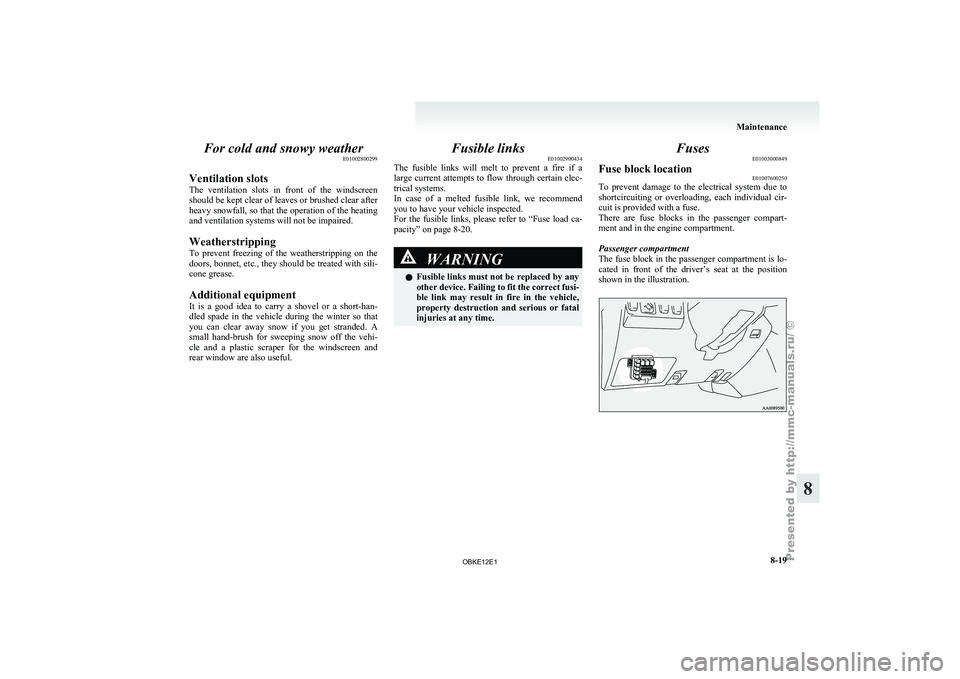
The fuse block in the passenger compartment is lo-
cated in front of the driver’s seat at the position
shown in the illustration. Maintenance
8-19 8
OBKE12E1
Page 328 of 377
No. Symbol Electrical sys-
tem Capacity
27 Starter motor
10 A
28 — — —
29 — Spare fuse 20 A
30 — Spare fuse 10 A
31 — Spare fuse 30 A
32 — Spare fuse 25 A l
Some fuses
may not be installed on your ve-
hicle, depending on the vehicle model or spec-
ifications.
l The table above shows the main equipment
corresponding to each fuse.
The fuse block does not contain spare 7.5 A
and 15 A fuses. If a fuse of one of these ca-
pacities blows, replace it temporarily by bor-
rowing the one that matches from:
7.5 A: Outside rear-view mirrors
15 A: Cigarette lighter
Replace the borrowed fuse as soon as possible. Engine compartment fuse location table
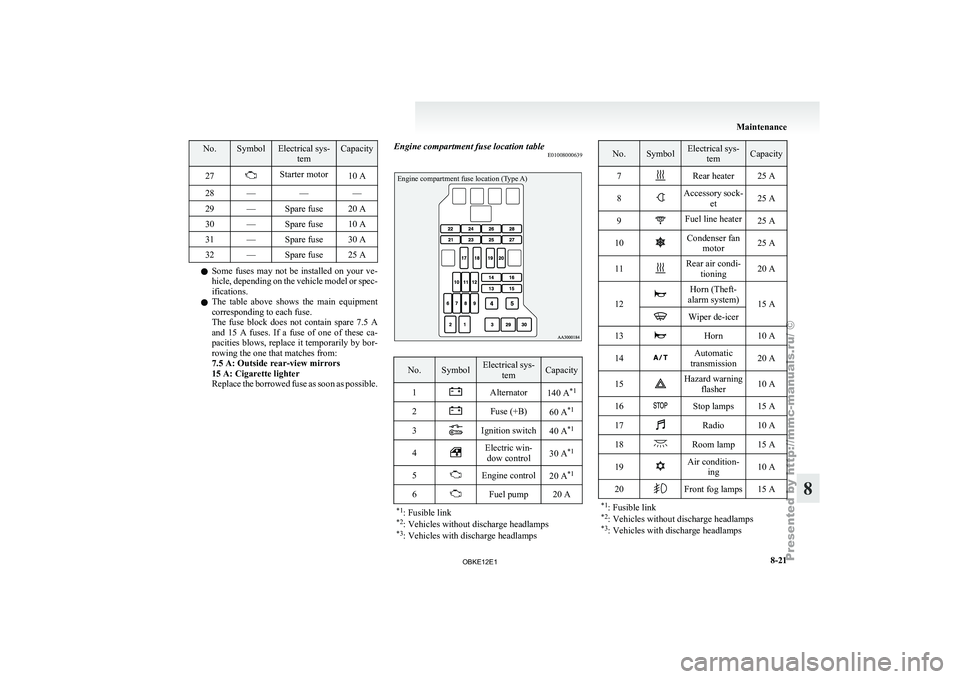
E01008000639
Engine compartment fuse location (Type A) No. Symbol Electrical sys-
tem Capacity
1 Alternator
140 A*1
2 Fuse (+B)
60 A*1
3 Ignition switch
40 A*1
4 Electric win-
dow control 30 A
*1
5 Engine control
20 A*1
6 Fuel pump 20 A
*1 : Fusible link
*2 : Vehicles without discharge headlamps
*3 : Vehicles with discharge headlamps No. Symbol Electrical sys-
tem Capacity
7 Rear heater 25 A
8 Accessory sock-
et 25 A
9 Fuel line heater
25 A
10 Condenser fan
motor 25 A
11 Rear air condi-
tioning 20 A
12 Horn (Theft-
alarm system) 15 A Wiper de-icer
13 Horn 10 A
14 Automatic
transmission 20 A
15 Hazard warning
flasher 10 A
16 Stop lamps 15 A
17 Radio 10 A
18 Room lamp 15 A
19 Air condition-
ing 10 A
20 Front fog lamps 15 A
*1 : Fusible link
*2 : Vehicles without discharge headlamps
*3 : Vehicles with discharge headlamps Maintenance
8-21 8
OBKE12E1
Page 358 of 377
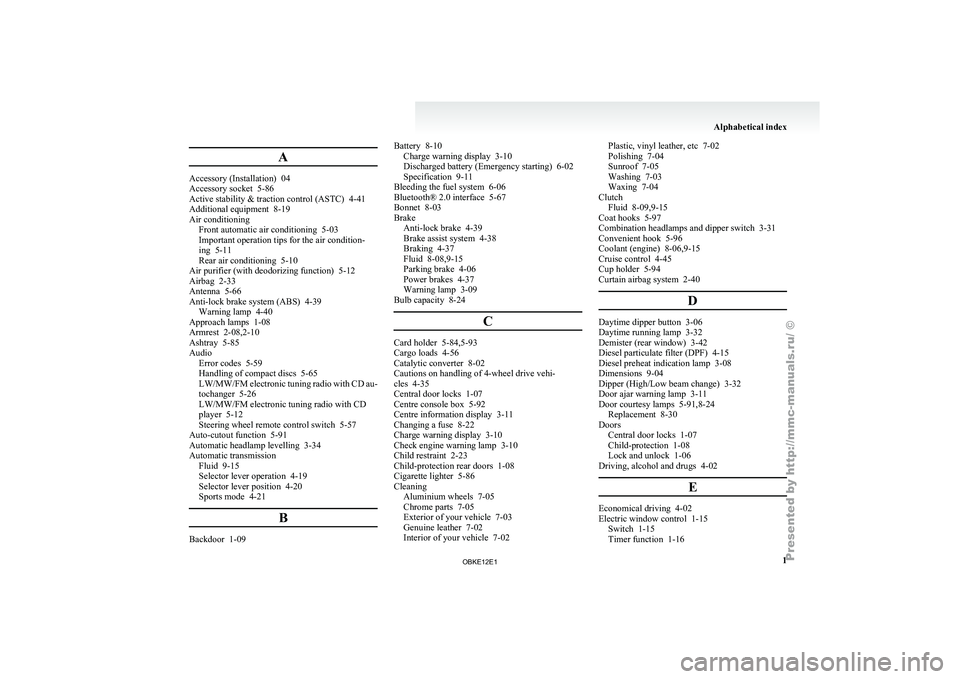
A
Accessory (Installation) 04
Accessory socket 5-86
Active stability & traction control (ASTC) 4-41
Additional equipment
8-19
Air conditioning Front automatic air conditioning
5-03
Important operation tips for the air condition-
ing 5-11
Rear air conditioning 5-10
Air purifier (with deodorizing function) 5-12
Airbag 2-33
Antenna 5-66
Anti-lock brake system (ABS) 4-39 Warning lamp 4-40
Approach lamps 1-08
Armrest 2-08,2-10
Ashtray 5-85
Audio Error codes 5-59
Handling of compact discs 5-65
LW/MW/FM electronic tuning radio with CD au-
tochanger 5-26
LW/MW/FM electronic tuning radio with CD
player 5-12
Steering wheel remote control switch 5-57
Auto-cutout function 5-91
Automatic headlamp levelling 3-34
Automatic transmission Fluid 9-15
Selector lever operation 4-19
Selector lever position 4-20
Sports mode 4-21
BBackdoor 1-09 Battery 8-10
Charge warning display 3-10
Discharged battery (Emergency starting) 6-02
Specification 9-11
Bleeding the fuel system
6-06
Bluetooth® 2.0 interface 5-67
Bonnet 8-03
Brake Anti-lock brake 4-39
Brake assist system 4-38
Braking 4-37
Fluid 8-08,9-15
Parking brake 4-06
Power brakes 4-37
Warning lamp 3-09
Bulb capacity 8-24
C Card holder 5-84,5-93
Cargo loads 4-56
Catalytic converter 8-02
Cautions on handling of 4-wheel drive vehi-
cles 4-35
Central door locks 1-07
Centre console box 5-92
Centre information display
3-11
Changing a fuse 8-22
Charge warning display 3-10
Check engine warning lamp
3-10
Child restraint 2-23
Child-protection rear doors 1-08
Cigarette lighter 5-86
Cleaning Aluminium wheels 7-05
Chrome parts 7-05
Exterior of your vehicle 7-03
Genuine leather 7-02
Interior of your vehicle 7-02 Plastic, vinyl leather, etc 7-02
Polishing 7-04
Sunroof 7-05
Washing 7-03
Waxing 7-04
Clutch Fluid 8-09,9-15
Coat hooks 5-97
Combination headlamps and dipper switch 3-31
Convenient hook 5-96
Coolant (engine) 8-06,9-15
Cruise control 4-45
Cup holder 5-94
Curtain airbag system 2-40
D Daytime dipper button 3-06
Daytime running lamp 3-32
Demister (rear window) 3-42
Diesel particulate filter (DPF)
4-15
Diesel preheat indication lamp
3-08
Dimensions 9-04
Dipper (High/Low beam change) 3-32
Door ajar warning lamp 3-11
Door courtesy lamps 5-91,8-24 Replacement 8-30
Doors Central door locks 1-07
Child-protection 1-08
Lock and unlock 1-06
Driving, alcohol and drugs 4-02
E Economical driving 4-02
Electric window control 1-15
Switch 1-15
Timer function 1-16 Alphabetical index
1
OBKE12E1
Page 359 of 377
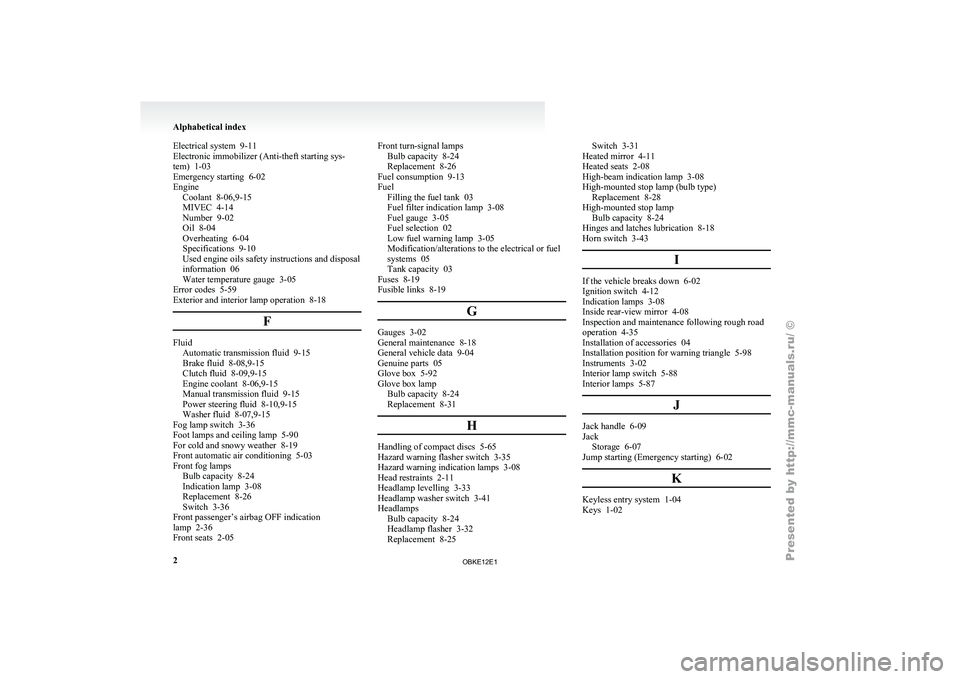
Electrical system 9-11
Electronic immobilizer (Anti-theft starting sys-
tem) 1-03
Emergency starting 6-02
Engine Coolant 8-06,9-15
MIVEC 4-14
Number 9-02
Oil 8-04
Overheating 6-04
Specifications 9-10
Used engine oils safety instructions and disposal
information 06
Water temperature gauge 3-05
Error codes 5-59
Exterior and interior lamp operation
8-18
F Fluid
Automatic transmission fluid 9-15Brake fluid 8-08,9-15
Clutch fluid 8-09,9-15
Engine coolant 8-06,9-15
Manual transmission fluid 9-15
Power steering fluid 8-10,9-15
Washer fluid 8-07,9-15
Fog lamp switch 3-36
Foot lamps and ceiling lamp
5-90
For cold and snowy weather 8-19
Front automatic air conditioning 5-03
Front fog lamps Bulb capacity 8-24
Indication lamp 3-08
Replacement 8-26
Switch 3-36
Front passenger’s airbag OFF indication
lamp 2-36
Front seats 2-05 Front turn-signal lamps
Bulb capacity 8-24
Replacement 8-26
Fuel consumption 9-13
Fuel Filling the fuel tank
03
Fuel filter indication lamp 3-08
Fuel gauge 3-05
Fuel selection 02
Low fuel warning lamp 3-05
Modification/alterations to the electrical or fuel
systems 05
Tank capacity 03
Fuses 8-19
Fusible links 8-19
G Gauges 3-02
General maintenance 8-18
General vehicle data
9-04
Genuine parts 05
Glove box 5-92
Glove box lamp Bulb capacity
8-24
Replacement 8-31
H Handling of compact discs 5-65
Hazard warning flasher switch 3-35
Hazard warning indication lamps 3-08
Head restraints 2-11
Headlamp levelling
3-33
Headlamp washer switch 3-41
Headlamps Bulb capacity
8-24
Headlamp flasher 3-32
Replacement 8-25 Switch 3-31
Heated mirror 4-11
Heated seats 2-08
High-beam indication lamp 3-08
High-mounted stop lamp (bulb type) Replacement 8-28
High-mounted stop lamp Bulb capacity
8-24
Hinges and latches lubrication 8-18
Horn switch 3-43
I If the vehicle breaks down 6-02
Ignition switch 4-12
Indication lamps 3-08
Inside rear-view mirror 4-08
Inspection and maintenance following rough road
operation 4-35
Installation of accessories
04
Installation position for warning triangle
5-98
Instruments 3-02
Interior lamp switch 5-88
Interior lamps 5-87
J Jack handle 6-09
Jack
Storage 6-07
Jump starting (Emergency starting) 6-02
K Keyless entry system 1-04
Keys 1-02Alphabetical index
2
OBKE12E1