key MITSUBISHI PAJERO IV 2011 Service Manual
[x] Cancel search | Manufacturer: MITSUBISHI, Model Year: 2011, Model line: PAJERO IV, Model: MITSUBISHI PAJERO IV 2011Pages: 377, PDF Size: 29.43 MB
Page 290 of 377

To use the jack handle
E00802400023
1. While pushing the
snap pin (A), remove the
inside handle (B). 2. With the snap pin (C) pushed, insert the in-
side handle until it is locked. How to change a tyre
E00801201601
Before changing a
tyre, first stop your vehicle in a
safe, flat location. 1. Park the vehicle on level and stable ground.
2. Set the parking brake firmly.
3. On vehicles with M/T, turn the ignitionswitch to the “LOCK” position, move the
gearshift lever to the “R” (Reverse) position.
On vehicles with A/T, move the selector lev-
er to the “P” (PARK) position, turn the igni-
tion key to the “LOCK” position.
4. Turn on the hazard warning flashers and set up a warning triangle, flashing signal lamp,
etc., at an adequate distance from the vehi-
cle, and have all your passengers leave the ve-
hicle.
5. To prevent the vehicle from rolling when it is raised on the jack, place chocks or blocks
(A) at the tyre that is diagonally opposite
from the tyre (B) you are changing. WARNING
l Be sure to
apply chocks or blocks to the
correct tyre when jacking up the vehicle.
If the vehicle moves while jacked up, the
jack could slip out of position, leading to
an accident.
NOTE l The
chocks shown
in the illustration do not
come with your vehicle. It is recommended
that you keep one in the vehicle for use if nee-
ded.
l If chocks are not available, use stones or any
other objects that are large enough to hold
the wheel in position.
6. Get the spare wheel, jack, jack handle and wheel nut wrench ready. Refer to “Tool, jack
and jack handle” on page 6-07.
Spare wheel information E00803600266
Check the air pressure of the spare tyre frequently
and make sure
it is ready for emergency use at any
time.
Maintaining the spare wheel at the highest speci-
fied air pressure will ensure that it can always be
used under any conditions (city/high-speed driving,
varying load weight, etc.). For emergencies
6-09 6
OBKE12E1
Page 298 of 377
Towing with rear wheels off the ground (Type C)
Place the gearshift
lever in the “N” (Neutral) posi-
tion (M/T) or the selector lever in the “N” (NEU-
TRAL) position (A/T). Turn the ignition key to the
“ACC” position and secure the steering wheel in a
straight ahead position with a rope or tie-down
strap. Never place the ignition switch in the
“LOCK” position when towing.
Emergency towing
If towing service is not available in an emergency,
your vehicle may be temporarily towed by a rope
secured to the towing hook.
If your vehicle is to be towed by another vehicle or
if your vehicle tows another vehicle, pay careful at-
tention to the following points:
If your vehicle is to be towed by another vehicle
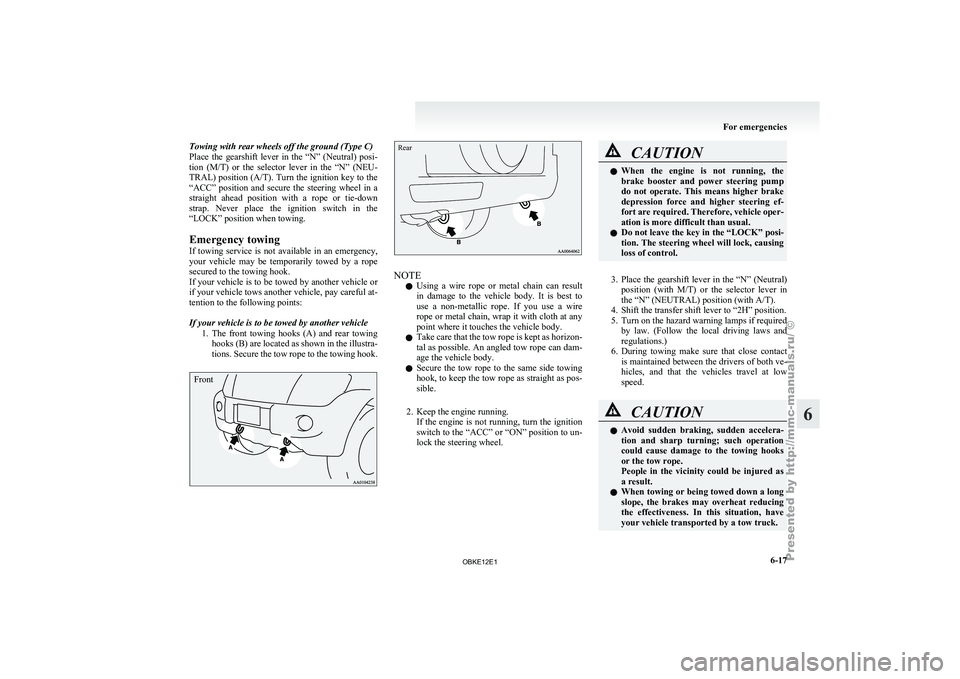
1. The front towing hooks (A) and rear towinghooks (B) are located as shown in the illustra-
tions. Secure the tow rope to the towing hook.
Front
Rear NOTE
l Using
a wire
rope or metal chain can result
in damage to the vehicle body. It is best to
use a non-metallic rope. If you use a wire
rope or metal chain, wrap it with cloth at any
point where it touches the vehicle body.
l Take care that the tow rope is kept as horizon-
tal as possible. An angled tow rope can dam-
age the vehicle body.
l Secure the tow rope to the same side towing
hook, to keep the tow rope as straight as pos-
sible.
2. Keep the engine running. If the engine is not running, turn the ignition
switch to the “ACC” or “ON” position to un-
lock the steering wheel. CAUTION
l
When the engine
is not running, the
brake booster and power steering pump
do not operate. This means higher brake
depression force and higher steering ef-
fort are required. Therefore, vehicle oper-
ation is more difficult than usual.
l Do not leave the key in the “LOCK” posi-
tion. The steering wheel will lock, causing
loss of control.
3. Place the gearshift lever in the “N” (Neutral)
position (with
M/T) or the selector lever in
the “N” (NEUTRAL) position (with A/T).
4. Shift the transfer shift lever to “2H” position.
5. Turn on the hazard warning lamps if required by law. (Follow the local driving laws and
regulations.)
6. During towing make sure that close contact is maintained between the drivers of both ve-
hicles, and that the vehicles travel at low
speed. CAUTION
l
Avoid sudden braking,
sudden accelera-
tion and sharp turning; such operation
could cause damage to the towing hooks
or the tow rope.
People in the vicinity could be injured as
a result.
l When towing or being towed down a long
slope, the brakes may overheat reducing
the effectiveness. In this situation, have
your vehicle transported by a tow truck. For emergencies
6-17 6
OBKE12E1
Page 359 of 377
Electrical system 9-11
Electronic immobilizer (Anti-theft starting sys-
tem) 1-03
Emergency starting 6-02
Engine Coolant 8-06,9-15
MIVEC 4-14
Number 9-02
Oil 8-04
Overheating 6-04
Specifications 9-10
Used engine oils safety instructions and disposal
information 06
Water temperature gauge 3-05
Error codes 5-59
Exterior and interior lamp operation
8-18
F Fluid
Automatic transmission fluid 9-15Brake fluid 8-08,9-15
Clutch fluid 8-09,9-15
Engine coolant 8-06,9-15
Manual transmission fluid 9-15
Power steering fluid 8-10,9-15
Washer fluid 8-07,9-15
Fog lamp switch 3-36
Foot lamps and ceiling lamp
5-90
For cold and snowy weather 8-19
Front automatic air conditioning 5-03
Front fog lamps Bulb capacity 8-24
Indication lamp 3-08
Replacement 8-26
Switch 3-36
Front passenger’s airbag OFF indication
lamp 2-36
Front seats 2-05 Front turn-signal lamps
Bulb capacity 8-24
Replacement 8-26
Fuel consumption 9-13
Fuel Filling the fuel tank
03
Fuel filter indication lamp 3-08
Fuel gauge 3-05
Fuel selection 02
Low fuel warning lamp 3-05
Modification/alterations to the electrical or fuel
systems 05
Tank capacity 03
Fuses 8-19
Fusible links 8-19
G Gauges 3-02
General maintenance 8-18
General vehicle data
9-04
Genuine parts 05
Glove box 5-92
Glove box lamp Bulb capacity
8-24
Replacement 8-31
H Handling of compact discs 5-65
Hazard warning flasher switch 3-35
Hazard warning indication lamps 3-08
Head restraints 2-11
Headlamp levelling
3-33
Headlamp washer switch 3-41
Headlamps Bulb capacity
8-24
Headlamp flasher 3-32
Replacement 8-25 Switch 3-31
Heated mirror 4-11
Heated seats 2-08
High-beam indication lamp 3-08
High-mounted stop lamp (bulb type) Replacement 8-28
High-mounted stop lamp Bulb capacity
8-24
Hinges and latches lubrication 8-18
Horn switch 3-43
I If the vehicle breaks down 6-02
Ignition switch 4-12
Indication lamps 3-08
Inside rear-view mirror 4-08
Inspection and maintenance following rough road
operation 4-35
Installation of accessories
04
Installation position for warning triangle
5-98
Instruments 3-02
Interior lamp switch 5-88
Interior lamps 5-87
J Jack handle 6-09
Jack
Storage 6-07
Jump starting (Emergency starting) 6-02
K Keyless entry system 1-04
Keys 1-02Alphabetical index
2
OBKE12E1