lock MITSUBISHI PAJERO IV 2011 Manual PDF
[x] Cancel search | Manufacturer: MITSUBISHI, Model Year: 2011, Model line: PAJERO IV, Model: MITSUBISHI PAJERO IV 2011Pages: 377, PDF Size: 29.43 MB
Page 149 of 377
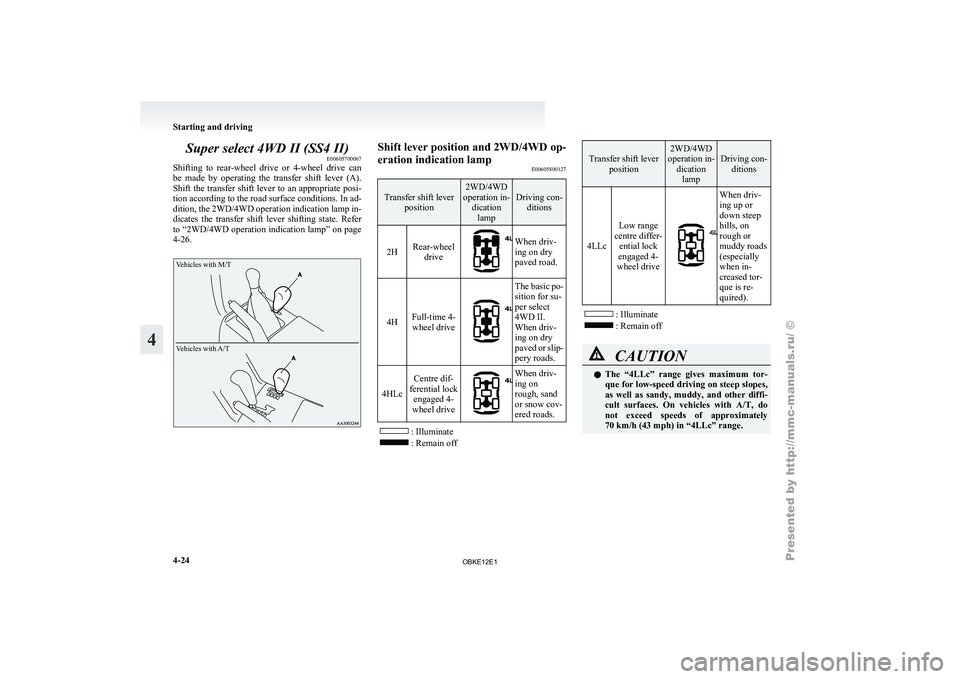
Super select 4WD II (SS4 II)
E00605700067
Shifting to rear-wheel
drive or 4-wheel drive can
be made by operating the transfer shift lever (A).
Shift the transfer shift lever to an appropriate posi-
tion according to the road surface conditions. In ad-
dition, the 2WD/4WD operation indication lamp in-
dicates the transfer shift lever shifting state. Refer
to “2WD/4WD operation indication lamp” on page
4-26.
Vehicles with M/T
Vehicles with A/T Shift lever position and 2WD/4WD op-
eration indication lamp
E00605800127 Transfer shift lever
position 2WD/4WD
operation in- dicationlamp Driving con-
ditions
2H Rear-wheel
drive When driv-
ing on dry
paved road.
4H Full-time 4-
wheel drive The basic po-
sition for su-
per select
4WD II.
When driv-
ing on dry
paved or
slip-
pery roads.
4HLc Centre dif-
ferential lock engaged 4-
wheel drive When driv-
ing on
rough, sand
or snow cov-
ered roads.
: Illuminate
: Remain off Transfer shift lever
position 2WD/4WD
operation in- dicationlamp Driving con-
ditions
4LLc Low range
centre differ- ential lock
engaged 4-
wheel drive When driv-
ing up or
down steep
hills, on
rough or
muddy roads
(especially
when in-
creased tor-
que is re-
quired).
: Illuminate
: Remain off
CAUTION
l
The “4LLc”
range
gives maximum tor-
que for low-speed driving on steep slopes,
as well as sandy, muddy, and other diffi-
cult surfaces. On vehicles with A/T, do
not exceed speeds of approximately
70 km/h (43 mph) in “4LLc” range. Starting and driving
4-24
4
OBKE12E1
Page 151 of 377
l
When shifting
from “2H” to “4H” in cold
weather while the vehicle is in motion, the
transmission gear may make some noise. In
cold weather, try to shift the gear while the
vehicle is stopped.
l When the lever is shifted between “2H” ↔
“4H” or “4H” ↔ “4HLc” while the vehicle
is stopped, the 2WD/4WD operation indica-
tion lamp blinks while the selection is in proc-
ess. Drive slowly and normally after confirm-
ing that the lamp is illuminated. Refer to
“2WD/4WD operation indication lamp” on
page 4-26.
l Do not move the selector lever while the 2WD/
4WD operation indication lamp is blinking.
l On vehicles with cruise control, when the lev-
er is shifted among “2H” ↔ “4H” ↔
“4HLc” while the cruise control is activated,
the transfer gear may make some noise. CAUTION
l
Do not
operate
the transfer shift lever
while the rear wheels of the vehicle are
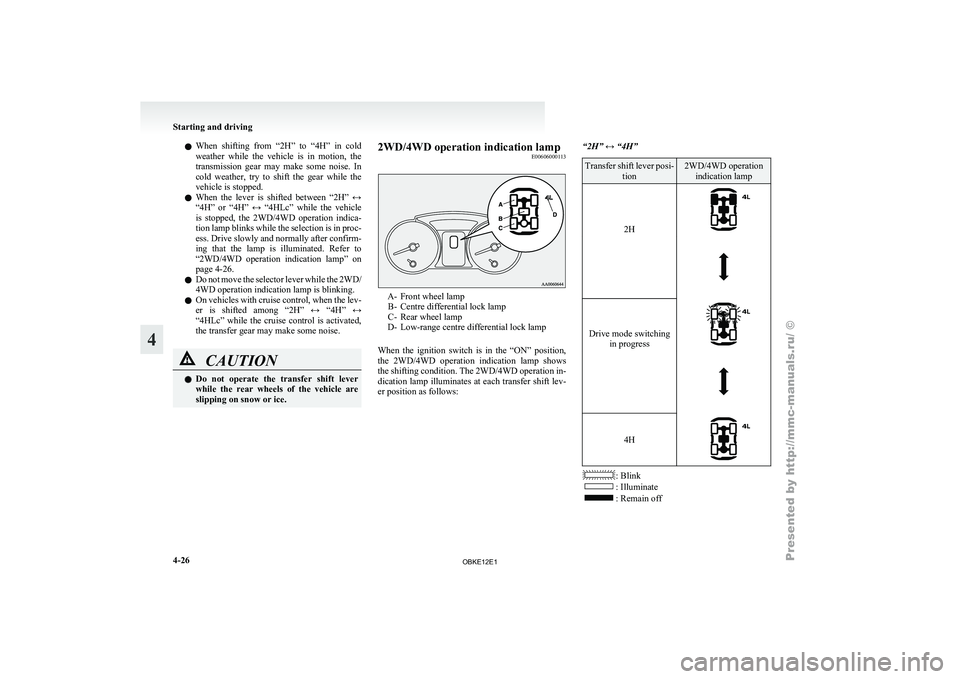
slipping on snow or ice. 2WD/4WD operation indication lamp
E00606000113 A- Front wheel lamp
B- Centre differential lock lampC- Rear wheel lamp
D-
Low-range centre differential lock lamp
When the ignition switch is in the “ON” position,
the 2WD/4WD operation indication lamp shows
the shifting condition. The 2WD/4WD operation in-
dication lamp illuminates at each transfer shift lev-
er position as follows: “2H” ↔ “4H” Transfer shift lever posi-
tion 2WD/4WD operation
indication lamp
2H
Drive mode switching
in progress
4H
: Blink
: Illuminate
: Remain offStarting and driving
4-26
4
OBKE12E1
Page 153 of 377
NOTE
l The
2WD/4WD operation
indication lamp
blinks while the selection is in process. Take
the following precautions when the indica-
tion lamp is blinking. • Keep the steering wheel in the straightahead position while making range selec-
tions. If you attempt to drive forward
with the steering wheel turned, gear rat-
tling may occur and the desired range
may not actually be selected.
• If the front wheel and/or centre differen- tial lock lamps continue blinking after a
“2H” ↔ “4H” ↔ “4HLc” selection has
been made with the vehicle moving, hold
the steering wheel in the straight ahead po-
sition and slowly depress the accelerator
pedal several times.
• If, after a “4HLc” ↔ “4LLc” selection has been made, the front and rear wheel
lamps continue blinking and the desired
range is not actually selected, return the
transfer shift lever to its previous posi-
tion. Place the steering wheel in the
straight ahead position, drive the vehicle
forward, and release the accelerator ped-
al. Next, hold down the clutch pedal
(with M/T) or place the selector lever in
the “N” (NEUTRAL) position (with A/T)
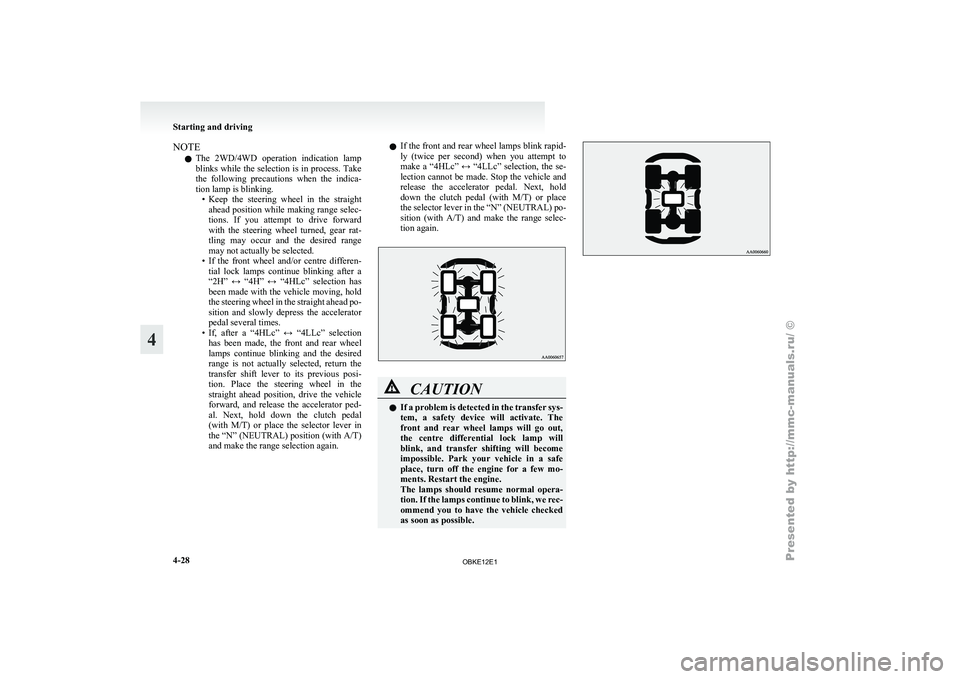
and make the range selection again. l
If
the
front and rear wheel lamps blink rapid-
ly (twice per second) when you attempt to
make a “4HLc” ↔ “4LLc” selection, the se-
lection cannot be made. Stop the vehicle and
release the accelerator pedal. Next, hold
down the clutch pedal (with M/T) or place
the selector lever in the “N” (NEUTRAL) po-
sition (with A/T) and make the range selec-
tion again. CAUTION
l
If a
problem
is detected in the transfer sys-
tem, a safety device will activate. The
front and rear wheel lamps will go out,
the centre differential lock lamp will
blink, and transfer shifting will become
impossible. Park your vehicle in a safe
place, turn off the engine for a few mo-
ments. Restart the engine.
The lamps should resume normal opera-
tion. If the lamps continue to blink, we rec-
ommend you to have the vehicle checked
as soon as possible. Starting and driving
4-28
4
OBKE12E1
Page 154 of 377
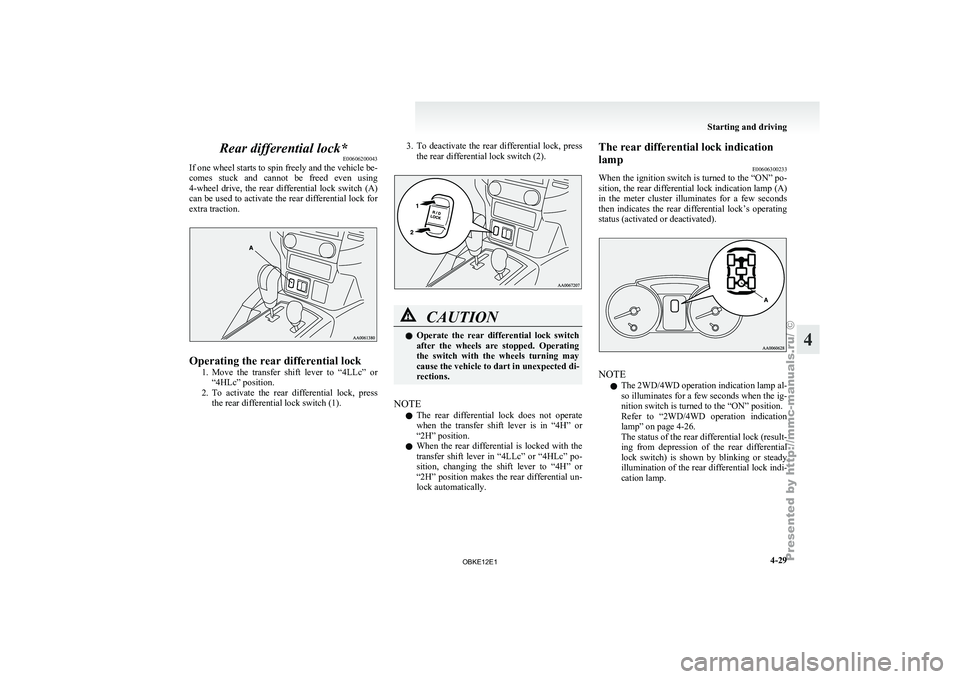
Rear differential lock*
E00606200043
If one wheel
starts to spin freely and the vehicle be-
comes stuck and cannot be freed even using
4-wheel drive, the rear differential lock switch (A)
can be used to activate the rear differential lock for
extra traction. Operating the rear differential lock
1. Move the transfer
shift lever to “4LLc” or
“4HLc” position.
2. To activate the rear differential lock, press the rear differential lock switch (1). 3. To deactivate the rear differential lock, press
the rear differential lock switch (2). CAUTION
l
Operate the rear
differential lock switch
after the wheels are stopped. Operating
the switch with the wheels turning may
cause the vehicle to dart in unexpected di-
rections.
NOTE l The
rear differential
lock does not operate
when the transfer shift lever is in “4H” or
“2H” position.
l When the rear differential is locked with the
transfer shift lever in “4LLc” or “4HLc” po-
sition, changing the shift lever to “4H” or
“2H” position makes the rear differential un-
lock automatically. The rear differential lock indication
lamp
E00606300233
When the ignition
switch is turned to the “ON” po-
sition, the rear differential lock indication lamp (A)
in the meter cluster illuminates for a few seconds
then indicates the rear differential lock’s operating
status (activated or deactivated). NOTE
l The
2WD/4WD operation
indication lamp al-
so illuminates for a few seconds when the ig-
nition switch is turned to the “ON” position.
Refer to “2WD/4WD operation indication
lamp” on page 4-26.
The status of the rear differential lock (result-
ing from depression of the rear differential
lock switch) is shown by blinking or steady
illumination of the rear differential lock indi-
cation lamp. Starting and driving
4-29 4
OBKE12E1
Page 155 of 377
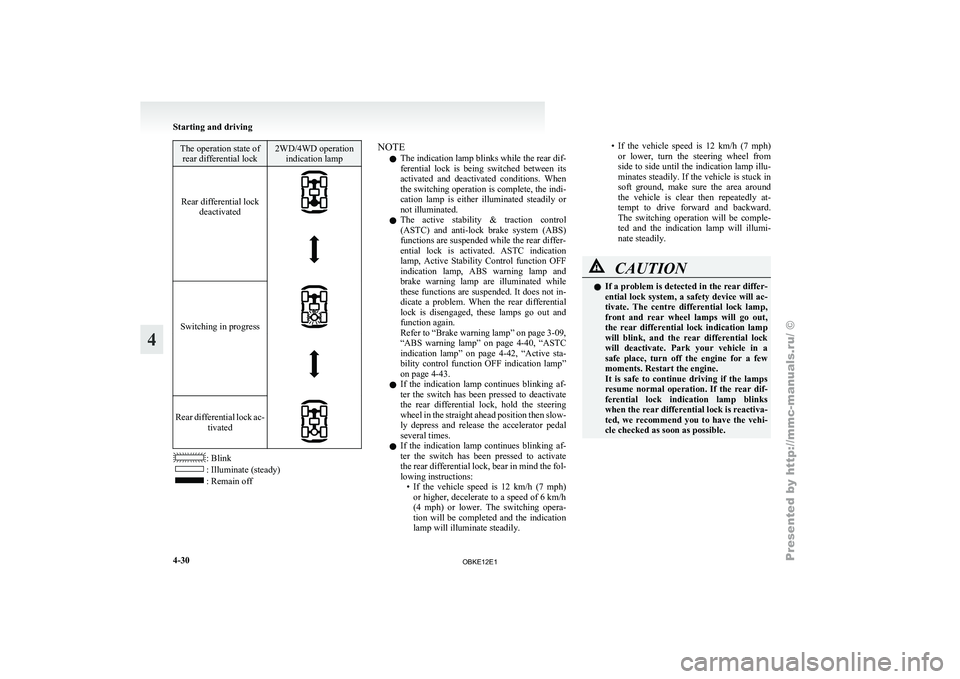
The operation state of
rear differential lock 2WD/4WD operation
indication lamp
Rear differential lock deactivated
Switching in progress
Rear differential lock ac-
tivated : Blink
: Illuminate (steady)
: Remain off NOTE
l The indication lamp blinks while the rear dif-
ferential
lock is
being switched between its
activated and deactivated conditions. When
the switching operation is complete, the indi-
cation lamp is either illuminated steadily or
not illuminated.
l The active stability & traction control
(ASTC) and anti-lock brake system (ABS)
functions are suspended while the rear differ-
ential lock is activated. ASTC indication
lamp, Active Stability Control function OFF
indication lamp, ABS warning lamp and
brake warning lamp are illuminated while
these functions are suspended. It does not in-
dicate a problem. When the rear differential
lock is disengaged, these lamps go out and
function again.
Refer to “Brake warning lamp” on page 3-09,
“ABS warning lamp” on page 4-40, “ASTC
indication lamp” on page 4-42, “Active sta-
bility control function OFF indication lamp”
on page 4-43.
l If the indication lamp continues blinking af-
ter the switch has been pressed to deactivate
the rear differential lock, hold the steering
wheel in the straight ahead position then slow-
ly depress and release the accelerator pedal
several times.
l If the indication lamp continues blinking af-
ter the switch has been pressed to activate
the rear differential lock, bear in mind the fol-
lowing instructions:
• If the vehicle speed is 12 km/h (7 mph)or higher, decelerate to a speed of 6 km/h
(4 mph) or lower. The switching opera-
tion will be completed and the indication
lamp will illuminate steadily. • If the vehicle speed is 12 km/h (7 mph)
or lower,
turn the steering wheel from
side to side until the indication lamp illu-
minates steadily. If the vehicle is stuck in
soft ground, make sure the area around
the vehicle is clear then repeatedly at-
tempt to drive forward and backward.
The switching operation will be comple-
ted and the indication lamp will illumi-
nate steadily. CAUTION
l
If a
problem
is detected in the rear differ-
ential lock system, a safety device will ac-
tivate. The centre differential lock lamp,
front and rear wheel lamps will go out,
the rear differential lock indication lamp
will blink, and the rear differential lock
will deactivate. Park your vehicle in a
safe place, turn off the engine for a few
moments. Restart the engine.
It is safe to continue driving if the lamps
resume normal operation. If the rear dif-
ferential lock indication lamp blinks
when the rear differential lock is reactiva-
ted, we recommend you to have the vehi-
cle checked as soon as possible. Starting and driving
4-30
4
OBKE12E1
Page 156 of 377
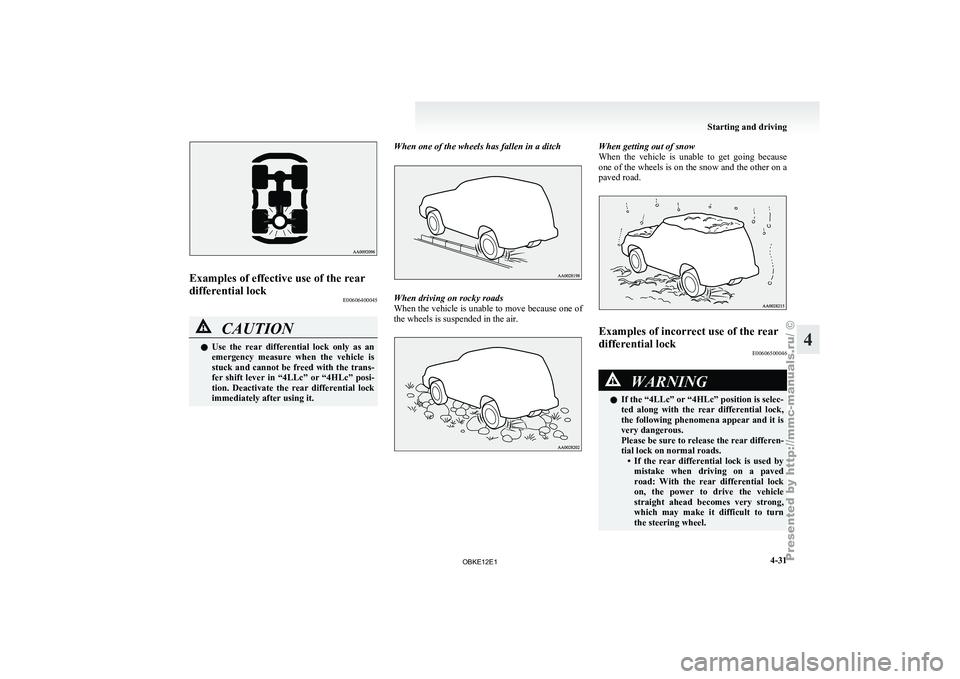
Examples of effective use of the rear
differential lock
E00606400045CAUTION
l
Use the rear differential lock only as an
emergency measure when the vehicle is
stuck and cannot be freed with the trans-
fer shift lever in “4LLc” or “4HLc” posi-
tion. Deactivate the rear differential lock
immediately after using it. When one of the wheels has fallen in a ditch When driving on rocky roads
When the
vehicle
is unable to move because one of
the wheels is suspended in the air. When getting out of snow
When the vehicle
is unable to get going because
one of the wheels is on the snow and the other on a
paved road. Examples of incorrect use of the rear
differential lock
E00606500046 WARNING
l If the “4LLc” or “4HLc” position is selec-
ted along
with
the rear differential lock,
the following phenomena appear and it is
very dangerous.
Please be sure to release the rear differen-
tial lock on normal roads. • If the rear differential lock is used bymistake when driving on a paved
road: With the rear differential lock
on, the power to drive the vehicle
straight ahead becomes very strong,
which may make it difficult to turn
the steering wheel. Starting and driving
4-31 4
OBKE12E1
Page 157 of 377
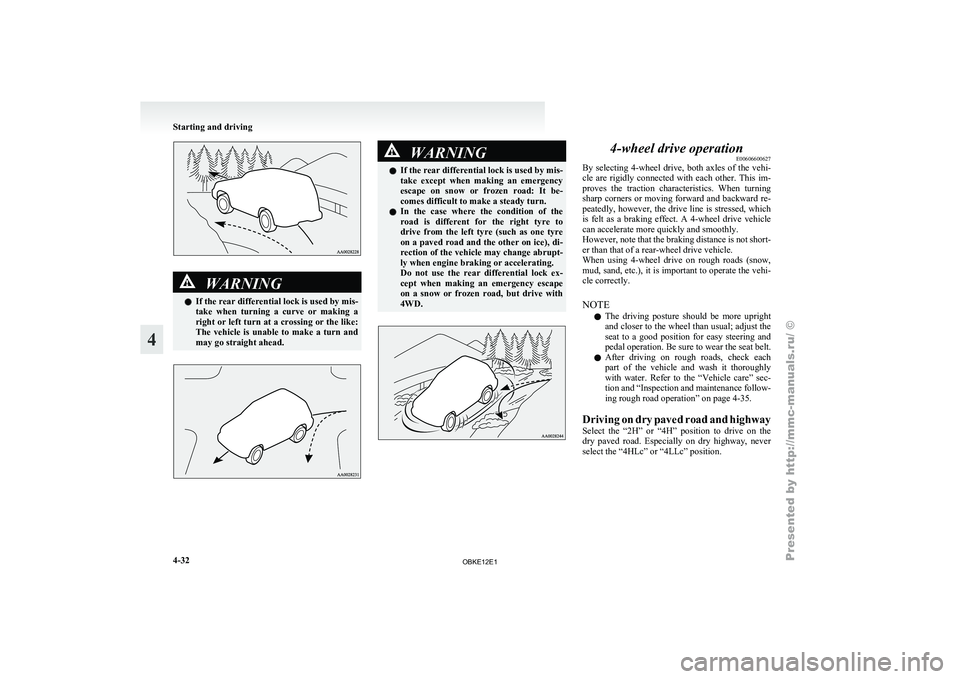
WARNING
l If the
rear differential lock is used by mis-
take when turning a curve or making a
right or left turn at a crossing or the like:
The vehicle is unable to make a turn and
may go straight ahead. WARNING
l If the rear
differential lock is used by mis-
take except when making an emergency
escape on snow or frozen road: It be-
comes difficult to make a steady turn.
l In the case where the condition of the
road is different for the right tyre to
drive from the left tyre (such as one tyre
on a paved road and the other on ice), di-
rection of the vehicle may change abrupt-
ly when engine braking or accelerating.
Do not use the rear differential lock ex-
cept when making an emergency escape
on a snow or frozen road, but drive with
4WD. 4-wheel drive operation
E00606600627
By selecting 4-wheel
drive, both axles of the vehi-
cle are rigidly connected with each other. This im-
proves the traction characteristics. When turning
sharp corners or moving forward and backward re-
peatedly, however, the drive line is stressed, which
is felt as a braking effect. A 4-wheel drive vehicle
can accelerate more quickly and smoothly.
However, note that the braking distance is not short-
er than that of a rear-wheel drive vehicle.
When using 4-wheel drive on rough roads (snow,
mud, sand, etc.), it is important to operate the vehi-
cle correctly.
NOTE
l The driving posture should be more upright
and closer to the wheel than usual; adjust the
seat to a good position for easy steering and
pedal operation. Be sure to wear the seat belt.
l After driving on rough roads, check each
part of the vehicle and wash it thoroughly
with water. Refer to the “Vehicle care” sec-
tion and “Inspection and maintenance follow-
ing rough road operation” on page 4-35.
Driving on dry paved road and highway
Select the “2H” or “4H” position to drive on the
dry paved road. Especially on dry highway, never
select the “4HLc” or “4LLc” position. Starting and driving
4-32
4
OBKE12E1
Page 158 of 377
CAUTION
l
Selecting the “4HLc” or “4LLc” position
to drive on dry paved road will increase
the fuel consumption with possible noise
generation and early tyre wear.
It may also increase the differential oil
temperature, resulting in possible dam-
age to the driving system.
Further, the drive train will be subjected
to excessive loading, possibly leading to
oil leakage, component seizure, or other
serious faults.
Driving on snowy or icy roads
Set the transfer
shift lever to the “4H” or “4HLc”
position in accordance with the road conditions,
and then gradually depress the accelerator pedal for
a smooth start.
NOTE
l The use of snow tyres and/or tyre chains is
recommended.
l In order to ensure that the anti-lock brake sys-
tem (ABS) will operate correctly in situa-
tions where tyre chains have been fitted,
drive in the “4H”, “4HLc” or “4LLc” position.
l Maintain a safe distance between vehicles,
avoid sudden braking, and use engine brak-
ing (downshifting). CAUTION
l
Avoid sudden braking,
sudden accelera-
tion, and sharp turning; such operations
could cause skidding and spinouts. Driving on sandy or muddy roads
Set the
transfer
shift lever to the “4HLc” or “4LLc”
position and then gradually depress the accelerator
pedal for a smooth start. Keep the pressure on the
accelerator pedal as constant as possible, and drive
at low speed. CAUTION
l
Do not
force
the vehicle or drive reckless-
ly on sandy surfaces. In comparison with
normal road surfaces, the engine and oth-
er drive-system components are put un-
der excessive strain when driving on such
a surface, and this could lead to accidents.
l If any of following conditions occur while
the vehicle is being driven, immediately
park your vehicle in a safe place and fol-
low these procedures:
• The needle in the temperature gaugeapproaches the overheating zone.
Refer to “Engine overheating” on
page 6-04.
• A/T fluid temperature warning lamp illuminates.
Refer to “When the A/T fluid temper-
ature warning lamp comes on” on
page 4-22. WARNING
l When attempting to rock your vehicle out
of a stuck
position, be sure that the area
around the vehicle is clear of people and
physical objects. The rocking motion may
cause the vehicle to suddenly launch for-
ward or backward, causing injury or dam-
age to nearby people or objects.
NOTE l Avoid
sudden braking,
acceleration, and turn-
ing; such operations could result in the vehi-
cle becoming stuck.
l If the vehicle becomes stuck in sandy or mud-
dy roads, it can often be moved with a rock-
ing motion. Move the selector lever rhythmi-
cally between the “D” (DRIVE) and “R” (RE-
VERSE) position (with M/T, between 1 st
and
Reverse), while applying slight pressure to
the accelerator pedal.
l It is recommended to start the vehicle with
parking brake partially, but not completely,
applied by slightly pulling the parking brake
lever.
After the vehicle has become free, do not for-
get to release the parking brake.
l If it is necessary to drive in extremely muddy
conditions, the use of tyre chains is recom-
mended. Because the extent of muddy condi-
tions is difficult to judge and the vehicle
could become bogged down very deeply, op-
eration should be at a low speed. If possible,
get out of the vehicle and check the condi-
tions ahead before proceeding. Starting and driving
4-33 4
OBKE12E1
Page 162 of 377
Braking
E00607001524
All the parts
of the brake system are critical to safe-
ty. We recommend you to have the vehicle
checked at regular intervals according to the serv-
ice booklet. CAUTION
l
Avoid driving
habits
that cause heavy
braking and never “ride” the brakes by
resting your foot on the brake pedal
while driving.
It causes brake overheating and fade.
Brake system
The service brake
is divided into two brake circuits
so that when one brake circuit fails, the other is
available to stop the vehicle. In this situation, even
if the brake pedal moves down to the very end of
its possible stroke, keep depressing the brake pedal
down harder than usual; stop driving as soon as pos-
sible and have the brake system repaired.
For details, refer to “Brake warning lamp” on page
3-09.
Power brakes
The power brakes use brake fluid pressurized by
the pump to power-assist the brake. If the brake sys-
tem fails during driving, the brake warning lamp
comes on and a buzzer sounds continuously. In this
case, the brake may not work properly.
If this buzzer should continue to sound, park your
vehicle in a safe place and have the system checked.
Refer to “Brake warning lamp” on page 3-09. CAUTION
l
Bring the vehicle
to halt in a safe location
by applying the brakes gently. Applying
the brakes rapidly or driving at high
speed may make the vehicle unstable.
NOTE l Depressing
the brake
pedal repeatedly may
turn on the brake warning lamp, ABS warn-
ing lamp and brake warning buzzer. (The
ASTC indication lamp and Active Stability
Control function OFF indication lamp also
turn on.) It is normal if the lamp goes out
and the buzzer stops sounding after a few sec-
onds.
l In certain cases immediately after the engine
has been started or when the brake pedal is
depressed repeatedly, a noise generated by op-
eration of brake devices may be heard com-
ing from the engine compartment, or the
brake pedal vibration may be felt. This type
of noise or vibration is normal and there is
no need for concern. In fact, it indicates that
the corresponding devices are operating nor-
mal. WARNING
l Do not
turn
off the engine while your ve-
hicle is in motion. If you turn off the en-
gine while driving, the power assistance
for the braking system will stop working
and your brakes will not work effectively. WARNING
l If the power
assist is lost or if either
brake hydraulic system stops working
properly, have your vehicle checked im-
mediately.
Warning lamp l The
brake warning
lamp illuminates to indi-
cate a fault in the braking system. Read
“Brake warning lamp” on page 3-09.
l On vehicles with the rear differential lock,
the active stability & traction control
(ASTC) and anti-lock brake system (ABS)
functions are suspended while the rear differ-
ential lock is activated. ASTC indication
lamp, Active Stability Control function OFF
indication lamp, ABS warning lamp and
brake warning lamp are illuminated while
these functions are suspended. It does not in-
dicate a problem. When the rear differential
lock is disengaged, these lamps go out and
function again.
Refer to “Brake warning lamp” on page 3-09,
“ABS warning lamp” on page 4-40, “ASTC
indication lamp” on page 4-42, “Active sta-
bility control function OFF indication lamp”
on page 4-43.
When brakes are wet
Check the brake system while driving at a low
speed immediately after starting, especially when
the brakes are wet, to confirm they work normally.
A film of water can be formed on the brake discs
and prevent normal braking after driving in heavy
rain or through large puddles, or after the vehicle is
washed. If this occurs, dry the brakes out by driv-
ing slowly while lightly depressing the brake pedal. Starting and driving
4-37 4
OBKE12E1
Page 163 of 377

When driving downhill
It is
important
to take advantage of the engine brak-
ing by shifting to a lower shift position while driv-
ing on steep downhill roads in order to prevent the
brakes from overheating. WARNING
l Do not
leave
any objects near the brake
pedal or let a floor mat slide under it; do-
ing so could prevent the full pedal stroke
that would be necessary in an emergency.
Make sure that the pedal can be operated
freely at all times. Make sure the floor
mat is securely held in place.
Brake pads l Avoid hard braking situations.
New
brakes need
to be broken-in by moder-
ate use for the first 200 km (125 miles).
l The disc brakes are provided with a warning
device which emits a shrieking metallic
sound while braking if the brake pads have
reached their wear limit.
If you hear this sound, have the brake pads re-
placed immediately. WARNING
l Driving with worn
brake pads will make
it harder to stop, and can cause an acci-
dent. Brake assist system
E00627000376
The brake assist system is a device assisting drivers
who cannot depress
the brake pedal firmly when it
is necessary to do so (such as in emergency stop sit-
uations) and provides greater braking force.
If the brake pedal is depressed suddenly, the brakes
will be applied with more force than usual. CAUTION
l
The brake
assist
system is not a device de-
signed to exercise braking force greater
than its capacity. Make sure to always
keep a sufficient distance between vehi-
cles in front of you without relying too
much on the brake assist system.
NOTE l Once
the brake
assist system is operational,
it maintains great braking force even if the
brake pedal is lightly released.
To stop its operation, completely remove
your foot from the brake pedal.
l When the brake assist system is in use while
driving, you may feel the brake pedal at-
tempt to resist, the pedal moves in small mo-
tions in conjunction with the operation noise,
or the vehicle body and the steering wheel vi-
brate. This occurs when the brake assist sys-
tem is operating normally and does not indi-
cate faulty operation. Continue to firmly de-
press the brake pedal. l
When
the
anti-lock
brake system warning
lamp is illuminated, the brake assist system
is not functioning. Starting and driving
4-38
4
OBKE12E1