lock MITSUBISHI PAJERO IV 2011 Owners Manual
[x] Cancel search | Manufacturer: MITSUBISHI, Model Year: 2011, Model line: PAJERO IV, Model: MITSUBISHI PAJERO IV 2011Pages: 377, PDF Size: 29.43 MB
Page 294 of 377
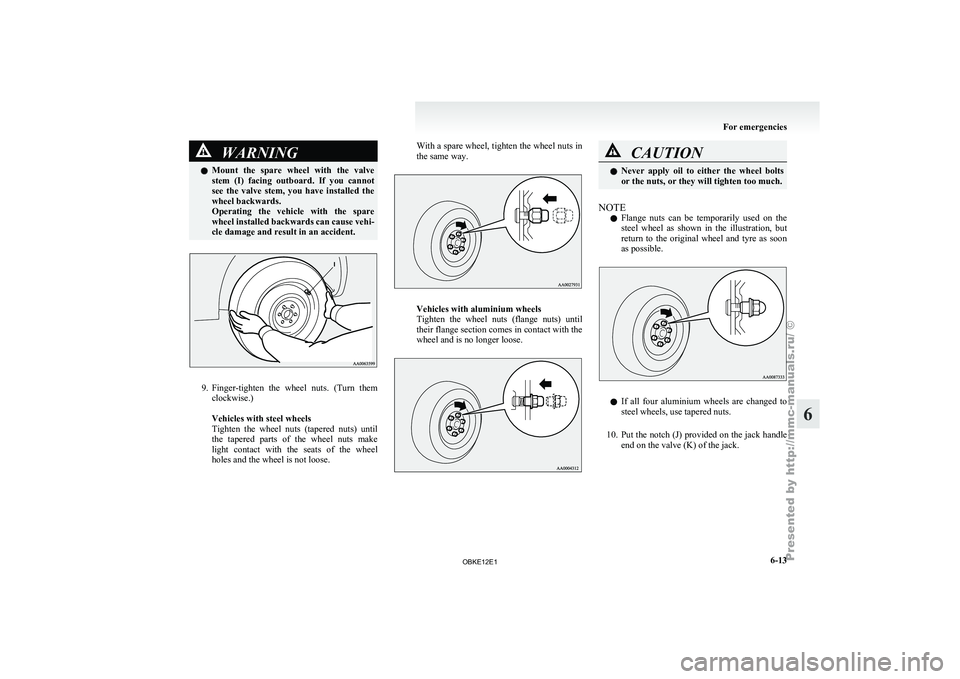
WARNING
l Mount the spare wheel with the valve
stem (I) facing outboard. If you cannot
see the valve stem, you have installed the
wheel backwards.
Operating the vehicle with the spare
wheel installed backwards can cause vehi-
cle damage and result in an accident. 9. Finger-tighten the
wheel
nuts. (Turn them
clockwise.)
Vehicles with steel wheels
Tighten the wheel nuts (tapered nuts) until
the tapered parts of the wheel nuts make
light contact with the seats of the wheel
holes and the wheel is not loose. With a spare wheel, tighten the wheel nuts in
the same way.
Vehicles with aluminium wheels
Tighten the
wheel
nuts (flange nuts) until
their flange section comes in contact with the
wheel and is no longer loose. CAUTION
l
Never apply oil
to either the wheel bolts
or the nuts, or they will tighten too much.
NOTE l Flange
nuts can
be temporarily used on the
steel wheel as shown in the illustration, but
return to the original wheel and tyre as soon
as possible. l
If all
four
aluminium wheels are changed to
steel wheels, use tapered nuts.
10. Put the notch (J) provided on the jack handle end on the valve (K) of the jack. For emergencies
6-13 6
OBKE12E1
Page 295 of 377
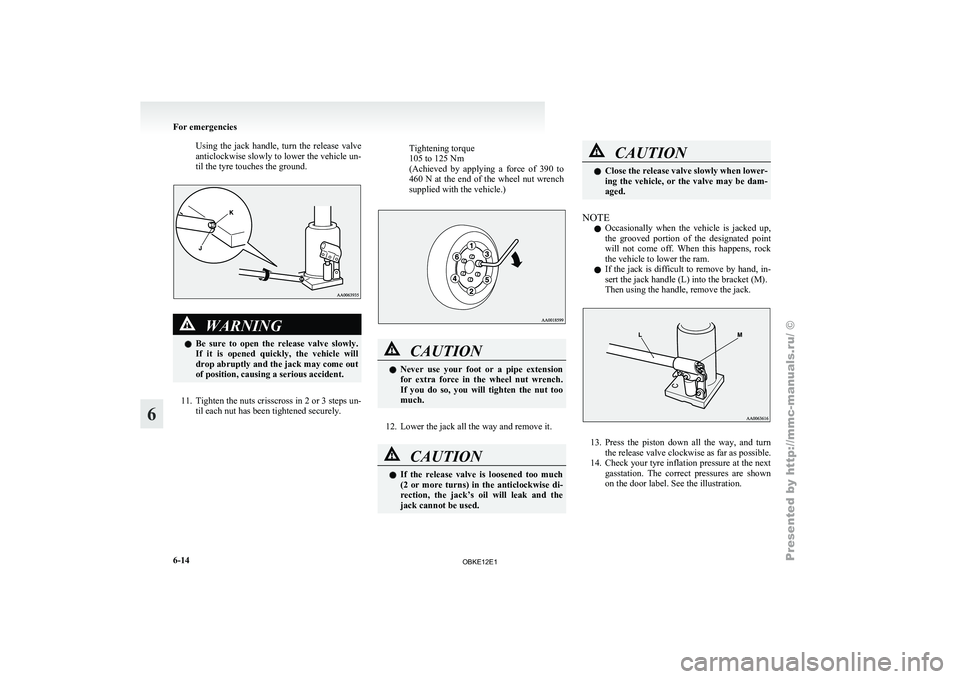
Using the jack handle, turn the release valve
anticlockwise slowly to lower the vehicle un-
til the tyre touches the ground.
WARNING
l Be sure
to open the release valve slowly.
If it is opened quickly, the vehicle will
drop abruptly and the jack may come out
of position, causing a serious accident.
11. Tighten the nuts crisscross in 2 or 3 steps un-
til each nut has been tightened securely.
Tightening torque
105 to 125 Nm
(Achieved by
applying
a force of 390 to
460 N at the end of the wheel nut wrench
supplied with the vehicle.) CAUTION
l
Never use
your
foot or a pipe extension
for extra force in the wheel nut wrench.
If you do so, you will tighten the nut too
much.
12. Lower the jack all the way and remove it. CAUTION
l
If the
release
valve is loosened too much
(2 or more turns) in the anticlockwise di-
rection, the jack’s oil will leak and the
jack cannot be used. CAUTION
l
Close the release
valve slowly when lower-
ing the vehicle, or the valve may be dam-
aged.
NOTE l Occasionally
when the
vehicle is jacked up,
the grooved portion of the designated point
will not come off. When this happens, rock
the vehicle to lower the ram.
l If the jack is difficult to remove by hand, in-
sert the jack handle (L) into the bracket (M).
Then using the handle, remove the jack. 13. Press the piston down all the way, and turn
the release valve clockwise as far as possible.
14. Check
your tyre inflation pressure at the next
gasstation. The correct pressures are shown
on the door label. See the illustration. For emergencies
6-14
6
OBKE12E1
Page 298 of 377
Towing with rear wheels off the ground (Type C)
Place the gearshift
lever in the “N” (Neutral) posi-
tion (M/T) or the selector lever in the “N” (NEU-
TRAL) position (A/T). Turn the ignition key to the
“ACC” position and secure the steering wheel in a
straight ahead position with a rope or tie-down
strap. Never place the ignition switch in the
“LOCK” position when towing.
Emergency towing
If towing service is not available in an emergency,
your vehicle may be temporarily towed by a rope
secured to the towing hook.
If your vehicle is to be towed by another vehicle or
if your vehicle tows another vehicle, pay careful at-
tention to the following points:
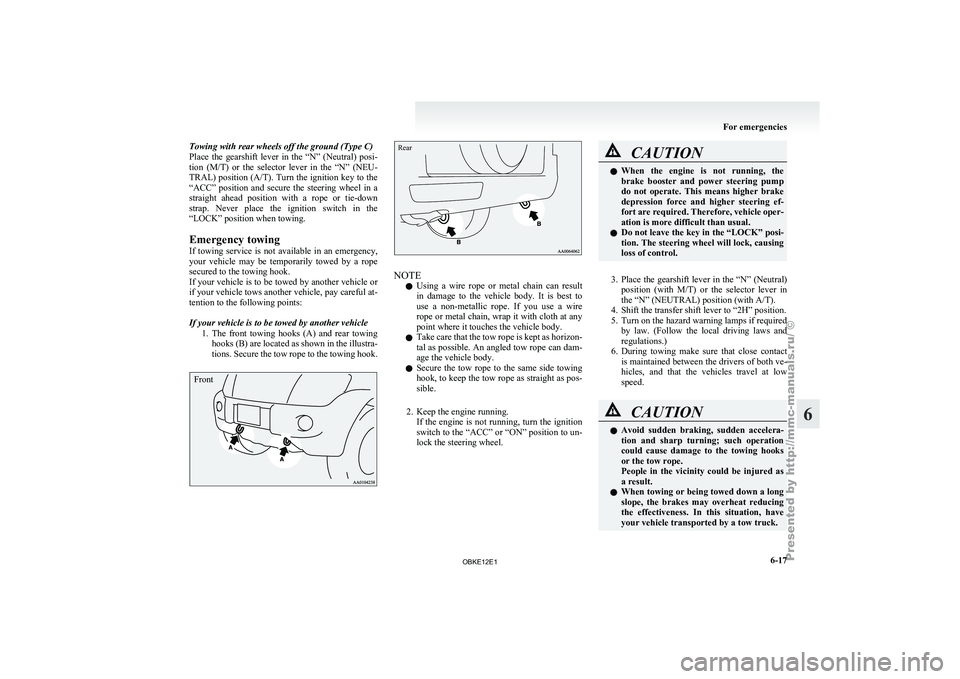
If your vehicle is to be towed by another vehicle
1. The front towing hooks (A) and rear towinghooks (B) are located as shown in the illustra-
tions. Secure the tow rope to the towing hook.
Front
Rear NOTE
l Using
a wire
rope or metal chain can result
in damage to the vehicle body. It is best to
use a non-metallic rope. If you use a wire
rope or metal chain, wrap it with cloth at any
point where it touches the vehicle body.
l Take care that the tow rope is kept as horizon-
tal as possible. An angled tow rope can dam-
age the vehicle body.
l Secure the tow rope to the same side towing
hook, to keep the tow rope as straight as pos-
sible.
2. Keep the engine running. If the engine is not running, turn the ignition
switch to the “ACC” or “ON” position to un-
lock the steering wheel. CAUTION
l
When the engine
is not running, the
brake booster and power steering pump
do not operate. This means higher brake
depression force and higher steering ef-
fort are required. Therefore, vehicle oper-
ation is more difficult than usual.
l Do not leave the key in the “LOCK” posi-
tion. The steering wheel will lock, causing
loss of control.
3. Place the gearshift lever in the “N” (Neutral)
position (with
M/T) or the selector lever in
the “N” (NEUTRAL) position (with A/T).
4. Shift the transfer shift lever to “2H” position.
5. Turn on the hazard warning lamps if required by law. (Follow the local driving laws and
regulations.)
6. During towing make sure that close contact is maintained between the drivers of both ve-
hicles, and that the vehicles travel at low
speed. CAUTION
l
Avoid sudden braking,
sudden accelera-
tion and sharp turning; such operation
could cause damage to the towing hooks
or the tow rope.
People in the vicinity could be injured as
a result.
l When towing or being towed down a long
slope, the brakes may overheat reducing
the effectiveness. In this situation, have
your vehicle transported by a tow truck. For emergencies
6-17 6
OBKE12E1
Page 300 of 377
l
Depressing the
brake pedal during travel on
snowy or icy roads may cause tyre slippage
and skidding. When traction between the
tyres and the road is reduced the wheels may
skid and the vehicle cannot readily be
brought to a stop by conventional braking
techniques. Braking will differ, depending
upon whether you have anti-lock brakes
(ABS). As your vehicle is equipped with
ABS, brake by pressing the brake pedal hard,
and keeping it pressed.
l Allow extra distance between your vehicle
and the vehicle in front of you, and avoid sud-
den braking.
l Accumulation of ice on the braking system
can cause the wheels to lock. Pull away from
a standstill slowly after confirming safety
around the vehicle. CAUTION
l
Do not
press
the accelerator pedal rapid-
ly. If the wheels break free of the ice, the
vehicle could suddenly start moving and
possibly cause an accident.
On a bumpy or rutted road
Drive as slow
as possible when driving on bumpy
or rutted roads. CAUTION
l
The impact on
tyres and/or wheels when
driving on a bumpy or rutted road can
damage the tyre and/or wheel. For emergencies
6-19 6
OBKE12E1
Page 303 of 377
Vehicle care precautions
E00900100825
In order to
maintain the value of your vehicle, it is
necessary to perform regular maintenance using the
proper procedures. Always maintain your vehicle
in compliance with environmental pollution control
regulations. Carefully select the materials used for
washing, etc., to be sure that they do not contain cor-
rosives. If in doubt, we recommend you to consult
a specialist for selection of these materials. CAUTION
l
Cleaning products
can
be dangerous. Al-
ways follow the instructions of the clean-
ing product supplier.
l To avoid damage, never use the following
to clean your vehicle:
• Petrol
• Paint Thinner
• Benzine
• Kerosene
• Turpentine
• Naphtha
• Lacquer Thinner
• Carbon Tetrachloride
• Nail Polish Remover
• Acetone Cleaning the interior of your
vehicle E00900200464
After cleaning the
interior of your vehicle with wa-
ter, cleaner or similar, wipe and dry in a shady, well-
ventilated area. CAUTION
l
Do not
use
organic substances (solvents,
benzine, kerosene, alcohol, petrol, etc.) or
alkaline or acidic solutions.
These chemicals can cause discolouring,
staining or cracking of the surface.
If you use cleaners or polishing agents,
make sure their ingredients do not in-
clude the substances mentioned above.
Plastic, vinyl leather, fabric and
flocked parts E00900300377
1. Gently wipe off with gauze or other soft
cloth soaked
with a 3 % aqueous solution of
neutral detergent.
2. Dip cloth in fresh water and wring out well. Using this cloth, wipe off the detergent thor-
oughly. NOTE
l Do
not use
cleaners, conditioners, and protec-
tants containing silicons or wax.
Such products, when applied to the instru-
ment panels or other parts, may cause reflec-
tions on the windscreen and obscure vision.
Also, if such products get on the switches of
the electrical accessories, it may lead to fail-
ure of these accessories.
Upholstery E00900500063
1. To maintain the value of your new vehicle,
handle the
upholstery carefully and keep the
interior clean.
Use a vacuum cleaner and brush to clean the
seats. If stained, vinyl and synthetic leather
should be cleaned with an appropriate clean-
er, and cloth fabrics can be cleaned with ei-
ther upholstery cleaner or a 3 % solution of
neutral detergent in lukewarm water.
2. Clean the carpeting with a vacuum cleaner and remove any stains with carpet cleaner.
Oil and grease can be removed by lightly dab-
bing with a clean colourfast cloth and stain re-
mover.
Genuine leather* E00900600716
1. Gently wipe off with gauze or other soft
cloth soaked
with a 5 % aqueous solution of
neutral detergent.
2. Dip cloth in fresh water and wring it out well. Using this cloth, wipe off the detergent
thoroughly.
3. Apply leather protecting agent to the genuine leather surface. Vehicle care
7-02
7
OBKE12E1
Page 310 of 377
Bonnet
E01000302630
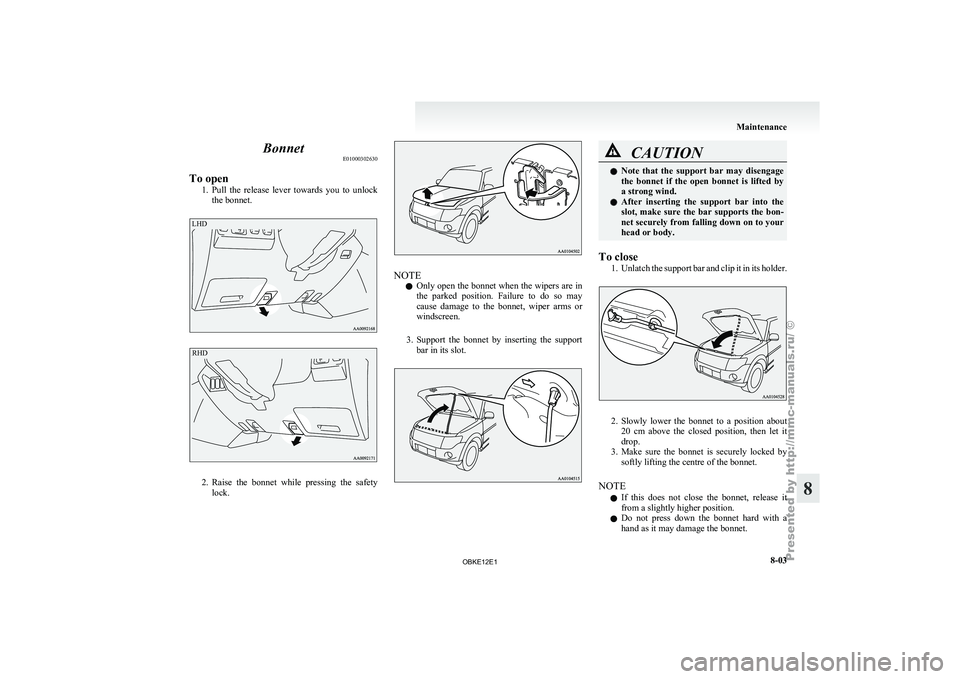
To open 1. Pull the release
lever towards you to unlock
the bonnet.
LHD
RHD 2. Raise
the bonnet while pressing the safety
lock. NOTE
l Only
open the
bonnet when the wipers are in
the parked position. Failure to do so may
cause damage to the bonnet, wiper arms or
windscreen.
3. Support the bonnet by inserting the support bar in its slot. CAUTION
l
Note that the
support bar may disengage
the bonnet if the open bonnet is lifted by
a strong wind.
l After inserting the support bar into the
slot, make sure the bar supports the bon-
net securely from falling down on to your
head or body.
To close 1. Unlatch the support
bar and clip it in its holder. 2. Slowly lower the bonnet to a position about
20 cm
above the closed position, then let it
drop.
3. Make sure the bonnet is securely locked by softly lifting the centre of the bonnet.
NOTE l If this does not close the bonnet, release it
from a slightly higher position.
l Do not press down the bonnet hard with a
hand as it may damage the bonnet. Maintenance
8-03 8
OBKE12E1
Page 314 of 377
WARNING
l Do not open the radiator cap while the en-
gine is hot.
The coolant system is under pressure and
any hot coolant escaping could cause se-
vere burns.
Anti-freeze
The engine coolant
contains an ethylene glycol anti-
corrosion agent. The cylinder head and water pump
housing are cast aluminium alloy, and periodic
changing of the engine coolant is necessary to pre-
vent corrosion of these parts.
Use “DIA QUEEN SUPER LONG LIFE COOL-
ANT” or equivalent.
MITSUBISHI Genuine Coolant has excellent pro-
tection against corrosion and rust formation of all
metals including aluminium and can avoid block-
ages in the radiator, heater, cylinder head, engine
block, etc.
Because of the necessity of this anti-corrosion
agent, the coolant must not be replaced with plain
water even in summer. The required concentration
of anti-freeze differs depending on the expected am-
bient temperature. Ambient
temperature (mini-
mum) °C -15 -20 -25 -30 -35 -50 Anti-freeze
concentra- tion % 30 35 40 45 50 60 CAUTION
l
Do not use
alcohol or methanol anti-
freeze or any engine coolants mixed with
alcohol or methanol anti-freeze. The use
of an improper anti-freeze can cause cor-
rosion of the aluminium components.
l For effective anti-corrosion and anti-
freeze performance, keep the anti-freeze
concentration within the range of 30 to
60 %.
Concentrations exceeding 60 % will re-
sult in a reduction of both the anti-freeze
and cooling performance thus adversely
affecting the engine.
l Do not top up with water only.
During cold weather
The concentration should
be checked before the
start of cold weather and anti-freeze added to the
system if necessary to prevent damage to engine
and radiator due to freezing. Washer fluid
E01000700656
Windscreen washer fluid
The windscreen washer
fluid reservoir is in the en-
gine compartment.
Check the washer fluid level at regular intervals
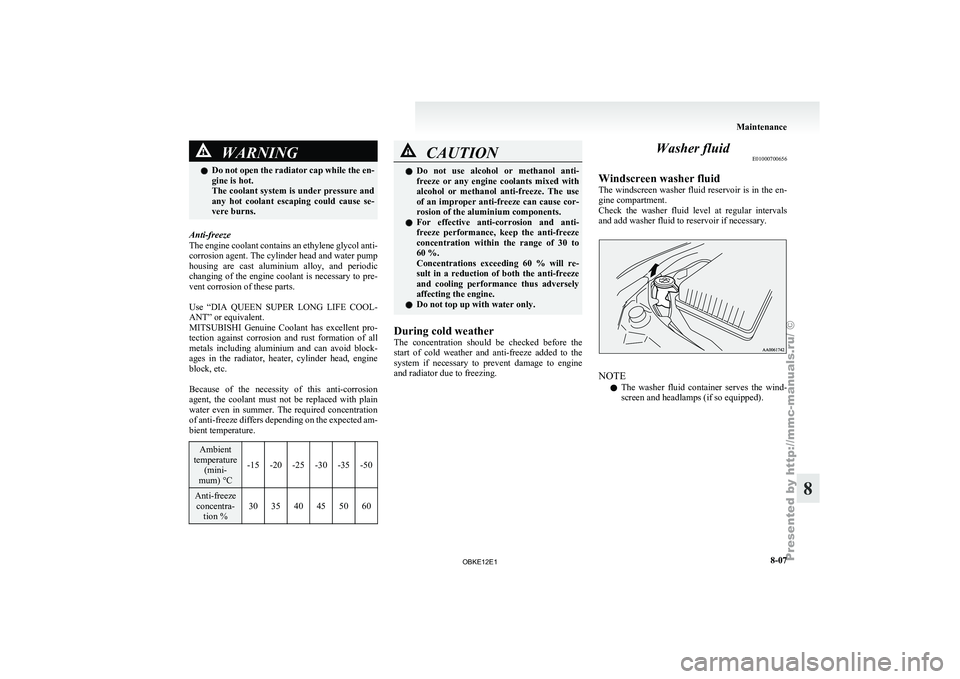
and add washer fluid to reservoir if necessary. NOTE
l The
washer fluid
container serves the wind-
screen and headlamps (if so equipped). Maintenance
8-07 8
OBKE12E1
Page 316 of 377
1. Turn the ignition switch to the “LOCK” or
“ACC” position.
2. Repeatedly
depress the brake pedal until sig-
nificant resistance is felt (normally after
about 40 times).
3. Check the brake fluid level in the reservoir. The brake fluid level must be between the
“MAX” and “MIN” marks on the reservoir.
The fluid level falls slightly with wear of the brake
pads, but this does not indicate any abnormality.
If the brake fluid level falls markedly in a short
length of time, it indicates leaks from the brake sys-
tem.
If this occurs, we recommend you to have the vehi-
cle checked.
Fluid type
Use brake fluid conforming to DOT3 or DOT4
from a sealed container. The brake fluid is hygro-
scopic. Too much moisture in the brake fluid will
adversely affect the brake system, reducing the
brake performance. CAUTION
l
Take care
in
handling brake fluid as it is
harmful to the eyes, may irritate your
skin and also damage painted surfaces.
l Use only the specified brake fluid.
Do not mix or add different brands of
brake fluid to prevent chemical reactions.
Do not let any petroleum-based fluid
touch, mix with, or get into the brake fluid.
This will damage the seals. CAUTION
l
Keep the reservoir tank cap closed to pre-
vent the brake
fluid from deteriorating ex-
cept maintenance.
l Clean the filler cap before removing and
close the cap securely after maintenance. Clutch fluid*
E01001000193
To check the fluid level
The clutch fluid
in the master cylinder should be
checked when performing other underhood service.
In addition, the system should be checked for leak-
age at the same time.
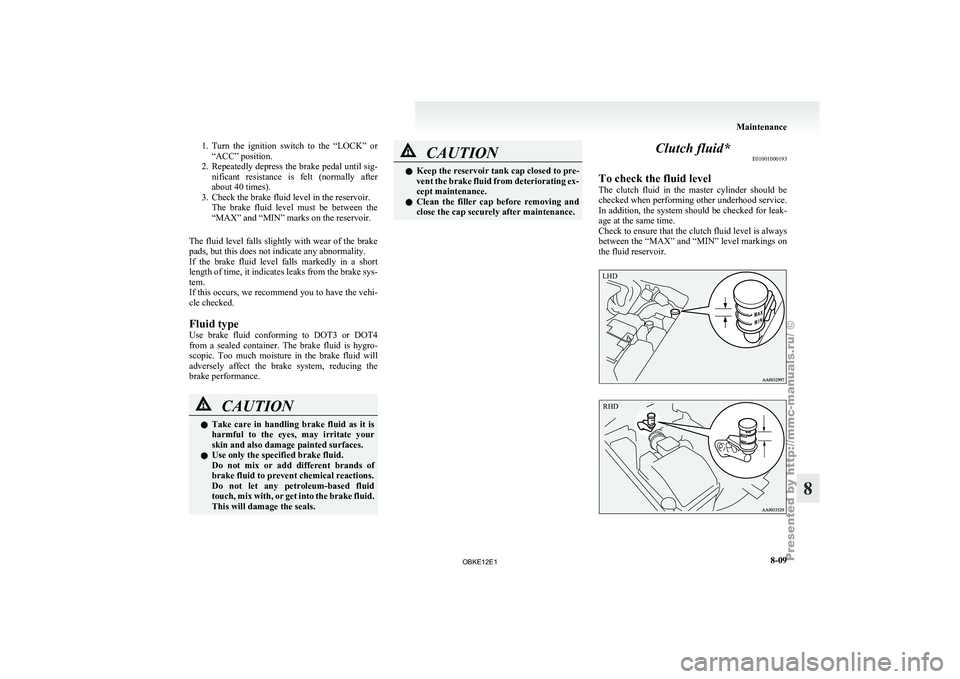
Check to ensure that the clutch fluid level is always
between the “MAX” and “MIN” level markings on
the fluid reservoir.
LHD
RHD Maintenance
8-09 8
OBKE12E1
Page 323 of 377
![MITSUBISHI PAJERO IV 2011 Owners Manual Tyre size Wheel size Max. chain
height[mm]
265/65R17 112H
265/65R17 112S 17 x 7 1/2 J
22
265/60R18 110H 18 x 7 1/2 JThe speed limit for tyre chain is 50 km/h (30 mph)
and
remove
the tyre chains a](/img/19/58151/w960_58151-322.png "MITSUBISHI PAJERO IV 2011 Owners Manual Tyre size Wheel size Max. chain
height[mm]
265/65R17 112H
265/65R17 112S 17 x 7 1/2 J
22
265/60R18 110H 18 x 7 1/2 JThe speed limit for tyre chain is 50 km/h (30 mph)
and
remove
the tyre chains a")
Tyre size Wheel size Max. chain
height[mm]
265/65R17 112H
265/65R17 112S 17 x 7 1/2 J
22
265/60R18 110H 18 x 7 1/2 JThe speed limit for tyre chain is 50 km/h (30 mph)
and
remove
the tyre chains as soon as possible on
snow free roads. CAUTION
l
As your vehicle is equipped with anti-lock
brake system
(ABS),
in order to ensure
that the anti-lock brake system (ABS)
will operate correctly in situations where
tyre chains have been fitted, drive in
“4H”, “4HLc” or “4LLc”.
l Practice fitting the chains before you
need them.
Don’t expect help from other people in
the cold.
l Choose a clear straight stretch of road
where you can pull over and still be seen
while you are fitting the chains.
l Do not fit chains before you need them.
This will wear out your tyres and the
road surface.
l After driving around 100-300 metres,
stop and retighten the chains. CAUTION
l
Drive carefully and
do not exceed
50 km/h (30 mph). Remember, fitting
chains is not going to stop accidents from
happening.
l When tyre chains are installed, take care
that they do not damage the disc wheel or
body.
l An aluminium wheel can be damaged by
a tyre chain while driving. When fitting a
tyre chain on an aluminium wheel, take
care that any part of the chain and fitting
cannot be brought into contact with the
wheel.
l When installing or removing the tyre
chains, take care that hands and other
parts of your body are not injured by the
sharp edges of the vehicle body.
NOTE l The
laws and
regulations concerning the use
of tyre chains vary. Always follow local laws
and regulations.
In most countries, it is prohibited by law to
use tyre chains on roads without snow. Parking brake break-in
E01008300010
Break-in the parking
brake linings whenever the
brake performance of the parking brake is insuffi-
cient or whenever the parking brake linings and/or
discs are replaced, in order to assure the best brake
performance.
This procedure is described in the vehicle service
manual and can be carried out by a MITSUBISHI
MOTORS Authorized Service Point. Maintenance
8-16
8
OBKE12E1
Page 326 of 377
For cold and snowy weather
E01002800299
Ventilation slots
The ventilation slots
in front of the windscreen
should be kept clear of leaves or brushed clear after
heavy snowfall, so that the operation of the heating
and ventilation systems will not be impaired.
Weatherstripping
To prevent freezing of the weatherstripping on the
doors, bonnet, etc., they should be treated with sili-
cone grease.
Additional equipment
It is a good idea to carry a shovel or a short-han-
dled spade in the vehicle during the winter so that
you can clear away snow if you get stranded. A
small hand-brush for sweeping snow off the vehi-
cle and a plastic scraper for the windscreen and
rear window are also useful. Fusible links
E01002900434
The fusible links
will melt to prevent a fire if a
large current attempts to flow through certain elec-
trical systems.
In case of a melted fusible link, we recommend
you to have your vehicle inspected.
For the fusible links, please refer to “Fuse load ca-
pacity” on page 8-20. WARNING
l Fusible links
must
not be replaced by any
other device. Failing to fit the correct fusi-
ble link may result in fire in the vehicle,
property destruction and serious or fatal
injuries at any time. Fuses
E01003000849
Fuse block location E01007600250
To prevent damage to the electrical system due to
shortcircuiting or overloading,
each individual cir-
cuit is provided with a fuse.
There are fuse blocks in the passenger compart-
ment and in the engine compartment.
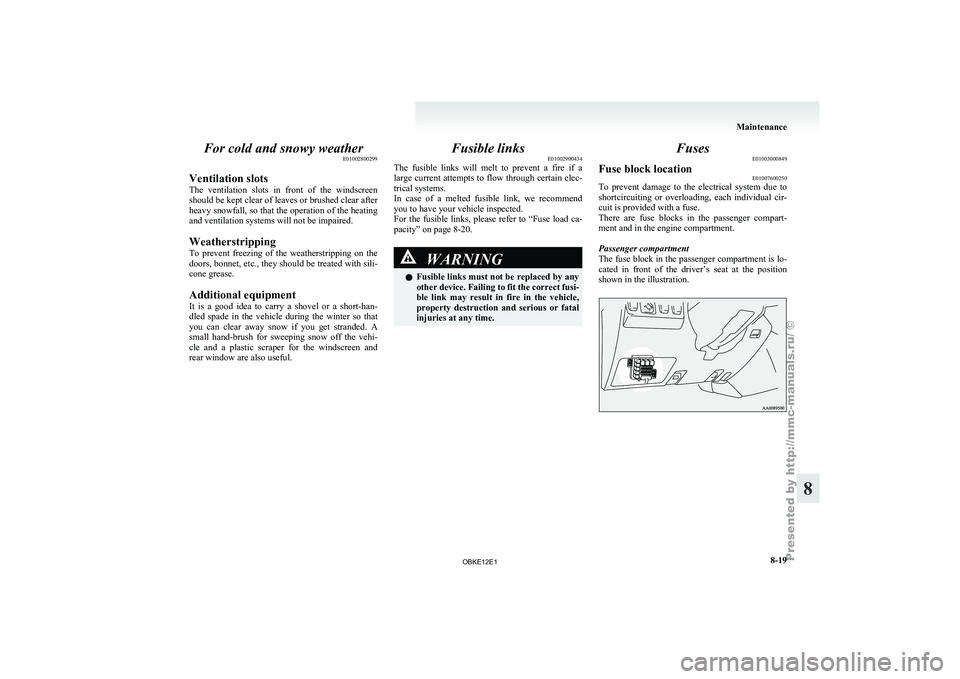
Passenger compartment
The fuse block in the passenger compartment is lo-
cated in front of the driver’s seat at the position
shown in the illustration. Maintenance
8-19 8
OBKE12E1