key MITSUBISHI SPYDER 1990 Service User Guide
[x] Cancel search | Manufacturer: MITSUBISHI, Model Year: 1990, Model line: SPYDER, Model: MITSUBISHI SPYDER 1990Pages: 2103, PDF Size: 68.98 MB
Page 529 of 2103
E N G I N E
AND ENGINE>
ON-BOARD DIAGNOSTICS
The engine control module monitors the input/out-
put signals (some signals at all times and the othe rs
under specified conditions) of the engine control
module.
Whenamalfunction has continued for a specified
time or longer since the irregular signal is initia lly
monitored, the engine control module judges that
a malfunction has occurred.
After the ECM first detects a malfunction, a diagno s-
tic trouble code is recorded when the engine is
restarted and the same malfunction is re-detected.
However, for items marked with a
a diagnostic
trouble code is recorded on the first detection of
the malfunction.
There are 45 diagnostic items, and the diagnostic results can be read out with a scan tool.
Moreover, since memorization of the diagnostic
trouble codes is backed up directly by the battery,
the diagnostic results are memorized even if the ignition key is turned off. The diagnostic trouble
codes will, however, be erased when the battery
terminal or the engine control module connector
is disconnected.
In addition, the diagnostic trouble code can also
be erased by turning the ignition switch to ON and
sending the diagnostic trouble code erase signal
from the scan tool to the engine control module.
Caution
If the sensor connector ‘is disconnected wlth
the’ ignition switch turned on, the diagnostic
trouble code is
In send
the diagnostic trouble code erase to the
engine control module in order to erase the
diagnostic memory.
The 45 diagnostic items are as follows,
and if plural items are activated, they are all ind i-
cated sequentially from the smallest code number.
Caution
The diagnostic trouble code of ignition
adjustment signal is output whenever
for ignition timing adjustment Is grounded.
Therefore, it is not a malfunction that the code
is output when adjusting
The ECM records the diagnostic, trouble code and
the engine operating conditions at the time the
malfunction was detected.’ These are called
“freeze frame” data.
This data indicates the engine operafing condition
from when nothing at all is detected to the initial
detection of malfunction.
This data can be read by using the scan tool, and
can then be used in simulation tests trouble-
shooting. Data items are as follows.,,
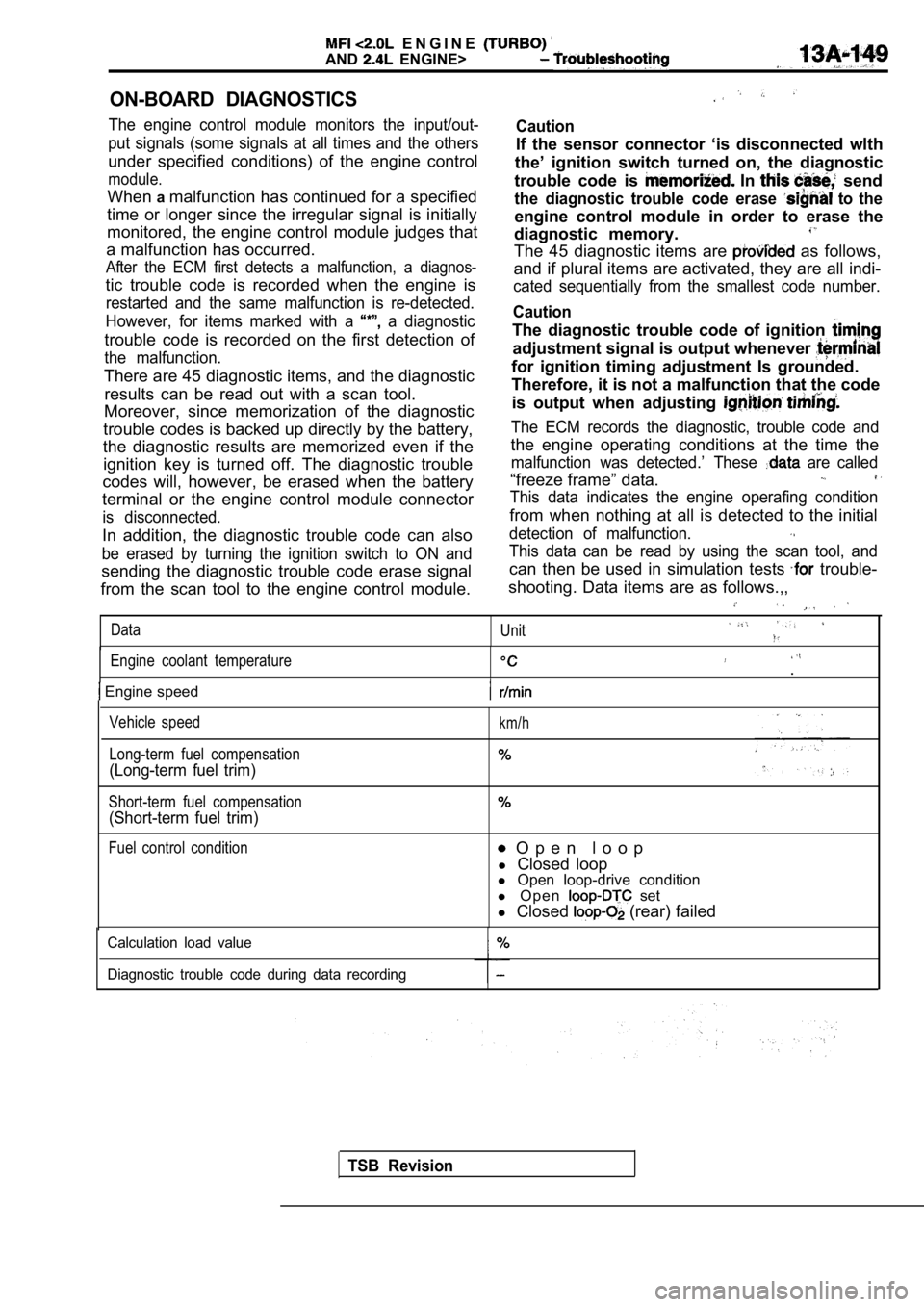
Data Unit
Engine coolant temperature.
Engine speed
Vehicle speed
Long-term fuel compensation
(Long-term fuel trim)
Short-term fuel compensation
(Short-term fuel trim)
km/h
Fuel control condition O p e n l o o p
l Closed loop
l Open loop-drive condition
l O p e n
set
l Closed
(rear) failed
Calculation load value
Diagnostic trouble code during data recording
TSB Revision
Page 647 of 2103
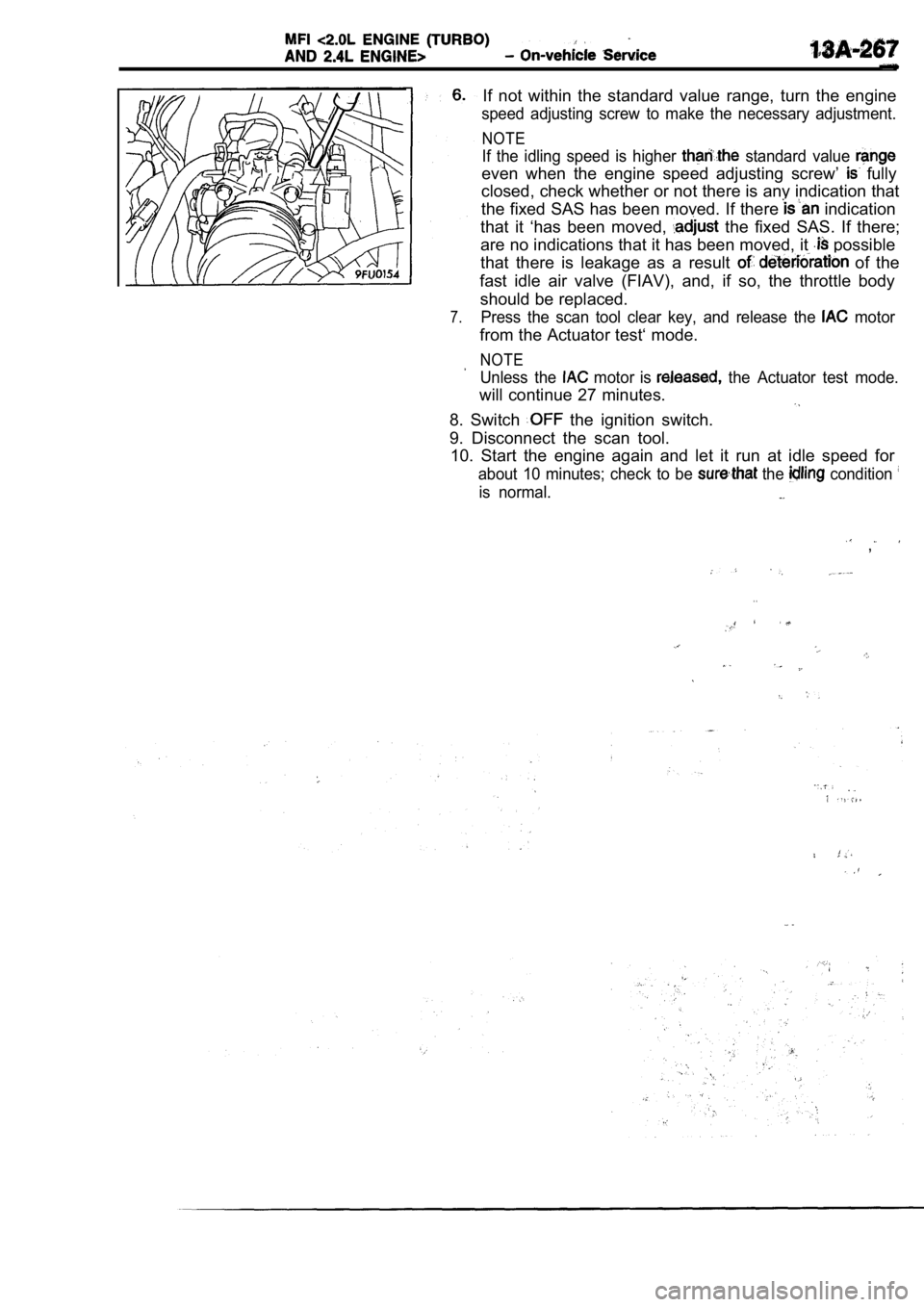
If not within the standard value range, turn the engine
speed adjusting screw to make the necessary adjustm ent.
NOTE
If the idling speed is higher standard value
even when the engine speed adjusting screw’ fully
closed, check whether or not there is any indicatio n that
the fixed SAS has been moved. If there
indication
that it ‘has been moved,
the fixed SAS. If there;
are no indications that it has been moved, it
possible
that there is leakage as a result
of the
fast idle air valve (FIAV), and, if so, the throttl e body
should be replaced.
7.Press the scan tool clear key, and release the motor
from the Actuator test‘ mode.
NOTE
Unless the motor is the Actuator test mode.
will continue 27 minutes.
8. Switch the ignition switch.
9. Disconnect the scan tool. 10. Start the engine again and let it run at idle s peed for
about 10 minutes; check to be the condition
is normal.
,
. .
Page 749 of 2103
ENGINE AND EMISSION CONTROL Auto-cruise Control
TROUBLESHOOTING ENGINE (NON-TURBO)>
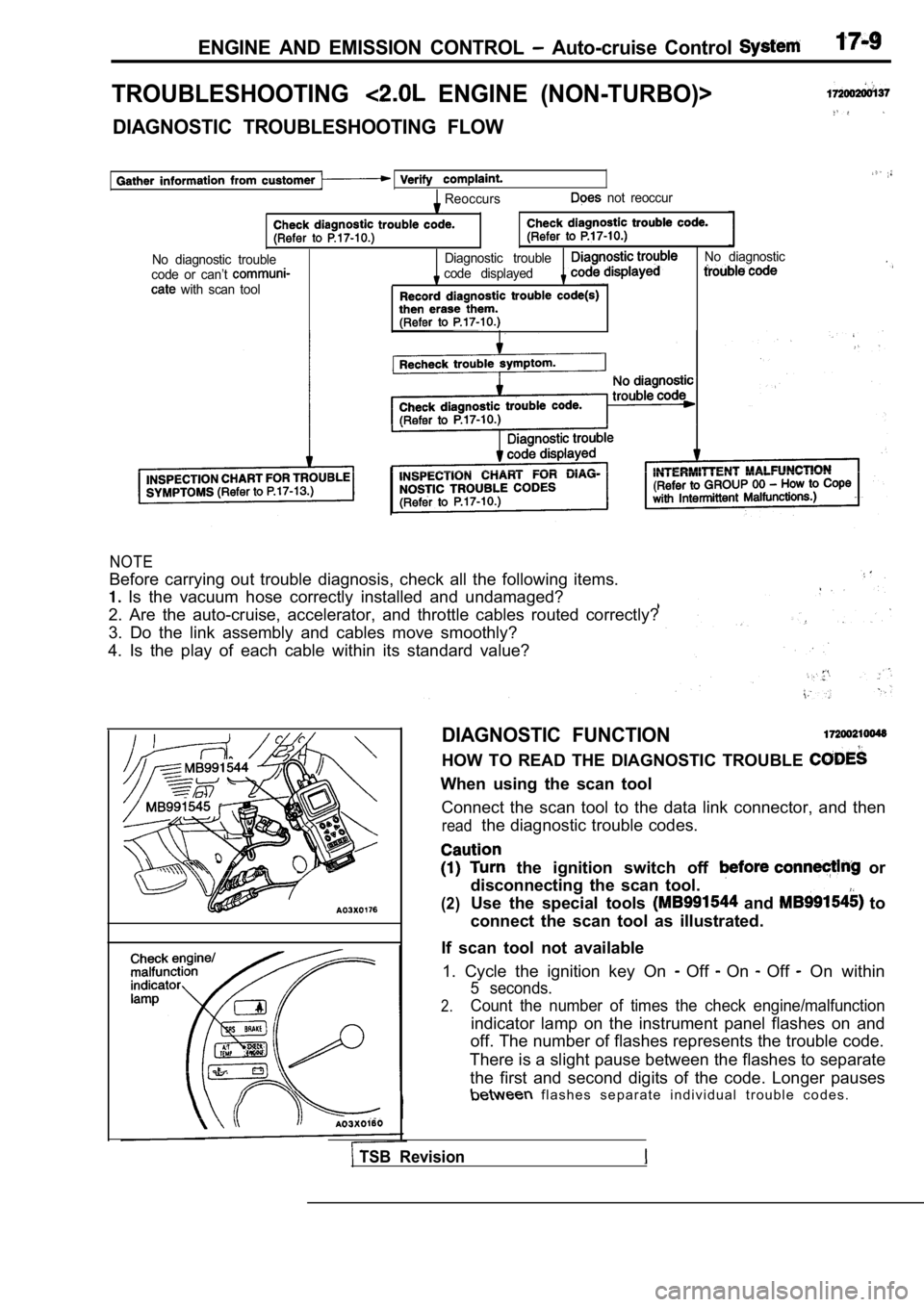
DIAGNOSTIC TROUBLESHOOTING FLOW
Reoccurs not reoccur
No diagnostic troubleDiagnostic troubleNo diagnostic
code or can’t code displayed
with scan tool
NOTE
Before carrying out trouble diagnosis, check all th e following items.
Is the vacuum hose correctly installed and undamag ed?
2. Are the auto-cruise, accelerator, and throttle c ables routed correctly?
3. Do the link assembly and cables move smoothly?
4. Is the play of each cable within its standard va lue?
DIAGNOSTIC FUNCTION
HOW TO READ THE DIAGNOSTIC TROUBLE
When using the scan tool
Connect the scan tool to the data link connector, a nd then
readthe diagnostic trouble codes.
the ignition switch off or
disconnecting the scan tool.
(2)Use the special tools and to
connect the scan tool as illustrated.
If scan tool not available 1. Cycle the ignition key On
Off On Off On within
5 seconds.
2.Count the number of times the check engine/malfunct ion
indicator lamp on the instrument panel flashes on and
off. The number of flashes represents the trouble c ode.
There is a slight pause between the flashes to sepa rate
the first and second digits of the code. Longer pau ses
f l a s h e s s e p a r a t e i n d i v i d u a l t r o u b l e c o d e s .
TSB Revision
Page 775 of 2103
ENGINE AND EMISSION CONTROL Auto-cruise Control System
Adjusting nut(C)
c o n t r o l - - - - - -
ON
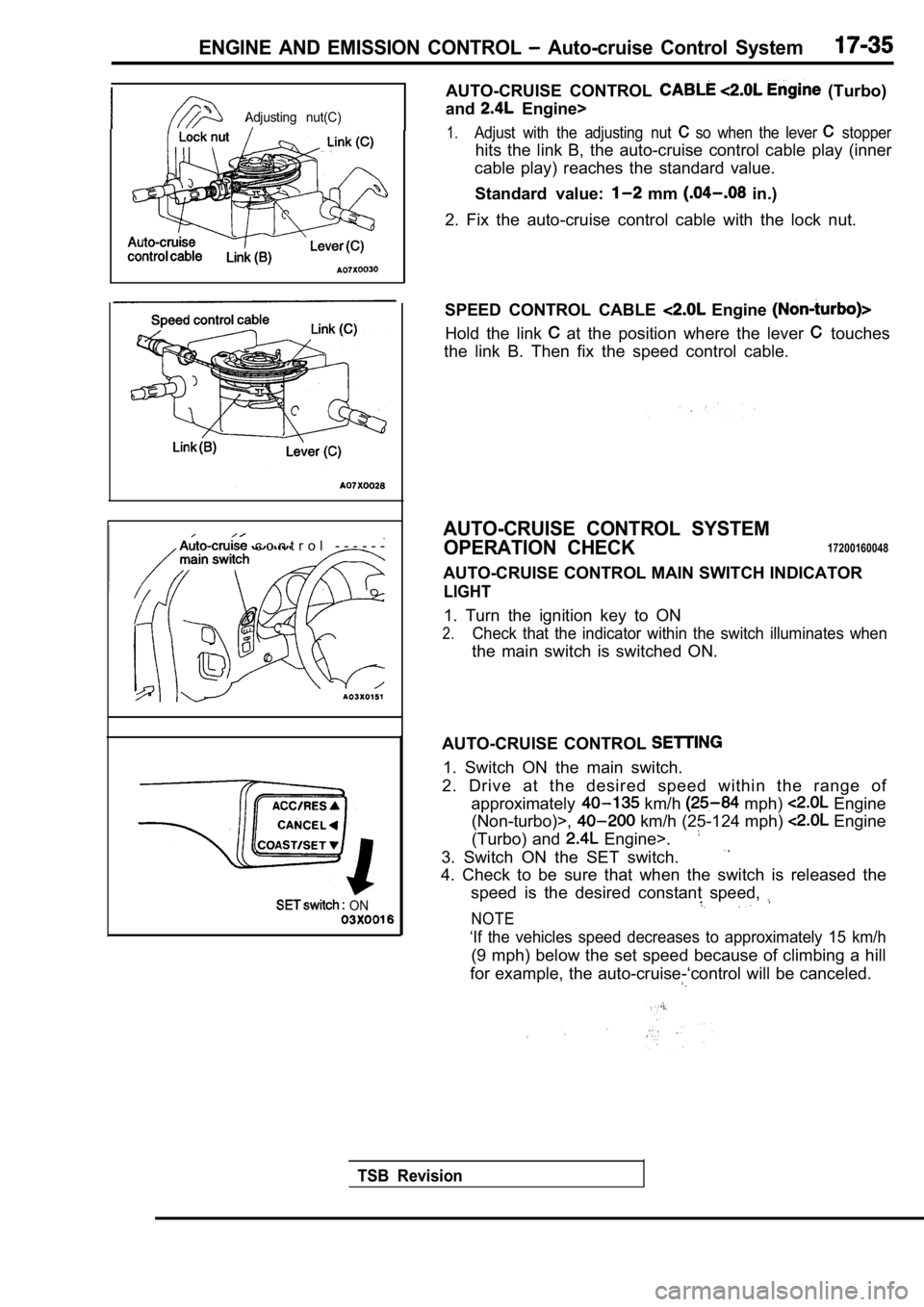
AUTO-CRUISE CONTROL (Turbo)
and
Engine>
1.Adjust with the adjusting nut so when the lever stopper
hits the link B, the auto-cruise control cable play (inner
cable play) reaches the standard value.
Standard value:
mm in.)
2. Fix the auto-cruise control cable with the lock nut.
SPEED CONTROL CABLE
Engine
Hold the link at the position where the lever touches
the link B. Then fix the speed control cable.
AUTO-CRUISE CONTROL SYSTEM
OPERATION CHECK
17200160048
AUTO-CRUISE CONTROL MAIN SWITCH INDICATOR
LIGHT
1. Turn the ignition key to ON
2.Check that the indicator within the switch illumina tes when
the main switch is switched ON.
AUTO-CRUISE CONTROL
1. Switch ON the main switch.
2. Drive at the desired speed within the range of approximately
km/h mph) Engine
(Non-turbo)>,
km/h (25-124 mph) Engine
(Turbo) and
Engine>.
3. Switch ON the SET switch.
4. Check to be sure that when the switch is release d the
speed is the desired constant speed,
.
NOTE
‘If the vehicles speed decreases to approximately 1 5 km/h
(9 mph) below the set speed because of climbing a h ill
for example, the auto-cruise-‘control will be cance led.
TSB Revision
Page 926 of 2103
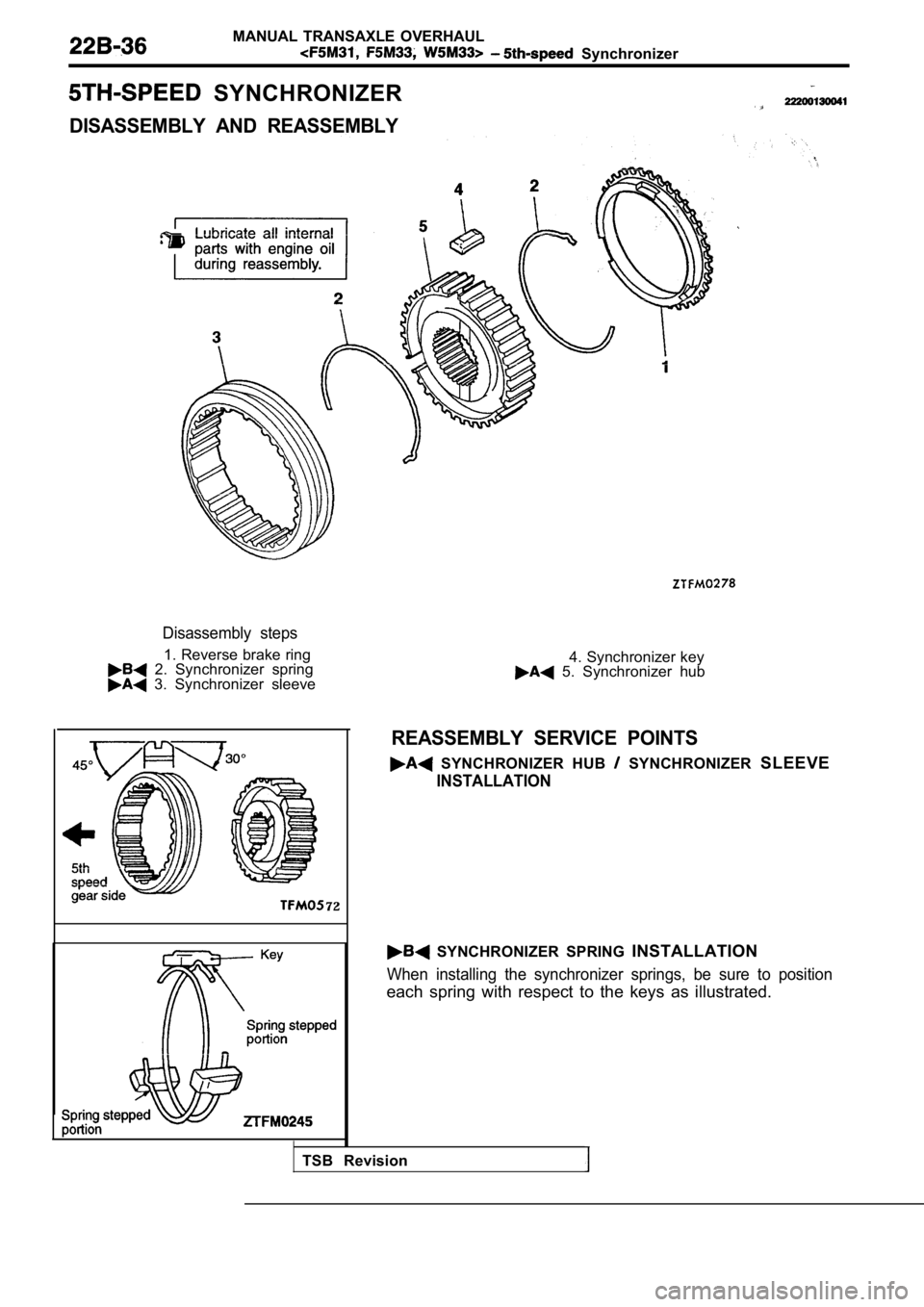
MANUAL TRANSAXLE OVERHAUL
Synchronizer
SYNCHRONIZER
DISASSEMBLY AND REASSEMBLY
Disassembly steps
1. Reverse brake ring 2. Synchronizer spring 3. Synchronizer sleeve
72
4. Synchronizer key 5. Synchronizer hub
REASSEMBLY SERVICE POINTS
SYNCHRONIZER HUB SYNCHRONIZER SLEEVE
INSTALLATION
SYNCHRONIZER SPRING INSTALLATION
When installing the synchronizer springs, be sure t o position
each spring with respect to the keys as illustrated.
TSB Revision
Page 927 of 2103
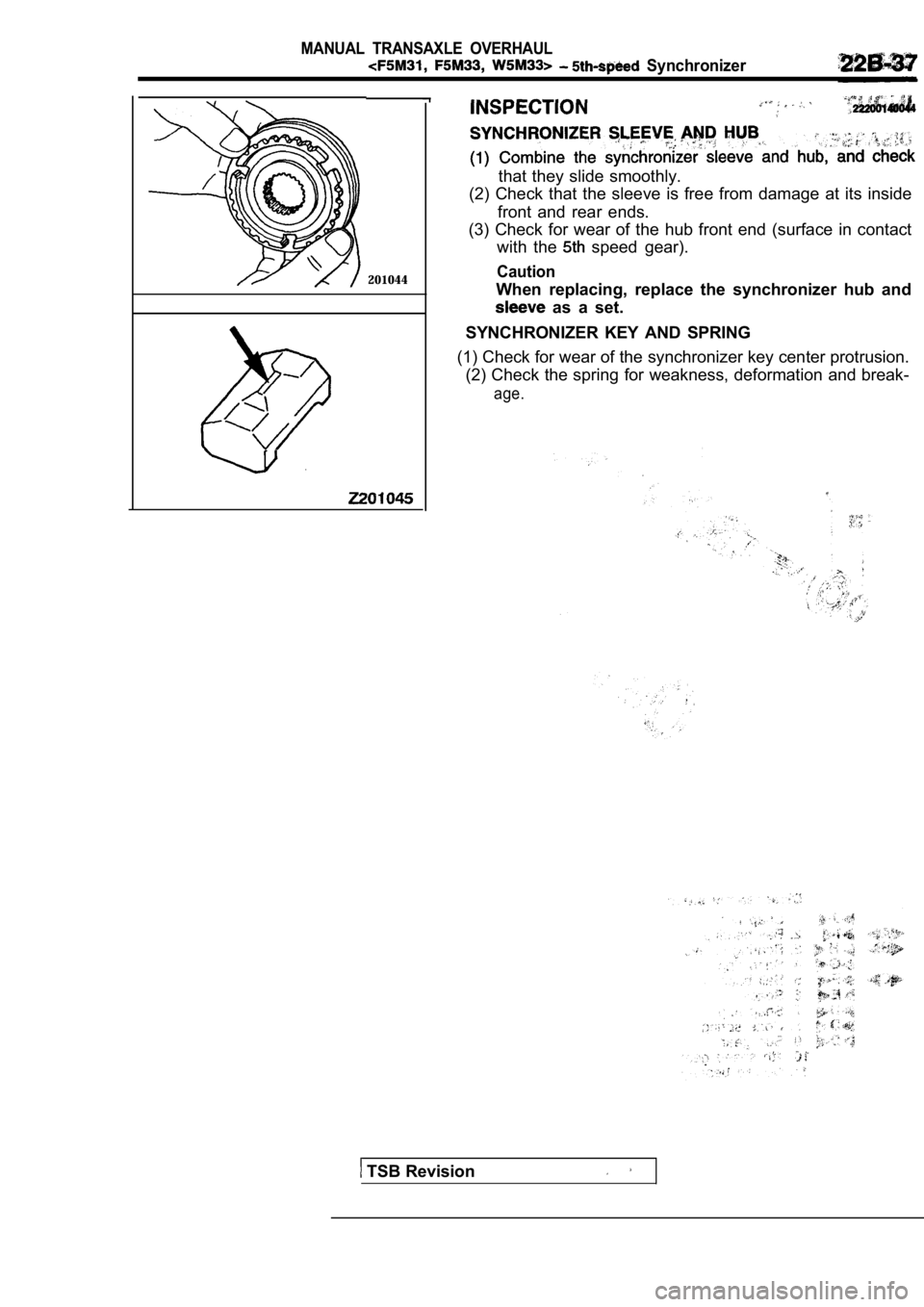
MANUAL TRANSAXLE OVERHAUL
Synchronizer
201044
that they slide smoothly.
(2) Check that the sleeve is free from damage at it s inside
front and rear ends.
(3) Check for wear of the hub front end (surface in contact
with the
speed gear).
Caution
When replacing, replace the synchronizer hub and
as a set.
SYNCHRONIZER KEY AND SPRING
(1) Check for wear of the synchronizer key center p rotrusion.
(2) Check the spring for weakness, deformation and break-
age.
TSB Revision
Page 929 of 2103
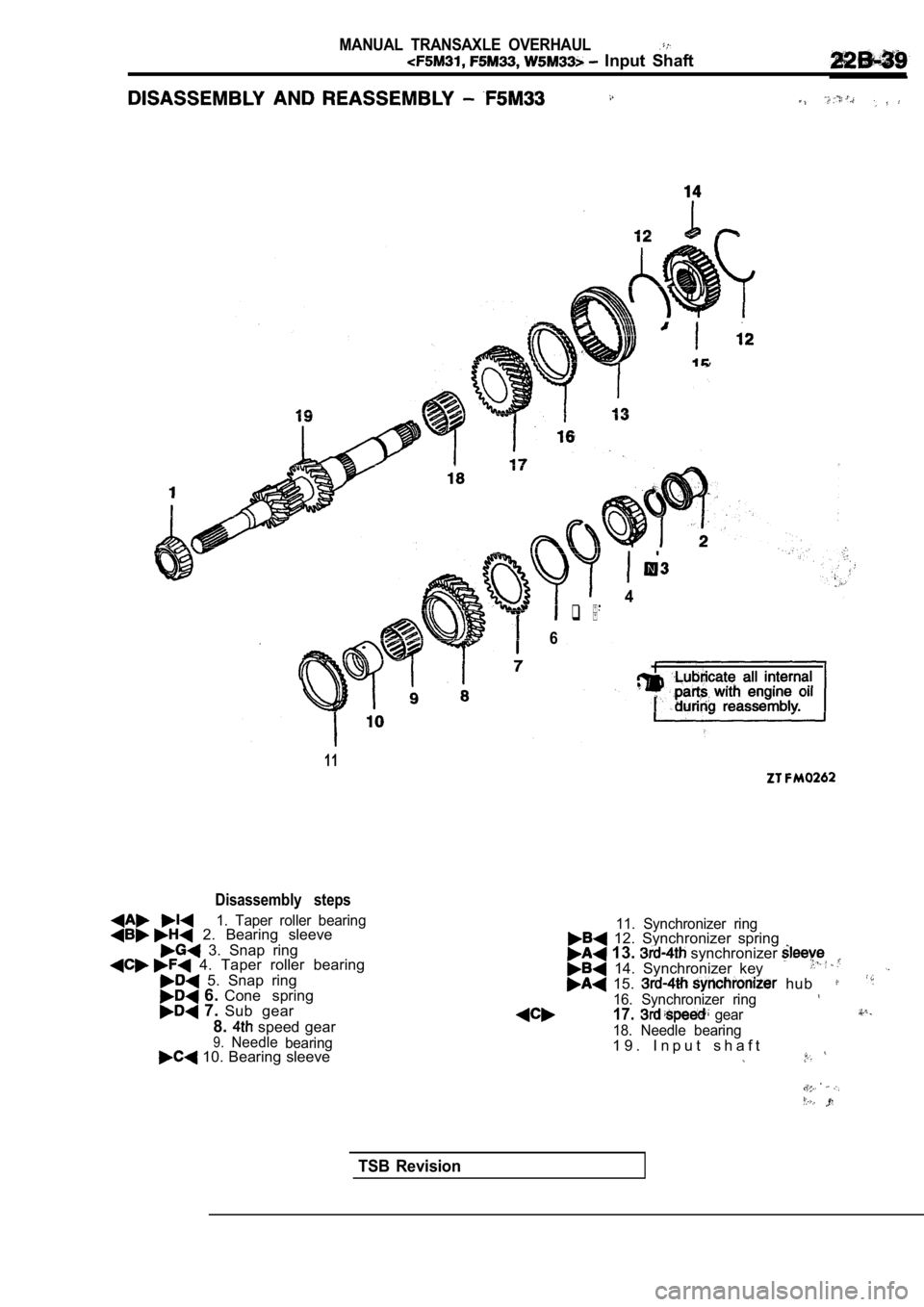
MANUAL TRANSAXLE OVERHAUL
Input Shaft
4
q 5
6
11
Disassembly steps
1. Taper roller bearing 2. Bearing sleeve
3. Snap ring 4. Taper roller bearing
5. Snap ring 6. Cone spring 7. Sub gear
8.
speed gear9.Needle bearing 10. Bearing sleeve
11. Synchronizer ring 12. Synchronizer spring 13. synchronizer 14. Synchronizer key 15. hub
16. Synchronizer ring17. gear
18. Needle bearing1 9 . I n p u t s h a f t
TSB Revision
Page 932 of 2103
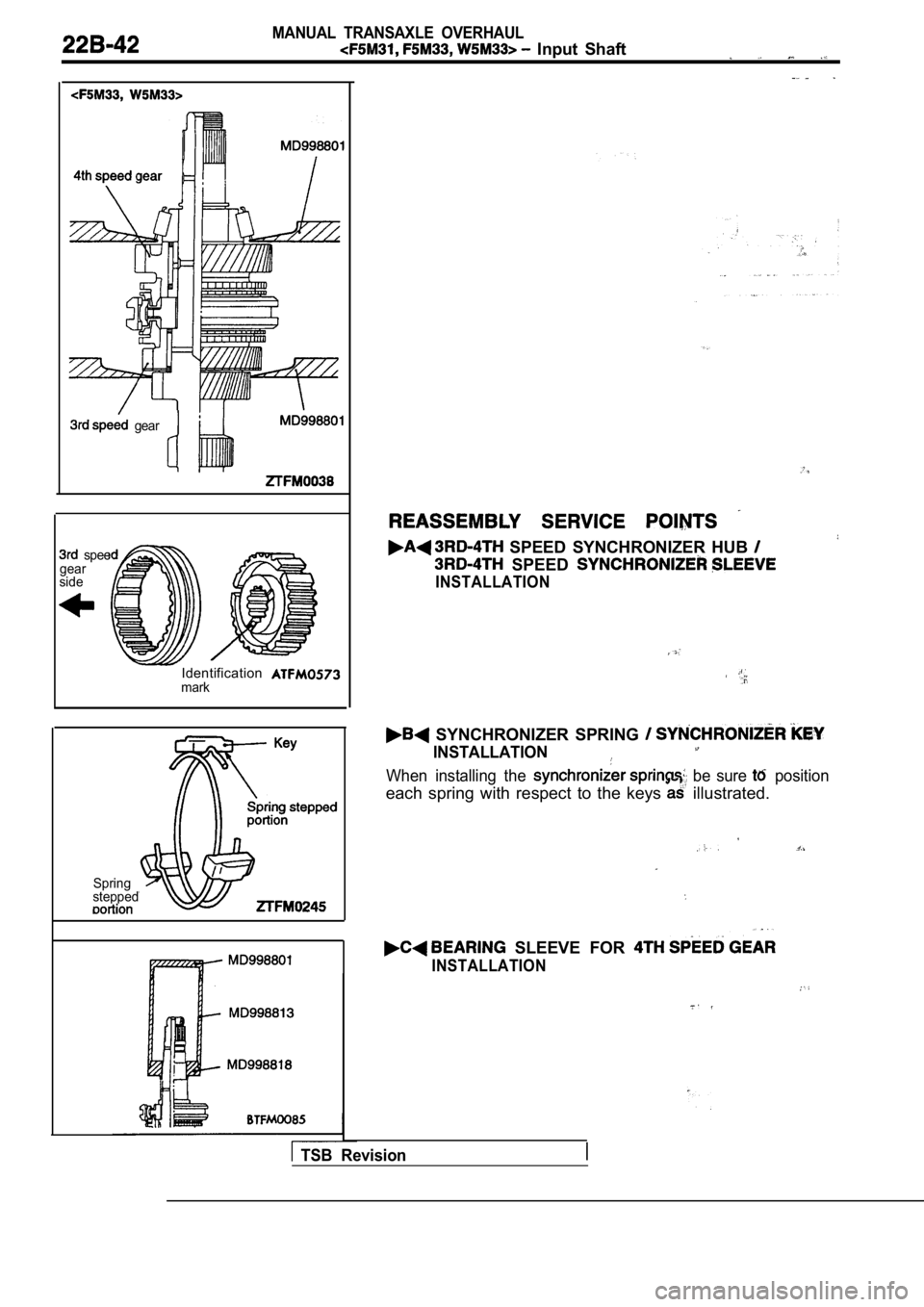
MANUAL TRANSAXLE OVERHAUL
Input Shaft
gear
spee
gear
side
Identificationmark
Spring
stepped
SPEED SYNCHRONIZER HUB
SPEED
INSTALLATION
SYNCHRONIZER SPRING
INSTALLATION
When installing the be sure position
each spring with respect to the keys illustrated.
SLEEVE FOR
INSTALLATION
TSB Revision
Page 937 of 2103
MANUAL TRANSAXLE OVERHAUL
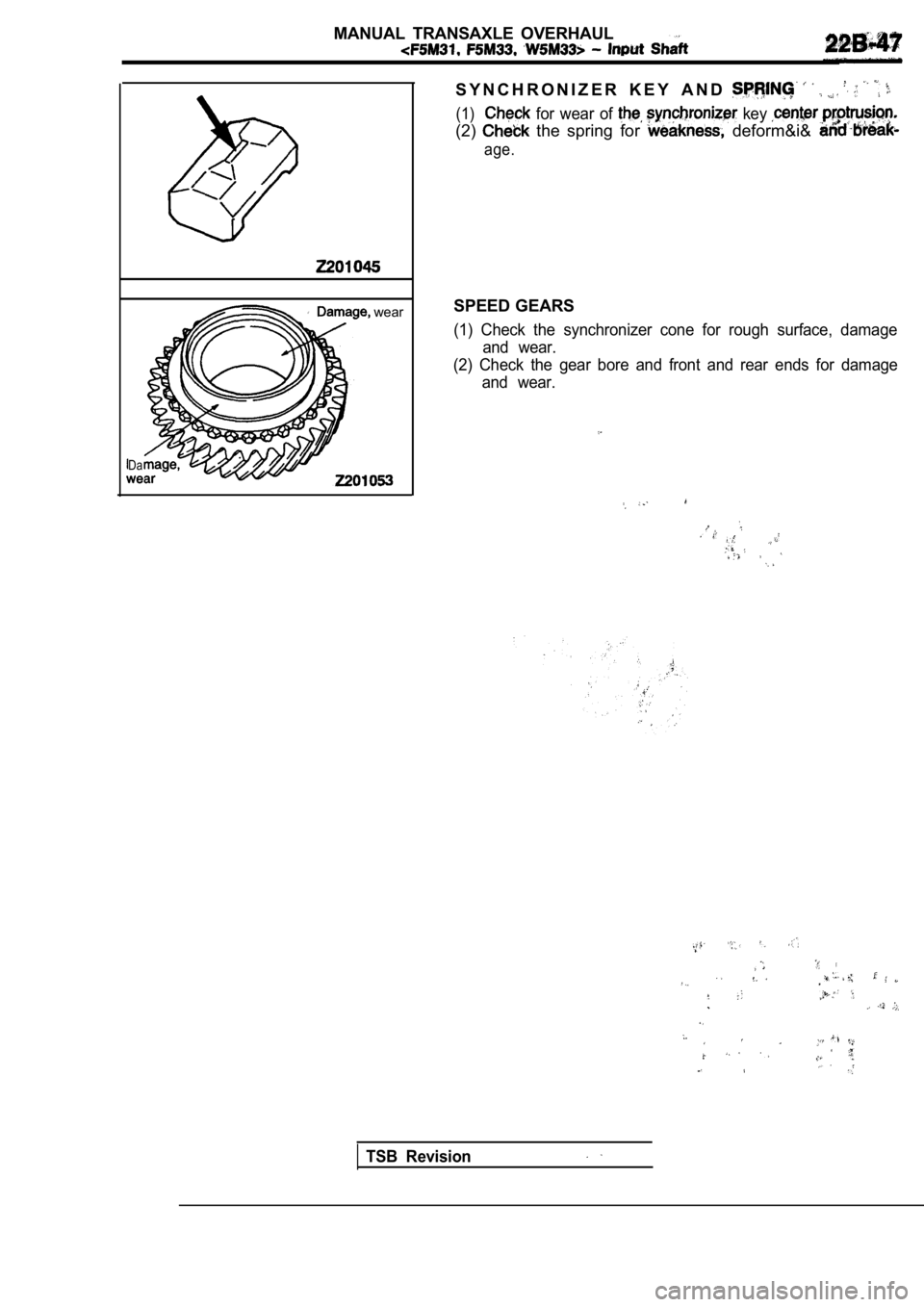
wear
Da
S Y N C H R O N I Z E R K E Y A N D
(1) for wear of key
(2) the spring for deform&i&
age.
SPEED GEARS
(1) Check the synchronizer cone for rough surface, damage
and wear.
(2) Check the gear bore and front and rear ends for damage
and wear.
TSB Revision
Page 938 of 2103
MANUAL TRANSAXLE OVERHAUL
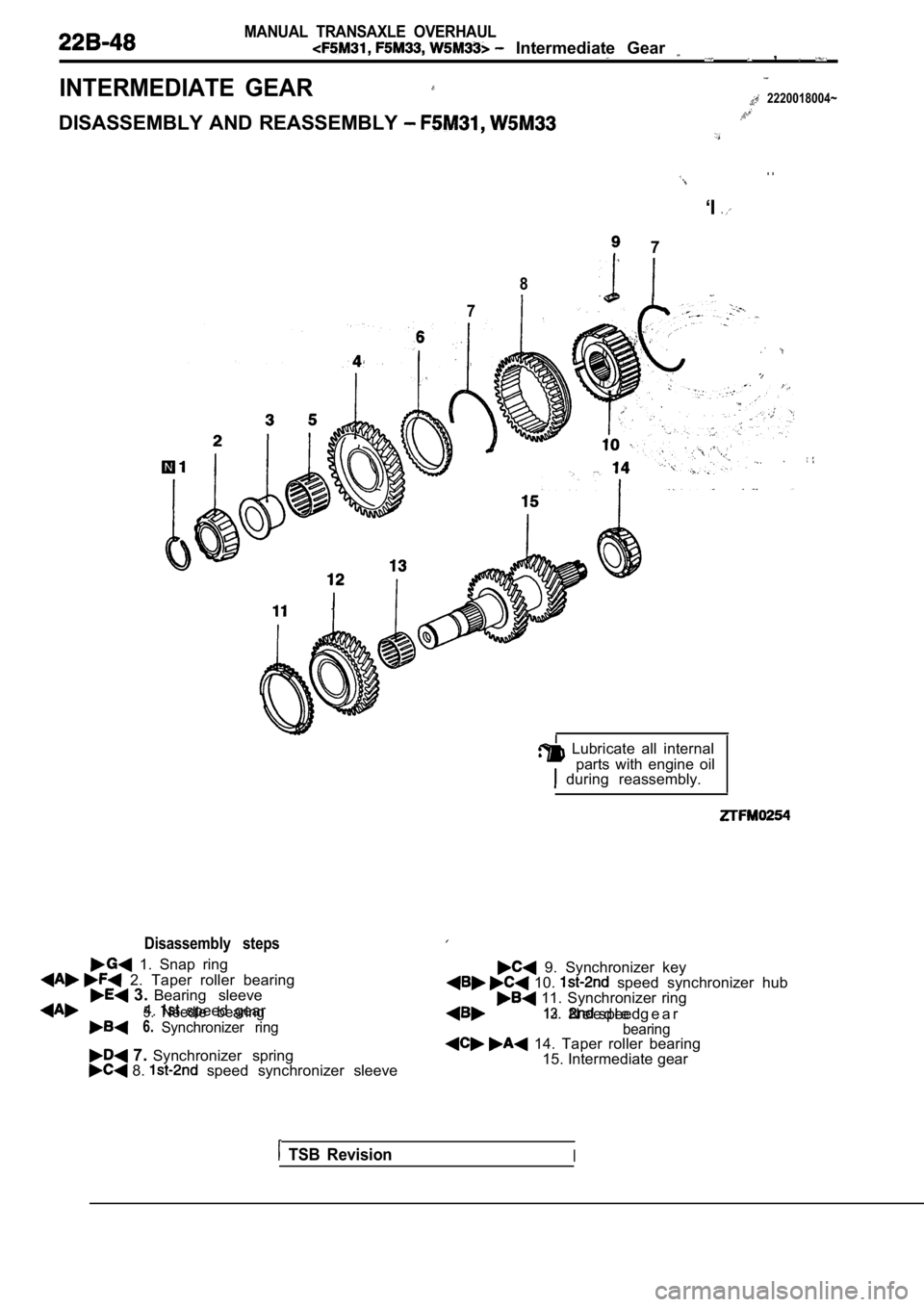
Intermediate Gear ,
INTERMEDIATE GEAR 2220018004~
DISASSEMBLY AND REASSEMBLY
. .
‘I
7
8
7
Lubricate all internalparts with engine oil
during reassembly.
Disassembly steps
1. Snap ring
2. Taper roller bearing 9. Synchronizer key
3. Bearing sleeve 10. speed synchronizer hub
4.
speed gear 11. Synchronizer ring
12.
5. speed13.N e e d l e g e a r6.Needle bearing
Synchronizer ring bearing
7. Synchronizer spring 14. Taper roller bearing
8. speed synchronizer sleeve 15. Intermediate gear
TSB RevisionI