ESP MITSUBISHI SPYDER 1990 Service Owner's Manual
[x] Cancel search | Manufacturer: MITSUBISHI, Model Year: 1990, Model line: SPYDER, Model: MITSUBISHI SPYDER 1990Pages: 2103, PDF Size: 68.98 MB
Page 518 of 2103
ENGINE
AND ENGINE> G e n e r a l
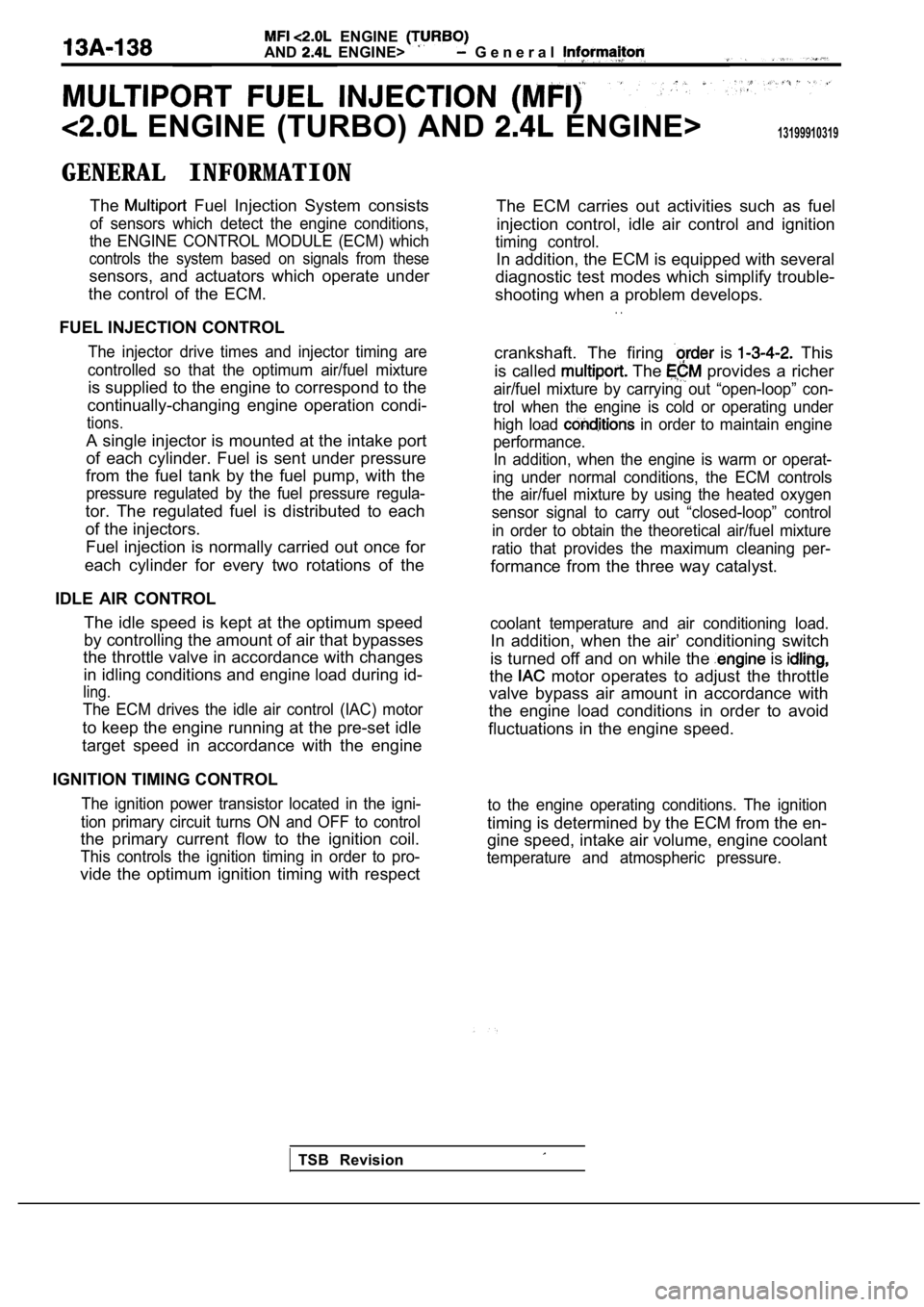
ENGINE (TURBO) AND ENGINE>13199910319
GENERAL INFORMATIONThe
Fuel Injection System consists
of sensors which detect the engine conditions,
the ENGINE CONTROL MODULE (ECM) which
controls the system based on signals from these
sensors, and actuators which operate under
the control of the ECM.
FUEL INJECTION CONTROL
The injector drive times and injector timing are
controlled so that the optimum air/fuel mixture
is supplied to the engine to correspond to the
continually-changing engine operation condi-
tions.
A single injector is mounted at the intake port
of each cylinder. Fuel is sent under pressure
from the fuel tank by the fuel pump, with the
pressure regulated by the fuel pressure regula-
tor. The regulated fuel is distributed to each
of the injectors.
Fuel injection is normally carried out once for
each cylinder for every two rotations of the
IDLE AIR CONTROL The idle speed is kept at the optimum speed
by controlling the amount of air that bypasses
the throttle valve in accordance with changes
in idling conditions and engine load during id-
ling.
The ECM drives the idle air control (IAC) motor
to keep the engine running at the pre-set idle
target speed in accordance with the engine
IGNITION TIMING CONTROL
The ignition power transistor located in the igni-
tion primary circuit turns ON and OFF to control
the primary current flow to the ignition coil.
This controls the ignition timing in order to pro-
vide the optimum ignition timing with respect The ECM carries out activities such as fuel
injection control, idle air control and ignition
timing control.
In addition, the ECM is equipped with several
diagnostic test modes which simplify trouble-
shooting when a problem develops.
. .
crankshaft. The firing is This
is called
The provides a richer
air/fuel mixture by carrying out “open-loop” con-
trol when the engine is cold or operating under high load
in order to maintain engine
performance. In addition, when the engine is warm or operat-
ing under normal conditions, the ECM controls
the air/fuel mixture by using the heated oxygen
sensor signal to carry out “closed-loop” control
in order to obtain the theoretical air/fuel mixture
ratio that provides the maximum cleaning per-
formance from the three way catalyst.
coolant temperature and air conditioning load.
In addition, when the air’ conditioning switch
is turned off and on while the
is
the motor operates to adjust the throttle
valve bypass air amount in accordance with
the engine load conditions in order to avoid
fluctuations in the engine speed.
to the engine operating conditions. The ignition
timing is determined by the ECM from the en-
gine speed, intake air volume, engine coolant
temperature and atmospheric pressure.
TSB Revision
Page 519 of 2103
ENGINE (TURBO)
ENGINE>
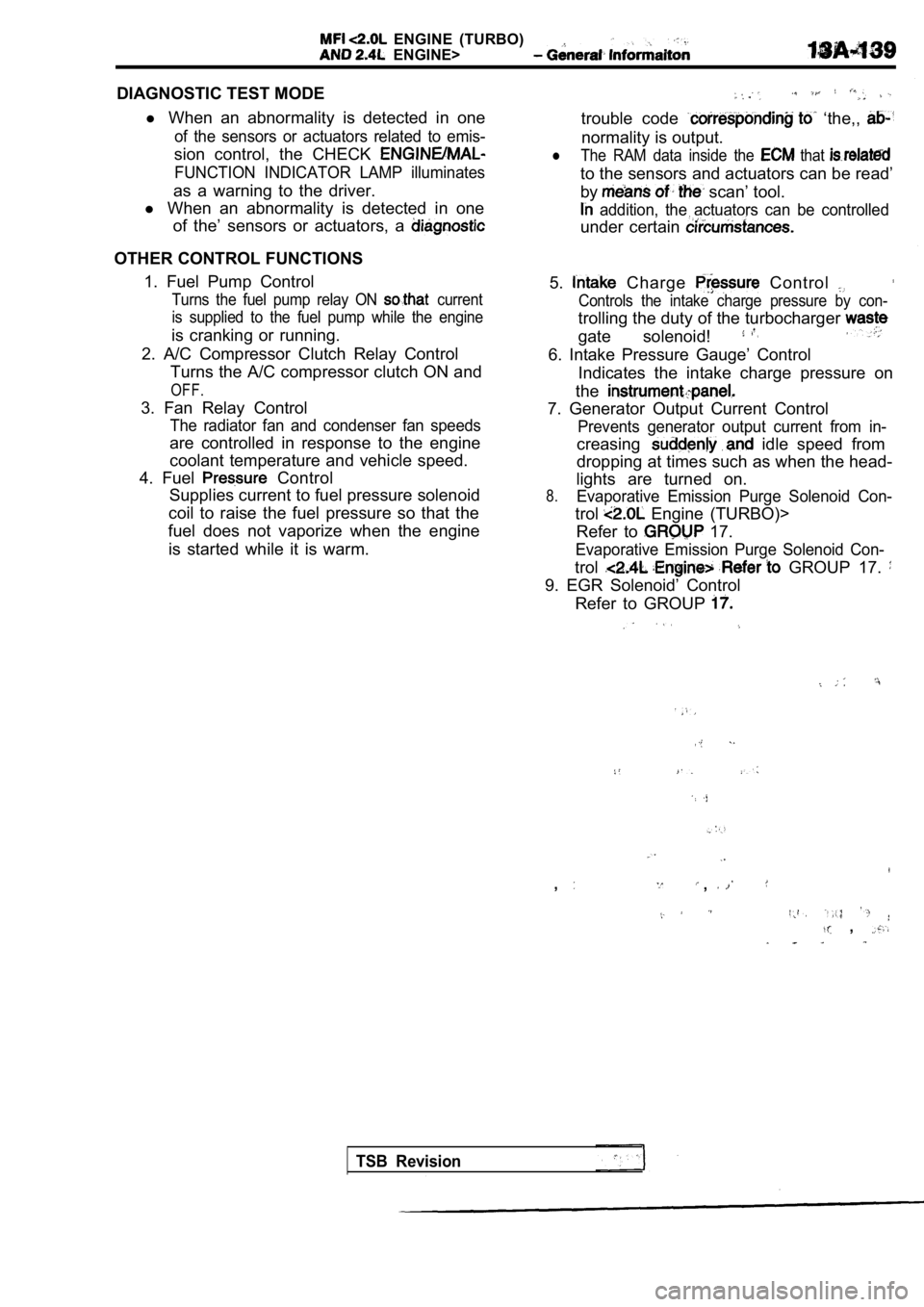
DIAGNOSTIC TEST MODEl When an abnormality is detected in one
of the sensors or actuators related to emis-
sion control, the CHECK
FUNCTION INDICATOR LAMP illuminates
as a warning to the driver.
l When an abnormality is detected in one
of the’ sensors or actuators, a
OTHER CONTROL FUNCTIONS
1. Fuel Pump Control
Turns the fuel pump relay ON current
is supplied to the fuel pump while the engine
is cranking or running.
2. A/C Compressor Clutch Relay Control Turns the A/C compressor clutch ON and
OFF.
3. Fan Relay Control
The radiator fan and condenser fan speeds
are controlled in response to the engine
coolant temperature and vehicle speed.
4. Fuel
Control
Supplies current to fuel pressure solenoid
coil to raise the fuel pressure so that the
fuel does not vaporize when the engine
is started while it is warm.
trouble code ‘the,,
normality is output.
lThe RAM data inside the that
to the sensors and actuators can be read’
by
scan’ tool.
addition, the actuators can be controlled
under certain
5. Charge Control
Controls the intake charge pressure by con-
trolling the duty of the turbocharger
gate solenoid!
6. Intake Pressure Gauge’ Control Indicates the intake charge pressure on
the
7. Generator Output Current Control
Prevents generator output current from in-
creasing idle speed from
dropping at times such as when the head-
lights are turned on.
8.Evaporative Emission Purge Solenoid Con-
trol Engine (TURBO)>
Refer to
17.
Evaporative Emission Purge Solenoid Con-
trol GROUP 17.
9. EGR Solenoid’ Control
Refer to GROUP
,,
,
TSB Revision
Page 531 of 2103
ENGINE (TURBO)
AND
ENGINE>
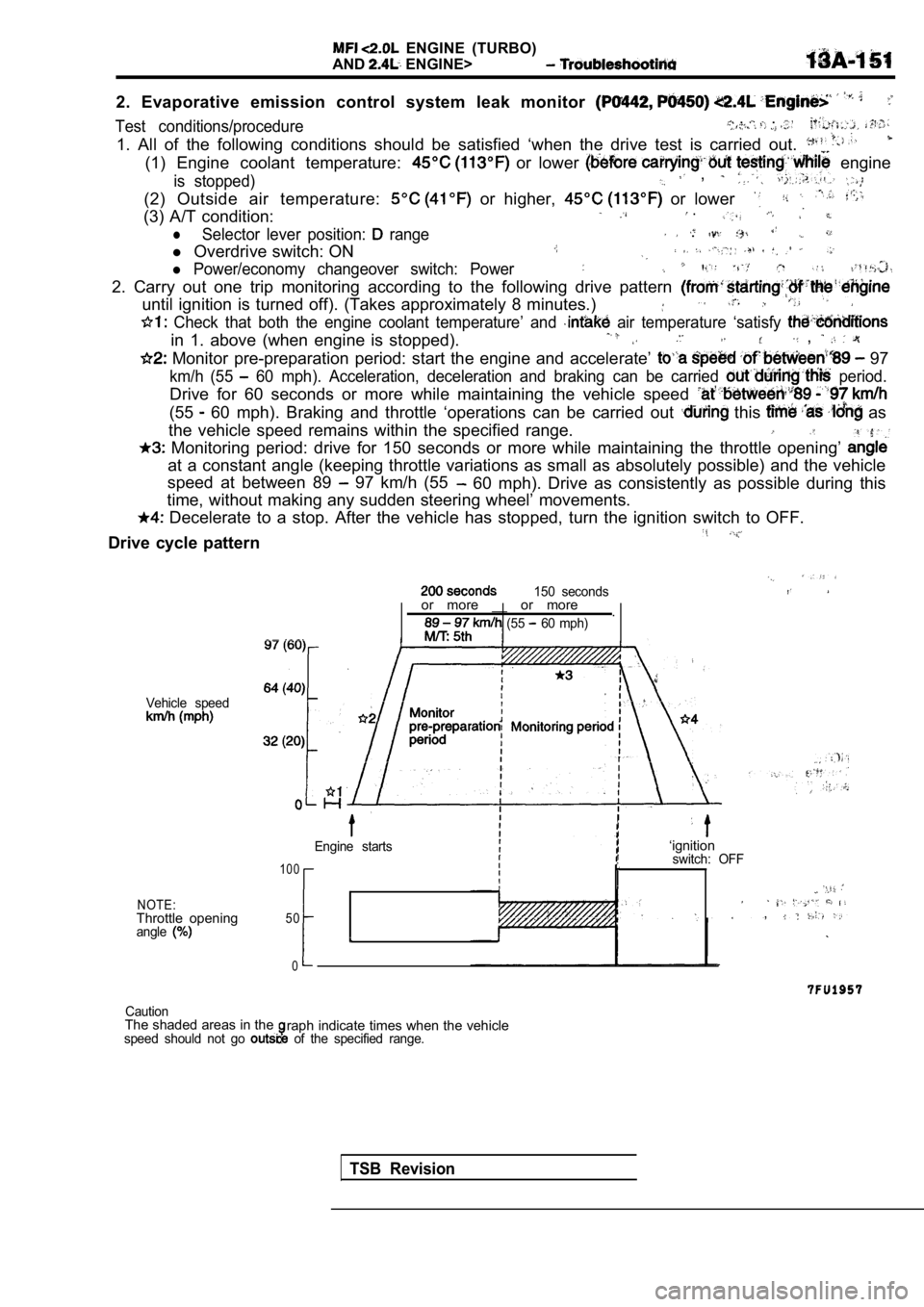
2. Evaporative emission control system leak monitor
Test conditions/procedure , . .
1. All of the following conditions should be satisfied ‘when the drive test is carried out.
(1) Engine coolant temperature: or lower engine
is stopped) ,
(2) Outside air temperature: or higher, or lower
(3) A/T condition: .
lSelector lever position: range .
l Overdrive switch: ON
l Power/economy changeover switch: Power
2. Carry out one trip monitoring according to the f ollowing drive pattern
until ignition is turned off). (Takes approximately 8 minutes.)
Check that both the engine coolant temperature’ an d air temperature ‘satisfy
in 1. above (when engine is stopped). ,
Monitor pre-preparation period: start the engine and accelerate’ 97
km/h (55 60 mph). Acceleration, deceleration and braking ca n be carried period.
Drive for 60 seconds or more while maintaining the vehicle speed
(55 60 mph). Braking and throttle ‘operations can be carried out this as
the vehicle speed remains within the specified rang e.
Monitoring period: drive for 150 seconds or more w hile maintaining the throttle opening’
at a constant angle (keeping throttle variations as small as absolutely possible) and the vehicle
speed at between 89
97 km/h (55 60 mph). Drive as consistently as possible during this
time, without making any sudden steering wheel’ mov ements.
Decelerate to a stop. After the vehicle has stopped, turn the ignition switch to OFF.
Drive cycle pattern
150 seconds
Vehicle speed
NOTE:Throttle openingangle
or more __ or more
.
(55 60 mph)
Engine starts
1 0 0
50
0
I
‘ignitionswitch: OFF
,
CautionThe shaded areas in theraph indicate times when the vehiclespeed should not go of the specified range.
TSB Revision
Page 534 of 2103
ENGINE (TURBO)
AND
ENGINE> Troubleshooting
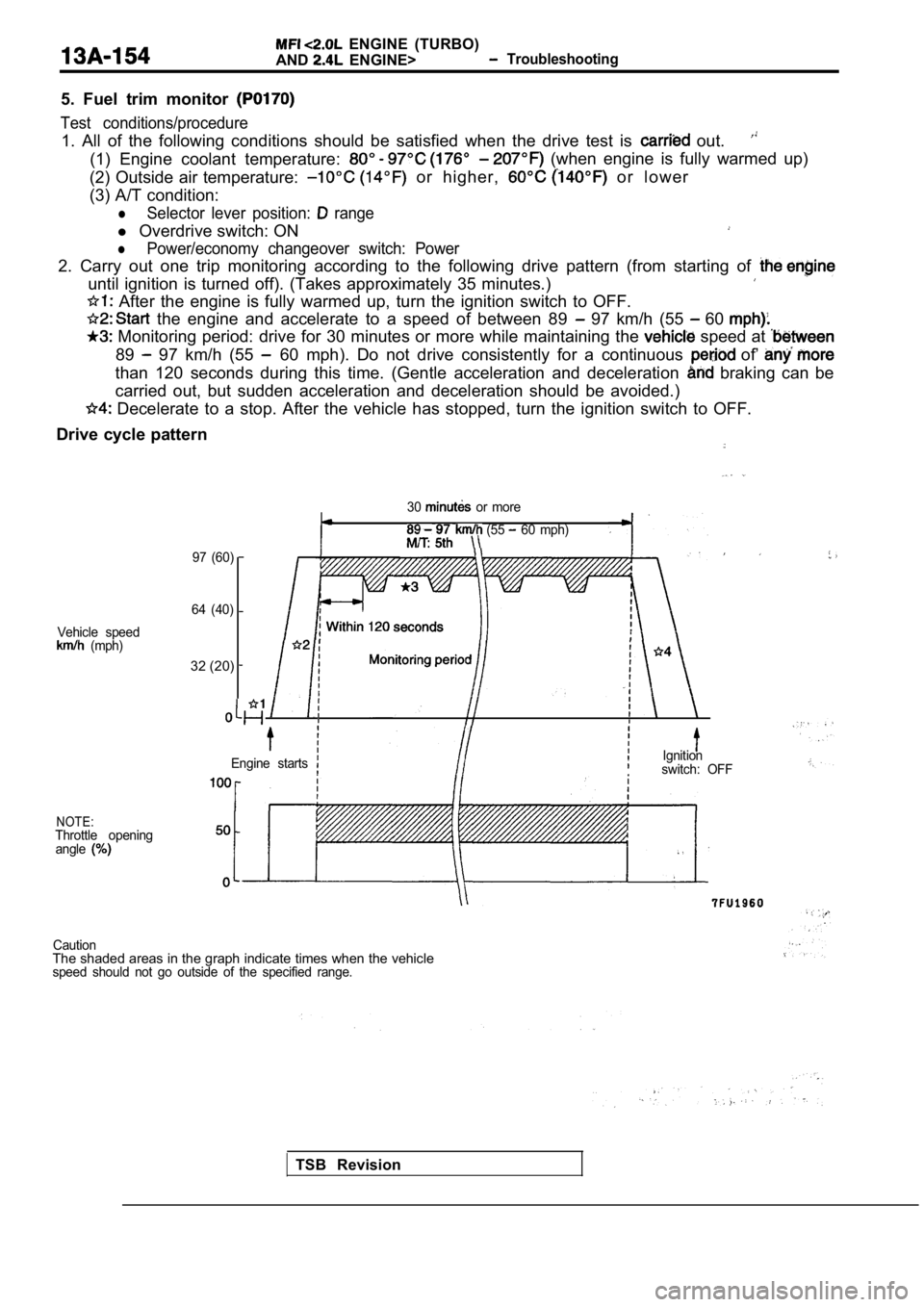
5. Fuel trim monitor
Test conditions/procedure
1. All of the following conditions should be satisf ied when the drive test is out.
(1) Engine coolant temperature: (when engine is fully warmed up)
(2) Outside air temperature:
or higher, o r l o w e r
(3) A/T condition:
lSelector lever position: range
l Overdrive switch: ON
lPower/economy changeover switch: Power
2. Carry out one trip monitoring according to the f ollowing drive pattern (from starting of
until ignition is turned off). (Takes approximately 35 minutes.)
After the engine is fully warmed up, turn the igni tion switch to OFF.
the engine and accelerate to a speed of between 89 97 km/h (55 60
Monitoring period: drive for 30 minutes or more while maintaining the speed at
89 97 km/h (55 60 mph). Do not drive consistently for a continuous of’
than 120 seconds during this time. (Gentle acceleration and deceleration braking can be
carried out, but sudden acceleration and decelerati on should be avoided.)
Decelerate to a stop. After the vehicle has stopped, turn the ignition switch to OFF.
Drive cycle pattern
30 or more
(55 60 mph)
Vehicle speed
(mph)
NOTE:Throttle opening angle
97 (60)
64 (40)
32 (20)
Engine startsIgnitionswitch: OFF
CautionThe shaded areas in the graph indicate times when t he vehiclespeed should not go outside of the specified range.
TSB Revision
Page 537 of 2103
ENGINE (TURBO)
AND
ENGINE> Troubleshooting
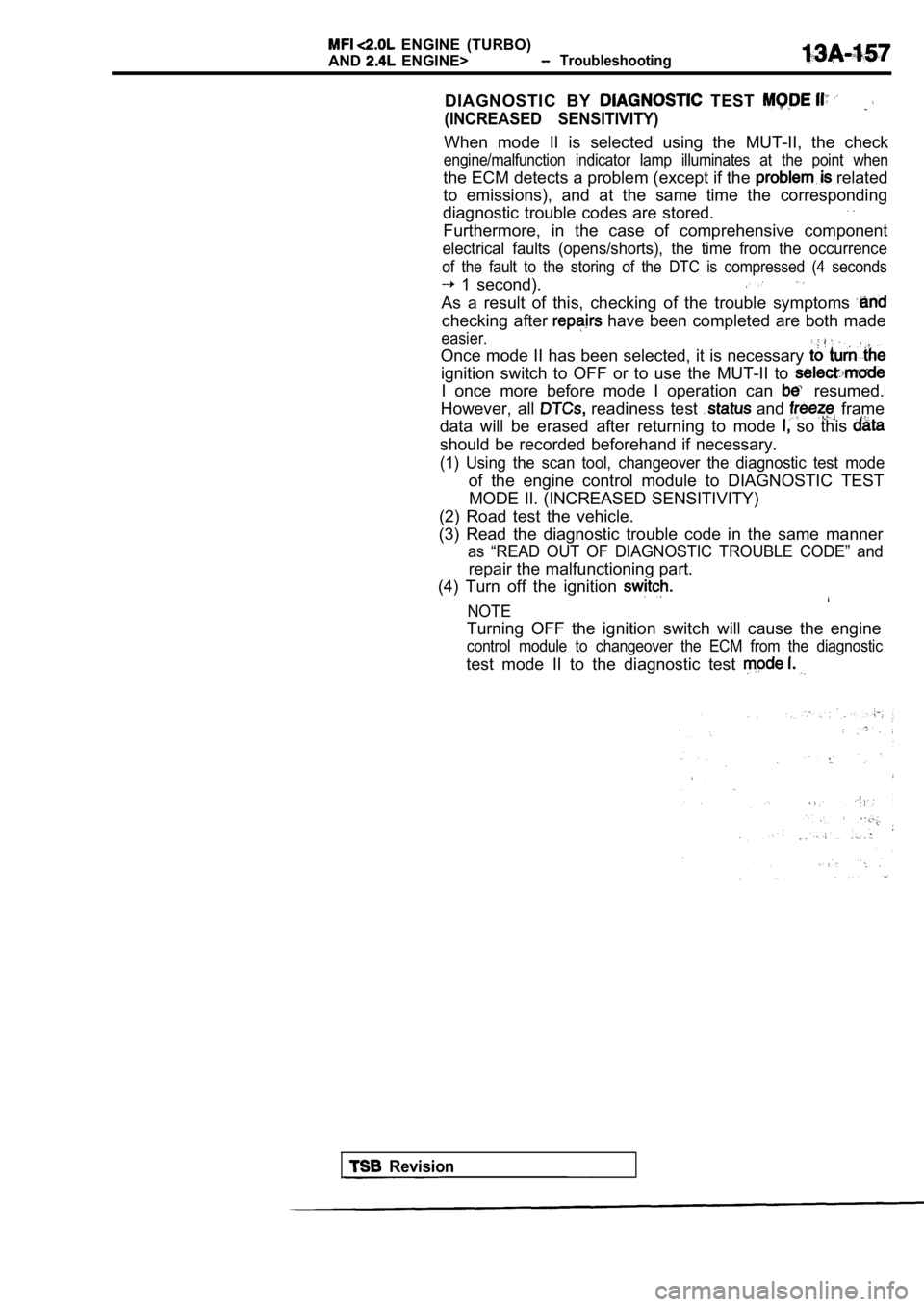
DIAGNOSTIC BY TEST
(INCREASED SENSITIVITY)
When mode II is selected using the MUT-II, the chec k
engine/malfunction indicator lamp illuminates at the point when
the ECM detects a problem (except if the related
to emissions), and at the same time the correspondi ng
diagnostic trouble codes are stored.
Furthermore, in the case of comprehensive component
electrical faults (opens/shorts), the time from the occurrence
of the fault to the storing of the DTC is compresse d (4 seconds
1 second).
As a result of this, checking of the trouble symptoms
checking after have been completed are both made
easier.
Once mode II has been selected, it is necessary
ignition switch to OFF or to use the MUT-II to
I once more before mode I operation can resumed.
However, all
readiness test and frame
data will be erased after returning to mode
so this
should be recorded beforehand if necessary.
(1) Using the scan tool, changeover the diagnostic test mode
of the engine control module to DIAGNOSTIC TEST
MODE II. (INCREASED SENSITIVITY)
(2) Road test the vehicle.
(3) Read the diagnostic trouble code in the same ma nner
as “READ OUT OF DIAGNOSTIC TROUBLE CODE” and
repair the malfunctioning part.
(4) Turn off the ignition
NOTE
Turning OFF the ignition switch will cause the engi ne
control module to changeover the ECM from the diagn ostic
test mode II to the diagnostic test
Revision
Page 538 of 2103
ENGINE
A N D E N G I N E > .
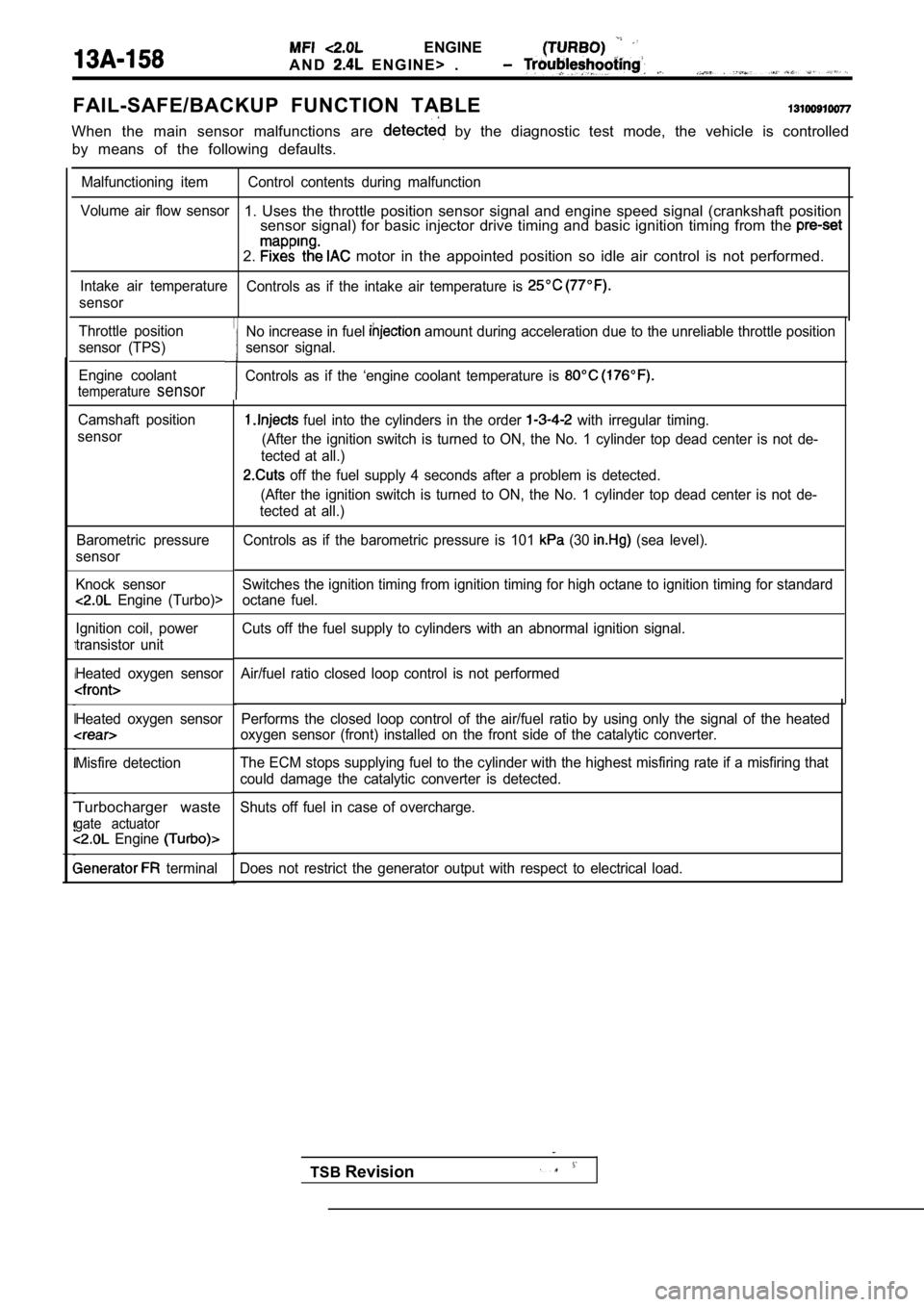
FAIL-SAFE/BACKUP FUNCTION TABLE
When the main sensor malfunctions are by the diagnostic test mode, the vehicle is controlled
by means of the following defaults.
Malfunctioning item Control contents during malfunct ion
Volume air flow sensor
1. Uses the throttle position sensor signal and eng ine speed signal (crankshaft position
sensor signal) for basic injector drive timing and basic ignition timing from the
2. motor in the appointed position so idle air contro l is not performed.
Intake air temperature
Controls as if the intake air temperature is
sensor
Throttle position
sensor (TPS)
Engine coolant
temperaturesensor
Camshaft position
sensor
Barometric pressure
sensor
Knock sensor
Engine (Turbo)>
Ignition coil, power
transistor unit
Heated oxygen sensor
Heated oxygen sensor
Misfire detection
Turbocharger waste
gate actuator Engine
terminal Performs the closed loop control of the air/fuel ra
tio by using only the signal of the heated
oxygen sensor (front) installed on the front side o f the catalytic converter.
The ECM stops supplying fuel to the cylinder with t he highest misfiring rate if a misfiring that
could damage the catalytic converter is detected.
Shuts off fuel in case of overcharge.
Does not restrict the generator output with respect to electrical load.
No increase in fuel amount during acceleration due to the unreliable throttle position
sensor signal.
Controls as if the ‘engine coolant temperature is
fuel into the cylinders in the order with irregular timing.
(After the ignition switch is turned to ON, the No. 1 cylinder top dead center is not de-
tected at all.)
off the fuel supply 4 seconds after a problem is d etected.
(After the ignition switch is turned to ON, the No. 1 cylinder top dead center is not de-
tected at all.)
Controls as if the barometric pressure is 101
(30 (sea level).
Switches the ignition timing from ignition timing f or high octane to ignition timing for standard
octane fuel.
Cuts off the fuel supply to cylinders with an abnor mal ignition signal.
Air/fuel ratio closed loop control is not performed
TSB Revision
Page 542 of 2103
![MITSUBISHI SPYDER 1990 Service Owners Manual ENGINE (TURBO)
AND ENGINE> Troubleshooting
Code No. Volume Air Flow Circuit Malfunction
[Comment]Background
lWhile the engine is running, the volume air flow se nsor outputs a](/img/19/57345/w960_57345-541.png "MITSUBISHI SPYDER 1990 Service Owners Manual ENGINE (TURBO)
AND ENGINE> Troubleshooting
Code No. Volume Air Flow Circuit Malfunction
[Comment]Background
lWhile the engine is running, the volume air flow se nsor outputs a")
ENGINE (TURBO)
AND ENGINE> Troubleshooting
Code No. Volume Air Flow Circuit Malfunction
[Comment]Background
lWhile the engine is running, the volume air flow se nsor outputs a signal which
corresponds to the volume of air flow.
lThe engine control module checks whether the freque ncy of this signal output by the
volume air flow sensor while the engine is running is at or above the set value.
Check Area, Judgement Criteria
1. Check Area
Engine is not lower than 500
Judgement CriterialSensor output frequency has continued to be 3.3 Hz or lower for 4 sec.
2. Check Area l Throttle position sensor voltage is 2
or lower. Engine speed is not higher than 2000
Judgement CriterialSensor freauencv has continued to be 1000 Hz or hiaher fo r 4 sec. EnginelSensor output frequency has continued to be 800 Hz or higher for 4 sec. Engine>
3. Check Area
l Throttle position sensor voltage is 1.5 or higher.
l Engine speed is 2000 or higher.
Judgement CriterialSensor output frequency is Hz or lower for 4 seconds.
Measure at the volume air flow Check the volume air flow sensor
sensor connector A-l 02. circuit. (Refer to
l Connect the connector. (Use PROCEDURE 47.)
the test harness:
1. Voltage between 3 and ground(Engine: idling)OK: 2.2-3.2 2. Voltage between 7 and ground OK: (Engine: idling)
6 - 9
OK
Replace the ECM.
(Ignition switch: ON)
O K : 6 - 9
TSB Revision
Check the following connector
Probable cause
lVolume air, flow lOpen or shorted sensor or loose connector Engine control module failed
Check trouble symptom.
N G
Repair
Replacethevolumeairflowsensor.
, Check trouble
Repair
Replace the ECM.
Page 543 of 2103
![MITSUBISHI SPYDER 1990 Service Owners Manual ENGINE ( T U R B O )
AND ENGINE> Troubleshooting
Code No. Barometric Pressure Malfunction Probable cause ,
[ C o m m e n t ]BackgroundlThe barometric pressure sensor outputs a voltage wh
ich](/img/19/57345/w960_57345-542.png "MITSUBISHI SPYDER 1990 Service Owners Manual ENGINE ( T U R B O )
AND ENGINE> Troubleshooting
Code No. Barometric Pressure Malfunction Probable cause ,
[ C o m m e n t ]BackgroundlThe barometric pressure sensor outputs a voltage wh
ich")
ENGINE ( T U R B O )
AND ENGINE> Troubleshooting
Code No. Barometric Pressure Malfunction Probable cause ,
[ C o m m e n t ]BackgroundlThe barometric pressure sensor outputs a voltage wh
ich corresponds to the barometricpressure.
Barometric pressure sensor failedlOpen or shorted barometric or loose connectorl Engine control module failedl The engine control module checks whether this volta ge is within a specified range.
Check Area l 60
or more have passed since the starting sequence wa s completed.
l Battery voltage is not lower than 8 V.
Judgement CriterialSensor output voltage has continued to be 4.5 or higher [corresponding to a barometricpressure of 114 (17 psi) or higher] for 4 sec. ,
or
lSensor output voltage has continued to be 1.95 or lower a barometricpressure of 50 (7.4 psi) or lower] for 4 sec.
theECM and the barometric
NGMeasure at the volume air flow
sensor connector
lDisconnect the connector, andmeasure at the harness side.lVoltage between 1 and ground(Ignition switch: ON)
O K :
l Continuity between 5 andground
sor connector l Connect the connector. (Use
the test harness:
lVoltage between 2 and ground(Ignition switch: ON)
OK: 3.7-4.3
[Altitude: 0 (0 ft.)]
[Altitude: 1,200 (3,937
OK
at the ECM 3-56. Connect the connector. Voltage between 85 and ground (Ignition switch: ON)
OK: 3.7-4.3
[Altitude: 0 (0 ft.)]
I
[(Altitude: 1,200 (3,937ii.)]
Continuity
OKsure sensor connector.I
Check the following connector: Repair
A-i
OK
OK
Check trouble symptom.
NG
Replace the ECM.
N GCheck the harness wire between Repairthe ECM and the barometric pres-sure sensor connector.
OKOK
the ECM and the barometric pres- harness wire
sure sensor connector.
Repair
OK
the ECM.
TSB Revision1
Page 544 of 2103
![MITSUBISHI SPYDER 1990 Service Owners Manual ENGINE (TURBO)
AND ENGINE> Troubleshooting,
Code No. Intake Air Temperature Circuit
[Comment]
Background
lThe intake air temperature sensor converts the intake air temperature to a voltag](/img/19/57345/w960_57345-543.png "MITSUBISHI SPYDER 1990 Service Owners Manual ENGINE (TURBO)
AND ENGINE> Troubleshooting,
Code No. Intake Air Temperature Circuit
[Comment]
Background
lThe intake air temperature sensor converts the intake air temperature to a voltag")
ENGINE (TURBO)
AND ENGINE> Troubleshooting,
Code No. Intake Air Temperature Circuit
[Comment]
Background
lThe intake air temperature sensor converts the intake air temperature to a voltage and
outputs it.
l The engine control module checks whether the voltag e is within a specified range.
Check Area
l 60
or more have passed since the starting sequence wa s completed.
Judgement CriterialSensor output voltage has continued to be 4.6 or higher [corresponding to an intake
air temperature of or lower] for 4 sec.
or
lSensor output voltage has continued to be 0.2 or lower [corresponding to an intake
air temperature of or higher] for 4 sec.
l Intake air temperature lOpen or shorted intake circuit, or loose l Engine control
Check the intake air temperature sor. (Refer to Replace the volume air flow sensor.
Measure at the volume air flow sensor
l
l a n d g r o u n d Check the wire between the RepairECM and the intake air temperaturesensor connector.
Replace the ECM.
Revision
Page 545 of 2103
![MITSUBISHI SPYDER 1990 Service Owners Manual ENGINE (TURBO)
AND ENGINE>
Code No. 5 Engine Coolant Temperature Circuit
Malfunction Probable
[Comment]l
Engine coolant temperature BackgroundlOpen shorted engine l theenginecoolanttemp](/img/19/57345/w960_57345-544.png "MITSUBISHI SPYDER 1990 Service Owners Manual ENGINE (TURBO)
AND ENGINE>
Code No. 5 Engine Coolant Temperature Circuit
Malfunction Probable
[Comment]l
Engine coolant temperature BackgroundlOpen shorted engine l theenginecoolanttemp")
ENGINE (TURBO)
AND ENGINE>
Code No. 5 Engine Coolant Temperature Circuit
Malfunction Probable
[Comment]l
Engine coolant temperature BackgroundlOpen shorted engine l theenginecoolanttemperature and outputs it. sensor circuit, or l
The engine control module checks whether the voltag e is within a specified range.l
Engine control module In addition, it checks that the engine coolant temp erature (signal) does not drop while
the engine is warming up.
Check Area, Judgement Criteria
1. Check Area, Judgement Criteria
lSensor output voltage has continued to be 4.6 or higher [corresponding to an enginecoolant temperature of or lower] for 4 sec.
or
lSensor output voltage has continued to be 0.1 or lower [corresponding to an enginecoolant temperature of or higher] for 4 sec.
2. Check Area, Judgement CriterialSensor output voltage increased from a value lower than 1.6 to a value higher than1.6 [Engine coolant temperature decreases from a highe r than temperature to a lower than temperature.]lThen the sensor output voltage has continued to be 1.6 or higher for 5 min.
3. Check Area
lEngine coolant temperature is approximately immediately after engine
is started.
Judgement CriterialAbout 60 300 have passed for the engine coolant temperature to about after starting sequence was completed.
Measure at the engine coolant
temperature sensor connector
l Disconnect the connector, and
measure at the harness side.
l Voltage between 1 and ground
(Ignition switch: ON)
OK:
l Continuity between 2 and ground
OK: Continuity
Check trouble symptom.
NG
Replace the ECM.
Replace the
TSB Revision