ESP MITSUBISHI SPYDER 1990 Service Workshop Manual
[x] Cancel search | Manufacturer: MITSUBISHI, Model Year: 1990, Model line: SPYDER, Model: MITSUBISHI SPYDER 1990Pages: 2103, PDF Size: 68.98 MB
Page 926 of 2103
MANUAL TRANSAXLE OVERHAUL
Synchronizer
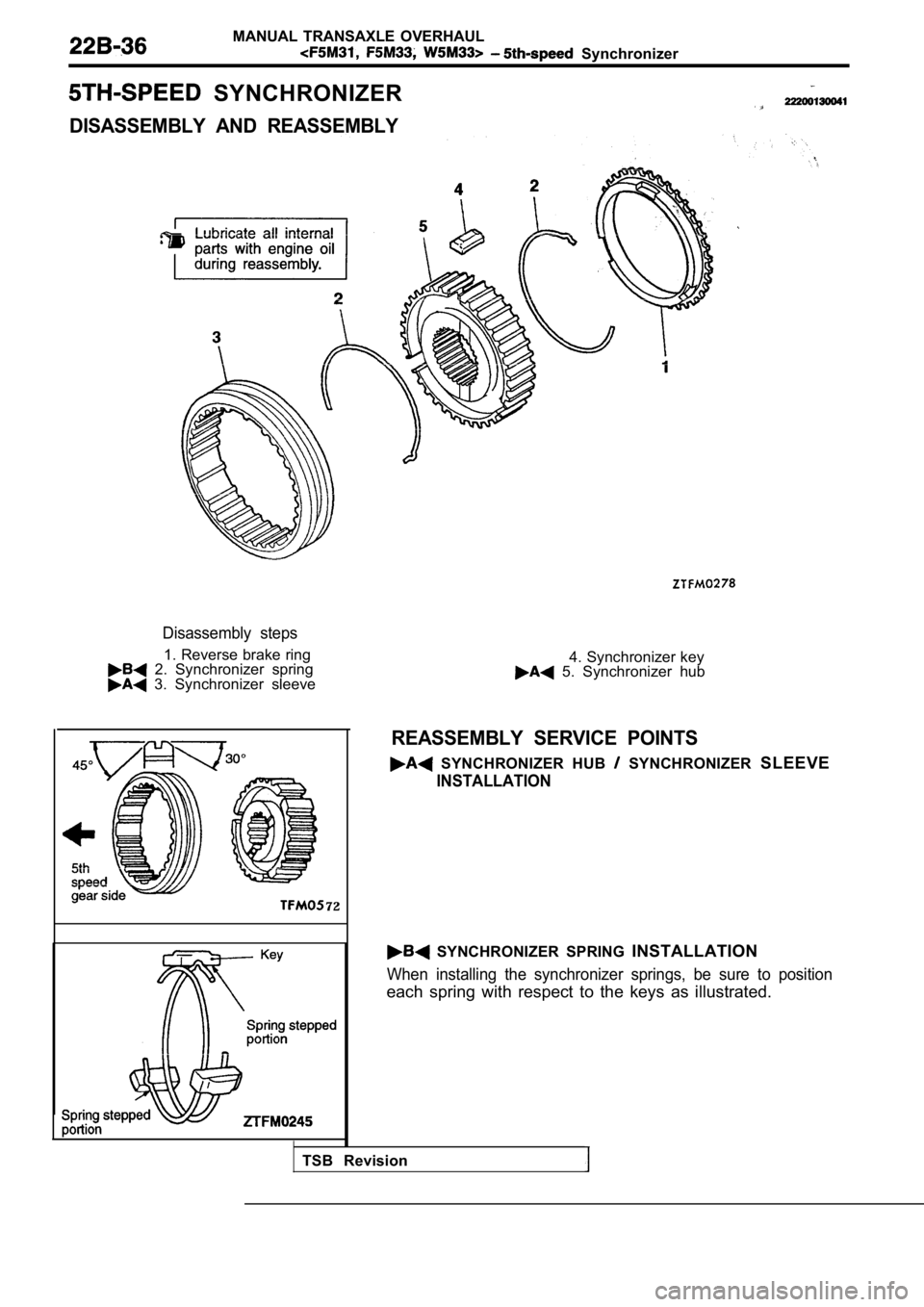
SYNCHRONIZER
DISASSEMBLY AND REASSEMBLY
Disassembly steps
1. Reverse brake ring 2. Synchronizer spring 3. Synchronizer sleeve
72
4. Synchronizer key 5. Synchronizer hub
REASSEMBLY SERVICE POINTS
SYNCHRONIZER HUB SYNCHRONIZER SLEEVE
INSTALLATION
SYNCHRONIZER SPRING INSTALLATION
When installing the synchronizer springs, be sure t o position
each spring with respect to the keys as illustrated.
TSB Revision
Page 932 of 2103
MANUAL TRANSAXLE OVERHAUL
Input Shaft
gear
spee
gear
side
Identificationmark
Spring
stepped
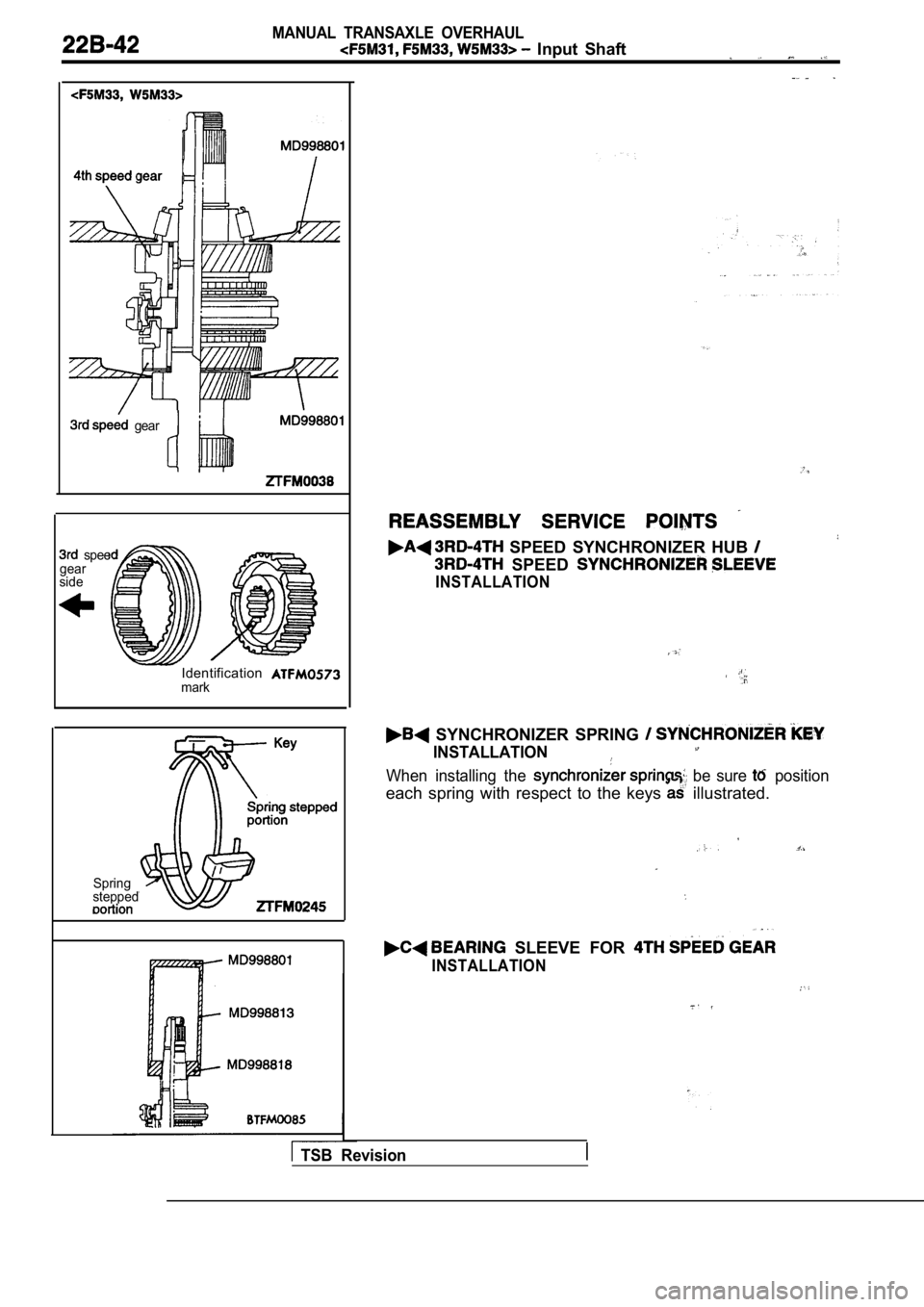
SPEED SYNCHRONIZER HUB
SPEED
INSTALLATION
SYNCHRONIZER SPRING
INSTALLATION
When installing the be sure position
each spring with respect to the keys illustrated.
SLEEVE FOR
INSTALLATION
TSB Revision
Page 941 of 2103
MANUAL TRANSAXLE OVERHAUL
bear
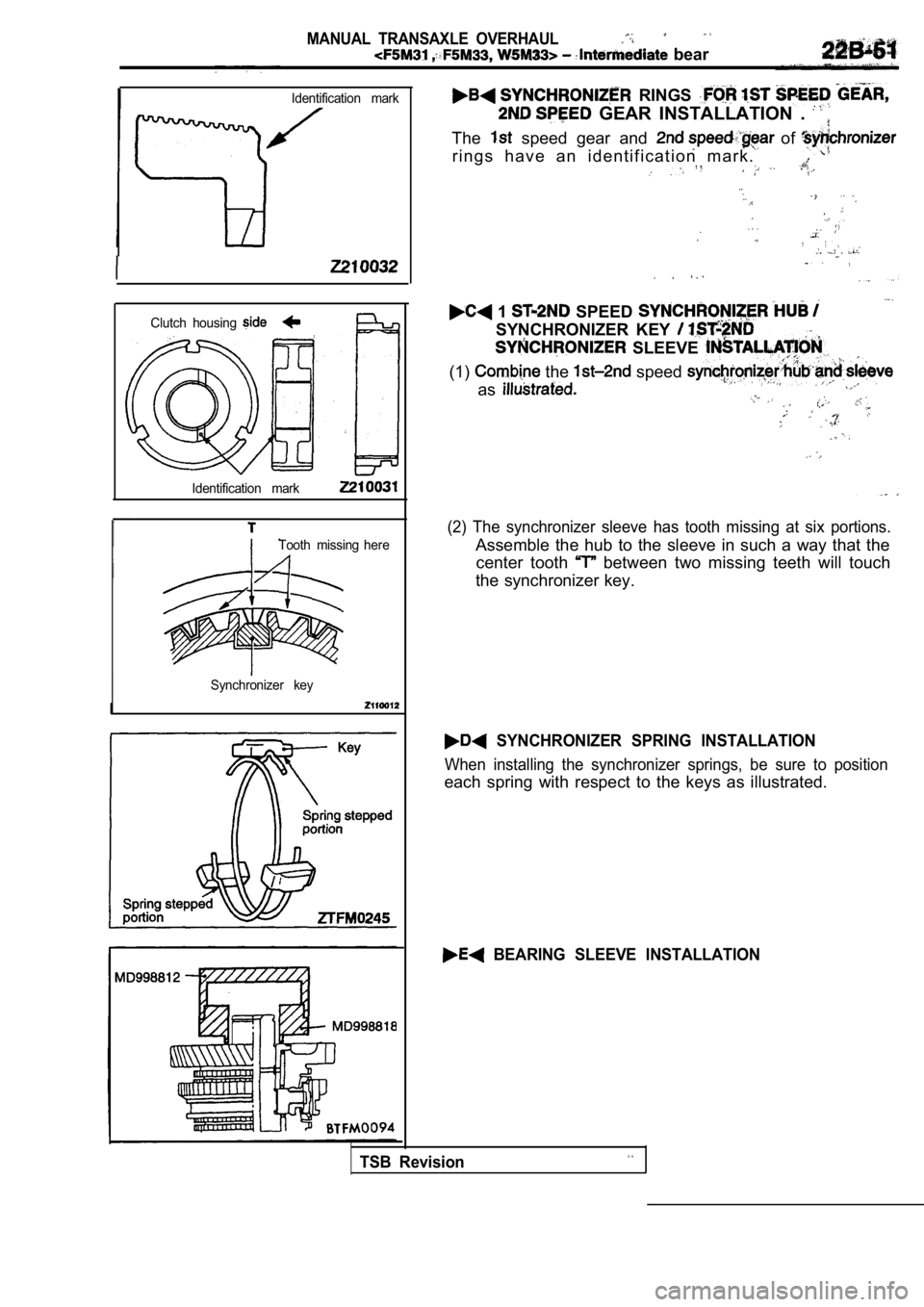
Identification mark RINGS
GEAR INSTALLATION .
The speed gear and of
r i n g s h a v e a n i d e n t i f i c a t i o n m a r k .
Clutch housing
Identification markTooth missing here
Synchronizer key
1 SPEED
SYNCHRONIZER KEY
SLEEVE
(1) the speed
as
(2) The synchronizer sleeve has tooth missing at si x portions.
Assemble the hub to the sleeve in such a way that t he
center tooth
between two missing teeth will touch
the synchronizer key.
SYNCHRONIZER SPRING INSTALLATION
When installing the synchronizer springs, be sure t o position
each spring with respect to the keys as illustrated.
BEARING SLEEVE INSTALLATION
TSB Revision
. .
Page 1009 of 2103
CONTENTS
AUTOMATIC TRANSAXLE
ENGINE (NON-TURBO)> . . . . . 115
AUTOMATIC TRANSAXLE KEY INTERLOCK
AND SHIFT LOCK MECHANISMS* . . . . . . . . 192
GENERAL INFORMATION
. . . . . . . . . . . . . . . . 115
LUBRICANTS. . . . . . . . . . . . . . . . . . . . . . . . . . . .117
ON-VEHICLE SERVICE . . . . . . . . . . . . . . . . . . . 159
Automatic Transaxle Control Component
Oil Temperature Sensor Continuity Check . . . . 160
Pinion Factor Writing Procedure After
TCM Replacement or Tire Size Change
. . . 159
Selector Level Operation Check . . . . . . . . . . . . . . ,166
Shift Lock Mechanism Check. . . . . . . . . . . . . . .
1 8 6
TCM Resetting Procedure . . . . . . . . . . . . .
..159
Torque Converter Stall Testing. . . . . . . . . . . . . .166
Transaxle Fluid Level Check . . . . . . . . . . .. . .159
Transaxle Fluid Replacement. . . . . . . . . . . . . . .
Transaxle Range Sensor Continuity . . .
Check. . . . . . . . . . . . . . . . . . . . . . . . . . . . . . . . . . . .163SERVICE SPECIFICATIONS.. . . .. . .Automatic Transaxle Control Component Layout
. . . . . . . . . . . . . . . . . . . . . . . . . . . . . . . . . . . . . . . . . . .
161SPECIAL TOOLS. . . . . . . . . . . . . . . . . . . . . . . . .117Clutch Air Pressure Tests . . . . . . . . . . . . . . . . . . .168
Fluid Leakage-Torque Converter Housing Area
Check. . . . . . . . . . . . . . . . . . . . . . . . . . . . . . . . . . . .169
Hydraulic Pressure Tests. . . . . . . . . . . . . . . . . . .169
Hydraulic Circuit. . . . . . . . . . . . . . . . . . . . . . . . . . .173
TRANSAXLE ASSEMBLY. . . . . . . . . . . . . . . .
TRANSAXLE CONTROL*. . . . . . . . . . . . . . . . .187
Selector Lever Assembly. . . . . . . . . . . . . . . . . . .189
Key Interlock Mechanism Check . . . . . . . . . . .
. 186CONTINUED ON NEXT PAGE
WARNINGS REGARDING SERVICING OF SUPPLEMENTAL EQUIPPED VEHICLES
WARNING! (1) Improper service or maintenance of any componen t of the
or any component, can lead to personal
injuryordeath inadvertent the inoperative).
(2) Service or maintenance of any component or SRS-related component must be perform ed only at an authorized
MITSUBISHI dealer.
(3)MITSUBISHI dealer personnel must thoroughly review this manual, and especially its GROUP Supplemental Re-
straint System (SRS) and GROUP 00 -Maintenance Serv ice before beginning any service or maintenance of any com-
ponent of the
or any component.
NOTEThe SRS includes the following components: SRS-ECU, SRS warning light, air bag module, clockspring and inte rconnecting wiring.Other SRS-related components (that may have to be removed/installed in connection with SRS service or maintenance) are indi-cated in the table of contents by an asterisk
Page 1131 of 2103
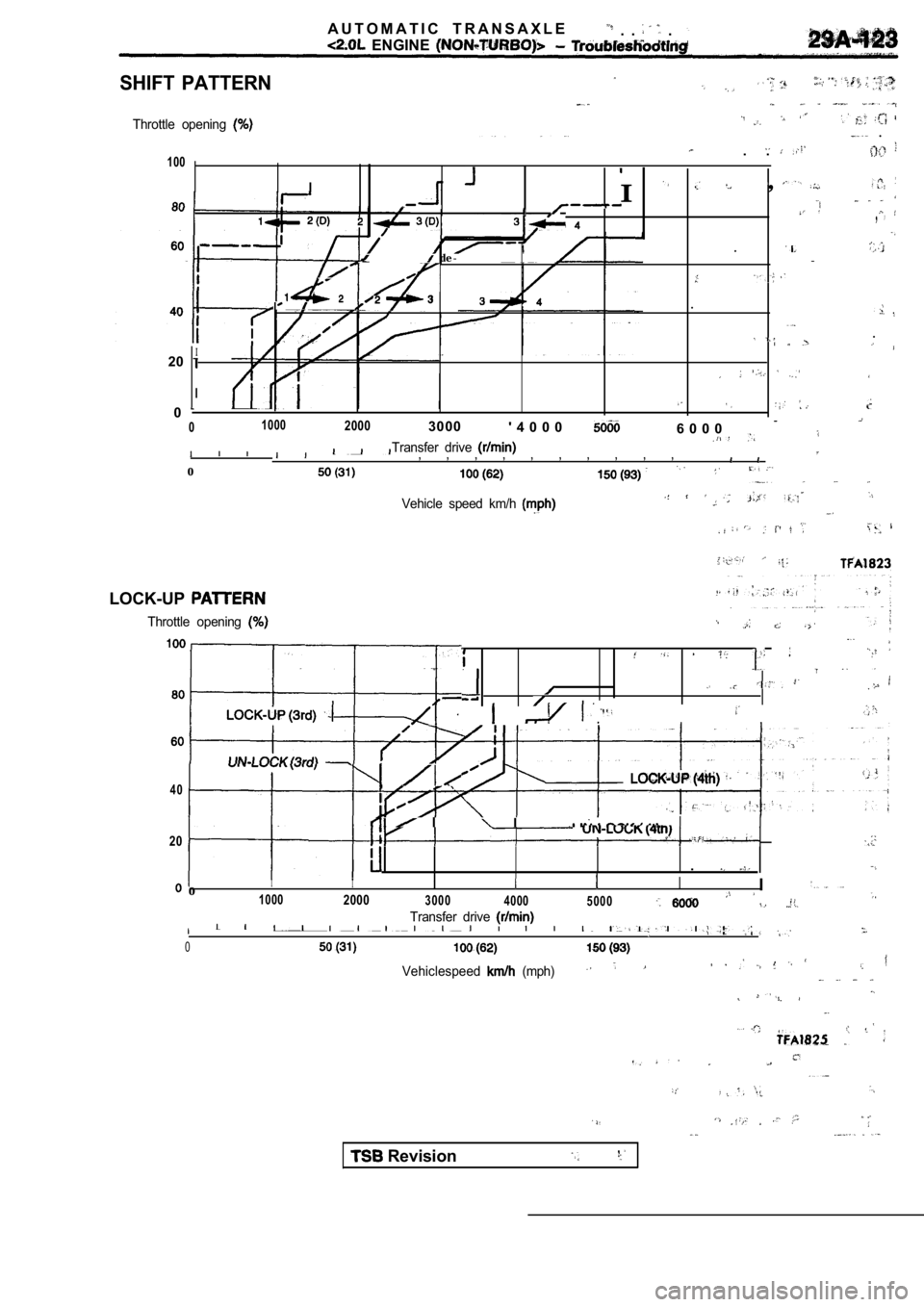
SHIFT PATTERN
Throttle opening .
. .100
II ,
,
A U T O M A T I C T R A N S A X L E . . . ENGINE
. de--
3.
.
I20
I
00100020003 0 0 0
' 4 0 0 06 0 0 0
Transfer drive , , , , , , , , , ,
0
Vehicle speed km/h
LOCK-UP
Throttle opening
4 0
I I .I I
20
0I
1000
I.
I
2000
I
3 0 0 04000
Transfer drive
II5 0 0 0 .
0
Vehiclespeed (mph)
Revision,
Page 1148 of 2103
AUTOMATIC TRANSAXLE
ENGINE (NON-TURBO)> Troubleshootihg
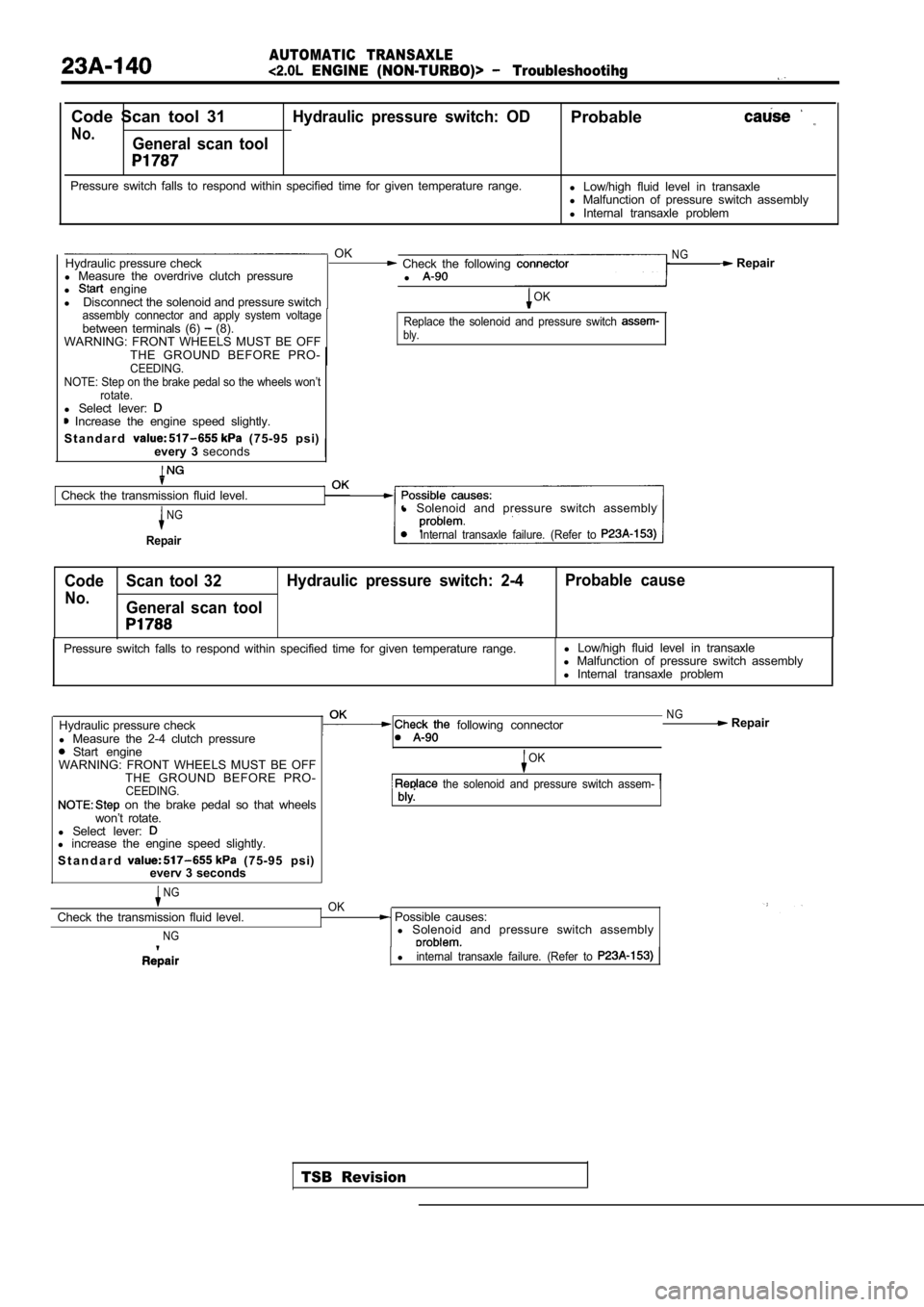
Code Scan tool 31Hydraulic pressure switch: ODProbable
No.General scan tool
Pressure switch falls to respond within specified time for given temperature range.
l Low/high fluid level in transaxle
l Malfunction of pressure switch assembly
l Internal transaxle problem
OKNGHydraulic pressure check Check the following Repair
l Measure the overdrive clutch pressure
l
l engine
l Disconnect the solenoid and pressure switchOK
assembly connector and apply system voltage
between terminals (6) (8).
WARNING: FRONT WHEELS MUST BE OFFReplace the solenoid and pressure switch bly.
THE GROUND BEFORE PRO-CEEDING.
NOTE: Step on the brake pedal so the wheels won’t rotate.
l Select lever: Increase the engine speed slightly.
S t a n d a r d
(75-95 psi)
every 3 seconds
Check the transmission fluid level.
NG
Repair
l Solenoid and pressure switch assembly
Internal transaxle failure. (Refer to
Code Scan tool 32 Hydraulic pressure switch: 2-4 Probable cause
No.General scan tool
TSB Revision
Pressure switch falls to respond within specified t
ime for given temperature range.l
Low/high fluid level in transaxle
l Malfunction of pressure switch assembly
l Internal transaxle problem
Hydraulic pressure check
l Measure the 2-4 clutch pressure
Start engine
following connector
WARNING: FRONT WHEELS MUST BE OFF THE GROUND BEFORE PRO-
CEEDING. on the brake pedal so that wheels
won’t rotate.
l Select lever:
l increase the engine speed slightly.
S t a n d a r d
(75-95 psi)
everv 3 seconds
NGOK
NG Repair
OK
the solenoid and pressure switch assem-
Check the transmission fluid level.
NG
Possible causes:
l Solenoid and pressure switch assembly
linternal transaxle failure. (Refer to
Page 1149 of 2103
AUTOMATIC TRANSAXLE
ENGINE (NON-TURBO)> Troubleshooting
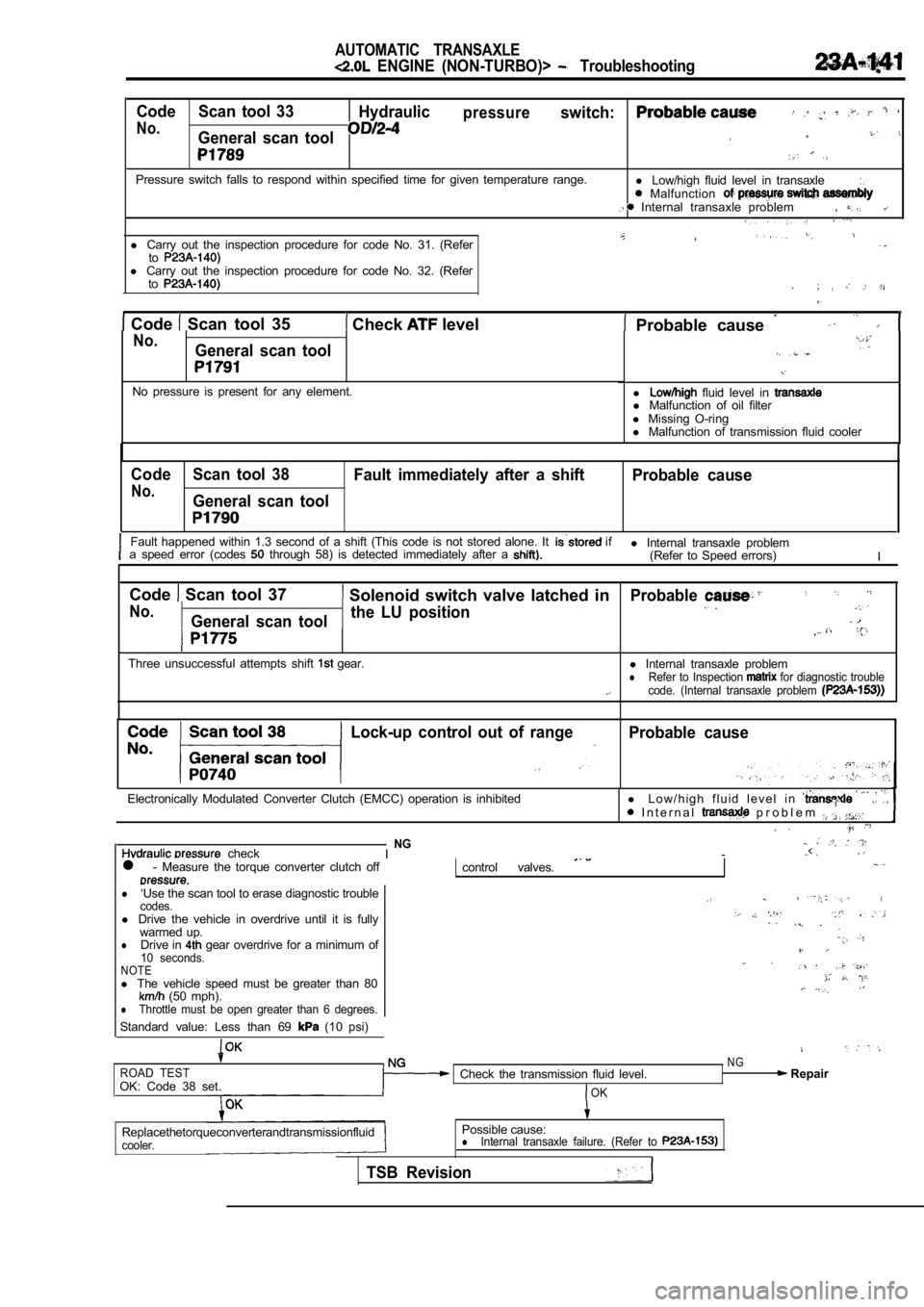
Code Scan tool 33Hydraulicpressureswitch:
No.General scan tool
Pressure switch falls to respond within specified t ime for given temperature range.
l Low/high fluid level in transaxle Malfunction Internal transaxle problem
,l Carry out the inspection procedure for code No. 31. (Refertol Carry out the inspection procedure for code No. 32. (Refer
to
Code Scan tool 35 Check level . Probable cause No.General scan tool
No pressure is present for any element.l fluid level in l
Malfunction of oil filter
l Missing O-ring
l Malfunction of transmission fluid cooler
Code Scan tool 38
Fault immediately after a shift Probable cause
No.General scan tool
Fault happened within 1.3 second of a shift (This code is not stored alone. It if
a speed error (codes through 58) is detected immediately after a l Internal transaxle problem
(Refer to Speed errors) I
Code
Scan tool 37 Solenoid switch valve latched in
No.General scan tool the LU position
Three unsuccessful attempts shift gear.
Probable
l
Internal transaxle problemlRefer to Inspection for diagnostic trouble
code. (Internal transaxle problem
Lock-up control out of rangeProbable cause
Electronically Modulated Converter Clutch (EMCC) op eration is inhibitedl L o w / h i g h f l u i d l e v e l i n I n t e r n a l p r o b l e m
checkNGI -..< .
l - Measure the torque converter clutch offcontrol valves.
l‘Use the scan tool to erase diagnostic troublecodes.l Drive the vehicle in overdrive until it is fully
warmed up.
lDrive in gear overdrive for a minimum of10 seconds.NOTEl The vehicle speed must be greater than 80 (50 mph).lThrottle must be open greater than 6 degrees.
Standard value: Less than 69 (10 psi)
ROAD TESTOK: Code 38 set. Check the transmission fluid level.OK
NG Repair
Replacethetorqueconverterandtransmissionfluid
cooler.
Possible cause:lInternal transaxle failure. (Refer to
TSB Revision
Page 1154 of 2103
AUTOMATIC TRANSAXLE
ENGINE (NON-TURBO)> Troubleshooting
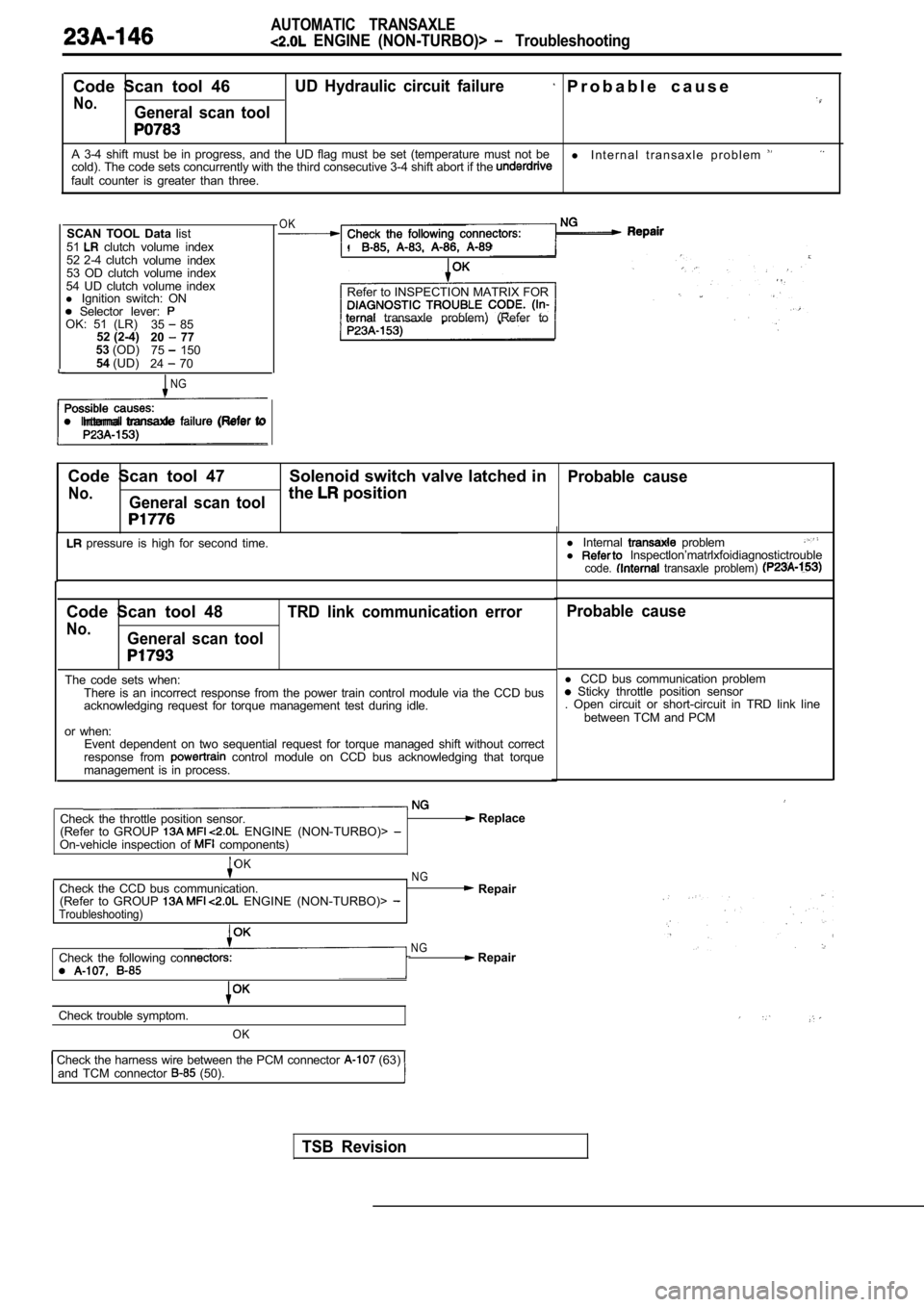
Code Scan tool 46UD Hydraulic circuit failure P r o b a b l e c a u s e
No.General scan tool
A 3-4 shift must be in progress, and the UD flag must be set (temperature must not be
l I n t e r n a l t r a n s a x l e p r o b l e m cold). The code sets concurrently with the third co nsecutive 3-4 shift abort if the fault counter is greater than three.
SCAN TOOL Data list
51
clutch volume index
52 2-4 clutch volume index
53 OD clutch volume index
54 UD clutch volume index
l Ignition switch: ON
Selector lever: OK: 51 (LR)
35 85
52 (2-4) 20 77
53 (OD)
75 150
54 (UD)
24 70
NG
l Internal transaxle (Refer to
OK
.
Refer to INSPECTION MATRIX FOR
transaxle problem) (Refer to
Code Scan tool 47 Solenoid switch valve latched in
Probable cause
No.General scan toolthe position
pressure is high for second time. l
Internal probleml lnspectlon’matrlxfoidiagnostictroublecode. transaxle problem)
Code Scan tool 48
No.General scan tool TRD link communication error
The code sets when:
There is an incorrect response from the power train control module via the CCD bus
acknowledging request for torque management test du ring idle.
or when: Event dependent on two sequential request for torqu e managed shift without correct
response from
control module on CCD bus acknowledging that torqu e
management is in process.
Check the throttle position sensor.
(Refer to GROUP ENGINE (NON-TURBO)> On-vehicle inspection of components)
Replace
OKNGCheck the CCD bus communication. Repair
(Refer to GROUP ENGINE (NON-TURBO)> Troubleshooting)
Check the following coNG Repair
Check trouble symptom.
OK
Check the harness wire between the PCM connector (63) and TCM connector (50).
Probable cause
l CCD bus communication problem Sticky throttle position sensor
. Open circuit or short-circuit in TRD link line
between TCM and PCM
TSB Revision
Page 1161 of 2103
AUTOMATIC TRANSAXLE
ENGINE (NON-TURBO)>:
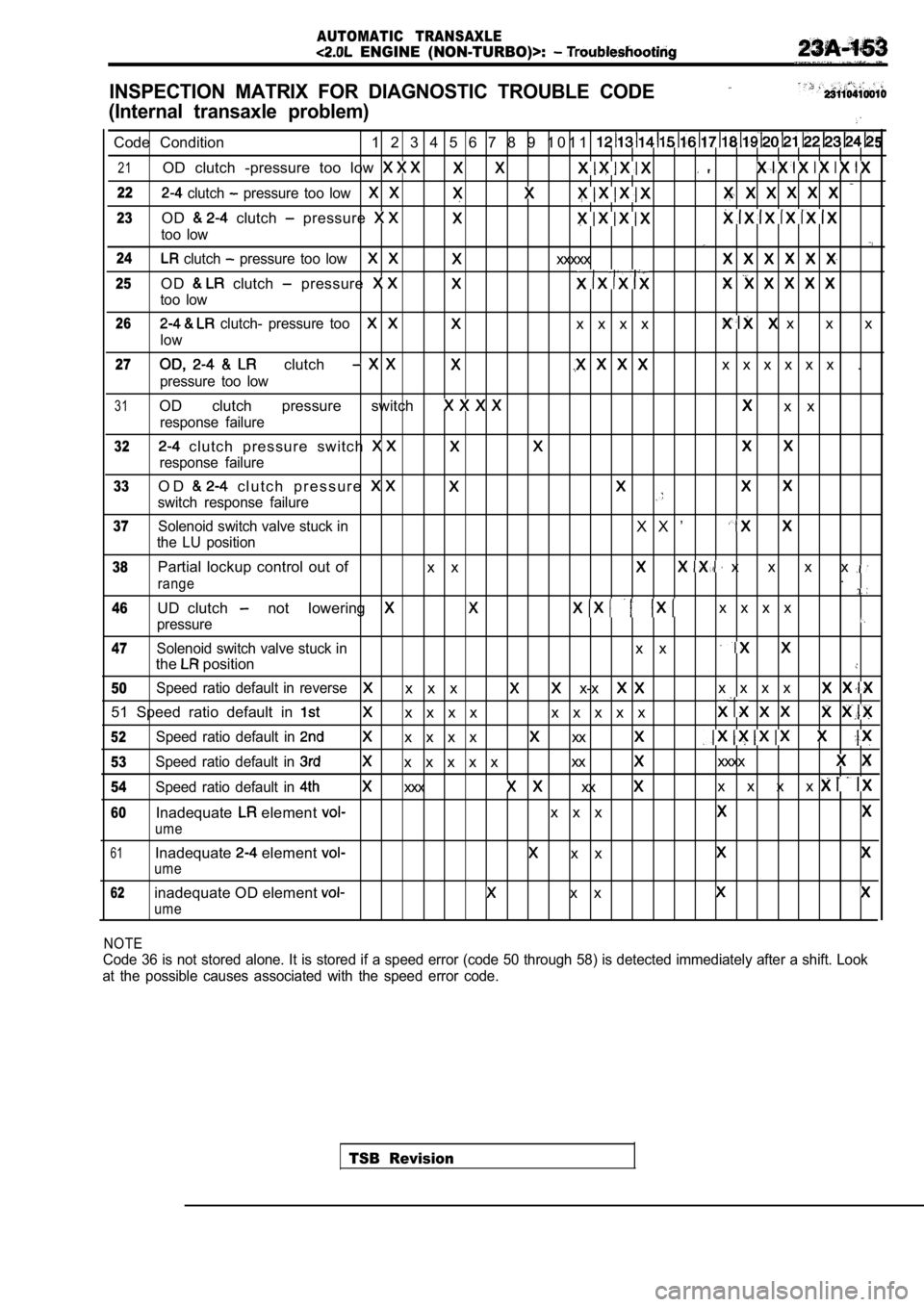
INSPECTION MATRIX FOR DIAGNOSTIC TROUBLE CODE
(Internal transaxle problem)
5Code Condition 1 2 3 4 5 6 7 8 9 1 0 1 1
21OD clutch -pressure too low
22 clutch pressure too low
23OD clutch pressure
too low
24 clutch pressure too lowxxxxx
25O D clutch pressure
too low
26 clutch- pressure toox x x x x x x
low
27 clutch x x x x x x .
pressure too low
31OD clutch pressure switch x x
response failure
32 clutch pressure switch
response failure
33O D c l u t c h p r e s s u r e
switch response failure
37Solenoid switch valve stuck inX X ’
the LU position
38Partial lockup control out of x x x x x x
range.
46UD clutch not lowering x x x x
pressure
47Solenoid switch valve stuck inx x
the position
50Speed ratio default in reversex x x x-x x x x x
51 Speed ratio default in x x x x x x x x x
52Speed ratio default in x x x xxx
53Speed ratio default in x x x x xxxxxxx
54Speed ratio default in xxx xx x x x x
60Inadequate element x x x
ume
61Inadequate element x xume
62inadequate OD element x x
ume
TSB Revision
NOTE
Code 36 is not stored alone. It is stored if a spee
d error (code 50 through 58) is detected immediatel y after a shift. Look
at the possible causes associated with the speed er ror code.
Page 1176 of 2103
AUTOMATIC TRANSAXLE
ENGINE On-vehicle Service
Accumulators
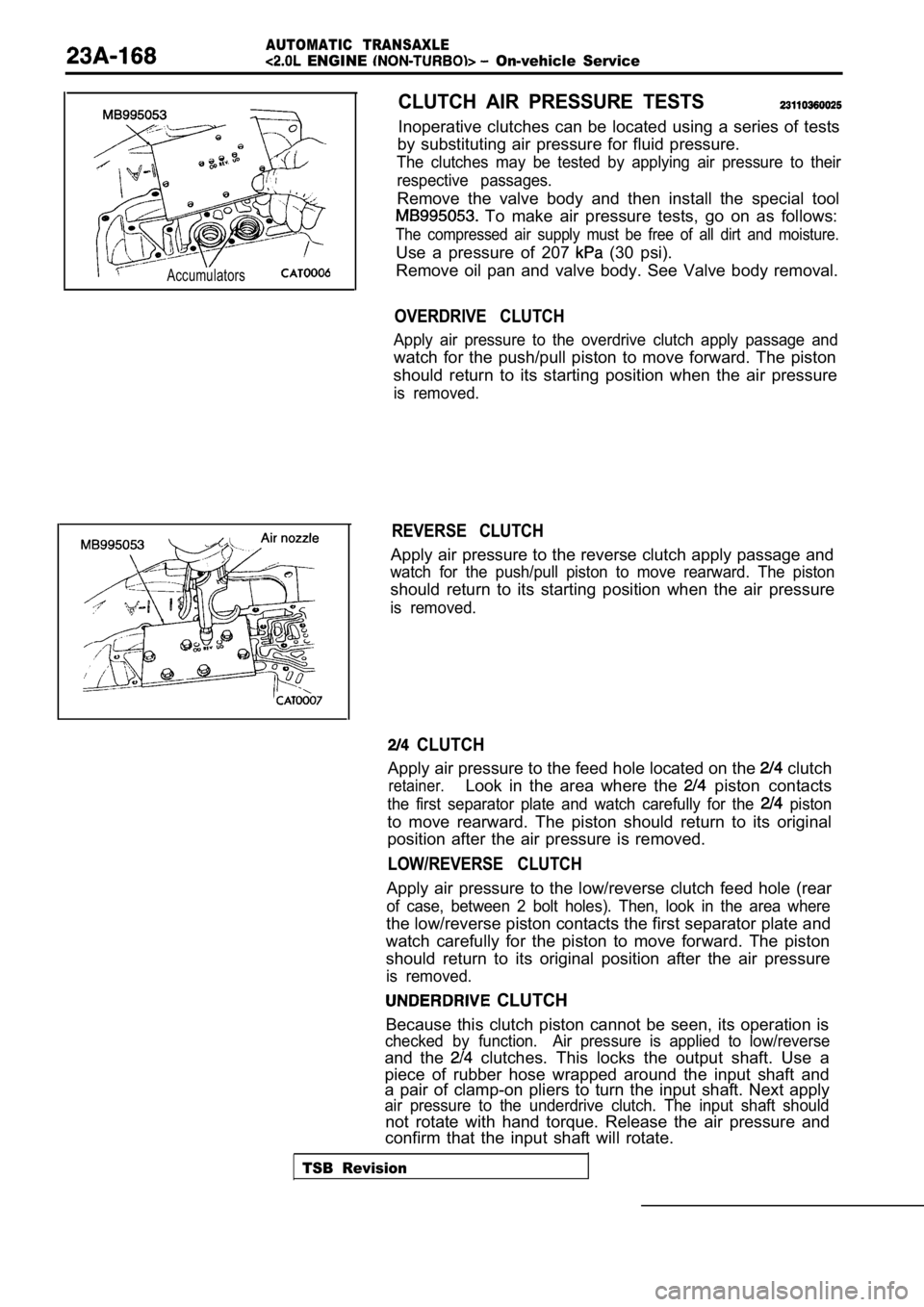
CLUTCH AIR PRESSURE TESTS
Inoperative clutches can be located using a series of tests
by substituting air pressure for fluid pressure.
The clutches may be tested by applying air pressure to their
respective passages.
Remove the valve body and then install the special tool
To make air pressure tests, go on as follows:
The compressed air supply must be free of all dirt and moisture.
Use a pressure of 207 (30 psi).
Remove oil pan and valve body. See Valve body remov al.
OVERDRIVE CLUTCH
Apply air pressure to the overdrive clutch apply passage and
watch for the push/pull piston to move forward. The piston
should return to its starting position when the air pressure
is removed.
REVERSE CLUTCH
Apply air pressure to the reverse clutch apply pass age and
watch for the push/pull piston to move rearward. Th e piston
should return to its starting position when the air pressure
is removed.
CLUTCH
Apply air pressure to the feed hole located on the clutch
retainer.Look in the area where the piston contacts
the first separator plate and watch carefully for the piston
to move rearward. The piston should return to its o riginal
position after the air pressure is removed.
LOW/REVERSE CLUTCH
Apply air pressure to the low/reverse clutch feed h ole (rear
of case, between 2 bolt holes). Then, look in the a rea where
the low/reverse piston contacts the first separator plate and
watch carefully for the piston to move forward. The piston
should return to its original position after the ai r pressure
is removed.
CLUTCH
Because this clutch piston cannot be seen, its oper ation is
checked by function. Air pressure is applied to low/ reverse
and the clutches. This locks the output shaft. Use a
piece of rubber hose wrapped around the input shaft and
a pair of clamp-on pliers to turn the input shaft. Next apply
air pressure to the underdrive clutch. The input sh aft should
not rotate with hand torque. Release the air pressu re and
confirm that the input shaft will rotate.
TSB Revision