check engine MITSUBISHI SPYDER 1990 Service Repair Manual
[x] Cancel search | Manufacturer: MITSUBISHI, Model Year: 1990, Model line: SPYDER, Model: MITSUBISHI SPYDER 1990Pages: 2103, PDF Size: 68.98 MB
Page 2048 of 2103
55-8HEATER, AIR
AND VENTILATION Troubleshooting/On-vehicle Service
Engine (Non-turbo)>
12
Sensor ground
Automatic compressor-ECM power
supply (output side)
Fin sensor power supply
o v
The ignition switch, blower switch andBattery positive
switch areall ONvoltage
The ignition switch, blower switch and
A/C switch are all ON
TROUBLESHOOTING HINTS
l R e f e r t o C O O L I N G S Y S T E M
SHOOTING.
Refer to
Terminal No.Name of Signal
Check requirements Terminal voltage
compressor clutch relay
When the compressor ON conditions Battery positive
are satisfied voltage
2Automatic compressor-ECM groundov
4Automatic compressor-ECM power
The ignition switch, blower switch and Battery positive
supply (input side) switch are all ONvoltage
5Automatic compressor-ECM powerTheignition switch is ONBattery positive
voltage
Engine (Turbo) and Engine>I
O N - V E H I C L E S E R V I C E
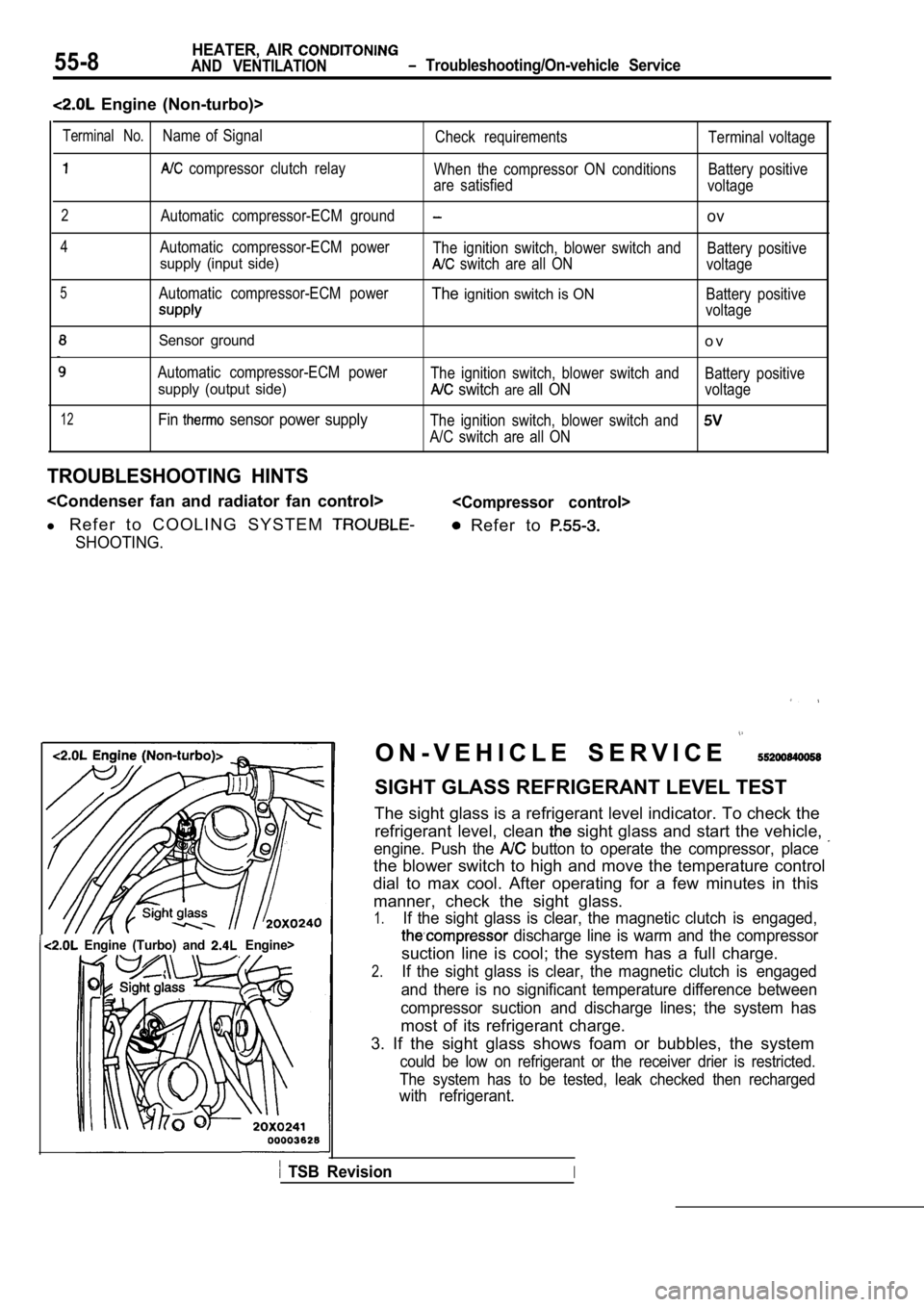
SIGHT GLASS REFRIGERANT LEVEL TEST
The sight glass is a refrigerant level indicator. T o check the
refrigerant level, clean
sight glass and start the vehicle,
engine. Push the button to operate the compressor, place
the blower switch to high and move the temperature control
dial to max cool. After operating for a few minutes in this
manner, check the sight glass.
1.If the sight glass is clear, the magnetic clutch is engaged,
discharge line is warm and the compressor
suction line is cool; the system has a full charge.
2.If the sight glass is clear, the magnetic clutch is engaged
and there is no significant temperature difference between
compressor suction and discharge lines; the system has
most of its refrigerant charge.
3. If the sight glass shows foam or bubbles, the sy stem
could be low on refrigerant or the receiver drier is restricted.
The system has to be tested, leak checked then rech arged
with refrigerant.
TSB RevisionI
Page 2051 of 2103
HEATER, AIR
AND VENTILATION On-vehicle
Bulk
Adaptorvalve
Bulk[Refrigerant container)
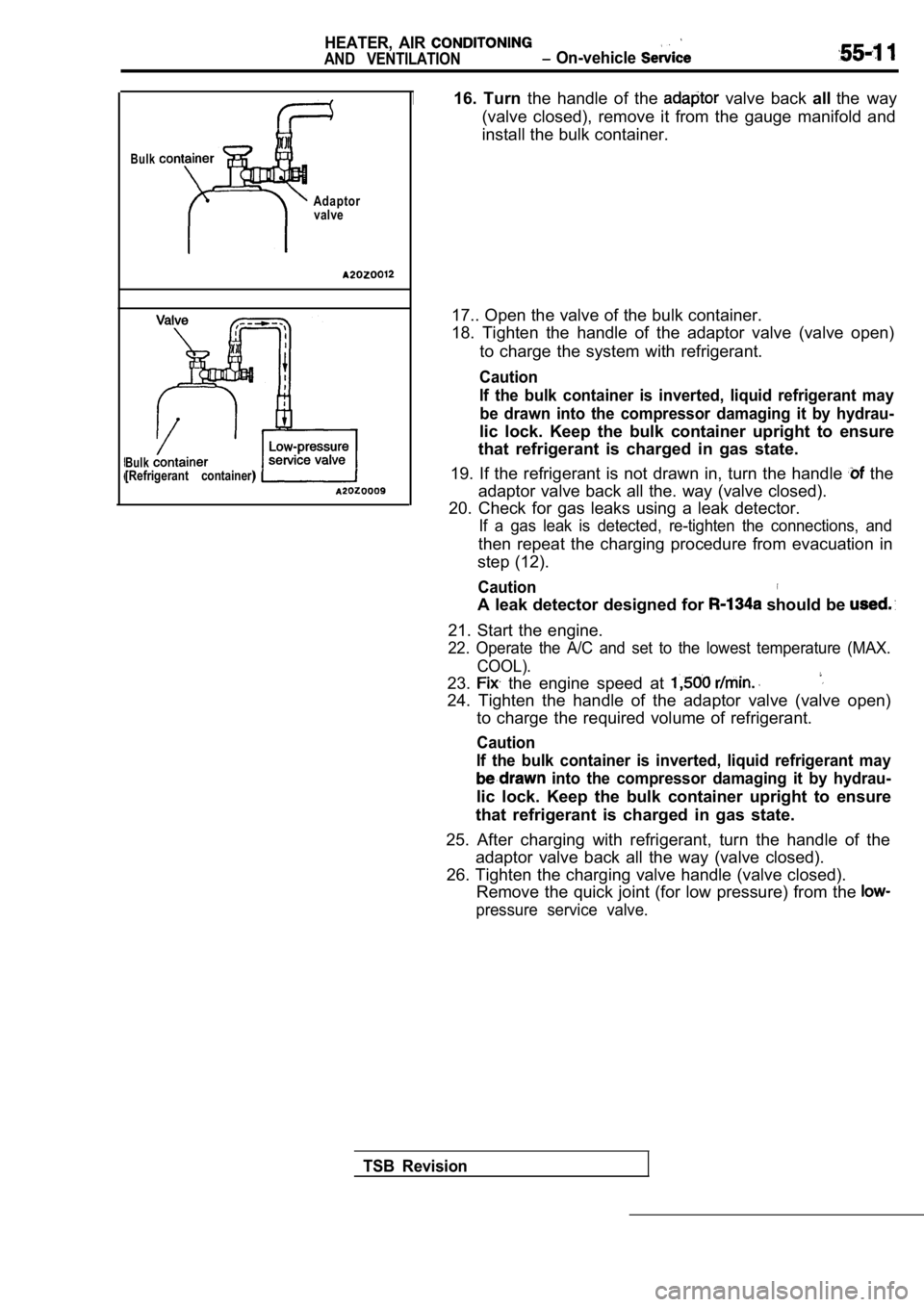
16. Turn the handle of the valve back allthe way
(valve closed), remove it from the gauge manifold a nd
install the bulk container.
17.. Open the valve of the bulk container.
18. Tighten the handle of the adaptor valve (valve open)
to charge the system with refrigerant.
Caution
If the bulk container is inverted, liquid refrigera nt may
be drawn into the compressor damaging it by hydrau-
lic lock. Keep the bulk container upright to ensure
that refrigerant is charged in gas state.
19. If the refrigerant is not drawn in, turn the ha ndle
the
adaptor valve back all the. way (valve closed).
20. Check for gas leaks using a leak detector.
If a gas leak is detected, re-tighten the connectio ns, and
then repeat the charging procedure from evacuation in
step (12).
Caution
A leak detector designed for should be
21. Start the engine.
22. Operate the A/C and set to the lowest temperatu re (MAX.
COOL).
23. the engine speed at
24. Tighten the handle of the adaptor valve (valve open)
to charge the required volume of refrigerant.
Caution
If the bulk container is inverted, liquid refrigera nt may
into the compressor damaging it by hydrau-
lic lock. Keep the bulk container upright to ensure
that refrigerant is charged in gas state.
25. After charging with refrigerant, turn the handl e of the
adaptor valve back all the way (valve closed).
26. Tighten the charging valve handle (valve closed ).
Remove the quick joint (for low pressure) from the
pressure service valve.
TSB Revision
Page 2052 of 2103
HEATER, AIR
AND VENTILATION On-vehicle Service
Bulk container
[Refrigerant container)
Refrigerant container)Bulk container
(Refrigerant container)
Low-pressure
service valve
I
CORRECTING LOW REFRIGERANT LEVEL IN CASE THE
BULK CONTAINER IS USED
1.
2.
3.
4.
5.
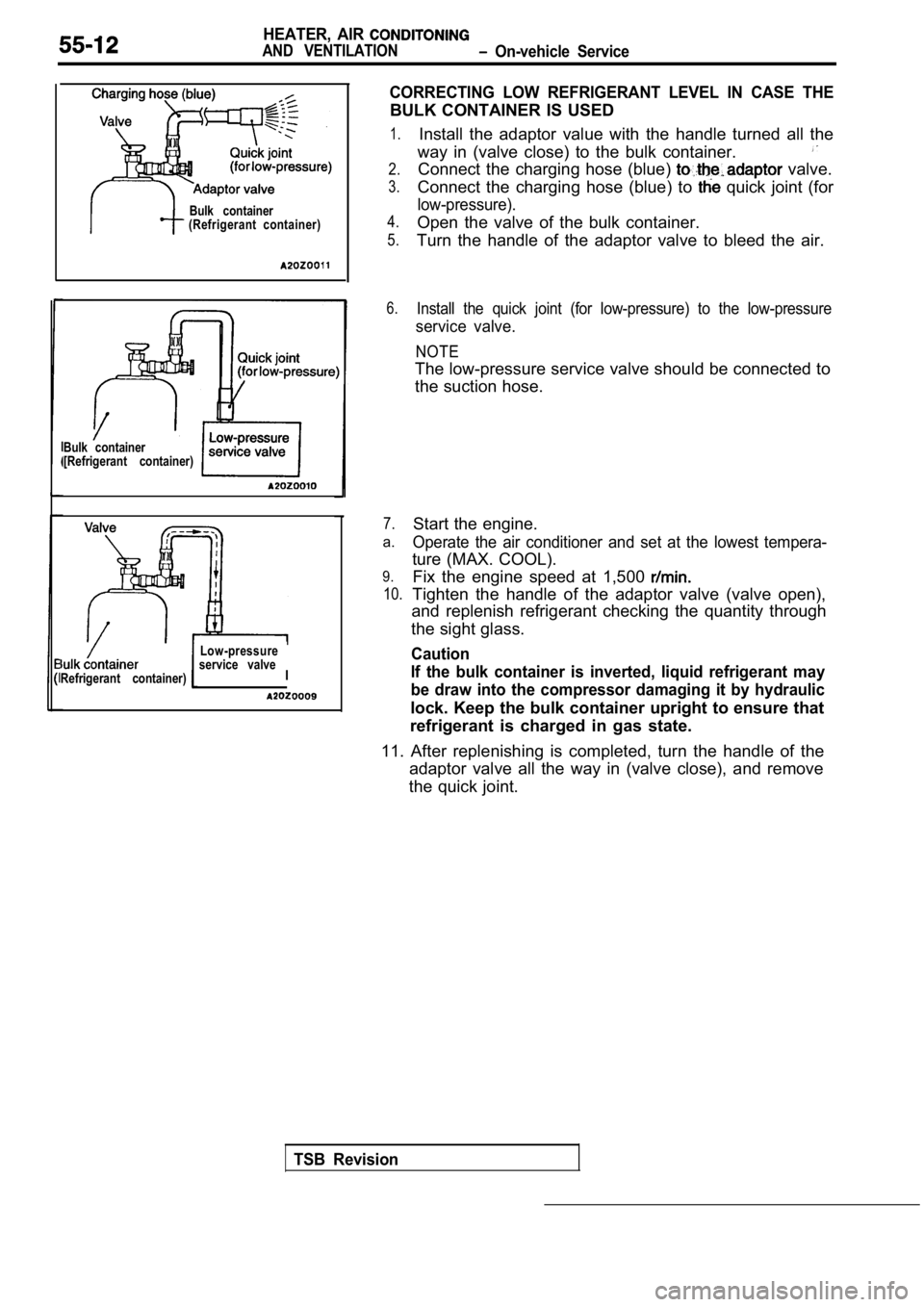
Install the adaptor value with the handle turned al l the
way in (valve close) to the bulk container.
Connect the charging hose (blue) valve.
Connect the charging hose (blue) to
quick joint (for
low-pressure).
Open the valve of the bulk container.
Turn the handle of the adaptor valve to bleed the a ir.
6.Install the quick joint (for low-pressure) to the low-pressure
service valve.
NOTE
The low-pressure service valve should be connected to
the suction hose.
7.
a.
9.
10.
Start the engine.
Operate the air conditioner and set at the lowest t empera-
ture (MAX. COOL).
Fix the engine speed at 1,500
Tighten the handle of the adaptor valve (valve open ),
and replenish refrigerant checking the quantity thr ough
the sight glass.
Caution
If the bulk container is inverted, liquid refrigera nt may
be draw into the compressor damaging it by hydrauli c
lock. Keep the bulk container upright to ensure that
refrigerant is charged in gas state.
11. After replenishing is completed, turn the handl e of the
adaptor valve all the way in (valve close), and rem ove
the quick joint.
TSB Revision
Page 2056 of 2103
6HEATER, AIR
AND VENTILATION On-vehicle Service
COMPRESSOR NOISE CHECK
You must first know the conditions when the noise occurs. These conditions are: weather, vehicle speed,
in gear or neutral, engine temperature or any other special conditions.
Noises that develop during A/C operation can often be misleading. For example: what sounds like a
failed front bearing or connecting rod, may be caus ed by loose bolts, nuts, mounting brackets, or a
loose clutch assembly. Verify accessory drive belt tension (power steering or generator).
Improper accessory drive belt tension can cause a m isleading noise when the compressor is engaged
and little or no noise when the compressor is disen gaged.
Drive belts are speed-sensitive. That is, at differ ent engine speeds, and depending upon belt tension,
belts can develop unusual noises that are often mis taken for mechanical problems within the compressor .
ADJUSTMENT
1. Select a quiet area for testing. Duplicate conditions as much as possible. Switch compressor on
and off several times to clearly identify compresso r noise. To duplicate high ambient
head pressure), restrict air flow through condenser . Install manifold gauge set sure discharge
pressure doesn’t exceed 2,070 (300 psi).
2. Tighten all compressor mounting bolts, clutch mo unting bolt, and compressor drive belt. Check to
assure clutch coil is tight (no rotation or wobble) .
3. Check refrigerant hoses for rubbing or interfere nce that can cause unusual noises.
4. Check refrigerant charge. (Refer to
5. Recheck compressor noise as in Step 1.
6. If noise still exists, loosen compressor mountin g bolts and retorque. Repeat Step 1.
7. If noise continues, replace compressor and repea t Step 1.
Revision
Page 2057 of 2103
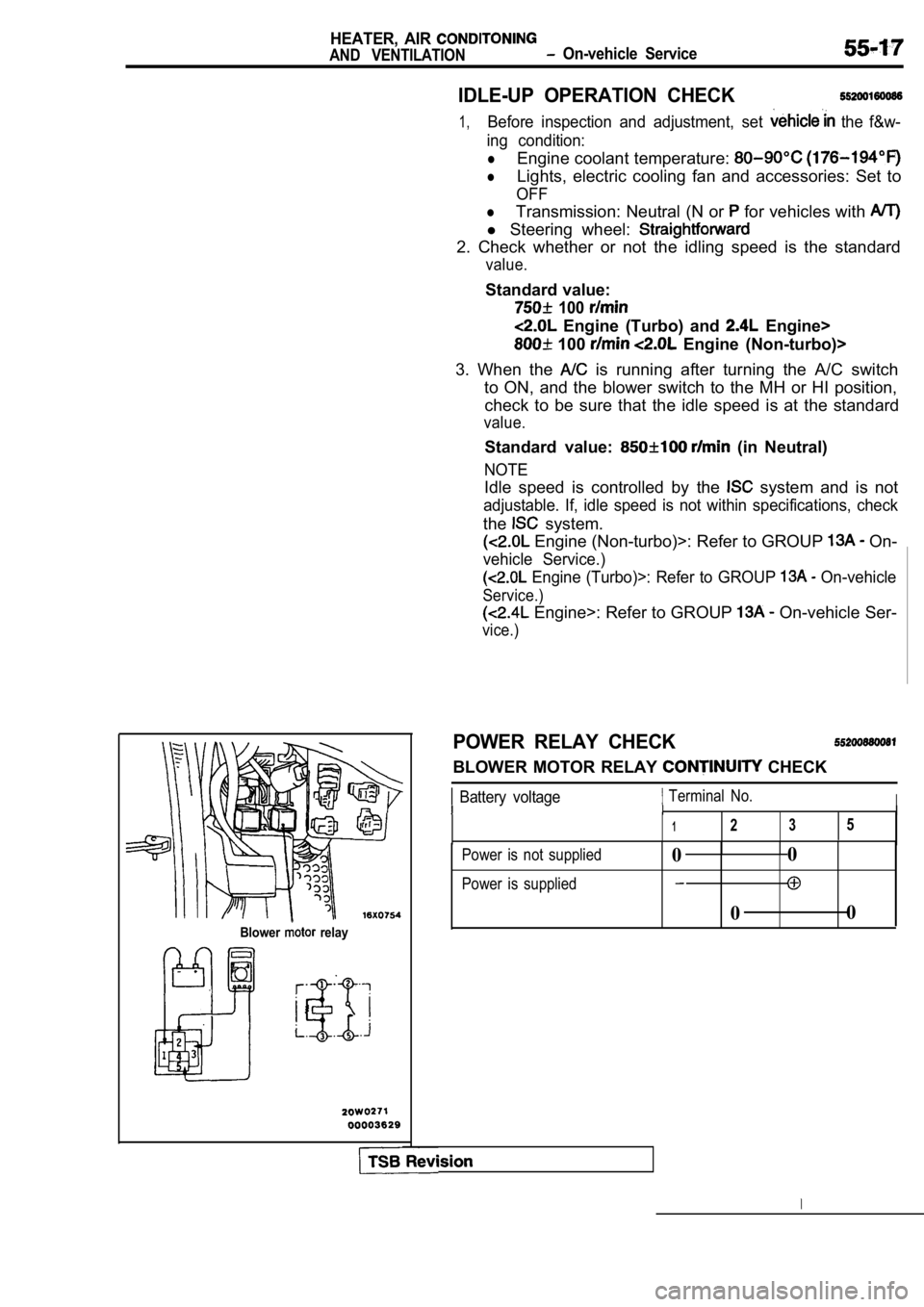
HEATER, AIR
AND VENTILATION On-vehicle Service
IDLE-UP OPERATION CHECK
1,Before inspection and adjustment, set the f&w-
ing condition:
lEngine coolant temperature:
lLights, electric cooling fan and accessories: Set t o
OFF
lTransmission: Neutral (N or for vehicles with
l Steering wheel:
2. Check whether or not the idling speed is the sta ndard
value.
Blower relay
Standard value:
100
Engine (Turbo) and Engine>
100 Engine (Non-turbo)>
3. When the
is running after turning the A/C switch
to ON, and the blower switch to the MH or HI positi on,
check to be sure that the idle speed is at the stan dard
value.
Standard value: (in Neutral)
NOTE
Idle speed is controlled by the system and is not
adjustable. If, idle speed is not within specifications, check
the system.
Engine (Non-turbo)>: Refer to GROUP On-
vehicle Service.)
Engine (Turbo)>: Refer to GROUP On-vehicle
Service.)
Engine>: Refer to GROUP On-vehicle Ser-
vice.)
POWER RELAY CHECK
BLOWER MOTOR RELAY CHECK
Battery voltage Terminal No.III
1235
Power is not supplied
Power is supplied0 0
0 0
Page 2058 of 2103
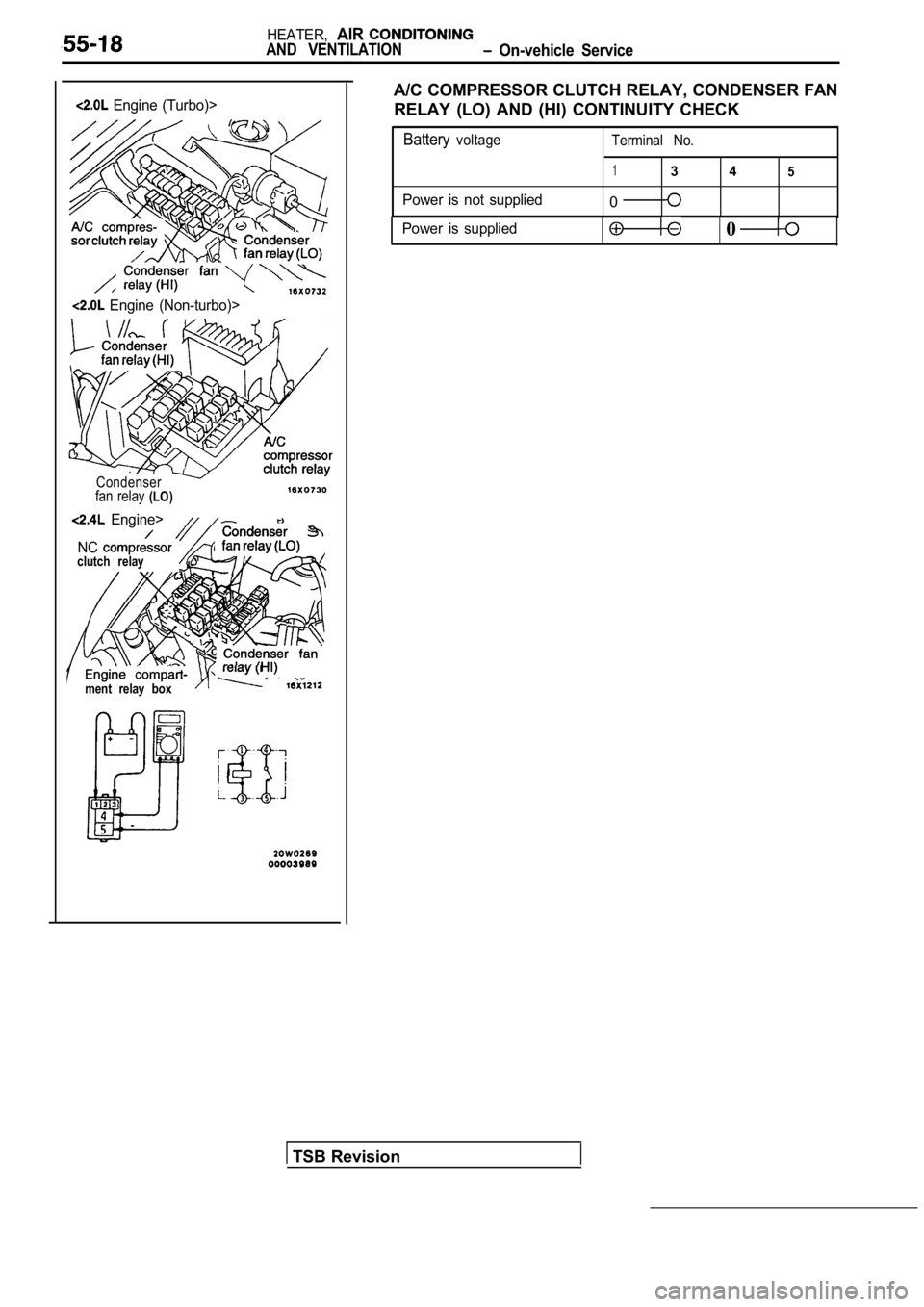
Engine (Turbo)>HEATER,
AIRAND VENTILATION On-vehicle Service
A/C COMPRESSOR CLUTCH RELAY, CONDENSER FAN
RELAY (LO) AND (HI) CONTINUITY CHECK
Batteryvoltage Terminal No.
13 45
Power is not supplied0
Engine (Non-turbo)>
Condenser
fan relay (LO)
Engine>
NC
clutch relay
ment relay box
Power is supplied0
TSB Revision
Page 2070 of 2103
HEATER, AIR
AND VENTILATION Cooling Unit
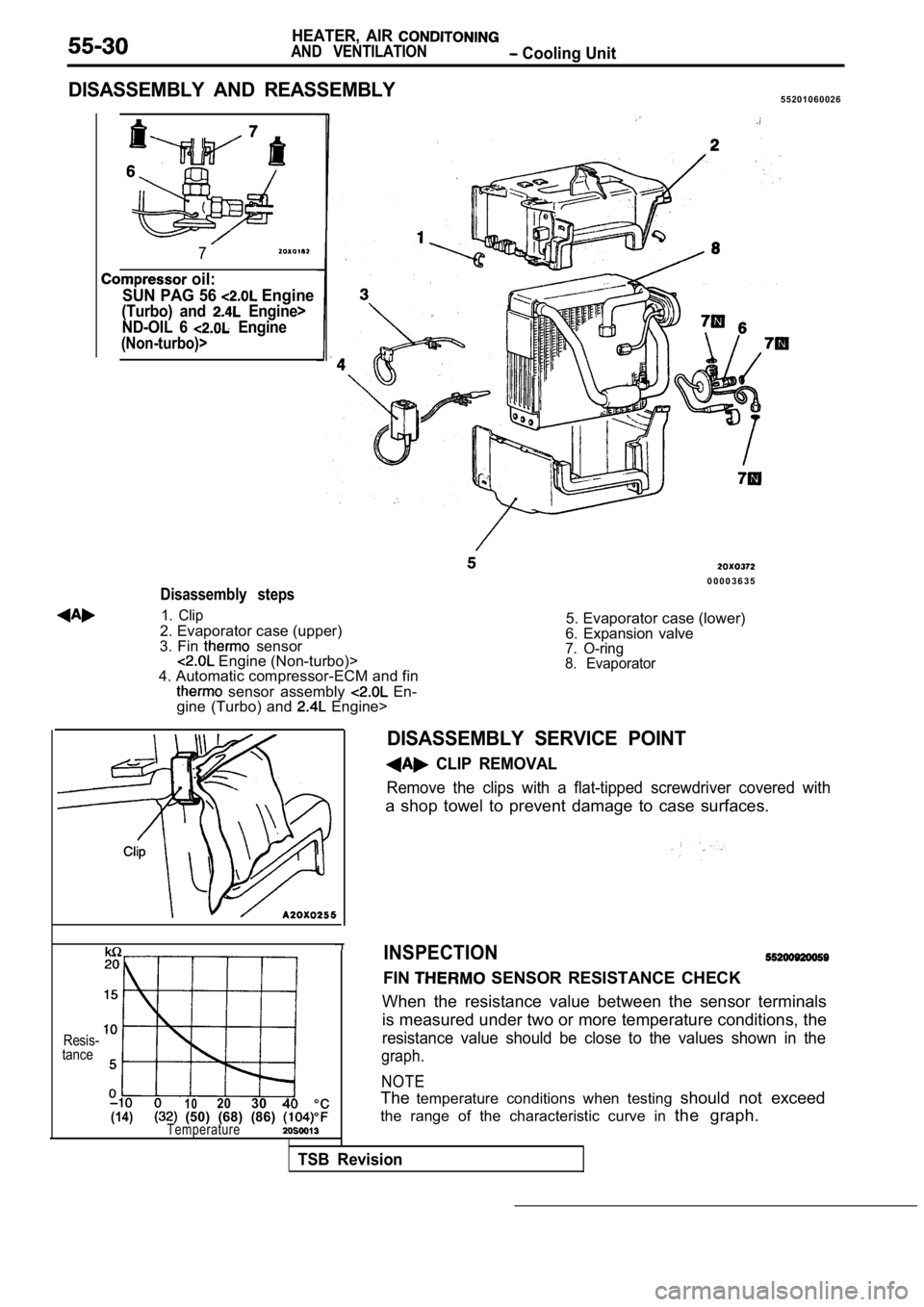
DISASSEMBLY AND REASSEMBLY5 5 2 0 1 0 6 0 0 2 6
7
oil:
SUN PAG 56
Engine
(Turbo) and Engine>
ND-OIL 6
Engine
(Non-turbo)>
0 0 0 0 3 6 3 5
Disassembly steps
1. Clip
2. Evaporator case (upper)
3. Fin sensor Engine (Non-turbo)>
4. Automatic compressor-ECM and fin
sensor assembly En-
gine (Turbo) and Engine> 5. Evaporator case (lower)
6. Expansion valve
7. O-ring
8. Evaporator
Resis-
tance
1 02030 40(14) (50) (68) (86) Temperature
INSPECTION
FIN SENSOR RESISTANCE CHECK
When the resistance value between the sensor termin als
is measured under two or more temperature condition s, the
resistance value should be close to the values show n in the
graph.
NOTE
Thetemperature conditions when testing should not exceed
the range of the characteristic curve in the graph.
TSB Revision
DISASSEMBLY SERVICE POINT
CLIP REMOVAL
Remove the clips with a flat-tipped screwdriver cov ered with
a shop towel to prevent damage to case surfaces.
Page 2073 of 2103
HEATER, AIR Compressor
AND VENTILATION Engine (Turbo) and
When the following’ parts as
compressor, subtract the rated oil amount of the each
part from discharge from the new
compressor.
Quantity
Evaporator: 60 (2.03
Condenser: 15
Suction hose: 10
Receiver: 10
INSPECTION55200420047
lChecking for heat damage of the tension pulley.
lCheck for excessive play or deflection of the tensi on pulley.
lCheck for unusual wear of the tension pulley.
Check for hardening of the compressor drive belt.
lCheck for unusual wear or abrasion of the compresso r
drive belt.
TSB Revision
Page 2076 of 2103
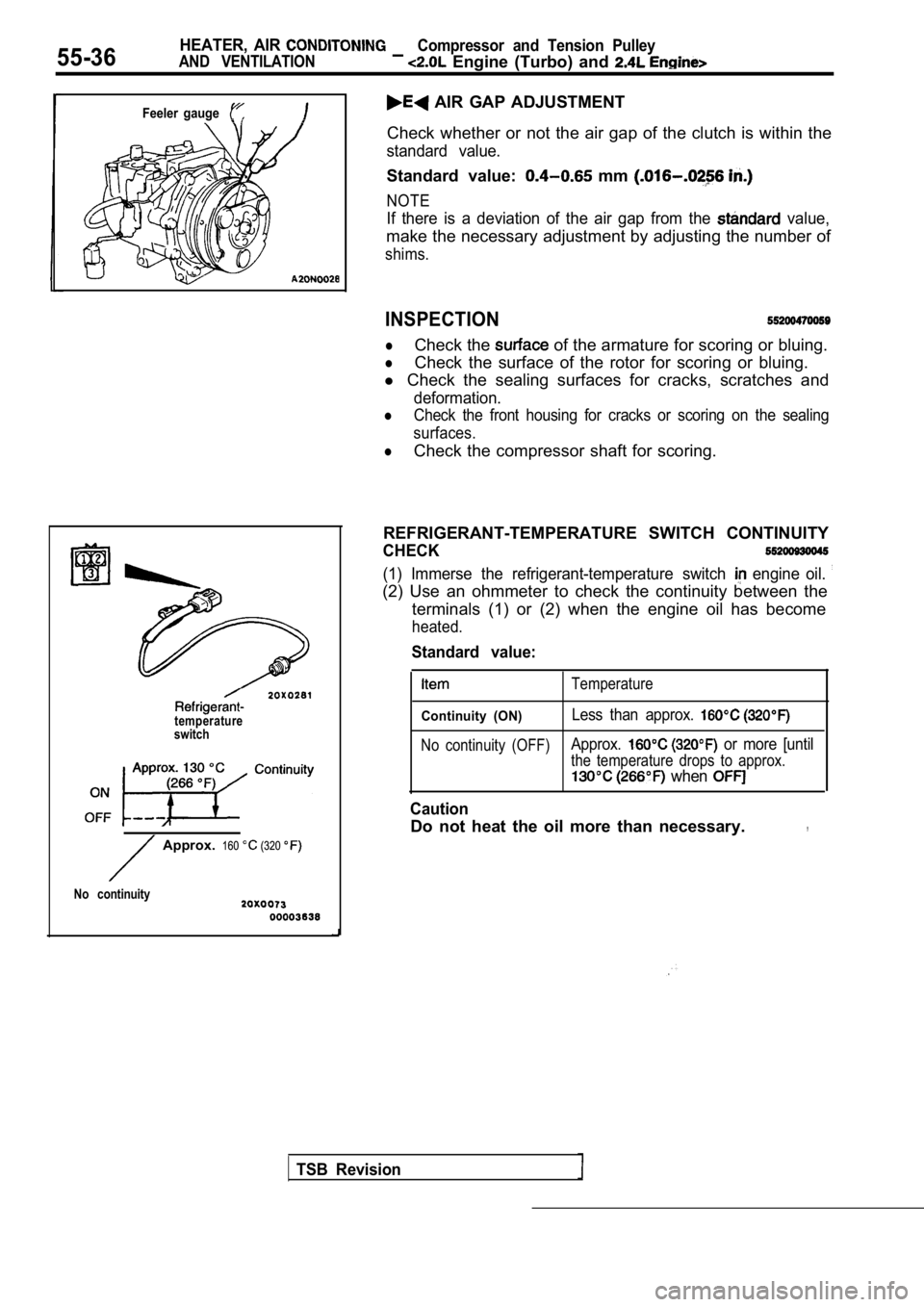
55-36HEATER, AIR
AND VENTILATION
Compressor and Tension Pulley
Engine (Turbo) and
Feeler gauge
temperature
switch
AIR GAP ADJUSTMENT
Check whether or not the air gap of the clutch is w ithin the
standard value.
Standard value: mm
NOTE
If there is a deviation of the air gap from the value,
make the necessary adjustment by adjusting the numb er of
shims.
INSPECTION
lCheck the of the armature for scoring or bluing.
lCheck the surface of the rotor for scoring or bluing.
l Check the sealing surfaces for cracks, scratches an d
deformation.
lCheck the front housing for cracks or scoring on the sealing
surfaces.
lCheck the compressor shaft for scoring.
REFRIGERANT-TEMPERATURE SWITCH CONTINUITY
CHECK
(1) Immerse the refrigerant-temperature switch engine oil.
(2) Use an ohmmeter to check the continuity between the
terminals (1) or (2) when the engine oil has become
heated.
TSB Revision
Approx. 160 (320
No continuity
Standard value:
Temperature
Continuity (ON)Less than approx.
No continuity (OFF)Approx. or more [until
the temperature drops to approx.
when
Caution
Do not heat the oil more than necessary.,
Page 2079 of 2103
Compressor
AND VENTILATION,
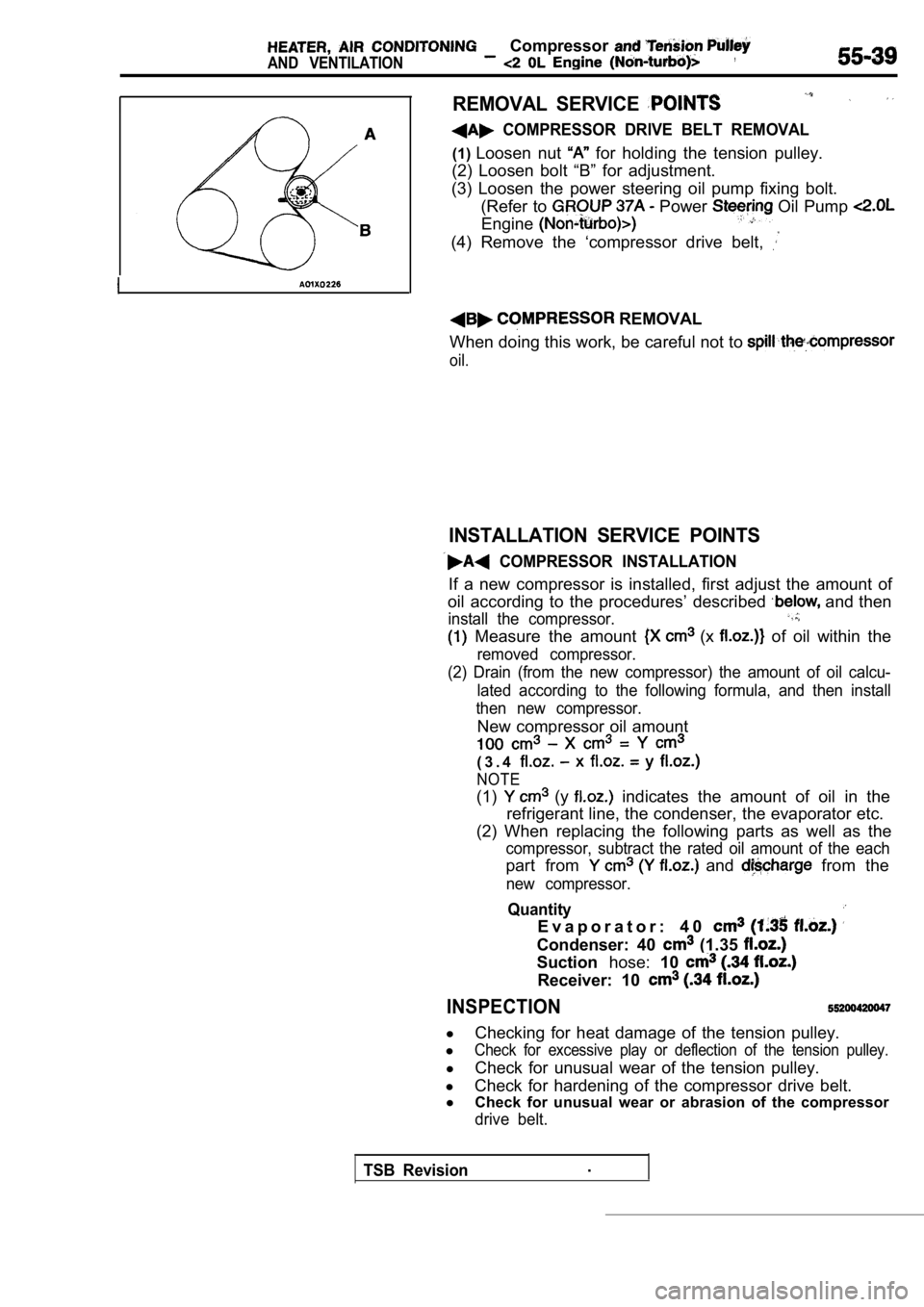
REMOVAL SERVICE
COMPRESSOR DRIVE BELT REMOVAL
(1)Loosen nut for holding the tension pulley.
(2) Loosen bolt “B” for adjustment.
(3) Loosen the power steering oil pump fixing bolt. (Refer to
Power Oil Pump
Engine
(4) Remove the ‘compressor drive belt,
REMOVAL
When doing this work, be careful not to
oil.
INSTALLATION SERVICE POINTS
COMPRESSOR INSTALLATION
If a new compressor is installed, first adjust the amount of
oil according to the procedures’ described
and then
install the compressor.
Measure the amount (x of oil within the
removed compressor.
(2) Drain (from the new compressor) the amount of o il calcu-
lated according to the following formula, and then install
then new compressor.
New compressor oil amount
( 3 . 4
NOTE
(1) (y indicates the amount of oil in the
refrigerant line, the condenser, the evaporator etc .
(2) When replacing the following parts as well as t he
compressor, subtract the rated oil amount of the each
part from and from the
new compressor.
Quantity
E v a p o r a t o r : 4 0
Condenser: 40 (1.35
Suctionhose:10
Receiver: 10
INSPECTION
l
Checking for heat damage of the tension pulley.
l
Check for excessive play or deflection of the tensi on pulley.
l
Check for unusual wear of the tension pulley.
l Check for hardening of the compressor drive belt.
l Check for unusual wear or abrasion of the compresso r
drive belt.
TSB Revision.