engine MITSUBISHI SPYDER 1990 Service Repair Manual
[x] Cancel search | Manufacturer: MITSUBISHI, Model Year: 1990, Model line: SPYDER, Model: MITSUBISHI SPYDER 1990Pages: 2103, PDF Size: 68.98 MB
Page 664 of 2103
ENGINE (TURBO)
ENGINE>of Components’
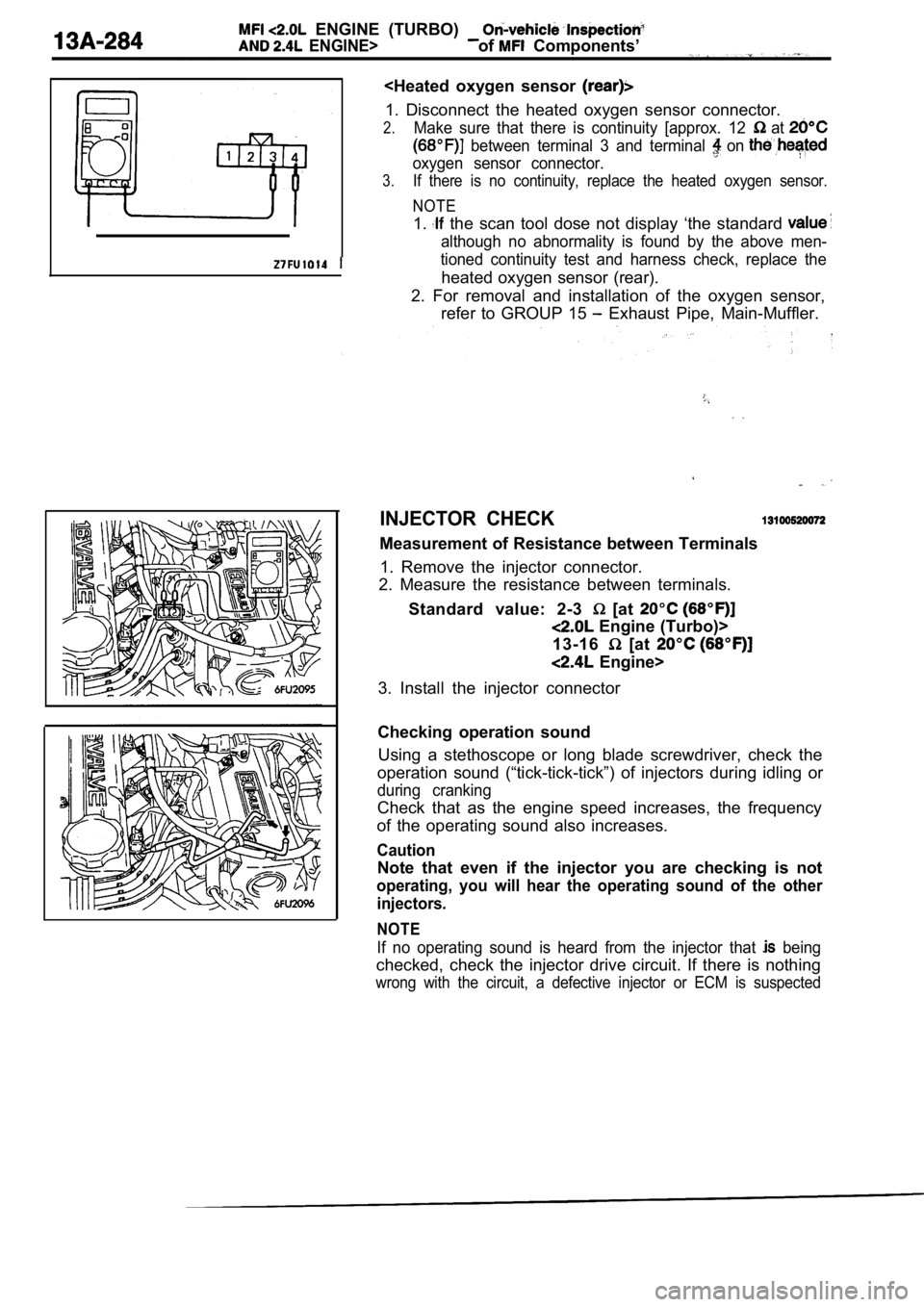
2.Make sure that there is continuity [approx. 12 at
between terminal 3 and terminal on
oxygen sensor connector.
3.If there is no continuity, replace the heated oxyge n sensor.
NOTE
1. the scan tool dose not display ‘the standard
although no abnormality is found by the above men-
tioned continuity test and harness check, replace t he
heated oxygen sensor (rear).
2. For removal and installation of the oxygen senso r,
refer to GROUP 15
Exhaust Pipe, Main-Muffler.
INJECTOR CHECK
Measurement of Resistance between Terminals
1. Remove the injector connector.
2. Measure the resistance between terminals.
Standard value: 2-3
[at
Engine (Turbo)>
13-16
[at
Engine>
3. Install the injector connector
Checking operation sound Using a stethoscope or long blade screwdriver, chec k the
operation sound (“tick-tick-tick”) of injectors dur ing idling or
during cranking
Check that as the engine speed increases, the frequ ency
of the operating sound also increases.
Caution
Note that even if the injector you are checking is not
operating, you will hear the operating sound of the other
injectors.
NOTE
If no operating sound is heard from the injector th at being
checked, check the injector drive circuit. If there is nothing
wrong with the circuit, a defective injector or ECM is suspected
Page 665 of 2103
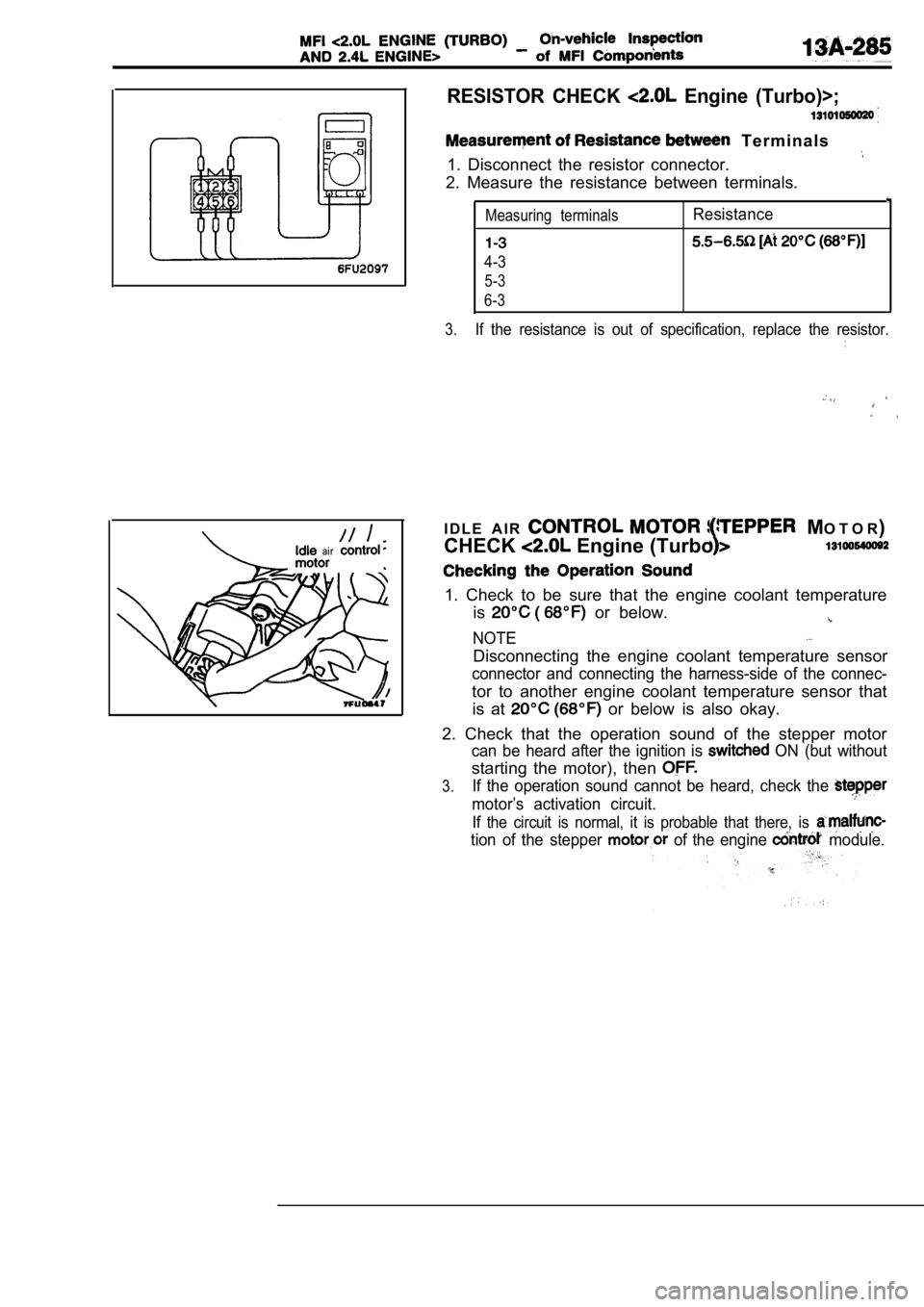
RESISTOR CHECK Engine (Turbo)>;
T e r m i n a l s
1. Disconnect the resistor connector.
2. Measure the resistance between terminals.
Measuring terminalsResistance
4-3
5-3
6-3
3.
If the resistance is out of specification, replace the resistor.
ai r
I D L E A I R MO T O R )
CHECK Engine (Turbo
1. Check to be sure that the engine coolant tempera ture
is
or below.
NOTE
Disconnecting the engine coolant temperature sensor
connector and connecting the harness-side of the co nnec-
tor to another engine coolant temperature sensor th at
is at
or below is also okay.
2. Check that the operation sound of the stepper mo tor
can be heard after the ignition is ON (but without
starting the motor), then
3.If the operation sound cannot be heard, check the
motor’s activation circuit.
If the circuit is normal, it is probable that there, is
tion of the stepper of the engine module.
Page 667 of 2103

IDLE AIR CONTROL (DC: MOTOR)
CHECK
Engine>
Use a stethoscope or long blade screwdriver to chec k if the
operating sound of the idle air control’ motor can
immediately after the ignition switch is turned to
NOTE
If the motor operation cannot be heard, check the m otor
drive circuit and the idle air control motor.
FUEL PRESSURE SOLENOID CHECK
Engine (Turbo)>
NOTE
When disconnecting the vacuum hose, always a mark’
so that it can be reconnected at original position! 1. Disconnect the vacuum hose from the solenoid val ve.
2. Disconnect the harness connector.
Page 668 of 2103
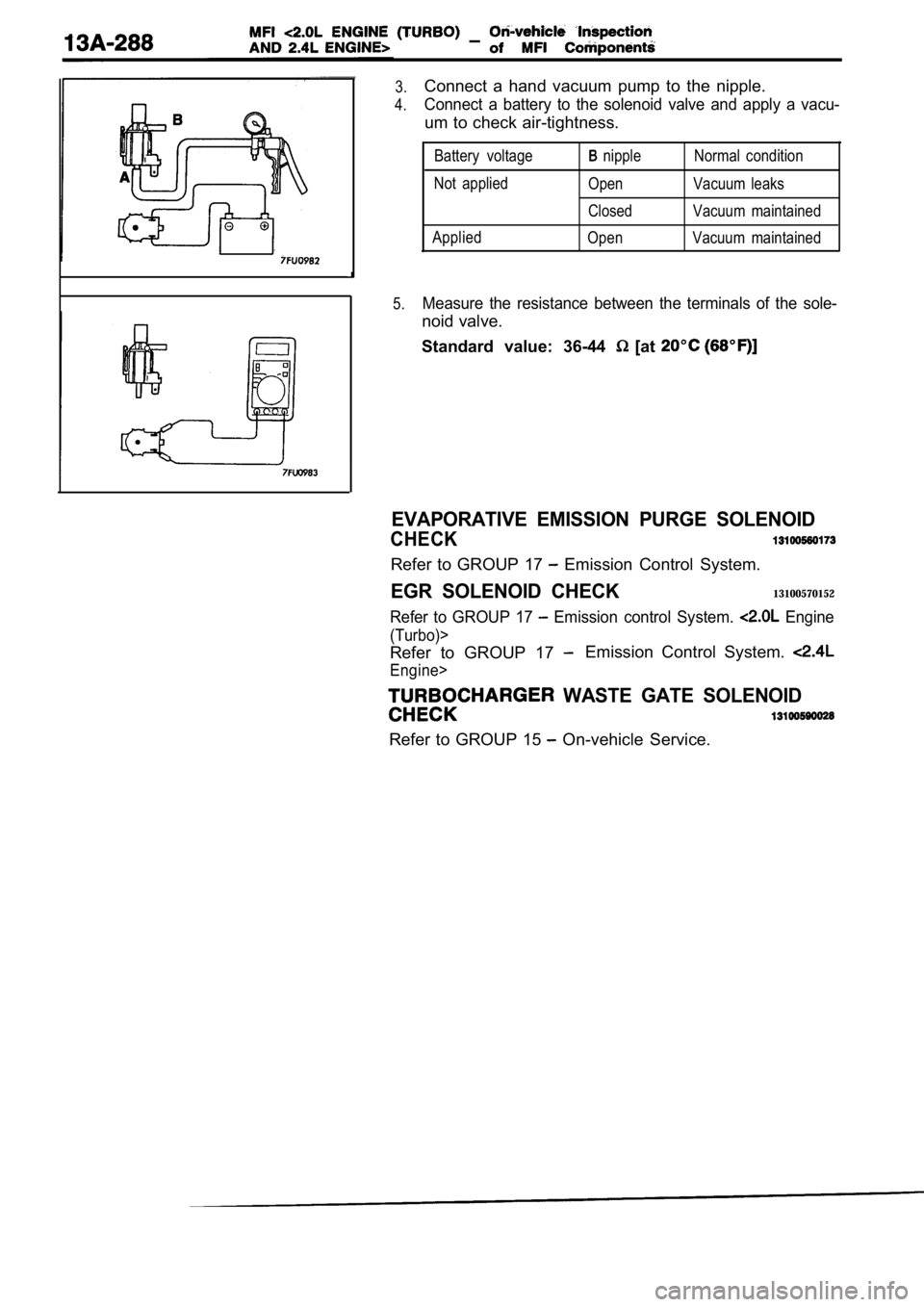
Connect a hand vacuum pump to the nipple.
Connect a battery to the solenoid valve and apply a vacu-
um to check air-tightness.
Battery voltage
Not applied
Applied nipple
Open
Closed
Open Normal condition
Vacuum leaks
Vacuum maintained
Vacuum maintained
Measure the resistance between the terminals of the sole-
noid valve.
Standard value: 36-44
[at
3.
4.
5.
EVAPORATIVE EMISSION PURGE SOLENOID
CHECK
Refer to GROUP 17 Emission Control System.
EGR SOLENOID CHECK13100570152
Refer to GROUP 17 Emission control System. Engine
(Turbo)>
Refer to GROUP 17 Emission Control System.
Engine>
WASTE GATE SOLENOID
Refer to GROUP 15 On-vehicle Service.
Page 669 of 2103
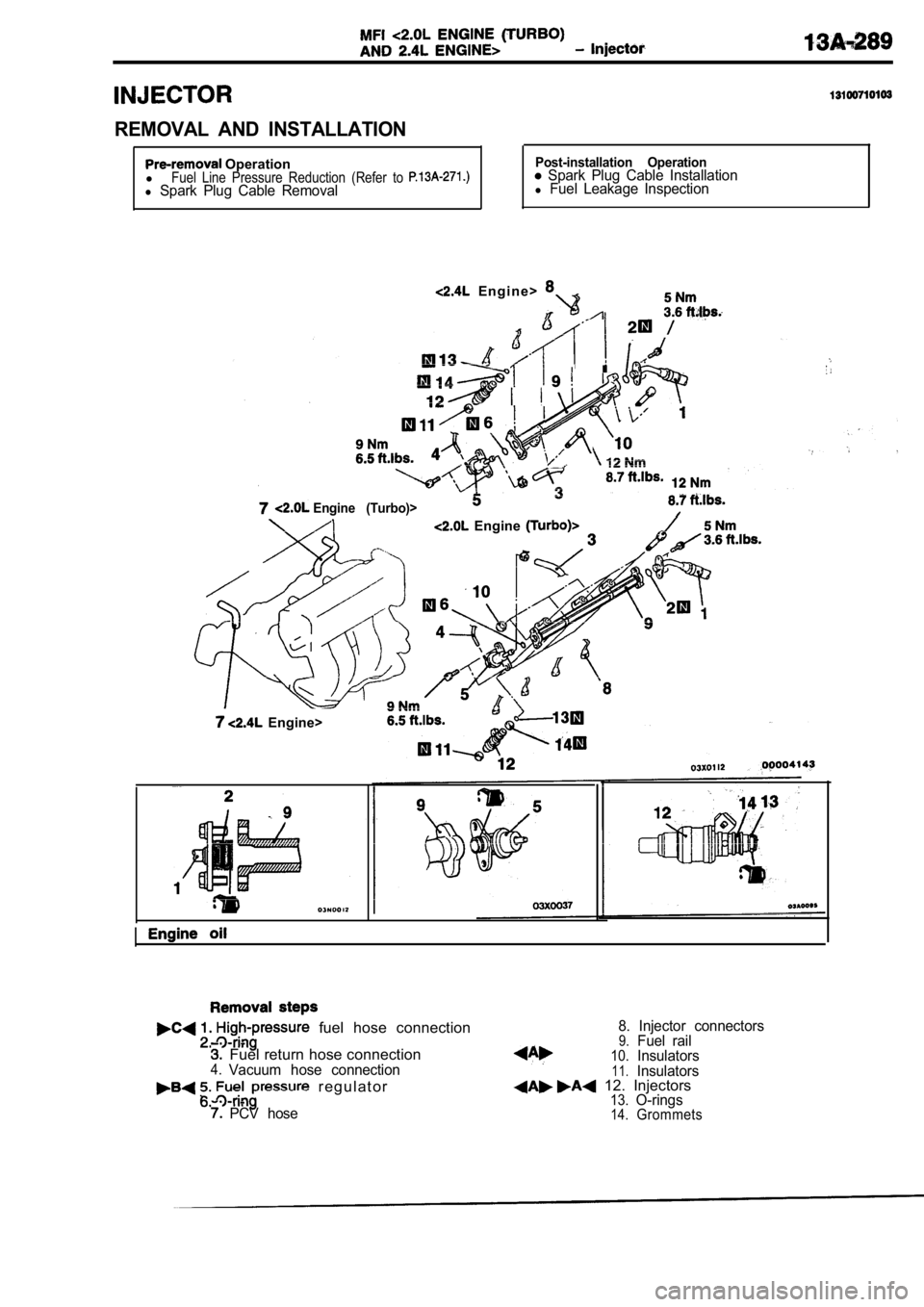
REMOVAL AND INSTALLATION
Operation
lFuel Line Pressure Reduction (Refer to l Spark Plug Cable Removal
Post-installation Operation Spark Plug Cable Installationl Fuel Leakage Inspection
E n g i n e >
Engine (Turbo)>
I:
Engine
Engine>
fuel hose connection
Fuel return hose connection4.Vacuum hose connection
r e g u l a t o r
PCV hose 8. Injector connectors
9.Fuel rail10.Insulators11.Insulators 12. Injectors13.O-rings14.Grommets
Page 670 of 2103
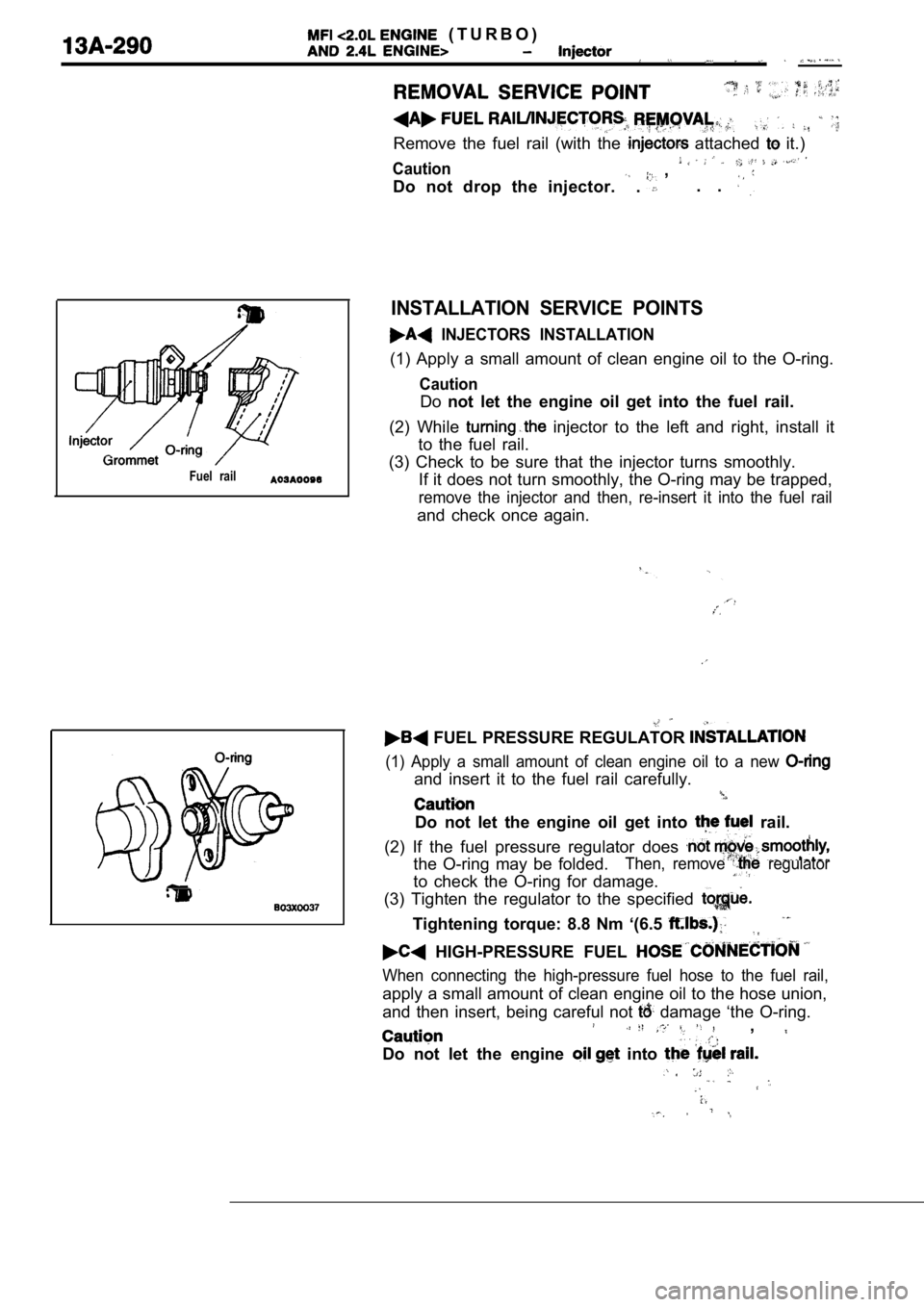
( T U R B O )
Remove the fuel rail (with the attached it.)
Caution ,
Do not drop the injector.
. . .
Fuel rail
INSTALLATION SERVICE POINTS
INJECTORS INSTALLATION
(1) Apply a small amount of clean engine oil to the O-ring.
Caution
Donot let the engine oil get into the fuel rail.
(2) While
injector to the left and right, install it
to the fuel rail.
(3) Check to be sure that the injector turns smooth ly.
If it does not turn smoothly, the O-ring may be tra pped,
remove the injector and then, re-insert it into the fuel rail
and check once again.
FUEL PRESSURE REGULATOR
(1) Apply a small amount of clean engine oil to a n ew
and insert it to the fuel rail carefully.
Do not let the engine oil get into rail.
(2) If the fuel pressure regulator does
the O-ring may be folded.Then, remove regulator
to check the O-ring for damage.
(3) Tighten the regulator to the specified
Tightening torque: 8.8 Nm ‘(6.5
HIGH-PRESSURE FUEL
When connecting the high-pressure fuel hose to the fuel rail,
apply a small amount of clean engine oil to the hose union,
and then insert, being careful not
damage ‘the O-ring.,
Do not let the engine into
,
Page 671 of 2103
E N G I N E ( T U R B O )
AND ENGINE>
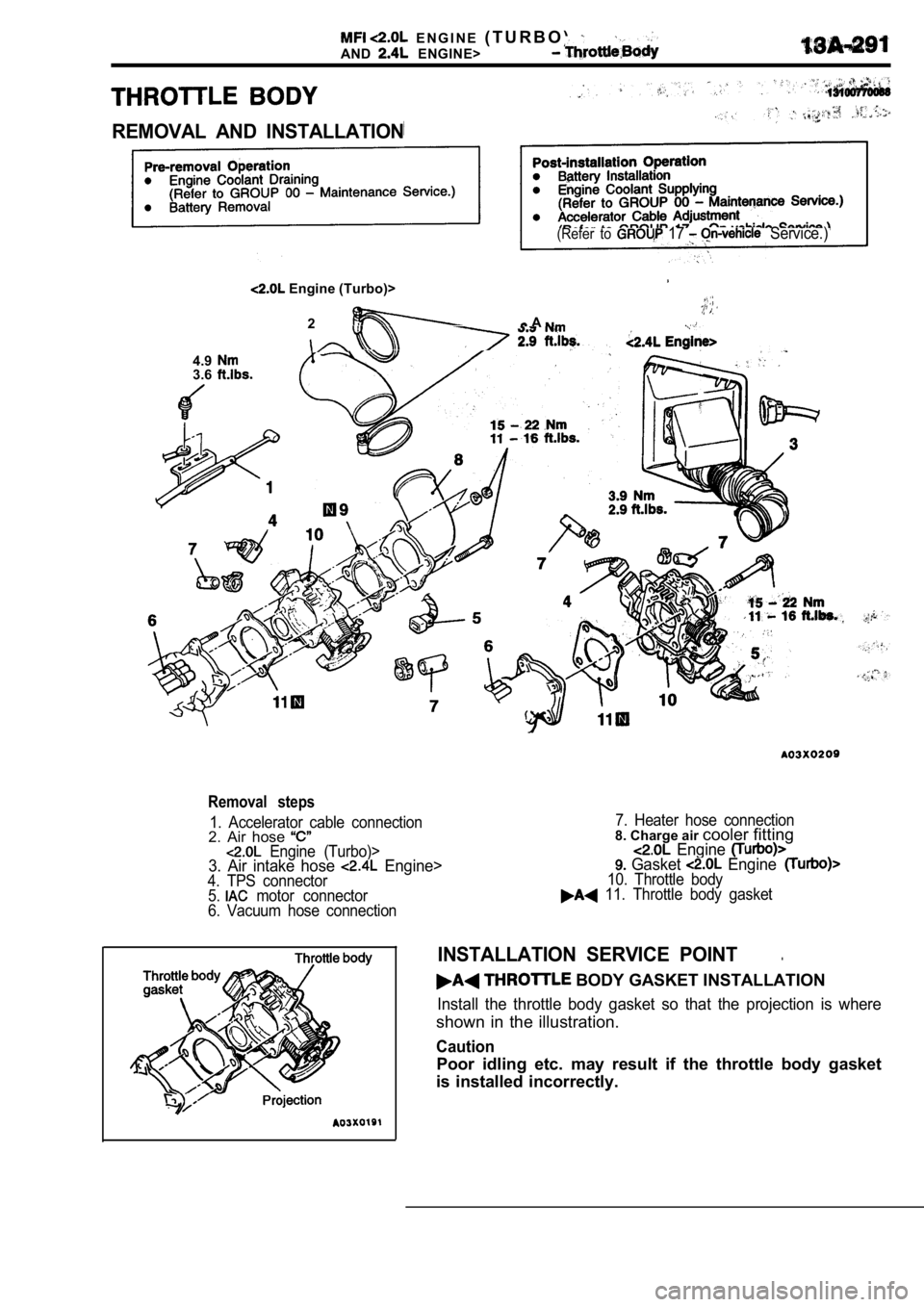
REMOVAL AND INSTALLATION
(Refer to 17 Service.)
Engine (Turbo)>
2 A . .
4.93.6
Removal steps
1. Accelerator cable connection2. Air hose Engine (Turbo)>3. Air intake hose Engine>4. TPS connector
5. motor connector
6. Vacuum hose connection 7. Heater hose connection
8. Charge air
cooler fitting Engine Gasket Engine10. Throttle body 11. Throttle body gasket
INSTALLATION SERVICE POINT.
BODY GASKET INSTALLATION
Install the throttle body gasket so that the projec tion is where
shown in the illustration.
Caution
Poor idling etc. may result if the throttle body ga sket
is installed incorrectly.
Page 679 of 2103
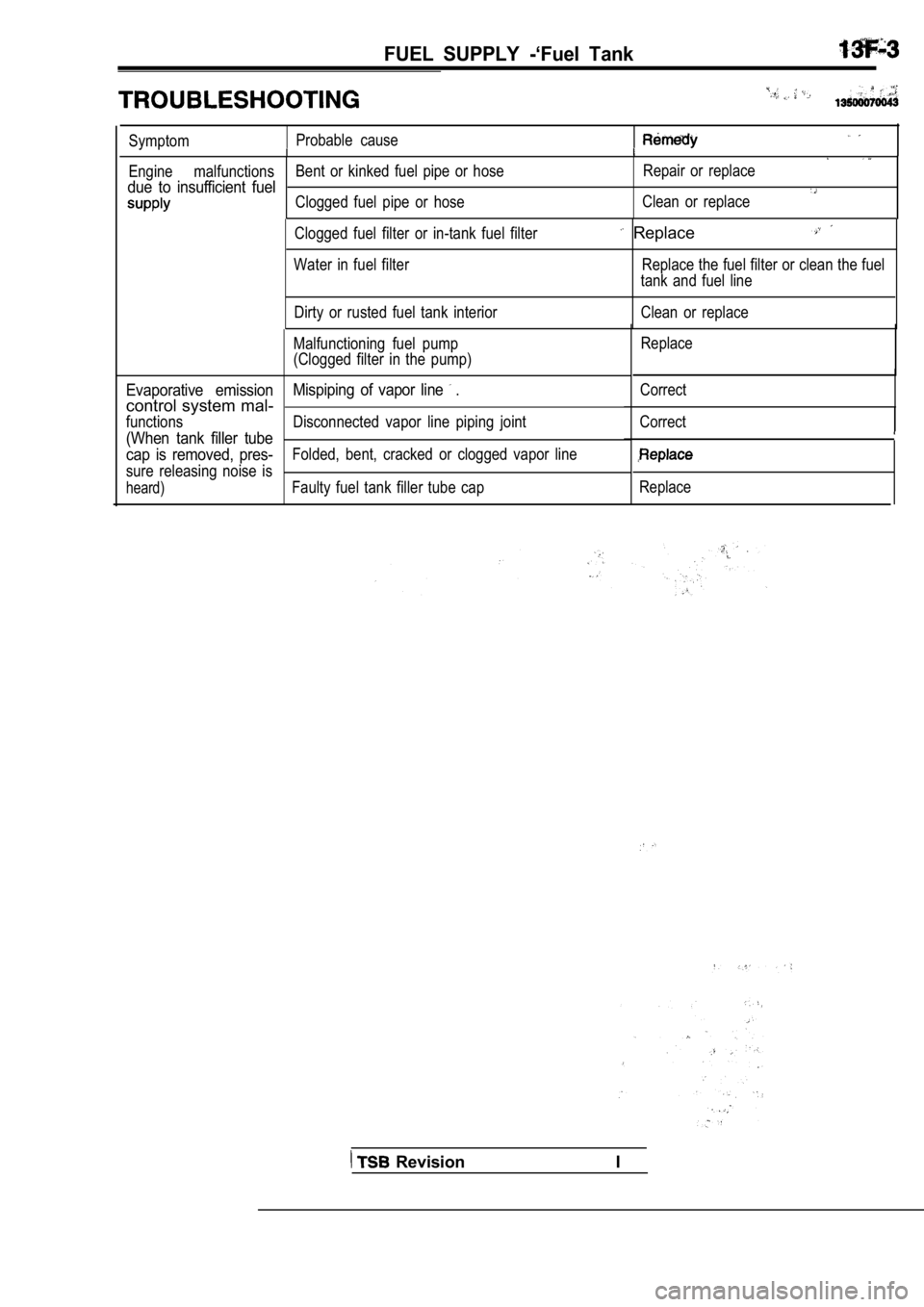
FUEL SUPPLY -‘Fuel Tank
SymptomProbable cause
Engine malfunctions
Bent or kinked fuel pipe or hose Repair or replace
due to insufficient fuelClogged fuel pipe or hoseClean or replace
Clogged fuel filter or in-tank fuel filter
Water in fuel filter
Dirty or rusted fuel tank interior
Replace. .
Replace the fuel filter or clean the fuel
tank and fuel line
Clean or replace
Malfunctioning fuel pump
(Clogged filter in the pump)
Evaporative emission Mispiping of vapor line .
control system mal-
functions Disconnected vapor line piping joint
(When tank filler tube
cap is removed, pres-
Folded, bent, cracked or clogged vapor line
sure releasing noise is
heard)Faulty fuel tank filler tube cap Replace
Correct
CorrectReplace
Revision I
Page 680 of 2103
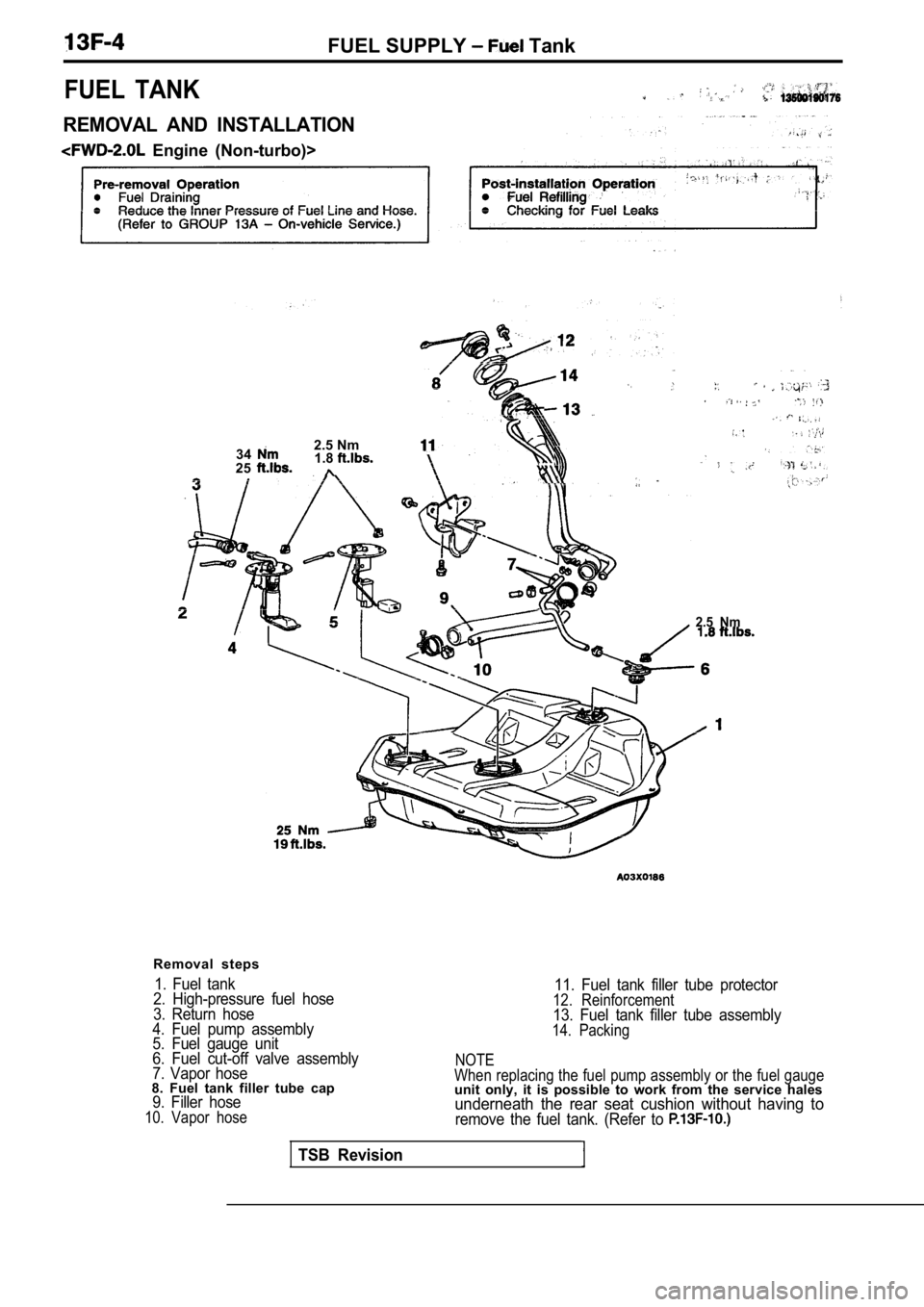
FUEL SUPPLY Tank
FUEL TANK
REMOVAL AND INSTALLATION
Engine (Non-turbo)>34
2.5 Nm
251.8
2.5 Nm
Removal steps
1. Fuel tank
2. High-pressure fuel hose
3. Return hose
4. Fuel pump assembly
5. Fuel gauge unit
6. Fuel cut-off valve assembly
7. Vapor hose
8. Fuel tank filler tube cap9. Filler hose10. Vapor hose
TSB Revision
11. Fuel tank filler tube protector12. Reinforcement13. Fuel tank filler tube assembly14. Packing
NOTE
When replacing the fuel pump assembly or the fuel g auge
unit only, it is possible to work from the service halesunderneath the rear seat cushion without having toremove the fuel tank. (Refer to
Page 682 of 2103
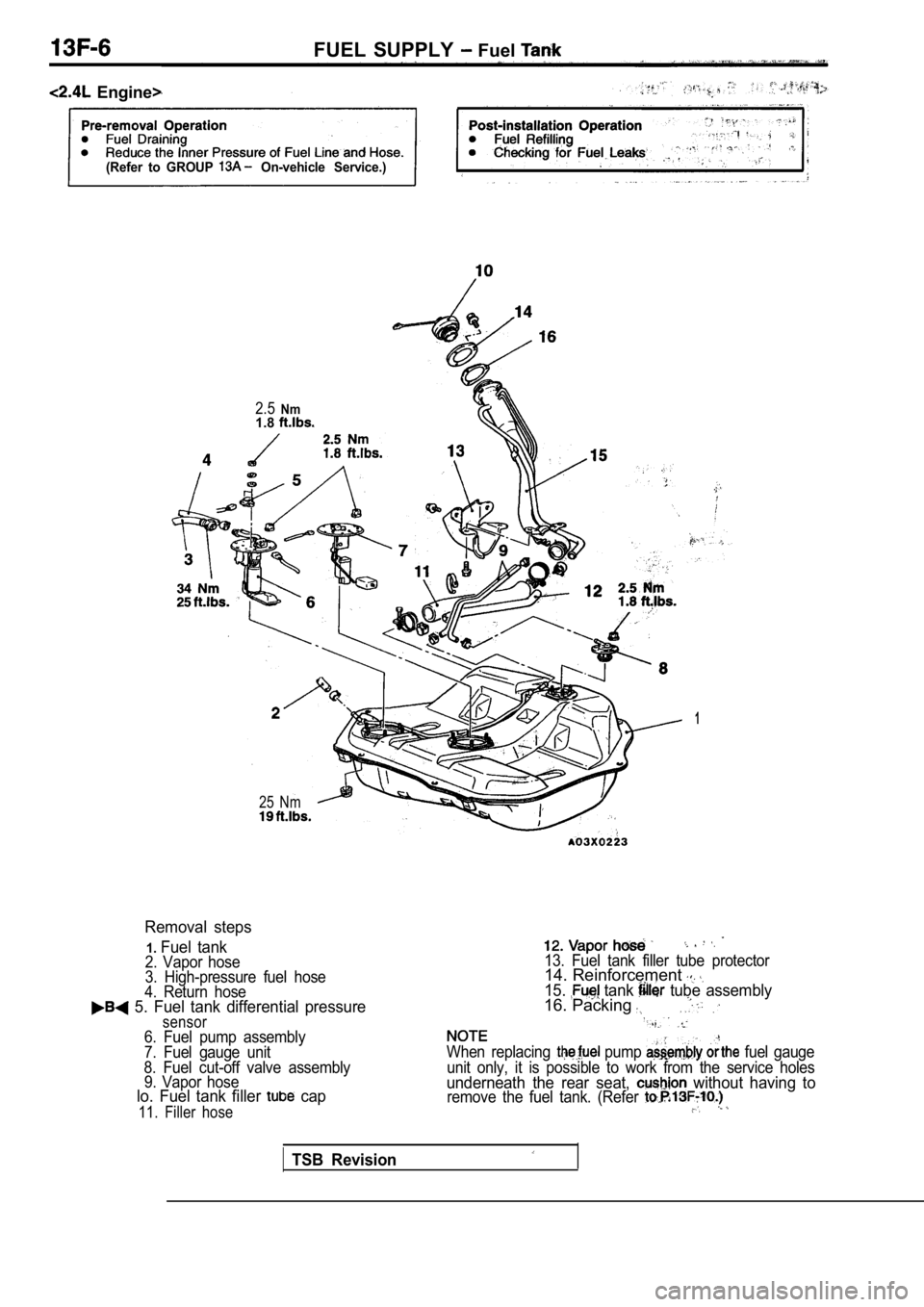
Engine>FUEL SUPPLY
Fuel
(Refer to GROUP On-vehicle Service.)
2.5Nm1.8
25 Nm
Removal steps
1.Fuel tank2. Vapor hose
3. High-pressure fuel hose
4. Return hose
5. Fuel tank differential pressuresensor6. Fuel pump assembly
7. Fuel gauge unit
8. Fuel cut-off valve assembly 9. Vapor hose
lo. Fuel tank filler cap
11. Filler hose
1
13. Fuel tank filler tube protector14. Reinforcement 15. tank tube assembly16. Packing
When replacing pump fuel gauge
unit only, it is possible to work from the service holes
underneath the rear seat, without having toremove the fuel tank. (Refer
TSB Revision