engine MITSUBISHI SPYDER 1990 Service Repair Manual
[x] Cancel search | Manufacturer: MITSUBISHI, Model Year: 1990, Model line: SPYDER, Model: MITSUBISHI SPYDER 1990Pages: 2103, PDF Size: 68.98 MB
Page 685 of 2103
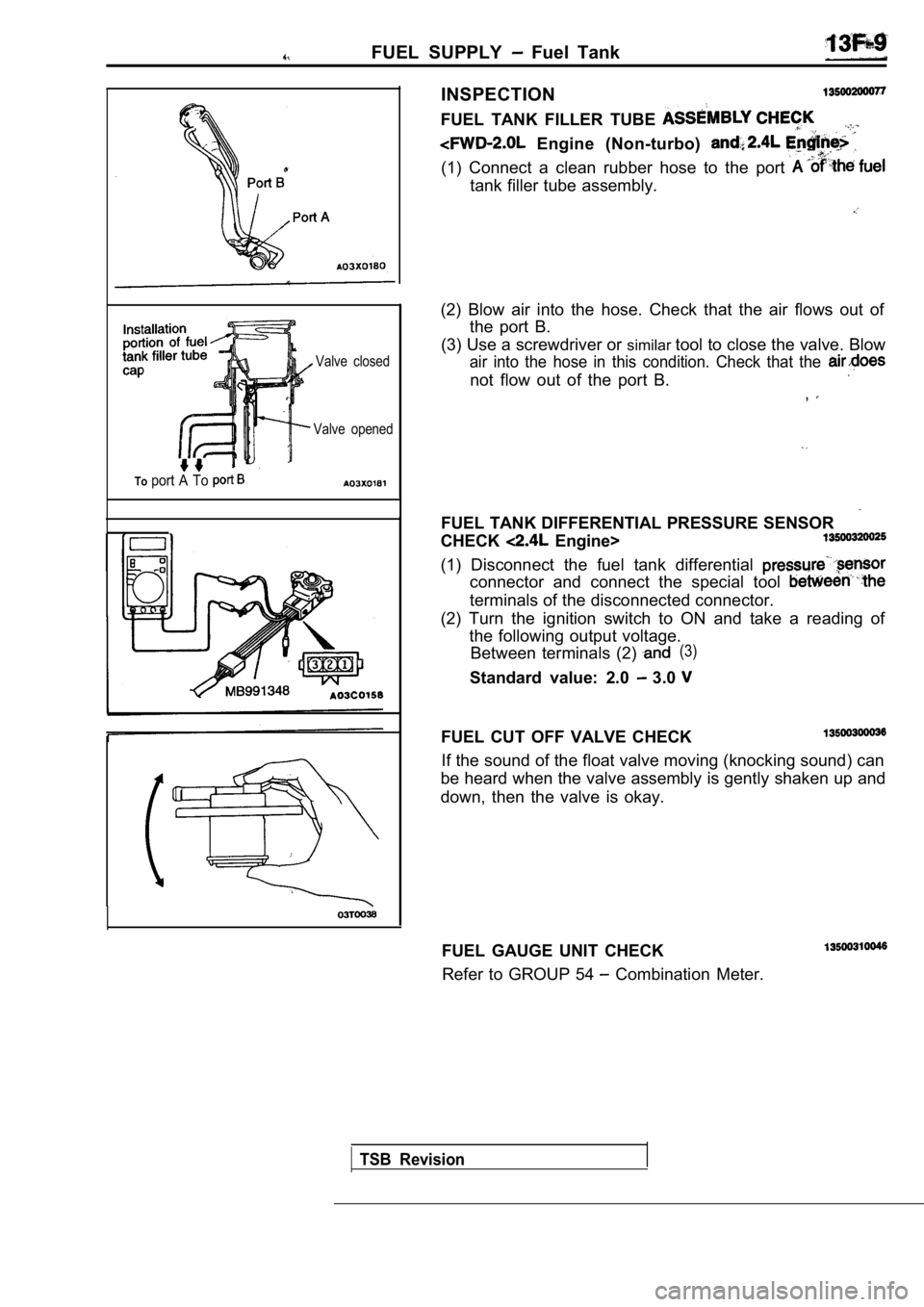
FUEL SUPPLY Fuel Tank
Valve closed
Valve opened
Toport A To
INSPECTION
FUEL TANK FILLER TUBE
Engine (Non-turbo)
(1) Connect a clean rubber hose to the port
tank filler tube assembly.
(2) Blow air into the hose. Check that the air flow s out of
the port B.
(3) Use a screwdriver or similartool to close the valve. Blow
air into the hose in this condition. Check that the
not flow out of the port B.,
FUEL TANK DIFFERENTIAL PRESSURE SENSOR
CHECK
Engine>
(1) Disconnect the fuel tank differential
connector and connect the special tool
terminals of the disconnected connector.
(2) Turn the ignition switch to ON and take a readi ng of
the following output voltage. Between terminals (2)
(3)
Standard value: 2.0 3.0
FUEL CUT OFF VALVE CHECK
If the sound of the float valve moving (knocking so und) can
be heard when the valve assembly is gently shaken u p and
down, then the valve is okay.
FUEL GAUGE UNIT CHECKRefer to GROUP 54
Combination Meter.
TSB Revision
Page 688 of 2103
FUEL SUPPLY Filter
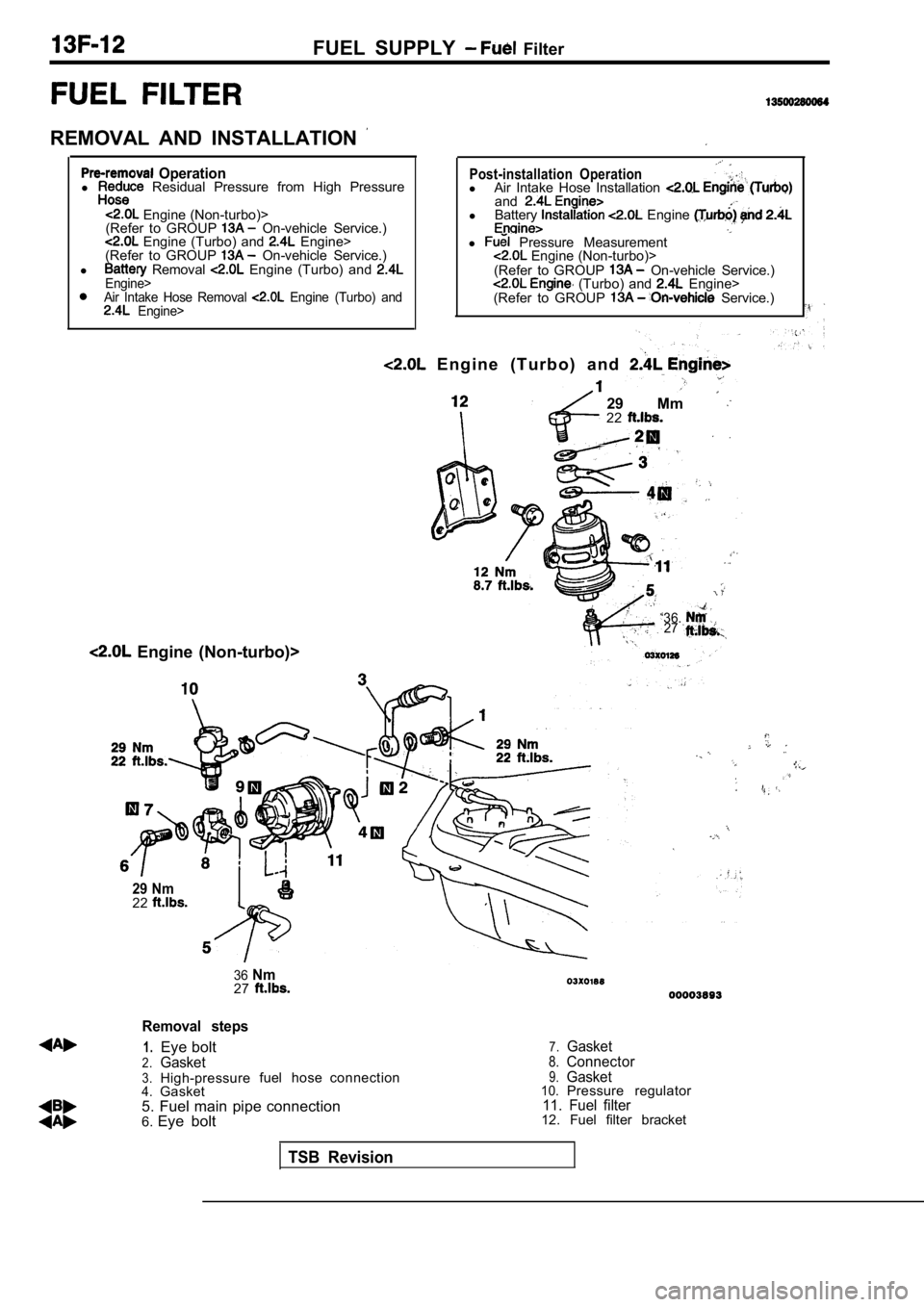
REMOVAL AND INSTALLATION
Operationl Residual Pressure from High Pressure
Engine (Non-turbo)>
(Refer to GROUP On-vehicle Service.) Engine (Turbo) and Engine>
(Refer to GROUP On-vehicle Service.)
l Removal Engine (Turbo) and Engine>Air Intake Hose Removal Engine (Turbo) and Engine>
Post-installation Operationl Air Intake Hose Installation andl Battery Engine . .
l Pressure Measurement Engine (Non-turbo)>
(Refer to GROUP On-vehicle Service.) (Turbo) and Engine>
(Refer to GROUP Service.)
E n g i n e ( T u r b o ) a n d
29 Mm 22
‘36.27
Engine (Non-turbo)>
29 Nm22
36Nm27
Removal steps
1.Eye bolt2.Gasket3.High-pressure fuel hose connection4.Gasket
5. Fuel main pipe connection
6. Eye bolt
7.Gasket8.Connector9.Gasket10.Pressure regulator11. Fuel filter12. Fuel filter bracket
TSB Revision
Page 691 of 2103
CONTENTS
GENERAL INFORMATION. . . . . . . . . . . . . . . . . .2SERVICE SPECIFICATIONS . . . . . . . . . . . . . . . . . 3
LUBRICANT3THERMOSTAT. . . . . . . . . . . . . . . . . . . . . . . . . . . .13. . . . . . . . . . . . . . . . . . . . . . . . . . . . . . .
ON-VEHICLE SERVICE. . . . . . . . . . . . . . . . . . . . .7TROUBLESHOOTING. . . . . . . . . . . . . . . . . . . . . . .4
Engine Coolant Concentration Test. . . . . . . . . . . .7.
Engine Coolant Leak Check . . . . . . . . . . . . . . . . . .
7WATER HOSE ‘AND PIPE
. . . . . . . . .
Engine Coolant Replacement. . . . . . . . . . . . . . . . .7 AND
Radiator Cap Valve Opening Pressure CheckENGINE>. . . . . . . . . . . . . . . .. . . . . . . . . . . . . . . . . .22
. . . . . . . . . . . . . . . . . . . . . . . . . . . . . . . . . . . . . . . . . . . . .7WATER PUMP
RADIATOR. . . . . . . . . .18. . . . . . . . . . . . . . . . . . . . . . . . . . . . . . . . .8 ENGINE (NON-TURBO)>
ENGINE (TURBO) AND , , S E A L A N T
. . . . . . . . . . . . . . . . . . . . . . . . . . . . . . . . . .3ENGINE>. . . . . . . . . . . . . . . . . . . . . . . . . . . . . . .18
Page 692 of 2103
14-2ENGINE COOLING General Information
GENERAL INFORMATION , ,
The cooling system is designed to keep every partthat the heat absorbed by the coolant may be of the engine at appropriate temperature in diated into the air.
er condition the engine may be operated.
The cooling of the water-cooled, pressureThe water pump is of the centrifugal type and is
driven by the
the
forced circulation type in which the water pump crankshaft. .
pressurizes coolant and circulates it throughout th e
engine: If the coolant temperature exceeds the
scribed temperature, the thermostat opens to circu-
late the coolant through the radiator as well so
and is cooled the
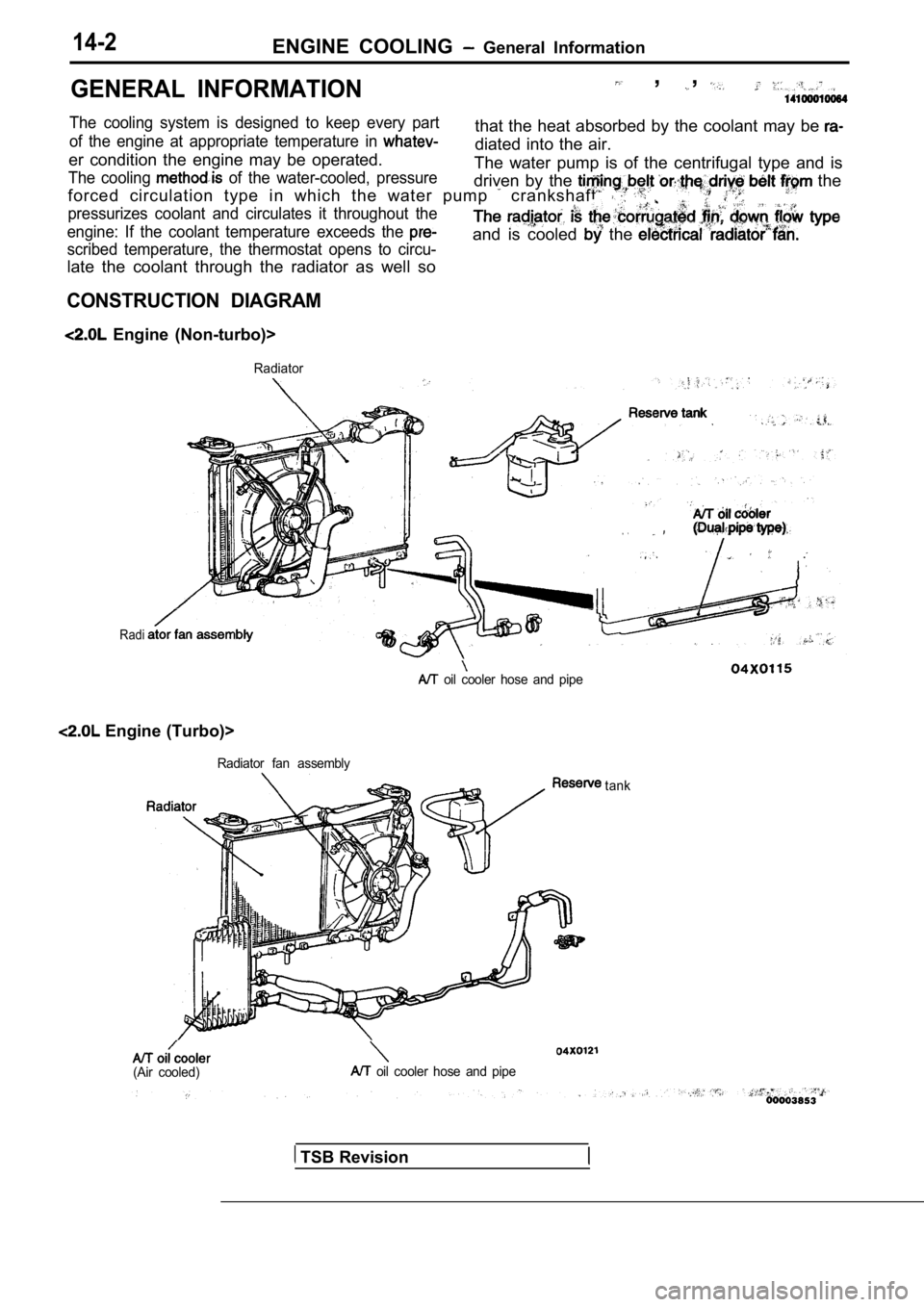
CONSTRUCTION DIAGRAM
Engine (Non-turbo)>
Radiator
Radi
.
oil cooler hose and pipe
Engine (Turbo)>
Radiator fan assembly
(Air cooled) oil cooler hose and pipetank
TSB Revision
Page 693 of 2103
G e n e r a l
ENGINE COOLING
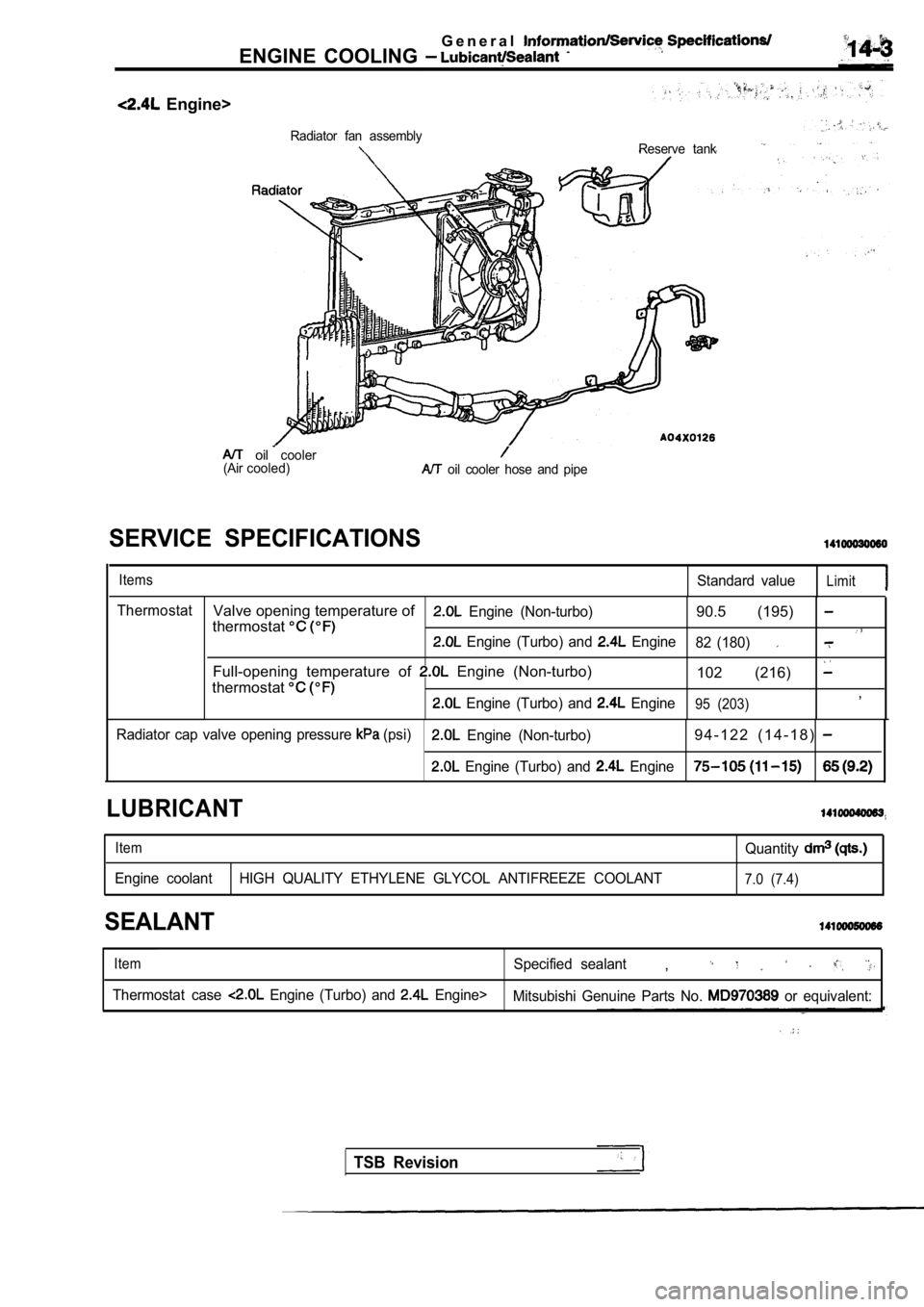
Engine>
Radiator fan assemblyReserve tank
(Airoilcooler
cooled) oil cooler hose and pipe
SERVICE SPECIFICATIONS
ItemsStandard valueLimit
ThermostatValve opening temperature of Engine (Non-turbo)90.5 (195) thermostat Engine (Turbo) and Engine 82 (180)
Full-opening temperature of Engine (Non-turbo)
102 (216)
thermostat
Engine (Turbo) and Engine95 (203),
Radiator cap valve opening pressure (psi) Engine (Non-turbo)9 4 - 1 2 2 ( 1 4 - 1 8 )
Engine (Turbo) and Engine
LUBRICANT
ItemQuantity
Engine coolant HIGH QUALITY ETHYLENE GLYCOL ANTIFREE ZE COOLANT7.0 (7.4)
SEALANT
ItemSpecified sealant,
Thermostat case Engine (Turbo) and Engine>
Mitsubishi Genuine Parts No. or equivalent:
TSB Revision
Page 694 of 2103
E N G I N E C O O L I N G
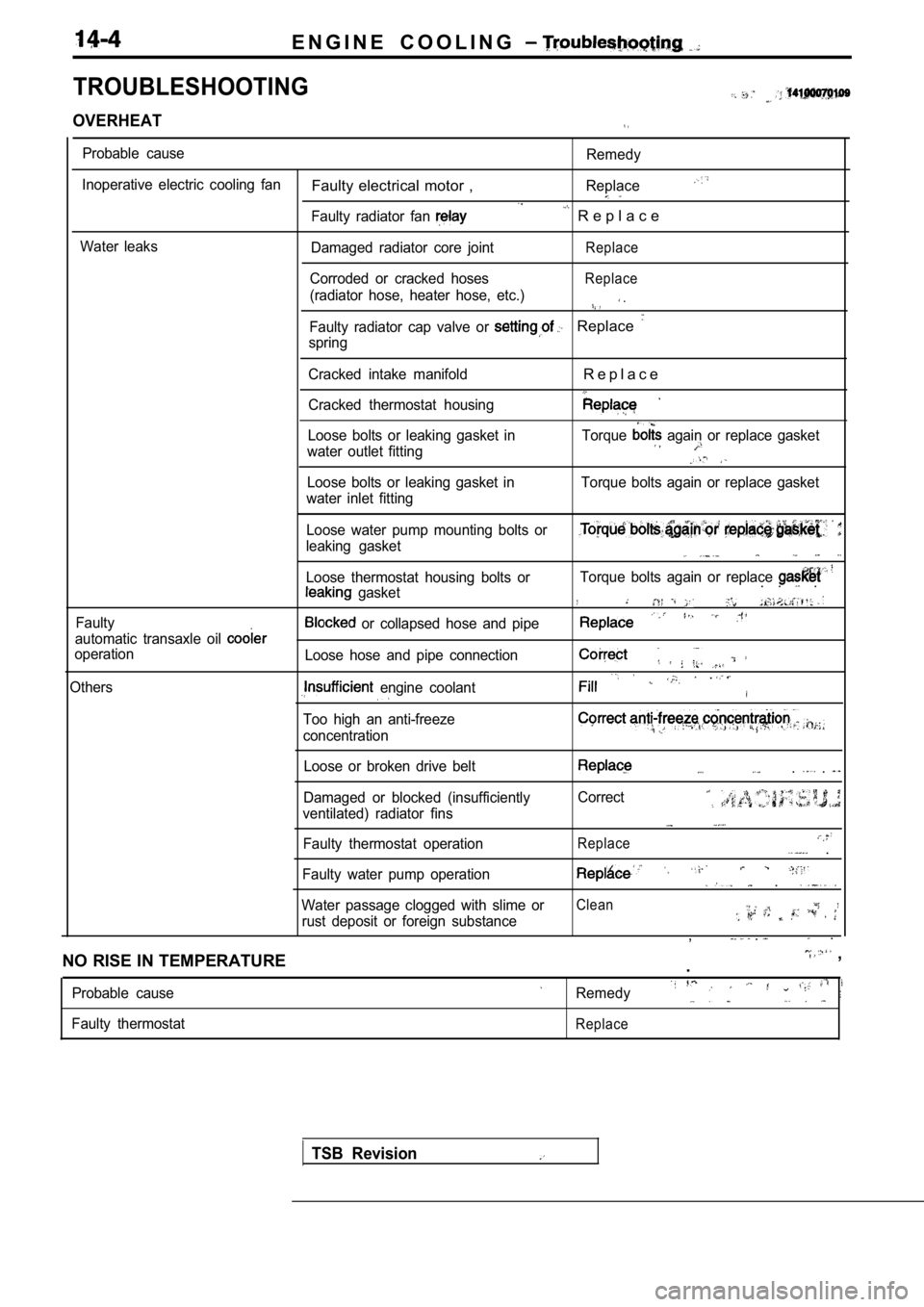
TROUBLESHOOTING
OVERHEAT
Probable cause
Inoperative electric cooling fan
Water leaks
Faulty electrical motor ,
Faulty radiator fan
Damaged radiator core joint
Corroded or cracked hoses
(radiator hose, heater hose, etc.)
Remedy
Replace
R e p l a c e
Replace
Replace
.
Faulty radiator cap valve or Replace
spring
Cracked intake manifold
Cracked thermostat housing
R e p l a c e
Loose bolts or leaking gasket in
water outlet fitting Torque again or replace gasket
Loose bolts or leaking gasket in
water inlet fitting Torque bolts again or replace gasket
Faulty Loose water pump mounting bolts or
leaking gasket
Loose thermostat housing bolts or
gasket
automatic transaxle oil
operation
Others
or collapsed hose and pipe
Loose hose and pipe connection
engine coolant
Too high an anti-freeze
concentration
Torque bolts again or replace . . .
.
Loose or broken drive belt
Damaged or blocked (insufficiently
ventilated) radiator fins
Faulty thermostat operation. .
Correct
Replace .
Faulty water pump operation .
Water passage clogged with slime orClean
rust deposit or foreign substance, . .
NO RISE IN TEMPERATURE
,
.
Probable cause
Faulty thermostatRemedy
Replace
TSB Revision
Page 695 of 2103
ENGINE COOLING Troubleshooting
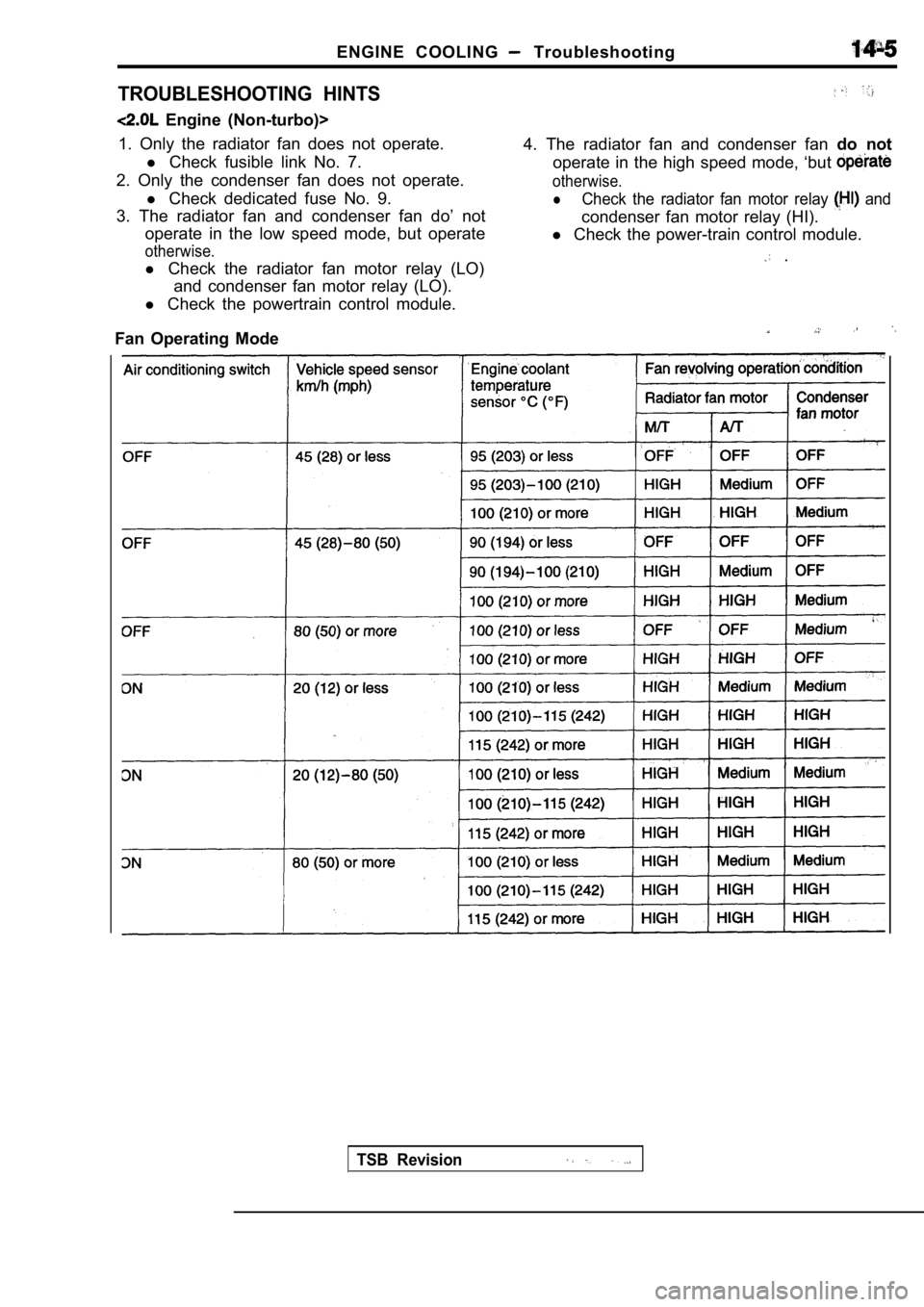
TROUBLESHOOTING HINTS
Engine (Non-turbo)>
1. Only the radiator fan does not operate. l Check fusible link No. 7.
2. Only the condenser fan does not operate. l Check dedicated fuse No. 9.
3. The radiator fan and condenser fan do’ not operate in the low speed mode, but operate
otherwise.
4. The radiator fan and condenser fan do not
operate in the high speed mode, ‘but
otherwise.
lCheck the radiator fan motor relay and
condenser fan motor relay (HI).
l Check the power-train control module.
l Check the radiator fan motor relay (LO)
and condenser fan motor relay (LO).
l Check the powertrain control module.
Fan Operating Mode
.
TSB Revision
Page 696 of 2103
14-6ENGINE COOLING
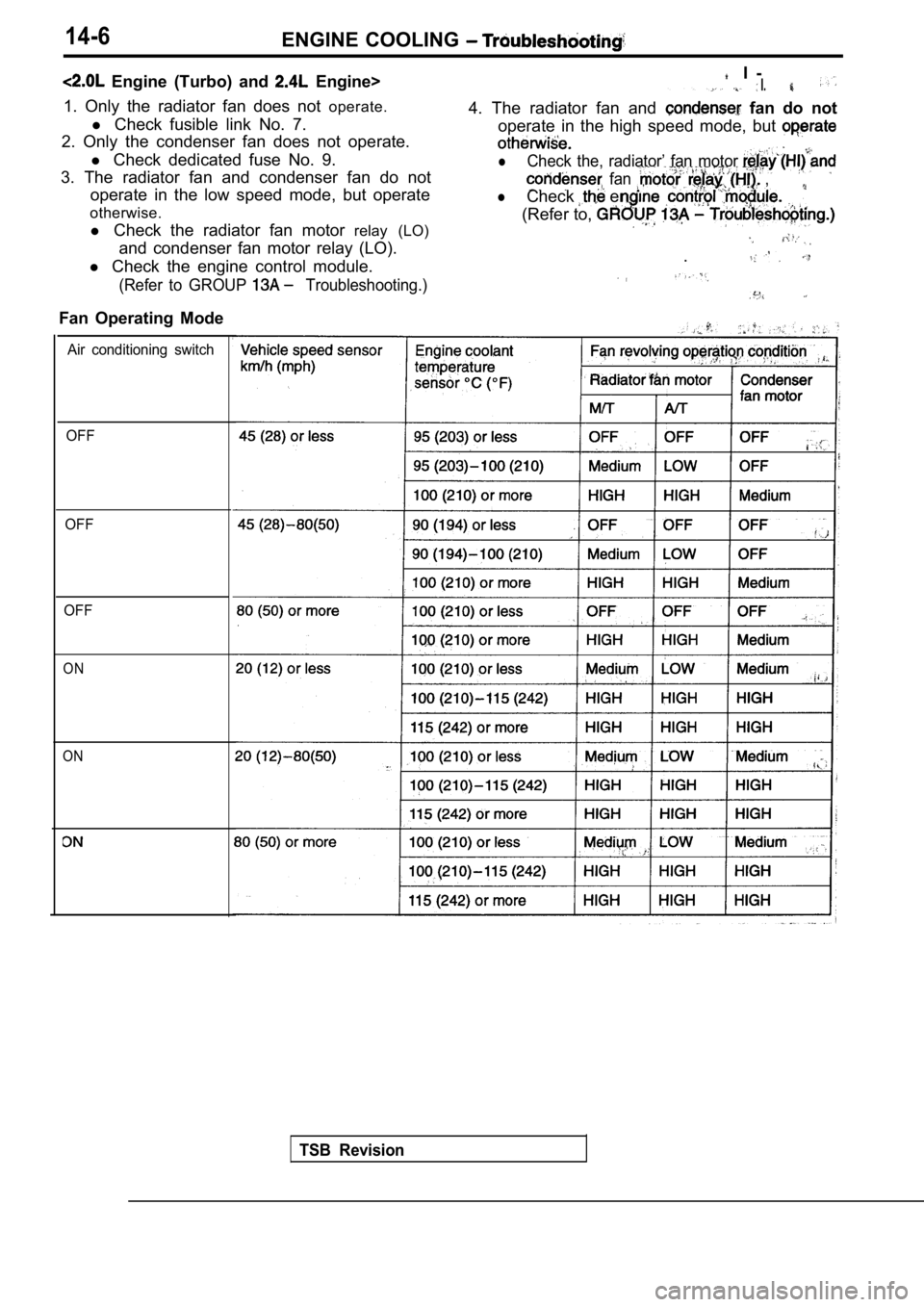
Engine (Turbo) and Engine>
1. Only the radiator fan does not operate.
l Check fusible link No. 7.
2. Only the condenser fan does not operate.
l Check dedicated fuse No. 9.
3. The radiator fan and condenser fan do not operate in the low speed mode, but operate
otherwise.
l Check the radiator fan motor relay (LO)
and condenser fan motor relay (LO).
l Check the engine control module.
(Refer to GROUP Troubleshooting.)
I -* I.
4. The radiator fan and fan do not
Fan Operating Mode operate in the high speed mode, but
lCheck the, radiator’ fan motor
fan ,
lCheck en
(Refer to,
.
Air conditioning switch
OFF
OFF
OFF
ON
ON
TSB Revision
Page 697 of 2103
ENGINE COOLING On-vehicle Service
Engine (Turbo) and
ON-VEHICLE SERVICE
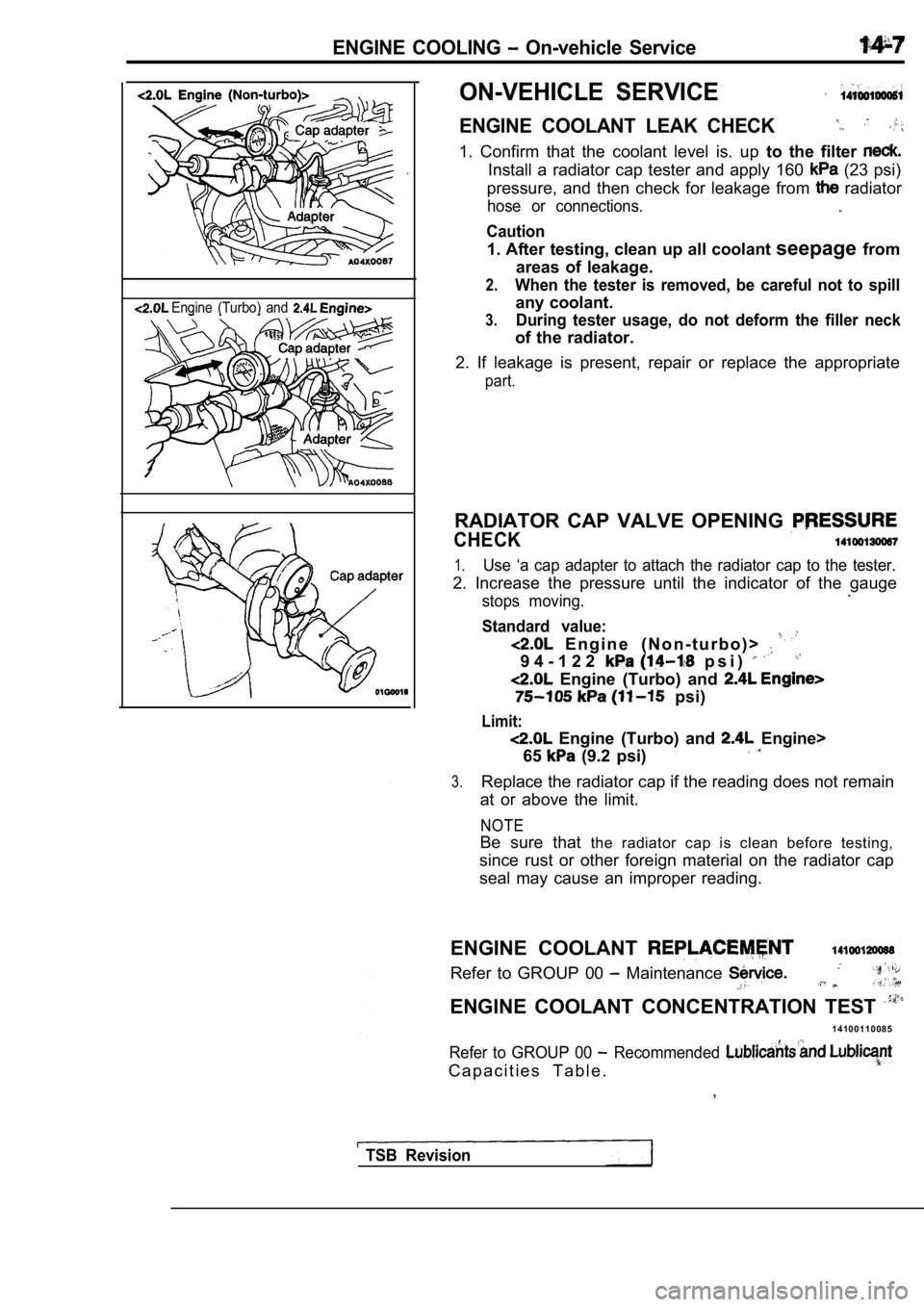
ENGINE COOLANT LEAK CHECK
1. Confirm that the coolant level is. up to the filter
Install a radiator cap tester and apply 160 (23 psi)
pressure, and then check for leakage from
radiator
hose or connections.
Caution
1. After testing, clean up all coolant seepagefrom
areas of leakage.
2.When the tester is removed, be careful not to spill
any coolant.
3.During tester usage, do not deform the filler neck
of the radiator.
2. If leakage is present, repair or replace the app ropriate
part.
RADIATOR CAP VALVE OPENING
CHECK
1.Use ‘a cap adapter to attach the radiator cap to the tester.
2. Increase the pressure until the indicator of the gauge
stops moving..
Standard value:
E n g i n e ( N o n - t u r b o ) >
9 4 - 1 2 2 p s i )
Engine (Turbo) and
psi)
Limit:
Engine (Turbo) and Engine>
65
(9.2 psi)
3.Replace the radiator cap if the reading does not re main
at or above the limit.
NOTE
Be sure that the radiator cap is clean before testing,
since rust or other foreign material on the radiato r cap
seal may cause an improper reading.
ENGINE COOLANT
Refer to GROUP 00 Maintenance
ENGINE COOLANT CONCENTRATION TEST
1 4 1 0 0 1 1 0 0 8 5
Refer to GROUP 00 Recommended
C a p a c i t i e s T a b l e . ,
TSB Revision
Page 698 of 2103
14-8ENGINE COOLING, Radiator
RADIATOR
REMOVAL AND INSTALLATION
Engine (Non-turbo)>
Operationl Engine Coolant Draining (Refer to GROUP 00 Maintenance Service.)
2
12 Nm6.7
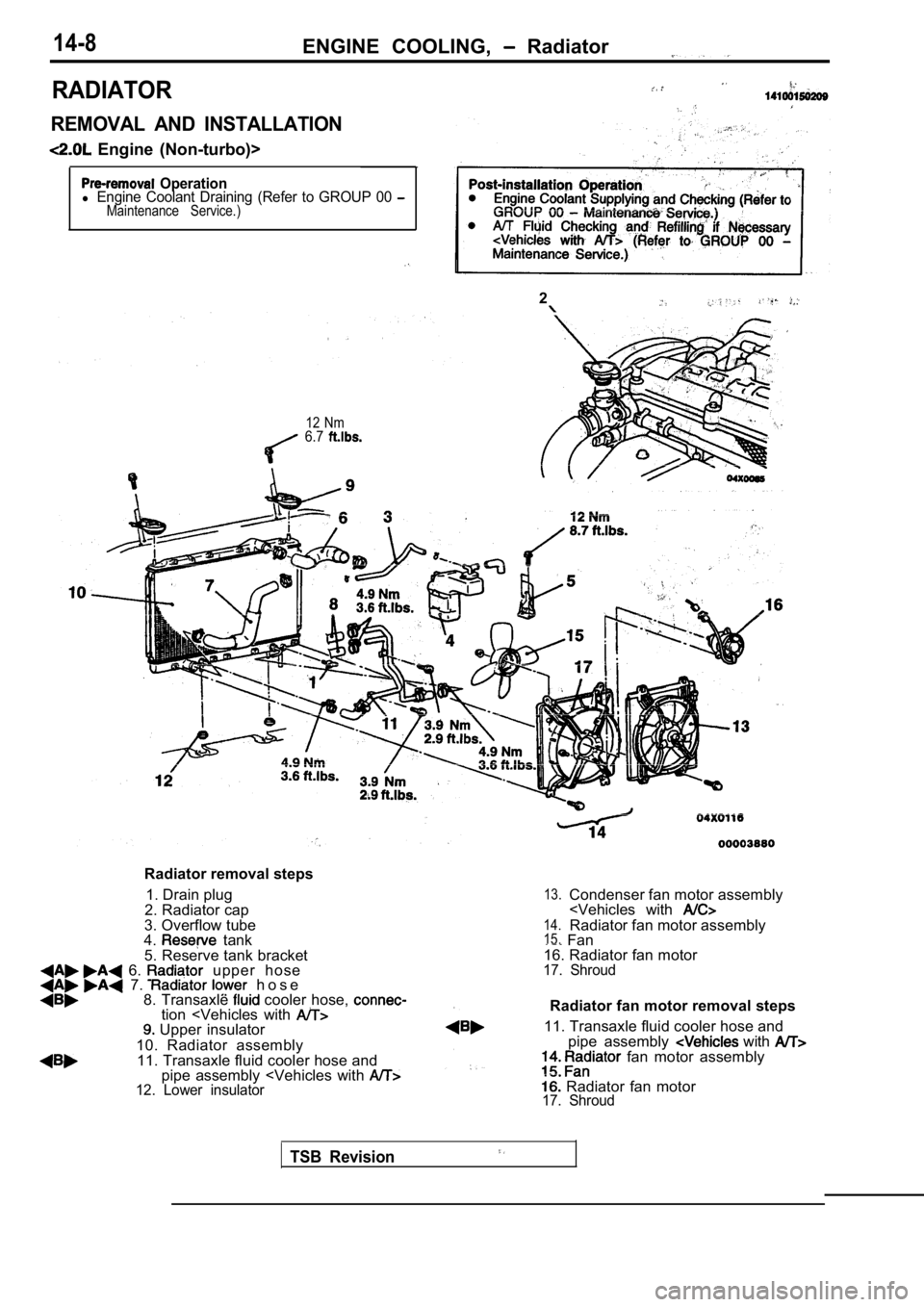
Radiator removal steps1. Drain plug
2. Radiator cap
3. Overflow tube
4.
tank
5. Reserve tank bracket
6. upper hose 7. h o s e
8. Transaxle cooler hose, tion
11. Transaxle fluid cooler hose and pipe assembly
13.Condenser fan motor assembly
16. Radiator fan motor
17. Shroud
Radiator fan motor removal steps
11. Transaxle fluid cooler hose and pipe assembly
with fan motor assembly
Radiator fan motor17. Shroud
TSB Revision