check engine MITSUBISHI SPYDER 1990 Service Manual PDF
[x] Cancel search | Manufacturer: MITSUBISHI, Model Year: 1990, Model line: SPYDER, Model: MITSUBISHI SPYDER 1990Pages: 2103, PDF Size: 68.98 MB
Page 244 of 2103
11ENGINE OVERHAUL Cylinder Head
(6) seat is properly positioned, the width of intake
and exhaust seats should be 0.9 to 1.3 mm
to
in.).
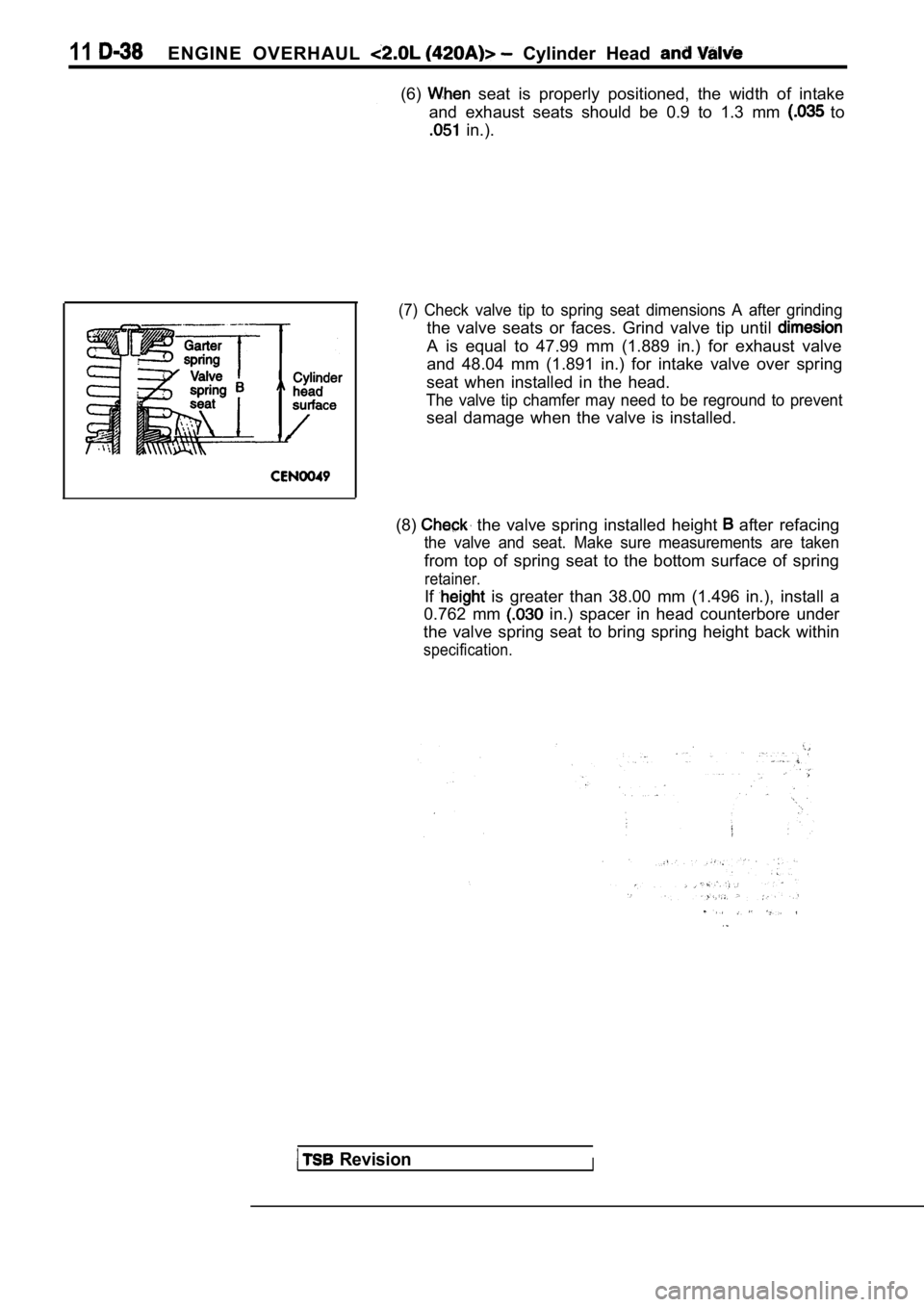
(7) Check valve tip to spring seat dimensions A aft er grinding
the valve seats or faces. Grind valve tip until
A is equal to 47.99 mm (1.889 in.) for exhaust valv e
and 48.04 mm (1.891 in.) for intake valve over spri ng
seat when installed in the head.
The valve tip chamfer may need to be reground to pr event
seal damage when the valve is installed.
(8)
the valve spring installed height after refacing
the valve and seat. Make sure measurements are take n
from top of spring seat to the bottom surface of spring
retainer.
If is greater than 38.00 mm (1.496 in.), install a
0.762 mm
in.) spacer in head counterbore under
the valve spring seat to bring spring height back w ithin
specification.
RevisionI
Page 258 of 2103
11
Piston, Connecting Rod
ENGINE OVERHAUL and
INSPECTION
BLOCK
(1) Clean cylinder block thoroughly and check all core hole
plugs for evidence of leaking.
(2) Examine block and cylinder bores for cracks or fractures.
Front
A
CYLINDER BORE
(1) The cylinder walls should be checked for out-of-round
and taper with Tool or equivalent cylinder
bore out-of-round is 0.051 mm in.) maximum, and
cylinder bore taper is 0.051 mm in.)
If the cylinder walls are badly scuffed or’scored, the cylin-
der block should be rebored and pistons
and rings fitted.
Whatever type is
used, boring and honing should be closely
with the fitting of pistons and rings so that speci fied clear-
ances may be maintained.
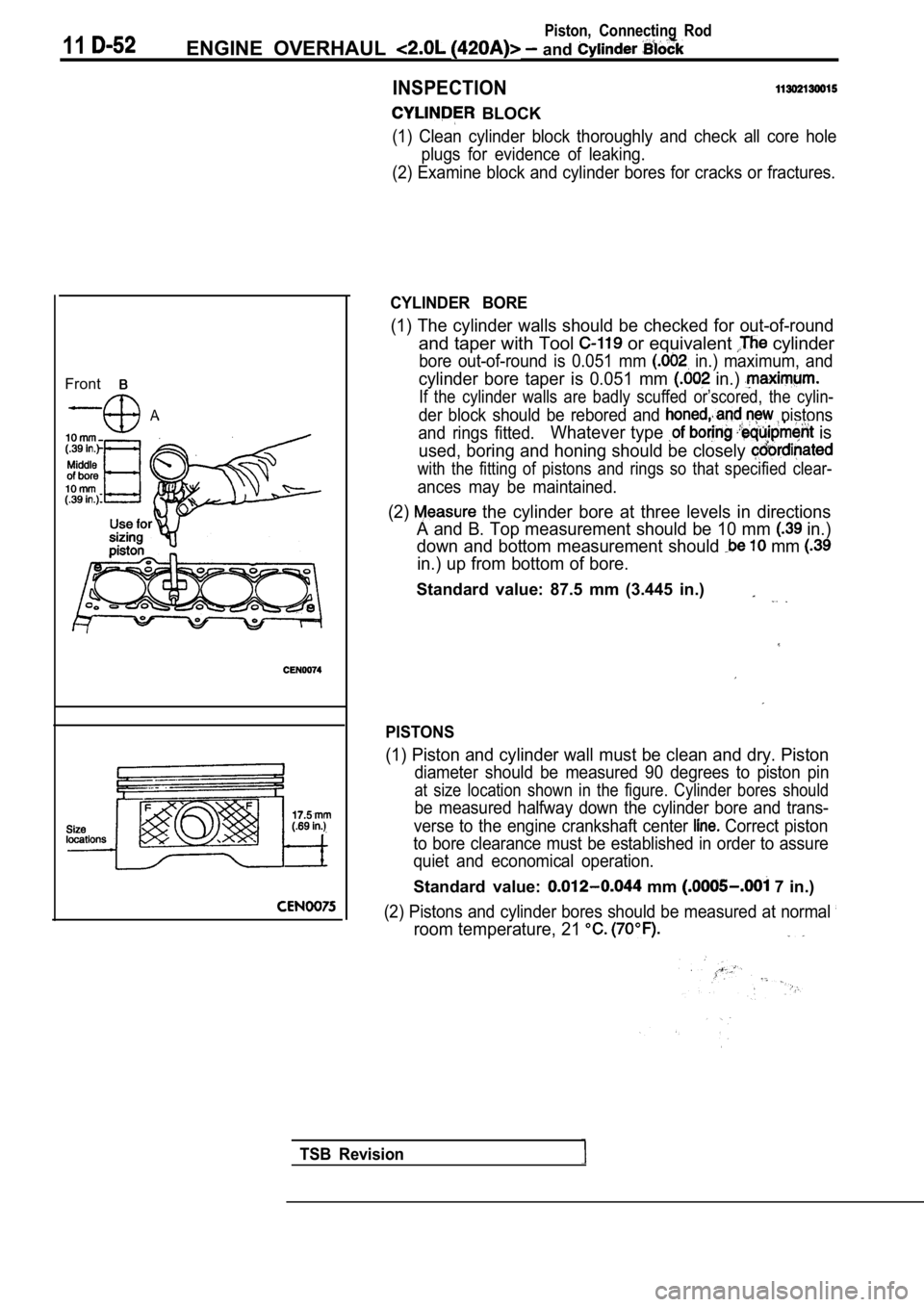
(2) the cylinder bore at three levels in directions
A and B. Top measurement should be 10 mm
in.)
down and bottom measurement should
mm
in.) up from bottom of bore.
Standard value: 87.5 mm (3.445 in.)
PISTONS
(1) Piston and cylinder wall must be clean and dry. Piston
diameter should be measured 90 degrees to piston pi n
at size location shown in the figure. Cylinder bores should
be measured halfway down the cylinder bore and tran s-
verse to the engine crankshaft center
Correct piston
to bore clearance must be established in order to a ssure
quiet and economical operation.
Standard value: mm 7 in.)
(2) Pistons and cylinder bores should be measured a t normal
room temperature, 21
TSB Revision
Page 260 of 2103
piston,
ENGINE OVERHAUL Cylinder Block
CONNECTING BEARING
(1) Place a piece of Plastigage across the, width of
bearing in the cap 6.35
mm off center and away -from the hole.
suspect areas can be checked, by placing in
the suspect area.
(2) Before assembling the rod with in place;
‘the crankshaft must be rotated the connecting rod
being checked starts moving toward the top of the e ngine.,
Only then should the cap be and torqued
to the specification.
Do not rotate the crankshaft while assembling the cap
or the Plastigage may be smeared, giving inaccurate re-
sults.
(3) Remove the bearing cap and compare the width of the
flattened Plastigage with the metric scale provided on
the package.
Standard value: mm in.)
Limit: 0.075 mm
in.)
bolt
Threads are not straight on line
Threads are straight
line,
bolt
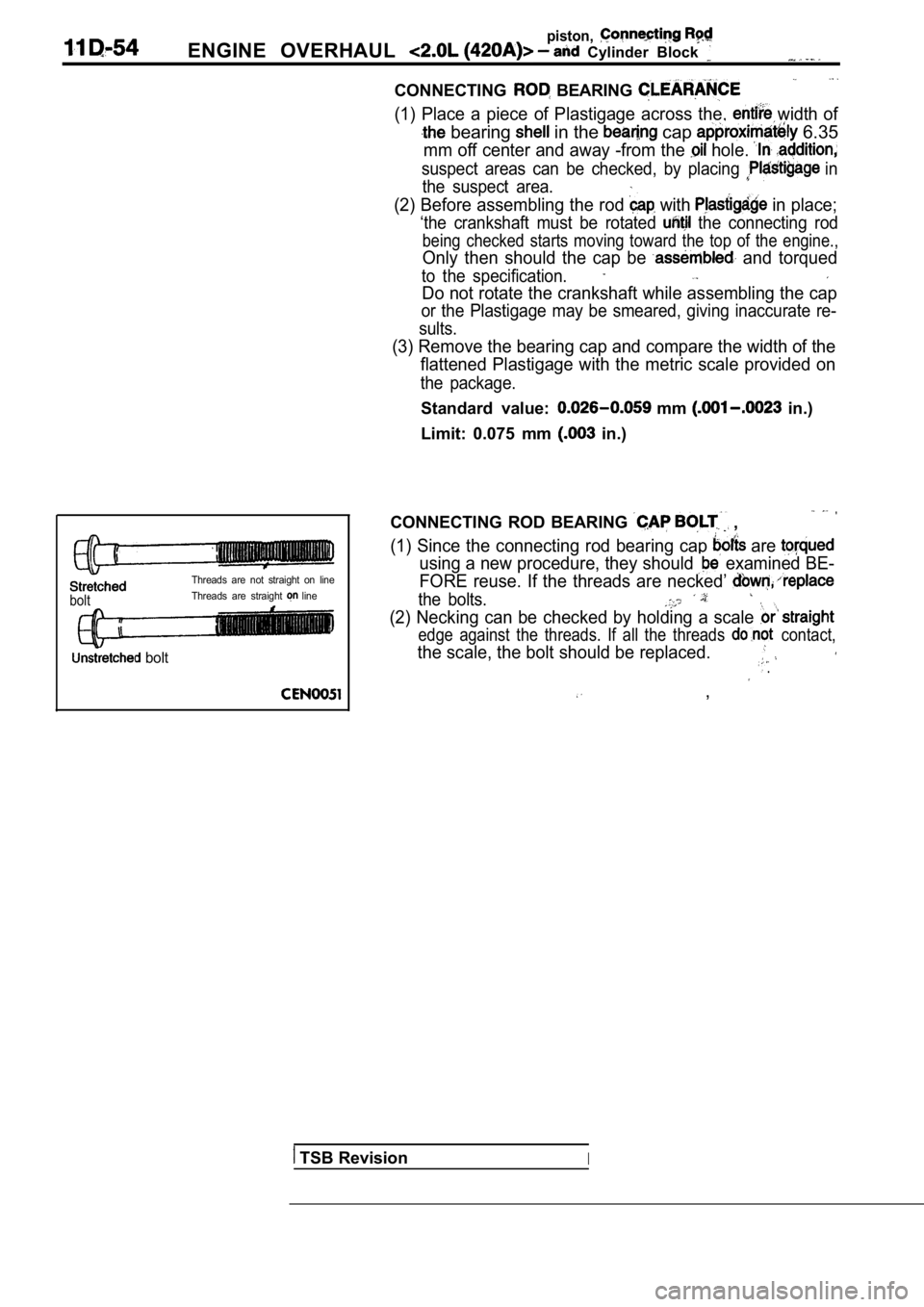
CONNECTING ROD BEARING ,
(1) Since the connecting rod bearing cap are
using a new procedure, they should examined BE-
FORE reuse. If the threads are necked’
the bolts.
(2) Necking can be checked by holding a scale
edge against the threads. If all the threads contact,
the scale, the bolt should be replaced. .
,
TSB RevisionI
Page 266 of 2103
11E N G I N E. .
INSPECTION
CRANKSHAFT MAIN JOURNALS
The crankshaft journals should be checked for excessive
wear, taper and scoring. Limits of taper or
on any crankshaft journals should be held. to mm.
in.). Journal grinding should not exceed 0.305 mm
in.) under the standard Do NOT
grind thrust faces of 3 journal. Do NOT
nick crank pin or journal fillets. After grinding, remove
rough edges from crankshaft oil holes and clean out all
passages.,
Caution.
With the nodular cast iron
tant that the final paper or journal
regrind be in the same direction as normal rotation’
in the engine.
TSB Revision
Page 267 of 2103
ENGINE
BEARING CLEARANCE
(1) The. total: clearance of the main bearings can only be
determined by removing the weight of the crankshaft .
This is accomplished by having the engine turned upside
down on the engine stand. This will remove all the crank-
weight off the bearing surface.
(2) Place, a piece of Plastigage across the entire width of
the bearing shell in the approximately 6.35 mm
in.) off center and away from the oil holes. In addition,
suspect areas can be checked by placing the Plastig age
in the suspect area.
Torque the
bolts of the bearing being checked
to the proper specifications.
Caution
Do not rotate crankshaft, or the Plastigage may be
smeared.
(3) Remove the and compare the width of the flat-
tened Plastigage with the metric scale provided on the
package.
Standard value: mm in.)
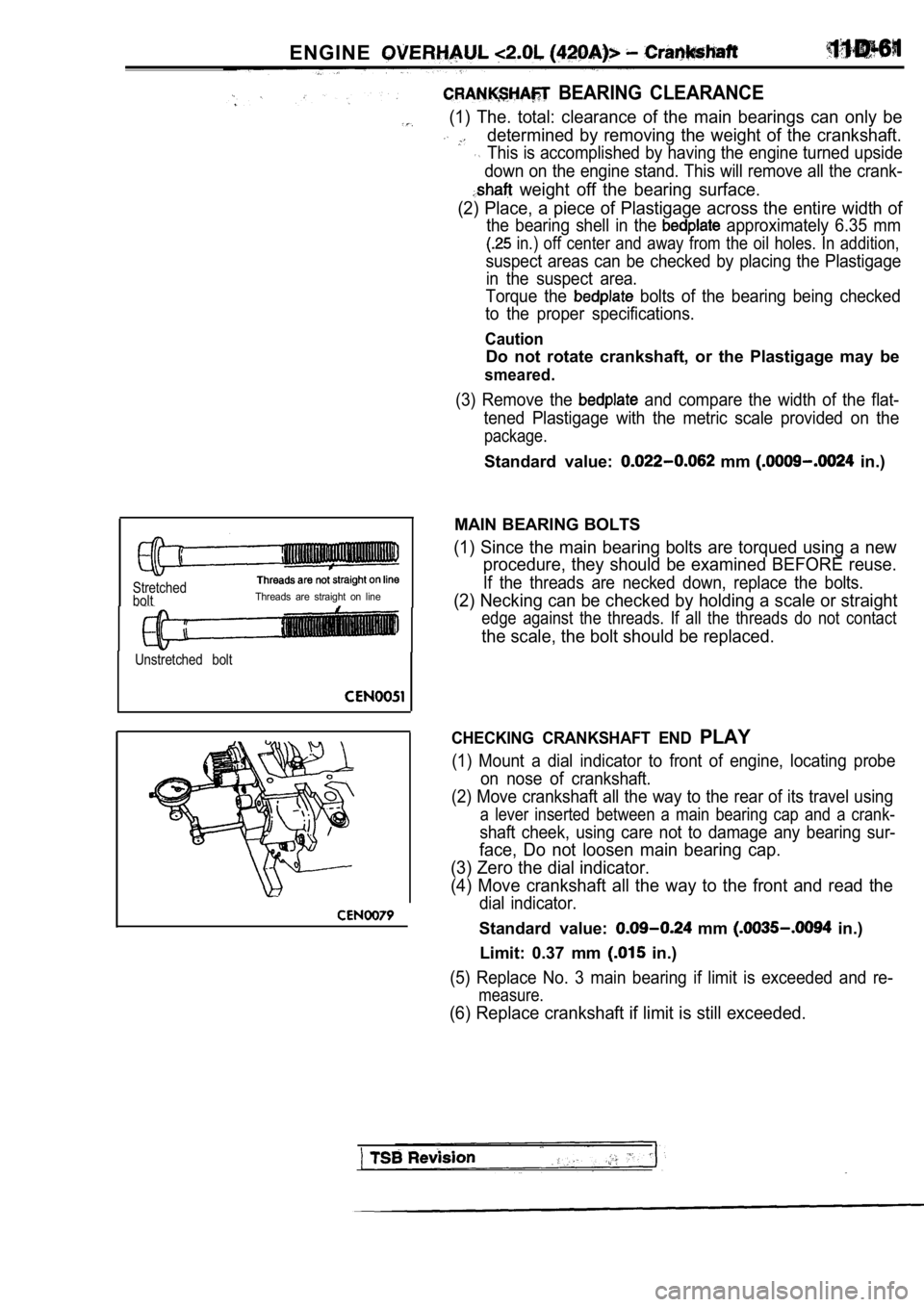
Stretched
boltThreads are straight on line,
Unstretched bolt
MAIN BEARING BOLTS
(1) Since the main bearing bolts are torqued using a new
procedure, they should be examined BEFORE reuse.
If the threads are necked down, replace the bolts.
(2) Necking can be checked by holding a scale or st raight
edge against the threads. If all the threads do not contact
the scale, the bolt should be replaced.
CHECKING CRANKSHAFT END PLAY
(1) Mount a dial indicator to front of engine, locating probe
on nose of crankshaft.
(2) Move crankshaft all the way to the rear of its travel using
a lever inserted between a main bearing cap and a c rank-
shaft cheek, using care not to damage any bearing sur-
face, Do not loosen main bearing cap.
(3) Zero the dial indicator.
(4) Move crankshaft all the way to the front and re ad the
dial indicator.
Standard value: mm in.)
Limit: 0.37 mm
in.)
(5) Replace No. 3 main bearing if limit is exceeded and re-
measure.
(6) Replace crankshaft if limit is still exceeded.
Page 268 of 2103
11ENGINE OVERHAUL
OPTIONAL CRANKSHAFT END PLAY CHECK
(1) Move crankshaft all the way to the rear of its travel using
a lever inserted between a main bearing cap and a c rank-
shaft cheek, using care not to damage any bearing sur-
face. Do not loosen main bearing cap.
(2) Use a feeler gauge between number three thrust bearing
and machined crankshaft surface to determine end pl ay.
Revision
Page 269 of 2103
CONTENTS
CAMSHAFT AND CAMSHAFT OILCompression Pressure Check. . . . . . . . . . ..
SEAL. . . . . . . . . . . . . . . . . . . . . . . . . . . . . . . . . . . . .21Curb Speed Check. . ... . . . .. . . . . . . . .
Drive Belt Tension Check and
CRANKSHAFT FRONT OIL SEAL. . . . . . . . . .26Adjustment.. . . . . . . . . . . . . . . . . . . . . . . . . . . .
Mixture Check . . . . . . . . . . . . . . . . . . . . . . .
CRANKSHAFT PULLEY. . . . . . . . . . . . . . . . . . .20Ignition Timing Check
. . . . . . . . . . . . . . . . . . . . . .
. . . . . . . . . . . . . . . . . . . . .13CRANKSHAFT REAR OIL SEAL27Lash Adjuster Check
. . . . . . . . . . .
Manifold Vacuum Check. . . . . . . . . . . . . . . . . .12
CYLINDER HEAD GASKET . . . . . . . . . . . . . . . .29 . .
SEALANTS. . . . . . . . . . . . . . . . . . . . . . . . . . .. .3
ENGINE ASSEMBLY. . . . . . . . . . . . . . . . . . . . . .15SERVICE. . . . . ... .
.....
.....
GENERAL INFORMATION. . . . . . . . . . . . . . . . . .2SPECIAL TOOLS. . . . . . . . . . . . . . . . . . . . . . . . . . .4
OIL PAN AND OIL SCREEN . . . . . . . . . . . . . . .24
ON-VEHICLE SERVICE. . . . . . . . . . . . . . . . . . . . .7
Basic Speed Adjustment
. . . . . . . . . . . . . . . . . . . . . . . Refer to GROUP
TIMING BELT. . . . . . . . . . . . . . . . . . . . . . . . . . . . .35
BELT . . . . . . . . . . . . . . . . . . . . . . . . . . .39
TROUBLESHOOTING
. . . . . . . . . . . . . . . . . . . . . . . 6
Page 271 of 2103
ENGINEService
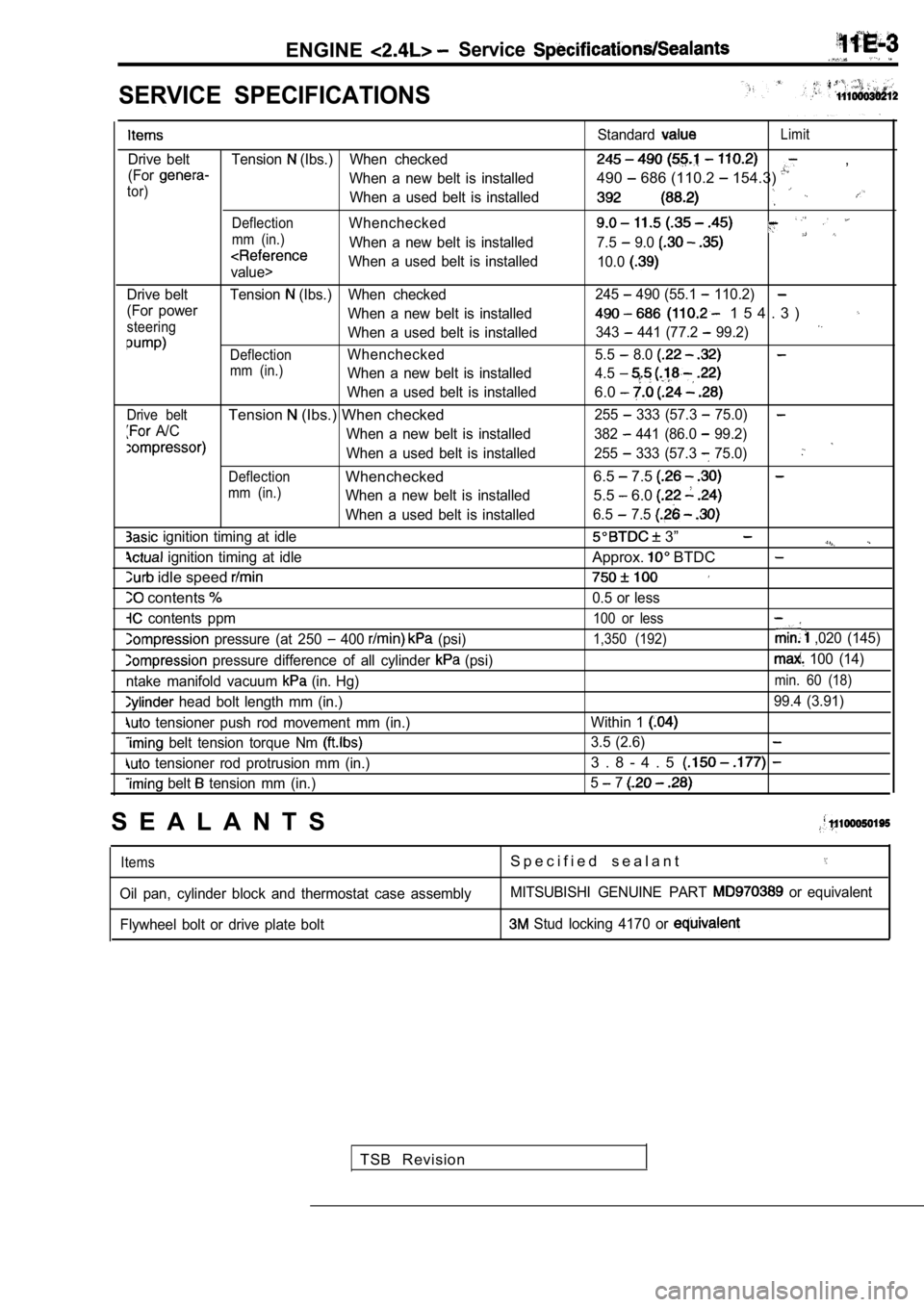
SERVICE SPECIFICATIONS
Drive belt Tension (Ibs.) When checked
(For
When a new belt is installedtor)When a used belt is installed
DeflectionWhenchecked
mm (in.)When a new belt is installed
value> When a used belt is installed
Drive belt Tension
(Ibs.) When checked
(For power When a new belt is installed
steeringWhen a used belt is installed
DeflectionWhenchecked
mm (in.)When a new belt is installed
When a used belt is installed
Drive beltTension (Ibs.) When checked
A/C When a new belt is installed
When a used belt is installed
DeflectionWhenchecked
mm (in.)When a new belt is installed
When a used belt is installed
ignition timing at idle
ignition timing at idle
idle speed
contents
contents ppm
pressure (at 250 400 (psi)
pressure difference of all cylinder (psi)
ntake manifold vacuum
(in. Hg)
head bolt length mm (in.)
tensioner push rod movement mm (in.)
belt tension torque Nm
tensioner rod protrusion mm (in.)
belt tension mm (in.) Standard
Limit
,
490
686 (110.2 154.3)
7.5 9.0
10.0
245 490 (55.1 110.2)
1 5 4 . 3 )
343 441 (77.2 99.2)
5.5 8.0
4.5
6.0
255 333 (57.3 75.0)
382 441 (86.0 99.2)
255
333 (57.3 75.0)
6.5 7.5
5.5 6.0
6.5 7.5
3”
Approx. BTDC
0.5 or less
100 or less
1,350 (192) ,020 (145)
100 (14)
min. 60 (18)
99.4 (3.91)
Within 1
3.5 (2.6)
3 . 8 - 4 . 5
5 7
S E A L A N T S
ItemsS p e c i f i e d s e a l a n t
Oil pan, cylinder block and thermostat case assembl yMITSUBISHI GENUINE PART or equivalent
Flywheel bolt or drive plate bolt
Stud locking 4170 or
TSB Revision
Page 274 of 2103
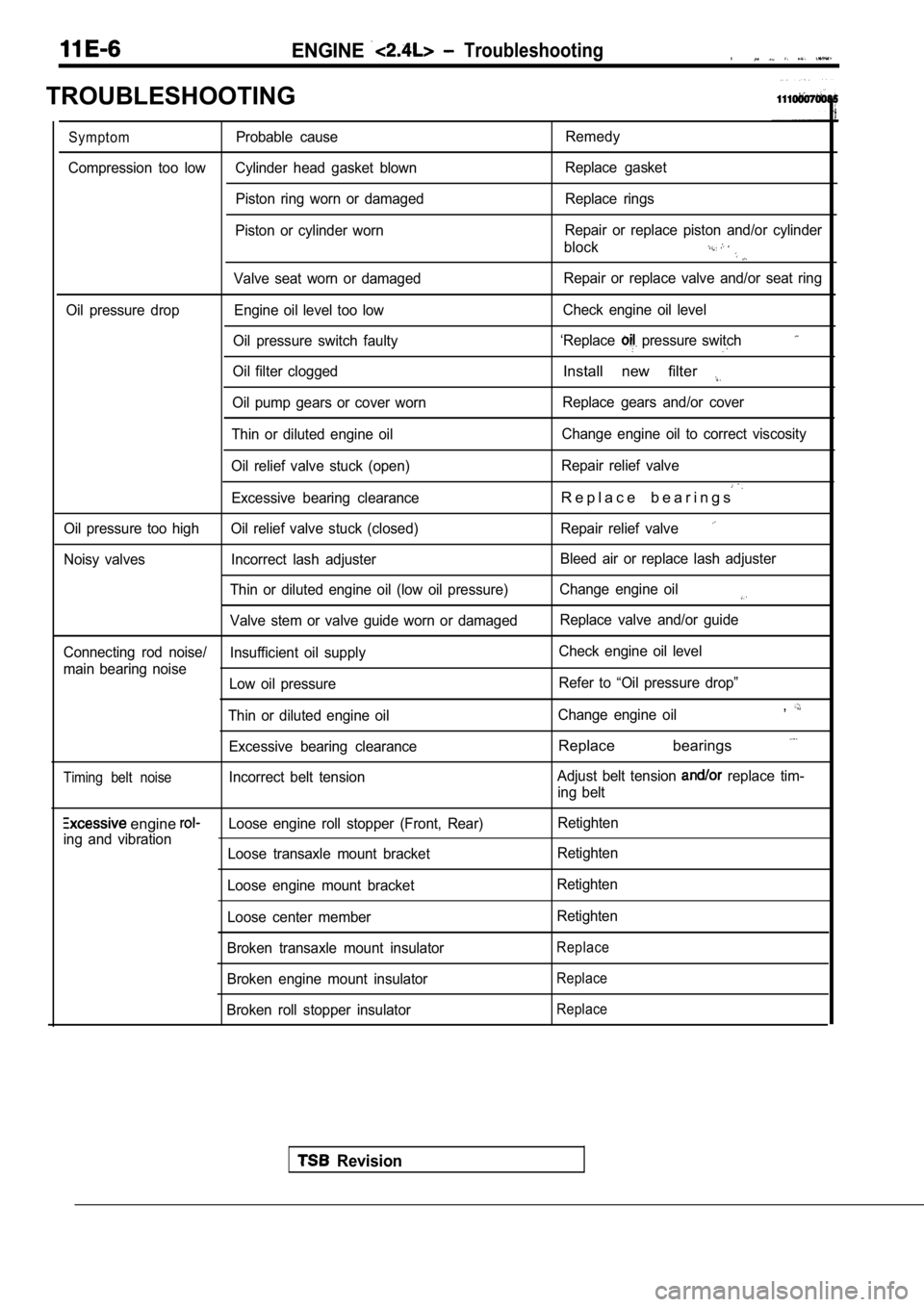
ENGINE Troubleshooting.
TROUBLESHOOTING
SymptomProbable causeRemedy
Compression too low Cylinder head gasket blown Replace gasket
Piston ring worn or damaged Replace rings
Piston or cylinder worn Repair or replace piston and/or cylinder
block
Valve seat worn or damaged Repair or replace valve and/or seat ring
Oil pressure drop Engine oil level too low Check engine oil level
Oil pressure switch faulty ‘Replace
pressure switch
Oil filter cloggedInstall new filter
Oil pump gears or cover worn Replace gears and/or cover
Thin or diluted engine oil Change engine oil to correct viscosity
Oil relief valve stuck (open) Repair relief valve
Excessive bearing clearanceR e p l a c e b e a r i n g s
Oil pressure too high Oil relief valve stuck (closed
) Repair relief valve
Noisy valves Incorrect lash adjuster Bleed air or replace lash adjuster
Thin or diluted engine oil (low oil pressure) Change engine oil
Valve stem or valve guide worn or damaged Replace valve and/or guide
Connecting rod noise/ Insufficient oil supply Check engine oil level
main bearing noise Low oil pressure Refer to “Oil pressure drop”
Thin or diluted engine oil Change engine oil
,
Excessive bearing clearanceReplace bearings
Timing belt noiseIncorrect belt tensionAdjust belt tension replace tim-
ing belt
engine Loose engine roll stopper (Front, Rear) Retighten
ing and vibration Loose transaxle mount bracket Retighten
Loose engine mount bracket Retighten
Loose center member Retighten
Broken transaxle mount insulator
Replace
Broken engine mount insulatorReplace
Broken roll stopper insulatorReplace
Revision
Page 275 of 2103
ENGINE On-vehicle Service
(22
Generator
pulley
Water
pulley
Adjus bolt
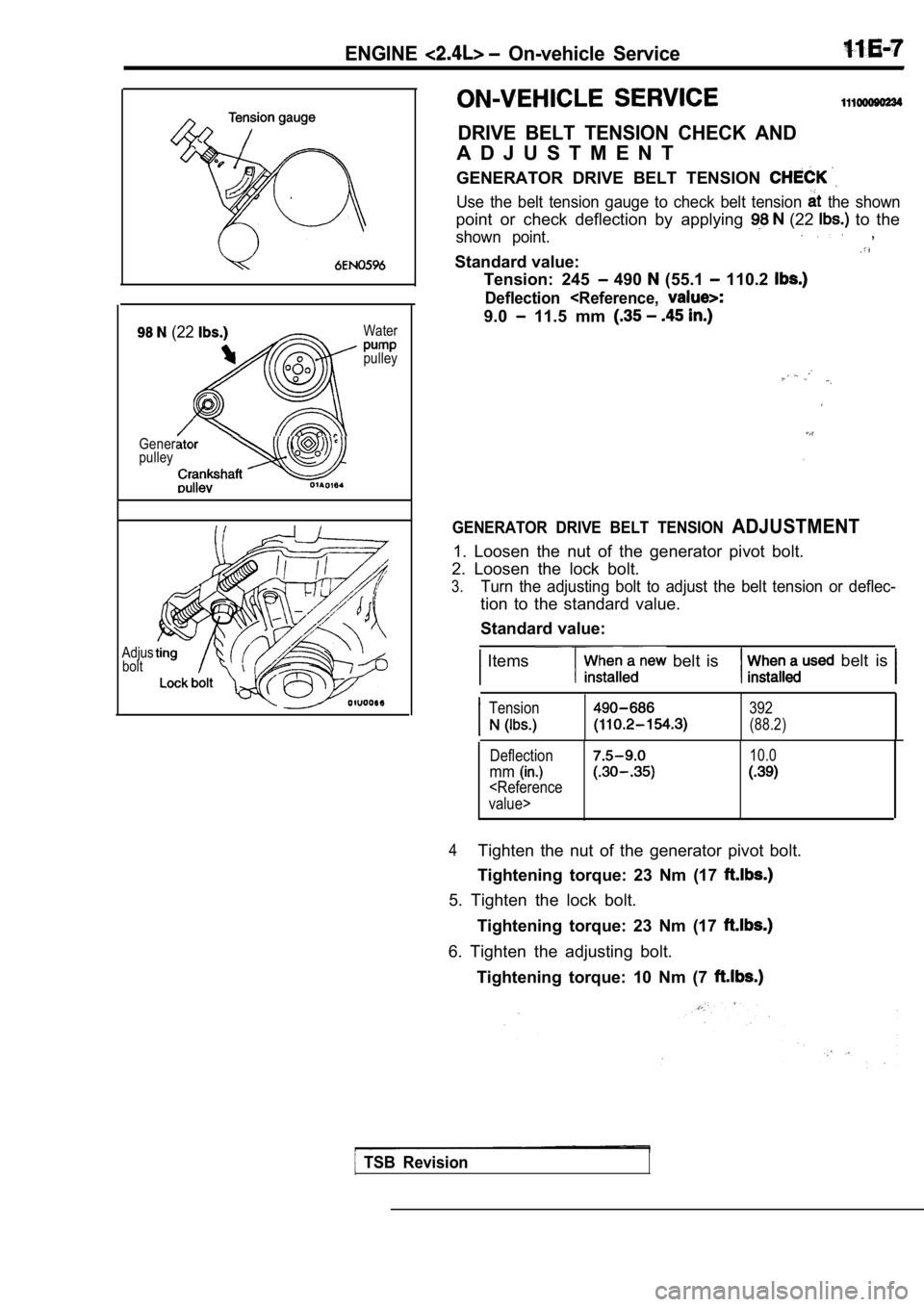
DRIVE BELT TENSION CHECK AND
A D J U S T M E N T
GENERATOR DRIVE BELT TENSION
Use the belt tension gauge to check belt tension the shown
point or check deflection by applying (22 to the
shown point. ,
Standard value: Tension: 245
490 (55.1 110.2
Deflection
GENERATOR DRIVE BELT TENSION ADJUSTMENT
1. Loosen the nut of the generator pivot bolt.
2. Loosen the lock bolt.
3.Turn the adjusting bolt to adjust the belt tension or deflec-
tion to the standard value.
Standard value:
Items belt is belt is
Tension392
(88.2)
Deflection10.0
mm
4Tighten the nut of the generator pivot bolt.
Tightening torque: 23 Nm (17
5. Tighten the lock bolt.
Tightening torque: 23 Nm (17
6. Tighten the adjusting bolt.Tightening torque: 10 Nm (7
TSB Revision