check engine MITSUBISHI SPYDER 1990 Service Workshop Manual
[x] Cancel search | Manufacturer: MITSUBISHI, Model Year: 1990, Model line: SPYDER, Model: MITSUBISHI SPYDER 1990Pages: 2103, PDF Size: 68.98 MB
Page 181 of 2103
ENGINE On-vehicle Service
IDLE MIXTURE CHECK
11100210081
1.Before inspection, set vehicles in the following co ndition:
lEngine coolant temperature:
l Lights, electric cooling fan and all accessories: O FF
lTransaxle: Neutral (P range on vehicles with
2.After turning the ignition switch to OFF, connect t he scan
tool to the data link connector.
3.Start the engine and run it at 2,500 for 2 minutes.
4. Set the CO, HC tester.
5. Check the CO contents and the HC contents at idl e.
Standard value:
CO contents: 0.5% or less
HC contents: 100 ppm or less
6. If the idle speed is outside the standard value, check
the following items: l Diagnostic output
l Closed-loop control (When the closed-loop control
is carried out normally, the output signal of the h eated
oxygen sensor repeats between and
,000 at idle.)
l Fuel pressure
I n j e c t o r
lIgnition coil, spark plug cable, spark plug
lEGR system and the EGR valve leak
l Evaporative emission control system
Compression pressure
NOTE
Replace the three-way catalyst whenever the CO and
HC contents do not remain inside the standard value .
(even though the result of the inspection is normal on
all items.)
COMPRESSION PRESSURE CHECK
1.Before inspection, check that the engine oil, start er and
battery are normal. Also, set the vehicle to the fo llowing
condition:
lEngine coolant temperature:
lLights, electric cooling fan and all accessories: O FF
lTransaxle: Neutral (P range on vehicle with
2. Disconnect the spark plug cables.
3. Remove all spark plugs.
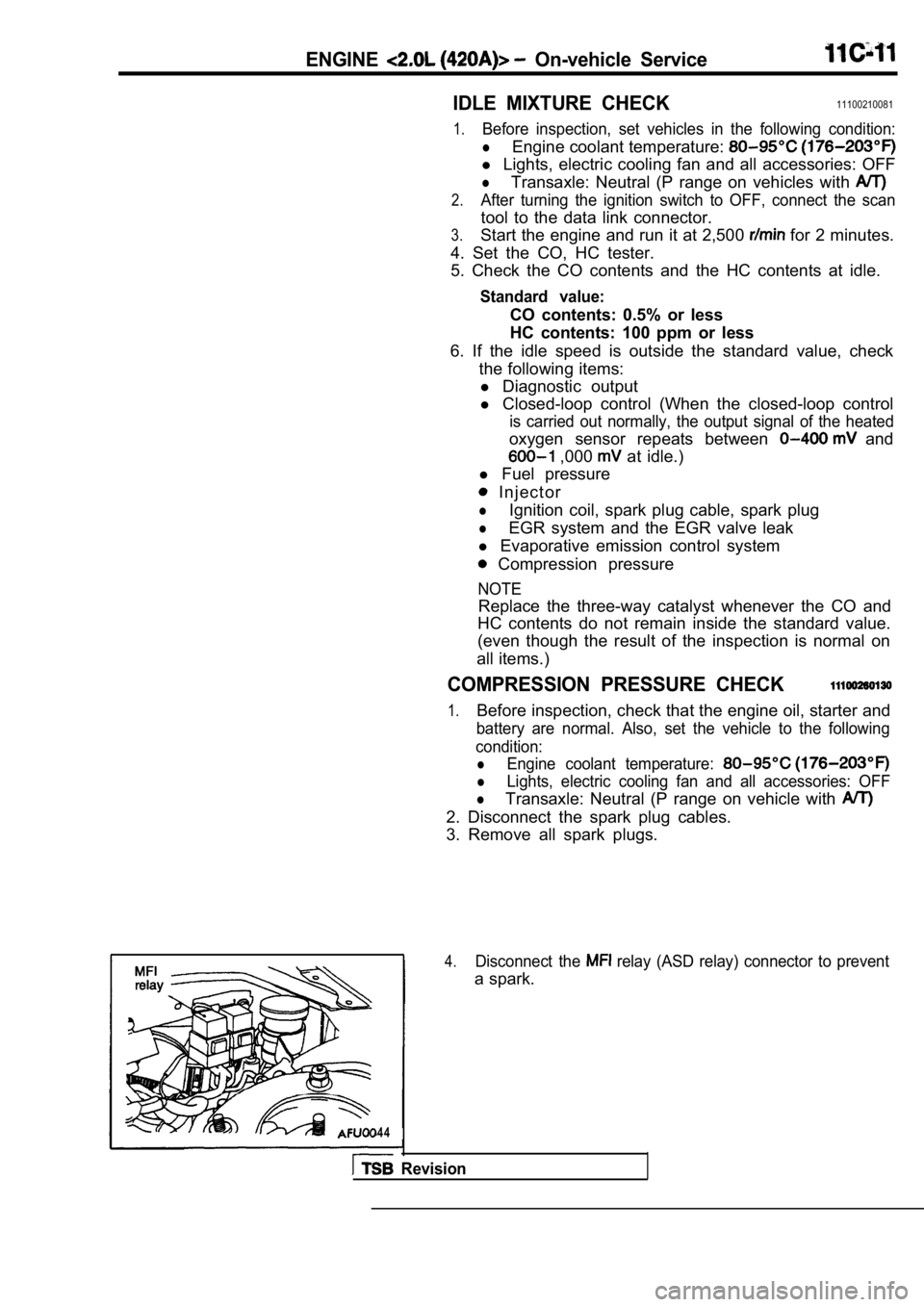
4.Disconnect the relay (ASD relay) connector to prevent
a spark.
4 4
Revision
Page 182 of 2103
E N G I N E On-vehicle Service’
5. Cover the spark plug hole with a shop towel etc. , and
after the engine has been cranked, check that no foreign
material is adhering to the shop towel.
. Caution
1.Keep away from the spark plug hole when crank-
ing.
2. If compression is measured with water, oil, fuel ,
etc., that has come from cracks inside the cylinder ,
these materials will become heated and will gush
out from the spark plug hole, which is dangerous.
6.Set compression gauge to one of the spark plug hole s.
7. Crank the engine with the throttle valve fully o pen and
measure the compression pressure.
Standard value (at engine speed of
p s i )
Limit (at engine speed of
min. 689 (100 psi)
8.Measure the compression pressure for all the cylind ers,
and check that the pressure differences of the cylinders
are below the limit.
Limit:
NOTE
The limit value can be derived by calculating the d ifference
between the maximum and minimum values for the
compression pressure and dividing this value by the
maximum value.
9.If there is a cylinder with compression or a compre ssion
difference that is outside the limit, pour a small amount
of engine oil through the spark plug hole, and repeat
the operations in steps 7 and 8. (1) If the compression increases after oil is added , the
cause of the malfunction is a worn or damaged pisto n
ring and/or cylinder inner surface.
(2) If the compression does not rise after oil is a dded,
the cause is a burnt or defective valve seat, or pr essure
is leaking from the gasket.
10. Connect the
relay (ASD relay) connector.
11. Install the spark plug and spark plug cable.
12. Use the scan tool to erase the diagnostic troub le codes.
NOTE
This will erase the diagnostic trouble code resulti ng
the relay (ASD relay) being disconnected.
TSB Revision
Page 183 of 2103
ENGINE On-vehicle.’
M A N I F O L D V A C U U M
1.Before inspection, set vehicles. in the condition:
Engine coolant
lLights, electric cooling and
lTransaxle: Neutral (P
2. Connect the scan tool to the data link connector.
,
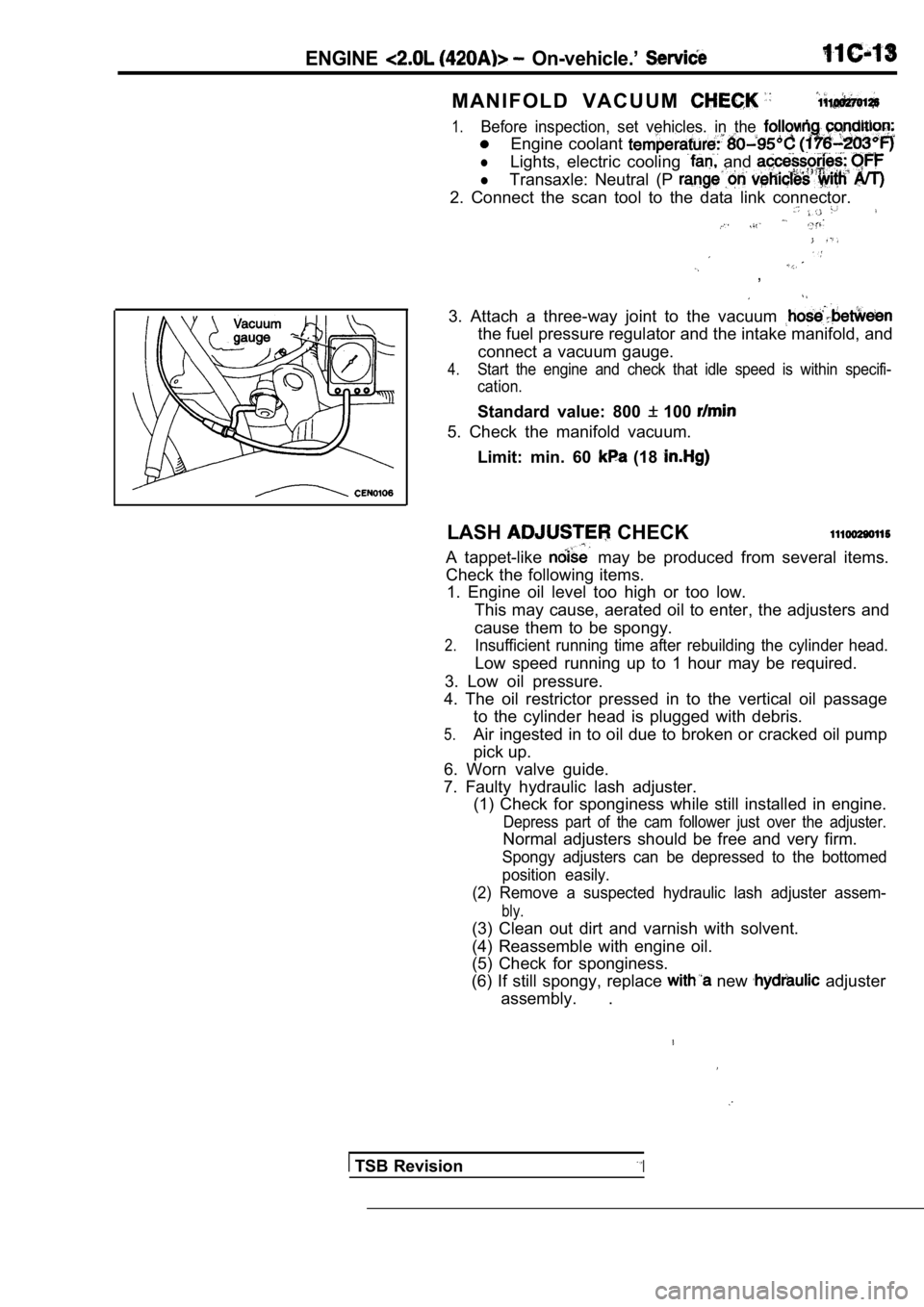
3. Attach a three-way joint to the vacuum
the fuel pressure regulator and the intake manifold, and
connect a vacuum gauge.
4.Start the engine and check that idle speed is withi n specifi-
cation.
Standard value: 800 100
5. Check the manifold vacuum.
Limit: min. 60
(18
LASH CHECK
A tappet-like may be produced from several items.
Check the following items. 1. Engine oil level too high or too low.
This may cause, aerated oil to enter, the adjusters and
cause them to be spongy.
2.Insufficient running time after rebuilding the cyli nder head.
Low speed running up to 1 hour may be required.
3. Low oil pressure.
4. The oil restrictor pressed in to the vertical oi l passage
to the cylinder head is plugged with debris.
5.Air ingested in to oil due to broken or cracked oil pump
pick up.
6. Worn valve guide.
7. Faulty hydraulic lash adjuster. (1) Check for sponginess while still installed in e ngine.
Depress part of the cam follower just over the adju ster.
Normal adjusters should be free and very firm.
Spongy adjusters can be depressed to the bottomed
position easily.
(2) Remove a suspected hydraulic lash adjuster asse m-
bly.
(3) Clean out dirt and varnish with solvent.
(4) Reassemble with engine oil.
(5) Check for sponginess.
(6) If still spongy, replace
new adjuster
assembly. .
TSB RevisionI
Page 187 of 2103
E N G I N E Engine
A/C COMPRESSOR REMOVAL
the A/C compressor connector and remove the
compressor from the compressor bracket with the
attached.
NOTE
Place the removed A/C compressor in a place where i t will
not be a hindrance when removing and installing the engine
assembly, and tie it with a cord.
Caution
Do not bend the joint between the A/C hose and the A/C
pipe by force.
M O U N T B R A C K E T
REMOVAL
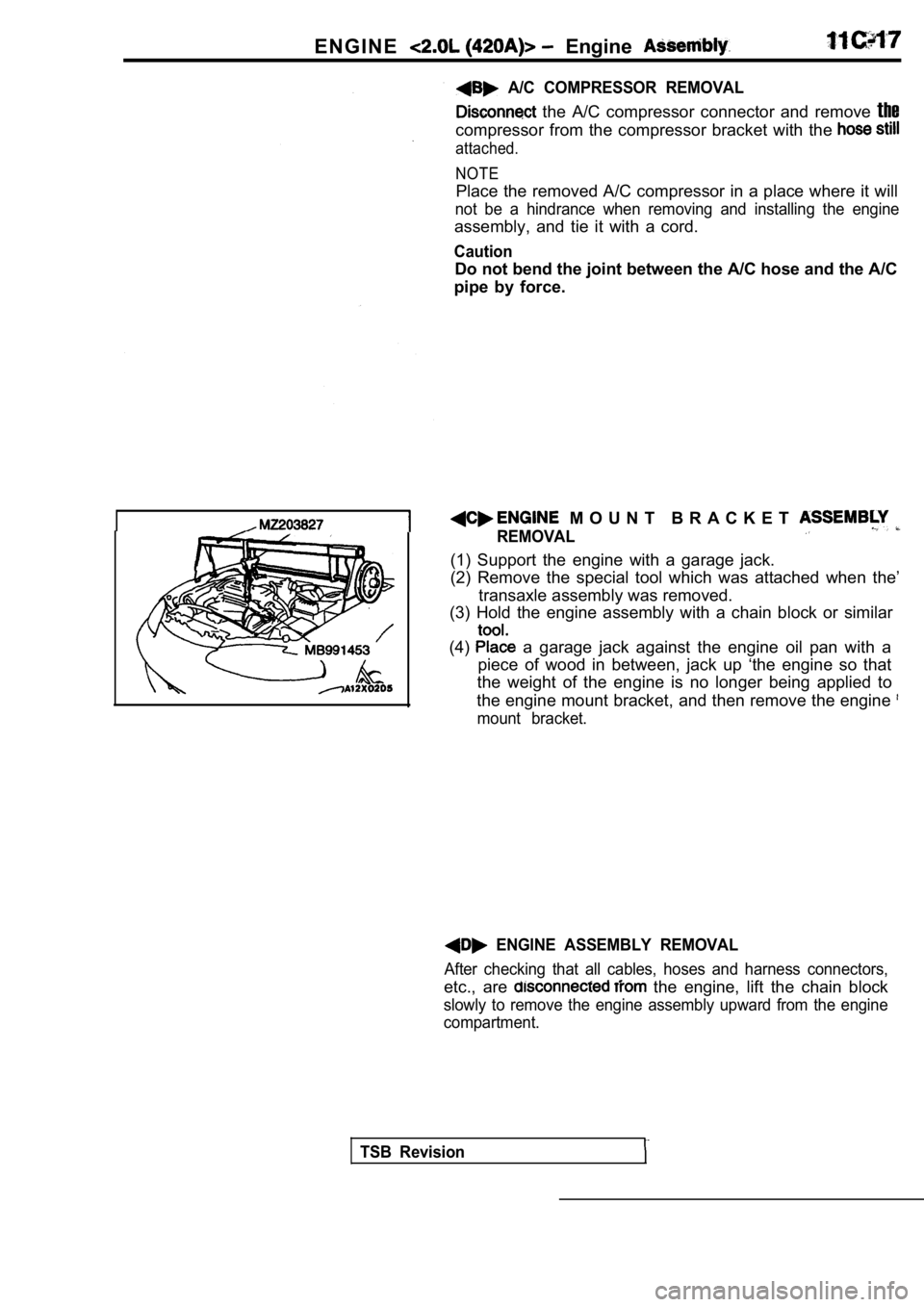
(1) Support the engine with a garage jack.
(2) Remove the special tool which was attached when the’
transaxle assembly was removed.
(3) Hold the engine assembly with a chain block or similar
(4) a garage jack against the engine oil pan with a
piece of wood in between, jack up ‘the engine so th at
the weight of the engine is no longer being applied to
the engine mount bracket, and then remove the engin e
mount bracket.
ENGINE ASSEMBLY REMOVAL
After checking that all cables, hoses and harness connectors,. ..etc., are the engine, lift the chain block
slowly to remove the engine assembly upward from th e engine
compartment.
TSB Revision
Page 188 of 2103
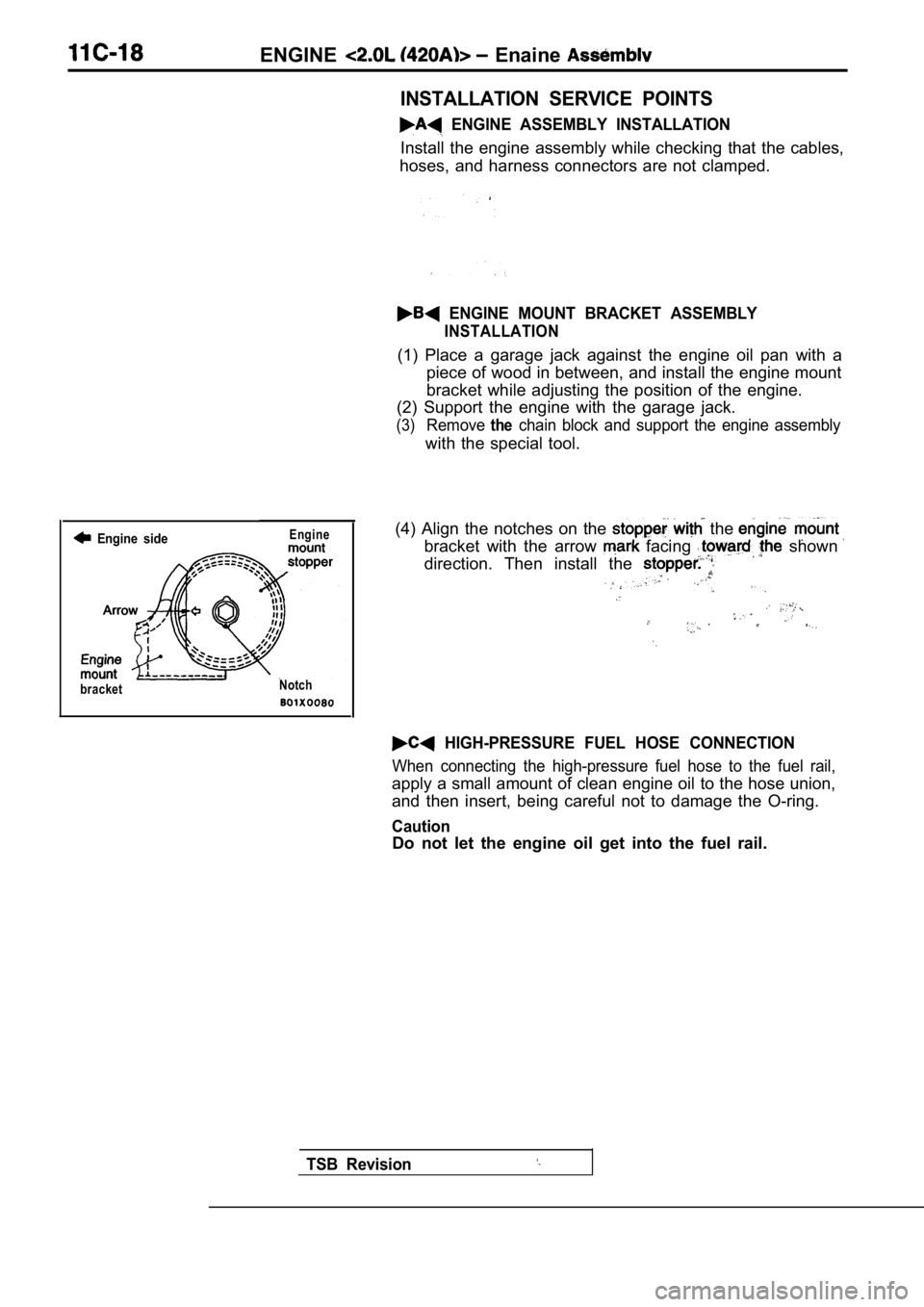
ENGINE Enaine
Engine side
bracketEngine
Notch
INSTALLATION SERVICE POINTS
ENGINE ASSEMBLY INSTALLATION
Install the engine assembly while checking that the cables,
hoses, and harness connectors are not clamped.
ENGINE MOUNT BRACKET ASSEMBLY
INSTALLATION
(1) Place a garage jack against the engine oil pan with a
piece of wood in between, and install the engine mo unt
bracket while adjusting the position of the engine.
(2) Support the engine with the garage jack.
(3)Removethechain block and support the engine assembly
with the special tool.
(4) Align the notches on the
the
bracket with the arrow facing shown
direction. Then install the
HIGH-PRESSURE FUEL HOSE CONNECTION
When connecting the high-pressure fuel hose to the fuel rail,
apply a small amount of clean engine oil to the hose union,
and then insert, being careful not to damage the O- ring.
Caution
Do not let the engine oil get into the fuel rail.
TSB Revision
Page 202 of 2103
E N G I N E Cylinder Head
Unstretched bolt
‘Location of 110 mm (4.330 in.) short bolts.Step 4
Painted marks
Projection
Water outlet fitting
INSTALLATION SERVICE POINTS
CYLINDER HEAD
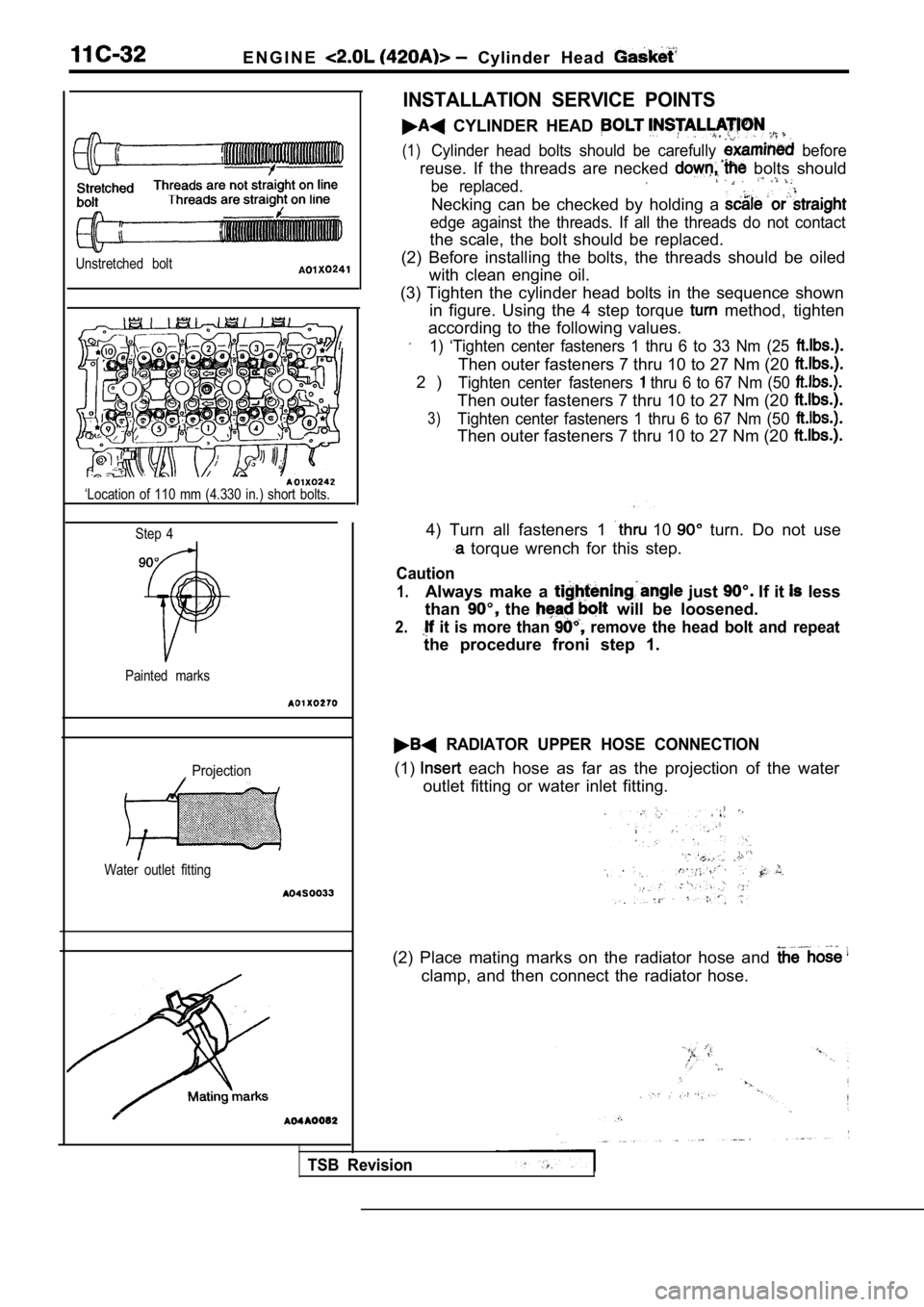
(1)Cylinder head bolts should be carefully before
reuse. If the threads are necked bolts should
be replaced.
Necking can be checked by holding a
edge against the threads. If all the threads do not contact
the scale, the bolt should be replaced.
(2) Before installing the bolts, the threads should be oiled
with clean engine oil.
(3) Tighten the cylinder head bolts in the sequence shown
in figure. Using the 4 step torque
method, tighten
according to the following values.
1) ‘Tighten center fasteners 1 thru 6 to 33 Nm (25
Then outer fasteners 7 thru 10 to 27 Nm (20
2 )Tighten center fasteners thru 6 to 67 Nm (50
Then outer fasteners 7 thru 10 to 27 Nm (20
3)Tighten center fasteners 1 thru 6 to 67 Nm (50
Then outer fasteners 7 thru 10 to 27 Nm (20
4) Turn all fasteners 1 10 turn. Do not use
torque wrench for this step.
Caution
1.Always make a just If it less
than
the will be loosened.
2. it is more than remove the head bolt and repeat
the procedure froni step 1.
RADIATOR UPPER HOSE CONNECTION
(1) each hose as far as the projection of the water
outlet fitting or water inlet fitting.
(2) Place mating marks on the radiator hose and
clamp, and then connect the radiator hose.
TSB Revision
Page 206 of 2103
ENGINE Belt
Reference mark
T.D.C.
Align camshaft sprockettimingmarks together
side
Arra
mount
bracket Engine
mount
INSTALLATION SERVICE POINT
TIMING BELT BELT
INSTALLATION
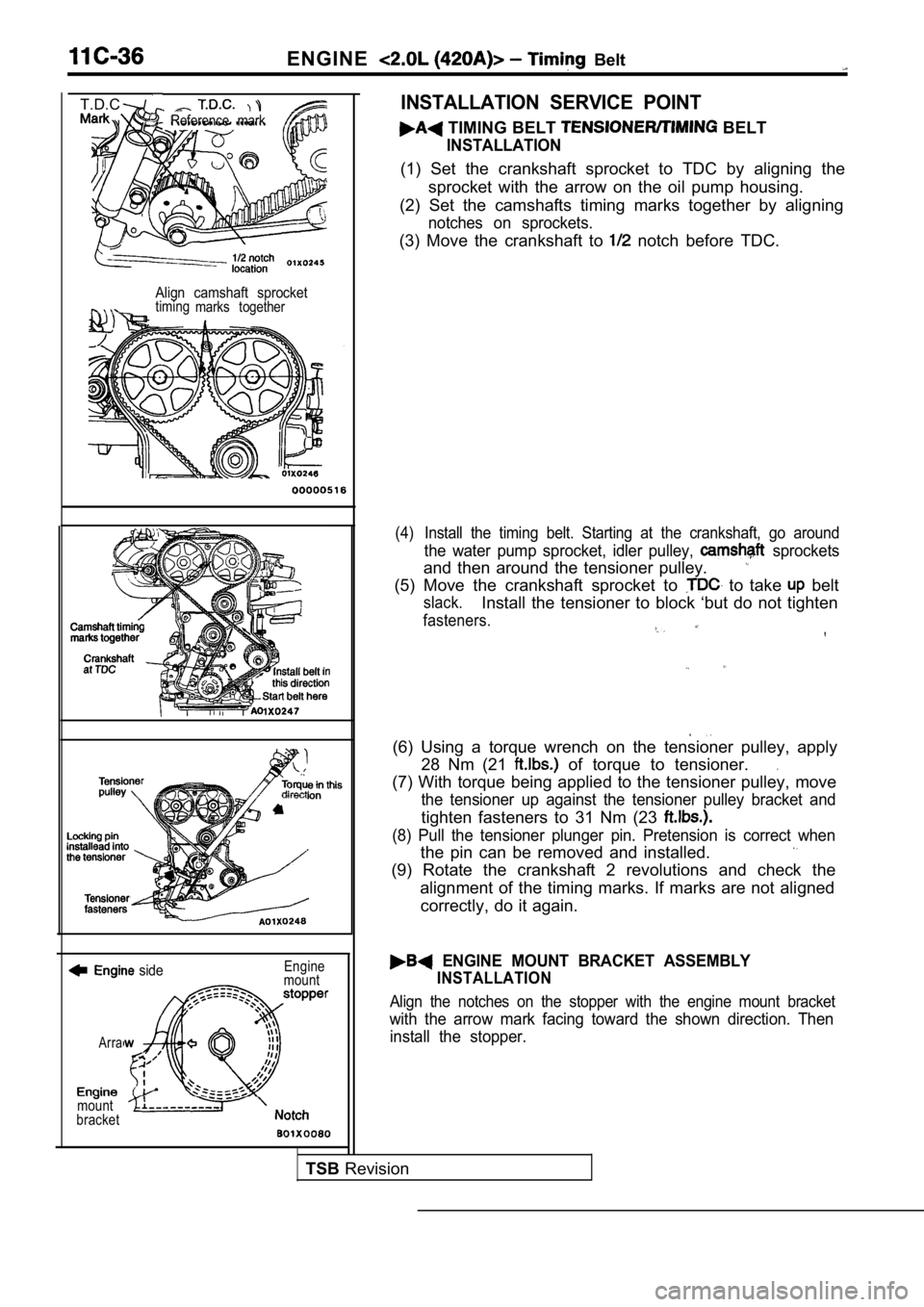
(1) Set the crankshaft sprocket to TDC by aligning the
sprocket with the arrow on the oil pump housing.
(2) Set the camshafts timing marks together by alig ning
notches on sprockets.
(3) Move the crankshaft to notch before TDC.
(4) Install the timing belt. Starting at the crankshaft, go around
the water pump sprocket, idler pulley, sprockets
and then around the tensioner pulley.
(5) Move the crankshaft sprocket to to take belt
slack.Install the tensioner to block ‘but do not tighten
fasteners.
(6) Using a torque wrench on the tensioner pulley, apply
28 Nm (21
of torque to tensioner..
(7) With torque being applied to the tensioner pull ey, move
the tensioner up against the tensioner pulley brack et and
tighten fasteners to 31 Nm (23
(8) Pull the tensioner plunger pin. Pretension is correct when
the pin can be removed and installed.
(9) Rotate the crankshaft 2 revolutions and check t he
alignment of the timing marks. If marks are not ali gned
correctly, do it again.
ENGINE MOUNT BRACKET ASSEMBLY
INSTALLATION
Align the notches on the stopper with the engine mo unt bracket
with the arrow mark facing toward the shown direction. Then
install the stopper.
TSB Revision
Page 225 of 2103
ENGINE OVERHAUL Belt
TDCInstall belt in
‘this
here
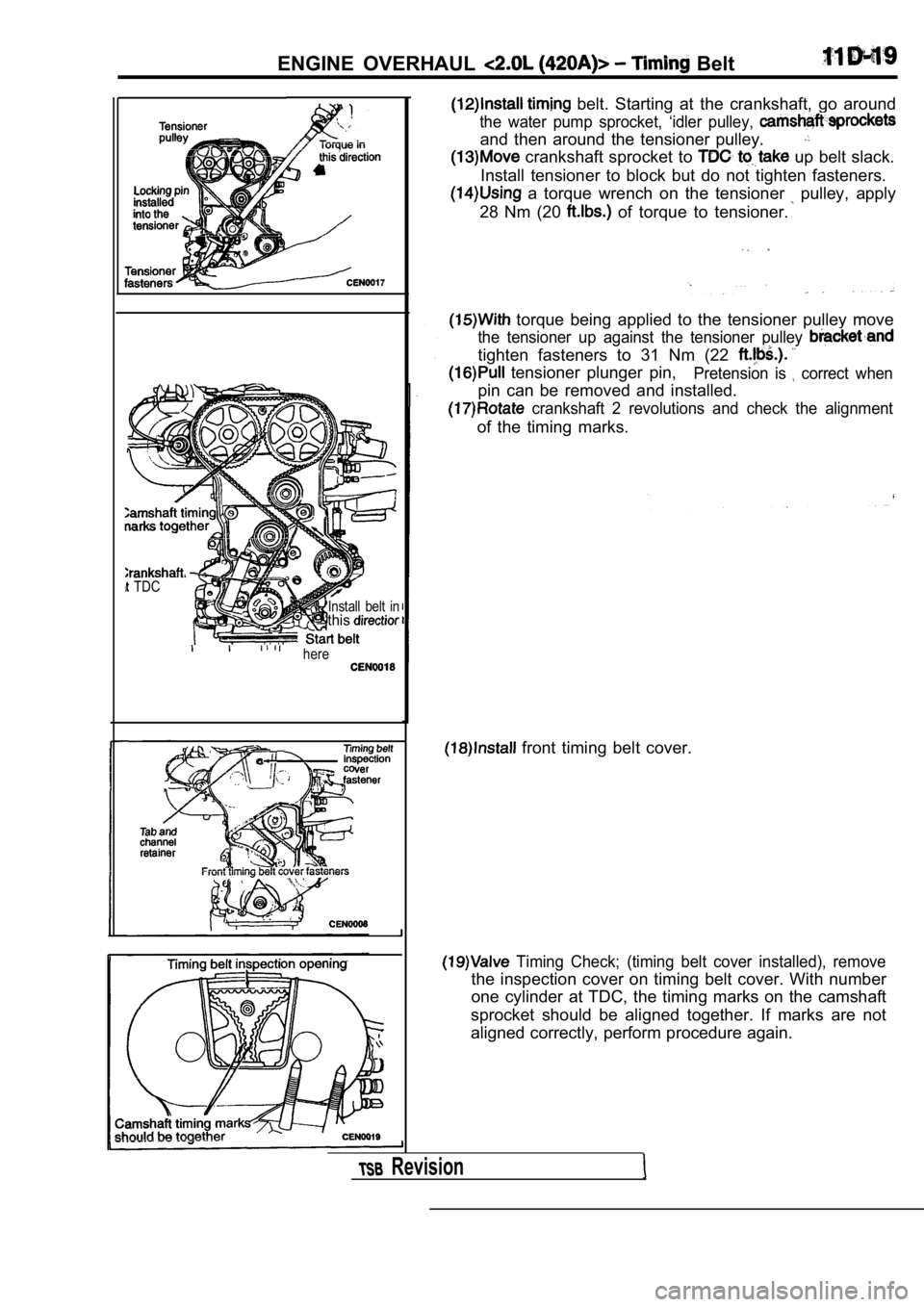
belt. Starting at the crankshaft, go around
the water pump sprocket, ‘idler pulley,
and then around the tensioner pulley.
crankshaft sprocket to up belt slack.
Install tensioner to block but do not tighten faste ners.
a torque wrench on the tensioner pulley, apply
28 Nm (20
of torque to tensioner.
torque being applied to the tensioner pulley move
the tensioner up against the tensioner pulley
tighten fasteners to 31 Nm (22
tensioner plunger pin,Pretension is correct when
pin can be removed and installed.
crankshaft 2 revolutions and check the alignment
of the timing marks.
front timing belt cover.
Timing Check; (timing belt cover installed), remov e
the inspection cover on timing belt cover. With num ber
one cylinder at TDC, the timing marks on the camsha ft
sprocket should be aligned together. If marks are n ot
aligned correctly, perform procedure again.
Revision
Page 228 of 2103
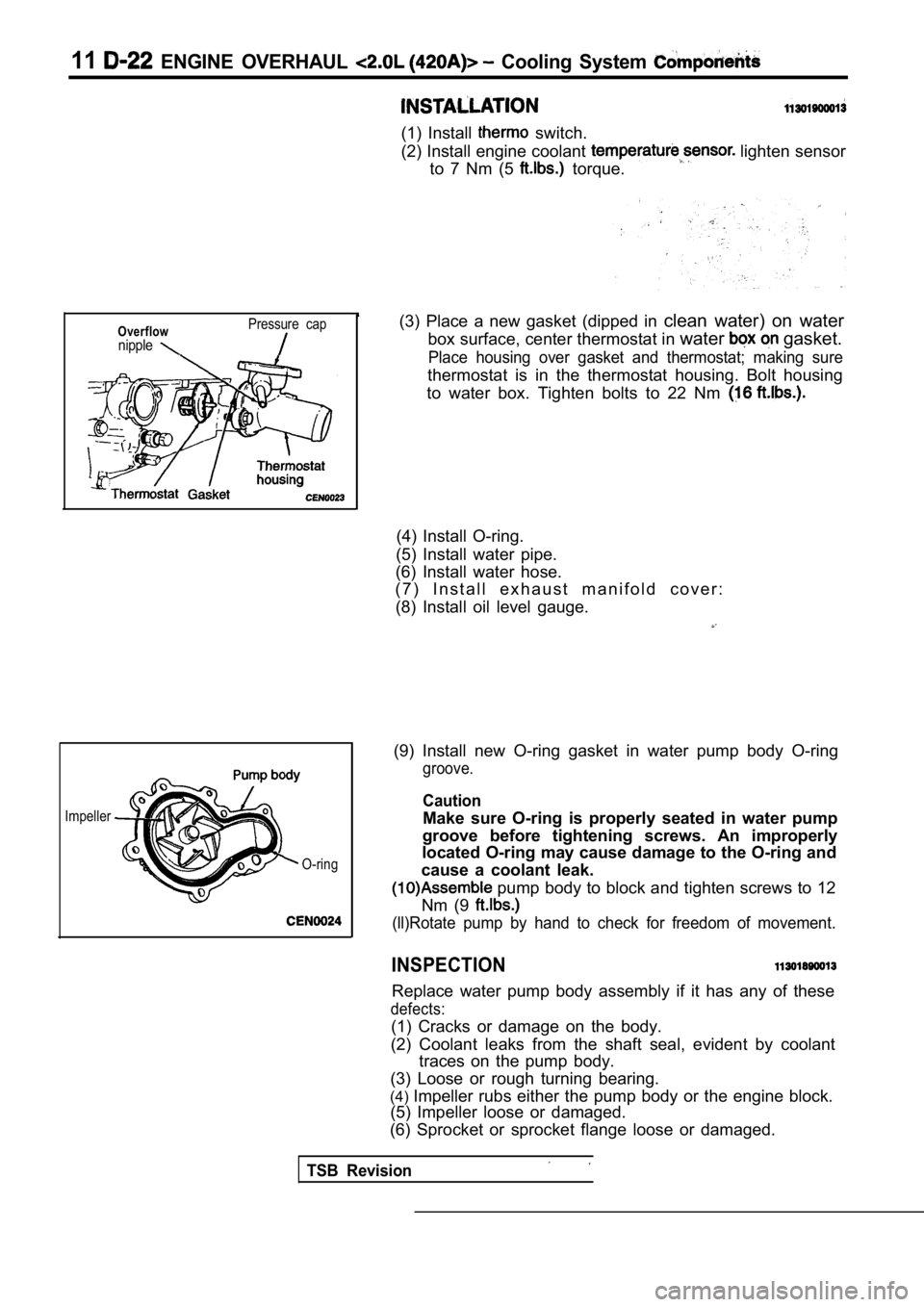
11 ENGINE OVERHAUL Cooling System
(1) Install switch.
(2) Install engine coolant
lighten sensor
to 7 Nm (5
torque.
Overflownipple
Pressure cap
Impeller
TSB Revision
O-ring
(3) Place a new gasket (dipped in clean water) on water
box surface, center thermostat in water
gasket.
Place housing over gasket and thermostat; making su re
thermostat is in the thermostat housing. Bolt housing
to water box. Tighten bolts to 22 Nm
(4) Install O-ring.
(5) Install water pipe.
(6) Install water hose.
( 7 ) I n s t a l l e x h a u s t m a n i f o l d c o v e r :
(8) Install oil level gauge.
(9) Install new O-ring gasket in water pump body O- ring
groove.
Caution
Make sure O-ring is properly seated in water pump
groove before tightening screws. An improperly
located O-ring may cause damage to the O-ring and
cause a coolant leak.
pump body to block and tighten screws to 12
Nm (9
(ll)Rotate pump by hand to check for freedom of mov ement.
INSPECTION
Replace water pump body assembly if it has any of these
defects:
(1) Cracks or damage on the body.
(2) Coolant leaks from the shaft seal, evident by c oolant
traces on the pump body.
(3) Loose or rough turning bearing.
(4) Impeller rubs either the pump body or the engine bl ock.
(5) Impeller loose or damaged.
(6) Sprocket or sprocket flange loose or damaged.
Page 237 of 2103
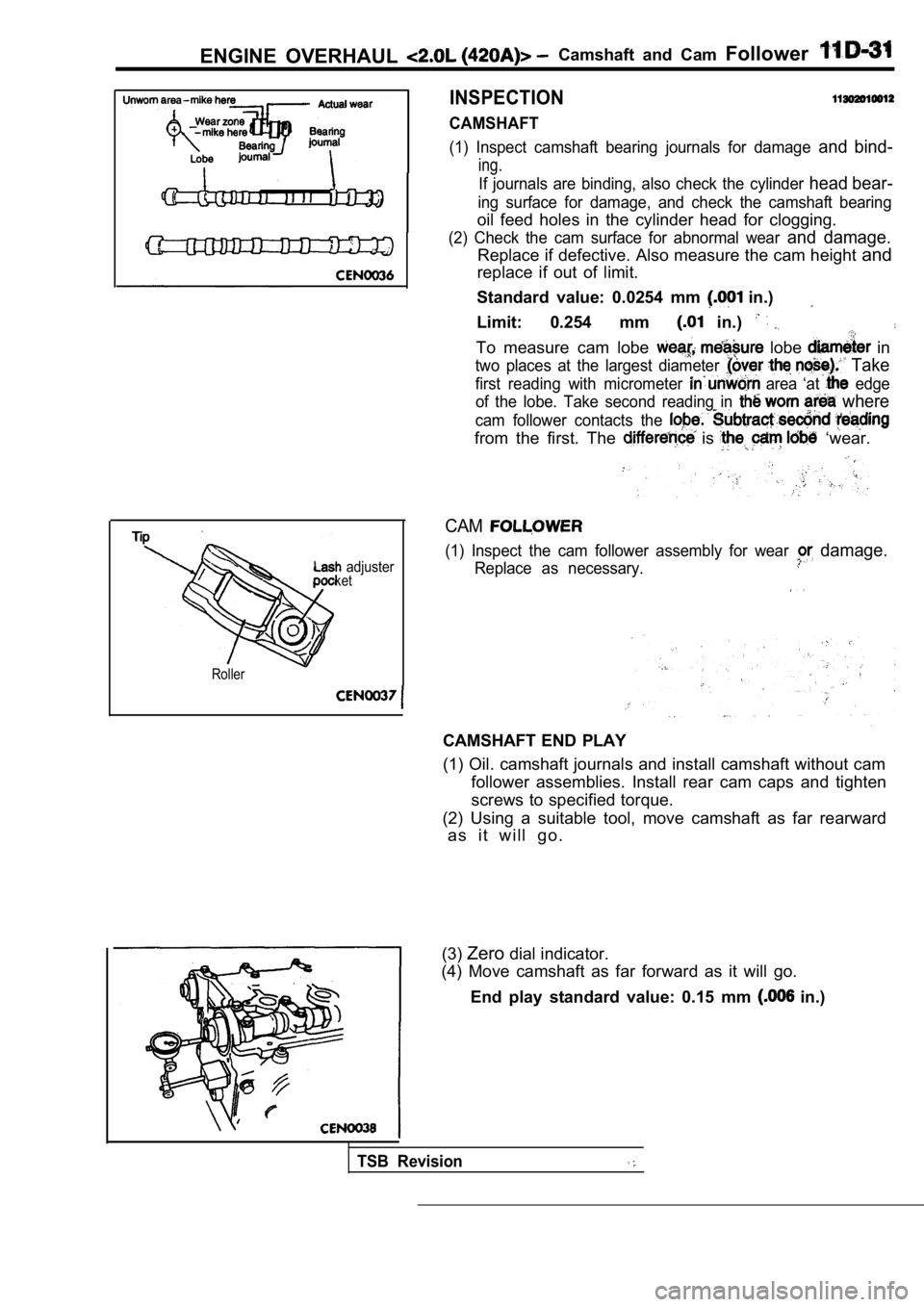
(1) Inspect camshaft bearing journals for damage and bind-
ing.
If journals are binding, also check the cylinder head bear-
ing surface for damage, and check the camshaft bearing
oil feed holes in the cylinder head for clogging.
(2) Check the cam surface for abnormal wear and damage.
Replace if defective. Also measure the cam height and
replace if out of limit.
Standard value: 0.0254 mm
in.)
Limit: 0.254 mm in.)
To measure cam lobe lobe in
two places at the largest diameter Take
first reading with micrometer area ‘at edge
of the lobe. Take second reading in
where
cam follower contacts the
from the first. The is ‘wear.
ENGINE OVERHAUL Camshaft and Cam Follower
INSPECTION
CAMSHAFT
adjusterket
Roller
CAM
(1) Inspect the cam follower assembly for wear damage.
Replace as necessary.
CAMSHAFT END PLAY
(1) Oil. camshaft journals and install camshaft wit hout cam
follower assemblies. Install rear cam caps and tigh ten
screws to specified torque.
(2) Using a suitable tool, move camshaft as far rea rward
a s i t w i l l g o .
(3) Zero dial indicator.
(4) Move camshaft as far forward as it will go.
End play standard value: 0.15 mm
in.)
TSB Revision