check engine MITSUBISHI SPYDER 1990 Service Repair Manual
[x] Cancel search | Manufacturer: MITSUBISHI, Model Year: 1990, Model line: SPYDER, Model: MITSUBISHI SPYDER 1990Pages: 2103, PDF Size: 68.98 MB
Page 376 of 2103
![MITSUBISHI SPYDER 1990 Service Repair Manual 12-4 L U B R I C A T I O N
EngineI
Turbo
4. Supply new engine oil through the oil filler.Engine oil total quantity:[including oil filter and oil cooler]
Engine (Non-turbo) arid](/img/19/57345/w960_57345-375.png "MITSUBISHI SPYDER 1990 Service Repair Manual 12-4 L U B R I C A T I O N
EngineI
Turbo
4. Supply new engine oil through the oil filler.Engine oil total quantity:[including oil filter and oil cooler]
Engine (Non-turbo) arid")
12-4 L U B R I C A T I O N
EngineI
Turbo
4. Supply new engine oil through the oil filler.Engine oil total quantity:[including oil filter and oil cooler]
Engine (Non-turbo) arid
4 . 3 (4 q t s . )
Engine (Turbo)>
4.4
(4.6 qts.)
5. Start and run the engine a
minutes.
6.Stop the engine and check the engine oil level is w ithin
the level range indicated on the oil dipstick.
.
NOTE
may be used for operation in very cold weather
areas where the lowest ambient temperature is below
OIL REPLACEMENT
1. Remove the engine oil filler cap.
2.Remove the engine oil drain plug, and drain out the engine
o i l .
3.Remove the engine oil filter by using the oil filter wrench.
4.Clean the oil filter mounting, surface of the oil f ilter bracket.
5. Coat engine oil to the O-ring of’new filter: .
6.Screw on the oil filter by hand until it touchesthe surface
of the flange and then tighten it with. the filter wrench:
etc.
Engine (Turbo) Engine>
lFor One full turn or 14 Nm
lFor or 17 Nm (12
E n g i n e ( N o n - t u r b o ) >
lFor 090: turn or 21 Nm (15
7. Add new engine oil through the oil filter.
8. Start and run engine and check for engine oil le aks.
9. After stopping engine, check oil level and reple nish as
necessary.
TSB Revision
Page 377 of 2103
ENGINE LUBRICATION Oil Cooler
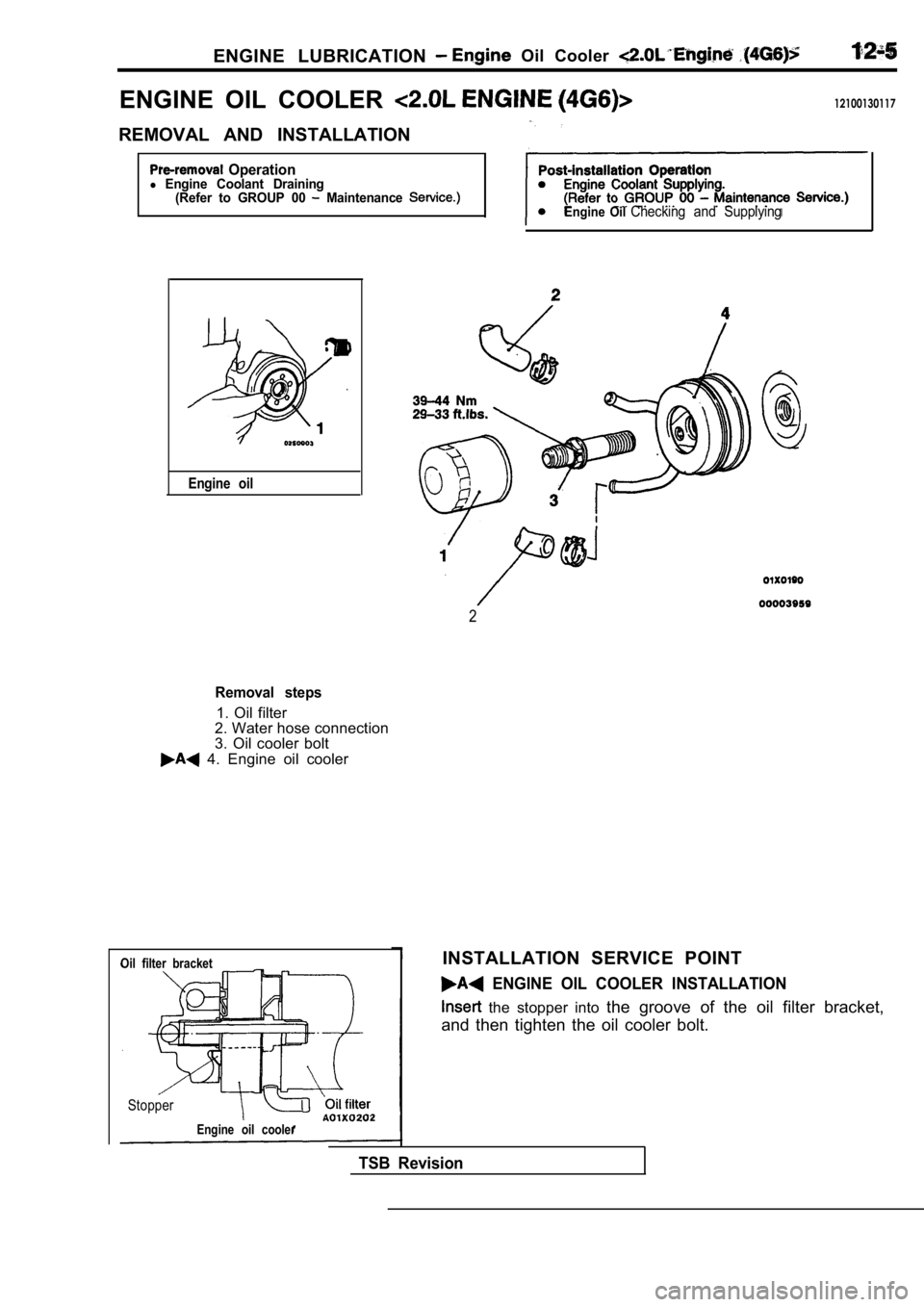
ENGINE OIL COOLER 12100130117
REMOVAL AND INSTALLATION
Operationl Engine Coolant Draining(Refer to GROUP 00 Maintenance
Engine oil
Engine Oil Checking and Supplying
2
Removal steps
1. Oil filter
2. Water hose connection
3. Oil cooler bolt
4. Engine oil cooler
Oil filter bracket
Stopper
Engine oil cooler
INSTALLATION SERVICE POINT
ENGINE OIL COOLER INSTALLATION
the stopper into the groove of the oil filter bracket,
and then tighten the oil cooler bolt.
TSB Revision
Page 378 of 2103
12-6ENGINE LUBRICATION Engine Oil Cooler
INSPECTION
lCheck the water for cracks, clogging, or
deterioration.
lCheck the oil cooler bolt clogging deformation.
Revision
Page 381 of 2103
FUEL
INJECTION
CONTENTS
FUEL INJECTION (MFI)
ENGINE (NON-TURBO)> . . . . . . . 3
Relay (ASD Relay) and Fuel ‘Relay
Check.. . . . . . . . . . . . . . . . . . . . . . . . . . , . . . . .128
Throttle Position Sensor Check. . . . . . . . . . .
129
GENERAL INFORMATION . . . . . . . . . . . . . . . . 3ON-VEHICLE SERVICE. . . . . . . . . . . . . . . .119
INJECTOR. . . . . . . . . . . . . . . . . . . . . . . . . . . .134Fuel Pressure Test . . . . . . . . . . . , . . . . . . . . .121
ON-VEHICLE INSPECTION OF
COMPONENTS . . . . . . . . . . . . . . . . . . . . . .
Component Location. . . . . . . . . . . . . . . . . . . 124
Electric EGR Transducer Solenoid Check
. . . . . . . . . . . . . . . . . . . . . . . . . . . . . . .. . . . . . . . .133
Engine Coolant Temperature Sensor Check
. . . . . . . . . . . . . . . . . . . . . . . . . . . . . . . . . . . . . . . .129
Evaporative Emission Purge Solenoid
C h e c k . . . . . . . . . . . . . . . . . . . . . . . . . . . . . . . . . . 1 3 3
Heated Oxygen Sensor Check . . . . . . . . . . . 13 0
Idle Air Control Motor (Stepper Motor)
Check . . . . . . . . . . . . . . . . . . . . . . . . . . . . . . . . . .132
Injector Check . . . . . . . . . . . . . . . . . . . . . . . . . .132
Intake Air Temperature Sensor Check . . . . 128 Fuel Pump Connector Disconnection
(How to Reduce Fuel Line Pressure) . . . . . 123
Throttle Body Minimum Air
Check . . . 110 ,
SEALANT. . . . . . . . . . . . . . . . . . . . . . . . . . . . . . .
SERVICE SPECIFICATIONS . . . . . . . . . . . . . . 6
SPECIAL TOOLS . . . . . . . . . . . . . . .
. . . . . 7,
THROTTLE BODY . . . . . . . . . . . . . . . . .
TROUBLESHOOTING. . . . . . . . . . . . . . . . 6
CONTINUED ON NEXT PAGE
Page 382 of 2103
MULTIPORT FUEL INJECTION (MFI)
(TURBO) AND’ EN-
GINE> . . . . . . . . . . . . . . . .
.. . . . . . . . . . .
FUEL RELAY MODULE
ENGINE> . . . . . . . . . . . . . . . . . . . . . . .
GENERAL INFORMATION. . . . . . . ... . . . . . . .136
INJECTOR. . . . . . . . . . . . . . . . . . . . . . . . . . . .269
ON-VEHICLE INSPECTION OF
COMPONENTS. . . . . . . . . . . . . . . . . . . . . . .
Closed Throttle Position Check . . . .282
Component Location. . . . . . . . . . . . . . . . . . . .272
EGR Solenoid Check . . . . . . . . . . . . . . . . . . . .288
Engine Coolant Temperature Sensor
Check... . . . . . . . . . . . . . . . . . . . . . . . . . . . . ....
281
Evaporative Emission Purge Solenoid
Check. . . . . . . . . . . . . . . . . . . . . . . . . . . . . . . . . .288
Fuel Pressure Solenoid Check
Engine (Turbo)> . . . . . . . . . . . . . . . . . .287
Heated Oxygen Sensor Check . . . . . . . . . . .283
Idle Air Control Motor (DC Motor) Check
Engine> . . . . . . . . . . . . . . . . . . . . . . . . . .287
Idle Air Control Motor (Stepper Motor)
Check
Engine (Turbo)> . . . . . . . . . . . .285
Injector Check. . . . . . . . . . . . . . . . . . . . . . . . . . .283
Intake Air Temperature Sensor Check . . . .280
Fuel Injection (MFI)
Relay and Fuel Pump Relay Check . . . . . .
280
Resistor Check Engine (Turbo)>. . . . 285
Throttle Position Sensor
. . . . . . . 282
Turbocharger Waste Gate, Check.. . . . . . . . . . . . . . . . . . . . . . . . . .288
ON-VEHICLE. . . . . . . . .
Basic Idle ‘Speed . . . . . . . 266
Closed Throttle
Position Sensor Adjustment . . . . . . . . . . . . . . 263
Curb Idle Speed Inspection
Engine (Turbo)
. . . , . . . .
. . . . . . .
Refer to GROUP
Refer to GROUP
Fixed SAS Adjustment . . . . . .
Fuel Pressure Test . 268
Fuel Pump Connector
(How to Reduce Fuel
Fuel Pump Operation Check . . . . . . 271
Throttle Body (Throttle Valve Area)
Cleaning. . . . , . . . . . . . . . , . . 262
SEALANT.144
SERVICE SPECIFICATIONS . . . . . . . .
SPECIAL . . . . . . . . . . . . . . . 145
BODY. . . . . . . . . . . . . . 291
. . . . . . . . . . . . . . . .
Page 384 of 2103
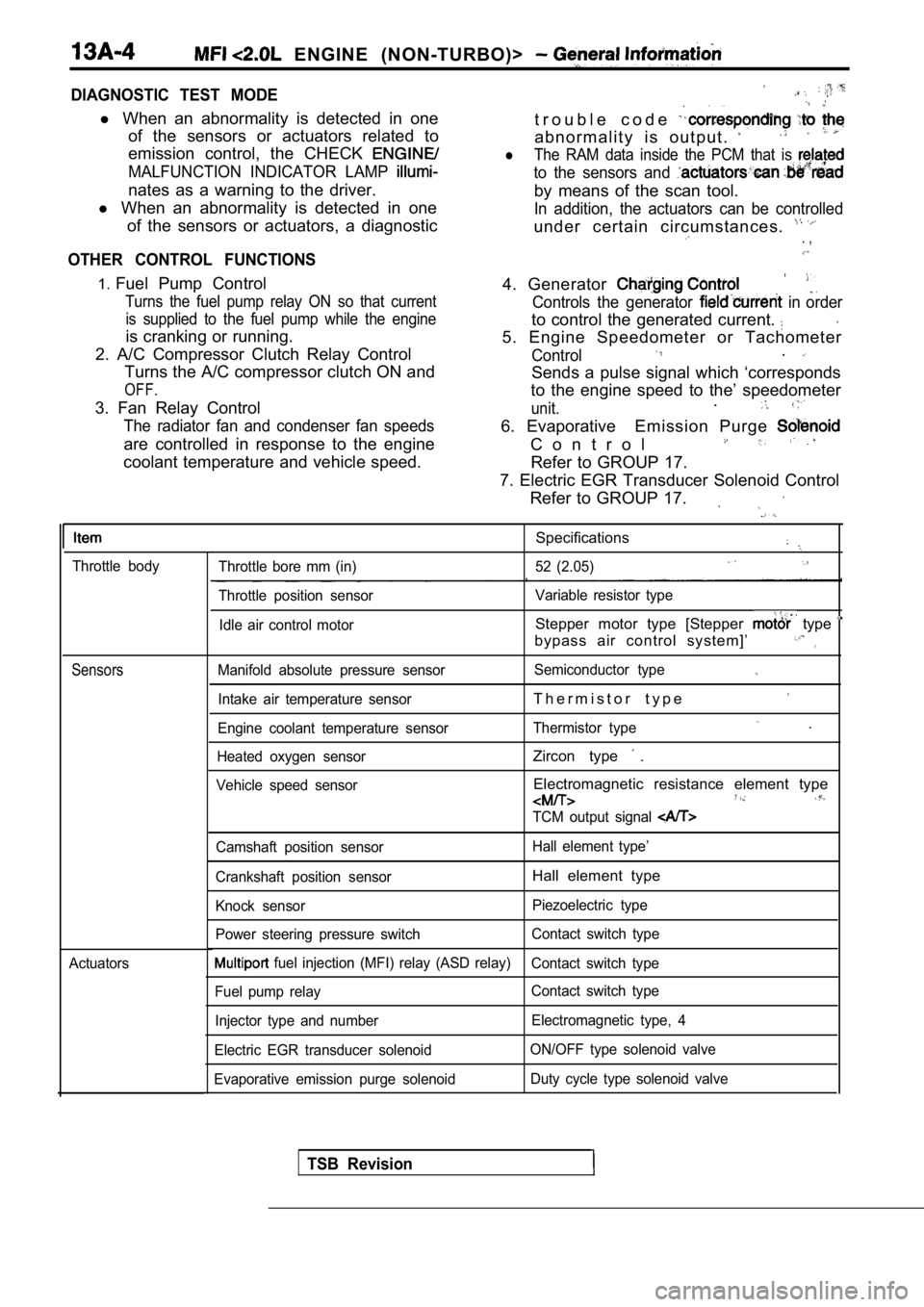
ENGINE (NON-TURBO)>
DIAGNOSTIC TEST MODE
l When an abnormality is detected in one
of the sensors or actuators related to
emission control, the CHECK
MALFUNCTION INDICATOR LAMP
nates as a warning to the driver.
l When an abnormality is detected in one
of the sensors or actuators, a diagnostic
OTHER CONTROL FUNCTIONS
t r o u b l e c o d e
a b n o r m a l i t y i s o u t p u t .
lThe RAM data inside the PCM that is
to the sensors and
by means of the scan tool.
In addition, the actuators can be controlled
under certain circumstances. . ,
1. Fuel Pump Control
Turns the fuel pump relay ON so that current
is supplied to the fuel pump while the engine
is cranking or running.
2. A/C Compressor Clutch Relay Control Turns the A/C compressor clutch ON and
OFF.
3. Fan Relay Control
The radiator fan and condenser fan speeds
are controlled in response to the engine
coolant temperature and vehicle speed. 4. Generator
Controls the generator in order
to control the generated current.
5. Engine Speedometer or Tachometer
Control.
Sends a pulse signal which ‘corresponds
to the engine speed to the’ speedometer
unit..
6. Evaporative Emission Purge
C o n t r o l
Refer to GROUP 17.
7. Electric EGR Transducer Solenoid Control Refer to GROUP 17.
Throttle body
Sensors
Actuators
Specifications
Throttle bore mm (in) 52 (2.05)
Throttle position sensor Variable resistor type
Idle air control motor
Stepper motor type [Stepper type
bypass air control system]’,
Manifold absolute pressure sensor Semiconductor type
Intake air temperature sensorT h e r m i s t o r t y p e
Engine coolant temperature sensorThermistor type .
Heated oxygen sensorZircon type .
Vehicle speed sensorElectromagnetic resistance element type
TCM output signal
Camshaft position sensor Hall element type’
Crankshaft position sensor
Hall element type
Knock sensor Piezoelectric type
Power steering pressure switch Contact switch type
fuel injection (MFI) relay (ASD relay)
Contact switch type
Fuel pump relay Contact switch type
Injector type and number Electromagnetic type, 4
Electric EGR transducer solenoid ON/OFF type solenoid valve
Evaporative emission purge solenoid Duty cycle type solenoid valve
TSB Revision
Page 388 of 2103
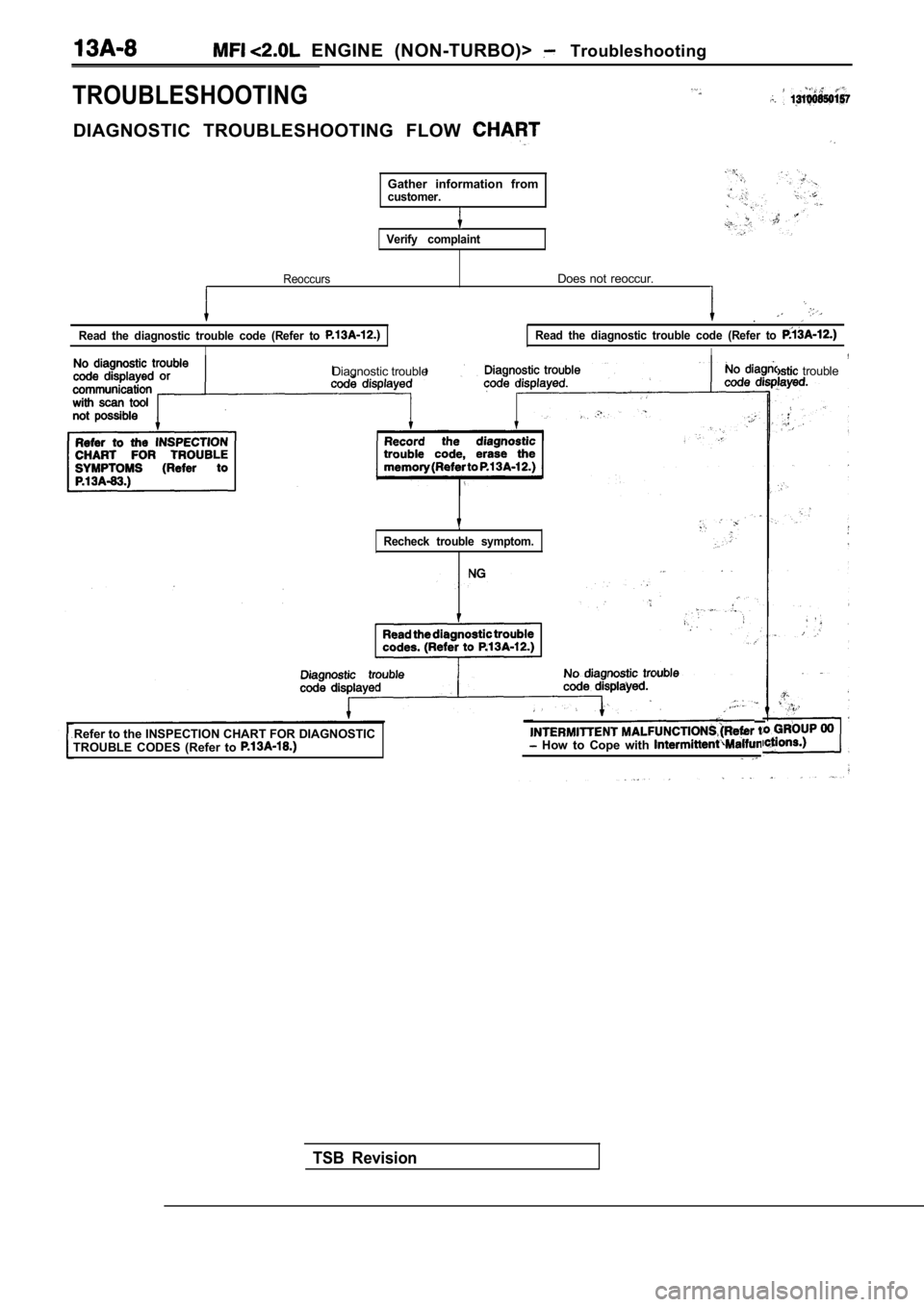
ENGINE (NON-TURBO)> Troubleshooting
TROUBLESHOOTING
DIAGNOSTIC TROUBLESHOOTING FLOW
Gather information fromcustomer.
Verify complaint
Reoccurs
Read the diagnostic trouble code (Refer to
I
Does not reoccur.
.
Read the diagnostic trouble code (Refer to
I
Diagnostic trouble trouble
Recheck trouble symptom.
Refer to the INSPECTION CHART FOR DIAGNOSTIC
TROUBLE CODES (Refer to How to Cope with
TSB Revision
Page 389 of 2103
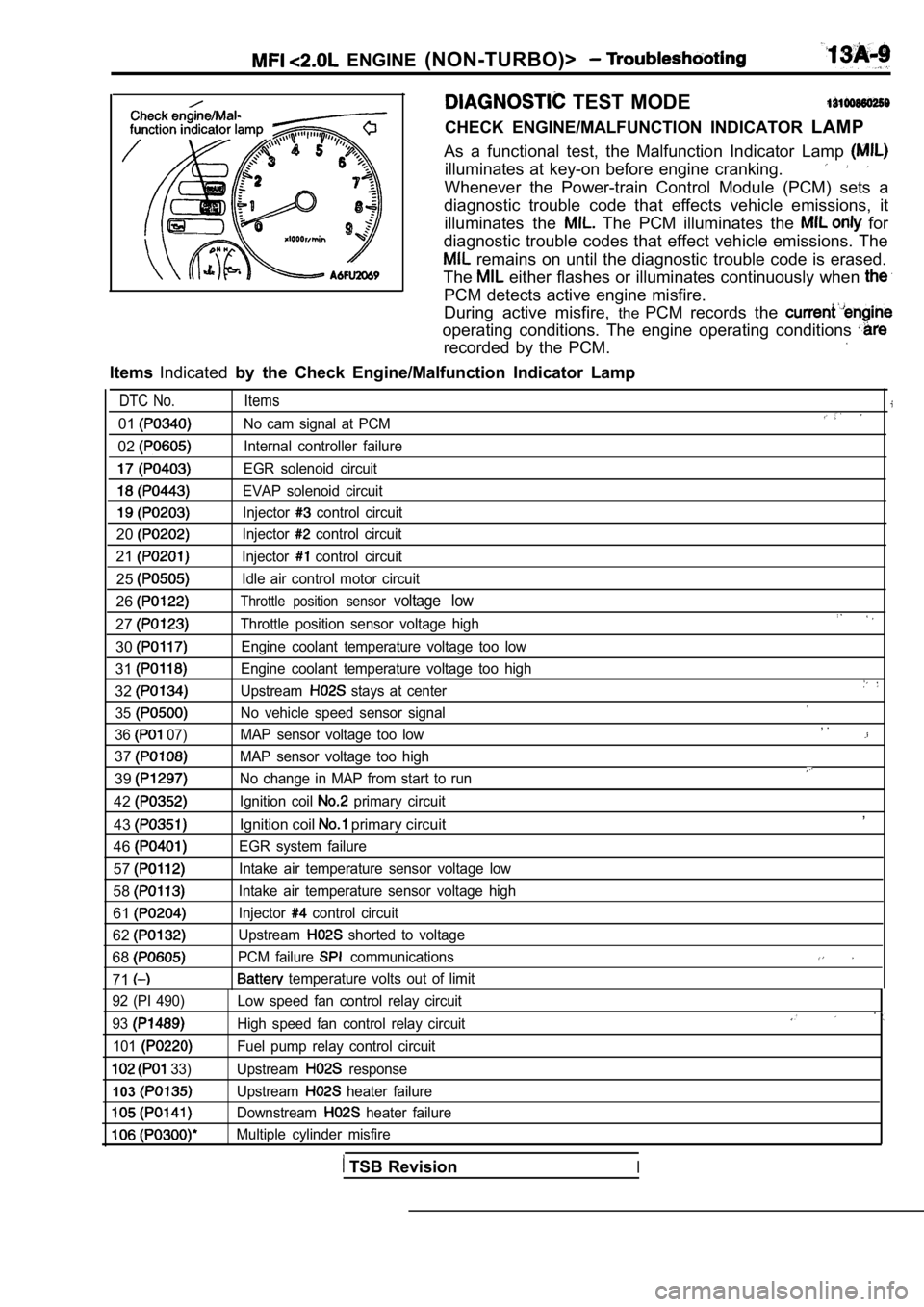
ENGINE (NON-TURBO)>
TEST MODE
CHECK ENGINE/MALFUNCTION INDICATOR LAMP
As a functional test, the Malfunction Indicator Lam p
illuminates at key-on before engine cranking.
Whenever the Power-train Control Module (PCM) sets a
diagnostic trouble code that effects vehicle emissi ons, it
illuminates the
The PCM illuminates the for
diagnostic trouble codes that effect vehicle emissi ons. The
remains on until the diagnostic trouble code is erased.
The
either flashes or illuminates continuously when
PCM detects active engine misfire.
During active misfire, thePCM records the
operating conditions. The engine operating conditio ns
recorded by the PCM.
ItemsIndicated by the Check Engine/Malfunction Indicator Lamp
DTC No. Items
01No cam signal at PCM
02Internal controller failure
EGR solenoid circuit
EVAP solenoid circuit
Injector control circuit
20Injector control circuit
21Injector control circuit
25Idle air control motor circuit
26Throttle position sensor voltage low
27Throttle position sensor voltage high
30Engine coolant temperature voltage too low
31Engine coolant temperature voltage too high
32Upstream stays at center
35
No vehicle speed sensor signal
36
07) MAP sensor voltage too low
37MAP sensor voltage too high
39No change in MAP from start to run
42Ignition coil primary circuit
43Ignition coil primary circuit
46
EGR system failure
57Intake air temperature sensor voltage low
58Intake air temperature sensor voltage high
61Injector control circuit
62Upstream shorted to voltage
68PCM failure communications
71 temperature volts out of limit
, .
,
92 (PI 490)
93
101
33)
103
Low speed fan control relay circuit
High speed fan control relay circuit
Fuel pump relay control circuit
Upstream
response
Upstream
heater failure
Downstream
heater failure
Multiple cylinder misfire
TSB RevisionI
Page 390 of 2103
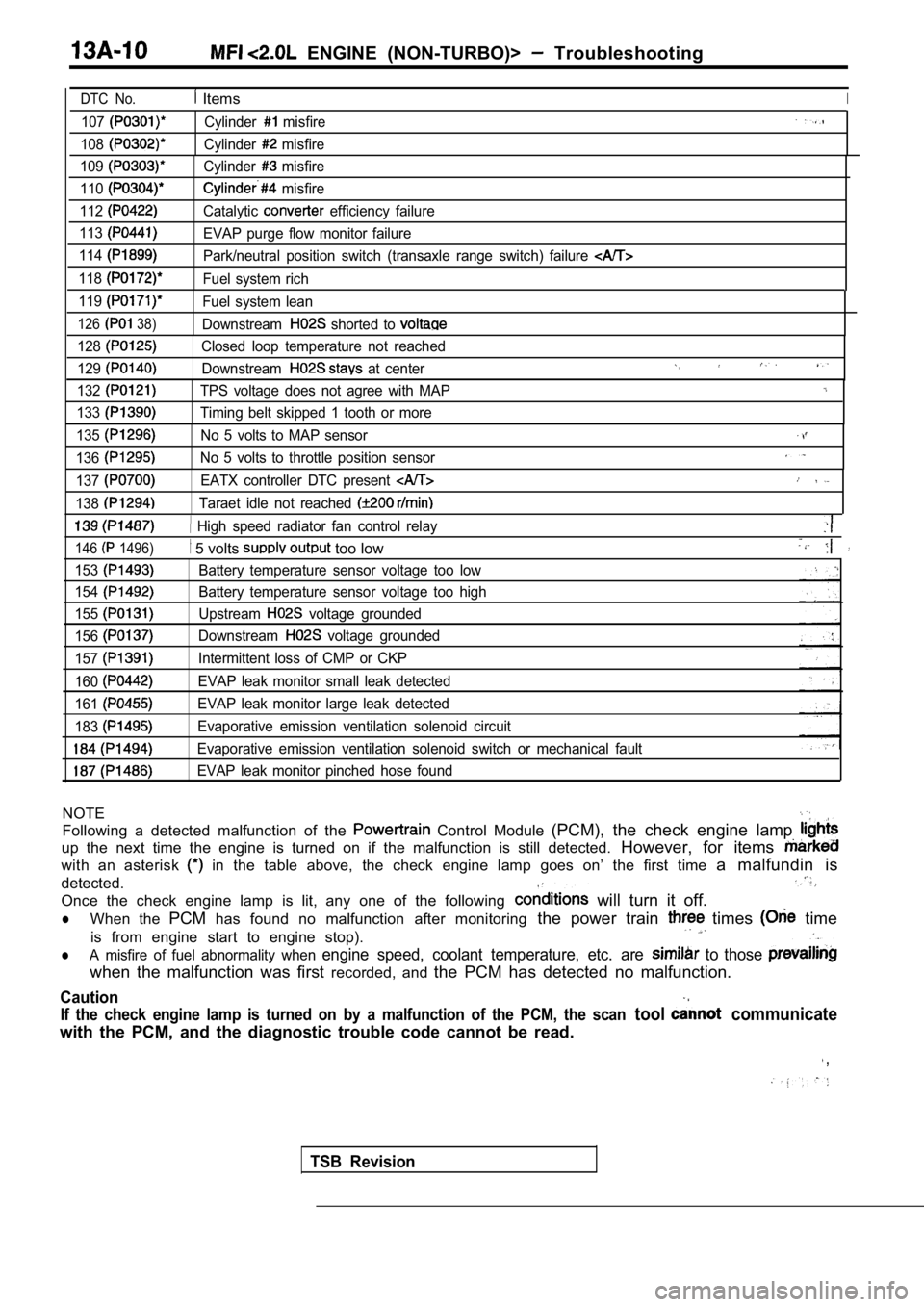
ENGINE (NON-TURBO)> Troubleshooting
DTC No. ItemsI
107
108
109
110
112
113
114
118
119
126 38)
Cylinder misfire
Cylinder
misfire
Cylinder
misfire
misfire
Catalytic
efficiency failure
EVAP purge flow monitor failure
Park/neutral position switch (transaxle range switc h) failure
Fuel system rich
Fuel system lean
Downstream
shorted to
128Closed loop temperature not reached
129
Downstream at center
132
133
TPS voltage does not agree with MAP
Timing belt skipped 1 tooth or more
135No 5 volts to MAP sensor
136No 5 volts to throttle position sensor
137EATX controller DTC present
138Taraet idle not reached
High speed radiator fan control relay
146 1496)
153
154
155
156
157
160
161
183
5 volts too low
Battery temperature sensor voltage too low
Battery temperature sensor voltage too high
Upstream
voltage grounded
Downstream
voltage grounded
Intermittent loss of CMP or CKP
EVAP leak monitor small leak detected
EVAP leak monitor large leak detected
Evaporative emission ventilation solenoid circuit
Evaporative emission ventilation solenoid switch or mechanical fault
EVAP leak monitor pinched hose found
NOTE
Following a detected malfunction of the Control Module (PCM), the check engine lamp
up the next time the engine is turned on if the mal function is still detected. However, for items
with an asterisk in the table above, the check engine lamp goes on’ the first time a malfundin is
detected.
Once the check engine lamp is lit, any one of the f ollowing
will turn it off.
lWhen the PCMhas found no malfunction after monitoring the power train times time
is from engine start to engine stop).
lA misfire of fuel abnormality when engine speed, coolant temperature, etc. are to those
when the malfunction was first recorded, and the PCM has detected no malfunction.
Caution
If the check engine lamp is turned on by a malfunct ion of the PCM, the scan tool communicate
with the PCM, and the diagnostic trouble code canno t be read.
,
TSB Revision
Page 391 of 2103
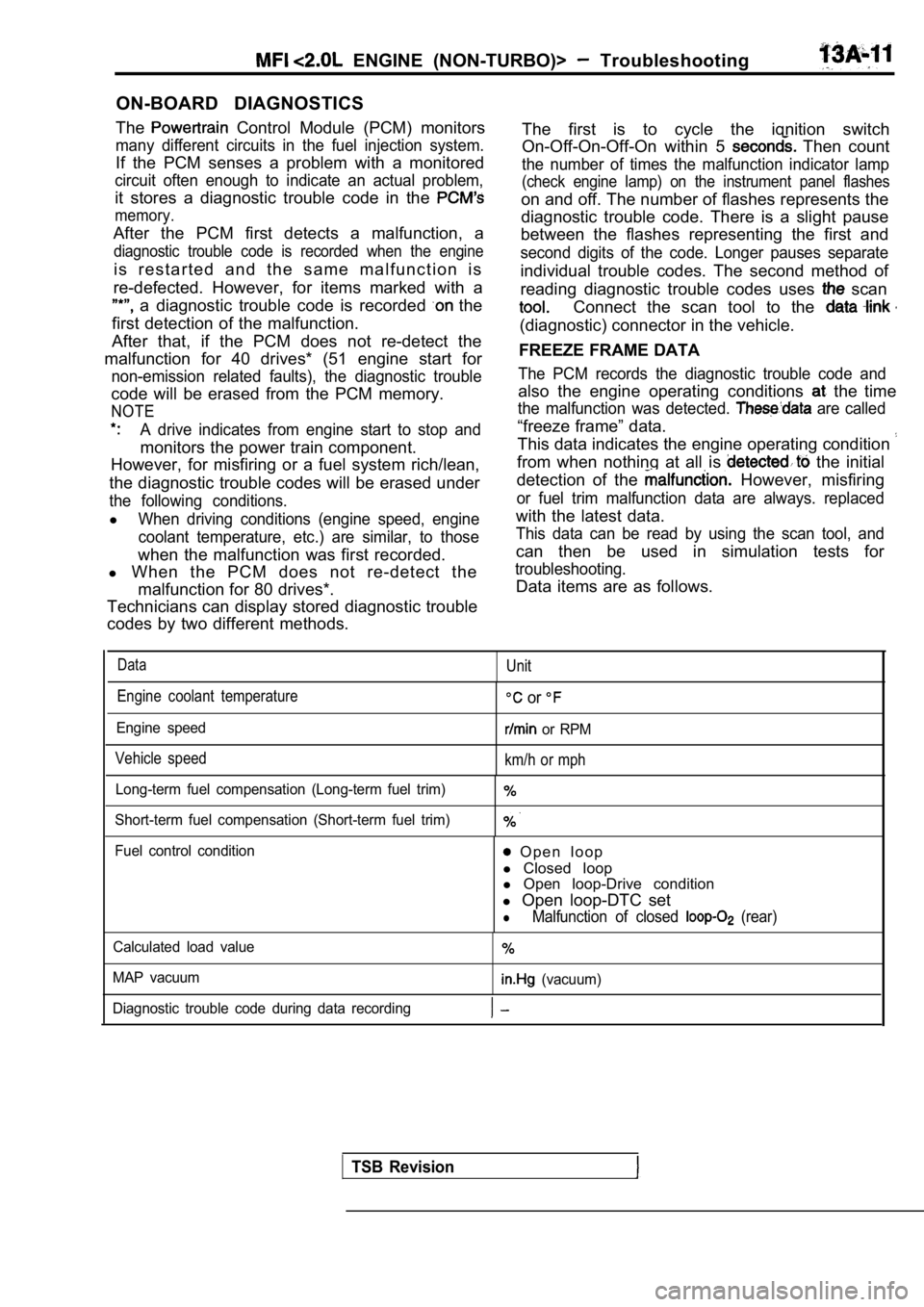
ON-BOARD DIAGNOSTICS
The
Control Module (PCM) monitors
many different circuits in the fuel injection syste m.
If the PCM senses a problem with a monitored
circuit often enough to indicate an actual problem,
it stores a diagnostic trouble code in the
memory.
After the PCM first detects a malfunction, a
diagnostic trouble code is recorded when the engine
i s r e s t a r t e d a n d t h e s a m e m a l f u n c t i o n i s
re-defected. However, for items marked with a
a diagnostic trouble code is recorded the
first detection of the malfunction.
After that, if the PCM does not re-detect the
malfunction for 40 drives* (51 engine start for
non-emission related faults), the diagnostic troubl e
code will be erased from the PCM memory.
NOTE
A drive indicates from engine start to stop and
monitors the power train component.
However, for misfiring or a fuel system rich/lean,
the diagnostic trouble codes will be erased under
the following conditions.
lWhen driving conditions (engine speed, engine
coolant temperature, etc.) are similar, to those
when the malfunction was first recorded.
l When the PCM does not re-detect the
malfunction for 80 drives*.
Technicians can display stored diagnostic trouble
codes by two different methods.
ENGINE (NON-TURBO)> Troubleshooting
The first is to cycle the ignition switch
On-Off-On-Off-On within 5
Then count
the number of times the malfunction indicator lamp
(check engine lamp) on the instrument panel flashes
on and off. The number of flashes represents the
diagnostic trouble code. There is a slight pause
between the flashes representing the first and
second digits of the code. Longer pauses separate
individual trouble codes. The second method of
reading diagnostic trouble codes uses
scan
Connect the scan tool to the
(diagnostic) connector in the vehicle.
FREEZE FRAME DATA
The PCM records the diagnostic trouble code and
also the engine operating conditions the time
the malfunction was detected. are called
“freeze frame” data.
This data indicates the engine operating condition
from when nothing at all is the initial
detection of the
However, misfiring
or fuel trim malfunction data are always. replaced
with the latest data.
This data can be read by using the scan tool, and
can then be used in simulation tests for
troubleshooting.
Data items are as follows.
DataUnit
Engine coolant temperature
Engine speed
Vehicle speed
or
or RPM
km/h or mph
Long-term fuel compensation (Long-term fuel trim)
Short-term fuel compensation (Short-term fuel trim)
Fuel control condition O p e n l o o p
l Closed loop
l Open loop-Drive condition
l Open loop-DTC set
lMalfunction of closed (rear)
Calculated load value
MAP vacuum
(vacuum)
Diagnostic trouble code during data recording
TSB Revision