engine MITSUBISHI SPYDER 1990 Service Repair Manual
[x] Cancel search | Manufacturer: MITSUBISHI, Model Year: 1990, Model line: SPYDER, Model: MITSUBISHI SPYDER 1990Pages: 2103, PDF Size: 68.98 MB
Page 1745 of 2103
![MITSUBISHI SPYDER 1990 Service Repair Manual ABS Troubleshooting
INSPECTION PROCEDURE 3
ignition key is turned to “ON’? (engine stopped),ProbableABS warning light does not illuminate
[Comment]When power is supplied to the ABS-](/img/19/57345/w960_57345-1744.png "MITSUBISHI SPYDER 1990 Service Repair Manual ABS Troubleshooting
INSPECTION PROCEDURE 3
ignition key is turned to “ON’? (engine stopped),ProbableABS warning light does not illuminate
[Comment]When power is supplied to the ABS-")
ABS Troubleshooting
INSPECTION PROCEDURE 3
ignition key is turned to “ON’? (engine stopped),ProbableABS warning light does not illuminate
[Comment]When power is supplied to the ABS-ECU, the valve relay changes from to OFF ON by the initial check, and thus even if there is a problem with the circuit betweenABS warning light and ABS-ECU, the light will illum inate once when the valve relayis OFF.Accordingly, the cause of the light not illuminating is probably an open circuit in the
light power circuit, a blown light bulb, or an open circuit in both the circuit between
the ABS
liaht and the ABS-ECU and the circuit between the ABS
l Blown fuselBurntout light. bulblMalfunction of wiring. or connector
.
light and the relay.When other lights also do not illuminate, the cause is probab ly a blown fuse.
N GNG ,
Measure at combination meter connector Checkl and l Disconnect the connector and mea-
l Disconnect the connector and mea-
sure atthe combination meter side.
l Continuitv between terminals
OK Continuity
OK
Not
Replace combination meter.
, Check the harnesses between the valve relay and the combination meter,
a n d b e t w e e n t h e A B S - E C U a n d
combination meter (common section).
Repair, if necessary.
INSPECTION PROCEDURE 4
Even after the engine is started, the ABS warning l ight Probable cause ,
remains illuminated.
[Comment]There is probably a short in the ABS light illumination l Malfunction of meter
l Malfunction of valve relay
l Malfunction of ABS-ECU
l Malfunction of wiring
NOTE
This trouble symptom is limited to cases where comm unication with the scan tool is
supply is normal) and the diagnostic trouble code is a normal diagnostic trouble code.
Disconnect the ABS-ECU connector Short circuit inside the combination meter or in the Does the ABS warning light remain illuminated? between the combination meter and the ABS-ECU.
NO
Replace the ABS-ECU.
TSB Revision
Page 1752 of 2103
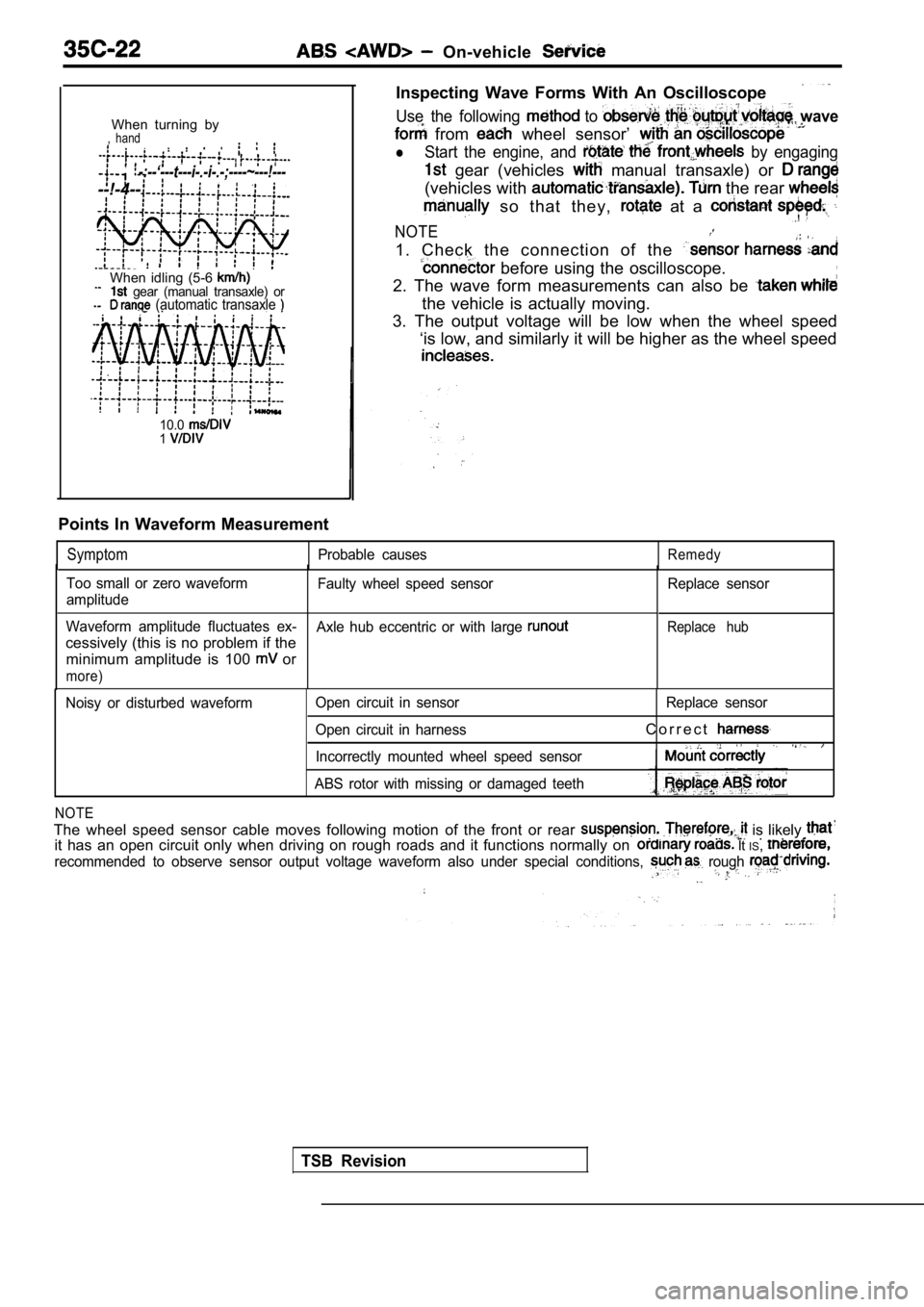
On-vehicle
When turning by, hand
-:--‘---t---i-.-i-.-;----~---!---
--!-4--
When idling (5-6 gear (manual transaxle) or (automatic transaxle
10.01
Inspecting Wave Forms With An Oscilloscope
Use the following to wave
from wheel sensor’
lStart the engine, and by engaging
gear (vehicles manual transaxle) or
(vehicles with the rear
so that they, at a
NOTE
1. Check the connection of the
before using the oscilloscope.,
2. The wave form measurements can also be
the vehicle is actually moving.
3. The output voltage will be low when the wheel sp eed
‘is low, and similarly it will be higher as the whe el speed
Points In Waveform Measurement
SymptomProbable causesRemedy
Too small or zero waveform
amplitude
Waveform amplitude fluctuates ex-
cessively (this is no problem if the minimum amplitude is 100
or
more)
Faulty wheel speed sensor
TSB Revision
Axle hub eccentric or with large
Replace sensor
Replace hub
Noisy or disturbed waveform Open circuit in sensor
Open circuit in harness Replace sensor
C o r r e c t
Incorrectly mounted wheel speed sensor
ABS rotor with missing or damaged teeth
NOTE
The wheel speed sensor cable moves following motion of the front or rear is likely . . . . . it has an open circuit only when driving on rough roads and it functions normally on It IS,
recommended to observe sensor output voltage wavefo rm also under special conditions, rough
Page 1756 of 2103
ABS On-vehicle Service
ABS-ECU
14
32
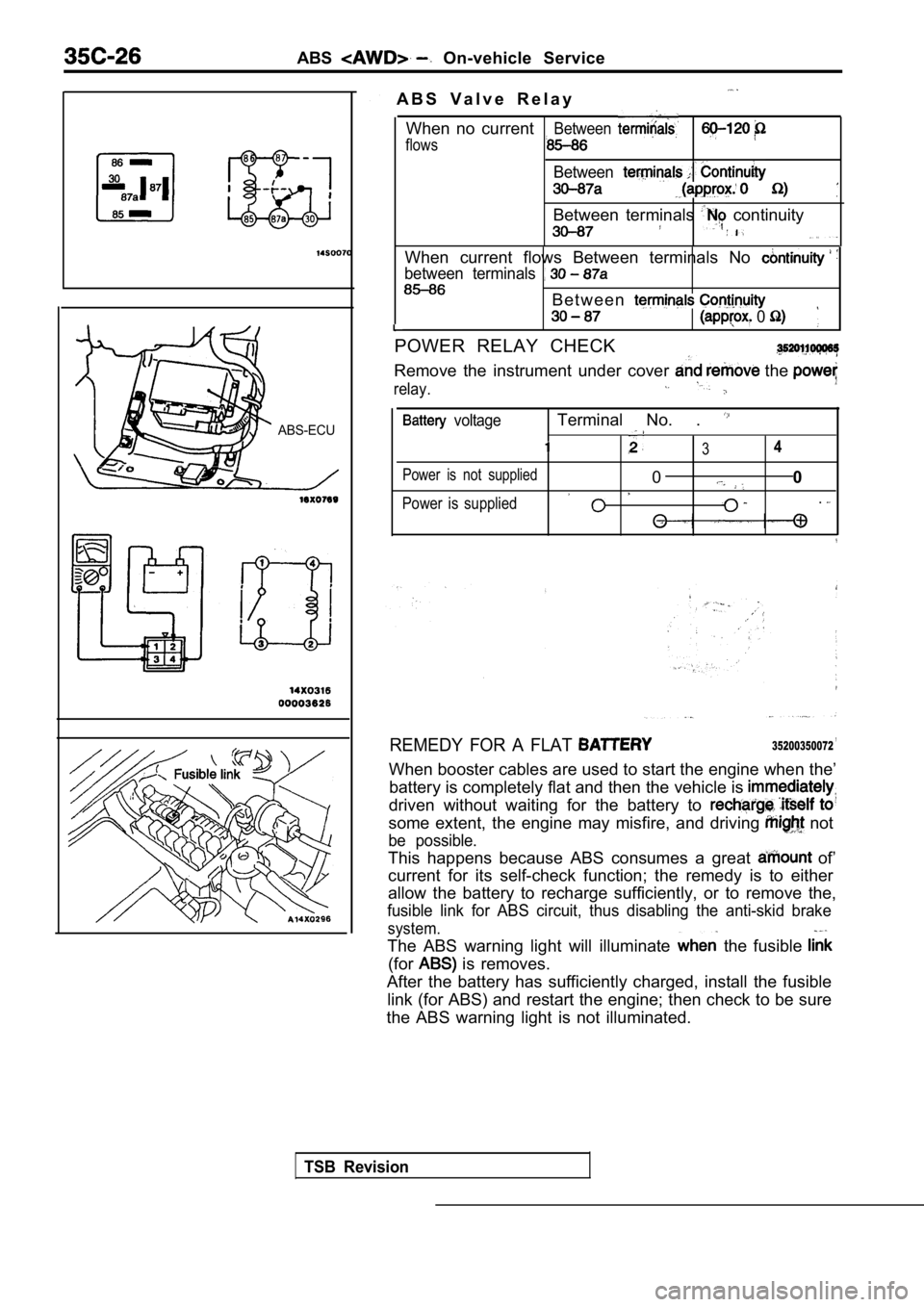
A B S V a l v e R e l a y
When no current
flows
Between
Between
Between terminals continuity
When current flows Between terminals No
between terminals
B e t w e e n
0
POWER RELAY CHECK
Remove the instrument under cover the
relay.
voltageTerminal No. .
34
Power is not supplied00
Power is supplied.
REMEDY FOR A FLAT ,35200350072
When booster cables are used to start the engine wh en the’
battery is completely flat and then the vehicle is
driven without waiting for the battery to
some extent, the engine may misfire, and driving not
be possible.
This happens because ABS consumes a great of’
current for its self-check function; the remedy is to either
allow the battery to recharge sufficiently, or to r emove the,
fusible link for ABS circuit, thus disabling the an ti-skid brake
system.
The ABS warning light will illuminate the fusible
(for is removes.
After the battery has sufficiently charged, install the fusible
link (for ABS) and restart the engine; then check t o be sure
the ABS warning light is not illuminated.
TSB Revision
Page 1766 of 2103
3 6 - 4P A R K I N G B R A K E S O n - v e h i c l e
PARKING BRAKE LEVER-
ADJUSTMENT
Pull ‘the parking brake lever with a force of appro
x.
(45 and count the number of notches.
Standard value:
3-5 notches
< V e h i c l e s w i t h
notches
The 196 (45 force of the brake
must be strictly observed.
2.If the parking stroke the standard
adjust as described below.
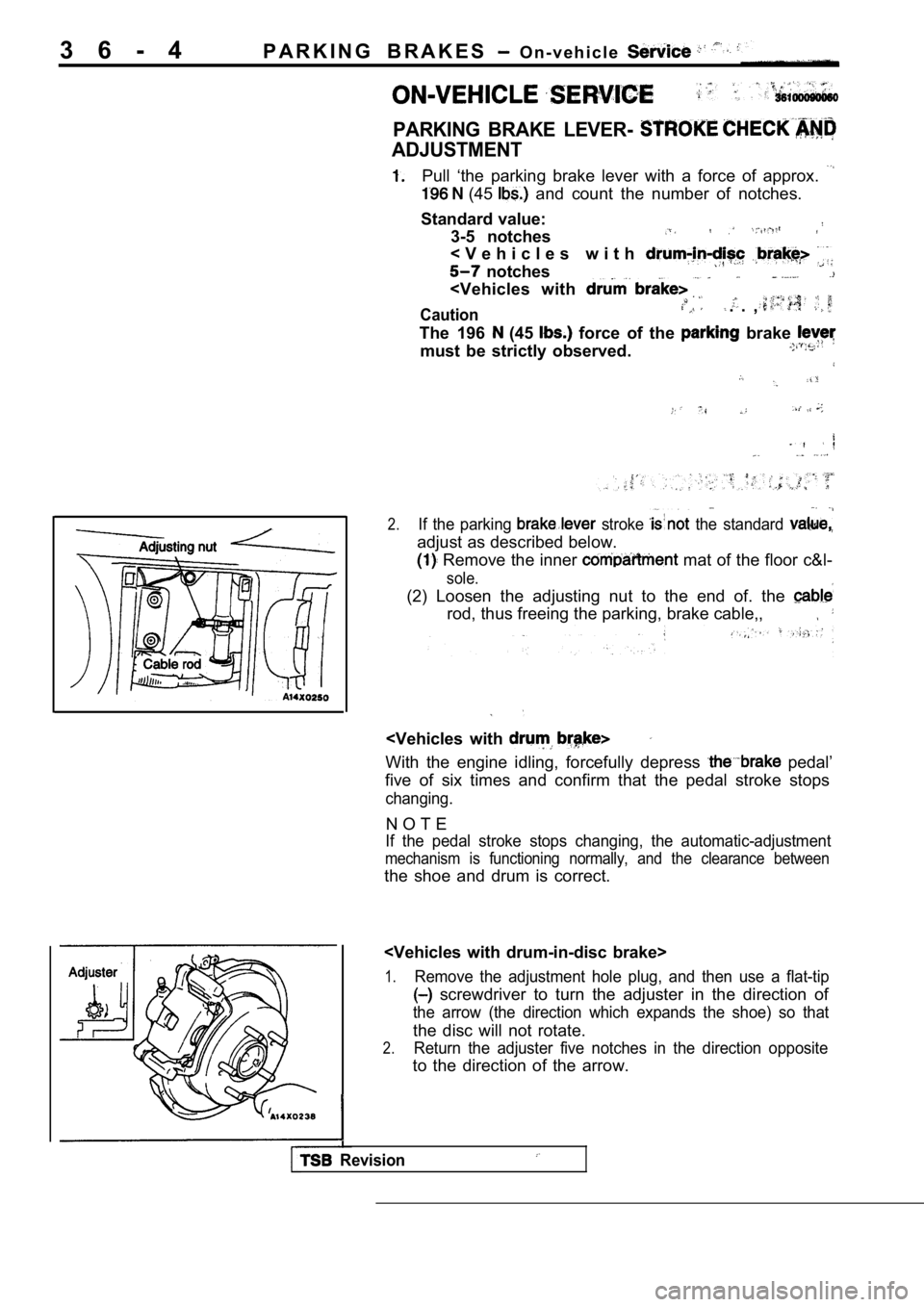
Remove the inner mat of the floor c&l-
sole.
(2) Loosen the adjusting nut to the end of. the
rod, thus freeing the parking, brake cable,,
five of six times and confirm that the pedal stroke stops
changing.
N O T E
If the pedal stroke stops changing, the automatic-a djustment
mechanism is functioning normally, and the clearanc e between
the shoe and drum is correct.
1.Remove the adjustment hole plug, and then use a fla t-tip
screwdriver to turn the adjuster in the direction of
the arrow (the direction which expands the shoe) so that
the disc will not rotate.
2.Return the adjuster five notches in the direction opposite
to the direction of the arrow.
Revision
Page 1775 of 2103
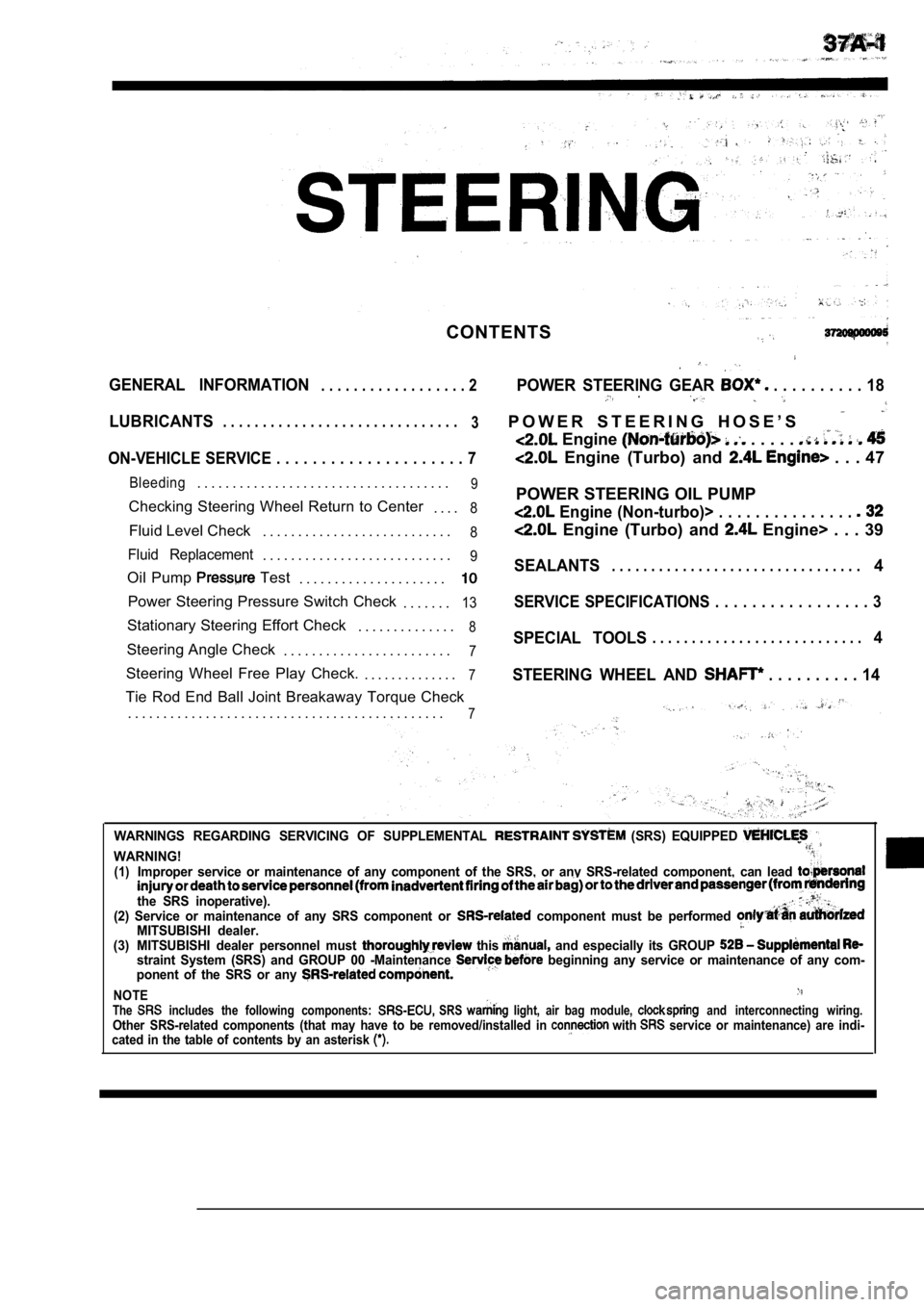
CONTENTS
GENERAL INFORMATION. . . . . . . . . . . . . . . . . . 2POWER STEERING GEAR . . . . . . . . . . 18
LUBRICANTS. . . . . . . . . . . . . . . . . . . . . . . . . . . . . .
3P O W E R S T E E R I N G H O S E ’ S
Engine . . . . .
ON-VEHICLE SERVICE . . . . . . . . . . . . . . . . . . . . . 7 Engine (Turbo) and . . . 47
Bleeding. . . . . . . . . . . . . . . . . . . . . . . . . . . . . . . . . . . .9
Checking Steering Wheel Return to Center
. . . .8
Fluid Level Check. . . . . . . . . . . . . . . . . . . . . . . . . . .8
Fluid Replacement. . . . . . . . . . . . . . . . . . . . . . . . . . .9
Oil Pump Test
. . . . . . . . . . . . . . . . . . . . .
Power Steering Pressure Switch Check
. . . . . . .13
Stationary Steering Effort Check. . . . . . . . . . . . . .8
Steering Angle Check. . . . . . . . . . . . . . . . . . . . . . . .7
Steering Wheel Free Play Check. . . . . . . . . . . . . . .7
Tie Rod End Ball Joint Breakaway Torque Check
. . . . . . . . . . . . . . . . . . . . . . . . . . . . . . . . . . . . . . . . . . . . .
7
POWER STEERING OIL PUMP
Engine (Non-turbo)> . . . . . . . . . . . . . . .
Engine (Turbo) and Engine> . . . 39
SEALANTS. . . . . . . . . . . . . . . . . . . . . . . . . . . . . . . .4
SERVICE SPECIFICATIONS . . . . . . . . . . . . . . . . . 3
SPECIAL TOOLS. . . . . . . . . . . . . . . . . . . . . . . . . . .4
STEERING WHEEL AND
. . . . . . . . . . 14
WARNINGS REGARDING SERVICING OF SUPPLEMENTAL (SRS) EQUIPPED
WARNING!(1)Improper service or maintenance of any component of the SRS, or any SRS-related component, can lead
the SRS inoperative).(2) Service or maintenance of any SRS component or component must be performed MITSUBISHI dealer.(3) MITSUBISHI dealer personnel must this and especially its GROUP straint System (SRS) and GROUP 00 -Maintenance beginning any service or maintenance of any com-
ponent of the SRS or any
NOTEThe includes the following components: SRS light, air bag module, and interconnecting wiring.Other SRS-related components (that may have to be r emoved/installed in with service or maintenance) are indi-
cated in the table of contents by an asterisk
Page 1776 of 2103
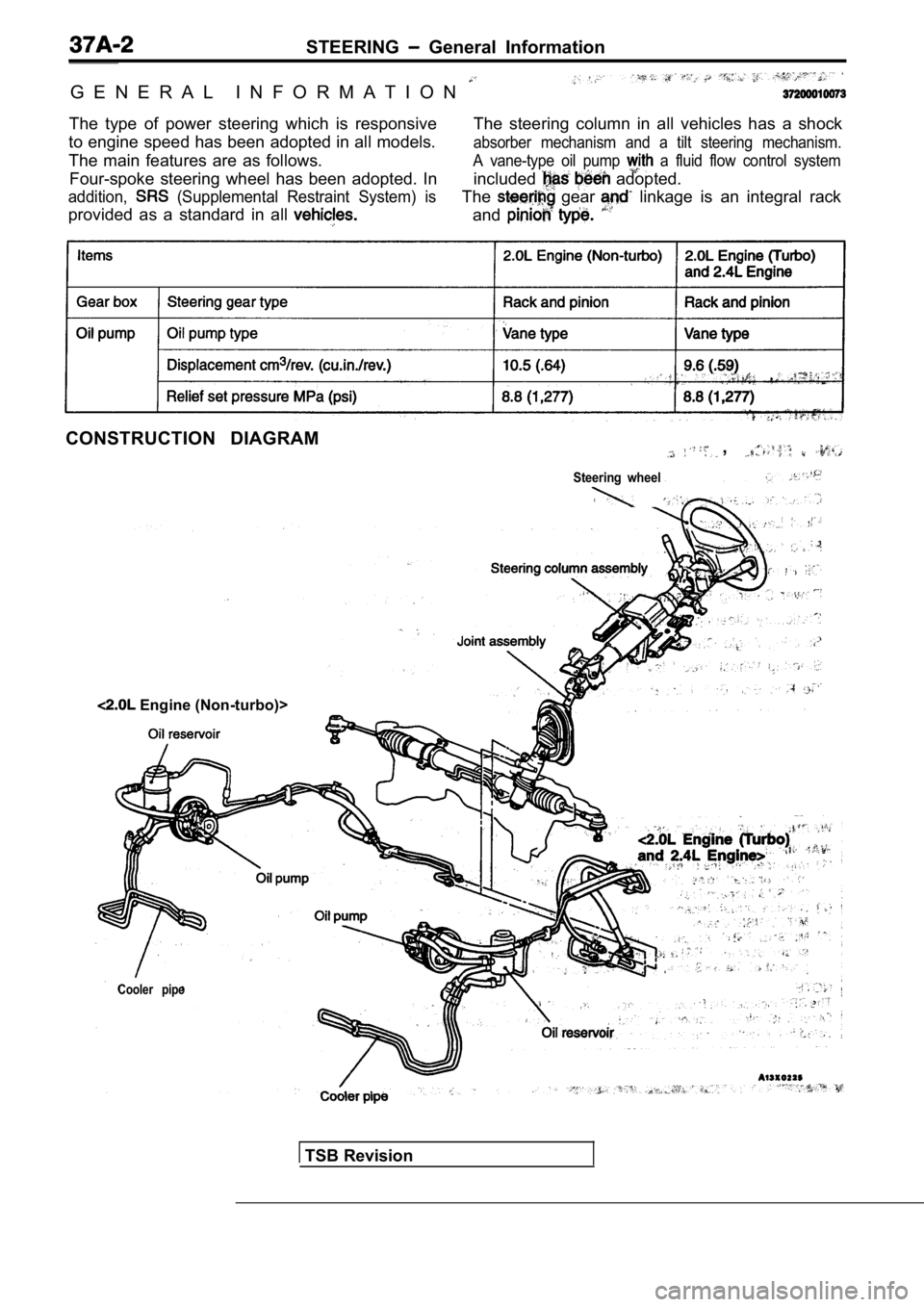
STEERING General Information
G E N E R A L I N F O R M A T I O N
The type of power steering which is responsive
to engine speed has been adopted in all models.
The main features are as follows. The steering column in all vehicles has a shock
absorber mechanism and a tilt steering mechanism.
Four-spoke steering wheel has been adopted. In
A vane-type oil pump a fluid flow control system
addition, (Supplemental Restraint System) is
included adopted.
provided as a standard in all
The gear linkage is an integral rack
and
CONSTRUCTION DIAGRAM,
Steering wheel
Cooler pipe
Engine (Non-turbo)>
TSB Revision
Page 1777 of 2103
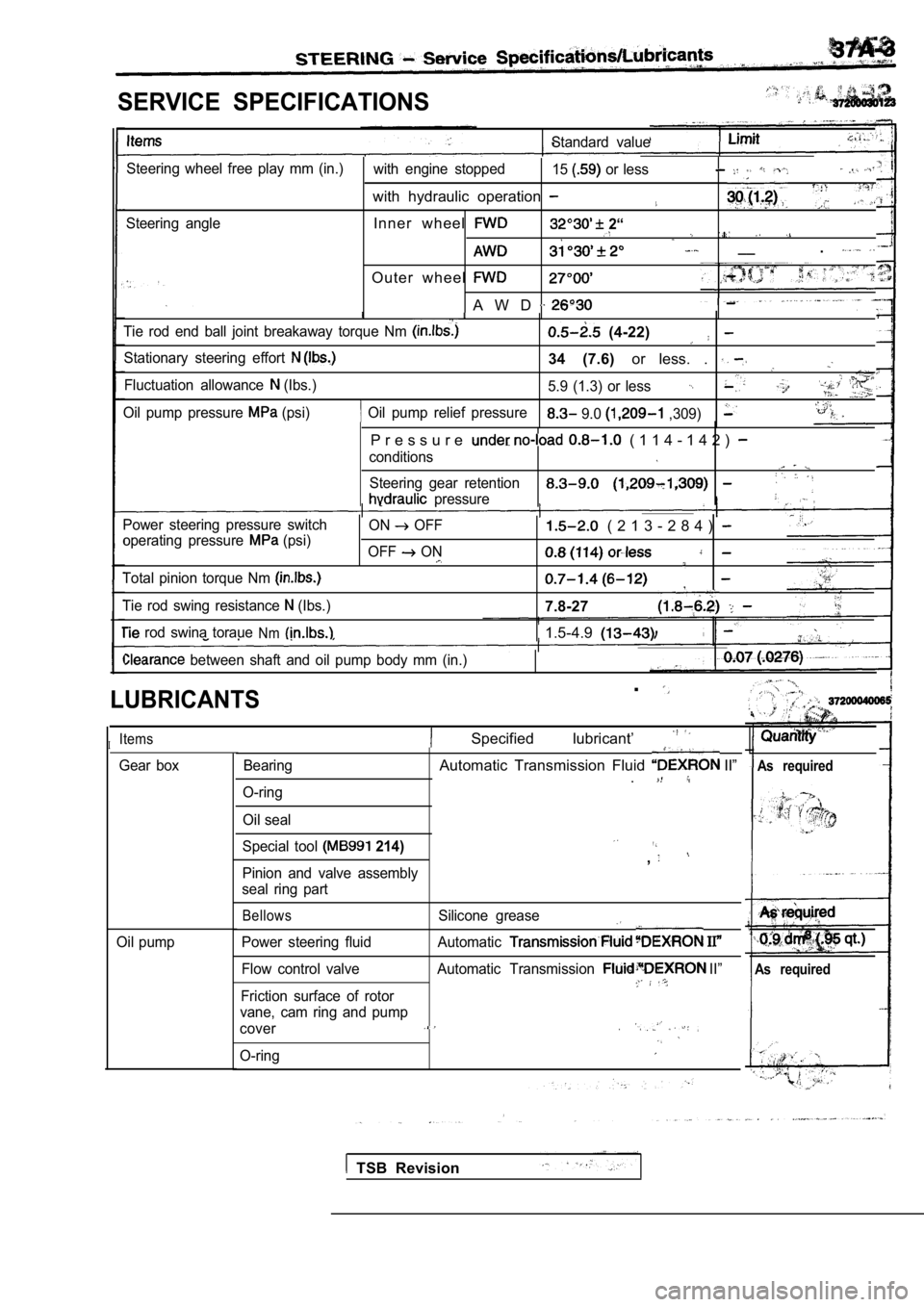
SERVICE SPECIFICATIONS
Standard value
Steering wheel free play mm (in.) with engine stopped15
or less,
with hydraulic operation
Steering angleInner wheel 2“
__
.
O u t e r w h e e l
A W D
Tie rod end ball joint breakaway torque Nm (4-22)
Stationary steering effort 34 (7.6) or less. .
Fluctuation allowance (Ibs.)
5.9 (1.3) or less
Oil pump relief pressureOil pump pressure (psi) 9.0 ,309)
P r e s s u r e ( 1 1 4 - 1 4 2 )
conditions
Steering gear retention
pressure
Power steering pressure switch
operating pressure
(psi)
Total pinion torque Nm
Tie rod swing resistance (Ibs.) ON
OFF
OFF
ON
( 2 1 3 - 2 8 4 )
7.8-27
rod swina toraueNm1.5-4.9
between shaft and oil pump body mm (in.)
LUBRICANTS
IItems
Bearing
O-ring
Oil seal
.
Specified lubricant’
Gear boxAutomatic Transmission Fluid II”
.As required
Oil pump Special tool
214)
Pinion and valve assembly
seal ring part
,
BellowsSilicone grease
Power steering fluid Automatic
Flow control valve Automatic Transmission II”
Friction surface of rotor
vane, cam ring and pump
cover.
O-ring
As required
TSB Revision
Page 1778 of 2103
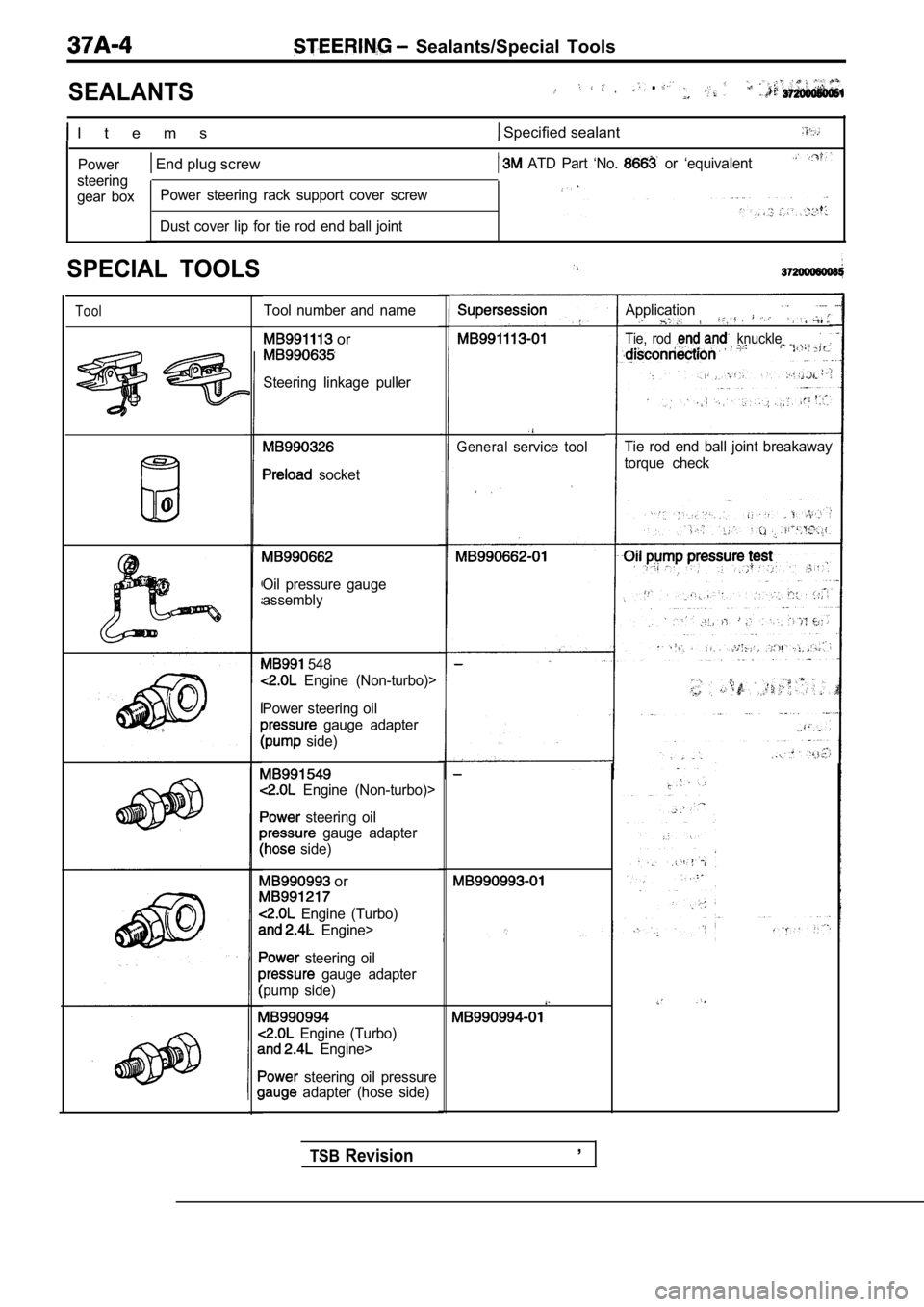
SEALANTS
Sealants/Special Tools
.
I t e m s Specified sealant
Power
steering
gear box End plug screw ATD Part ‘No. or ‘equivalent
Power steering rack support cover screw
Dust cover lip for tie rod end ball joint
SPECIAL TOOLS
Tool
0
Tool number and name
or
Steering linkage puller
socket
Oil pressure gauge
assembly
548
Engine (Non-turbo)>
Power steering oil
gauge adapter
side)
Engine (Non-turbo)>
steering oil
gauge adapter
side)
or
Engine (Turbo)
Engine>
steering oil
gauge adapter
pump side)
Engine (Turbo)
Engine>
steering oil pressure adapter (hose side)
Generalservice tool
TSBRevision,
Application
Tie, rod knuckle
Tie rod end ball joint breakaway
torque check
Page 1781 of 2103
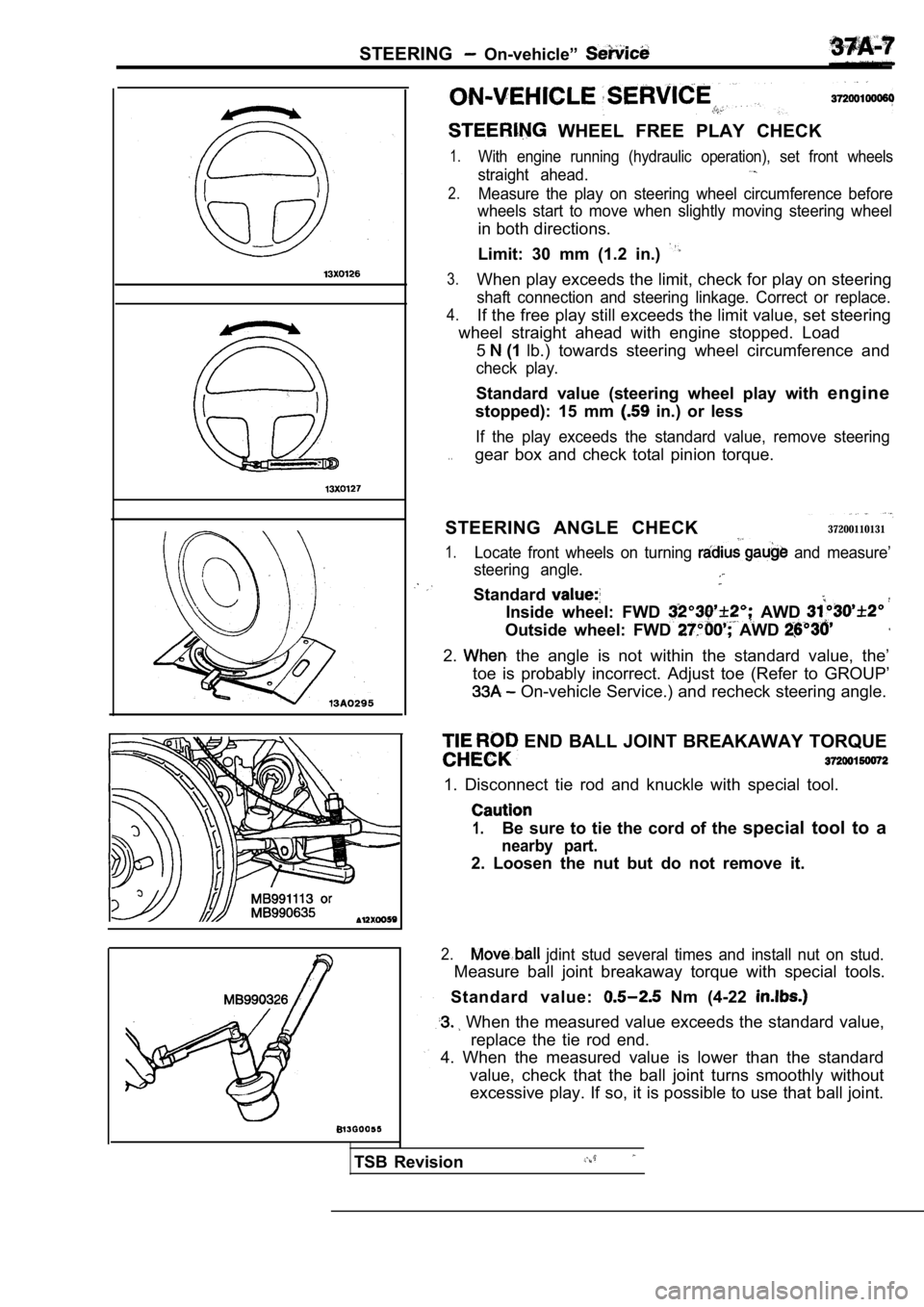
STEERING On-vehicle”
TSB Revision
WHEEL FREE PLAY CHECK
1.With engine running (hydraulic operation), set front wheels
straight ahead.
2.Measure the play on steering wheel circumference be fore
wheels start to move when slightly moving steering wheel
in both directions.
Limit: 30 mm (1.2 in.)
3.When play exceeds the limit, check for play on steering
shaft connection and steering linkage. Correct or replace.
4.If the free play still exceeds the limit value, set steering
wheel straight ahead with engine stopped. Load
5
(1 lb.) towards steering wheel circumference and
check play.
Standard value (steering wheel play with engine
stopped): 15 mm
in.) or less
If the play exceeds the standard value, remove stee ring
. .gear box and check total pinion torque.
STEERING ANGLE CHECK
37200110131
1.Locate front wheels on turning and measure’
steering angle.
Standard
Inside wheel: FWD AWD
Outside wheel: FWD AWD
2. the angle is not within the standard value, the’
toe is probably incorrect. Adjust toe (Refer to GRO UP’
On-vehicle Service.) and recheck steering angle.
END BALL JOINT BREAKAWAY TORQUE
1. Disconnect tie rod and knuckle with special tool .
1.Be sure to tie the cord of the special tool to a
nearby part.
2. Loosen the nut but do not remove it.
2. jdint stud several times and install nut on stud.
Measure ball joint breakaway torque with special to ols.
Standard value:
Nm (4-22
When the measured value exceeds the standard value ,
replace the tie rod end.
4. When the measured value is lower than the standa rd
value, check that the ball joint turns smoothly wit hout
excessive play. If so, it is possible to use that b all joint.
Page 1782 of 2103
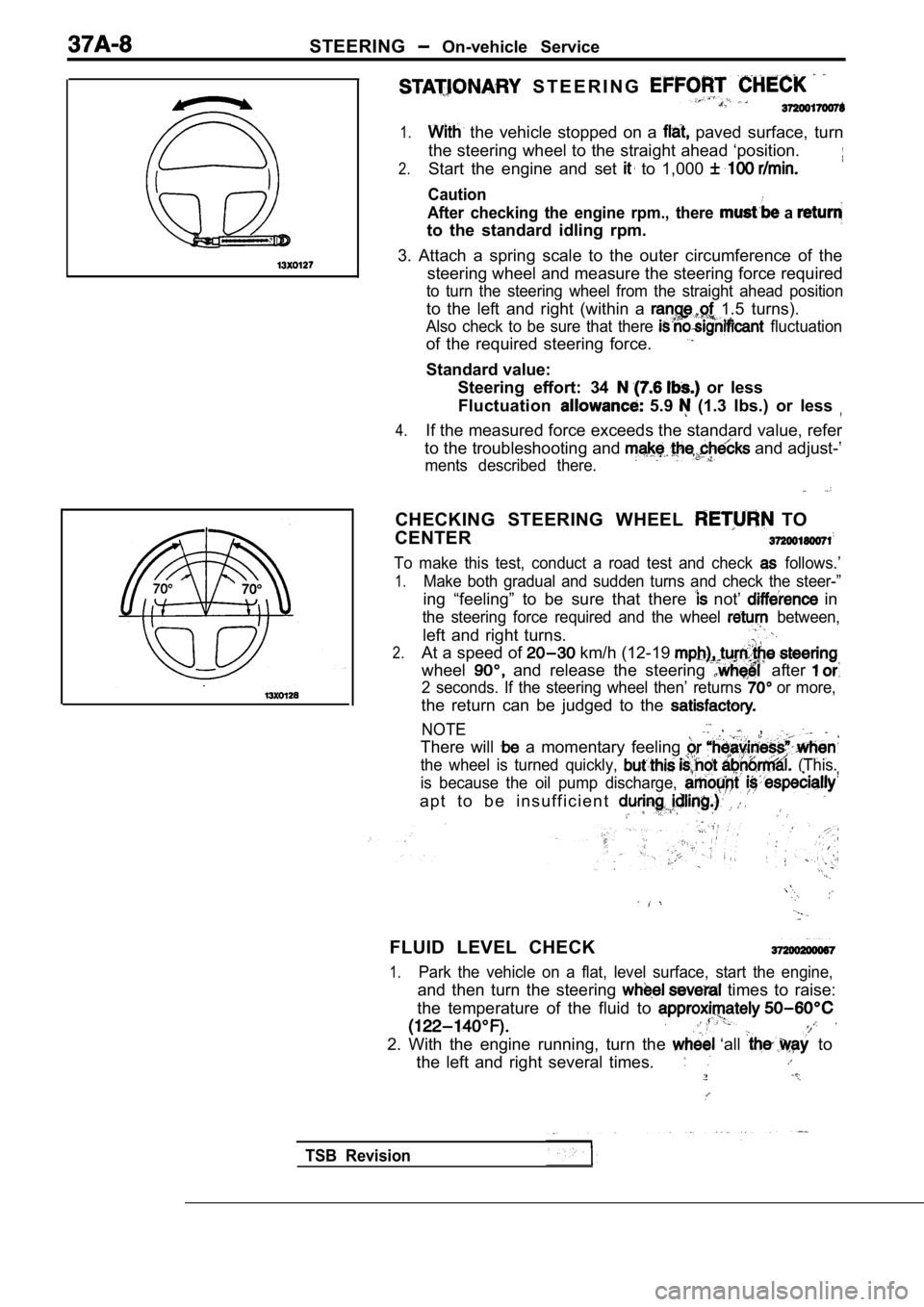
STEERING On-vehicle Service
S T E E R I N G
1. the vehicle stopped on a paved surface, turn
the steering wheel to the straight ahead ‘position.
2.Start the engine and set to 1,000
Caution
After checking the engine rpm., there
a
to the standard idling rpm.
3. Attach a spring scale to the outer circumference of the
steering wheel and measure the steering force requi red
to turn the steering wheel from the straight ahead position
to the left and right (within a 1.5 turns).
Also check to be sure that there fluctuation
of the required steering force.
Standard value:
Steering effort: 34
or less
Fluctuation
5.9 (1.3 Ibs.) or less
4.If the measured force exceeds the standard value, r efer
to the troubleshooting and
and adjust-’
ments described there.
CHECKING STEERING WHEEL TO
CENTER
To make this test, conduct a road test and check follows.’
1.Make both gradual and sudden turns and check the st eer-”
ing “feeling” to be sure that there not’ in
the steering force required and the wheel between,
left and right turns.
2.At a speed of km/h (12-19
wheel and release the steering after
2 seconds. If the steering wheel then’ returns or more,
the return can be judged to the
NOTE ,
There will a momentary feeling
the wheel is turned quickly, (This.
is because the oil pump discharge,
a p t t o b e i n s u f f i c i e n t
FLUID LEVEL CHECK
1.Park the vehicle on a flat, level surface, start th e engine,
and then turn the steering times to raise:
the temperature of the fluid to
2. With the engine running, turn the ‘all to
the left and right several times.
TSB Revision