engine MITSUBISHI SPYDER 1990 Service Repair Manual
[x] Cancel search | Manufacturer: MITSUBISHI, Model Year: 1990, Model line: SPYDER, Model: MITSUBISHI SPYDER 1990Pages: 2103, PDF Size: 68.98 MB
Page 1822 of 2103
STEERING Power Steering Hoses Engine (Turbo) and Engine>
REMOVAL SERVICE
BRAKE FLUID RESERVOIR ASSEMBLY
REMOVAL
Disconnect the brake fluid level sensor connector and
the brake fluid reservoir assembly from the dash panel with
the hose still attached.
NOTE
Place the removed reservoir assembly in a place whe re it
will not be a hindrance when removing and installin g the
power steering gear box, and tie it with a cord.
CLUTCH FLUID RESERVOIR ASSEMBLY
REMOVAL
Remove the clutch fluid reservoir assembly from the dash
panel with the hose still attached.
NOTE
Place the removed reservoir assembly in a place whe re it
will not be a hindrance when removing and installin g the
power steering hoses, and tie it with a cord.
A/C COMPRESSOR REMOVAL
Disconnect the A/C compressor connector remove the
compressor from the compressor bracket with the hos e still
attached.
NOTE
Place the removed in a where it will not be a hindrance when
removing and installing the power steering hoses an d tie
it with a cord.
Caution
Do not damage the joint between the A/C hose and the
A/C pipe.
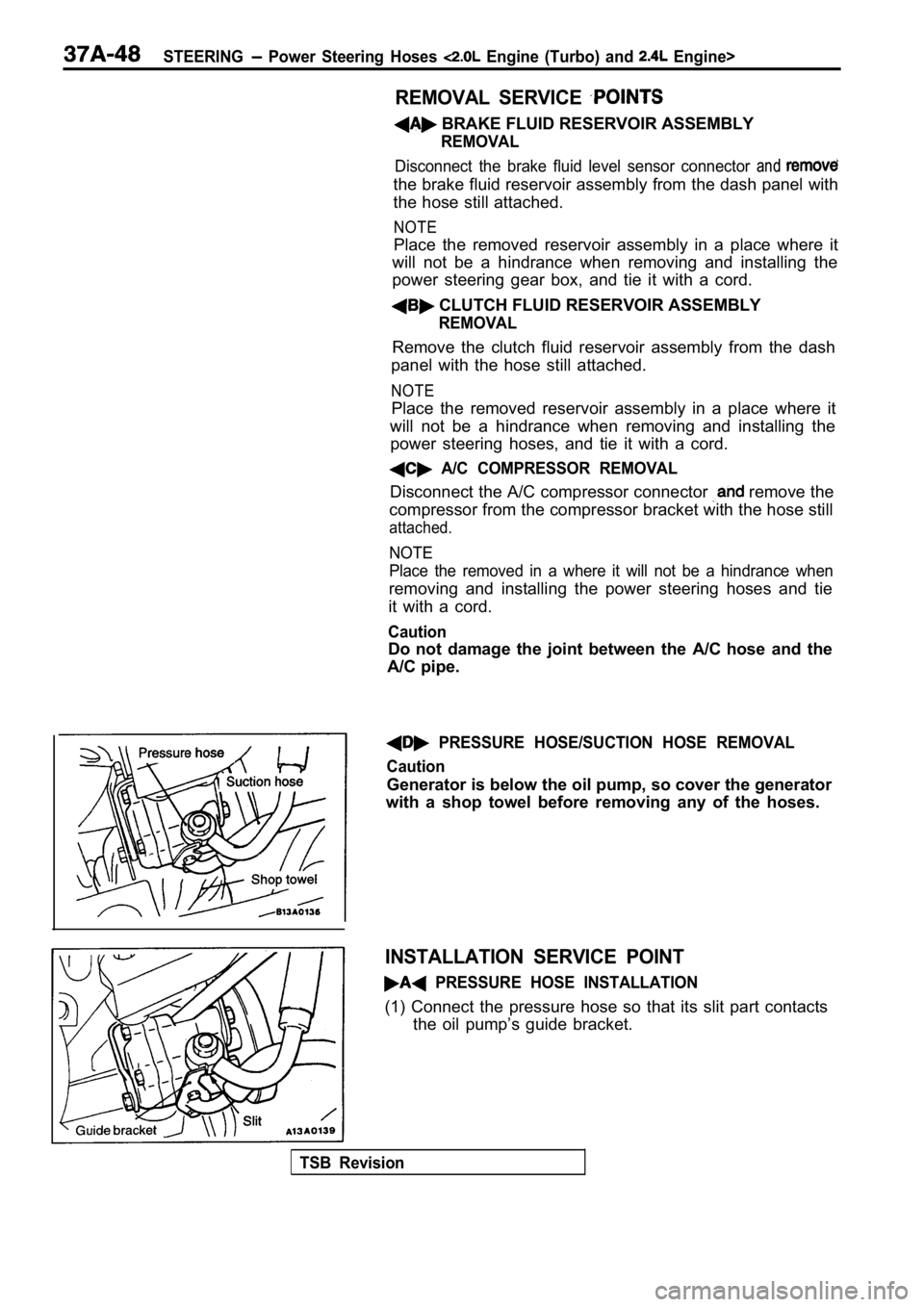
PRESSURE HOSE/SUCTION HOSE REMOVAL
Caution
Generator is below the oil pump, so cover the gener ator
with a shop towel before removing any of the hoses.
INSTALLATION SERVICE POINT
PRESSURE HOSE INSTALLATION
(1) Connect the pressure hose so that its slit part contacts
the oil pump’s guide bracket.
TSB Revision
Page 1823 of 2103
STEERINGPower Steering Hoses Engine (Turbo) and ,
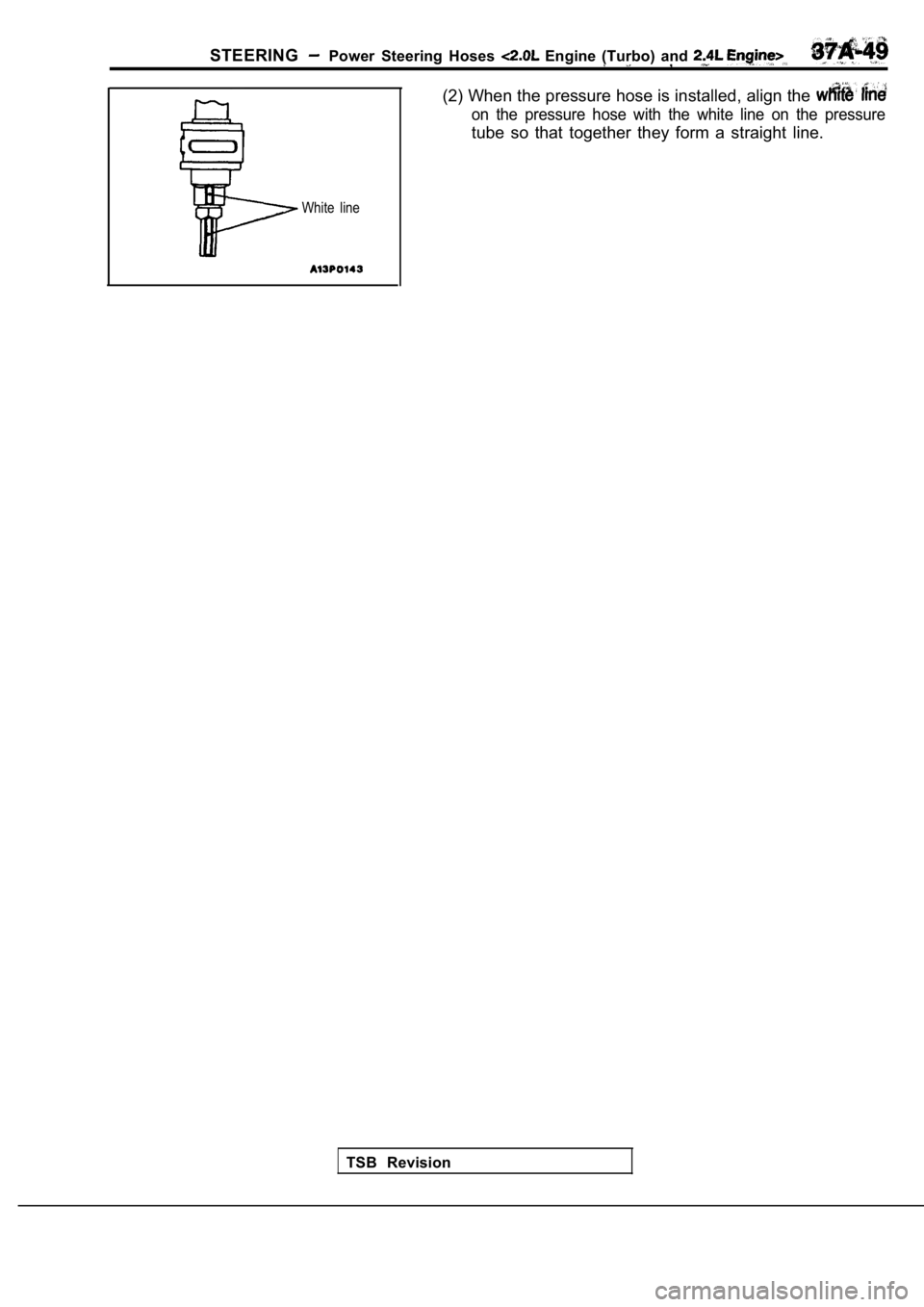
White line
(2) When the pressure hose is installed, align the
on the pressure hose with the white line on the pressure
tube so that together they form a straight line.
TSB Revision
Page 1986 of 2103
INTERIOR Front Seat Belt
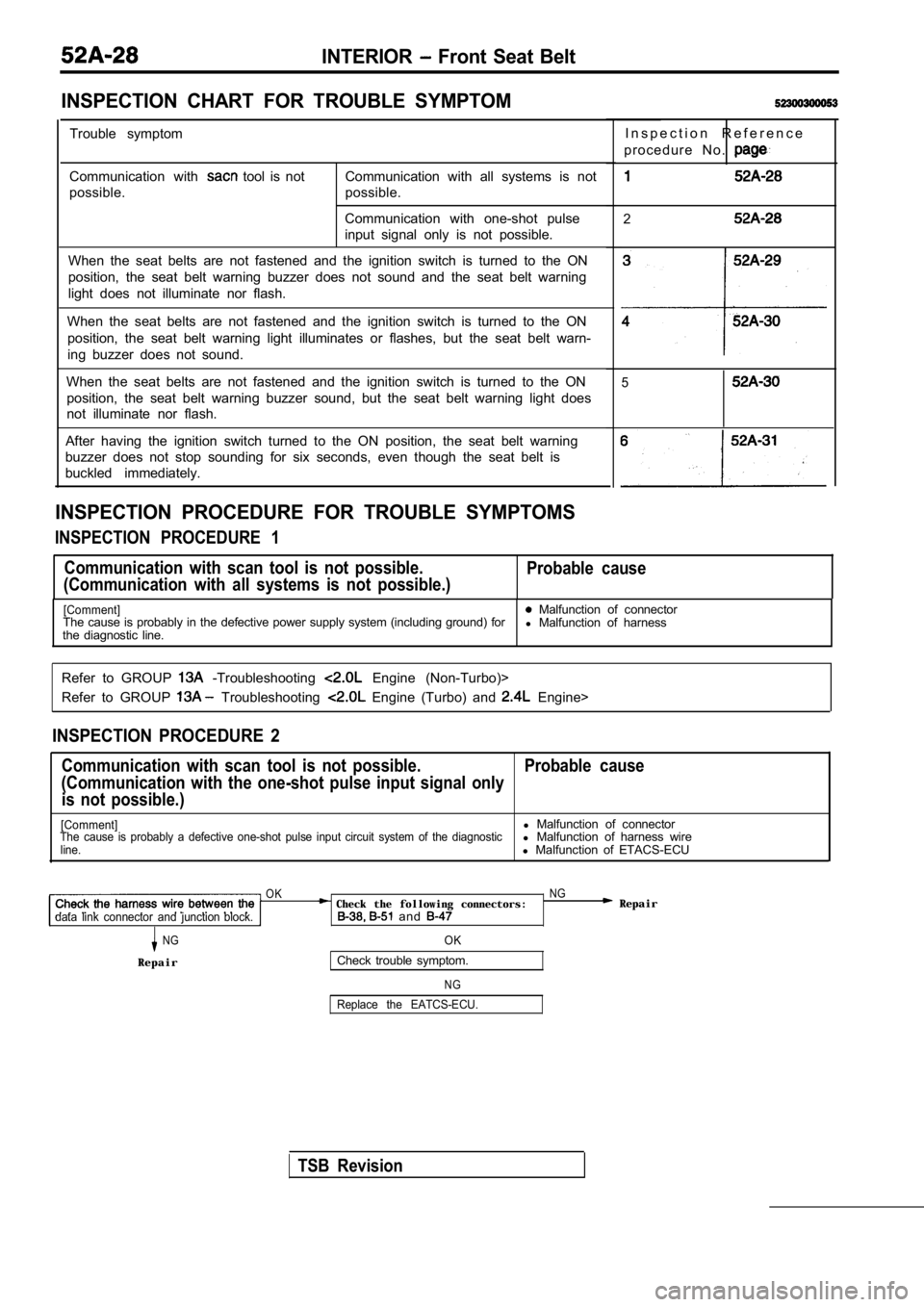
INSPECTION CHART FOR TROUBLE SYMPTOM
Trouble symptom
Communication with
tool is not
possible. Communication with all systems is not
possible.
Communication with one-shot pulse
input signal only is not possible.
When the seat belts are not fastened and the igniti on switch is turned to the ON
position, the seat belt warning buzzer does not sou nd and the seat belt warning
light does not illuminate nor flash.
When the seat belts are not fastened and the igniti on switch is turned to the ON
position, the seat belt warning light illuminates o r flashes, but the seat belt warn-
ing buzzer does not sound.
When the seat belts are not fastened and the igniti on switch is turned to the ON
position, the seat belt warning buzzer sound, but t he seat belt warning light does
not illuminate nor flash.
After having the ignition switch turned to the ON p osition, the seat belt warning
buzzer does not stop sounding for six seconds, even though the seat belt is
buckled immediately.
INSPECTION PROCEDURE FOR TROUBLE SYMPTOMS
INSPECTION PROCEDURE 1
I n s p e c t i o n R e f e r e n c e
p r o c e d u r e N o .
2
3
4
5
Communication with scan tool is not possible.
(Communication with all systems is not possible.) Probable cause
[Comment] Malfunction of connector
The cause is probably in the defective power supply system (including ground) for
l Malfunction of harness
the diagnostic line.
Refer to GROUP
-Troubleshooting Engine (Non-Turbo)>
Refer to GROUP
Troubleshooting Engine (Turbo) and Engine>
INSPECTION PROCEDURE 2
Communication with scan tool is not possible. Probab le cause
(Communication with the one-shot pulse input signal only
is not possible.)
[Comment]l Malfunction of connectorThe cause is probably a defective one-shot pulse in put circuit system of the diagnosticl Malfunction of harness wireline.l Malfunction of ETACS-ECU
OK NG Check the following connectors: Repairdata link connector and junction block. and
NGOK
RepairCheck trouble symptom.
N G
Replace the EATCS-ECU.
TSB Revision
Page 2001 of 2103
SRS General- Jnformation
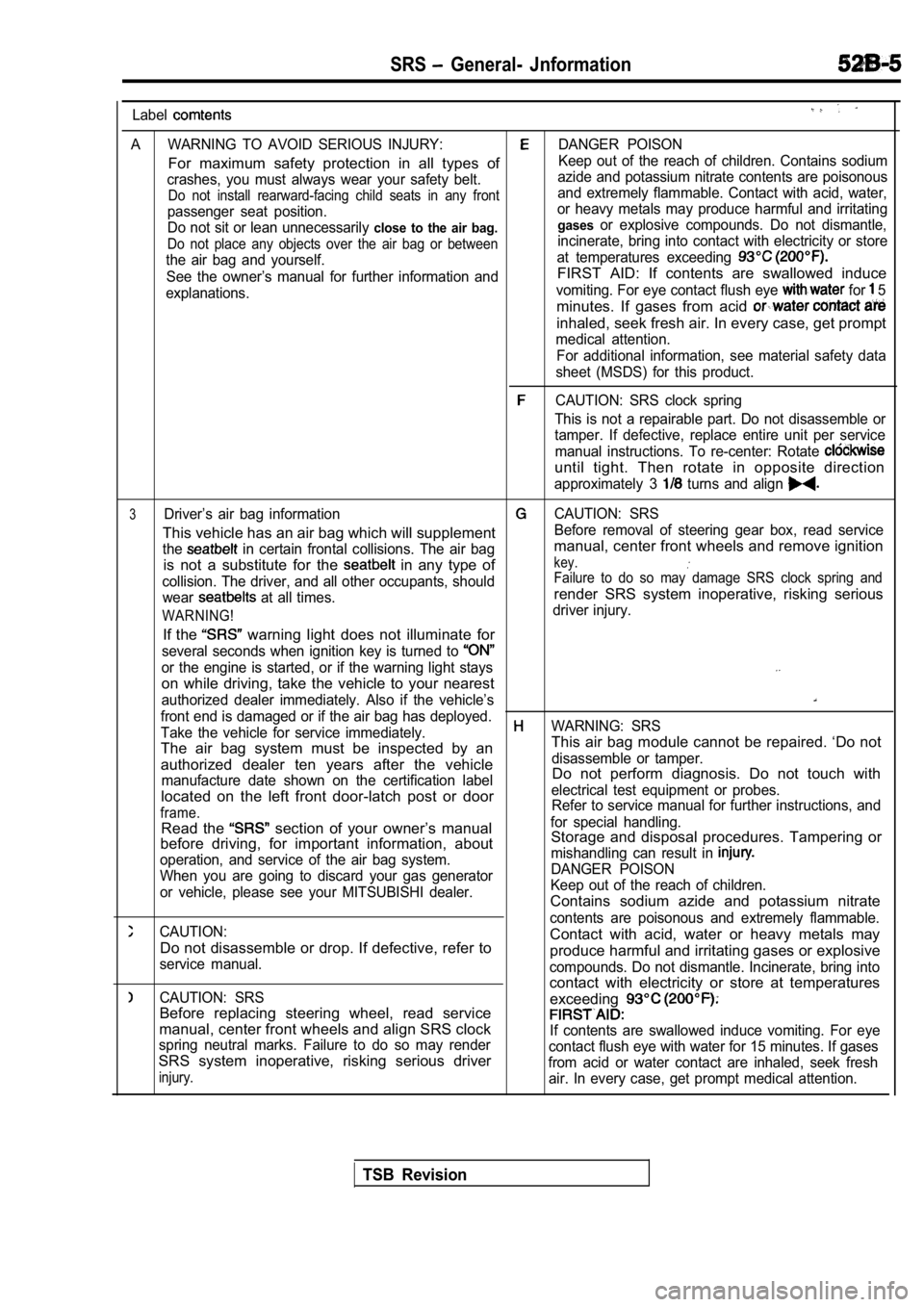
Label
A WARNING TO AVOID SERIOUS INJURY:DANGER POISON
For maximum safety protection in all types ofKeep out of the reach of children. Contains sodium
crashes, you must always wear your safety belt. azide and potassium nitrate contents are poisonous
Do not install rearward-facing child seats in any f
rontand extremely flammable. Contact with acid, water,
passenger seat position. or heavy metals may produce harmful and irritating
Do not sit or lean unnecessarily
close to the air bag. gasesor explosive compounds. Do not dismantle,
Do not place any objects over the air bag or betwee
nincinerate, bring into contact with electricity or store
the air bag and yourself. at temperatures exceeding
See the owner’s manual for further information andFIRST AID: If contents are swallowed induce
explanations.vomiting. For eye contact flush eye for 5
minutes. If gases from acid
inhaled, seek fresh air. In every case, get prompt
medical attention.
For additional information, see material safety dat a
sheet (MSDS) for this product.
CAUTION: SRS clock spring
This is not a repairable part. Do not disassemble o r
tamper. If defective, replace entire unit per servi ce
manual instructions. To re-center: Rotate
until tight. Then rotate in opposite direction
approximately 3 turns and align
3Driver’s air bag informationCAUTION: SRS
This vehicle has an air bag which will supplementBefore removal of steering gear box, read service
the
in certain frontal collisions. The air bagmanual, center front wheels and remove ignition
is not a substitute for the
in any type ofkey.
collision. The driver, and all other occupants, sho uldFailure to do so may damage SRS clock spring and
wear at all times.render SRS system inoperative, risking serious
WARNING!driver injury.
If the warning light does not illuminate for
several seconds when ignition key is turned to
or the engine is started, or if the warning light stays
on while driving, take the vehicle to your nearest
authorized dealer immediately. Also if the vehicle’ s
front end is damaged or if the air bag has deployed .
Take the vehicle for service immediately.WARNING: SRS
The air bag system must be inspected by an This air bag module cannot be repaired. ‘Do not
authorized dealer ten years after the vehicledisassemble or tamper.
manufacture date shown on the certification labelDo not perform diagnosis. Do not touch with
located on the left front door-latch post or door
electrical test equipment or probes.
frame.Refer to service manual for further instructions, a nd
Read the section of your owner’s manualfor special handling.
before driving, for important information, about Storage and disposal procedures. Tampering or
operation, and service of the air bag system. mishandling can result in
When you are going to discard your gas generatorDANGER POISON
or vehicle, please see your MITSUBISHI dealer. Keep out of the reach of children.
Contains sodium azide and potassium nitrate
CAUTION:contents are poisonous and extremely flammable.
Do not disassemble or drop. If defective, refer toContact with acid, water or heavy metals may
service manual.produce harmful and irritating gases or explosive
compounds. Do not dismantle. Incinerate, bring into
CAUTION: SRScontact with electricity or store at temperatures
exceeding
Before replacing steering wheel, read service
manual, center front wheels and align SRS clockIf contents are swallowed induce vomiting. For eye
spring neutral marks. Failure to do so may render contact flush eye with water for 15 minutes. If gases
SRS system inoperative, risking serious driverfrom acid or water contact are inhaled, seek freshinjury.air. In every case, get prompt medical attention.
TSB Revision
Page 2023 of 2103
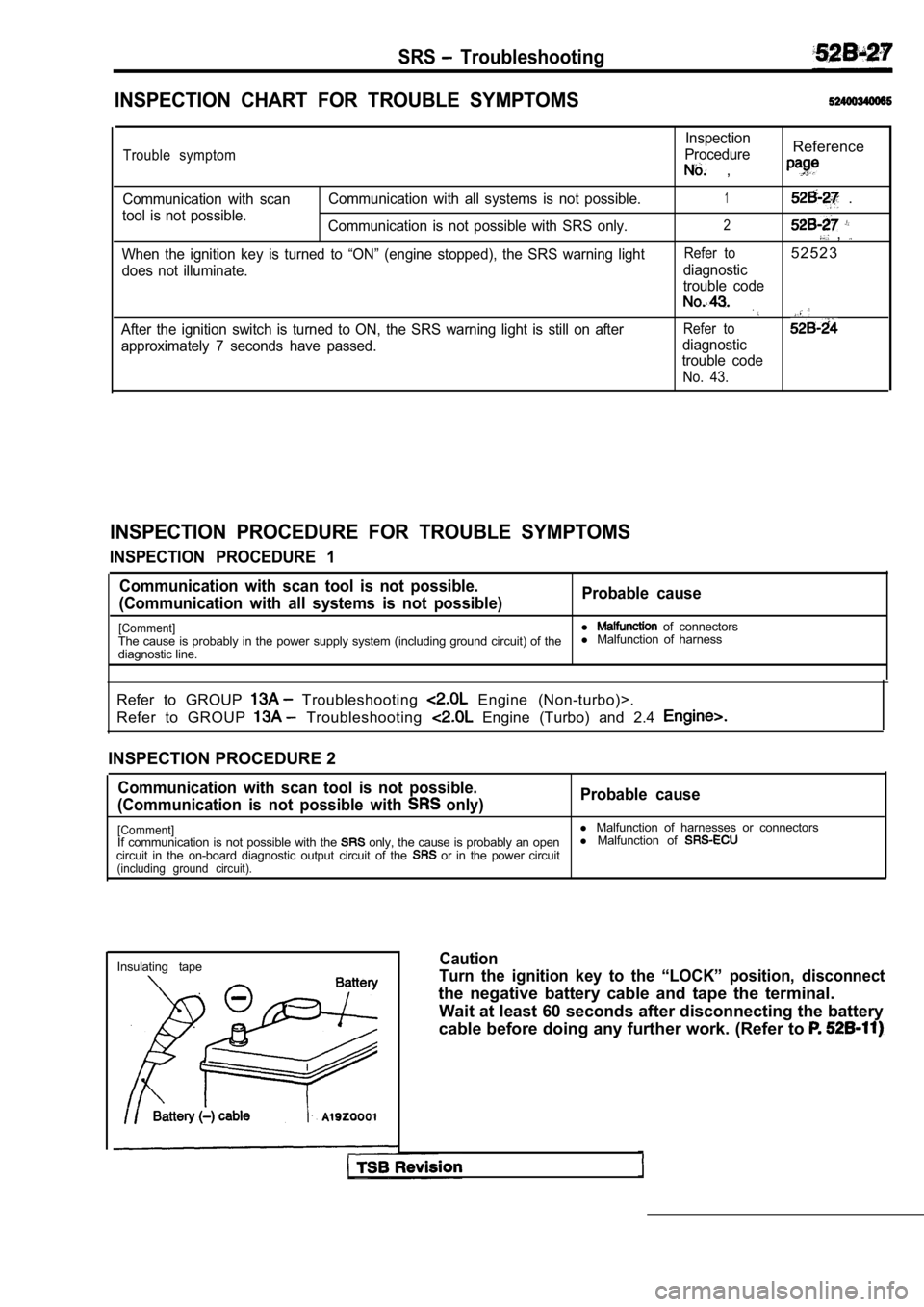
SRS Troubleshooting
INSPECTION CHART FOR TROUBLE SYMPTOMS
Trouble symptom
Communication with scanCommunication with all systems is not possible.
tool is not possible. Communication is not possible with SRS only.
When the ignition key is turned to “ON” (engine sto pped), the SRS warning light
does not illuminate.
After the ignition switch is turned to ON, the SRS warning light is still on after
approximately 7 seconds have passed. Inspection
Procedure
Reference
,
1 .
2 ,
Refer to5 2 5 2 3
diagnostic
trouble code
Refer to
diagnostic
trouble code
No. 43.
INSPECTION PROCEDURE FOR TROUBLE SYMPTOMS
INSPECTION PROCEDURE 1
Communication with scan tool is not possible.
(Communication with all systems is not possible) Probable cause
[Comment]l of connectors
The cause is probably in the power supply system (i ncluding ground circuit) of thel
Malfunction of harness
diagnostic line.
Refer to GROUP
Troubleshooting Engine (Non-turbo)>.
Refer to GROUP
Troubleshooting Engine (Turbo) and 2.4
INSPECTION PROCEDURE 2
Communication with scan tool is not possible.
(Communication is not possible with
only) Probable cause
[Comment]l
Malfunction of harnesses or connectors
If communication is not possible with the only, the cause is probably an open l
Malfunction of circuit in the on-board diagnostic output circuit o f the or in the power circuit(including ground circuit).
Insulating tapeCaution
Turn the ignition key to the “LOCK” position, disco nnect
the negative battery cable and tape the terminal.
Wait at least 60 seconds after disconnecting the ba ttery
cable before doing any further work. (Refer to
Page 2041 of 2103
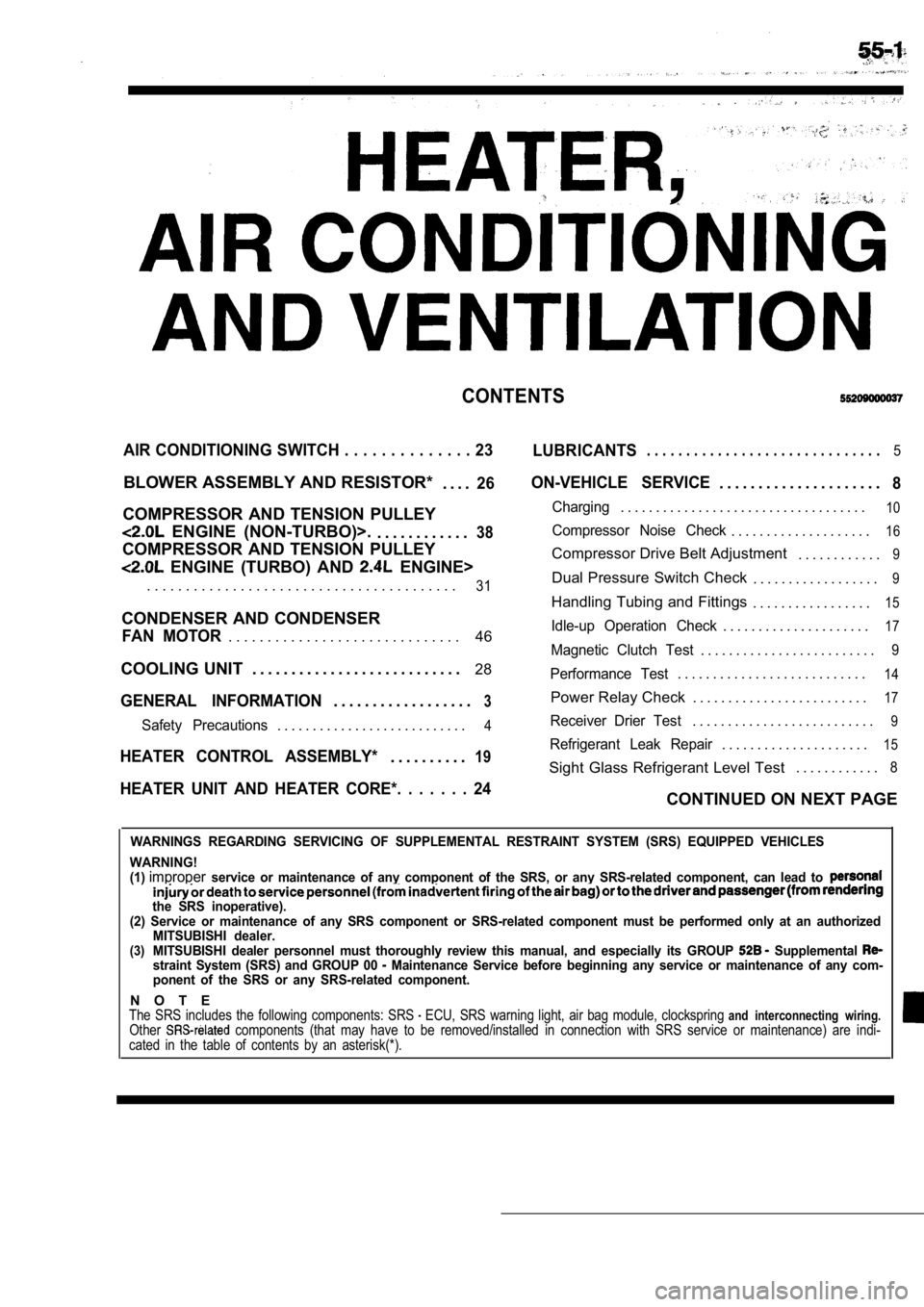
CONTENTS
AIR CONDITIONING SWITCH . . . . . . . . . . . . . . 23
LUBRICANTS. . . . . . . . . . . . . . . . . . . . . . . . . . . . . .5
BLOWER ASSEMBLY AND RESISTOR*
. . . .26
COMPRESSOR AND TENSION PULLEY
ENGINE (NON-TURBO)>.. . . . . . . . . . . .38
COMPRESSOR AND TENSION PULLEY
ENGINE (TURBO) AND ENGINE>
ON-VEHICLE SERVICE. . . . . . . . . . . . . . . . . . . . .8
Charging. . . . . . . . . . . . . . . . . . . . . . . . . . . . . . . . . . .10
Compressor Noise Check. . . . . . . . . . . . . . . . . . . .16
Compressor Drive Belt Adjustment . . . . . . . . . . . .9
. . . . . . . . . . . . . . . . . . . . . . . . . . . . . . . . . . . . . . . .31Dual Pressure Switch Check. . . . . . . . . . . . . . . . . .9
Handling Tubing and Fittings. . . . . . . . . . . . . . . . .15
CONDENSER AND CONDENSER
46Idle-up Operation Check. . . . . . . . . . . . . . . . . . . . .17FAN MOTOR. . . . . . . . . . . . . . . . . . . . . . . . . . . . . .Magnetic Clutch Test. . . . . . . . . . . . . . . . . . . . . . . . .9
COOLING UNIT . . . . . . . . . . . . . . . . . . . . . . . . . . . 28
GENERAL INFORMATION3. . . . . . . . . . . . . . . . . .
Performance Test. . . . . . . . . . . . . . . . . . . . . . . . . . .14
Power Relay Check . . . . . . . . . . . . . . . . . . . . . . . . .17
Safety Precautions. . . . . . . . . . . . . . . . . . . . . . . . . . .4Receiver Drier Test. . . . . . . . . . . . . . . . . . . . . . . . . .9
. . . . . . . . . . . . . . . . . . . . .15HEATER CONTROL ASSEMBLY*19Refrigerant Leak Repair. . . . . . . . . .
Sight Glass Refrigerant Level Test . . . . . . . . . . . .8
HEATER UNIT AND HEATER CORE*. . . . . . . 24CONTINUED ON NEXT PAGE
WARNINGS REGARDING SERVICING OF SUPPLEMENTAL RESTRA
INT SYSTEM (SRS) EQUIPPED VEHICLES
WARNING!
(1)
improperservice or maintenance of any component of the SRS, or any SRS-related component, can lead to
the SRS inoperative).
(2) Service or maintenance of any SRS component or SRS-related component must be performed only at an authorized
MITSUBISHI dealer.
(3)MITSUBISHI dealer personnel must thoroughly review this manual, and especially its GROUP Supplemental straint System (SRS) and GROUP 00 Maintenance Service before beginning any service or maintenance of any com-
ponent of the SRS or any SRS-related component.
N O T EThe SRS includes the following components: SRS ECU, SRS warning light, air bag module, clocksprin g and interconnecting wiring.Other components (that may have to be removed/installed in connection with SRS service or maintenance) are indi-
cated in the table of contents by an asterisk(*).
Page 2043 of 2103
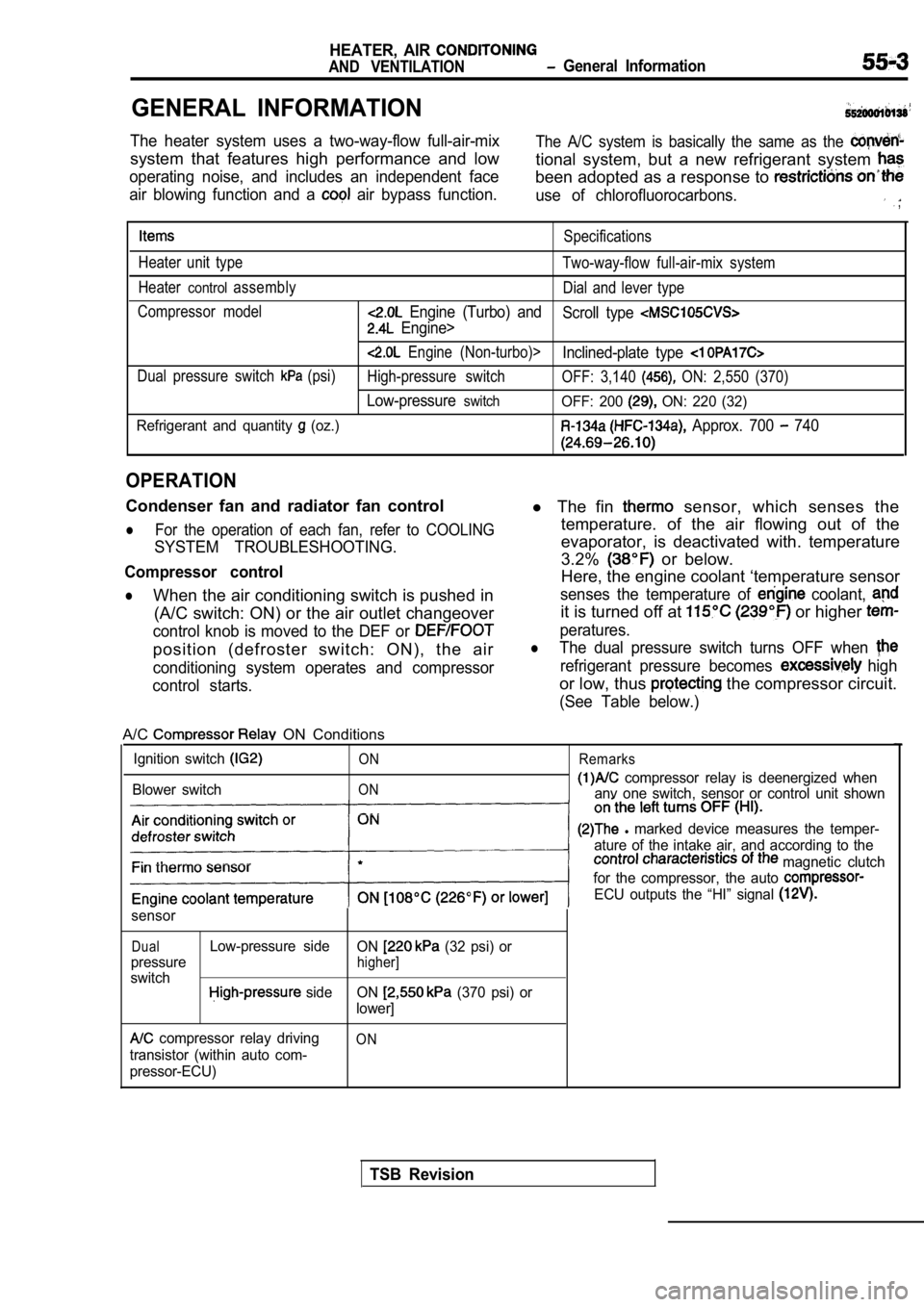
HEATER, AIR
AND VENTILATION General Information
GENERAL INFORMATION
The heater system uses a two-way-flow full-air-mixThe A/C system is basically the same as the
system that features high performance and lowtional system, but a new refrigerant system
operating noise, and includes an independent facebeen adopted as a response to
air blowing function and a air bypass function.use of chlorofluorocarbons. ,
Specifications
Heater unit type Two-way-flow full-air-mix system
Heater
controlassembly Dial and lever type
Compressor model
Engine (Turbo) and Scroll type
Engine>
Engine (Non-turbo)>Inclined-plate type
Dual pressure switch (psi)High-pressure switch OFF: 3,140 ON: 2,550 (370)
Low-pressureswitchOFF: 200 ON: 220 (32)
Refrigerant and quantity
(oz.) Approx. 700 740
OPERATION
Condenser fan and radiator fan control
lFor the operation of each fan, refer to COOLING
SYSTEM TROUBLESHOOTING.
Compressor control
lWhen the air conditioning switch is pushed in (A/C switch: ON) or the air outlet changeover
control knob is moved to the DEF or
position (defroster switch: ON), the air
conditioning system operates and compressor
control starts.
l The fin sensor, which senses the
temperature. of the air flowing out of the
evaporator, is deactivated with. temperature
3.2%
or below.
Here, the engine coolant ‘temperature sensor
senses the temperature of coolant,
it is turned off at or higher
peratures.
lThe dual pressure switch turns OFF when
refrigerant pressure becomes high
or low, thus the compressor circuit.
(See Table below.)
A/C ON Conditions
Ignition switch
Blower switch
ON
ON Remarks
compressor relay is deenergized when
anv one switch, sensor or control unit shown
l marked device measures the temper-
ature of the intake air, and according to the
magnetic clutch
for the compressor, the auto
ECU outputs the “HI” signal
sensor
DualLow-pressure side ON (32 psi) or
pressure
higher]
switch side ON (370 psi) or
lower]
compressor relay driving
transistor (within auto com-
pressor-ECU)ON
TSB Revision
Page 2045 of 2103
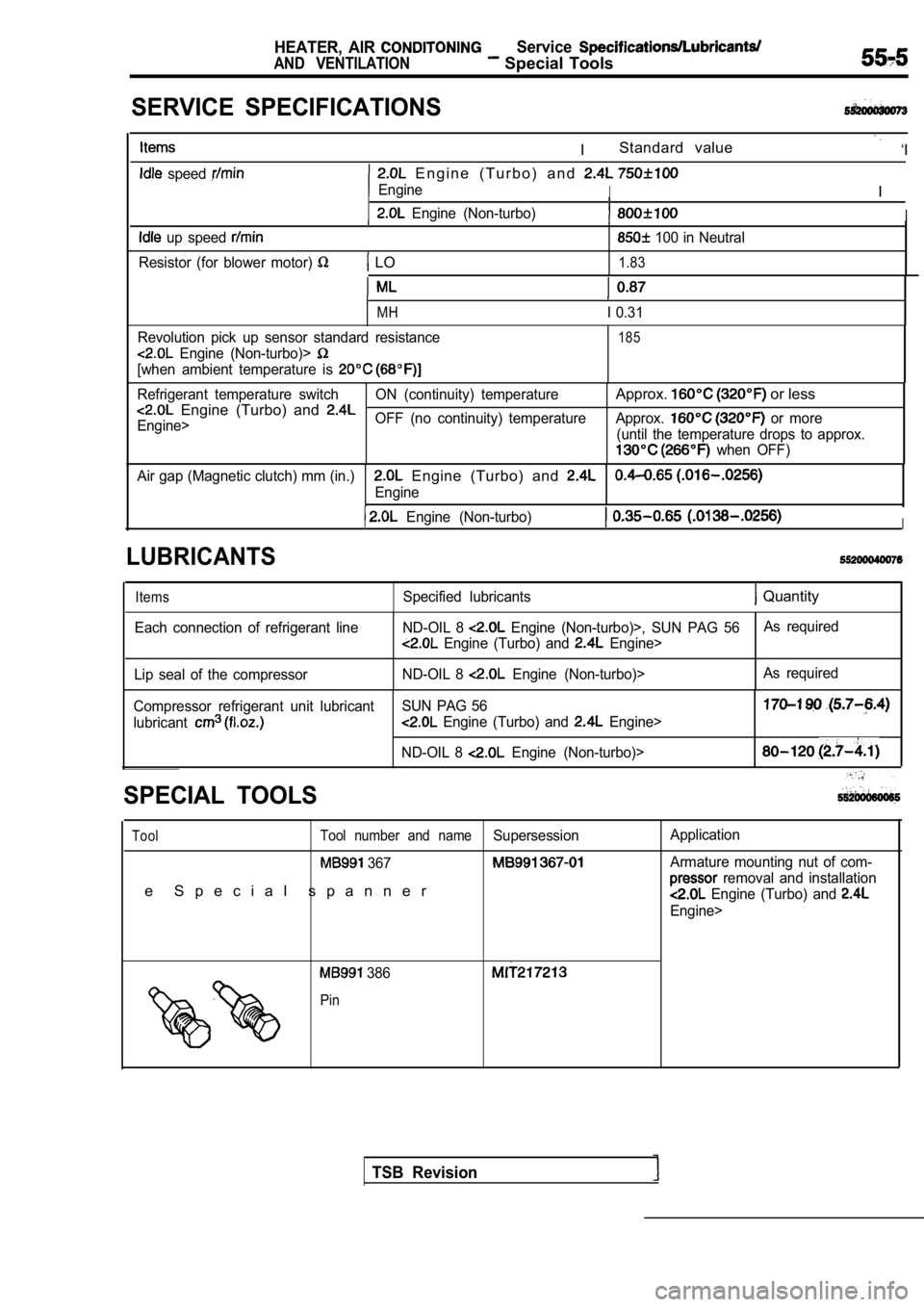
HEATER, AIR Service
AND VENTILATION Special Tools
SERVICE SPECIFICATIONS
IStandard value ‘I
speed E n g i n e ( T u r b o ) a n d
EngineII
Engine (Non-turbo)I
up speed
Resistor (for blower motor) LO
100 in Neutral
1.83
MHI 0.31
Revolution pick up sensor standard resistance
Engine (Non-turbo)>
185
[when ambient temperature is
Refrigerant temperature switch ON (continuity) tempe rature
Engine (Turbo) and
Engine>OFF (no continuity) temperature
Approx. or less
Approx. or more
(until the temperature drops to approx.
when OFF)
Air gap (Magnetic clutch) mm (in.)
Engine (Turbo) and
Engine
Engine (Non-turbo)I
LUBRICANTS
ItemsSpecified lubricants Quantity
Each connection of refrigerant line ND-OIL 8 Engine (Non-turbo)>, SUN PAG 56 As required
Engine (Turbo) and Engine>
Lip seal of the compressor ND-OIL 8
Engine (Non-turbo)>As required
Compressor refrigerant unit lubricant SUN PAG 56
lubricant
Engine (Turbo) and Engine>
ND-OIL 8
Engine (Non-turbo)>
SPECIAL TOOLS
ToolTool number and nameSupersession Application
367Armature mounting nut of com-
e S p e c i a l s p a n n e r removal and installation
Engine (Turbo) and
Engine>
386
Pin
TSB Revision
Page 2046 of 2103
HEATER, AIR
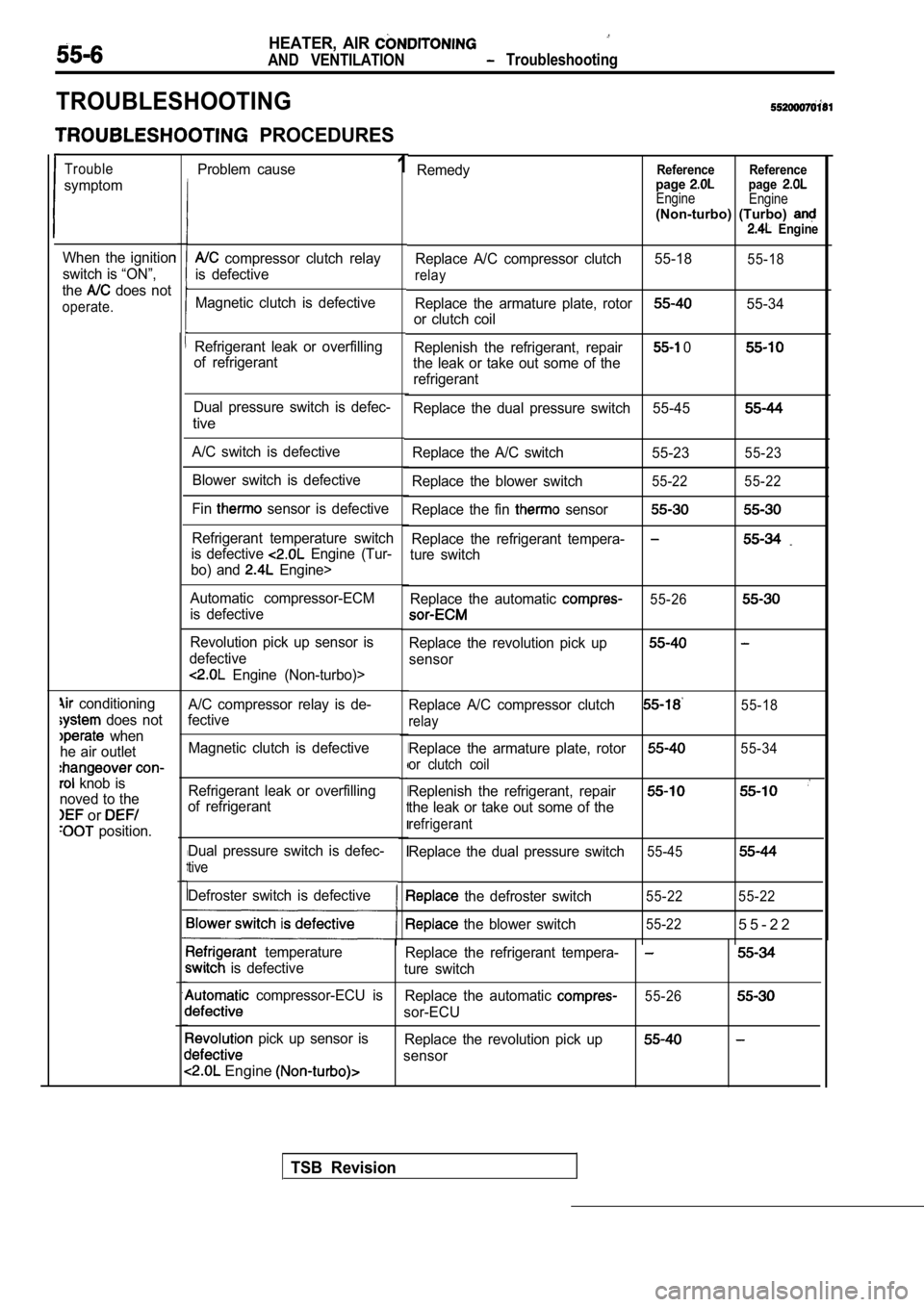
AND VENTILATION Troubleshooting
TROUBLESHOOTING
PROCEDURES
Trouble
symptom
When the ignitior
switch is “ON”,
the
does not
operate.
conditioning
does not
when
he air outlet
knob is
noved to the
or
position. Problem cause
compressor clutch relay
is defective
Magnetic clutch is defective
Refrigerant leak or overfilling
of refrigerant
Dual pressure switch is defec-
tive
A/C switch is defective Blower switch is defective
Fin
sensor is defective
Refrigerant temperature switch
is defective
Engine (Tur-
bo) and
Engine>
Automatic compressor-ECM
is defective
Revolution pick up sensor is
defective
Engine (Non-turbo)>
A/C compressor relay is de-
fective
1
Dual pressure switch is defec-
tive
Defroster switch is defective
TSB Revision
Magnetic clutch is defective
Refrigerant leak or overfilling
of refrigerant Remedy
Reference ReferencepagepageEngine
Engine(Non-turbo) (Turbo) Engine
Replace A/C compressor clutch 55-1855-18
relay
Replace the armature plate, rotor55-34
or clutch coil
Replenish the refrigerant, repair
0
the leak or take out some of therefrigerant
Replace the dual pressure switch 55-45
Replace the A/C switch 55-2355-23
Replace the blower switch55-22 55-22
Replace the fin sensor
Replace the refrigerant tempera-
ture switch
Replace the automatic
Replace the revolution pick up
sensor
55-26
Replace A/C compressor clutch55-18
relay
Replace the armature plate, rotor55-34
or clutch coil
Replenish the refrigerant, repair
the leak or take out some of the
refrigerant
Replace the dual pressure switch55-45
the defroster switch55-22 55-22
the blower switch55-225 5 - 2 2
temperature Replace the refrigerant tempera-
is defective
ture switch
compressor-ECU isReplace the automatic 55-26
sor-ECU
pick up sensor is
Replace the revolution pick up
sensor Engine
Page 2047 of 2103
HEATER, AIR
AND VENTILATION Troubleshooting
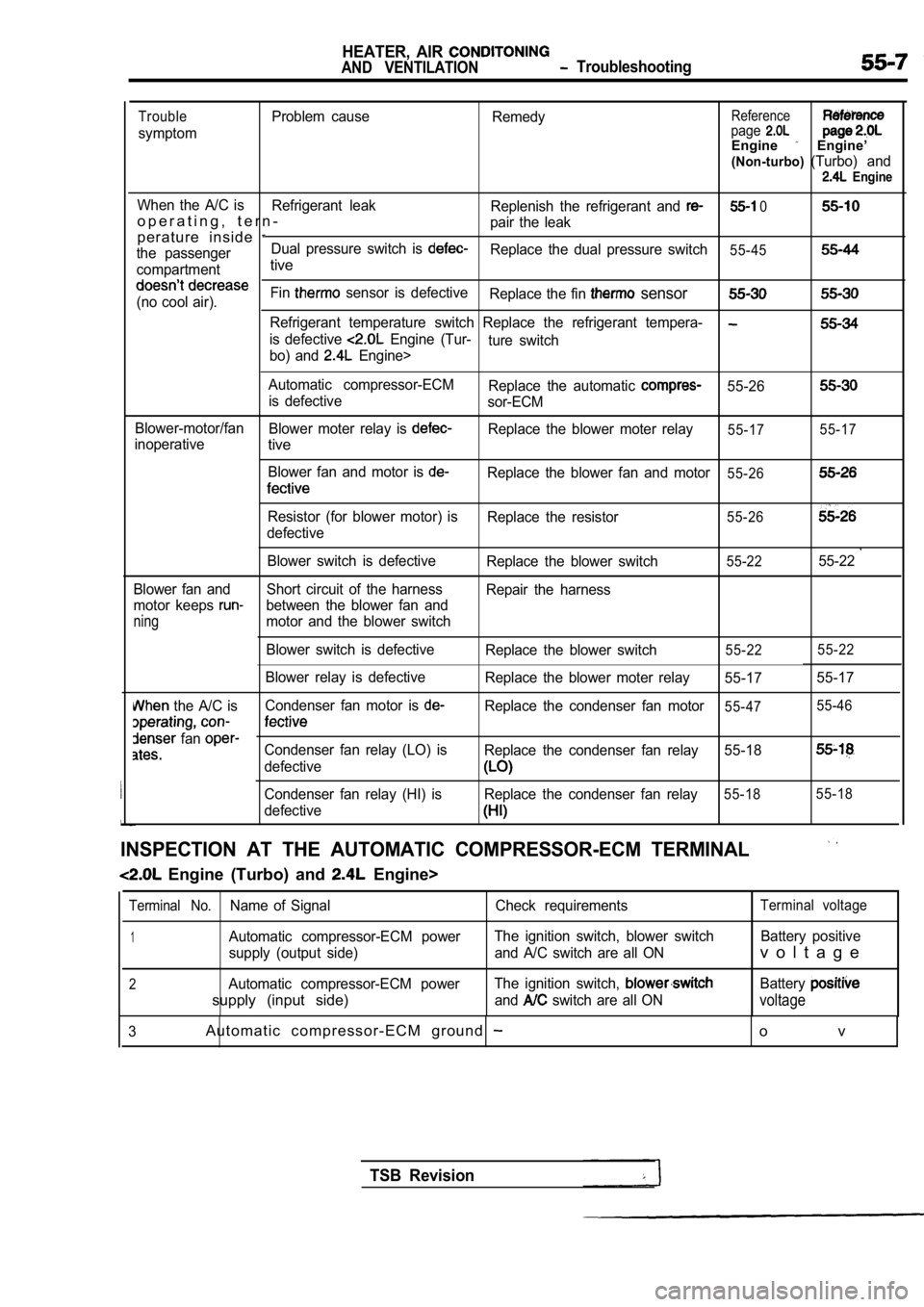
Trouble
symptomProblem cause
Remedy
ReferencepageEngine Engine’
(Non-turbo)(Turbo) and Engine
When the A/C isRefrigerant leak
Replenish the refrigerant and 0o p e r a t i n g , t e r n -pair the leakperature inside
the passengerDual pressure switch is Replace the dual pressure switch55-45
compartmenttive
(no cool air).Fin sensor is defective
Replace the fin sensor
Refrigerant temperature switch Replace the refriger ant tempera-
is defective Engine (Tur-
ture switch
bo) and
Engine>
Automatic compressor-ECM Replace the automatic
55-26is defectivesor-ECM
Blower-motor/fan Blower moter relay is
Replace the blower moter relay55-1755-17inoperativetive
Blower fan and motor is Replace the blower fan and motor55-26
Resistor (for blower motor) is
Replace the resistor55-26
defective
Blower switch is defective Replace the blower switch
55-2255-22
Blower fan and Short circuit of the harness Repair the harness
motor keeps
between the blower fan and
ningmotor and the blower switch
Blower switch is defective Replace the blower switch
55-2255-22
Blower relay is defective
Replace the blower moter relay 55-1755-17
the A/C is Condenser fan motor is Replace the condenser fan motor55-47 55-46
fan Condenser fan relay (LO) is
Replace the condenser fan relay 55-18
defective
Condenser fan relay (HI) is Replace the condenser fa n relay55-1855-18
defective
INSPECTION AT THE AUTOMATIC COMPRESSOR-ECM TERMINAL
Engine (Turbo) and Engine>
Terminal No.Name of Signal Check requirementsTerminal voltage
1Automatic compressor-ECM power The ignition switch, blower switch Battery positive
supply (output side) and A/C switch are all ON
v o l t a g e
2Automatic compressor-ECM power
supply (input side)
The ignition switch,
and switch are all ON Batteryvoltage
3A u t o m a t i c c o m p r e s s o r - E C M g r o u n d o v
TSB Revision