check engine NISSAN ALMERA N15 1995 Owner's Manual
[x] Cancel search | Manufacturer: NISSAN, Model Year: 1995, Model line: ALMERA N15, Model: NISSAN ALMERA N15 1995Pages: 1701, PDF Size: 82.27 MB
Page 363 of 1701
INSPECTIONANDADJUSTMENT
Pedal stopper
Dash lower
panel (except
CD20 engine //
model)
/L
Floor car-pet
L
Dash reinforcement panel
(CD20 engine model)
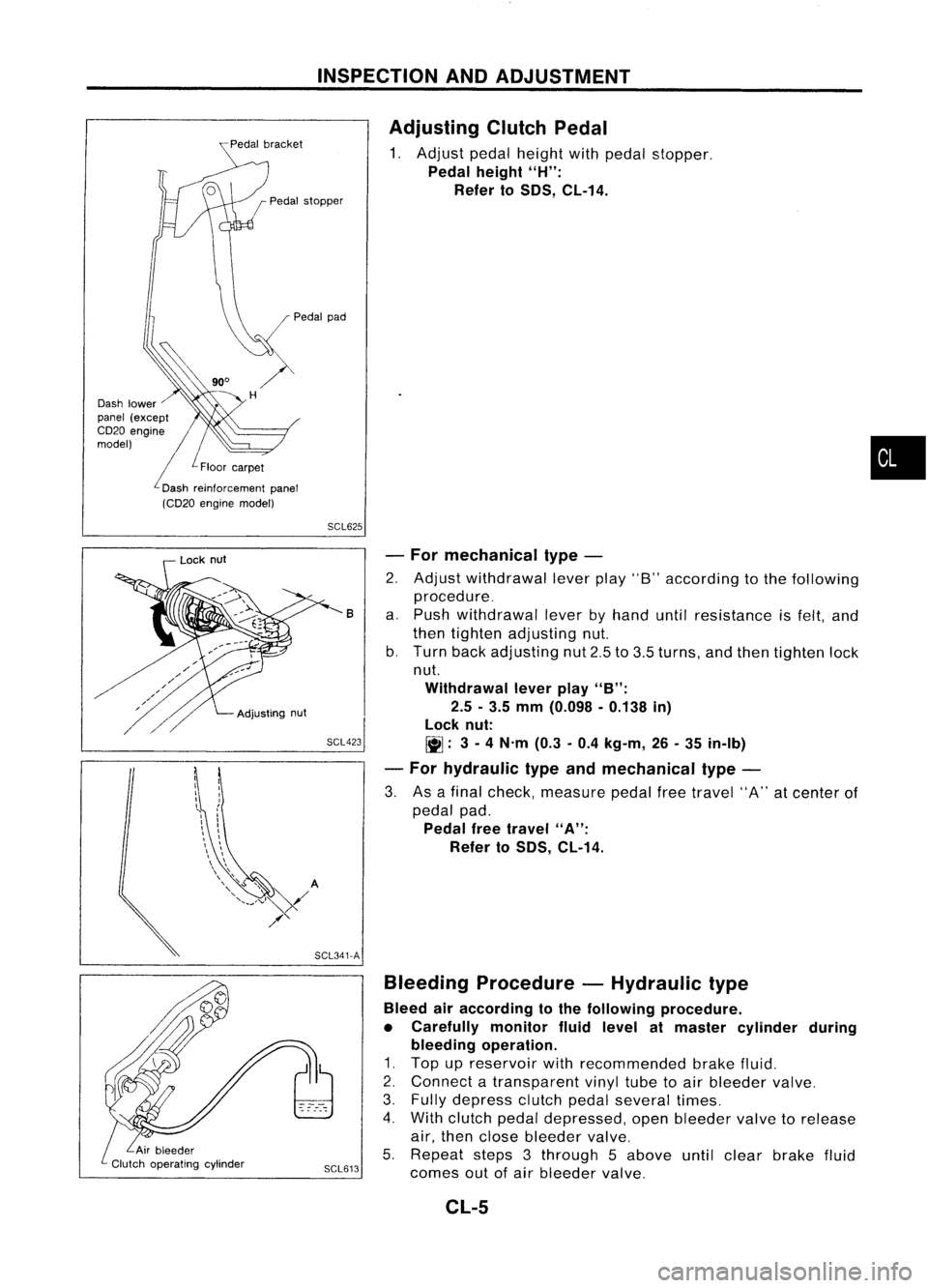
Adjusting
ClutchPedal
1. Adjust pedalheight withpedal stopper.
Pedal height
"H":
Refer to
50S,
CL-14.
•
SCL625
SCL423 -
For mechanical type-
2. Adjust withdrawal leverplay"8"according tothe following
procedure_
a. Push withdrawal leverbyhand untilresistance isfelt, and
then tighten adjusting nut.
b. Turn backadjusting nut2.5to3.5 turns, andthen tighten lock
nut.
Withdrawal leverplay
"B":
2.5 -3.5 mm (0.098 -0.138 in)
lock nut:
~: 3-
4 N'm (0.3-0.4 kg-m, 26-35 in-Ib)
- For hydraulic typeandmechanical type-
3. Asafinal check, measure pedalfreetravel "A"atcenter of
pedal pad.
Pedal freetravel
"A":
Refer to
50S,
CL-14.
B
Bleeding Procedure -Hydraulic type
Bleed airaccording tothe following procedure.
• Carefully monitorfluidlevel atmaster cylinder during
bleeding operation.
1. Top upreservoir withrecommended brakefluid.
2. Connect atransparent vinyltubetoair bleeder valve.
3. Fully depress clutchpedalseveral times.
4. With clutch pedaldepressed, openbleeder valvetorelease
air, then close bleeder valve.
5. Repeat steps3through 5above untilclear brake fluid
SCL613
comesoutofair bleeder valve.
SCL341-A
Adjusting
nut
Lock
nut
CL-5
Page 372 of 1701
SERVICEDATAANDSPECIFICATIONS (SOS)
Inspection andAdjustment
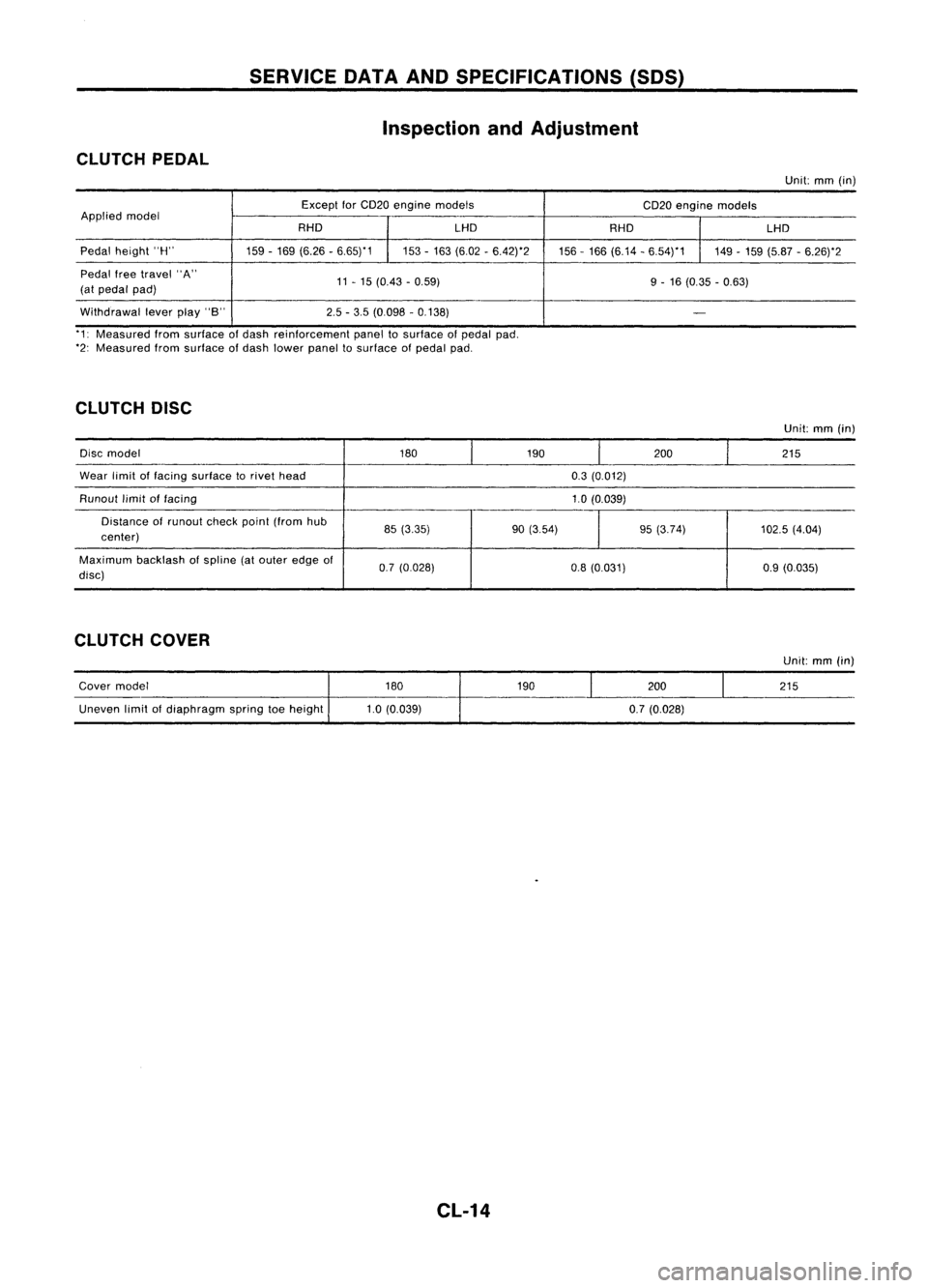
CLUTCH PEDAL
Unit:mm(in)
Except forCD20 engine models
CD20engine models
Applied model
RHOLHD
RHO LHD
Pedal height "H"
159-169 (6.26 -6.65)'1 153-163 (6.02 -6.42)*2 156-166 (6.14 -6.54)'1
149-159 (5.87 -6.26)'2
Pedal freetravel "A"
11-15 (0.43 -0.59)
9-16 (0.35 -0.63)
(at pedal pad)
Withdrawal leverplay"8" 2.5-3.5 (0.098 -0.138)
-
'1: Measured fromsurface ofdash reinforcement paneltosurface ofpedal pad.
'2: Measured fromsurface ofdash lower paneltosurface ofpedal pad.
CLUTCH DISC
Unit:mm(in)
Disc model
180190
I
200
215
Wear limitoffacing surface torivet head
0.3(0.012)
Runout limitoffacing 1.0(0.039)
Distance ofrunout checkpoint(from hub
85(3.35) 90(3.54)
I
95
(3.74) 102.5(4.04)
center)
Maximum backlashofspline (atouter edgeof
0.7(0.028) 0.8(0.031)
0.9(0.035)
disc)
CLUTCH COVER
Cover model
Uneven limitofdiaphragm springtoeheight 180
1.0 (0.039)
CL-14 190
I
200
0.7 (0.028)
I
Unit:
mm(in)
215
Page 397 of 1701
SEL711EBATTERY
CAUTION:
• If
itbecomes necessary tostart theengine withabooster
battery andjumper cables, usea12-volt booster battery.
• After connecting batterycables, ensurethatthey aretightly
clamped tobattery terminals forgood contact.
• Never adddistilled waterthrough thehole used tocheck
specific gravity.
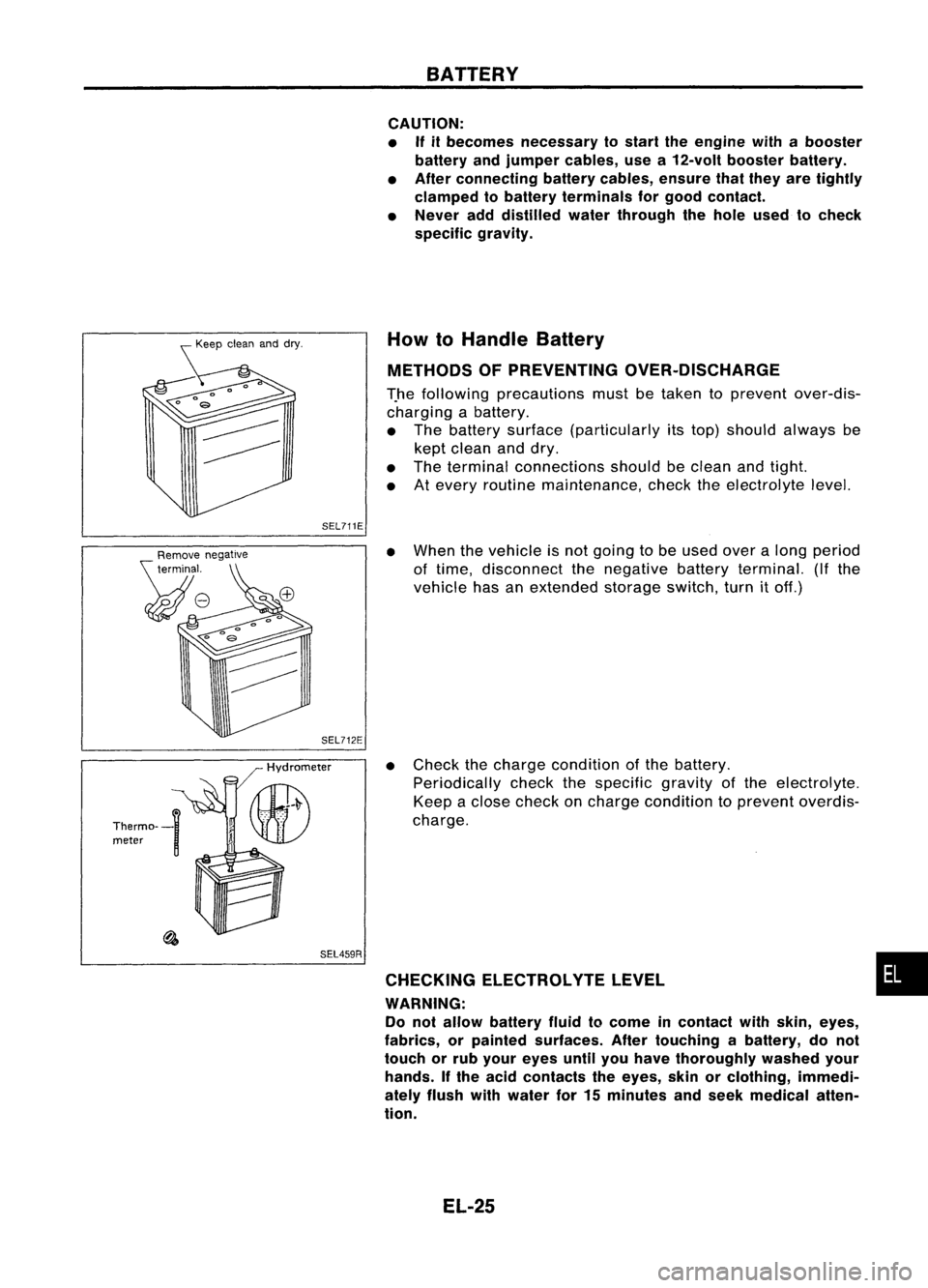
How toHandle Battery
METHODS OFPREVENTING OVER-DISCHARGE
T.he following precautions mustbetaken toprevent over-dis-
charging abattery.
• The battery surface (particularly itstop) should always be
kept clean anddry.
• The terminal connections shouldbeclean andtight.
• Atevery routine maintenance, checktheelectrolyte level.
SEL459R
•
When thevehicle isnot going tobe used overalong period
of time, disconnect thenegative batteryterminal. (Ifthe
vehicle hasanextended storageswitch,turnitoff.)
• Check thecharge condition ofthe battery.
Periodically checkthespecific gravityofthe electrolyte.
Keep aclose check oncharge condition toprevent overdis-
charge.
CHECKING ELECTROLVTELEVEL •
WARNING: Do not allow battery fluidtocome incontact withskin, eyes,
fabrics, orpainted surfaces. Aftertouching abattery, donot
touch orrub your eyes untilyouhave thoroughly washedyour
hands. Ifthe acid contacts theeyes, skinorclothing, immedi-
ately flush withwater for15minutes andseek medical atten-
tion.
EL-25
Page 404 of 1701
I
C: QUICK CHARGE
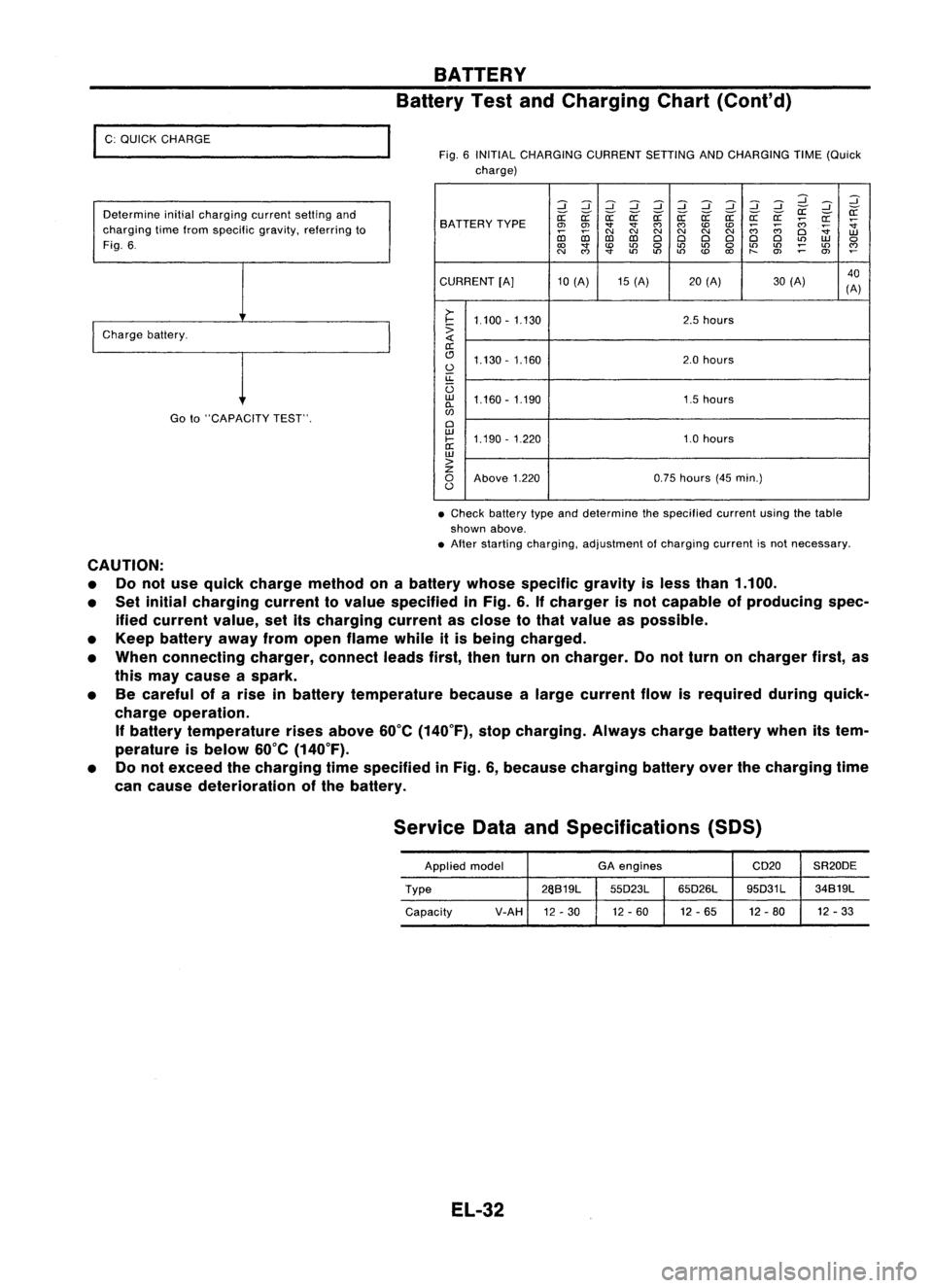
Determine initialcharging currentsettingand
charging timefrom specific gravity,referring to
Fig. 6.
I
Charge battery.
Goto"CAPACITY TEST".
BATTERY
Battery TestandCharging Chart(Cont'd)
Fig. 6INITIAL CHARGING CURRENTSETTINGANDCHARGING TIME(Quick
charge)
:::J:::J:::J:::J :::J:::J:::J
d dd
:::J
:::J :::J
~ ~
SA TTERY TYPE
~
~ ~~~~ ~a: a:a:
;;:;
~
~
0>
0>
""
""
C')
C')
CDCD
;;:;
;;:;
~
co co
C\I
N
C\I
N
C\I
N
Cl
W
D:l D:l
ClCl ClCl ClCl
L()
W
0
to
""
CD
L()
0
L()
L()
0
L()
L()
;:
L()
~
N
C')
""
L()
L()L()
CD
to
t-
O>
0>
CURRENT [A]10(A) 15(A) 20(A) 30(A) 40
(A)
>-
I-
1.100 -1.130 2.5
hours
:>
a:
(!J 1.130 -1.160 2.0
hours
0
u::
U
w
1.160 -1.190 1.5hours
0-
w
Cl
w
1.190 -1.220 1.0hours
I-
a:
w
>
z
0
Above 1.220 0.75
hours (45min.)
0
• Check battery typeanddetermine thespecified currentusingthetable
shown above.
• After starting charging, adjustment ofcharging currentisnot necessary.
CAUTION: • Donot use quick charge method onabattery whosespecific gravityisless than 1.100.
• Set initial charging currenttovalue specified inFig. 6.Ifcharger isnot capable ofproducing spec-
ified current value,setitscharging currentasclose tothat value aspossible.
• Keep battery awayfromopen flame whileitis being charged.
• When connecting charger,connectleadsfirst,thenturnoncharger. Donot turn oncharger first,as
this may cause aspark.
• Becareful ofarise inbattery temperature becausealarge current flowisrequired duringquick-
charge operation.
If
battery temperature risesabove 60°C(140°F), stopcharging. Alwayschargebatterywhenitstem-
perature isbelow 60°C(140°F).
• Donot exceed thecharging timespecified inFig. 6,because charging batteryoverthecharging time
can cause deterioration ofthe battery.
Service DataandSpecifications (SOS)
Applied model GA
engines CD20SR20DE
Type 26S19L
55D23L65D26L 95D31L
34S19L
Capacity V-AH
12-30 12
-60 12-65 12-80 12
-33
EL-32
Page 407 of 1701

STARTINGSYSTEM
Trouble Diagnoses
If any abnormality isfound, immediately disconnectbatterynegative terminal.
Starter doesnotstop.
Engine doesnotstart. Replace
magnetic switch.
Does engine turnbycranking? Doesengine turnnormally? Check
ignition/fuel system.
No No
(Turns slowly.)
Check battery asfollows:
OK
Repairstarter motor.
• Charging condition
• Terminal connections
• Terminal corrosion
NG
@
Does starter motorturn? Yes
Doesgearshaft turn? Checkpinionclutch.
No No
Check reduction gear,armature
and gear shaft.
Check fuseandfusible link. Replace.
OK
Check battery asfollows:
@
• Charging condition
• Terminal connections
NG
• Terminal corrosion •
Charge battery.
• Repair connections andcorro-
OK
sian
ofbattery terminals.
Check starting systemwiring.
Repair.
OK
Does magnetic switchoperation No
Replace magnetic switch
sound occur?
Yes
Check condition ofpinion and
OK
Doesstarter turnunder noload Yes
Replace magnetic switch.
ring gear mesh.
byconnecting wiresasfollows?
NG
•
• Adjust pinionmovement.
Repairstarter motor.
• Check pinionmoving mecha-
nism .
• Check ringgear.
SELOO9Z
EL-35
Page 426 of 1701
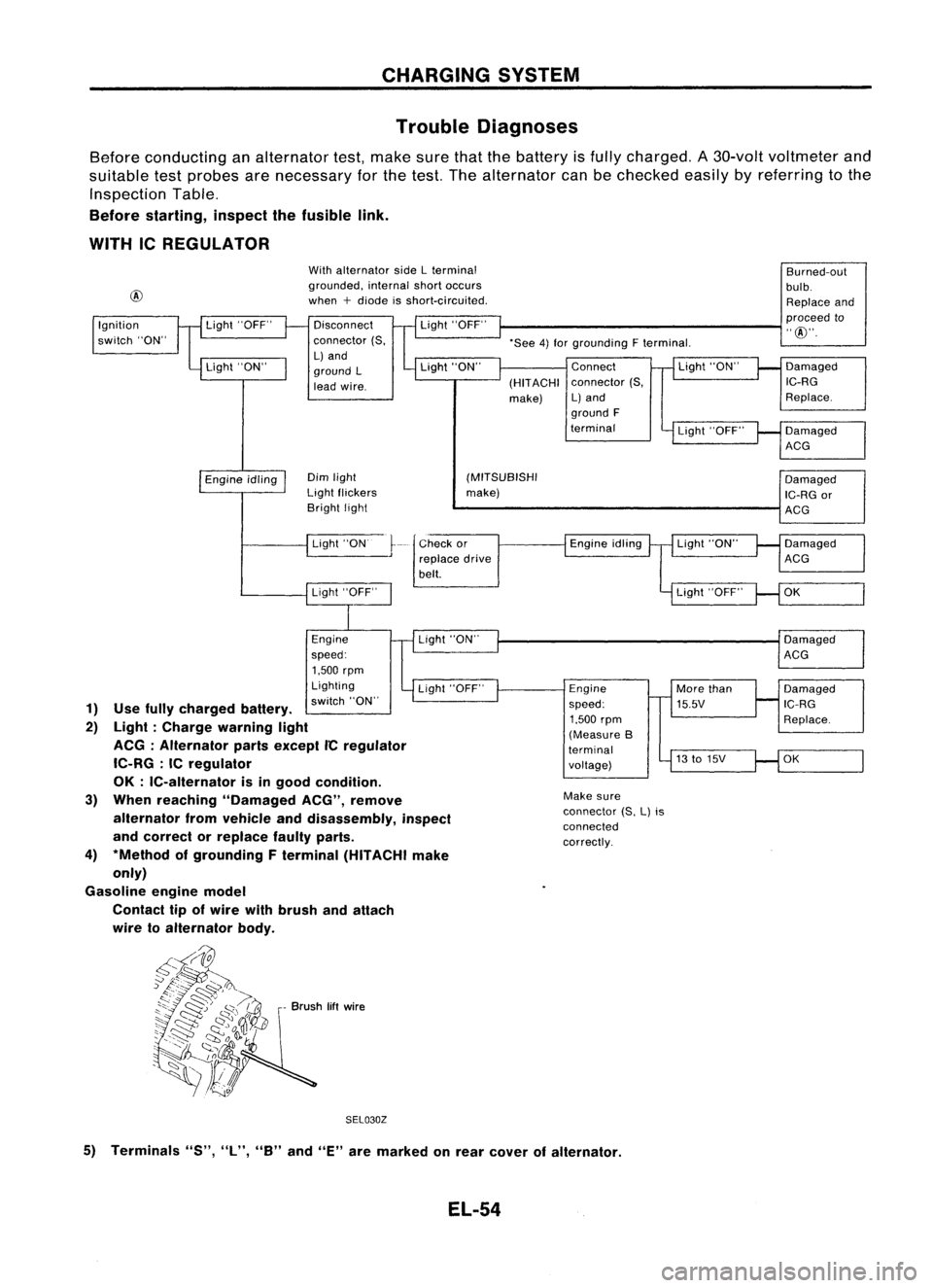
CHARGINGSYSTEM
Trouble Diagnoses
Before conducting analternator test,make surethatthebattery isfully charged. A3D-volt voltmeter and
suitable testprobes arenecessary forthe test. Thealternator canbechecked easilybyreferring tothe
Inspection Table.
Before starting, inspectthefusible link.
WITH IeREGULATOR
Burned-out
bulb.
Replace and
proceed to
"@".
Light "ON"
Light "OFF"
Connect
connector (S,
L) and
ground F
terminal
Engine
speed: 1,500 rpm
(Measure B
terminal
voltage)
Make sure
connector (S,L)is
connected
correctly.
(HITACHI
make)
'See
4)for grounding Fterminal.
(MITSUBISHI
make)
Check or
replace drive
belt.
Light "ON"
Light "OFF"
Disconnect
connector (S,
L) and
ground L
lead wire.
Engine
speed:
1,500 rpm
Lighting
switch "ON"
With
alternator sideLterminal
grounded. internalshortoccurs
when
+
diode isshort-circuited.
Light "ON
Dim
light
Light flickers
Bright light
Light
"ON"
Light
"OFF"
Ignition
switch "ON"
@
1) Use fully charged battery.
2) light: Charge warning light
ACG :Alternator partsexcept I'Cregulator
IC-RG :IC regulator
OK :IC-alternator isingood condition.
3) When reaching "Damaged ACG",remove
alternator fromvehicle anddisassembly, inspect
and correct orreplace faultyparts.
4) *Method ofgrounding Fterminal (HITACHI make
only)
Gasoline enginemodel
Contact tipofwire withbrush andattach
wire toalternator body.
~~~
;;z..'~~.~
~~~/j
S$.~~'
s<(r~, -
Brush liftwire
;;.. ~ Q<:::z"d,l'T7.
~ .. ~ ~-)o,IJ!"-f/
- -~~ C);
0~~/
'~-/i ~-,~
-~j~n
- <::::; -~ \•
'" 1A/-'
SEL030Z
5) Terminals
"S","l","B"
and
"E"
aremarked onrear cover ofalternator.
EL-54
Page 506 of 1701
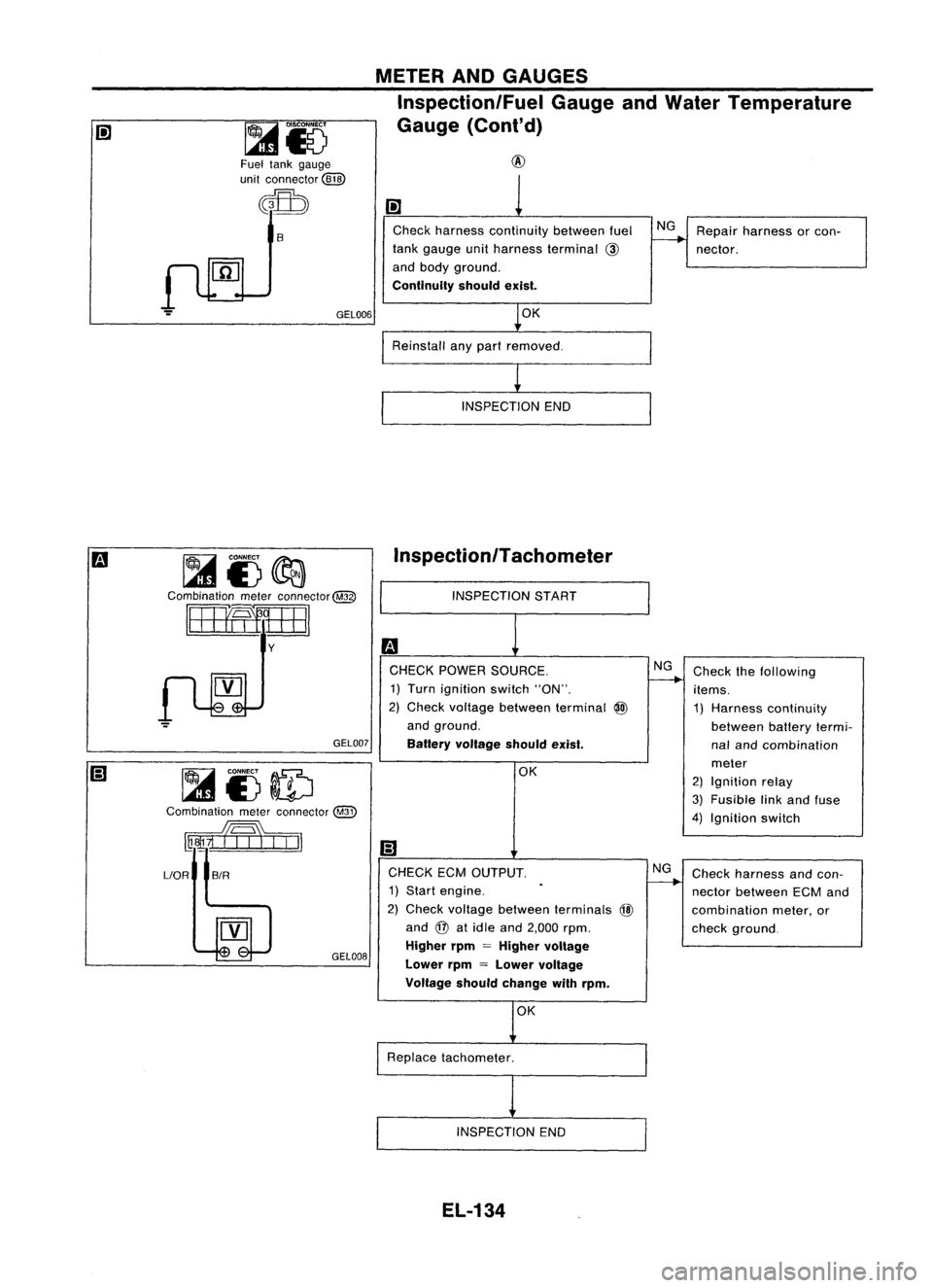
METERANDGAUGES
Inspection/Fuel GaugeandWater Temperature
Gauge (Cont'd)
Fuel tank gauge
unit connector
@W
~
S
GEL006
~i)~
Combination meterconnector@
8mIIEJ
y
GEL007
~i3ID
Combination meterconnector
@
w1i7h:n
Check
harness continuity betweenfuel
tank gauge unitharness terminal
@
and body ground.
Continuity shouldexist.
OK
Reinstall anypart removed.
INSPECTION END
Inspection/Tachometer
INSPECTION START
m
CHECK POWER SOURCE.
1) Turn ignition switch"ON".
2) Check voltage between terminal
@
and ground.
Battery voltage shouldexist.
OK NG
NG
Repair
harness orcon-
nector.
Check thefollowing
items.
1) Harness continuity
between batterytermi-
nal and combination
meter
2) Ignition relay
3) Fusible linkand fuse
4) Ignition switch
LlOR
SIR
GEL008
CHECK
ECMOUTPUT. NG
1) Start engine.
2) Check voltage between terminals
@
and
@
atidle and 2,000 rpm.
Higher rpm
=
Higher voltage
Lower rpm
=
Lower voltage
Voltage shouldchange withrpm.
Replace tachometer.
INSPECTION END
EL-134
Check
harness andcon-
nector between ECMand
combination meter,or
check ground.
Page 523 of 1701

Ohmmeter- + WARNING
LAMPSANDBUZZER
Oil Pressure SwitchCheck
Oil pressure
Continuity
kPa (bar, kg/cm
2,
psi)
More than10-20
NO
Engine
start
(0.10-0.20, 0.1-0.2, 1.4-2.8)
Less than10-20
YES
Engine
stop
(0.10-0.20, 0.1-0.2, 1.4-2.8)
SEL748K
Test lamp 3.4WON
\ ,I
"
/
Ballery
Test lamp 3.4W OFF
~0
CD
Ballery
Gasoline MEL623D
SEL901F
Check
thecontinuity betweentheterminals ofoil pressure
switch andbody ground.
Fuel Warning LampSensor Check
• Itwill take ashort timeforthe bulb tolight.
Diode Check
• Check continuity usinganohmmeter.
• Diode isfunctioning properlyiftest results areasshown in
the figure atleft.
NOTE:
Specification mayvary depending onthe type oftester. Before
performing thisinspection, besure torefer tothe instruction
manual forthe tester tobe used.
• Diodes forwarning lampsarebuilt intothecombination
meter printed circuit.
Refer to"Combination Meter"(EL-127).
Warning BuzzerUnit
• Seat beltwarning lampiscontrolled bythe warning buzzer
unit.
Refer to"Warning Buzzer"(EL-152).
EL-151
•
Page 623 of 1701
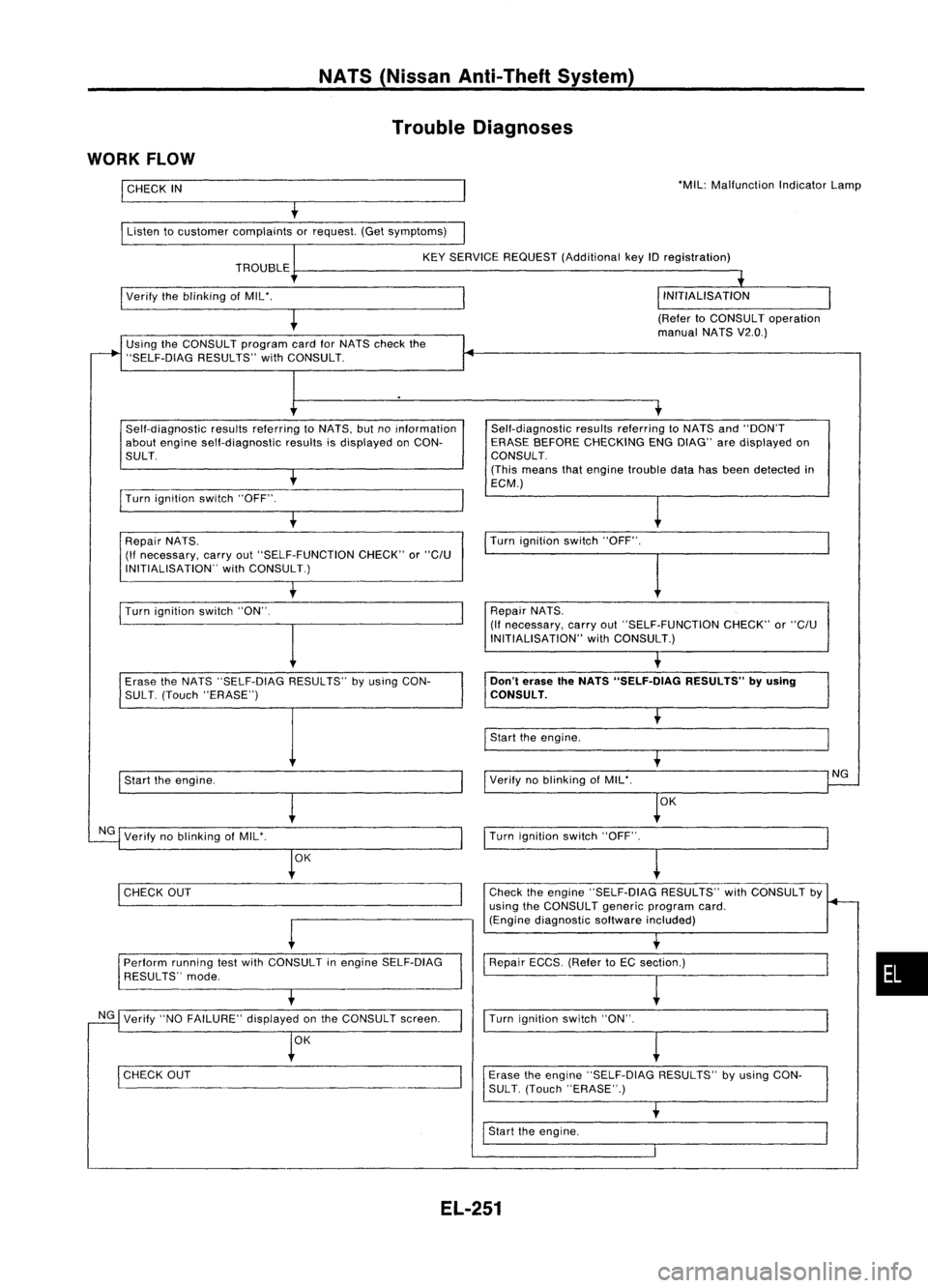
NATS(Nissan Anti-Theft System)
Trouble Diagnoses
WORK FLOW
I
CHECK
IN
Listen tocustomer complaints orrequest. (Getsymptoms) 'MIL:
Malfunction IndicatorLamp
KEY SERVICE REQUEST (Additional keyIDregistration)
TROUBLE
I
Verify theblinking ofMIL'.
(RefertoCONSULT operation
manual NATSV2.0.)
Using theCONSULT programcardforNATS check the
"SELF-DiAG RESULTS"withCONSULT.
Self-diagnostic resultsreferring toNATS, butnoinformation
about engine self-diagnostic resultsisdisplayed onCON-
SULT.
I
Turn ignition switch"OFF".
t
Repair NATS.
(If necessary, carryout"SELF-FUNCTION CHECK"or
"C/U
INITIALISATION" withCONSULT.) Self-diagnostic
resultsreferring toNATS and"DON'T
ERASE BEFORE CHECKING ENGDIAG" aredisplayed on
CONSULT.
(This means thatengine trouble datahasbeen detected in
ECM.)
Turn ignition switch"OFF".
I
Turn ignition switch"ON".
I
Repair
NATS.
(If necessary, carryout"SELF-FUNCTION CHECK"or
"C/U
INITIALISATION" withCONSULT.)
Erase theNATS "SELF-DIAG RESULTS"byusing CON-
SUL T.(Touch "ERASE")
I
Start theengine.
NG Verify noblinking ofMIL'.
OK
I
CHECK OUT
-
Perform runningtestwith CONSULT inengine SELF-DiAG
RESULTS" mode.
NG Verify "NOFAILURE" displayedonthe CONSULT screen.
OK
I
CHECK OUT
Don't
erase theNATS "SELF.DlAG RESULTS"byusing
CONSULT.
I
Start theengine.
Verify noblinking ofMIL'.
OK
I
Turn ignition switch"OFF".
~
Check theengine "SELF-DiAG RESULTS"withCONSULT by
using theCONSULT genericprogram card.
(Engine diagnostic softwareincluded)
Repair ECCS.(RefertoEC section.)
I
Turn ignition switch"ON".
Erase theengine "SELF-DIAG RESULTS"byusing CON-
SUL T.(Touch "ERASE".)
I
Start theengine.
NG
•
EL-251
Page 626 of 1701
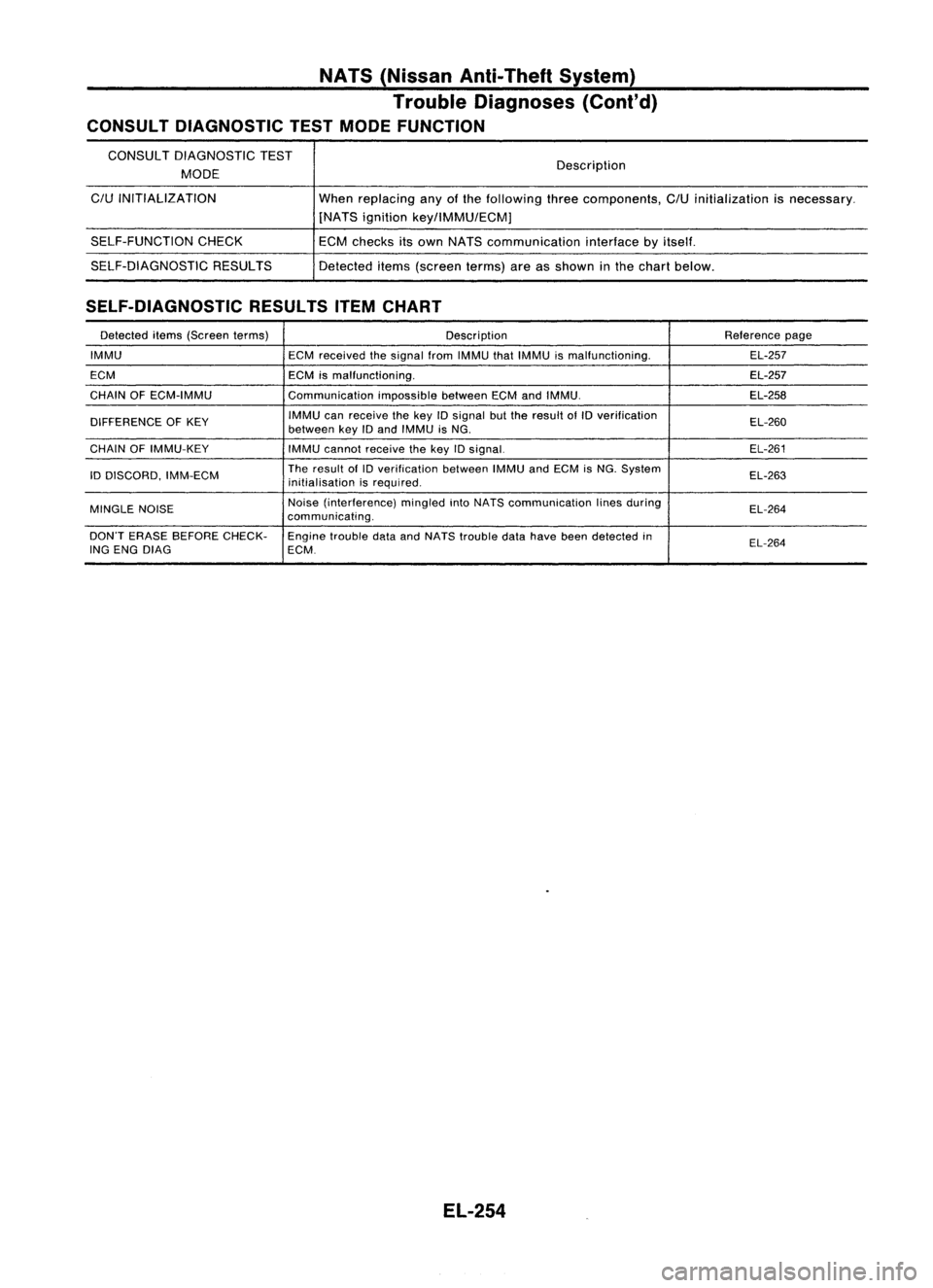
NATS(Nissan Anti-Theft System)
Trouble Diagnoses (Cont'd)
CONSULT DIAGNOSTIC TESTMODE FUNCTION
CONSULT DIAGNOSTIC TEST
MODE
C/U
INITIALIZATION
SELF-FUNCTION CHECK
SELF-DIAGNOSTIC RESULTS Description
When replacing anyofthe following threecomponents,
C/U
initialization isnecessary.
[NATS ignition key/lMMU/ECMj
ECM checks itsown NATS communication interfacebyitself.
Detected items(screen terms)areasshown inthe chart below.
SELF-DIAGNOSTIC RESULTSITEMCHART
Detected items(Screen terms) Description Reference
page
IMMU ECMreceived thesignal fromIMMU thatIMMU ismalfunctioning. EL-257
ECM ECMismalfunctioning. EL-257
CHAIN OFECM-IMMU CommunicationimpossiblebetweenECMandIMMU. EL-258
DIFFERENCE OFKEY IMMU
canreceive thekey
10
signal butthe result ofID verification
EL-260
between keyIDand IMMU isNG.
CHAIN OFIMMU-KEY
IMMUcannot receive thekey IDsignal. EL-261
ID DISCORD, IMM-ECM The
result of
10
verification betweenIMMUandECM isNG. System
EL-263
initialisation isrequired.
MINGLE NOISE Noise
(interference) mingledintoNATS communication linesduring
EL-264
communicating.
DON'T ERASE BEFORE CHECK-
Enginetrouble dataandNATS trouble datahave beendetected in
EL-264
ING ENG DIAG ECM.
EL-254