brake NISSAN ALMERA TINO 2001 Service User Guide
[x] Cancel search | Manufacturer: NISSAN, Model Year: 2001, Model line: ALMERA TINO, Model: NISSAN ALMERA TINO 2001Pages: 3051, PDF Size: 46.38 MB
Page 44 of 3051
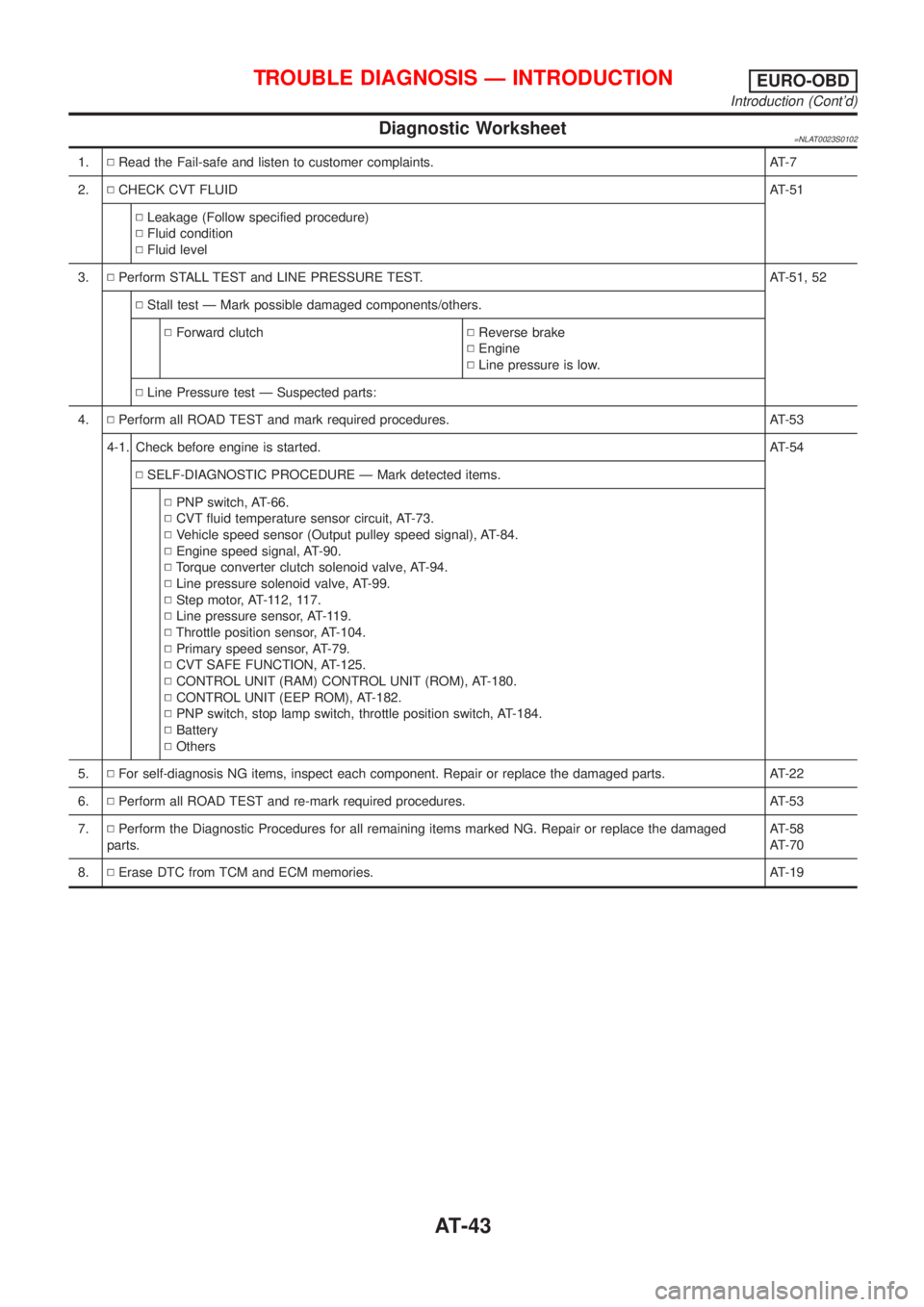
Diagnostic Worksheet=NLAT0023S0102
1.NRead the Fail-safe and listen to customer complaints. AT-7
2.NCHECK CVT FLUIDAT-51
NLeakage (Follow specified procedure)
NFluid condition
NFluid level
3.NPerform STALL TEST and LINE PRESSURE TEST. AT-51, 52
NStall test Ð Mark possible damaged components/others.
NForward clutchNReverse brake
NEngine
NLine pressure is low.
NLine Pressure test Ð Suspected parts:
4.NPerform all ROAD TEST and mark required procedures. AT-53
4-1. Check before engine is started.AT-54
NSELF-DIAGNOSTIC PROCEDURE Ð Mark detected items.
NPNP switch, AT-66.
NCVT fluid temperature sensor circuit, AT-73.
NVehicle speed sensor (Output pulley speed signal), AT-84.
NEngine speed signal, AT-90.
NTorque converter clutch solenoid valve, AT-94.
NLine pressure solenoid valve, AT-99.
NStep motor, AT-112, 117.
NLine pressure sensor, AT-119.
NThrottle position sensor, AT-104.
NPrimary speed sensor, AT-79.
NCVT SAFE FUNCTION, AT-125.
NCONTROL UNIT (RAM) CONTROL UNIT (ROM), AT-180.
NCONTROL UNIT (EEP ROM), AT-182.
NPNP switch, stop lamp switch, throttle position switch, AT-184.
NBattery
NOthers
5.NFor self-diagnosis NG items, inspect each component. Repair or replace the damaged parts. AT-22
6.NPerform all ROAD TEST and re-mark required procedures. AT-53
7.NPerform the Diagnostic Procedures for all remaining items marked NG. Repair or replace the damaged
parts.AT-58
AT-70
8.NErase DTC from TCM and ECM memories. AT-19
TROUBLE DIAGNOSIS Ð INTRODUCTIONEURO-OBD
Introduction (Cont'd)
AT-43
Page 49 of 3051
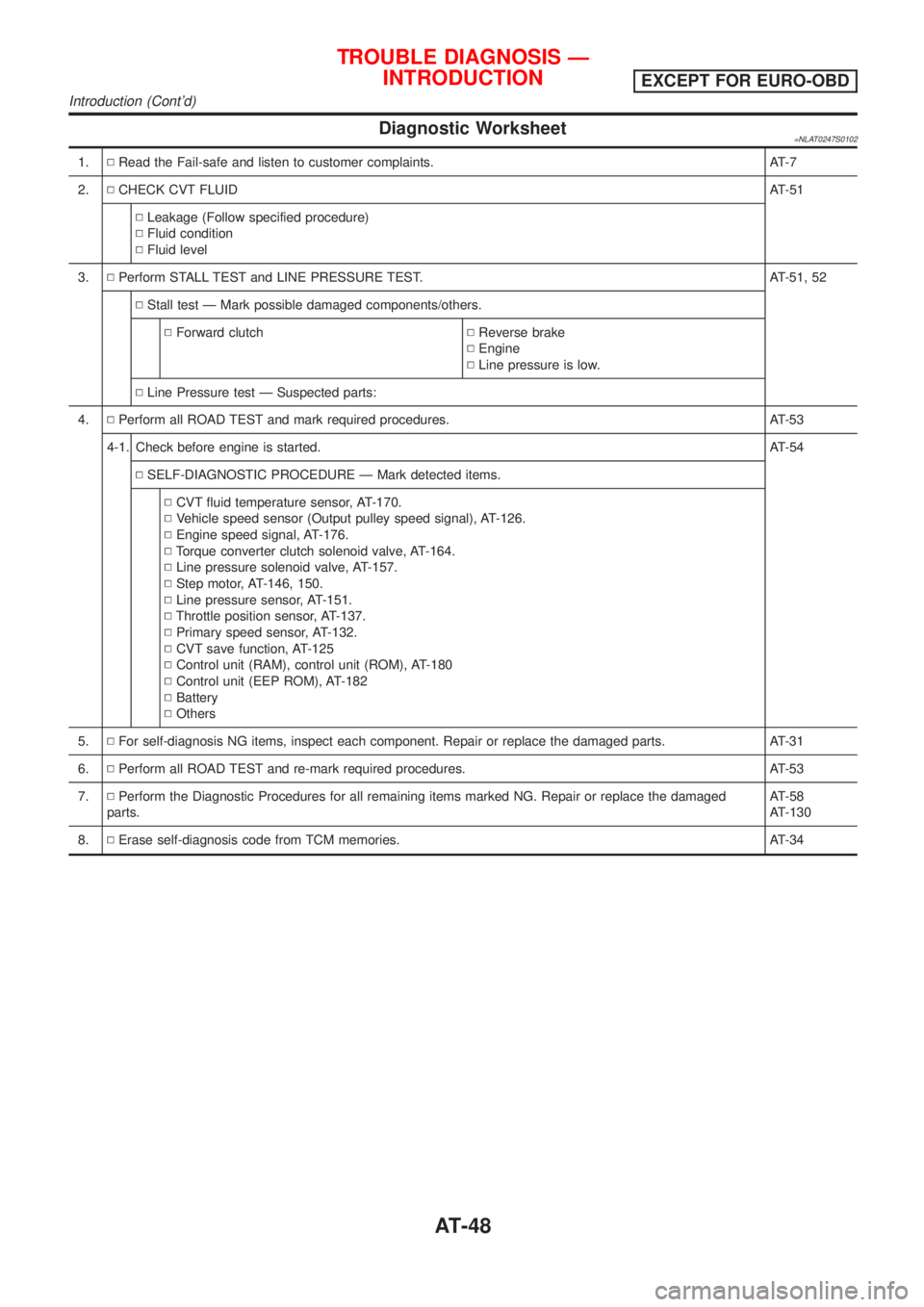
Diagnostic Worksheet=NLAT0247S0102
1.NRead the Fail-safe and listen to customer complaints. AT-7
2.NCHECK CVT FLUIDAT-51
NLeakage (Follow specified procedure)
NFluid condition
NFluid level
3.NPerform STALL TEST and LINE PRESSURE TEST. AT-51, 52
NStall test Ð Mark possible damaged components/others.
NForward clutchNReverse brake
NEngine
NLine pressure is low.
NLine Pressure test Ð Suspected parts:
4.NPerform all ROAD TEST and mark required procedures. AT-53
4-1. Check before engine is started.AT-54
NSELF-DIAGNOSTIC PROCEDURE Ð Mark detected items.
NCVT fluid temperature sensor, AT-170.
NVehicle speed sensor (Output pulley speed signal), AT-126.
NEngine speed signal, AT-176.
NTorque converter clutch solenoid valve, AT-164.
NLine pressure solenoid valve, AT-157.
NStep motor, AT-146, 150.
NLine pressure sensor, AT-151.
NThrottle position sensor, AT-137.
NPrimary speed sensor, AT-132.
NCVT save function, AT-125
NControl unit (RAM), control unit (ROM), AT-180
NControl unit (EEP ROM), AT-182
NBattery
NOthers
5.NFor self-diagnosis NG items, inspect each component. Repair or replace the damaged parts. AT-31
6.NPerform all ROAD TEST and re-mark required procedures. AT-53
7.NPerform the Diagnostic Procedures for all remaining items marked NG. Repair or replace the damaged
parts.AT-58
AT-130
8.NErase self-diagnosis code from TCM memories. AT-34
TROUBLE DIAGNOSIS Ð
INTRODUCTION
EXCEPT FOR EURO-OBD
Introduction (Cont'd)
AT-48
Page 52 of 3051
SAT767B
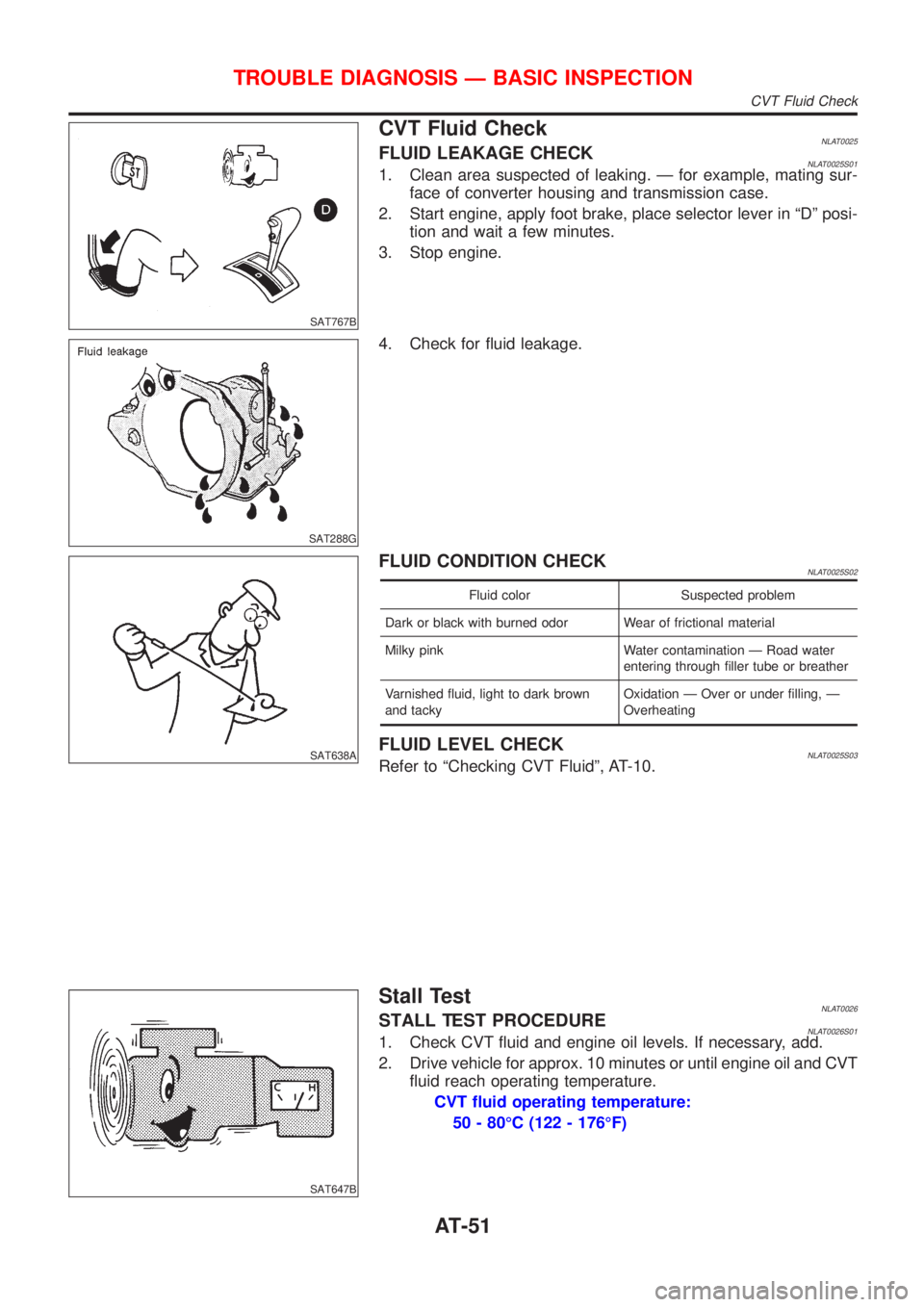
CVT Fluid CheckNLAT0025FLUID LEAKAGE CHECKNLAT0025S011. Clean area suspected of leaking. Ð for example, mating sur-
face of converter housing and transmission case.
2. Start engine, apply foot brake, place selector lever in ªDº posi-
tion and wait a few minutes.
3. Stop engine.
SAT288G
4. Check for fluid leakage.
SAT638A
FLUID CONDITION CHECKNLAT0025S02
Fluid color Suspected problem
Dark or black with burned odor Wear of frictional material
Milky pink Water contamination Ð Road water
entering through filler tube or breather
Varnished fluid, light to dark brown
and tackyOxidation Ð Over or under filling, Ð
Overheating
FLUID LEVEL CHECKNLAT0025S03Refer to ªChecking CVT Fluidº, AT-10.
SAT647B
Stall TestNLAT0026STALL TEST PROCEDURENLAT0026S011. Check CVT fluid and engine oil levels. If necessary, add.
2. Drive vehicle for approx. 10 minutes or until engine oil and CVT
fluid reach operating temperature.
CVT fluid operating temperature:
50 - 80ÉC (122 - 176ÉF)
TROUBLE DIAGNOSIS Ð BASIC INSPECTION
CVT Fluid Check
AT-51
Page 53 of 3051
SAT513G
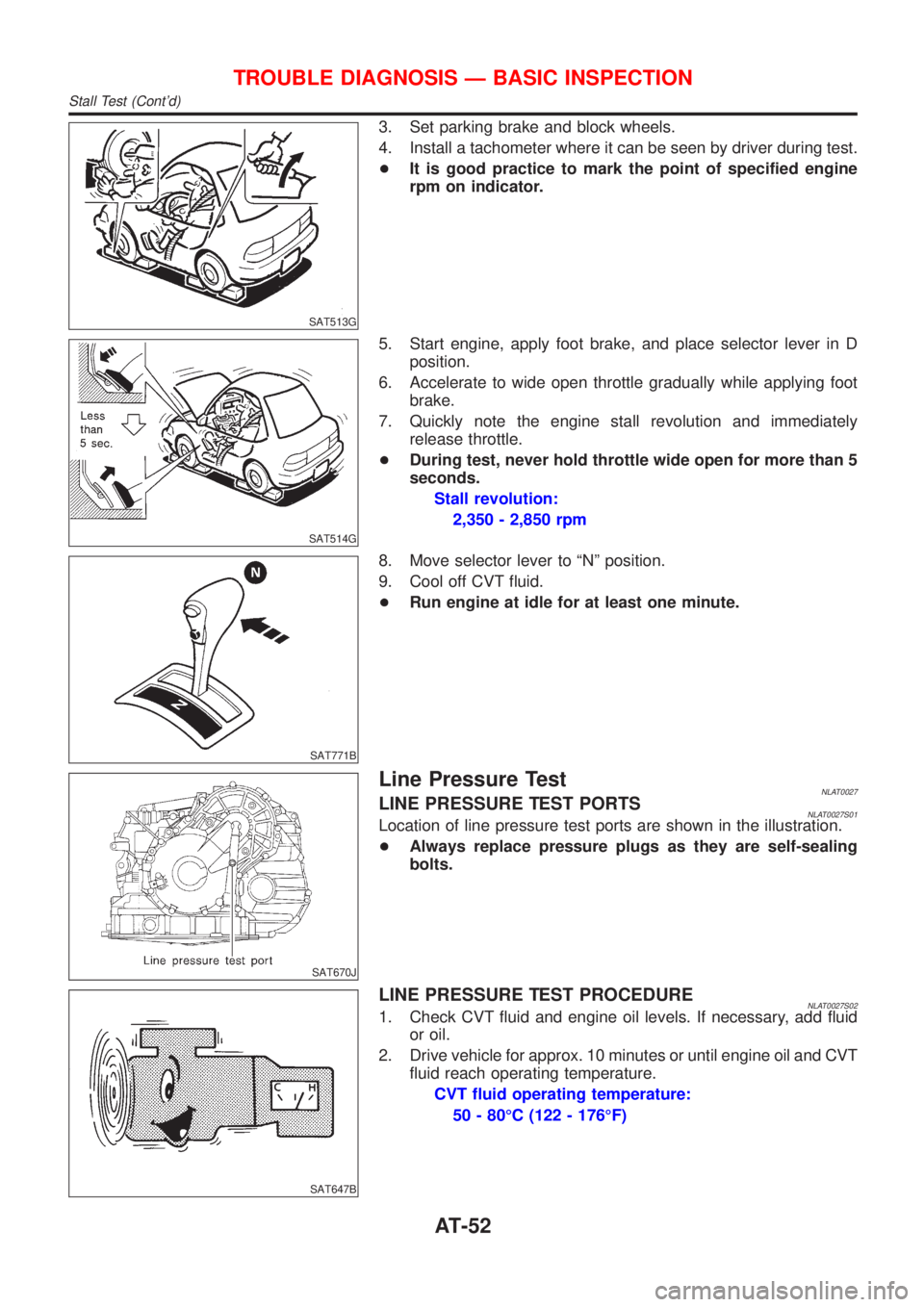
3. Set parking brake and block wheels.
4. Install a tachometer where it can be seen by driver during test.
+It is good practice to mark the point of specified engine
rpm on indicator.
SAT514G
5. Start engine, apply foot brake, and place selector lever in D
position.
6. Accelerate to wide open throttle gradually while applying foot
brake.
7. Quickly note the engine stall revolution and immediately
release throttle.
+During test, never hold throttle wide open for more than 5
seconds.
Stall revolution:
2,350 - 2,850 rpm
SAT771B
8. Move selector lever to ªNº position.
9. Cool off CVT fluid.
+Run engine at idle for at least one minute.
SAT670J
Line Pressure TestNLAT0027LINE PRESSURE TEST PORTSNLAT0027S01Location of line pressure test ports are shown in the illustration.
+Always replace pressure plugs as they are self-sealing
bolts.
SAT647B
LINE PRESSURE TEST PROCEDURENLAT0027S021. Check CVT fluid and engine oil levels. If necessary, add fluid
or oil.
2. Drive vehicle for approx. 10 minutes or until engine oil and CVT
fluid reach operating temperature.
CVT fluid operating temperature:
50 - 80ÉC (122 - 176ÉF)
TROUBLE DIAGNOSIS Ð BASIC INSPECTION
Stall Test (Cont'd)
AT-52
Page 54 of 3051

3. Install pressure gauge to corresponding line pressure port.
SAT513G
4. Set parking brake and block wheels.
+Continue to depress brake pedal fully while line pressure
test is being performed at stall speed.
SAT493G
5. Start engine and measure line pressure at idle and stall speed.
+When measuring line pressure at stall speed, follow the
stall test procedure.
Line pressure: Refer to SDS, AT-210.
SAT692J
Road TestNLAT0028DESCRIPTIONNLAT0028S01+The purpose of the test is to determine overall performance of
CVT and analyze causes of problems.
+The road test consists of the following three parts:
1. Check before engine is started
2. Cruise test
SAT496G
+Before road test, familiarize yourself with all test procedures
and items to check.
+Conduct tests on all items until specified symptom is found.
Troubleshoot items which check out No Good after road test.
Refer to ªON BOARD DIAGNOSTIC SYSTEM
DESCRIPTIONº, AT-18 to AT-28 (EURO-OBD)/AT-31 to AT-38
(Except for EURO-OBD).
TROUBLE DIAGNOSIS Ð BASIC INSPECTION
Line Pressure Test (Cont'd)
AT-53
Page 159 of 3051
SAT250K
SAT815HA
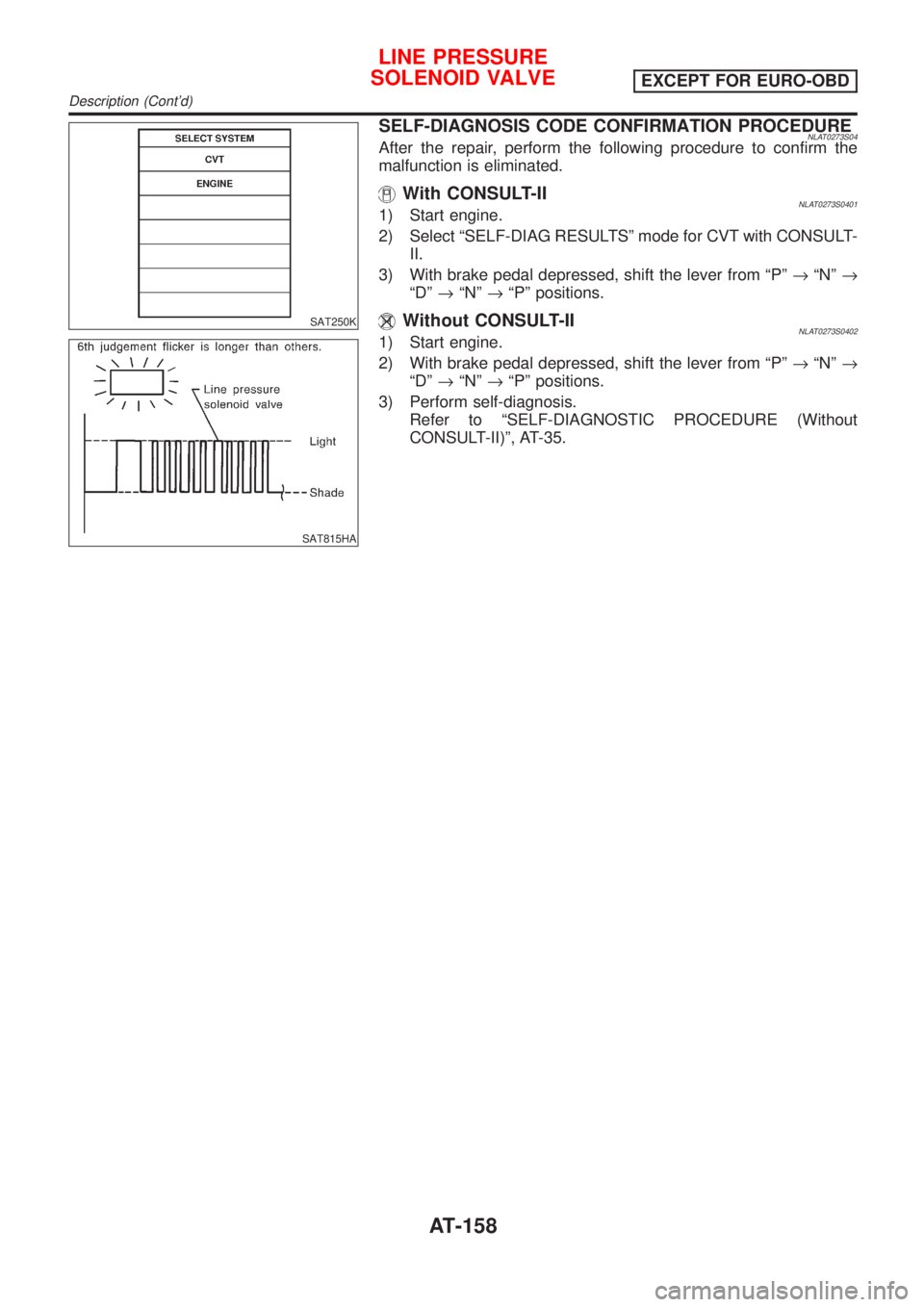
SELF-DIAGNOSIS CODE CONFIRMATION PROCEDURENLAT0273S04After the repair, perform the following procedure to confirm the
malfunction is eliminated.
With CONSULT-IINLAT0273S04011) Start engine.
2) Select ªSELF-DIAG RESULTSº mode for CVT with CONSULT-
II.
3) With brake pedal depressed, shift the lever from ªPº®ªNº®
ªDº®ªNº®ªPº positions.
Without CONSULT-IINLAT0273S04021) Start engine.
2) With brake pedal depressed, shift the lever from ªPº®ªNº®
ªDº®ªNº®ªPº positions.
3) Perform self-diagnosis.
Refer to ªSELF-DIAGNOSTIC PROCEDURE (Without
CONSULT-II)º, AT-35.
LINE PRESSURE
SOLENOID VALVE
EXCEPT FOR EURO-OBD
Description (Cont'd)
AT-158
Page 186 of 3051
2 CHECK PNP SWITCH CIRCUIT (Without CONSULT-II)
With CONSULT-II
1. Turn ignition switch to ªONº position.
(Do not start engine.)
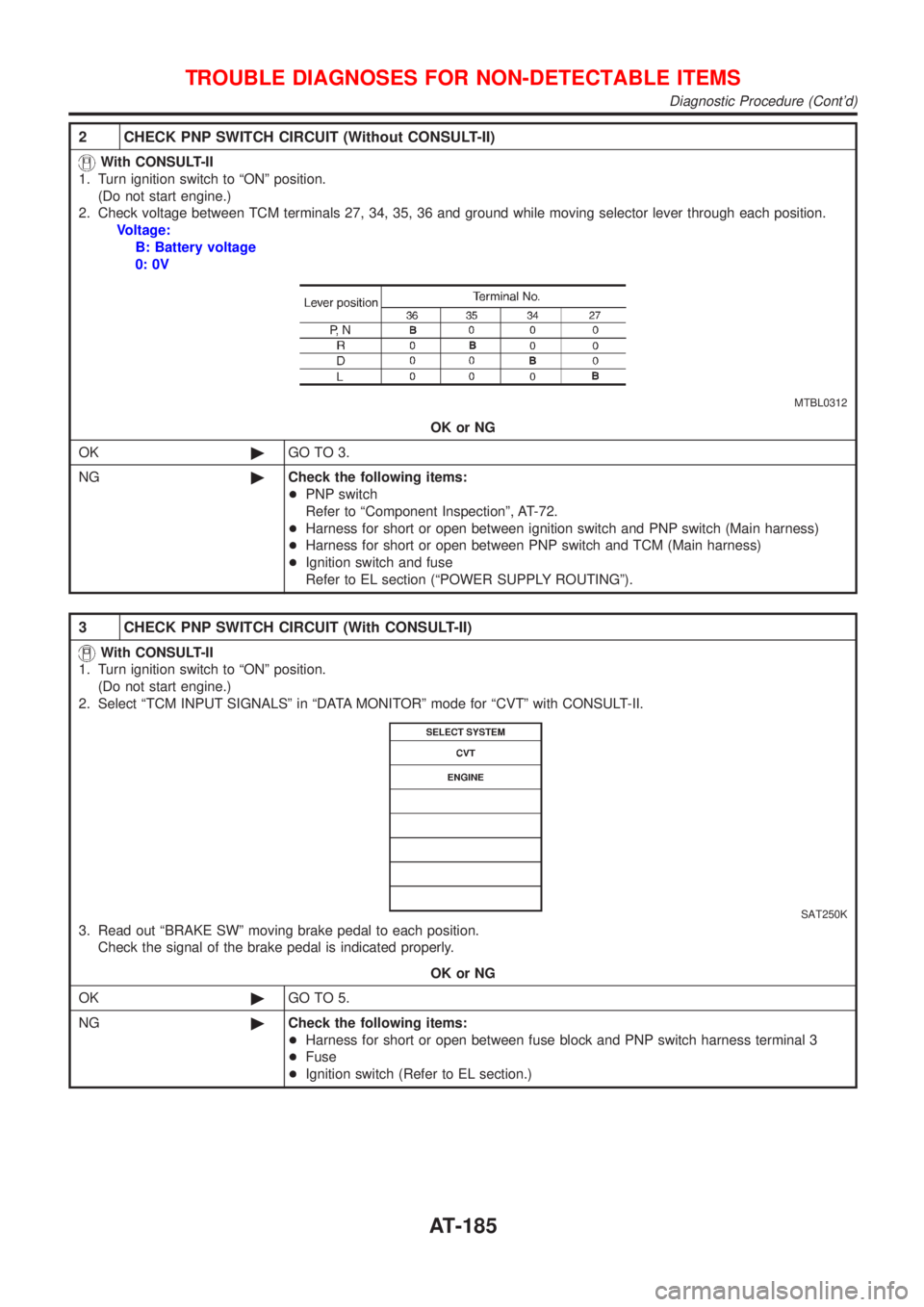
2. Check voltage between TCM terminals 27, 34, 35, 36 and ground while moving selector lever through each position.
Voltage:
B: Battery voltage
0: 0V
MTBL0312
OK or NG
OK©GO TO 3.
NG©Check the following items:
+PNP switch
Refer to ªComponent Inspectionº, AT-72.
+Harness for short or open between ignition switch and PNP switch (Main harness)
+Harness for short or open between PNP switch and TCM (Main harness)
+Ignition switch and fuse
Refer to EL section (ªPOWER SUPPLY ROUTINGº).
3 CHECK PNP SWITCH CIRCUIT (With CONSULT-II)
With CONSULT-II
1. Turn ignition switch to ªONº position.
(Do not start engine.)
2. Select ªTCM INPUT SIGNALSº in ªDATA MONITORº mode for ªCVTº with CONSULT-II.
SAT250K
3. Read out ªBRAKE SWº moving brake pedal to each position.
Check the signal of the brake pedal is indicated properly.
OK or NG
OK©GO TO 5.
NG©Check the following items:
+Harness for short or open between fuse block and PNP switch harness terminal 3
+Fuse
+Ignition switch (Refer to EL section.)
TROUBLE DIAGNOSES FOR NON-DETECTABLE ITEMS
Diagnostic Procedure (Cont'd)
AT-185
Page 196 of 3051
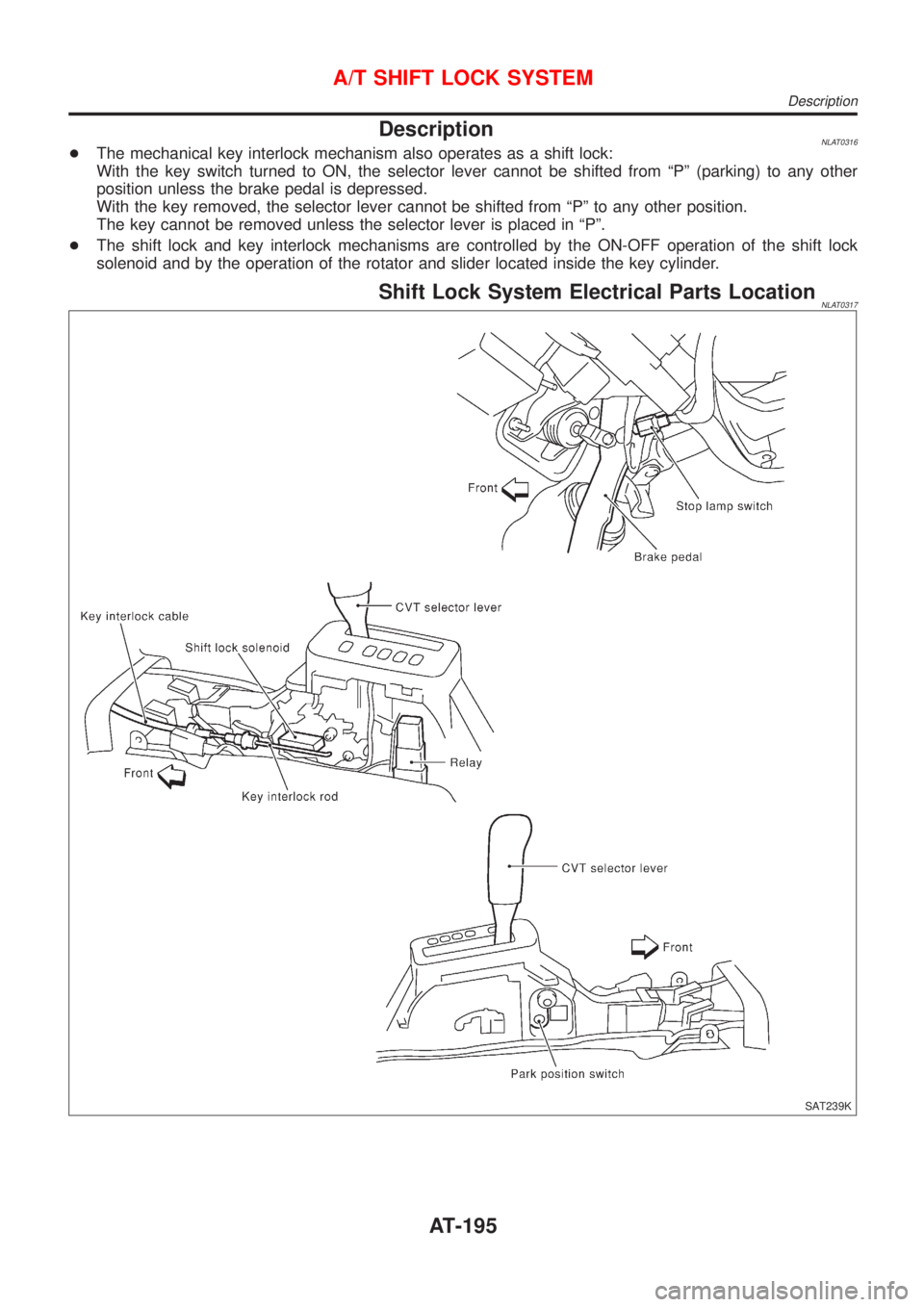
DescriptionNLAT0316+The mechanical key interlock mechanism also operates as a shift lock:
With the key switch turned to ON, the selector lever cannot be shifted from ªPº (parking) to any other
position unless the brake pedal is depressed.
With the key removed, the selector lever cannot be shifted from ªPº to any other position.
The key cannot be removed unless the selector lever is placed in ªPº.
+The shift lock and key interlock mechanisms are controlled by the ON-OFF operation of the shift lock
solenoid and by the operation of the rotator and slider located inside the key cylinder.
Shift Lock System Electrical Parts LocationNLAT0317
SAT239K
A/T SHIFT LOCK SYSTEM
Description
AT-195
Page 199 of 3051
Diagnostic ProcedureNLAT0319SYMPTOM 1:
+Selector lever cannot be moved from ªPº position with key
in ON position and brake pedal applied.
+Selector lever can be moved from ªPº position with key in
ON position and brake pedal released.
+Selector lever can be moved from ªPº position when key
is removed from key cylinder.
SYMPTOM 2:
Ignition key cannot be removed when selector lever is set to
ªPº position. It can be removed when selector lever is set to
any position except ªPº.
1 CHECK KEY INTERLOCK CABLE
Check key interlock cable for damage.
OK or NG
OK©GO TO 2.
NG©Repair key interlock cable. Refer to AT-202.
2 CHECK SELECTOR LEVER POSITION
Check selector lever position for damage.
OK or NG
OK©GO TO 3.
NG©Check selector lever. Refer to ªON-VEHICLE SERVICE Ð PNP Switch and Control
Cable Adjustmentº, AT-204.
3 CHECK POWER SOURCE
1. Turn ignition switch to ªONº position.
(Do not start engine.)
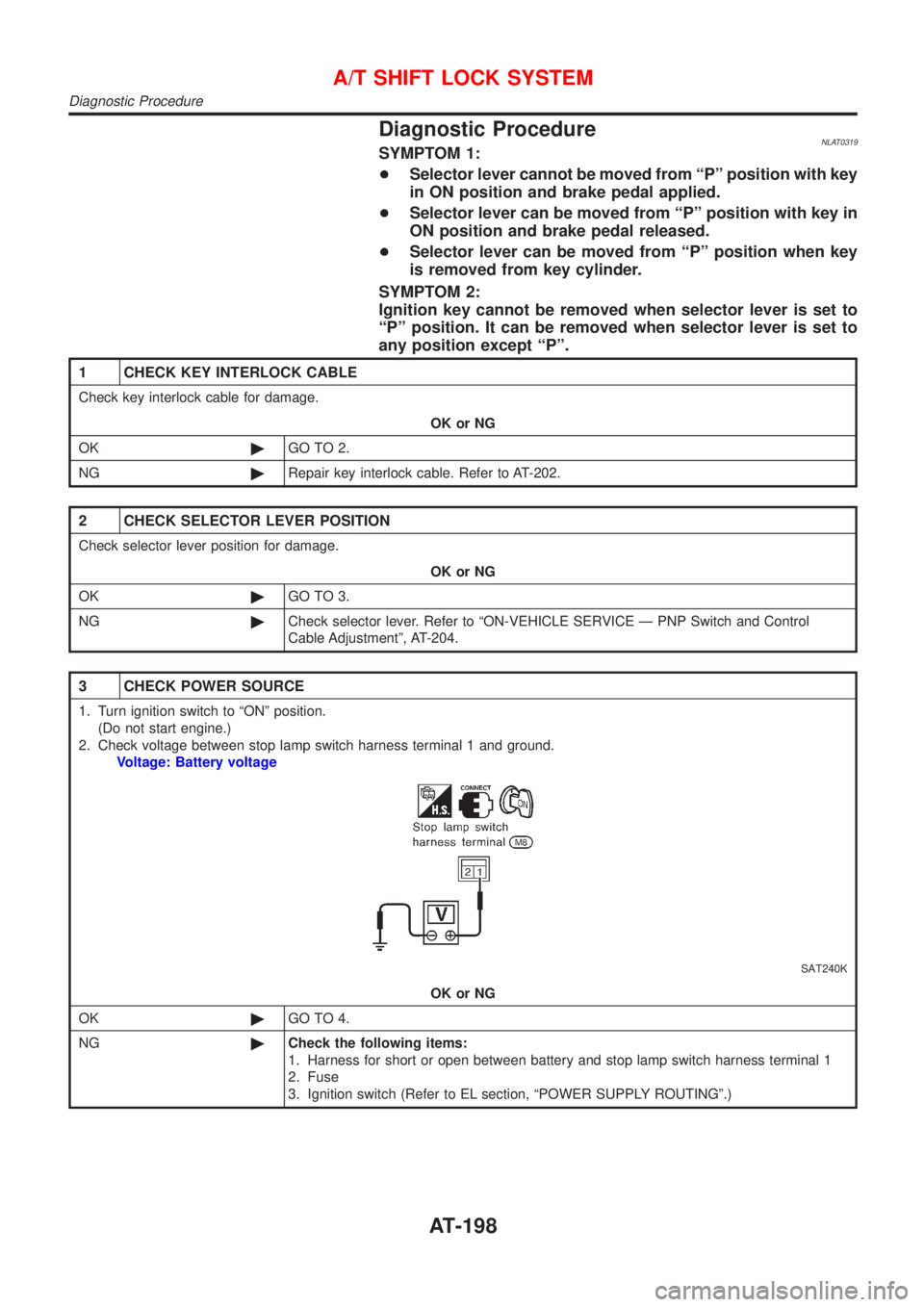
2. Check voltage between stop lamp switch harness terminal 1 and ground.
Voltage: Battery voltage
SAT240K
OK or NG
OK©GO TO 4.
NG©Check the following items:
1. Harness for short or open between battery and stop lamp switch harness terminal 1
2. Fuse
3. Ignition switch (Refer to EL section, ªPOWER SUPPLY ROUTINGº.)
A/T SHIFT LOCK SYSTEM
Diagnostic Procedure
AT-198
Page 200 of 3051
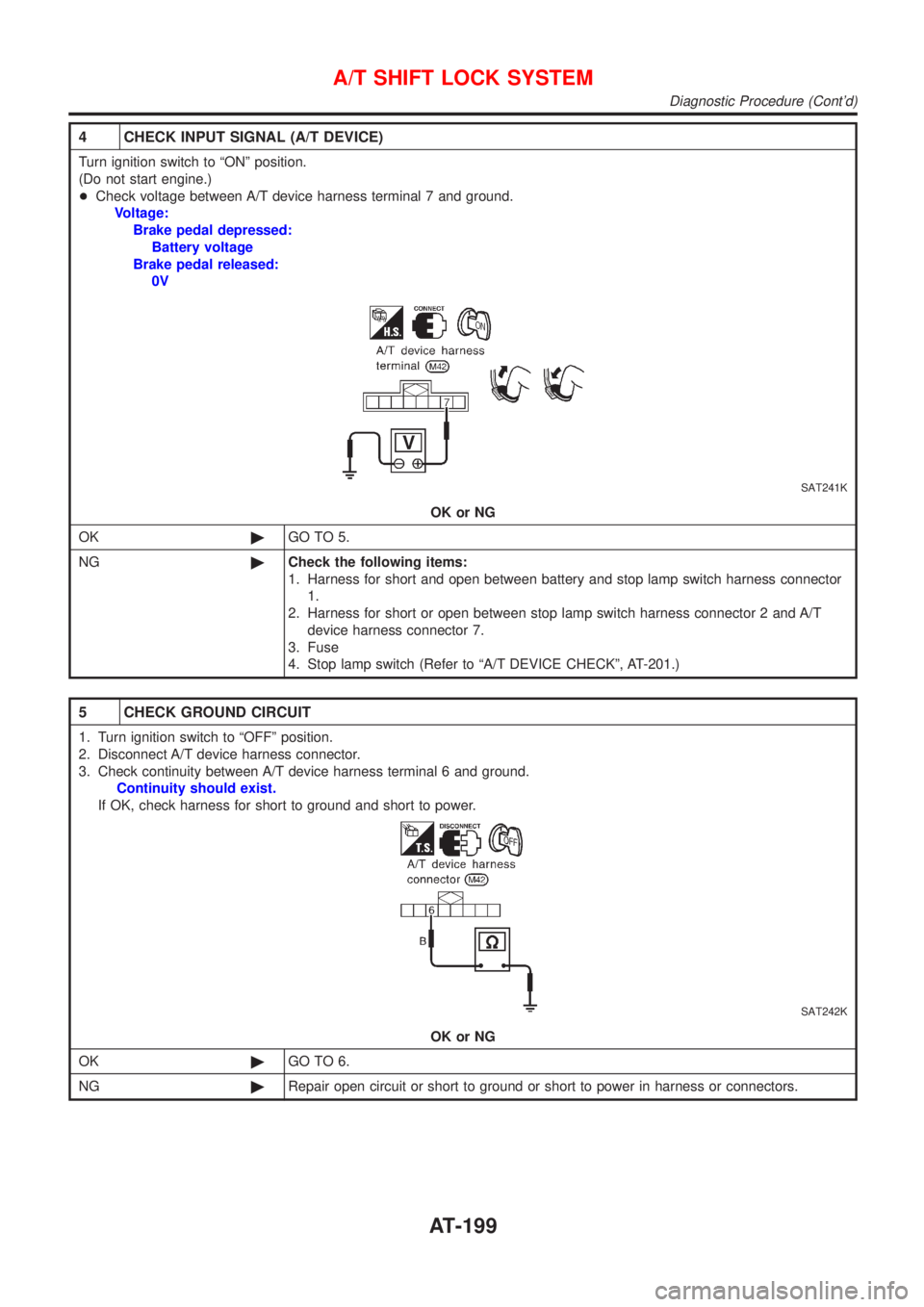
4 CHECK INPUT SIGNAL (A/T DEVICE)
Turn ignition switch to ªONº position.
(Do not start engine.)
+Check voltage between A/T device harness terminal 7 and ground.
Voltage:
Brake pedal depressed:
Battery voltage
Brake pedal released:
0V
SAT241K
OK or NG
OK©GO TO 5.
NG©Check the following items:
1. Harness for short and open between battery and stop lamp switch harness connector
1.
2. Harness for short or open between stop lamp switch harness connector 2 and A/T
device harness connector 7.
3. Fuse
4. Stop lamp switch (Refer to ªA/T DEVICE CHECKº, AT-201.)
5 CHECK GROUND CIRCUIT
1. Turn ignition switch to ªOFFº position.
2. Disconnect A/T device harness connector.
3. Check continuity between A/T device harness terminal 6 and ground.
Continuity should exist.
If OK, check harness for short to ground and short to power.
SAT242K
OK or NG
OK©GO TO 6.
NG©Repair open circuit or short to ground or short to power in harness or connectors.
A/T SHIFT LOCK SYSTEM
Diagnostic Procedure (Cont'd)
AT-199