stop NISSAN FRONTIER 2023 User Guide
[x] Cancel search | Manufacturer: NISSAN, Model Year: 2023, Model line: FRONTIER, Model: NISSAN FRONTIER 2023Pages: 572, PDF Size: 6.58 MB
Page 43 of 572
The ELR mode allows the seat belt to ex-
tend and retract to allow the passengers
some freedom of movement in the seat.
The ELR locks the seat belt when the ve-
hicle slows down rapidly or during certain
impacts.
The ALR mode (child restraint mode) locks
the seat belt for child restraint installation.
When the ALR mode is activated, the seat
belt cannot be extended again until the
seat belt tongue is detached from the
buckle and fully retracted. The seat belt re-
turns to the ELR mode af ter the seat belt
fully retracts. For additional information,
see “Child restraints” (P. 1-26).
The ALR mode should be used only for
child restraint installation. During nor-
mal seat belt use by an occupant, the ALR
mode should not be activated. If it is
activated it may cause uncomfortable
seat belt tension. It can also change the
operation of the front passenger air bag.
For additional information, see “Front
passenger air bag and status light”
(P. 1-80).WARNING
When fastening the seat belts, be cer-
tain that the seatbacks are completely
secured in the latched position. If they
are not completely secured, passen-
gers may be injured in an accident or
sudden stop.
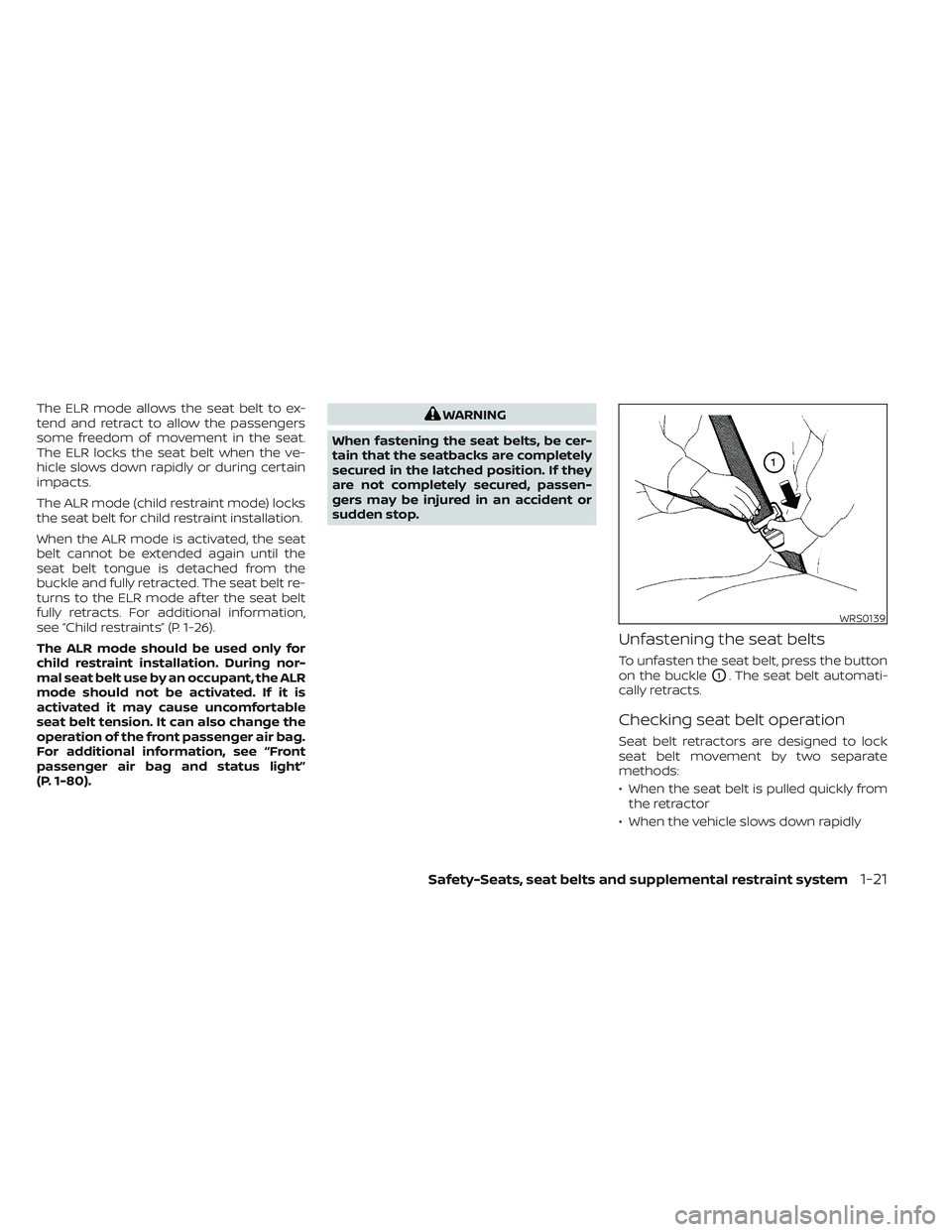
Unfastening the seat belts
To unfasten the seat belt, press the button
on the buckle
O1. The seat belt automati-
cally retracts.
Checking seat belt operation
Seat belt retractors are designed to lock
seat belt movement by two separate
methods:
• When the seat belt is pulled quickly from the retractor
• When the vehicle slows down rapidly
WRS0139
Safety-Seats, seat belts and supplemental restraint system1-21
Page 45 of 572
WARNING
• Only NISSAN seat belt extenders,
made by the same company which
made the original equipment seat
belts, should be used with NISSAN
seat belts.
• Adults and children who can use the
standard seat belt should not use an
extender. Such unnecessary use
could result in serious personal injury
in the event of an accident.
• Never use seat belt extenders to in-
stall child restraints. If the child re-
straint is not secured properly, the
child could be seriously injured or
killed in a collision or a sudden stop.SEAT BELT MAINTENANCE
• To clean the seat belt webbing, apply a
mild soap solution or any solution rec-
ommended for cleaning upholstery or
carpet. Then wipe with a cloth and allow
the seat belts to dry in the shade. Do not
allow the seat belts to retract until they
are completely dry.
• If dirt builds up in the shoulder belt
guide of the seat belt anchors, the seat
belts may retract slowly. Wipe the shoul-
der belt guide with a clean, dry cloth.
• Periodically check to see that the seat
belt and the metal components, such
as buckles, tongues, retractors, flexible
wires and anchors, work properly. If loose
parts, deterioration, cuts or other dam-
age on the webbing is found, the entire
seat belt assembly should be replaced.WARNING
Do not allow children to play with the
seat belts. Most seating positions are
equipped with Automatic Locking Re-
tractor (ALR) mode seat belts. If the seat
belt becomes wrapped around a child’s
neck with the ALR mode activated, the
child can be seriously injured or killed if
the seat belt retracts and becomes
tight. This can occur even if the vehicle
is parked. Unbuckle the seat belt to re-
lease the child. If the seat belt cannot
be unbuckled or is already unbuckled,
release the child by cutting the seat
belt with a suitable tool (such as a knife
or scissors) to release the seat belt.
Children need adults to help protect them.
They need to be properly restrained.
In addition to the general information in
this manual, child safety information is
available from many other sources, includ-
ing doctors, teachers, government traffic
safety offices, and community organiza-
tions. Every child is different, so be sure to
learn the best way to transport your child.
CHILD SAFETY
Safety-Seats, seat belts and supplemental restraint system1-23
Page 48 of 572
WARNING
Never let a child stand or kneel on any
seat and do not allow a child in the
cargo area. The child could be seriously
injured or killed in a sudden stop or
collision.
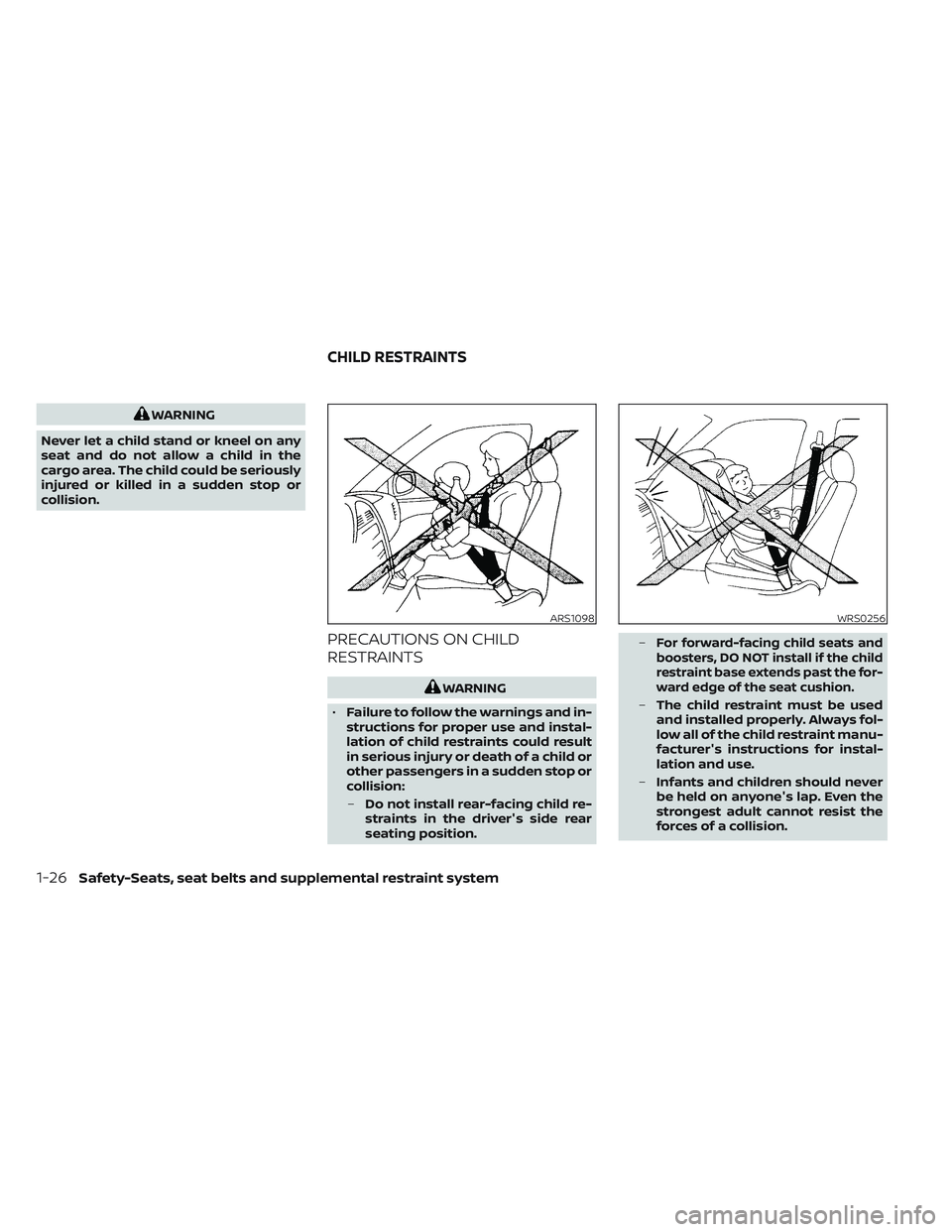
PRECAUTIONS ON CHILD
RESTRAINTS
WARNING
• Failure to follow the warnings and in-
structions for proper use and instal-
lation of child restraints could result
in serious injury or death of a child or
other passengers in a sudden stop or
collision:
– Do not install rear-facing child re-
straints in the driver's side rear
seating position. –
For forward-facing child seats and
boosters, DO NOT install if the child
restraint base extends past the for-
ward edge of the seat cushion.
–
The child restraint must be used
and installed properly. Always fol-
low all of the child restraint manu-
facturer's instructions for instal-
lation and use.
– Infants and children should never
be held on anyone's lap. Even the
strongest adult cannot resist the
forces of a collision.
ARS1098WRS0256
CHILD RESTRAINTS
1-26Safety-Seats, seat belts and supplemental restraint system
Page 49 of 572
–Do not put a seat belt around both
a child and another passenger.
– NISSAN recommends that all child
restraints be installed in the rear
seat. Studies show that children
are safer when properly re-
strained in the rear seat than in
the front seat. If you must install a
forward-facing child restraint in
the front seat, see “Forward-
facing child restraint installation
using the seat belts - front pas-
senger and rear bench seat (Crew
Cab models)” (P. 1-54) or “Forward-
facing child restraint installation
using the seat belts - front pas-
senger and jump seats (King Cab®
models) (P. 1-59).
– Even with the NISSAN Advanced
Air Bag System, never install a
rear-facing child restraint in the
front seat. An inflating air bag
could seriously injure or kill a child.
A rear-facing child restraint must
only be used in the rear seat.
– Be sure to purchase a child re-
straint that will fit the child and
vehicle. Some child restraints may
not fit properly in your vehicle. –Child restraint anchorages are de-
signed to withstand only those
loads imposed by correctly fitted
child restraints. Under no circum-
stances are they to be used to at-
tach adult seat belts, or other items
or equipment to the vehicle. Doing
so could damage the child restraint
anchorages. The child restraint will
not be properly installed using the
damaged anchorage, and a child
could be seriously injured or killed
in a collision.
–
Never use the anchor points for
adult seat belts, or other items.
– A child restraint with a top tether
strap should not be used in the
front passenger seat (King Cab®
models).
–
Keep seatbacks as upright as pos-
sible af ter fitting the child restraint.
– Infants and children should al-
ways be placed in an appropriate
child restraint while in the vehicle.
• When the child restraint is not in use,
keep it secured with the LATCH sys-
tem or a seat belt. In a sudden stop
or collision, loose objects can injure
occupants or damage the vehicle.
CAUTION
A child restraint in a closed vehicle can
become very hot. Check the seating
surface and buckles before placing a
child in the child restraint.
This vehicle is equipped with a universal
child restraint anchor system, referred to
as the LATCH (Lower Anchors and Tethers
for CHildren) system. Some child restraints
include rigid or webbing-mounted attach-
ments that can be connected to these
anchors. For additional information, see
“LATCH (Lower Anchors and Tethers for
CHildren) system” (P. 1-28).
If you do not have a LATCH compatible
child restraint, the vehicle seat belts can be
used.
Safety-Seats, seat belts and supplemental restraint system1-27
Page 51 of 572
is greater than 65 lbs. (29.5 kg) use the vehi-
cle’s seat belt (not the lower anchors) to
install the child restraint. Be sure to follow
the child restraint manufacturer’s instruc-
tions for installation.
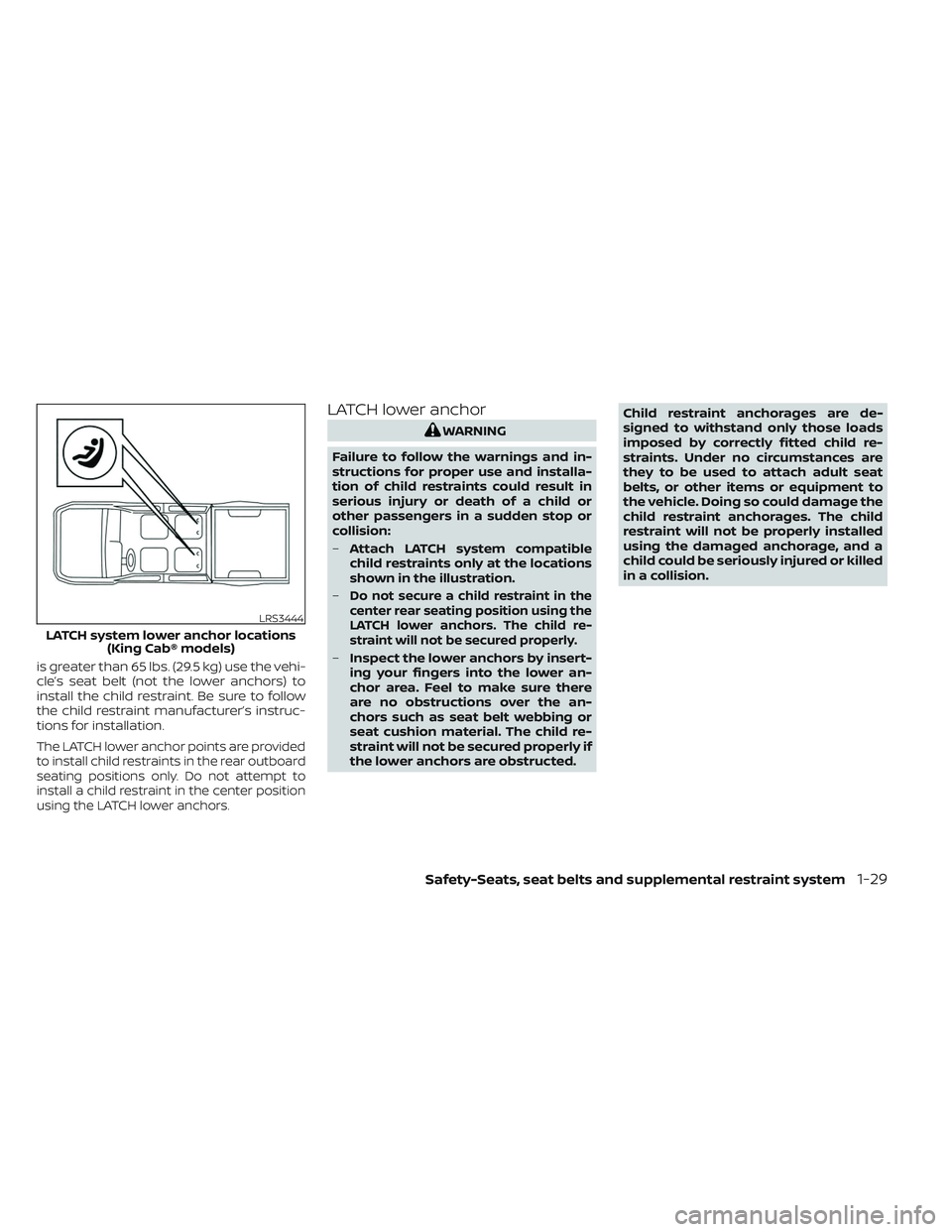
The LATCH lower anchor points are provided
to install child restraints in the rear outboard
seating positions only. Do not attempt to
install a child restraint in the center position
using the LATCH lower anchors.
LATCH lower anchor
WARNING
Failure to follow the warnings and in-
structions for proper use and installa-
tion of child restraints could result in
serious injury or death of a child or
other passengers in a sudden stop or
collision:
– Attach LATCH system compatible
child restraints only at the locations
shown in the illustration.
–
Do not secure a child restraint in the
center rear seating position using the
LATCH lower anchors. The child re-
straint will not be secured properly.
– Inspect the lower anchors by insert-
ing your fingers into the lower an-
chor area. Feel to make sure there
are no obstructions over the an-
chors such as seat belt webbing or
seat cushion material. The child re-
straint will not be secured properly if
the lower anchors are obstructed. Child restraint anchorages are de-
signed to withstand only those loads
imposed by correctly fitted child re-
straints. Under no circumstances are
they to be used to attach adult seat
belts, or other items or equipment to
the vehicle. Doing so could damage the
child restraint anchorages. The child
restraint will not be properly installed
using the damaged anchorage, and a
child could be seriously injured or killed
in a collision.
LRS3444
LATCH system lower anchor locations
(King Cab® models)
Safety-Seats, seat belts and supplemental restraint system1-29
Page 56 of 572
5. Check to make sure the child restraint isproperly secured prior to each use. If the
child restraint is loose, repeat steps 2
through 4.
REAR-FACING CHILD RESTRAINT
INSTALLATION USING LATCH —
JUMP SEAT (King Cab® models)
WARNING
• If a child restraint system is not in-
stalled properly, the child could be
seriously injured or killed in a sudden
stop or collision.
– Never install a rear-facing child re-
straint system on the driver's side
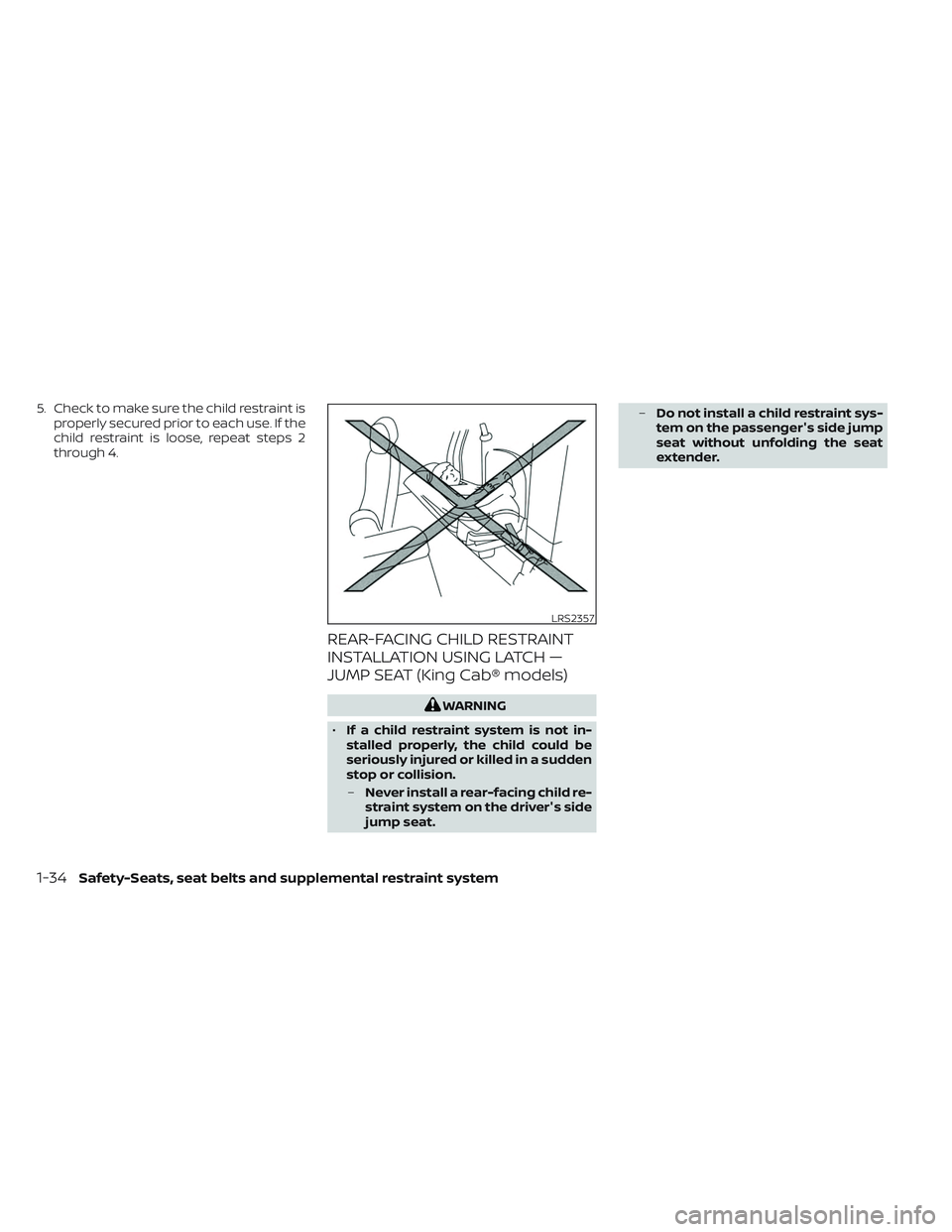
jump seat. –
Do not install a child restraint sys-
tem on the passenger's side jump
seat without unfolding the seat
extender.
LRS2357
1-34Safety-Seats, seat belts and supplemental restraint system
Page 57 of 572
WARNING
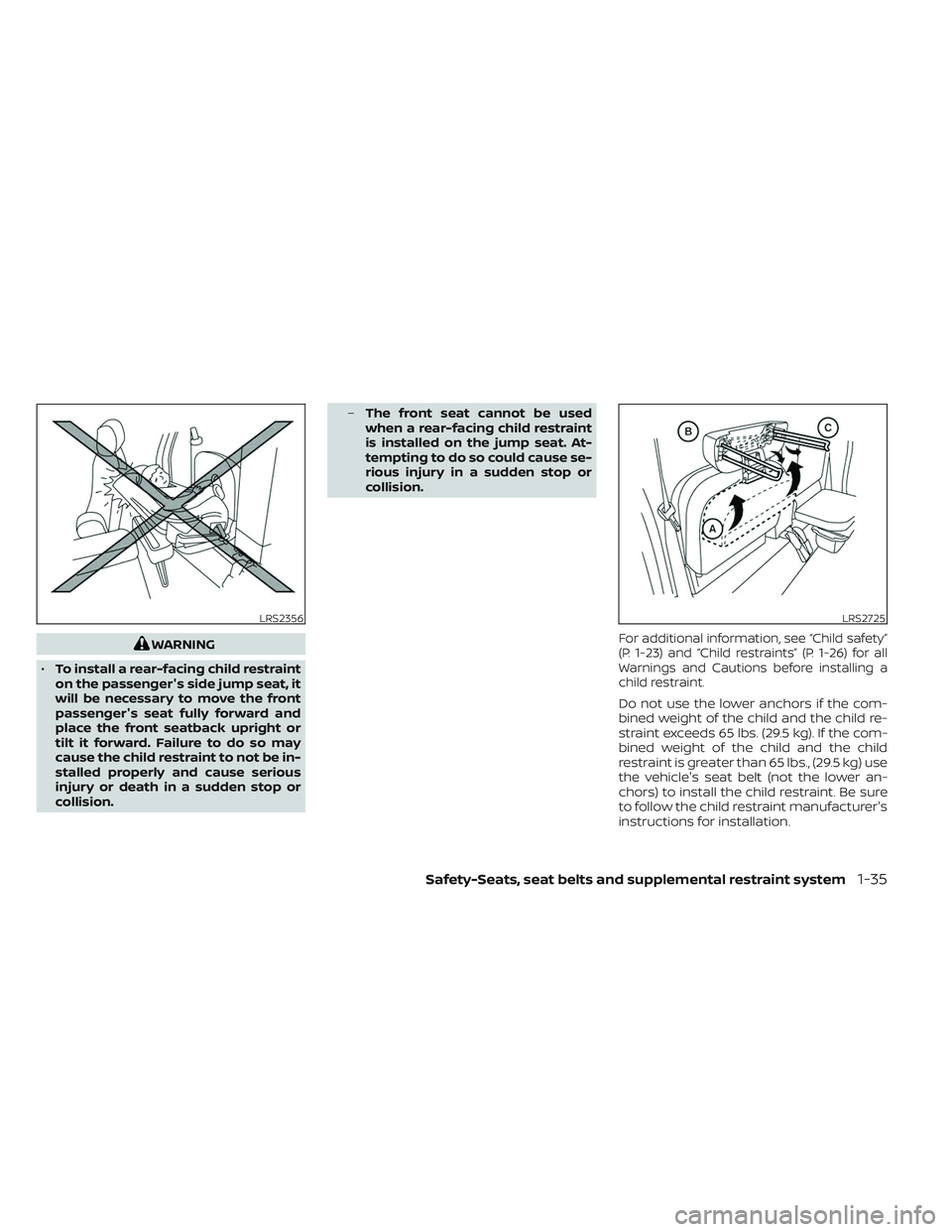
• To install a rear-facing child restraint
on the passenger's side jump seat, it
will be necessary to move the front
passenger's seat fully forward and
place the front seatback upright or
tilt it forward. Failure to do so may
cause the child restraint to not be in-
stalled properly and cause serious
injury or death in a sudden stop or
collision. –
The front seat cannot be used
when a rear-facing child restraint
is installed on the jump seat. At-
tempting to do so could cause se-
rious injury in a sudden stop or
collision.For additional information, see “Child safety”
(P. 1-23) and “Child restraints” (P. 1-26) for all
Warnings and Cautions before installing a
child restraint.
Do not use the lower anchors if the com-
bined weight of the child and the child re-
straint exceeds 65 lbs. (29.5 kg). If the com-
bined weight of the child and the child
restraint is greater than 65 lbs., (29.5 kg) use
the vehicle's seat belt (not the lower an-
chors) to install the child restraint. Be sure
to follow the child restraint manufacturer's
instructions for installation.
LRS2356LRS2725
Safety-Seats, seat belts and supplemental restraint system1-35
Page 60 of 572
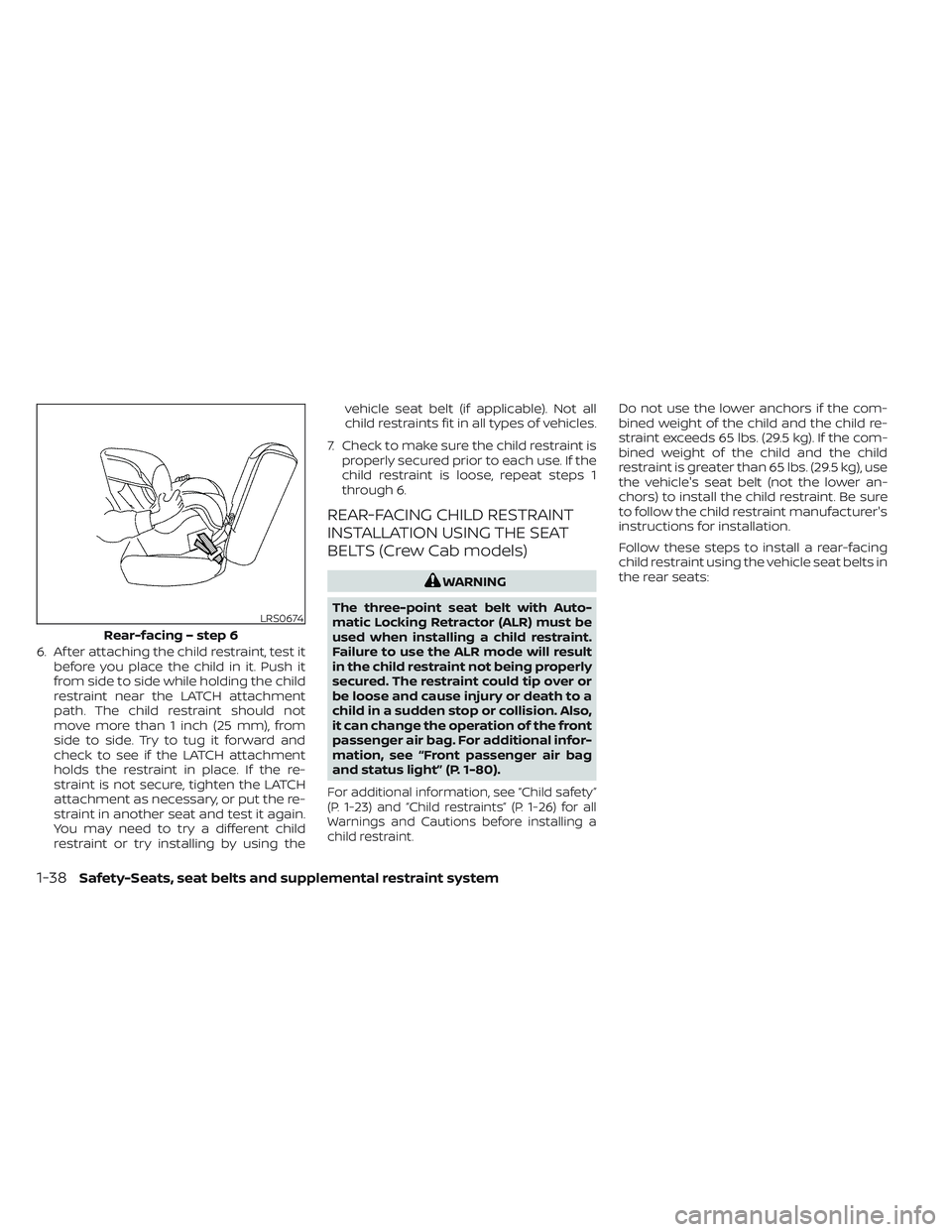
6. Af ter attaching the child restraint, test itbefore you place the child in it. Push it
from side to side while holding the child
restraint near the LATCH attachment
path. The child restraint should not
move more than 1 inch (25 mm), from
side to side. Try to tug it forward and
check to see if the LATCH attachment
holds the restraint in place. If the re-
straint is not secure, tighten the LATCH
attachment as necessary, or put the re-
straint in another seat and test it again.
You may need to try a different child
restraint or try installing by using the vehicle seat belt (if applicable). Not all
child restraints fit in all types of vehicles.
7. Check to make sure the child restraint is properly secured prior to each use. If the
child restraint is loose, repeat steps 1
through 6.
REAR-FACING CHILD RESTRAINT
INSTALLATION USING THE SEAT
BELTS (Crew Cab models)
WARNING
The three-point seat belt with Auto-
matic Locking Retractor (ALR) must be
used when installing a child restraint.
Failure to use the ALR mode will result
in the child restraint not being properly
secured. The restraint could tip over or
be loose and cause injury or death to a
child in a sudden stop or collision. Also,
it can change the operation of the front
passenger air bag. For additional infor-
mation, see “Front passenger air bag
and status light” (P. 1-80).
For additional information, see “Child safety”
(P. 1-23) and “Child restraints” (P. 1-26) for all
Warnings and Cautions before installing a
child restraint.
Do not use the lower anchors if the com-
bined weight of the child and the child re-
straint exceeds 65 lbs. (29.5 kg). If the com-
bined weight of the child and the child
restraint is greater than 65 lbs. (29.5 kg), use
the vehicle's seat belt (not the lower an-
chors) to install the child restraint. Be sure
to follow the child restraint manufacturer's
instructions for installation.
Follow these steps to install a rear-facing
child restraint using the vehicle seat belts in
the rear seats:
LRS0674
Rear-facing – step 6
1-38Safety-Seats, seat belts and supplemental restraint system
Page 63 of 572
7. Check to make sure that the child re-straint is properly secured prior to each
use. If the seat belt is not locked, repeat
steps 3 through 6.
Af ter the child restraint is removed and the
seat belt fully retracted, the ALR mode
(child restraint mode) is canceled.
REAR-FACING CHILD RESTRAINT
INSTALLATION USING THE SEAT
BELTS — JUMP SEAT (King Cab®
models)
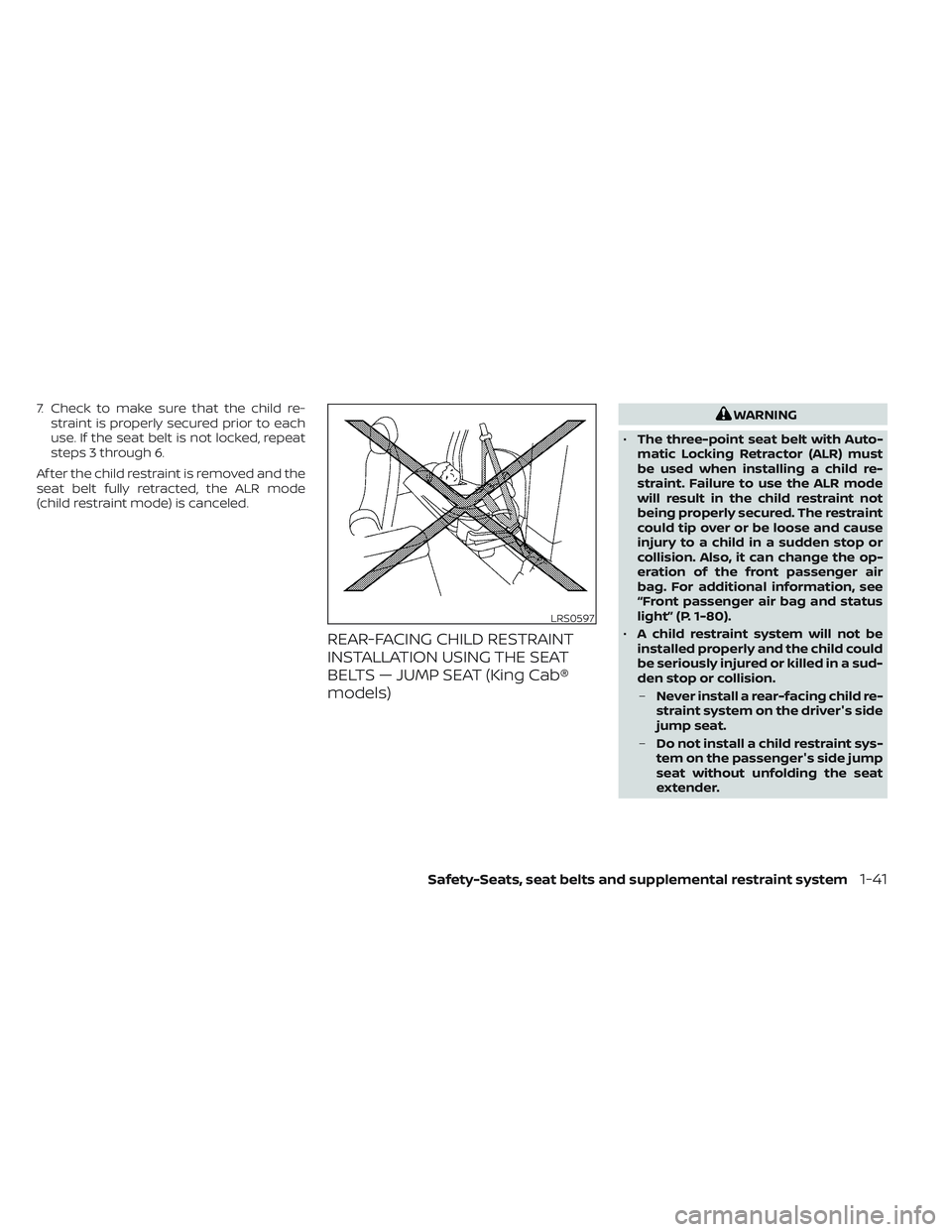
WARNING
• The three-point seat belt with Auto-
matic Locking Retractor (ALR) must
be used when installing a child re-
straint. Failure to use the ALR mode
will result in the child restraint not
being properly secured. The restraint
could tip over or be loose and cause
injury to a child in a sudden stop or
collision. Also, it can change the op-
eration of the front passenger air
bag. For additional information, see
“Front passenger air bag and status
light” (P. 1-80).
• A child restraint system will not be
installed properly and the child could
be seriously injured or killed in a sud-
den stop or collision.
– Never install a rear-facing child re-
straint system on the driver's side
jump seat.
– Do not install a child restraint sys-
tem on the passenger's side jump
seat without unfolding the seat
extender.
LRS0597
Safety-Seats, seat belts and supplemental restraint system1-41
Page 64 of 572
WARNING
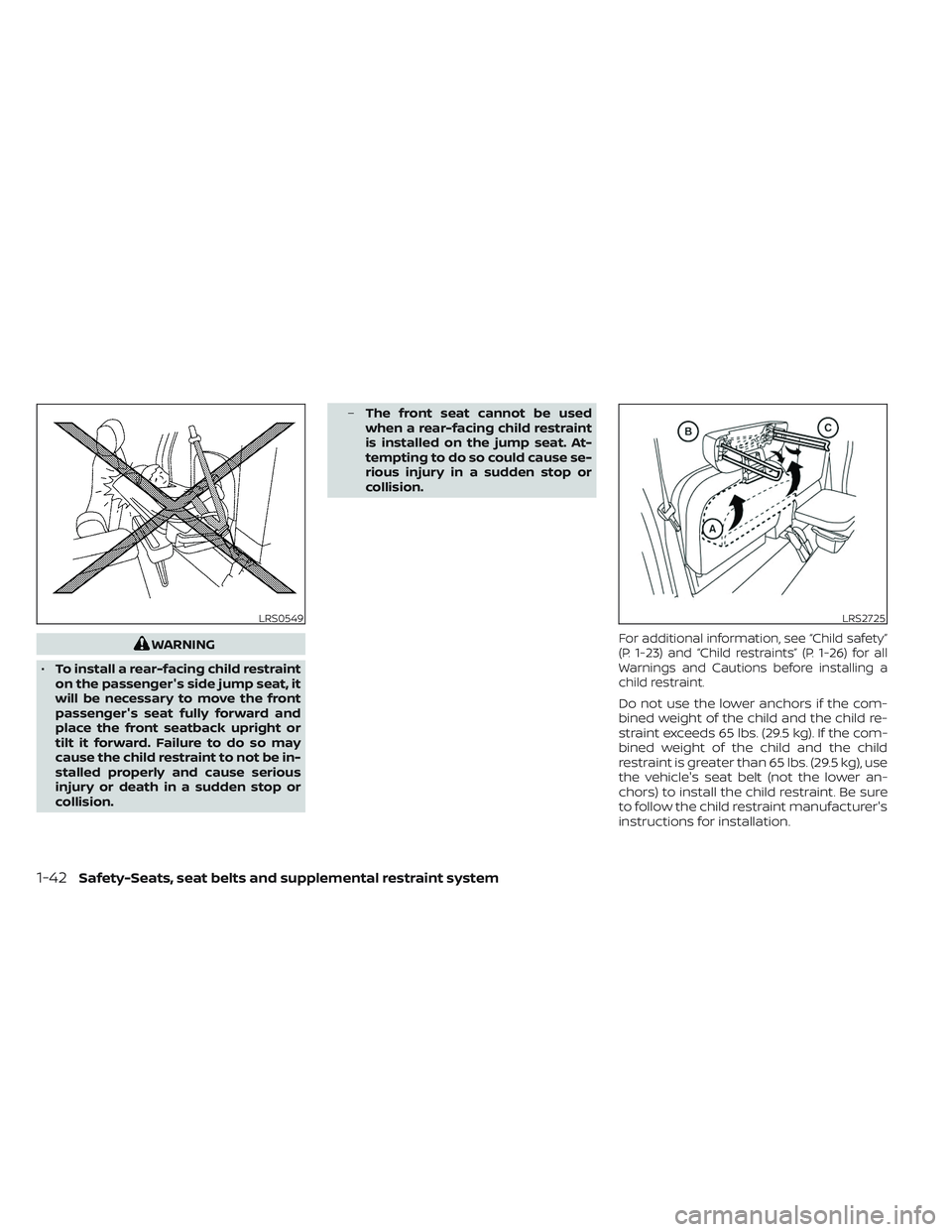
• To install a rear-facing child restraint
on the passenger's side jump seat, it
will be necessary to move the front
passenger's seat fully forward and
place the front seatback upright or
tilt it forward. Failure to do so may
cause the child restraint to not be in-
stalled properly and cause serious
injury or death in a sudden stop or
collision. –
The front seat cannot be used
when a rear-facing child restraint
is installed on the jump seat. At-
tempting to do so could cause se-
rious injury in a sudden stop or
collision.For additional information, see “Child safety”
(P. 1-23) and “Child restraints” (P. 1-26) for all
Warnings and Cautions before installing a
child restraint.
Do not use the lower anchors if the com-
bined weight of the child and the child re-
straint exceeds 65 lbs. (29.5 kg). If the com-
bined weight of the child and the child
restraint is greater than 65 lbs. (29.5 kg), use
the vehicle's seat belt (not the lower an-
chors) to install the child restraint. Be sure
to follow the child restraint manufacturer's
instructions for installation.
LRS0549LRS2725
1-42Safety-Seats, seat belts and supplemental restraint system