lock NISSAN GT-R 1998 User Guide
[x] Cancel search | Manufacturer: NISSAN, Model Year: 1998, Model line: GT-R, Model: NISSAN GT-R 1998Pages: 230, PDF Size: 12.66 MB
Page 62 of 230

TROUBLE DIAGNOSES
Control Unit Input/Output Signal Specifications
Refer to EC section ("ECM.TCM or ECM Input/Output Signal
Reference Value").
USING CONSULT -
Monitor item Indication value Operating status
Throttle position sensor Approx.
0.4 - 4.OV
Throttle fully - closed to fully-open --
AK fluid temperature sensor I Appro~. 1.5 - 0.5V I A/T fluid: Appro~. 20 - 80°C -- - - --- -
ON Overdrive control switch: OFF
Lever switch
OFF Overdrive control switch: ON
Line pressure
duty 29 - 94% Low
pressure - High pressure
Lock-up duty
4 - 94% Lock-up released - Lock-up engaged
USING CIRCUIT TESTER
Terminal
No.' 1 Condition Specifications
.- Refer to EC section
("ECM-TCM or
5 (39) Engine speed signal - ECM Input/Output Signal Reference
Value*).
Voltage increases gradually in
Throttle position sensor
signal After
engine warm-up, depress accelerator pedal
slowly. response
to throttle position.
Fully-closed throttle
: Approx. 0.5V
Fully-open throttle : Approx. 4.2V
24 (I0) Power source
31 (19) Turn
ignition switch ON. Battery
voltage
Turn ignition switch OFF. Approx.
OV
--
25 (25) 1 Ground 32 (48) Turn ignition switch ON. Approx. OV
Shift control
signal SB1 - - 28 (I4) (Except RB20DE)
Vehicle speed sensor
2 When vehicle is moved at 2 to 3 km/h for more than Voltage varies approx. between OV 29 (40) (vehicle speed
signal in 1 m. and 4.5V intermittently.
speedometer)
*: Each number in parenthesis ( ) shows the terminal No. for TCM (RB25DE).
Page 64 of 230

TROUBLE DIAGNOSES
Control Unit InputlOutput Signal Specifications
(Cont'd)
Terminal
No.' Operation
or measurement condition
Specifications
Total control signal
(multiple communication)
(Except
RB20DE) Refer to
EC section
("ECM.TCM or ECM Input1
Output Signal Reference Value").
I I
I Turn ignition swi?ch ON. I Battery voltage
Power supply (Backup)
Line pressure solenoid - - Turn ignition switch OFF. Battery voltage
r After engine
warm-up, depress accelerator pedal
Line pressure solenoid
(dropping resistor circuit) 5
Approx. OV
w
0.
s
Overrun clutch solenoid After engine
wan-up, release accelerator pedal.
After engine warm-up, release accelerator pedal.
After engine warm-up, depress accelerator pedal
fullv. .- >. .- 5
POWER indicator lamp (4AT)
Dual rnatic
AK waming lamp
(M-AT)
Approx. 1.5 - 3.OV
Approx. 4 - 14V
Approx. OV
When POWER indicator lamp is tumed on (W
mode switch: POWER), or dual matic warn-
ing lamp
is turned on
When
overrun clutch solenoid operates
When overrun clutch solenoid does not operate
Approx.
OV
Battery voltage Approx.
OV
When POWER indicator lamp is tumed off (NT
mode switch:Except POWER), or dual matic A/T Battery voltage
I warning lamp is turned off 1
I When vehicle is locked UD I Approx. 8 - 15V Lock-up solenoid I . .
When vehicle is not locked up I Approx. OV
When shift solenoid A operates
(Driving in 'Dln or
"D,")
When
shift solenoid A does not operate
(Driving in
"D," or "D,")
parenthesis
(
Battery voltage
Approx.
OV
Shift solenoid B
) shows the terminal No. for TCM (RB25DE ).
I
*: Each
When shift solenoid B operates
(Driving in 'Dln or
'D,")
When shift solenoid
B does not operate
(Driving in
"D,"
or
"Dd)
number Battery voltage
Approx. OV
Page 67 of 230

TROUBLE DIAGNOSES
Shift Schedule
VEHICLE SPEED WHEN SHIFTING GEARS
RB20DE engine (4AX03 model)
I 1 Vehicle meed km/h
Throttle opening
Full throttle
RB25DE engine (4AX01 model)
Shift pattern
Half throttle
I I Vehicle s~eed km/h
D14D2 I D2*D3 I D34D4 1 D4-1D3 I D3*D2 I D24D1
Normal
Power
Normal
Power
Full throttle 46 - 50
46
- 50
I
Throttle opening Shift pattern
31 - 35
43
- 47
I D2-rD3 I DJdD4 I D4*D3 1 D3*02 1 D24D1
91 - 99
91 - 99
Normal
Power
RB25DET engine (4AX00 model)
62 - 68
84
- 90 149
- 159
149
- 159
50
- 54
50
- 54 I
101 - 109
135
- 143
32
- 36
42
- 46 Half throttle
Throttle opening
VEHICLE SPEED WHEN PERFORMING LOCK-UP
144 - 154
144
- 154
101
- 109
101
- 109
Normal Power
Full throttle
Half throttle
71 - 79
83
- 91
61
- 67
85
- 91
Shift pattern
86 - 94
86
- 94
157
- 167
157
- 167
Vehicle speed krnlh
D14D2 I D2*D3 I D3*D4 I D4*D3 I D3*DZ I D2+D1
Normal
Power
Normal
Power
Closed throttle: Throttle opening
is 118 or below, and idle switch is turned OFF.
Half throttle: Throttle opening is 418.
41 - 45
41
- 45
41
- 45
45
- 51
104
- 112
135
- 143
Engine type
Model No.
speed
D4
speed
6-10
6- 10
151
- 161
151
- 161
-
45 - 49
45
- 49
31
- 35
39
- 43
RB20DE
4AX03
31
- 39
- D,
80 - 88
87
- 95
Lock-up OFF kmh
Lock-up
ON km/h
Lock-up
OFF kmlh
96 - 104
96
- 104
RB25DE
4AX01
34
- 42
- Lock-up ON km/h
40 - 44
40 - 44
37 - 43
45
- 51
-
103 - 111
103
- 111
74
- 80
84
- 90
RB25DET
4AX00
-
-
Closed throttle
Half throttle
Closed throttle
Half throttle
Closed throttle
Half throttle
Closed throttle
Half throttle
6-10
6-10
98
- 106
98 - 106
32
- 38
50
- 56
-- --
40 - 44
40
- 44
6-10
6- 10
167
- 177
167
- 177
111
- 119
133
- 141
23
- 31
101
- 109
44
- 52
120
- 128
35
- 43
110
- 118
-- -- -
161 - 171
161
- 171
63
- 71
98
- 106
25
- 33
104
- 112
48
- 56
118
- 126
38
- 46
107
- 115 59
- 67
121
- 129
55
- 63
128 - 136
52
- 60
103
- 111
Page 68 of 230
TROUBLE DIAGNOSES
n t
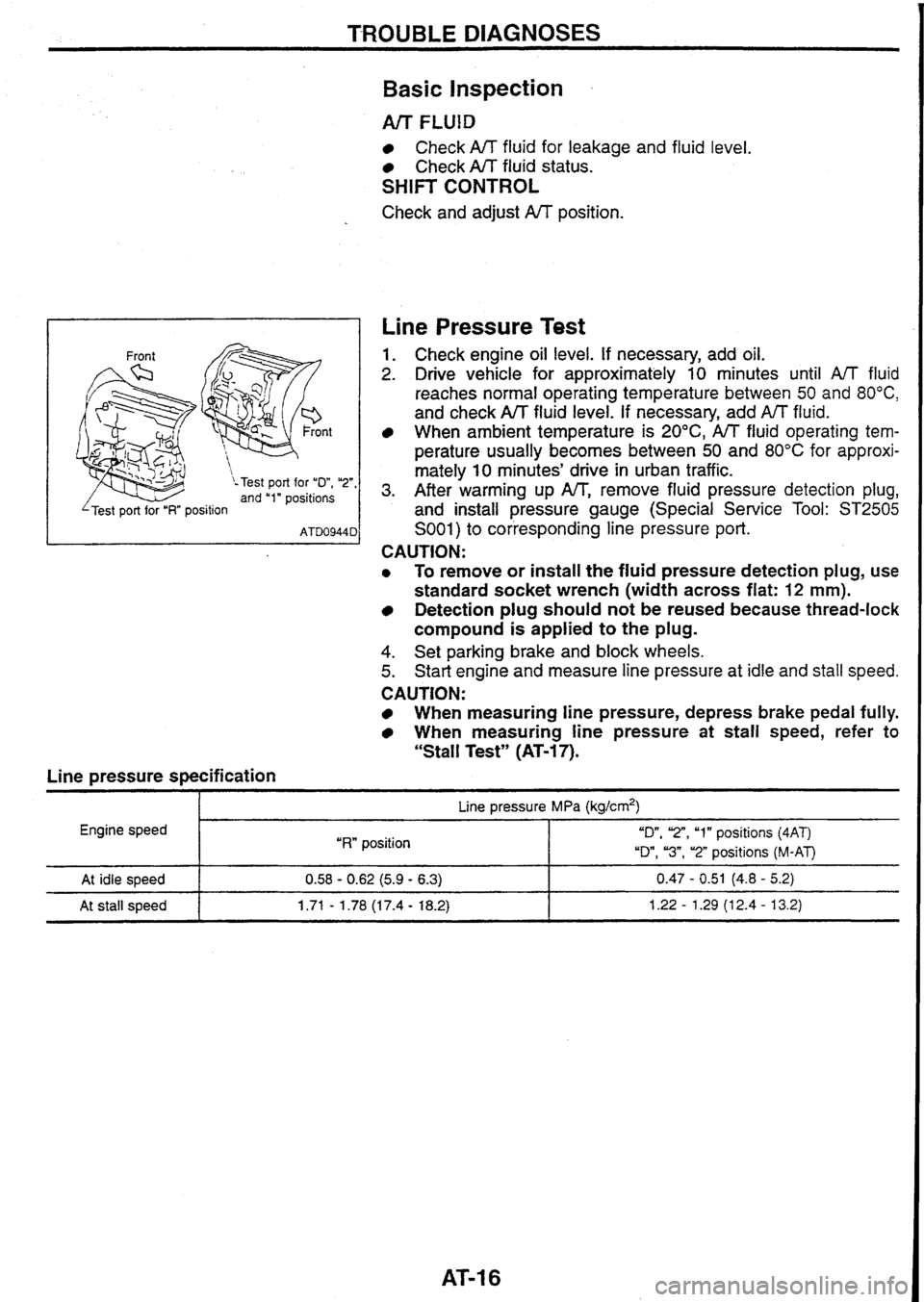
\-Test port for "D", "2", and "1" positions
I 'Test port for "I?" position I
Line pressure specification
Basic Inspection
Arr FLUlD
Check A/T fluid for leakage and fluid level.
Check A/T fluid status.
SHIFT CONTROL
Check and adjust A/T position.
Line Pressure Test
1. Check engine oil level. If necessary, add oil.
2. Drive vehicle for approximately 10 minutes until A/T fluid
reaches normal operating temperature between
50 and 80°C,
and check A/T fluid level. If necessary, add fluid.
When
ambient temperature is 20°C, A/T fluid operating tem-
perature
usually becomes between 50 and 80°C for approxi-
mately
10 minutes' drive in urban traffic.
3. After warming up IW', remove fluid pressure detection plug,
and install pressure gauge (Special Service Tool:
ST2505
S001) to corresponding line pressure port.
CAUTION:
0 To remove or install the fluid pressure detection plug, use
standard socket wrench (width across flat:
12 mm).
Detection plug should not be reused because thread-lock
compound is applied
to the plug.
4. Set parking brake and block wheels.
5. Start engine and measure line pressure at idle and stall speed.
CAUTION:
When measuring line pressure, depress brake pedal fully.
When measuring line pressure at stall speed, refer to
"Stall Test" (AT-17).
I p- Line pressure MPa (kg/crn2)
Engine speed
I "RW position "On, 'Z", "1" positions (4AT)
"Dm,
"3", "2" positions (M-AT)
At idle speed
At stall speed 0.58 - 0.62 (5.9 - 6.3) 0.47 - 0.51 (4.8 - 5.2)
1.71
- 1.78 (1 7.4 - 18.2) 1.22 - 1.29 (1 2.4 - 13.2)
Page 69 of 230
TROUBLE DIAGNOSES
Line Pressure Test (Cont'd)
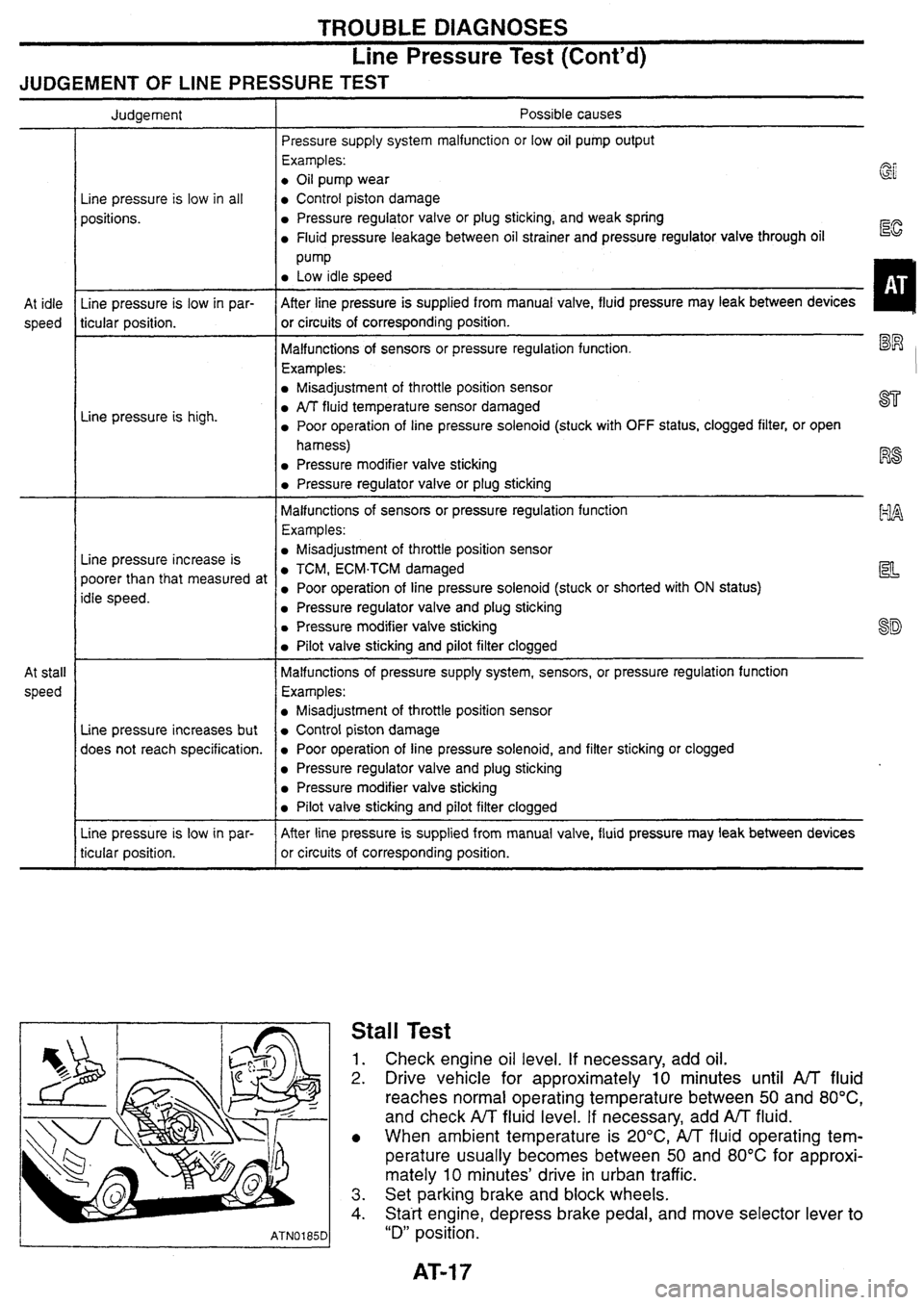
JUDGEMENT OF LINE PRESSURE TEST
At idle
speed
At stall
speed Judgement
Line pressure is low in all
positions.
Line pressure is low in par-
ticular position.
Line pressure is
high.
Line pressure increase is
poorer than that measured at
idle speed.
Line pressure increases but
does not reach specification.
Line pressure is low in par-
ticular position. Possible
causes
Pressure supply system malfunction or low oil pump output
Examples:
0 Oil pump wear
Control piston damage
Pressure regulator valve or plug sticking, and weak spring
Fluid pressure leakage between oil strainer and pressure regulator valve through oil Eg
Pump
Low idle speed
After line pressure is supplied from manual valve, fluid pressure may leak between devices
or circuits of corresponding position.
1
Malfunctions of sensors or pressure regulation function. El
Examples:
Misadjustment of throttle position sensor
PJT fluid temperature sensor damaged ST
Poor operation of line pressure solenoid (stuck with OFF status, clogged filter, or open
harness)
Pressure modifier valve sticking F%
Pressure regulator valve or plug sticking
Malfunctions of sensors or pressure regulation function
Examples:
EILA
Misadjustment of throttle position sensor
TCM, ECM.TCM damaged la
Poor operation of line pressure solenoid (stuck or shorted with ON status)
Pressure regulator valve and plug sticking
Pressure modifier valve sticking
sf$
Pilot valve sticking and pilot filter clogged
Malfunctions of pressure supply system, sensors, or pressure regulation function
Examples:
Misadjustment of throttle position sensor
Control piston damage
Poor operation of line pressure solenoid, and filter sticking or clogged
Pressure regulator valve and plug sticking
Pressure modifier valve sticking
Pilot valve sticking and pilot filter clogged
After line pressure is supplied from manual valve, fluid pressure
may leak between devices
or circuits of corresponding position.
Stall Test
1. Check engine oil level. If necessary, add oil.
2. Drive vehicle for approximately 10 minutes until A/T fluid
reaches normal operating temperature between
50 and 80°C,
and check A/T fluid level. If necessary, add AfT fluid.
When ambient temperature is
20°C,
A/T fluid operating tem-
perature usually becomes between 50 and
80°C for approxi-
mately
10 minutes' drive in urban traffic.
3. Set parking brake and block wheels.
4. Statt engine, depress brake pedal, and move selector lever to
"D" position.
Page 71 of 230
TROUBLE DIAGNOSES
DESCRIPTION
CONSULT indicates operation timing of each solenoid such as electrical shift timing and lock-up timing.
Therefore, when there is a definite difference between shift timing detected from shift shock (or engine
speed variation) and the one indicated by CONSULT, mechanical parts other than solenoids and sensors
(including hydraulic circuit) may be malfunctioning. In this case, check the mechanical parts using appli-
cable diagnostic procedures.
Shift schedule (which implies gear position) displayed on CONSULT and that indicated in Service Manual
may differ slightly. This occurs because of the following reasons:
Actual shift schedule has more or less tolerance or allowance.
Shift schedule indicated in Service Manual refers to the point where shifts start, and gear position dis-
played on CONSULT indicates the point where shifts are completed.
Shift solenoid valve A or B (ON/OFF) is displayed on CONSULT at the start of shifting. Gear position
is displayed upon completion of shifting (which is computed by TCM).
To make sure the part No. of ECM-TCM on CONSULT, touch "ENGINE" to verify "C/U PART NUMBER".
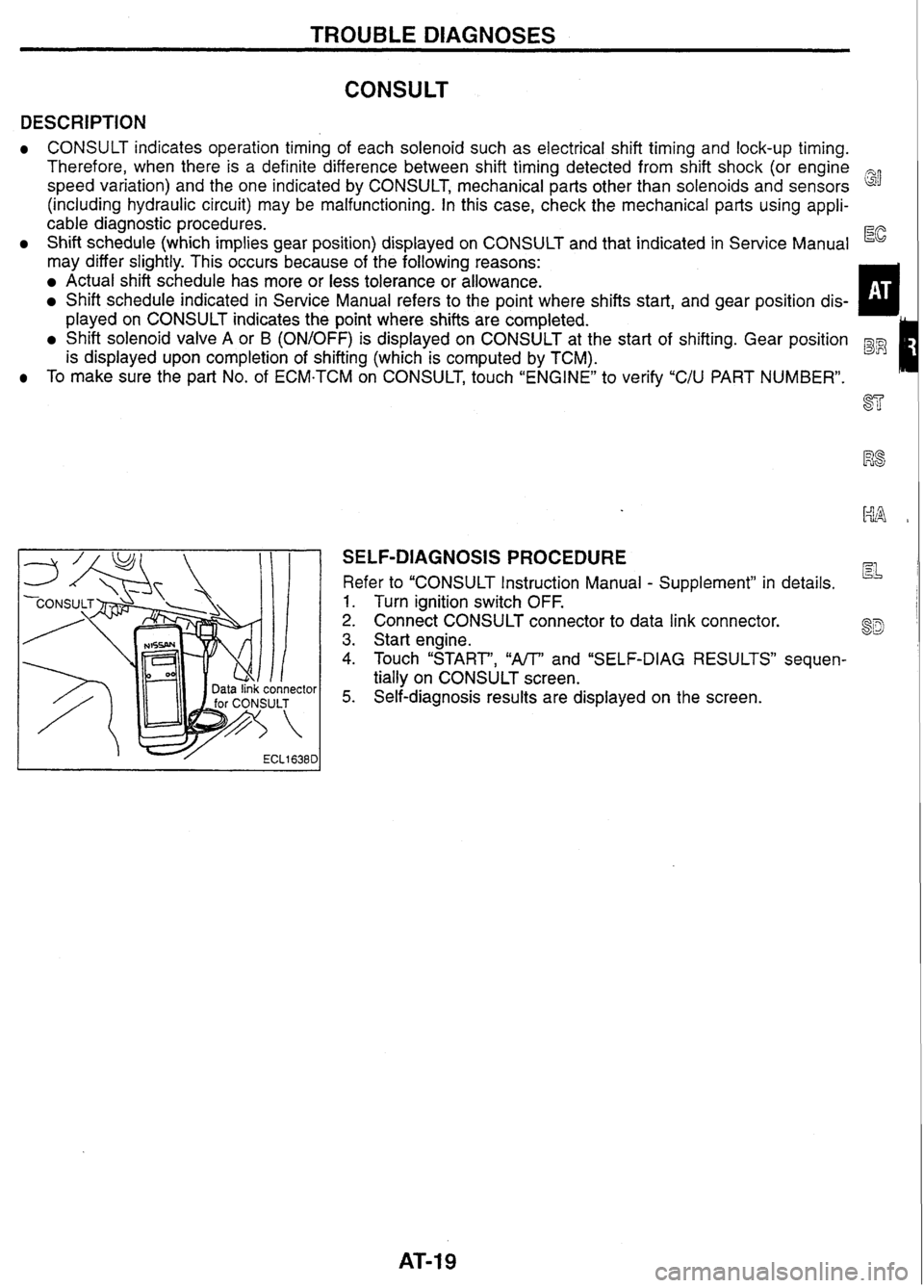
SELF-DIAGNOSIS PROCEDURE
Refer to "CONSULT Instruction Manual - Supplement" in details.
1. Turn ignition switch OFF.
2. Connect CONSULT connector to data link connector.
3. Start engine.
4. Touch "START', "NT and "SELF-DIAG RESULTS" sequen-
tially on CONSULT screen.
5. Self-diagnosis results are displayed on the screen.
Page 72 of 230

TROUBLE DIAGNOSES
CONSULT (Cont'd)
SELF-DIAGNOSTIC RESULTS MODE
Diagnostic item 1 Diagnostic item is detected when ... Inspection item - -- -
I TCM does not receive vehicle speed sensor 1 signal due to
open circuit, etc.
TCM receives improper signal during driving. After ignition switch is turned ON, vehicle speed sensor 2 receives improper signal until vehicle starts to run.
VHCL
SPEED
SEN.A/T Vehicle
speed sensor 1 circuit
TCM does not receive vehicle speed sensor 2 signal due to
open circuit, etc.
TCM receives improper signal during driving.
VHCL
SPEED
SEN.MTR Vehicle
speed sensor 2 circuit
TCM detects
folfowing conditions during driving (Except N and
P positions). 0 Excessively high throttle position sensor signal voltage Excessive1 low throttle position sensor signal voltage with idle
switch OF; or full switch ON
THROTTLE
POSl
SEN
Throttle position sensor circuit
SHIFT SOLENOIDN A
SHIFT SOLENOIDN B Shift
solenoid A circuit
Shift solenoid
B circuit
Overrun clutch solenoid circuit
TIC
CLUTCH SOW
I
OVERRUN CLUTCH SN
Lock-up solenoid circuit Specified voltage is not applied to solenoid due to open and/or
short circuit.
LINE
PRESSURE SN
I Line pressure solenoid circuit
0 Excessively low supply voltage to TCM during driving
Excessively high si nal voltage of AIT fluid temperature sensor
(excessively low d fluid temperature) during driving This message is displayed only when malfunction occurs with ignition switch ON, and does not have memory func-
tion.
fluid temperature sensor circuit,
TCM power supply circuit, or
throttle position sensor power sup-
ply circuit
BATT/FLUID
TEMP SEN
ENGINE SPEED SIG
I Excessively low engine speed during driving Engine speed
signal circuit
Turbine sensor circuit
TURBINE
SENSOR
(Except
RB20DE)
SHIFT SOLENOIDN C
(Except
RB20DE)
TCM does not receive input shaft speed sensor signal due to
open circuit,
etc.
0 TCM receives improper signal during driving.
0 TCM does not receive shift solenoid A pressure detection switch
signal due to open
andfor short circuit. Shift solenoid A pressure
detection
switch circuit
MANUAL MODE SW
(Except
RB20DE)
TCM does not receive proper manual mode switch signal due to
open and/or short circuit. Manual
mode switch circuit
ENGINE BRAKE
C/U'1
(Except
RB20DE)
Shift control unit does not operate properly due to open and/or
short circuit of each
input/output signal wire.
Malfunction occurs in shift control unit. Each
signal wire circuit connected
to shift control unit
'INITIAL START*
Power supply to TCM is shut down, and self-diagnostic memory
function is canceled due to battery removal, etc.
CONTROL UNIT (RAM)
I Malfunction is detected in TCM memory (RAM) function.
CONTROL
UNIT
(ROM)
I Malfunction is detected in TCM memory (ROM) function.
'1 : Indicates shift control unit.
DATA MONITOR PROCEDURE
Refer to "CONSULT Instruction Manual - Supplement" and "CON-
SULT Service Manual
- Supplement" in details.
1. Turn ignition switch OFF.
2. Connect CONSULT connector to data link connector.
3. Turn ignition switch ON.
4. Touch "START', ''AT and "DATA MONITOR" sequentially on
CONSULT screen.
Page 76 of 230

\ I1 // \ 11 // =-I= or =mj= // 11 \ // 11 \
1, = 2.5 sec. t, = 2.0 sec. t, = 1.0 sec.
RB20DE 10 judgement flashes.
Stan signal Malfunctioning unit a")
TROUBLE DIAGNOSES
Self-diagnosis (Cont'd)
\ I1 // \ 11 // =-I= or =mj= // 11 \ // 11 \
1, = 2.5 sec. t, = 2.0 sec. t, = 1.0 sec.
RB20DE 10 judgement flashes.
Stan signal Malfunctioning unit and circuit I
Except RBPODE 13 judgement flashes.
signal Malfunctioning unit and circuit I
POWER INDICATOR LAMP OR DUAL MATIC A/T
WARNING LAMP INDICATION
If malfunction occurs in electrical system, indicator lamp stays on
longer at corresponding circuit.
Flashing
order
t5 1 Overrun clutch solenoid
1
2
3
4
5
7 1 Lock-up solenoid
Malfunctioning
unit and circuit
Vehicle speed sensor
1
Vehicle speed sensor 2
Throttle position sensor
Shift solenoid
A
Shift solenoid B
I
W fluid temperature sensor, TCM power supply, or throttle posi-
tion sensor power supply
RB20DE
9 1 Engine speed
signal Except
RB20DE
10 1 Line
pressure solenoid I Turbine sensor
I - I Line pressure solenoid
12 1 - I Total control signal
When indicator lamp repeats flashing in 4 Hz, the following malfunctions
may exist: (Insufficient memory backup
powerflCM repiacement1Battery
has been disconnected for prolonged
periodllow battery power)
13
No flashes
HOW TO ERASE SELF-DIAGNOSTIC RESULTS
To facilitate cause investigation of malfunction that is less likely to
reappear, the TCM always stores self-diagnostic results during cus-
tomer operation. This memory cannot be erased even if ignition
switch
is turned ON and OFF repeatedly. To erase the seif-diag-
nostic
results, turn ignition switch
OFF after self-diagnosis has
been performed, or use
"ERASE" function of CONSULT.
- - - - Shift control unit
PNP switch, idle
switch/full switch
Overdrive control switch Stop lamp switch
Page 77 of 230

TROUBLE DIAGNOSES
Symptom Chart
Sharp shock in Engine brake
applied
Shifting
Malfunctions
Slip
(Racing)
hifting
.- erator pedal
Shifting
Shifting
inspection item
Fluid level and status
Control linkage
PNP switch (short/open circuit)
Throttle ~osition sensor (installed)
I Vehicle weed sensor
I Enaine meed sensor
A/T fluid temperature sensor
Engine idle speed
Line
Dressure
Control valve assembly
Shift solenoid
A
Shift solenoid B
Line pressure solenoid
Lock-up solenoid
Overrun clutch solenoid
Accumulator N-D
Accumulator
1-2
Accumulator 2-3
Accumulator 3-4 (N-R) Ignition coil and starter motor
Overdrive control switch
I AfT mode switch (AUTO)
Torque converter
1 Oil pump
I Reverse clutch
I High clutch
I Forward clutch
I Forward one-wav clutch
I Overrun ciutch
1 Low one-wav clutch
I Low reverse brake
Brake. band (including servo)
Parking linkage
Page 78 of 230

Symptom Chart (Cont'd)
Greater noise
Malfunctions
Inspection item No shifting
I Shifting I
Fluid level
and status 11
Control linkage
-
(I) C 0 .- c. .- (I) 0 a
v
-CU
n - 1
PNP switch
(shortlopen
circuit)
Throttle position sensor (installed)
2 2
Vehicle speed sensor
I Engine speed sensor -
-T
L o 1 Control valve assembly .- - -- Shift solenoid A 4 3
. ' Shift solenoid 6 4 cut I1
--, Line pressure solenoid .- 5 -t Lock-up solenoid ?
6 Overrun clutch solenoid 3
Accumulator N-D
1 Accumulator 1-2 I 1-
Accumulator 2-3
Accumulator 3-4 (N-R)
Ignition coil and starter motor
I Overdrive control switch I 1-
A/T mode switch (AUTO)
A/T mode switch (POWER) I - I Ail mode switch (SNOW) I
I Torque converter I I
1 Oil pump I I -- - - Reverse clutch 0 -
'g High clutch a 4 6
%I Forward clutch I I - .- a Forward one-way clutch -
$ Overrun clutch a, 8
Low one-way clutch
O Low reverse brake 7
Brake band (including servo) 7
Parking linkage