low oil pressure NISSAN GT-R 1998 User Guide
[x] Cancel search | Manufacturer: NISSAN, Model Year: 1998, Model line: GT-R, Model: NISSAN GT-R 1998Pages: 230, PDF Size: 12.66 MB
Page 40 of 230
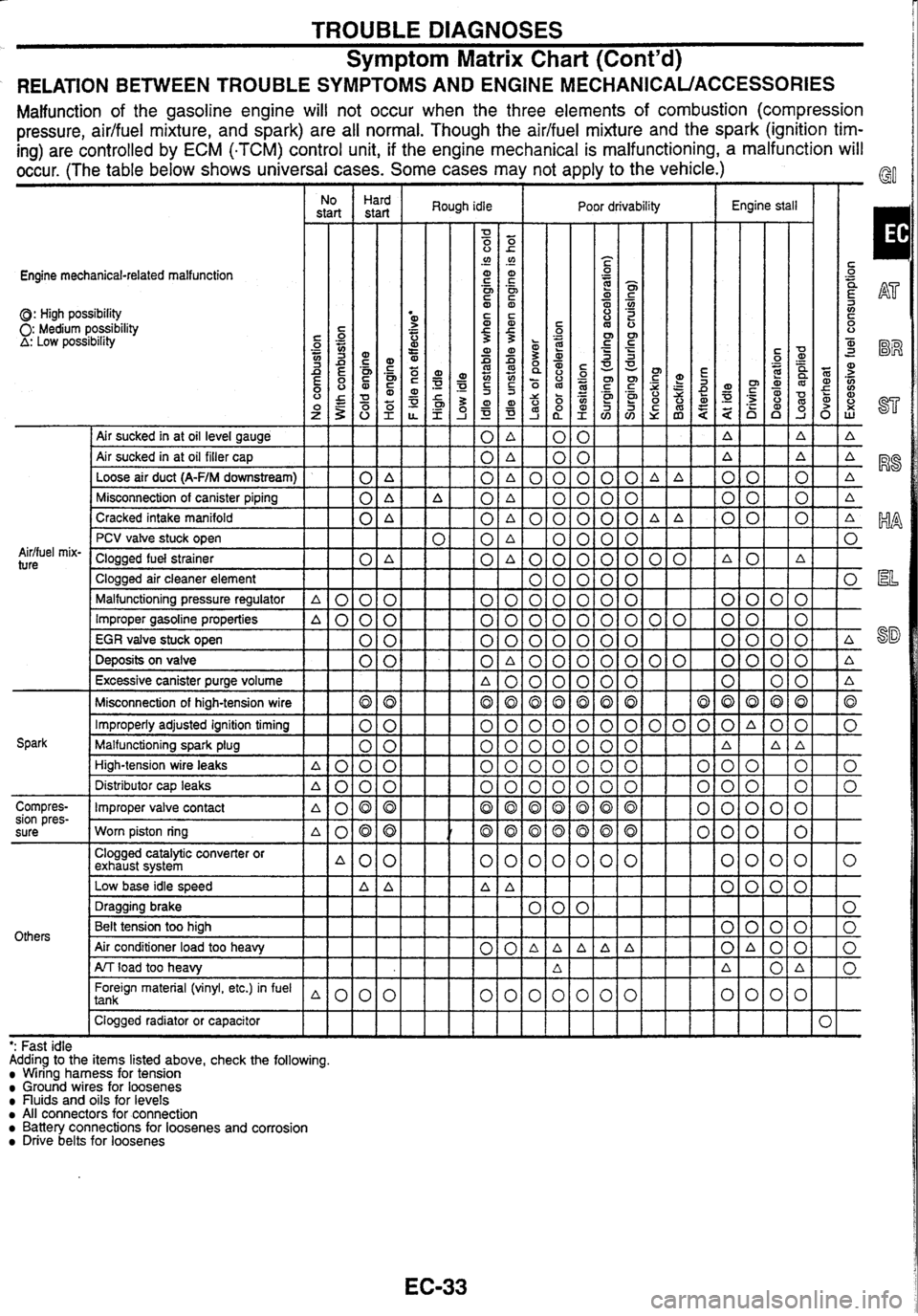
TROUBLE DIAGNOSES
Symptom Matrix Chart (Cont'd)
RELATION BETWEEN TROUBLE SYMPTOMS AND ENGINE MECHANICAUACCESSORIES
Malfunction of the gasoline engine will not occur when the three elements of combustion (compression
pressure, aidfuel mixture, and spark) are all normal. Though the
aidfuel mixture and the spark (ignition tim-
ing) are controlled by ECM
(.TCM) control unit, if the engine mechanical is malfunctioning,
a malfunction will
occur. (The table below shows universal cases. Some cases may not apply to the vehicle.)
Engine mechanical-related malfunction
0: High possibility 0: Medium possibility A: Low posstbility
I No I Hard
start start
I Air sucked in at oil level gauge
Air sucked in at oil filler cap
Loose air duct
(A-F/M downstream) 0 A
Misconnection of canister piping
0 A
Cracked intake manifold
0 A
Aidfuel
mix-
ture
PCV valve stuck open
Clogged fuel strainer
0 A
Clogged air cleaner element
Malfunctioning pressure regulator
A 0 0 0
Improper gasoline properties A000
EGR valve stuck open 0 0
Deposits on valve 0 0
Excessive canister purge volume
Misconnection of high-tension wire
Improperly adjusted ignition timing
Malfunctioning spark plug
High-tension wire leaks
A000
Spark Distributor cap leaks
A000
Compres-
Improper valve contact
sion pres-
. a080
sure Worn piston ring ~080
Others
Clogged catalytic converter or
exhaust system A00
Low base idle speed A
A
Foreign material (vinyl, etc.) in fuel 1 tank
Clogged radiator or capacitor
IIII
Rough idle I Poor drivability Engine stall
- - - - - - -- ': Fast
idle
Adding to the items listed above, check the following.
Wiring harness for tension Ground wires for loosenes nuids and oils for levels All connectors for connection Battery connections for loosenes and corrosion Drive belts for loosenes
Page 41 of 230
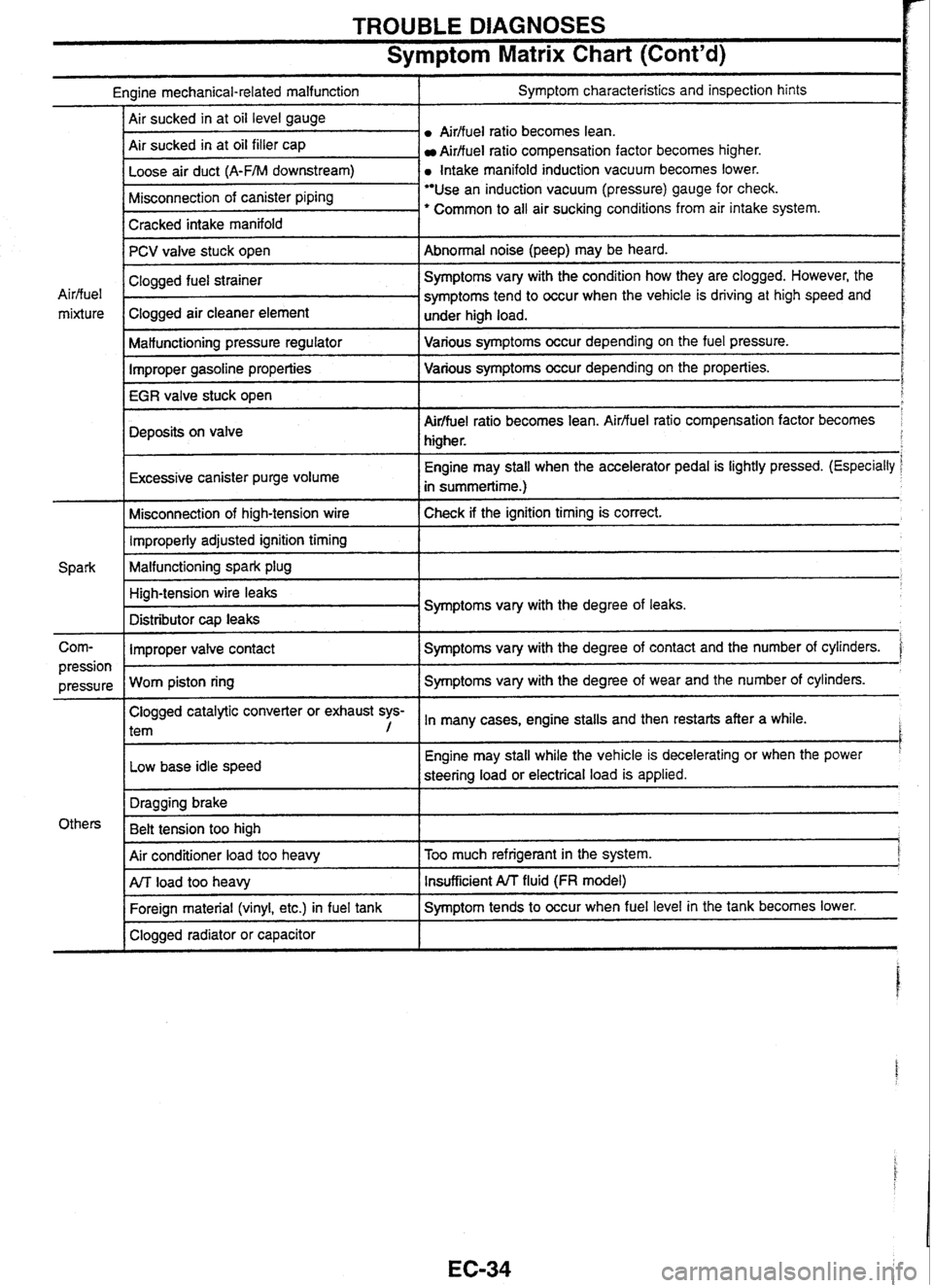
TROUBLE DIAGNOSES
Symptom Matrix Chart (Cont'd)
Engine mechanical-related malfunction I Symptom characteristics and inspection hints
Airffuel
ratio becomes lean.
Air sucked in at oil filler cap
Aidfuel ratio compensation factor becomes higher.
a Intake manifold induction vacuum becomes lower.
I Cracked intake manifold I
Misconnection of canister piping Use an induction vacuum (pressure) gauge for check.
' Common to all air sucking conditions from air intake system.
-
PCV valve stuck open
I Malfunctioning pressure regulator I Various symptoms occur depending on the fuel pressure.
Abnormal noise (peep) may
be heard.
Air/fuel
mixture
Improper gasoline properties Various
symptoms occur depending on the properties.
IEGRiale
stuck open
I
Clogged fuel strainer .
Clogged air cleaner element
Deposits on valve
r
Symptoms vary with the condition how they are clogged. However, the
symptoms tend to occur when the vehicle is driving at high speed and
under high load.
I
Air/fuel ratio becomes lean. Airfluel ratio compensation factor becomes
higher.
Excessive canister purge volume
I
Engine may stall when the accelerator pedal is lightly pressed. (Especially
in summertime.)
Misconnection of high-tension wire Check if the ignition timing
is correct. 1 Improperly adjusted ignition timing 1
Malfunctioning spark plug 1
Corn- I Improper valve contact I Symptoms vary with the degree of contact and the number of cylinders. '
High-tension wire leaks
Distributor
cap leaks Symptoms
vary with the degree of leaks.
Clogged catalytic converter or exhaust sys-
l tem , In many cases, engine stalls and then restarts after a while. I
pression I
Low base idle speed
pressure
Worn piston ring I
Engine may
stall while the vehicle is decelerating or when the power '
steering load or electrical load is applied.
Symptoms vary
with the degree of wear and the number of cylinders.
I
Air conditioner load too heavy I Too much refrigerant in the system. j
Others Dragging
brake
Belt tension too high
1
I Clogged radiator or capacitor I
ArJ load too heavy
Foreign material (vinyl, etc.) in fuel tank Insufficient A/T fluid (FR model)
Symptom tends to occur when fuel level in the tank becomes lower.
Page 55 of 230

TROUBLE DIAGNOSES
System Description
Vehicle with RB20DE and RB25DET engine has TCM integrated into ECM. Vehicle with RB25DE engine has
TCM and ECM separately.
Fail-safe Function @ When malfunction occurs in each sensor and solenoid, the fail-safe functions below enable vehicle to be
driven.
VEHICLE SPEED SENSOR 1 (Output shaft speed sensor)
Inputs a signal from vehicle speed sensor in speedometer. EG
THROTTLE POSITION SENSOR
Detects throttle opening by idle switch and full switch, and controls line pressure as follows. I 1 I Idle switch
-
--
I
--
ON OFF I Minimum oil pressure I 0/8 ST
I
OFF OFF
Full switch
ON Maximum oil pressure
PNP SWITCH
When the multiple PNP switch signals are input to TCM and ECM-TCM, the priority of selector lever position I28
becomes as follows by internal TCM determination.
4AT D, N, R, 2, 1 I%$ M-AT D, N, R, 3, 2
Because the hydraulic circuit of the control valve is switched by manual valve according to the selector lever
position, however, actual operating condition of vehicle becomes as follows.
EL
I N I "N" and other position signals I N
Line pressure
218
P
R
- - -- pp - pp - -
4AT I D I "D" and other position signals I Dl*DP*Dd
Throttle opening I
418 BR
Running status
Actual lever position
1 "2 and other position signals I 21 ~22
PNP switch input signal
"P and other position signals
"R" and other position signals
--
r"2 and "1" 21 ~22
P 83
R
I 2 1 "2" and other position signals / 21 42
M -AT
3
L
1
P
R
N
D
"1" and other position signals
"P" and other position signals
"R" and other position signals
"N" and other position signals
"D" and other position signals
I
l,++l2
P
R
N
D1t;.D2c*D3
"3 and other position signals
"3" and "2" position signals
3, -3,-3-3,
3, +3, +3,
Page 56 of 230

TROUBLE DIAGNOSES
Fail-safe Function (Cont'd)
SHIFT SOLENOID A, B
When a malfunctioning signal of solenoid is input to TCM and ECM-TCM, the gear is shifted as follows.
Normal Abnormal solenoid A Abnormal solenoid B Abnormal solenoid A/B Shift positions A B Gears A B Gears A I3 Gears A 8 Gears
0 0 1 st o-+x 03x - - - -
-- 0: Solenoid ON X: Solenoid OFF -: Abnormal
LINE PRESSURE SOLENOID
When a malfunctioning signal of solenoid is input to TCM and ECM-TCM, the line pressure solenoid is turned
OFF, and the line pressure is set to maximum oil pressure.
LOCK-UP SOLENOID
When a malfunctioning signal of solenoid is input to TCM and ECM.TCM, the lock-up solenoid is turned OFF,
and the lock-up
is released.
OVERRUN CLUTCH SOLENOID
When a malfunctioning signal of solenoid is input to TCM and ECM-TCM, the overrun clutch solenoid is turned
OFF, and the overrun clutch is engaged to apply the engine brake during deceleration.
MANUAL MODE SWITCH (M-AT)
When a malfunctioning signal of manual mode switch is input to TCM and ECM.TCM, the gear is controlled
with normal "D" position.
SHIFT CONTROL UNIT (Except RB20DE)
When a malfunction occurs in the shift control unit, the shift solenoid NB are turned OFF, and the gear posi-
tion
is controlled with 3rd speed.
TURBINE SENSOR (Except RB20DE)
Controlled by vehicle speed sensor 1 in the same way without turbine sensor
Page 58 of 230

TROUBLE DIAGNOSES
Clutch and Band Chart
U0.C
(Low one-
way
clutchl L&R/B
(Low and
reverse
brake)
F/O C
(Forward
clutch)
.
Remarks
PARK POSI-
TION
REVERSE POSITION
O/C
(Overrun
clutch)
*I@
'I@
'18
@
NEUTRAL
POSITION
*"
c'utch)
0
0
WC
clutch)
(Reverse
0
P
R
N
Automatic shift
0
0
FIC
(For-
ward
clutch)
0
0
0
69
0
Band servo
'4
2 Automatic shift
1 st
2nd
-3rd 4th
1 st
1. Locked in 1st
-
4th apply
0
2nd apply
0
'263
*3@
2nd
I st
2nd
0
0
0
DUAL MATIC M-ATx
3rd release
0
8
0
0
0
--
fi In Band servo I FI0.C / UOC I L&WB I
(Reverse clutch) FIC (For- WC (High
ward
clutch) clutch)
PARK POSI-
TION
REVERSE POSITION
NEUTRAL POSITION
@ 0 . . Automatic shift
0 '269 8 - -
-38 8 0
@
G3 0 Automatic shift
10 I I Automatic shift
I I I I I I I
:ch is being set in "OFF position. (D, shift is inhibited.) '2: oil pressure is applied to both 2nd "apply" side and 3rd "releasen side of band servo piston. However, brake band does not contract because oil pressure area on the "releasen side is greater than that on the "apply" side. '3: Oil pressure is applied to 4th "apply" side in condition '2 above, and brake band contracts. '4: A/T will not shift to 4th when overdrive control switch is set in "OFF position.
* 1 : O~erate when control
swil
0: Operates. a: Operates
during "progressive" acceleration.
@: Operates but does not affect power transmission. @: Operates when throttle opening is less than specification, but does not affect engine brake. fi: O~erates when throttle opening is less than specification, activating engine brake.
Page 69 of 230
TROUBLE DIAGNOSES
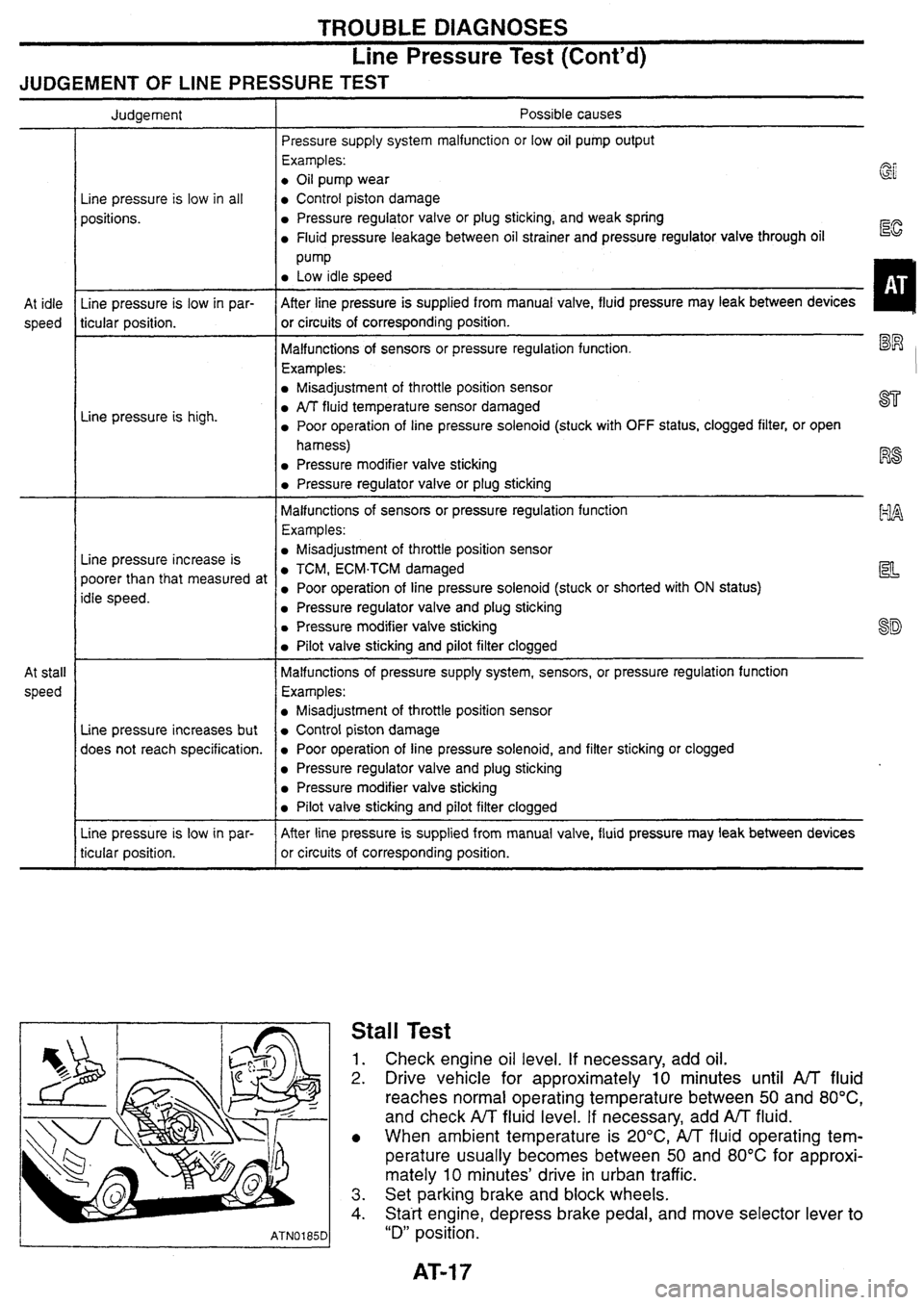
Line Pressure Test (Cont'd)
JUDGEMENT OF LINE PRESSURE TEST
At idle
speed
At stall
speed Judgement
Line pressure is low in all
positions.
Line pressure is low in par-
ticular position.
Line pressure is
high.
Line pressure increase is
poorer than that measured at
idle speed.
Line pressure increases but
does not reach specification.
Line pressure is low in par-
ticular position. Possible
causes
Pressure supply system malfunction or low oil pump output
Examples:
0 Oil pump wear
Control piston damage
Pressure regulator valve or plug sticking, and weak spring
Fluid pressure leakage between oil strainer and pressure regulator valve through oil Eg
Pump
Low idle speed
After line pressure is supplied from manual valve, fluid pressure may leak between devices
or circuits of corresponding position.
1
Malfunctions of sensors or pressure regulation function. El
Examples:
Misadjustment of throttle position sensor
PJT fluid temperature sensor damaged ST
Poor operation of line pressure solenoid (stuck with OFF status, clogged filter, or open
harness)
Pressure modifier valve sticking F%
Pressure regulator valve or plug sticking
Malfunctions of sensors or pressure regulation function
Examples:
EILA
Misadjustment of throttle position sensor
TCM, ECM.TCM damaged la
Poor operation of line pressure solenoid (stuck or shorted with ON status)
Pressure regulator valve and plug sticking
Pressure modifier valve sticking
sf$
Pilot valve sticking and pilot filter clogged
Malfunctions of pressure supply system, sensors, or pressure regulation function
Examples:
Misadjustment of throttle position sensor
Control piston damage
Poor operation of line pressure solenoid, and filter sticking or clogged
Pressure regulator valve and plug sticking
Pressure modifier valve sticking
Pilot valve sticking and pilot filter clogged
After line pressure is supplied from manual valve, fluid pressure
may leak between devices
or circuits of corresponding position.
Stall Test
1. Check engine oil level. If necessary, add oil.
2. Drive vehicle for approximately 10 minutes until A/T fluid
reaches normal operating temperature between
50 and 80°C,
and check A/T fluid level. If necessary, add AfT fluid.
When ambient temperature is
20°C,
A/T fluid operating tem-
perature usually becomes between 50 and
80°C for approxi-
mately
10 minutes' drive in urban traffic.
3. Set parking brake and block wheels.
4. Statt engine, depress brake pedal, and move selector lever to
"D" position.
Page 77 of 230

TROUBLE DIAGNOSES
Symptom Chart
Sharp shock in Engine brake
applied
Shifting
Malfunctions
Slip
(Racing)
hifting
.- erator pedal
Shifting
Shifting
inspection item
Fluid level and status
Control linkage
PNP switch (short/open circuit)
Throttle ~osition sensor (installed)
I Vehicle weed sensor
I Enaine meed sensor
A/T fluid temperature sensor
Engine idle speed
Line
Dressure
Control valve assembly
Shift solenoid
A
Shift solenoid B
Line pressure solenoid
Lock-up solenoid
Overrun clutch solenoid
Accumulator N-D
Accumulator
1-2
Accumulator 2-3
Accumulator 3-4 (N-R) Ignition coil and starter motor
Overdrive control switch
I AfT mode switch (AUTO)
Torque converter
1 Oil pump
I Reverse clutch
I High clutch
I Forward clutch
I Forward one-wav clutch
I Overrun ciutch
1 Low one-wav clutch
I Low reverse brake
Brake. band (including servo)
Parking linkage
Page 78 of 230

Symptom Chart (Cont'd)
Greater noise
Malfunctions
Inspection item No shifting
I Shifting I
Fluid level
and status 11
Control linkage
-
(I) C 0 .- c. .- (I) 0 a
v
-CU
n - 1
PNP switch
(shortlopen
circuit)
Throttle position sensor (installed)
2 2
Vehicle speed sensor
I Engine speed sensor -
-T
L o 1 Control valve assembly .- - -- Shift solenoid A 4 3
. ' Shift solenoid 6 4 cut I1
--, Line pressure solenoid .- 5 -t Lock-up solenoid ?
6 Overrun clutch solenoid 3
Accumulator N-D
1 Accumulator 1-2 I 1-
Accumulator 2-3
Accumulator 3-4 (N-R)
Ignition coil and starter motor
I Overdrive control switch I 1-
A/T mode switch (AUTO)
A/T mode switch (POWER) I - I Ail mode switch (SNOW) I
I Torque converter I I
1 Oil pump I I -- - - Reverse clutch 0 -
'g High clutch a 4 6
%I Forward clutch I I - .- a Forward one-way clutch -
$ Overrun clutch a, 8
Low one-way clutch
O Low reverse brake 7
Brake band (including servo) 7
Parking linkage
Page 79 of 230
TROUBLE DIAGNOSES
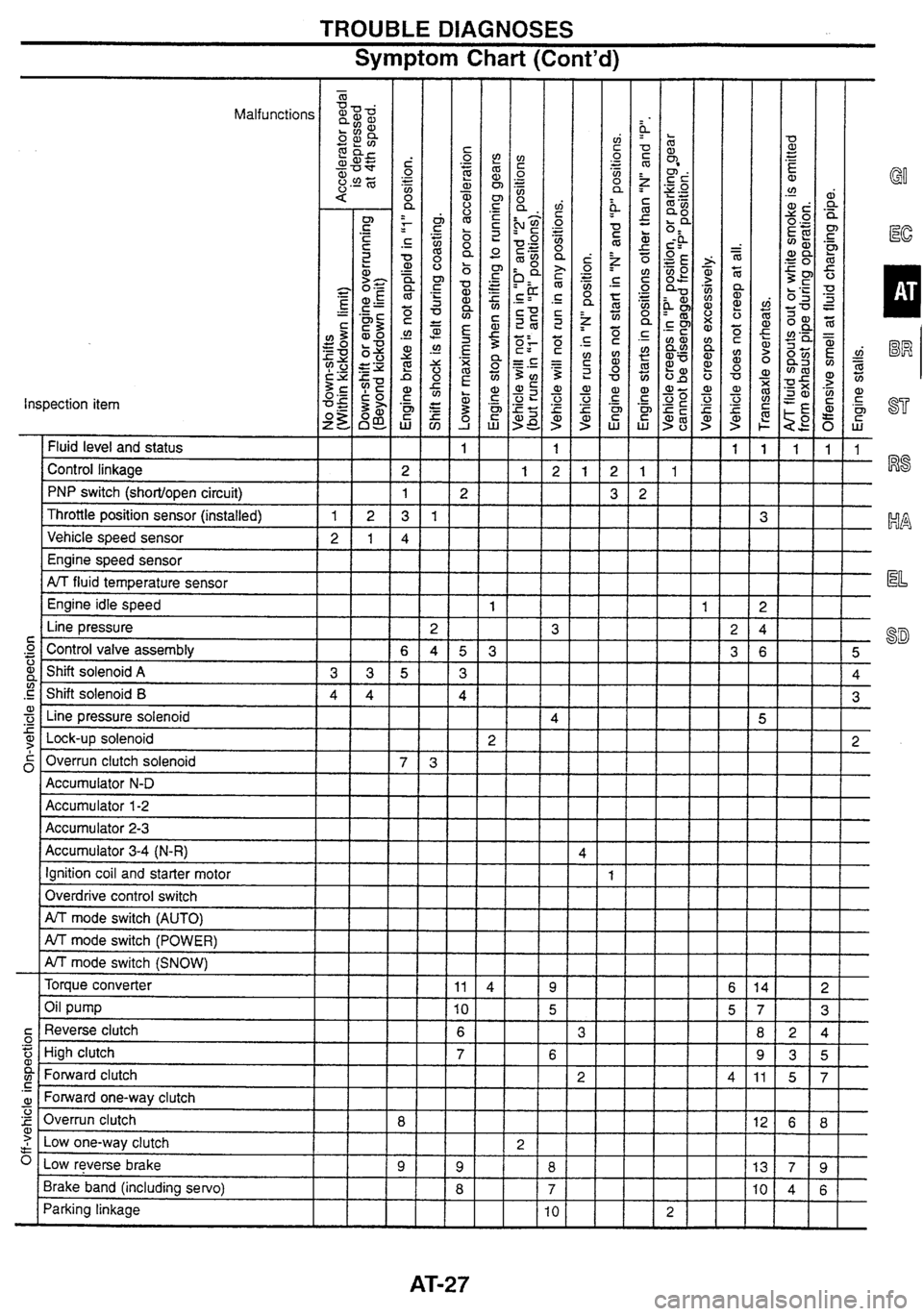
Symptom Chart (Cont'd)
xi - - ([I C V) a, C .- cn C W
t 0 .- .L 2 a, - 8 0 ([I L 0 0 Q
& 0 a, a, Q V)
5 E .- X
i! L a
zl -I - 1 -
- 2 -
-
-
-
-
-
5 - 3 - 4 -
-
-
-
-
-
-
-
-
-
-
-
-
I1 - 0 - 6 - 7 -
-
-
-
-
9 - 8 -
-
vj c 0 .- - .- V) 0 n
Q 7J C ([I
t C .- r ([I c. V) c. 0 C V) a 0 7J 0, C .- 0 C W -
- 2 - 3 -
-
- -
-
1 -
-
-
-
- - a +- ([I a a, 2 0 c. 0 C V) a, 0 u a, - 0 2
8 - 1 -
-
-
-
-
-
-
-
2 - 3 -
-
-
-
-
-
-
-
-
-
-
- I
i
g
- 4 -
-
-
-
-
-
-
B- ; 2 to a =? - 0,
2 5.j c 2.z 2 a0 - 0- z & 5 0 gE V) V)o C 02 .s nu 5 ng %-([I C O c --t .- V) a V) r aa ([I z gz a, a- c 50 -6 s
6 $2
11
2
I
I
Malfunctions
Inspection item
I I I Fluid level and status I I Control linkage 2
PNP switch (shortfopen circuit) 1 I I I Throttle position sensor (installed) 111213
Vehicle speed sensor
214
Engine speed sensor L -
AIT fluid temperature sensor
Engine idle weed
Line pressure
Control valve assembly
Shift solenoid A 3
3
Shift solenoid B 4 4
Line pressure solenoid
Lock-up solenoid
Overrun clutch solenoid
u I I I -
Accumulator N-D I I 1 I Accumulator 1-2
Accumulator 2-3 I Accumulator 3-4 (N-R)
Ignition coil and starter motor
Overdrive control switch
Torque converter
tg Reverse clutch .- High clutch
2 Forward clutch C .- a Forward one-way clutch -.
$ Overrun clutch 0, 8
? Low one-way clutch 3= O Low reverse brake 9
Brake band (including servo)
Parking linkage
Page 187 of 230

COMBINATION METER
Diagnosis Function
(Cont'd)
METER CIRCUIT CHECK
After the segment check, press the odohrip meter switch to
verify that meters operate as shown below. (Low fuel warning
lamp goes off at this point.)
i
ELF0967D I It takes 1 minute for the meters to become stable.
DIAGNOSIS FUNCTION CANCELLATION
Turn the ignition switch ACC or OFF.
Meter-related Circuit Diagram
I I TO oil pressure W.L