ABS NISSAN GT-R 1998 Owner's Manual
[x] Cancel search | Manufacturer: NISSAN, Model Year: 1998, Model line: GT-R, Model: NISSAN GT-R 1998Pages: 230, PDF Size: 12.66 MB
Page 93 of 230

ANTI-LOCK BRAKE SYSTEM
Self-diagnosis
DESCRIPTION
When a problem occurs in the ABS, the ABS warning lamp on the
instrument panel comes on. To actuate the self-diagnostic results
mode, ground the self-diagnostic check terminal
4 located on the
data
link
connector for
CONSULT. The ABS warning lamp, then,
flashes and indicates the location of the malfunction.
SELF-DIAGNOSIS PROCEDURE
1. Collect information on the concern from the customer, and then
perform basic inspections.
2. Drive vehicle at approx. 30 km/h for approx. 1 minute.
3. Stop vehicle and start diagnosis.
4. Turn ignition switch "OFF'.
5. Ground the self-diagnostic check terminal 4.
6. Turn ignition switch "ON" to start the self-diagnostic results
mode.
CAUTION:
Keep terminal 4 grounded during self-diagnosis.
Do not depress brake pedal. (Self-diagnosis would not
start.)
Do not start engine. (Self-diagnosis would not start.)
7. After 3 or 4 seconds, ABS warning lamp starts blinking to indi-
cate the malfunction code No.
The indication terminates after 5 minutes. Turning the ignition
switch from
"OFF" to "ON" resumes blinking the indication.
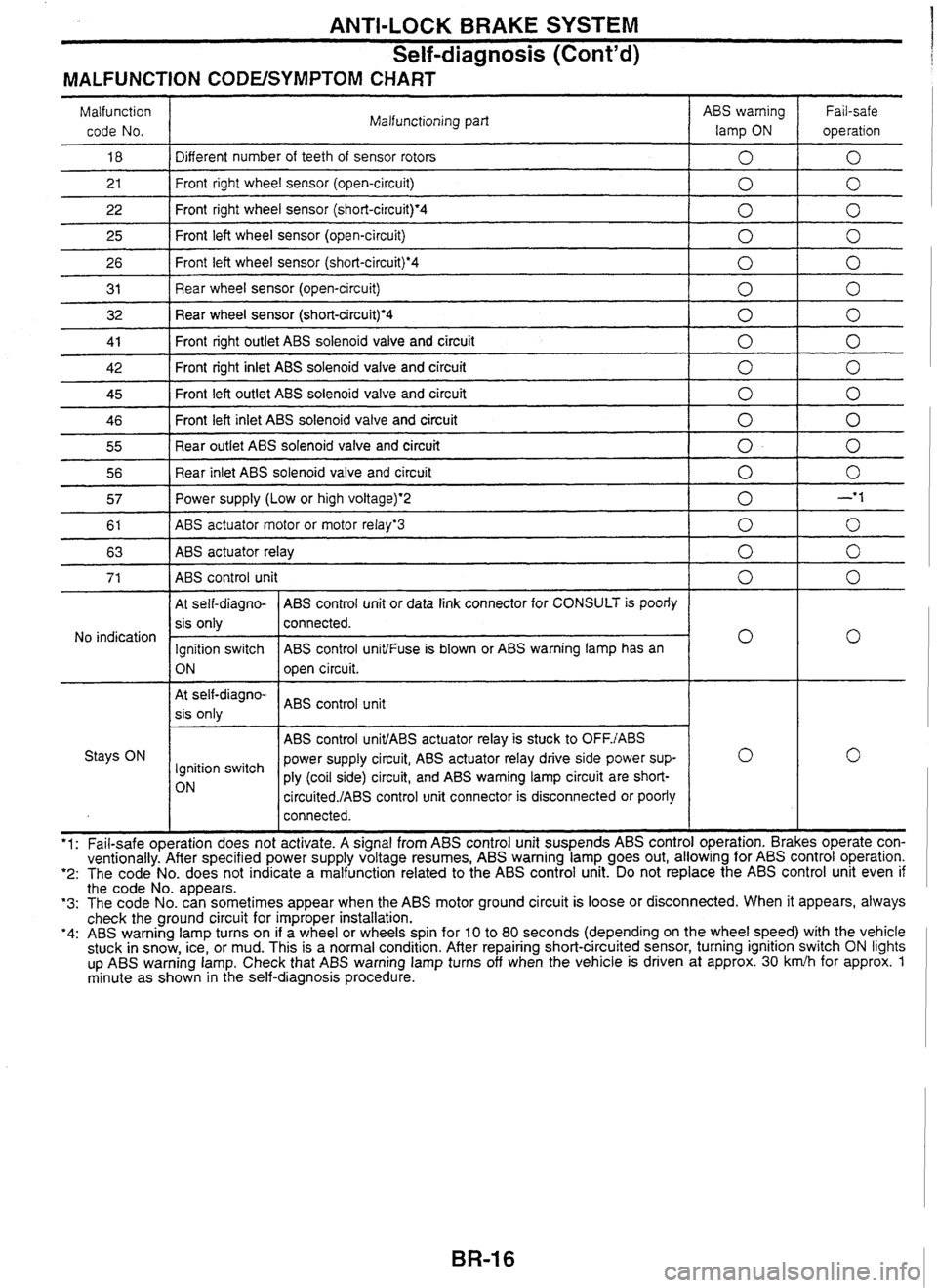
8. Verify the location of the malfunction with "MALFUNCTION
CODUSYMPTOM CHART", BR-16. Then make the necessary
repairs.
9. After the malfunctions are repaired, erase the malfunction
codes stored in the control unit. Refer to "HOW
TO ERASE
SELF-DIAGNOSTIC RESULTS" on the next page.
10. Rerun the self-diagnostic results mode to verify that the mal-
function codes have been erased.
11. Disconnect the check terminal from the ground. The self-diag-
nostic results mode is now complete.
12. Drive vehicle at approx. 30 km/h for approx. I minute, and then
check that the ABS warning lamp is off.
HOW TO READ SELF-DIAGNOSTIC RESULTS
(Malfunction codes)
Determine the code No. by observing the time and the fre-
quency that the
ABS warning lamp blinks ON and OFF.
When multiple malfunctions occur at a time, up to three code
numbers can be stored; the latest malfunction will be indicated
first.
The indication begins with the start code No. 12. A maximum
of three code numbers appear in the order of the latest one
first. The indication then returns to the start code No.
12 to
repeat.
The start code No. 12 is only indicated repeatedly when there
is no malfunction.
Page 94 of 230

ANTI-LOCK BRAKE SYSTEM
Self-diagnosis (Cont'd)
Example: Code No. 25 Front left wheel sensor (open-ccrcuit)
lnd~cat~on
s:arl
Start code No. i2
Unit: seconds BRG1185D
ABS warnq lamp ON -
A9S warnrng lamp OFF
Self-d~agnosis complete , C ABS warning lamp !
I i I I I
................ &. j(j(?.:e~o"dd~i!~?!!f!!. . -----... .-.---.--. iiii rase 1 12.5 seconds I mode
Malfunct~on
memory Malfunction memory is Nn. erase mode starts. Is erased BRG0057C
Tens d~g~ts Un~ts digits Code No 25 I I - I
HOW TO ERASE SELF-DIAGNOSTIC RESULTS
(Malfunction codes)
r--------- -T---t----t-l-T-l-
1. Turn the ignition switch "ON" and start the engine.
-.
---------- -I--I--t--l-i-"I
2. Drive the vehicle at approx. 30 kmh for approx. 1 minute to
check that there is no other malfunction.
ST
3. Stop the vehicle.
4. Turn the ignition switch "OFF'.
5. Ground the self-diagnostic check terminal. RS'
6. Turn the ignition switch "ON" to start the self-diagnostic results
-
-.
3 06 0.9 03C303 3.3 06 0.6 0.6 09 050303030305030303
-----
mode.
CAUTION:
c--
Do not depress the brake pedal during self-diagnosis. Do not
start the engine. (The self-diagnosis
would not start.)
7. The ABS warning lamp starts to blink 3 or 4 seconds after the EL
self-diagnostic results mode is started.
8. Under the self-diagnostic results mode, the malfunction $jD
memory erase mode starts when the check terminal is discon-
nected from the ground.
9. Ground the check terminal 3 times or more in succession
within 12.5 seconds after the erase mode starts. (Each ground-
ing must
be 1 second or longer.)
10. Disconnect the grounding cable from the check terminal to
erase the malfunction memory and complete the
self-diagno-
sis. The ABS warning lamp
, then, turns off.
11. Turn the ignition switch
"OFF'.
Page 95 of 230
ANTI-LOCK BRAKE SYSTEM
Self-diagnosis (Cont'd)
MALFUNCTION CODEISYMPTOM CHART
Malfunction code No. Malfunctioning
part ABS warning
lamp
ON
Fail-safe
operation
18 1 Different number of teeth of sensor rotors 1010
2 1
26 I Front left wheel sensor (short-circuiQ.4 1010
- --
22
25
3 1 I Rear wheel sensor (open-circuit) 1010
Front right wheel sensor (open-circuit)
32 Rear wheel sensor (short-circuit)'4 1 0 1 0
Front right wheel sensor (short-circuit)'4
Front left wheel sensor (open-circuit)
41
I Front right outlet ABS solenoid valve and circuit 1010
0 0
0
0
0
0
- -
42
-- - -
46 Front left inlet ABS solenoid valve and circuit 0 1 0
45 Front
left outlet ABS solenoid valve and circuit
55
1 Rear outlet ABS solenoid valve and circuit 1010
Front right inlet ABS solenoid valve and circuit
56
1 Rear inlet ABS solenoid valve and circuit 1010
0
57 1 Power supply (Low or high voltage)*2 I 0 I -'I
0
0
0
I At self-diagno- ( ABS control unit or data link connector for CONSULT is poorly 1 I
61
63
At self-diagno-
I ABS control unit
sis only
ABS
actuator motor or motor relayg3
ABS
actuator relay
No indication
I I ABS control unit1ABS actuator relay is stuck to OFFJABS I Stays ON power supply circuit, ABS actuator relay drive side power sup-
lgnition switch
ply (coil side) circuit, and ABS warning lamp circuit are
short-
circuited./ABS control unit connector is disconnected or poorly
0
0
I
sis only
Ignition switch
ON
I I connected. I I
0
0
connected.
ABS control
unit1Fuse is blown or ABS warning lamp has an
open circuit.
- -- '1: Fail-safe operation does not activate. A signal from ABS control unit suspends ABS control operation. Brakes operate con-
ventionally. After specified power supply voltage resumes, ABS warning lamp goes out, allowing for ABS control operation. '2: The code No. does not indicate a malfunction related to the ABS control unit. Do not replace the ABS control unit even if the code No. appears. '3: The code No. can sometimes appear when the ABS motor ground circuit is loose or disconnected. When it appears, always
check the ground circuit for improper installation.
'4: ABS warning lamp turns on if a wheel or wheels spin for 10 to 80 seconds (depending on the wheel speed) with the vehicle
stuck in snow, ice, or mud. This is a normal condition. After repairing short-circuited sensor, turning ignition switch ON lights
up
ABS warning lamp. Check that ABS warning lamp turns off when the vehicle is driven at approx. 30 krnlh for approx. 1 minute as shown in the self-diagnosis procedure.
Page 96 of 230

TCSIABS SYSTEM
System
Description
ABS FUNCTION
During ABS operation, the brake pedal pulsates along with a mechanical noise. This ensures that the ABS
is working properly. mP
When starting up the engine or immediately after the vehicle starts to run, the brake pedal pulsates and G'
a motor noise from the engine compartment can be heard. They are caused by the ABS operation check
and should not be considered abnormal.
A vehicle with the ABS may stop in a longer distance than a vehicle without the ABS when the brake is
EC
applied on a bad road, gravel road, or deep fresh snow.
TCS FUNCTION
TCS/ABS control unit monitors the speed of the driving wheels through 4 wheel speed sensors. If driving
wheel slip is detected, fuel to the engine is cut
ol
and the throttle valve is adjusted so that the engine
a
torque is reduced. On vehicles with automatic transmission, transmission shift schedule is also changed
to control the rear wheel driving torque, which results
in the reduction of wheel slip. This system enables
the throttle valve to be controlled so that optimum engine torque can be achieved in accordance with the
driver's acceleration request.
The driver may not feel satisfied with acceleration on some road surfaces. This poor acceleration occurs
because the operating TCS gives priority to maintaining optimum traction. Therefore, this condition should
R8
be considered normal.
When shiftdown is made or the acceleration pedal is depressed while the vehicle is driven on the road
surface that has different friction coefficients, the TCS may operate temporarily.
r-- 4 Lrd[-i
On vehicles with manual transmission, the SLlP indicator lamp and the TCS OFF indicator lamp may light
up when the engine is about to stall in the conditions shown below.
If the lamps go off when engine speed
increases, there is no problem in the system.
At start, the engine almost stalls and the engine speed is much lower than the idle speed.
The vehicle is driven at an extremely low speed with a high-speed gear engaged.
The clutch has been engaged until the vehicle almost stops. 8D
FAIL-SAFE FUNCTION
ABS system
If any malfunction is detected in the system, the ABS warning lamp, the TCS OFF indicator lamp and the SLlP
indicator lamp in the instrument panel is turned on with the TCSIABS deactivated and the vehicle's brake sys-
tem reverts to normal operation.
TCS system
If any malfunction is detected in the system, both the SLlP indicator lamp and the TCS indicator lamp on the
instrument panel light up and the TCS is shut down. The vehicle operates in the same manner as a vehicle
without the
TCS, while the ABS is operational.
If there is a malfunction in the throttle control system, the TCS becomes inoperative while the ABS
remains functional.
When fail-safe operation is activated, perform the self-diagnosis procedure for the TCSIABS first.
Refer to
BR-27 for details.
Page 97 of 230

TCSIABS SYSTEM
System Description (Cont'd)
Parts that make throttle control inoperative
Malfunction code No.
11
12
13
91
32 I
Throttle motor return spring (Return spring is bro-
ken.) Malfunctioning part
Throttle position sensor circuit
Throttle motor sensor circuit Circuit for
the communication line
(DKR line)
between
TCSIABS control unit and throttle control
unit
Actuator system (Motor circuit is open or throttle
L I
22
23
24
Parts that make throttle control operative
motor intermittently works.)
Throttle motor drive system (overcurrent)
Throttle motor relay circuit (shorted)
Throttle motor relay circuit (open)
System Diagram
Secondary throttle posrt~on sensor value - - C; Front nght C CI) - ul wheel sensor , Throttle control unrt 0 - CI, -
$ Rear ngh:
g 5 wheel sensor c 0 m E
000000
Total control stgnal for engrne, AIT and TCS/ABS (multrpie communication)
TCSlABS control unrt
Rear lett
whee! sensor
TCS OFF swtch
Front left
wheei sensor
-+ SLIP 1ndrca:or Lamp '
----c TCS OFF rndcator lamp
c A9S warnlns lamp BR-0227D
Malfunction code No.
31
33
Malfunctioning parts
Starter signal circuit (shorted)
Paridneutral
position switch circuit (open or
shorted)
Page 98 of 230

TCSfABS SYSTEM
Component Parts
Location
[El TCSIABS
Rear wheel sensor
Throttle motor relay
Front right wheel
senso
Throttle control unit
Front left wheel sensor
@ RH side of engine compartment
// /LA~A~~~~
RH side of rear suspension t%ernb&- /
I Rear wheel sensor connector
Engine compartment control unit
-- -- -- -
- - LH side of engine compartment
Behind LH side lower fi
Page 99 of 230

10 SLIP indicator lamp IOA~ I
Throttle
motor relay ABS warnina lam. 1 I Throlllo
motor sensor
Throtlle
~osition sensor ,----------- --- - 7 I I I Actuator motor I
1 L
TCS OFF indicator
Throlllo motor
I angle signal ECM TCM
37 or ECM
TCS switch signal
5 3
4
2
7 6
7
Throttle ClU 20
10
Stop lamp SW u22 & FR OUT 1 1
j To data link
,connector TXL I for {W- l CONSULT I I I I I I
Rear IN
Throllle molor
1 I
& 5 6 7 8 @JgT$@
- - - - - - - - - DKV (Throlllo angle output) 2
ECM.TCM or ECM 2
109 3 Meter CIU (NT model only) 111 3
--------- -- DKR (Ttirotllo niolor (argot : angle signal) ' TO data link I 1 4 connector for I
To Meler CIU (Engine speed signal) 4 1 115
Dala link connector
for CONSULT
Ttlrottle CIU
Page 100 of 230

TCSIABS SYSTEM
Control Unit
InputlOutput Signal Specifications
USING CIRCUIT TESTER
TCS/ABS control unit - -
To perform the following inspection, the ignition switch should be turned ON with TCS/ABS control unit con-
nector and actuator connector properly connected.
I
TCS/ABS contro! unit connector
Terminal No.
P Front right wheel I
Item
sensor
I
Specifications'l
Rear right wheel Wheels are turning (Approx.
30 km/h)'3: Pulse generates.
Front: Approx. 200
Hz
Rear: ADDrox. 200 Hz I . , sensor
Rear left wheel
sensor
I
I
Brake pedal is depressed: Battery voltage (Approx. 12V)
Stop lamp signal Brake pedal is not depressed: Less than approx. 2V
Actuator relay is activated (with engine running): Less than approx.
2V
Actuator relay Actuator relay
is not activated (with fail-safe function activated and engine
not running): Battery voltage (Approx.
12V)
ABS motor is running (in CONSULT active test mode): Battery voltage
ABS motor monitor (Approx. 12V)
ABS motor is stopped (with ignition switch ON): Approx. OV
SLIP
indicator
SLIP
indicator lamp
ON'S: OV
lamp
SLIP
indicator lamp
OFF'5: Battery voltage (Approx. 12V)
TCS OFF indicator TCS OFF indicator lamp
ON'4: OV
lamp TCS OFF indicator lamp
OFF'4: Battery voltage (Approx. 12V)
TCS OFF switch TCS OFF switch is pressed: Approx. OV
signal TCS OFF switch is not pressed: Approx. 4
- 5V
Engine speed sig-
nal Pulse generates.
Refer to EC section
("ECM.TCM Input/Outout Reference Value")
Total control signal
(Multiple communi-
cation) for engine,
A/T and TCSIABS Check item (Refer-
ence)
Wheel sensors
and circuit Stop lamp switch
and circuit
ABS actuator relay
and circuit
ABS motor monitor
circuit
SLlP indicator
lamp and circuit
TCS OFF indicator
lamp and circuit
TCS OFF switch
and circuit
Engine speed sig-
nal circuit
Circuit for total
control signal (Mul-
tiple communica-
tion) for engine, A/T and TCSIABS
Page 101 of 230
TCS/ABS SYSTEM
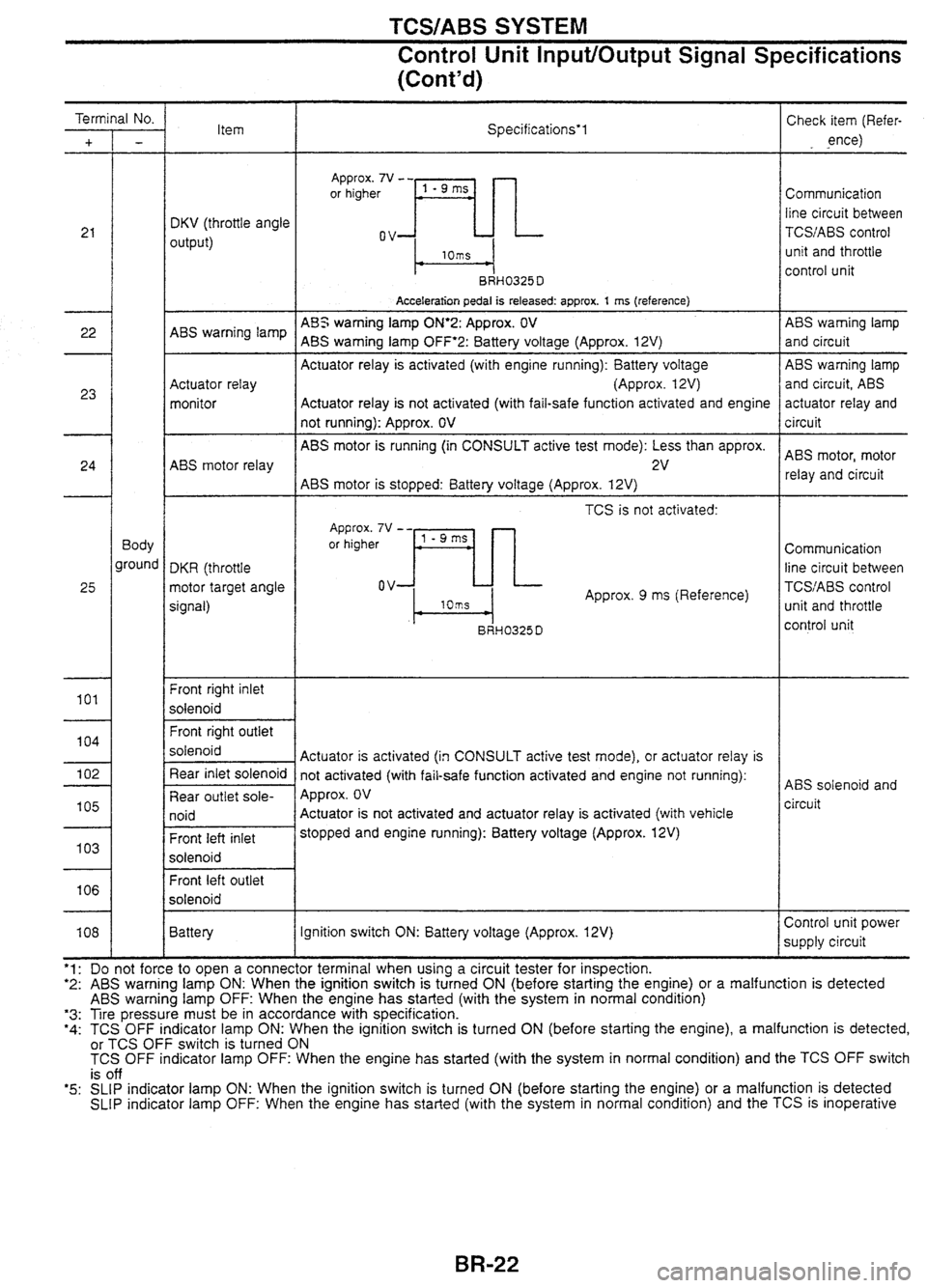
Control Unit InputlOutput Signal Specifications
(Cont'd)
Terminal No.
Specifications'l
- - --
Check item (Refer-
ence)
- - -
Body
ground
-
Approx. 7V - - or higher Communication
line circuit between
TCSIABS control
unit and throttle
control unit
DKV
(throttle angle
output)
Acceleration pedal is released: approx. 1 ms (reference)
ABS warning lamp ABS warning
lamp
and circuit 4B3 warning lamp 0Nr2: Approx. OV
4BS
warning lamp 0FF72: Battery voltage (Approx. 12V)
cictuator
relay is activated (with engine running): Battery voltage
(Approx.
12V)
ktuator
relay is not activated (with fail-safe function activated and engine
70t
running): Approx.
OV
ABS warning lamp
and circuit,
ABS
actuator relay and
circuit
Actuator relay
monitor
48s
motor is running (in
CONSULT active test mode): Less than approx.
2V
4BS motor is stopped: Battery voltage (Approx. 12V)
TCS is not activated: ABS
motor, motor
relay and circuit
ABS
motor relay
Approx. 7V - -
OV I I Communication
line circuit between TCSfABS control
unit and throttle
control unit
DKR
(throttle
motor target angle
signal) Approx. 9 ms (Reference)
Front
right inlet
solenoid
Front right outlet
solenoid
4ctuator
is activated (in CONSULT active test mode), or actuator relay is
lot
activated (with fail-safe function activated and engine not running):
4pprox.
OV
4ctuator
is not activated and actuator relay is activated (with vehicle
stopped and engine running): Battery voltage (Approx.
12V)
Rear inlet solenoid
Rear outlet
sole- ABS solenoid and
circuit
Front left inlet
solenoid
Front left outlet
solenoid
Battery gnition switch
ON: Baitery voltage
(Approx. 12V) Control
unit power
supply circuit
'1: Do not force to oDen a connector terminal when usina a circuit tester for ins~ection. '2: ABS warning lamp ON: When the ignition switch is t6ned ON (before startirig the engine) or a malfunction is detected
ABS warning lamp OFF: When the engine has started (with the system in normal condition)
'3: Tire pressure must be in accordance with specification. '4: TCS OFF indicator lamp ON: When the ignition switch is turned ON (before starting the engine), a malfunction is detected,
or TCS OFF switch is turned ON TCS OFF indicator lamp OFF: When the engine has started (with the system in normal condition) and the TCS OFF switch
is off '5: SLlP indicator lamp ON: When the ignition switch is turned ON (before starting the engine) or a malfunction is detected
SLlP
indicator lamp OFF: When the engine has started (with the system in normal condition) and the TCS is inoperative
Page 102 of 230

TCS/ABS SYSTEM
Control
Unit InpuVOutput Signal Specifications
(Cont'd)
Throttle control unit
Terminal No.
Specifications*
item Check
item (Refer-
ence)
Throttle angle sig-
nal Ignition switch
ON
Throttle valve is fully closed: Approx.
0.5V
Throttle valve is fully open: Approx.
4.2V
Throttle motor sen-
sor
Throttle motor angle signal Throttle
position
sensor circuit and
ECM
I
Throttle motor sen-
sor and circuit R8 Engine is idling: Approx. 4.4V
I
I Throttle motor
TCS switch signal Engine
is idling: Approx.
3.4V
lgnition switch ON: Approx. 5V
Throttle control
unit power supply angle
signal and
MA
circuit
TCS switch signal
circuit
EL
Body
jround
- - -- -- - - - --
lgnition switch ON: Battery voltage (Approx. 12V)
Throttle control
unit power supply
Throttle motor relay
Sensor battery
voltage
Throttle control
unit power supply
Throttle motor relay Throttle
control
unit power circuit @J
1
Throttle control
unit power circuit
lgnition switch
ON: Battery voltage (Approx.
12V)
Throttle motor relay and circuit
lgnition
switch ON: Approx.
OV
Throttle position
sensor power cir-
cuit
lgnition
switch ON: Approx. 5V
lgnition switch ON: Battery voltage (Approx. 12V) Throttle control
unit power circuit
lgnition switch ON: Battery voltage (Approx. 12V)
I
Throttle motor
relay
and circuit
Start signal lgnition
switch START (Disconnect ECM-TCM connector or ECM connec-
tor.): Approx.
10V
*: Do not force to open a connector terminal when using a circuit tester for inspection. Start
signal circuit
and ECM