fuel NISSAN GT-R 1998 Owner's Manual
[x] Cancel search | Manufacturer: NISSAN, Model Year: 1998, Model line: GT-R, Model: NISSAN GT-R 1998Pages: 230, PDF Size: 12.66 MB
Page 35 of 230

TROUBLE DIAGNOSES
Symptom Matrix Chart
RELATION BETWEEN CONTROL ITEMS AND SENSORSfACTUATORS
@: High possibility to control damage 0: Low possibility to control damage
Sensors and actuators
1$1$1$ r I I
Crankshaft position sensor 1@1@1@
Ring gear crankshaft position sensor
[RB20DE (UB)] @
Mass air flow sensor
I Engine coolant temperature sensor I 0 I @ I 0 i I
Heated oxygen sensor 0
Knock sensor
Vehicle speed sensor
e? - 01 0
Throttle position sensor 000 C. $ Turbo pressure sensor (TIC) 0 0
Refrigerant pressure sensor
START
lgnition switch
@ 0
IGN 000
Air conditioner switch
Parklneutral position switch
Power steering oil pressure switch
Electrical load switch
Battery
voltage
0
injector @GO I
I power transistor I I I Ignition system I I I lgnition coil I I I I
AAC valve
Fuel DumD relav
. . I I I
2 o ECM & IGN coil relay I@l@l@ 1 I I % Auxiliary electric fan relay 3 - 2 Air conditioner relay
Canister purge control valve
0
Variable valve timing control solenoid valve
Variable air intake control solenoid valve
, (NA) Air jet swirl control solenoid valve
[RB20DE (UB)] 0
Turbo pressure control solenoid valve
(TW
FPCM (TIC)
%' Dropping resistor (TIC) 2. I I 5 Air regulator
Canister 0
Page 37 of 230

TROUBLE DIAGNOSES
Symptom Matrix Chart (Cont'd)
Sensor-related problems I Symptom characteristics and ins~ection hints
Open Engine
will not start when either REF signal circuit or POS signal circuit is open.
Neither fuel system nor ignition system outputs control signals.
Crankshaft position sensor
(POS, REF) Instanta-
neous break Symptoms
vary with the break time and the vehicle's driving conditions. Light
shock or surging will occur while the vehicle is being driven, and the engine will
stall at idle speed.
Ring gear crankshaft position
sensor
[RB20DE
(UB)]
Signal
Mass air flow sensor Open
Open
High output
Low output I Aidfuel
ratio becomes lean. Dirty hot wire or air entering the system could be the
cause. No
airfluel ratio compensation
is carried out during lean bum status. Drivability
may be affected.
Enters fail-safe mode. Driving under
2,400 rpm is allowed.
Airlfuel
ratio becomes rich. Black smoke may be noted. Poor contact at the
ground could be the cause.
Engine coolant temperature sen-
sor Open
Open
Opedshort
High resis-
tance
Low resis-
tance
Opedshort
Heated oxygen sensor
I
Airlfuel ratio becomes over-rich.
Same symptom as when signal wire is open.
Enters fail-safe mode. Malfunction indicator lamp comes ON. Ordinary driving is
allowed. Problems tend to occur when engine is cold or engine coolant tempera-
ture
is high.
Detects low engine coolant temperature. Problems tend to occur after engine
warm-up.
Detects high engine coolant temperature. Problems tend to occur when engine is
cold.
Base
aidfuel ratio is used.
lgnition timing is retarded within the knock control range. Lack of power may be
OpedShort
I noted.
Knock sensor lgnition
timing is retarded within the knock control range. Lack of power may be
High
Output
(noted.
Low output
1 lgnition timing may not be retarded when knock is detected.
Vehicle speed sensor
Throttle position sensor
Opedshort
Opedshort
Unstable out-
put
Poor adjust-
ment
Open
Turbo pressure sensor
(TE) Fuel
cut time becomes-shorter, or no fuel cut is observed.
Base idle speed is used. Fuel injection is not increased during acceleration.
AIT shift point changes for AfF vehicles.
Unnecessary cut-in fuel injection could be the cause. Poor contact at the ground
or control unit could be the cause.
ldle judgment is "OFF while idling. Condition returns
normal by turning the igni-
tion switch ON and OFF repeatedly.
Turbo pressure is judged zero. No remarkable malfunction will be detected.
Refrigerant pressure is judged high. ldle speed remains high while the air condi-
tioner is ON.
Refrigerant pressure sensor
Short Refrigerant pressure
is judged low. ldle speed remains low while the air condi-
tioner is ON.
lgnition switch (IGN)
lgnition switch (START)
Air conditioner switch Open
Engine
will not start because neither fuel system nor ignition system outputs con-
trol signals.
Engine starts in normal condition. Engine may not start when temperature is
extremefy
low.
Air conditioner will not operate. No other malfunction will be noted.
Park/neutral
position switch is judged "OFF. Target engine speed for cold engine
in
N or P position is reduced.
ParWneutral position switch is judged
"0N"I Fast Jdle is effective when the engine
is cold and the gear is in other than N and P posrtlons. Vehrcle excessrvely
creeps.
Open
Open
Parklneutral
position
switch
Short
Power steering oil pressure
switch Open
Engine may
stall when the steering wheel is turned while the vehicle is standstill
and the accelerator pedal is lightly pressed, or when the steering wheel is turned
Electrical load switch Short
Open
Open/short
Multiplex communication line
- -- during deceleration. '
Power steering switch is judged 'ON." Value will be compensated constantly.
Idle speed drops so that the engine can stall when electrical load is applied.
Torque reduction control is not performed. Therefore,
shift shock becomes
greater.
- -- -- -- -- Engine will not start because neither fuel system nor ignition system outputs con-
trol signals.
Open
Control unit power supply
- -- - - --- - - - - - O~edshort I Same symptoms as when sensor harness is open.
Sensor ground -- - Poor contact
Water intru-
sion - -- - - - - - -- -- In case of poor contact, the connector fitting may be loose. In case of water
intrusion, the engine stalls and become inoperative for a while. The engine may restart soon in some cases.
Control unit
and connector
Page 38 of 230

*va r TROUBLE DIAGNOSES
Symptom Matrix Chart (Cont'd)
"- RELATION BETWEEN TROUBLE SYMPTOMS AND ACTUATORS - Actuators No
Start Hard
start Rough
idle
Poor derivability Engine
stall
Symptom
. @: High possibility 0: Low possibility
Coil Open
Open
Open
Short
I Injection port Foreign
material
Ignition signal (Power
transistor drive signal)
Ignition primary signal
(Power transistor
ground)
Primary
si'de
.- c. - k Secondary side -
2 Power supply
Fuel pump relay
Auxiliary electric fan
relay
[RB25DE,
RB25DEfl
hen
Canister purge con-
trol valve
Variable valve timing
control solenoid valve
~
Variable air intake
control solenoid valve
Air jet swirl control
solenoid valve
Turbo pressure con-
trol solenoid valve
Injector ground (Total
ground) nstantaneous
reak
I ': Fast idle
Page 39 of 230

TROUBLE DIAGNOSES
Symptom Matrix Chart (Cont'd)
An open circuit causes no fuel injection to the corresponding cylinder, and the heated oxygen sensor output becomes lean. When the open circuits are
observed at all cylinders, the engine will not start.
Actuator-related malfunction
Injector Symptom
characteristics and inspection hints
Drive
circuit
lgnition signal
(POW&
transistor
drive
siqnal)
(open
Injection Open
Short
Fuel pump relay
1 Open 1 Engine will not start. In case of instantaneous break, surging may occur.
A
short circuit causes continuous fuel injection to the corresponding cylinder, and
over-rich airlfuel ratio and misfire will be noted. When the short circuits are
observed at all cylinders, the engine will not start.
Foreign
material
Clogs
L
Foreign
material causes continuous fuel injection to the corresponding cylinder.
Symptoms vary with the condition how the injection port is clogged.
Aidfuel ratio
compensation factor becomes larger.
(1 10 to 125%)
Canister purge control valve Ignition primary
signal (Power
transistor ground)
Auxiliary electric fan relay
[RB25DE, RB25DETI
1 Short
Open
Open -
Open
Open
Leaks
Open
Open
lgnition coil
AAC valve
The valve purges constantly. In summertime, engine may stall at idle speed due
i to rich aidfuel ratio. In wintertime, various malfunctions may occur due to lean
airlfuel ratio.
An open circuit causes no fuel injection to the corresponding cylinder, and the '
heated oxygen sensor output becomes lean. When the open circuits are observed at all cylinders, the engine will not start. In case of instantaneous break, symptoms vary with the break time and the
vehicle's driving conditions. Light shock or surging will occur while the vehicle
is being driven.
The engine will stall when break time is long.
AAC valve is fully closed. Symptoms vary with the base engine speed. When it is
too low, engine may stall while the vehicle is decelerating or when the power
steering load or electrical load is applied.
Power
supply
s~de
primary
Second-
arY side
Power
supply
Drive
circuit
Open Open Auxiliary
electric fan will not operate even after warm-up is completed.
The valve
will not purge. Gasoline smell may be noted when the weather is hot.
Variable valve timing control
solenoid valve
Variable air intake control sole-
noid valve (NA)
Air jet swirl control solenoid
valve
[RB20DE
(UB)]
Injector ground (Total ground) lnstanta- Symptoms vary
with the break time and the vehicle's driving conditions. Surging neous break or engine stall may occur when the instantaneous break occurred during fuel
I I injection. I
Open
, Open
Short
Turbo pressure control solenoid
valve (TIC) Valve
timing not switched.
Variable air intake valve opens, and torque in low speed range is reduced.
Variable air intake valve closes, and torque in high speed range is reduced.
Open
Short Air jet
swirl control valve remains closed.
Air jet swirl control valve remains open.
Open
Open Swing valve opens earlier, and
maximum turbo pressure is reduced.
Engine will not start
because the injectors do not operate.
Page 40 of 230
TROUBLE DIAGNOSES
Symptom Matrix Chart (Cont'd)
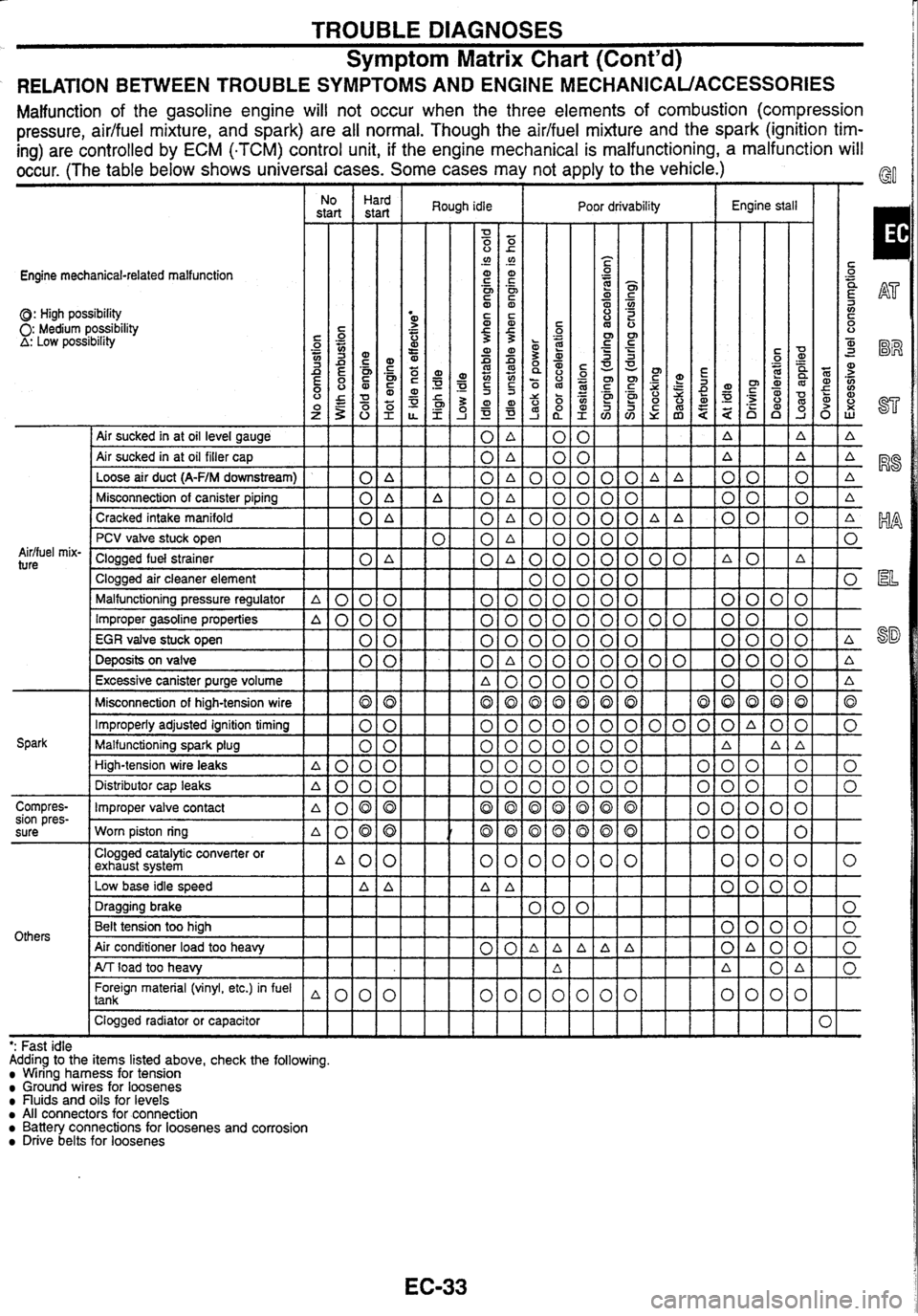
RELATION BETWEEN TROUBLE SYMPTOMS AND ENGINE MECHANICAUACCESSORIES
Malfunction of the gasoline engine will not occur when the three elements of combustion (compression
pressure, aidfuel mixture, and spark) are all normal. Though the
aidfuel mixture and the spark (ignition tim-
ing) are controlled by ECM
(.TCM) control unit, if the engine mechanical is malfunctioning,
a malfunction will
occur. (The table below shows universal cases. Some cases may not apply to the vehicle.)
Engine mechanical-related malfunction
0: High possibility 0: Medium possibility A: Low posstbility
I No I Hard
start start
I Air sucked in at oil level gauge
Air sucked in at oil filler cap
Loose air duct
(A-F/M downstream) 0 A
Misconnection of canister piping
0 A
Cracked intake manifold
0 A
Aidfuel
mix-
ture
PCV valve stuck open
Clogged fuel strainer
0 A
Clogged air cleaner element
Malfunctioning pressure regulator
A 0 0 0
Improper gasoline properties A000
EGR valve stuck open 0 0
Deposits on valve 0 0
Excessive canister purge volume
Misconnection of high-tension wire
Improperly adjusted ignition timing
Malfunctioning spark plug
High-tension wire leaks
A000
Spark Distributor cap leaks
A000
Compres-
Improper valve contact
sion pres-
. a080
sure Worn piston ring ~080
Others
Clogged catalytic converter or
exhaust system A00
Low base idle speed A
A
Foreign material (vinyl, etc.) in fuel 1 tank
Clogged radiator or capacitor
IIII
Rough idle I Poor drivability Engine stall
- - - - - - -- ': Fast
idle
Adding to the items listed above, check the following.
Wiring harness for tension Ground wires for loosenes nuids and oils for levels All connectors for connection Battery connections for loosenes and corrosion Drive belts for loosenes
Page 41 of 230
TROUBLE DIAGNOSES
Symptom Matrix Chart (Cont'd)
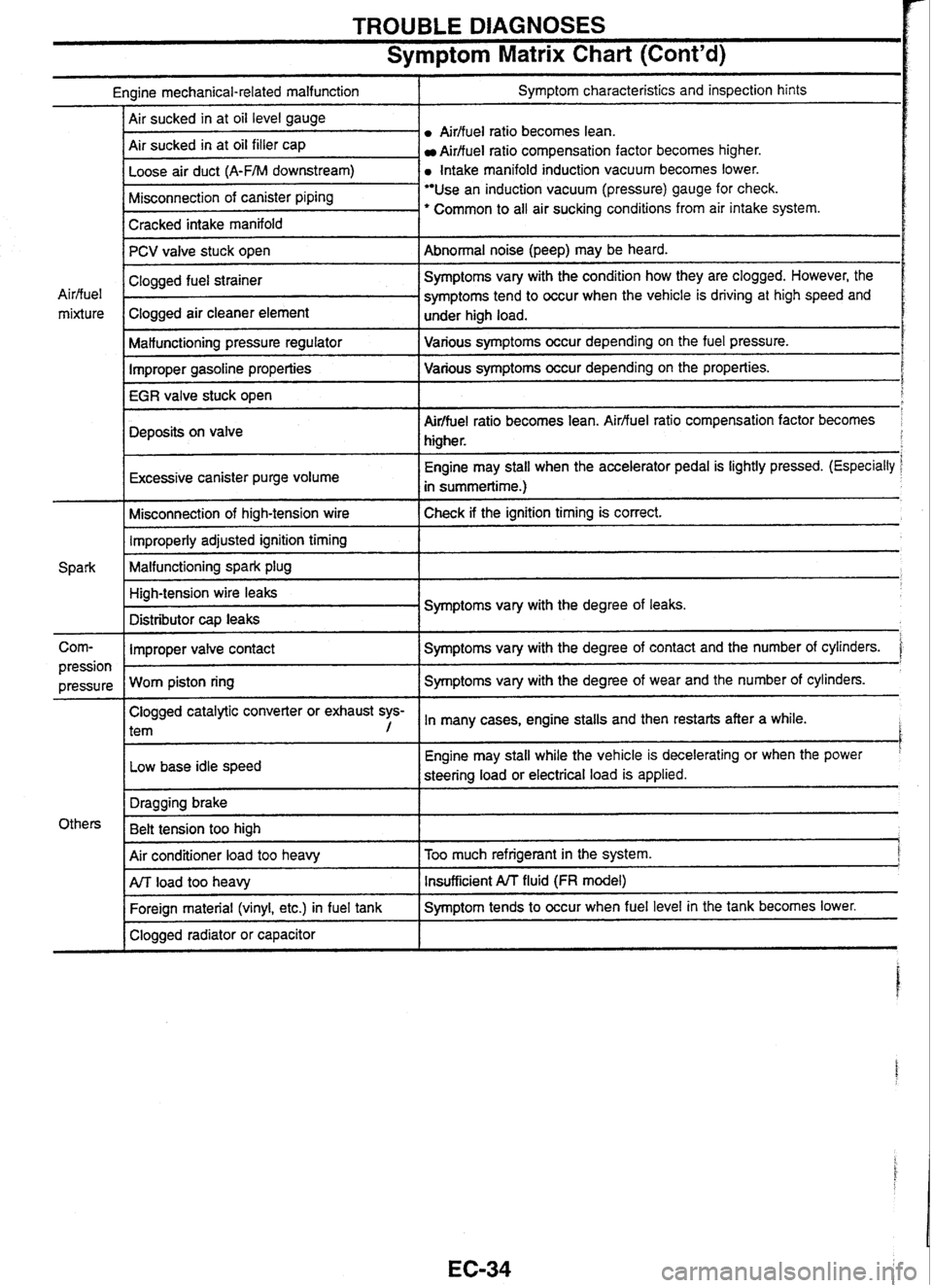
Engine mechanical-related malfunction I Symptom characteristics and inspection hints
Airffuel
ratio becomes lean.
Air sucked in at oil filler cap
Aidfuel ratio compensation factor becomes higher.
a Intake manifold induction vacuum becomes lower.
I Cracked intake manifold I
Misconnection of canister piping Use an induction vacuum (pressure) gauge for check.
' Common to all air sucking conditions from air intake system.
-
PCV valve stuck open
I Malfunctioning pressure regulator I Various symptoms occur depending on the fuel pressure.
Abnormal noise (peep) may
be heard.
Air/fuel
mixture
Improper gasoline properties Various
symptoms occur depending on the properties.
IEGRiale
stuck open
I
Clogged fuel strainer .
Clogged air cleaner element
Deposits on valve
r
Symptoms vary with the condition how they are clogged. However, the
symptoms tend to occur when the vehicle is driving at high speed and
under high load.
I
Air/fuel ratio becomes lean. Airfluel ratio compensation factor becomes
higher.
Excessive canister purge volume
I
Engine may stall when the accelerator pedal is lightly pressed. (Especially
in summertime.)
Misconnection of high-tension wire Check if the ignition timing
is correct. 1 Improperly adjusted ignition timing 1
Malfunctioning spark plug 1
Corn- I Improper valve contact I Symptoms vary with the degree of contact and the number of cylinders. '
High-tension wire leaks
Distributor
cap leaks Symptoms
vary with the degree of leaks.
Clogged catalytic converter or exhaust sys-
l tem , In many cases, engine stalls and then restarts after a while. I
pression I
Low base idle speed
pressure
Worn piston ring I
Engine may
stall while the vehicle is decelerating or when the power '
steering load or electrical load is applied.
Symptoms vary
with the degree of wear and the number of cylinders.
I
Air conditioner load too heavy I Too much refrigerant in the system. j
Others Dragging
brake
Belt tension too high
1
I Clogged radiator or capacitor I
ArJ load too heavy
Foreign material (vinyl, etc.) in fuel tank Insufficient A/T fluid (FR model)
Symptom tends to occur when fuel level in the tank becomes lower.
Page 44 of 230
TROUBLE DIAGNOSES
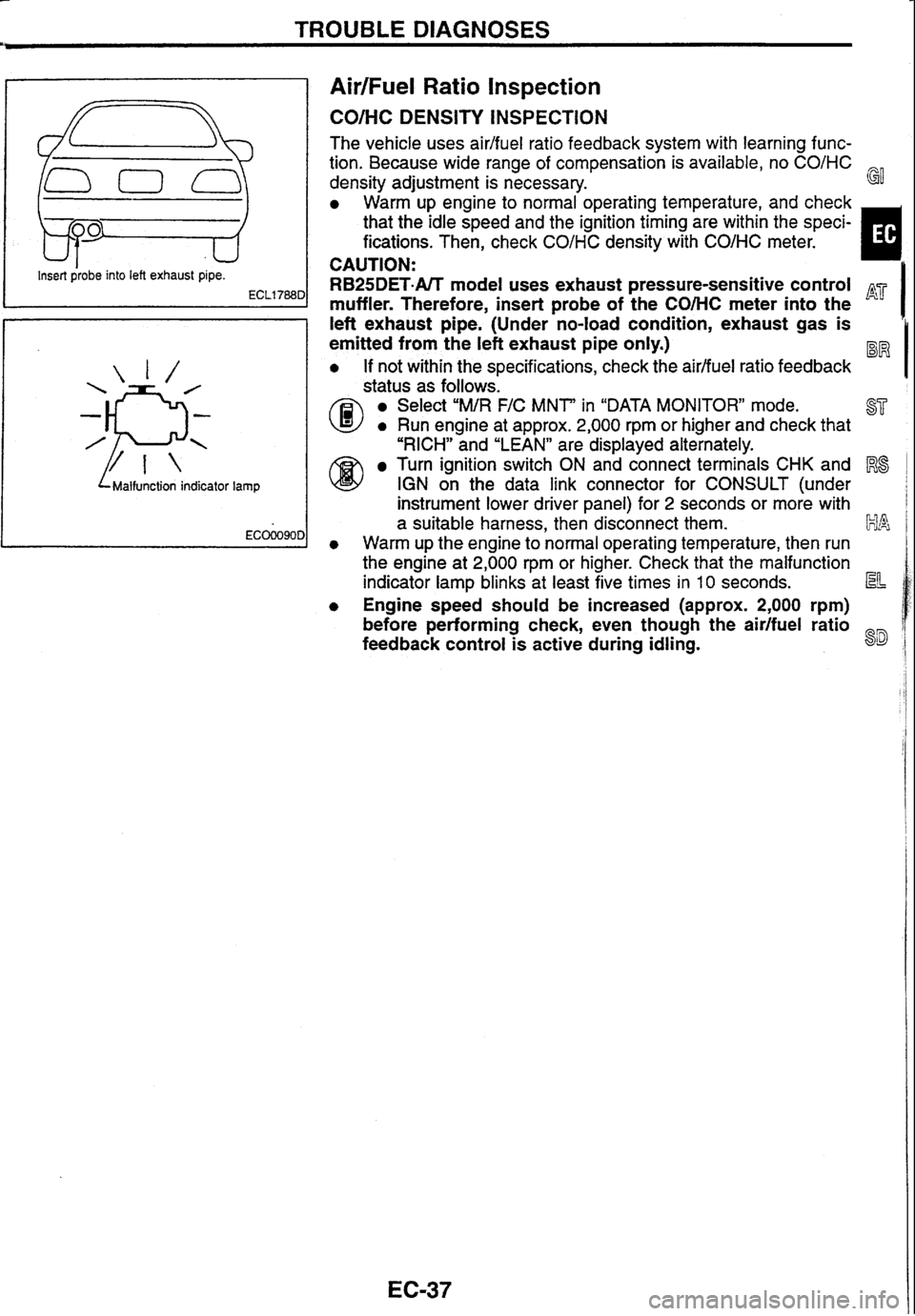
AirIFuel Ratio Inspection
Insert probe into left exhaust pipe.
ECLl788D
L Malfunction indicator lamp
CO/HC DENSITY INSPECTION
The vehicle uses aidfuel ratio feedback system with learning func-
tion. Because wide range of compensation is available, no
CO/HC
density adjustment is necessary. G!
Warm up engine to normal operating temperature, and check
that the idle speed and the ignition timing are within the speci-
fications. Then, check
CO/HC density with COIHC meter.
CAUTION:
muffler. Therefore, insert probe of the COMC meter into the
I
RB25DET-NT model uses exhaust pressure-sensitive control
I left exhaust pipe. (under -no-load condition, exhaust gas is
emitted from the left exhaust pipe only.)
a If not within the specifications, check the airlfuel ratio feedback
@status as follows.
Select "MIR FIC MNT" in "DATA MONITOR" mode.
a Run engine at approx. 2,000 rpm or higher and check that ST
I "RICH" and "LEAN" are displayed alternately.
Turn ignition switch ON and connect terminals CHK and Rs
@ IGN on the data link connector for CONSULT (under
instrument lower driver panel) for
2 seconds or more with
a suitable harness, then disconnect them. klk~
a Warm up the engine to normal operating temperature, then run
the engine at 2,000
rpm or higher. Check that the malfunction
indicator lamp blinks at least five times in
10 seconds. La=
0 Engine speed should be increased (approx. 2,000 rpm)
before performing check, even though the
air/fuel ratio
feedback control is active during idling.
8D
Page 45 of 230
TROUBLE DIAGNOSES
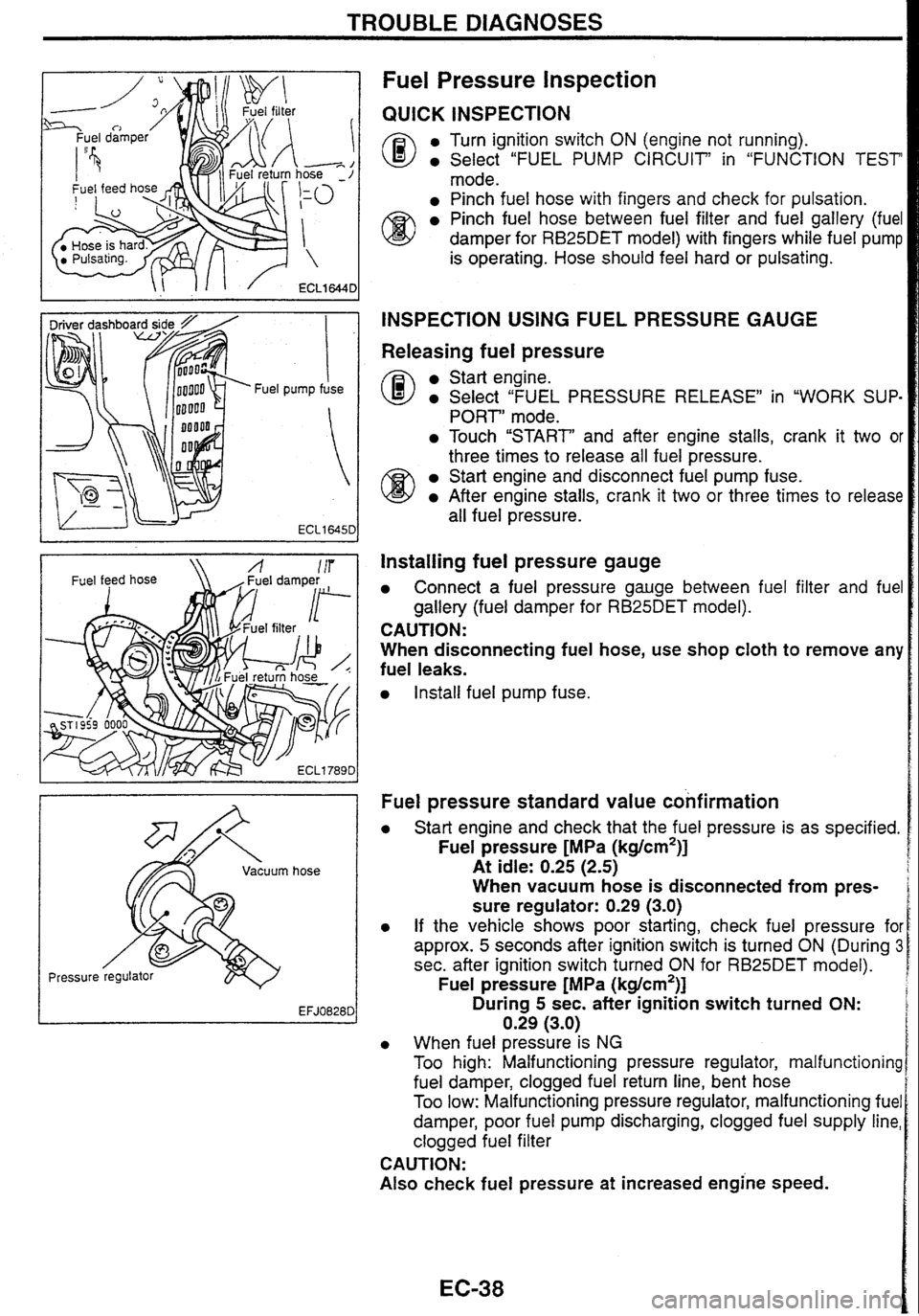
Fuel Pressure Inspection
Fuel pump fuse
Pressure hose
QUICK
INSPECTION
0 Turn ignition switch ON (engine not running).
Select "FUEL PUMP CIRCUIT' in "FUNCTION TEST
mode.
Pinch fuel hose with fingers and check for pulsation.
Pinch fuel hose between fuel filter and fuel gallery (fue
@ damper for RB2SDET model) with fingers while fuel puml
is operating. Hose should feel hard or pulsating.
INSPECTION USING FUEL PRESSURE GAUGE
Releasing fuel pressure
Start engine.
Select "FUEL PRESSURE RELEASE" in "WORK SUP
PORT' mode.
Touch "START' and after engine stalls, crank it two o
three times to release all fuel pressure.
Start engine and disconnect fuel pump fuse.
After engine stalls, crank it two or three times to releas
all fuel pressure.
Installing fuel pressure gauge
Connect a fuel pressure gauge between fuel filter and fue
gallery (fuel damper for
RB25DET model).
CAUTION:
When disconnecting fuel hose, use shop cloth to remove an!
fuel leaks.
Install fuel pump fuse.
Fuel pressure standard value confirmation
Start engine and check that the fuel pressure is as specified.
Fuel pressure [MPa (kg/cm2)]
At idle: 0.25 (2.5)
When vacuum hose is disconnected from pres-
sure regulator:
0.29 (3.0)
If the vehicle shows poor starting, check fuel pressure fo
approx.
5 seconds after ignition switch is turned ON (During :
sec. after ignition switch turned ON for RB25DET model).
Fuel pressure [MPa (kg/cm2)]
During 5 sec. after ignition switch turned ON:
0.29 (3.0)
When fuel pressure is NG
Too high: Malfunctioning pressure regulator, malfunction in^
fuel damper, clogged fuel return line, bent hose
Too low: Malfunctioning pressure regulator, malfunctioning fue
damper, poor fuel pump discharging, clogged fuel supply line
clogged fuel filter
CAUTION:
Also check fuel pressure at increased engine speed.
Page 47 of 230
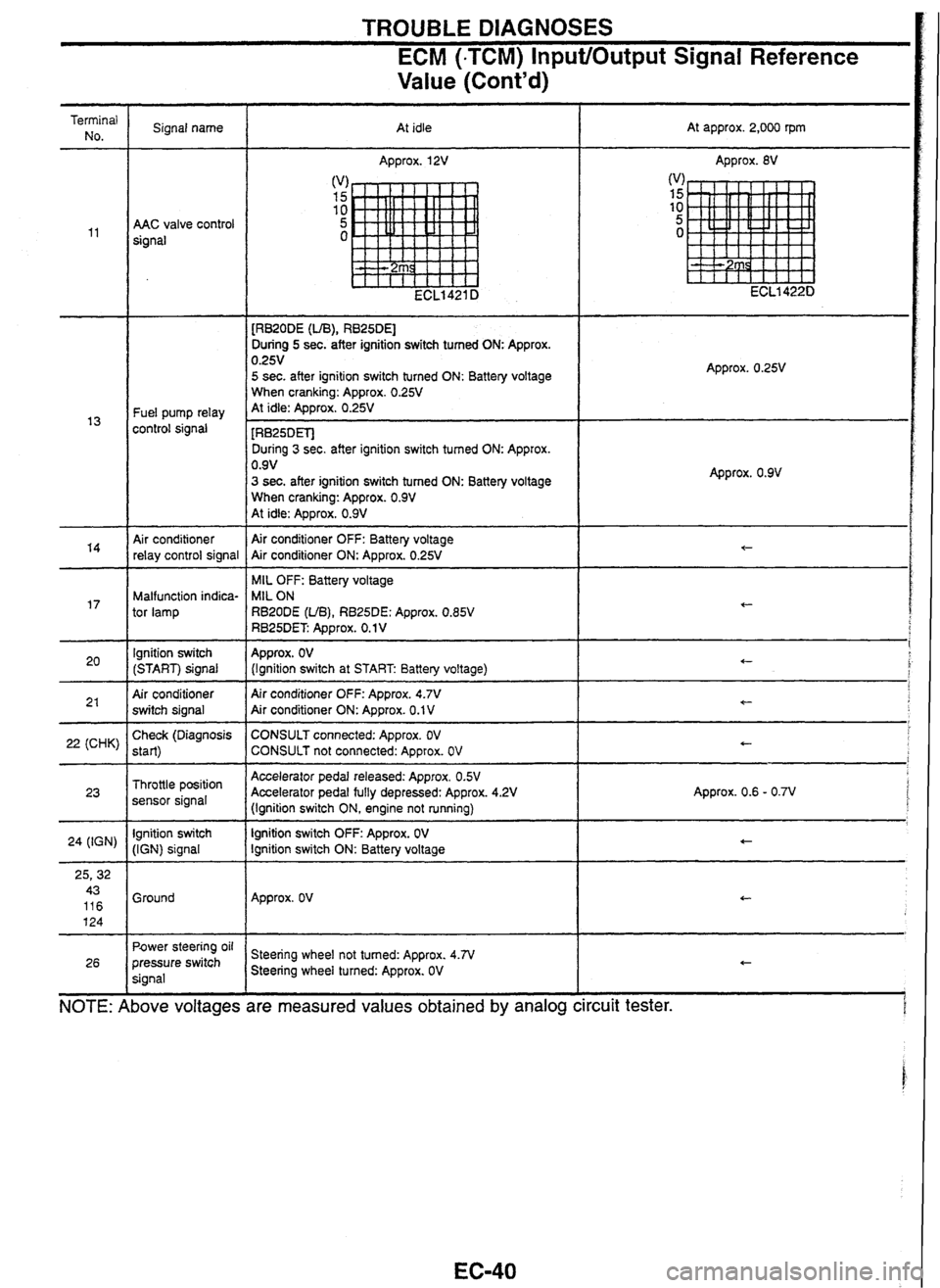
TROUBLE DIAGNOSES
ECM (-TCM) InputlOutput Signal Reference
Value (Cont'd)
d
voltages are
Terminal No. Signal name
At idle At
approx. 2,000 rpm
Approx.
12V Approx. 8V
AAC valve control
signal
[RB20DE
(UB), RB25DEl
During 5 sec. after ignition switch tumed ON: Approx. 0.25V 5 sec. after ignition switch turned ON: Battery voltage
When cranking: Approx. 0.25V At idle: Approx. 0.25V Fuel pump relay
control signal - - [RB25DETJ
During 3 sec. after ignition switch tumed ON: Approx.
0.9V
3 sec. after ignition switch tumed ON: Battery voltage
When cranking: Approx. 0.9V At idle: Approx. 0.9V
Approx. 0.9V
Air conditioner
relay control signal Air conditioner
OFF: Battery voltage
Air conditioner ON: Approx. 0.25V
MIL OFF: Battery voltage
MIL ON
RBZODE
(UB), RB25DE: Approx. 0.85V RB25DET Approx. 0.1 V
Malfunction indica-
tor lamp
lgnition switch
(START) signal
Air conditioner
switch signal Approx.
OV (Ignition
switch at START Battery voltage)
Air conditioner OFF: Approx.
4.7V Air conditioner ON: Approx. 0.1 V -
22 (CHK) Check
(Diagnosis
start)
Throttle position
sensor signal
lgnition switch
(IGN) signal CONSULT
connected: Approx. OV CONSULT not connected: Approx. OV
Accelerator pedal released: Approx. OSV Accelerator pedal fully depressed: Approx. 4.2V
(Ignition switch ON, engine not running)
lgnition switch
OFF: Approx. OV lgnition switch ON: Battery voltage Approx.
0.6 - 0.7V
24
(IGN)
Ground Approx.
OV
Power
steering oil
pressure switch
signal Steering
wheel not tumed: Approx. 4.N Steering wheel turned: Approx. OV
26
NOTE: I bove measured values obtained by analog ircuit
tester.
Page 52 of 230

TROUBLE DIAGNOSES
ECM (.TCM) InputlOutput Signal Reference
Value (Cont'd)
I Signal name
No. At
idle 7 At approx. 2,000 rpm
Control unit power sup-
ply (Counter-electromo-
live current feedback
circuit)
Fuel pump terminal
voltage control output
1 signal
IRB25DETI
Variable valve timing ,- control signal Battery voltage
Ignition switch at START: Approx.
OV During approx. 30 sec. after engine started with cool-
ant temperature 50°C or above: Approx. OV At idle: Approx. 1 OV
Battery voltage (Solenoid valve OFF)
Approx.
0.3V
Approx. OV
I t [With driving wheels lifted and gear in D position:
Approx. 0.45V (Solenoid valve ON)] AT
Approx. 0.3V (At approx. 2,800 rpm and above: Battery voltage) 1 I I
NOTE: Above voltages are measured values obtained by analogue circuit tester. BR