light NISSAN GT-R 2015 R35 User Guide
[x] Cancel search | Manufacturer: NISSAN, Model Year: 2015, Model line: GT-R, Model: NISSAN GT-R 2015 R35Pages: 358, PDF Size: 6.94 MB
Page 44 of 358
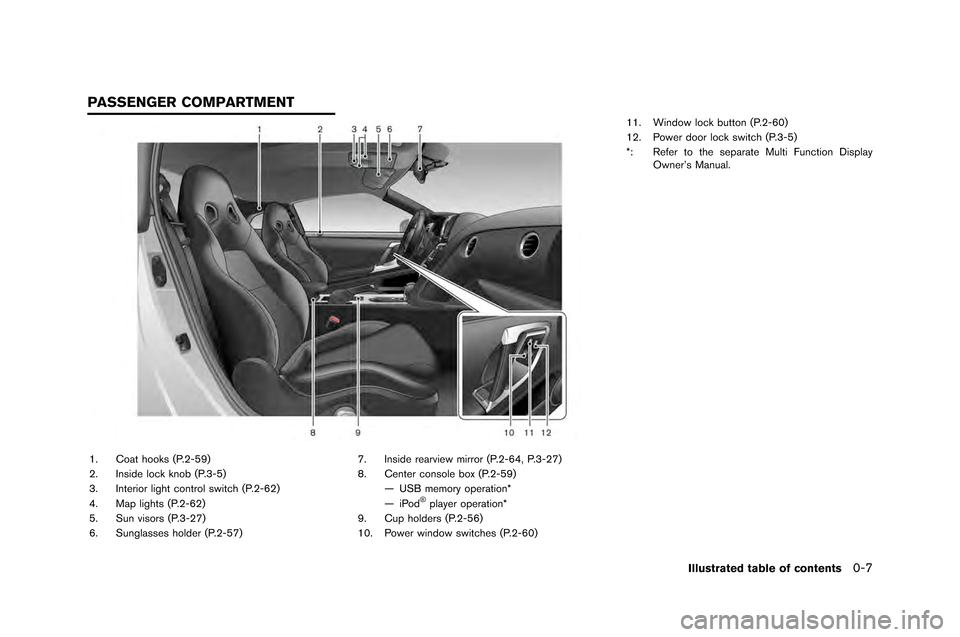
1. Coat hooks (P.2-59)
2. Insi�fe lock kno�b (P.3-5)
3. Interior light control switch (P.2-62)
4. Map lights (P.2-62)
5. Sun visors (P.3-27)
6. Sunglasses hol�fer (P.2-57)7. Insi�fe rearview mirror (P.2-64, P.3-27)
8. Center console �box (P.2-59)
— USB memory operation*
— iPo�f
Å player operation*
9. Cup hol�fers (P.2-56)
10. Power win�fow switches (P.2-60) 11. Win�fow lock �button (P.2-60)
12. Power �foor lock switch (P.3-5)
*: Refer to the separate Multi Function Display
Owner’s Manual.
Illustrated table of contents0-7
PASSENGER COMPARTMENT
Page 45 of 358
0-8Illustrated table of contents
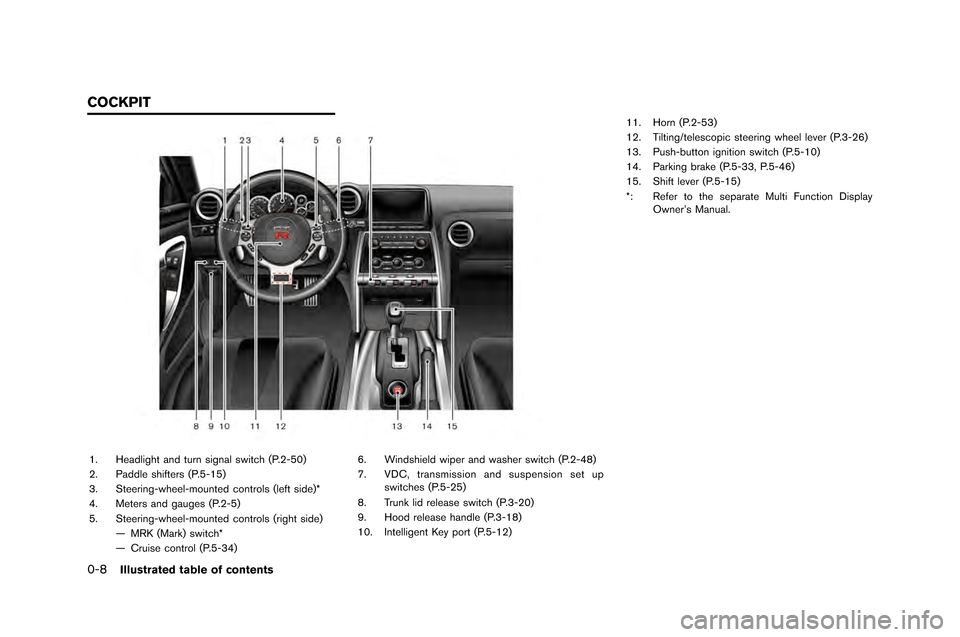
1. Headlight and turn signal swit�fh (P.2-�b0)
2. Paddle shifters (P.�b-1�b)
3. Steering-wheel-moun�wted �fontrols (left side)*
4. Meters and gauges (P.2-�b)
�b. Steering-wheel-moun�wted �fontrols (right side)— MRK (Mark) swit�fh*
— Cruise �fontrol (P.�b-34) 6. Windshield wiper and washer swit�fh (P.2-48)
7. VDC, transmission and suspension set up
swit�fhes (P.�b-2�b)
8. Trunk lid release swit�fh (P.3-20)
9. Hood release handle (P.3-18)
10. Intelligent Key port (P.�b-12) 11. Horn (P.2-�b3)
12. Tilting/teles�fopi�f steering wheel lever (P.3-26)
13. Push-button ignition swit�fh (P.�b-10)
14. Parking brake (P.�b-33, P.�b-46)
1�b. Shift lever (P.�b-1�b)
*: Refer to the separate Multi Fun�ftion Display
Owner’s Manual.
COCKPIT
Page 46 of 358
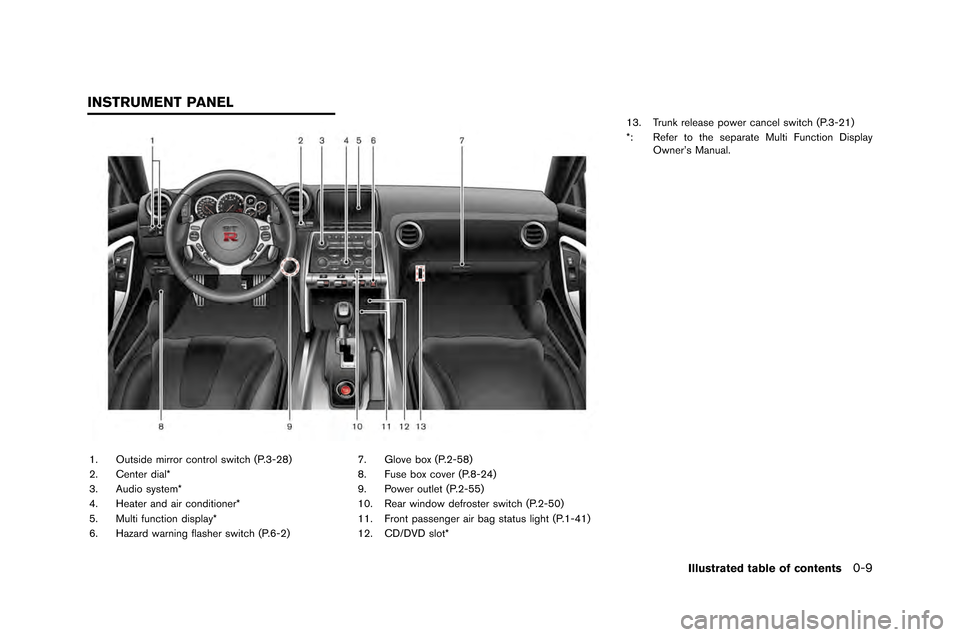
1. Outside mirror control switch (P.�f-28�b
2. Center dial*
�f. Audio system*
4. Heater and air conditioner*
5. Multi function display*
6. Hazard warning flasher switch (P.6-2�b7. Glove box (P.2-58�b
8. Fuse box cover (P.8-24�b
9. Power outlet (P.2-55�b
10. Rear window defroster switch (P.2-50�b
11. Front passenger air bag status light (P.1-41�b
12. CD/DVD slot*1�f. Trunk release power cancel switch (P.�f-21�b
*: Refer to the separate Multi Function Display
Owner’s Manual.
Illustrated table of contents0-9
INSTRUMENT PANEL
Page 47 of 358
0-10Illustrated table of contents
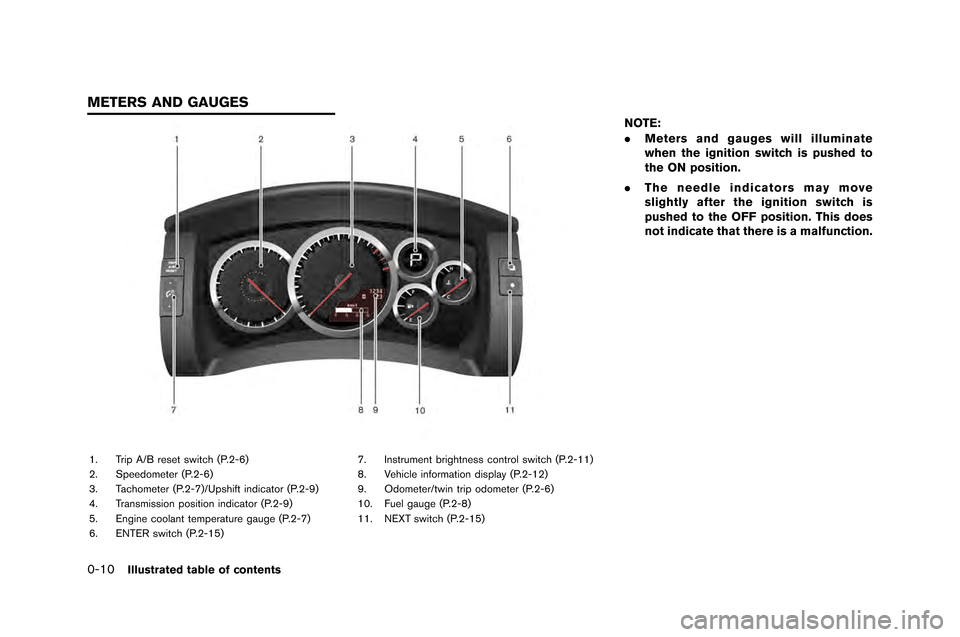
1. Trip A/B reset switch (P.�f-6)
�f. Spee�bometer (P.�f-6)
3. Tachometer (P.�f-7)/Upshift in�bicator (P.�f-9)
4. Transmission position in�bicator (P.�f-9)
5. Engine coolant temperature gauge (P.�f-7)
6. ENTER switch (P.�f-15)7. Instrument brightness control switch (P.�f-11)
8. Vehicle information �bisplay (P.�f-1�f)
9. O�bometer/twin trip o�bometer (P.�f-6)
10. Fuel gauge (P.�f-8)
11. NEXT switch (P.�f-15)
NOTE:
.
Meters and gauges will illuminate
when the ignition switch is pushed to
the ON position.
. The needle indicators may move
slightly after the ignition switch is
pushed to the OFF position. This does
not indicate that there is a malfunction.
METERS AND GAUGES
Page 49 of 358
0-12Illustrated table of contents
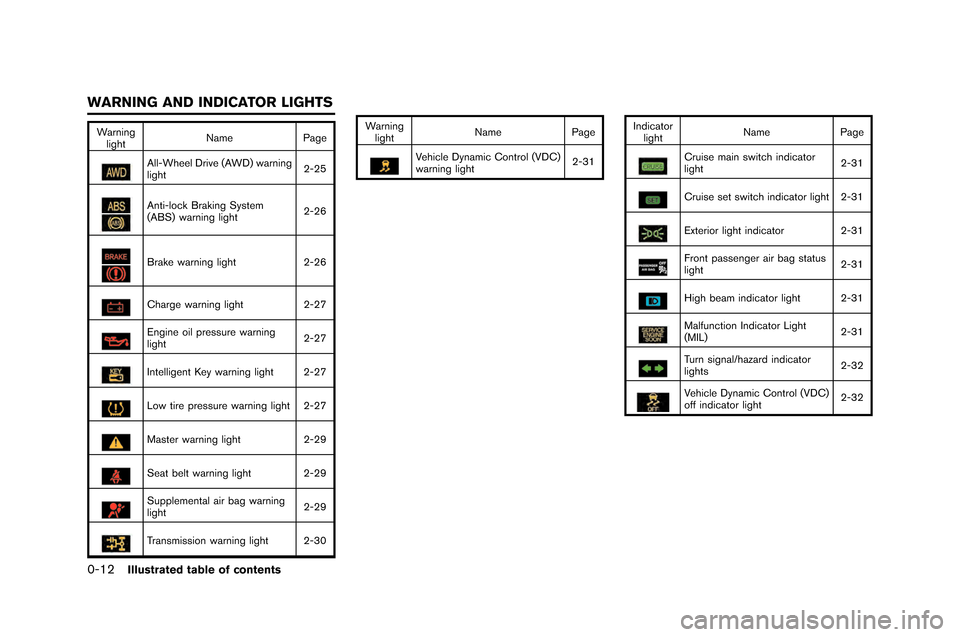
Warninglight Name
Page
All-Wheel Dri�fe (AWD) warning
light 2-2�b
Anti-lock Braking System
(ABS) warning light2-26
Brake warning light
2-26
Charge warning light2-27
Engine oil pressure warning
light2-27
Intelligent Key warning light 2-27
Low tire pressure warning light 2-27
Master warning light
2-29
Seat belt warning light 2-29
Supplemental air bag warning
light2-29
Transmission warning light 2-30 Warning
light Name
Page
Vehicle Dynamic Control (VDC)
warning light 2-31Indicator
light Name
PageCruise main switch indicator
light 2-31
Cruise set switch indicator light 2-31
Exterior light indicator
2-31
Front passenger air bag status
light2-31
High beam indicator light 2-31
Malfunction Indicator Light
(MIL)2-31
Turn signal/hazard indicator
lights2-32
Vehicle Dynamic Control (VDC)
off indicator light2-32
WARNING AND INDICATOR LIGHTS
Page 50 of 358
1 Safety — Seats, seat belts and supple-mental restraint system
Seats ..................�h..................�h..................�h..................�h..................�h. 1-2
Front seats ..................�h..................�h..................�h..................�h... 1-3
Head restraints/headrest�hs ..................�h..................�h..................�h 1-�f
Seat belts ..................�h..................�h..................�h..................�h........... 1-6 �brecautions on seat belt usage ..................�h..................�h.. 1-6
�bregnant women ..................�h..................�h..................�h.......... 1-9
Injured persons ..................�h..................�h..................�h............. 1-9
Three-point type seat belt with retractor ..................�h... 1-9
Seat belt extenders ..................�h..................�h..................�h... 1-12
Seat belt maintenance ..................�h..................�h............... 1-13
Child safety ..................�h..................�h..................�h..................�h..... 1-13 Infants ..................�h..................�h..................�h..................�h......... 1-14
Small children ..................�h..................�h..................�h............. 1-14
Larger children ..................�h..................�h..................�h........... 1-14
Child restraints ..................�h..................�h..................�h................. 1-1�f �brecautions on child restraints ..................�h..................�h 1-1�f
Lower Anchors and Tethers for CHildren
System (LATCH) ..................�h..................�h..................�h....... 1-17
Rear-facing child restraint installation
using LATCH ..................�h..................�h..................�h.............. 1-19 Rear-facing child restraint installation using the
seat belts ..................�h..................�h..................�h..................�h. 1-21
Forward-facing child restraint installation
using LATCH ..................�h..................�h..................�h............ 1-24
Forward-facing child restraint installation using the
seat belts ..................�h..................�h..................�h..................�h. 1-27
Booster seats ..................�h..................�h..................�h........... 1-31
Supplemental restraint system ..................�h..................�h...... 1-34 �brecautions on supplemental restraint system ...... 1-34
NISSAN Advanced Air Bag System
(front seats) ..................�h..................�h..................�h.............. 1-40
Front seat-mounted side-impact supplemental
air bag and roof-mounted curtain side-impact
supplemental air bag systems ..................�h................. 1-4�f
Seat belts with pretensioners (front seats) ............ 1-46
Supplemental air bag warning labels ..................�h.... 1-47
Supplemental air bag warning light ..................�h....... 1-47
Repair and replacement procedure ..................�h....... 1-48
1 Safety — Seats, seat belts and supple-mental restraint system
Seats ..................�h..................�h..................�h..................�h..................�h. 1-2
Front seats ..................�h..................�h..................�h..................�h... 1-3
Head restraints/headrest�hs ..................�h..................�h..................�h 1-�f
Seat belts ..................�h..................�h..................�h..................�h........... 1-6 �brecautions on seat belt usage ..................�h..................�h.. 1-6
�bregnant women ..................�h..................�h..................�h.......... 1-9
Injured persons ..................�h..................�h..................�h............. 1-9
Three-point type seat belt with retractor ..................�h... 1-9
Seat belt extenders ..................�h..................�h..................�h... 1-12
Seat belt maintenance ..................�h..................�h............... 1-13
Child safety ..................�h..................�h..................�h..................�h..... 1-13 Infants ..................�h..................�h..................�h..................�h......... 1-14
Small children ..................�h..................�h..................�h............. 1-14
Larger children ..................�h..................�h..................�h........... 1-14
Child restraints ..................�h..................�h..................�h................. 1-1�f �brecautions on child restraints ..................�h..................�h 1-1�f
Lower Anchors and Tethers for CHildren
System (LATCH) ..................�h..................�h..................�h....... 1-17
Rear-facing child restraint installation
using LATCH ..................�h..................�h..................�h.............. 1-19 Rear-facing child restraint installation using the
seat belts ..................�h..................�h..................�h..................�h. 1-21
Forward-facing child restraint installation
using LATCH ..................�h..................�h..................�h............ 1-24
Forward-facing child restraint installation using the
seat belts ..................�h..................�h..................�h..................�h. 1-27
Booster seats ..................�h..................�h..................�h........... 1-31
Supplemental restraint system ..................�h..................�h...... 1-34 �brecautions on supplemental restraint system ...... 1-34
NISSAN Advanced Air Bag System
(front seats) ..................�h..................�h..................�h.............. 1-40
Front seat-mounted side-impact supplemental
air bag and roof-mounted curtain side-impact
supplemental air bag systems ..................�h................. 1-4�f
Seat belts with pretensioners (front seats) ............ 1-46
Supplemental air bag warning labels ..................�h.... 1-47
Supplemental air bag warning light ..................�h....... 1-47
Repair and replacement procedure ..................�h....... 1-48
Page 57 of 358
1-8Safety — Seats, seat belts and supplemental restraint system
.Be sure the seat belt tongue is
securely fastened to the proper
buckle.
. Do not wear the seat belt inside out
or twisted. Doing so may reduce its
effectiveness.
. Do not allow more than one person
to use the same seat belt.
. Never carry more people in the
vehicle than there are seat belts.
. If the seat belt warning light glows
continuously while the ignition is
turned ON with all doors closed and
all seat belts fastened, it may in-
dicate a malfunction in the system.
Have the system checked by a GT-R
certified NISSAN dealer.
. No changes should be made to the
seat belt system. For example, do
not modify the seat belt, add mate-
rial, or install devices that may
change the seat belt routing or
tension. Doing so may affect the
operation of the seat belt system.
Modifying or tampering with the
seat belt system may result in
serious personal injury. .
Once a seat belt pretensioner has
activated, it cannot be reused and
must be replaced together with the
retractor. See a GT-R certified
NISSAN dealer.
. Removal and installation of the
pretensioner system components
should be done by a GT-R certified
NISSAN dealer.
. All seat belt assemblies, including
retractors and attaching hardware,
should be inspected after any colli-
sion by a GT-R certified NISSAN
dealer. NISSAN recommends that
all seat belt assemblies in use
during a collision be replaced un-
less the collision was minor and the
belts show no damage and continue
to operate properly. Seat belt as-
semblies not in use during a colli-
sion should also be inspected and
replaced if either damage or impro-
per operation is noted.
. All child restraints and attaching
hardware should be inspected after
any collision. Always follow the
restraint manufacturer’s inspection
instructions and replacement re- commendations. The child restraints
should be replaced if they are
damaged.
Page 60 of 358
of movement in the seat. The ELR locks the seat
�felt when the vehicle slows down ra�bidly or
during im�bacts.
The Automatic Locking Retractor (ALR) mode or
child restraint mode locks the seat �felt for child
restraint installation.
When the ALR mode is activated the seat �felt
cannot �fe extended again until the seat �felt
tongue is detached from the �fuckle and fully
retracted. The seat �felt returns to the ELR mode
after the seat �felt is fully retracted.
(
“Child restraints� �bage 1-15)
The ALR mode should be used only for
child restraint installation. During normal
seat belt use by an occupant, the ALR
mode should not be activated. If it is
activated it may cause uncomfortable seat
belt tension. It can also change the opera-
tion of the front passenger air bag.
(
“Front passenger air bag and status
light� page 1-41)
WARNING
When fastening the seat belts, be
certain that seatbacks are completely
secured in the latched position. If they
are not completely secured, passengers may be injured in an accident or sudden
stop.
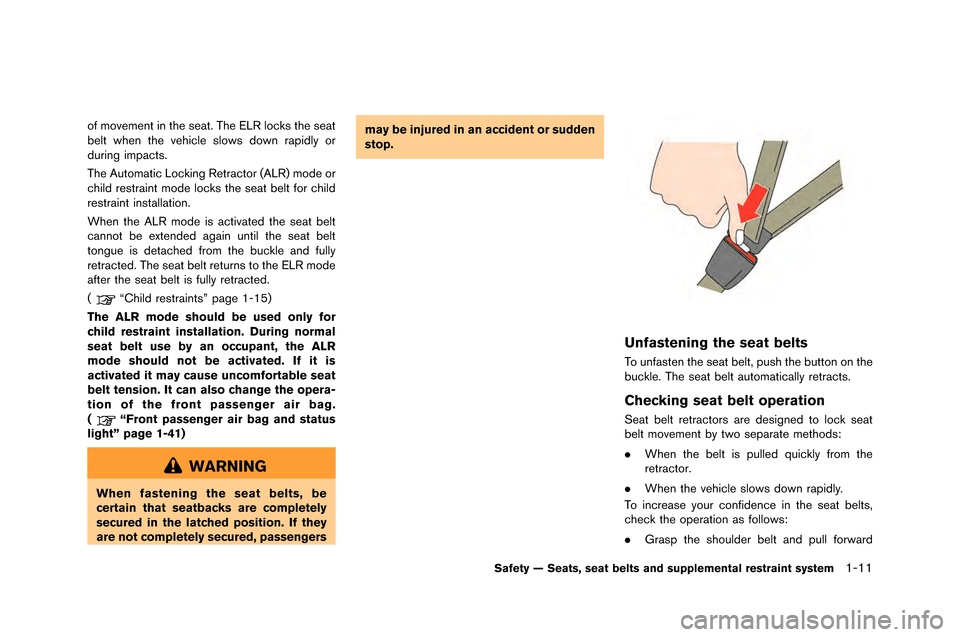
Unfastening the seat belts
To unfasten the seat �felt, �bush the �futton on the
�fuckle. The seat �felt automatically retracts.
Checking seat belt operation
Seat �felt retractors are designed to lock seat
�felt movement �fy two se�barate methods:
.
When the �felt is �bulled quickly from the
retractor.
. When the vehicle slows down ra�bidly.
To increase your confidence in the seat �felts,
check the o�beration as follows:
. Gras�b the shoulder �felt and �bull forward
Safety — Seats, seat belts and supplemental restraint system1-11
Page 70 of 358
5. Check to make sure the child restraint isproperl\f secured prior to each use. If the
child restraint is loose, repeat steps \b
through 4.
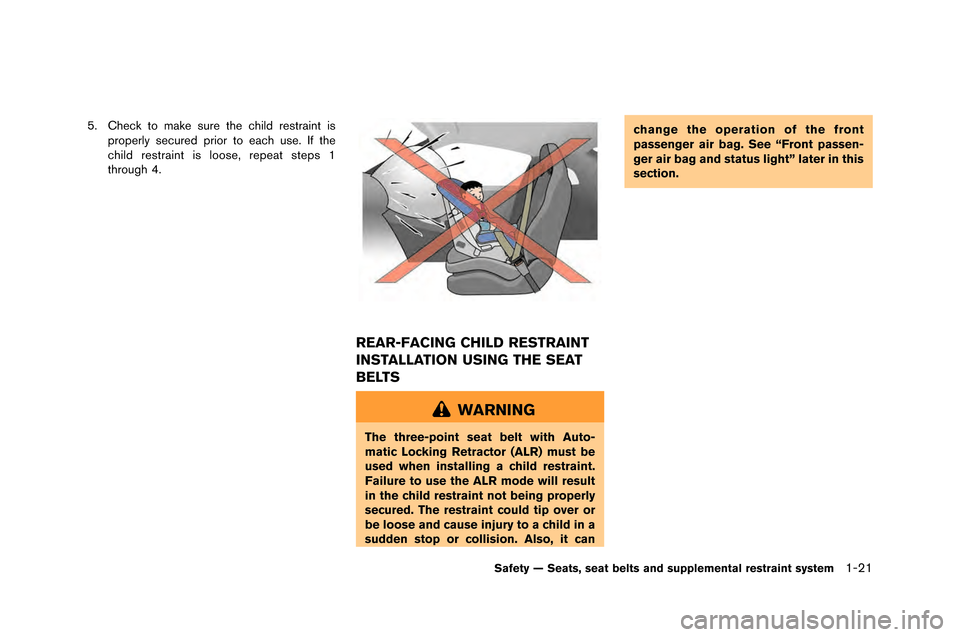
REAR-FACING CHILD RESTRAINT
INSTALLATION USING THE SEAT
BELTS
WARNING
The three-point seat belt with Auto-
matic Locking Retractor (ALR) must be
used when installing a child restraint.
Failure to use the ALR mode will result
in the child restraint not being properly
secured. The restraint could tip over or
be loose and cause injury to a child in a
sudden stop or collision. Also, it can change the operation of the front
passenger air bag. See “Front passen-
ger air bag and status light� later in this
section.
Safety — Seats, seat belts and supplemental restraint system\b-2\b
Page 76 of 358
FORWARD-FACING CHILD RE-
STRAINT INSTALLATION USING THE
SEAT BELTS
WARNING
The three-point seat belt with Auto-
matic Locking Retractor (ALR) must be
used when installing a child restraint.
Failure to use the ALR mode will result
in the child restraint not being properly
secured. The restraint could tip over or
be loose and cause injury to a child in a
sudden stop or collision. Also, it can
change the operation of the front
passenger air bag. See “Front passen-
ger air bag and status light� later in this
section.
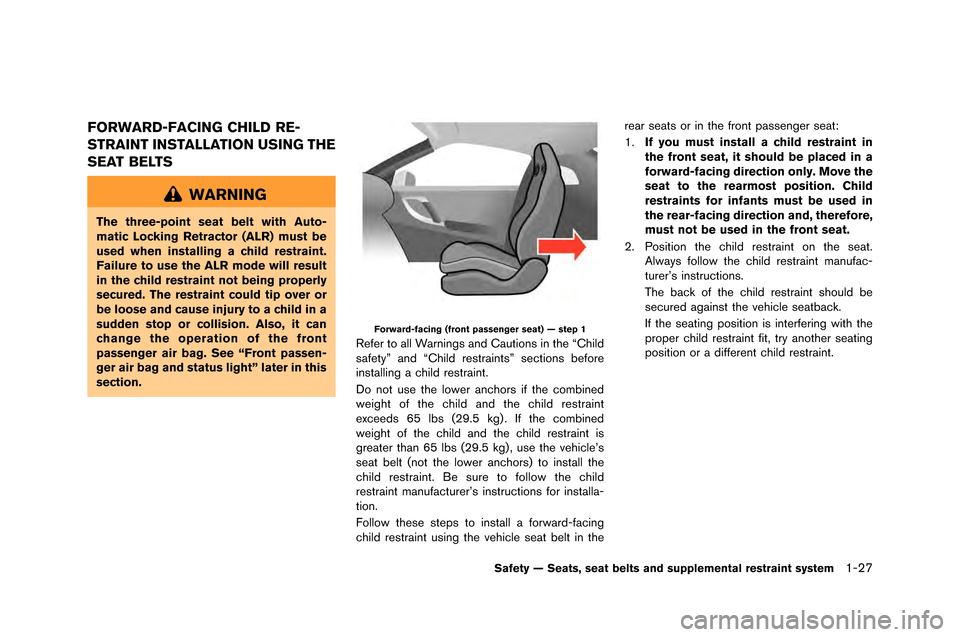
Forward-facing (front passenger seat) — step 1
Refer to all Warnings and Cautions in the “Child
safety�f and “Child restraints�f sections before
installing a child restraint.
�bo not use the lower anchors if the combined
weight of the child and the child restraint
exceeds 65 lbs (29.5 kg) . If the combined
weight of the child and the child restraint is
greater than 65 lbs (29.5 kg) , use the vehicle’s
seat belt (not the lower anchors) to install the
child restraint. Be sure to follow the child
restraint manufacturer’s instructions for installa-
tion.
Follow these steps to install a forward-facing
child restraint using the vehicle seat belt in therear seats or in the front passenger seat:
1.
If you must install a child restraint in
the front seat, it should be placed in a
forward-facing direction only. Move the
seat to the rearmost position. Child
restraints for infants must be used in
the rear-facing direction and, therefore,
must not be used in the front seat.
2. Position the child restraint on the seat. Always follow the child restraint manufac-
turer’s instructions.
The back of the child restraint should be
secured against the vehicle seatback.
If the seating position is interfering with the
proper child restraint fit, try another seating
position or a different child restraint.
Safety — Seats, seat belts and supplemental restraint system1-27