navigation system NISSAN LEAF 2014 1.G User Guide
[x] Cancel search | Manufacturer: NISSAN, Model Year: 2014, Model line: LEAF, Model: NISSAN LEAF 2014 1.GPages: 397, PDF Size: 9.45 MB
Page 29 of 397
EMERGENCY SHUT-OFF SYSTEM
The emergency shut-off system is activated and
the high-voltage system automatically turns off in
the following conditions:
- Front and side collisions in which the air bags
are deployed.
- Certain rear collisions.
- Certain EV (Electric Vehicle) system malfunc-
tions
For the above collisions and certain other EV
(Electric Vehicle) system malfunctions, the
READY to drive indicator light will turn off. See
“Warning/indicator lights and audible reminders”
in the “Instruments and controls” section.
The emergency shut-off activates for the above
collisions to minimize risk of an event that could
cause injury or an accident. If the emergency
shut-off system activates, the EV system may not
be switched to READY to drive position, contact
a NISSAN certified LEAF dealer. Even if the
power switch is switched to READY to drive
position, the system may shut-off suddenly.
Therefore, drive cautiously to the nearest
NISSAN certified LEAF dealer or contact a
NISSAN certified LEAF dealer as soon as pos-
sible.WARNING
• Pay special attention to pedestrians.
Because there is no engine noise, pe-
destrians may not know the vehicle is
approaching, moving or about to
move, and may step into the path of
vehicle travel.
• When leaving the vehicle, be sure to
turn off the EV (Electric Vehicle) sys-
tem.
• Be sure to push the P (Park) position
switch on the shift lever and apply the
parking brake when parking because
the vehicle can move when the READY
to drive indicator light is ON. When the
READY to drive indicator light is ON,
do not leave your vehicle in a shift
position other than the P (Park) posi-
tion.
• Keep the brake pedal depressed until
you are ready to drive. When the ve-
hicle is in the D (Drive) position or ECO
or R (Reverse) position, if you release
the brake pedal and do not depress
accelerator, the vehicle will creep and
may start abruptly. This may cause se-
rious injury or death.
NOTE:
•The vehicle cannot run with a discharged
Li-ion battery. Repeated acceleration con-
sumes more power from the Li-ion battery
than driving at a steady speed.
•This vehicle is equipped with a regenera-
tive brake system. The primary purpose of
regenerative brake system is to provide
some power to recharge the Li-ion battery
and extend driving range. A secondary
benefit is “engine braking” that operates
based on Li-ion battery conditions.
•In the D (Drive) position, when the accel-
erator pedal is released, the regenerative
brake system provides some decelera-
tion.
•When you put the shift lever in the ECO
position (models without navigation sys-
tem) or B position (models with naviga-
tion system) and take your foot off the
accelerator pedal, more regenerative
brake is applied than in the D (Drive) po-
sition.
•Less deceleration is provided by the re-
generative brake system when the Li-ion
battery is fully charged. Regenerative
brake is automatically reduced when the
EV (ELECTRIC VEHICLE)
CHARACTERISTICS
EV OverviewEV-9
Page 30 of 397
Li-ion battery is fully charged to prevent
the Li-ion battery from becoming over-
charged. Regenerating brake is also auto-
matically reduced when the battery tem-
perature is high/low (indicated by the red/
blue zones on the Li-ion battery
temperature gauge) to prevent Li-ion bat-
tery damage.
•The brake pedal should be used to slow or
stop the vehicle depending on traffic or
road conditions. The vehicle brakes are
not affected by regenerative brake system
operation.NOISE AND VIBRATION
You might experience the following noise or vi-
bration as a normal characteristic of this vehicle.
• Traction motor noise from motor compartment.
• Water pump and radiator fan noise while charg-
ing.
• Compressor and radiator fan noise when the
Climate Ctrl. Timer or remote climate control
(models with navigation system) is used.
• Relay operation noise and vibration at start-up
and shut-down of the EV (Electric Vehicle) sys-
tem (power switch placed in the ON and OFF
position) .
• Approaching Vehicle Sound for Pedestrians
(VSP) .This section provides a brief explanation for the
most important LEAF functions. Refer to the spe-
cific sections of this manual for detailed explana-
tions of the vehicle features and operation.
CHARGING THE LI-ION BATTERY
WARNING
The EV (Electric Vehicle) system uses a
high voltage current. Failure to follow the
proper handling instructions may cause
serious injury or death. Be sure to read
the “Charge” section and follow the pro-
cedures and guidelines described.
LIFE WITH AN EV (SCENE GUIDE)
EV-10EV Overview
Page 33 of 397
BEFORE DRIVING YOUR VEHICLE
(MODELS WITH NAVIGATION
SYSTEM)
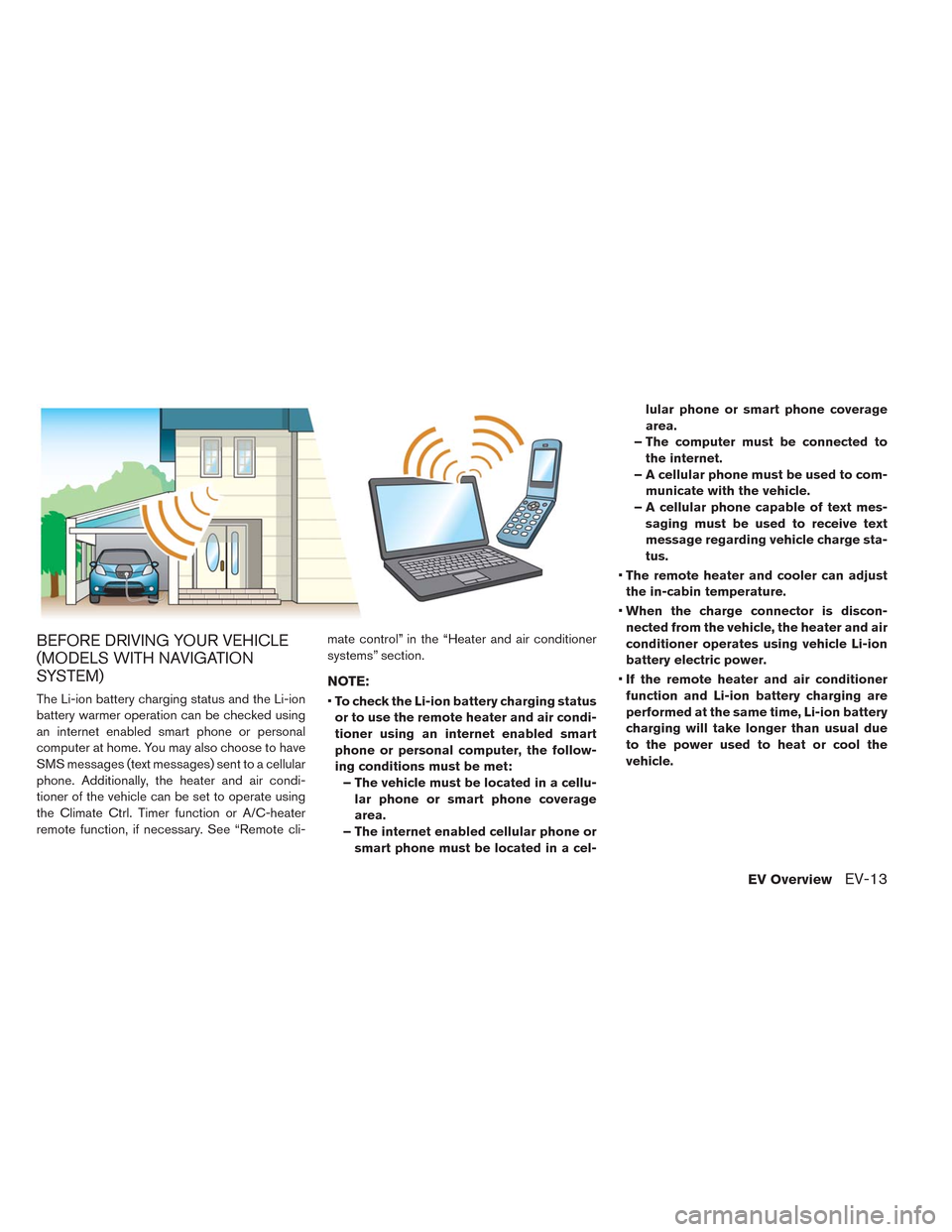
The Li-ion battery charging status and the Li-ion
battery warmer operation can be checked using
an internet enabled smart phone or personal
computer at home. You may also choose to have
SMS messages (text messages) sent to a cellular
phone. Additionally, the heater and air condi-
tioner of the vehicle can be set to operate using
the Climate Ctrl. Timer function or A/C-heater
remote function, if necessary. See “Remote cli-mate control” in the “Heater and air conditioner
systems” section.
NOTE:
•To check the Li-ion battery charging status
or to use the remote heater and air condi-
tioner using an internet enabled smart
phone or personal computer, the follow-
ing conditions must be met:
– The vehicle must be located in a cellu-
lar phone or smart phone coverage
area.
– The internet enabled cellular phone or
smart phone must be located in a cel-lular phone or smart phone coverage
area.
– The computer must be connected to
the internet.
– A cellular phone must be used to com-
municate with the vehicle.
– A cellular phone capable of text mes-
saging must be used to receive text
message regarding vehicle charge sta-
tus.
•The remote heater and cooler can adjust
the in-cabin temperature.
•When the charge connector is discon-
nected from the vehicle, the heater and air
conditioner operates using vehicle Li-ion
battery electric power.
•If the remote heater and air conditioner
function and Li-ion battery charging are
performed at the same time, Li-ion battery
charging will take longer than usual due
to the power used to heat or cool the
vehicle.
EV OverviewEV-13
Page 36 of 397
Notification of the Li-ion battery
warmer operation
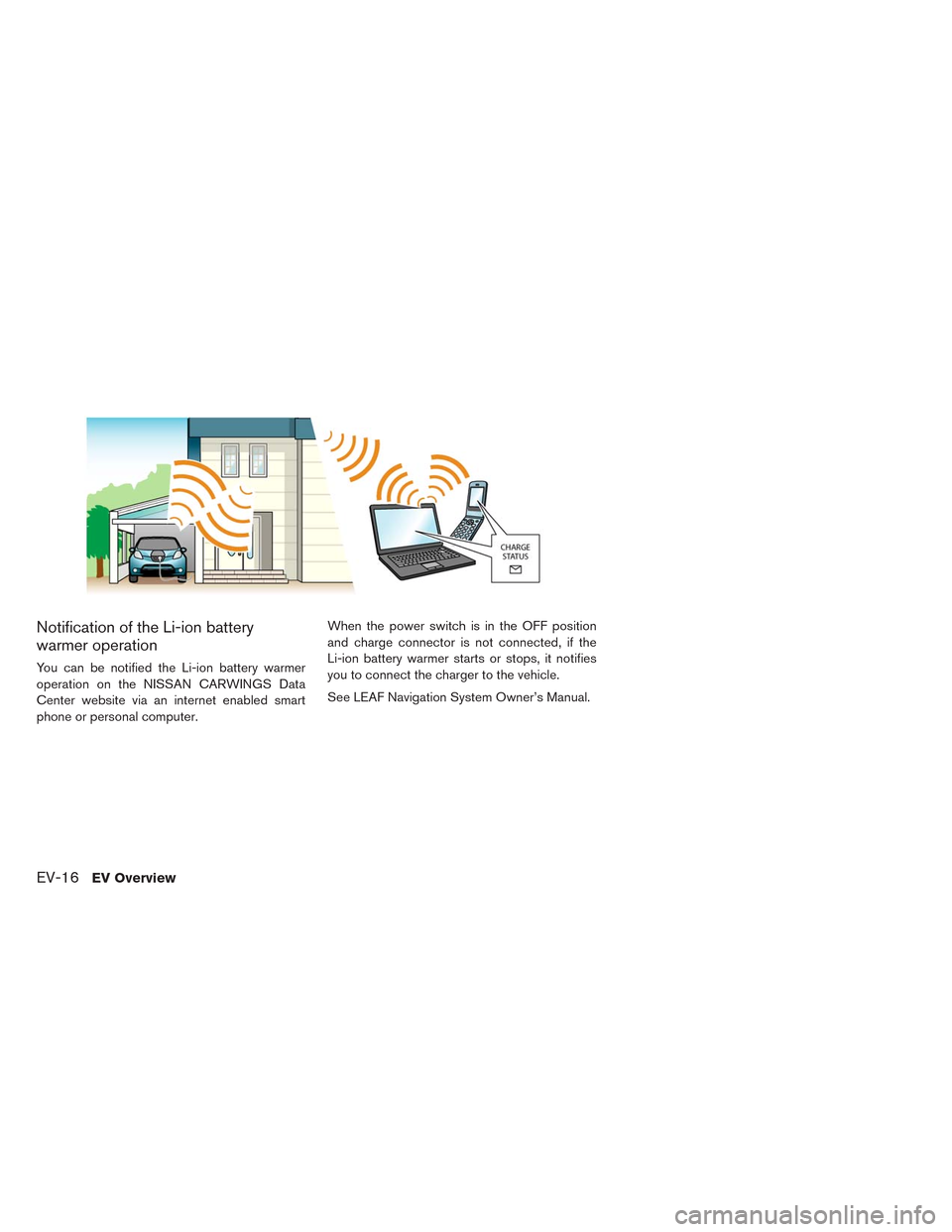
You can be notified the Li-ion battery warmer
operation on the NISSAN CARWINGS Data
Center website via an internet enabled smart
phone or personal computer.When the power switch is in the OFF position
and charge connector is not connected, if the
Li-ion battery warmer starts or stops, it notifies
you to connect the charger to the vehicle.
See LEAF Navigation System Owner’s Manual.
EV-16EV Overview
Page 37 of 397
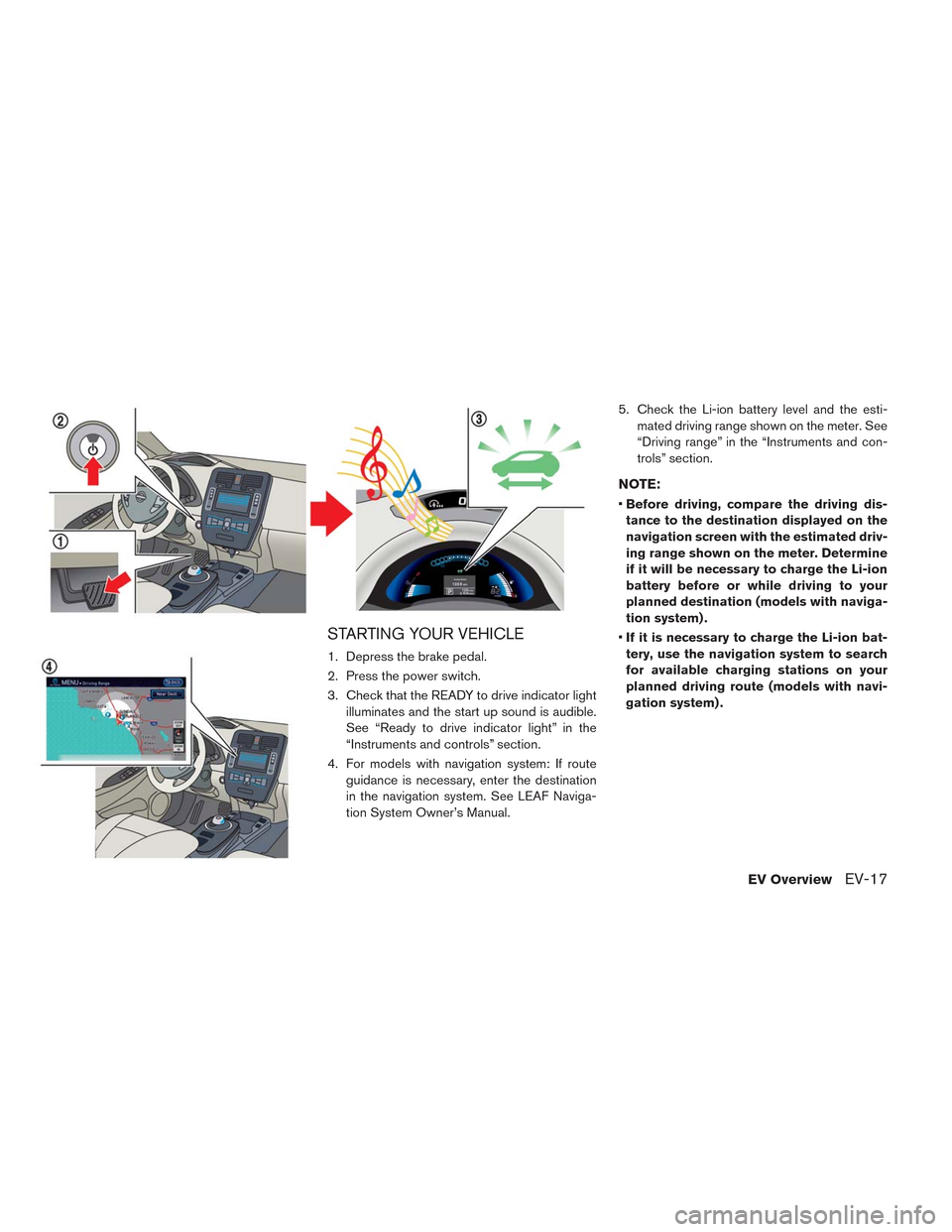
STARTING YOUR VEHICLE
1. Depress the brake pedal.
2. Press the power switch.
3. Check that the READY to drive indicator light
illuminates and the start up sound is audible.
See “Ready to drive indicator light” in the
“Instruments and controls” section.
4. For models with navigation system: If route
guidance is necessary, enter the destination
in the navigation system. See LEAF Naviga-
tion System Owner’s Manual.5. Check the Li-ion battery level and the esti-
mated driving range shown on the meter. See
“Driving range” in the “Instruments and con-
trols” section.
NOTE:
•Before driving, compare the driving dis-
tance to the destination displayed on the
navigation screen with the estimated driv-
ing range shown on the meter. Determine
if it will be necessary to charge the Li-ion
battery before or while driving to your
planned destination (models with naviga-
tion system) .
•If it is necessary to charge the Li-ion bat-
tery, use the navigation system to search
for available charging stations on your
planned driving route (models with navi-
gation system) .
EV OverviewEV-17
Page 38 of 397
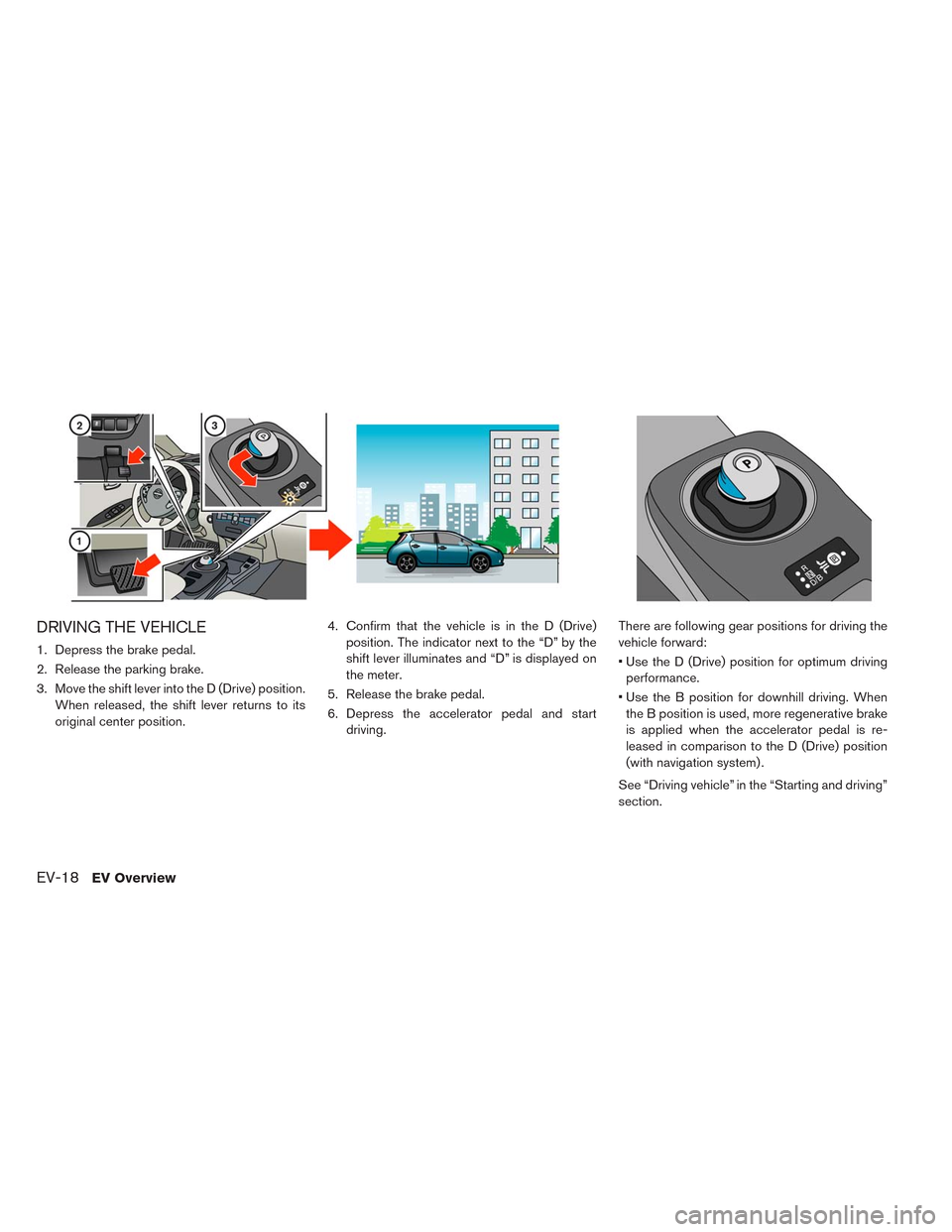
DRIVING THE VEHICLE
1. Depress the brake pedal.
2. Release the parking brake.
3. Move the shift lever into the D (Drive) position.
When released, the shift lever returns to its
original center position.4. Confirm that the vehicle is in the D (Drive)
position. The indicator next to the “D” by the
shift lever illuminates and “D” is displayed on
the meter.
5. Release the brake pedal.
6. Depress the accelerator pedal and start
driving.There are following gear positions for driving the
vehicle forward:
• Use the D (Drive) position for optimum driving
performance.
• Use the B position for downhill driving. When
the B position is used, more regenerative brake
is applied when the accelerator pedal is re-
leased in comparison to the D (Drive) position
(with navigation system) .
See “Driving vehicle” in the “Starting and driving”
section.
EV-18EV Overview
Page 39 of 397
Use the ECO position for maximum vehicle range
and for city driving. The ECO position helps re-
duce power consumption by reducing accelera-
tion when compared to the same accelerator
pedal position in the D (Drive) position and re-
duces the power provided to the heating and air
conditioner system.
Without navigation system model: When the
ECO position is used, more regenerative brake is
applied when the accelerator pedal is released in
comparison to the D (Drive) position.
NOTE:
The regenerative brake converts the vehi-
cle’s forward motion to electric power to
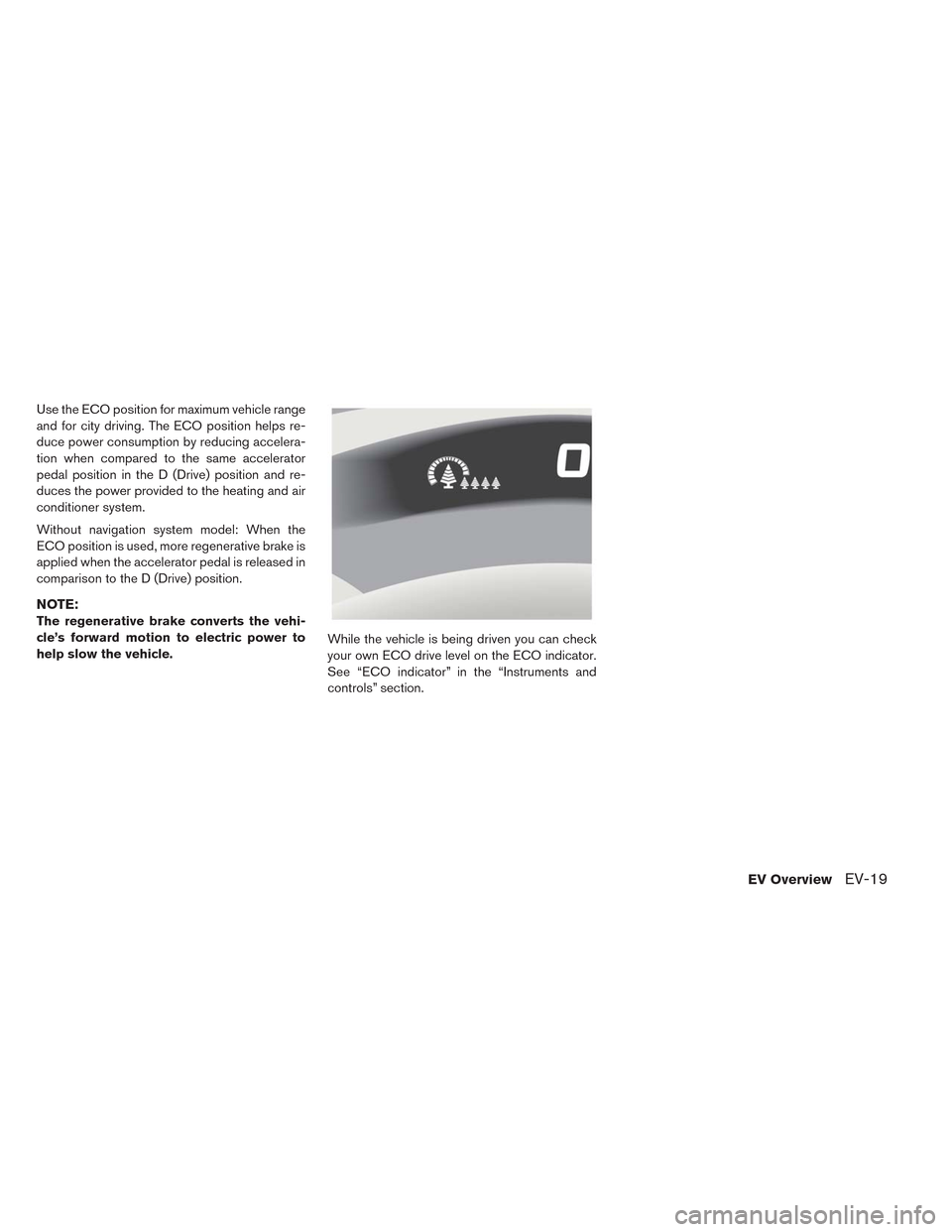
help slow the vehicle.While the vehicle is being driven you can check
your own ECO drive level on the ECO indicator.
See “ECO indicator” in the “Instruments and
controls” section.
EV OverviewEV-19
Page 42 of 397
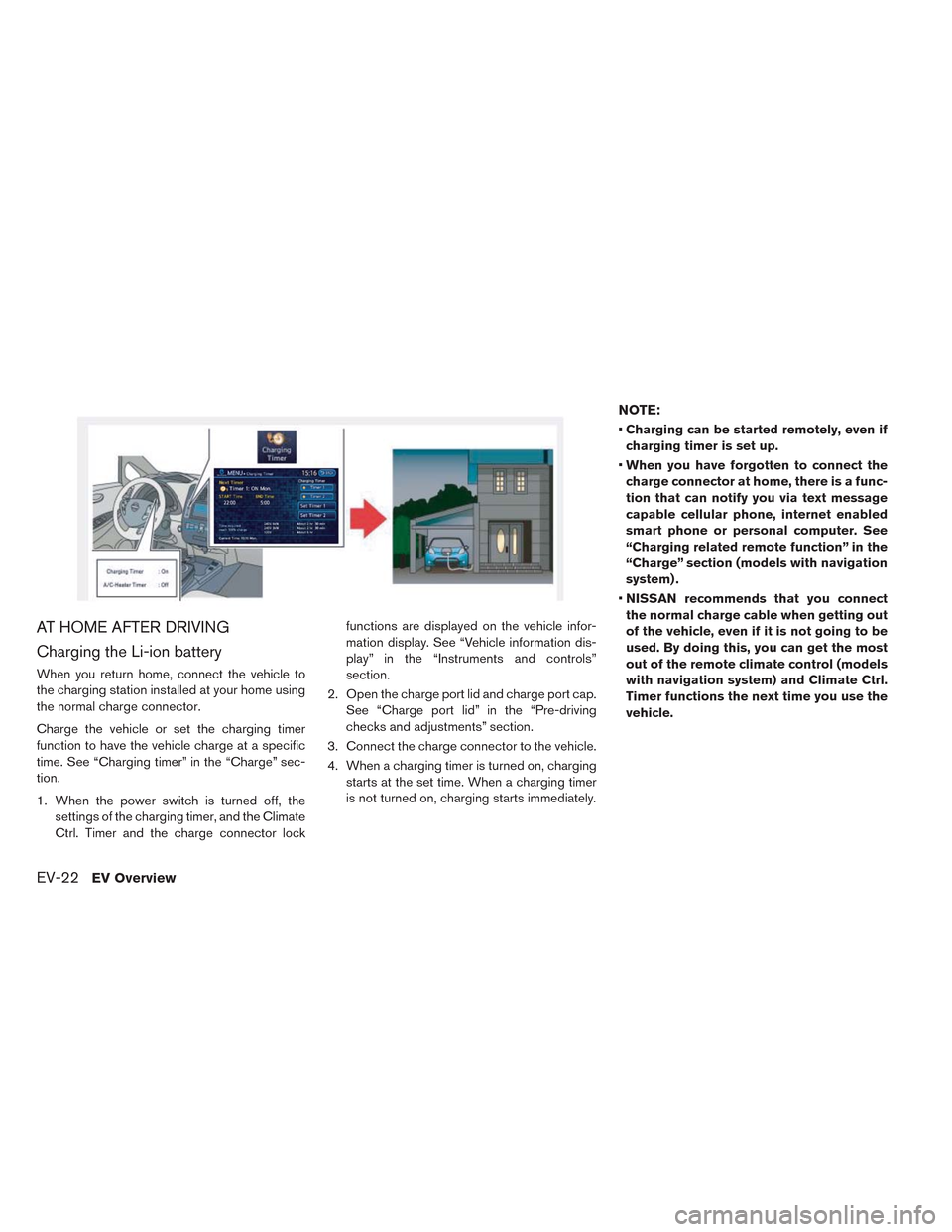
AT HOME AFTER DRIVING
Charging the Li-ion battery
When you return home, connect the vehicle to
the charging station installed at your home using
the normal charge connector.
Charge the vehicle or set the charging timer
function to have the vehicle charge at a specific
time. See “Charging timer” in the “Charge” sec-
tion.
1. When the power switch is turned off, the
settings of the charging timer, and the Climate
Ctrl. Timer and the charge connector lockfunctions are displayed on the vehicle infor-
mation display. See “Vehicle information dis-
play” in the “Instruments and controls”
section.
2. Open the charge port lid and charge port cap.
See “Charge port lid” in the “Pre-driving
checks and adjustments” section.
3. Connect the charge connector to the vehicle.
4. When a charging timer is turned on, charging
starts at the set time. When a charging timer
is not turned on, charging starts immediately.
NOTE:
•Charging can be started remotely, even if
charging timer is set up.
•When you have forgotten to connect the
charge connector at home, there is a func-
tion that can notify you via text message
capable cellular phone, internet enabled
smart phone or personal computer. See
“Charging related remote function” in the
“Charge” section (models with navigation
system) .
•NISSAN recommends that you connect
the normal charge cable when getting out
of the vehicle, even if it is not going to be
used. By doing this, you can get the most
out of the remote climate control (models
with navigation system) and Climate Ctrl.
Timer functions the next time you use the
vehicle.
EV-22EV Overview
Page 43 of 397
RANGE
The distance you can drive the vehicle (range)
varies considerably depending upon available
charge, weather, temperature, usage, battery
age, topography, and driving style.
Vehicle range depends on a number of factors.
When the Li-ion battery is new, the estimated
vehicle range with a fully charged Li-ion battery is
approximately 100 miles (160 km) based on the
EPA laboratory test commonly called the LA4
mode drive cycle. This test represents city driving
conditions. Your actual range can vary, either
initially or as the battery ages and with use over
time. The majority of drivers will experience ve-
hicle ranges between 62 to 138 miles (99 to 222
km) based on the many factors that affect vehicle
range. See “Improve driving range” later in this
section for information of the factors that affect
vehicle range and how to use the vehicle to
maximize vehicle range.
IMPROVE DRIVING RANGE
Vehicle range depends on a number of factors.
Actual vehicle range will vary depending upon:
• speed,
• vehicle load,• electrical load from vehicle accessories,
• traffic and road conditions.
NISSAN recommends the following driving
habits to help maximize vehicle range:
Before driving:
• Follow recommended periodic maintenance.
• Keep tires inflated to correct pressure.
• Keep wheels in correct alignment.
• Pre-heat or pre-cool the interior cabin while the
vehicle is charging.
• Remove unnecessary cargo from the vehicle.
While driving:
• Drive in ECO mode
– In the ECO position more regenerative
brake is applied when the accelerator pedal
is released in comparison to the D (Drive)
position and more power is provided to the
Li-ion battery (models with navigation sys-
tem) .
– The ECO position helps reduce power con-
sumption by reducing acceleration when
compared to the same accelerator pedal
position in the D (Drive) position.
– The ECO position reduces the power pro-
vided to the heater and air conditioner sys-
tem.• Drive at a constant speed. Maintain cruising
speeds with a constant accelerator positions or
by using cruise control when appropriate.
• Accelerate slowly and smoothly. Gently press
and release the accelerator pedal for accelera-
tion and deceleration.
• Drive at moderate speeds on the highway.
• Avoid frequent stopping and braking. Maintain a
safe distance behind other vehicles.
• Turn off the air conditioner/heater when it is not
necessary.
• Select a moderate temperature setting for heat-
ing or cooling to help reduce power consump-
tion.
• Use the air conditioner/heater and close win-
dows to reduce drag when cruising at highway
speed.
• Vehicle range may be substantially reduced in
extremely cold conditions (for example -4°F
(-20°C)) .
• Using the climate control system to heat the
cabin when outside temperature is below 32°F
(0°C) uses more electricity and affects vehicle
range more than when using the heater when
the temperature is above 32°F (0°C) .
EFFICIENT USE OF YOUR VEHICLE
EV OverviewEV-23
Page 50 of 397
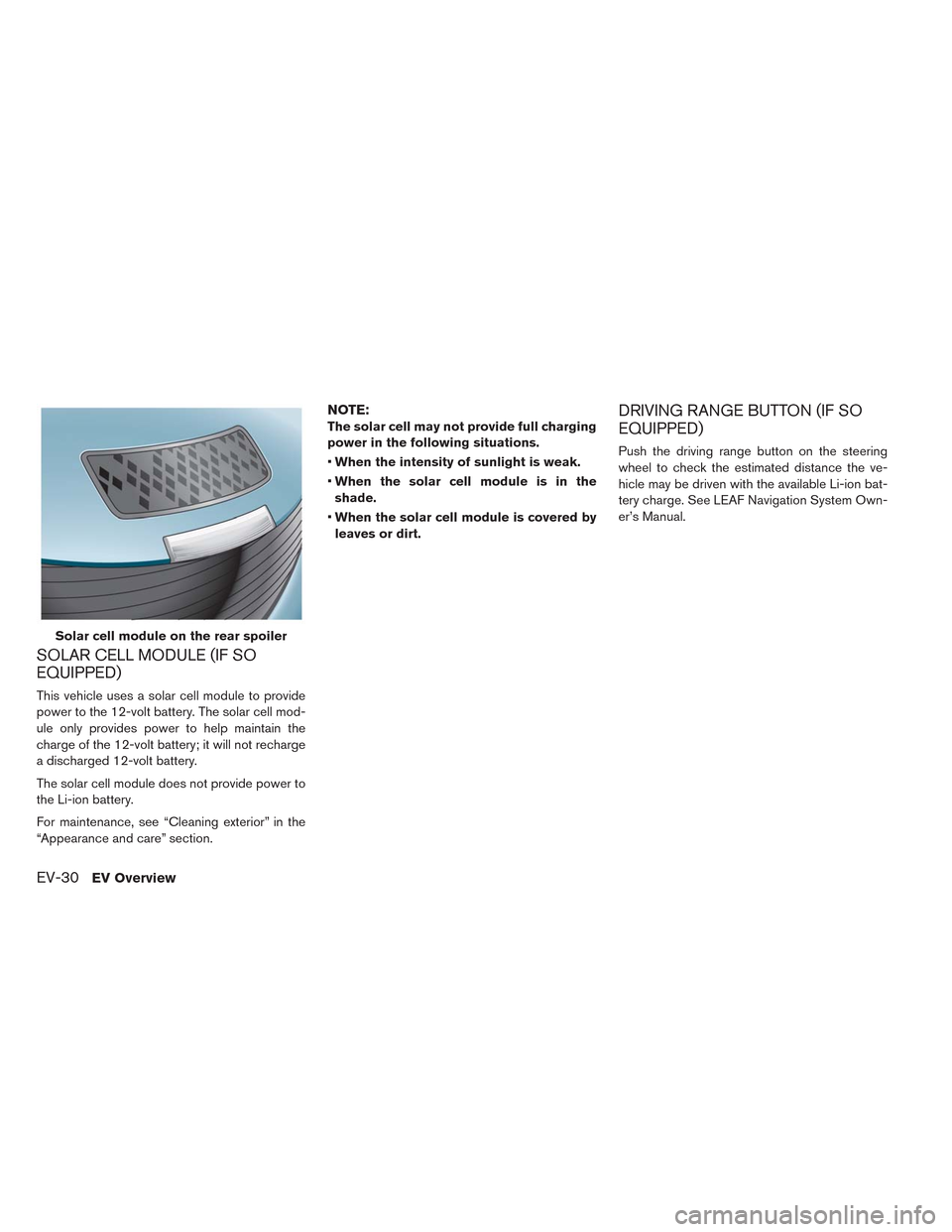
SOLAR CELL MODULE (IF SO
EQUIPPED)
This vehicle uses a solar cell module to provide
power to the 12-volt battery. The solar cell mod-
ule only provides power to help maintain the
charge of the 12-volt battery; it will not recharge
a discharged 12-volt battery.
The solar cell module does not provide power to
the Li-ion battery.
For maintenance, see “Cleaning exterior” in the
“Appearance and care” section.
NOTE:
The solar cell may not provide full charging
power in the following situations.
•When the intensity of sunlight is weak.
•When the solar cell module is in the
shade.
•When the solar cell module is covered by
leaves or dirt.DRIVING RANGE BUTTON (IF SO
EQUIPPED)
Push the driving range button on the steering
wheel to check the estimated distance the ve-
hicle may be driven with the available Li-ion bat-
tery charge. See LEAF Navigation System Own-
er’s Manual.
Solar cell module on the rear spoiler
EV-30EV Overview