wheel NISSAN LEAF 2015 1.G Repair Manual
[x] Cancel search | Manufacturer: NISSAN, Model Year: 2015, Model line: LEAF, Model: NISSAN LEAF 2015 1.GPages: 412, PDF Size: 8.81 MB
Page 372 of 412
The wheel nuts must be kept tight-
ened to the specification at all times.
It is recommended that wheel nuts
be tightened to the specification at
each tire rotation interval.
WARNING
•
After rotating the tires, check
and adjust the tire pressure.
•Retighten the wheel nuts when
the vehicle has been driven for
600 miles (1,000 km) (also in
cases of a flat tire, etc.) .
•For additional information re-
garding tires, refer to “Important
Tire Safety Information” (US) or
“Tire Safety Information”
(Canada) in the Warranty Infor-
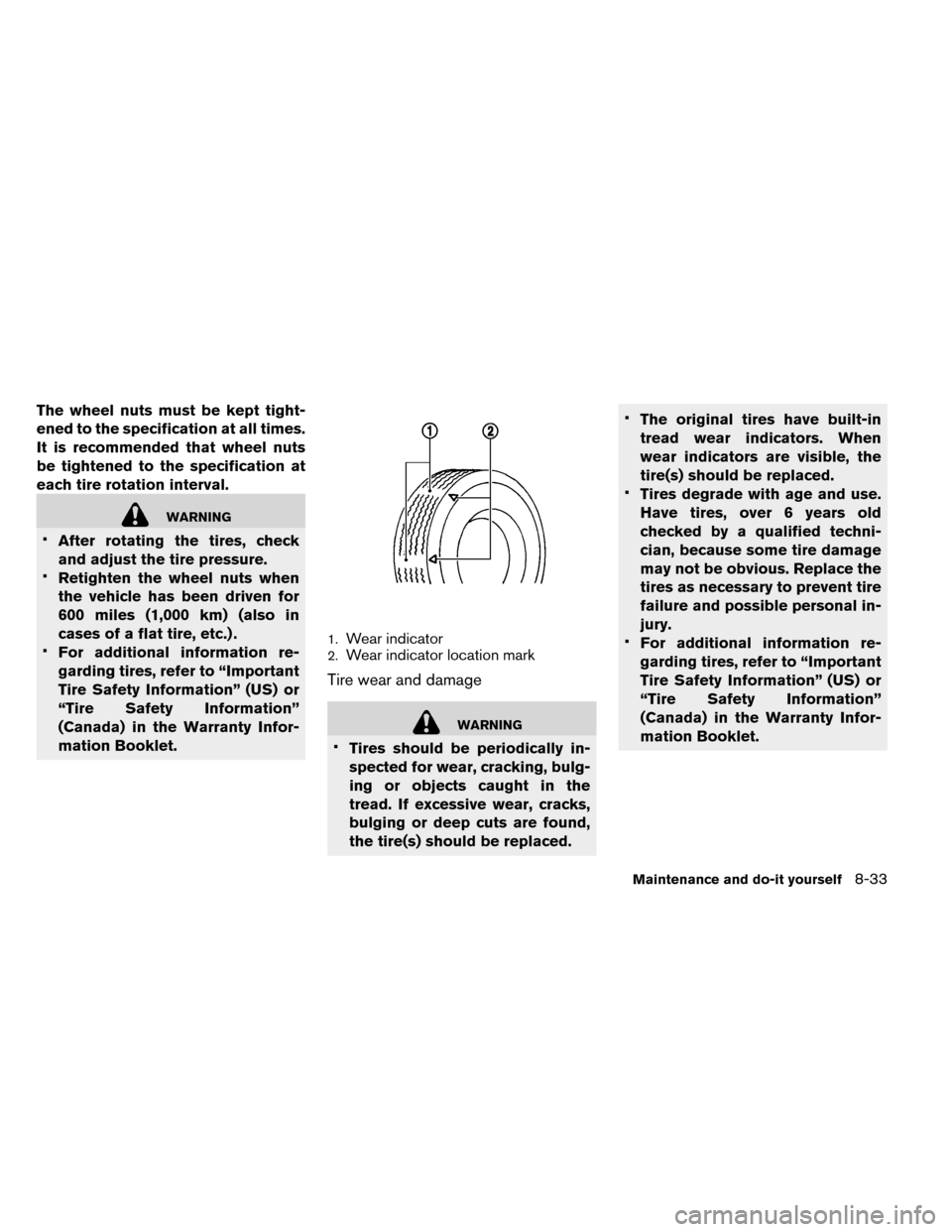
mation Booklet.1.Wear indicator
2.Wear indicator location mark
Tire wear and damage
WARNING
•
Tires should be periodically in-
spected for wear, cracking, bulg-
ing or objects caught in the
tread. If excessive wear, cracks,
bulging or deep cuts are found,
the tire(s) should be replaced.
•The original tires have built-in
tread wear indicators. When
wear indicators are visible, the
tire(s) should be replaced.
•Tires degrade with age and use.
Have tires, over 6 years old
checked by a qualified techni-
cian, because some tire damage
may not be obvious. Replace the
tires as necessary to prevent tire
failure and possible personal in-
jury.
•For additional information re-
garding tires, refer to “Important
Tire Safety Information” (US) or
“Tire Safety Information”
(Canada) in the Warranty Infor-
mation Booklet.
Maintenance and do-it yourself8-33
Page 373 of 412
Replacing wheels and tires
When replacing a tire, use the same size, tread
design, speed rating and load carrying capacity
as originally equipped. See “Specifications” in
the “Technical and consumer information” sec-
tion for recommended types and sizes of tires
and wheels.
WARNING
• The use of tires other than those rec- ommended or the mixed use of tires of
different brands, construction (bias,
bias-belted or radial) , or tread patterns
can adversely affect the ride, braking,
handling, ground clearance, body-to-
tire clearance, tire chain clearance,
speedometer calibration, headlight
aim and bumper height. Some of these
effects may lead to accidents and
could result in serious personal injury.
• If your vehicle was originally equipped with 4 tires that were the same size
and you are only replacing 2 of the 4
tires, install the new tires on the rear
axle. Placing new tires on the front
axle may cause loss of vehicle control
in some driving conditions and cause
an accident and personal injury. • If the wheels are changed for any rea-
son, always replace with wheels which
have the same off-set dimension.
Wheels of a different off-set could
cause premature tire wear, degrade
vehicle handling characteristics
and/or interference with the brake
discs. Such interference can lead to
decreased braking efficiency and/or
early brake pad/shoe wear. See
“Wheels and tires” in the “Technical
and consumer information” section of
this manual for wheel off-set dimen-
sions.
• When a wheel is replaced, the TPMS will not function and the low tire pres-
sure warning light will flash for ap-
proximately 1 minute. The light will re-
main on after 1 minute. Contact your
NISSAN certified LEAF dealer as soon
as possible for tire replacement
and/or system resetting.
• Replacing tires with those not origi- nally specified by NISSAN could affect
the proper operation of the TPMS.
• Do not install a damaged or deformed wheel or tire even if it has been re-
paired. Such wheels or tires could have
structural damage and could fail with-
out warning. • The use of retread tire is not recom-
mended.
• For additional information regarding tires, refer to “Important Tire Safety
Information” (US) or “Tire Safety Infor-
mation” (Canada) in the Warranty In-
formation Booklet.Wheel balance
Unbalanced wheels may affect vehicle handling
and tire life. Even with regular use, wheels can get
out of balance. Therefore, they should be bal-
anced as required.
Wheel balance service should be per-
formed with the wheels off the vehicle.
Spin balancing the wheels on the vehicle
could lead to mechanical damage.
For additional information regarding tires, refer to
“Important Tire Safety Information” (US) or “Tire
Safety Information” (Canada) in the Warranty In-
formation Booklet.
Care of wheels
See “Cleaning exterior” in the “Appearance and
care” section for details about care of the wheels.
8-34Maintenance and do-it yourself
Page 376 of 412
9 Technical and consumer information
Recommended fluids/lubricants and capacities.....9-2
Air conditioning system refrigerant and lubricant
recommendations .................... .9-3
Specifications ........................ .9-4
Charging system .................... .9-4
Motor ........................... .9-5
Wheels and tires .................... .9-5
Dimensions and weights ................ .9-6
When traveling or registering your vehicle in another
country ............................ .9-6
Vehicle identification .................... .9-7
Vehicle Identification Number (VIN) plate .......9-7
Vehicle identification number (chassis number). . . .9-7
Traction motor serial number ..............9-7
F.M.V.S.S./C.M.V.S.S certification label ........9-8
Emission control information label ...........9-8
Tire and Loading Information label ...........9-8
Air conditioner specification label ............9-9
Installing front license plate .................9-9Vehicle loading information
.................9-10
Terms .......................... .9-10
Vehicle load capacity ................. .9-11
Securing the load ................... .9-12
Loading tips ...................... .9-12
Measurement of weights ................9-13
Towing a trailer ....................... .9-14
Flat towing ......................... .9-14
Uniform tire quality grading .................9-14
Treadwear ....................... .9-14
Traction AA, A, B and C ................9-14
Temperature A, B and C ................9-15
Reporting safety defects ................. .9-15
Telematics overview .................... .9-16
Event Data Recorder (EDR) ................9-18
Owner’s Manual/Service Manual order information. . .9-19
Charging information ................... .9-20
Cold tire pressures .................... .9-22
Page 380 of 412
Rated input voltageAC120V (single phase) , AC240V (single phase)
Rated input frequency 60Hz
Applicable standards SAE J1772: 2010
EN61851-1: 2010
EN61851-21: 2002
IEC61851-1: 2010
IEC61851-21: 2001EN61000-6-1: 2007
EN61000-6-3: 2007
Adapters
Adaptors shall not be used to connect a vehicle connector to a vehicle inlet.
MOTOR
Model EM61
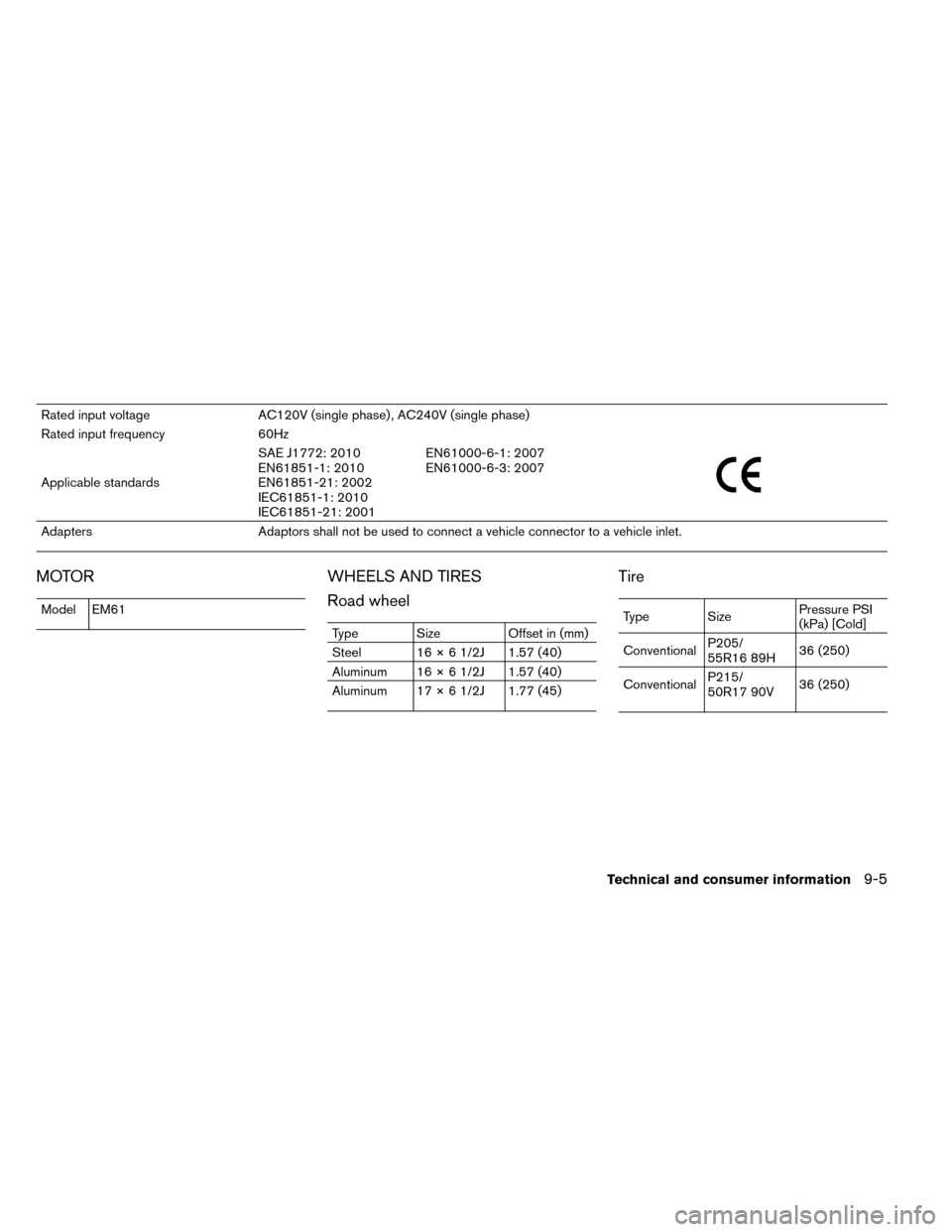
WHEELS AND TIRES
Road wheel
Type SizeOffset in (mm)
Steel 16 × 6 1/2J 1.57 (40)
Aluminum 16 × 6 1/2J 1.57 (40)
Aluminum 17 × 6 1/2J 1.77 (45)
Tire
Type Size Pressure PSI
(kPa) [Cold]
Conventional P205/
55R16 89H 36 (250)
Conventional P215/
50R17 90V 36 (250)
Technical and consumer information9-5
Page 381 of 412
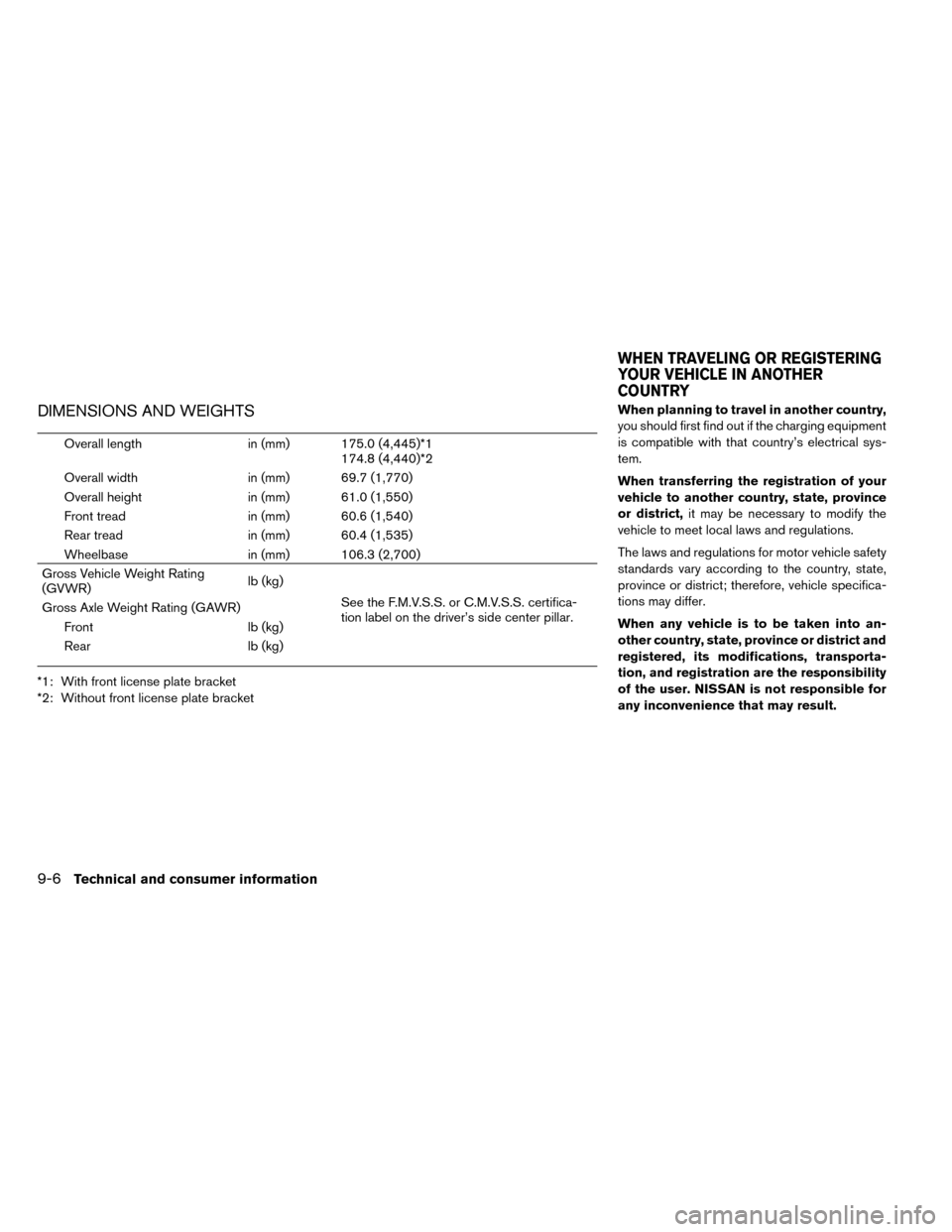
DIMENSIONS AND WEIGHTS
Overall lengthin (mm) 175.0 (4,445)*1
174.8 (4,440)*2
Overall width in (mm) 69.7 (1,770)
Overall height in (mm) 61.0 (1,550)
Front tread in (mm) 60.6 (1,540)
Rear tread in (mm) 60.4 (1,535)
Wheelbase in (mm) 106.3 (2,700)
Gross Vehicle Weight Rating
(GVWR) lb (kg)
See the F.M.V.S.S. or C.M.V.S.S. certifica-
tion label on the driver’s side center pillar.
Gross Axle Weight Rating (GAWR)
Front lb (kg)
Rear lb (kg)
*1: With front license plate bracket
*2: Without front license plate bracket When planning to travel in another country,
you should first find out if the charging equipment
is compatible with that country’s electrical sys-
tem.
When transferring the registration of your
vehicle to another country, state, province
or district,
it may be necessary to modify the
vehicle to meet local laws and regulations.
The laws and regulations for motor vehicle safety
standards vary according to the country, state,
province or district; therefore, vehicle specifica-
tions may differ.
When any vehicle is to be taken into an-
other country, state, province or district and
registered, its modifications, transporta-
tion, and registration are the responsibility
of the user. NISSAN is not responsible for
any inconvenience that may result.
WHEN TRAVELING OR REGISTERING
YOUR VEHICLE IN ANOTHER
COUNTRY
9-6Technical and consumer information
Page 388 of 412
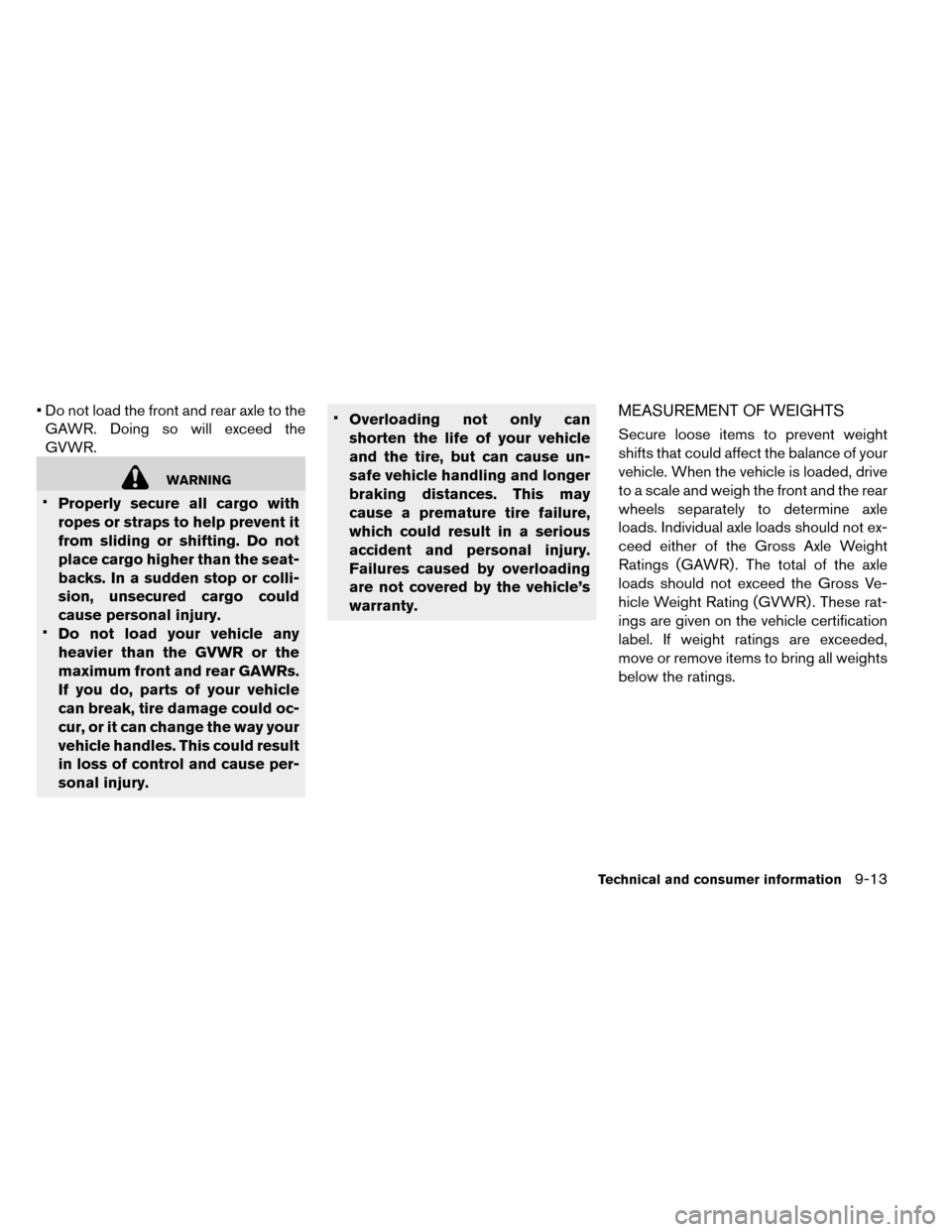
• Do not load the front and rear axle to theGAWR. Doing so will exceed the
GVWR.
WARNING
•
Properly secure all cargo with
ropes or straps to help prevent it
from sliding or shifting. Do not
place cargo higher than the seat-
backs. In a sudden stop or colli-
sion, unsecured cargo could
cause personal injury.
•Do not load your vehicle any
heavier than the GVWR or the
maximum front and rear GAWRs.
If you do, parts of your vehicle
can break, tire damage could oc-
cur, or it can change the way your
vehicle handles. This could result
in loss of control and cause per-
sonal injury.
•Overloading not only can
shorten the life of your vehicle
and the tire, but can cause un-
safe vehicle handling and longer
braking distances. This may
cause a premature tire failure,
which could result in a serious
accident and personal injury.
Failures caused by overloading
are not covered by the vehicle’s
warranty.MEASUREMENT OF WEIGHTS
Secure loose items to prevent weight
shifts that could affect the balance of your
vehicle. When the vehicle is loaded, drive
to a scale and weigh the front and the rear
wheels separately to determine axle
loads. Individual axle loads should not ex-
ceed either of the Gross Axle Weight
Ratings (GAWR) . The total of the axle
loads should not exceed the Gross Ve-
hicle Weight Rating (GVWR) . These rat-
ings are given on the vehicle certification
label. If weight ratings are exceeded,
move or remove items to bring all weights
below the ratings.
Technical and consumer information9-13
Page 389 of 412
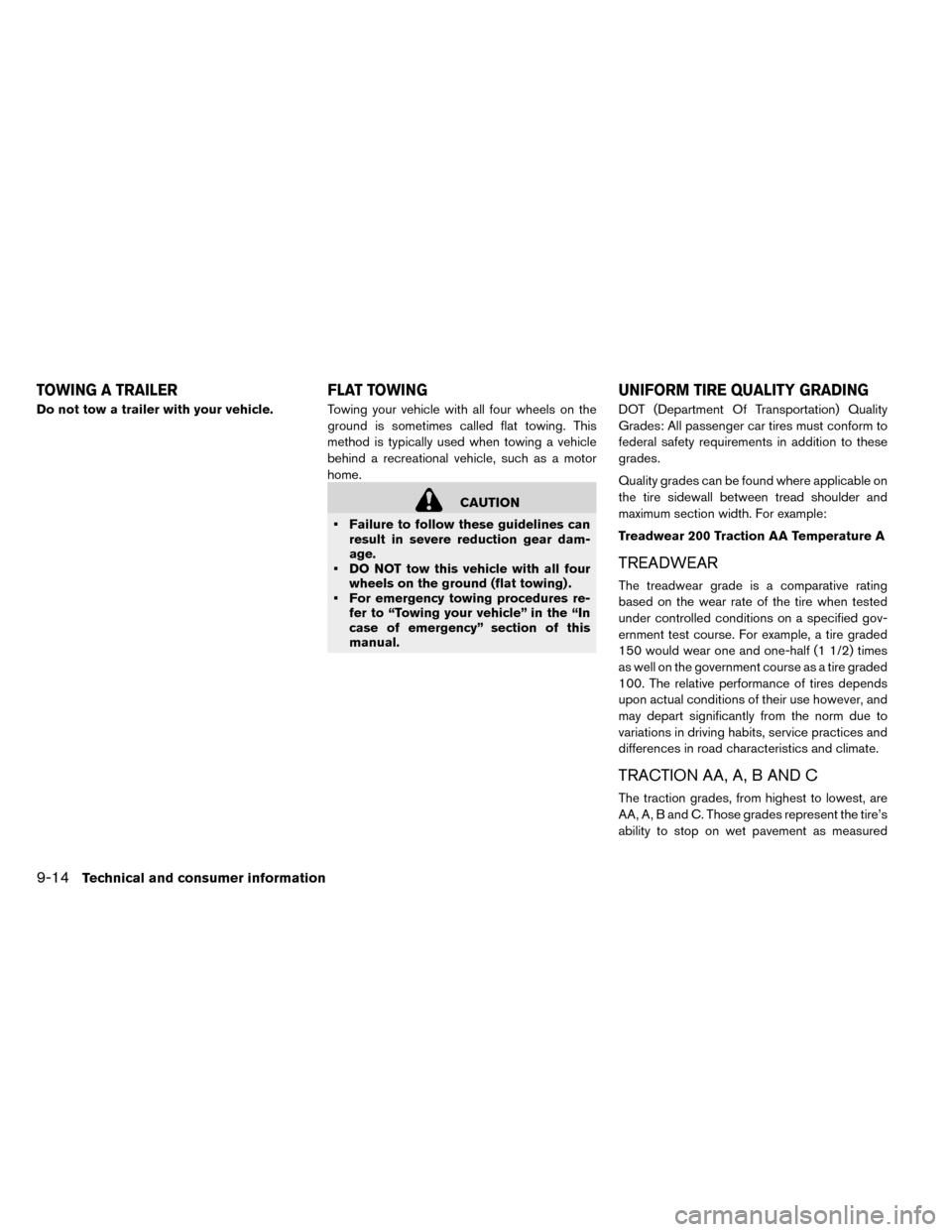
Do not tow a trailer with your vehicle.Towing your vehicle with all four wheels on the
ground is sometimes called flat towing. This
method is typically used when towing a vehicle
behind a recreational vehicle, such as a motor
home.
CAUTION
• Failure to follow these guidelines can result in severe reduction gear dam-
age.
• DO NOT tow this vehicle with all four wheels on the ground (flat towing) .
• For emergency towing procedures re- fer to “Towing your vehicle” in the “In
case of emergency” section of this
manual. DOT (Department Of Transportation) Quality
Grades: All passenger car tires must conform to
federal safety requirements in addition to these
grades.
Quality grades can be found where applicable on
the tire sidewall between tread shoulder and
maximum section width. For example:
Treadwear 200 Traction AA Temperature A
TREADWEAR
The treadwear grade is a comparative rating
based on the wear rate of the tire when tested
under controlled conditions on a specified gov-
ernment test course. For example, a tire graded
150 would wear one and one-half (1 1/2) times
as well on the government course as a tire graded
100. The relative performance of tires depends
upon actual conditions of their use however, and
may depart significantly from the norm due to
variations in driving habits, service practices and
differences in road characteristics and climate.
TRACTION AA, A, B AND C
The traction grades, from highest to lowest, are
AA, A, B and C. Those grades represent the tire’s
ability to stop on wet pavement as measured
TOWING A TRAILER
FLAT TOWINGUNIFORM TIRE QUALITY GRADING
9-14Technical and consumer information
Page 390 of 412
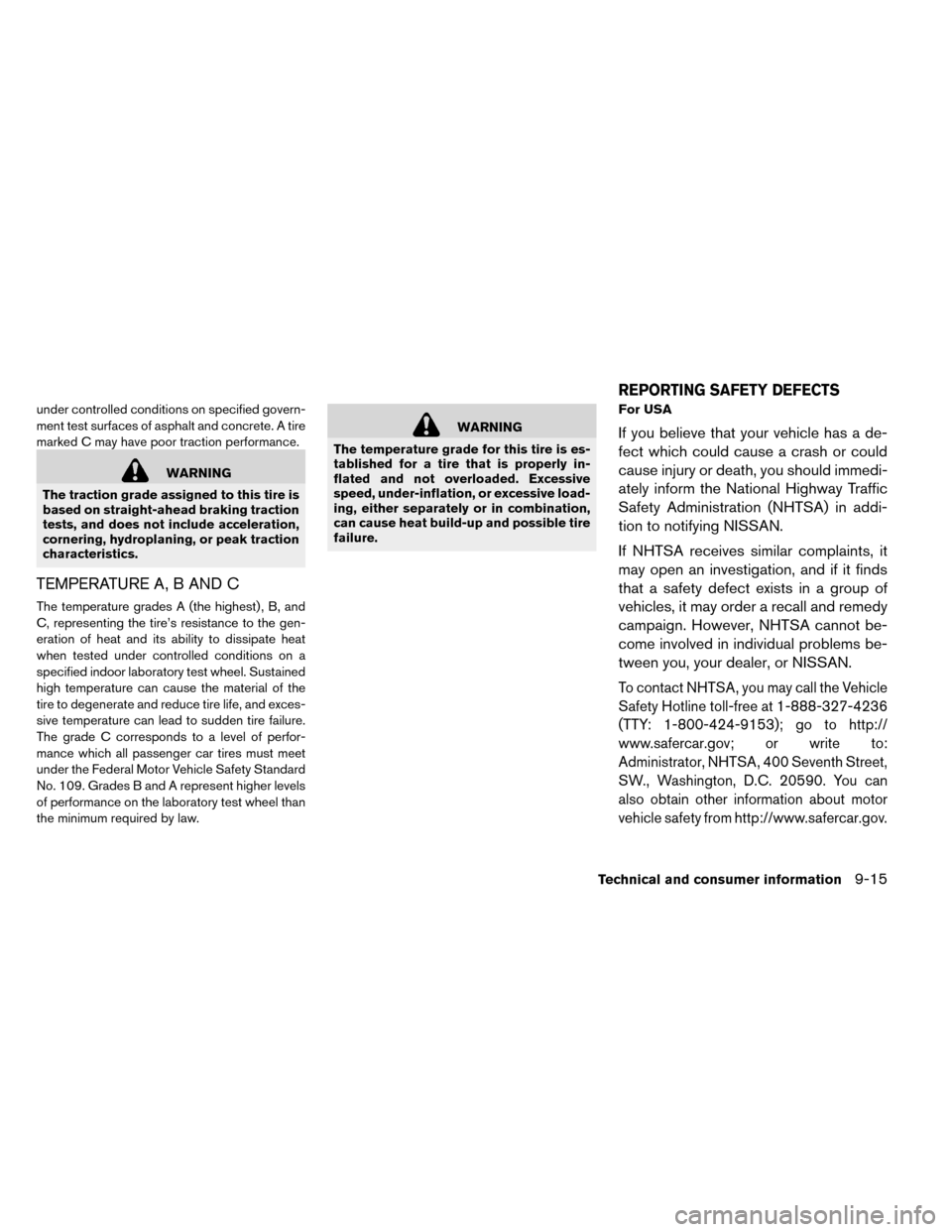
under controlled conditions on specified govern-
ment test surfaces of asphalt and concrete. A tire
marked C may have poor traction performance.
WARNING
The traction grade assigned to this tire is
based on straight-ahead braking traction
tests, and does not include acceleration,
cornering, hydroplaning, or peak traction
characteristics.
TEMPERATURE A, B AND C
The temperature grades A (the highest) , B, and
C, representing the tire’s resistance to the gen-
eration of heat and its ability to dissipate heat
when tested under controlled conditions on a
specified indoor laboratory test wheel. Sustained
high temperature can cause the material of the
tire to degenerate and reduce tire life, and exces-
sive temperature can lead to sudden tire failure.
The grade C corresponds to a level of perfor-
mance which all passenger car tires must meet
under the Federal Motor Vehicle Safety Standard
No. 109. Grades B and A represent higher levels
of performance on the laboratory test wheel than
the minimum required by law.
WARNING
The temperature grade for this tire is es-
tablished for a tire that is properly in-
flated and not overloaded. Excessive
speed, under-inflation, or excessive load-
ing, either separately or in combination,
can cause heat build-up and possible tire
failure. For USAIf you believe that your vehicle has a de-
fect which could cause a crash or could
cause injury or death, you should immedi-
ately inform the National Highway Traffic
Safety Administration (NHTSA) in addi-
tion to notifying NISSAN.
If NHTSA receives similar complaints, it
may open an investigation, and if it finds
that a safety defect exists in a group of
vehicles, it may order a recall and remedy
campaign. However, NHTSA cannot be-
come involved in individual problems be-
tween you, your dealer, or NISSAN.
To contact NHTSA, you may call the Vehicle
Safety Hotline toll-free at 1-888-327-4236
(TTY: 1-800-424-9153); go to http://
www.safercar.gov; or write to:
Administrator, NHTSA, 400 Seventh Street,
SW., Washington, D.C. 20590. You can
also obtain other information about motor
vehicle safety from http://www.safercar.gov.
REPORTING SAFETY DEFECTS
Technical and consumer information9-15
Page 397 of 412
The label is typically located on the driver side
center pillar or on the driver’s door. For additional
information, see “Wheels and tires” in the “Main-
tenance and do-it-yourself” section.
COLD TIRE PRESSURES
9-22Technical and consumer information
Page 400 of 412
Li-ion battery temperature gauge.......2-7
Odometer ....................2-6
Power meter ..................2-7
Speedometer ..................2-6
Generalmaintenance...............8-2
Glovebox.....................2-52
H
Hazard warning flasher switch ..........6-2
Headlights ....................8-22
Bulb replacement ...............8-22
Headlightswitch...............2-42
Heatedseatswitch ...............2-46
Heated steering wheel switch .........2-45
High voltage precautions ............EV-7
HillStart .....................5-24
Hill Start Assist ..................5-24
HomeLink® universal transceiver ........2-59
Hood release ...................3-17
Horn .......................2-46
Howtonormalcharge.............CH-9
Howtoquickcharge.............CH-15
How to trickle charge (if so equipped) ....CH-11
I
If the Li-ion battery becomes completely
discharged....................6-11
Immediate charge...............CH-26 Immobilizer system
................2-37
In-cabin microfilter ................4-19
Indicatorlights..................2-19
Indicators for operation .............2-23
Inside rearview mirror ..............3-23
Instrument brightness control ..........2-41
Instrument panel ..................2-4
Intelligent Key system ..............3-13
Remote keyless operation ..........3-13
Interior light replacement ............8-23
Interior lights ...................2-57
ISOFIX child restraint ..............1-19
J
Jump starting...................6-9
K
Keylessentry...................3-13
With Intelligent Key system (See Intelligent
Key system) ..................3-13
Keys ........................3-2 For Intelligent Key system ...........3-6
L
Labels.......................1-50
Airbagwarninglabels............1-50
Air conditioner specification label .......9-9Emission control information label
......9-8
F.M.V.S.S./C.M.V.S.S. certification label . . .9-8
Motor serial number ..............9-7
Tire and Loading information label . . .8-27, 9-8
Vehicle identification number (VIN) ......9-7
LATCH system ..................1-19
License plate, Installing front license plate . . .9-9
Light .......................1-50 Airbagwarninglight.............1-50
Bulb replacement ...............8-21
Ceiling light ..................2-58
Fog light switch ................2-44
Headlightsbulbreplacement ........8-22
Headlightswitch...............2-42
Indicatorlights ................2-19
Interiorlights .................2-57
Maplights...................2-57
Replacement.................8-21
Warning lights ................2-13
Lightreminderwarning .............2-25
Lights, Exterior and interior light
replacement ...................8-23
Li-ion battery ...................EV-2
Li-ion battery available charge gauge ......2-9
Li-ion battery capacity level gauge .......2-10
Li-ion battery status check ..........CH-27
Li-ion battery temperature gauge .........2-7
Li-ion battery warmer ..............EV-5
Limited power ..................2-33
Loading information (See vehicle loading
information)....................9-10
Technical and consumer information10-3