light NISSAN MAXIMA 1998 A32 / 4.G Repair Manual
[x] Cancel search | Manufacturer: NISSAN, Model Year: 1998, Model line: MAXIMA, Model: NISSAN MAXIMA 1998 A32 / 4.GPages: 231, PDF Size: 1.94 MB
Page 168 of 231
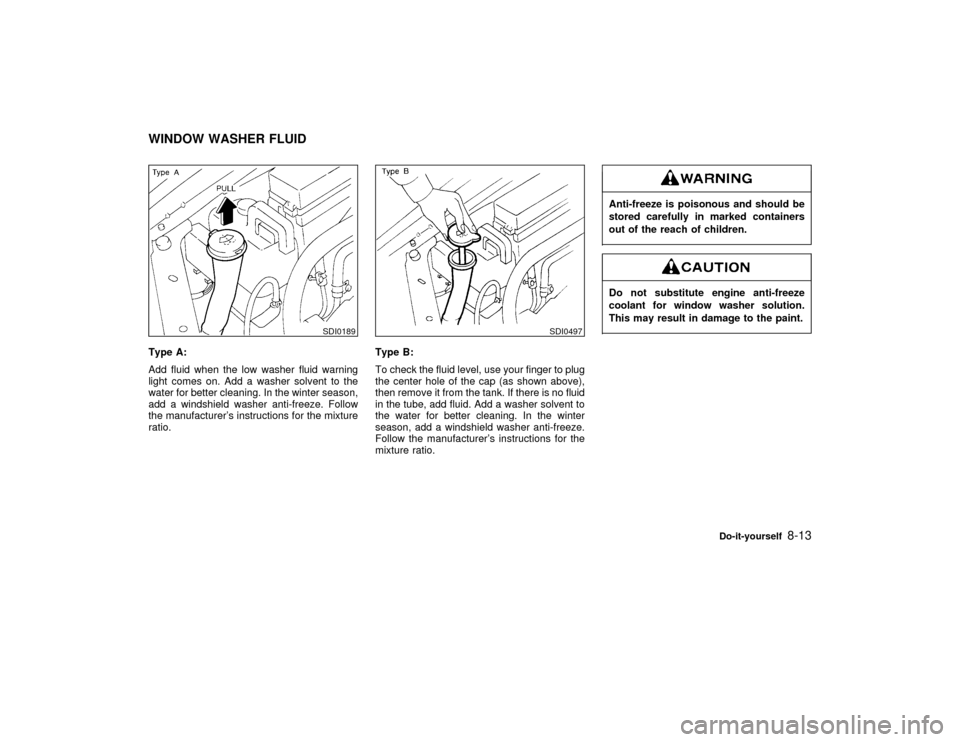
Type A:
Add fluid when the low washer fluid warning
light comes on. Add a washer solvent to the
water for better cleaning. In the winter season,
add a windshield washer anti-freeze. Follow
the manufacturer's instructions for the mixture
ratio.Type B:
To check the fluid level, use your finger to plug
the center hole of the cap (as shown above),
then remove it from the tank. If there is no fluid
in the tube, add fluid. Add a washer solvent to
the water for better cleaning. In the winter
season, add a windshield washer anti-freeze.
Follow the manufacturer's instructions for the
mixture ratio.
Anti-freeze is poisonous and should be
stored carefully in marked containers
out of the reach of children.Do not substitute engine anti-freeze
coolant for window washer solution.
This may result in damage to the paint.
SDI0189
SDI0497
WINDOW WASHER FLUID
Do-it-yourself
8-13
Z
01.1.31/A32-D
X
Page 175 of 231
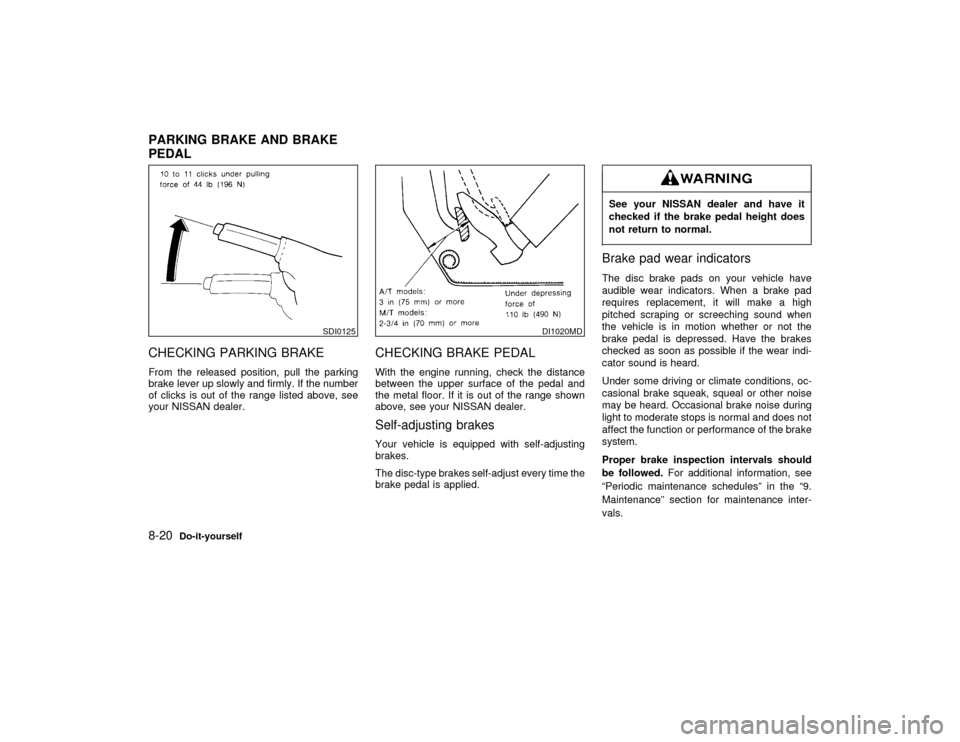
CHECKING PARKING BRAKEFrom the released position, pull the parking
brake lever up slowly and firmly. If the number
of clicks is out of the range listed above, see
your NISSAN dealer.
CHECKING BRAKE PEDALWith the engine running, check the distance
between the upper surface of the pedal and
the metal floor. If it is out of the range shown
above, see your NISSAN dealer.Self-adjusting brakesYour vehicle is equipped with self-adjusting
brakes.
The disc-type brakes self-adjust every time the
brake pedal is applied.
See your NISSAN dealer and have it
checked if the brake pedal height does
not return to normal.Brake pad wear indicatorsThe disc brake pads on your vehicle have
audible wear indicators. When a brake pad
requires replacement, it will make a high
pitched scraping or screeching sound when
the vehicle is in motion whether or not the
brake pedal is depressed. Have the brakes
checked as soon as possible if the wear indi-
cator sound is heard.
Under some driving or climate conditions, oc-
casional brake squeak, squeal or other noise
may be heard. Occasional brake noise during
light to moderate stops is normal and does not
affect the function or performance of the brake
system.
Proper brake inspection intervals should
be followed.For additional information, see
ªPeriodic maintenance schedulesº in the ª9.
Maintenanceº section for maintenance inter-
vals.
SDI0125
DI1020MD
PARKING BRAKE AND BRAKE
PEDAL8-20
Do-it-yourself
Z
01.1.31/A32-D
X
Page 177 of 231

ENGINE COMPARTMENTIf any electrical equipment does not operate,
check for an open fuse.
1. Be sure the ignition key and headlight
switch are OFF.
2. Open the engine hood.
3. Remove the fusible link cover.
4. Remove the fuse with the fuse puller.
5. If the fuse is open, replace it with a new
fuse.
6. If a new fuse also opens, have the electricalsystem checked and repaired by your
NISSAN dealer.
Fusible linksIf any electrical equipment does not operate
and fuses are in good condition, check the
fusible links. If any of these fusible links are
melted, replace only with genuine NISSAN
parts.
SDI0126
SDI0128
8-22
Do-it-yourself
Z
01.1.31/A32-D
X
Page 178 of 231
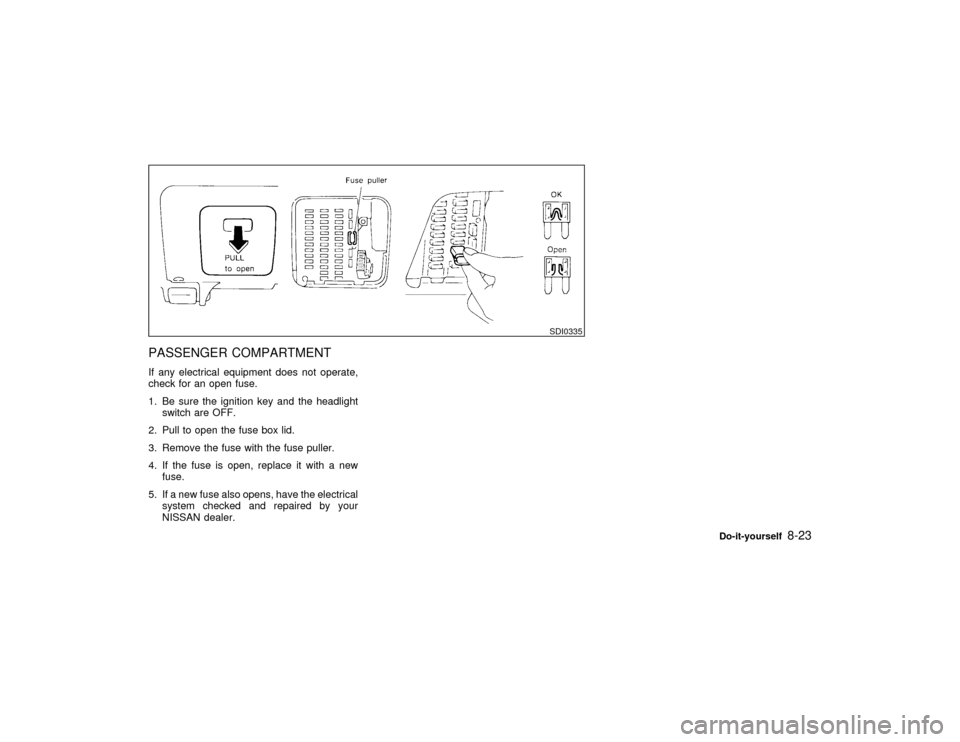
PASSENGER COMPARTMENTIf any electrical equipment does not operate,
check for an open fuse.
1. Be sure the ignition key and the headlight
switch are OFF.
2. Pull to open the fuse box lid.
3. Remove the fuse with the fuse puller.
4. If the fuse is open, replace it with a new
fuse.
5. If a new fuse also opens, have the electrical
system checked and repaired by your
NISSAN dealer.
SDI0335
Do-it-yourself
8-23
Z
01.1.31/A32-D
X
Page 179 of 231

SDI0735
LIGHTS8-24
Do-it-yourself
Z
01.1.31/A32-D
X
Page 180 of 231

HEADLIGHTSThe headlight is a semi-sealed beam type
which uses a replaceable headlight (halogen)
bulb. A bulb can be replaced from inside the
engine compartment without removing the
headlight assembly.High pressure halogen gas is sealed
inside the halogen bulb. The bulb may
break if the glass envelope is scratched
or the bulb is dropped.
Hold the plastic base when handling the
bulb. Never touch the glass envelope.
Replacing the headlight bulb1. Disconnect the battery negative cable.
2. Disconnect the electrical connector from
the rear end of the bulb.
3. Turn the bulb retaining ring counterclock-
wise until it is free from the headlight reflec-
tor, then remove it.
4. Remove the headlight bulb. Do not shake
or rotate the bulb when removing it.
5. Insert the bulb into the headlight reflector
with the flat side of the plastic base facing
upward.
6. Install the bulb retaining ring and turn it
clockwise until it stops.
7. Push the electrical connector into the bulb
plastic base until it snaps and stops.
8. Connect the battery negative cable.
SDI0129
Do-it-yourself
8-25
Z
01.1.31/A32-D
X
Page 181 of 231

IDo not touch the bulb.
IUse the same number and wattage as
originally installed:
Wattage 65/45
Bulb no. 9004
IAiming is not necessary after replac-
ing the bulb. When aiming adjust-
ment is necessary, contact your
NISSAN dealer.
IDo not leave the bulb out of the head-
light reflector for a long period of time
as dust, moisture, and smoke may
enter the headlight body and affect
the performance of the headlight.
EXTERIOR AND INTERIOR LIGHTS
Item Wattage (W) Bulb No.
Clearance 27/8 1157
Front turn signal light 27 1156
Front side marker light 3.8 194
Front fog light (if so equipped) 55
Rear combination light
Turn signal 27 1156
Stop/Tail 27/8 1157
Back-up 18 921
Side marker light 3.8 194
License plate light 5
High-mounted stop light (if so
equipped)18 921
Interior light 10
Front personal light 10
Step light 2.7 161
Trunk light 3.4 158
Vanity mirror light (if so equipped) 1.4 Ð
8-26
Do-it-yourself
Z
01.1.31/A32-D
X
Page 182 of 231

Replacement proceduresAll other lights are either type A, B, C or D.
When replacing a bulb, first remove the lens
and/or cover.
MDI0006
Do-it-yourself
8-27
Z
01.1.31/A32-D
X
Page 189 of 231

IAfter rotating the tires, adjust the tire
pressure.
IRetighten the wheel nuts after the
aluminum wheels have been run for
the first 600 miles (1,000 km) (also in
cases of a flat tire, etc.).
IDo not include the T-type spare tire or
any other small size spare tire in the
tire rotation.
Tire wear and damageTires should be periodically inspected
for wear, cracking, bulging, or objects
caught in the tread. If excessive wear,
cracks, bulging, or deep cuts are found,
the tire should be replaced.
The original tires have a built-in tread
wear indicator. When the wear indicator
is visible, the tire should be replaced.
Improper service for a T-type spare tiremay result in serious personal injury. If
it is necessary to repair the T-type spare
tire, contact your NISSAN dealer.
Replacing tires and wheelsWhen replacing a tire, use the same size,
speed rating and load carrying capacity as
originally equipped. See ªSpecificationsº in the
ª10. Technical and consumer informationº sec-
tion for recommended types and sizes of tires
and wheels.IThe use of tires other than those
recommended or the mixed use of
tires of different brands, construction
(bias, bias-belted or radial), or tread
patterns can adversely affect the ride,
braking, handling, ground clearance,
body-to-tire clearance, tire chain
clearance, speedometer calibration,
headlight aim and bumper height.
Some of these effects may lead to
accidents and could result in serious
personal injury.
IIf the wheels are changed for any
reason, always replace with wheels
MDI0004
8-34
Do-it-yourself
Z
01.1.31/A32-D
X
Page 194 of 231

During the normal day-to-day operation of the
vehicle, general maintenance should be per-
formed regularly as prescribed in this section.
If you detect any unusual sounds, vibrations or
smell, be sure to check for the cause or have
your NISSAN dealer do it promptly. In addition,
you should notify your NISSAN dealer if you
think that repairs are required.
When performing any checks or maintenance
work, see ªMaintenance precautionsº in the ª8.
Do-it-yourselfº section.EXPLANATION OF MAINTENANCE
ITEMSAdditional information on the following
items with ª*º is found in the ª8. Do-it-
yourselfº section.Outside the vehicleThe maintenance items listed here should be
performed from time to time, unless otherwise
specified.
Tires*:Check the pressure with a gauge pe-
riodically when at a service station, including
the spare, and adjust to the specified pressure
if necessary. Check carefully for damage, cuts
or excessive wear.
Wheel nuts*:When checking the tires, makesure no nuts are missing, and check for any
loose nuts. Tighten if necessary.
Tire rotation*:Tires should be rotated every
7,500 miles (12,000 km).
Wheel alignment and balance:If the vehicle
pulls to either side while driving on a straight
and level road, or if you detect uneven or
abnormal tire wear, there may be a need for
wheel alignment.
If the steering wheel or seat vibrates at normal
highway speeds, wheel balancing may be
needed.
Windshield wiper blades*:Check for cracks
or wear if they do not wipe properly.
Doors and engine hood:Check that all doors
and the engine hood operate smoothly as well
as the trunk lid or back hatch. Also make sure
that all latches lock securely. Lubricate if nec-
essary. Make sure that the secondary latch
keeps the hood from opening when the pri-
mary latch is released.
When driving in areas using road salt or other
corrosive materials, check lubrication fre-
quently.
Inside the vehicleThe maintenance items listed here should be
checked on a regular basis, such as when
performing periodic maintenance, cleaning the
vehicle, etc.
Lights*:Make sure that the headlights, stop
lights, tail lights, turn signal lights, and other
lights are all operating properly and installed
securely. Also check headlight aim.
Warning lights and buzzers:Make sure that
all warning lights and buzzers are operating
properly.
Windshield wiper and washer*:Check that
the wipers and washer operate properly and
that the wipers do not streak.
Windshield defroster:Check that the air
comes out of the defroster outlets properly and
in good quantity when operating the heater or
air conditioner.
Steering wheel:Check for changes in the
steering conditions, such as excessive free
play, hard steering or strange noises.
GENERAL MAINTENANCE
Maintenance
9-3
Z
01.1.31/A32-D
X