torque NISSAN NAVARA 2005 Repair Owners Manual
[x] Cancel search | Manufacturer: NISSAN, Model Year: 2005, Model line: NAVARA, Model: NISSAN NAVARA 2005Pages: 3171, PDF Size: 49.59 MB
Page 868 of 3171
CL-4
PREPARATION
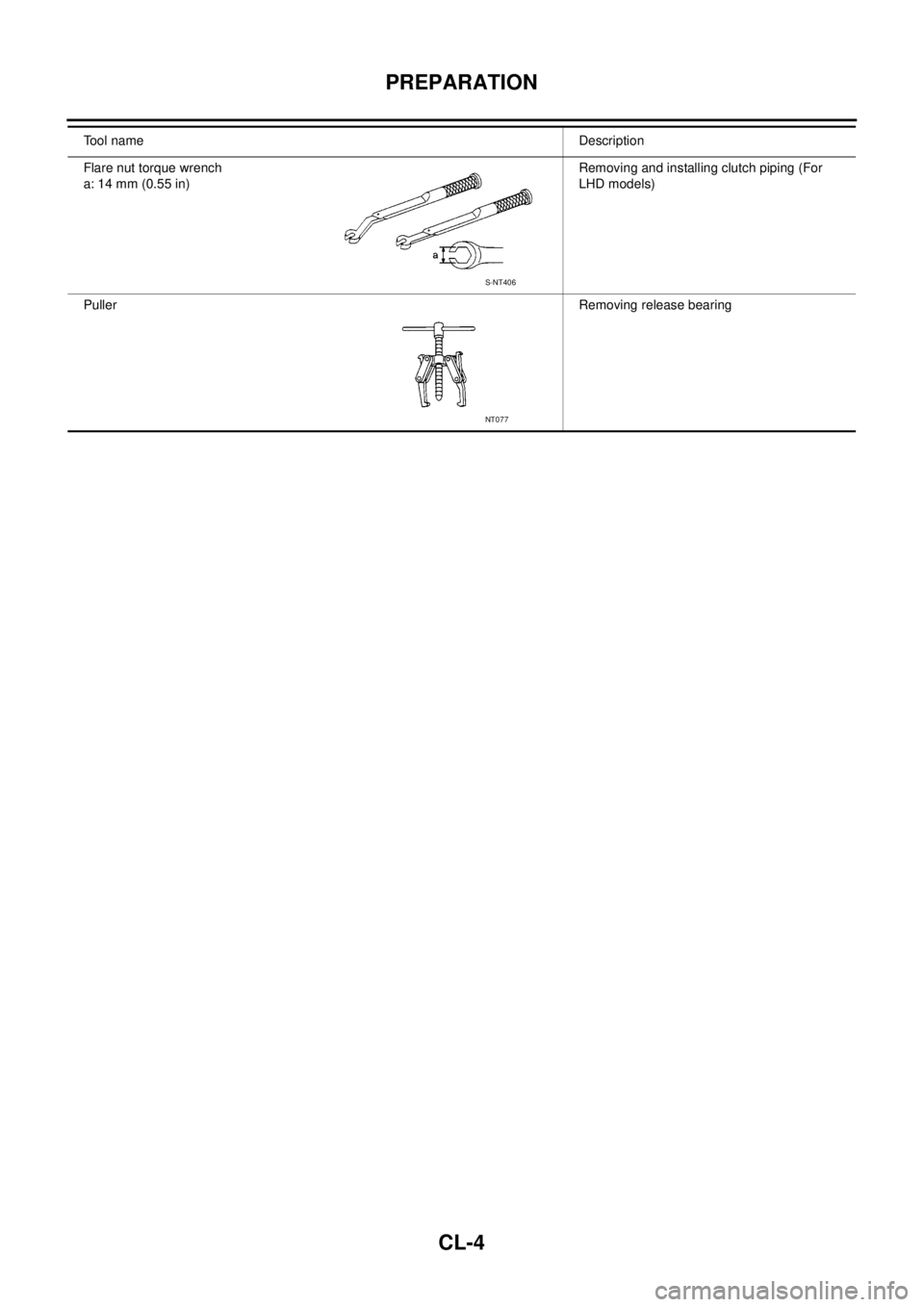
Flare nut torque wrench
a: 14 mm (0.55 in)Removing and installing clutch piping (For
LHD models)
PullerRemoving release bearing Tool nameDescription
S-NT406
NT077
Page 871 of 3171
CLUTCH PEDAL
CL-7
D
E
F
G
H
I
J
K
L
MA
B
CL
Removal and InstallationECS00ICH
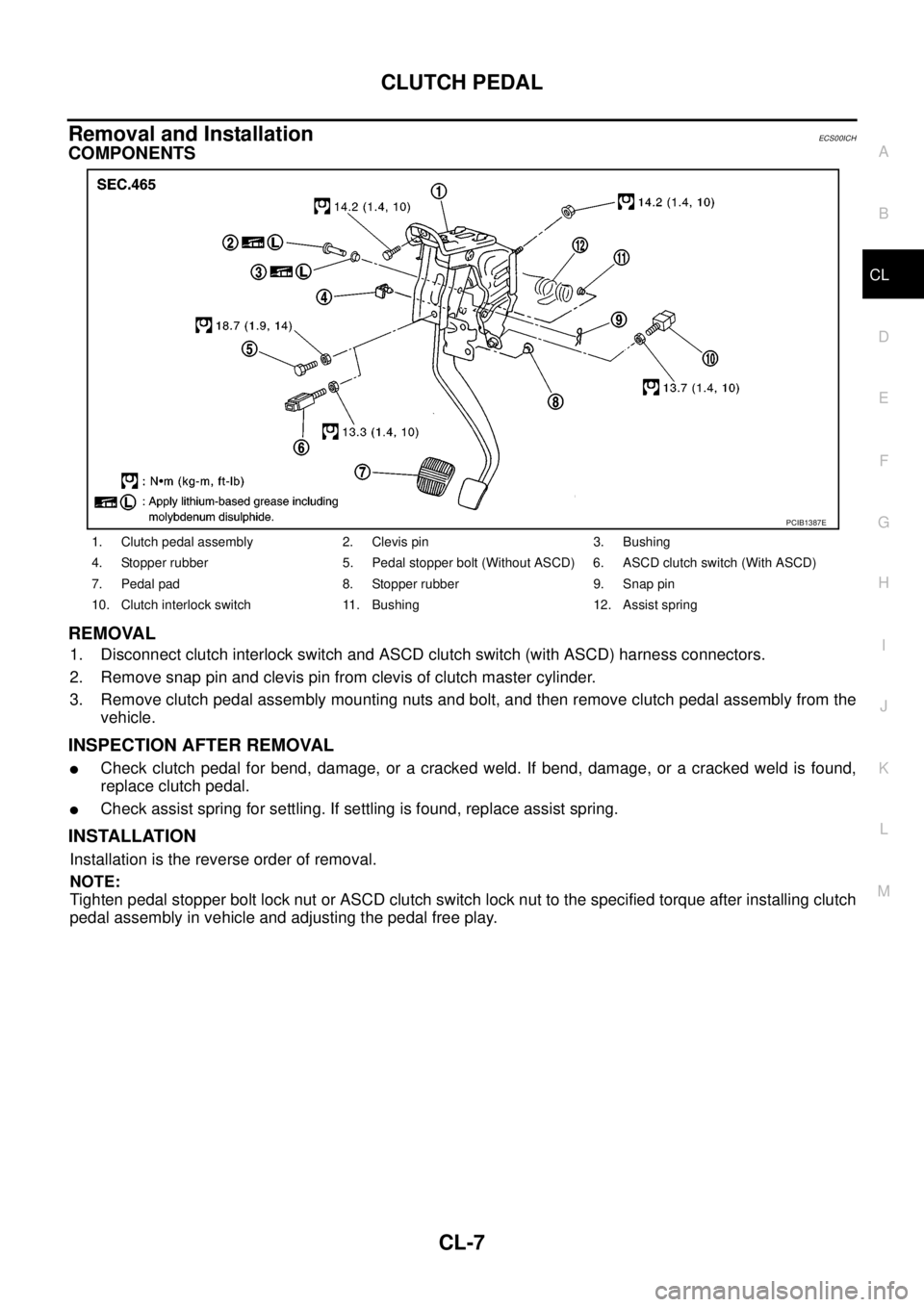
COMPONENTS
REMOVAL
1. Disconnect clutch interlock switch and ASCD clutch switch (with ASCD) harness connectors.
2. Remove snap pin and clevis pin from clevis of clutch master cylinder.
3. Remove clutch pedal assembly mounting nuts and bolt, and then remove clutch pedal assembly from the
vehicle.
INSPECTION AFTER REMOVAL
lCheck clutch pedal for bend, damage, or a cracked weld. If bend, damage, or a cracked weld is found,
replace clutch pedal.
lCheck assist spring for settling. If settling is found, replace assist spring.
INSTALLATION
Installation is the reverse order of removal.
NOTE:
Tighten pedal stopper bolt lock nut or ASCD clutch switch lock nut to the specified torque after installing clutch
pedal assembly in vehicle and adjusting the pedal free play.
1. Clutch pedal assembly 2. Clevis pin 3. Bushing
4. Stopper rubber 5. Pedal stopper bolt (Without ASCD) 6. ASCD clutch switch (With ASCD)
7. Pedal pad 8. Stopper rubber 9. Snap pin
10. Clutch interlock switch 11. Bushing 12. Assist spring
PCIB1387E
Page 872 of 3171
CL-8
CLUTCH FLUID
CLUTCH FLUID
PFP:00017
Air Bleeding ProcedureECS00ICI
NOTE:
Do not use a vacuum assist or any other type of power bleeder on this system. Use of a vacuum assist or
power bleeder will not purge all the air from the system.
CAUTION:
lMonitor clutch fluid level in reservoir tank to make sure it
does not empty.
lKeep painted surface on the body or other parts free of
clutch fluid. If it spills, wipe up immediately and wash the
affected area with water.
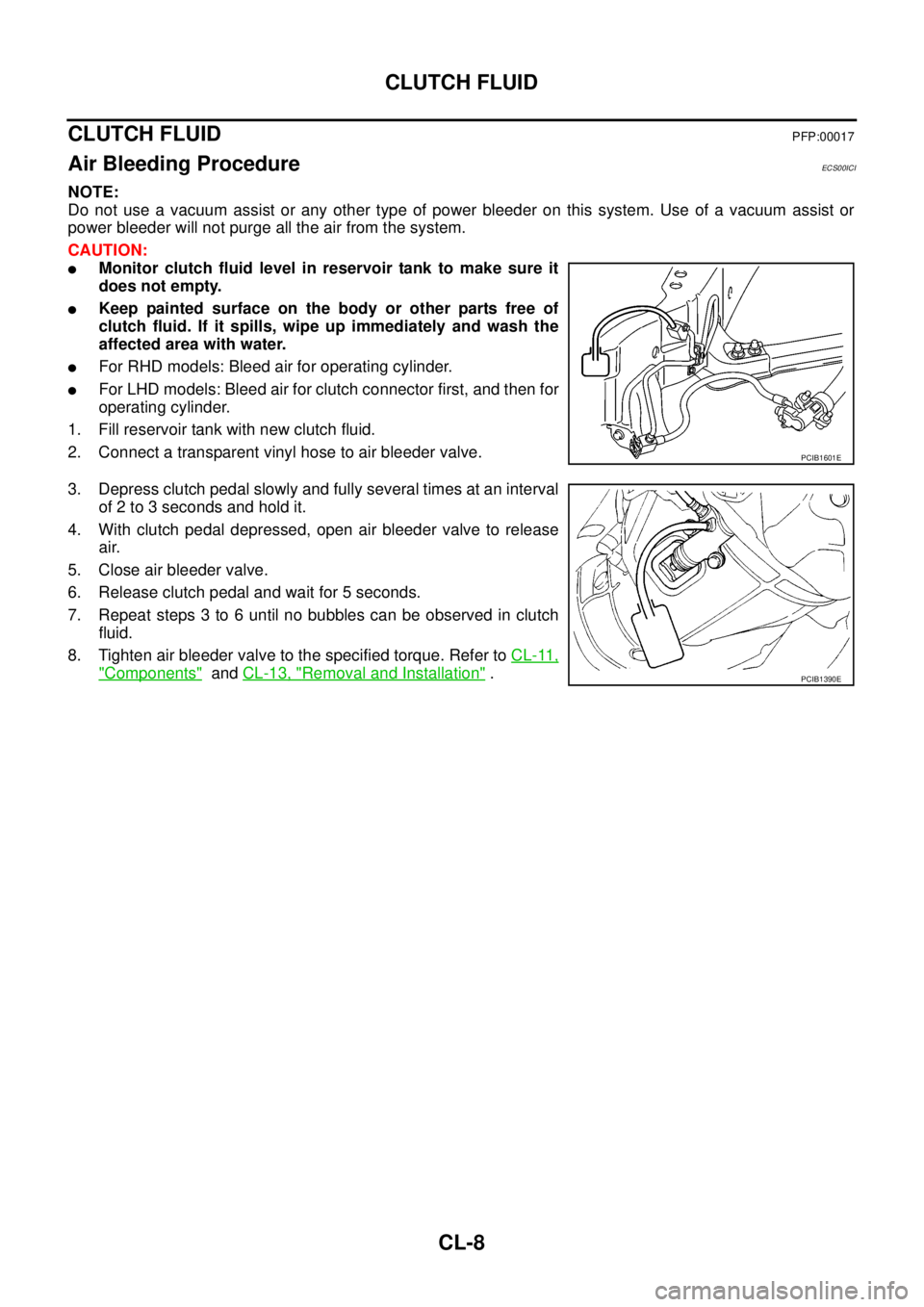
lFor RHD models: Bleed air for operating cylinder.
lFor LHD models: Bleed air for clutch connector first, and then for
operating cylinder.
1. Fill reservoir tank with new clutch fluid.
2. Connect a transparent vinyl hose to air bleeder valve.
3. Depress clutch pedal slowly and fully several times at an interval
of 2 to 3 seconds and hold it.
4. With clutch pedal depressed, open air bleeder valve to release
air.
5. Close air bleeder valve.
6. Release clutch pedal and wait for 5 seconds.
7. Repeat steps 3 to 6 until no bubbles can be observed in clutch
fluid.
8. Tighten air bleeder valve to the specified torque. Refer toCL-11,
"Components"andCL-13, "Removal and Installation".
PCIB1601E
PCIB1390E
Page 873 of 3171
CLUTCH MASTER CYLINDER
CL-9
D
E
F
G
H
I
J
K
L
MA
B
CL
CLUTCH MASTER CYLINDERPFP:30610
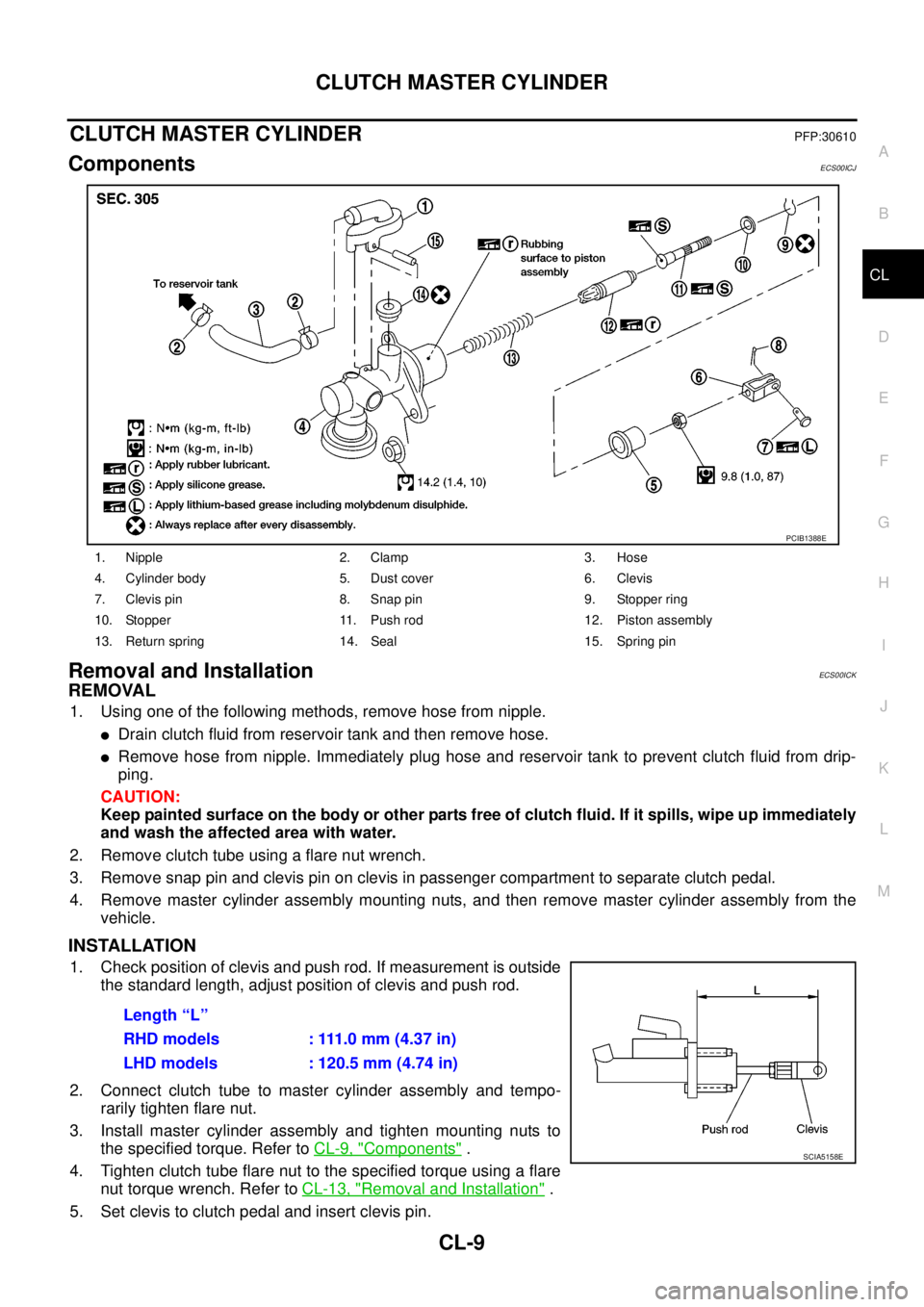
ComponentsECS00ICJ
Removal and InstallationECS00ICK
REMOVAL
1. Using one of the following methods, remove hose from nipple.
lDrain clutch fluid from reservoir tank and then remove hose.
lRemove hose from nipple. Immediately plug hose and reservoir tank to prevent clutch fluid from drip-
ping.
CAUTION:
Keep painted surface on the body or other parts free of clutch fluid. If it spills, wipe up immediately
and wash the affected area with water.
2. Remove clutch tube using a flare nut wrench.
3. Remove snap pin and clevis pin on clevis in passenger compartment to separate clutch pedal.
4. Remove master cylinder assembly mounting nuts, and then remove master cylinder assembly from the
vehicle.
INSTALLATION
1. Check position of clevis and push rod. If measurement is outside
the standard length, adjust position of clevis and push rod.
2. Connect clutch tube to master cylinder assembly and tempo-
rarily tighten flare nut.
3. Install master cylinder assembly and tighten mounting nuts to
the specified torque. Refer toCL-9, "
Components".
4. Tightenclutchtubeflarenuttothespecifiedtorqueusingaflare
nut torque wrench. Refer toCL-13, "
Removal and Installation".
5. Set clevis to clutch pedal and insert clevis pin.
1. Nipple 2. Clamp 3. Hose
4. Cylinder body 5. Dust cover 6. Clevis
7. Clevis pin 8. Snap pin 9. Stopper ring
10. Stopper 11. Push rod 12. Piston assembly
13. Return spring 14. Seal 15. Spring pin
PCIB1388E
Length “L”
RHD models : 111.0 mm (4.37 in)
LHD models : 120.5 mm (4.74 in)
SCIA5158E
Page 874 of 3171
CL-10
CLUTCH MASTER CYLINDER
6. Attach snap pin to clevis pin.
7. Install hose to nipple.
8. After completing this procedure, inspect and adjust for clutch pedal and then bleed the air from the clutch
hydraulic system. Refer toCL-6, "
On-Vehicle Inspection and Adjustment"andCL-8, "Air Bleeding Proce-
dure".
Disassembly and AssemblyECS00ICL
DISASSEMBLY
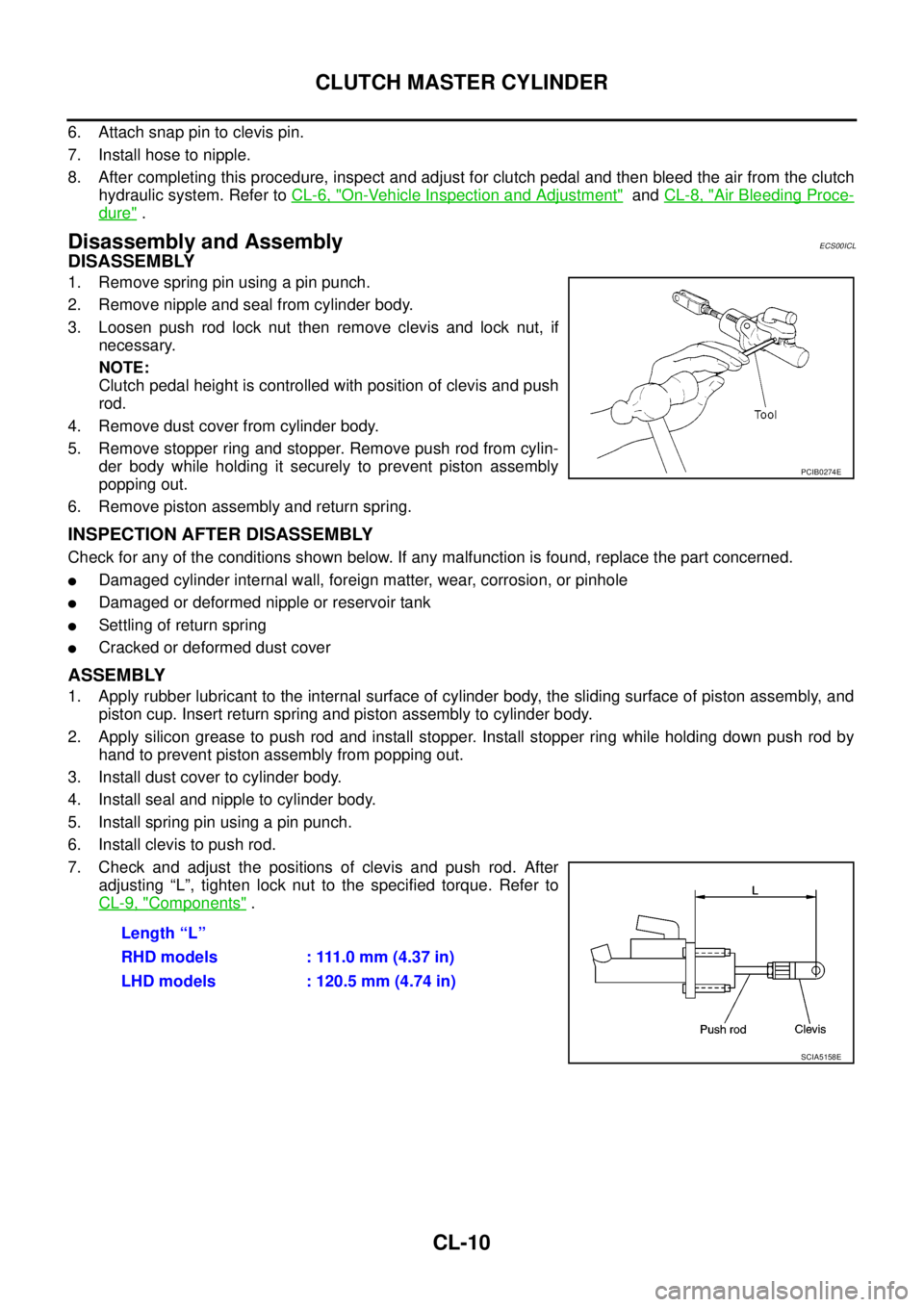
1. Remove spring pin using a pin punch.
2. Remove nipple and seal from cylinder body.
3. Loosen push rod lock nut then remove clevis and lock nut, if
necessary.
NOTE:
Clutch pedal height is controlled with position of clevis and push
rod.
4. Remove dust cover from cylinder body.
5. Remove stopper ring and stopper. Remove push rod from cylin-
der body while holding it securely to prevent piston assembly
popping out.
6. Remove piston assembly and return spring.
INSPECTION AFTER DISASSEMBLY
Check for any of the conditions shown below. If any malfunction is found, replace the part concerned.
lDamaged cylinder internal wall, foreign matter, wear, corrosion, or pinhole
lDamaged or deformed nipple or reservoir tank
lSettling of return spring
lCracked or deformed dust cover
ASSEMBLY
1. Apply rubber lubricant to the internal surface of cylinder body, the sliding surface of piston assembly, and
piston cup. Insert return spring and piston assembly to cylinder body.
2. Apply silicon grease to push rod and install stopper. Install stopper ring while holding down push rod by
hand to prevent piston assembly from popping out.
3. Install dust cover to cylinder body.
4. Install seal and nipple to cylinder body.
5. Install spring pin using a pin punch.
6. Install clevis to push rod.
7. Check and adjust the positions of clevis and push rod. After
adjusting “L”, tighten lock nut to the specified torque. Refer to
CL-9, "
Components".
PCIB0274E
Length “L”
RHD models : 111.0 mm (4.37 in)
LHD models : 120.5 mm (4.74 in)
SCIA5158E
Page 876 of 3171

CL-12
OPERATING CYLINDER
CAUTION:
Keep painted surface on the body or other parts free of clutch fluid. If it spills, wipe up immediately
and wash the affected area with water.
2. Remove clutch hose from operating cylinder assembly.
3. Remove operating cylinder assembly mounting bolts, and then remove operating cylinder assembly from
the vehicle.
INSTALLATION
Note the following, and install in the reverse order of removal.
lInstall clutch hose with care so that it will not be bent or twisted.
lTightenclutchhosetothespecifiedtorque.
CAUTION:
Do not reuse copper washer.
lAfter completing the procedure, bleed the air from the clutch hydraulic system. Refer toCL-8, "Air Bleed-
ing Procedure".
Disassembly and AssemblyECS00ICO
DISASSEMBLY
lRemove dust cover and push rod. Then remove piston, piston cup and piston spring from cylinder body.
INSPECTION AFTER DISASSEMBLY
Check for any of the conditions shown below. If any malfunction is found, replace the part concerned.
lDamage to cylinder internal surface or piston sliding surface. Foreign matter, wear, corrosion, or pinhole
lSettling of piston spring
lCracked or deformed dust cover
ASSEMBLY
1. Apply rubber lubricant to cylinder body internal surface and rubber grease to piston cup and piston. Insert
piston assembly and piston spring into cylinder body.
2. Apply rubber grease to dust cover and then install push rod and dust cover.
Page 877 of 3171
CLUTCH PIPING
CL-13
D
E
F
G
H
I
J
K
L
MA
B
CL
CLUTCH PIPINGPFP:30650
Removal and InstallationECS00ICP
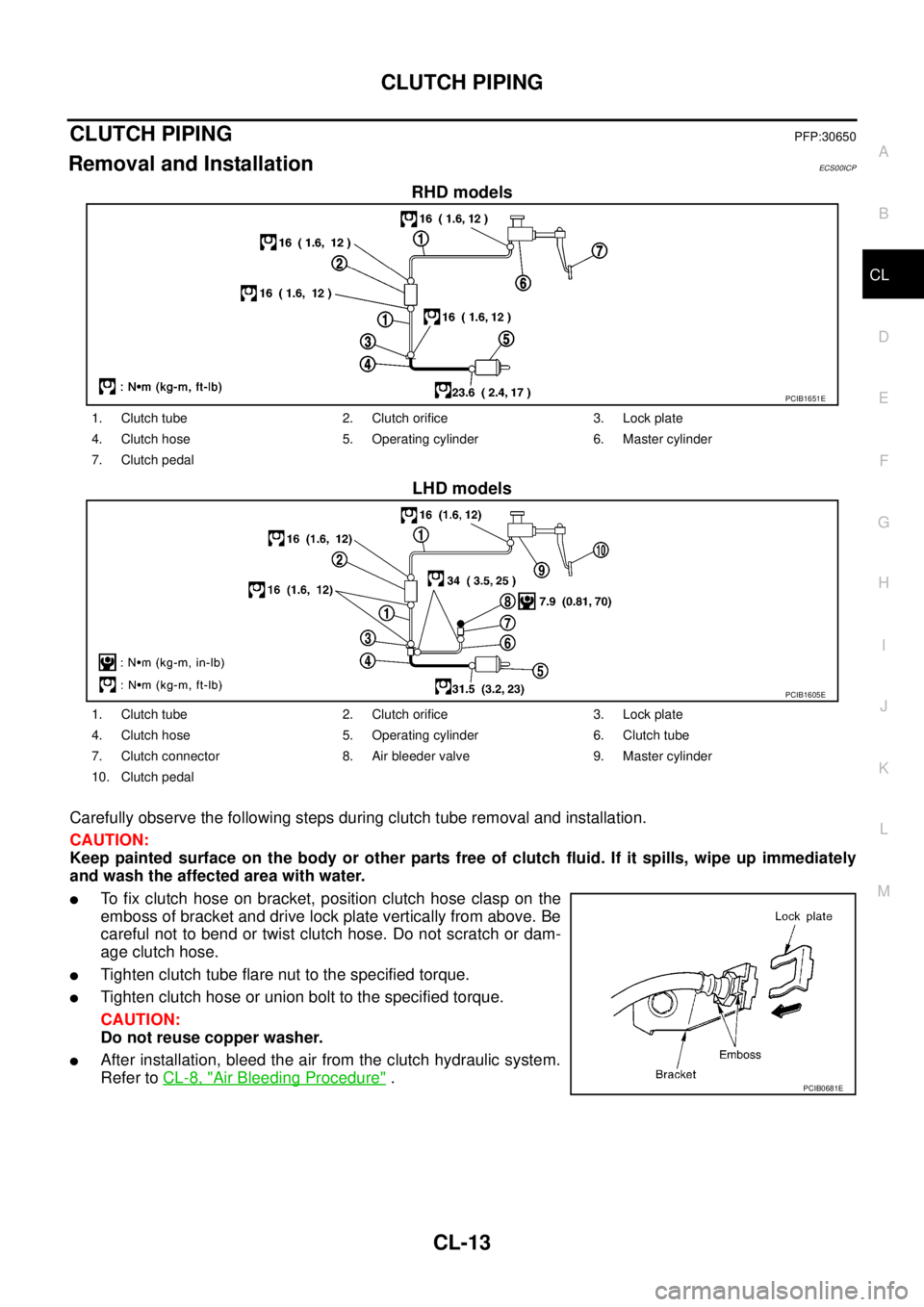
RHD models
LHD models
Carefully observe the following steps during clutch tube removal and installation.
CAUTION:
Keep painted surface on the body or other parts free of clutch fluid. If it spills, wipe up immediately
and wash the affected area with water.
lTo fix clutch hose on bracket, position clutch hose clasp on the
emboss of bracket and drive lock plate vertically from above. Be
careful not to bend or twist clutch hose. Do not scratch or dam-
age clutch hose.
lTighten clutch tube flare nut to the specified torque.
lTighten clutch hose or union bolt to the specified torque.
CAUTION:
Do not reuse copper washer.
lAfter installation, bleed the air from the clutch hydraulic system.
Refer toCL-8, "
Air Bleeding Procedure".
PCIB1651E
1. Clutch tube 2. Clutch orifice 3. Lock plate
4. Clutch hose 5. Operating cylinder 6. Master cylinder
7. Clutch pedal
PCIB1605E
1. Clutch tube 2. Clutch orifice 3. Lock plate
4. Clutch hose 5. Operating cylinder 6. Clutch tube
7. Clutch connector 8. Air bleeder valve 9. Master cylinder
10. Clutch pedal
PCIB0681E
Page 1281 of 3171
GLOW CONTROL SYSTEM
EC-301
C
D
E
F
G
H
I
J
K
L
MA
EC
15.CHECK INTERMITTENT INCIDENT
Refer toEC-70, "
TROUBLE DIAGNOSIS FOR INTERMITTENT INCIDENT".
>>INSPECTION END
Component InspectionEBS01KLP
GLOW RELAY
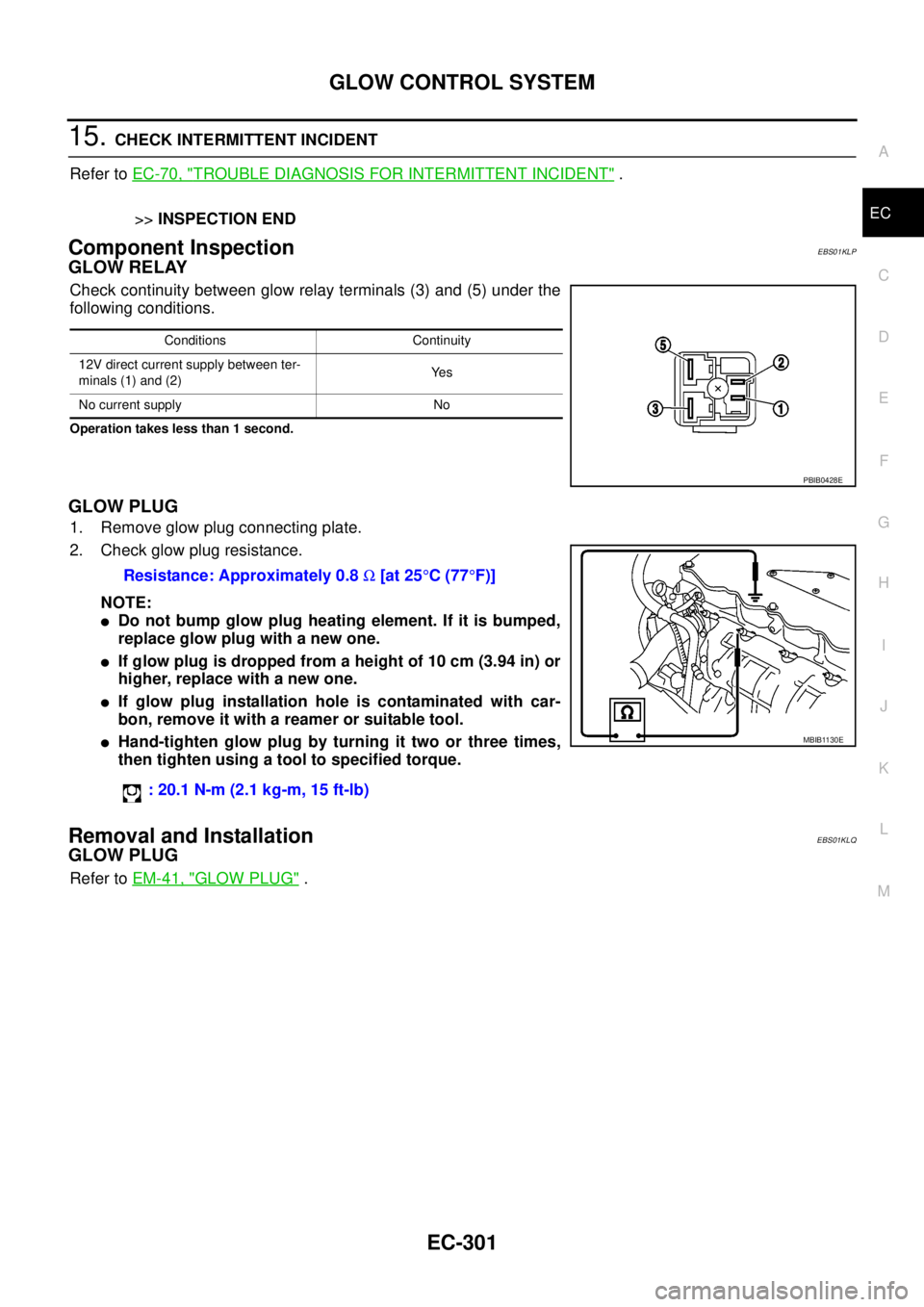
Check continuity between glow relay terminals (3) and (5) under the
following conditions.
Operation takes less than 1 second.
GLOW PLUG
1. Remove glow plug connecting plate.
2. Check glow plug resistance.
NOTE:
lDo not bump glow plug heating element. If it is bumped,
replace glow plug with a new one.
lIf glow plug is dropped from a height of 10 cm (3.94 in) or
higher, replace with a new one.
lIf glow plug installation hole is contaminated with car-
bon, remove it with a reamer or suitable tool.
lHand-tighten glow plug by turning it two or three times,
then tighten using a tool to specified torque.
Removal and InstallationEBS01KLQ
GLOW PLUG
Refer toEM-41, "GLOW PLUG".
Conditions Continuity
12V direct current supply between ter-
minals (1) and (2)Ye s
No current supply No
PBIB0428E
Resistance: Approximately 0.8W[at 25°C(77°F)]
: 20.1 N-m (2.1 kg-m, 15 ft-lb)
MBIB1130E
Page 1386 of 3171

EM-4
PRECAUTIONS
PRECAUTIONS
PFP:00001
Precautions for Draining Engine CoolantEBS01E5H
Drain engine coolant when engine is cooled.
Precautions for Disconnecting Fuel PipingEBS01E5I
lBefore starting work, make sure no fire or spark producing items are in the work area.
lAfter disconnecting pipes, plug openings to stop fuel leakage.
Precautions for Removal and DisassemblyEBS01E5J
lWhen instructed to use SST, use the specified tools. Always be careful to work safely, avoid forceful or
uninstructed operations.
lExercise maximum care to avoid damage to mating or sliding surfaces.
lCover openings of engine system with tape or the equivalent, if necessary, to seal out foreign materials.
lMark and arrange disassembly parts in an organized way for easy troubleshooting and re-assembly.
lWhen loosening nuts and bolts, as a basic rule, start with the one furthest outside, then the one diagonally
opposite, and so on. If the order of loosening is specified, do exactly as specified.
Precautions for Inspection, Repair and ReplacementEBS01E5K
Before repairing or replacing, thoroughly inspect parts. Inspect new replacement parts in the same way, and
replace if necessary.
Precautions for Assembly and InstallationEBS01E5L
lUsetorquewrenchtotightenboltsornutstospecification.
lWhen tightening nuts and bolts, as a basic rule, equally tighten in several different steps starting with the
ones in center, then ones on inside and outside diagonally in this order. If the order of tightening is speci-
fied, do exactly as specified.
lReplace with new liquid gasket, packing, oil seal or O-ring.
lDowel pins are used for several parts alignment. When replacing and reassembling parts with dowel pins,
make sure that dowel pins are installed in the original position.
lThoroughly wash, clean, and air-blow each part. Carefully check engine oil or engine coolant passages for
any restriction and blockage.
lAvoid damaging sliding or mating surfaces. Completely remove foreign materials such as cloth lint or dust.
Before assembly, oil sliding surfaces well.
lRelease air within route when refilling after draining engine coolant.
lAfter repairing, start engine and increase engine speed to check engine coolant, fuel, engine oil, and
exhaust systems for leakage.
Parts Requiring Angle TighteningEBS01E5M
lUse an angle wrench [SST: KV10112100] for the final tightening of the following engine parts:
–Cylinder head bolts
–Main bearing cap bolts
–Connecting rod cap nuts
–Crankshaft pulley bolt (No angle wrench is required as the bolt flange is provided with notches for angle
tightening)
lDo not use a torque value for final tightening.
lThe torque value for these parts are for a preliminary step.
lEnsure thread and seat surfaces are clean and coated with engine oil.
Page 1396 of 3171
EM-14
DRIVE BELTS
A/C COMPRESSOR, ALTERNATOR AND WATER PUMP BELT
1. Loosen idler pulley lock nut (D).
2. Turn adjusting nut (C) to adjust. Refer toEM-13, "
Deflection Adjustment".
3. Tighten lock nut (D).
Removal and InstallationEBS01EJ6
REMOVAL
1. Loosen each belt. Refer toEM-13, "Deflection Adjustment".
2. Remove power steering oil pump belt. Refer toEM-13, "
POWER STEERING OIL PUMP BELT".
3. Remove A/C compressor, alternator and water pump belt. Refer toEM-14, "
A/C COMPRESSOR, ALTER-
NATOR AND WATER PUMP BELT".
INSTALLATION
1. Install each belt on pulley in the reverse order of removal.
2. Adjust belt deflection. Refer toEM-13, "
Deflection Adjustment".
3. Tighten nuts provided for adjustment to the specified torque.
4. Make sure again that each belt deflection is as specified.Nut D:
: 45.0 N·m (4.6 kg-m, 33 ft-lb)