coolant NISSAN NOTE 2016 Service Repair Manual
[x] Cancel search | Manufacturer: NISSAN, Model Year: 2016, Model line: NOTE, Model: NISSAN NOTE 2016Pages: 3641, PDF Size: 28.72 MB
Page 2734 of 3641
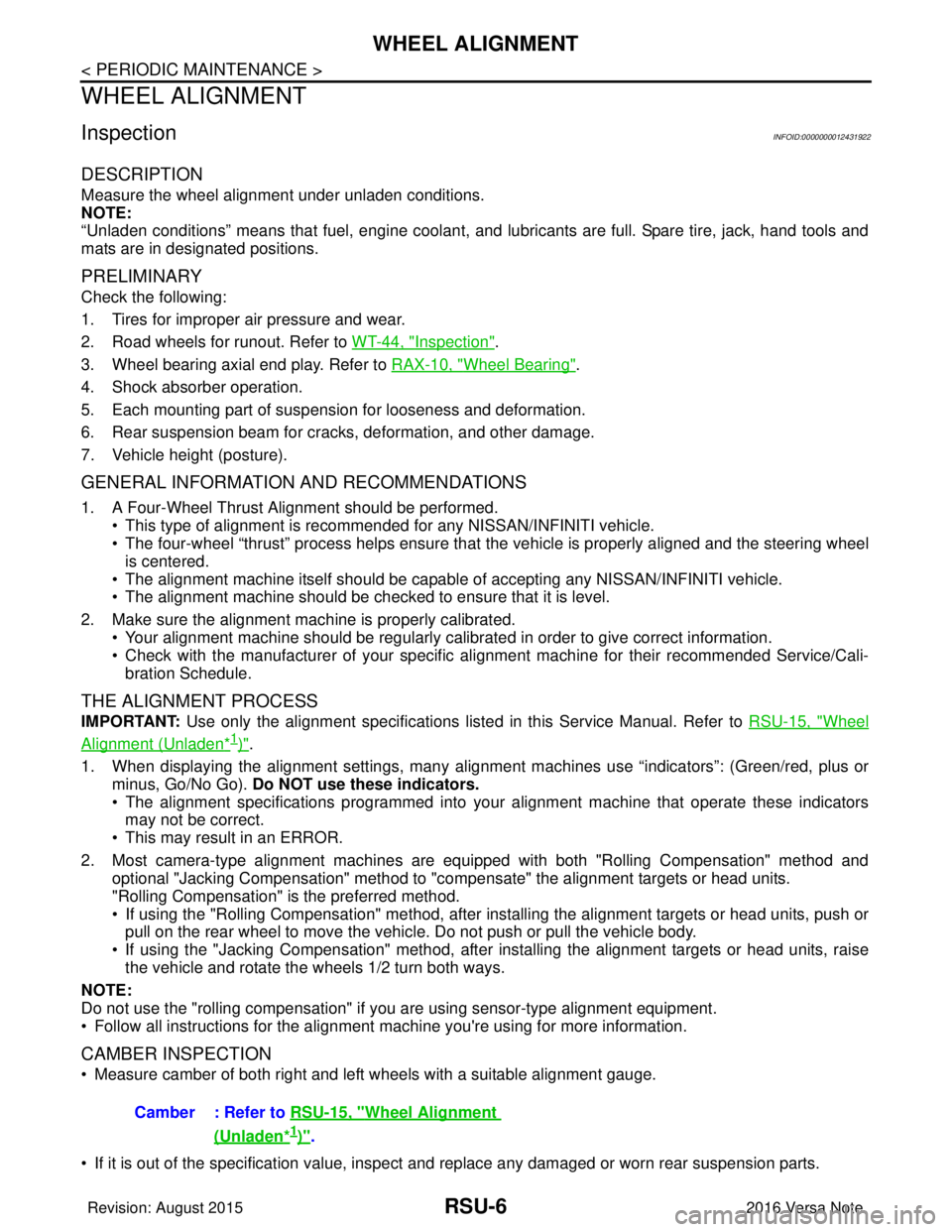
RSU-6
< PERIODIC MAINTENANCE >
WHEEL ALIGNMENT
WHEEL ALIGNMENT
InspectionINFOID:0000000012431922
DESCRIPTION
Measure the wheel alignment under unladen conditions.
NOTE:
“Unladen conditions” means that fuel, engine coolant, and lubricants are full. Spare tire, jack, hand tools and
mats are in designated positions.
PRELIMINARY
Check the following:
1. Tires for improper air pressure and wear.
2. Road wheels for runout. Refer to WT-44, "
Inspection".
3. Wheel bearing axial end play. Refer to RAX-10, "
Wheel Bearing".
4. Shock absorber operation.
5. Each mounting part of suspension for looseness and deformation.
6. Rear suspension beam for cracks, deformation, and other damage.
7. Vehicle height (posture).
GENERAL INFORMATION AND RECOMMENDATIONS
1. A Four-Wheel Thrust Alignment should be performed. • This type of alignment is recommended for any NISSAN/INFINITI vehicle.
• The four-wheel “thrust” process helps ensure that the vehicle is properly aligned and the steering wheel
is centered.
• The alignment machine itself should be capabl e of accepting any NISSAN/INFINITI vehicle.
• The alignment machine should be checked to ensure that it is level.
2. Make sure the alignment machine is properly calibrated. • Your alignment machine should be regularly calibrated in order to give correct information.
• Check with the manufacturer of your specific al ignment machine for their recommended Service/Cali-
bration Schedule.
THE ALIGNMENT PROCESS
IMPORTANT: Use only the alignment specifications listed in this Service Manual. Refer to RSU-15, "Wheel
Alignment (Unladen*1)".
1. When displaying the alignment settings, many alignment machines use “indicators”: (Green/red, plus or minus, Go/No Go). Do NOT use these indicators.
• The alignment specifications programmed into your alignment machine that operate these indicators may not be correct.
• This may result in an ERROR.
2. Most camera-type alignment machines are equipped with both "Rolling Compensation" method and optional "Jacking Compensation" method to "com pensate" the alignment targets or head units.
"Rolling Compensation" is the preferred method.
• If using the "Rolling Compensation" method, after installing the alignment targets or head units, push or pull on the rear wheel to move the vehicle. Do not push or pull the vehicle body.
• If using the "Jacking Compensation" method, after in stalling the alignment targets or head units, raise
the vehicle and rotate the wheels 1/2 turn both ways.
NOTE:
Do not use the "rolling compensation" if you are using sensor-type alignment equipment.
• Follow all instructions for the alignment machine you're using for more information.
CAMBER INSPECTION
• Measure camber of both right and left wheels with a suitable alignment gauge.
• If it is out of the specificati on value, inspect and replace any damaged or worn rear suspension parts.
Camber : Refer to RSU-15, "
Wheel Alignment
(Unladen*1)".
Revision: August 2015
2016 Versa Note
cardiagn.com
Page 2743 of 3641
SERVICE DATA AND SPECIFICATIONS (SDS)RSU-15
< SERVICE DATA AND SPECIFICATIONS (SDS)
C
DF
G H
I
J
K L
M A
B
RSU
N
O P
SERVICE DATA AND SPECIFICATIONS (SDS)
SERVICE DATA AND SPECIFICATIONS (SDS)
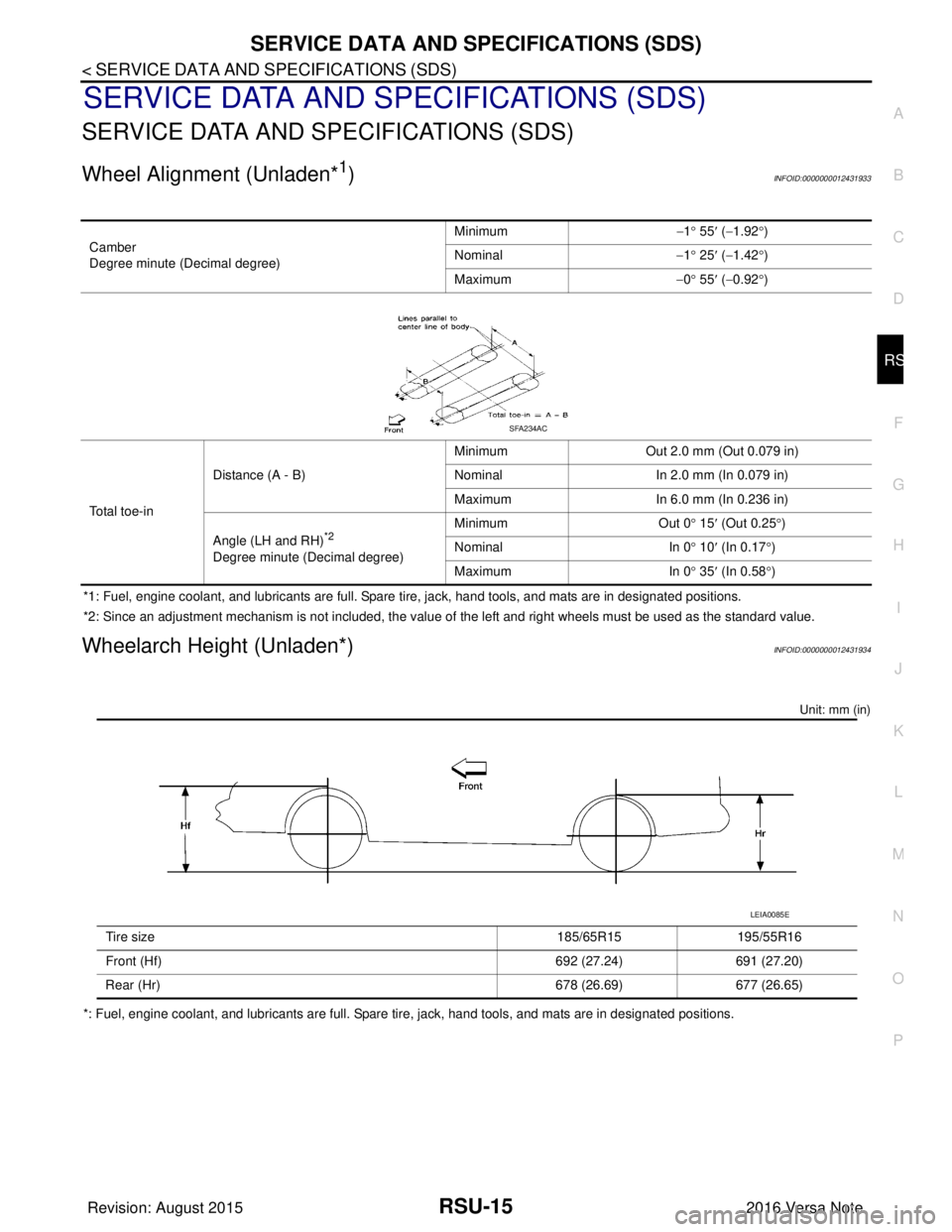
Wheel Alignment (Unladen*1)INFOID:0000000012431933
*1: Fuel, engine coolant, and lubricants are full. Spare tire, jack, hand tools, and mats are in designated positions.
*2: Since an adjustment mechanism is not included, the value of the left and right wheels must be used as the standard value.
Wheelarch Height (Unladen*)INFOID:0000000012431934
Unit: mm (in)
*: Fuel, engine coolant, and lubricants are full. Spare tire, jack, hand tools, and mats are in designated positions. Camber
Degree minute (Decimal degree)
Minimum
−1° 55 ′ ( −1.92 °)
Nominal −1° 25 ′ ( −1.42 °)
Maximum −0° 55 ′ ( −0.92 °)
Total toe-in Distance (A - B)
Minimum
Out 2.0 mm (Out 0.079 in)
Nominal In 2.0 mm (In 0.079 in)
Maximum In 6.0 mm (In 0.236 in)
Angle (LH and RH)
*2
Degree minute (Decimal degree) Minimum Out 0
° 15 ′ (Out 0.25 °)
Nominal In 0° 10 ′ (In 0.17 °)
Maximum In 0° 35 ′ (In 0.58 °)
SFA234AC
Tire size 185/65R15195/55R16
Front (Hf) 692 (27.24)691 (27.20)
Rear (Hr) 678 (26.69)677 (26.65)
LEIA0085E
Revision: August 2015 2016 Versa Note
cardiagn.com
Page 3175 of 3641
DIAGNOSIS AND REPAIR WORKFLOWSTR-23
< BASIC INSPECTION >
C
DE
F
G H
I
J
K L
M A
STR
NP
O
Perform the starting system test with Multitasking bat
tery and electrical diagnostic station GR8-1200 NI. For
details and operating instructions, refer to diagnostic station Instruction Manual.
Test result
CRANKING NORMAL>>GO TO 2.
LOW VOLTAGE>>GO TO 5.
CHARGE BATTERY>>Perform the slow battery charging procedure. (Initial rate of charge is 10A for 12
hours.) Perform battery test again. Refer to diagnostic station instruction manual.
REPLACE BATTERY>>Before replacing battery, clean the battery cable clamps and battery posts. Perform battery test again. Refer to diagnostic station instruction manual. If second test result is
“REPLACE BATTERY”, then do so. Perform battery test again to confirm repair.
2.CRANKING CHECK
Check that the starter motor operates properly.
Does the engine crank normally?
YES >> GO TO 3.
NO >> GO TO 4.
3.ENGINE START CHECK
Check that the engine starts.
Does the engine start?
YES >> Inspection End.
NO >> Perform further diagnosis of engine mechanical or engine control system.\
Refer to EM and EC sections. Once resolved, perform battery test again.
4.STARTER MOTOR ACTIVATION
Check that the starter motor operates.
Does the starter motor turn?
YES >> Check ring gear and starter motor drive pinion. Once resolved, perform battery test again.
NO >> GO TO 7.
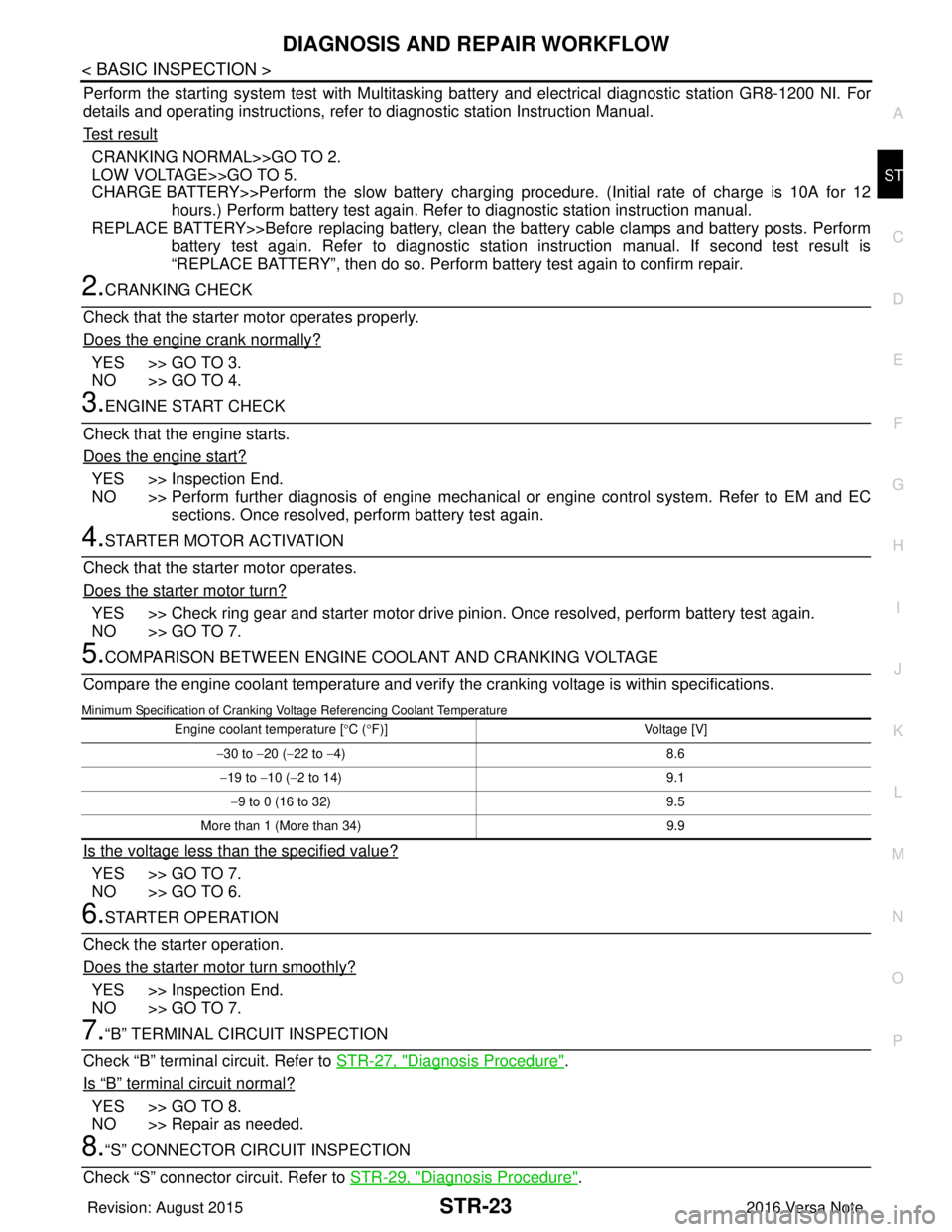
5.COMPARISON BETWEEN ENGINE C OOLANT AND CRANKING VOLTAGE
Compare the engine coolant temperature and verify the cranking voltage is within specifications.
Minimum Specification of Cranking Voltage Referencing Coolant Temperature
Is the voltage less than the specified value?
YES >> GO TO 7.
NO >> GO TO 6.
6.STARTER OPERATION
Check the starter operation.
Does the starter motor turn smoothly?
YES >> Inspection End.
NO >> GO TO 7.
7.“B” TERMINAL CIRCUIT INSPECTION
Check “B” terminal circuit. Refer to STR-27, "
Diagnosis Procedure".
Is
“B” terminal circuit normal?
YES >> GO TO 8.
NO >> Repair as needed.
8.“S” CONNECTOR CIRCUIT INSPECTION
Check “S” connector circuit. Refer to STR-29, "
Diagnosis Procedure".
Engine coolant temperature [°C ( °F)] Voltage [V]
− 30 to −20 ( −22 to − 4) 8.6
− 19 to − 10 (−2 to 14) 9.1
− 9 to 0 (16 to 32) 9.5
More than 1 (More than 34) 9.9
Revision: August 2015 2016 Versa Note
cardiagn.com
Page 3250 of 3641
![NISSAN NOTE 2016 Service Repair Manual PRECAUTIONSTM-9
< PRECAUTION > [5MT: RS5F91R]
C
EF
G H
I
J
K L
M A
B
TM
N
O P
• After 30 minutes or more have passed from the installation, fill engine oil and engine coolant.
CAUTION:
If there are](/img/5/57363/w960_57363-3249.png "NISSAN NOTE 2016 Service Repair Manual PRECAUTIONSTM-9
< PRECAUTION > [5MT: RS5F91R]
C
EF
G H
I
J
K L
M A
B
TM
N
O P
• After 30 minutes or more have passed from the installation, fill engine oil and engine coolant.
CAUTION:
If there are")
PRECAUTIONSTM-9
< PRECAUTION > [5MT: RS5F91R]
C
EF
G H
I
J
K L
M A
B
TM
N
O P
• After 30 minutes or more have passed from the installation, fill engine oil and engine coolant.
CAUTION:
If there are specific instructions in the procedures contained in this manual concerning liquid gas-
ket application, observe them.
Revision: August 2015 2016 Versa Note
cardiagn.com
Page 3265 of 3641
![NISSAN NOTE 2016 Service Repair Manual TM-24
< UNIT REMOVAL AND INSTALLATION >[5MT: RS5F91R]
TRANSAXLE ASSEMBLY
UNIT REMOVAL AND INSTALLATION
TRANSAXLE ASSEMBLY
Exploded ViewINFOID:0000000012430961
Removal and InstallationINFOID:0000000012](/img/5/57363/w960_57363-3264.png "NISSAN NOTE 2016 Service Repair Manual TM-24
< UNIT REMOVAL AND INSTALLATION >[5MT: RS5F91R]
TRANSAXLE ASSEMBLY
UNIT REMOVAL AND INSTALLATION
TRANSAXLE ASSEMBLY
Exploded ViewINFOID:0000000012430961
Removal and InstallationINFOID:0000000012")
TM-24
< UNIT REMOVAL AND INSTALLATION >[5MT: RS5F91R]
TRANSAXLE ASSEMBLY
UNIT REMOVAL AND INSTALLATION
TRANSAXLE ASSEMBLY
Exploded ViewINFOID:0000000012430961
Removal and InstallationINFOID:0000000012430962
WARNING:
Do not remove the radiator cap when the engine is
hot. Serious burns could occur from high pressure
coolant escaping from the radiator. Wrap a thick clot h around the cap. Slowly turn it a quarter turn to
allow built-up pressure to escape. Carefully remove the cap by turning it all the way.
CAUTION:
Do not reuse CSC (Concentric Slave Cylinder). The CSC slides back to the orig inal position every time
the transaxle assembly is removed. This action may allow dust or contaminants to gather on the slid-
ing parts and damage a seal of CSC causing clutch fluid leakage.
NOTE:
When removing components such as hoses, tubes/lines, etc. , cap or plug openings to prevent fluid from spill-
ing.
REMOVAL
1. Remove the engine and transaxle assembly. Refer to EM-87, "Removal and Installation".
2. Disconnect the reverse lamp switch harness connector.
3. Remove the bolts that fasten the transaxle assembly and engine assembly.
4. Remove transaxle assembly from the engine assembly.
5. Remove engine mounting bracket (LH). Refer to EM-86, "
Exploded View".
6. Remove CSC (Concentric Slave Cylinder). Refer to CL-17, "
Removal and Installation".
INSTALLATION
Installation is in the reverse order of removal.
CAUTION:
• Secure transaxle assembly to a suitable jack.
• The transaxle assembly must not interfere with the wire harnesses and clutch tube.
• When installing transaxle assembly, do not bring input shaft into contact with clutch cover.
• Bolt hole is not threaded on new clutch housing. Self-tapping bolt is used to attach lock plate to
clutch housing.
1. Transaxle assembly
: Refer to "INSTALLATION" in TM-24, "
Removal and Installation" for the locations and tightening torque.
JPDIC0478ZZ
Revision: August 2015 2016 Versa Note
cardiagn.com
Page 3266 of 3641
![NISSAN NOTE 2016 Service Repair Manual TRANSAXLE ASSEMBLYTM-25
< UNIT REMOVAL AND INSTALLATION > [5MT: RS5F91R]
C
EF
G H
I
J
K L
M A
B
TM
N
O P
• Do not reuse self-tapping bolt.
• Tighten transaxle assembly bolts to the specified torqu](/img/5/57363/w960_57363-3265.png "NISSAN NOTE 2016 Service Repair Manual TRANSAXLE ASSEMBLYTM-25
< UNIT REMOVAL AND INSTALLATION > [5MT: RS5F91R]
C
EF
G H
I
J
K L
M A
B
TM
N
O P
• Do not reuse self-tapping bolt.
• Tighten transaxle assembly bolts to the specified torqu")
TRANSAXLE ASSEMBLYTM-25
< UNIT REMOVAL AND INSTALLATION > [5MT: RS5F91R]
C
EF
G H
I
J
K L
M A
B
TM
N
O P
• Do not reuse self-tapping bolt.
• Tighten transaxle assembly bolts to the specified torque. The illus- tration is the view from the engine.
InspectionINFOID:0000000012430963
INSPECTION AFTER INSTALLATION
• Check the operation of the control linkage. Refer to TM-21, "Inspection".
• Before starting engine, check oil/fluid levels incl uding engine coolant and engine oil. If less than required
quantity, fill to the specified level. Refer to MA-11, "
Fluids and Lubricants".
• Use procedure below to check for fuel leaks.
• Turn ignition switch ON (with engine stopped). With fuel pressure applied to fuel piping, check for fuel leaks at connection points.
• Start engine. With engine speed increased, check again for fuel leaks at connection points.
• Run engine to check for unusual noise and vibration. NOTE:
If hydraulic pressure inside timing chain tensioner drops after removal and installation, slack in the guide
may generate a pounding noise during and just after engine start. However, this is normal. Noise will stop
after hydraulic pressure rises.
• Warm up engine thoroughly to make sure there is no lea ks of fuel, exhaust gas, or any oils/fluids including
engine oil and engine coolant.
• Bleed air from passages in lines and hoses, such as in cooling system.
• After cooling down engine, again check oil/fluid levels including engine oil and engine coolant. Refill to spec-
ified level, if necessary.
• Summary of the inspection items:
*Power steering fluid, brake fluid, etc.
Bolt symbol
ABC D
Insertion direction Transaxle to
engine Engine to transaxle
Quantity 2321
Bolt length
() mm (in) 55 (2.17)
49 (1.93) 69 (2.72)
Tightening torque
N·m (kg-m, ft-lb) 48.0 (4.9, 35)
JPDIC0813ZZ
Item
Before starting engine Engine runningAfter engine stopped
Engine coolant LevelLeaks Level
Engine oil LevelLeaks Level
Transmission/
transaxle fluid CVT Models
LeaksLevel/Leaks Leaks
M/T Models Level/Leaks LeaksLevel/Leaks
Other oils and fluids* LevelLeaks Level
Fuel LeaksLeaks Leaks
Exhaust gas —Leaks —
Revision: August 2015 2016 Versa Note
cardiagn.com
Page 3315 of 3641
![NISSAN NOTE 2016 Service Repair Manual TM-74
< SYSTEM DESCRIPTION >[CVT: RE0F11A]
STRUCTURE AND OPERATION
FLUID COOLER & FL
UID WARMER SYSTEM
FLUID COOLER & FLUID WARMER SYSTEM : System DescriptionINFOID:0000000012431015
CVT FLUID COOLER](/img/5/57363/w960_57363-3314.png "NISSAN NOTE 2016 Service Repair Manual TM-74
< SYSTEM DESCRIPTION >[CVT: RE0F11A]
STRUCTURE AND OPERATION
FLUID COOLER & FL
UID WARMER SYSTEM
FLUID COOLER & FLUID WARMER SYSTEM : System DescriptionINFOID:0000000012431015
CVT FLUID COOLER")
TM-74
< SYSTEM DESCRIPTION >[CVT: RE0F11A]
STRUCTURE AND OPERATION
FLUID COOLER & FL
UID WARMER SYSTEM
FLUID COOLER & FLUID WARMER SYSTEM : System DescriptionINFOID:0000000012431015
CVT FLUID COOLER SCHEMATIC
COMPONENT DESCRIPTION
CVT Oil Warmer
• The CVT oil warmer (1) is installed on the front part of transaxle
assembly.
• When engine is started while engine and CVT are cold, engine coolant temperature rises more quickly than CVT fluid tempera-
ture. CVT oil warmer is provided with two circuits for CVT and
engine coolant respectively so that warmed engine coolant warms
CVT quickly. This helps shorten CVT warming up time, improving
fuel economy.
• A cooling effect is obtained when CVT fluid temperature is high.
CVT Fluid Cooler (Water-cooling)
• The CVT fluid cooler (water-cooling) is installed in the radiator side tank (right side).
• CVT fluid is cooled by engine coolant.
SHIFT LOCK SYSTEM
Manual valve Distributes the clutch and brake operation pressures (pilot pressure) corresponding to
each shift position.
High clutch/reverse brake switching valve Switches the circuit for the high clutch and the reverse brake.
Torque converter clutch control valve It is operated with the torque converter clutch solenoid valve and it adjusts the tighten-
ing pressure and non-tightening pressure of the torque converter clutch piston of the
torque converter.
Primary pressure control valve It is operated with the primary pressure solenoid valve and adjusts the feed pressure to
the primary pulley.
Primary pressure solenoid valve TM-65, "
CVT CONTROL SYSTEM : Primary Pressure Solenoid Valve"
Low brake solenoid valve TM-65, "CVT CONTROL SYSTEM : Low Brake Solenoid Valve"
High clutch & reverse brake solenoid valveTM-66, "CVT CONTROL SYSTEM : High Clutch & Reverse Brake Solenoid Valve"
Torque converter clutch solenoid valve TM-66, "CVT CONTROL SYSTEM : Torque Converter Clutch Solenoid Valve"
Line pressure solenoid valve TM-66, "CVT CONTROL SYSTEM : Line Pressure Solenoid Valve"
Part name Function
JSDIA4074GB
JSDIA2586ZZ
Revision: August 2015 2016 Versa Note
cardiagn.com
Page 3319 of 3641
![NISSAN NOTE 2016 Service Repair Manual TM-78
< SYSTEM DESCRIPTION >[CVT: RE0F11A]
SYSTEM
·*: If these input/output signals show erro
rs, TCM activates the fail-safe function.
CVT CONTROL SYSTEM : Fail-safeINFOID:0000000012431019
TCM has a](/img/5/57363/w960_57363-3318.png "NISSAN NOTE 2016 Service Repair Manual TM-78
< SYSTEM DESCRIPTION >[CVT: RE0F11A]
SYSTEM
·*: If these input/output signals show erro
rs, TCM activates the fail-safe function.
CVT CONTROL SYSTEM : Fail-safeINFOID:0000000012431019
TCM has a")
TM-78
< SYSTEM DESCRIPTION >[CVT: RE0F11A]
SYSTEM
·*: If these input/output signals show erro
rs, TCM activates the fail-safe function.
CVT CONTROL SYSTEM : Fail-safeINFOID:0000000012431019
TCM has a fail-safe mode. The mode functions so that operation can be continued even if the signal circuit of
the main electronically contro lled input/output parts is damaged.
If the vehicle shows following behaviors including “poor acceleration”, a malfunction of the applicable system
is detected by TCM and the vehicle may be in a fail-sa fe mode. At this time, check the DTC code and perform
inspection and repair according to the malfunction diagnosis procedures.
Fail-safe function
Output Line pressure solenoid valve
××× ×
Primary pressure solenoid valve ××
Torque converter clutch solenoid
valve ××
High clutch & reverse brake solenoid
valve ×××
Low brake solenoid valve ×××
Shift position indicator
(CAN communication) ×
OD OFF indicator lamp
(CAN communication) ×
Control Item
Shift controlLine pressure
control Select control Lock-up con-
trol Fail-safe func-
tion *
DTC Vehicle behavior Conditions of vehicle
P062F Not changed from normal driving —
P0705 • Shift position indicator on combination meter is not dis-
played.
• Selector shock is large
•Start is slow
• Acceleration is slow
• Lock-up is not performed —
P0706 • Shift position indicator on combination meter is not dis-
played.
• Selector shock is large
•Start is slow
• Acceleration is slow
• Lock-up is not performed —
P0711 Acceleration is slow
Engine coolant temperature when engine start: Temp. ≥
10 °C (50 °F)
• Selector shock is large
•Start is slow Engine coolant temperature when engine start: −
35°C ( −
31 °F) ≤Te m p . < 1 0 °C (50 °F)
• Selector shock is large
•Start is slow Engine coolant temperature when engine start: Temp. <
−
35 °C ( −31 °F)
P0712 Acceleration is slow
Engine coolant temperature when engine start: Temp. ≥
10 °C (50 °F)
• Selector shock is large
•Start is slow Engine coolant temperature when engine start: −
35°C ( −
31 °F) ≤Te m p . < 1 0 °C (50 °F)
• Selector shock is large
•Start is slow Engine coolant temperature when engine start: Temp. <
−
35 °C ( −31 °F)
Revision: August 2015 2016 Versa Note
cardiagn.com
Page 3320 of 3641
![NISSAN NOTE 2016 Service Repair Manual SYSTEMTM-79
< SYSTEM DESCRIPTION > [CVT: RE0F11A]
C
EF
G H
I
J
K L
M A
B
TM
N
O P
P0713 Acceleration is slow
Engine coolant temperature when engine start: Temp.
≥
10 °C (50 °F)
• Selector shoc](/img/5/57363/w960_57363-3319.png "NISSAN NOTE 2016 Service Repair Manual SYSTEMTM-79
< SYSTEM DESCRIPTION > [CVT: RE0F11A]
C
EF
G H
I
J
K L
M A
B
TM
N
O P
P0713 Acceleration is slow
Engine coolant temperature when engine start: Temp.
≥
10 °C (50 °F)
• Selector shoc")
SYSTEMTM-79
< SYSTEM DESCRIPTION > [CVT: RE0F11A]
C
EF
G H
I
J
K L
M A
B
TM
N
O P
P0713 Acceleration is slow
Engine coolant temperature when engine start: Temp.
≥
10 °C (50 °F)
• Selector shock is large
•Start is slow Engine coolant temperature when engine start: −
35°C ( −
31 °F) ≤Te m p . < 1 0 °C (50 °F)
• Selector shock is large
•Start is slow Engine coolant temperature when engine start: Temp. <
−
35 °C ( −31 °F)
P0715 • Selector shock is large
•Start is slow
• Acceleration is slow
• Vehicle speed is not increased
• Lock-up is not performed —
P0720 • Selector shock is large
•Start is slow
• Acceleration is slow
• Lock-up is not performed —
P0740 Lock-up is not performed —
P0743 Lock-up is not performed —
P0744 Lock-up is not performed —
P0746 • Selector shock is large
•Start is slow
• Acceleration is slow
• Vehicle speed is not increased
• Lock-up is not performed
—
P0846 •Start is slow
• Acceleration is slow —
P0847 Acceleration is slow —
P0848 •Start is slow
• Acceleration is slow —
P0863 Not changed from normal driving —
P0890 • Selector shock is large
•Start is slow
• Acceleration is slow
• Lock-up is not performed —
P0962 • Selector shock is large
•Start is slow
• Acceleration is slow
• Lock-up is not performed
—
P0963 • Selector shock is large
•Start is slow
• Acceleration is slow
• Lock-up is not performed —
P0965 • Selector shock is large
•Start is slow
• Acceleration is slow
• Lock-up is not performed —
P0966 • Selector shock is large
•Start is slow
• Acceleration is slow
• Lock-up is not performed —
P0967 • Selector shock is large
•Start is slow
• Acceleration is slow
• Lock-up is not performed —
P0998 •Start is slow
• Lock-up is not performed —
DTC
Vehicle behavior Conditions of vehicle
Revision: August 2015 2016 Versa Note
cardiagn.com
Page 3329 of 3641
![NISSAN NOTE 2016 Service Repair Manual TM-88
< SYSTEM DESCRIPTION >[CVT: RE0F11A]
SYSTEM
Provides idle neutral control when st
op/start operation is not performed.
Idle Neutral Control Start Condition
Idle neutral control is started when](/img/5/57363/w960_57363-3328.png "NISSAN NOTE 2016 Service Repair Manual TM-88
< SYSTEM DESCRIPTION >[CVT: RE0F11A]
SYSTEM
Provides idle neutral control when st
op/start operation is not performed.
Idle Neutral Control Start Condition
Idle neutral control is started when")
TM-88
< SYSTEM DESCRIPTION >[CVT: RE0F11A]
SYSTEM
Provides idle neutral control when st
op/start operation is not performed.
Idle Neutral Control Start Condition
Idle neutral control is started when all of the following conditions are fulfilled. However, during idle neutral con-
trol, idle neutral control is stopped when any of the following conditions is not met or idle neutral control contin-
ues 30 seconds.
NOTE:
Stops or prohibits the idle neutral control when the TC M and ECM detect that the vehicle is in one of the fol-
lowing conditions.
• Engine coolant temperature and CVT fluid temperature are the specified temperature or more, or the speci-
fied temperature or less.
• When a transaxle malfunction occurs.
• When the vehicle detects DTC and is in the fail-safe mode.
• When idle speed increases due to heavy electric load*. *: When any one of rear window defogger switch, A/C s witch, headlamp, fog lamp is turned ON. In addition,
when the steering wheel is operated.
JPDIA1215GB
Driving environment : Flat road or road with mild gradient
Selector lever position : “D” position
Vehicle speed : 0 km/h (0 MPH)
Accelerator pedal position : 0.0/8
Brake pedal : Depressed
Engine speed : Idle speed
Turn signal lamp/hazard signal lamp : Not activated
Revision: August 2015 2016 Versa Note
cardiagn.com