service NISSAN NOTE 2016 Service Repair Manual
[x] Cancel search | Manufacturer: NISSAN, Model Year: 2016, Model line: NOTE, Model: NISSAN NOTE 2016Pages: 3641, PDF Size: 28.72 MB
Page 2043 of 3641
HA-18
< PERIODIC MAINTENANCE >
REFRIGERANT
PERIODIC MAINTENANCE
REFRIGERANT
DescriptionINFOID:0000000012431997
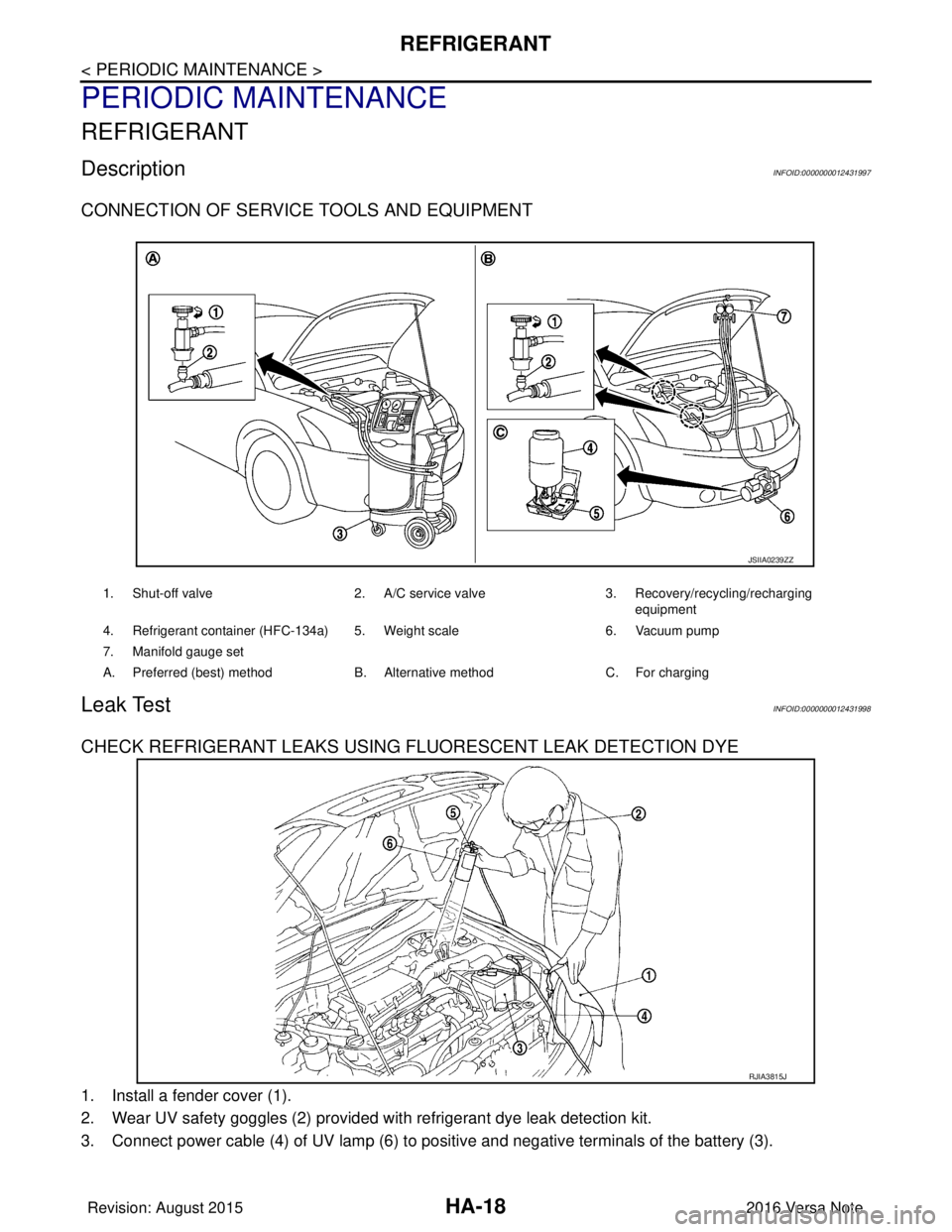
CONNECTION OF SERVICE TOOLS AND EQUIPMENT
Leak TestINFOID:0000000012431998
CHECK REFRIGERANT LEAKS USING FLUORESCENT LEAK DETECTION DYE
1. Install a fender cover (1).
2. Wear UV safety goggles (2) provided with refrigerant dye leak detection kit.
3. Connect power cable (4) of UV lamp (6) to positive and negative terminals of the battery (3).
1. Shut-off valve2. A/C service valve 3. Recovery/recycling/recharging
equipment
4. Refrigerant container (HFC-134a) 5. Weight scale 6. Vacuum pump
7. Manifold gauge set
A. Preferred (best) method B. Alternative methodC. For charging
JSIIA0239ZZ
RJIA3815J
Revision: August 2015 2016 Versa Note
cardiagn.com
Page 2044 of 3641

REFRIGERANTHA-19
< PERIODIC MAINTENANCE >
C
DE
F
G H
J
K L
M A
B
HA
N
O P
4. Press UV lamp switch (5) and check A/C system for re frigerant leaks. (Where refrigerant leaks occur, flu-
orescent leak detection dye appears green in color.)
WARNING:
Do not look directly into UV lamp light source.
NOTE:
• For continuous operating time of UV lamp, fo llow the manufacturer’s operating instructions.
• Illuminate pipe joints from different angles using UV lamp to check for leaks.
• Use a mirror in areas that are di fficult to see to check for leaks.
• Refrigerant leaks from the evaporator can be detected by soaking a cotton swab or similar material with
drain hose water and illuminating it using the UV lamp.
• Dust, dirt, and packing material adhesives used for condenser, evaporator, and other components may fluoresce. Be careful not to misidentify leaks.
5. Repair or replace parts where refrigerant lea ks occur and wipe off fluorescent leak detection dye.
NOTE:
Completely wipe off fluorescent leak detection dye from gaps between parts, screw threads, and other
components using a cotton swab or similar material.
6. Use a UV lamp to check that no fluorescent leak detection dye remains after finishing work. WARNING:
Do not look directly into UV lamp light source.
NOTE:
• For continuous operating time of UV lamp, fo llow the manufacturer’s operating instructions.
• Dust, dirt, and packing material adhesives used for condenser, evaporator, and other components may
fluoresce. Be careful not to misidentify leaks.
CHECK REFRIGERANT LEAKS USING ELECTRONIC LEAK DETECTOR
WARNING:
Do not check for refrigerant leaks while the engine is running.
CAUTION:
Be careful of the following items so that in accurate checks or misidentifications are avoided.
• Do not allow refrigerant vapor, shop chemical vapors, cigarette smoke or other contaminates around the vehicle.
• Always check refrigerant leaks in a low air flow en vironment so that refrigerant may not disperse.
1. Stop the engine.
2. Connect recovery/recycling/recharging equipment or manifold gauge set to the A/C service valves.
3. Check that A/C refrigerant pressure is 345 kPa (3.52 kg/cm
2, 50 psi) or more when temperature is 16 °C
(61 °F) or more. When pressure is lower than the specified value, recycle refrigerant completely and
recharge refrigerant to the specified level.
NOTE:
Leaks may not be detected if A/C refriger ant pressure is 345 kPa (3.52 kg/cm
2, 50 psi) or less when tem-
perature is less than 16° C (61°F).
4. Clean the area where the refrigerant leak check is performed and check for refrigerant leaks along all sur- faces of pipe connections and A/C system co mponents using electronic leak detector probe.
CAUTION:
• Continue checking once leaks are found. Always co ntinue and complete checking along all pipe
connections and A/C system comp onents for additional leaks.
• When leaks are detected, clean leak ar ea using compressed air and re-check.
• When checking the evaporator for leaks, always clean inside of drain hose so that the probe sur-
face may not be exposed to water or dirt.
NOTE:
• Always check for leaks starting from the high-pressure side and continue to the low-pressure side.
• When checking the evaporator for leaks, operate blower motor for 15 minut\
es or more at the maximum speed while the engine is stopped. Insert electronic leak detector probe into drain hose and hold for 10
minutes or more.
• When disconnecting shut-off valve that is connected to A/C service valve, always evacuate remaining
refrigerant so that misidentification can be avoided.
5. Repair or replace parts where refrigerant leaks occur.
6. Start the engine and set A/C control in the following conditions. • A/C switch: ON
Revision: August 2015 2016 Versa Note
cardiagn.com
Page 2045 of 3641
HA-20
< PERIODIC MAINTENANCE >
REFRIGERANT
• Air flow: VENT (ventilation)
• Intake door position: Recirculation
• Temperature setting: Full cold
• Blower speed: Maximum
7. Run the engine at approximately 1,500 rpm for two minutes or more.
8. Stop the engine. Check for refrigerant leaks. Go to step 4. WARNING:
Be careful not to get burned when the engine is hot.
NOTE:
• Start refrigerant leak check immediately after the engine is stopped.
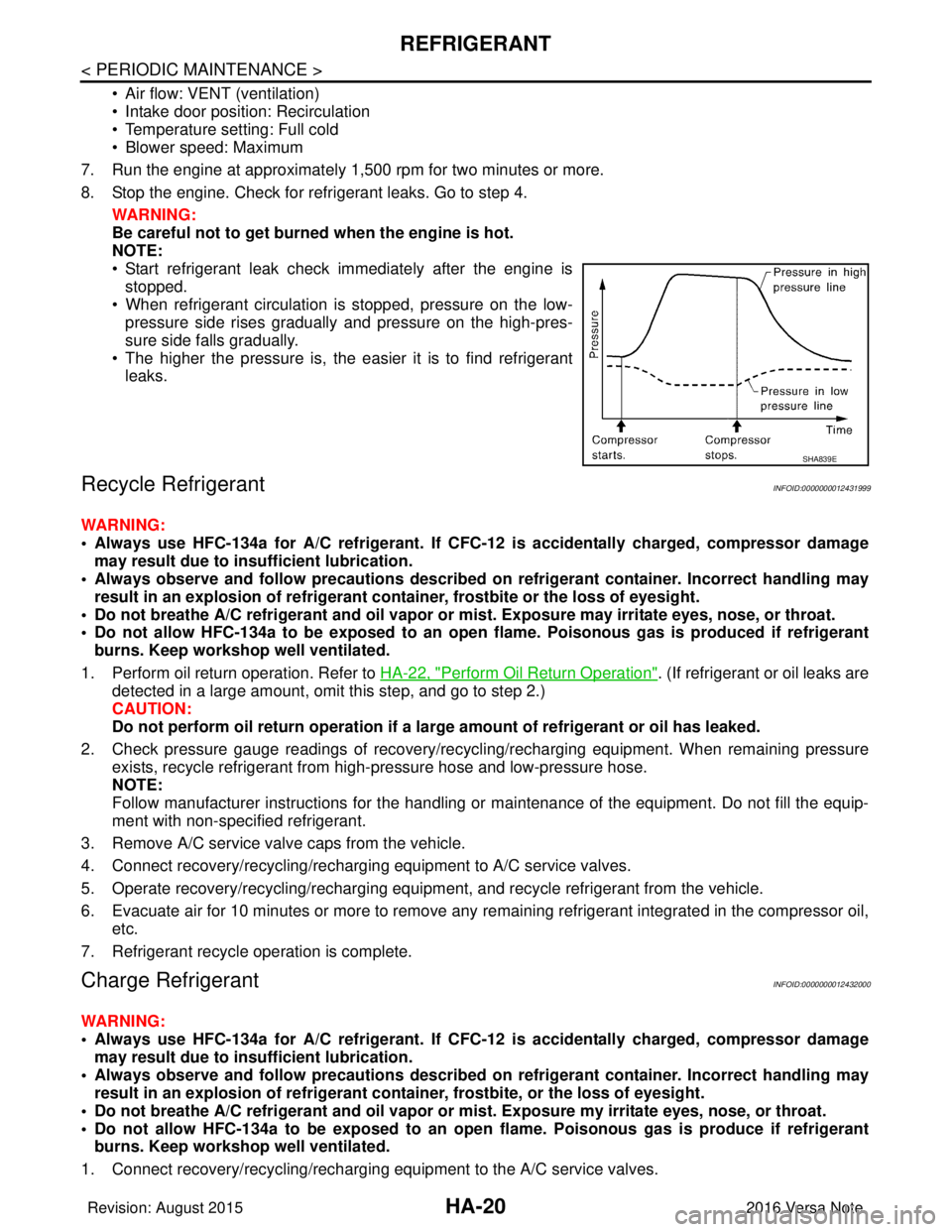
• When refrigerant circulation is stopped, pressure on the low- pressure side rises gradually and pressure on the high-pres-
sure side falls gradually.
• The higher the pressure is, the easier it is to find refrigerant leaks.
Recycle RefrigerantINFOID:0000000012431999
WARNING:
• Always use HFC-134a for A/C refrigerant. If CFC- 12 is accidentally charged, compressor damage
may result due to in sufficient lubrication.
• Always observe and follow precaution s described on refrigerant container. Incorrect handling may
result in an explosion of refrigerant container, frostbite or the loss of eyesight.
• Do not breathe A/C refrigerant and oil vapor or mi st. Exposure may irritate eyes, nose, or throat.
• Do not allow HFC-134a to be exposed to an open flame. Poisonous gas is produced if refrigerant
burns. Keep workshop well ventilated.
1. Perform oil return operation. Refer to HA-22, "
Perform Oil Return Operation". (If refrigerant or oil leaks are
detected in a large amount, omit this step, and go to step 2.)
CAUTION:
Do not perform oil return operation if a la rge amount of refrigerant or oil has leaked.
2. Check pressure gauge readings of recovery/recyc ling/recharging equipment. When remaining pressure
exists, recycle refrigerant from high-pressure hose and low-pressure hose.
NOTE:
Follow manufacturer instructions for the handling or maintenance of the equipment. Do not fill the equip-
ment with non-specified refrigerant.
3. Remove A/C service valve caps from the vehicle.
4. Connect recovery/recycling/recharging equipment to A/C service valves.
5. Operate recovery/recycling/recharging equipm ent, and recycle refrigerant from the vehicle.
6. Evacuate air for 10 minutes or more to remove any remaining refrigerant integrated in the compressor oil,
etc.
7. Refrigerant recycle operation is complete.
Charge RefrigerantINFOID:0000000012432000
WARNING:
• Always use HFC-134a for A/C refrigerant. If CFC- 12 is accidentally charged, compressor damage
may result due to in sufficient lubrication.
• Always observe and follow precaution s described on refrigerant container. Incorrect handling may
result in an explosion of refrigerant co ntainer, frostbite, or the loss of eyesight.
• Do not breathe A/C refrigerant and oil vapor or mi st. Exposure my irritate eyes, nose, or throat.
• Do not allow HFC-134a to be exposed to an open flame. Poisonous gas is produce if refrigerant burns. Keep workshop well ventilated.
1. Connect recovery/recycling/recharging equipment to the A/C service valves.
SHA839E
Revision: August 2015 2016 Versa Note
cardiagn.com
Page 2046 of 3641

REFRIGERANTHA-21
< PERIODIC MAINTENANCE >
C
DE
F
G H
J
K L
M A
B
HA
N
O P
2. Operate recovery/recycling/recharging equipment, and evacuate air from A/C system for 25 minutes or more.
CAUTION:
Evacuate air for 15 minutes or more if parts are replaced.
3. Check the airtightness of A/C system for 25 minutes or more. If pressure raises more than the specified
level, charge A/C system with approximately 200g of refrigerant and check that there are no refrigerant
leaks. Refer to HA-18, "
Leak Test".
CAUTION:
Check the airtightness for 15 minutes or more if parts are replaced.
4. If parts other than the compressor are replaced, fill compressor oil according to parts that are replaced.
Refer to HA-22, "
Oil Adjusting Procedure for Components Replacement Except Compressor".
5. Charge the specified amount of refrigerant into A/C system.
6. Check that the A/C system operates normally.
7. Collect the refrigerant from the high-pressure hos e and low-pressure hose of recovery/recycling/recharg-
ing equipment. Disconnect recovery/recycling/recharging equipment.
8. Install A/C service valve caps.
9. Refrigerant charge is complete.
Revision: August 2015 2016 Versa Note
cardiagn.com
Page 2057 of 3641
HA-32
< REMOVAL AND INSTALLATION >
CONDENSER
INSTALLATION
Installation is in the reverse order of removal.
CAUTION:
• Do not reuse O-rings.
• Apply compressor oil to new O-rings of the high-pressure flexible hose and high-pressure pipe forinstallation.
• Perform oil adjusting procedure before installing new condenser. Refer to HA-22, "
Oil Adjusting Pro-
cedure for Components Replacement Except Compressor".
• After charging refrigerant, check for leaks. Refer to HA-18, "
Leak Test".
LIQUID TANK
LIQUID TANK : Removal and Installation of Liquid TankINFOID:0000000012432016
The liquid tank is only serviced as part of the condenser. Refer to HA-31, "CONDENSER : Removal and Instal-
lation".
REFRIGERANT PRESSURE SENSOR
REFRIGERANT PRESSURE SENSOR : Removal and InstallationINFOID:0000000012432017
CAUTION:
Perform oil return operation before each refrigeration system disassembly. However, if a large
amountof refrigerant or oil is detected, do not perform oil return operation. Refer to HA-22, "
Perform
Oil Return Operation".
REMOVAL
1. Discharge the refrigerant. Refer to HA-20, "Recycle Refrigerant".
2. Remove front grille. Refer to EXT-32, "
Removal and Installation".
3. Remove upper air guide and air guide (LH). Refer to DLK-144, "
Exploded View".
4. Clean refrigerant pressure sensor and surrounding area. CAUTION:
Make sure to clean carefully.
5. Disconnect the harness connector from the refrigerant pressure sensor.
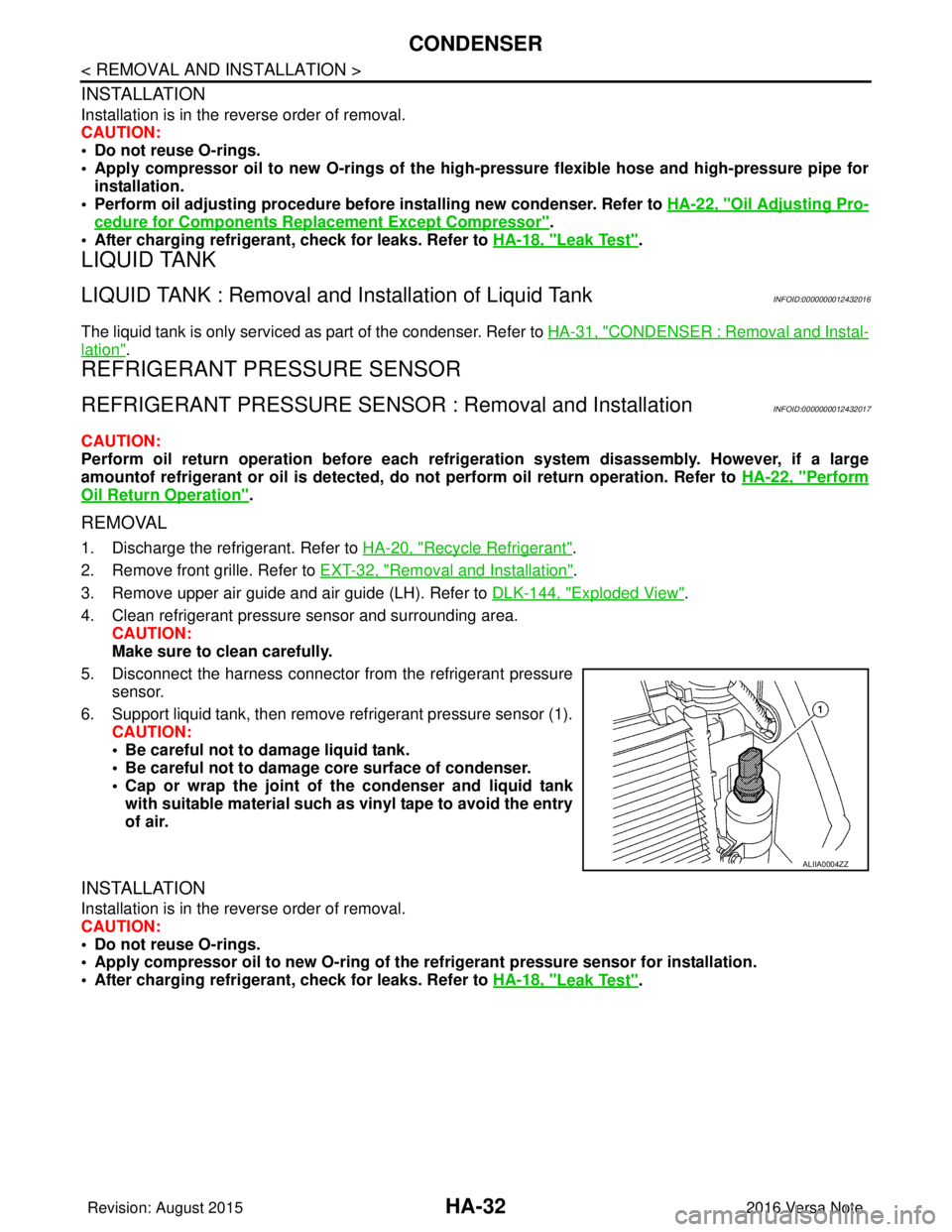
6. Support liquid tank, then remove refrigerant pressure sensor (1). CAUTION:
• Be careful not to damage liquid tank.
• Be careful not to damage core surface of condenser.
• Cap or wrap the joint of the condenser and liquid tank
with suitable material such as vinyl tape to avoid the entry
of air.
INSTALLATION
Installation is in the reverse order of removal.
CAUTION:
• Do not reuse O-rings.
• Apply compressor oil to new O-ring of the refrigerant pressure sensor for installation.
• After charging refrigerant, check for leaks. Refer to HA-18, "
Leak Test".
ALIIA0004ZZ
Revision: August 2015 2016 Versa Note
cardiagn.com
Page 2062 of 3641
SERVICE DATA AND SPECIFICATIONS (SDS)HA-37
< SERVICE DATA AND SPECIFICATIONS (SDS)
C
DE
F
G H
J
K L
M A
B
HA
N
O P
SERVICE DATA AND SPECIFICATIONS (SDS)
SERVICE DATA AND SPECIFICATIONS (SDS)
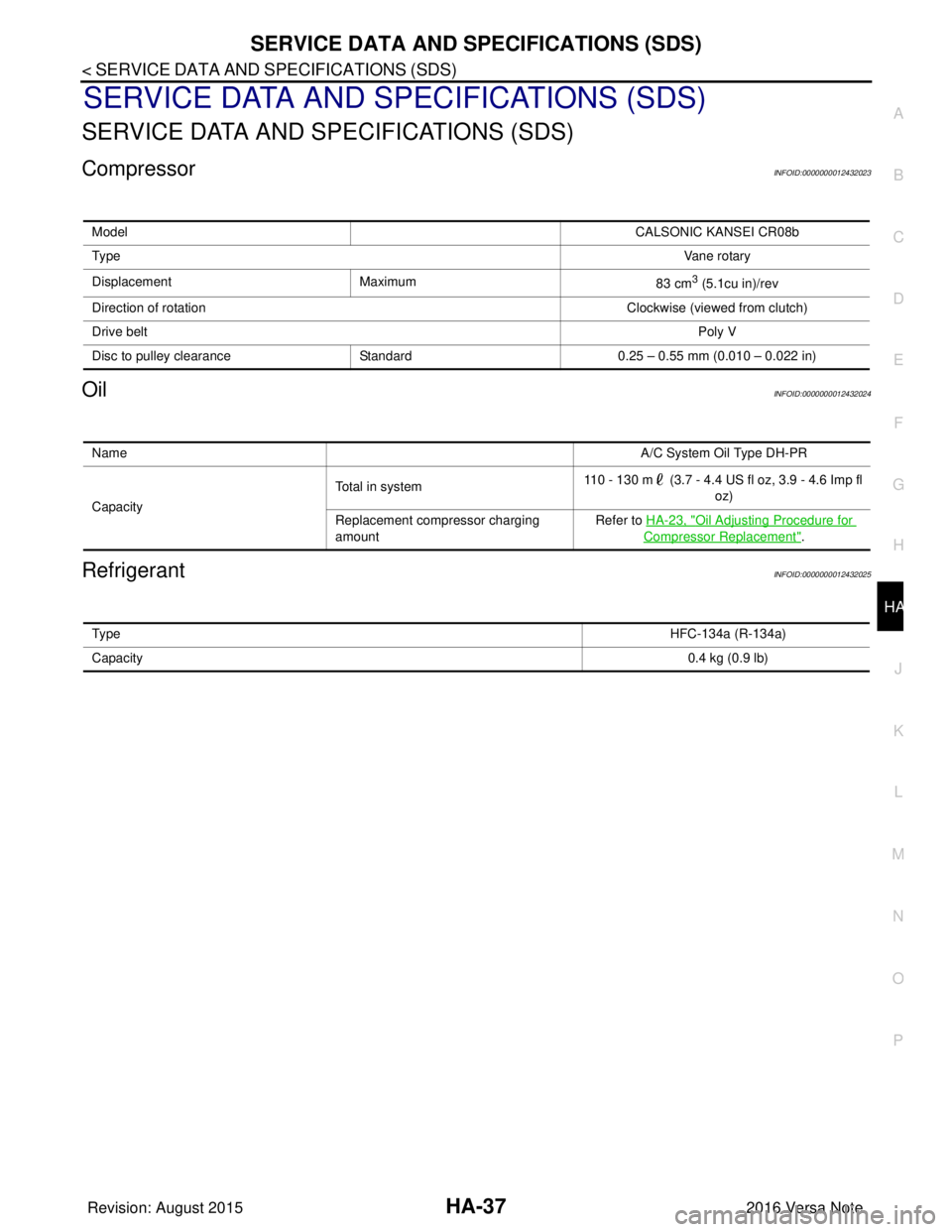
CompressorINFOID:0000000012432023
OilINFOID:0000000012432024
RefrigerantINFOID:0000000012432025
Model CALSONIC KANSEI CR08b
Ty p e Vane rotary
Displacement Maximum 83 cm
3 (5.1cu in)/rev
Direction of rotation Clockwise (viewed from clutch)
Drive belt Poly V
Disc to pulley clearance Standard0.25 – 0.55 mm (0.010 – 0.022 in)
Name A/C System Oil Type DH-PR
Capacity Total in system
110 - 130 m (3.7 - 4.4 US fl oz, 3.9 - 4.6 Imp fl
oz)
Replacement compressor charging
amount Refer to
HA-23, "
Oil Adjusting Procedure for
Compressor Replacement".
Ty p e HFC-134a (R-134a)
Capacity 0.4 kg (0.9 lb)
Revision: August 20152016 Versa Note
cardiagn.com
Page 2064 of 3641

HRN-2
< PRECAUTION >
PRECAUTIONS
PRECAUTION
PRECAUTIONS
Precaution for Supplemental Restraint System (SRS) "AIR BAG" and "SEAT BELT
PRE-TENSIONER"
INFOID:0000000012431935
The Supplemental Restraint System such as “A IR BAG” and “SEAT BELT PRE-TENSIONER”, used along
with a front seat belt, helps to reduce the risk or severity of injury to the driver and front passenger for certain
types of collision. Information necessary to service the system safely is included in the SR and SB section of
this Service Manual.
WARNING:
• To avoid rendering the SRS inopera tive, which could increase the risk of personal injury or death in
the event of a collision which would result in air bag inflation, all maintenance must be performed by
an authorized NISSAN/INFINITI dealer.
• Improper maintenance, including in correct removal and installation of the SRS, can lead to personal
injury caused by unintent ional activation of the system. For re moval of Spiral Cable and Air Bag
Module, see the SR section.
• Do not use electrical test equipmen t on any circuit related to the SRS unless instructed to in this
Service Manual. SRS wiring harn esses can be identified by yellow and/or orange harnesses or har-
ness connectors.
PRECAUTIONS WHEN USING POWER TOOLS (AIR OR ELECTRIC) AND HAMMERS
WARNING:
• When working near the Airbag Diagnosis Sensor Unit or other Airbag System sensors with the Igni-
tion ON or engine running, DO NOT use air or electri c power tools or strike near the sensor(s) with a
hammer. Heavy vibration could activate the sensor( s) and deploy the air bag(s), possibly causing
serious injury.
• When using air or electric power tools or hammers , always switch the Ignition OFF, disconnect the
battery and wait at least three minutes before performing any service.
Revision: August 2015 2016 Versa Note
cardiagn.com
Page 2069 of 3641

IP-1
BODY INTERIOR
C
DE
F
G H
I
K L
M
SECTION IP
A
B
IP
N
O P
CONTENTS
INSTRUMENT PANEL
PRECAUTION ....... ........................................2
PRECAUTIONS .............................................. .....2
Precaution for Supplemental Restraint System
(SRS) "AIR BAG" and "SEAT BELT PRE-TEN-
SIONER" ............................................................. ......
2
Precaution for Work ..................................................2
PREPARATION ............................................3
PREPARATION .............................................. .....3
Special Service Tools ........................................ ......3
Commercial Service Tools .......................................3
CLIP LIST ............................................................4
Descriptions for Clips ................................................4
SYMPTOM DIAGNOSIS ...............................8
SQUEAK AND RATTLE TROUBLE DIAG-
NOSES ........................ ........................................
8
Work Flow ........................................................... ......8
Generic Squeak and Rattle Troubleshooting ............9
Diagnostic Worksheet .............................................12
REMOVAL AND INSTALLATION ...............14
INSTRUMENT PANEL ASSEMBLY .............. ....14
Exploded View .................................................... ....14
Removal and Installation ..................................... ....15
STEERING COLUMN COVERS .......................17
Removal and Installation .........................................17
CENTER CONSOLE ASSEMBLY ....................18
Exploded View .........................................................18
Removal and Installation .........................................18
CENTER CONSOLE LOWER ...........................20
Removal and Installation .........................................20
CLUSTER LID A ...............................................21
Removal and Installation .........................................21
CLUSTER LID C ...............................................22
Removal and Installation .........................................22
FRONT AIR CONTROL FINISHER ...................23
Removal and Installation .........................................23
INSTRUMENT LOWER PANEL LH ..................24
Removal and Installation .........................................24
GLOVE BOX ASSEMBLY ................................25
Removal and Installation .........................................25
UPPER GLOVE BOX ........................................26
Removal and Installation ..................................... ....26
Revision: August 2015 2016 Versa Note
cardiagn.com
Page 2070 of 3641

IP-2
< PRECAUTION >
PRECAUTIONS
PRECAUTION
PRECAUTIONS
Precaution for Supplemental Restraint System (SRS) "AIR BAG" and "SEAT BELT
PRE-TENSIONER"
INFOID:0000000012430769
The Supplemental Restraint System such as “A IR BAG” and “SEAT BELT PRE-TENSIONER”, used along
with a front seat belt, helps to reduce the risk or severity of injury to the driver and front passenger for certain
types of collision. Information necessary to service the system safely is included in the SR and SB section of
this Service Manual.
WARNING:
• To avoid rendering the SRS inopera tive, which could increase the risk of personal injury or death in
the event of a collision which would result in air bag inflation, all maintenance must be performed by
an authorized NISSAN/INFINITI dealer.
• Improper maintenance, including in correct removal and installation of the SRS, can lead to personal
injury caused by unintent ional activation of the system. For re moval of Spiral Cable and Air Bag
Module, see the SR section.
• Do not use electrical test equipmen t on any circuit related to the SRS unless instructed to in this
Service Manual. SRS wiring harn esses can be identified by yellow and/or orange harnesses or har-
ness connectors.
PRECAUTIONS WHEN USING POWER TOOLS (AIR OR ELECTRIC) AND HAMMERS
WARNING:
• When working near the Airbag Diagnosis Sensor Unit or other Airbag System sensors with the Igni-
tion ON or engine running, DO NOT use air or electri c power tools or strike near the sensor(s) with a
hammer. Heavy vibration could activate the sensor( s) and deploy the air bag(s), possibly causing
serious injury.
• When using air or electric power tools or hammers , always switch the Ignition OFF, disconnect the
battery and wait at least three minutes before performing any service.
Precaution for WorkINFOID:0000000012430770
• When removing or disassembling each component, be careful not to damage or deform it. If a component may be subject to interference, be sure to protect it with a shop cloth.
• When removing (disengaging) components with a screwdriver or similar tool, be sure to wrap the component with a shop cloth or vinyl tape to protect it.
• Protect the removed parts with a shop cloth and prevent them from being dropped.
• Replace a deformed or damaged clip.
• If a part is specified as a non-reusable part, always replace it with a new one.
• Be sure to tighten bolts and nuts securely to the specified torque.
• After installation is complete, be sure to check that each part works properly.
• Follow the steps below to clean components:
- Water soluble dirt:
• Dip a soft cloth into lukewarm water, wring the water out of the cloth and wipe the dirty area.
• Then rub with a soft, dry cloth.
- Oily dirt:
• Dip a soft cloth into lukewarm water with mild detergent (concentration: within 2 to 3%) and wipe the dirty area.
• Then dip a cloth into fresh water, wring the water out of the cloth and wipe the detergent off.
• Then rub with a soft, dry cloth.
- Do not use organic solvent such as thinner, benzene, alcohol or gasoline.
- For genuine leather seats, use a genuine leather seat cleaner.
Revision: August 2015 2016 Versa Note
cardiagn.com
Page 2071 of 3641
PREPARATIONIP-3
< PREPARATION >
C
DE
F
G H
I
K L
M A
B
IP
N
O P
PREPARATION
PREPARATION
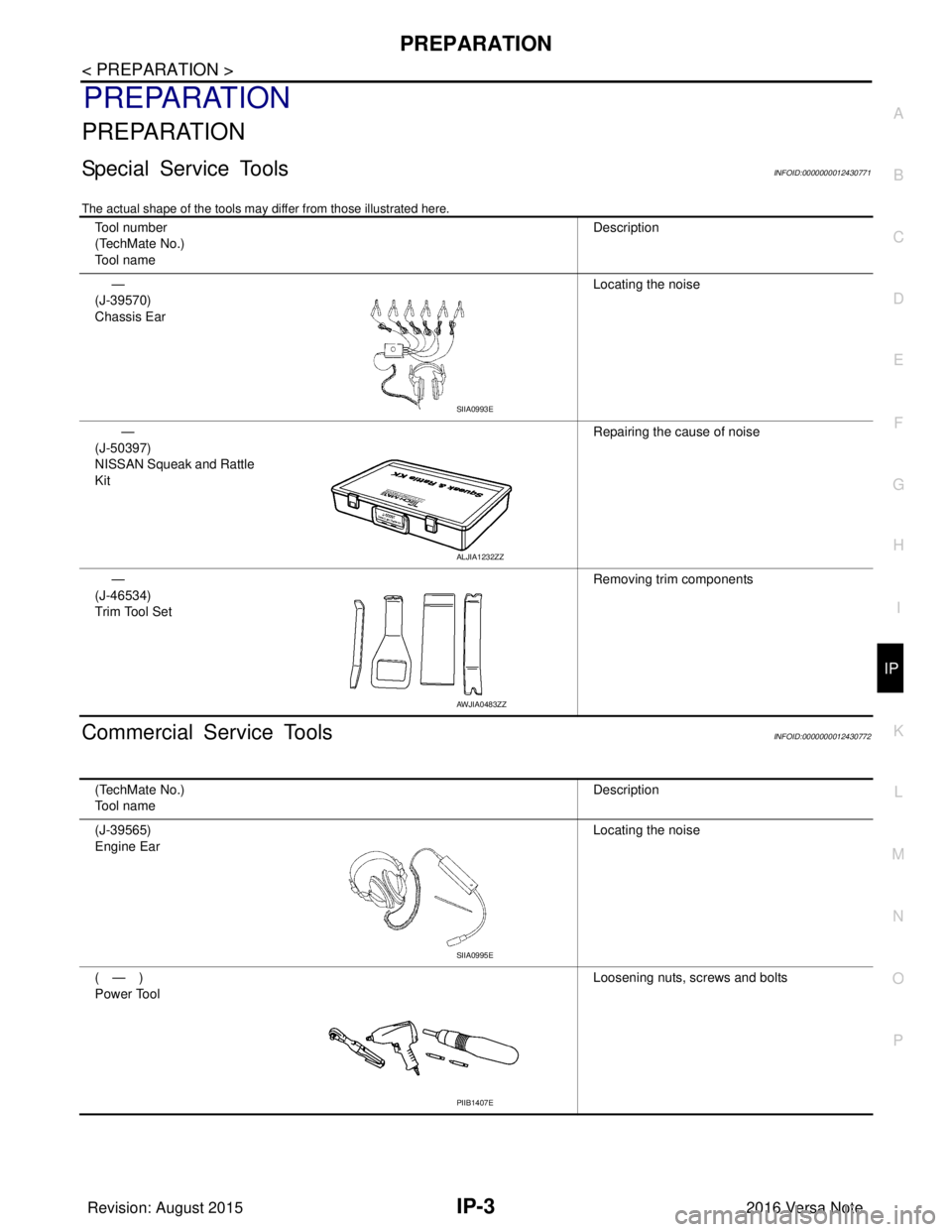
Special Service ToolsINFOID:0000000012430771
The actual shape of the tools may di ffer from those illustrated here.
Commercial Service ToolsINFOID:0000000012430772
Tool number
(TechMate No.)
Tool name Description
—
(J-39570)
Chassis Ear Locating the noise
—
(J-50397)
NISSAN Squeak and Rattle
Kit Repairing the cause of noise
—
(J-46534)
Trim Tool Set Removing trim components
SIIA0993E
ALJIA1232ZZ
AWJIA0483ZZ
(TechMate No.)
Tool name
Description
(J-39565)
Engine Ear Locating the noise
(—)
Power Tool Loosening nuts, screws and bolts
SIIA0995E
PIIB1407E
Revision: August 2015
2016 Versa Note
cardiagn.com