head light NISSAN NOTE 2016 Service Owner's Manual
[x] Cancel search | Manufacturer: NISSAN, Model Year: 2016, Model line: NOTE, Model: NISSAN NOTE 2016Pages: 3641, PDF Size: 28.72 MB
Page 1662 of 3641
EXL-10
< SYSTEM DESCRIPTION >
SYSTEM
FRONT FOG LAMP SYSTEM : System Description
INFOID:0000000012432774
FRONT FOG LAMP OPERATION
When the combination switch (lighting and turn signal switch) is in front fog lamp ON position and also in 1ST
or 2ND position (headlamp is ON), the BCM detects FR FOG ON and the HEAD LAMP 1 or 2 ON. The BCM
sends a front fog lamp request ON signal through the CAN communication lines to the IPDM E/R. The IPDM
E/R then turns ON the front fog lamp relay sending power to the front fog lamps.
TURN SIGNAL AND HAZARD WARNING LAMP SYSTEM
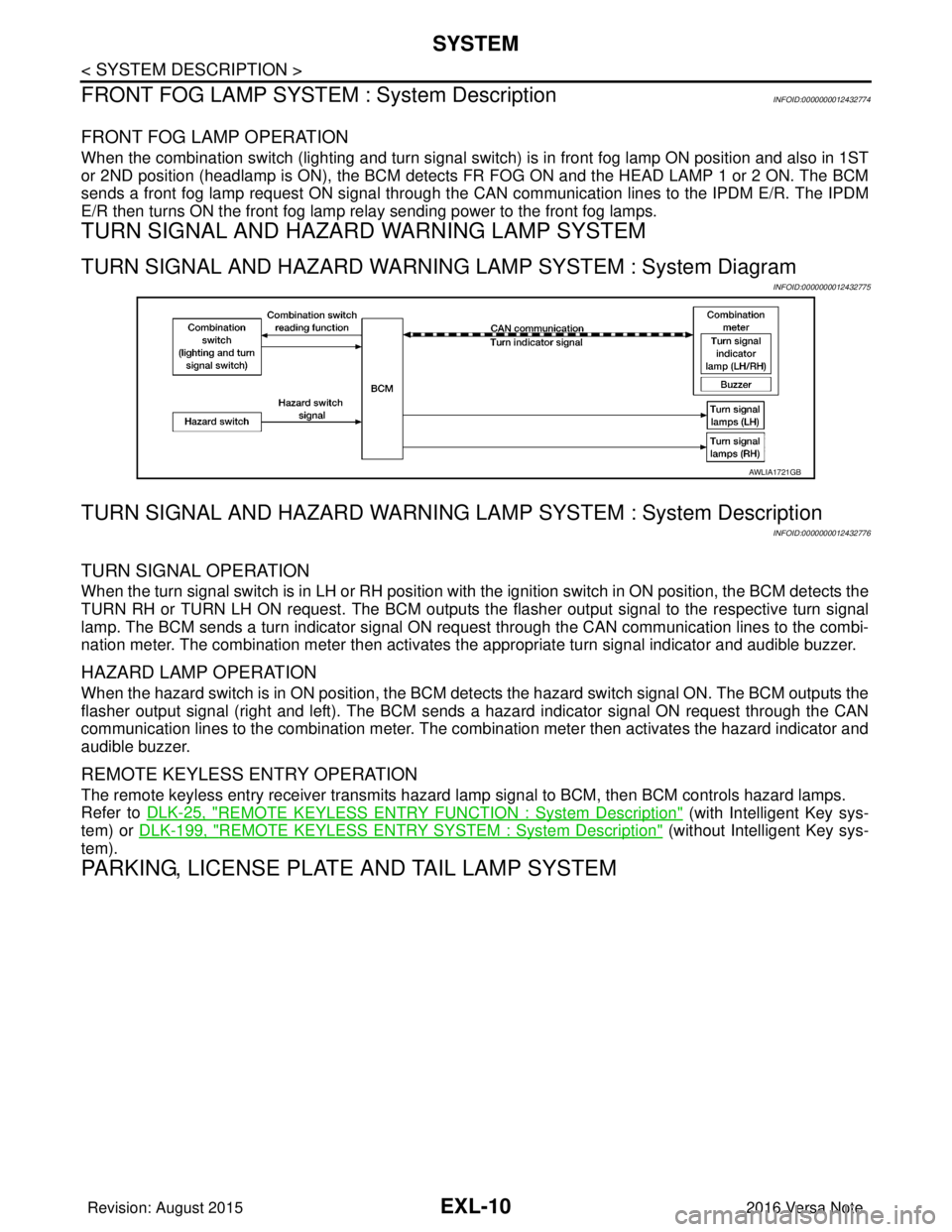
TURN SIGNAL AND HAZARD WARNING LAMP SYSTEM : System Diagram
INFOID:0000000012432775
TURN SIGNAL AND HAZARD WARNING LA MP SYSTEM : System Description
INFOID:0000000012432776
TURN SIGNAL OPERATION
When the turn signal switch is in LH or RH position with the ignition switch in ON position, the BCM detects the
TURN RH or TURN LH ON request. The BCM outputs the flasher output signal to the respective turn signal
lamp. The BCM sends a turn indicator signal ON request through the CAN communication lines to the combi-
nation meter. The combination meter then activates the appropriate turn signal indicator and audible buzzer.
HAZARD LAMP OPERATION
When the hazard switch is in ON position, the BCM det ects the hazard switch signal ON. The BCM outputs the
flasher output signal (right and left). The BCM sends a hazard indicator signal ON request through the CAN
communication lines to the combination meter. The combination meter then activates the hazard indicator and
audible buzzer.
REMOTE KEYLESS ENTRY OPERATION
The remote keyless entry receiver transmits hazard lamp signal to BCM, then BCM controls hazard lamps.
Refer to DLK-25, "
REMOTE KEYLESS ENTRY FUNCTION : System Description" (with Intelligent Key sys-
tem) or DLK-199, "
REMOTE KEYLESS ENTRY SYSTEM : System Description" (without Intelligent Key sys-
tem).
PARKING, LICENSE PLATE AND TAIL LAMP SYSTEM
AWLIA1721GB
Revision: August 2015 2016 Versa Note
cardiagn.com
Page 1663 of 3641
SYSTEMEXL-11
< SYSTEM DESCRIPTION >
C
DE
F
G H
I
J
K
M A
B
EXL
N
O P
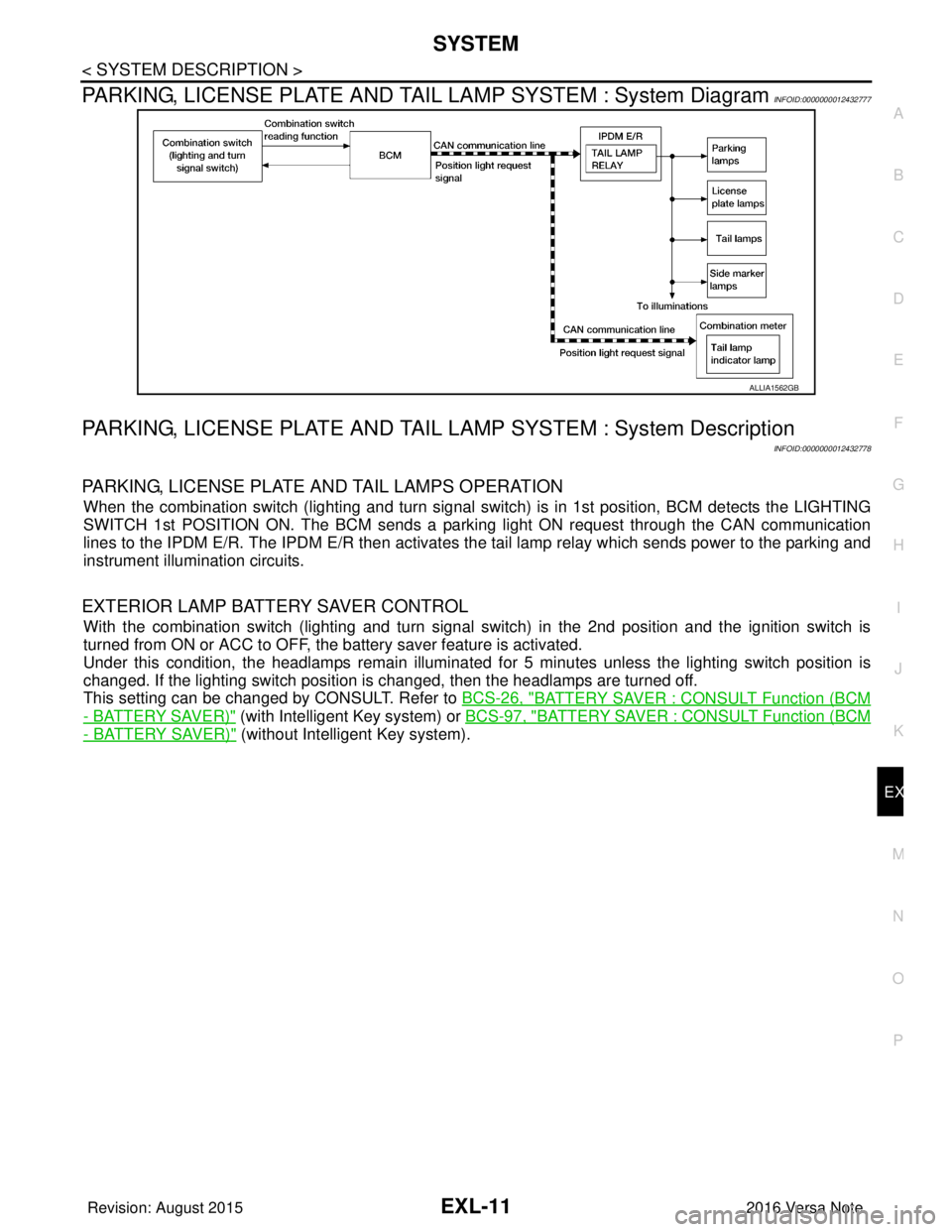
PARKING, LICENSE PLATE AND TAIL LAMP SYSTEM : System DiagramINFOID:0000000012432777
PARKING, LICENSE PLATE AND TAIL LA MP SYSTEM : System Description
INFOID:0000000012432778
PARKING, LICENSE PLATE AND TAIL LAMPS OPERATION
When the combination switch (lighting and turn signal s witch) is in 1st position, BCM detects the LIGHTING
SWITCH 1st POSITION ON. The BCM sends a parking light ON request through the CAN communication
lines to the IPDM E/R. The IPDM E/R then activates the tail lamp relay which sends power to the parking and
instrument illumination circuits.
EXTERIOR LAMP BATTERY SAVER CONTROL
With the combination switch (lighting and turn signal switch) in the 2nd position and the ignition switch is
turned from ON or ACC to OFF, the battery saver feature is activated.
Under this condition, the headlamps remain illuminated for 5 minutes unless the lighting switch position is
changed. If the lighting switch position is changed, then the headlamps are turned off.
This setting can be changed by CONSULT. Refer to BCS-26, "
BATTERY SAVER : CONSULT Function (BCM
- BATTERY SAVER)" (with Intelligent Key system) or BCS-97, "BATTERY SAVER : CONSULT Function (BCM
- BATTERY SAVER)" (without Intelligent Key system).
ALLIA1562GB
Revision: August 2015 2016 Versa Note
cardiagn.com
Page 1730 of 3641
EXL-78
< DTC/CIRCUIT DIAGNOSIS >
HEADLAMP (HI) CIRCUIT
Is the inspection result normal?
YES >> GO TO 5.
NO >> GO TO 4.
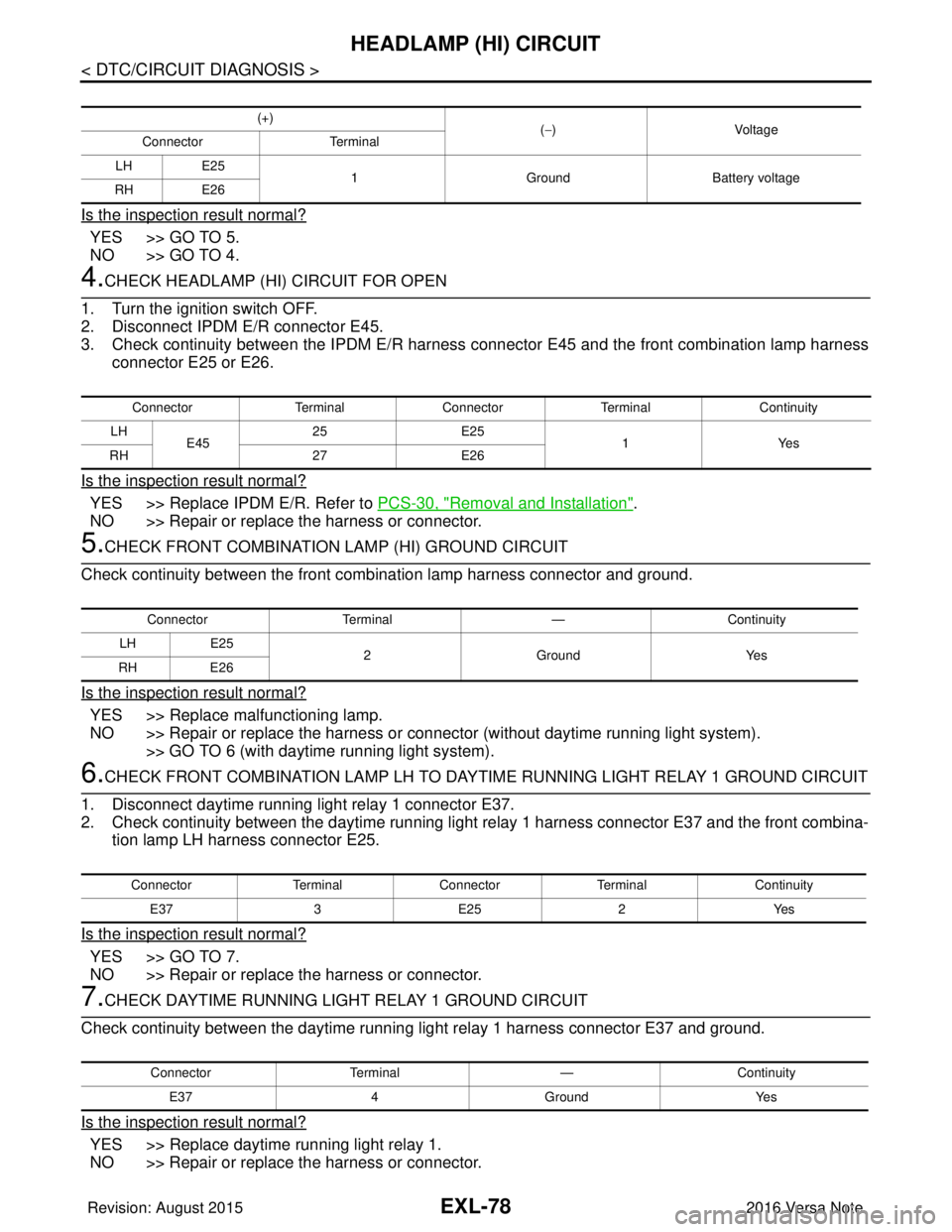
4.CHECK HEADLAMP (HI) CIRCUIT FOR OPEN
1. Turn the ignition switch OFF.
2. Disconnect IPDM E/R connector E45.
3. Check continuity between the IPDM E/R harness connector E45 and the front combination lamp harness connector E25 or E26.
Is the inspection result normal?
YES >> Replace IPDM E/R. Refer to PCS-30, "Removal and Installation".
NO >> Repair or replace the harness or connector.
5.CHECK FRONT COMBINATION LAMP (HI) GROUND CIRCUIT
Check continuity between the front combination lamp harness connector and ground.
Is the inspection result normal?
YES >> Replace malfunctioning lamp.
NO >> Repair or replace the harness or c onnector (without daytime running light system).
>> GO TO 6 (with daytime running light system).
6.CHECK FRONT COMBINATION LAMP LH TO DA YTIME RUNNING LIGHT RELAY 1 GROUND CIRCUIT
1. Disconnect daytime running light relay 1 connector E37.
2. Check continuity between the daytime running light relay 1 harness connector E37 and the front combina- tion lamp LH harness connector E25.
Is the inspection result normal?
YES >> GO TO 7.
NO >> Repair or replace the harness or connector.
7.CHECK DAYTIME RUNNING LIGHT RELAY 1 GROUND CIRCUIT
Check continuity between the daytime running light relay 1 harness connector E37 and ground.
Is the inspection result normal?
YES >> Replace daytime running light relay 1.
NO >> Repair or replace the harness or connector.
(+) (−)Voltage
Connector Terminal
LH E25
1 Ground Battery voltage
RH E26
Connector TerminalConnector Terminal Continuity
LH E45 25
E25
1Y es
RH 27E26
Connector Terminal —Continuity
LH E25
2G ro un dY es
RH E26
Connector TerminalConnector Terminal Continuity
E37 3E25 2Yes
Connector Terminal —Continuity
E37 4Ground Yes
Revision: August 2015 2016 Versa Note
cardiagn.com
Page 1731 of 3641
HEADLAMP (LO) CIRCUITEXL-79
< DTC/CIRCUIT DIAGNOSIS >
C
DE
F
G H
I
J
K
M A
B
EXL
N
O P
HEADLAMP (LO) CIRCUIT
DescriptionINFOID:0000000012432807
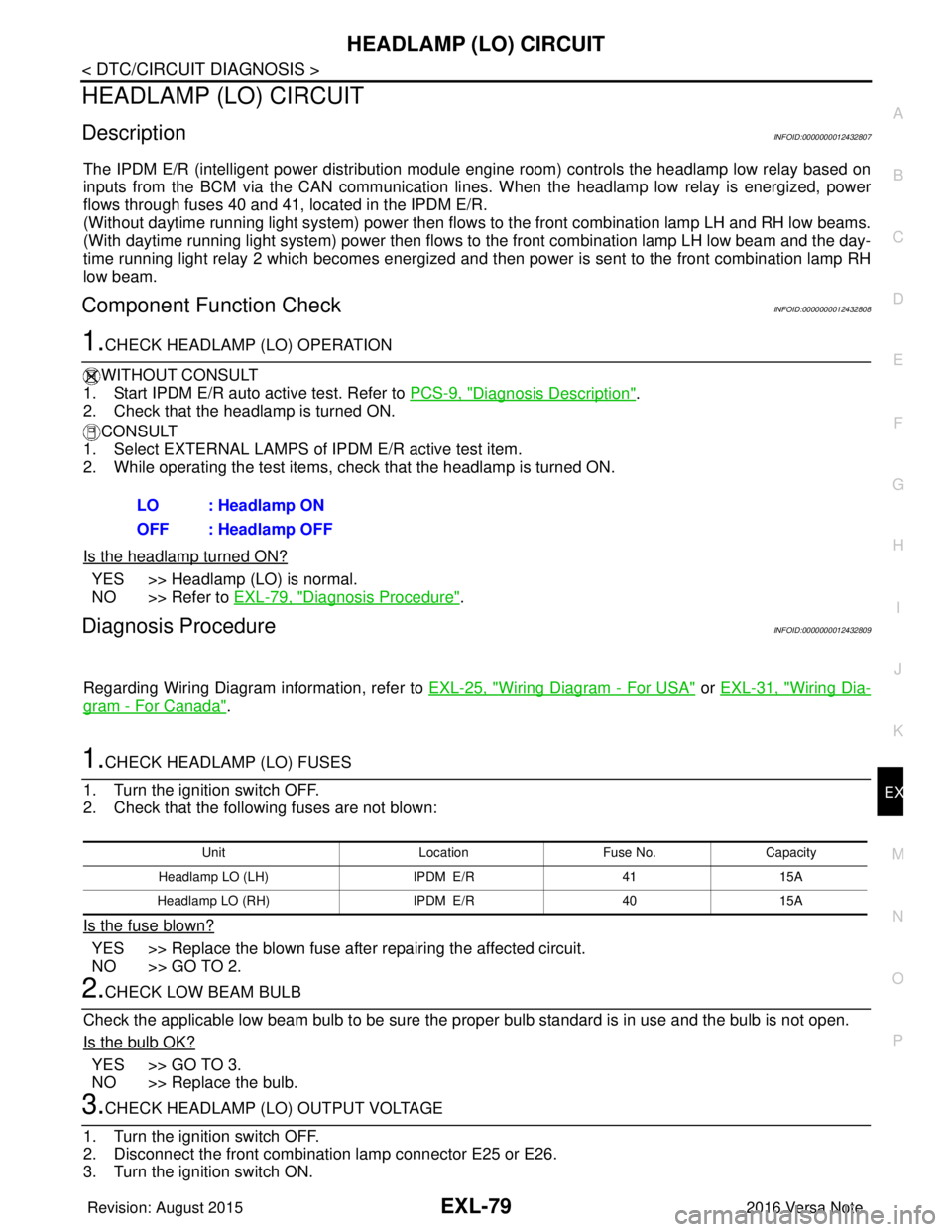
The IPDM E/R (intelligent power distribution modul e engine room) controls the headlamp low relay based on
inputs from the BCM via the CAN communication li nes. When the headlamp low relay is energized, power
flows through fuses 40 and 41, located in the IPDM E/R.
(Without daytime running light system) power then flow s to the front combination lamp LH and RH low beams.
(With daytime running light system) power then flows to the front combination lamp LH low beam and the day-
time running light relay 2 which becomes energized and t hen power is sent to the front combination lamp RH
low beam.
Component Function CheckINFOID:0000000012432808
1.CHECK HEADLAMP (LO) OPERATION
WITHOUT CONSULT
1. Start IPDM E/R auto active test. Refer to PCS-9, "
Diagnosis Description".
2. Check that the headlamp is turned ON.
CONSULT
1. Select EXTERNAL LAMPS of IP DM E/R active test item.
2. While operating the test items, check that the headlamp is turned ON.
Is the headlamp turned ON?
YES >> Headlamp (LO) is normal.
NO >> Refer to EXL-79, "
Diagnosis Procedure".
Diagnosis ProcedureINFOID:0000000012432809
Regarding Wiring Diagram information, refer to EXL-25, "Wiring Diagram - For USA" or EXL-31, "Wiring Dia-
gram - For Canada".
1.CHECK HEADLAMP (LO) FUSES
1. Turn the ignition switch OFF.
2. Check that the following fuses are not blown:
Is the fuse blown?
YES >> Replace the blown fuse after repairing the affected circuit.
NO >> GO TO 2.
2.CHECK LOW BEAM BULB
Check the applicable low beam bulb to be sure the proper bulb standard is in use and the bulb is not open.
Is the bulb OK?
YES >> GO TO 3.
NO >> Replace the bulb.
3.CHECK HEADLAMP (LO) OUTPUT VOLTAGE
1. Turn the ignition switch OFF.
2. Disconnect the front combination lamp connector E25 or E26.
3. Turn the ignition switch ON. LO : Headlamp ON
OFF : Headlamp OFF
Unit
LocationFuse No.Capacity
Headlamp LO (L H) IPDM E/R 4115A
Headlamp LO (RH) IPDM E/R4015A
Revision: August 2015 2016 Versa Note
cardiagn.com
Page 1732 of 3641
EXL-80
< DTC/CIRCUIT DIAGNOSIS >
HEADLAMP (LO) CIRCUIT
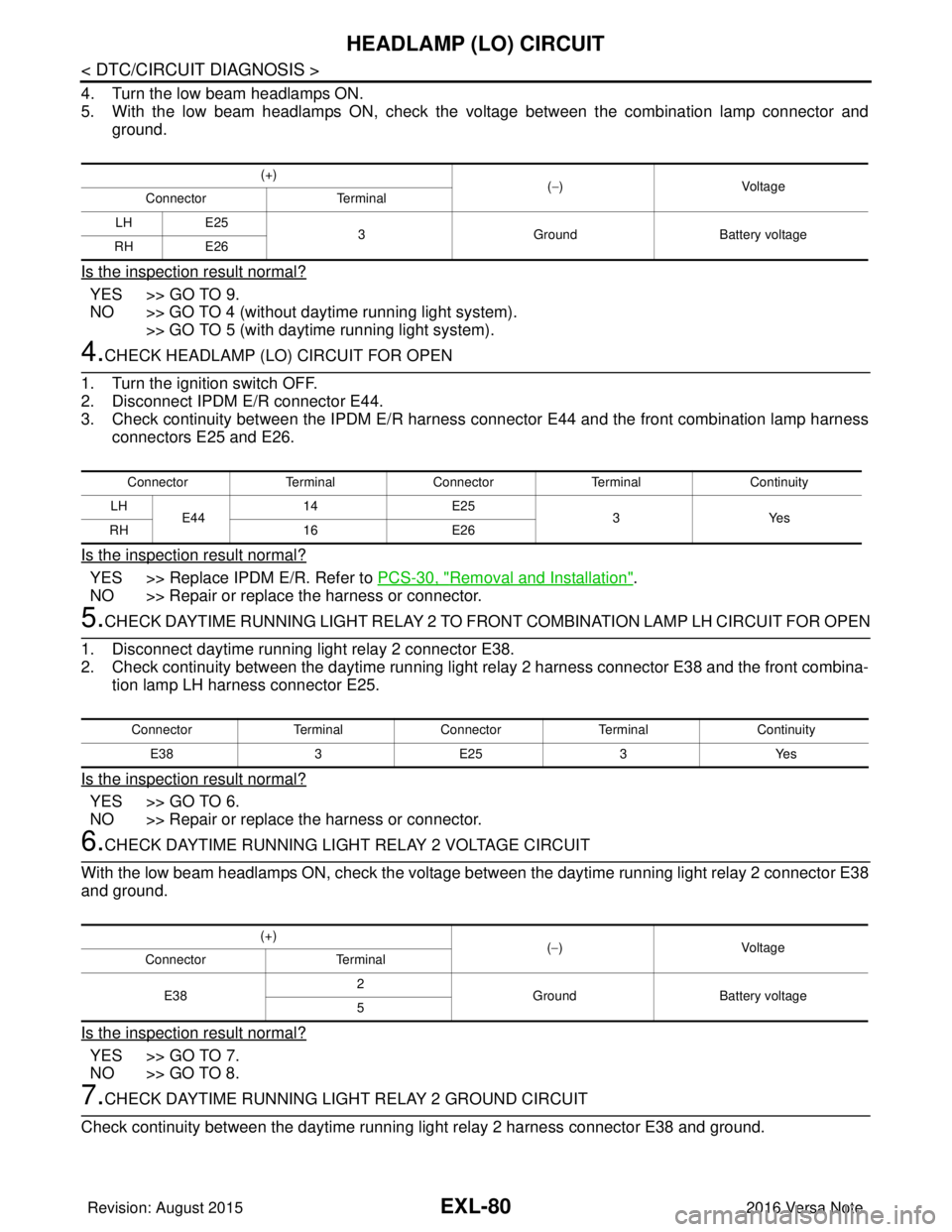
4. Turn the low beam headlamps ON.
5. With the low beam headlamps ON, check the voltage between the combination lamp connector andground.
Is the inspection result normal?
YES >> GO TO 9.
NO >> GO TO 4 (without daytime running light system). >> GO TO 5 (with daytime running light system).
4.CHECK HEADLAMP (LO) CIRCUIT FOR OPEN
1. Turn the ignition switch OFF.
2. Disconnect IPDM E/R connector E44.
3. Check continuity between the IPDM E/R harness connector E44 and the front combination lamp harness connectors E25 and E26.
Is the inspection result normal?
YES >> Replace IPDM E/R. Refer to PCS-30, "Removal and Installation".
NO >> Repair or replace the harness or connector.
5.CHECK DAYTIME RUNNING LIGHT RELAY 2 TO FR ONT COMBINATION LAMP LH CIRCUIT FOR OPEN
1. Disconnect daytime running light relay 2 connector E38.
2. Check continuity between the daytime running light relay 2 harness connector E38 and the front combina- tion lamp LH harness connector E25.
Is the inspection result normal?
YES >> GO TO 6.
NO >> Repair or replace the harness or connector.
6.CHECK DAYTIME RUNNING LIGHT RELAY 2 VOLTAGE CIRCUIT
With the low beam headlamps ON, check the voltage bet ween the daytime running light relay 2 connector E38
and ground.
Is the inspection result normal?
YES >> GO TO 7.
NO >> GO TO 8.
7.CHECK DAYTIME RUNNING LIGHT RELAY 2 GROUND CIRCUIT
Check continuity between the daytime running light relay 2 harness connector E38 and ground.
(+) (−)Voltage
Connector Terminal
LH E25 3 Ground Battery voltage
RH E26
Connector TerminalConnector Terminal Continuity
LH E44 14
E25
3Y es
RH 16E26
Connector TerminalConnector Terminal Continuity
E38 3E25 3Yes
(+)
(−)Voltage
Connector Terminal
E38 2
Ground Battery voltage
5
Revision: August 2015 2016 Versa Note
cardiagn.com
Page 1733 of 3641
HEADLAMP (LO) CIRCUITEXL-81
< DTC/CIRCUIT DIAGNOSIS >
C
DE
F
G H
I
J
K
M A
B
EXL
N
O P
Is the inspection result normal?
YES >> Replace daytime light relay 2.
NO >> Repair or replace the harness or connector.
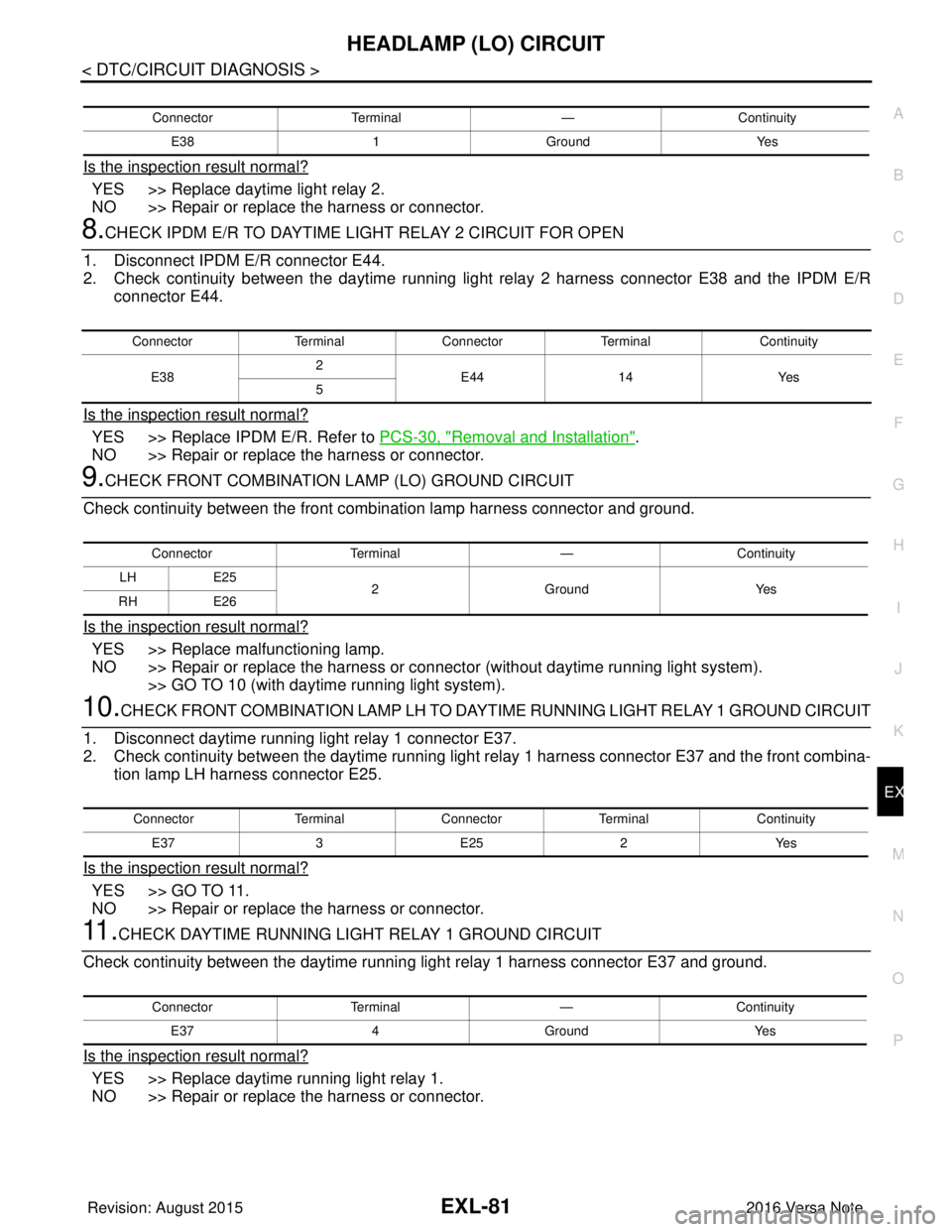
8.CHECK IPDM E/R TO DAYTIME LIGHT RELAY 2 CIRCUIT FOR OPEN
1. Disconnect IPDM E/R connector E44.
2. Check continuity between the daytime running li ght relay 2 harness connector E38 and the IPDM E/R
connector E44.
Is the inspection result normal?
YES >> Replace IPDM E/R. Refer to PCS-30, "Removal and Installation".
NO >> Repair or replace the harness or connector.
9.CHECK FRONT COMBINATION LAMP (LO) GROUND CIRCUIT
Check continuity between the front combination lamp harness connector and ground.
Is the inspection result normal?
YES >> Replace malfunctioning lamp.
NO >> Repair or replace the harness or connec tor (without daytime running light system).
>> GO TO 10 (with daytime running light system).
10.CHECK FRONT COMBINATION LAMP LH TO DA YTIME RUNNING LIGHT RELAY 1 GROUND CIRCUIT
1. Disconnect daytime running light relay 1 connector E37.
2. Check continuity between the daytime running light relay 1 harness connector E37 and the front combina-
tion lamp LH harness connector E25.
Is the inspection result normal?
YES >> GO TO 11.
NO >> Repair or replace the harness or connector.
11 .CHECK DAYTIME RUNNING LIGHT RELAY 1 GROUND CIRCUIT
Check continuity between the daytime running light relay 1 harness connector E37 and ground.
Is the inspection result normal?
YES >> Replace daytime running light relay 1.
NO >> Repair or replace the harness or connector.
Connector Terminal —Continuity
E38 1Ground Yes
ConnectorTerminalConnector Terminal Continuity
E38 2
E44 14 Yes
5
Connector Terminal —Continuity
LH E25
2 Ground Yes
RH E26
Connector TerminalConnector Terminal Continuity
E37 3E25 2Yes
Connector Terminal —Continuity
E37 4Ground Yes
Revision: August 2015 2016 Versa Note
cardiagn.com
Page 1743 of 3641
EXTERIOR LIGHTING SYSTEM SYMPTOMSEXL-91
< SYMPTOM DIAGNOSIS >
C
DE
F
G H
I
J
K
M A
B
EXL
N
O P
SYMPTOM DIAGNOSIS
EXTERIOR LIGHTING SYSTEM SYMPTOMS
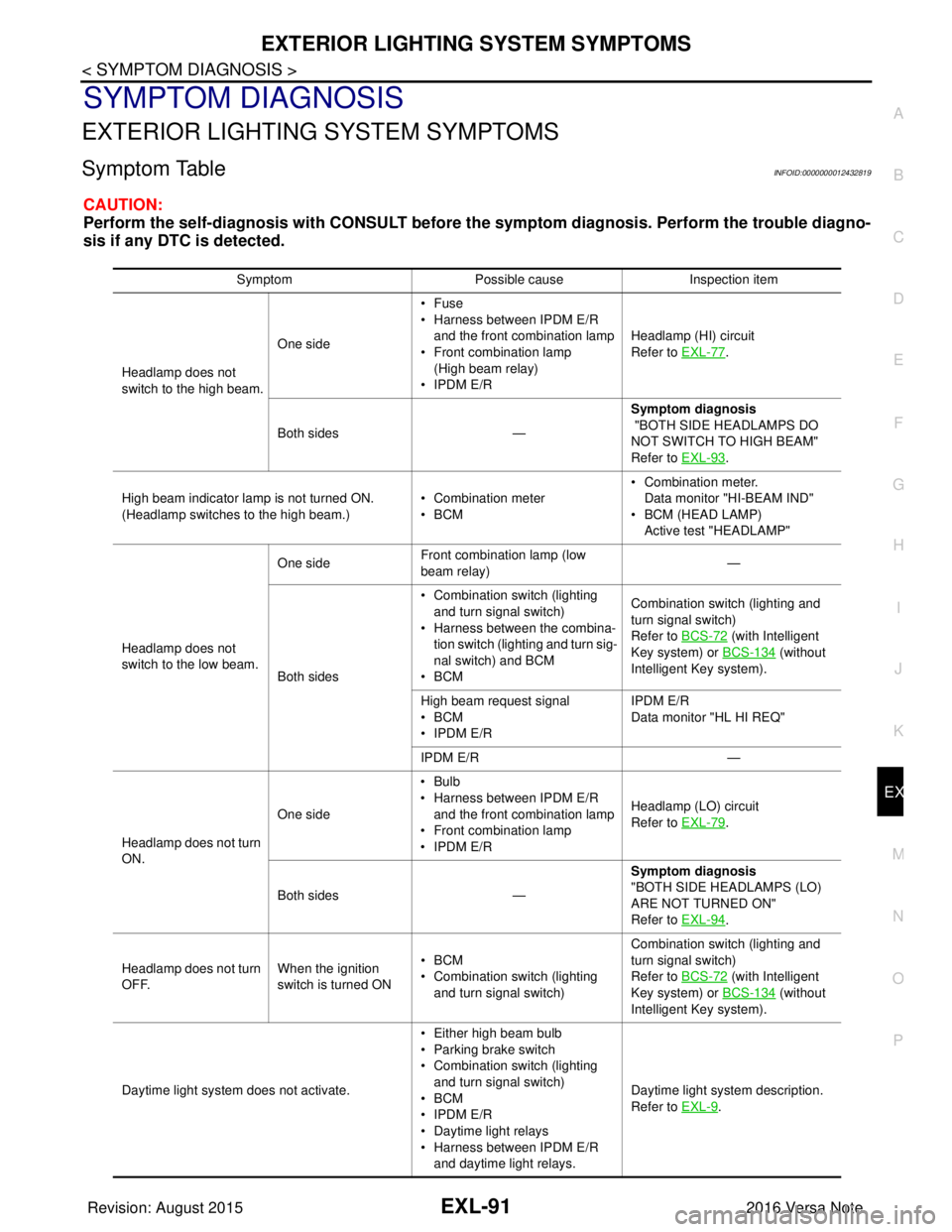
Symptom TableINFOID:0000000012432819
CAUTION:
Perform the self-diagnosis with CONSULT before th e symptom diagnosis. Perform the trouble diagno-
sis if any DTC is detected.
Symptom Possible causeInspection item
Headlamp does not
switch to the high beam. One side
•Fuse
• Harness between IPDM E/R
and the front combination lamp
• Front combination lamp
(High beam relay)
• IPDM E/R Headlamp (HI) circuit
Refer to EXL-77
.
Both sides — Symptom diagnosis
"BOTH SIDE HEADLAMPS DO
NOT SWITCH TO HIGH BEAM"
Refer to EXL-93
.
High beam indicator lamp is not turned ON.
(Headlamp switches to the high beam.) • Combination meter
•BCM• Combination meter.
Data monitor "HI-BEAM IND"
• BCM (HEAD LAMP)
Active test "HEADLAMP"
Headlamp does not
switch to the low beam. One side
Front combination lamp (low
beam relay) —
Both sides • Combination switch (lighting
and turn signal switch)
• Harness between the combina- tion switch (lighting and turn sig-
nal switch) and BCM
•BCM Combination switch (lighting and
turn signal switch)
Refer to BCS-72
(with Intelligent
Key system) or BCS-134
(without
Intelligent Key system).
High beam request signal
•BCM
• IPDM E/R IPDM E/R
Data monitor "HL HI REQ"
IPDM E/R —
Headlamp does not turn
ON. One side
•Bulb
• Harness between IPDM E/R
and the front combination lamp
• Front combination lamp
• IPDM E/R Headlamp (LO) circuit
Refer to EXL-79
.
Both sides — Symptom diagnosis
"BOTH SIDE HEADLAMPS (LO)
ARE NOT TURNED ON"
Refer to EXL-94
.
Headlamp does not turn
OFF. When the ignition
switch is turned ON•BCM
• Combination switch (lighting
and turn signal switch) Combination switch (lighting and
turn signal switch)
Refer to BCS-72
(with Intelligent
Key system) or BCS-134
(without
Intelligent Key system).
Daytime light system does not activate. • Either high beam bulb
• Parking brake switch
• Combination switch (lighting
and turn signal switch)
•BCM
• IPDM E/R
• Daytime light relays
• Harness between IPDM E/R
and daytime light relays. Daytime light system description.
Refer to EXL-9
.
Revision: August 2015
2016 Versa Note
cardiagn.com
Page 1745 of 3641
BOTH SIDE HEADLAMPS DO NOT SWITCH TO HIGH BEAM
EXL-93
< SYMPTOM DIAGNOSIS >
C
D E
F
G H
I
J
K
M A
B
EXL
N
O P
BOTH SIDE HEADLAMPS DO NOT SWITCH TO HIGH BEAM
DescriptionINFOID:0000000012432820
The headlamps (both sides) do not switch to high beam when the combination switch (lighting and turn signal
switch) is in the HI or PASS setting.
Diagnosis ProcedureINFOID:0000000012432821
1.COMBINATION SWITCH (LIGHTING AND TURN SIGNAL SWITCH) INSPECTION
Check the combination switch (lighti ng and turn signal switch). Refer to BCS-72, "
Symptom Table" (with Intel-
ligent Key system) or BCS-134, "
Symptom Table" (without Intelligent Key system).
Is the combination switch (lighting and turn signal switch) normal?
YES >> GO TO 2.
NO >> Repair or replace the malfunctioning part.
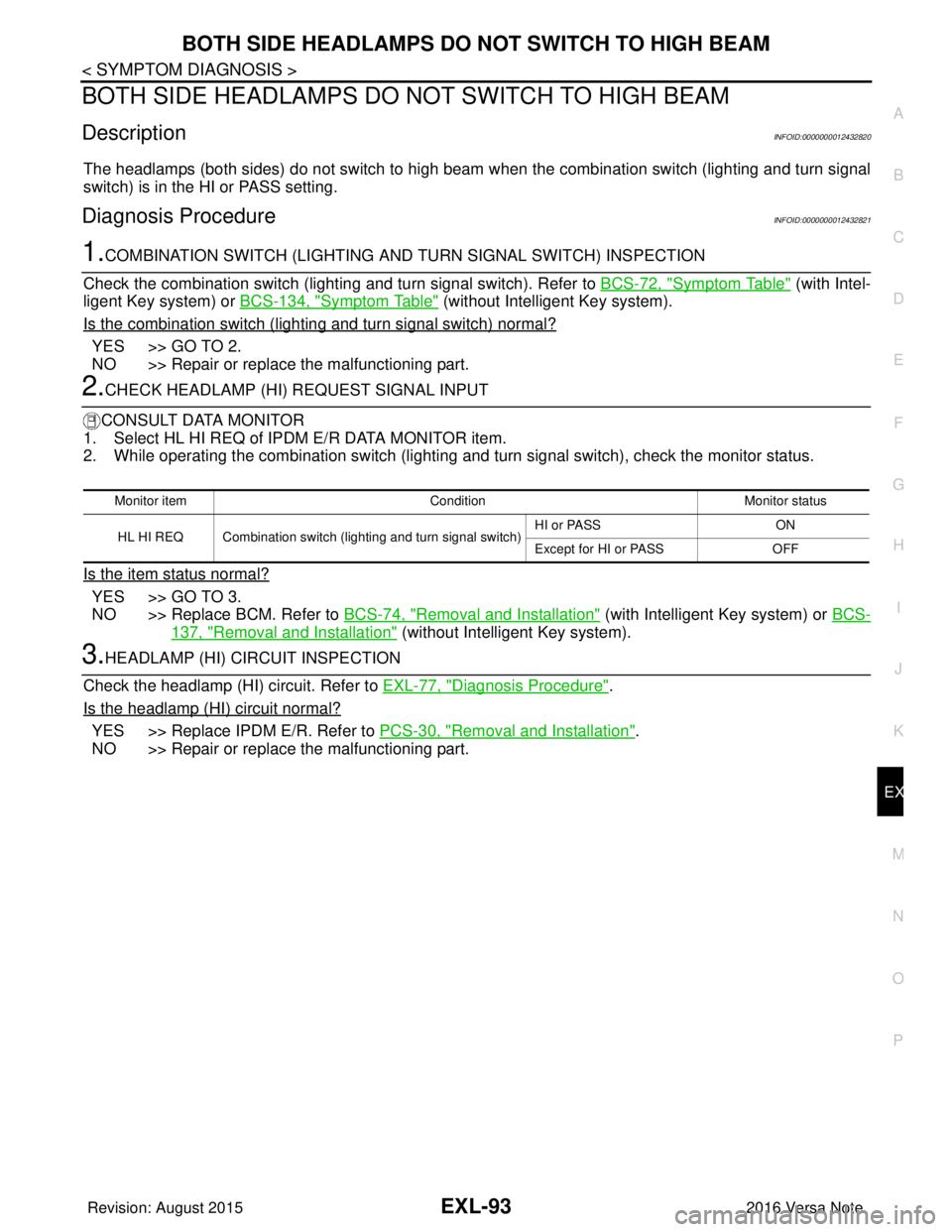
2.CHECK HEADLAMP (HI) REQUEST SIGNAL INPUT
CONSULT DATA MONITOR
1. Select HL HI REQ of IP DM E/R DATA MONITOR item.
2. While operating the combination switch (lighting and turn signal switch), check the monitor status.
Is the item status normal?
YES >> GO TO 3.
NO >> Replace BCM. Refer to BCS-74, "
Removal and Installation" (with Intelligent Key system) or BCS-
137, "Removal and Installation" (without Intelligent Key system).
3.HEADLAMP (HI) CIRCUIT INSPECTION
Check the headlamp (HI) circuit. Refer to EXL-77, "
Diagnosis Procedure".
Is the headlamp (HI) circuit normal?
YES >> Replace IPDM E/R. Refer to PCS-30, "Removal and Installation".
NO >> Repair or replace the malfunctioning part.
Monitor item ConditionMonitor status
HL HI REQ Combination switch (lighting and turn signal switch) HI or PASS
ON
Except for HI or PASS OFF
Revision: August 2015 2016 Versa Note
cardiagn.com
Page 1746 of 3641
EXL-94
< SYMPTOM DIAGNOSIS >
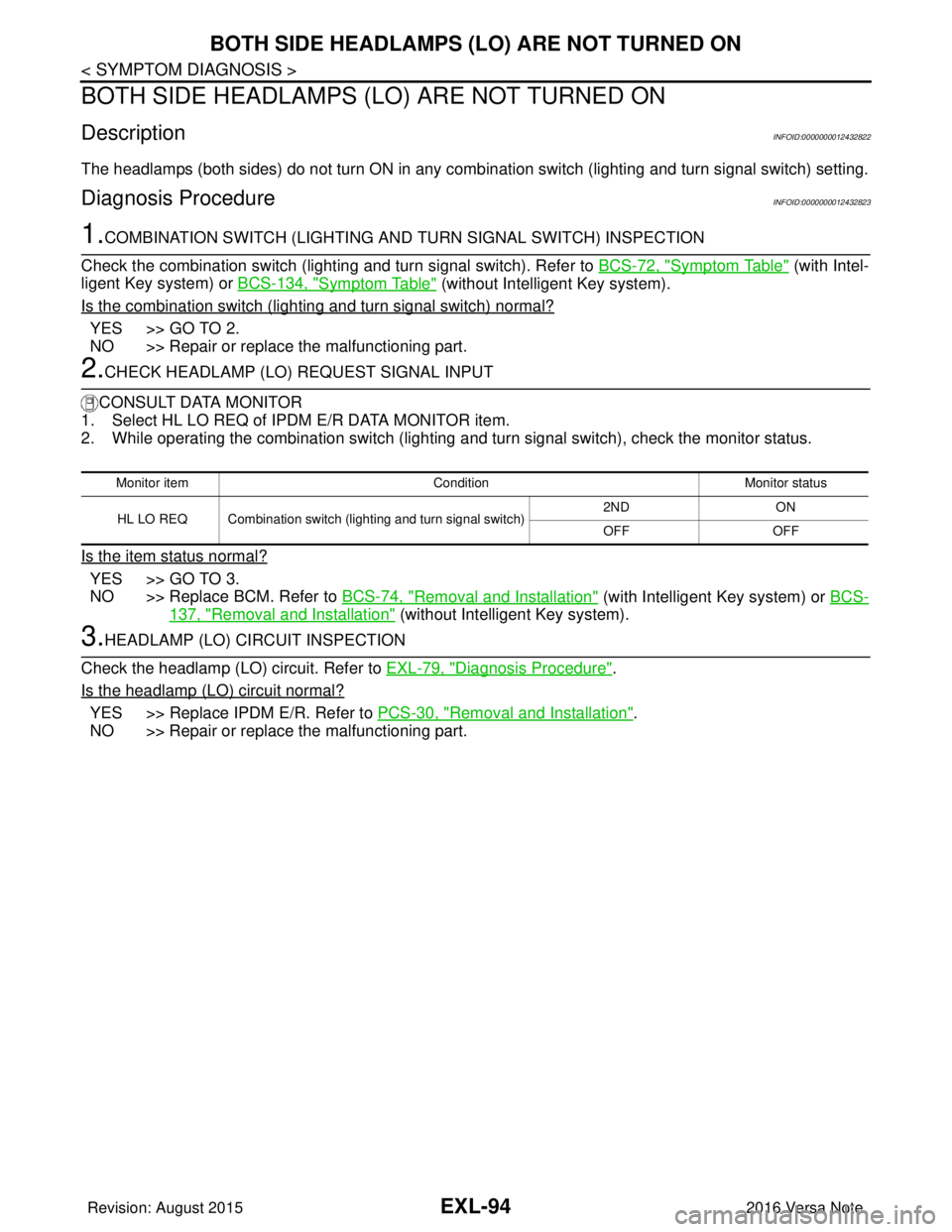
BOTH SIDE HEADLAMPS (LO) ARE NOT TURNED ON
BOTH SIDE HEADLAMPS (LO) ARE NOT TURNED ON
DescriptionINFOID:0000000012432822
The headlamps (both sides) do not turn ON in any combination switch (lighting and turn signal switch) setting.
Diagnosis ProcedureINFOID:0000000012432823
1.COMBINATION SWITCH (LIGHTING AND TURN SIGNAL SWITCH) INSPECTION
Check the combination switch (lighting and turn signal switch). Refer to BCS-72, "
Symptom Table" (with Intel-
ligent Key system) or BCS-134, "
Symptom Table" (without Intelligent Key system).
Is the combination switch (lighting and turn signal switch) normal?
YES >> GO TO 2.
NO >> Repair or replace the malfunctioning part.
2.CHECK HEADLAMP (LO) REQUEST SIGNAL INPUT
CONSULT DATA MONITOR
1. Select HL LO REQ of IPDM E/R DATA MONITOR item.
2. While operating the combination switch (lighting and turn signal switch), check the monitor status.
Is the item status normal?
YES >> GO TO 3.
NO >> Replace BCM. Refer to BCS-74, "
Removal and Installation" (with Intelligent Key system) or BCS-
137, "Removal and Installation" (without Intelligent Key system).
3.HEADLAMP (LO) CIRCUIT INSPECTION
Check the headlamp (LO) circuit. Refer to EXL-79, "
Diagnosis Procedure".
Is the headlamp (LO) circuit normal?
YES >> Replace IPDM E/R. Refer to PCS-30, "Removal and Installation".
NO >> Repair or replace the malfunctioning part.
Monitor item ConditionMonitor status
HL LO REQ Combination switch (lighting and turn signal switch) 2ND
ON
OFF OFF
Revision: August 2015 2016 Versa Note
cardiagn.com
Page 1786 of 3641
SQUEAK AND RATTLE TROUBLE DIAGNOSESEXT-19
< SYMPTOM DIAGNOSIS >
C
DE
F
G H
I
J
L
M A
B
EXT
N
O P
INSTRUMENT PANEL
Most incidents are caused by contact and movement between:
1. Cluster lid A and the instrument panel
2. Acrylic lens and combination meter housing
3. Instrument panel to front pillar finisher
4. Instrument panel to windshield
5. Instrument panel pins
6. Wiring harnesses behind the combination meter
7. A/C defroster duct and duct joint
These incidents can usually be located by tapping or moving the components to duplicate the noise or by
pressing on the components while driving to stop the noi se. Most of these incidents can be repaired by apply-
ing felt cloth tape or silicone spray (in hard to reach areas). Urethane pads can be used to insulate wiring har-
ness.
CAUTION:
Do not use silicone spray to isolate a squeak or ra ttle. If you saturate the area with silicone, you will
not be able to recheck the repair.
CENTER CONSOLE
Components to pay attention to include:
1. Shift selector assembly cover to finisher
2. A/C control unit and cluster lid C
3. Wiring harnesses behind audio and A/C control unit
The instrument panel repair and isolation pr ocedures also apply to the center console.
DOORS
Pay attention to the:
1. Finisher and inner panel making a slapping noise
2. Inside handle escutcheon to door finisher
3. Wiring harnesses tapping
4. Door striker out of alignment causing a popping noise on starts and stops
Tapping or moving the components or pressing on them while driving to duplicate the conditions can isolate
many of these incidents. You can usually insulate the ar eas with felt cloth tape or insulator foam blocks from
the NISSAN Squeak and Rattle Kit (J-50397) to repair the noise.
TRUNK
Trunk noises are often caused by a loose jack or loose items put into the trunk by the owner.
In addition look for:
1. Trunk lid bumpers out of adjustment
2. Trunk lid striker out of adjustment
3. The trunk lid torsion bars knocking together
4. A loose license plate or bracket
Most of these incidents can be repaired by adjusting, se curing or insulating the item(s) or component(s) caus-
ing the noise.
SUNROOF/HEADLINING
Noises in the sunroof/headlining area can often be traced to one of the following:
1. Sunroof lid, rail, linkage or seals making a rattle or light knocking noise
2. Sun visor shaft shaking in the holder
3. Front or rear windshield touching headlining and squeaking
Again, pressing on the components to stop the noise while duplicating the conditions can isolate most of these
incidents. Repairs usually consist of insulating with felt cloth tape.
OVERHEAD CONSOLE (FRONT AND REAR)
Overhead console noises are often caused by the cons ole panel clips not being engaged correctly. Most of
these incidents are repaired by pushing up on the c onsole at the clip locations until the clips engage.
In addition look for:
Revision: August 2015 2016 Versa Note
cardiagn.com