heating NISSAN NOTE 2016 Service Owner's Manual
[x] Cancel search | Manufacturer: NISSAN, Model Year: 2016, Model line: NOTE, Model: NISSAN NOTE 2016Pages: 3641, PDF Size: 28.72 MB
Page 1611 of 3641
![NISSAN NOTE 2016 Service Owners Manual CO-6
< SYMPTOM DIAGNOSIS >[HR16DE]
OVERHEATING CAUSE ANALYSIS
SYMPTOM DIAGNOSIS
OVERHEATING CAUSE ANALYSIS
Troubleshooting ChartINFOID:0000000012432132
Symptom
Check items
Cooling sys-
tem parts
malf](/img/5/57363/w960_57363-1610.png "NISSAN NOTE 2016 Service Owners Manual CO-6
< SYMPTOM DIAGNOSIS >[HR16DE]
OVERHEATING CAUSE ANALYSIS
SYMPTOM DIAGNOSIS
OVERHEATING CAUSE ANALYSIS
Troubleshooting ChartINFOID:0000000012432132
Symptom
Check items
Cooling sys-
tem parts
malf")
CO-6
< SYMPTOM DIAGNOSIS >[HR16DE]
OVERHEATING CAUSE ANALYSIS
SYMPTOM DIAGNOSIS
OVERHEATING CAUSE ANALYSIS
Troubleshooting ChartINFOID:0000000012432132
Symptom
Check items
Cooling sys-
tem parts
malfunction Poor heat transfer
Water pump malfunction Worn or loose drive belt
—
Thermostat stuck closed Thermostat
Damaged fins
Dust contamination or pa-
per clogging
Physical damage
Clogged radiator cooling
tube Excess foreign material
(rust, dirt, sand, etc.)
Reduced air flow Cooling fan does not oper-
ate
Fan assembly —
High resistance to fan rota-
tion
Damaged fan blades
Damaged radiator shroud —Radiator shroud —
Improper engine coolant
mixture ratio —
Engine coolant viscosity —
Poor engine coolant quality —Periodic maintenance —
Insufficient engine coolant Engine coolant leaksCooling hose
Loose clamp
Cracked hose
Water pump Poor sealing
Radiator cap Loose
Poor sealing
Radiator O-ring for da
mage, deterio-
ration or improper fitting
Cracked radiator tank
Cracked radiator core
Reservoir tank Cracked reservoir tank
Overflowing reservoir tank Exhaust gas leaking into
cooling system Cylinder head deterioration
Cylinder head gasket deteri-
oration
Revision: August 2015
2016 Versa Note
cardiagn.com
Page 1612 of 3641
![NISSAN NOTE 2016 Service Owners Manual OVERHEATING CAUSE ANALYSISCO-7
< SYMPTOM DIAGNOSIS > [HR16DE]
C
D
E
F
G H
I
J
K L
M A
CO
NP
O
Except cool-
ing system
parts mal-
function —
Overload on engine Abusive driving
High engine rpm under](/img/5/57363/w960_57363-1611.png "NISSAN NOTE 2016 Service Owners Manual OVERHEATING CAUSE ANALYSISCO-7
< SYMPTOM DIAGNOSIS > [HR16DE]
C
D
E
F
G H
I
J
K L
M A
CO
NP
O
Except cool-
ing system
parts mal-
function —
Overload on engine Abusive driving
High engine rpm under")
OVERHEATING CAUSE ANALYSISCO-7
< SYMPTOM DIAGNOSIS > [HR16DE]
C
D
E
F
G H
I
J
K L
M A
CO
NP
O
Except cool-
ing system
parts mal-
function —
Overload on engine Abusive driving
High engine rpm under no
load
Driving in low gear for ex-
tended time
Driving at extremely high
speed
Power train system mal-
function
—
Installed improper size
wheels and tires
Dragging brakes
Improper ignition timing
Blocked or restricted air
flow Blocked bumper
Installed front bumper fas-
cia cover
—
Blocked radiator grille Mud contamination or paper
clogging
Blocked radiator Blocked air flow
Blocked condenser
Installed large fog lamp
Symptom
Check items
Revision: August 2015 2016 Versa Note
cardiagn.com
Page 1626 of 3641
![NISSAN NOTE 2016 Service Owners Manual THERMOSTATCO-21
< REMOVAL AND INSTALLATION > [HR16DE]
C
D
E
F
G H
I
J
K L
M A
CO
NP
O
• Place a thread (A) so that it is caught in the valves of thermostat
(1). Immerse fully in a container (B) fill](/img/5/57363/w960_57363-1625.png "NISSAN NOTE 2016 Service Owners Manual THERMOSTATCO-21
< REMOVAL AND INSTALLATION > [HR16DE]
C
D
E
F
G H
I
J
K L
M A
CO
NP
O
• Place a thread (A) so that it is caught in the valves of thermostat
(1). Immerse fully in a container (B) fill")
THERMOSTATCO-21
< REMOVAL AND INSTALLATION > [HR16DE]
C
D
E
F
G H
I
J
K L
M A
CO
NP
O
• Place a thread (A) so that it is caught in the valves of thermostat
(1). Immerse fully in a container (B) filled with water. Heat while
stirring.
• The valve opening temperature is the temperature at which the valve opens and falls from the thread.
• Continue heating. Check the full open valve lift amount.
• After checking the maximum valve lift amount, lower the water
temperature and check the valve closing temperature.
• If out of the standard specificati on range, replace the thermostat.
INSTALLATION
Installation is in the reverse order of removal.
Thermostat
• Install thermostat making sure rubber ring (1) groove fits securely
to thermostat flange (A).
CAUTION:
Do not reuse rubber ring.
• Install thermostat (2) into the cylinder block (1) with jiggle valve (A) facing upward.
Water Inlet
After installation, attach the water inlet clip (A) on the oil level gauge
guide (1) positioned at location (B) as shown.
INSPECTION AFTER INSTALLATION
• Before starting engine, check oil/fluid levels, includi ng engine coolant and engine oil. If less than required
quantity, fill to the specified level. Refer to MA-11, "
Fluids and Lubricants".
• Use procedure below to check for fuel leaks.
• Turn ignition switch ON (with engine stopped). With fuel pressure applied to fuel piping, check for fuel leaks at connection points.
• Start engine. With engine speed increased, check again for fuel leaks at connection points. Standard : Refer to
CO-25, "
Standard and Limit".
PBIC3314J
JPBIA4229ZZ
PBIC3812E
PBIC3755E
Revision: August 2015 2016 Versa Note
cardiagn.com
Page 1632 of 3641
![NISSAN NOTE 2016 Service Owners Manual LU-2
< PRECAUTION >[HR16DE]
PRECAUTIONS
PRECAUTION
PRECAUTIONS
Precaution for Supplemental Restraint Syst
em (SRS) "AIR BAG" and "SEAT BELT
PRE-TENSIONER"
INFOID:0000000012432194
The Supplemental Res](/img/5/57363/w960_57363-1631.png "NISSAN NOTE 2016 Service Owners Manual LU-2
< PRECAUTION >[HR16DE]
PRECAUTIONS
PRECAUTION
PRECAUTIONS
Precaution for Supplemental Restraint Syst
em (SRS) \"AIR BAG\" and \"SEAT BELT
PRE-TENSIONER\"
INFOID:0000000012432194
The Supplemental Res")
LU-2
< PRECAUTION >[HR16DE]
PRECAUTIONS
PRECAUTION
PRECAUTIONS
Precaution for Supplemental Restraint Syst
em (SRS) "AIR BAG" and "SEAT BELT
PRE-TENSIONER"
INFOID:0000000012432194
The Supplemental Restraint System such as “A IR BAG” and “SEAT BELT PRE-TENSIONER”, used along
with a front seat belt, helps to reduce the risk or severity of injury to the driver and front passenger for certain
types of collision. Information necessary to service the system safely is included in the SR and SB section of
this Service Manual.
WARNING:
• To avoid rendering the SRS inopera tive, which could increase the risk of personal injury or death in
the event of a collision which would result in air bag inflation, all maintenance must be performed by
an authorized NISSAN/INFINITI dealer.
• Improper maintenance, including in correct removal and installation of the SRS, can lead to personal
injury caused by unintent ional activation of the system. For re moval of Spiral Cable and Air Bag
Module, see the SR section.
• Do not use electrical test equipmen t on any circuit related to the SRS unless instructed to in this
Service Manual. SRS wiring harn esses can be identified by yellow and/or orange harnesses or har-
ness connectors.
PRECAUTIONS WHEN USING POWER TOOLS (AIR OR ELECTRIC) AND HAMMERS
WARNING:
• When working near the Airbag Diagnosis Sensor Unit or other Airbag System sensors with the Igni-
tion ON or engine running, DO NOT use air or electri c power tools or strike near the sensor(s) with a
hammer. Heavy vibration could activate the sensor( s) and deploy the air bag(s), possibly causing
serious injury.
• When using air or electric power tools or hammers , always switch the Ignition OFF, disconnect the
battery and wait at least three minutes before performing any service.
Liquid GasketINFOID:0000000012432195
REMOVAL OF LIQUID GASKET SEALING
• After removing the bolts and nuts, separate the mating surface and remove the liquid gasket using Tool (A).
• In areas where the cutter is difficult to use, use a plastic hammer to lightly tap (1) the cutter where the liquid gasket is applied. Use a
plastic hammer to slide (2) the cutter by tapping on the side.
CAUTION:
Do not damage the mating surfaces.
LIQUID GASKET APPLICATION PROCEDURE
1. Using suitable tool (A), remove old liquid gasket adhering to the liquid gasket application surface and the mating surface.
• Remove liquid gasket completely from the groove of the liquidgasket application surface, mounting bolts, and bolt holes.
2. Wipe the liquid gasket application surface and the mating sur- face with white gasoline (lighting and heating use) to remove
adhering moisture, grease and foreign materials.Tool number (A) : KV10111100 (J-37228)
AWBIA1249GB
JPBIA0053ZZ
Revision: August 2015
2016 Versa Note
cardiagn.com
Page 1931 of 3641
SERVICE INFORMATION FOR ELECTRICAL INCIDENTGI-43
< BASIC INSPECTION >
C
DE
F
G H
I
J
K L
M B
GI
N
O P
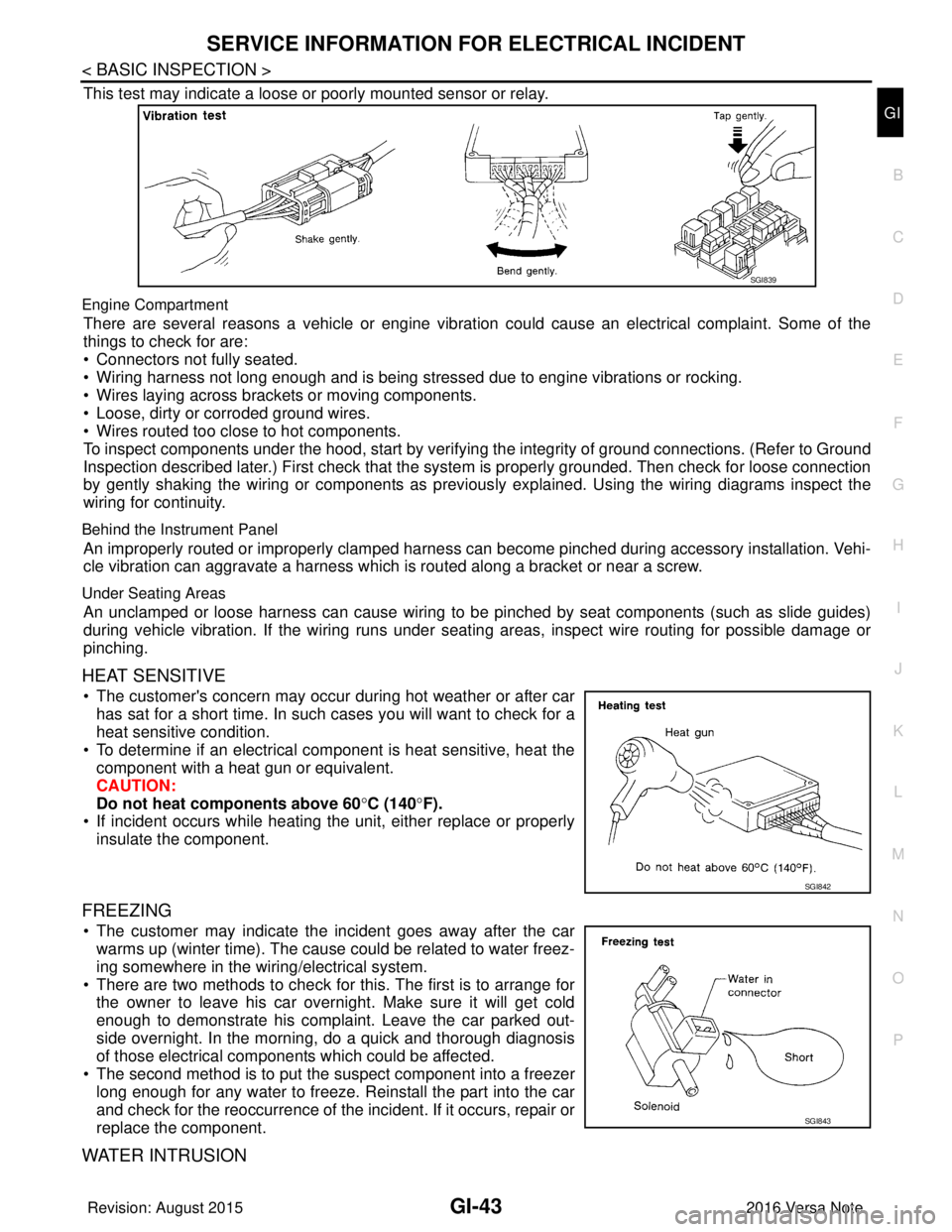
This test may indicate a loose or poorly mounted sensor or relay.
Engine Compartment
There are several reasons a vehicle or engine vibration could cause an electrical complaint. Some of the
things to check for are:
• Connectors not fully seated.
• Wiring harness not long enough and is being stressed due to engine vibrations or rocking.
• Wires laying across brackets or moving components.
• Loose, dirty or corroded ground wires.
• Wires routed too close to hot components.
To inspect components under the hood, start by verifyi ng the integrity of ground connections. (Refer to Ground
Inspection described later.) First check that the system is properly grounded. Then check for loose connection
by gently shaking the wiring or components as previous ly explained. Using the wiring diagrams inspect the
wiring for continuity.
Behind the Instrument Panel
An improperly routed or improperly clamped harness can become pinched during accessory installation. Vehi-
cle vibration can aggravate a harness which is routed along a bracket or near a screw.
Under Seating Areas
An unclamped or loose harness can cause wiring to be pinched by seat components (such as slide guides)
during vehicle vibration. If the wiring runs under s eating areas, inspect wire routing for possible damage or
pinching.
HEAT SENSITIVE
• The customer's concern may occur during hot weather or after car has sat for a short time. In such cases you will want to check for a
heat sensitive condition.
• To determine if an electrical component is heat sensitive, heat the component with a heat gun or equivalent.
CAUTION:
Do not heat components above 60 °C (140° F).
• If incident occurs while heating t he unit, either replace or properly
insulate the component.
FREEZING
• The customer may indicate the incident goes away after the car warms up (winter time). The cause could be related to water freez-
ing somewhere in the wiring/electrical system.
• There are two methods to check for this. The first is to arrange for the owner to leave his car overnight. Make sure it will get cold
enough to demonstrate his complaint. Leave the car parked out-
side overnight. In the morning, do a quick and thorough diagnosis
of those electrical components which could be affected.
• The second method is to put the suspect component into a freezer long enough for any water to freeze. Reinstall the part into the car
and check for the reoccurrence of the incident. If it occurs, repair or
replace the component.
WATER INTRUSION
SGI839
SGI842
SGI843
Revision: August 2015 2016 Versa Note
cardiagn.com
Page 1970 of 3641

HAC-2
Diagnosis Procedure ..............................................37
A/C INDICATOR ................................................39
Diagnosis Procedure ........................................... ...39
FRONT BLOWER MOTOR ................................41
Description ........................................................... ...41
Diagnosis Procedure ..............................................41
Component Inspection (Front Blower Motor) ..........43
Component Inspection (B lower Relay) ...................43
Component Inspection (Front Blower Motor Re-
sistor) ................................................................... ...
43
Component Inspection (Fan Switch) ......................43
MAGNET CLUTCH ............................................45
Description ........................................................... ...45
Component Function Check ...................................45
Diagnosis Procedure ..............................................45
SYMPTOM DIAGNOSIS .............................47
MANUAL AIR CONDITIONING SYSTEM ...... ...47
Symptom Table ................................................... ...47
INSUFFICIENT COOLING .................................48
Description ........................................................... ...48
Diagnosis Procedure ..............................................48
INSUFFICIENT HEATING .................................49
Description ........................................................... ...49
Diagnosis Procedure ..............................................49
COMPRESSOR DOES NOT OPERATE ...........50
Description ........................................................... ...50
Diagnosis Procedure ............................................ ...50
REMOVAL AND INSTALLATION ..............52
FRONT AIR CONTROL .................................. ...52
Exploded View ..................................................... ...52
Removal and Installation .........................................52
THERMO CONTROL AMPLIFIER ................. ...53
Removal and Installation .........................................53
REFRIGERANT PRESSURE SENSOR ......... ...54
Removal and Installation .........................................54
FRONT BLOWER MOTOR RESISTOR ......... ...55
Exploded View ..................................................... ...55
Removal and Installation .........................................55
DOOR CABLE ................................................ ...56
Exploded View ..................................................... ...56
INTAKE DOOR CABLE ......................................... ...56
INTAKE DOOR CABLE : Removal and Installation
...
56
INTAKE DOOR CABLE : Adjustment .................. ...56
MODE DOOR CABLE ............................................ ...57
MODE DOOR CABLE : Removal and Installation ...57
MODE DOOR CABLE : Adjustment ........................57
AIR MIX DOOR CABLE ......................................... ...57
AIR MIX DOOR CABLE : Removal and Installation
...
57
AIR MIX DOOR CABLE : Adjustment .................. ...57
Revision: August 2015 2016 Versa Note
cardiagn.com
Page 1978 of 3641
![NISSAN NOTE 2016 Service Owners Manual HAC-10
< SYSTEM DESCRIPTION >[MANUAL AIR CONDITIONING]
COMPONENT PARTS
A. LH side of instrument panel B. Behind center of instrument panel C. Center of instrument panel
No. Component Description
1. BC](/img/5/57363/w960_57363-1977.png "NISSAN NOTE 2016 Service Owners Manual HAC-10
< SYSTEM DESCRIPTION >[MANUAL AIR CONDITIONING]
COMPONENT PARTS
A. LH side of instrument panel B. Behind center of instrument panel C. Center of instrument panel
No. Component Description
1. BC")
HAC-10
< SYSTEM DESCRIPTION >[MANUAL AIR CONDITIONING]
COMPONENT PARTS
A. LH side of instrument panel B. Behind center of instrument panel C. Center of instrument panel
No. Component Description
1. BCM The BCM receives the fan ON and A/C ON signals from the front air control and sends a com-
pressor ON request to the ECM.
2. Fuse Block (J/B) Located in the passenger compartment, behind the left lower IP, the Fuse Block (J/B) con-
tains the front blower motor relay and several fuses required for the air conditioner control
system.
3. Blower relay The blower relay controls the flow of current to fuse 20, 21 and 22 in the Fuse Block (J/B).
The relay is connected directly to ground, and is energized when the ignition switch is in the
ON or START position.
4. Front blower motor The front blower motor varies the speed at which the air flows through the ventilation system.
5. Front blower motor resistor Ground for the blower is supplied through blower resistor and the blower speed switch. As
the switch is moved from position 1 through 4, more current is allowed to flow through the
motor, for a higher speed. This is because less resistors are in the path as the switch is
moved to a higher position. When the switch is on the highest position, all resistors are by-
passed.
6. Thermo control amp. Thermo control amp. is composed of thermistor and amplifier. When the A/C switch signal is
received from the front air control, the thermo control amp. transmits the A/C ON signal to the
BCM according to evaporator fin temperature. When the thermistor detecting temperature of
the air that passes through evaporator is extremely low, the thermo control amp. sends the
A/C OFF signal to BCM, and stops the compressor.
7. Front air control The front air control controls the operation of the A/C and heating system.
AWIIA1862ZZ
Revision: August 2015 2016 Versa Note
cardiagn.com
Page 2015 of 3641
![NISSAN NOTE 2016 Service Owners Manual MANUAL AIR CONDITIONING SYSTEMHAC-47
< SYMPTOM DIAGNOSIS > [MANUAL AIR CONDITIONING]
C
D
E
F
G H
J
K L
M A
B
HAC
N
O P
SYMPTOM DIAGNOSIS
MANUAL AIR CONDITIONING SYSTEM
Symptom TableINFOID:000000001243](/img/5/57363/w960_57363-2014.png "NISSAN NOTE 2016 Service Owners Manual MANUAL AIR CONDITIONING SYSTEMHAC-47
< SYMPTOM DIAGNOSIS > [MANUAL AIR CONDITIONING]
C
D
E
F
G H
J
K L
M A
B
HAC
N
O P
SYMPTOM DIAGNOSIS
MANUAL AIR CONDITIONING SYSTEM
Symptom TableINFOID:000000001243")
MANUAL AIR CONDITIONING SYSTEMHAC-47
< SYMPTOM DIAGNOSIS > [MANUAL AIR CONDITIONING]
C
D
E
F
G H
J
K L
M A
B
HAC
N
O P
SYMPTOM DIAGNOSIS
MANUAL AIR CONDITIONING SYSTEM
Symptom TableINFOID:0000000012430749
SYMPTOM TABLE
Symptom Reference Page
A/C system does not come on. Go to Trouble Diagnosis Procedure for A/C System. HAC-30
A/C system cannot be controlled.Go to Self-diagnosis Function. HAC-28
Air outlet does not change.Go to Adjustment Procedure for Mode Door. HAC-57
Discharge air temperature does not change. Go to Adjustment Procedure for Air Mix Door. HAC-57
Intake door does not change.Go to Adjustment Procedure for Intake Door. HAC-56
Front blower motor operation is malfunction-
ing.Go to Trouble Diagnosis Procedure for Front Blower Motor.
HAC-41
Magnet clutch does not engage.Go to Trouble Diagnosis Procedure for Magnet Clutch. HAC-45
Insufficient cooling.Go to Trouble Diagnosis Procedure for Insufficient Cooling. HAC-48
Insufficient heating.Go to Trouble Diagnosis Procedure for Insufficient Heating. HAC-49
Noise.Go to Trouble Diagnosis Procedure for Noise. HA-17
A/C switch LED does not illuminate. Go to Trouble Diagnosis Procedure for A/C System. HAC-39
Both high- and low-pressure sides are too
high.Go to Trouble Diagnosis Procedure for Abnormal Pressure.
HA-15
High-pressure side is too high and low pres-
sure side is too low.Go to Trouble Diagnosis Procedure for Abnormal Pressure.
HA-15
High-pressure side is too low and low-pres-
sure side is too high.Go to Trouble Diagnosis Procedure for Abnormal Pressure.
HA-15
Both high- and low-pressure side sometimes
become negative.Go to Trouble Diagnosis Procedure for Abnormal Pressure.
HA-15
Low-pressure side sometimes becomes neg-
ative.Go to Trouble Diagnosis Procedure for Abnormal Pressure.
HA-15
Low-pressure side becomes negative. Go to Trouble Diagnosis Procedure for Abnormal Pressure. HA-15
Revision: August 20152016 Versa Note
cardiagn.com
Page 2017 of 3641
![NISSAN NOTE 2016 Service Owners Manual INSUFFICIENT HEATINGHAC-49
< SYMPTOM DIAGNOSIS > [MANUAL AIR CONDITIONING]
C
D
E
F
G H
J
K L
M A
B
HAC
N
O P
INSUFFICIENT HEATING
DescriptionINFOID:0000000012430752
Symptom
• Insufficient heating
â€](/img/5/57363/w960_57363-2016.png "NISSAN NOTE 2016 Service Owners Manual INSUFFICIENT HEATINGHAC-49
< SYMPTOM DIAGNOSIS > [MANUAL AIR CONDITIONING]
C
D
E
F
G H
J
K L
M A
B
HAC
N
O P
INSUFFICIENT HEATING
DescriptionINFOID:0000000012430752
Symptom
• Insufficient heating
â€")
INSUFFICIENT HEATINGHAC-49
< SYMPTOM DIAGNOSIS > [MANUAL AIR CONDITIONING]
C
D
E
F
G H
J
K L
M A
B
HAC
N
O P
INSUFFICIENT HEATING
DescriptionINFOID:0000000012430752
Symptom
• Insufficient heating
• No warm air comes out. (Air flow volume is normal.)
Diagnosis ProcedureINFOID:0000000012430753
NOTE:
Perform self-diagnosis with CONSULT before performing sy mptom diagnosis. If any malfunction result or DTC
is detected, perform the corresponding diagnosis.
1.CHECK COOLING SYSTEM
1. Check engine coolant level and check for leakage. Refer to CO-8, "
Inspection".
2. Check radiator cap. Refer to CO-12, "
RADIATOR CAP : Inspection".
3. Check water flow sounds of the engine coolant. Refer to CO-9, "
Refilling".
Is the inspection result normal?
YES >> GO TO 2.
NO >> Refill engine coolant and repair or replace the parts depending on the inspection results.
2.CHECK HEATER HOSE
Check installation of heater hose by visually or touching.
Is the inspection result normal?
YES >> GO TO 3.
NO >> Repair or replace parts depending on the inspection results.
3.CHECK HEATER CORE
1. Check temperature of inlet hose and outlet hose of heater core.
2. Check that inlet side of heater core is hot and the outle t side is slightly lower than/almost equal to the inlet
side.
CAUTION:
Always perform the temperature inspection in a sh ort period of time because the engine coolant
temperature is very hot.
Is the inspection result normal?
YES >> GO TO 4.
NO >> Replace heater core. Refer to HA-35, "
HEATER CORE : Removal and Installation".
4.CHECK AIR LEAKAGE FROM EACH DUCT
Check duct and nozzle, etc. of air conditioning system for air leakage.
Is the inspection result normal?
YES >> Check air mix door cable inst allation and air mix door operation.
NO >> Repair or replace parts depending on the inspection results.
Revision: August 2015 2016 Versa Note
cardiagn.com
Page 2023 of 3641
![NISSAN NOTE 2016 Service Owners Manual FRONT BLOWER MOTOR RESISTORHAC-55
< REMOVAL AND INSTALLATION > [MANUAL AIR CONDITIONING]
C
D
E
F
G H
J
K L
M A
B
HAC
N
O P
FRONT BLOWER MOTOR RESISTOR
Exploded ViewINFOID:0000000012430760
Removal and](/img/5/57363/w960_57363-2022.png "NISSAN NOTE 2016 Service Owners Manual FRONT BLOWER MOTOR RESISTORHAC-55
< REMOVAL AND INSTALLATION > [MANUAL AIR CONDITIONING]
C
D
E
F
G H
J
K L
M A
B
HAC
N
O P
FRONT BLOWER MOTOR RESISTOR
Exploded ViewINFOID:0000000012430760
Removal and")
FRONT BLOWER MOTOR RESISTORHAC-55
< REMOVAL AND INSTALLATION > [MANUAL AIR CONDITIONING]
C
D
E
F
G H
J
K L
M A
B
HAC
N
O P
FRONT BLOWER MOTOR RESISTOR
Exploded ViewINFOID:0000000012430760
Removal and InstallationINFOID:0000000012430761
REMOVAL
1. From under the LH side of the instrment panel, disconnect harness connector from front blower motor
resistor.
2. Remove screws and front blower motor resistor.
INSTALLATION
Installation is in the reverse order of removal.
1. Heating and cooling unit assembly 2. Front blower motor 3. Front blower motor resistor
AWIIA1465ZZ
Revision: August 2015 2016 Versa Note
cardiagn.com