fuel NISSAN NOTE 2016 Service Repair Manual
[x] Cancel search | Manufacturer: NISSAN, Model Year: 2016, Model line: NOTE, Model: NISSAN NOTE 2016Pages: 3641, PDF Size: 28.72 MB
Page 3178 of 3641
STR-26
< BASIC INSPECTION >
DIAGNOSIS AND REPAIR WORKFLOW
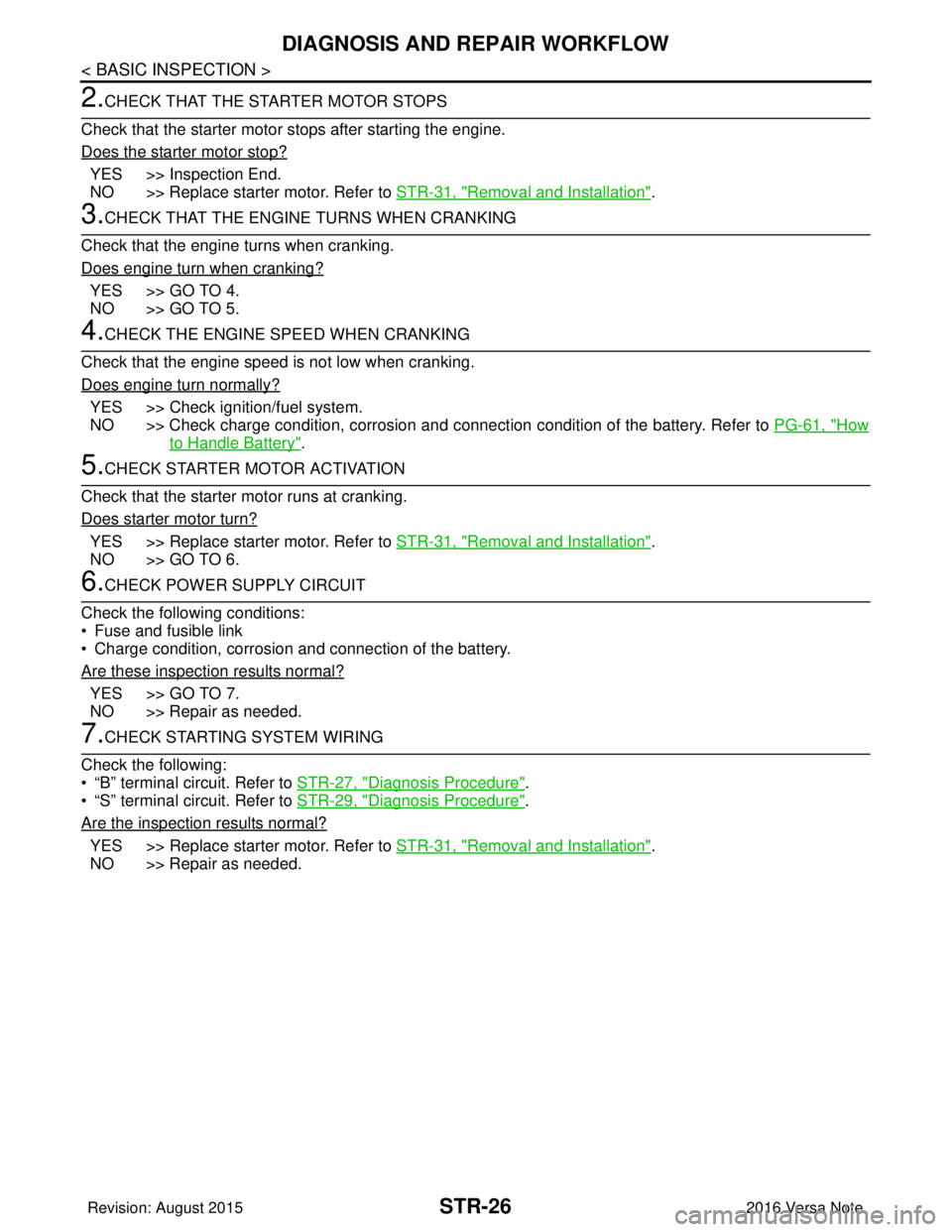
2.CHECK THAT THE STARTER MOTOR STOPS
Check that the starter motor stops after starting the engine.
Does the starter motor stop?
YES >> Inspection End.
NO >> Replace starter motor. Refer to STR-31, "
Removal and Installation".
3.CHECK THAT THE ENGINE TURNS WHEN CRANKING
Check that the engine turns when cranking.
Does engine turn when cranking?
YES >> GO TO 4.
NO >> GO TO 5.
4.CHECK THE ENGINE SPEED WHEN CRANKING
Check that the engine speed is not low when cranking.
Does engine turn normally?
YES >> Check ignition/fuel system.
NO >> Check charge condition, corrosion and connection condition of the battery. Refer to PG-61, "
How
to Handle Battery".
5.CHECK STARTER MOTOR ACTIVATION
Check that the starter motor runs at cranking.
Does starter motor turn?
YES >> Replace starter motor. Refer to STR-31, "Removal and Installation".
NO >> GO TO 6.
6.CHECK POWER SUPPLY CIRCUIT
Check the following conditions:
• Fuse and fusible link
• Charge condition, corrosion and connection of the battery.
Are these inspection results normal?
YES >> GO TO 7.
NO >> Repair as needed.
7.CHECK STARTING SYSTEM WIRING
Check the following:
• “B” terminal circuit. Refer to STR-27, "
Diagnosis Procedure".
• “S” terminal circuit. Refer to STR-29, "
Diagnosis Procedure".
Are the inspection results normal?
YES >> Replace starter motor. Refer to STR-31, "Removal and Installation".
NO >> Repair as needed.
Revision: August 2015 2016 Versa Note
cardiagn.com
Page 3179 of 3641
B TERMINAL CIRCUITSTR-27
< DTC/CIRCUIT DIAGNOSIS >
C
DE
F
G H
I
J
K L
M A
STR
NP
O
DTC/CIRCUIT DIAGNOSIS
B TERMINAL CIRCUIT
DescriptionINFOID:0000000012432072
Terminal “B” is constantly supplied with battery power.
Diagnosis ProcedureINFOID:0000000012432073
Regarding Wiring Diagram information, refer to
STR-10, "Wiring Diagram - With Intelligent Key System" or
STR-16, "
Wiring Diagram - Without Intelligent Key System".
CAUTION:
Perform diagnosis under the cond ition that the engine cannot start by the following procedure.
1. Remove fuel pump fuse.
2. Crank or start the engine (where possi ble) until the fuel pressure is released.
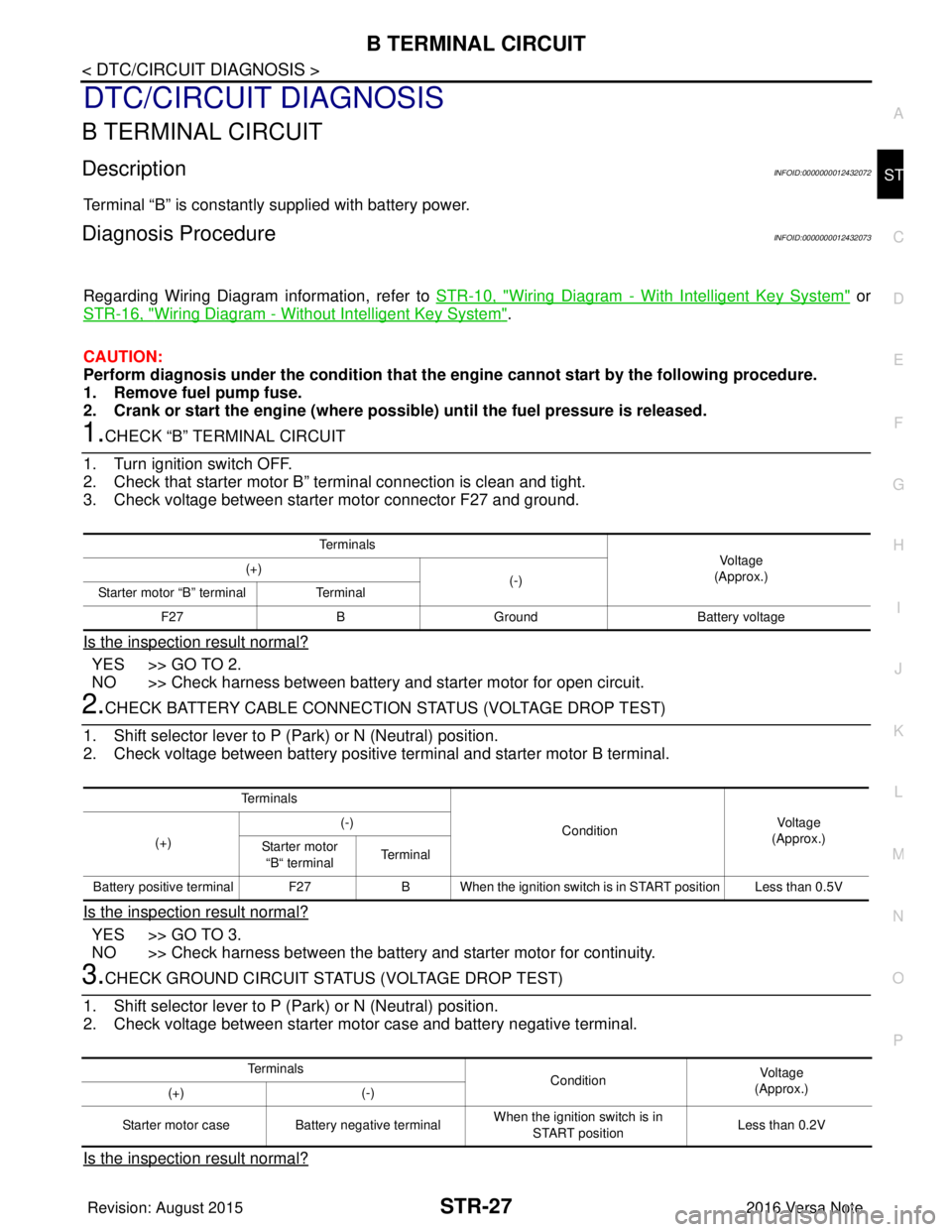
1.CHECK “B” TERMINAL CIRCUIT
1. Turn ignition switch OFF.
2. Check that starter motor B” terminal connection is clean and tight.
3. Check voltage between starter motor connector F27 and ground.
Is the inspection result normal?
YES >> GO TO 2.
NO >> Check harness between battery and starter motor for open circuit.
2.CHECK BATTERY CABLE CONNECTION STATUS (VOLTAGE DROP TEST)
1. Shift selector lever to P (P ark) or N (Neutral) position.
2. Check voltage between battery positive terminal and starter motor B terminal.
Is the inspection result normal?
YES >> GO TO 3.
NO >> Check harness between the battery and starter motor for continuity.
3.CHECK GROUND CIRCUIT STATUS (VOLTAGE DROP TEST)
1. Shift selector lever to P (P ark) or N (Neutral) position.
2. Check voltage between starter motor case and battery negative terminal.
Is the inspection result normal?
Te r m i n a l s
Voltage
(Approx.)
(+)
(-)
Starter motor “B” terminal Terminal
F27 BGround Battery voltage
Te r m i n a l s
ConditionVoltage
(Approx.)
(+) (-)
Starter motor “B“ terminal Terminal
Battery positive terminal F27 B When the ignition switch is in START position Less than 0.5V
Te r m i n a l s
ConditionVoltage
(Approx.)
(+) (-)
Starter motor case Battery negative terminal When the ignition switch is in
START position Less than 0.2V
Revision: August 2015
2016 Versa Note
cardiagn.com
Page 3181 of 3641
S CONNECTOR CIRCUITSTR-29
< DTC/CIRCUIT DIAGNOSIS >
C
DE
F
G H
I
J
K L
M A
STR
NP
O
S CONNECTOR CIRCUIT
DescriptionINFOID:0000000012432074
The starter motor magnetic switch is supplied with power when the ignition switch is turned to the START posi-
tion while the selector lever is in the P (Park) or N (Neutral) position.
Diagnosis ProcedureINFOID:0000000012432075
Regarding Wiring Diagram information, refer to
STR-10, "Wiring Diagram - With Intelligent Key System" or
STR-16, "
Wiring Diagram - Without Intelligent Key System".
CAUTION:
Perform diagnosis under the cond ition that engine cannot start by the following procedure.
1. Remove fuel pump fuse.
2. Crank or start the engine (where possi ble) until the fuel pressure is released.
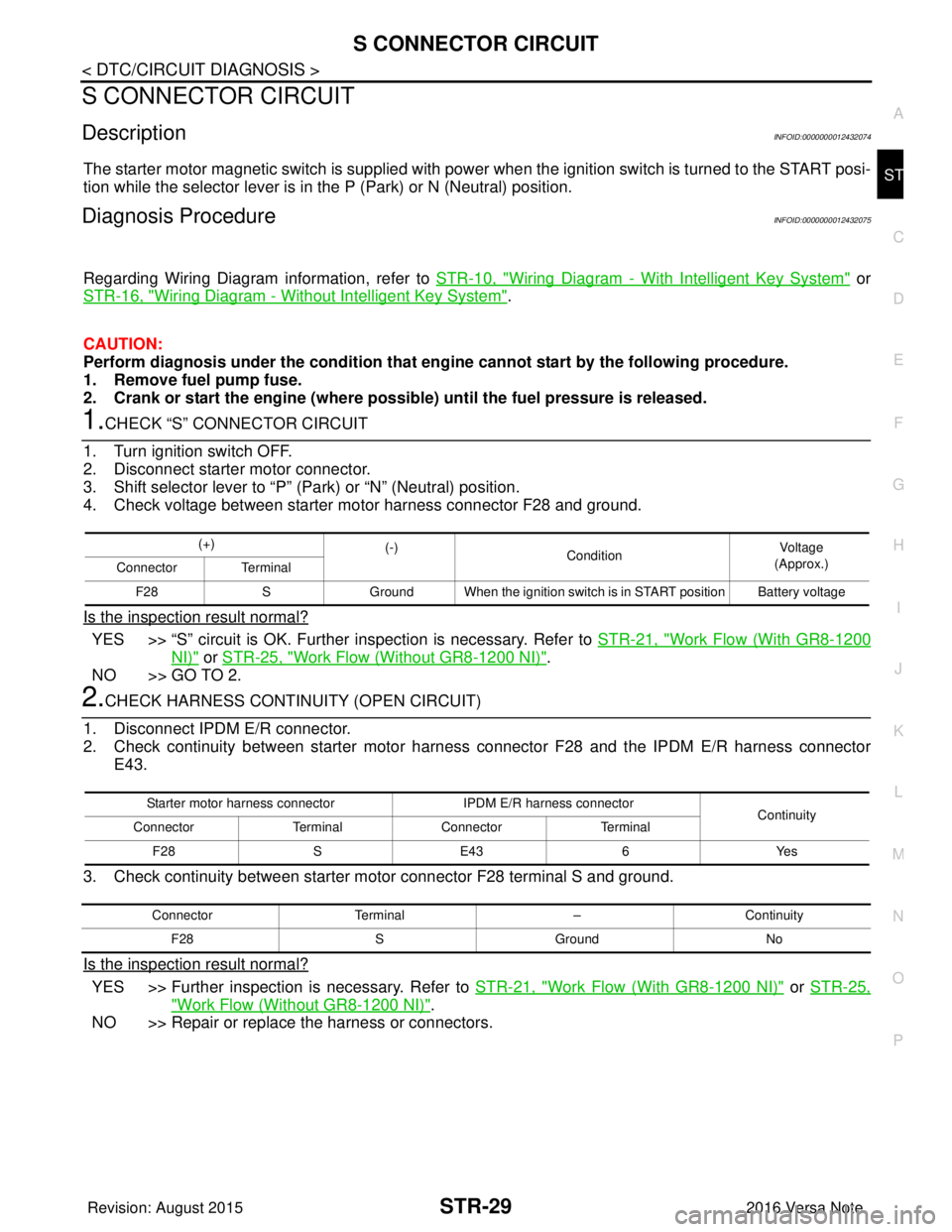
1.CHECK “S” CONNECTOR CIRCUIT
1. Turn ignition switch OFF.
2. Disconnect starter motor connector.
3. Shift selector lever to “P” (Park) or “N” (Neutral) position.
4. Check voltage between starter motor harness connector F28 and ground.
Is the inspection result normal?
YES >> “S” circuit is OK. Further inspection is necessary. Refer to STR-21, "Work Flow (With GR8-1200
NI)" or STR-25, "Work Flow (Without GR8-1200 NI)".
NO >> GO TO 2.
2.CHECK HARNESS CONTINUI TY (OPEN CIRCUIT)
1. Disconnect IPDM E/R connector.
2. Check continuity between starter motor harnes s connector F28 and the IPDM E/R harness connector
E43.
3. Check continuity between starter motor connector F28 terminal S and ground.
Is the inspection result normal?
YES >> Further inspection is necessary. Refer to STR-21, "Work Flow (With GR8-1200 NI)" or STR-25,
"Work Flow (Without GR8-1200 NI)".
NO >> Repair or replace the harness or connectors.
(+) (-)
Condition Voltage
(Approx.)
Connector Terminal
F28 SGround When the ignition switch is in START position Battery voltage
Starter motor harness connector IPDM E/R harness connector
Continuity
Connector TerminalConnector Terminal
F28 SE43 6Yes
Connector Terminal –Continuity
F28 SGround No
Revision: August 2015 2016 Versa Note
cardiagn.com
Page 3266 of 3641
![NISSAN NOTE 2016 Service Repair Manual TRANSAXLE ASSEMBLYTM-25
< UNIT REMOVAL AND INSTALLATION > [5MT: RS5F91R]
C
EF
G H
I
J
K L
M A
B
TM
N
O P
• Do not reuse self-tapping bolt.
• Tighten transaxle assembly bolts to the specified torqu](/img/5/57363/w960_57363-3265.png "NISSAN NOTE 2016 Service Repair Manual TRANSAXLE ASSEMBLYTM-25
< UNIT REMOVAL AND INSTALLATION > [5MT: RS5F91R]
C
EF
G H
I
J
K L
M A
B
TM
N
O P
• Do not reuse self-tapping bolt.
• Tighten transaxle assembly bolts to the specified torqu")
TRANSAXLE ASSEMBLYTM-25
< UNIT REMOVAL AND INSTALLATION > [5MT: RS5F91R]
C
EF
G H
I
J
K L
M A
B
TM
N
O P
• Do not reuse self-tapping bolt.
• Tighten transaxle assembly bolts to the specified torque. The illus- tration is the view from the engine.
InspectionINFOID:0000000012430963
INSPECTION AFTER INSTALLATION
• Check the operation of the control linkage. Refer to TM-21, "Inspection".
• Before starting engine, check oil/fluid levels incl uding engine coolant and engine oil. If less than required
quantity, fill to the specified level. Refer to MA-11, "
Fluids and Lubricants".
• Use procedure below to check for fuel leaks.
• Turn ignition switch ON (with engine stopped). With fuel pressure applied to fuel piping, check for fuel leaks at connection points.
• Start engine. With engine speed increased, check again for fuel leaks at connection points.
• Run engine to check for unusual noise and vibration. NOTE:
If hydraulic pressure inside timing chain tensioner drops after removal and installation, slack in the guide
may generate a pounding noise during and just after engine start. However, this is normal. Noise will stop
after hydraulic pressure rises.
• Warm up engine thoroughly to make sure there is no lea ks of fuel, exhaust gas, or any oils/fluids including
engine oil and engine coolant.
• Bleed air from passages in lines and hoses, such as in cooling system.
• After cooling down engine, again check oil/fluid levels including engine oil and engine coolant. Refill to spec-
ified level, if necessary.
• Summary of the inspection items:
*Power steering fluid, brake fluid, etc.
Bolt symbol
ABC D
Insertion direction Transaxle to
engine Engine to transaxle
Quantity 2321
Bolt length
() mm (in) 55 (2.17)
49 (1.93) 69 (2.72)
Tightening torque
N·m (kg-m, ft-lb) 48.0 (4.9, 35)
JPDIC0813ZZ
Item
Before starting engine Engine runningAfter engine stopped
Engine coolant LevelLeaks Level
Engine oil LevelLeaks Level
Transmission/
transaxle fluid CVT Models
LeaksLevel/Leaks Leaks
M/T Models Level/Leaks LeaksLevel/Leaks
Other oils and fluids* LevelLeaks Level
Fuel LeaksLeaks Leaks
Exhaust gas —Leaks —
Revision: August 2015 2016 Versa Note
cardiagn.com
Page 3298 of 3641
![NISSAN NOTE 2016 Service Repair Manual PRECAUTIONSTM-57
< PRECAUTION > [CVT: RE0F11A]
C
EF
G H
I
J
K L
M A
B
TM
N
O P
On Board Diagnosis (OBD) System of CVT and EngineINFOID:0000000012430986
The ECM has an on board diagnostic system . It](/img/5/57363/w960_57363-3297.png "NISSAN NOTE 2016 Service Repair Manual PRECAUTIONSTM-57
< PRECAUTION > [CVT: RE0F11A]
C
EF
G H
I
J
K L
M A
B
TM
N
O P
On Board Diagnosis (OBD) System of CVT and EngineINFOID:0000000012430986
The ECM has an on board diagnostic system . It")
PRECAUTIONSTM-57
< PRECAUTION > [CVT: RE0F11A]
C
EF
G H
I
J
K L
M A
B
TM
N
O P
On Board Diagnosis (OBD) System of CVT and EngineINFOID:0000000012430986
The ECM has an on board diagnostic system . It will light up the malfunction indicator lamp (MIL) to warn the
driver of a malfunction causing emission deterioration.
CAUTION:
• Be sure to turn the ignition switch OFF and di sconnect the battery cable from the negative terminal
before any repair or inspection work. The open/s hort circuit of related switches, sensors, solenoid
valves, etc. will cause the MIL to light up.
• Be sure to connect and lock the connectors secure ly after work. A loose (unlocked) connector will
cause the MIL to light up due to an open circuit. (Be sure the connector is free from water, grease,
dirt, bent terminals, etc.)
• Be sure to route and secure the harnesses properly after work. Interference of the harness with a
bracket, etc. may cause the MIL to light up due to a short circuit.
• Be sure to connect rubber tubes properly afte r work. A misconnected or disconnected rubber tube
may cause the MIL to light up due to a malfunction of the EGR system or fuel injection system, etc.
• Be sure to erase the unnecessary malfunction informa tion (repairs completed) from the TCM and
ECM before returning the vehicle to the customer.
Removal and Installation Proc edure for CVT Unit ConnectorINFOID:0000000012430987
REMOVAL
• Rotate bayonet ring (A) counterclockwise. Pull out CVT unit har-
ness connector (B) upward and remove it.
INSTALLATION
1. Align marking (A) on CVT unit harness connector terminal with
marking (B) on bayonet ring. Insert CVT unit harness connector.
2. Rotate bayonet ring clockwise.
3. Rotate bayonet ring clockwise until marking (A) on CVT unit har- ness connector terminal body is aligned with the slit (B) on bayo-
net ring as shown in the figure (correctly fitting condition).
CAUTION:
JSDIA1162ZZ
JPDIA0294ZZ
JPDIA0295ZZ
Revision: August 2015 2016 Versa Note
cardiagn.com
Page 3315 of 3641
![NISSAN NOTE 2016 Service Repair Manual TM-74
< SYSTEM DESCRIPTION >[CVT: RE0F11A]
STRUCTURE AND OPERATION
FLUID COOLER & FL
UID WARMER SYSTEM
FLUID COOLER & FLUID WARMER SYSTEM : System DescriptionINFOID:0000000012431015
CVT FLUID COOLER](/img/5/57363/w960_57363-3314.png "NISSAN NOTE 2016 Service Repair Manual TM-74
< SYSTEM DESCRIPTION >[CVT: RE0F11A]
STRUCTURE AND OPERATION
FLUID COOLER & FL
UID WARMER SYSTEM
FLUID COOLER & FLUID WARMER SYSTEM : System DescriptionINFOID:0000000012431015
CVT FLUID COOLER")
TM-74
< SYSTEM DESCRIPTION >[CVT: RE0F11A]
STRUCTURE AND OPERATION
FLUID COOLER & FL
UID WARMER SYSTEM
FLUID COOLER & FLUID WARMER SYSTEM : System DescriptionINFOID:0000000012431015
CVT FLUID COOLER SCHEMATIC
COMPONENT DESCRIPTION
CVT Oil Warmer
• The CVT oil warmer (1) is installed on the front part of transaxle
assembly.
• When engine is started while engine and CVT are cold, engine coolant temperature rises more quickly than CVT fluid tempera-
ture. CVT oil warmer is provided with two circuits for CVT and
engine coolant respectively so that warmed engine coolant warms
CVT quickly. This helps shorten CVT warming up time, improving
fuel economy.
• A cooling effect is obtained when CVT fluid temperature is high.
CVT Fluid Cooler (Water-cooling)
• The CVT fluid cooler (water-cooling) is installed in the radiator side tank (right side).
• CVT fluid is cooled by engine coolant.
SHIFT LOCK SYSTEM
Manual valve Distributes the clutch and brake operation pressures (pilot pressure) corresponding to
each shift position.
High clutch/reverse brake switching valve Switches the circuit for the high clutch and the reverse brake.
Torque converter clutch control valve It is operated with the torque converter clutch solenoid valve and it adjusts the tighten-
ing pressure and non-tightening pressure of the torque converter clutch piston of the
torque converter.
Primary pressure control valve It is operated with the primary pressure solenoid valve and adjusts the feed pressure to
the primary pulley.
Primary pressure solenoid valve TM-65, "
CVT CONTROL SYSTEM : Primary Pressure Solenoid Valve"
Low brake solenoid valve TM-65, "CVT CONTROL SYSTEM : Low Brake Solenoid Valve"
High clutch & reverse brake solenoid valveTM-66, "CVT CONTROL SYSTEM : High Clutch & Reverse Brake Solenoid Valve"
Torque converter clutch solenoid valve TM-66, "CVT CONTROL SYSTEM : Torque Converter Clutch Solenoid Valve"
Line pressure solenoid valve TM-66, "CVT CONTROL SYSTEM : Line Pressure Solenoid Valve"
Part name Function
JSDIA4074GB
JSDIA2586ZZ
Revision: August 2015 2016 Versa Note
cardiagn.com
Page 3323 of 3641
![NISSAN NOTE 2016 Service Repair Manual TM-82
< SYSTEM DESCRIPTION >[CVT: RE0F11A]
SYSTEM
LINE PRESSURE CONTROL : System Description
INFOID:0000000012431021
SYSTEM DIAGRAM
DESCRIPTION
Highly accurate line pressure control (secondary pressur](/img/5/57363/w960_57363-3322.png "NISSAN NOTE 2016 Service Repair Manual TM-82
< SYSTEM DESCRIPTION >[CVT: RE0F11A]
SYSTEM
LINE PRESSURE CONTROL : System Description
INFOID:0000000012431021
SYSTEM DIAGRAM
DESCRIPTION
Highly accurate line pressure control (secondary pressur")
TM-82
< SYSTEM DESCRIPTION >[CVT: RE0F11A]
SYSTEM
LINE PRESSURE CONTROL : System Description
INFOID:0000000012431021
SYSTEM DIAGRAM
DESCRIPTION
Highly accurate line pressure control (secondary pressure control) reduces friction for improvement of fuel
economy.
Normal Oil Pressure Control
Appropriate line pressure and secondary pressure su itable for driving condition are determined based on the
accelerator pedal position, engine speed, primary pulle y (input) speed, secondary pulley (output) speed, vehi-
cle speed, input torque, stop lamp switch signal, transmission range switch signal, lock-up signal, power volt-
age, target shift ratio, oil temperature and oil pressure.
Secondary Pressure Feedback Control
In normal oil pressure control and oil pressure control in shifting, highly accurate secondary pressure is deter-
mined by detecting the secondary pressure using a oil pressure sensor and by feedback control.
SHIFT CONTROL
JSDIA1864GB
Revision: August 2015 2016 Versa Note
cardiagn.com
Page 3328 of 3641
![NISSAN NOTE 2016 Service Repair Manual SYSTEMTM-87
< SYSTEM DESCRIPTION > [CVT: RE0F11A]
C
EF
G H
I
J
K L
M A
B
TM
N
O P
IDLE NEUTRAL CONTROL : System DescriptionINFOID:0000000012431025
SYSTEM DIAGRAM
DESCRIPTION
If a driver has no intent](/img/5/57363/w960_57363-3327.png "NISSAN NOTE 2016 Service Repair Manual SYSTEMTM-87
< SYSTEM DESCRIPTION > [CVT: RE0F11A]
C
EF
G H
I
J
K L
M A
B
TM
N
O P
IDLE NEUTRAL CONTROL : System DescriptionINFOID:0000000012431025
SYSTEM DIAGRAM
DESCRIPTION
If a driver has no intent")
SYSTEMTM-87
< SYSTEM DESCRIPTION > [CVT: RE0F11A]
C
EF
G H
I
J
K L
M A
B
TM
N
O P
IDLE NEUTRAL CONTROL : System DescriptionINFOID:0000000012431025
SYSTEM DIAGRAM
DESCRIPTION
If a driver has no intention of starting the vehicle in D position, TCM operates the low brake solenoid valve and
controls the oil pressure of the low brake to be low pressure. Therefore, the low brake is in the release (slip)
status and the power transmission route of transaxle is the same status as the N position. In this way, the tran-
saxle is in idling status and load to the engine can be reduced to improve fuel economy.
NOTE:
JSDIA2535GB
Revision: August 2015 2016 Versa Note
cardiagn.com
Page 3395 of 3641
![NISSAN NOTE 2016 Service Repair Manual TM-154
< DTC/CIRCUIT DIAGNOSIS >[CVT: RE0F11A]
P0711 TRANSMISSION FLUID
TEMPERATURE SENSOR A
4.PERFORM DTC CONFIRMATION PROCEDURE (PART 1)
TESTING CONDITION:
• While performing the following proced](/img/5/57363/w960_57363-3394.png "NISSAN NOTE 2016 Service Repair Manual TM-154
< DTC/CIRCUIT DIAGNOSIS >[CVT: RE0F11A]
P0711 TRANSMISSION FLUID
TEMPERATURE SENSOR A
4.PERFORM DTC CONFIRMATION PROCEDURE (PART 1)
TESTING CONDITION:
• While performing the following proced")
TM-154
< DTC/CIRCUIT DIAGNOSIS >[CVT: RE0F11A]
P0711 TRANSMISSION FLUID
TEMPERATURE SENSOR A
4.PERFORM DTC CONFIRMATION PROCEDURE (PART 1)
TESTING CONDITION:
• While performing the following procedure, do not add fuel.
• Before performing the followin g procedure, check that fuel level is between 1/4 and 4/4.
• Before performing the following procedure, confirm that battery voltage is 11 V or more at idle.
With CONSULT
1. Move the vehicle to a cool place.
NOTE:
Cool the vehicle in an environment of ambient air temperature between −10° C (14° F) and 35 °C (95 °F).
2. Turn ignition switch OFF and leave the vehicle for 12 hours.
CAUTION:
Never turn ignition switch ON during this procedure.
NOTE:
The vehicle must be cooled with the food open.
3. Turn ignition switch ON. CAUTION:
Never start the engine.
4. Select “Data Monitor” in “TRANSMISSION”.
5. Select “FLUID TEMP”.
6. Record CVT fluid temperature.
7. Start engine and let it idle for 5 minutes or more. CAUTION:
Never turn ignition switch OFF during idling.
8. Check 1st trip DTC.
With GST
1. Move the vehicle to a cool place. NOTE:
Cool the vehicle in an environment of ambient air temperature between −10° C (14° F) and 35 °C (95 °F).
2. Turn ignition switch OFF and leave the vehicle for 12 hours. CAUTION:
Never turn ignition switch ON during this procedure.
NOTE:
The vehicle must be cooled with the food open.
3. Start engine and let it idle for 5 minutes or more. CAUTION:
Never turn ignition switch OFF during idling.
4. Check 1st trip DTC.
Is
“P0711” detected?
YES >> Go to TM-156, "Diagnosis Procedure".
NO-1 (With CONSULT)>>GO TO 5.
NO-2 (With GST)>>GO TO 6.
5.CHECK CVT FLUID TEMPERATURE
With CONSULT
1. Select “Data Monitor” in “TRANSMISSION”.
2. Select “FLUID TEMP”.
Is the value of
“FLUID TEMP” 10°C (50°F) or more?
YES >> INSPECTION END
NO >> GO TO 6.
6.PERFORM DTC CONFIRMATION PROCEDURE (PART 2)
With CONSULT
1. Drive the vehicle for the total minutes specified in the Driving time column below with the following condi-
tions satisfied.
Selector lever : “D” position
Accelerator pedal position : 1.0/8 or more
Vehicle speed : 10 km/h (7 MPH) or more
Revision: August 2015 2016 Versa Note
cardiagn.com
Page 3503 of 3641
![NISSAN NOTE 2016 Service Repair Manual TM-262
< UNIT REMOVAL AND INSTALLATION >[CVT: RE0F11A]
TRANSMISSION ASSEMBLY
INSPECTION AFTER INSTALLATION
Check the following items:
• For CVT position, refer to
TM-232, "
Inspection".
• Before](/img/5/57363/w960_57363-3502.png "NISSAN NOTE 2016 Service Repair Manual TM-262
< UNIT REMOVAL AND INSTALLATION >[CVT: RE0F11A]
TRANSMISSION ASSEMBLY
INSPECTION AFTER INSTALLATION
Check the following items:
• For CVT position, refer to
TM-232, \"
Inspection\".
• Before")
TM-262
< UNIT REMOVAL AND INSTALLATION >[CVT: RE0F11A]
TRANSMISSION ASSEMBLY
INSPECTION AFTER INSTALLATION
Check the following items:
• For CVT position, refer to
TM-232, "
Inspection".
• Before starting engine, check oil/fluid levels incl uding engine coolant and engine oil. If less than required
quantity, fill to the specified level. Refer to MA-11, "
Fluids and Lubricants".
• Use procedure below to check for fuel leakage.
• Turn ignition switch ON (with engine stopped). With fuel pressure applied to fuel piping, check for fuel leak-
age at connection points.
• Start engine. With engine speed increased, che ck again for fuel leakage at connection points.
• Run engine to check for unusual noise and vibration. NOTE:
If hydraulic pressure inside timing chain tensioner drops after removal and installation, slack in the guide
may generate a pounding noise during and just after engine start. However, this is normal. Noise will stop
after hydraulic pressure rises.
• Warm up engine thoroughly to make sure there is no leakage of fuel, exhaust gas, or any oils/fluids including engine oil and engine coolant.
• Bleed air from passages in lines and hoses, such as in cooling system.
• After cooling down engine, again check oil/fluid levels including engine oil and engine coolant. Refill to spec- ified level, if necessary.
• Summary of the inspection items:
*Power steering fluid, brake fluid, etc.
ADJUSTMENT AFTER INSTALLATION
• Adjust the CVT fluid level. TM-229, "Adjustment".
• Perform "ADDITIONAL SERVICE WHEN REPL ACING TRANSAXLE ASSEMBLY". Refer to TM-127,
"Description".
ItemBefore starting engine Engine runningAfter engine stopped
Engine coolant LevelLeakage Level
Engine oil LevelLeakage Level
Transmission/
transaxle fluid A/T and CVT Models
LeakageLevel/Leakage Leakage
M/T Models Level/Leakage LeakageLevel/Leakage
Other oils and fluids* LevelLeakage Level
Fuel LeakageLeakageLeakage
Exhaust gas —Leakage —
Revision: August 2015 2016 Versa Note
cardiagn.com