Vents NISSAN NOTE 2016 Service Repair Manual
[x] Cancel search | Manufacturer: NISSAN, Model Year: 2016, Model line: NOTE, Model: NISSAN NOTE 2016Pages: 3641, PDF Size: 28.72 MB
Page 403 of 3641

BRM-4
< PRECAUTION >
HANDLING PRECAUTIONS FOR PLASTICS
HANDLING PRECAUTIONS FOR PLASTICS
Precautions For PlasticsINFOID:0000000012430792
1. When repairing and painting a portion of the body adjacent to plastic parts, consider their characteristics
(influence of heat and solvent) and remove them if neces sary or take suitable measures to protect them.
2. Plastic parts should be repaired and painted using methods suiting the materials
, characteristics.
LOCATION OF PLASTIC PARTS
Abbre- viation Material name Heat resisting
temperature °C ( °F) Resistance to gasoline and
solvents Other cautions
PE Polyethylene 60 (140)Gasoline and most solvents are
harmless if applied for a very
short time (wipe up quickly). Flammable
PVC Poly Vinyl Chloride 80 (176) Same as above. Poison gas is emitted
when burned.
EPM/
EPDM Ethylene Propylene (Diene) co-
polymer
80 (176) Same as above.
Flammable
PP Polypropylene 90 (194) Same as above. Flammable, avoid bat-
tery acid.
UP Unsaturated Polyester 90 (194) Same as above. Flammable
PS Polystyrene 80 (176) Avoid solvents. Flammable
ABS Acrylonitrile Butadiene Styrene 80 (176) Avoid gasoline and solvents.
PMMA Poly Methyl Methacrylate 85 (185) Same as above.
EVAC Ethylene Vinyl Acetate 90 (194) Same as above.
ASA Acrylonitrile Styrene Acrylate 100 (222) Same as above. Flammable
PPE Poly Phenylene Ether 110 (230) Same as above.
PC Polycarbonate 120 (248) Same as above.
PAR Polyarylate 180 (356) Same as above.
PUR Polyurethane 90 (194) Same as above.
POM Poly Oxymethylene 120 (248) Same as above. Avoid battery acid.
PBT+
PC Poly Butylene Terephthalate +
Polycarbonate
120 (248) Same as above.
Flammable
PA Polyamide 140 (284) Same as above. Avoid immersing in wa-
ter.
PBT Poly Butylene Terephthalate 140 (284) Same as above.
PET Polyester 180 (356) Same as above.
PEI Polyetherimide 200 (392) Same as above.
Revision: August 2015 2016 Versa Note
cardiagn.com
Page 471 of 3641
![NISSAN NOTE 2016 Service Repair Manual SYSTEMBRC-23
< SYSTEM DESCRIPTION > [VDC/TCS/ABS]
C
D
E
G H
I
J
K L
M A
B
BRC
N
O P
• Brake force control function at braking hard detects driver ′s brake operations with the pressure sensor,
judg](/img/5/57363/w960_57363-470.png "NISSAN NOTE 2016 Service Repair Manual SYSTEMBRC-23
< SYSTEM DESCRIPTION > [VDC/TCS/ABS]
C
D
E
G H
I
J
K L
M A
B
BRC
N
O P
• Brake force control function at braking hard detects driver ′s brake operations with the pressure sensor,
judg")
SYSTEMBRC-23
< SYSTEM DESCRIPTION > [VDC/TCS/ABS]
C
D
E
G H
I
J
K L
M A
B
BRC
N
O P
• Brake force control function at braking hard detects driver ′s brake operations with the pressure sensor,
judges a brake booster ′s maximum brake power function by using information from the vacuum sensor, and
enhances more powerful braking force by controlling brakes of four wheels.
• VDC warning lamp blinks while VDC function is in operat ion and indicates to the driver that the function is in
operation.
• CONSULT can be used to diagnose the system.
• Fail-safe function is adopted. When a malfunction occurs in VDC function, the control is suspended for VDC
function and TCS function. However, ABS function and EBD function operate normally. Refer to BRC-39,
"Fail-safe".
INPUT SIGNAL AND OUTPUT SIGNAL
Major signal transmission between each unit via communication lines is shown in the following table.
OPERATION CHARACTERISTICS
VDC Function That Prevents Oversteer Tendency
• During cornering, brake force (brake fluid pressure) is applied on front wheel and rear wheel on the outer
side of turn. Momentum is generated directing the vehicle toward the outer side of the turn. Oversteer is pre-
vented.
• Changing driving lane on a slippery road, when there may be a tendency to oversteer, engine output is con-
trolled as well as brake force (brake fluid pr essure) of 4 wheels. Oversteer tendency decreases.
Component Signal description
ECM Transmits the following signals to ABS actuator an
d electric unit (control unit) via CAN commu-
nication:
• Acceleration pedal position signal
• Engine speed signal
• Target throttle position signal
TCM Transmits the current gear positi
on signal to ABS actuator and electric unit (control unit) via
CAN communication.
Steering angle sensor Transmits the steering an
gle sensor signal to ABS actuator an d electric unit (control unit) via
CAN communication.
Combination meter Transmits the following signals to ABS actuator an
d electric unit (control unit) via CAN commu-
nication:
• Brake fluid level switch signal
• parking brake switch signal
Receives the following signals from ABS actuator and electric unit (control unit) via CAN com-
munication:
• VDC OFF indicator lamp signal
• SLIP indicator lamp signal
ALFIA0339GB
ALFIA0340GB
Revision: August 2015 2016 Versa Note
cardiagn.com
Page 472 of 3641
![NISSAN NOTE 2016 Service Repair Manual BRC-24
< SYSTEM DESCRIPTION >[VDC/TCS/ABS]
SYSTEM
VDC Function That Prevents Understeer Tendency
• During cornering, brake force (brake fluid pressure) is applied on front wheel and rear wheel on th](/img/5/57363/w960_57363-471.png "NISSAN NOTE 2016 Service Repair Manual BRC-24
< SYSTEM DESCRIPTION >[VDC/TCS/ABS]
SYSTEM
VDC Function That Prevents Understeer Tendency
• During cornering, brake force (brake fluid pressure) is applied on front wheel and rear wheel on th")
BRC-24
< SYSTEM DESCRIPTION >[VDC/TCS/ABS]
SYSTEM
VDC Function That Prevents Understeer Tendency
• During cornering, brake force (brake fluid pressure) is applied on front wheel and rear wheel on the inner
side of turn. Momentum is generated directing the vehicle toward the inner side of the turn. Understeer is
prevented.
• Applying brakes during cornering on a slippery road, when there may be a tendency to understeer, engine output is controlled as well as brake force (bra ke fluid pressure) of 4 wheels. Understeer tendency
decreases.
VDC/TCS/ABS : TCS FunctionINFOID:0000000012430838
SYSTEM DIAGRAM
SYSTEM DESCRIPTION
JPFIC0137GB
ALFIA0341GB
AWFIA0807GB
Revision: August 2015 2016 Versa Note
cardiagn.com
Page 716 of 3641
![NISSAN NOTE 2016 Service Repair Manual SYSTEM (INTELLIGENT KEY SYSTEM)DLK-27
< SYSTEM DESCRIPTION > [WITH INTELLIGENT KEY SYSTEM]
C
D
E
F
G H
I
J
L
M A
B
DLK
N
O P
KEY REMINDER FUNCTION : System DescriptionINFOID:0000000012429986
System Di](/img/5/57363/w960_57363-715.png "NISSAN NOTE 2016 Service Repair Manual SYSTEM (INTELLIGENT KEY SYSTEM)DLK-27
< SYSTEM DESCRIPTION > [WITH INTELLIGENT KEY SYSTEM]
C
D
E
F
G H
I
J
L
M A
B
DLK
N
O P
KEY REMINDER FUNCTION : System DescriptionINFOID:0000000012429986
System Di")
SYSTEM (INTELLIGENT KEY SYSTEM)DLK-27
< SYSTEM DESCRIPTION > [WITH INTELLIGENT KEY SYSTEM]
C
D
E
F
G H
I
J
L
M A
B
DLK
N
O P
KEY REMINDER FUNCTION : System DescriptionINFOID:0000000012429986
System Diagram
BASIC OPERATION
Key reminder is the function that prevents the key from being left in the vehicle.
Key reminder has the following 3 functions:
*:When closing the door if something comes into contact with the door lock switch it might activate the door locks accidentally , but the
unlock operation will override this.
NOTE:
The above function operates when the Intelligent Key is in side the vehicle. However, there may be times when
the Intelligent Key cannot be detected, and this func tion does not operate when the Intelligent Key is on the
instrument panel, rear parcel shelf, or in the glove box. Also, this system sometimes does not operate if the
Intelligent Key is in the door pocket for the open door.
WARNING FUNCTION
WARNING FUNCTION : System DescriptionINFOID:0000000012429987
OPERATION DESCRIPTION
The warning function are as per the following items and are given to the user as warning information and
warnings using combinations of Intelligent Key warni ng buzzer, combination meter buzzer, KEY warning lamp,
shift P warning lamp and engine start operation indicator lamp:
• Intelligent Key system malfunction
• OFF position warning
• P position warning
• ACC warning
• Take away warning
• Door lock operation warning
• Engine start information
ALKIA3196GB
Key reminder function Operation condition Operation
Driver side door closed* Right after driver side door is closed under the following conditions:
• Intelligent Key is inside the vehicle.
• Driver side door is opened.
• Driver side door is in unlock state. All doors unlock
Door is open or closed Right after all doors are closed under the following conditions:
• Door lock/unlock switch or driver side door lock knob are operated.
• Intelligent Key is inside the vehicle.
• Any door is opened.
• All doors are locked. • All doors unlock
• Honk Intelligent Key warn-
ing buzzer
Back door is closed Right after Back door is closed under the following conditions:
• Intelligent Key is inside trunk room.
• All doors are closed.
• All doors are locked. • Back door open
• Honk Intelligent Key warn-
ing buzzer
Revision: August 2015 2016 Versa Note
cardiagn.com
Page 1092 of 3641
![NISSAN NOTE 2016 Service Repair Manual ENGINE UNITEM-91
< UNIT DISASSEMBLY AND ASSEMBLY > [HR16DE]
C
D
E
F
G H
I
J
K L
M A
EM
NP
O
UNIT DISASSEMBLY AND ASSEMBLY
ENGINE UNIT
SettingINFOID:0000000012431733
NOTE:
The following procedures expl](/img/5/57363/w960_57363-1091.png "NISSAN NOTE 2016 Service Repair Manual ENGINE UNITEM-91
< UNIT DISASSEMBLY AND ASSEMBLY > [HR16DE]
C
D
E
F
G H
I
J
K L
M A
EM
NP
O
UNIT DISASSEMBLY AND ASSEMBLY
ENGINE UNIT
SettingINFOID:0000000012431733
NOTE:
The following procedures expl")
ENGINE UNITEM-91
< UNIT DISASSEMBLY AND ASSEMBLY > [HR16DE]
C
D
E
F
G H
I
J
K L
M A
EM
NP
O
UNIT DISASSEMBLY AND ASSEMBLY
ENGINE UNIT
SettingINFOID:0000000012431733
NOTE:
The following procedures explain how to disassemble the engine with the engine stand fastened to the bell
housing. Some steps may be different if using a different type of engine stand.
1. Install engine to engine stand:
a. On (M/T models), remove flywheel.
• Secure flywheel using suitable tool and remove bolts.
CAUTION:
• Do not disassemble flywheel.
• Do not place flywheel with signal plate facing down.
• When handling signal plate, take care not to damage or scratch it.
• Handle signal plate in a manner that prevents it from becoming magnetized.
b. On (CVT models), remove driveplate. • Secure driveplate using suitable tool and remove bolts.
CAUTION:
• Do not disassemble flywheel.
• Do not place flywheel or drive plat e with signal plate facing down.
• When handling signal plate, take care not to damage or scratch it.
• Handle signal plate in a manner that prevents it from becoming magnetized.
c. Lift the engine with a hoist to install it onto a widely used engine stand. CAUTION:
• Use the engine stand that has a load capacity approximately 150 kg (331 lb) or more large
enough for supporting the engine weight.
• If the load capacity of stand is not adequate, remove the following parts beforehand to reduce the poten- tial risk of overturning stand.
- Intake manifold. Refer to EM-28, "
Exploded View".
- Exhaust manifold. Refer to EM-31, "
Removal and Installation".
- Rocker cover. Refer to EM-48, "
Exploded View".
CAUTION:
Before removing the hanging chains, check the engine stand is stable and there is no risk of over-
turning.
NOTE:
The figure shows an example of widely used engine stand (A)
that can support the mating surface of transaxle with flywheel
removed.
2. Drain engine oil. Refer to LU-8, "
Draining".
CAUTION:
• Be sure to clean drain plug and in stall with new drain plug washer.
• Do not reuse drain plug washer. Tool number : KV11105210 (J-44716)
Tool number : KV11105210 (J-44716)
PBIC3227J
Revision: August 2015
2016 Versa Note
cardiagn.com
Page 1150 of 3641
![NISSAN NOTE 2016 Service Repair Manual COMPONENT PARTSEC-23
< SYSTEM DESCRIPTION > [HR16DE]
C
D
E
F
G H
I
J
K L
M A
EC
NP
O
Exhaust Valve Timing Control Solenoid ValveINFOID:0000000012431286
Exhaust valve timing control solenoi
d valve is](/img/5/57363/w960_57363-1149.png "NISSAN NOTE 2016 Service Repair Manual COMPONENT PARTSEC-23
< SYSTEM DESCRIPTION > [HR16DE]
C
D
E
F
G H
I
J
K L
M A
EC
NP
O
Exhaust Valve Timing Control Solenoid ValveINFOID:0000000012431286
Exhaust valve timing control solenoi
d valve is")
COMPONENT PARTSEC-23
< SYSTEM DESCRIPTION > [HR16DE]
C
D
E
F
G H
I
J
K L
M A
EC
NP
O
Exhaust Valve Timing Control Solenoid ValveINFOID:0000000012431286
Exhaust valve timing control solenoi
d valve is activated by ON/OFF
pulse duty (ratio) signals from the ECM.
The exhaust valve timing control solenoid valve changes the oil
amount and direction of flow through exhaust valve timing control
unit or stops oil flow.
The longer pulse width retards valve angle.
The shorter pulse width advances valve angle.
When ON and OFF pulse widths become equal, the solenoid valve
stops oil pressure flow to fix the exhaust valve angle at the control
position.
Fuel InjectorINFOID:0000000012431287
The fuel injector is a small, precise solenoid valve. When the ECM
supplies a ground to the fuel injector circuit, the coil in the fuel injec-
tor is energized. The energized coil pulls the ball valve back and
allows fuel to flow through the fuel injector into the intake manifold.
The amount of fuel injected depends upon the injection pulse dura-
tion. Pulse duration is the length of time the fuel injector remains
open. The ECM controls the injection pulse duration based on
engine fuel needs.
Fuel PumpINFOID:0000000012431288
*: ECM determines the start signal status by the signals of engine speed and battery voltage.
The ECM activates the fuel pump for a few seconds after the ignition switch is turned ON to improve engine
start ability. If the ECM receives a engine speed signal from the crankshaft position sensor (POS) and cam-
shaft position sensor (PHASE), it knows that the engi ne is rotating, and causes the pump to operate. If the
engine speed signal is not received when the ignition s witch is ON, the engine stalls. The ECM stops pump
operation and prevents battery discharging, thereby improving safety. The EC M does not directly drive the fuel
pump. It controls the ON/OFF fuel pump rela y, which in turn controls the fuel pump.
JSBIA0652ZZ
JSBIA0742ZZ
SensorInput signal to ECMECM functionActuator
Crankshaft position sensor (POS)
Camshaft position sensor (PHASE) Engine speed*
Fuel pump controlFuel pump relay
↓
Fuel pump
Battery Battery voltage*
Condition Fuel pump operation
Ignition switch is turned to ON. Operates for 1 second.
Engine running and cranking Operates.
When engine is stopped Stops in 1.5 seconds.
Except as shown above Sto ps .
Revision: August 20152016 Versa Note
cardiagn.com
Page 1183 of 3641
![NISSAN NOTE 2016 Service Repair Manual EC-56
< SYSTEM DESCRIPTION >[HR16DE]
DIAGNOSIS SYSTEM (ECM)
OK: Self-diagnosis is carried out and the result is OK.
NG: Self-diagnosis is carried out and the result is NG.
—: Self-diagnosis is not c](/img/5/57363/w960_57363-1182.png "NISSAN NOTE 2016 Service Repair Manual EC-56
< SYSTEM DESCRIPTION >[HR16DE]
DIAGNOSIS SYSTEM (ECM)
OK: Self-diagnosis is carried out and the result is OK.
NG: Self-diagnosis is carried out and the result is NG.
—: Self-diagnosis is not c")
EC-56
< SYSTEM DESCRIPTION >[HR16DE]
DIAGNOSIS SYSTEM (ECM)
OK: Self-diagnosis is carried out and the result is OK.
NG: Self-diagnosis is carried out and the result is NG.
—: Self-diagnosis is not carried out.
When all SRT related self-diagnoses show OK result
s in a single cycle (Ignition OFF-ON-OFF), the SRT will
indicate “CMPLT”. → Case 1 above
When all SRT related self-diagnoses show OK results through several different cycles, the SRT will indicate
“CMPLT” at the time the respective se lf-diagnoses have at least one OK result. → Case 2 above
If one or more SRT related self-diagnoses show NG resu lts in 2 consecutive cycles, the SRT will also indicate
“CMPLT”. → Case 3 above
The table above shows that the minimum number of cycl es for setting SRT as “INCMP” is the number one (1)
for each self-diagnosis (Case 1 & 2) or the number tw o (2) for one of self-diagnoses (Case 3). However, in
preparation for the state emissions inspection, it is unnecessary for each self-diagnosis to be executed twice
(Case 3) for the following reasons:
• The SRT will indicate “CMPLT” at the time the respective self-diagnoses have one (1) OK result.
• The emissions inspection requires “CMPLT” of the SRT only with OK self-diagnosis results.
• During SRT driving pattern, the 1st trip DTC (NG) is detected prior to “CMPLT” of SRT and the self-diagnosis memory must be erased from the ECM after repair.
• If the 1st trip DTC is erased, all the SRT will indicate “INCMP”. NOTE:
SRT can be set as “CMPLT” together with the DTC(s). Therefore, DTC check must always be carried out
prior to the state emission inspection even though the SRT indicates “CMPLT”.
DIAGNOSIS DESCRIPTION : Permanent Diagno stic Trouble Code (Permanent DTC)
INFOID:0000000012431338
Permanent DTC is defined in SAE J1979/ISO 15031-5 Service $0A.
ECM stores a DTC issuing a command of turning on MIL as a permanent DTC and keeps storing the DTC as
a permanent DTC until ECM judges that there is no presence of malfunction.
Permanent DTCs cannot be erased by using the Erase function of CONSULT or Generic Scan Tool (GST) and
by disconnecting the battery to shut off power to ECM. This prevents a vehicle from passing the state emission
inspection without repairing a malfunctioning part.
When not passing the state emission inspection due to more than one permanent DTC, permanent DTCs
should be erased, referring to this manual.
NOTE:
• The important items in state emission inspection are t hat MIL is not ON, SRT test items are set, and perma-
nent DTCs are not included.
• Permanent DTCs do not apply for regions that permanent DTCs are not regulated by law.
Self-diagnosis result Example
Diagnosis Ignition cycle
← ON →OFF ← ON →OFF ← ON →OFF ← ON →
All OK Case 1 P0400OK (1) — (1)OK (2) — (2)
P0402 OK (1) — (1)— (1)OK (2)
P1402 OK (1) OK (2) — (2)— (2)
SRT of EGR “CMPLT” “CMPLT”“CMPLT” “CMPLT”
Case 2 P0400 OK (1) — (1)— (1)— (1)
P0402 — (0)— (0)OK (1) — (1)
P1402 OK (1) OK (2) — (2)— (2)
SRT of EGR “INCMP” “INCMP”“CMPLT” “CMPLT”
NG exists Case 3 P0400OKOK ——
P0402 —— ——
P1402 NG—NG NG
(Consecutive NG)
(1st trip) DTC 1st trip DTC
—1st trip DTC DTC
(= MIL ON)
SRT of EGR “INCMP” “INCMP”“INCMP”“CMPLT”
Revision: August 2015 2016 Versa Note
cardiagn.com
Page 1661 of 3641
SYSTEMEXL-9
< SYSTEM DESCRIPTION >
C
DE
F
G H
I
J
K
M A
B
EXL
N
O P
Under this condition, the headlamps remain illuminated for 45 seconds unless the lighting switch position is
changed. If the lighting switch position is changed, then the headlamps are turned off.
This setting can be changed by CONSULT. Refer to BCS-20, "
HEADLAMP : CONSULT Function (BCM -
HEAD LAMP)" (with Intelligent Key system) or BCS-93, "HEADLAMP : CONSULT Function (BCM - HEAD
LAMP)" (without Intelligent Key system).
DAYTIME RUNNING LIGHT SYSTEM
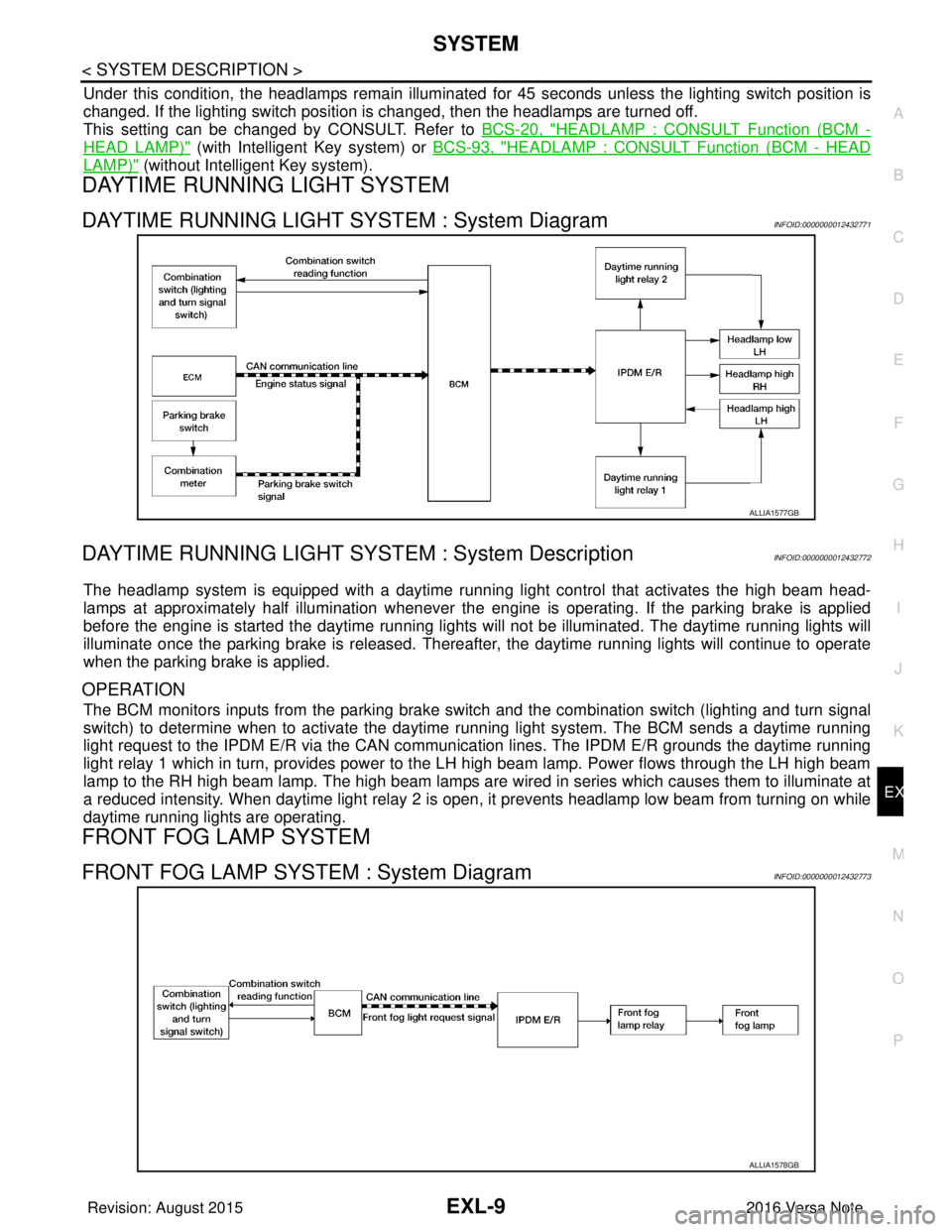
DAYTIME RUNNING LIGHT SYSTEM : System DiagramINFOID:0000000012432771
DAYTIME RUNNING LIGHT SYST EM : System DescriptionINFOID:0000000012432772
The headlamp system is equipped with a daytime running light control that activates the high beam head-
lamps at approximately half illumination whenever the e ngine is operating. If the parking brake is applied
before the engine is started the daytime running lights will not be illuminated. The daytime running lights will
illuminate once the parking brake is released. Thereaf ter, the daytime running lights will continue to operate
when the parking brake is applied.
OPERATION
The BCM monitors inputs from the parking brake swit ch and the combination switch (lighting and turn signal
switch) to determine when to activate the daytime running light system. The BCM sends a daytime running
light request to the IPDM E/R via the CAN communication lines. The IPDM E/R grounds the daytime running
light relay 1 which in turn, provides power to the LH high beam lamp. Power flows through the LH high beam
lamp to the RH high beam lamp. The high beam lamps are wired in series which causes them to illuminate at
a reduced intensity. When daytime light relay 2 is open, it prevents headlamp low beam from turning on while
daytime running lights are operating.
FRONT FOG LAMP SYSTEM
FRONT FOG LAMP SYSTEM : System DiagramINFOID:0000000012432773
ALLIA1577GB
ALLIA1578GB
Revision: August 2015 2016 Versa Note
cardiagn.com
Page 1915 of 3641
PRECAUTIONSGI-27
< PRECAUTION >
C
DE
F
G H
I
J
K L
M B
GI
N
O P
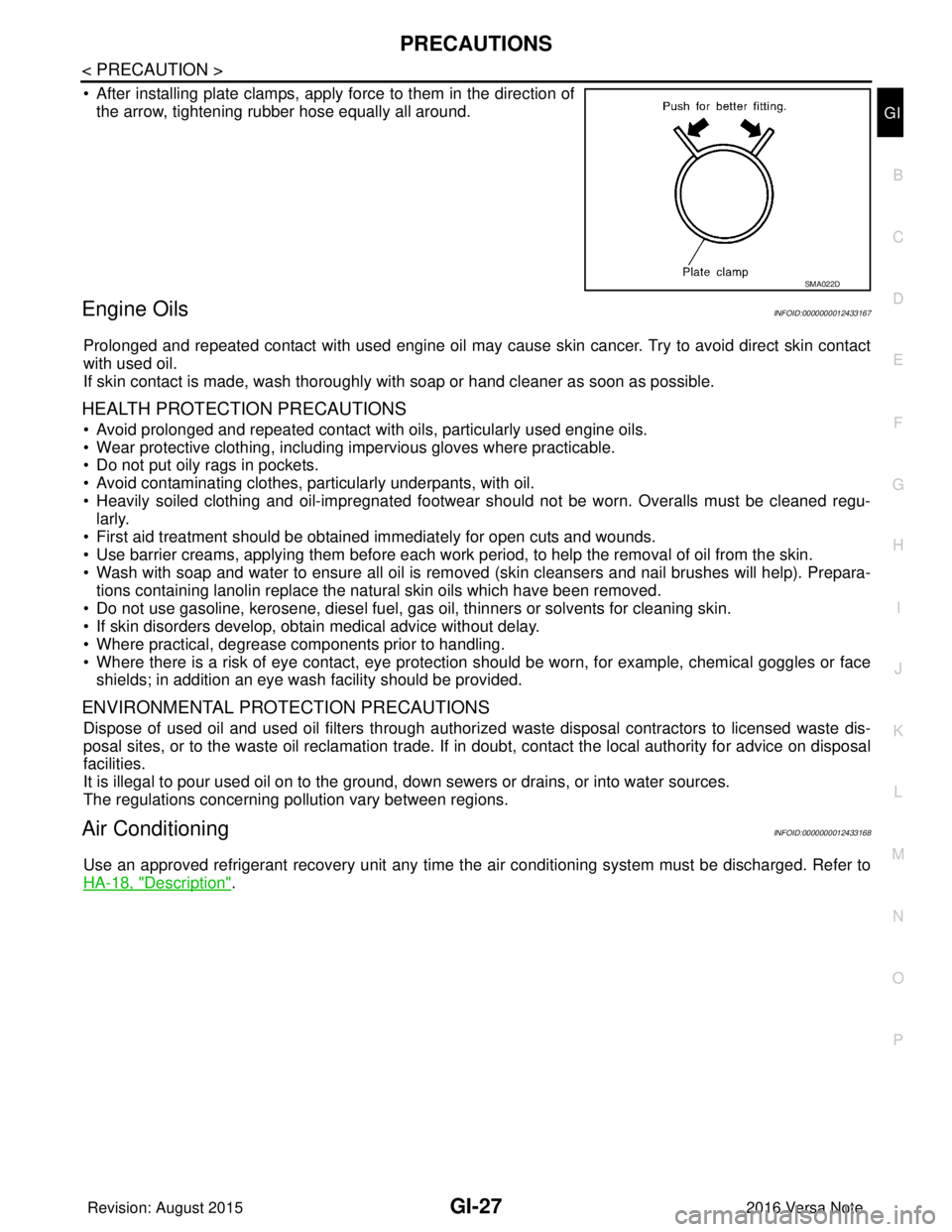
• After installing plate clamps, apply force to them in the direction of the arrow, tightening rubber hose equally all around.
Engine OilsINFOID:0000000012433167
Prolonged and repeated contact with used engine oil may cause skin cancer. Try to avoid direct skin contact
with used oil.
If skin contact is made, wash thoroughly with soap or hand cleaner as soon as possible.
HEALTH PROTECTION PRECAUTIONS
• Avoid prolonged and repeated contact with oils, particularly used engine oils.
• Wear protective clothing, including impervious gloves where practicable.
• Do not put oily rags in pockets.
• Avoid contaminating clothes, particularly underpants, with oil.
• Heavily soiled clothing and oil-impregnated footwear should not be worn. Overalls must be cleaned regu-
larly.
• First aid treatment should be obtained immediately for open cuts and wounds.
• Use barrier creams, applying them before each work period, to help the removal of oil from the skin.
• Wash with soap and water to ensure all oil is removed (skin cleansers and nail brushes will help). Prepara-
tions containing lanolin replace the natural skin oils which have been removed.
• Do not use gasoline, kerosene, diesel fuel, gas oil, thinners or solvents for cleaning skin.
• If skin disorders develop, obtain medical advice without delay.
• Where practical, degrease components prior to handling.
• Where there is a risk of eye contact, eye protection should be worn, for example, chemical goggles or face shields; in addition an eye wash facility should be provided.
ENVIRONMENTAL PROTECTION PRECAUTIONS
Dispose of used oil and used oil filters through authorized waste disposal contractors to licensed waste dis-
posal sites, or to the waste oil reclamation trade. If in doubt, contact the local authority for advice on disposal
facilities.
It is illegal to pour used oil on to the ground, down sewers or drains, or into water sources.
The regulations concerning po llution vary between regions.
Air ConditioningINFOID:0000000012433168
Use an approved refrigerant recovery unit any time t he air conditioning system must be discharged. Refer to
HA-18, "
Description".
SMA022D
Revision: August 2015 2016 Versa Note
cardiagn.com
Page 1973 of 3641
![NISSAN NOTE 2016 Service Repair Manual PRECAUTIONSHAC-5
< PRECAUTION > [MANUAL AIR CONDITIONING]
C
D
E
F
G H
J
K L
M A
B
HAC
N
O P
• When the compressor is removed, store it in th e same way as it is when mounted on the vehicle.
Failure](/img/5/57363/w960_57363-1972.png "NISSAN NOTE 2016 Service Repair Manual PRECAUTIONSHAC-5
< PRECAUTION > [MANUAL AIR CONDITIONING]
C
D
E
F
G H
J
K L
M A
B
HAC
N
O P
• When the compressor is removed, store it in th e same way as it is when mounted on the vehicle.
Failure")
PRECAUTIONSHAC-5
< PRECAUTION > [MANUAL AIR CONDITIONING]
C
D
E
F
G H
J
K L
M A
B
HAC
N
O P
• When the compressor is removed, store it in th e same way as it is when mounted on the vehicle.
Failure to do so will cause oil to enter the low-pressure chamber.
• Use always a torque wrench and a b ack-up wrench when connecting tubes.
• Plug immediately all openings to prevent entry of dust and mois ture after disconnecting tubes.
• Connect the pipes at the final stag e of the operation when installing an air conditioner in the vehicle.
Do not remove the seal caps of pipes and other comp onents until just before required for connec-
tion.
• Allow components stored in cool areas to warm to working area temperature before removing seal
caps. This prevents condensation from forming inside A/C components.
• Remove thoroughly moisture from the refriger ation system before charging the refrigerant.
• Replace always used O-rings.
• Apply oil to the O-rings shown in illustrations wh en connecting tubes. Be careful not to apply oil to
threaded portion.
• O-ring must be closely attached to the groove portion of tube.
• Be careful not to damage O-ring and tube when replacing the O-ring.
• Connect tube until a click can be heard. Then tighten the nut or bolt by hand. Check that the O-ring is
installed to tube correctly.
• Perform leak test and make sure there are no leaks from connections after connecting lines. Discon-
nect that line and replace the O-ring when the refrigerant leak point is found. Then tighten connec-
tions of seal seat to the specified torque.
COMPRESSOR
CAUTION:
• Plug all openings to prevent moisture and foreign matter from entering.
• When the compressor is removed, store it in the same way as it is when mounted on the vehicle.
• Follow “MAINTENANCE OF OIL LEVEL” exactly when replacing or repairing compressor. Refer to HA-22, "
Description".
• Keep friction surfaces between clutch and pulley clean . Wipe them off by using a clean waste cloth
moistened with solvent if the su rfaces are contaminated with oil.
• Turn the compressor shaft by hand more than fi ve turns in both directions after compressor service
operation. This equally distribut es oil inside the compressor. Let the engine idle and operate the
compressor for one hour after the compressor is installed.
• After replacing the compressor magnet clutch, appl y voltage to the new clutch to check for normal
operation.
LEAK DETECTION DYE
CAUTION:
• The A/C system contains a fluorescent leak detect ion dye used for locating refrigerant leaks. An
ultraviolet (UV) lamp is required to il luminate the dye when inspecting for leaks.
• Always wear fluorescence enhancing UV safety goggles to protect eyes and enhance the visibility of
the fluorescent dye. Name : A/C System Oil Type: DH-PR
RHA861F
Revision: August 2015
2016 Versa Note
cardiagn.com