wheel bolt torque NISSAN NOTE 2016 Service Repair Manual
[x] Cancel search | Manufacturer: NISSAN, Model Year: 2016, Model line: NOTE, Model: NISSAN NOTE 2016Pages: 3641, PDF Size: 28.72 MB
Page 454 of 3641
![NISSAN NOTE 2016 Service Repair Manual BRC-6
< PREPARATION >[VDC/TCS/ABS]
PREPARATION
PREPARATION
PREPARATION
Special Service ToolINFOID:0000000012430824
The actual shape of the tools may differ from those illustrated here.
Commercial Serv](/img/5/57363/w960_57363-453.png "NISSAN NOTE 2016 Service Repair Manual BRC-6
< PREPARATION >[VDC/TCS/ABS]
PREPARATION
PREPARATION
PREPARATION
Special Service ToolINFOID:0000000012430824
The actual shape of the tools may differ from those illustrated here.
Commercial Serv")
BRC-6
< PREPARATION >[VDC/TCS/ABS]
PREPARATION
PREPARATION
PREPARATION
Special Service ToolINFOID:0000000012430824
The actual shape of the tools may differ from those illustrated here.
Commercial Service ToolINFOID:0000000012430825
Tool number
(TechMate No.)
Tool nameDescription
KV991J0080
(J-45741)
ABS active wheel sensor tester Checking operation of ABS active wheel sen-
sors
WFIA0101E
Tool name
Description
1. Flare nut crowfoot
2. Torque wrench Tightening brake tube flare nuts
a: 10mm (0.39 in)/12mm (0.47 in)
Power Tool Loosening nuts, screws and bolts
S-NT360
PIIB1407E
Revision: August 2015 2016 Versa Note
cardiagn.com
Page 513 of 3641
![NISSAN NOTE 2016 Service Repair Manual C1105, C1106, C1107, C1108 WHEEL SENSOR
BRC-65
< DTC/CIRCUIT DIAGNOSIS > [VDC/TCS/ABS]
C
D
E
G H
I
J
K L
M A
B
BRC
N
O P
Note the difference at 50 km/h (31 MPH) between t he wheel speed detected by th](/img/5/57363/w960_57363-512.png "NISSAN NOTE 2016 Service Repair Manual C1105, C1106, C1107, C1108 WHEEL SENSOR
BRC-65
< DTC/CIRCUIT DIAGNOSIS > [VDC/TCS/ABS]
C
D
E
G H
I
J
K L
M A
B
BRC
N
O P
Note the difference at 50 km/h (31 MPH) between t he wheel speed detected by th")
C1105, C1106, C1107, C1108 WHEEL SENSOR
BRC-65
< DTC/CIRCUIT DIAGNOSIS > [VDC/TCS/ABS]
C
D
E
G H
I
J
K L
M A
B
BRC
N
O P
Note the difference at 50 km/h (31 MPH) between t he wheel speed detected by the malfunctioning wheel sen-
sor and the maximum/minimum wheel speed detected by the normal wheel sensors, is the difference within
5%, respectively?
YES >> GO TO 5.
NO >> GO TO 6.
5.PERFORM SELF-DIAGNOSIS (1)
With CONSULT
1. Stop the vehicle.
2. Turn the ignition switch OFF. NOTE:
Wait at least 10 seconds after turning ignition switch OFF.
3. Start the engine. NOTE:
Wait at least 10 seconds after start the engine.
4. Perform “Self Diagnostic Result” of “ABS”.
Is DTC
“C1105”, “C1106”, “C1107” or “C1108” detected?
YES >> GO TO 6.
NO >> Inspection End.
6.CHECK WHEEL SENSOR AND SENSOR ROTOR
1. Turn the ignition switch OFF.
2. Disconnect wheel sensor harness connector.
3. Remove dust and foreign matter adhered to the wheel sensor and sensor rotor with a vacuum dust collec- tor through the wheel sensor mounting hole.
CAUTION:
Install wheel sensor with no backl ash and float, and tighten the mounting bolt to the specified
torque.
• Front: Refer to BRC-140, "
FRONT WHEEL SENSOR : Exploded View".
• Rear: Refer to BRC-141, "
REAR WHEEL SENSOR : Exploded View".
>> GO TO 7.
7.CHECK WHEEL SENSOR
Check the wheel sensor for damage.
Is the inspection result normal?
YES >> GO TO 8.
NO >> GO TO 9.
8.CHECK WHEEL SENSOR OUTPUT SIGNAL
1. Disconnect ABS actuator and electric unit (control unit) harness connector.
2. Connect ABS active wheel sensor tester (SST: J-45741-A) to wheel sensor using appropriate adapter.
3. Turn the ABS active wheel sensor tester power switch ON. NOTE:
The green POWER indicator should illuminate. If the POWER indicator does not illuminate, replace the
battery in the ABS active wheel sensor tester before proceeding.
4. Spin the wheel of the vehicle by hand and observe the red SENSOR indicator on the ABS active wheel
sensor tester. The red SENSOR indicator should flash ON and OFF to indicate an output signal.
NOTE:
If the red SENSOR indicator illuminates but does not flash, reverse the polarity of the tester leads and
retest.
Does the ABS active wheel s ensor tester detect a signal?
YES >> GO TO 12.
NO >> GO TO 9.
9.REPLACE WHEEL SENSOR (1)
With CONSULT
1. Replace the wheel sensor.
- Front: Refer to BRC-140, "
FRONT WHEEL SENSOR : Removal and Installation".
Revision: August 2015 2016 Versa Note
cardiagn.com
Page 526 of 3641
![NISSAN NOTE 2016 Service Repair Manual BRC-78
< DTC/CIRCUIT DIAGNOSIS >[VDC/TCS/ABS]
C1115 WHEEL SENSOR
1.CHECK TIRE
Check the tire air pressure, wear and size. Refer to WT-54, "
Tire Air Pressure".
Is the inspection result normal?
YES >>](/img/5/57363/w960_57363-525.png "NISSAN NOTE 2016 Service Repair Manual BRC-78
< DTC/CIRCUIT DIAGNOSIS >[VDC/TCS/ABS]
C1115 WHEEL SENSOR
1.CHECK TIRE
Check the tire air pressure, wear and size. Refer to WT-54, \"
Tire Air Pressure\".
Is the inspection result normal?
YES >>")
BRC-78
< DTC/CIRCUIT DIAGNOSIS >[VDC/TCS/ABS]
C1115 WHEEL SENSOR
1.CHECK TIRE
Check the tire air pressure, wear and size. Refer to WT-54, "
Tire Air Pressure".
Is the inspection result normal?
YES >> GO TO 4.
NO >> Adjust air pressure or replace tire and GO TO 2.
2.CHECK DATA MONITOR (1)
With CONSULT
1. Erase “Self Diagnostic Result” of “ABS”
2. Turn the ignition switch OFF → ON → OFF.
NOTE:
Wait at least 10 seconds after turning ignition switch OFF or ON.
3. Start the engine.
4. Select “DATA MONITOR” of “ABS”, check “FR LH SENSOR”, “FR RH SENSOR”, “RR LH SENSOR” and
“RR RH SENSOR”.
NOTE:
Set the “DATA MONITOR” recording speed to “10 msec”.
5. Read the values (wheel speed) of both the norma l wheel sensors and malfunctioning wheel sensor.
NOTE:
Vehicle must be driven after repair or replacement to erase the previous DTCs.
Note the difference at 50 km/h (31 MPH) between the wheel speed detected by the malfunctioning wheel sen-
sor and the maximum/minimum wheel speed detected by t he normal wheel sensors, is the difference within
5%, respectively?
YES >> GO TO 3.
NO >> GO TO 4.
3.PERFORM SELF-DIAGNOSIS (1)
With CONSULT
1. Stop the vehicle.
2. Turn the ignition switch OFF. NOTE:
Wait at least 10 seconds after turning ignition switch OFF.
3. Start the engine. NOTE:
Wait at least 10 seconds after starting the engine.
4. Perform “Self Diagnostic Result” of “ABS”.
Is DTC
“C1115” detected?
YES >> GO TO 4.
NO >> Inspection End.
4.CHECK ABS ACTUATOR AND ELECTRIC UNIT (CONTROL UNIT) POWER SUPPLY AND GROUND CIR-
CUIT
Check the ABS actuator and electric unit (contro l unit) power supply and ground circuits. Refer to BRC-121,
"Diagnosis Procedure".
Is the inspection result normal?
YES >> GO TO 5.
NO >> Repair / replace harness, connector, fuse, or fusible link.
5.CHECK WHEEL SENSOR AND SENSOR ROTOR
1. Turn the ignition switch OFF.
2. Disconnect wheel sensor harness connector.
3. Remove dust and foreign matter adhered to the wheel sensor and sensor rotor with a vacuum dust collec- tor through the wheel sensor mounting hole.
CAUTION:
Install wheel sensor with no backlash and float, and tighten the mounting bolt to the specified
torque.
• Front: Refer to BRC-140, "
FRONT WHEEL SENSOR : Exploded View".
•Rear: Refer to BRC-141, "
REAR WHEEL SENSOR : Exploded View".
Revision: August 2015 2016 Versa Note
cardiagn.com
Page 1017 of 3641
![NISSAN NOTE 2016 Service Repair Manual EM-16
< PERIODIC MAINTENANCE >[HR16DE]
DRIVE BELT
PERIODIC MAINTENANCE
DRIVE BELT
Exploded ViewINFOID:0000000012431693
Removal and InstallationINFOID:0000000012431694
REMOVAL
1. Remove engine undercov](/img/5/57363/w960_57363-1016.png "NISSAN NOTE 2016 Service Repair Manual EM-16
< PERIODIC MAINTENANCE >[HR16DE]
DRIVE BELT
PERIODIC MAINTENANCE
DRIVE BELT
Exploded ViewINFOID:0000000012431693
Removal and InstallationINFOID:0000000012431694
REMOVAL
1. Remove engine undercov")
EM-16
< PERIODIC MAINTENANCE >[HR16DE]
DRIVE BELT
PERIODIC MAINTENANCE
DRIVE BELT
Exploded ViewINFOID:0000000012431693
Removal and InstallationINFOID:0000000012431694
REMOVAL
1. Remove engine undercover. Refer to
EXT-39, "FRONT UNDER COVER : Removal and Installation".
2. Remove wheel and tire (RH) using a power tool. Refer to WT-48, "
Removal and Installation".
3. Partially remove the fender protector (RH). Refer to EXT-38, "
Removal and Installation".
4. Loosen the lock nut and then release the belt tension by turning the adjusting bolt.
5. Remove the drive belt.
INSTALLATION
1. Pull the idler pulley in the loosening direction, and then temporarily tighten the lock nut to the following
torque.
NOTE:
Do not move the lock nut from the te mporary tightened position. Go to step 2.
2. Install the drive belt on each pulley. CAUTION:
• Check that there is no engine oil, grease, or engine coolant, etc. in pulley grooves.
• Check that the belt seats securely inside the groove on each pulley.
3. Adjust drive belt tension by turning the adjusting bolt. Refer to EM-17, "
Adjustment".
CAUTION:
• Perform the belt tension adjustment with the lock nut temporarily tightened to the torque specifi-
cation listed in step 1 which preven ts the idler pulley from tilting.
• When checking immediately after in stallation, first adjust it to the specified value. Then, after
turning crankshaft two turns or more, readjust to the specified value to avoid variation in deflec-
tion between pulleys.
1. Generator 2. Water pump 3. Crankshaft pulley
4. A/C compressor 5. Tensioner idler pulley 6. Drive belt
A. Lock nut B. Adjusting bolt
ALBIA1157ZZ
Lock nut
(Temporary tightening): 4.4 N·m (0.45 kg-m, 39 in-lb)
Revision: August 2015
2016 Versa Note
cardiagn.com
Page 1088 of 3641
![NISSAN NOTE 2016 Service Repair Manual ENGINE ASSEMBLYEM-87
< UNIT REMOVAL AND INSTALLATION > [HR16DE]
C
D
E
F
G H
I
J
K L
M A
EM
NP
O
CAUTION:
Check that the stud bolt (*2) is tigh
t at the specified torque before tightening the nut (*1)](/img/5/57363/w960_57363-1087.png "NISSAN NOTE 2016 Service Repair Manual ENGINE ASSEMBLYEM-87
< UNIT REMOVAL AND INSTALLATION > [HR16DE]
C
D
E
F
G H
I
J
K L
M A
EM
NP
O
CAUTION:
Check that the stud bolt (*2) is tigh
t at the specified torque before tightening the nut (*1)")
ENGINE ASSEMBLYEM-87
< UNIT REMOVAL AND INSTALLATION > [HR16DE]
C
D
E
F
G H
I
J
K L
M A
EM
NP
O
CAUTION:
Check that the stud bolt (*2) is tigh
t at the specified torque before tightening the nut (*1) shown. [Stud
bolt (*2) may be loosened after loosening the nut (*1)]
Removal and InstallationINFOID:0000000012431732
WARNING:
• Position the vehicle on a flat and solid surface.
• Place chocks at front and back of rear wheels.
• Attach proper slingers and bolts described in PARTS CATALOG if engine is not already equipped.
CAUTION:
• Always be careful to work safely.
• Do not start working until exhaust system and coolant are cool enough.
• If items or work required are not covered by th e engine section, refer to the applicable sections.
• Always use the support poin t specified for lifting.
• Use either 2-pole lift type or separate type lift. If board-on type must be used, support the rear axle
jacking point with a transmission jack or similar to ol before starting work, in preparation for the
backward shift of center of gravity.
• For supporting points for lifting and j acking point at rear axle, refer to GI-29, "
2-Pole Lift".
NOTE:
• When removing components such as hoses, tubes/lines, etc., cap or plug openings to prevent fluid from
spilling.
1. Engine mounting (RH) stay 2. Engine mount (RH) stay 3. Engine mounting insulator (RH)
4. Rear engine mounting bracket 5. Rear torque rod 6. Engine mounting bracket (LH)
7. Mass damper 8. Engine mounting insulator (LH) 9. Engine mounting bracket (LH)
10. Engine mount bracket (LH) A. Front mark B. Transaxle (upper)
C. Transaxle (lower) D. M/T models
AWBIA1587ZZ
Revision: August 2015 2016 Versa Note
cardiagn.com
Page 1089 of 3641
![NISSAN NOTE 2016 Service Repair Manual EM-88
< UNIT REMOVAL AND INSTALLATION >[HR16DE]
ENGINE ASSEMBLY
• Remove the engine and the transaxle assembly from the vehicle downward. Separate the engine and the
transaxle.
REMOVAL
1. Release fu](/img/5/57363/w960_57363-1088.png "NISSAN NOTE 2016 Service Repair Manual EM-88
< UNIT REMOVAL AND INSTALLATION >[HR16DE]
ENGINE ASSEMBLY
• Remove the engine and the transaxle assembly from the vehicle downward. Separate the engine and the
transaxle.
REMOVAL
1. Release fu")
EM-88
< UNIT REMOVAL AND INSTALLATION >[HR16DE]
ENGINE ASSEMBLY
• Remove the engine and the transaxle assembly from the vehicle downward. Separate the engine and the
transaxle.
REMOVAL
1. Release fuel pressure. Refer to EC-137, "Work Procedure".
2. Drain engine coolant from radiator. Refer to CO-8, "
Draining Engine Coolant".
CAUTION:
• Perform this step when the engine is cold.
• Do not spill engine coolant on drive belts.
3. Remove the following parts: • Front wheels and tires (RH/LH). Refer to WT-48, "
Removal and Installation".
• Front fender protector (RH/LH). Refer to EXT-38, "
Exploded View".
• Drive belt. Refer to EM-16, "
Removal and Installation".
• Battery and battery tray. Refer to PG-70, "
Exploded View".
• Air duct (inlet), air duct, and air cleaner case assembly. Refer to EM-26, "
Removal and Installation".
• Radiator hose (upper and lower). Refer to CO-13, "
Exploded View".
• Exhaust front tube. Refer to EX-5, "
Exploded View".
4. Disconnect engine room harness connector at the ECM and CVT (if equipped). CAUTION:
Protect connectors against foreign materials during the operation by wrapping in a plastic bag.
5. Disconnect heater hoses. Refer to CO-13, "
Exploded View".
6. Disconnect fuel feed hose at engine side. Refer to EM-40, "
Exploded View".
7. Disconnect control linkage cable from transaxle. Refer to TM-20, "
Exploded View" (M/T models) and TM-
234, "Exploded View" (CVT models).
8. Disconnect clutch tube on transaxle side from clutch damper (M/T models). Refer to CL-15, "
Exploded
View".
9. Remove generator. Refer to CHG-29, "
Exploded View".
10. Disconnect vacuum hose at engine side.
11. Remove EVAP hoses at engine side.
12. Remove A/C compressor from the engine with the piping connected. Temporarily position the A/C com-
pressor on the vehicle side with a rope without placing a heavy load on the piping.
13. Remove ground cable at transaxle side.
14. Remove drive shafts (RH/LH). Refer to FAX-19, "
Removal and Installation".
15. Remove rear torque rod (1).
16. When engine can be hoisted, install engine slinger to cylinder head front left side (A) and rear right side (B) and support the
engine position with a suitable tool.
(2) : Rear engine mounting bracket
: Front
JSBIA0643ZZ
: Engine front
Slinger (A) bolts : 65 N·m (6.6 kg-m, 48 ft-lb)
Slinger (B) bolts : 25 N·m (2.6 kg-m, 18 ft-lb)
AWBIA1134GB
Revision: August 2015 2016 Versa Note
cardiagn.com
Page 1110 of 3641
![NISSAN NOTE 2016 Service Repair Manual CYLINDER BLOCKEM-109
< UNIT DISASSEMBLY AND ASSEMBLY > [HR16DE]
C
D
E
F
G H
I
J
K L
M A
EM
NP
O
• When main bearing cap is removed after being tightened to the
specified torque with main bearings (1](/img/5/57363/w960_57363-1109.png "NISSAN NOTE 2016 Service Repair Manual CYLINDER BLOCKEM-109
< UNIT DISASSEMBLY AND ASSEMBLY > [HR16DE]
C
D
E
F
G H
I
J
K L
M A
EM
NP
O
• When main bearing cap is removed after being tightened to the
specified torque with main bearings (1")
CYLINDER BLOCKEM-109
< UNIT DISASSEMBLY AND ASSEMBLY > [HR16DE]
C
D
E
F
G H
I
J
K L
M A
EM
NP
O
• When main bearing cap is removed after being tightened to the
specified torque with main bearings (1) installed, the tip end of
bearing must protrude (B). Refer to EM-94, "
Disassembly and
Assembly".
• If the standard is not met, replace main bearings.
CONNECTING ROD BEARING CRUSH HEIGHT
• When connecting rod cap is removed after being tightened to the specified torque with connecting rod bearings (1) installed, the tip
end of bearing must protrude (B). Refer to EM-94, "
Disassembly
and Assembly".
• If the standard is not met, replace connecting rod bearings.
MAIN BEARING CAP BOLT OUTER DIAMETER
• Measure the outer diameters (d1) and (d2) at two positions as
shown.
• If reduction appears in places other than (B) range, regard it as (d
2).
• If it exceeds the limit (a large difference in dimensions), replace main bearing cap bolt with a new one.
CONNECTING ROD CAP BOLT OUTER DIAMETER
• Measure the outer diameter (d) at position as shown.
• If reduction appears in a position other than (d), regard it as (d).
• When (d) is less than the limit (when it becomes thinner), replaceconnecting rod cap bolt with a new one.
FLYWHEEL DEFLECTION (M/T models)
(A) : Example
Standard : There must be crush height.
PBIC3279J
(A) : Example
Standard : There must be crush height.
PBIC3279J
(A) : (d1) measuring position
(B) : (d2) measuring position
Limit [(d1) – (d2)]: 0.2 mm (0.0078 in)
PBIC4015E
Limit: 7.75 mm (0.3051 in)
PBIC4016E
Revision: August 2015 2016 Versa Note
cardiagn.com
Page 1832 of 3641
FRONT DRIVE SHAFT BOOTFAX-15
< REMOVAL AND INSTALLATION >
CEF
G H
I
J
K L
M A
B
FA X
N
O P
WHEEL SIDE : Removal and InstallationINFOID:0000000012431895
REMOVAL
1. Remove the wheel and tire using power tool. Refer to WT-48, "Removal and Installation".
2. Remove the brake caliper torque member bolts, leav ing the brake hose attached. Position the brake cali-
per aside with wire. Refer to BR-37, "
BRAKE CALIPER ASSEMBLY : Removal and Installation".
CAUTION:
Do not depress the brake pedal while the brake caliper is removed.
3. Put alignment marks on the disc brake rotor and on the wheel hub. Remove the disc brake rotor.
CAUTION:
Do not drop the disc brake rotor.
4. Remove the wheel sensor bolt. Position the wheel sensor and the wheel sensor harness aside. Refer to
BRC-140, "
FRONT WHEEL SENSOR : Removal and Installation".
5. Remove the cotter pin from the drive shaft.
6. Hold the wheel hub using Tool. Loosen the wheel hub lock nut.
7. Using a piece of wood and a suitable tool, tap on the wheel hub lock nut to disengage the drive shaft from the wheel hub.
CAUTION:
• Do not place the drive shaft joint at an extreme angle. Also be careful not to overextend slide
joint.
• Do not allow the drive shaft to hang down without support.
NOTE:
Use a suitable puller if the drive shaft cannot be separated from the wheel hub even after performing the
above procedure.
8. Remove the wheel hub lock nut.
9. Remove the nut and bolt from the lower ball joint. Disconnect the steering knuckle from the transverse
link.
10. Remove the drive shaft from the wheel hub.
11. Remove the boot bands.
12. Separate the boot from the joint sub-assembly.
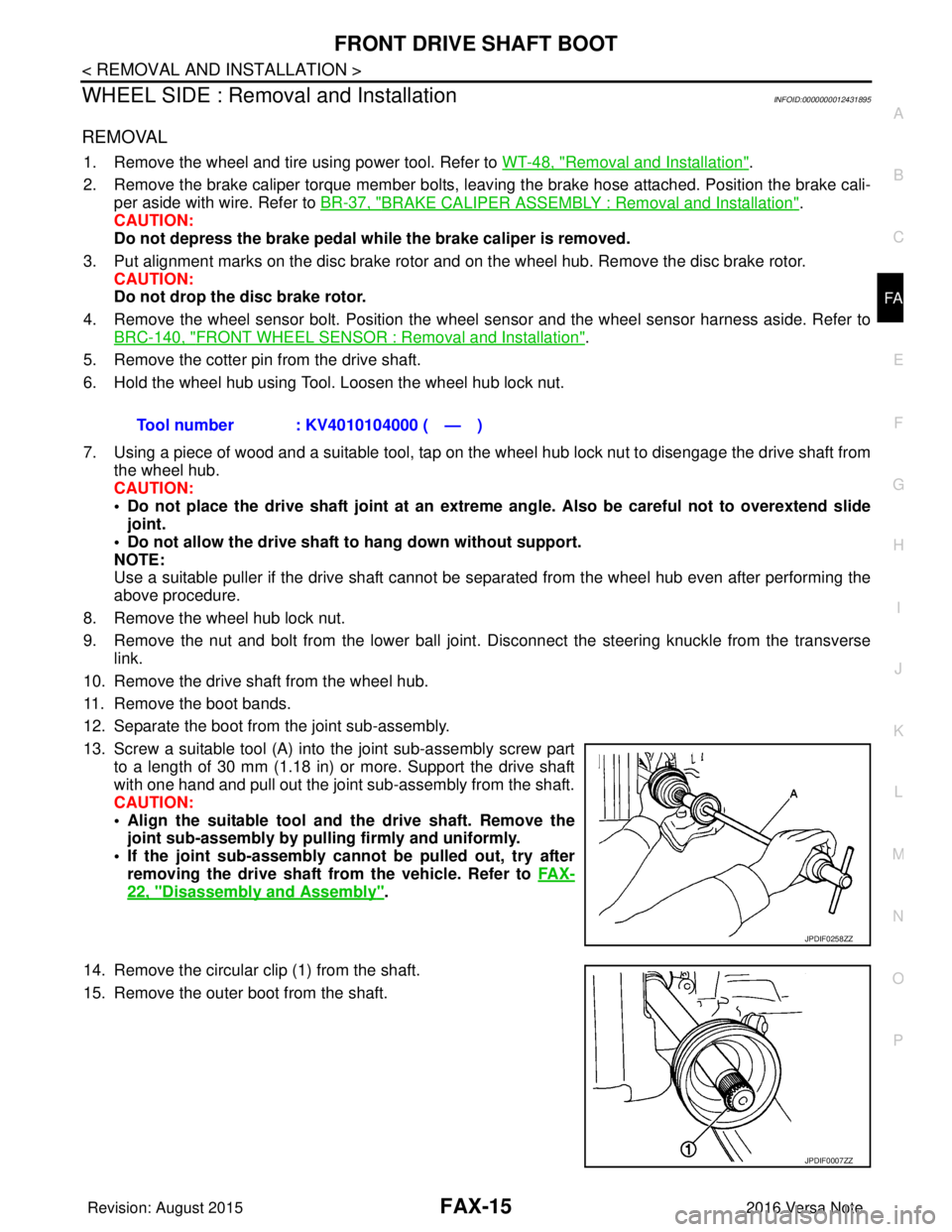
13. Screw a suitable tool (A) into the joint sub-assembly screw part to a length of 30 mm (1.18 in) or more. Support the drive shaft
with one hand and pull out the joint sub-assembly from the shaft.
CAUTION:
• Align the suitable tool an d the drive shaft. Remove the
joint sub-assembly by pull ing firmly and uniformly.
• If the joint sub-assembly cannot be pulled out, try after removing the drive shaft from the vehicle. Refer to FA X -
22, "Disassembly and Assembly".
14. Remove the circular clip (1) from the shaft.
15. Remove the outer boot from the shaft. Tool number : KV4010104000 ( — )
JPDIF0258ZZ
JPDIF0007ZZ
Revision: August 2015
2016 Versa Note
cardiagn.com
Page 1835 of 3641
FAX-18
< REMOVAL AND INSTALLATION >
FRONT DRIVE SHAFT BOOT
• Check each mating surface for water and foreign matter. If there is any water or foreign matter,
clean the mating surface.
17. Install the transverse link to the steering knuckle with the nut and bolt. Refer to FSU-10, "
Exploded View".
18. Hold the wheel hub using a Tool. Tighten the wheel hub lock nut. CAUTION:
• Since the drive shaft is assembled by press-fitting, use a torque wrench to tighten the wheel hub
lock nut. Do not use a power tool.
• Too much torque causes axle noise. Too little torque causes wheel bearing looseness. Tighten the wheel hub lock nut to the specification.
19. Install the cotter pin. Securely bend the cotter pin to prevent rattles. CAUTION:
Do not reuse the cotter pin.
20. Install the wheel sensor, the wheel sensor bolt, and the wheel sensor harness. Refer to BRC-140,
"FRONT WHEEL SENSOR : Removal and Installation".
21. Align the matching marks on the disc brake roto r and on the wheel hub. Install the disc brake rotor.
CAUTION:
Do not drop the disc brake rotor.
22. Remove the wire from the brake caliper. Install the brake caliper and the brake caliper torque member
bolts. Refer to BR-37, "
BRAKE CALIPER ASSEMBLY : Removal and Installation".
CAUTION:
Do not twist the brake hose.
23. Install the wheel and tire. Refer to WT-48, "
Removal and Installation".
24. Complete the inspection. Refer to FAX-18, "
Inspection".
TRANSAXLE SIDE
TRANSAXLE SIDE : Removal and InstallationINFOID:0000000012431896
Remove boot after drive shaft is removed from the vehicle.
• For drive shaft removal and installation, refer to FAX-19, "
Removal and Installation".
• For drive shaft disassembly and assembly, refer to FAX-22, "
Disassembly and Assembly".
InspectionINFOID:0000000012431897
INSPECTION AFTER INSTALLATION
1. Check the wheel sensor harness to be sure the connectors are fully seated.
2. Check the wheel alignment. Refer to FSU-7, "
Inspection".
Tool number : KV4010104000 ( — )
Revision: August 2015
2016 Versa Note
cardiagn.com
Page 1854 of 3641
FRONT COIL SPRING AND STRUTFSU-9
< REMOVAL AND INSTALLATION >
C
DF
G H
I
J
K L
M A
B
FSU
N
O P
REMOVAL AND INSTALLATION
FRONT COIL SPRING AND STRUT
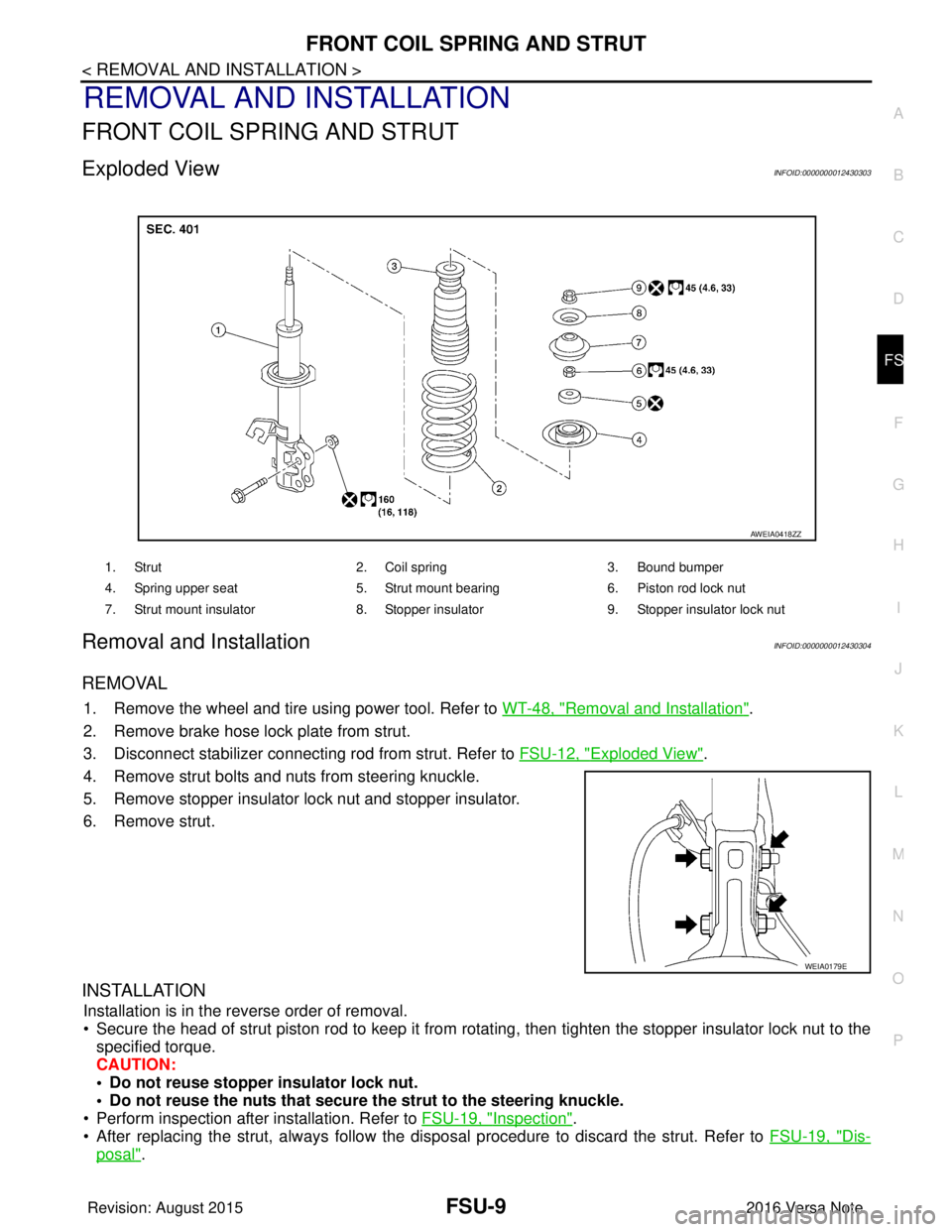
Exploded ViewINFOID:0000000012430303
Removal and InstallationINFOID:0000000012430304
REMOVAL
1. Remove the wheel and tire using power tool. Refer to WT-48, "Removal and Installation".
2. Remove brake hose lock plate from strut.
3. Disconnect stabilizer connecting rod from strut. Refer to FSU-12, "
Exploded View".
4. Remove strut bolts and nuts from steering knuckle.
5. Remove stopper insulator lock nut and stopper insulator.
6. Remove strut.
INSTALLATION
Installation is in the reverse order of removal.
• Secure the head of strut piston rod to keep it from rotating, then tighten the stopper insulator lock nut to the specified torque.
CAUTION:
• Do not reuse stopper insulator lock nut.
• Do not reuse the nuts that secure the strut to the steering knuckle.
• Perform inspection after installation. Refer to FSU-19, "
Inspection".
• After replacing the strut, always follow the dis posal procedure to discard the strut. Refer to FSU-19, "
Dis-
posal".
1. Strut2. Coil spring3. Bound bumper
4. Spring upper seat 5. Strut mount bearing6. Piston rod lock nut
7. Strut mount insulator 8. Stopper insulator9. Stopper insulator lock nut
AWEIA0418ZZ
WEIA0179E
Revision: August 2015 2016 Versa Note
cardiagn.com