ECU NISSAN PATHFINDER 2001 R50 / 2.G Workshop Manual
[x] Cancel search | Manufacturer: NISSAN, Model Year: 2001, Model line: PATHFINDER, Model: NISSAN PATHFINDER 2001 R50 / 2.GPages: 289, PDF Size: 2.45 MB
Page 246 of 289
Wheel nuts*:
When checking the tires, make sure no nuts
are missing, and check for any loose nuts.
Tighten if necessary.
Tire rotation*:
Tires should be rotated every 7,500 miles
(12,000 km). However, the timing for tire rota-
tion may vary according to your driving habits
and road surface conditions.
Wheel alignment and balance:
If the vehicle should pull to either side while
driving on a straight and level road, or if you
detect uneven or abnormal tire wear, there
may be a need for wheel alignment.
If the steering wheel or seat vibrates at normal
highway speeds, wheel balancing may be
needed.
Windshield wiper blades*:
Check for cracks or wear if they do not wipe
properly.
Doors and engine hood:
Check that all doors and the engine hood,
operate properly. Also ensure that all latches
lock securely. Lubricate hinges, latches, rollers
and links if necessary. Make sure that the
secondary latch keeps the hood from openingwhen the primary latch is released.
When driving in areas using road salt or other
corrosive materials, check lubrication fre-
quently.
Inside the vehicleLights*:
Make sure that the headlights, stop lights, tail
lights, turn signal lights, and other lights are all
operating properly and installed securely. Also
check headlight aim.INTERIOR MAINTENANCEThe maintenance items listed here should be
checked on a regular basis, such as when
performing periodic maintenance, cleaning the
vehicle, etc.
Warning lights and chimes:
Make sure that all warning lights and chimes
are operating properly.
Windshield wiper and washer*:
Check that the wipers and washer operate
properly and that the wipers do not streak.Windshield defroster:
Check that the air comes out of the defroster
outlets properly and in sufficient quantity when
operating the heater or air conditioner.
Steering wheel:
Check for changes in the steering conditions,
such as excessive freeplay, hard steering or
strange noises.
Seats:
Check seat position controls such as seat
adjusters, seatback recliner, etc. to ensure
they operate smoothly and that all latches lock
securely in every position. Check that the head
restraints move up and down smoothly and
that the locks (if so equipped) hold securely in
all latched positions.
Seat belts:
Check that all parts of the seat belt system
(e.g. buckles, anchors, adjusters and retrac-
tors) operate properly and smoothly, and are
installed securely. Check the belt webbing for
cuts, fraying, wear or damage.
Accelerator pedal:
Check the pedal for smooth operation and
make sure the pedal does not catch or require
Maintenance
9-3
Z
00.1.10/R50-D/V5
X
Page 247 of 289
uneven effort. Keep the floor mats away from
the pedal.
Clutch pedal*:
Make sure the pedal operates smoothly and
check that it has the proper free travel.
Brakes:
Check that the brakes do not pull the vehicle to
one side when applied.
Brake pedal and booster*:
Check the pedal for smooth operation and
make sure it has the proper distance under it
when depressed fully. Check the brake
booster function. Be certain to keep floormats
away from the pedal.
Parking brake*:
Check that the lever has the proper travel and
confirm that your vehicle is held securely on a
fairly steep hill with only the parking brake
applied.
Automatic transmission P (Park) position
mechanism:
On a fairly steep hill check that your vehicle is
held securely with the selector lever in the P
position without applying any brakes.
Under the hood and vehicleThe maintenance items listed here should be
checked periodically e.g. each time you check
the engine oil or refuel.
Windshield washer fluid*:
Check that there is adequate fluid in the tank.
Engine oil level*:
Check the level after parking the vehicle on a
level spot and turning off the engine. (Be sure
to wait a few minutes to allow the oil to drain
back into the sump.)
Brake and clutch fluid levels*:
Make sure that the brake and clutch fluid level
is between the MAX and MIN lines on the
reservoir.
Power steering fluid level* and lines:
Check the level when the fluid is cold and the
engine is turned off. Check the lines for proper
attachment, leaks, cracks, etc.
Automatic transmission fluid level*:
Check the level after putting the selector lever
in P (Park) with the engine idling.Engine coolant level*:
Check the coolant level when the engine is
cold.
Radiator and hoses:
Check the front of the radiator and clean off
any dirt, insects, leaves, etc., that may have
accumulated. Make sure the hoses have no
cracks, deformation, rot or loose connections.
Engine drive belts*:
Make sure that no belt is frayed, worn, cracked
or oily.
Battery*:
Check the fluid level in each cell. It should be
between the MAX and MIN lines.
Exhaust system:
Make sure there are no loose supports, cracks
or holes. If the sound of the exhaust seems
unusual or there is a smell of exhaust fumes,
immediately locate the trouble and correct it.
See ªPrecautions when starting and drivingº in
the ª5. Starting and drivingº section for exhaust
gas (carbon monoxide).
Underbody:
The underbody is frequently exposed to corro-
sive substances such as those used on icy
9-4
Maintenance
Z
00.1.10/R50-D/V5
X
Page 270 of 289

WARNING
IIt is extremely dangerous to ride in a
cargo area inside of a vehicle. In a
collision, people riding in these areas
are more likely to be seriously injured
or killed.
IDo not allow people to ride in any
area of your vehicle that is not
equipped with seats and seat belts.
IBe sure everyone in your vehicle is in
a seat and using a seat belt properly.TERMSIt is important to familiarize yourself with the
following terms before loading your vehicle:
ICurb Weight (actual weight of your vehicle)
- vehicle weight including: standard and
optional equipment, fluids, emergency
tools, and spare tire assembly. This weight
does notinclude passengers and cargo.
IGVW (Gross Vehicle Weight) - curb weight
plus the combined weight of passengers
and cargo.IGVWR (Gross Vehicle Weight Rating) -
maximum total weight (load) limit specified
for the vehicle.
IGAWR (Gross Axle Weight Rating) - maxi-
mum weight (load) limit specified for the
front or rear axle.
DETERMINING VEHICLE LOAD
CAPACITYThe load capacity of this vehicle is determined
by weight, not by available cargo space. For
example, a luggage rack, bike carrier, cartop
carrier or similar equipment does not increase
load carrying capacity of your vehicle.
To determine vehicle load capacity:
Vehicle weight can be determined by using a
commercial-grade scale, found at places such
as a truck stop, gravel quarry, grain elevator,
or a scrap metal recycling facility.
1) Determine the curb weight of your vehicle.
2) Compare the curb weight amount to the
GVWR specified for your vehicle to deter-
mine how much more weight your vehicle
can carry.
3) After loading (cargo and passengers), re-
weigh your vehicle to determine if either
GVWR or GAWR for your vehicle is ex-ceeded. If GVWR is exceeded, remove
cargo as necessary. If either the front or
rear GAWR is exceeded, shift the load or
remove cargo as necessary.
LOADING TIPSIThe GVW must not exceed GVWR or
GAWR as specified on the FMVSS Certifi-
cation Label.
IDo not load the front and rear axle to the
GAWR. Doing so will exceed the GVWR.
WARNING
IProperly secure all cargo to help pre-
vent it from sliding or shifting. Do not
place cargo higher than the seat-
backs. In a sudden stop or collision,
unsecured cargo could cause per-
sonal injury.
IDo not load your vehicle any heavier
than the GVWR or the maximum front
and rear GAWRs. If you do, parts on
your vehicle can break, or it can
change the way your vehicle handles.
This could result in loss of control
and cause personal injury.
VEHICLE LOADING
INFORMATION
Technical and consumer information
10-15
Z
00.1.10/R50-D/V5
X
Page 273 of 289

TOWING LOAD/SPECIFICATION CHART
TOWING LOAD/SPECIFICATION CHART
Unit: lb (kg)
MODEL
WEIGHTPATHFINDER VQ35DE/VG33E (6-Cyl.)
M/T A/T
MAXIMUM TRAILER WEIGHT*1 3,500 (1,588) 5,000 (2,268)
MAXIMUM TONGUE LOAD 350 (159) 500 (227)
GROSS COMBINED WEIGHT
RATING8,000 (3,628) 9,500 (4,308)
RECOMMENDED EQUIP-
MENT*2Sway Control Device (SCD)
*1: All towing above 1,000 lb (454 kg) requires the use of trailer brakes. NISSAN recommends the use
of a tandem axle trailer whenever towing above 3,000 lb (1,361 kg).
*2: A sway control device is recommended for all towing above 2,000 lb (907 kg). Sway control devices
are not offered by NISSAN. See a professional trailer/hitch outlet for a properly designed sway
control device for your trailer.
TOWING SAFETY
Trailer hitchCheck the towing capacity of your receiver
type frame mounted hitch. Choose a proper
hitch for your vehicle and trailer. A genuine
NISSAN trailer hitch is available from your
NISSAN dealer (US only). Make sure the
trailer hitch is securely attached to the vehicle,
to help avoid personal injury or property dam-
age due to sway caused by crosswinds, rough
road surfaces or passing trucks.
CAUTION
ISpecial hitches which include frame
reinforcements are required for tow-
ing above 2,000 lb (907 kg). Suitable
Genuine NISSAN hitches for pickup
truck and sport utility vehicles are
available at an authorized NISSAN
dealer.
IDo not use axle-mounted hitches.
IDo not modify the vehicle exhaust
system, brake system, etc. to install a
trailer hitch.
10-18
Technical and consumer information
Z
00.1.10/R50-D/V5
X
Page 274 of 289
IAfter the hitch is removed, seal the
bolt holes to prevent exhaust fumes,
water or dust from entering the pas-
senger compartment.
IRegularly check all hitch mounting
bolts are securely mounted.
ITo reduce the possibility of additional
damage if your vehicle is struck from
the rear, where practical, remove the
hitch and/or receiver when not in use.
INever connect a trailer brake system
directly to the vehicle brake system.Tire pressuresIWhen towing a trailer, inflate the vehicle
tires to the recommended cold tire pressure
indicated on the tire placard (affixed to the
glove box lid).
ITrailer tire condition, size, load rating and
proper inflation pressure should be in ac-
cordance with the trailer and tire manufac-
turers' specifications.Safety chainsAlways use a suitable chain between yourvehicle and the trailer. The chain should be
crossed and should be attached to the hitch,
not to the vehicle bumper or axle. Be sure to
leave enough slack in the chain to permit
turning corners.
Trailer lightsTrailer lights should comply with Federal
and/or local regulations.
When wiring vehicle for towing connection,
connect stop and tail light pickup into the
vehicle electrical circuit at point between
the sensor and stop light switch or light
switch.Trailer brakesIf your trailer is equipped with a braking sys-
tem, make sure it conforms to Federal and/or
local regulations and that it is properly in-
stalled.
WARNING
Never connect a trailer brake system
directly to the vehicle brake system.Trailer towing tipsIn order to gain skill and an understanding ofthe vehicle's behavior, you should practice
turning, stopping and backing up in an area
which is free from traffic. Steering stability and
braking performance will be somewhat differ-
ent than under normal driving conditions.
IAlways secure items in the trailer to prevent
load shift while driving.
IAvoid abrupt starts, acceleration or stops.
IAvoid sharp turns or lane changes.
IAlways drive your vehicle at a moderate
speed.
IAlways block the wheels on both vehicle
and trailer when parking. Parking on a
slope is not recommended; however, if you
must do so, and if your vehicle is equipped
with automatic transmission, first block the
wheels and apply the parking brake, and
then move the transmission selector lever
into the P position. If you move the selector
lever to the P position before blocking the
wheels and applying the parking brake,
transmission damage could occur.
IWhen going down a hill, shift into a lower
gear and use the engine braking effect.
When ascending a long grade, downshift
the transmission to a lower gear and reduce
speed to reduce chances of engine over-
loading and/or overheating.
Technical and consumer information
10-19
Z
00.1.10/R50-D/V5
X
Page 277 of 289
You may notify NISSAN by contact-
ing our Consumer Affairs Depart-
ment, toll-free, at 1-800-NISSAN-1.
In Hawaii call (808) 836-0888.
Due to legal requirements in some states/
areas, your vehicle may be required to be in
what is called the ready condition for an
Inspection/Maintenance (I/M) test of the emis-
sion control system.
The vehicle is set to the ready condition when
it is driven through certain driving patterns.
Usually, the ready condition can be obtained
by ordinary usage of the vehicle.
If a powertrain system component is repaired
or the battery is disconnected, the vehicle may
be reset to a not ready condition. Before taking
the I/M test, drive the vehicle through the
following pattern to set the vehicle to the ready
condition. If you cannot or do not want to
perform the driving pattern, an NISSAN dealer
can conduct it for you.
WARNING
Always drive the vehicle in a safe and
prudent manner according to traffic con-
ditions, and obey all traffic laws.
1. Start the engine when the engine coolant
temperature gauge needle points to C. Al-
low the engine to idle until the gauge needlepoints between the C and H (normal oper-
ating temperature).
2. Accelerate the vehicle to 55 MPH (88
km/h), then quickly release the accelerator
pedal completely and keep it released for at
least 6 seconds.
3. Quickly depress the accelerator pedal for a
moment, then drive the vehicle at a speed
of 53 to 60 MPH (86 to 96 km/h) for at least
5 minutes.
4. Stop the vehicle.
5. Accelerate the vehicle to 35 MPH (55 km/h)
and maintain the speed for 20 seconds.
6. Repeat steps 4 and 5 at least 3 times.
7. Accelerate the vehicle to 55 MPH (88 km/h)
and maintain the speed for at least 3 min-
utes.
8. Stop the vehicle (shift lever in the ªPº or ªNº
position).
9. Rev the engine up between 2,500 and
3,500 rpm and hold it for 3 consecutive
minutes, then release the accelerator pedal
completely.
10.Wait 5 second at idle.
11.Rev the engine up between 2,000 andREADINESS FOR INSPECTION/
MAINTENANCE (I/M) TEST (US
only)
10-22
Technical and consumer information
Z
00.1.10/R50-D/V5
X
Page 278 of 289

3,000 rpm and maintain it for 5 consecutive
minutes.
12.Turn the engine off.
13.Repeat steps 1 through 8 at least one more
time.
If step 1 through 7 is interrupted, repeat the
preceding step. Any safe driving mode is ac-
ceptable between steps. Do not stop the en-
gine until step 7 is completed.
Dynamometer testing for Inspection/
Maintenance (I/M) test (US only)Due to legal requirements in some
states/areas, your vehicle may be tested for
emissions on a dynamometer. The transfer
control lever (if so equipped) MUST be in the
2H position for I/M testing on a two wheel
dynamometer.
WARNING
IIf the transfer control lever is not in
the 2H position during the dynamom-
eter I/M testing, the vehicle could
come off the dynamometer and cause
serious personal injury and/or body
damage to the vehicle.ISerious damage will occur to the
4WD system if the transfer control
lever is not in the 2H position.
Technical and consumer information
10-23
Z
00.1.10/R50-D/V5
X
Page 284 of 289
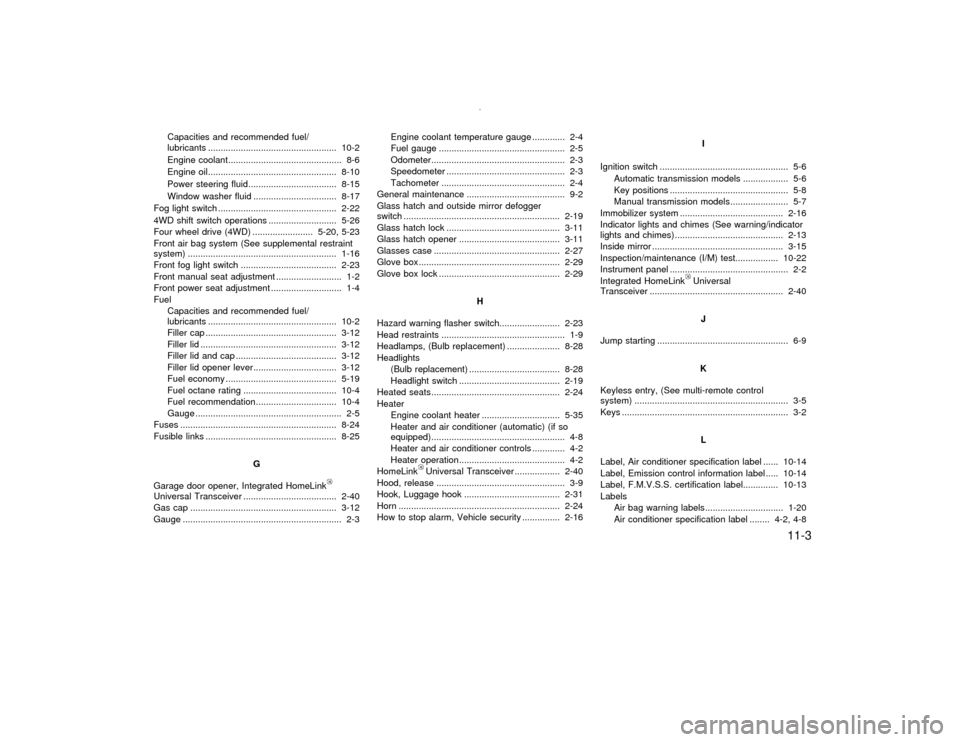
Capacities and recommended fuel/
lubricants ................................................... 10-2
Engine coolant............................................. 8-6
Engine oil................................................... 8-10
Power steering fluid................................... 8-15
Window washer fluid ................................. 8-17
Fog light switch ............................................... 2-22
4WD shift switch operations ........................... 5-26
Four wheel drive (4WD) ........................ 5-20, 5-23
Front air bag system (See supplemental restraint
system) ........................................................... 1-16
Front fog light switch ...................................... 2-23
Front manual seat adjustment .......................... 1-2
Front power seat adjustment ............................ 1-4
Fuel
Capacities and recommended fuel/
lubricants ................................................... 10-2
Filler cap .................................................... 3-12
Filler lid ...................................................... 3-12
Filler lid and cap ........................................ 3-12
Filler lid opener lever................................. 3-12
Fuel economy ............................................ 5-19
Fuel octane rating ..................................... 10-4
Fuel recommendation................................ 10-4
Gauge .......................................................... 2-5
Fuses .............................................................. 8-24
Fusible links .................................................... 8-25
G
Garage door opener, Integrated HomeLink
Universal Transceiver ..................................... 2-40
Gas cap .......................................................... 3-12
Gauge ............................................................... 2-3Engine coolant temperature gauge ............. 2-4
Fuel gauge .................................................. 2-5
Odometer..................................................... 2-3
Speedometer ............................................... 2-3
Tachometer ................................................. 2-4
General maintenance ....................................... 9-2
Glass hatch and outside mirror defogger
switch .............................................................. 2-19
Glass hatch lock ............................................. 3-11
Glass hatch opener ........................................ 3-11
Glasses case .................................................. 2-27
Glove box........................................................ 2-29
Glove box lock ................................................ 2-29
H
Hazard warning flasher switch........................ 2-23
Head restraints ................................................. 1-9
Headlamps, (Bulb replacement) ..................... 8-28
Headlights
(Bulb replacement) .................................... 8-28
Headlight switch ........................................ 2-19
Heated seats................................................... 2-24
Heater
Engine coolant heater ............................... 5-35
Heater and air conditioner (automatic) (if so
equipped)..................................................... 4-8
Heater and air conditioner controls ............. 4-2
Heater operation.......................................... 4-2
HomeLink
Universal Transceiver .................. 2-40
Hood, release ................................................... 3-9
Hook, Luggage hook ...................................... 2-31
Horn ................................................................ 2-24
How to stop alarm, Vehicle security ............... 2-16I
Ignition switch ................................................... 5-6
Automatic transmission models .................. 5-6
Key positions ............................................... 5-8
Manual transmission models....................... 5-7
Immobilizer system ......................................... 2-16
Indicator lights and chimes (See warning/indicator
lights and chimes) ........................................... 2-13
Inside mirror .................................................... 3-15
Inspection/maintenance (I/M) test................. 10-22
Instrument panel ............................................... 2-2
Integrated HomeLink
Universal
Transceiver ..................................................... 2-40
J
Jump starting .................................................... 6-9
K
Keyless entry, (See multi-remote control
system) ............................................................. 3-5
Keys .................................................................. 3-2
L
Label, Air conditioner specification label ...... 10-14
Label, Emission control information label ..... 10-14
Label, F.M.V.S.S. certification label.............. 10-13
Labels
Air bag warning labels............................... 1-20
Air conditioner specification label ........ 4-2, 4-8
Z
00.1.10/R50-D/V5
X
11-3
Page 286 of 289

On-pavement and offroad driving
precautions .................................................. 5-3
Precautions when starting and driving ........ 5-2
Push starting ................................................... 6-11
R
Rack, Luggage rack ........................................ 2-34
Radio, Car phone or CB radio ........................ 4-27
Readiness for inspection/maintenance (I/M) test
(US only) ....................................................... 10-22
Rear door ........................................................ 3-10
Rear door lock ................................................ 3-10
Child safety rear door lock .......................... 3-4
Rear door opener ........................................... 3-10
Rear power point ............................................ 2-25
Rear seat adjustment ....................................... 1-6
Rear window wiper and washer switch .......... 2-18
Registering your vehicle in another
country .......................................................... 10-12
Remote keyless entry, (See multi-remote control
system) ............................................................. 3-5
Reporting safety defects (US only)............... 10-21
Rollover ............................................................. 5-4
S
Safety
Child seat belts.......................................... 1-24
Reporting safety defects (US only) ......... 10-21
Towing safety .......................................... 10-18
Seat
Belt extenders ........................................... 1-30
Belt hook ................................................... 1-28Belt maintenance....................................... 1-31
Belt warning light ....................................... 1-22
Belt warning light and chime ..................... 2-12
Seat adjustment
Front manual seat adjustment .................... 1-2
Front power seat adjustment ...................... 1-4
Rear seat adjustment .................................. 1-6
Seat belt(s)
Child safety................................................ 1-24
Infants and small children ......................... 1-24
Injured persons.......................................... 1-25
Larger children .......................................... 1-25
Pre-tensioner seat belt system ................. 1-19
Precautions on seat belt usage ................ 1-23
Pregnant women ....................................... 1-25
Seat belt cleaning........................................ 7-4
Seat belts .................................................. 1-22
Three-point type with retractor .................. 1-25
Two-point type without retractor (rear center
lap belt)...................................................... 1-29
Seat(s), Seats ................................................... 1-2
Seats, Heated seats ....................................... 2-24
Security systems (Nissan Vehicle Immobilizer
System), Engine start ..................................... 2-16
Security systems (See vehicle security
system) ........................................................... 2-15
Servicing air conditioner................... 4-2, 4-8, 4-10
Shift lock release ............................................ 5-13
Shifting
Automatic transmission ............................. 5-10
Manual transmission ................................. 5-14
Shoulder belt height adjustment, For front
seats ............................................................... 1-28Side air bag system (See supplemental side air
bag system) .................................................... 1-18
Spare tire carrier ............................................. 3-10
Spark plugs ..................................................... 8-19
Speedometer .................................................... 2-3
Starting
Before starting the engine ........................... 5-9
Jump starting ............................................... 6-9
Precautions when starting and driving ........ 5-2
Push starting ............................................. 6-10
Starting the engine ...................................... 5-9
Steering
Power steering fluid................................... 8-15
Power steering system .............................. 5-31
Tilting steering wheel ................................ 3-14
Storage ........................................................... 2-27
Sun shade....................................................... 2-38
Sun visors ....................................................... 3-14
Sunroof, Electric sunroof ................................ 2-36
Supplemental air bag warning labels ............. 1-20
Supplemental air bag warning light ....... 1-21, 2-12
Supplemental front air bag system ................. 1-16
Supplemental restraint system ....................... 1-10
Precautions on supplemental restraint
system ....................................................... 1-10
Supplemental side air bag system ................. 1-18
Switch
4WD shift switch operations...................... 5-26
Front fog light switch ................................. 2-23
Glass hatch and outside mirror defogger
switch......................................................... 2-19
Hazard warning flasher switch .................. 2-23
Headlight switch ........................................ 2-19
Ignition switch .............................................. 5-6
Z
00.1.10/R50-D/V5
X
11-5
Page 287 of 289

Ignition switch automatic transmission
models ......................................................... 5-6
Ignition switch manual transmission
models ......................................................... 5-7
Overdrive switch ........................................ 5-13
Power door lock switch ............................... 3-4
Turn signal switch ..................................... 2-22
T
Tachometer ....................................................... 2-4
Temperature display ......................................... 2-6
Temperature gauge, Engine coolant temperature
gauge ................................................................ 2-4
Theft (Nissan Vehicle Immobilizer System),
Engine start..................................................... 2-16
Three way catalyst ............................................ 5-3
Tilting steering wheel ...................................... 3-14
Tire
Flat tire ........................................................ 6-2
Uniform tire quality grading ..................... 10-20
Tires
Spare tire ................................................... 8-36
Tire chains ................................................. 8-34
Tire placard ............................................. 10-14
Tire pressure ............................................. 8-32
Tire rotation ............................................... 8-34
Type of tires .............................................. 8-33
wheel/tire size.......................................... 10-11
Wheels and tires ....................................... 8-32
Tonneau cover ................................................ 2-33
Top tether strap child restraints ...................... 1-40
Towing
Tow truck towing ....................................... 6-12Towing a trailer........................................ 10-16
Towing load/specification chart ............... 10-16
Towing safety .......................................... 10-18
Trailer towing ................................................ 10-16
Transceiver, Integrated HomeLink
Universal
Transceiver ..................................................... 2-40
Transfer case shifting procedures ......... 5-21, 5-23
Transmission
Automatic transmission fluid (ATF) ........... 8-13
Driving with automatic transmission.......... 5-10
Driving with manual transmission ............. 5-14
Transmission selector lever lock
release ....................................................... 5-13
Transmitter (See multi-remote control
system) ............................................................. 3-5
Traveling or registering your vehicle in another
country .......................................................... 10-12
Turn signal switch ........................................... 2-22
U
Underbody cleaning .......................................... 7-3
Uniform tire quality grading........................... 10-20
V
Vanity mirror light ............................................ 2-40
Vehicle
Dimensions and weights ......................... 10-11
Identification number (VIN) ..................... 10-12
Loading information ................................. 10-15
Vehicle recovery, (freeing a stuck vehicle)..... 6-15
Vehicle security system .................................. 2-15
Ventilators ......................................................... 4-2W
Warning, Hazard warning flasher switch ........ 2-23
Warning labels, Air bag warning labels .......... 1-20
Warning light
4WD warning light ..................................... 5-28
Air bag warning light ........................ 1-21, 2-12
Brake warning light.................................... 2-10
Door open.................................................. 2-11
Low fuel warning light ............................... 2-12
Seat belt warning light and chime............. 2-12
Warning/indicator lights and chimes ................. 2-9
Warranty, Emission control system
warranty ........................................................ 10-21
Washer switch
Rear window wiper and washer switch ..... 2-18
Windshield wiper and washer switch ........ 2-18
Washing ............................................................ 7-2
Waxing .............................................................. 7-2
Weights (See dimensions and weights) ....... 10-11
Wheel/tire size .............................................. 10-11
Wheels and tires ............................................. 8-31
Cleaning aluminum alloy wheels................. 7-3
Window washer fluid ....................................... 8-17
Window(s)
Cleaning ...................................................... 7-3
Power windows ......................................... 2-35
Windshield wiper and washer switch.............. 2-17
Wiper
Blades........................................................ 8-21
Rear window wiper and washer switch ..... 2-18
Windshield wiper and washer switch ........ 2-18
Z
00.1.10/R50-D/V5
X
11-6