battery NISSAN PATROL 2000 Electronic Owner's Manual
[x] Cancel search | Manufacturer: NISSAN, Model Year: 2000, Model line: PATROL, Model: NISSAN PATROL 2000Pages: 1033, PDF Size: 30.71 MB
Page 124 of 1033
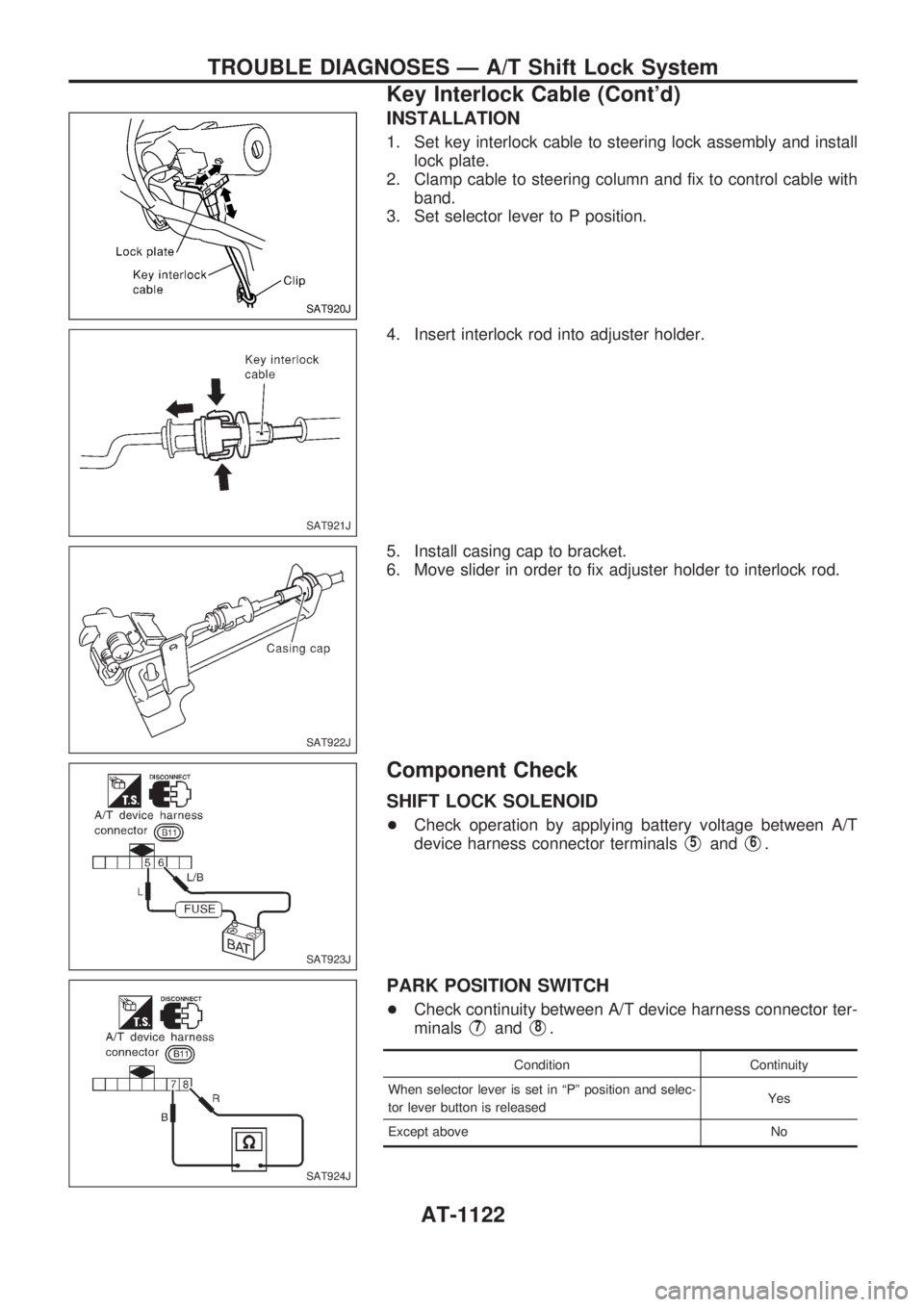
INSTALLATION
1. Set key interlock cable to steering lock assembly and install
lock plate.
2. Clamp cable to steering column and fix to control cable with
band.
3. Set selector lever to P position.
4. Insert interlock rod into adjuster holder.
5. Install casing cap to bracket.
6. Move slider in order to fix adjuster holder to interlock rod.
Component Check
SHIFT LOCK SOLENOID
+Check operation by applying battery voltage between A/T
device harness connector terminals
V5andV6.
PARK POSITION SWITCH
+Check continuity between A/T device harness connector ter-
minals
V7andV8.
Condition Continuity
When selector lever is set in ªPº position and selec-
tor lever button is releasedYes
Except above No
SAT920J
SAT921J
SAT922J
SAT923J
SAT924J
TROUBLE DIAGNOSES Ð A/T Shift Lock System
Key Interlock Cable (Cont'd)
AT-1122
Page 129 of 1033
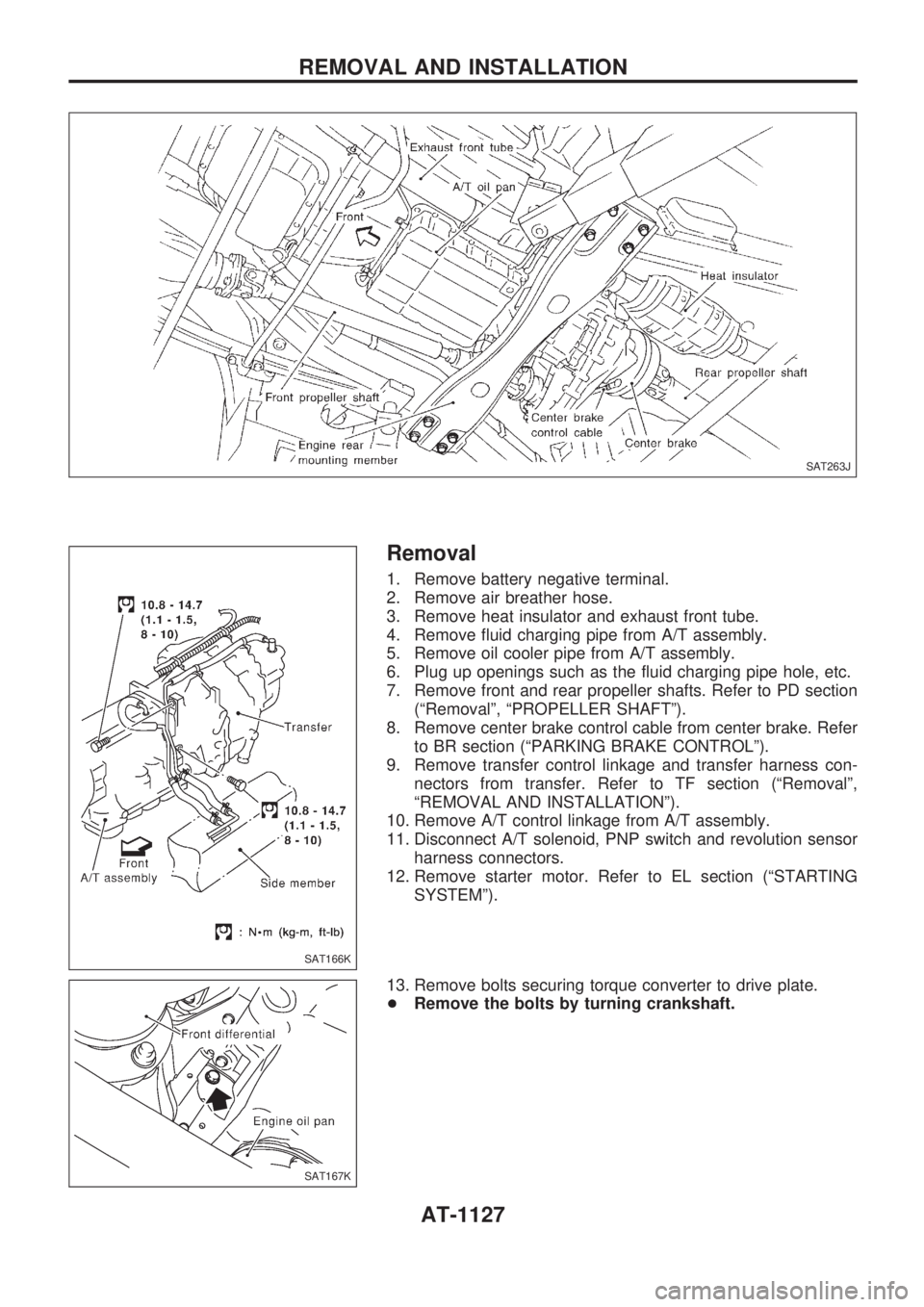
Removal
1. Remove battery negative terminal.
2. Remove air breather hose.
3. Remove heat insulator and exhaust front tube.
4. Remove fluid charging pipe from A/T assembly.
5. Remove oil cooler pipe from A/T assembly.
6. Plug up openings such as the fluid charging pipe hole, etc.
7. Remove front and rear propeller shafts. Refer to PD section
(ªRemovalº, ªPROPELLER SHAFTº).
8. Remove center brake control cable from center brake. Refer
to BR section (ªPARKING BRAKE CONTROLº).
9. Remove transfer control linkage and transfer harness con-
nectors from transfer. Refer to TF section (ªRemovalº,
ªREMOVAL AND INSTALLATIONº).
10. Remove A/T control linkage from A/T assembly.
11. Disconnect A/T solenoid, PNP switch and revolution sensor
harness connectors.
12. Remove starter motor. Refer to EL section (ªSTARTING
SYSTEMº).
13. Remove bolts securing torque converter to drive plate.
+Remove the bolts by turning crankshaft.
SAT263J
SAT166K
SAT167K
REMOVAL AND INSTALLATION
AT-1127
Page 235 of 1033
On Board Diagnosis Logic ............................... 1092
DTC Confirmation Procedure .......................... 1092
Wiring Diagram ................................................ 1093
Diagnostic Procedure....................................... 1094
DTC 0104 VEHICLE SPEED SEN...................... 1096
Description ....................................................... 1096
ECM Terminals and Reference Value ............. 1096
On Board Diagnosis Logic ............................... 1096
Overall Function Check ................................... 1097
Wiring Diagram ................................................ 1098
Diagnostic Procedure....................................... 1099
DTC 0203 ACCEL POS SW (F/C)...................... 1100
Description ....................................................... 1100
CONSULT-II Reference Value in Data Monitor
Mode ................................................................ 1100
ECM Terminals and Reference Value ............. 1100
On Board Diagnosis Logic ............................... 1100
DTC Confirmation Procedure .......................... 1101
Wiring Diagram ................................................ 1102
Diagnostic Procedure....................................... 1103
DTC 0208 OVER HEAT....................................... 1105
Description ....................................................... 1105
CONSULT-II Reference Value in Data Monitor
Mode ................................................................ 1105
ECM Terminals and Reference Value ............. 1106
On Board Diagnosis Logic ............................... 1106
Overall Function Check ................................... 1107
Wiring Diagram ................................................ 1108
Diagnostic Procedure....................................... 1109
Main 12 Causes of Overheating ...................... 1116
DTC 0301 ECM 2, DTC 0901 ECM 12............... 1117
Description ....................................................... 1117
On Board Diagnosis Logic ............................... 1117
DTC Confirmation Procedure .......................... 1117
Diagnostic Procedure....................................... 1118
DTC 0402 P9zFUEL TEMP SEN......................... 1119
Description ....................................................... 1119
CONSULT-II Reference Value in Data Monitor
Mode ................................................................ 1120
ECM Terminals and Reference Value ............. 1120
On Board Diagnosis Logic ............................... 1120
DTC Confirmation Procedure .......................... 1121
Wiring Diagram ................................................ 1122
Diagnostic Procedure....................................... 1123
DTC 0403 ACCEL POS SENSOR...................... 1125
Description ....................................................... 1125
CONSULT-II Reference Value in Data Monitor
Mode ................................................................ 1125
ECM Terminals and Reference Value ............. 1126
On Board Diagnosis Logic ............................... 1126
DTC Confirmation Procedure .......................... 1127
Wiring Diagram ................................................ 1128
Diagnostic Procedure....................................... 1130
DTC 0406 INT AIR VOL...................................... 1138On Board Diagnosis Logic ............................... 1138
DTC Confirmation Procedure .......................... 1138
Diagnostic Procedure....................................... 1139
DTC 0407 CRANK POS SEN (TDC).................. 1140
Description ....................................................... 1140
CONSULT-II Reference Value in Data Monitor
Mode ................................................................ 1140
ECM Terminals and Reference Value ............. 1140
On Board Diagnosis Logic ............................... 1141
DTC Confirmation Procedure .......................... 1141
Wiring Diagram ................................................ 1142
Diagnostic Procedure....................................... 1143
DTC 0502 BATTERY VOLTAGE........................ 1146
On Board Diagnosis Logic ............................... 1146
DTC Confirmation Procedure .......................... 1146
Diagnostic Procedure....................................... 1146
DTC 0504 A/T COMM LINE................................ 1148
System Description .......................................... 1148
ECM Terminals and Reference Value ............. 1148
On Board Diagnosis Logic ............................... 1148
DTC Confirmation Procedure .......................... 1149
Overall Function Check ................................... 1149
Wiring Diagram ................................................ 1150
Diagnostic Procedure....................................... 1151
DTC 0701 P1zCAM POS SEN............................. 1153
Description ....................................................... 1153
CONSULT-II Reference Value in Data Monitor
Mode ................................................................ 1154
ECM Terminals and Reference Value ............. 1154
On Board Diagnosis Logic ............................... 1154
DTC Confirmation Procedure .......................... 1155
Wiring Diagram ................................................ 1156
Diagnostic Procedure....................................... 1157
DTC 0702 P2zTDC PULSE SIG........................... 1159
Description ....................................................... 1159
CONSULT-II Reference Value in Data Monitor
Mode ................................................................ 1160
ECM Terminals and Reference Value ............. 1160
On Board Diagnosis Logic ............................... 1160
DTC Confirmation Procedure .......................... 1161
Wiring Diagram ................................................ 1162
Diagnostic Procedure....................................... 1163
DTC 0703 P3zPUMP COMM LINE...................... 1165
Description ....................................................... 1165
CONSULT-II Reference Value in Data Monitor
Mode ................................................................ 1166
ECM Terminals and Reference Value ............. 1166
On Board Diagnosis Logic ............................... 1166
DTC Confirmation Procedure .......................... 1167
Wiring Diagram ................................................ 1168
Diagnostic Procedure....................................... 1169
DTC 0704 P4zSPILL/V CIRC, DTC 0706
P6zSPILL VALVE................................................. 1171
Description ....................................................... 1171
EC-1002
Page 241 of 1033
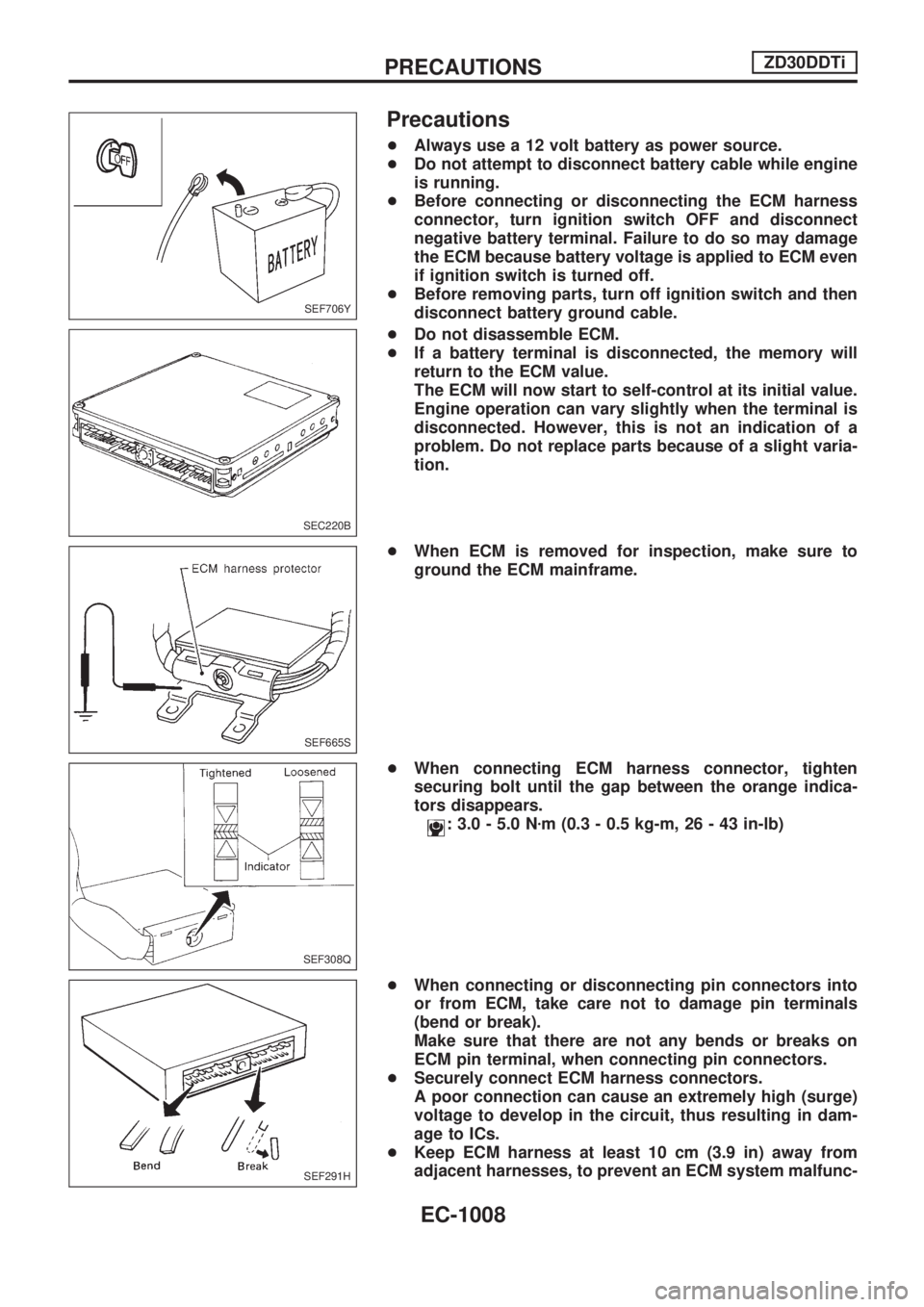
Precautions
+Always use a 12 volt battery as power source.
+Do not attempt to disconnect battery cable while engine
is running.
+Before connecting or disconnecting the ECM harness
connector, turn ignition switch OFF and disconnect
negative battery terminal. Failure to do so may damage
the ECM because battery voltage is applied to ECM even
if ignition switch is turned off.
+Before removing parts, turn off ignition switch and then
disconnect battery ground cable.
+Do not disassemble ECM.
+If a battery terminal is disconnected, the memory will
return to the ECM value.
The ECM will now start to self-control at its initial value.
Engine operation can vary slightly when the terminal is
disconnected. However, this is not an indication of a
problem. Do not replace parts because of a slight varia-
tion.
+When ECM is removed for inspection, make sure to
ground the ECM mainframe.
+When connecting ECM harness connector, tighten
securing bolt until the gap between the orange indica-
tors disappears.
: 3.0 - 5.0 Nzm (0.3 - 0.5 kg-m, 26 - 43 in-lb)
+When connecting or disconnecting pin connectors into
or from ECM, take care not to damage pin terminals
(bend or break).
Make sure that there are not any bends or breaks on
ECM pin terminal, when connecting pin connectors.
+Securely connect ECM harness connectors.
A poor connection can cause an extremely high (surge)
voltage to develop in the circuit, thus resulting in dam-
age to ICs.
+Keep ECM harness at least 10 cm (3.9 in) away from
adjacent harnesses, to prevent an ECM system malfunc-
SEF706Y
SEC220B
SEF665S
SEF308Q
SEF291H
PRECAUTIONSZD30DDTi
EC-1008
Page 251 of 1033
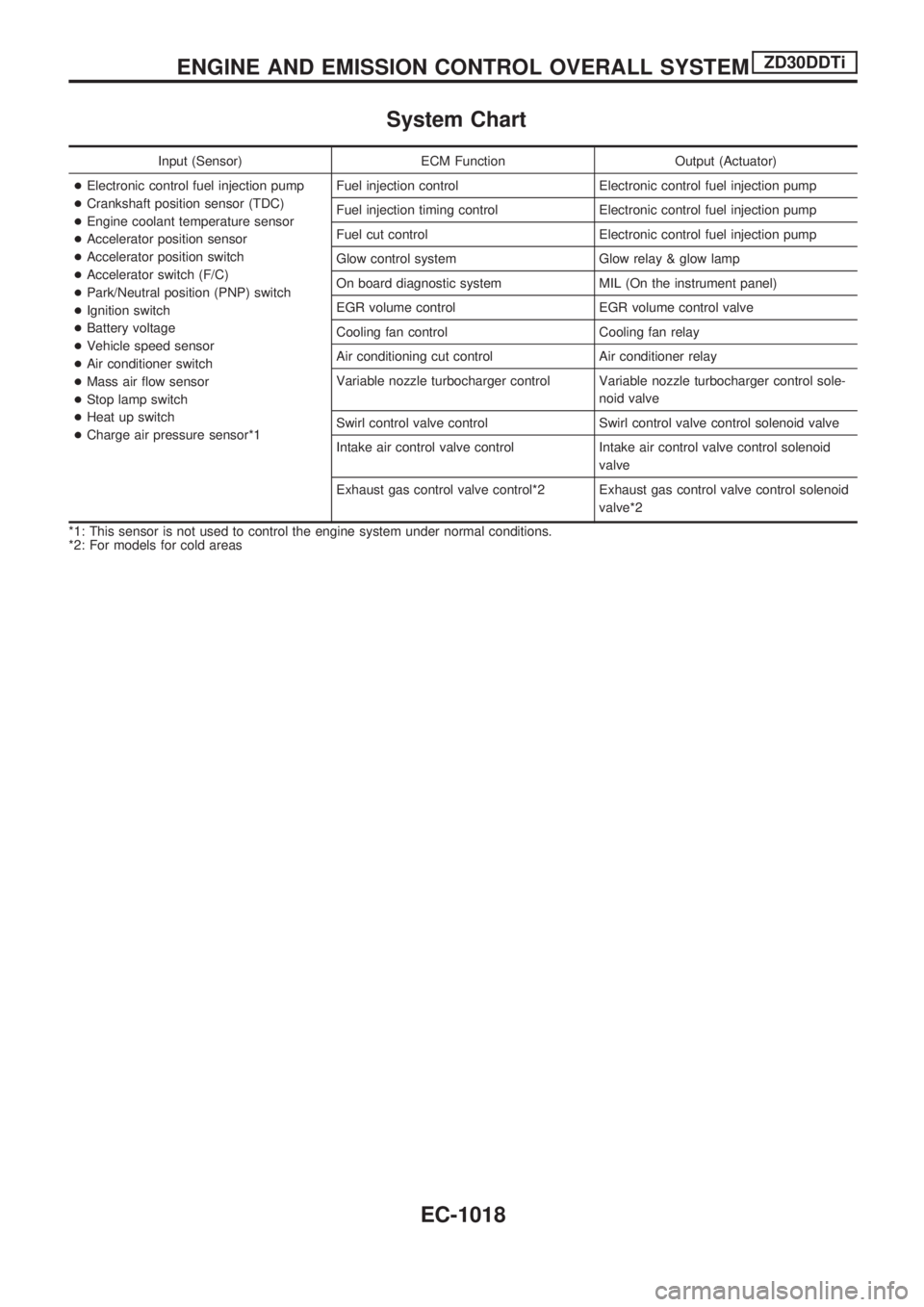
System Chart
Input (Sensor) ECM Function Output (Actuator)
+Electronic control fuel injection pump
+Crankshaft position sensor (TDC)
+Engine coolant temperature sensor
+Accelerator position sensor
+Accelerator position switch
+Accelerator switch (F/C)
+Park/Neutral position (PNP) switch
+Ignition switch
+Battery voltage
+Vehicle speed sensor
+Air conditioner switch
+Mass air flow sensor
+Stop lamp switch
+Heat up switch
+Charge air pressure sensor*1Fuel injection control Electronic control fuel injection pump
Fuel injection timing control Electronic control fuel injection pump
Fuel cut control Electronic control fuel injection pump
Glow control system Glow relay & glow lamp
On board diagnostic system MIL (On the instrument panel)
EGR volume control EGR volume control valve
Cooling fan control Cooling fan relay
Air conditioning cut control Air conditioner relay
Variable nozzle turbocharger control Variable nozzle turbocharger control sole-
noid valve
Swirl control valve control Swirl control valve control solenoid valve
Intake air control valve control Intake air control valve control solenoid
valve
Exhaust gas control valve control*2 Exhaust gas control valve control solenoid
valve*2
*1: This sensor is not used to control the engine system under normal conditions.
*2: For models for cold areas
ENGINE AND EMISSION CONTROL OVERALL SYSTEMZD30DDTi
EC-1018
Page 252 of 1033
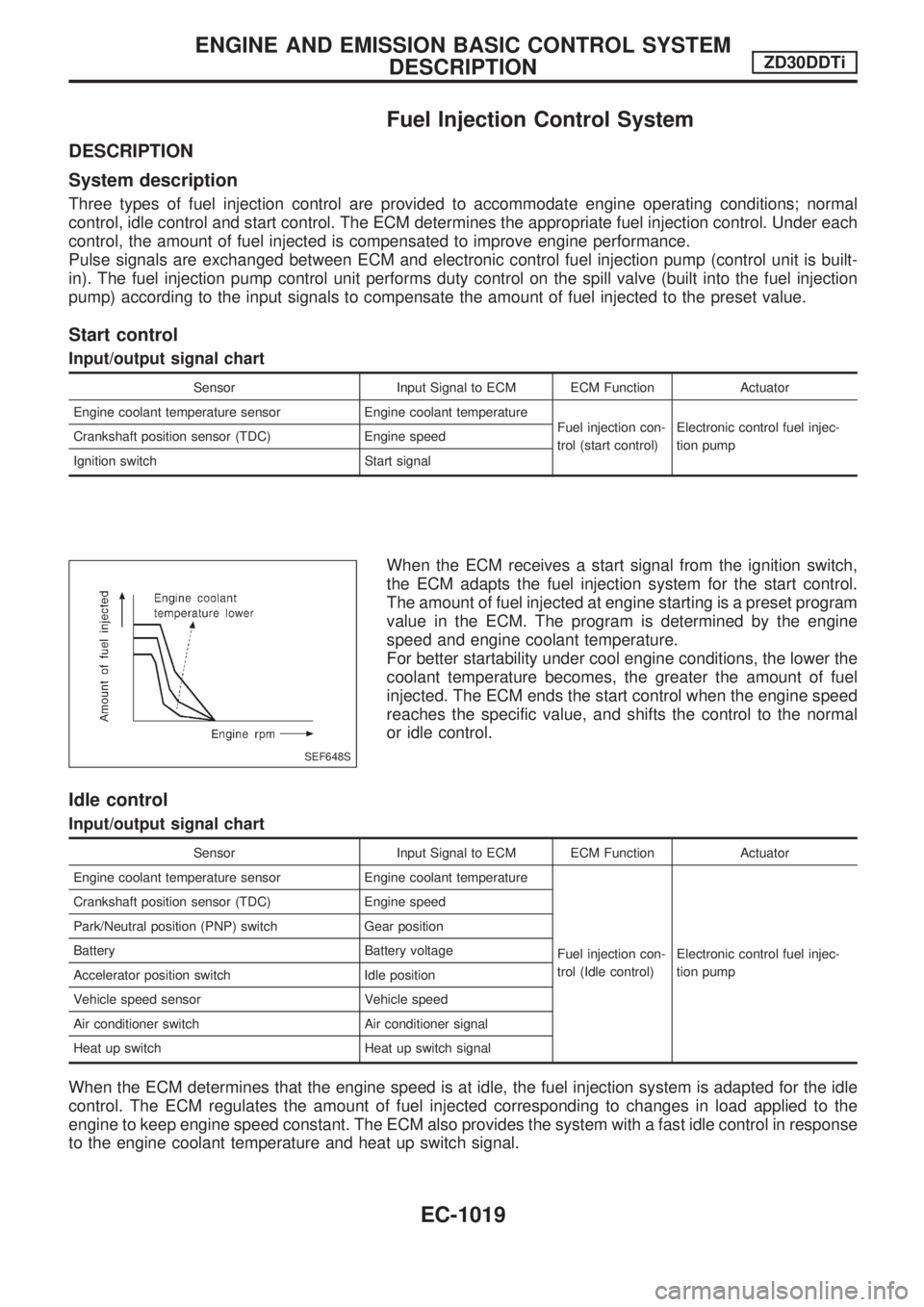
Fuel Injection Control System
DESCRIPTION
System description
Three types of fuel injection control are provided to accommodate engine operating conditions; normal
control, idle control and start control. The ECM determines the appropriate fuel injection control. Under each
control, the amount of fuel injected is compensated to improve engine performance.
Pulse signals are exchanged between ECM and electronic control fuel injection pump (control unit is built-
in). The fuel injection pump control unit performs duty control on the spill valve (built into the fuel injection
pump) according to the input signals to compensate the amount of fuel injected to the preset value.
Start control
Input/output signal chart
Sensor Input Signal to ECM ECM Function Actuator
Engine coolant temperature sensor Engine coolant temperature
Fuel injection con-
trol (start control)Electronic control fuel injec-
tion pump Crankshaft position sensor (TDC) Engine speed
Ignition switch Start signal
When the ECM receives a start signal from the ignition switch,
the ECM adapts the fuel injection system for the start control.
The amount of fuel injected at engine starting is a preset program
value in the ECM. The program is determined by the engine
speed and engine coolant temperature.
For better startability under cool engine conditions, the lower the
coolant temperature becomes, the greater the amount of fuel
injected. The ECM ends the start control when the engine speed
reaches the specific value, and shifts the control to the normal
or idle control.
Idle control
Input/output signal chart
Sensor Input Signal to ECM ECM Function Actuator
Engine coolant temperature sensor Engine coolant temperature
Fuel injection con-
trol (Idle control)Electronic control fuel injec-
tion pump Crankshaft position sensor (TDC) Engine speed
Park/Neutral position (PNP) switch Gear position
Battery Battery voltage
Accelerator position switch Idle position
Vehicle speed sensor Vehicle speed
Air conditioner switch Air conditioner signal
Heat up switch Heat up switch signal
When the ECM determines that the engine speed is at idle, the fuel injection system is adapted for the idle
control. The ECM regulates the amount of fuel injected corresponding to changes in load applied to the
engine to keep engine speed constant. The ECM also provides the system with a fast idle control in response
to the engine coolant temperature and heat up switch signal.
SEF648S
ENGINE AND EMISSION BASIC CONTROL SYSTEM
DESCRIPTIONZD30DDTi
EC-1019
Page 266 of 1033
2. Change the diagnostic test mode from Mode II to Mode I by using the data link connector. (See
EC-1035.)
The emission related diagnostic information in the ECM can be erased by changing the diagnostic test mode.
+If the battery is disconnected, the emission-related diagnostic information will be lost after
approx. 24 hours.
+Erasing the emission-related diagnostic information using CONSULT-II is easier and quicker than
switching the diagnostic test mode using the data link connector.
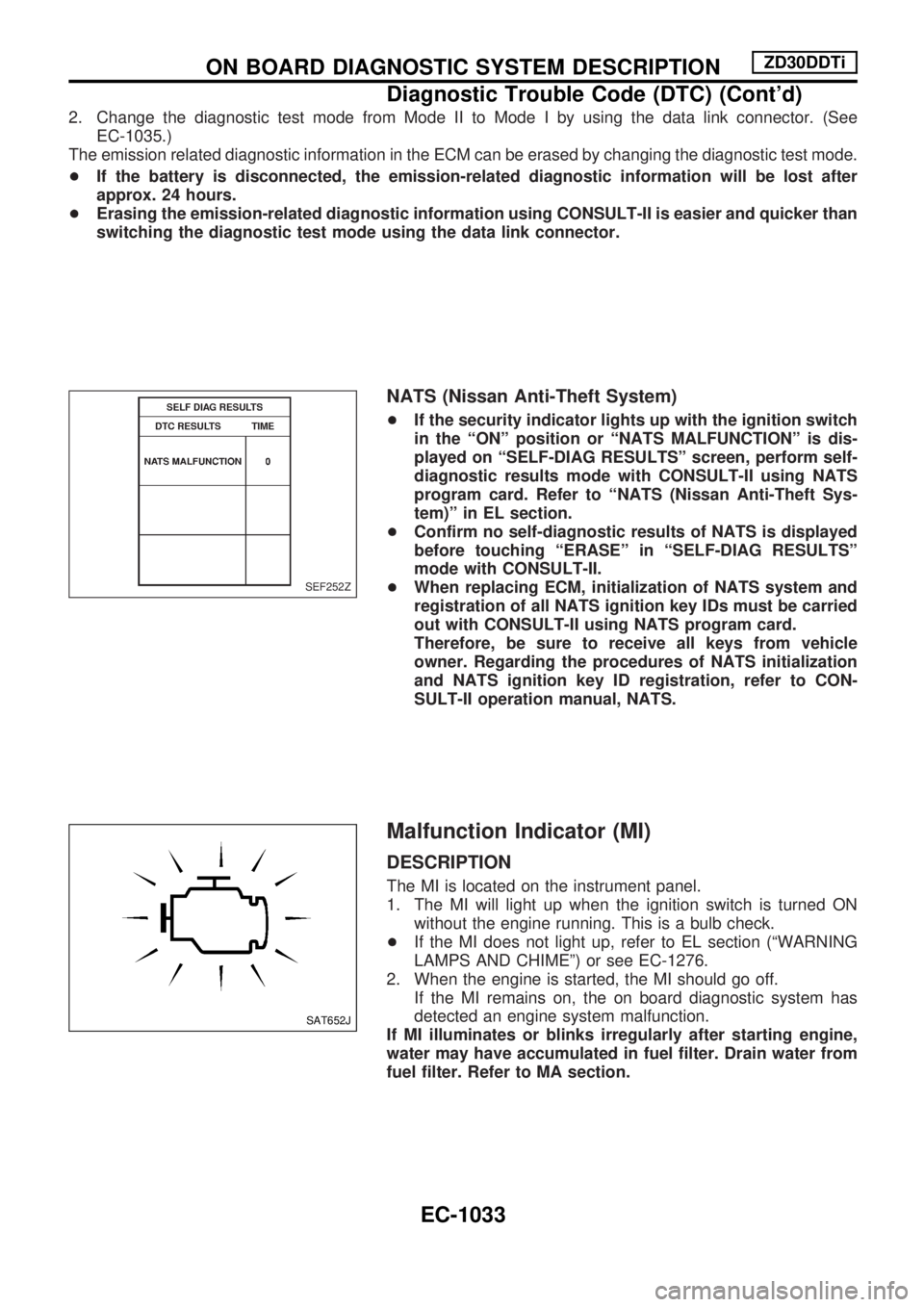
NATS (Nissan Anti-Theft System)
+If the security indicator lights up with the ignition switch
in the ªONº position or ªNATS MALFUNCTIONº is dis-
played on ªSELF-DIAG RESULTSº screen, perform self-
diagnostic results mode with CONSULT-II using NATS
program card. Refer to ªNATS (Nissan Anti-Theft Sys-
tem)º in EL section.
+Confirm no self-diagnostic results of NATS is displayed
before touching ªERASEº in ªSELF-DIAG RESULTSº
mode with CONSULT-II.
+When replacing ECM, initialization of NATS system and
registration of all NATS ignition key IDs must be carried
out with CONSULT-II using NATS program card.
Therefore, be sure to receive all keys from vehicle
owner. Regarding the procedures of NATS initialization
and NATS ignition key ID registration, refer to CON-
SULT-II operation manual, NATS.
Malfunction Indicator (MI)
DESCRIPTION
The MI is located on the instrument panel.
1. The MI will light up when the ignition switch is turned ON
without the engine running. This is a bulb check.
+If the MI does not light up, refer to EL section (ªWARNING
LAMPS AND CHIMEº) or see EC-1276.
2. When the engine is started, the MI should go off.
If the MI remains on, the on board diagnostic system has
detected an engine system malfunction.
If MI illuminates or blinks irregularly after starting engine,
water may have accumulated in fuel filter. Drain water from
fuel filter. Refer to MA section.
SEF252Z
SAT652J
ON BOARD DIAGNOSTIC SYSTEM DESCRIPTIONZD30DDTi
Diagnostic Trouble Code (DTC) (Cont'd)
EC-1033
Page 269 of 1033
Diagnostic test mode I Ð Bulb check
In this mode, the MI on the instrument panel should stay ON. If it remains OFF, check the bulb. Refer to EL
section, ªWARNING LAMPS AND CHIMEº or see EC-1276.
Diagnostic test mode I Ð Malfunction warning
MI Condition
ON When the malfunction is detected or the ECM's CPU is malfunctioning.
OFF No malfunction.
Diagnostic test mode II Ð Self-diagnostic results
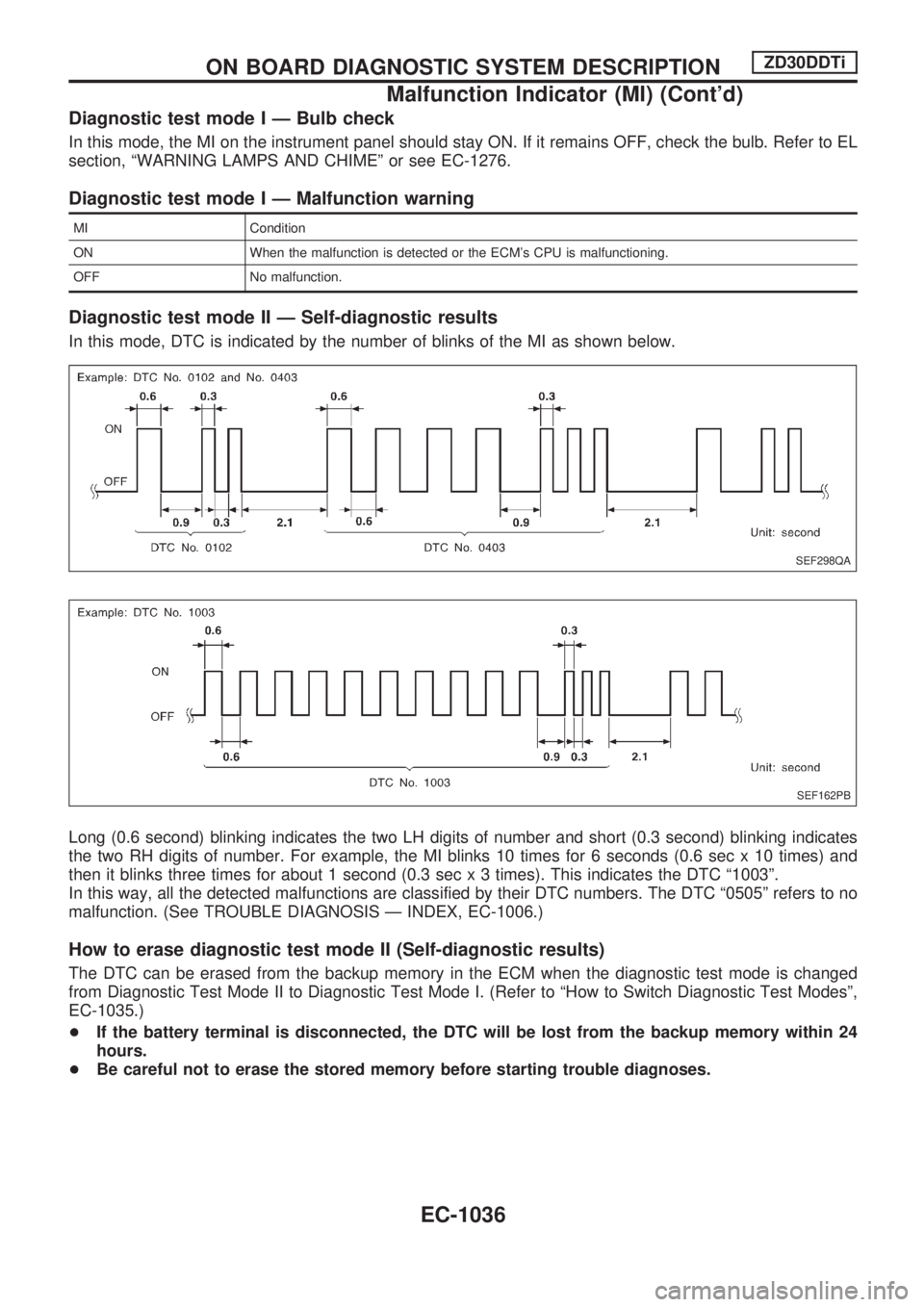
In this mode, DTC is indicated by the number of blinks of the MI as shown below.
Long (0.6 second) blinking indicates the two LH digits of number and short (0.3 second) blinking indicates
the two RH digits of number. For example, the MI blinks 10 times for 6 seconds (0.6 sec x 10 times) and
then it blinks three times for about 1 second (0.3 sec x 3 times). This indicates the DTC ª1003º.
In this way, all the detected malfunctions are classified by their DTC numbers. The DTC ª0505º refers to no
malfunction. (See TROUBLE DIAGNOSIS Ð INDEX, EC-1006.)
How to erase diagnostic test mode II (Self-diagnostic results)
The DTC can be erased from the backup memory in the ECM when the diagnostic test mode is changed
from Diagnostic Test Mode II to Diagnostic Test Mode I. (Refer to ªHow to Switch Diagnostic Test Modesº,
EC-1035.)
+If the battery terminal is disconnected, the DTC will be lost from the backup memory within 24
hours.
+Be careful not to erase the stored memory before starting trouble diagnoses.
SEF298QA
SEF162PB
ON BOARD DIAGNOSTIC SYSTEM DESCRIPTIONZD30DDTi
Malfunction Indicator (MI) (Cont'd)
EC-1036
Page 272 of 1033
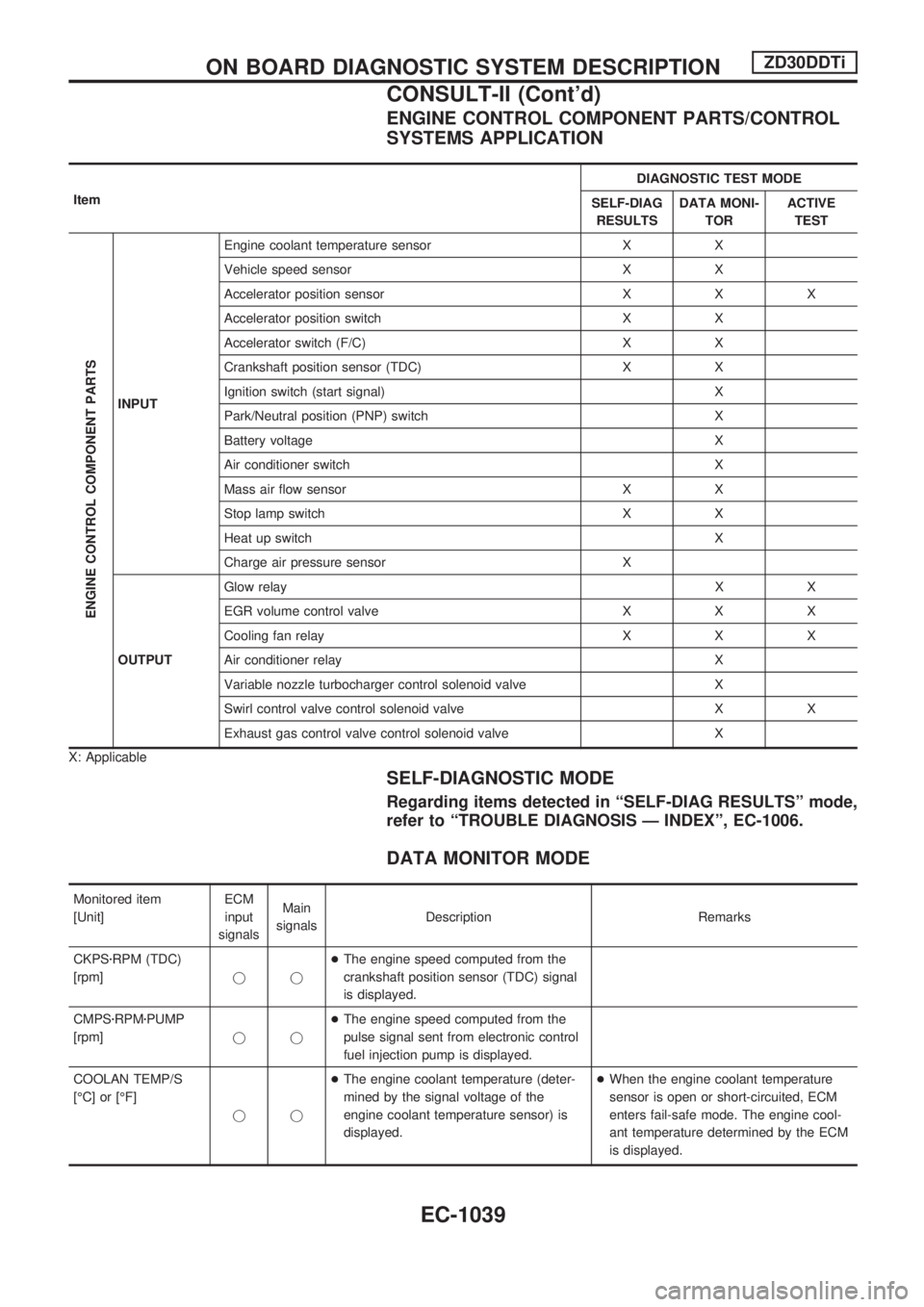
ENGINE CONTROL COMPONENT PARTS/CONTROL
SYSTEMS APPLICATION
ItemDIAGNOSTIC TEST MODE
SELF-DIAG
RESULTSDATA MONI-
TORACTIVE
TEST
ENGINE CONTROL COMPONENT PARTS
INPUTEngine coolant temperature sensor X X
Vehicle speed sensor X X
Accelerator position sensor X X X
Accelerator position switch X X
Accelerator switch (F/C) X X
Crankshaft position sensor (TDC) X X
Ignition switch (start signal) X
Park/Neutral position (PNP) switch X
Battery voltage X
Air conditioner switch X
Mass air flow sensor X X
Stop lamp switch X X
Heat up switch X
Charge air pressure sensor X
OUTPUTGlow relayXX
EGR volume control valve X X X
Cooling fan relay X X X
Air conditioner relay X
Variable nozzle turbocharger control solenoid valve X
Swirl control valve control solenoid valve X X
Exhaust gas control valve control solenoid valve X
X: Applicable
SELF-DIAGNOSTIC MODE
Regarding items detected in ªSELF-DIAG RESULTSº mode,
refer to ªTROUBLE DIAGNOSIS Ð INDEXº, EC-1006.
DATA MONITOR MODE
Monitored item
[Unit]ECM
input
signalsMain
signalsDescription Remarks
CKPSzRPM (TDC)
[rpm]jj+The engine speed computed from the
crankshaft position sensor (TDC) signal
is displayed.
CMPSzRPMzPUMP
[rpm]jj+The engine speed computed from the
pulse signal sent from electronic control
fuel injection pump is displayed.
COOLAN TEMP/S
[ÉC] or [ÉF]
jj+The engine coolant temperature (deter-
mined by the signal voltage of the
engine coolant temperature sensor) is
displayed.+When the engine coolant temperature
sensor is open or short-circuited, ECM
enters fail-safe mode. The engine cool-
ant temperature determined by the ECM
is displayed.
ON BOARD DIAGNOSTIC SYSTEM DESCRIPTIONZD30DDTi
CONSULT-II (Cont'd)
EC-1039
Page 273 of 1033
![NISSAN PATROL 2000 Electronic Owners Manual Monitored item
[Unit]ECM
input
signalsMain
signalsDescription Remarks
VHCL SPEED SE
[km/h] or [mph]jj+The vehicle speed computed from the
vehicle speed sensor signal is displayed.
FUEL TEMP SEN
[ÉC]](/img/5/57367/w960_57367-272.png "NISSAN PATROL 2000 Electronic Owners Manual Monitored item
[Unit]ECM
input
signalsMain
signalsDescription Remarks
VHCL SPEED SE
[km/h] or [mph]jj+The vehicle speed computed from the
vehicle speed sensor signal is displayed.
FUEL TEMP SEN
[ÉC]")
Monitored item
[Unit]ECM
input
signalsMain
signalsDescription Remarks
VHCL SPEED SE
[km/h] or [mph]jj+The vehicle speed computed from the
vehicle speed sensor signal is displayed.
FUEL TEMP SEN
[ÉC] or [ÉF]jj+The fuel temperature (sent from elec-
tronic control fuel injection pump) is dis-
played.
ACCEL POS SEN [V]
jj+The accelerator position sensor signal
voltage is displayed.
FULL ACCEL SW
[ON/OFF]jj+Indicates [ON/OFF] condition from the
accelerator position switch signal.
ACCEL SW (FC)
[OPEN/CLOSE]jj+Indicates [OPEN/CLOSE] condition from
the accelerator switch (FC) signal.
OFF ACCEL SW
[ON/OFF]jj+Indicates [ON/OFF] condition from the
accelerator position switch signal.
SPILL/V [ÉCA]
j+The control position of spill valve (sent
from electronic control fuel injection
pump) is displayed.
BATTERY VOLT [V]
jj+The power supply voltage of ECM is dis-
played.
P/N POSI SW
[ON/OFF]jj+Indicates [ON/OFF] condition from the
park/neutral position switch signal.
START SIGNAL
[ON/OFF]jj+Indicates [ON/OFF] condition from the
starter signal.+After starting the engine, [OFF] is dis-
played regardless of the starter signal.
AIR COND SIG
[ON/OFF]jj+Indicates [ON/OFF] condition of the air
conditioner switch as determined by the
air conditioner signal.
BRAKE SW [ON/OFF]
jj+Indicates [ON/OFF] condition from the
stop lamp switch signal.
IGN SW
[ON/OFF]jj+Indicates [ON/OFF] condition from igni-
tion switch signal.
WARM UP SW
[ON/OFF]j+Indicates [ON/OFF] condition from the
heat up switch signal.
MAS AIR/FL SE [V]
jj+The signal voltage of the mass air flow
sensor is displayed.+When the engine is stopped, a certain
value is indicated.
DECELER F/CUT
[ON/OFF]j+The [ON/OFF] condition from decelera-
tion fuel cut signal (sent from electronic
control fuel injection pump) is displayed.
INJ TIMG C/V [%]
j+The duty ratio of fuel injection timing
control valve (sent from electronic con-
trol fuel injection pump) is displayed.
AIR COND RLY
[ON/OFF]j+Indicates the control condition of the air
conditioner relay (determined by ECM
according to the input signals).
GLOW RLY [ON/OFF]
j+The glow relay control condition (deter-
mined by ECM according to the input
signal) is displayed.
ON BOARD DIAGNOSTIC SYSTEM DESCRIPTIONZD30DDTi
CONSULT-II (Cont'd)
EC-1040