main NISSAN PATROL 2006 Owners Manual
[x] Cancel search | Manufacturer: NISSAN, Model Year: 2006, Model line: PATROL, Model: NISSAN PATROL 2006Pages: 1226, PDF Size: 37.18 MB
Page 874 of 1226
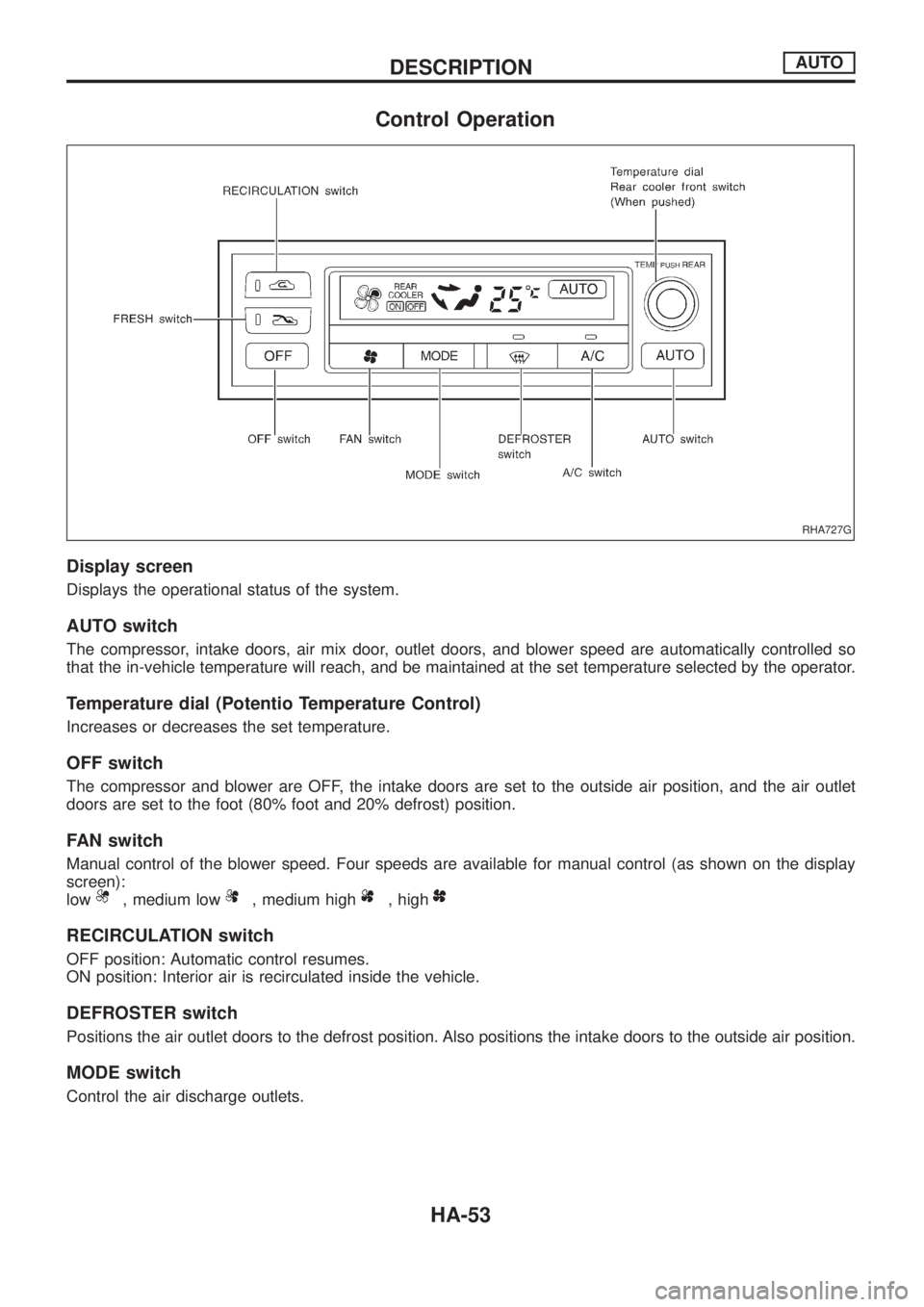
Control Operation
Display screen
Displays the operational status of the system.
AUTO switch
The compressor, intake doors, air mix door, outlet doors, and blower speed are automatically controlled so
that the in-vehicle temperature will reach, and be maintained at the set temperature selected by the operator.
Temperature dial (Potentio Temperature Control)
Increases or decreases the set temperature.
OFF switch
The compressor and blower are OFF, the intake doors are set to the outside air position, and the air outlet
doors are set to the foot (80% foot and 20% defrost) position.
FAN switch
Manual control of the blower speed. Four speeds are available for manual control (as shown on the display
screen):
low
, medium low, medium high, high
RECIRCULATION switch
OFF position: Automatic control resumes.
ON position: Interior air is recirculated inside the vehicle.
DEFROSTER switch
Positions the air outlet doors to the defrost position. Also positions the intake doors to the outside air position.
MODE switch
Control the air discharge outlets.
RHA727G
DESCRIPTIONAUTO
HA-53
Page 891 of 1226
Operational Check
The purpose of the operational check is to con®rm that the system
operates properly.
CONDITIONS
+Engine running and at normal operating temperature.
PROCEDURE
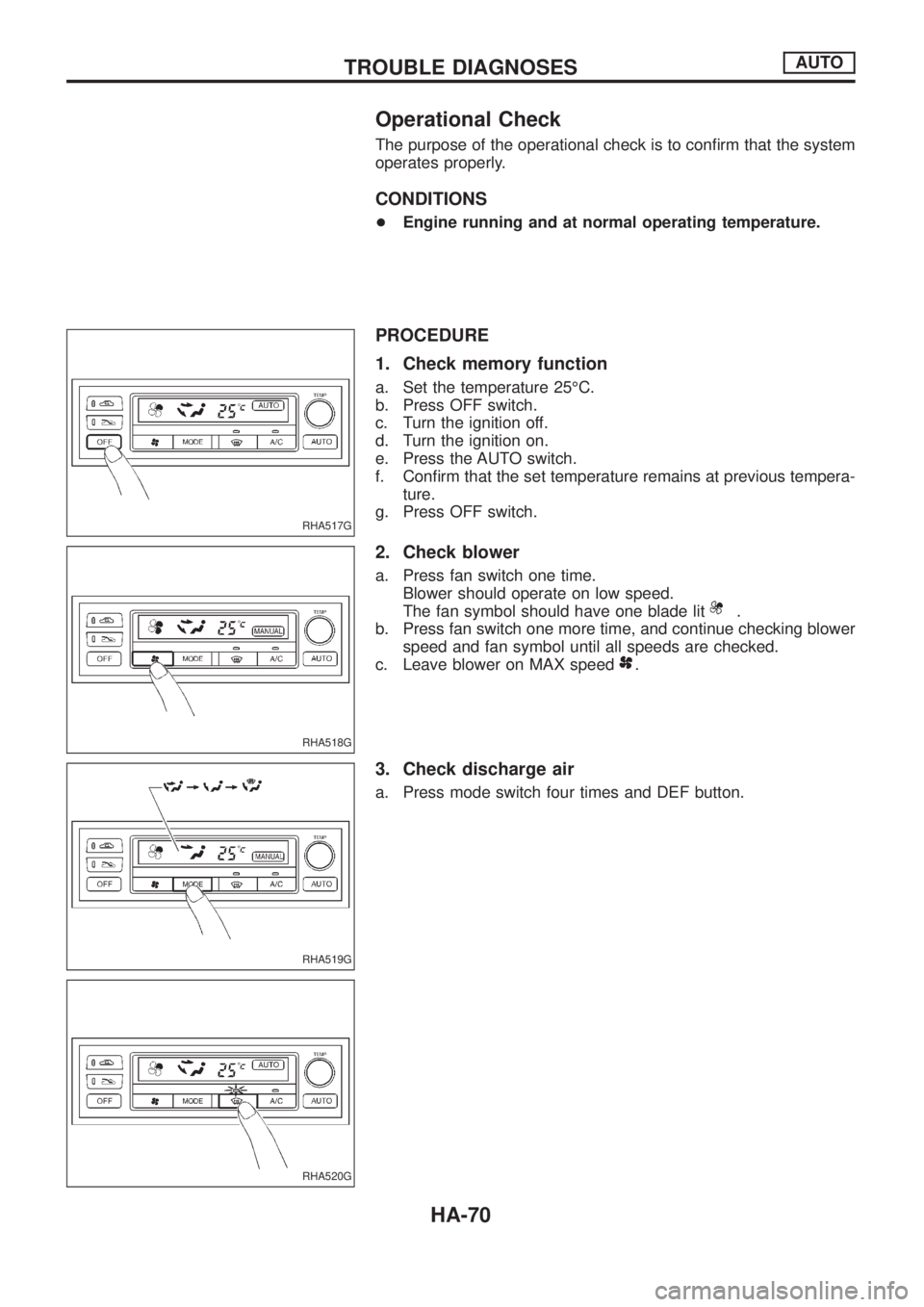
1. Check memory function
a. Set the temperature 25ÉC.
b. Press OFF switch.
c. Turn the ignition off.
d. Turn the ignition on.
e. Press the AUTO switch.
f. Con®rm that the set temperature remains at previous tempera-
ture.
g. Press OFF switch.
2. Check blower
a. Press fan switch one time.
Blower should operate on low speed.
The fan symbol should have one blade lit
.
b. Press fan switch one more time, and continue checking blower
speed and fan symbol until all speeds are checked.
c. Leave blower on MAX speed
.
3. Check discharge air
a. Press mode switch four times and DEF button.
RHA517G
RHA518G
RHA519G
RHA520G
TROUBLE DIAGNOSESAUTO
HA-70
Page 898 of 1226
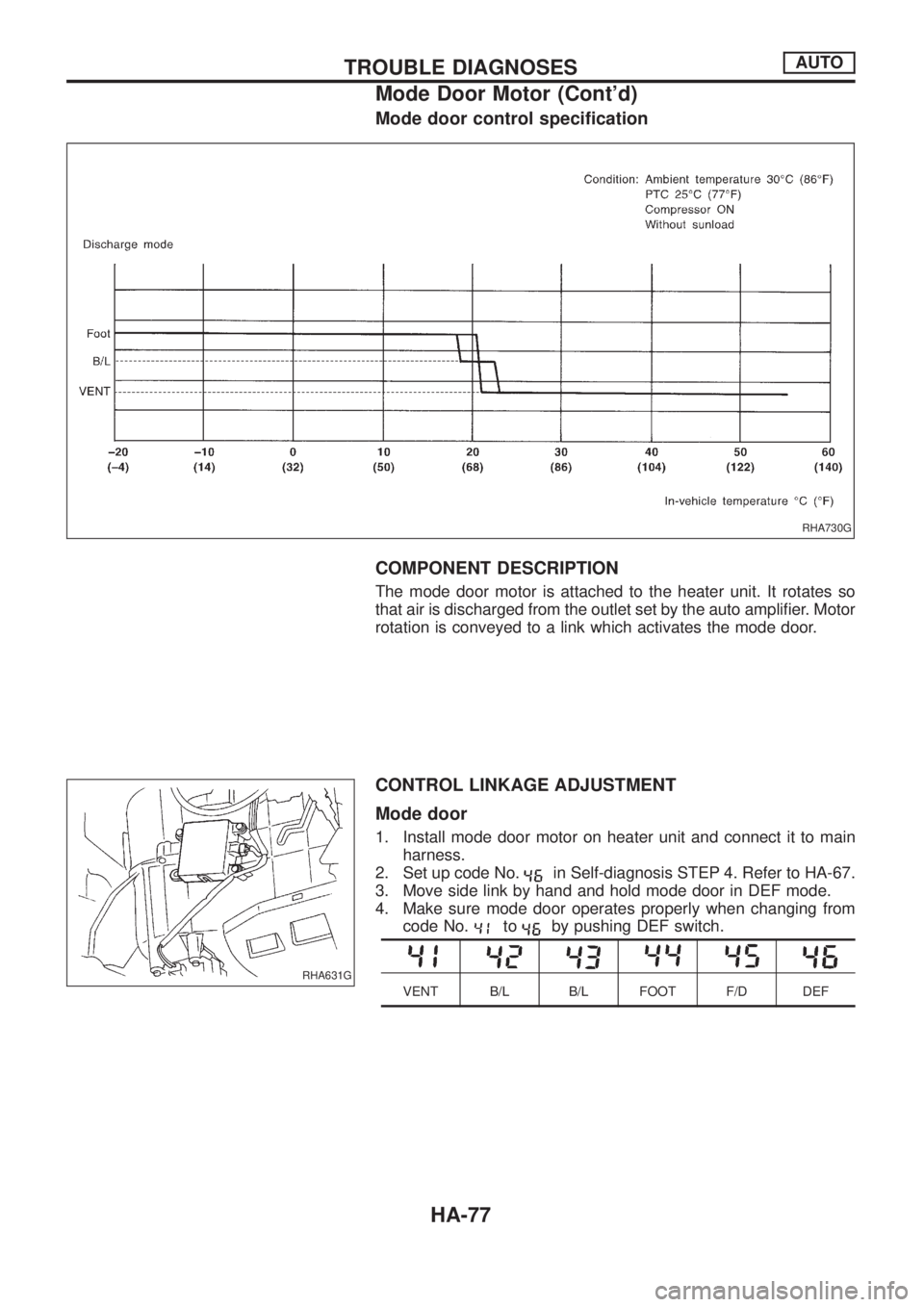
Mode door control speci®cation
COMPONENT DESCRIPTION
The mode door motor is attached to the heater unit. It rotates so
that air is discharged from the outlet set by the auto ampli®er. Motor
rotation is conveyed to a link which activates the mode door.
CONTROL LINKAGE ADJUSTMENT
Mode door
1. Install mode door motor on heater unit and connect it to main
harness.
2. Set up code No.
in Self-diagnosis STEP 4. Refer to HA-67.
3. Move side link by hand and hold mode door in DEF mode.
4. Make sure mode door operates properly when changing from
code No.
toby pushing DEF switch.
VENT B/L B/L FOOT F/D DEF
RHA730G
RHA631G
TROUBLE DIAGNOSESAUTO
Mode Door Motor (Cont'd)
HA-77
Page 902 of 1226
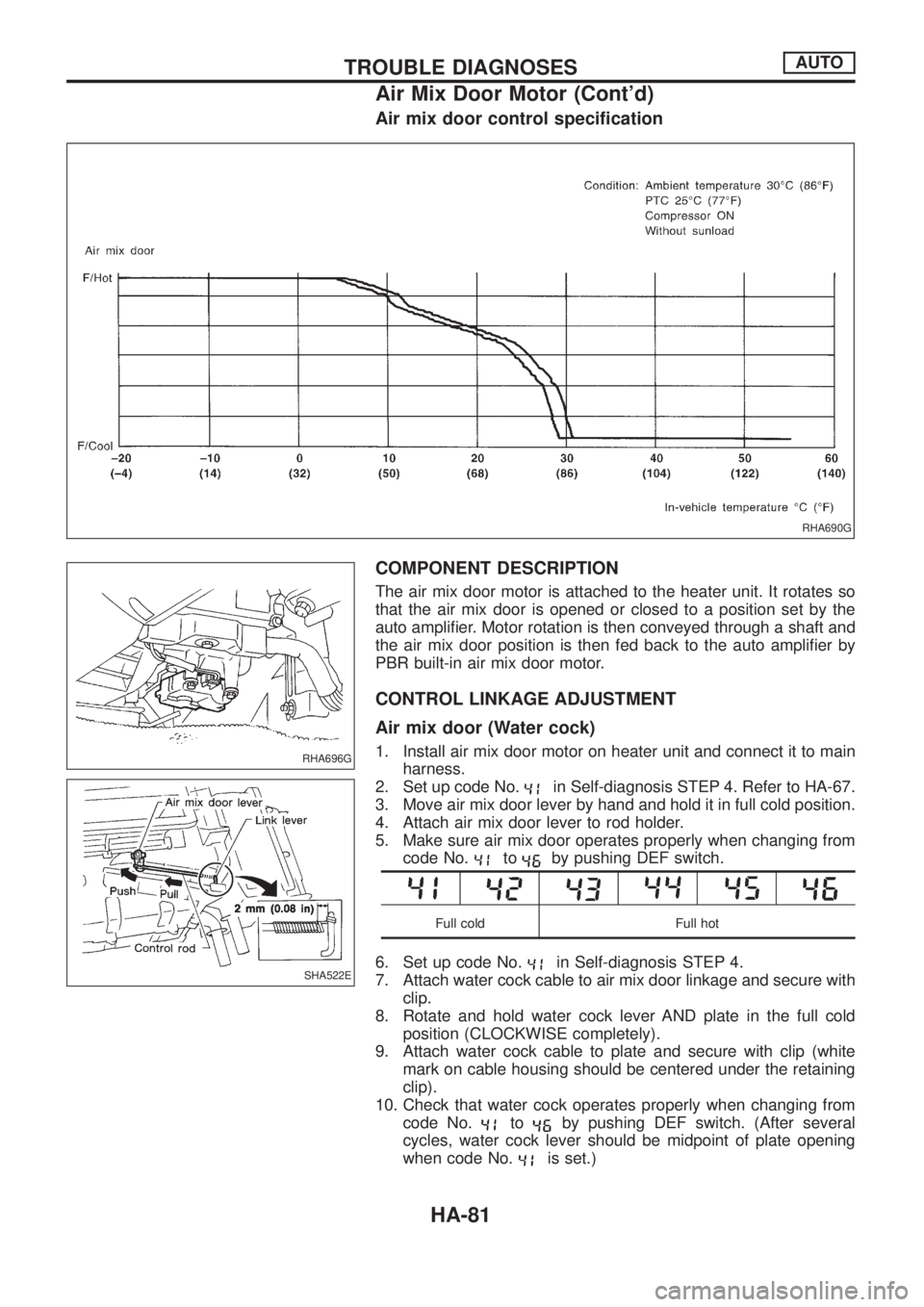
Air mix door control speci®cation
COMPONENT DESCRIPTION
The air mix door motor is attached to the heater unit. It rotates so
that the air mix door is opened or closed to a position set by the
auto ampli®er. Motor rotation is then conveyed through a shaft and
the air mix door position is then fed back to the auto ampli®er by
PBR built-in air mix door motor.
CONTROL LINKAGE ADJUSTMENT
Air mix door (Water cock)
1. Install air mix door motor on heater unit and connect it to main
harness.
2. Set up code No.
in Self-diagnosis STEP 4. Refer to HA-67.
3. Move air mix door lever by hand and hold it in full cold position.
4. Attach air mix door lever to rod holder.
5. Make sure air mix door operates properly when changing from
code No.
toby pushing DEF switch.
Full cold Full hot
6. Set up code No.in Self-diagnosis STEP 4.
7. Attach water cock cable to air mix door linkage and secure with
clip.
8. Rotate and hold water cock lever AND plate in the full cold
position (CLOCKWISE completely).
9. Attach water cock cable to plate and secure with clip (white
mark on cable housing should be centered under the retaining
clip).
10. Check that water cock operates properly when changing from
code No.
toby pushing DEF switch. (After several
cycles, water cock lever should be midpoint of plate opening
when code No.
is set.)
RHA690G
RHA696G
SHA522E
TROUBLE DIAGNOSESAUTO
Air Mix Door Motor (Cont'd)
HA-81
Page 905 of 1226
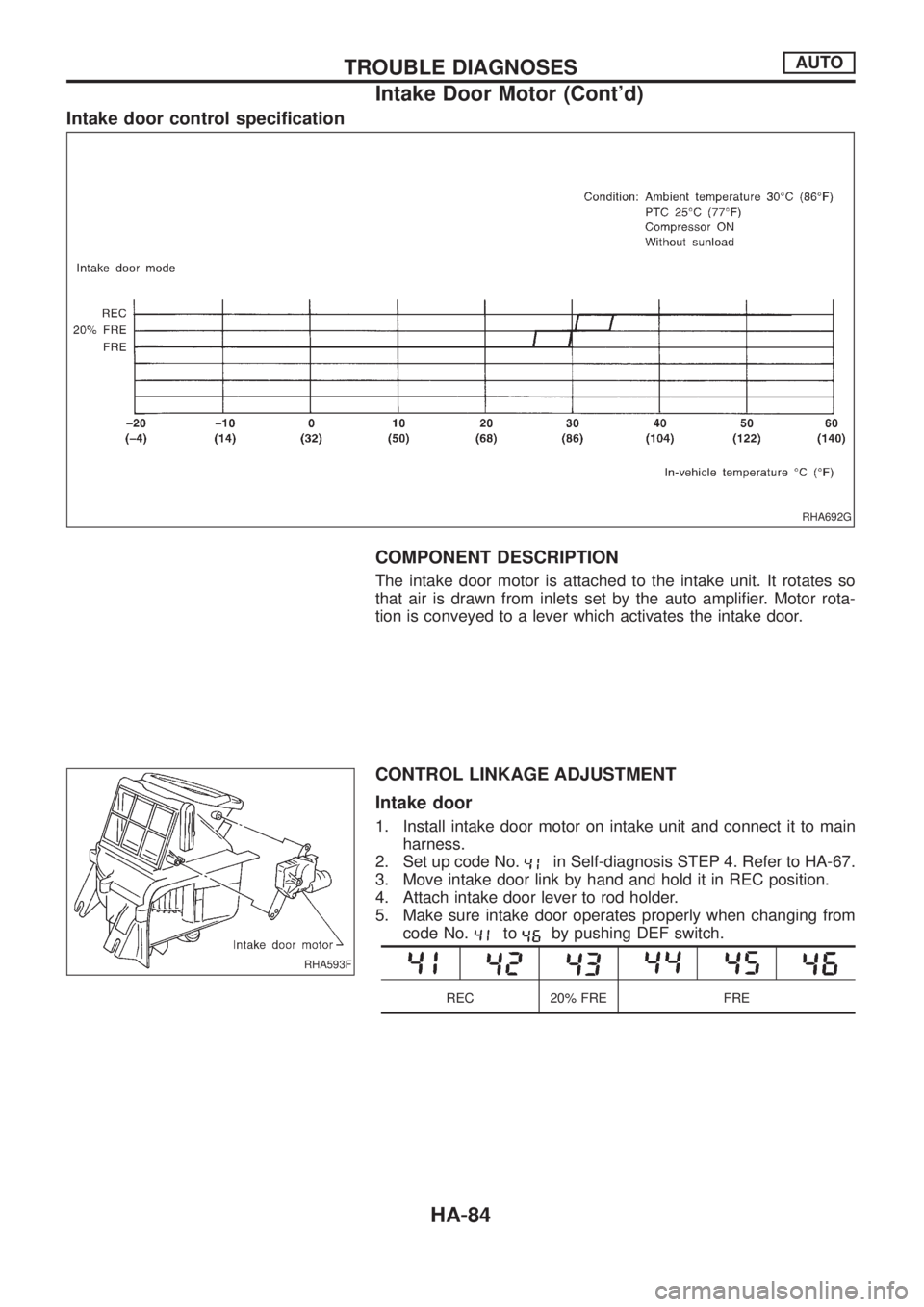
Intake door control speci®cation
COMPONENT DESCRIPTION
The intake door motor is attached to the intake unit. It rotates so
that air is drawn from inlets set by the auto ampli®er. Motor rota-
tion is conveyed to a lever which activates the intake door.
CONTROL LINKAGE ADJUSTMENT
Intake door
1. Install intake door motor on intake unit and connect it to main
harness.
2. Set up code No.
in Self-diagnosis STEP 4. Refer to HA-67.
3. Move intake door link by hand and hold it in REC position.
4. Attach intake door lever to rod holder.
5. Make sure intake door operates properly when changing from
code No.
toby pushing DEF switch.
REC 20% FRE FRE
RHA692G
RHA593F
TROUBLE DIAGNOSESAUTO
Intake Door Motor (Cont'd)
HA-84
Page 909 of 1226
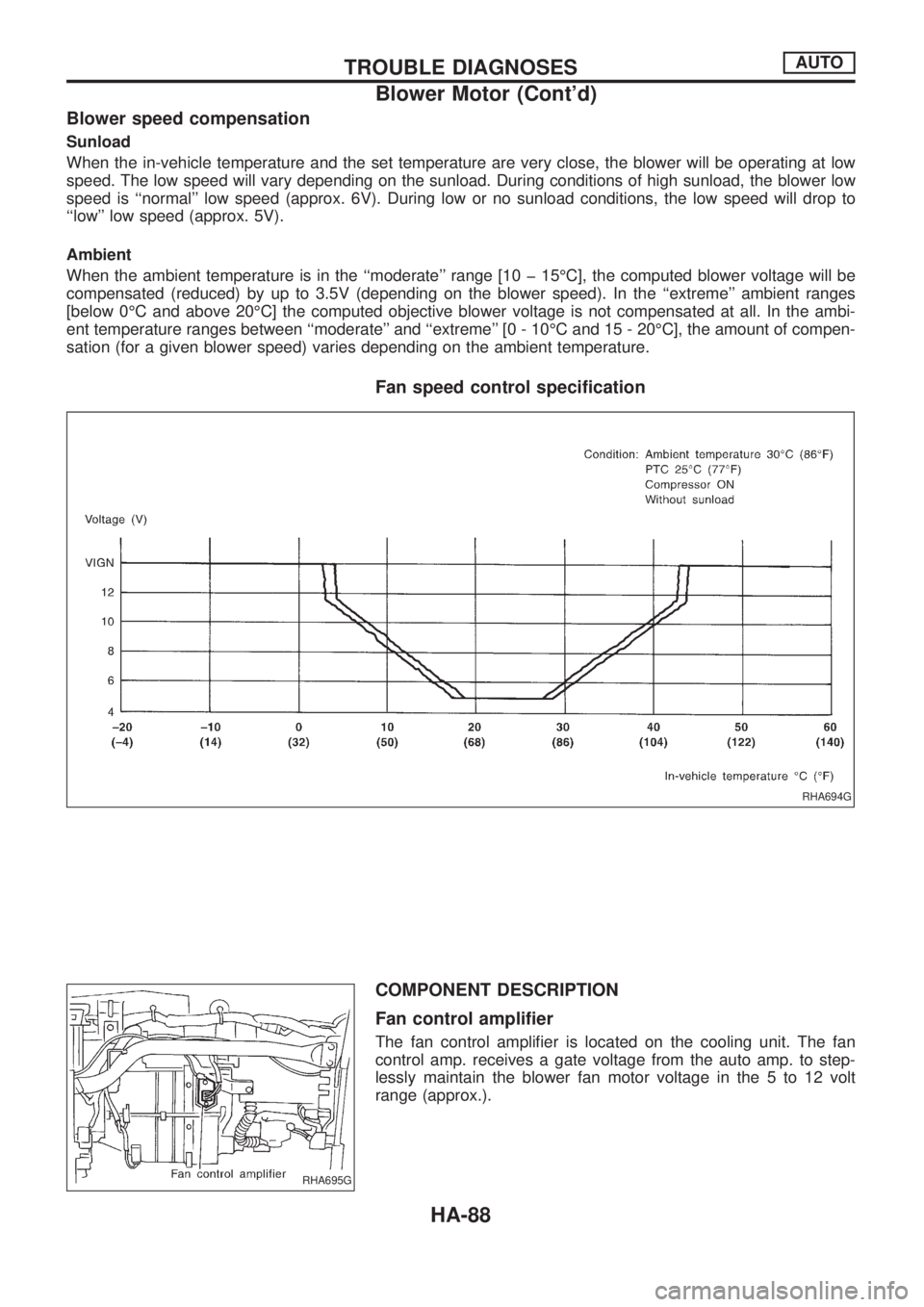
Blower speed compensation
Sunload
When the in-vehicle temperature and the set temperature are very close, the blower will be operating at low
speed. The low speed will vary depending on the sunload. During conditions of high sunload, the blower low
speed is ``normal'' low speed (approx. 6V). During low or no sunload conditions, the low speed will drop to
``low'' low speed (approx. 5V).
Ambient
When the ambient temperature is in the ``moderate'' range [10 þ 15ÉC], the computed blower voltage will be
compensated (reduced) by up to 3.5V (depending on the blower speed). In the ``extreme'' ambient ranges
[below 0ÉC and above 20ÉC] the computed objective blower voltage is not compensated at all. In the ambi-
ent temperature ranges between ``moderate'' and ``extreme'' [0 - 10ÉC and 15 - 20ÉC], the amount of compen-
sation (for a given blower speed) varies depending on the ambient temperature.
Fan speed control speci®cation
COMPONENT DESCRIPTION
Fan control ampli®er
The fan control ampli®er is located on the cooling unit. The fan
control amp. receives a gate voltage from the auto amp. to step-
lessly maintain the blower fan motor voltage in the 5 to 12 volt
range (approx.).
RHA694G
RHA695G
TROUBLE DIAGNOSESAUTO
Blower Motor (Cont'd)
HA-88
Page 935 of 1226
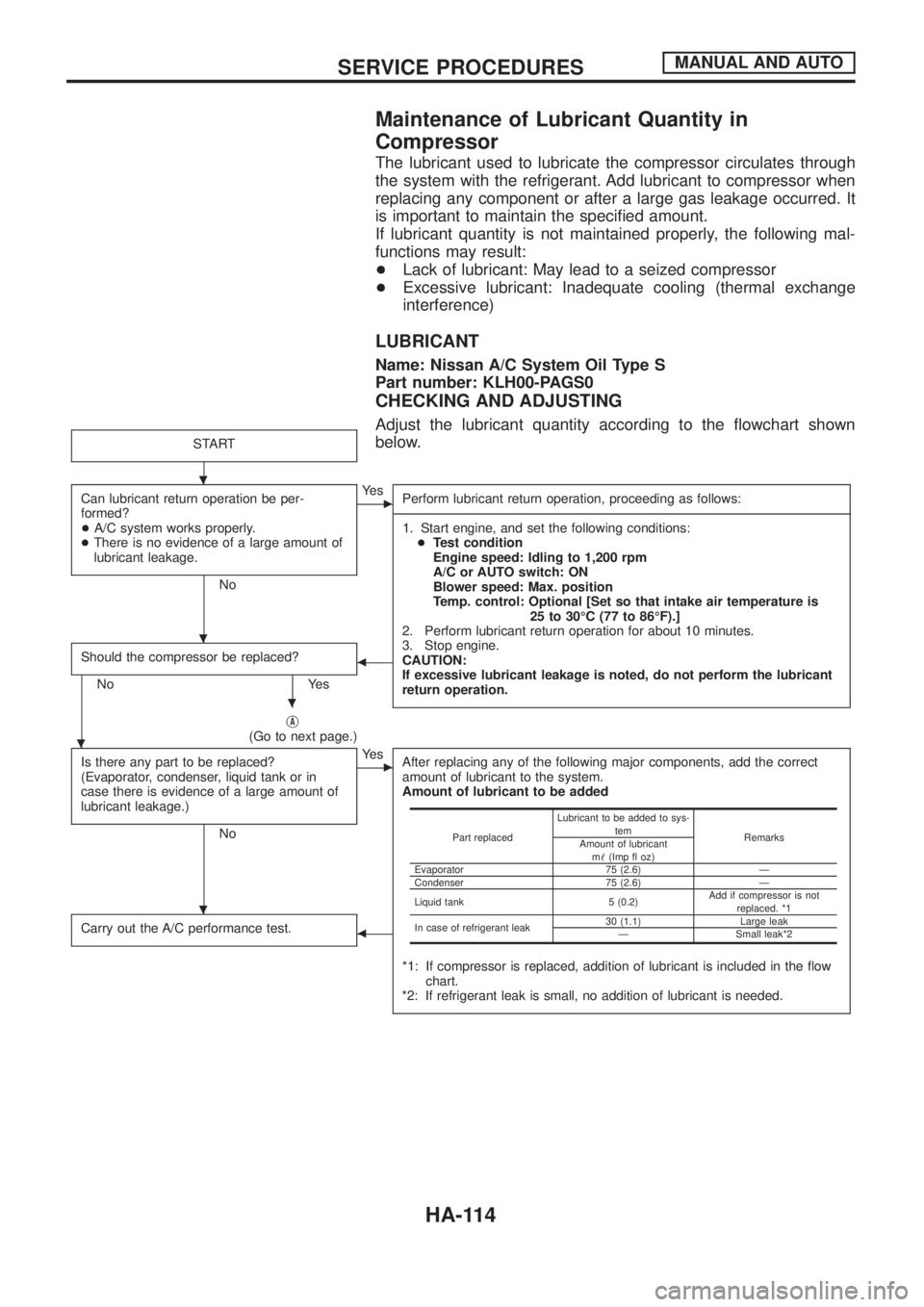
Maintenance of Lubricant Quantity in
Compressor
The lubricant used to lubricate the compressor circulates through
the system with the refrigerant. Add lubricant to compressor when
replacing any component or after a large gas leakage occurred. It
is important to maintain the speci®ed amount.
If lubricant quantity is not maintained properly, the following mal-
functions may result:
+Lack of lubricant: May lead to a seized compressor
+Excessive lubricant: Inadequate cooling (thermal exchange
interference)
LUBRICANT
Name: Nissan A/C System Oil Type S
Part number: KLH00-PAGS0
CHECKING AND ADJUSTING
Adjust the lubricant quantity according to the ¯owchart shown
below.
START
Can lubricant return operation be per-
formed?
+A/C system works properly.
+There is no evidence of a large amount of
lubricant leakage.
No
cYe s
Perform lubricant return operation, proceeding as follows:
------------------------------------------------------------------------------------------------------------------------------------------------------------------------------------------------------------------------------------------------------------------------------------------------------------------------------------------------------------------------------------------------------------------------------------------------------------------------------------------------------------------------------------
1. Start engine, and set the following conditions:
+Test condition
Engine speed: Idling to 1,200 rpm
A/C or AUTO switch: ON
Blower speed: Max. position
Temp. control: Optional [Set so that intake air temperature is
25 to 30ÉC (77 to 86ÉF).]
2. Perform lubricant return operation for about 10 minutes.
3. Stop engine.
CAUTION:
If excessive lubricant leakage is noted, do not perform the lubricant
return operation.
Should the compressor be replaced?
No Yes
b
jA(Go to next page.)
Is there any part to be replaced?
(Evaporator, condenser, liquid tank or in
case there is evidence of a large amount of
lubricant leakage.)
No
cYe s
After replacing any of the following major components, add the correct
amount of lubricant to the system.
Amount of lubricant to be added
*1: If compressor is replaced, addition of lubricant is included in the ¯ow
chart.
*2: If refrigerant leak is small, no addition of lubricant is needed.
Carry out the A/C performance test.b
Part replacedLubricant to be added to sys-
tem
Remarks
Amount of lubricant
m!(Imp ¯ oz)
Evaporator 75 (2.6) Ð
Condenser 75 (2.6) Ð
Liquid tank 5 (0.2)Add if compressor is not
replaced. *1
In case of refrigerant leak30 (1.1) Large leak
Ð Small leak*2
.
.
.
.
.
SERVICE PROCEDURESMANUAL AND AUTO
HA-114
Page 936 of 1226
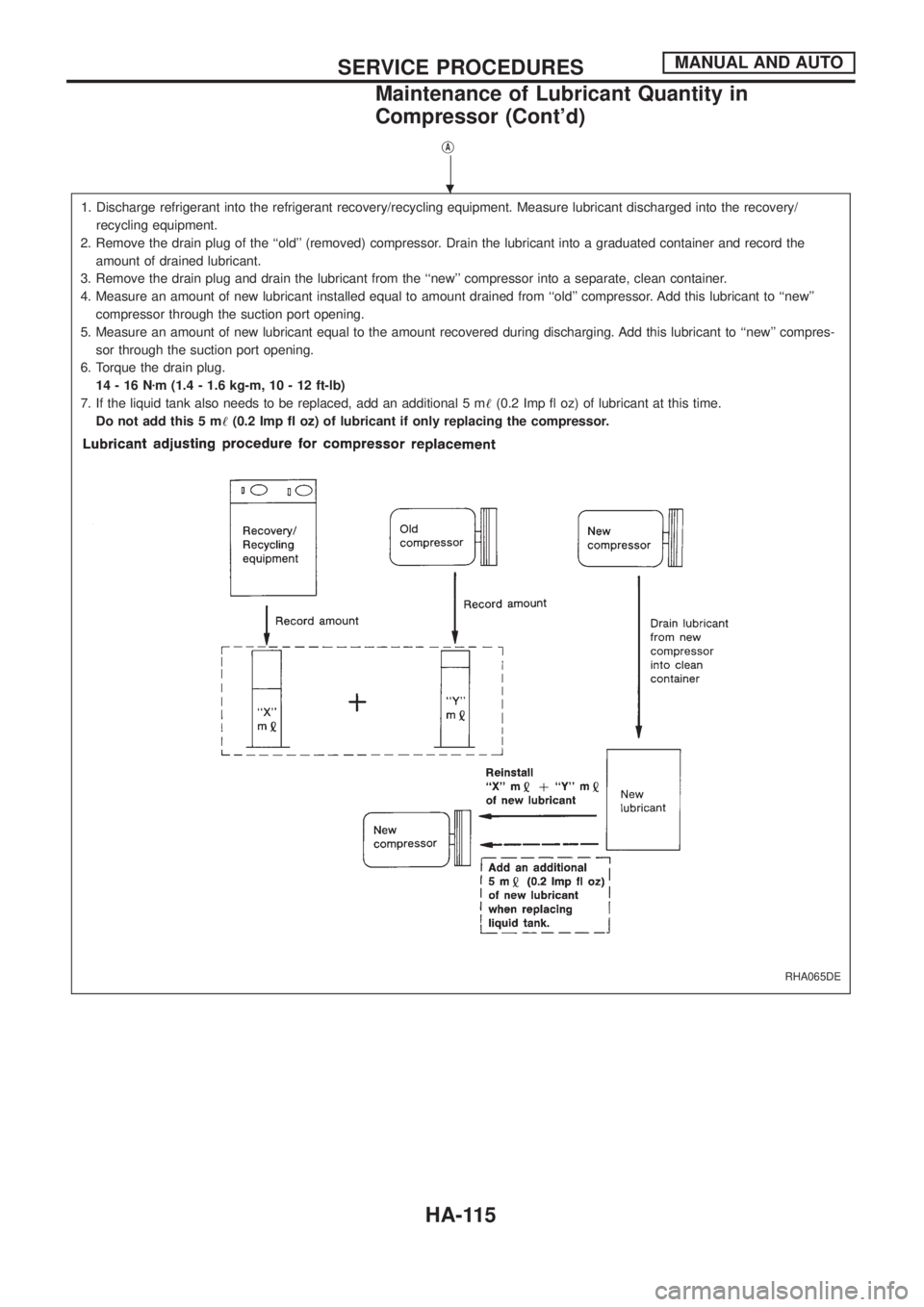
jA
1. Discharge refrigerant into the refrigerant recovery/recycling equipment. Measure lubricant discharged into the recovery/
recycling equipment.
2. Remove the drain plug of the ``old'' (removed) compressor. Drain the lubricant into a graduated container and record the
amount of drained lubricant.
3. Remove the drain plug and drain the lubricant from the ``new'' compressor into a separate, clean container.
4. Measure an amount of new lubricant installed equal to amount drained from ``old'' compressor. Add this lubricant to ``new''
compressor through the suction port opening.
5. Measure an amount of new lubricant equal to the amount recovered during discharging. Add this lubricant to ``new'' compres-
sor through the suction port opening.
6. Torque the drain plug.
14-16Nzm (1.4 - 1.6 kg-m, 10 - 12 ft-lb)
7. If the liquid tank also needs to be replaced, add an additional 5 m!(0.2 Imp ¯ oz) of lubricant at this time.
Do not add this 5 m!(0.2 Imp ¯ oz) of lubricant if only replacing the compressor.
RHA065DE
.
SERVICE PROCEDURESMANUAL AND AUTO
Maintenance of Lubricant Quantity in
Compressor (Cont'd)
HA-115
Page 937 of 1226
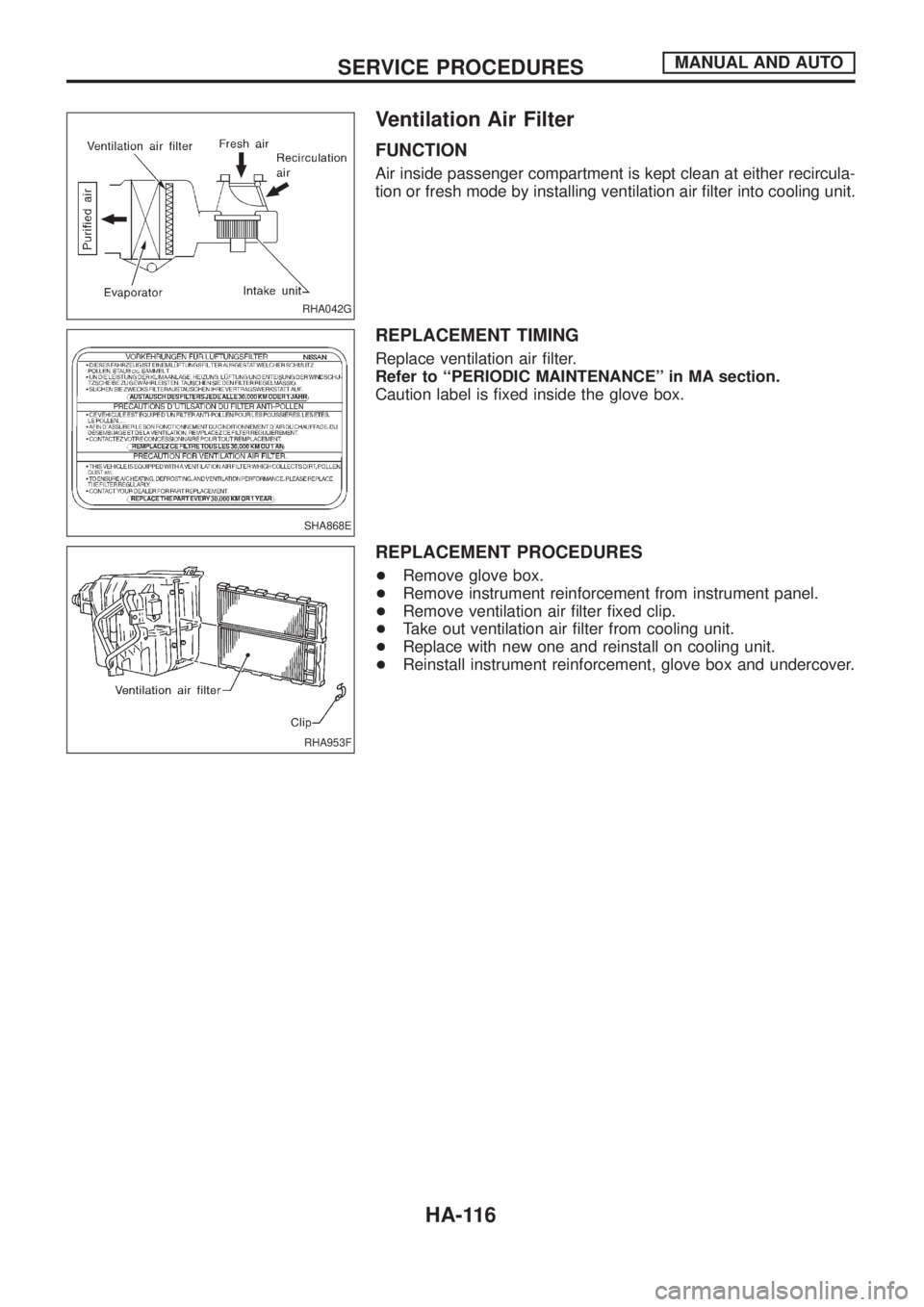
Ventilation Air Filter
FUNCTION
Air inside passenger compartment is kept clean at either recircula-
tion or fresh mode by installing ventilation air ®lter into cooling unit.
REPLACEMENT TIMING
Replace ventilation air ®lter.
Refer to ``PERIODIC MAINTENANCE'' in MA section.
Caution label is ®xed inside the glove box.
REPLACEMENT PROCEDURES
+Remove glove box.
+Remove instrument reinforcement from instrument panel.
+Remove ventilation air ®lter ®xed clip.
+Take out ventilation air ®lter from cooling unit.
+Replace with new one and reinstall on cooling unit.
+Reinstall instrument reinforcement, glove box and undercover.
RHA042G
SHA868E
RHA953F
SERVICE PROCEDURESMANUAL AND AUTO
HA-116
Page 940 of 1226
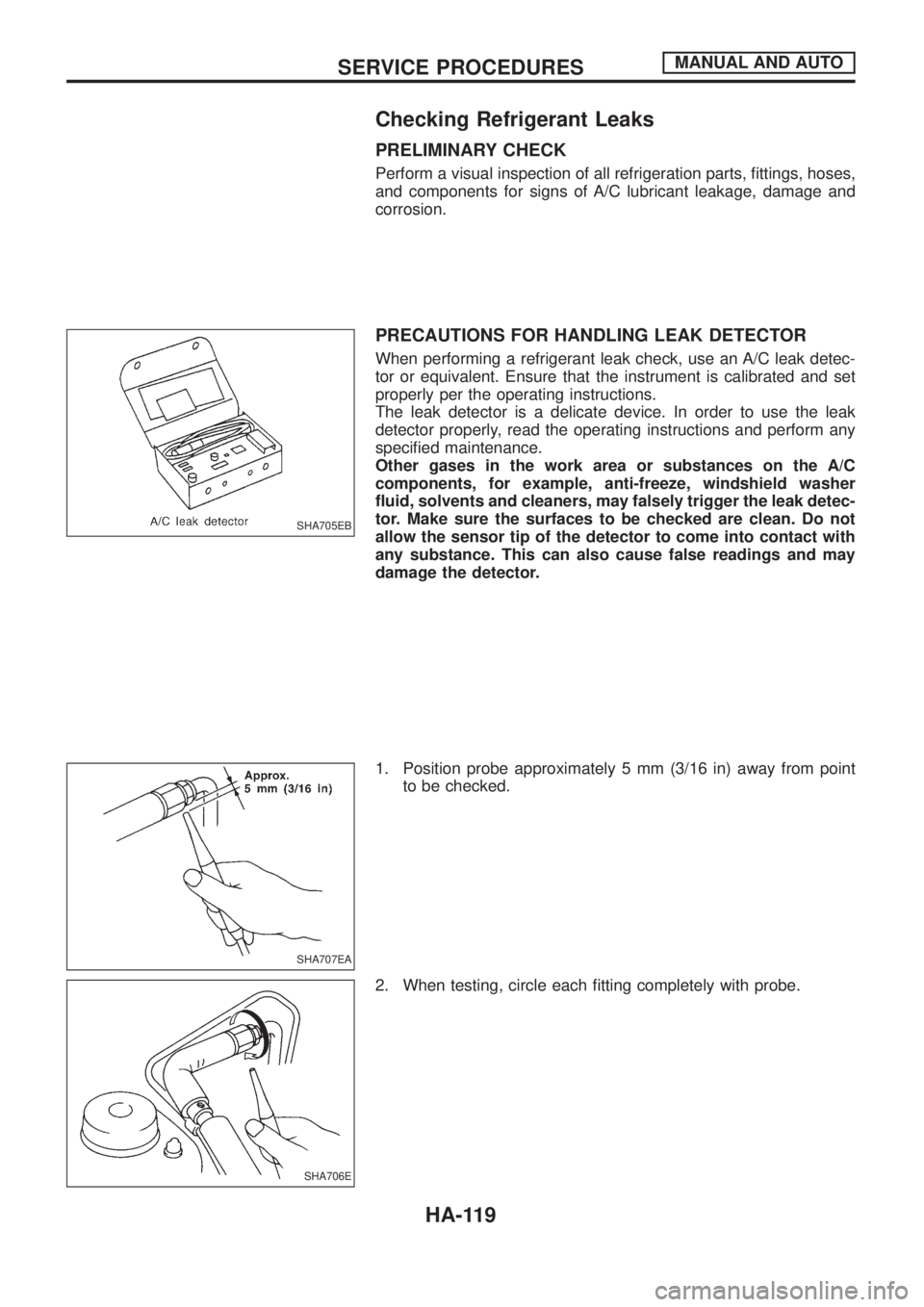
Checking Refrigerant Leaks
PRELIMINARY CHECK
Perform a visual inspection of all refrigeration parts, ®ttings, hoses,
and components for signs of A/C lubricant leakage, damage and
corrosion.
PRECAUTIONS FOR HANDLING LEAK DETECTOR
When performing a refrigerant leak check, use an A/C leak detec-
tor or equivalent. Ensure that the instrument is calibrated and set
properly per the operating instructions.
The leak detector is a delicate device. In order to use the leak
detector properly, read the operating instructions and perform any
speci®ed maintenance.
Other gases in the work area or substances on the A/C
components, for example, anti-freeze, windshield washer
¯uid, solvents and cleaners, may falsely trigger the leak detec-
tor. Make sure the surfaces to be checked are clean. Do not
allow the sensor tip of the detector to come into contact with
any substance. This can also cause false readings and may
damage the detector.
1. Position probe approximately 5 mm (3/16 in) away from point
to be checked.
2. When testing, circle each ®tting completely with probe.
SHA705EB
SHA707EA
SHA706E
SERVICE PROCEDURESMANUAL AND AUTO
HA-119