lock NISSAN PATROL 2006 Service Manual
[x] Cancel search | Manufacturer: NISSAN, Model Year: 2006, Model line: PATROL, Model: NISSAN PATROL 2006Pages: 1226, PDF Size: 37.18 MB
Page 1139 of 1226
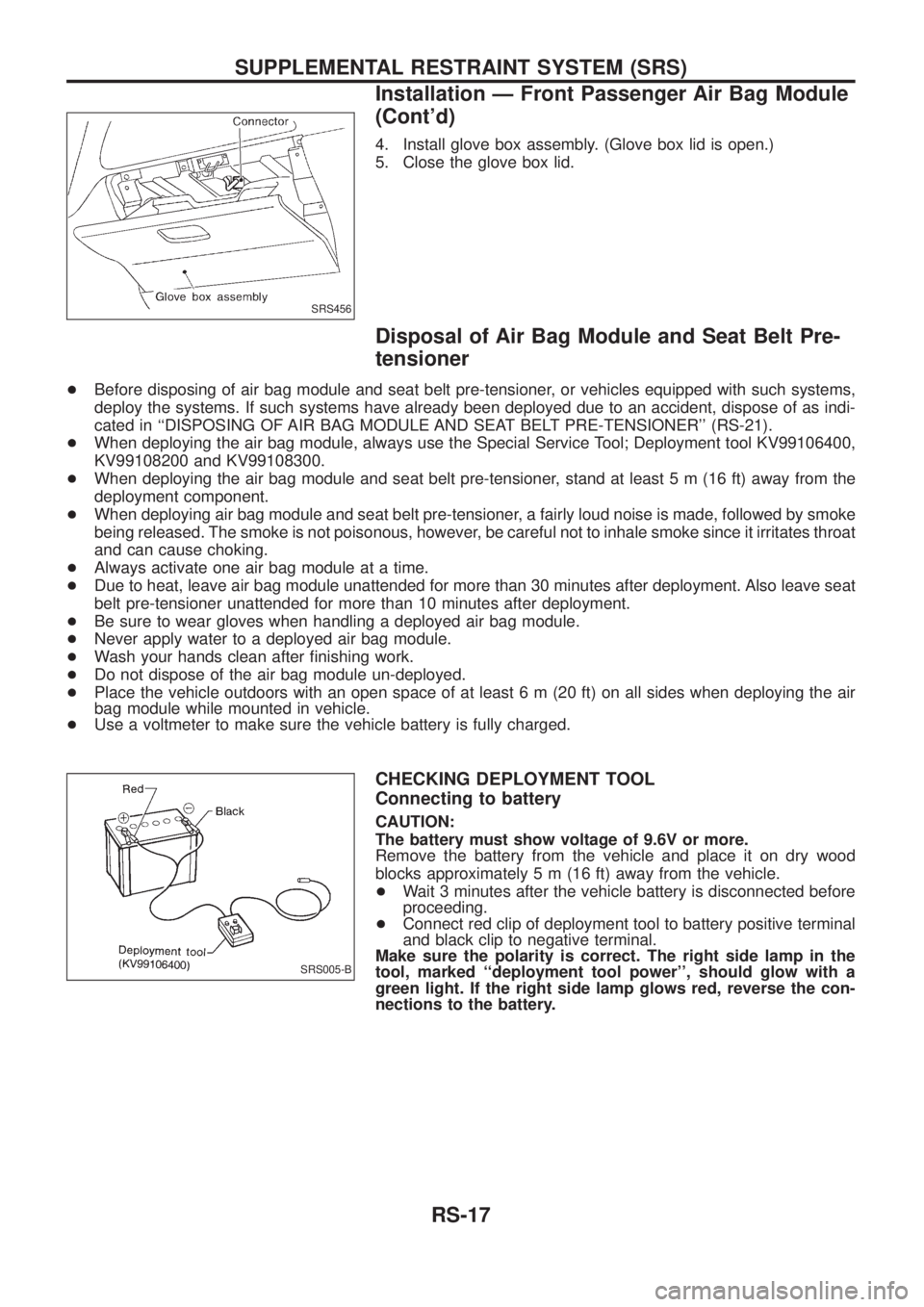
4. Install glove box assembly. (Glove box lid is open.)
5. Close the glove box lid.
Disposal of Air Bag Module and Seat Belt Pre-
tensioner
+Before disposing of air bag module and seat belt pre-tensioner, or vehicles equipped with such systems,
deploy the systems. If such systems have already been deployed due to an accident, dispose of as indi-
cated in ``DISPOSING OF AIR BAG MODULE AND SEAT BELT PRE-TENSIONER'' (RS-21).
+When deploying the air bag module, always use the Special Service Tool; Deployment tool KV99106400,
KV99108200 and KV99108300.
+When deploying the air bag module and seat belt pre-tensioner, stand at least 5 m (16 ft) away from the
deployment component.
+When deploying air bag module and seat belt pre-tensioner, a fairly loud noise is made, followed by smoke
being released. The smoke is not poisonous, however, be careful not to inhale smoke since it irritates throat
and can cause choking.
+Always activate one air bag module at a time.
+Due to heat, leave air bag module unattended for more than 30 minutes after deployment. Also leave seat
belt pre-tensioner unattended for more than 10 minutes after deployment.
+Be sure to wear gloves when handling a deployed air bag module.
+Never apply water to a deployed air bag module.
+Wash your hands clean after ®nishing work.
+Do not dispose of the air bag module un-deployed.
+Place the vehicle outdoors with an open space of at least 6 m (20 ft) on all sides when deploying the air
bag module while mounted in vehicle.
+Use a voltmeter to make sure the vehicle battery is fully charged.
CHECKING DEPLOYMENT TOOL
Connecting to battery
CAUTION:
The battery must show voltage of 9.6V or more.
Remove the battery from the vehicle and place it on dry wood
blocks approximately 5 m (16 ft) away from the vehicle.
+Wait 3 minutes after the vehicle battery is disconnected before
proceeding.
+Connect red clip of deployment tool to battery positive terminal
and black clip to negative terminal.
Make sure the polarity is correct. The right side lamp in the
tool, marked ``deployment tool power'', should glow with a
green light. If the right side lamp glows red, reverse the con-
nections to the battery.
SRS456
SRS005-B
SUPPLEMENTAL RESTRAINT SYSTEM (SRS)
Installation Ð Front Passenger Air Bag Module
(Cont'd)
RS-17
Page 1172 of 1226
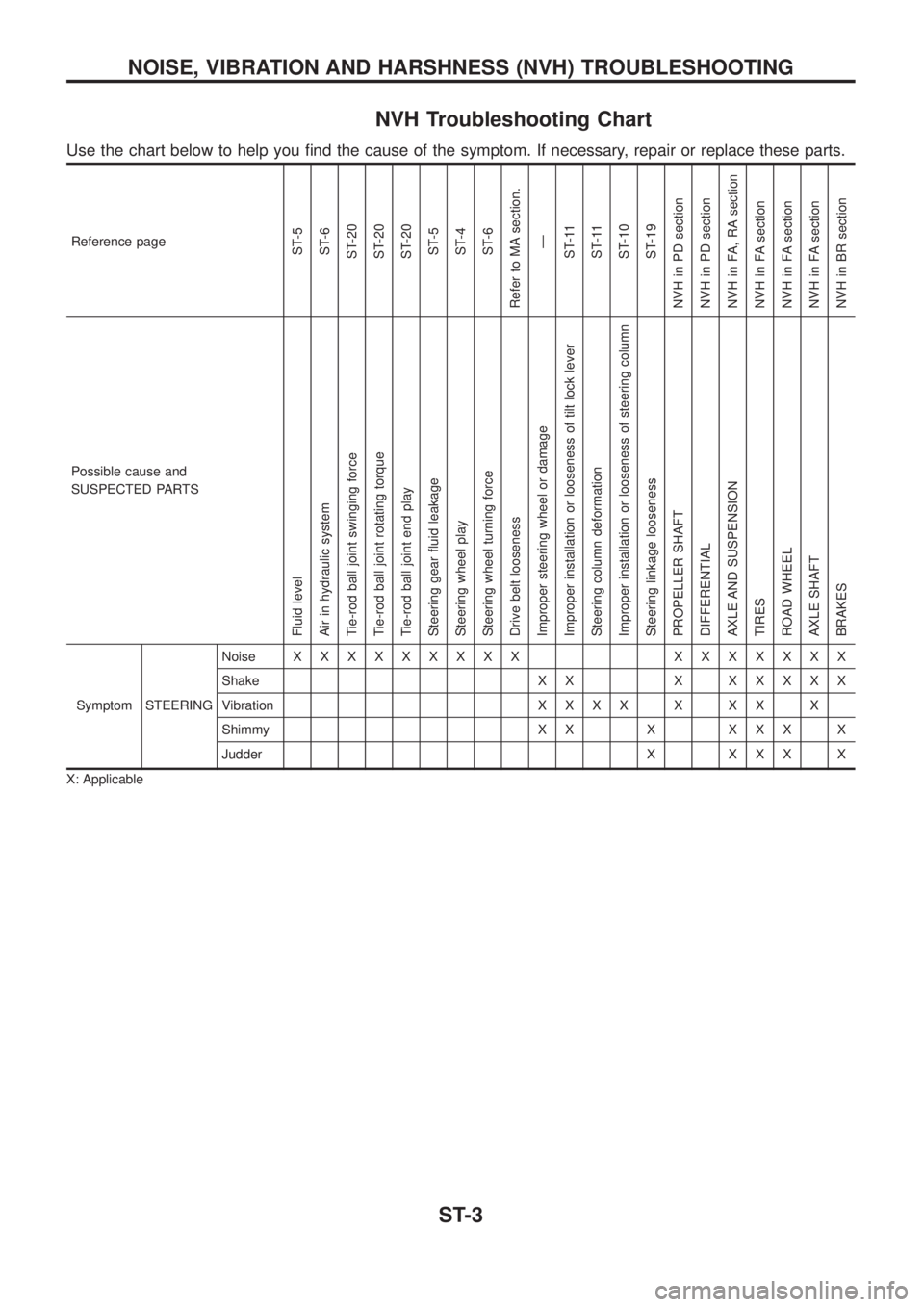
NVH Troubleshooting Chart
Use the chart below to help you ®nd the cause of the symptom. If necessary, repair or replace these parts.
Reference pageST-5
ST-6
ST-20
ST-20
ST-20
ST-5
ST-4
ST-6
Refer to MA section.
Ð
ST-11
ST-11
ST-10
ST-19
NVH in PD section
NVH in PD section
NVH in FA, RA section
NVH in FA section
NVH in FA section
NVH in FA section
NVH in BR section
Possible cause and
SUSPECTED PARTS
Fluid level
Air in hydraulic system
Tie-rod ball joint swinging force
Tie-rod ball joint rotating torque
Tie-rod ball joint end play
Steering gear ¯uid leakage
Steering wheel play
Steering wheel turning force
Drive belt looseness
Improper steering wheel or damage
Improper installation or looseness of tilt lock lever
Steering column deformation
Improper installation or looseness of steering column
Steering linkage looseness
PROPELLER SHAFT
DIFFERENTIAL
AXLE AND SUSPENSION
TIRES
ROAD WHEEL
AXLE SHAFT
BRAKES
Symptom STEERINGNoiseXXXXXXXXX XXXXXXX
Shake X X XXXXXX
VibrationXXXXXXXX
Shimmy X X X X X X X
Judder X X X X X
X: Applicable
NOISE, VIBRATION AND HARSHNESS (NVH) TROUBLESHOOTING
ST-3
Page 1173 of 1226
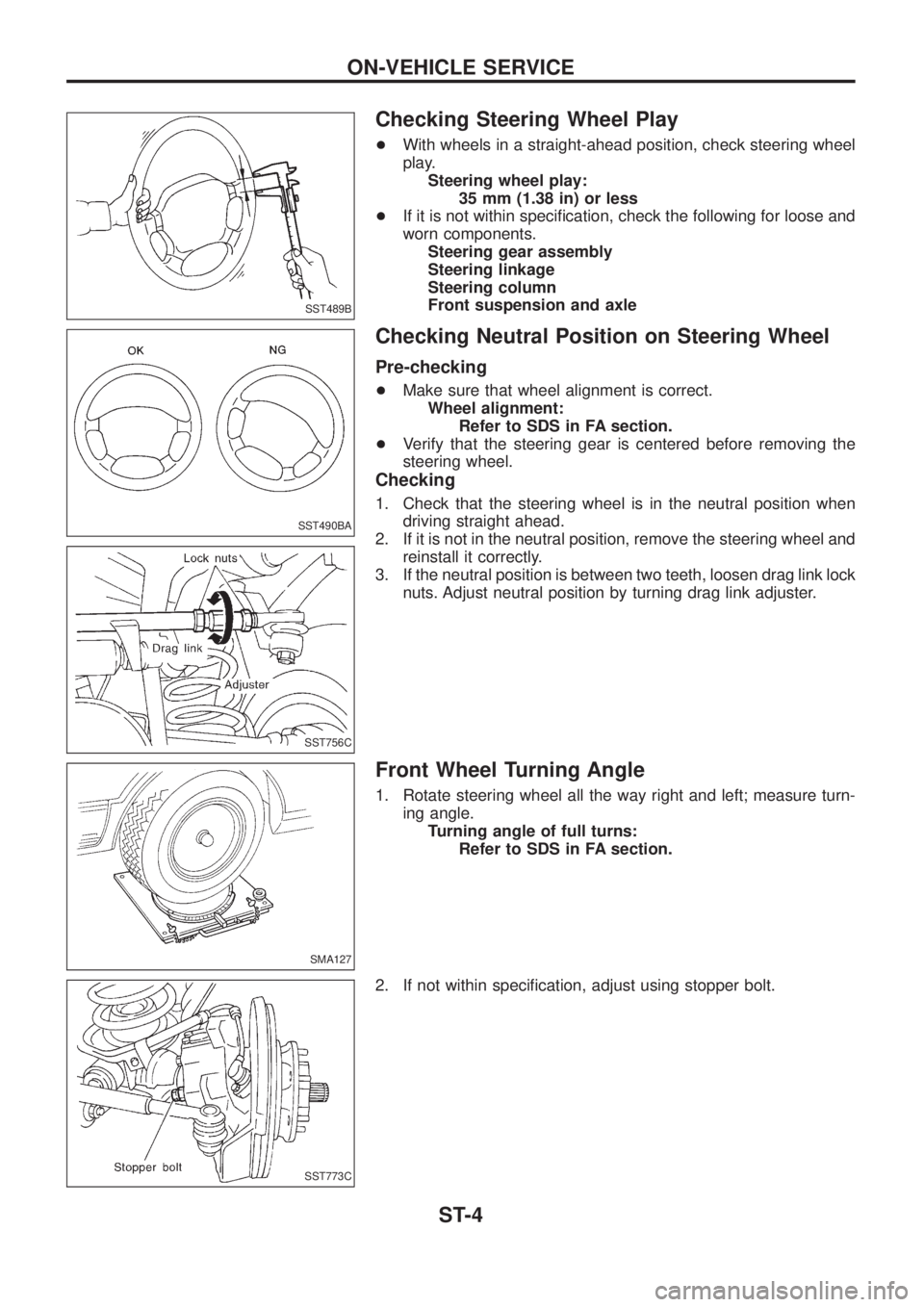
Checking Steering Wheel Play
+With wheels in a straight-ahead position, check steering wheel
play.
Steering wheel play:
35 mm (1.38 in) or less
+If it is not within speci®cation, check the following for loose and
worn components.
Steering gear assembly
Steering linkage
Steering column
Front suspension and axle
Checking Neutral Position on Steering Wheel
Pre-checking
+Make sure that wheel alignment is correct.
Wheel alignment:
Refer to SDS in FA section.
+Verify that the steering gear is centered before removing the
steering wheel.
Checking
1. Check that the steering wheel is in the neutral position when
driving straight ahead.
2. If it is not in the neutral position, remove the steering wheel and
reinstall it correctly.
3. If the neutral position is between two teeth, loosen drag link lock
nuts. Adjust neutral position by turning drag link adjuster.
Front Wheel Turning Angle
1. Rotate steering wheel all the way right and left; measure turn-
ing angle.
Turning angle of full turns:
Refer to SDS in FA section.
2. If not within speci®cation, adjust using stopper bolt.
SST489B
SST490BA
SST756C
SMA127
SST773C
ON-VEHICLE SERVICE
ST-4
Page 1174 of 1226
Checking and Adjusting Drive Belts
Refer to MA section (``Checking Drive Belts'', ``ENGINE MAINTE-
NANCE'').
Checking Fluid Level
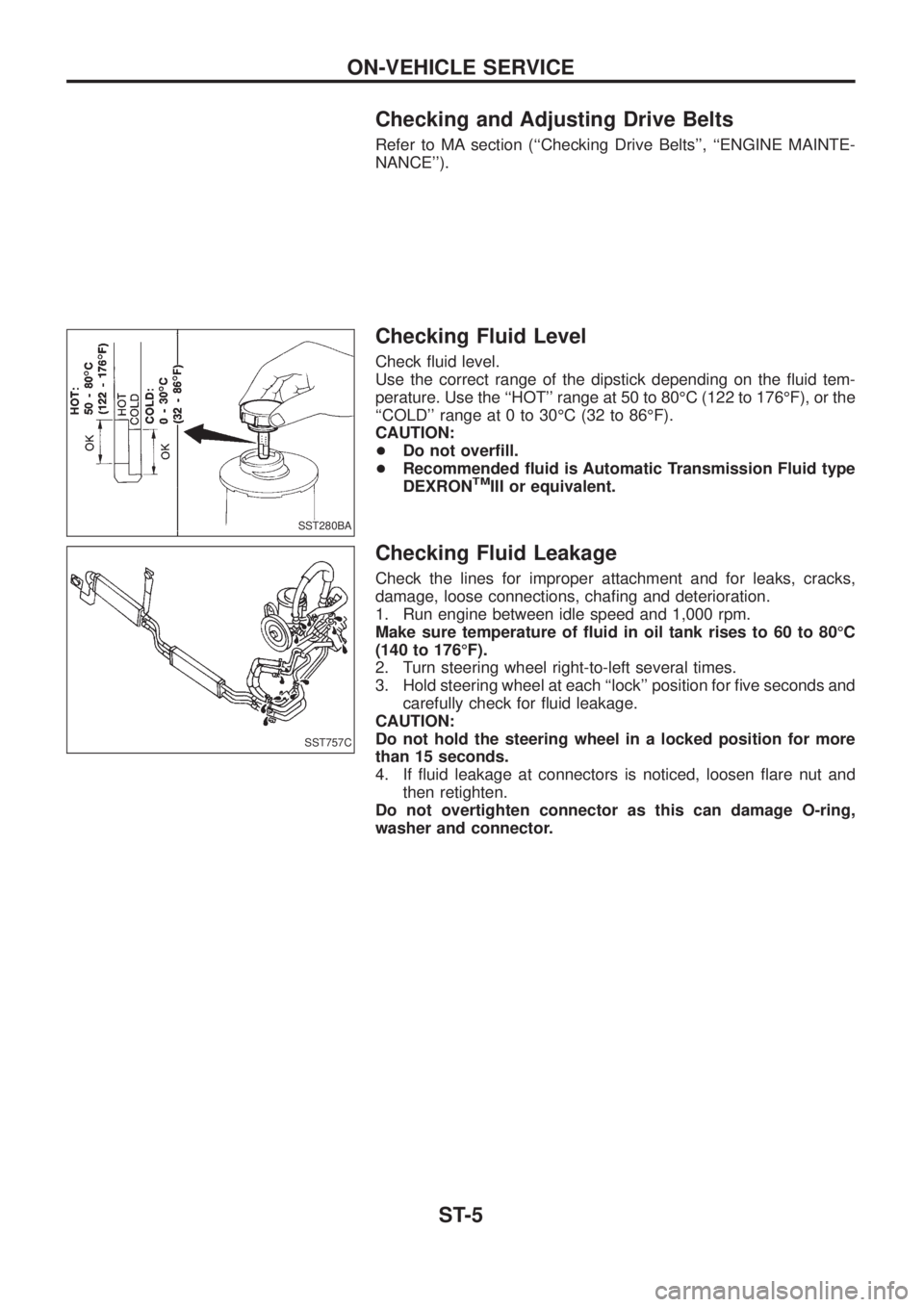
Check ¯uid level.
Use the correct range of the dipstick depending on the ¯uid tem-
perature. Use the ``HOT'' range at 50 to 80ÉC (122 to 176ÉF), or the
``COLD'' range at 0 to 30ÉC (32 to 86ÉF).
CAUTION:
+Do not over®ll.
+Recommended ¯uid is Automatic Transmission Fluid type
DEXRON
TMIII or equivalent.
Checking Fluid Leakage
Check the lines for improper attachment and for leaks, cracks,
damage, loose connections, cha®ng and deterioration.
1. Run engine between idle speed and 1,000 rpm.
Make sure temperature of ¯uid in oil tank rises to 60 to 80ÉC
(140 to 176ÉF).
2. Turn steering wheel right-to-left several times.
3. Hold steering wheel at each ``lock'' position for ®ve seconds and
carefully check for ¯uid leakage.
CAUTION:
Do not hold the steering wheel in a locked position for more
than 15 seconds.
4. If ¯uid leakage at connectors is noticed, loosen ¯are nut and
then retighten.
Do not overtighten connector as this can damage O-ring,
washer and connector.
SST280BA
SST757C
ON-VEHICLE SERVICE
ST-5
Page 1175 of 1226
Bleeding Hydraulic System
1. Raise front end of vehicle until wheels are clear of the ground.
2. Add ¯uid into oil tank to speci®ed level. Then, quickly turn steer-
ing wheel fully to right and left and lightly touch steering stop-
pers.
Repeat steering wheel operation until ¯uid level no longer
decreases.
3. Start engine.
Repeat step 2 above.
+Incomplete air bleeding will cause the following to occur. When
this happens, bleed air again.
a. Air bubbles in reservoir tank
b. Clicking noise in oil pump
c. Excessive buzzing in oil pump
Fluid noise may occur in the valve or oil pump. This is common
when the vehicle is stationary or while turning steering wheel
slowly. This does not affect performance or durability of the system.
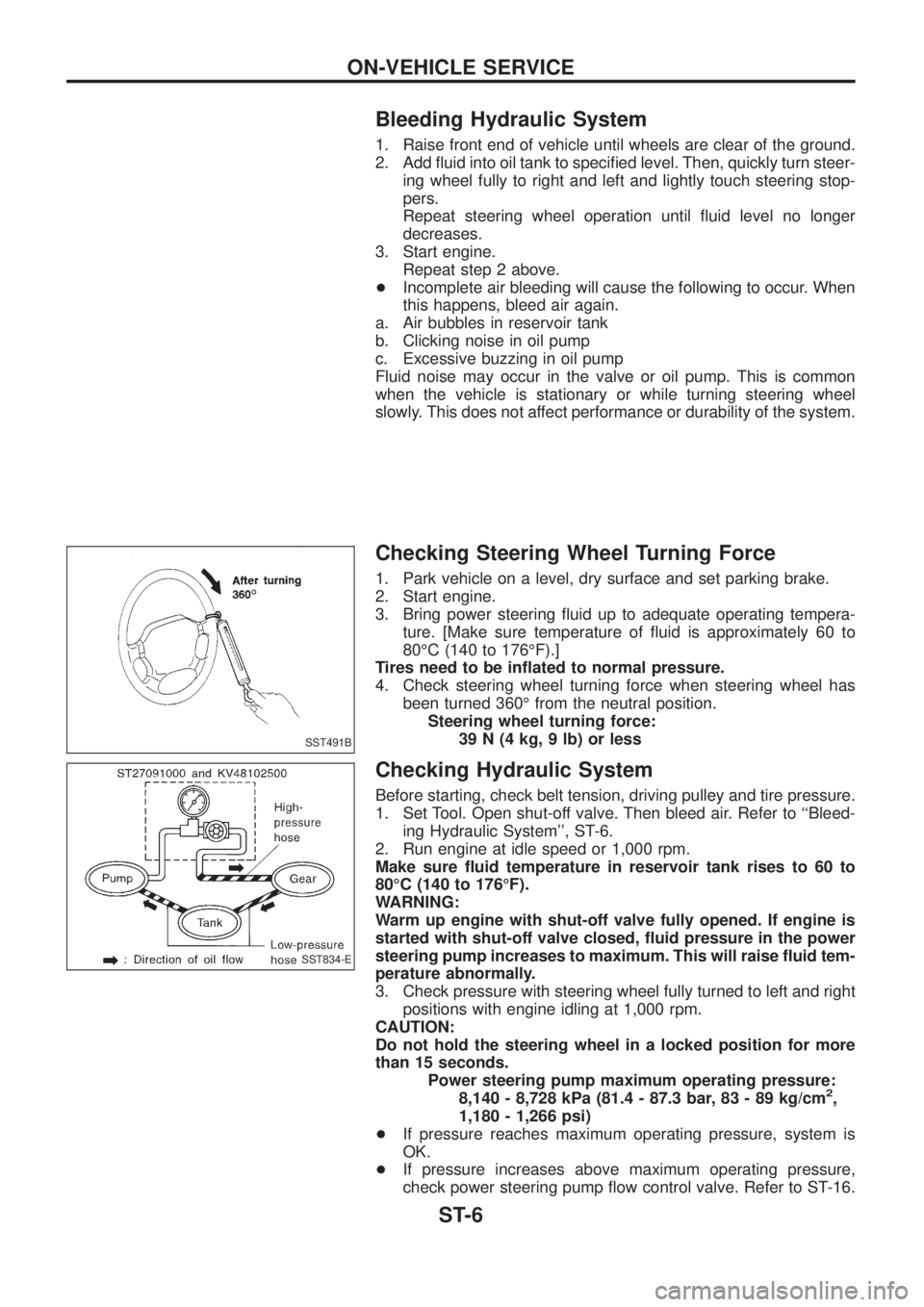
Checking Steering Wheel Turning Force
1. Park vehicle on a level, dry surface and set parking brake.
2. Start engine.
3. Bring power steering ¯uid up to adequate operating tempera-
ture. [Make sure temperature of ¯uid is approximately 60 to
80ÉC (140 to 176ÉF).]
Tires need to be in¯ated to normal pressure.
4. Check steering wheel turning force when steering wheel has
been turned 360É from the neutral position.
Steering wheel turning force:
39 N (4 kg, 9 lb) or less
Checking Hydraulic System
Before starting, check belt tension, driving pulley and tire pressure.
1. Set Tool. Open shut-off valve. Then bleed air. Refer to ``Bleed-
ing Hydraulic System'', ST-6.
2. Run engine at idle speed or 1,000 rpm.
Make sure ¯uid temperature in reservoir tank rises to 60 to
80ÉC (140 to 176ÉF).
WARNING:
Warm up engine with shut-off valve fully opened. If engine is
started with shut-off valve closed, ¯uid pressure in the power
steering pump increases to maximum. This will raise ¯uid tem-
perature abnormally.
3. Check pressure with steering wheel fully turned to left and right
positions with engine idling at 1,000 rpm.
CAUTION:
Do not hold the steering wheel in a locked position for more
than 15 seconds.
Power steering pump maximum operating pressure:
8,140 - 8,728 kPa (81.4 - 87.3 bar, 83 - 89 kg/cm
2,
1,180 - 1,266 psi)
+If pressure reaches maximum operating pressure, system is
OK.
+If pressure increases above maximum operating pressure,
check power steering pump ¯ow control valve. Refer to ST-16.
SST491B
SST834-E
ON-VEHICLE SERVICE
ST-6
Page 1179 of 1226
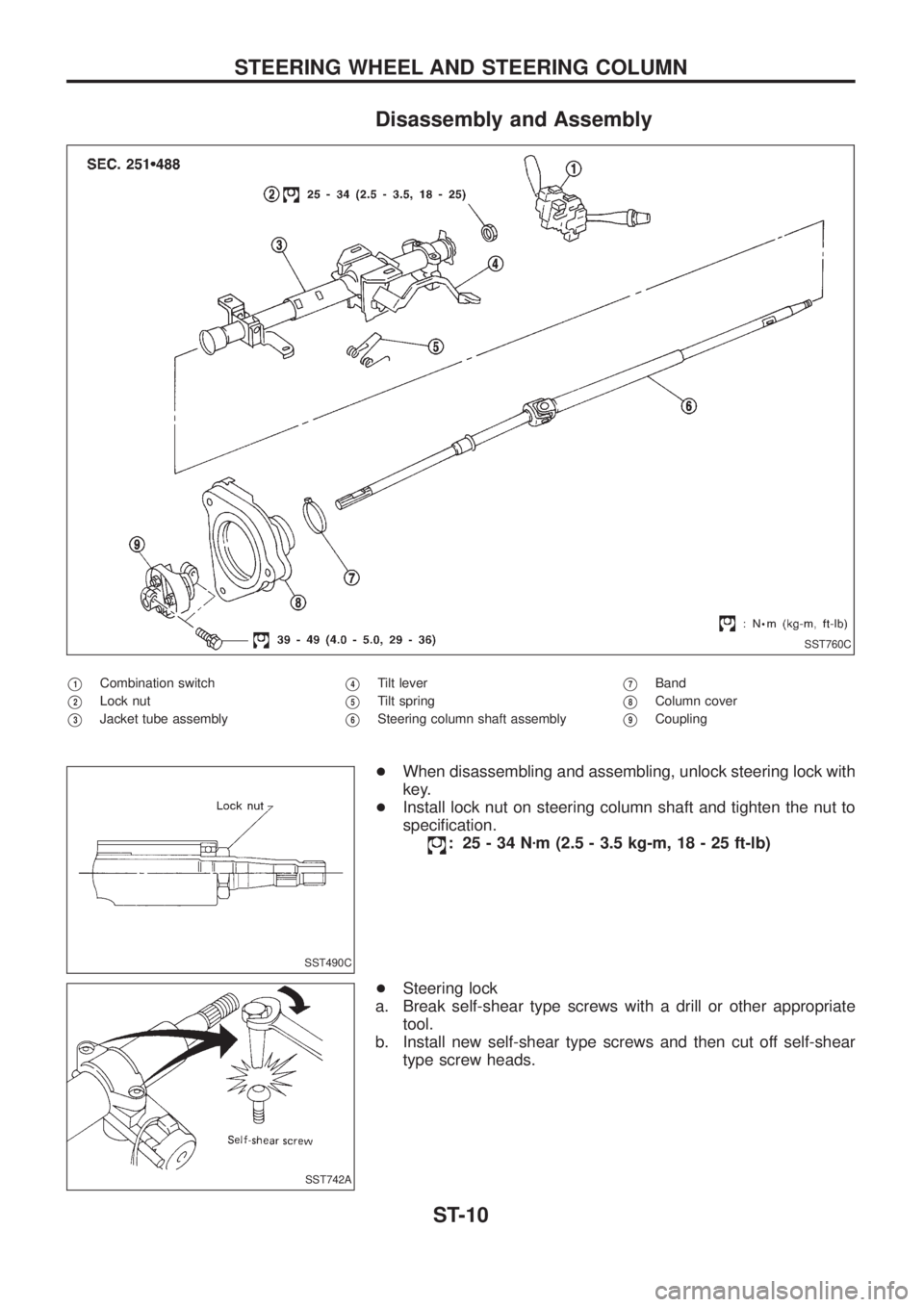
Disassembly and Assembly
V1Combination switch
V2Lock nut
V3Jacket tube assembly
V4Tilt lever
V5Tilt spring
V6Steering column shaft assembly
V7Band
V8Column cover
V9Coupling
+When disassembling and assembling, unlock steering lock with
key.
+Install lock nut on steering column shaft and tighten the nut to
speci®cation.
: 25-34Nzm (2.5 - 3.5 kg-m, 18 - 25 ft-lb)
+Steering lock
a. Break self-shear type screws with a drill or other appropriate
tool.
b. Install new self-shear type screws and then cut off self-shear
type screw heads.
SST760C
SST490C
SST742A
STEERING WHEEL AND STEERING COLUMN
ST-10
Page 1182 of 1226
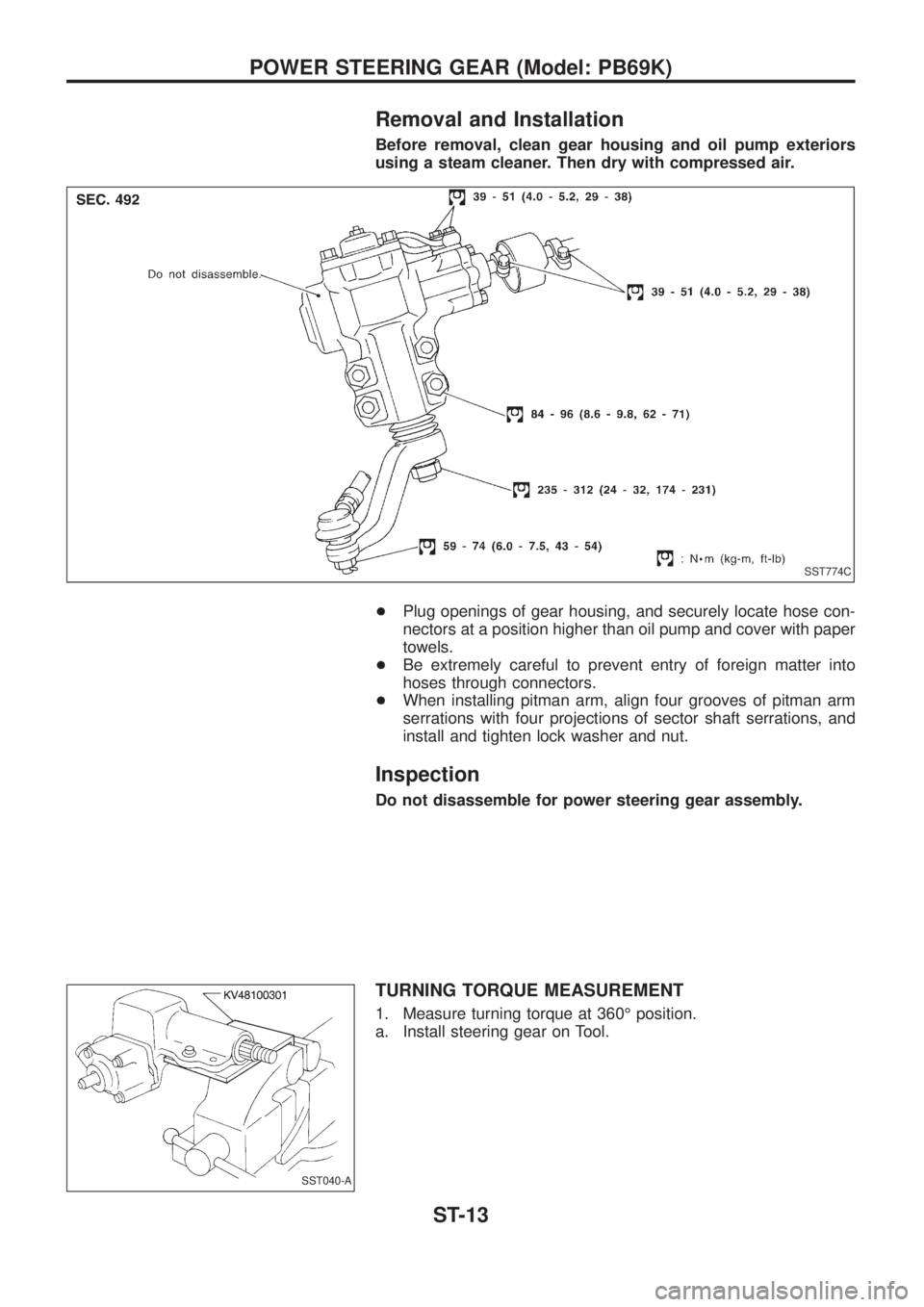
Removal and Installation
Before removal, clean gear housing and oil pump exteriors
using a steam cleaner. Then dry with compressed air.
+Plug openings of gear housing, and securely locate hose con-
nectors at a position higher than oil pump and cover with paper
towels.
+Be extremely careful to prevent entry of foreign matter into
hoses through connectors.
+When installing pitman arm, align four grooves of pitman arm
serrations with four projections of sector shaft serrations, and
install and tighten lock washer and nut.
Inspection
Do not disassemble for power steering gear assembly.
TURNING TORQUE MEASUREMENT
1. Measure turning torque at 360É position.
a. Install steering gear on Tool.
SST774C
SST040-A
POWER STEERING GEAR (Model: PB69K)
ST-13
Page 1183 of 1226
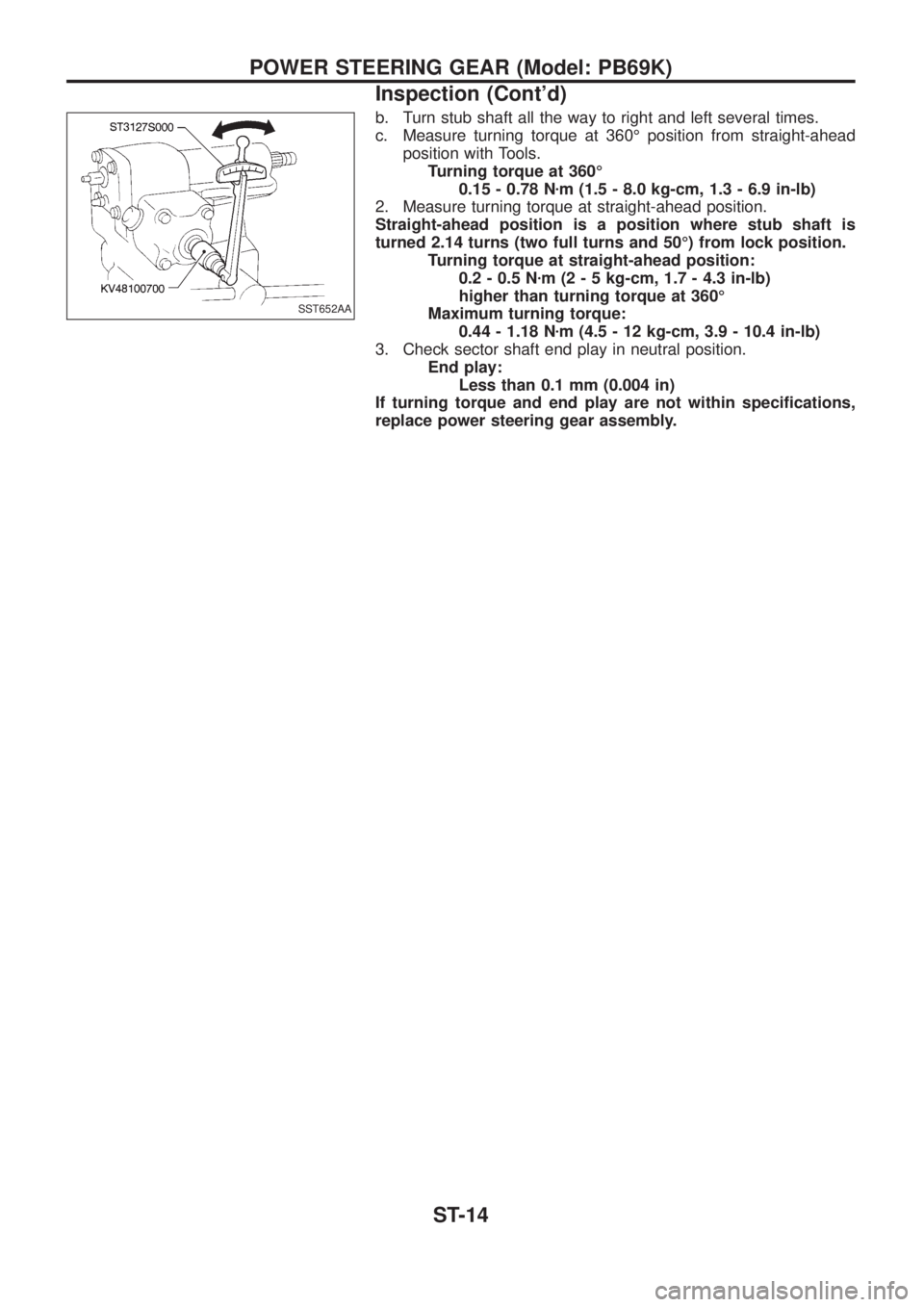
b. Turn stub shaft all the way to right and left several times.
c. Measure turning torque at 360É position from straight-ahead
position with Tools.
Turning torque at 360É
0.15 - 0.78 Nzm (1.5 - 8.0 kg-cm, 1.3 - 6.9 in-lb)
2. Measure turning torque at straight-ahead position.
Straight-ahead position is a position where stub shaft is
turned 2.14 turns (two full turns and 50É) from lock position.
Turning torque at straight-ahead position:
0.2 - 0.5 Nzm (2 - 5 kg-cm, 1.7 - 4.3 in-lb)
higher than turning torque at 360É
Maximum turning torque:
0.44 - 1.18 Nzm (4.5 - 12 kg-cm, 3.9 - 10.4 in-lb)
3. Check sector shaft end play in neutral position.
End play:
Less than 0.1 mm (0.004 in)
If turning torque and end play are not within speci®cations,
replace power steering gear assembly.
SST652AA
POWER STEERING GEAR (Model: PB69K)
Inspection (Cont'd)
ST-14
Page 1191 of 1226
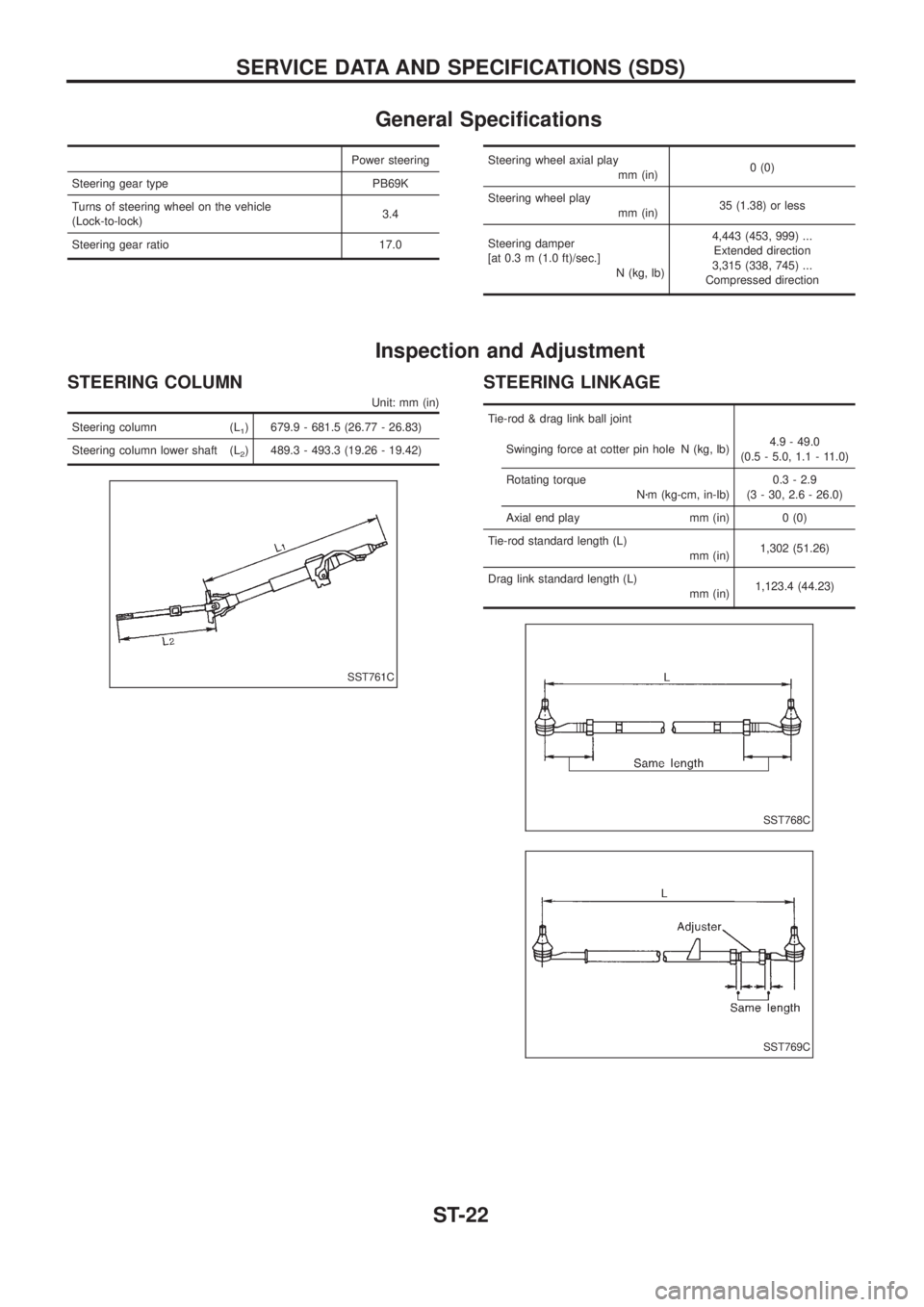
General Speci®cations
Power steering
Steering gear type PB69K
Turns of steering wheel on the vehicle
(Lock-to-lock)3.4
Steering gear ratio 17.0Steering wheel axial play
mm (in)0 (0)
Steering wheel play
mm (in)35 (1.38) or less
Steering damper
[at 0.3 m (1.0 ft)/sec.]
N (kg, lb)4,443 (453, 999) ...
Extended direction
3,315 (338, 745) ...
Compressed direction
Inspection and Adjustment
STEERING COLUMN
Unit: mm (in)
Steering column (L1) 679.9 - 681.5 (26.77 - 26.83)
Steering column lower shaft (L
2) 489.3 - 493.3 (19.26 - 19.42)
STEERING LINKAGE
Tie-rod & drag link ball joint
Swinging force at cotter pin hole N (kg, lb)4.9 - 49.0
(0.5 - 5.0, 1.1 - 11.0)
Rotating torque
Nzm (kg-cm, in-lb)0.3 - 2.9
(3 - 30, 2.6 - 26.0)
Axial end play mm (in) 0 (0)
Tie-rod standard length (L)
mm (in)1,302 (51.26)
Drag link standard length (L)
mm (in)1,123.4 (44.23)
SST761C
SST768C
SST769C
SERVICE DATA AND SPECIFICATIONS (SDS)
ST-22
Page 1219 of 1226
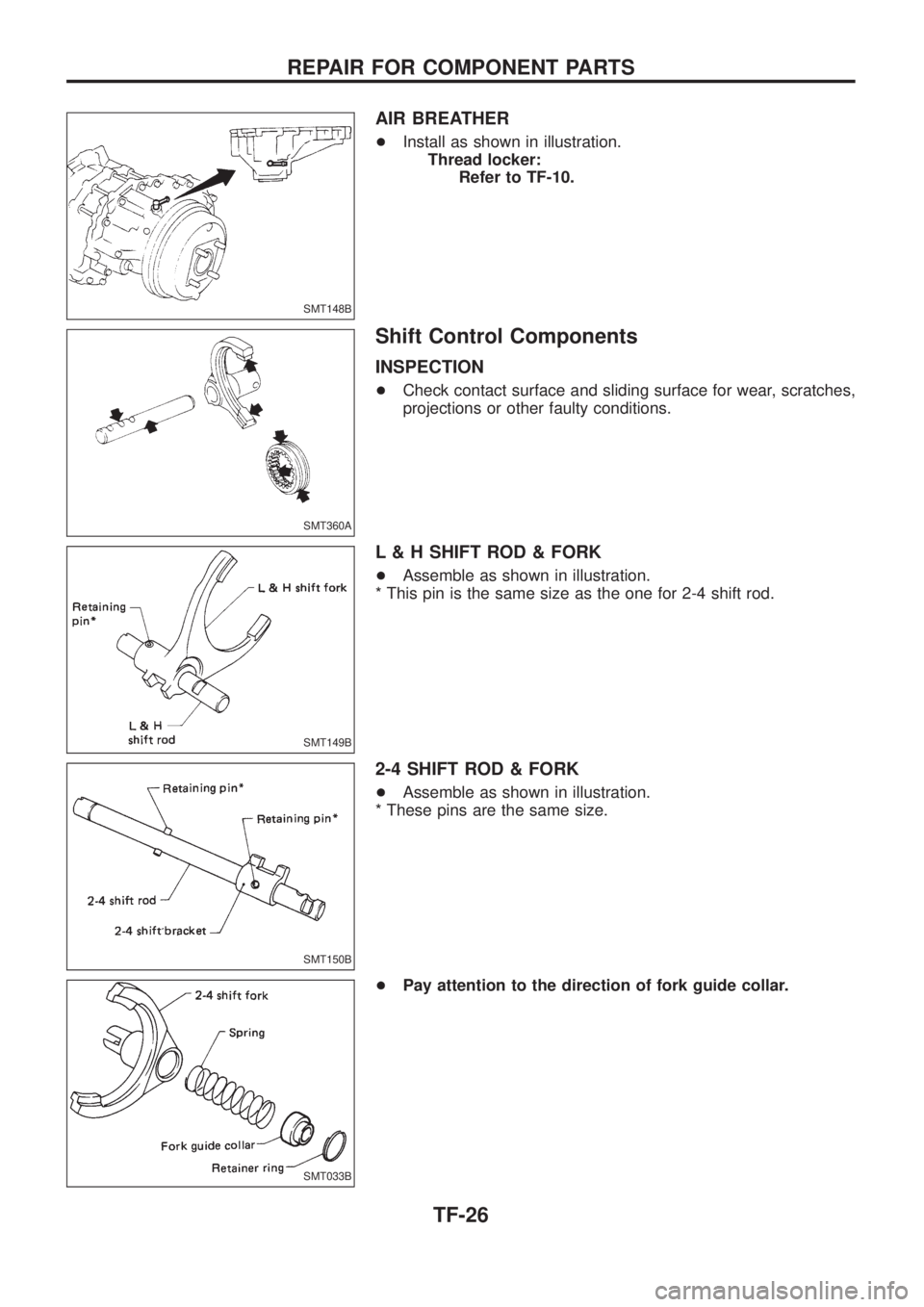
AIR BREATHER
+Install as shown in illustration.
Thread locker:
Refer to TF-10.
Shift Control Components
INSPECTION
+Check contact surface and sliding surface for wear, scratches,
projections or other faulty conditions.
L & H SHIFT ROD & FORK
+Assemble as shown in illustration.
* This pin is the same size as the one for 2-4 shift rod.
2-4 SHIFT ROD & FORK
+Assemble as shown in illustration.
* These pins are the same size.
+Pay attention to the direction of fork guide collar.
SMT148B
SMT360A
SMT149B
SMT150B
SMT033B
REPAIR FOR COMPONENT PARTS
TF-26