check engine NISSAN PICK-UP 1998 Manual PDF
[x] Cancel search | Manufacturer: NISSAN, Model Year: 1998, Model line: PICK-UP, Model: NISSAN PICK-UP 1998Pages: 1659, PDF Size: 53.39 MB
Page 258 of 1659
Overheat
ON BOARD DIAGNOSIS LOGIC
If the cooling fan or another component in the cooling system malfunctions, the engine coolant temperature
will rise.
When the engine coolant temperature reaches an abnormally high temperature condition, a malfunction is
indicated.
Diagnostic trouble
code No.Malfunction is detected when ...Check Items
(Possible Cause)
28
lEngine coolant temperature reaches an abnormally
high temperature.lCooling fan
lRadiator hose
lRadiator
lRadiator cap
lWater pump
lThermostat
For more information, refer to ``MAIN 12
CAUSES OF OVERHEATING'', EC-108.
CAUTION:
When a malfunction is indicated, be sure to replace the coolant following the procedure in MA sec-
tion (``Changing Engine Coolant'', ``ENGINE MAINTENANCE''). Also, replace the engine oil.
lFill radiator with coolant up to specified level with a filling speed of 2 liters per minute like pour-
ing coolant by kettle. Be sure to use coolant with the proper mixture ratio. Refer to MA section
(``Anti-freeze Coolant Mixture Ratio'', ``RECOMMENDED FLUIDS AND LUBRICANTS'').
lAfter refilling coolant, run engine to ensure that no water-flow noise is emitted.
OVERALL FUNCTION CHECK
WARNING:
Never remove the radiator cap when the engine is hot. Seri-
ous burns could be caused by high pressure fluid escaping
from the radiator.
Wrap a thick cloth around cap. Carefully remove the cap by
turning it a quarter turn to allow built-up pressure to escape.
Then turn the cap all the way off.
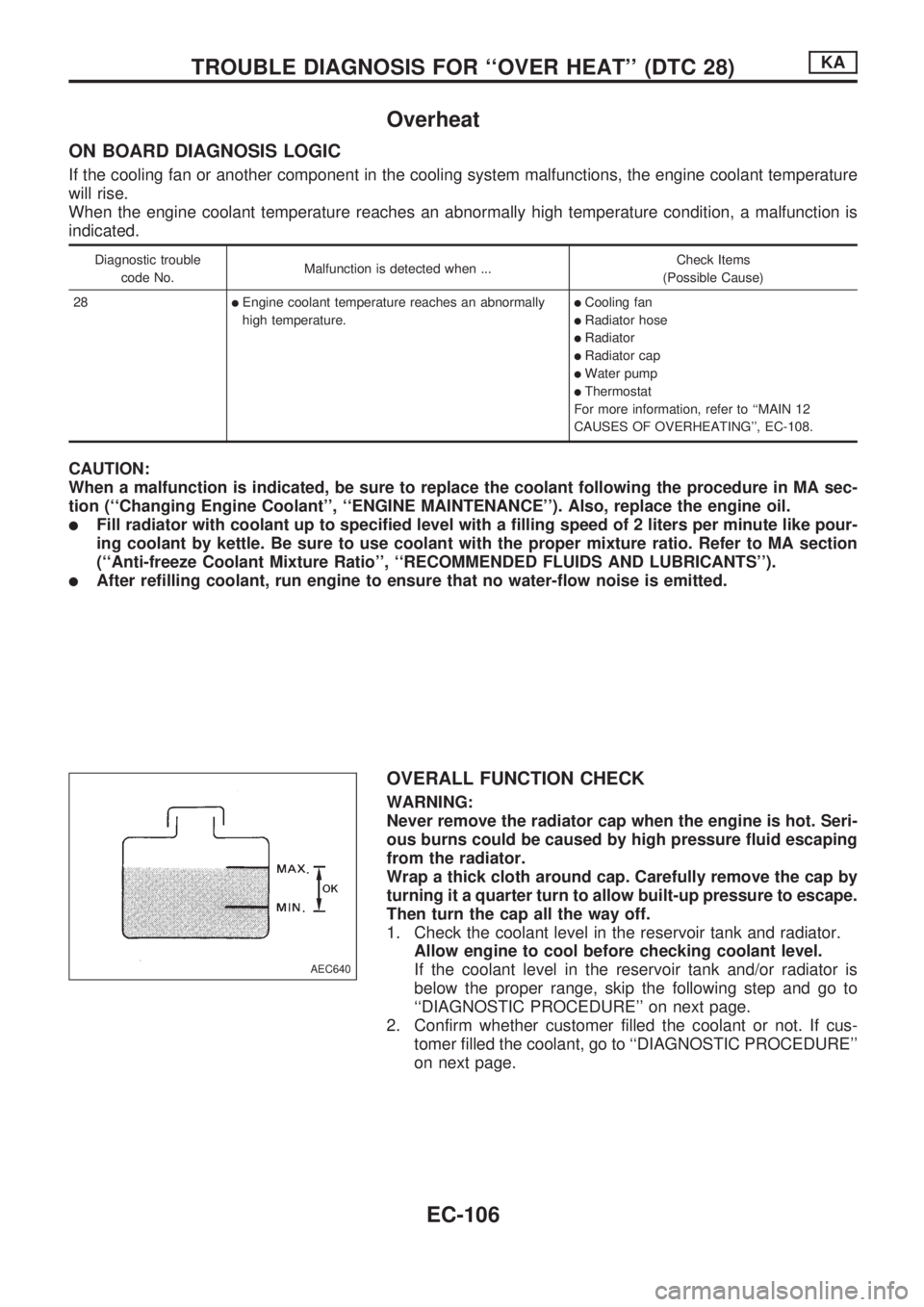
1. Check the coolant level in the reservoir tank and radiator.
Allow engine to cool before checking coolant level.
If the coolant level in the reservoir tank and/or radiator is
below the proper range, skip the following step and go to
``DIAGNOSTIC PROCEDURE'' on next page.
2. Confirm whether customer filled the coolant or not. If cus-
tomer filled the coolant, go to ``DIAGNOSTIC PROCEDURE''
on next page.
AEC640
TROUBLE DIAGNOSIS FOR ``OVER HEAT'' (DTC 28)KA
EC-106
Page 259 of 1659
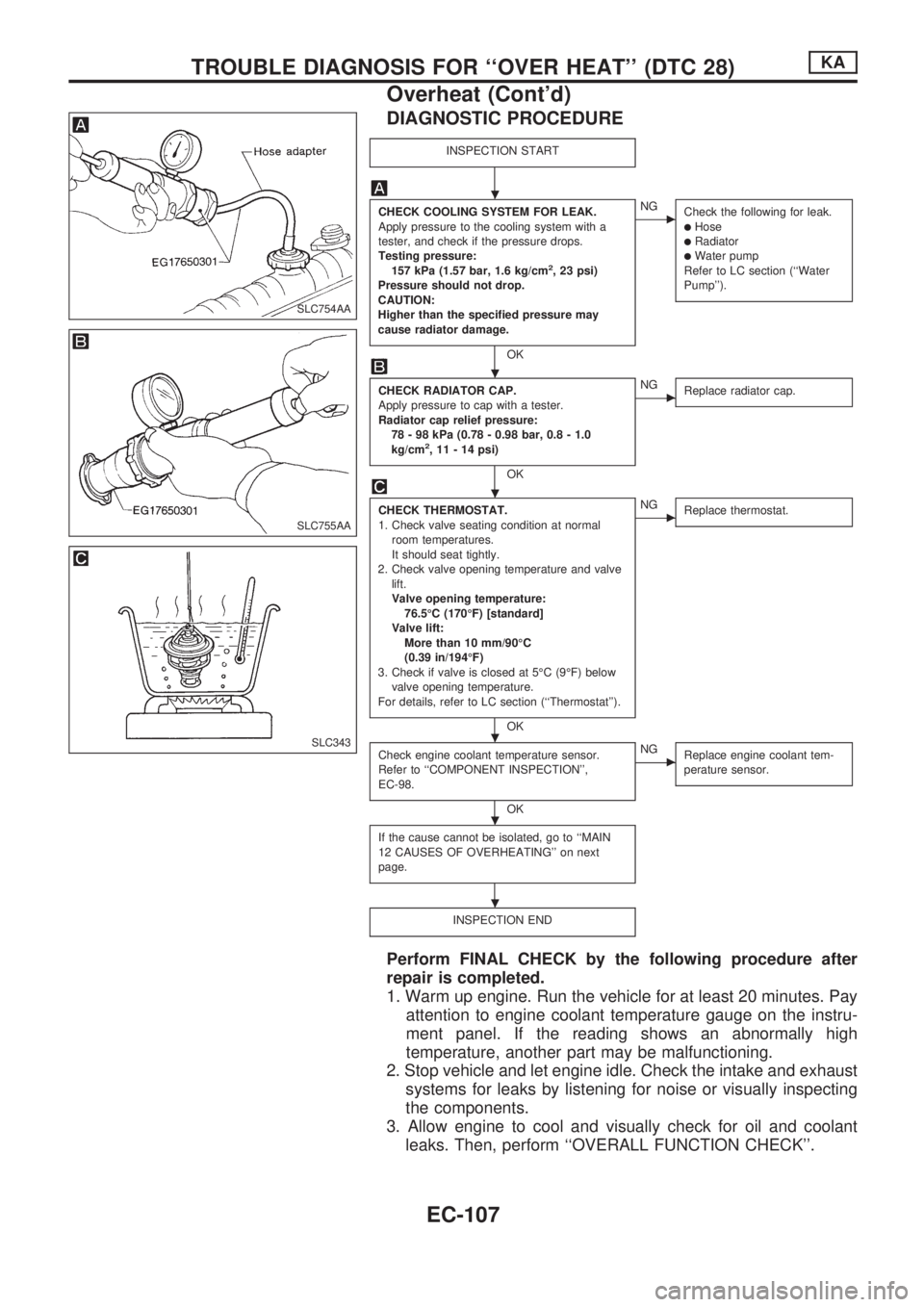
DIAGNOSTIC PROCEDURE
INSPECTION START
CHECK COOLING SYSTEM FOR LEAK.
Apply pressure to the cooling system with a
tester, and check if the pressure drops.
Testing pressure:
157 kPa (1.57 bar, 1.6 kg/cm
2, 23 psi)
Pressure should not drop.
CAUTION:
Higher than the specified pressure may
cause radiator damage.
OK
cNG
Check the following for leak.
lHoselRadiatorlWater pump
Refer to LC section (``Water
Pump'').
CHECK RADIATOR CAP.
Apply pressure to cap with a tester.
Radiator cap relief pressure:
78 - 98 kPa (0.78 - 0.98 bar, 0.8 - 1.0
kg/cm
2, 11 - 14 psi)
OK
cNG
Replace radiator cap.
CHECK THERMOSTAT.
1. Check valve seating condition at normal
room temperatures.
It should seat tightly.
2. Check valve opening temperature and valve
lift.
Valve opening temperature:
76.5ÉC (170ÉF) [standard]
Valve lift:
More than 10 mm/90ÉC
(0.39 in/194ÉF)
3. Check if valve is closed at 5ÉC (9ÉF) below
valve opening temperature.
For details, refer to LC section (``Thermostat'').
OK
cNG
Replace thermostat.
Check engine coolant temperature sensor.
Refer to ``COMPONENT INSPECTION'',
EC-98.
OK
cNG
Replace engine coolant tem-
perature sensor.
If the cause cannot be isolated, go to ``MAIN
12 CAUSES OF OVERHEATING'' on next
page.
INSPECTION END
Perform FINAL CHECK by the following procedure after
repair is completed.
1. Warm up engine. Run the vehicle for at least 20 minutes. Pay
attention to engine coolant temperature gauge on the instru-
ment panel. If the reading shows an abnormally high
temperature, another part may be malfunctioning.
2. Stop vehicle and let engine idle. Check the intake and exhaust
systems for leaks by listening for noise or visually inspecting
the components.
3. Allow engine to cool and visually check for oil and coolant
leaks. Then, perform ``OVERALL FUNCTION CHECK''.
SLC754AA
SLC755AA
SLC343
.
.
.
.
.
.
TROUBLE DIAGNOSIS FOR ``OVER HEAT'' (DTC 28)KA
Overheat (Cont'd)
EC-107
Page 260 of 1659
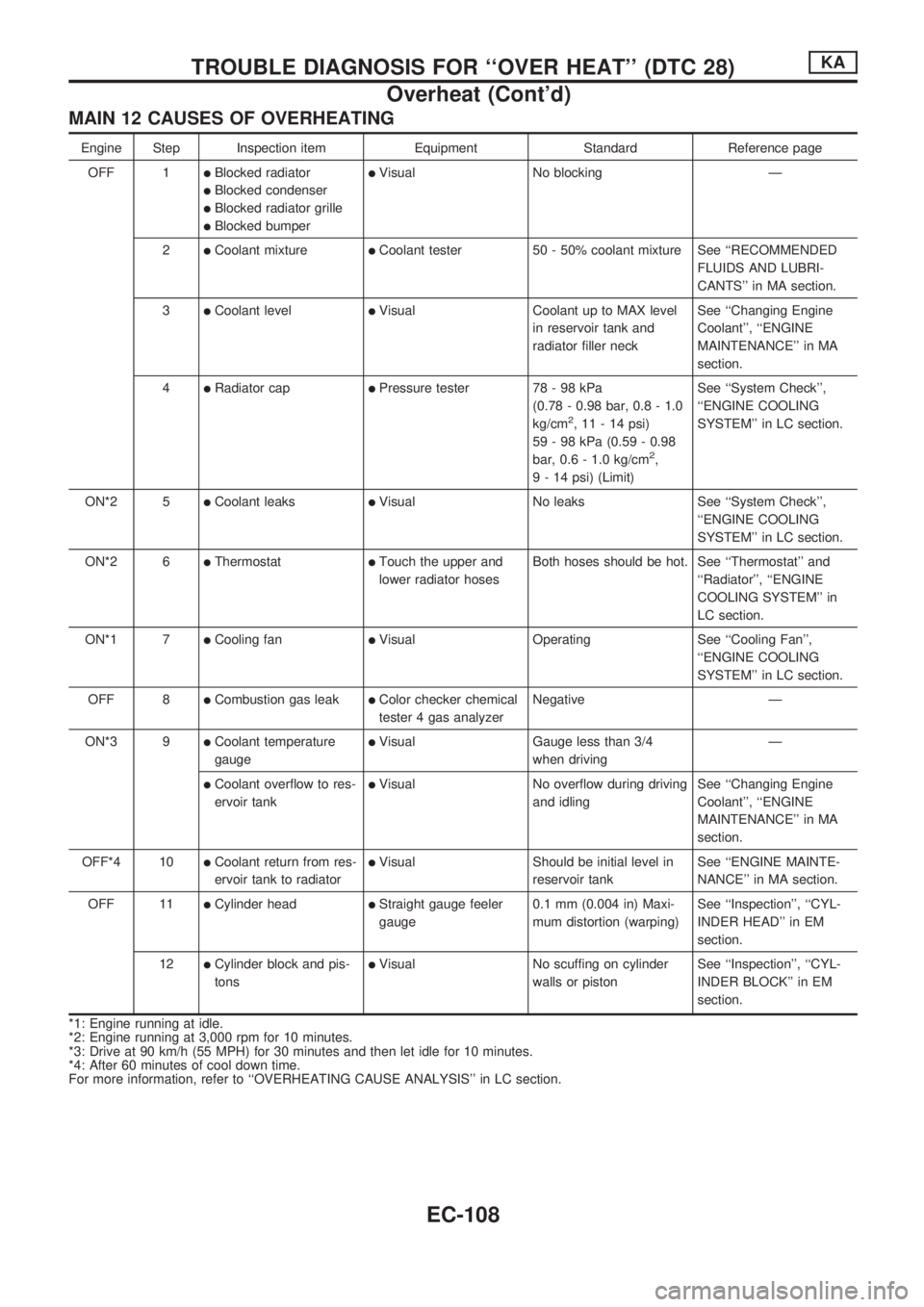
MAIN 12 CAUSES OF OVERHEATING
Engine Step Inspection item Equipment Standard Reference page
OFF 1
lBlocked radiator
lBlocked condenser
lBlocked radiator grille
lBlocked bumper
lVisual No blocking Ð
2
lCoolant mixturelCoolant tester 50 - 50% coolant mixture See ``RECOMMENDED
FLUIDS AND LUBRI-
CANTS'' in MA section.
3
lCoolant levellVisual Coolant up to MAX level
in reservoir tank and
radiator filler neckSee ``Changing Engine
Coolant'', ``ENGINE
MAINTENANCE'' in MA
section.
4
lRadiator caplPressure tester 78 - 98 kPa
(0.78 - 0.98 bar, 0.8 - 1.0
kg/cm
2, 11 - 14 psi)
59 - 98 kPa (0.59 - 0.98
bar, 0.6 - 1.0 kg/cm
2,
9 - 14 psi) (Limit)See ``System Check'',
``ENGINE COOLING
SYSTEM'' in LC section.
ON*2 5
lCoolant leakslVisual No leaks See ``System Check'',
``ENGINE COOLING
SYSTEM'' in LC section.
ON*2 6
lThermostatlTouch the upper and
lower radiator hosesBoth hoses should be hot. See ``Thermostat'' and
``Radiator'', ``ENGINE
COOLING SYSTEM'' in
LC section.
ON*1 7
lCooling fanlVisual Operating See ``Cooling Fan'',
``ENGINE COOLING
SYSTEM'' in LC section.
OFF 8
lCombustion gas leaklColor checker chemical
tester 4 gas analyzerNegative Ð
ON*3 9
lCoolant temperature
gaugelVisual Gauge less than 3/4
when drivingÐ
lCoolant overflow to res-
ervoir tanklVisual No overflow during driving
and idlingSee ``Changing Engine
Coolant'', ``ENGINE
MAINTENANCE'' in MA
section.
OFF*4 10
lCoolant return from res-
ervoir tank to radiatorlVisual Should be initial level in
reservoir tankSee ``ENGINE MAINTE-
NANCE'' in MA section.
OFF 11
lCylinder headlStraight gauge feeler
gauge0.1 mm (0.004 in) Maxi-
mum distortion (warping)See ``Inspection'', ``CYL-
INDER HEAD'' in EM
section.
12
lCylinder block and pis-
tonslVisual No scuffing on cylinder
walls or pistonSee ``Inspection'', ``CYL-
INDER BLOCK'' in EM
section.
*1: Engine running at idle.
*2: Engine running at 3,000 rpm for 10 minutes.
*3: Drive at 90 km/h (55 MPH) for 30 minutes and then let idle for 10 minutes.
*4: After 60 minutes of cool down time.
For more information, refer to ``OVERHEATING CAUSE ANALYSIS'' in LC section.
TROUBLE DIAGNOSIS FOR ``OVER HEAT'' (DTC 28)KA
Overheat (Cont'd)
EC-108
Page 261 of 1659
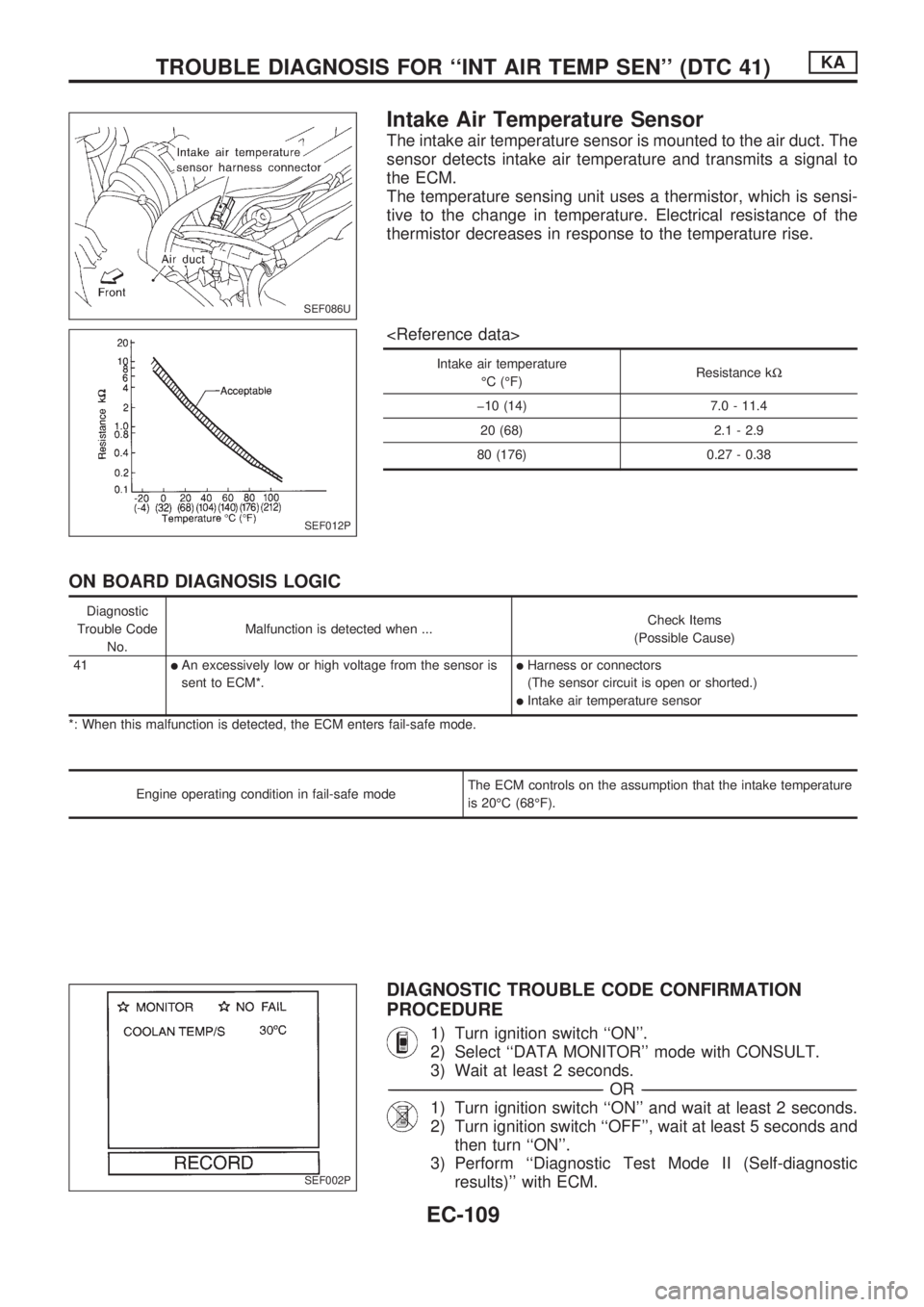
Intake Air Temperature Sensor
The intake air temperature sensor is mounted to the air duct. The
sensor detects intake air temperature and transmits a signal to
the ECM.
The temperature sensing unit uses a thermistor, which is sensi-
tive to the change in temperature. Electrical resistance of the
thermistor decreases in response to the temperature rise.
Intake air temperature
ÉC (ÉF)Resistance kW
þ10 (14) 7.0 - 11.4
20 (68) 2.1 - 2.9
80 (176) 0.27 - 0.38
ON BOARD DIAGNOSIS LOGIC
Diagnostic
Trouble Code
No.Malfunction is detected when ...Check Items
(Possible Cause)
41
lAn excessively low or high voltage from the sensor is
sent to ECM*.lHarness or connectors
(The sensor circuit is open or shorted.)
lIntake air temperature sensor
*: When this malfunction is detected, the ECM enters fail-safe mode.
Engine operating condition in fail-safe modeThe ECM controls on the assumption that the intake temperature
is 20ÉC (68ÉF).
DIAGNOSTIC TROUBLE CODE CONFIRMATION
PROCEDURE
1) Turn ignition switch ``ON''.
2) Select ``DATA MONITOR'' mode with CONSULT.
3) Wait at least 2 seconds.
-------------------------------------------------------------------------------------------------------------------------------------------------------------------------------------------------------------------------------------------------OR-------------------------------------------------------------------------------------------------------------------------------------------------------------------------------------------------------------------------------------------------
1) Turn ignition switch ``ON'' and wait at least 2 seconds.
2) Turn ignition switch ``OFF'', wait at least 5 seconds and
then turn ``ON''.
3) Perform ``Diagnostic Test Mode II (Self-diagnostic
results)'' with ECM.
SEF086U
SEF012P
SEF002P
TROUBLE DIAGNOSIS FOR ``INT AIR TEMP SEN'' (DTC 41)KA
EC-109
Page 263 of 1659
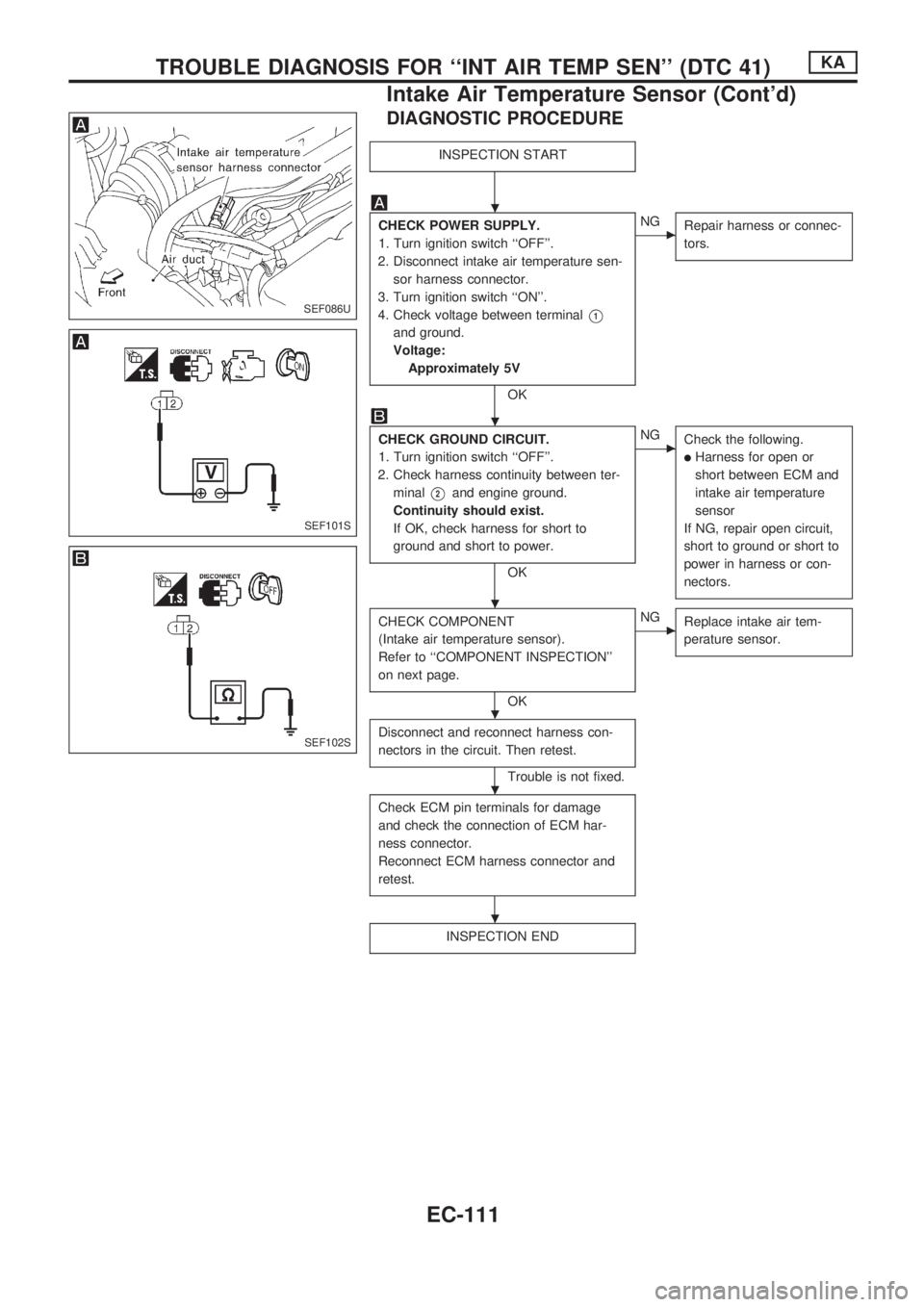
DIAGNOSTIC PROCEDURE
INSPECTION START
CHECK POWER SUPPLY.
1. Turn ignition switch ``OFF''.
2. Disconnect intake air temperature sen-
sor harness connector.
3. Turn ignition switch ``ON''.
4. Check voltage between terminal
V1
and ground.
Voltage:
Approximately 5V
OK
cNG
Repair harness or connec-
tors.
CHECK GROUND CIRCUIT.
1. Turn ignition switch ``OFF''.
2. Check harness continuity between ter-
minal
V2and engine ground.
Continuity should exist.
If OK, check harness for short to
ground and short to power.
OK
cNG
Check the following.
lHarness for open or
short between ECM and
intake air temperature
sensor
If NG, repair open circuit,
short to ground or short to
power in harness or con-
nectors.
CHECK COMPONENT
(Intake air temperature sensor).
Refer to ``COMPONENT INSPECTION''
on next page.
OK
cNG
Replace intake air tem-
perature sensor.
Disconnect and reconnect harness con-
nectors in the circuit. Then retest.
Trouble is not fixed.
Check ECM pin terminals for damage
and check the connection of ECM har-
ness connector.
Reconnect ECM harness connector and
retest.
INSPECTION END
SEF086U
SEF101S
SEF102S
.
.
.
.
.
.
TROUBLE DIAGNOSIS FOR ``INT AIR TEMP SEN'' (DTC 41)KA
Intake Air Temperature Sensor (Cont'd)
EC-111
Page 266 of 1659
ON BOARD DIAGNOSIS LOGIC
Diagnostic
Trouble
Code No.Malfunction is detected when ...Check Items
(Possible Cause)
43
lAn excessively low or high voltage from the sensor is
sent to ECM.*lHarness or connectors
(The sensor circuit is open or shorted.)
lThrottle position sensor
*: When this malfunction is detected, the ECM enters fail-safe mode.
Engine operating condition in fail-safe mode Condition Driving condition
Throttle position will be determined based on the
amount of mass air flow and the engine speed.
Therefore, acceleration will be poor.When engine is idling Normal
When accelerating Poor acceleration
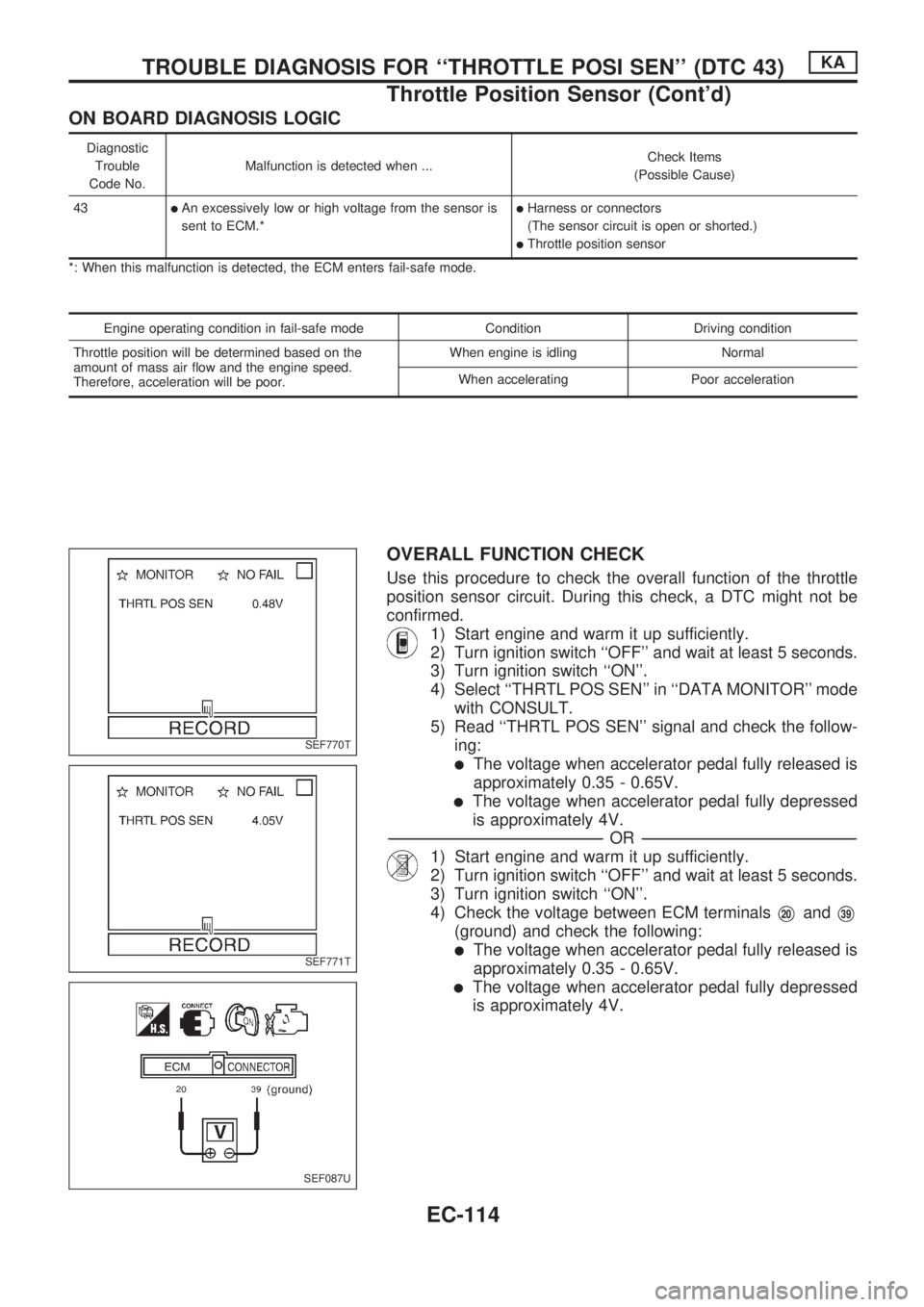
OVERALL FUNCTION CHECK
Use this procedure to check the overall function of the throttle
position sensor circuit. During this check, a DTC might not be
confirmed.
1) Start engine and warm it up sufficiently.
2) Turn ignition switch ``OFF'' and wait at least 5 seconds.
3) Turn ignition switch ``ON''.
4) Select ``THRTL POS SEN'' in ``DATA MONITOR'' mode
with CONSULT.
5) Read ``THRTL POS SEN'' signal and check the follow-
ing:
lThe voltage when accelerator pedal fully released is
approximately 0.35 - 0.65V.
lThe voltage when accelerator pedal fully depressed
is approximately 4V.
-------------------------------------------------------------------------------------------------------------------------------------------------------------------------------------------------------------------------------------------------OR-------------------------------------------------------------------------------------------------------------------------------------------------------------------------------------------------------------------------------------------------
1) Start engine and warm it up sufficiently.
2) Turn ignition switch ``OFF'' and wait at least 5 seconds.
3) Turn ignition switch ``ON''.
4) Check the voltage between ECM terminals
V20andV39
(ground) and check the following:
lThe voltage when accelerator pedal fully released is
approximately 0.35 - 0.65V.
lThe voltage when accelerator pedal fully depressed
is approximately 4V.
SEF770T
SEF771T
SEF087U
TROUBLE DIAGNOSIS FOR ``THROTTLE POSI SEN'' (DTC 43)KA
Throttle Position Sensor (Cont'd)
EC-114
Page 268 of 1659
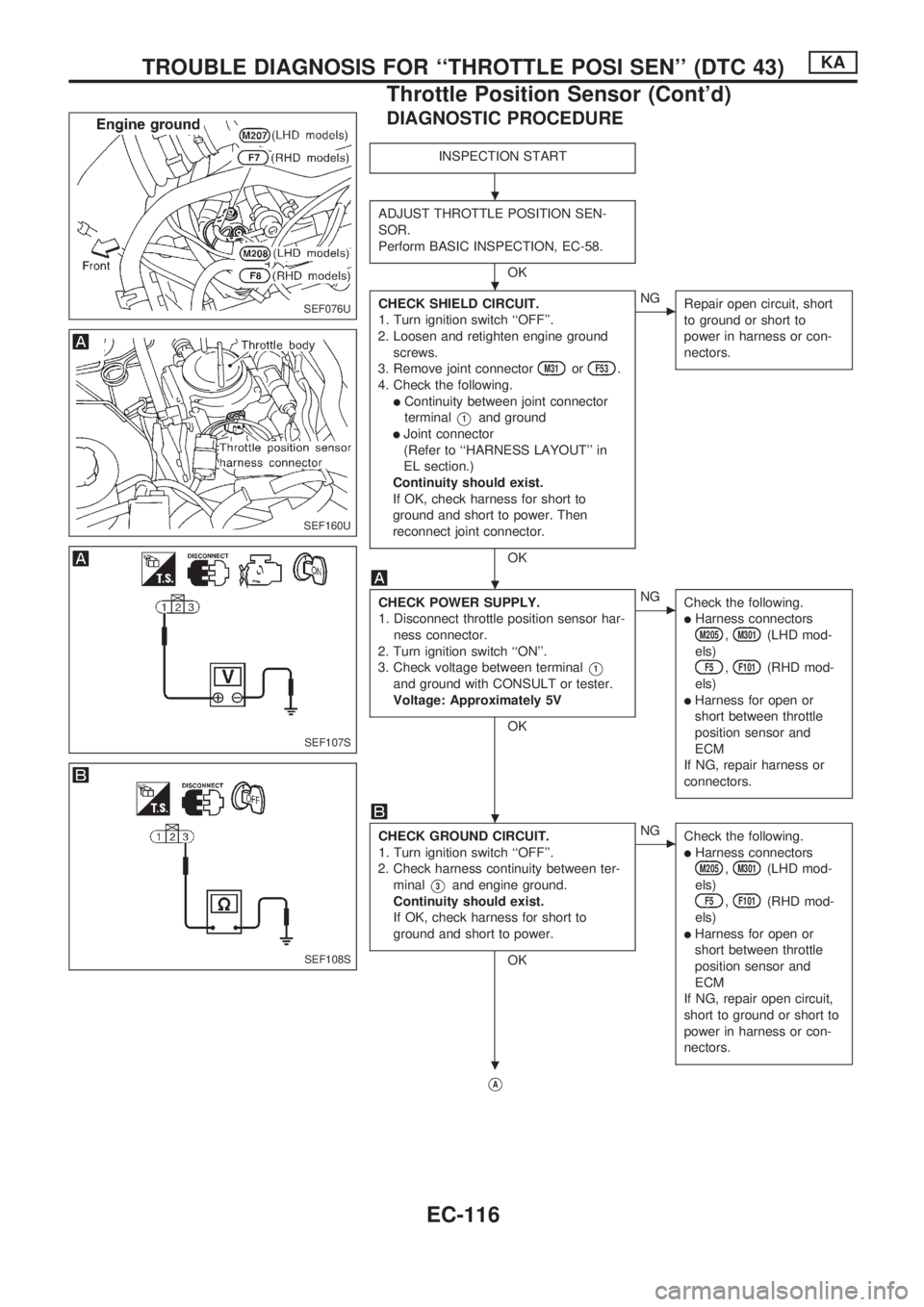
DIAGNOSTIC PROCEDURE
INSPECTION START
ADJUST THROTTLE POSITION SEN-
SOR.
Perform BASIC INSPECTION, EC-58.
OK
CHECK SHIELD CIRCUIT.
1. Turn ignition switch ``OFF''.
2. Loosen and retighten engine ground
screws.
3. Remove joint connector
M31orF53.
4. Check the following.
lContinuity between joint connector
terminal
V1and ground
lJoint connector
(Refer to ``HARNESS LAYOUT'' in
EL section.)
Continuity should exist.
If OK, check harness for short to
ground and short to power. Then
reconnect joint connector.
OK
cNG
Repair open circuit, short
to ground or short to
power in harness or con-
nectors.
CHECK POWER SUPPLY.
1. Disconnect throttle position sensor har-
ness connector.
2. Turn ignition switch ``ON''.
3. Check voltage between terminal
V1
and ground with CONSULT or tester.
Voltage: Approximately 5V
OK
cNG
Check the following.
lHarness connectorsM205,M301(LHD mod-
els)
F5,F101(RHD mod-
els)
lHarness for open or
short between throttle
position sensor and
ECM
If NG, repair harness or
connectors.
CHECK GROUND CIRCUIT.
1. Turn ignition switch ``OFF''.
2. Check harness continuity between ter-
minal
V3and engine ground.
Continuity should exist.
If OK, check harness for short to
ground and short to power.
OK
cNG
Check the following.
lHarness connectorsM205,M301(LHD mod-
els)
F5,F101(RHD mod-
els)
lHarness for open or
short between throttle
position sensor and
ECM
If NG, repair open circuit,
short to ground or short to
power in harness or con-
nectors.
VA
SEF076U
SEF160U
SEF107S
SEF108S
.
.
.
.
.
TROUBLE DIAGNOSIS FOR ``THROTTLE POSI SEN'' (DTC 43)KA
Throttle Position Sensor (Cont'd)
EC-116
Page 269 of 1659

VA
CHECK INPUT SIGNAL CIRCUIT.
1. Disconnect ECM harness connector.
2. Check harness continuity between
ECM terminal
V20and terminalV2.
Continuity should exist.
If OK, check harness for short to
ground and short to power.
OK
cNG
Check the following.
lHarness connectorsM205,M301(LHD models)
F5,F101(RHD models)
lHarness for open or short
between throttle position
sensor and ECM
If NG, repair open circuit,
short to ground or short to
power in harness or connec-
tors.
CHECK COMPONENT
(Throttle position sensor).
Refer to ``COMPONENT INSPECTION''
below.
OK
cNG
Replace throttle position
sensor. To adjust it, perform
BASIC INSPECTION,
EC-58.
Disconnect and reconnect harness con-
nectors in the circuit. Then retest.
Trouble is not fixed.
Check ECM pin terminals for damage
and check the connection of ECM har-
ness connector.
Reconnect ECM harness connector and
retest.
INSPECTION END
COMPONENT INSPECTION
Throttle position sensor
1. Start engine and warm it up sufficiently.
2. Turn ignition switch ``OFF''.
3. Disconnect throttle position sensor harness connector.
4. Make sure that resistance between terminals
V2andV3
changes when opening throttle valve manually.
Throttle valve conditions Resistance at 25ÉC (77ÉF)
Completely closed Approximately 0.6 kW
Partially open 0.6 - 4.0 kW
Completely open Approximately 4 kW
If NG, replace throttle position sensor.
To adjust throttle position sensor, perform ``BASIC
INSPECTION'', EC-58.
SEF088U
SEF161U
.
.
.
.
.
TROUBLE DIAGNOSIS FOR ``THROTTLE POSI SEN'' (DTC 43)KA
Throttle Position Sensor (Cont'd)
EC-117
Page 273 of 1659
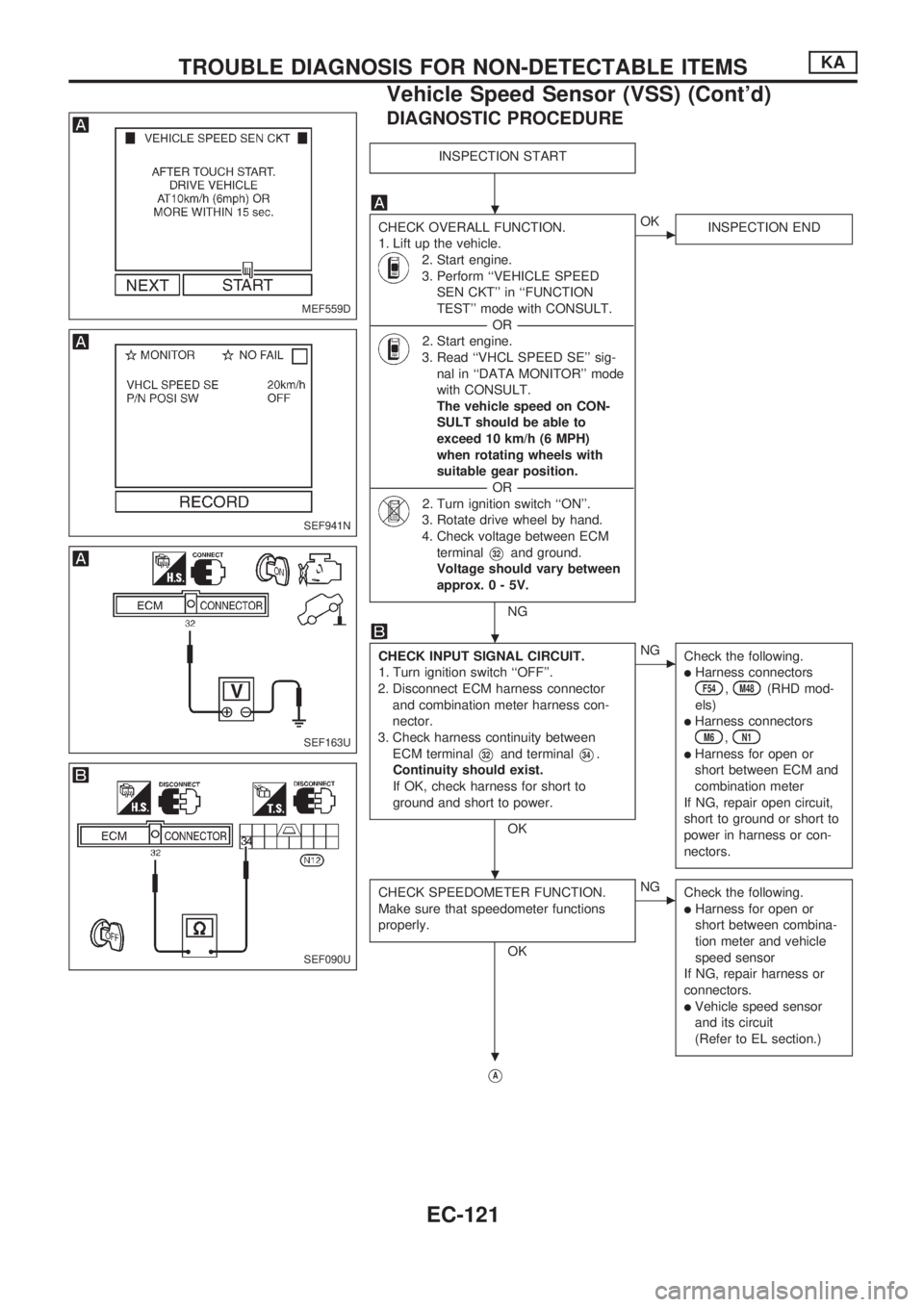
DIAGNOSTIC PROCEDURE
INSPECTION START
CHECK OVERALL FUNCTION.
1. Lift up the vehicle.
2. Start engine.
3. Perform ``VEHICLE SPEED
SEN CKT'' in ``FUNCTION
TEST'' mode with CONSULT.
----------------------------------------------------------------------------------------------------------------------------------OR----------------------------------------------------------------------------------------------------------------------------------
2. Start engine.
3. Read ``VHCL SPEED SE'' sig-
nal in ``DATA MONITOR'' mode
with CONSULT.
The vehicle speed on CON-
SULT should be able to
exceed 10 km/h (6 MPH)
when rotating wheels with
suitable gear position.
----------------------------------------------------------------------------------------------------------------------------------OR----------------------------------------------------------------------------------------------------------------------------------
2. Turn ignition switch ``ON''.
3. Rotate drive wheel by hand.
4. Check voltage between ECM
terminal
V32and ground.
Voltage should vary between
approx.0-5V.
NG
cOK
INSPECTION END
CHECK INPUT SIGNAL CIRCUIT.
1. Turn ignition switch ``OFF''.
2. Disconnect ECM harness connector
and combination meter harness con-
nector.
3. Check harness continuity between
ECM terminal
V32and terminalV34.
Continuity should exist.
If OK, check harness for short to
ground and short to power.
OK
cNG
Check the following.
lHarness connectorsF54,M48(RHD mod-
els)
lHarness connectorsM6,N1
lHarness for open or
short between ECM and
combination meter
If NG, repair open circuit,
short to ground or short to
power in harness or con-
nectors.
CHECK SPEEDOMETER FUNCTION.
Make sure that speedometer functions
properly.
OK
cNG
Check the following.
lHarness for open or
short between combina-
tion meter and vehicle
speed sensor
If NG, repair harness or
connectors.
lVehicle speed sensor
and its circuit
(Refer to EL section.)
VA
MEF559D
SEF941N
SEF163U
SEF090U
.
.
.
.
TROUBLE DIAGNOSIS FOR NON-DETECTABLE ITEMSKA
Vehicle Speed Sensor (VSS) (Cont'd)
EC-121
Page 277 of 1659
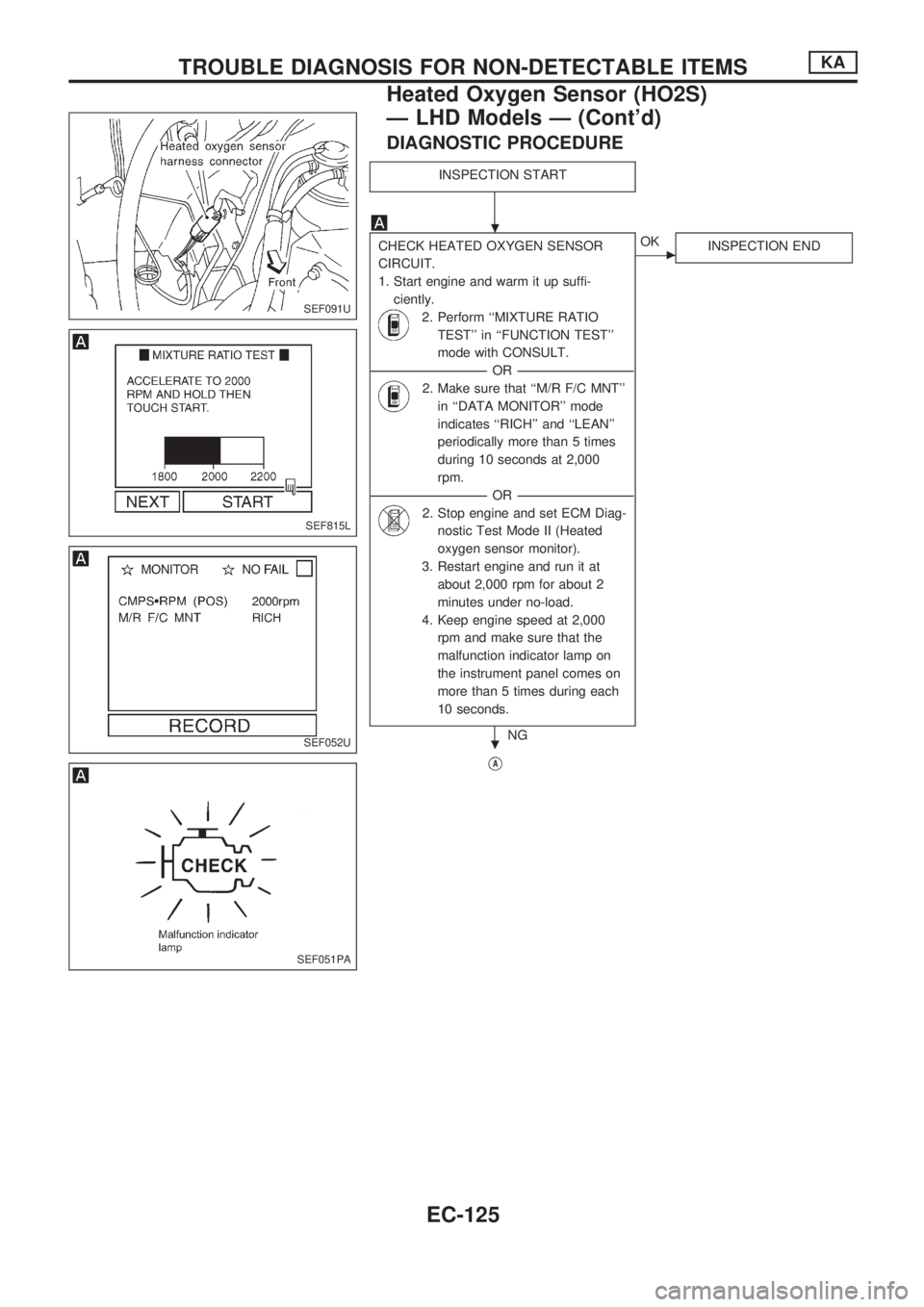
DIAGNOSTIC PROCEDURE
INSPECTION START
CHECK HEATED OXYGEN SENSOR
CIRCUIT.
1. Start engine and warm it up suffi-
ciently.
2. Perform ``MIXTURE RATIO
TEST'' in ``FUNCTION TEST''
mode with CONSULT.
----------------------------------------------------------------------------------------------------------------------------------OR----------------------------------------------------------------------------------------------------------------------------------
2. Make sure that ``M/R F/C MNT''
in ``DATA MONITOR'' mode
indicates ``RICH'' and ``LEAN''
periodically more than 5 times
during 10 seconds at 2,000
rpm.
----------------------------------------------------------------------------------------------------------------------------------OR----------------------------------------------------------------------------------------------------------------------------------
2. Stop engine and set ECM Diag-
nostic Test Mode II (Heated
oxygen sensor monitor).
3. Restart engine and run it at
about 2,000 rpm for about 2
minutes under no-load.
4. Keep engine speed at 2,000
rpm and make sure that the
malfunction indicator lamp on
the instrument panel comes on
more than 5 times during each
10 seconds.
NG
cOK
INSPECTION END
VA
SEF091U
SEF815L
SEF052U
SEF051PA
.
.
TROUBLE DIAGNOSIS FOR NON-DETECTABLE ITEMSKA
Heated Oxygen Sensor (HO2S)
Ð LHD Models Ð (Cont'd)
EC-125