check engine NISSAN PICK-UP 2001 Repair Manual
[x] Cancel search | Manufacturer: NISSAN, Model Year: 2001, Model line: PICK-UP, Model: NISSAN PICK-UP 2001Pages: 1306, PDF Size: 31.7 MB
Page 1040 of 1306
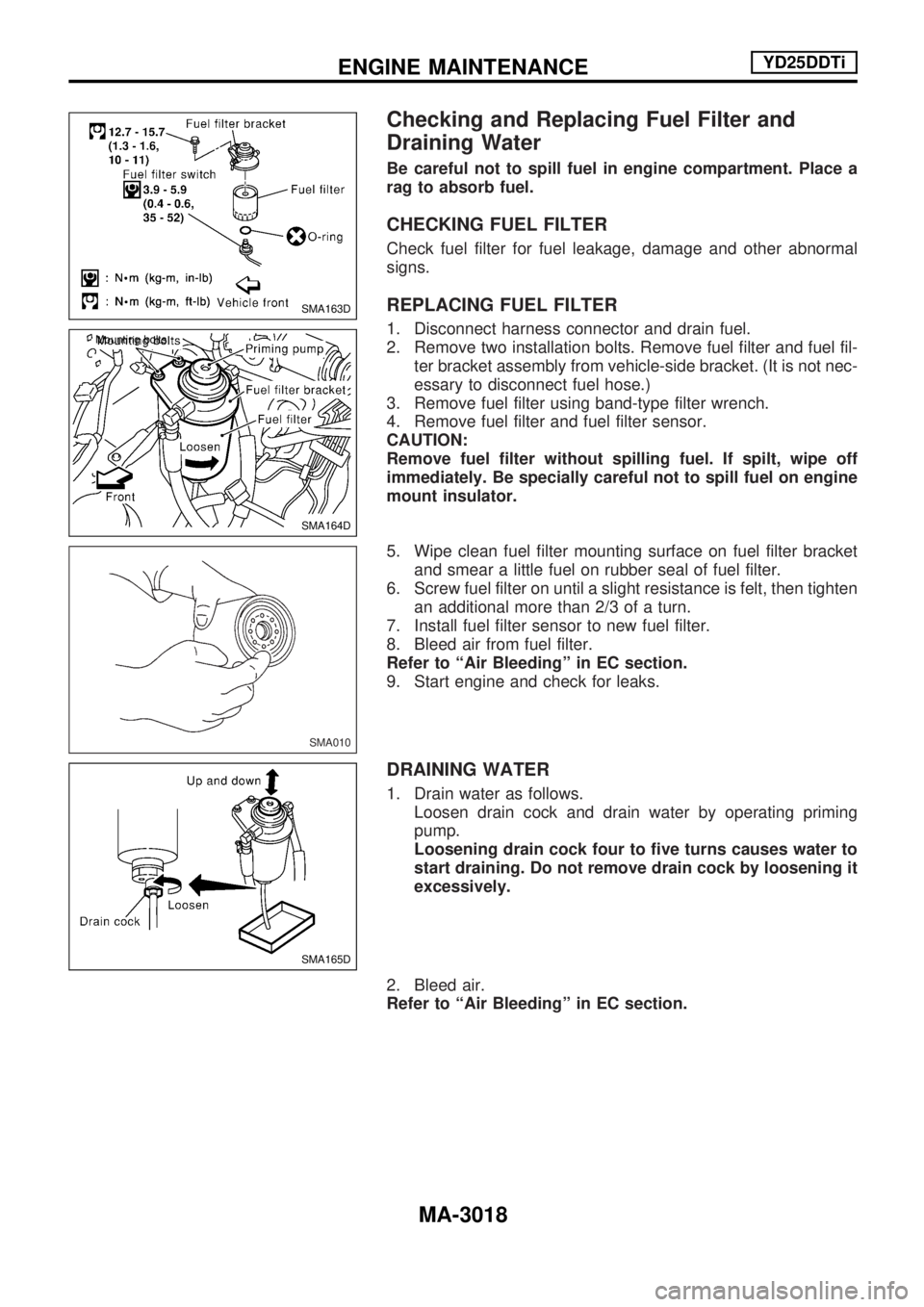
Checking and Replacing Fuel Filter and
Draining Water
Be careful not to spill fuel in engine compartment. Place a
rag to absorb fuel.
CHECKING FUEL FILTER
Check fuel filter for fuel leakage, damage and other abnormal
signs.
REPLACING FUEL FILTER
1. Disconnect harness connector and drain fuel.
2. Remove two installation bolts. Remove fuel filter and fuel fil-
ter bracket assembly from vehicle-side bracket. (It is not nec-
essary to disconnect fuel hose.)
3. Remove fuel filter using band-type filter wrench.
4. Remove fuel filter and fuel filter sensor.
CAUTION:
Remove fuel filter without spilling fuel. If spilt, wipe off
immediately. Be specially careful not to spill fuel on engine
mount insulator.
5. Wipe clean fuel filter mounting surface on fuel filter bracket
and smear a little fuel on rubber seal of fuel filter.
6. Screw fuel filter on until a slight resistance is felt, then tighten
an additional more than 2/3 of a turn.
7. Install fuel filter sensor to new fuel filter.
8. Bleed air from fuel filter.
Refer to ªAir Bleedingº in EC section.
9. Start engine and check for leaks.
DRAINING WATER
1. Drain water as follows.
Loosen drain cock and drain water by operating priming
pump.
Loosening drain cock four to five turns causes water to
start draining. Do not remove drain cock by loosening it
excessively.
2. Bleed air.
Refer to ªAir Bleedingº in EC section.
SMA163D
SMA164D Mounting bolts
SMA010
SMA165D
ENGINE MAINTENANCEYD25DDTi
MA-3018
Page 1041 of 1306
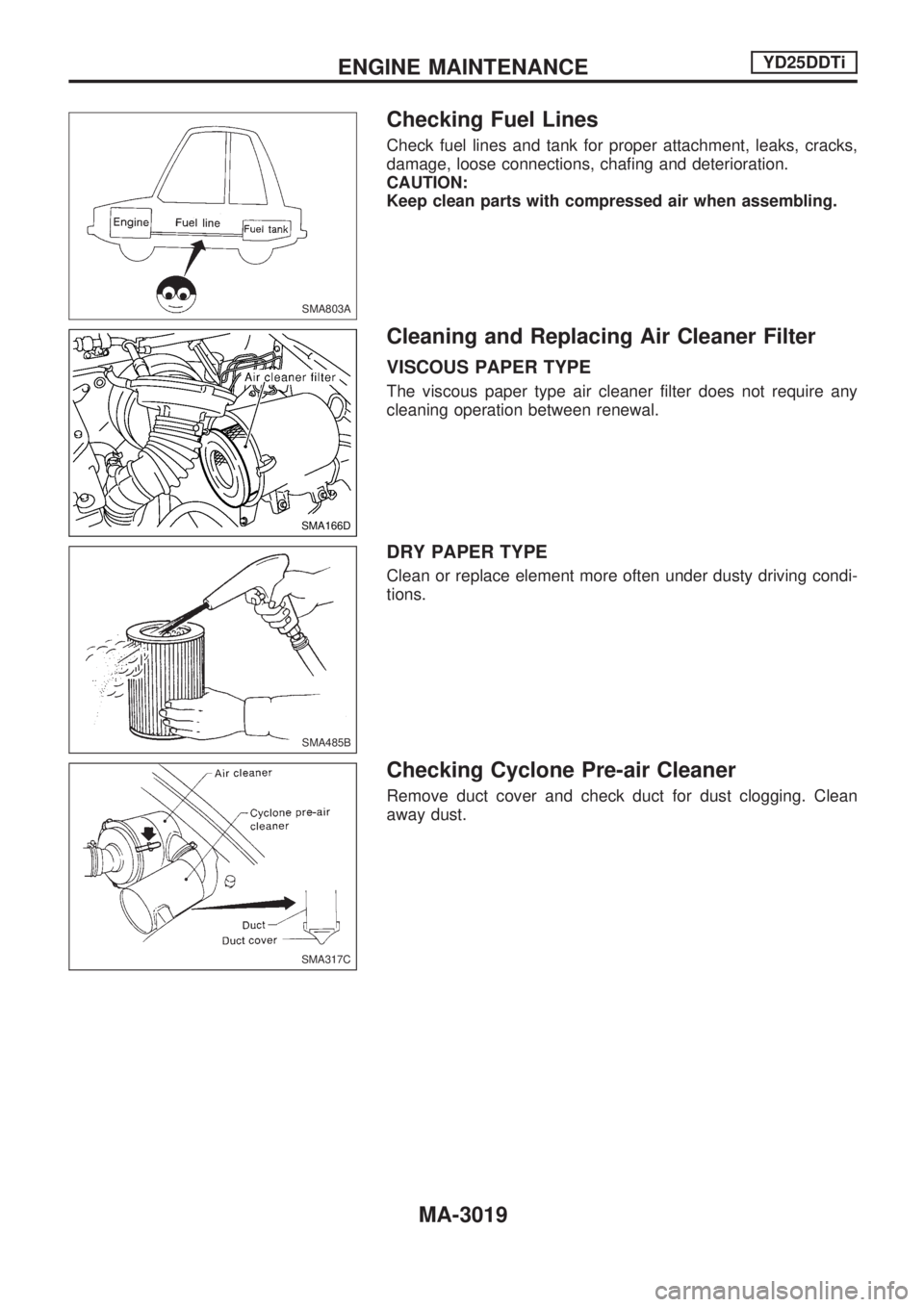
Checking Fuel Lines
Check fuel lines and tank for proper attachment, leaks, cracks,
damage, loose connections, chafing and deterioration.
CAUTION:
Keep clean parts with compressed air when assembling.
Cleaning and Replacing Air Cleaner Filter
VISCOUS PAPER TYPE
The viscous paper type air cleaner filter does not require any
cleaning operation between renewal.
DRY PAPER TYPE
Clean or replace element more often under dusty driving condi-
tions.
Checking Cyclone Pre-air Cleaner
Remove duct cover and check duct for dust clogging. Clean
away dust.
SMA803A
SMA166D
SMA485B
SMA317C
ENGINE MAINTENANCEYD25DDTi
MA-3019
Page 1042 of 1306
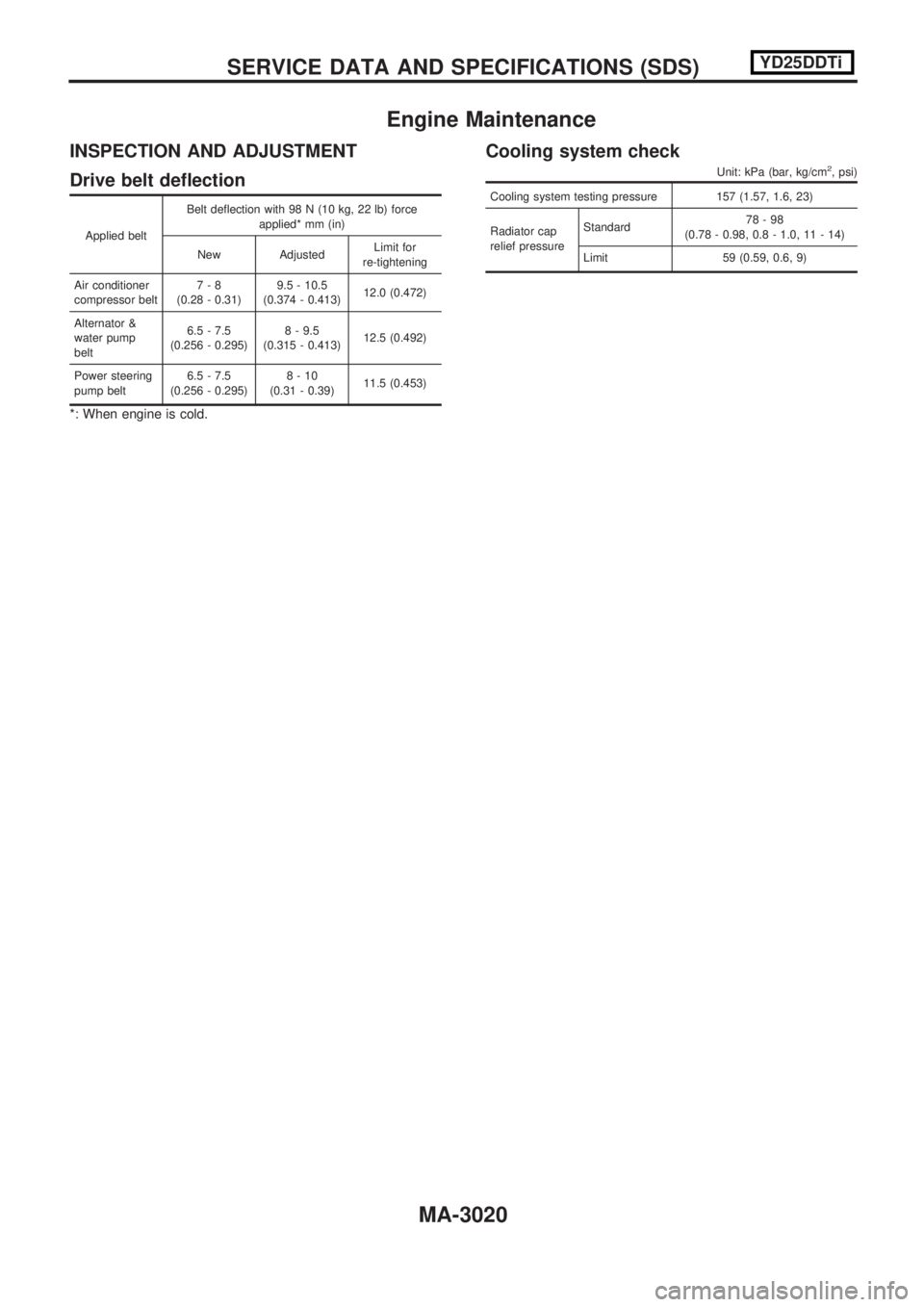
Engine Maintenance
INSPECTION AND ADJUSTMENT
Drive belt deflection
Applied beltBelt deflection with 98 N (10 kg, 22 lb) force
applied* mm (in)
New Adjusted Limit for
re-tightening
Air conditioner
compressor belt 7-8
(0.28 - 0.31) 9.5 - 10.5
(0.374 - 0.413) 12.0 (0.472)
Alternator &
water pump
belt 6.5 - 7.5
(0.256 - 0.295) 8 - 9.5
(0.315 - 0.413) 12.5 (0.492)
Power steering
pump belt 6.5 - 7.5
(0.256 - 0.295) 8-10
(0.31 - 0.39) 11.5 (0.453)
*: When engine is cold.
Cooling system check
Unit: kPa (bar, kg/cm2, psi)
Cooling system testing pressure 157 (1.57, 1.6, 23)
Radiator cap
relief pressureStandard
78-98
(0.78 - 0.98, 0.8 - 1.0, 11 - 14)
Limit 59 (0.59, 0.6, 9)
SERVICEDATAANDSPECIFICATIONS(SDS) YD25DDTi
MA-3020
Page 1043 of 1306
ENGINE LUBRICATION &
COOLING SYSTEMS
SECTION
LC
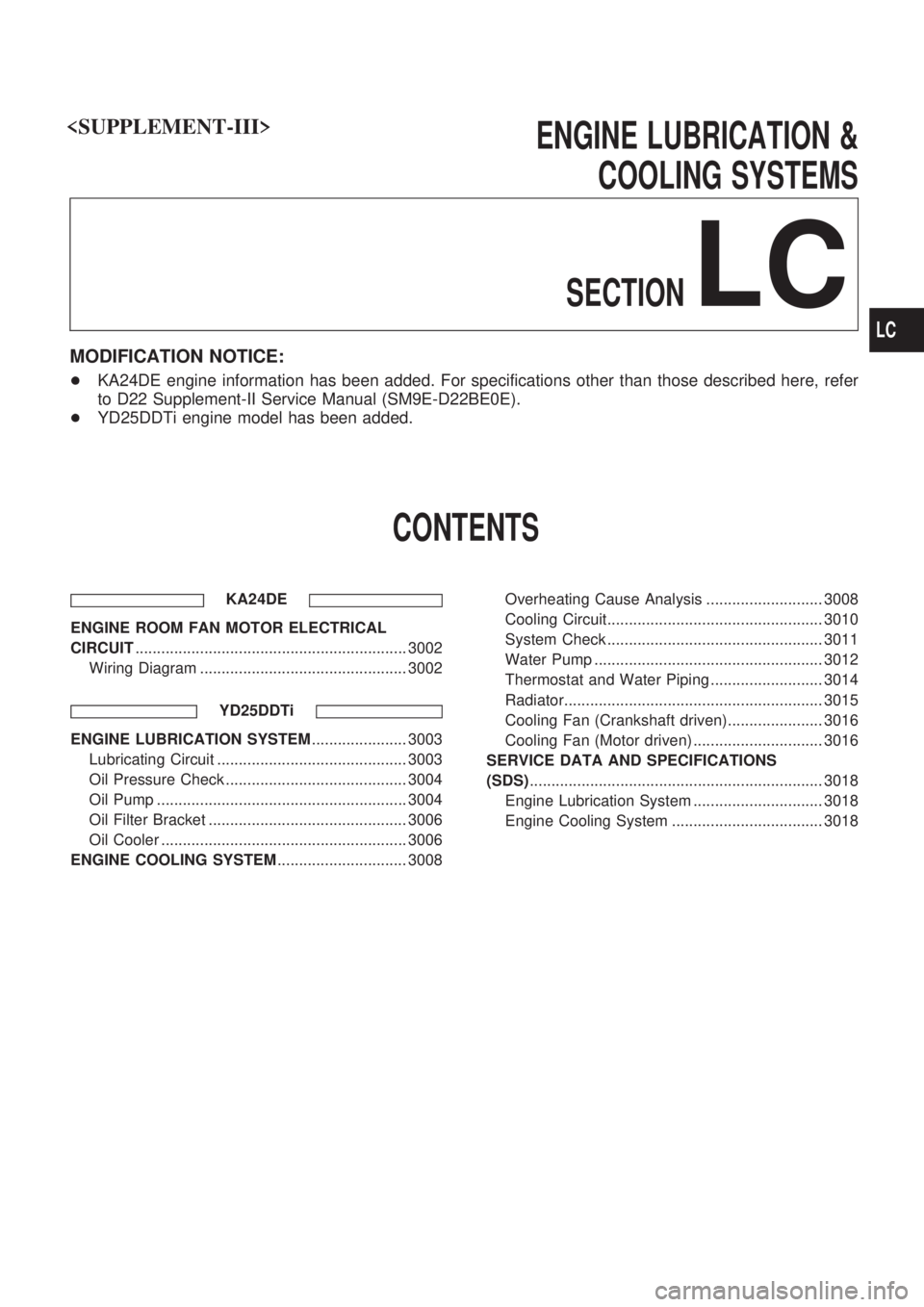
MODIFICATION NOTICE:
+KA24DE engine information has been added. For specifications other than those described here, refer
to D22 Supplement-II Service Manual (SM9E-D22BE0E).
+YD25DDTi engine model has been added.
CONTENTS
KA24DE
ENGINE ROOM FAN MOTOR ELECTRICAL
CIRCUIT............................................................... 3002
Wiring Diagram ................................................ 3002
YD25DDTi
ENGINE LUBRICATION SYSTEM...................... 3003
Lubricating Circuit ............................................ 3003
Oil Pressure Check .......................................... 3004
Oil Pump .......................................................... 3004
Oil Filter Bracket .............................................. 3006
Oil Cooler ......................................................... 3006
ENGINE COOLING SYSTEM.............................. 3008Overheating Cause Analysis ........................... 3008
Cooling Circuit.................................................. 3010
System Check .................................................. 3011
Water Pump ..................................................... 3012
Thermostat and Water Piping .......................... 3014
Radiator............................................................ 3015
Cooling Fan (Crankshaft driven)...................... 3016
Cooling Fan (Motor driven) .............................. 3016
SERVICE DATA AND SPECIFICATIONS
(SDS).................................................................... 3018
Engine Lubrication System .............................. 3018
Engine Cooling System ................................... 3018
LC
Page 1046 of 1306
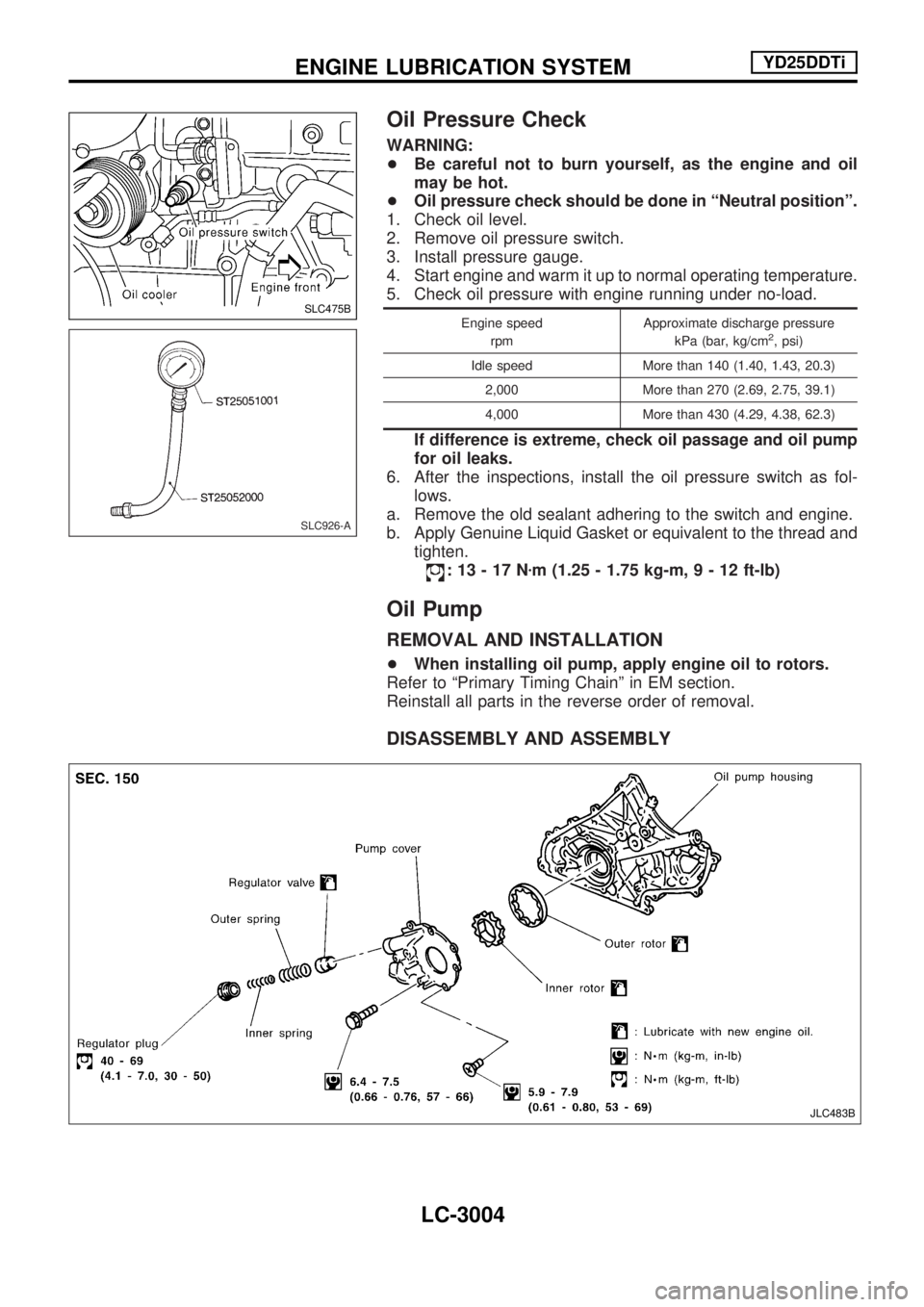
Oil Pressure Check
WARNING:
+Be careful not to burn yourself, as the engine and oil
may be hot.
+Oil pressure check should be done in ªNeutral positionº.
1. Check oil level.
2. Remove oil pressure switch.
3. Install pressure gauge.
4. Start engine and warm it up to normal operating temperature.
5. Check oil pressure with engine running under no-load.
Engine speed
rpmApproximate discharge pressure
kPa (bar, kg/cm2, psi)
Idle speed More than 140 (1.40, 1.43, 20.3)
2,000 More than 270 (2.69, 2.75, 39.1)
4,000 More than 430 (4.29, 4.38, 62.3)
If difference is extreme, check oil passage and oil pump
for oil leaks.
6. After the inspections, install the oil pressure switch as fol-
lows.
a. Remove the old sealant adhering to the switch and engine.
b. Apply Genuine Liquid Gasket or equivalent to the thread and
tighten.
:13-17Nzm (1.25 - 1.75 kg-m,9-12ft-lb)
Oil Pump
REMOVAL AND INSTALLATION
+When installing oil pump, apply engine oil to rotors.
Refer to ªPrimary Timing Chainº in EM section.
Reinstall all parts in the reverse order of removal.
DISASSEMBLY AND ASSEMBLY
SLC475B
SLC926-A
JLC483B
ENGINE LUBRICATION SYSTEMYD25DDTi
LC-3004
Page 1047 of 1306
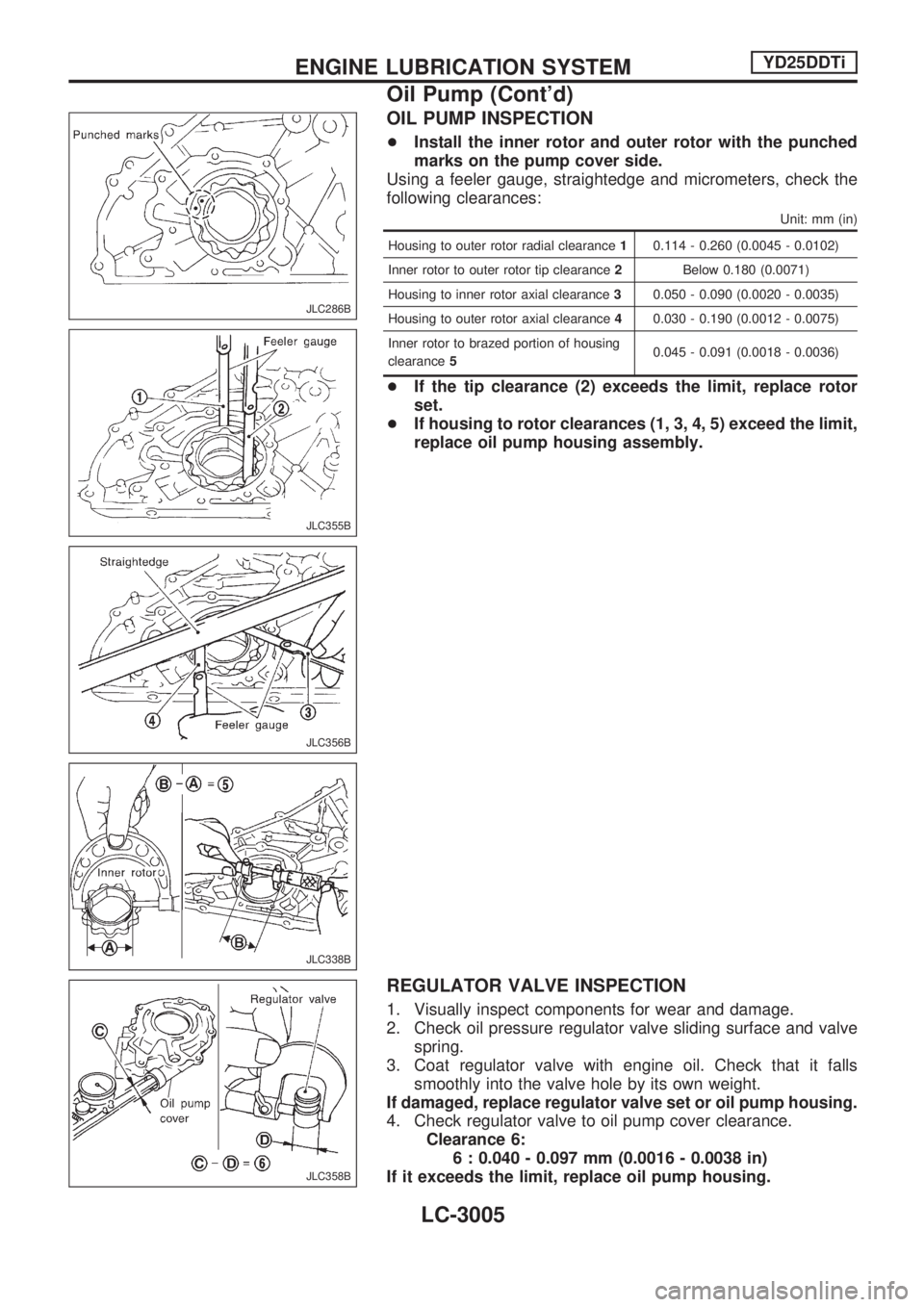
OIL PUMP INSPECTION
+Install the inner rotor and outer rotor with the punched
marks on the pump cover side.
Using a feeler gauge, straightedge and micrometers, check the
following clearances:
Unit: mm (in)
Housing to outer rotor radial clearance10.114 - 0.260 (0.0045 - 0.0102)
Inner rotor to outer rotor tip clearance2Below 0.180 (0.0071)
Housing to inner rotor axial clearance30.050 - 0.090 (0.0020 - 0.0035)
Housing to outer rotor axial clearance40.030 - 0.190 (0.0012 - 0.0075)
Inner rotor to brazed portion of housing
clearance50.045 - 0.091 (0.0018 - 0.0036)
+If the tip clearance (2) exceeds the limit, replace rotor
set.
+If housing to rotor clearances (1, 3, 4, 5) exceed the limit,
replace oil pump housing assembly.
REGULATOR VALVE INSPECTION
1. Visually inspect components for wear and damage.
2. Check oil pressure regulator valve sliding surface and valve
spring.
3. Coat regulator valve with engine oil. Check that it falls
smoothly into the valve hole by its own weight.
If damaged, replace regulator valve set or oil pump housing.
4. Check regulator valve to oil pump cover clearance.
Clearance 6:
6 : 0.040 - 0.097 mm (0.0016 - 0.0038 in)
If it exceeds the limit, replace oil pump housing.
JLC286B
JLC355B
JLC356B
JLC338B
JLC358B
ENGINE LUBRICATION SYSTEMYD25DDTi
Oil Pump (Cont'd)
LC-3005
Page 1050 of 1306
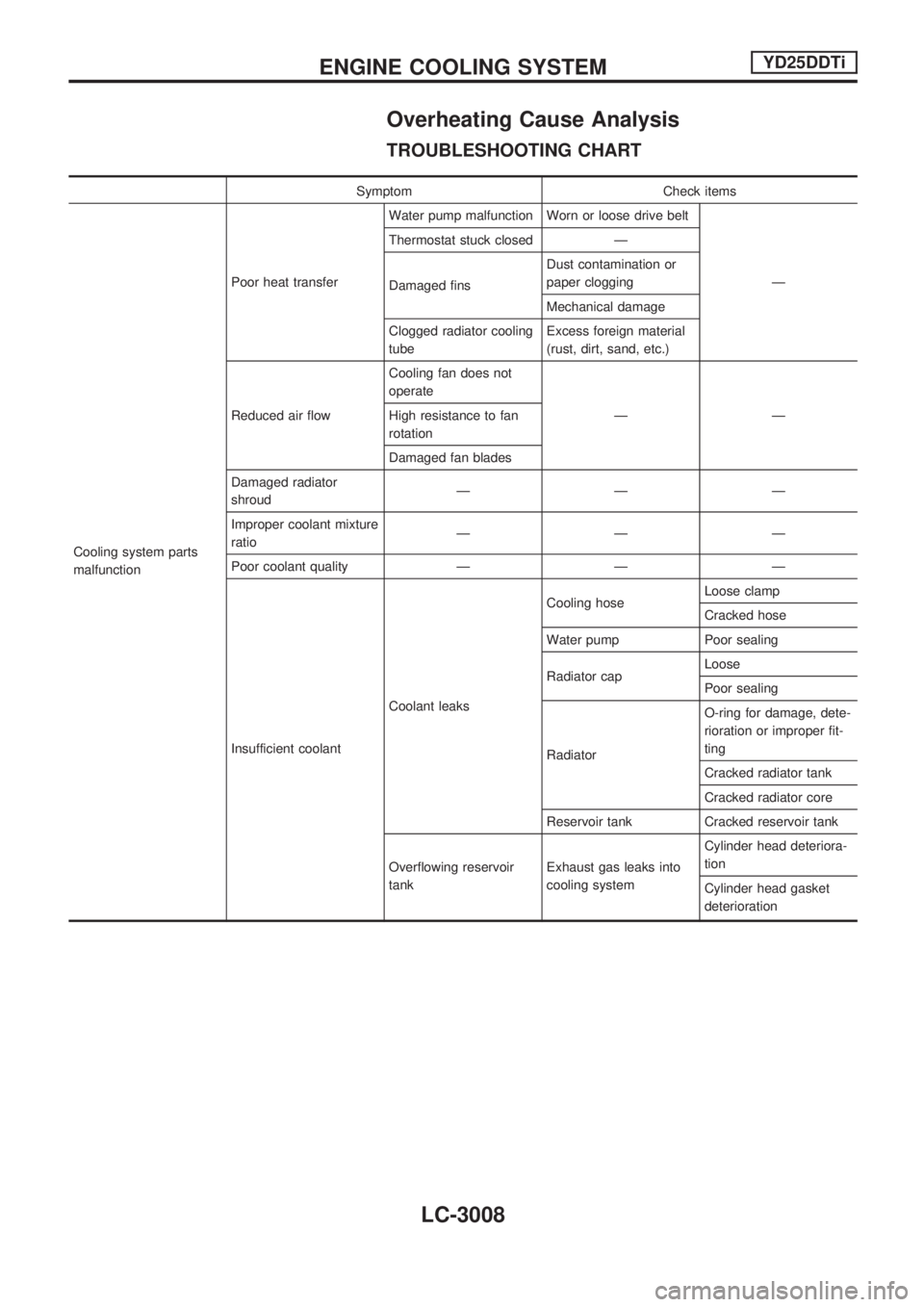
Overheating Cause Analysis
TROUBLESHOOTING CHART
Symptom Check items
Cooling system parts
malfunctionPoor heat transferWater pump malfunction Worn or loose drive belt
Ð Thermostat stuck closed Ð
Damaged finsDust contamination or
paper clogging
Mechanical damage
Clogged radiator cooling
tubeExcess foreign material
(rust, dirt, sand, etc.)
Reduced air flowCooling fan does not
operate
ÐÐ High resistance to fan
rotation
Damaged fan blades
Damaged radiator
shroudÐÐÐ
Improper coolant mixture
ratioÐÐÐ
Poor coolant quality Ð Ð Ð
Insufficient coolantCoolant leaksCooling hoseLoose clamp
Cracked hose
Water pump Poor sealing
Radiator capLoose
Poor sealing
RadiatorO-ring for damage, dete-
rioration or improper fit-
ting
Cracked radiator tank
Cracked radiator core
Reservoir tank Cracked reservoir tank
Overflowing reservoir
tankExhaust gas leaks into
cooling systemCylinder head deteriora-
tion
Cylinder head gasket
deterioration
ENGINE COOLING SYSTEMYD25DDTi
LC-3008
Page 1051 of 1306
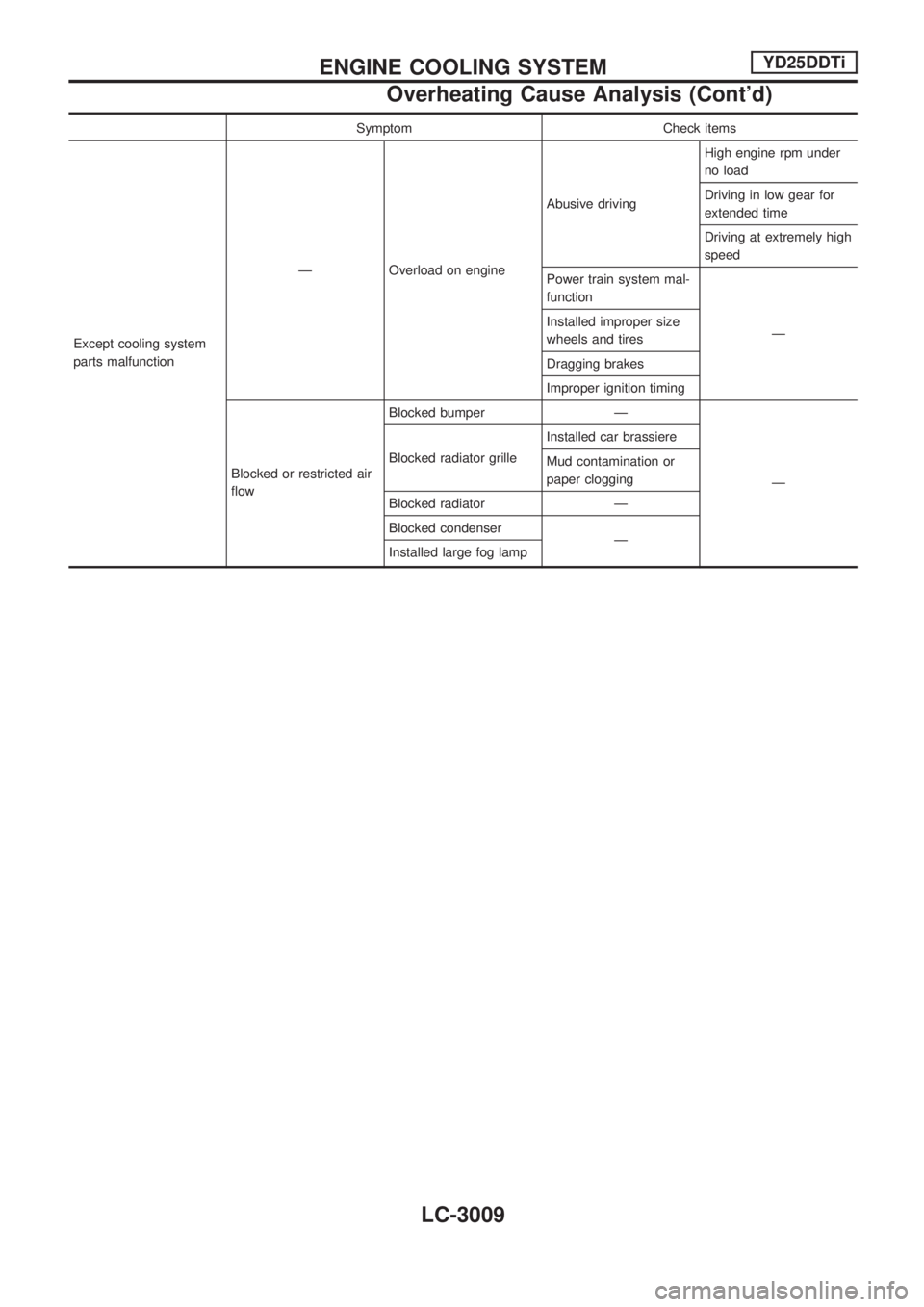
Symptom Check items
Except cooling system
parts malfunctionÐ Overload on engineAbusive drivingHigh engine rpm under
no load
Driving in low gear for
extended time
Driving at extremely high
speed
Power train system mal-
function
Ð Installed improper size
wheels and tires
Dragging brakes
Improper ignition timing
Blocked or restricted air
flowBlocked bumper Ð
Ð Blocked radiator grilleInstalled car brassiere
Mud contamination or
paper clogging
Blocked radiator Ð
Blocked condenser
Ð
Installed large fog lamp
ENGINE COOLING SYSTEMYD25DDTi
Overheating Cause Analysis (Cont'd)
LC-3009
Page 1053 of 1306
System Check
WARNING:
Never remove the radiator cap when the engine is hot; seri-
ous burns could be caused by high pressure fluid escaping
from the radiator.
Wrap a thick cloth around the cap and carefully remove it by
turning it a quarter turn to allow built-up pressure to escape
and then turn the cap all the way off.
CHECKING RADIATOR CAP
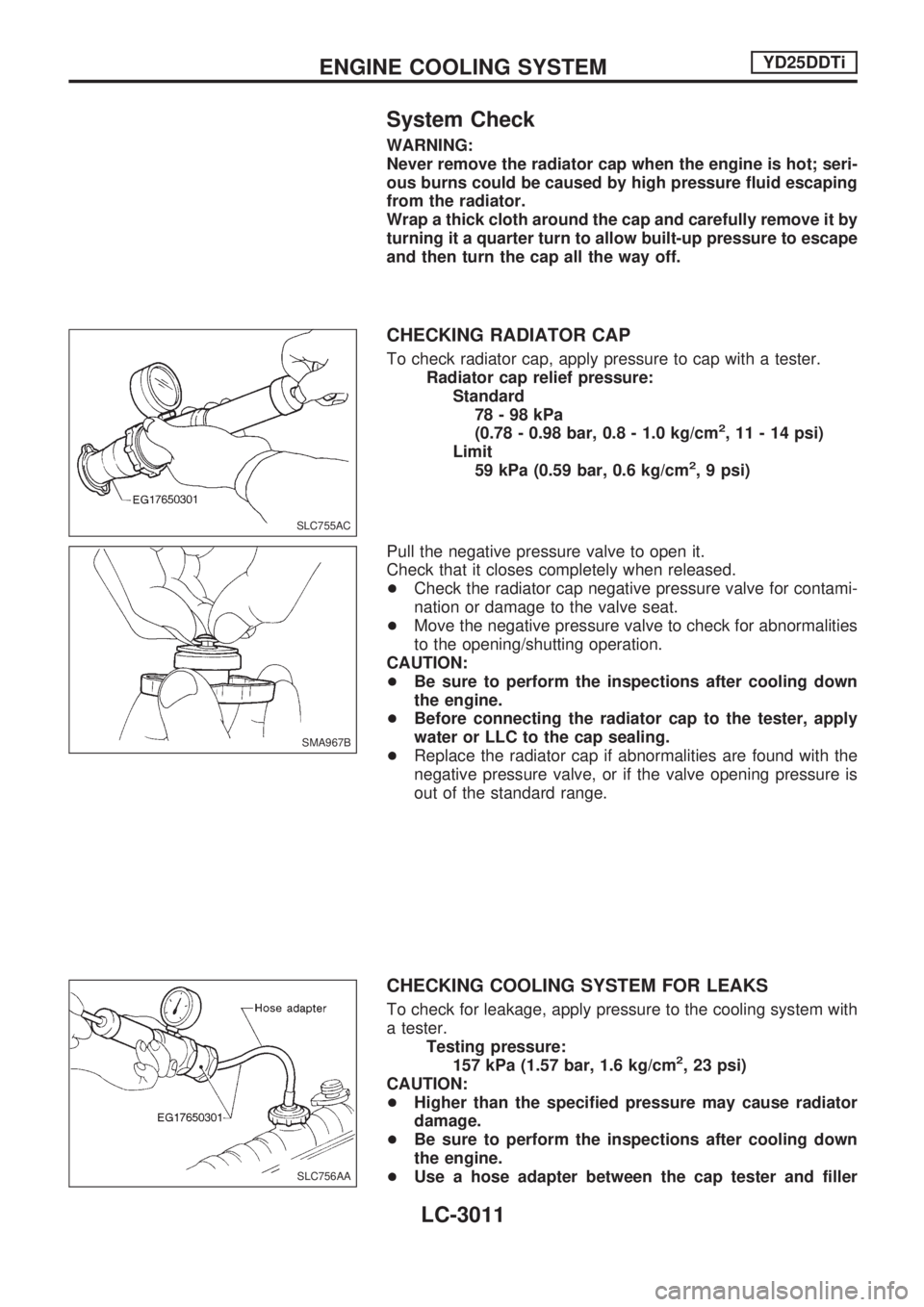
To check radiator cap, apply pressure to cap with a tester.
Radiator cap relief pressure:
Standard
78-98kPa
(0.78 - 0.98 bar, 0.8 - 1.0 kg/cm
2, 11 - 14 psi)
Limit
59 kPa (0.59 bar, 0.6 kg/cm
2, 9 psi)
Pull the negative pressure valve to open it.
Check that it closes completely when released.
+Check the radiator cap negative pressure valve for contami-
nation or damage to the valve seat.
+Move the negative pressure valve to check for abnormalities
to the opening/shutting operation.
CAUTION:
+Be sure to perform the inspections after cooling down
the engine.
+Before connecting the radiator cap to the tester, apply
water or LLC to the cap sealing.
+Replace the radiator cap if abnormalities are found with the
negative pressure valve, or if the valve opening pressure is
out of the standard range.
CHECKING COOLING SYSTEM FOR LEAKS
To check for leakage, apply pressure to the cooling system with
a tester.
Testing pressure:
157 kPa (1.57 bar, 1.6 kg/cm
2, 23 psi)
CAUTION:
+Higher than the specified pressure may cause radiator
damage.
+Be sure to perform the inspections after cooling down
the engine.
+Use a hose adapter between the cap tester and filler
SLC755AC
SMA967B
SLC756AA
ENGINE COOLING SYSTEMYD25DDTi
LC-3011
Page 1054 of 1306
neck to prevent the radiator filler neck from deforming.
+If any abnormalities are found, repair or replace the malfunc-
tioning parts.
Water Pump
REMOVAL AND INSTALLATION
CAUTION:
+When removing water pump assembly, be careful not to
get coolant on drive belt.
+Water pump cannot be disassembled and should be
replaced as a unit.
+After installing water pump, connect hose and clamp
securely, then check for leaks using radiator cap tester.
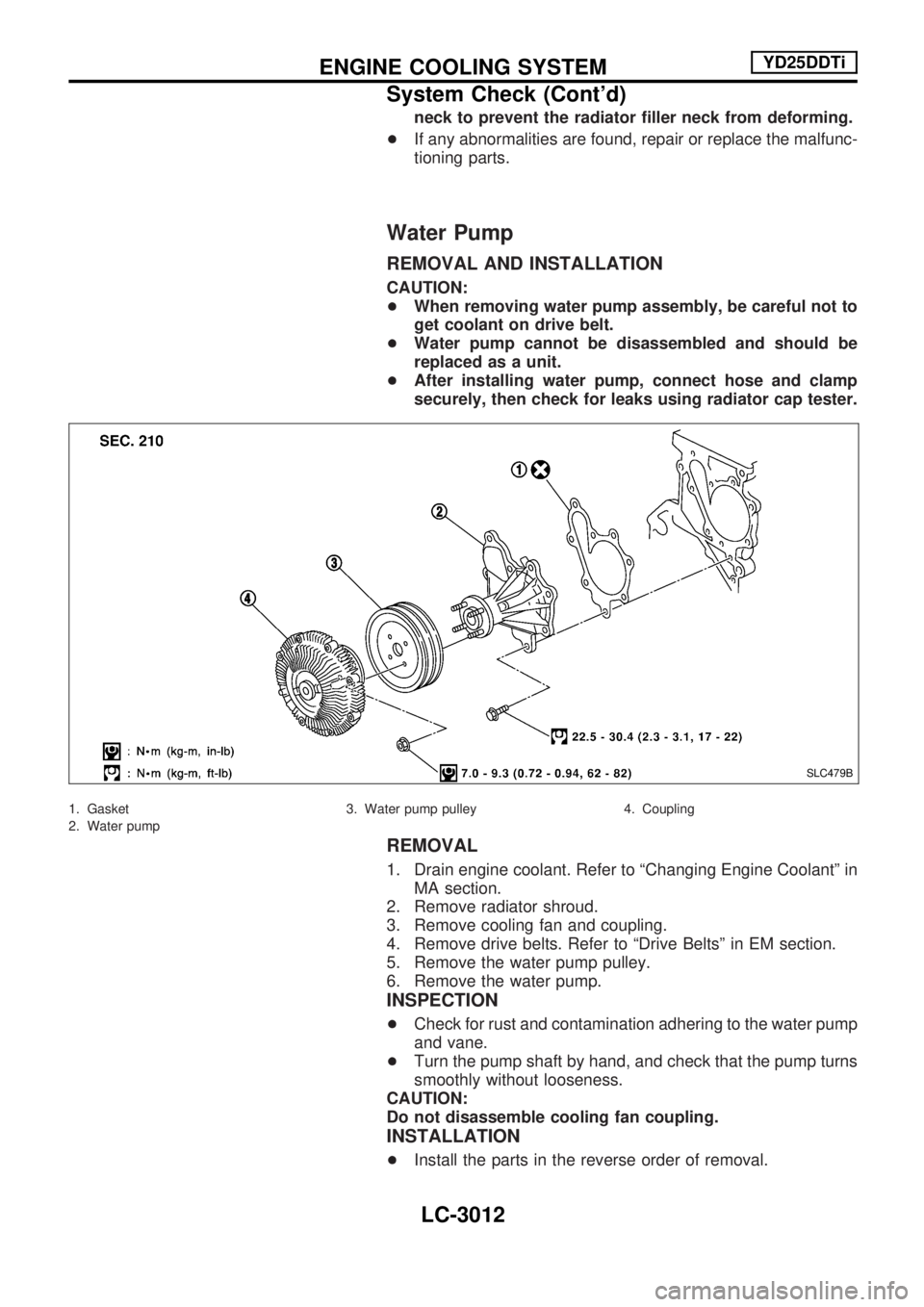
1. Gasket
2. Water pump3. Water pump pulley 4. Coupling
REMOVAL
1. Drain engine coolant. Refer to ªChanging Engine Coolantº in
MA section.
2. Remove radiator shroud.
3. Remove cooling fan and coupling.
4. Remove drive belts. Refer to ªDrive Beltsº in EM section.
5. Remove the water pump pulley.
6. Remove the water pump.
INSPECTION
+Check for rust and contamination adhering to the water pump
and vane.
+Turn the pump shaft by hand, and check that the pump turns
smoothly without looseness.
CAUTION:
Do not disassemble cooling fan coupling.
INSTALLATION
+Install the parts in the reverse order of removal.
SLC479B
ENGINE COOLING SYSTEMYD25DDTi
System Check (Cont'd)
LC-3012