Control NISSAN PRIMERA 1999 Electronic Repair Manual
[x] Cancel search | Manufacturer: NISSAN, Model Year: 1999, Model line: PRIMERA, Model: NISSAN PRIMERA 1999Pages: 2267, PDF Size: 35.74 MB
Page 630 of 2267
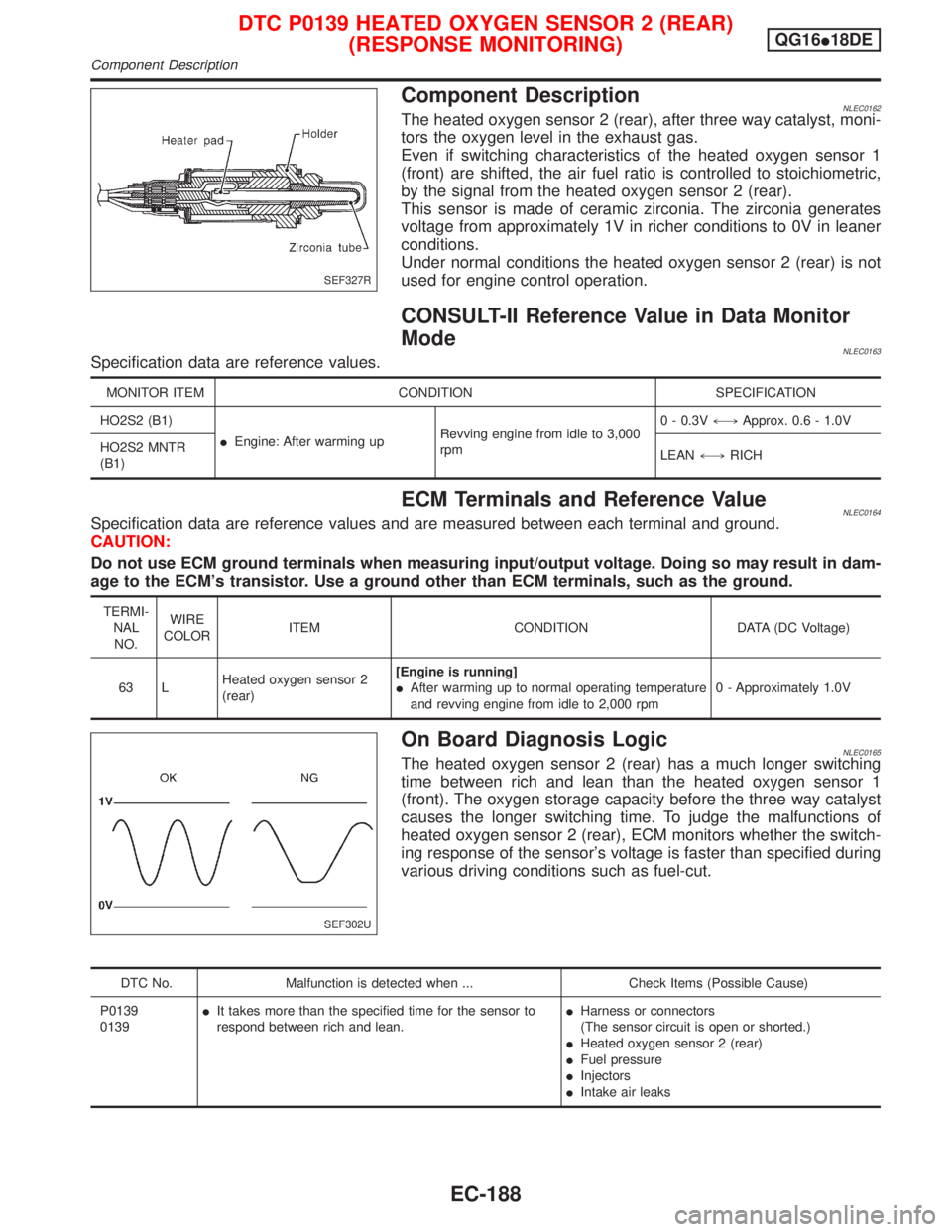
Component DescriptionNLEC0162The heated oxygen sensor 2 (rear), after three way catalyst, moni-
tors the oxygen level in the exhaust gas.
Even if switching characteristics of the heated oxygen sensor 1
(front) are shifted, the air fuel ratio is controlled to stoichiometric,
by the signal from the heated oxygen sensor 2 (rear).
This sensor is made of ceramic zirconia. The zirconia generates
voltage from approximately 1V in richer conditions to 0V in leaner
conditions.
Under normal conditions the heated oxygen sensor 2 (rear) is not
used for engine control operation.
CONSULT-II Reference Value in Data Monitor
Mode
NLEC0163Specification data are reference values.
MONITOR ITEM CONDITION SPECIFICATION
HO2S2 (B1)
IEngine: After warming upRevving engine from idle to 3,000
rpm0 - 0.3V+,Approx. 0.6 - 1.0V
HO2S2 MNTR
(B1)LEAN+,RICH
ECM Terminals and Reference ValueNLEC0164Specification data are reference values and are measured between each terminal and ground.
CAUTION:
Do not use ECM ground terminals when measuring input/output voltage. Doing so may result in dam-
age to the ECM's transistor. Use a ground other than ECM terminals, such as the ground.
TERMI-
NAL
NO.WIRE
COLORITEM CONDITION DATA (DC Voltage)
63 LHeated oxygen sensor 2
(rear)[Engine is running]
IAfter warming up to normal operating temperature
and revving engine from idle to 2,000 rpm0 - Approximately 1.0V
On Board Diagnosis LogicNLEC0165The heated oxygen sensor 2 (rear) has a much longer switching
time between rich and lean than the heated oxygen sensor 1
(front). The oxygen storage capacity before the three way catalyst
causes the longer switching time. To judge the malfunctions of
heated oxygen sensor 2 (rear), ECM monitors whether the switch-
ing response of the sensor's voltage is faster than specified during
various driving conditions such as fuel-cut.
DTC No. Malfunction is detected when ... Check Items (Possible Cause)
P0139
0139IIt takes more than the specified time for the sensor to
respond between rich and lean.IHarness or connectors
(The sensor circuit is open or shorted.)
IHeated oxygen sensor 2 (rear)
IFuel pressure
IInjectors
IIntake air leaks
SEF327R
SEF302U
DTC P0139 HEATED OXYGEN SENSOR 2 (REAR)
(RESPONSE MONITORING)QG16I18DE
Component Description
EC-188
Page 635 of 2267
2 CLEAR THE SELF-LEARNING DATA
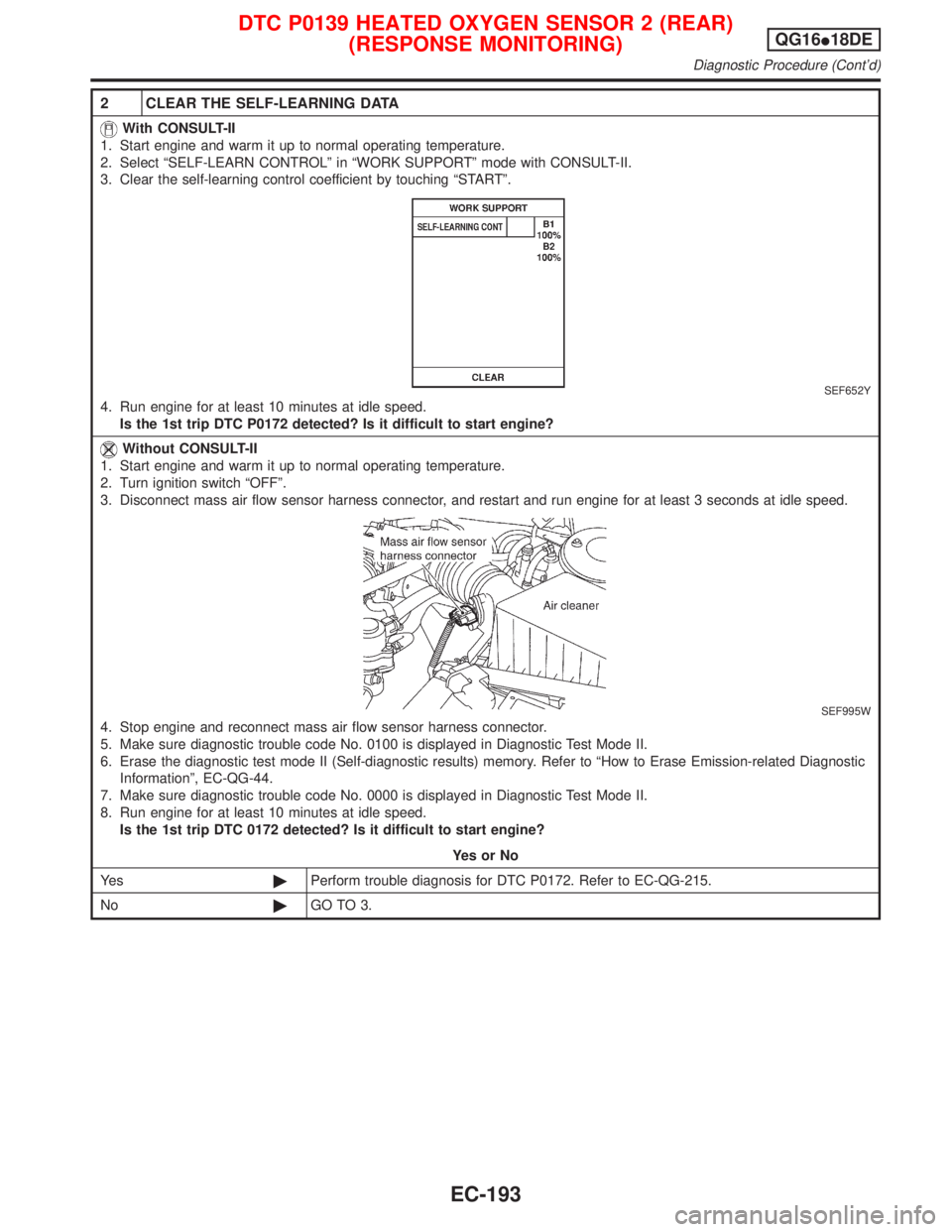
With CONSULT-II
1. Start engine and warm it up to normal operating temperature.
2. Select ªSELF-LEARN CONTROLº in ªWORK SUPPORTº mode with CONSULT-II.
3. Clear the self-learning control coefficient by touching ªSTARTº.
SEF652Y
4. Run engine for at least 10 minutes at idle speed.
Is the 1st trip DTC P0172 detected? Is it difficult to start engine?
Without CONSULT-II
1. Start engine and warm it up to normal operating temperature.
2. Turn ignition switch ªOFFº.
3. Disconnect mass air flow sensor harness connector, and restart and run engine for at least 3 seconds at idle speed.
SEF995W
4. Stop engine and reconnect mass air flow sensor harness connector.
5. Make sure diagnostic trouble code No. 0100 is displayed in Diagnostic Test Mode II.
6. Erase the diagnostic test mode II (Self-diagnostic results) memory. Refer to ªHow to Erase Emission-related Diagnostic
Informationº, EC-QG-44.
7. Make sure diagnostic trouble code No. 0000 is displayed in Diagnostic Test Mode II.
8. Run engine for at least 10 minutes at idle speed.
Is the 1st trip DTC 0172 detected? Is it difficult to start engine?
YesorNo
Ye s©Perform trouble diagnosis for DTC P0172. Refer to EC-QG-215.
No©GO TO 3.
DTC P0139 HEATED OXYGEN SENSOR 2 (REAR)
(RESPONSE MONITORING)QG16I18DE
Diagnostic Procedure (Cont'd)
EC-193
Page 639 of 2267
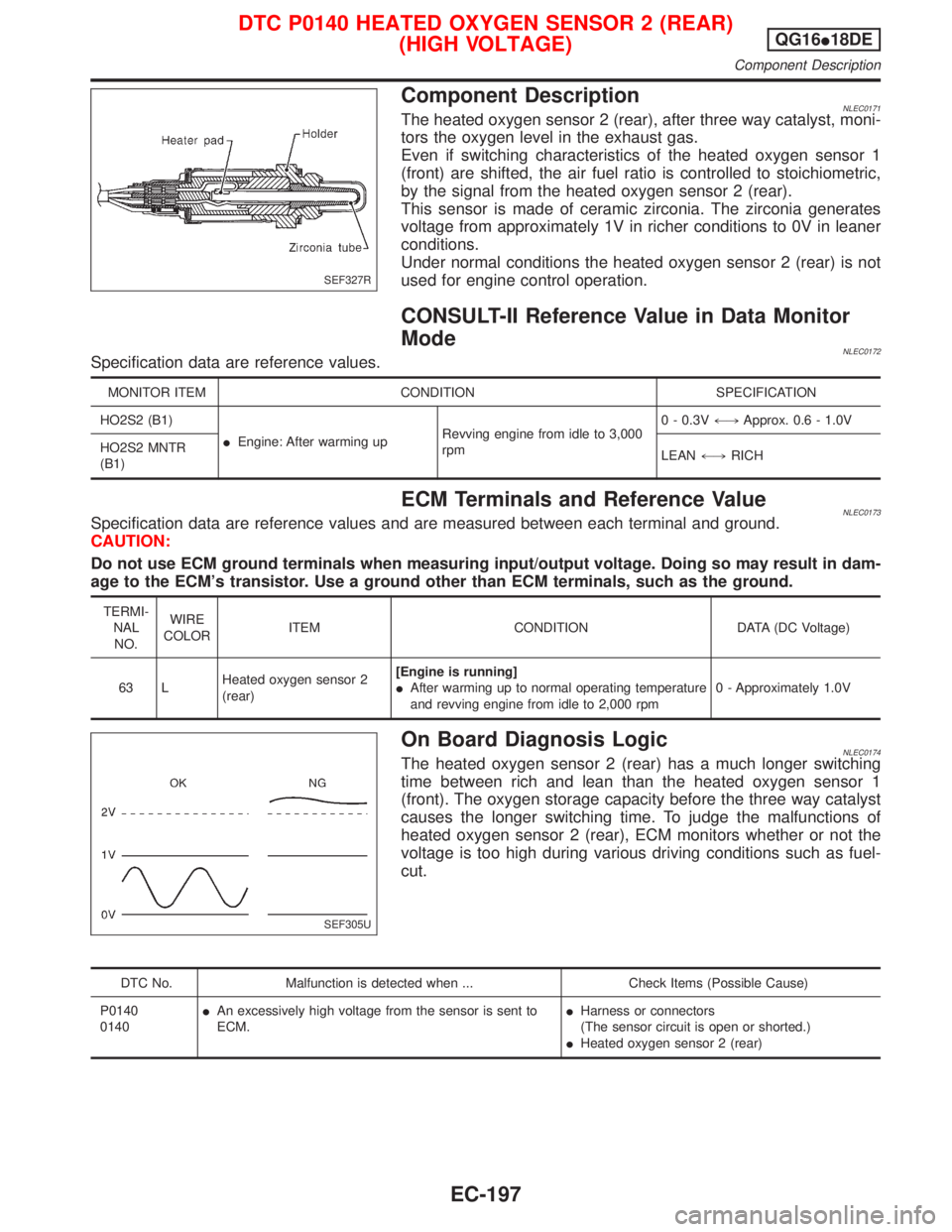
Component DescriptionNLEC0171The heated oxygen sensor 2 (rear), after three way catalyst, moni-
tors the oxygen level in the exhaust gas.
Even if switching characteristics of the heated oxygen sensor 1
(front) are shifted, the air fuel ratio is controlled to stoichiometric,
by the signal from the heated oxygen sensor 2 (rear).
This sensor is made of ceramic zirconia. The zirconia generates
voltage from approximately 1V in richer conditions to 0V in leaner
conditions.
Under normal conditions the heated oxygen sensor 2 (rear) is not
used for engine control operation.
CONSULT-II Reference Value in Data Monitor
Mode
NLEC0172Specification data are reference values.
MONITOR ITEM CONDITION SPECIFICATION
HO2S2 (B1)
IEngine: After warming upRevving engine from idle to 3,000
rpm0 - 0.3V+,Approx. 0.6 - 1.0V
HO2S2 MNTR
(B1)LEAN+,RICH
ECM Terminals and Reference ValueNLEC0173Specification data are reference values and are measured between each terminal and ground.
CAUTION:
Do not use ECM ground terminals when measuring input/output voltage. Doing so may result in dam-
age to the ECM's transistor. Use a ground other than ECM terminals, such as the ground.
TERMI-
NAL
NO.WIRE
COLORITEM CONDITION DATA (DC Voltage)
63 LHeated oxygen sensor 2
(rear)[Engine is running]
IAfter warming up to normal operating temperature
and revving engine from idle to 2,000 rpm0 - Approximately 1.0V
On Board Diagnosis LogicNLEC0174The heated oxygen sensor 2 (rear) has a much longer switching
time between rich and lean than the heated oxygen sensor 1
(front). The oxygen storage capacity before the three way catalyst
causes the longer switching time. To judge the malfunctions of
heated oxygen sensor 2 (rear), ECM monitors whether or not the
voltage is too high during various driving conditions such as fuel-
cut.
DTC No. Malfunction is detected when ... Check Items (Possible Cause)
P0140
0140IAn excessively high voltage from the sensor is sent to
ECM.IHarness or connectors
(The sensor circuit is open or shorted.)
IHeated oxygen sensor 2 (rear)
SEF327R
SEF305U
DTC P0140 HEATED OXYGEN SENSOR 2 (REAR)
(HIGH VOLTAGE)QG16I18DE
Component Description
EC-197
Page 645 of 2267
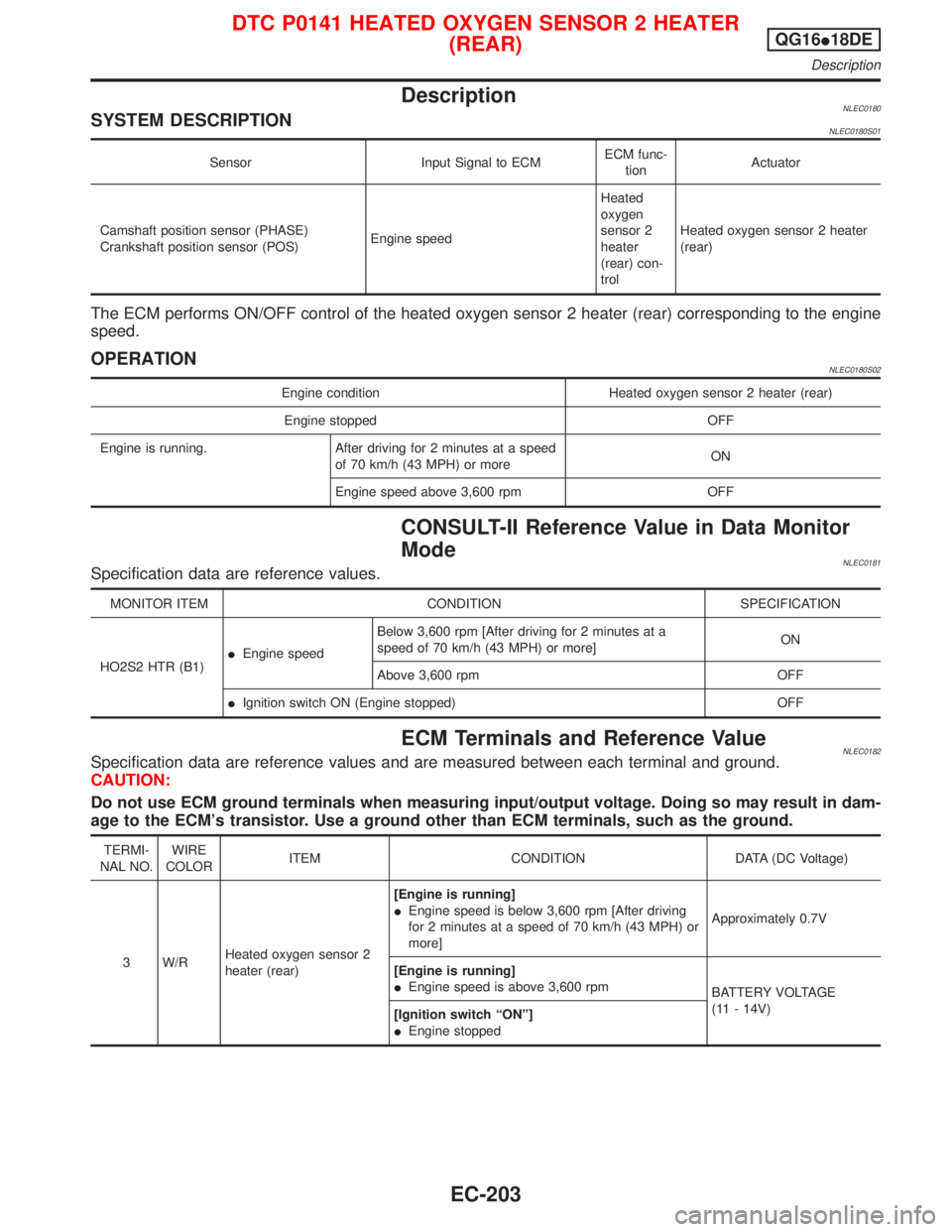
DescriptionNLEC0180SYSTEM DESCRIPTIONNLEC0180S01
Sensor Input Signal to ECMECM func-
tionActuator
Camshaft position sensor (PHASE)
Crankshaft position sensor (POS)Engine speedHeated
oxygen
sensor 2
heater
(rear) con-
trolHeated oxygen sensor 2 heater
(rear)
The ECM performs ON/OFF control of the heated oxygen sensor 2 heater (rear) corresponding to the engine
speed.
OPERATIONNLEC0180S02
Engine condition Heated oxygen sensor 2 heater (rear)
Engine stopped OFF
Engine is running. After driving for 2 minutes at a speed
of 70 km/h (43 MPH) or moreON
Engine speed above 3,600 rpm OFF
CONSULT-II Reference Value in Data Monitor
Mode
NLEC0181Specification data are reference values.
MONITOR ITEM CONDITION SPECIFICATION
HO2S2 HTR (B1)IEngine speedBelow 3,600 rpm [After driving for 2 minutes at a
speed of 70 km/h (43 MPH) or more]ON
Above 3,600 rpm OFF
IIgnition switch ON (Engine stopped) OFF
ECM Terminals and Reference ValueNLEC0182Specification data are reference values and are measured between each terminal and ground.
CAUTION:
Do not use ECM ground terminals when measuring input/output voltage. Doing so may result in dam-
age to the ECM's transistor. Use a ground other than ECM terminals, such as the ground.
TERMI-
NAL NO.WIRE
COLORITEM CONDITION DATA (DC Voltage)
3 W/RHeated oxygen sensor 2
heater (rear)[Engine is running]
IEngine speed is below 3,600 rpm [After driving
for 2 minutes at a speed of 70 km/h (43 MPH) or
more]Approximately 0.7V
[Engine is running]
IEngine speed is above 3,600 rpm
BATTERY VOLTAGE
(11 - 14V)
[Ignition switch ªONº]
IEngine stopped
DTC P0141 HEATED OXYGEN SENSOR 2 HEATER
(REAR)QG16I18DE
Description
EC-203
Page 650 of 2267
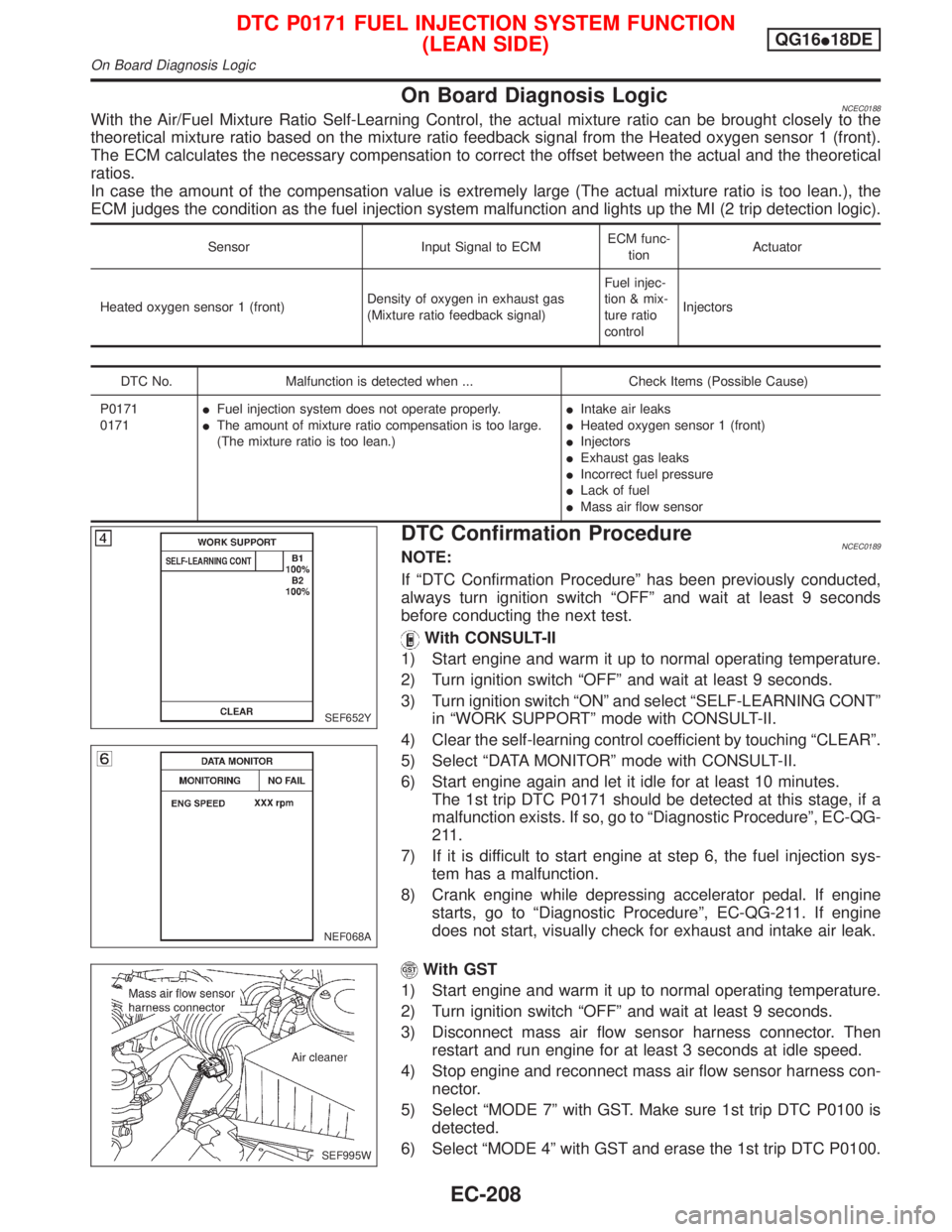
On Board Diagnosis LogicNCEC0188With the Air/Fuel Mixture Ratio Self-Learning Control, the actual mixture ratio can be brought closely to the
theoretical mixture ratio based on the mixture ratio feedback signal from the Heated oxygen sensor 1 (front).
The ECM calculates the necessary compensation to correct the offset between the actual and the theoretical
ratios.
In case the amount of the compensation value is extremely large (The actual mixture ratio is too lean.), the
ECM judges the condition as the fuel injection system malfunction and lights up the MI (2 trip detection logic).
Sensor Input Signal to ECMECM func-
tionActuator
Heated oxygen sensor 1 (front)Density of oxygen in exhaust gas
(Mixture ratio feedback signal)Fuel injec-
tion & mix-
ture ratio
controlInjectors
DTC No. Malfunction is detected when ... Check Items (Possible Cause)
P0171
0171IFuel injection system does not operate properly.
IThe amount of mixture ratio compensation is too large.
(The mixture ratio is too lean.)IIntake air leaks
IHeated oxygen sensor 1 (front)
IInjectors
IExhaust gas leaks
IIncorrect fuel pressure
ILack of fuel
IMass air flow sensor
DTC Confirmation ProcedureNCEC0189NOTE:
If ªDTC Confirmation Procedureº has been previously conducted,
always turn ignition switch ªOFFº and wait at least 9 seconds
before conducting the next test.
With CONSULT-II
1) Start engine and warm it up to normal operating temperature.
2) Turn ignition switch ªOFFº and wait at least 9 seconds.
3) Turn ignition switch ªONº and select ªSELF-LEARNING CONTº
in ªWORK SUPPORTº mode with CONSULT-II.
4) Clear the self-learning control coefficient by touching ªCLEARº.
5) Select ªDATA MONITORº mode with CONSULT-II.
6) Start engine again and let it idle for at least 10 minutes.
The 1st trip DTC P0171 should be detected at this stage, if a
malfunction exists. If so, go to ªDiagnostic Procedureº, EC-QG-
211.
7) If it is difficult to start engine at step 6, the fuel injection sys-
tem has a malfunction.
8) Crank engine while depressing accelerator pedal. If engine
starts, go to ªDiagnostic Procedureº, EC-QG-211. If engine
does not start, visually check for exhaust and intake air leak.
With GST
1) Start engine and warm it up to normal operating temperature.
2) Turn ignition switch ªOFFº and wait at least 9 seconds.
3) Disconnect mass air flow sensor harness connector. Then
restart and run engine for at least 3 seconds at idle speed.
4) Stop engine and reconnect mass air flow sensor harness con-
nector.
5) Select ªMODE 7º with GST. Make sure 1st trip DTC P0100 is
detected.
6) Select ªMODE 4º with GST and erase the 1st trip DTC P0100.
SEF652Y
NEF068A
SEF995W
DTC P0171 FUEL INJECTION SYSTEM FUNCTION
(LEAN SIDE)QG16I18DE
On Board Diagnosis Logic
EC-208
Page 657 of 2267
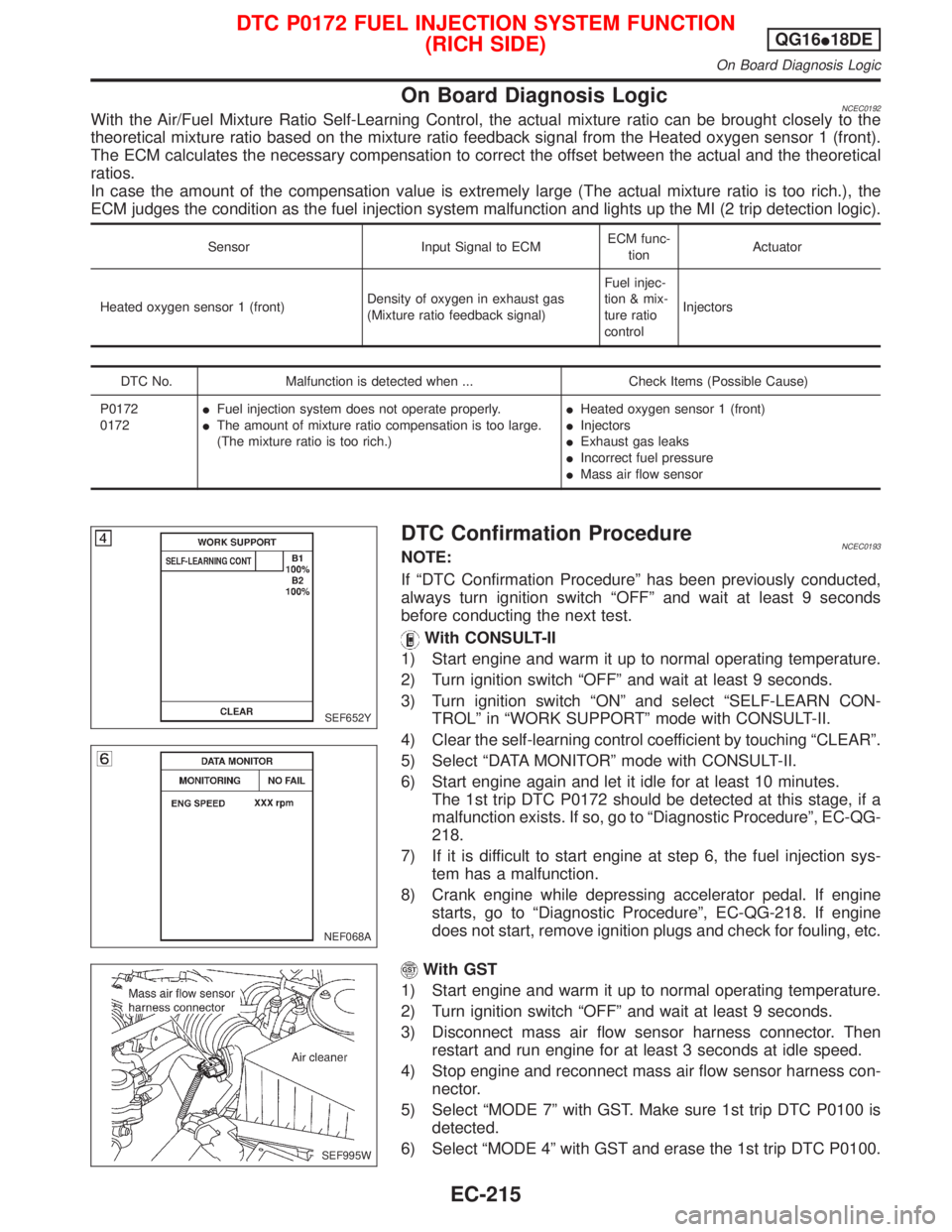
On Board Diagnosis LogicNCEC0192With the Air/Fuel Mixture Ratio Self-Learning Control, the actual mixture ratio can be brought closely to the
theoretical mixture ratio based on the mixture ratio feedback signal from the Heated oxygen sensor 1 (front).
The ECM calculates the necessary compensation to correct the offset between the actual and the theoretical
ratios.
In case the amount of the compensation value is extremely large (The actual mixture ratio is too rich.), the
ECM judges the condition as the fuel injection system malfunction and lights up the MI (2 trip detection logic).
Sensor Input Signal to ECMECM func-
tionActuator
Heated oxygen sensor 1 (front)Density of oxygen in exhaust gas
(Mixture ratio feedback signal)Fuel injec-
tion & mix-
ture ratio
controlInjectors
DTC No. Malfunction is detected when ... Check Items (Possible Cause)
P0172
0172IFuel injection system does not operate properly.
IThe amount of mixture ratio compensation is too large.
(The mixture ratio is too rich.)IHeated oxygen sensor 1 (front)
IInjectors
IExhaust gas leaks
IIncorrect fuel pressure
IMass air flow sensor
DTC Confirmation ProcedureNCEC0193NOTE:
If ªDTC Confirmation Procedureº has been previously conducted,
always turn ignition switch ªOFFº and wait at least 9 seconds
before conducting the next test.
With CONSULT-II
1) Start engine and warm it up to normal operating temperature.
2) Turn ignition switch ªOFFº and wait at least 9 seconds.
3) Turn ignition switch ªONº and select ªSELF-LEARN CON-
TROLº in ªWORK SUPPORTº mode with CONSULT-II.
4) Clear the self-learning control coefficient by touching ªCLEARº.
5) Select ªDATA MONITORº mode with CONSULT-II.
6) Start engine again and let it idle for at least 10 minutes.
The 1st trip DTC P0172 should be detected at this stage, if a
malfunction exists. If so, go to ªDiagnostic Procedureº, EC-QG-
218.
7) If it is difficult to start engine at step 6, the fuel injection sys-
tem has a malfunction.
8) Crank engine while depressing accelerator pedal. If engine
starts, go to ªDiagnostic Procedureº, EC-QG-218. If engine
does not start, remove ignition plugs and check for fouling, etc.
With GST
1) Start engine and warm it up to normal operating temperature.
2) Turn ignition switch ªOFFº and wait at least 9 seconds.
3) Disconnect mass air flow sensor harness connector. Then
restart and run engine for at least 3 seconds at idle speed.
4) Stop engine and reconnect mass air flow sensor harness con-
nector.
5) Select ªMODE 7º with GST. Make sure 1st trip DTC P0100 is
detected.
6) Select ªMODE 4º with GST and erase the 1st trip DTC P0100.
SEF652Y
NEF068A
SEF995W
DTC P0172 FUEL INJECTION SYSTEM FUNCTION
(RICH SIDE)QG16I18DE
On Board Diagnosis Logic
EC-215
Page 664 of 2267
On Board Diagnosis LogicNCEC0202When a misfire occurs, the engine speed will fluctuate. If the engine speed fluctuates enough to cause the
CKP sensor signal to vary, The ECM can determine that a misfire is occurring.
Sensor Input Signal to ECM ECM function
Crankshaft position sensor (POS) Engine speed On board diagnosis of misfire
The misfire detection logic consists of the following two conditions.
1. One Trip Detection Logic (Three Way Catalyst Damage)
On the first trip that a misfire condition occurs that can damage the three way catalyst (TWC) due to
overheating, the MI will blink.
When a misfire condition occurs, the ECM monitors the CKP sensor signal every 200 engine revolutions
for a change.
When the misfire condition decreases to a level that will not damage the TWC, the MI will turn off.
If another misfire condition occurs that can damage the TWC on a second trip, the MI will blink.
When the misfire condition decreases to a level that will not damage the TWC, the MI will remain on.
If another misfire condition occurs that can damage the TWC, the MI will begin to blink again.
(After the first trip detection, the MI will light up from engine starting. If a misfire is detected that will cause
three way catalyst damage, the MI will start blinking.)
2. Two Trip Detection Logic (Exhaust quality deterioration)
For misfire conditions that will not damage the TWC (but will affect emissions), the MI will only light when
the misfire is detected on a second trip. During this condition, the ECM monitors the CKP sensor signal
every 1,000 engine revolutions.
A misfire malfunction can be detected on any one cylinder or on multiple cylinders.
DTC No. Malfunction is detected when ... Check Items (Possible Cause)
P0300
0300IMultiple cylinders misfire.IImproper spark plug
IInsufficient compression
IIncorrect fuel pressure
IEGR volume control valve (If so equipped)
IThe injector circuit is open or shorted
IInjectors
IIntake air leak
IInsufficient ignition spark
ILack of fuel
IHeated oxygen sensor 1 (front) P0301
0301INo. 1 cylinder misfires.
P0302
0302INo. 2 cylinder misfires.
P0303
0303INo. 3 cylinder misfires.
P0304
0304INo. 4 cylinder misfires.
DTC Confirmation ProcedureNCEC0203CAUTION:
Always drive vehicle at a safe speed.
NOTE:
If ªDTC Confirmation Procedureº has been previously conducted,
always turn ignition switch ªOFFº and wait at least 9 seconds
before conducting the next test.
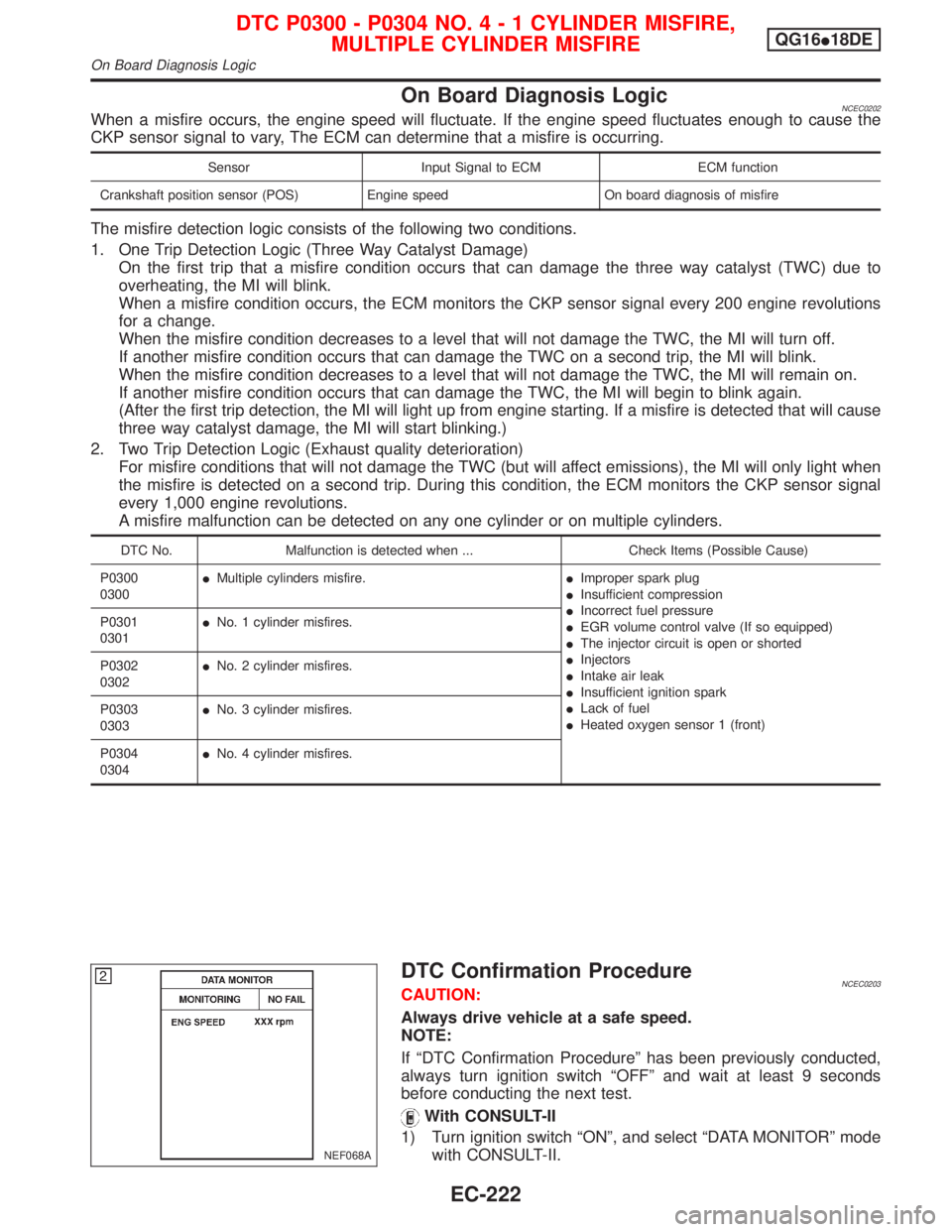
With CONSULT-II
1) Turn ignition switch ªONº, and select ªDATA MONITORº mode
with CONSULT-II.
NEF068A
DTC P0300 - P0304 NO.4-1CYLINDER MISFIRE,
MULTIPLE CYLINDER MISFIREQG16I18DE
On Board Diagnosis Logic
EC-222
Page 674 of 2267
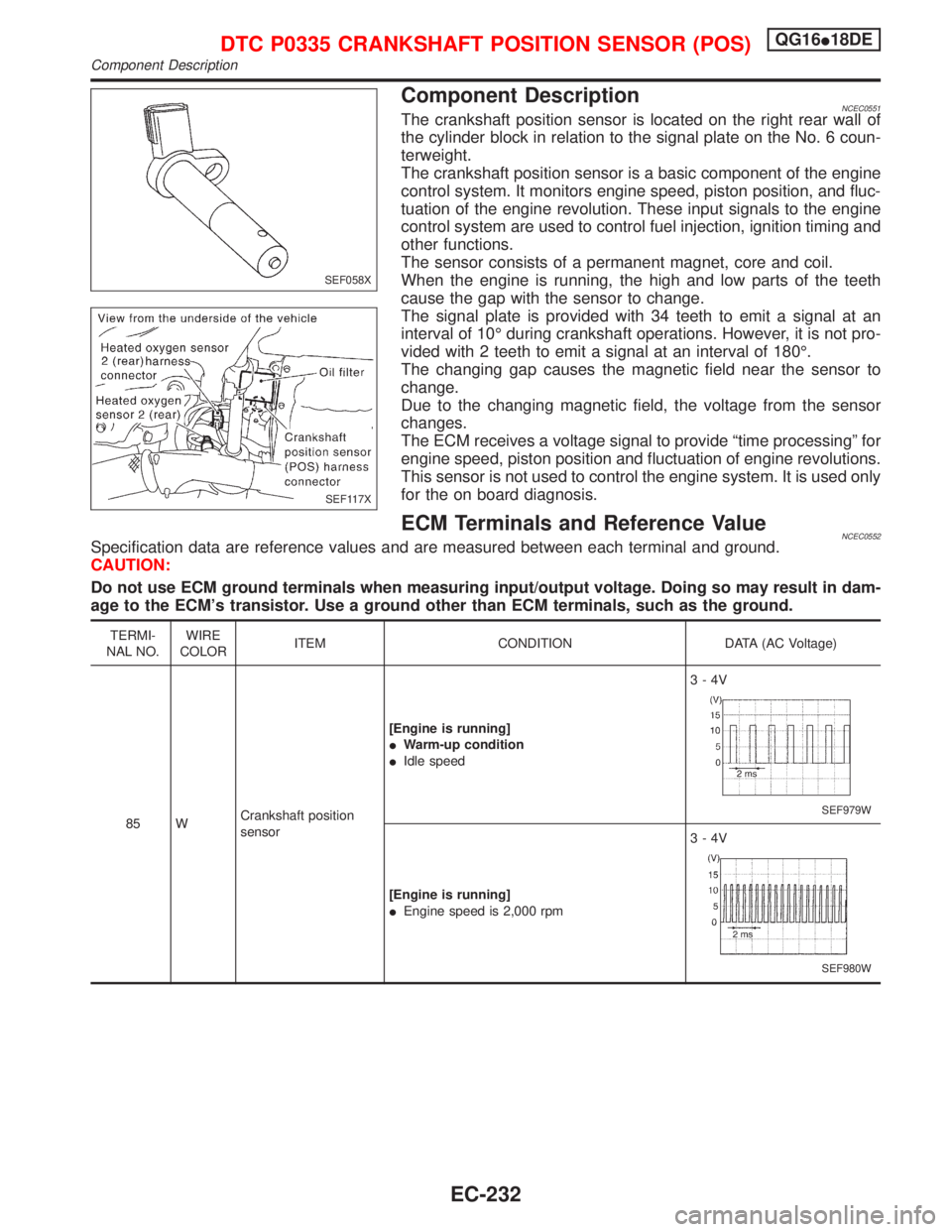
Component DescriptionNCEC0551The crankshaft position sensor is located on the right rear wall of
the cylinder block in relation to the signal plate on the No. 6 coun-
terweight.
The crankshaft position sensor is a basic component of the engine
control system. It monitors engine speed, piston position, and fluc-
tuation of the engine revolution. These input signals to the engine
control system are used to control fuel injection, ignition timing and
other functions.
The sensor consists of a permanent magnet, core and coil.
When the engine is running, the high and low parts of the teeth
cause the gap with the sensor to change.
The signal plate is provided with 34 teeth to emit a signal at an
interval of 10É during crankshaft operations. However, it is not pro-
vided with 2 teeth to emit a signal at an interval of 180É.
The changing gap causes the magnetic field near the sensor to
change.
Due to the changing magnetic field, the voltage from the sensor
changes.
The ECM receives a voltage signal to provide ªtime processingº for
engine speed, piston position and fluctuation of engine revolutions.
This sensor is not used to control the engine system. It is used only
for the on board diagnosis.
ECM Terminals and Reference ValueNCEC0552Specification data are reference values and are measured between each terminal and ground.
CAUTION:
Do not use ECM ground terminals when measuring input/output voltage. Doing so may result in dam-
age to the ECM's transistor. Use a ground other than ECM terminals, such as the ground.
TERMI-
NAL NO.WIRE
COLORITEM CONDITION DATA (AC Voltage)
85 WCrankshaft position
sensor[Engine is running]
IWarm-up condition
IIdle speed3-4V
SEF979W
[Engine is running]
IEngine speed is 2,000 rpm3-4V
SEF980W
SEF058X
SEF117X
DTC P0335 CRANKSHAFT POSITION SENSOR (POS)QG16I18DE
Component Description
EC-232
Page 680 of 2267
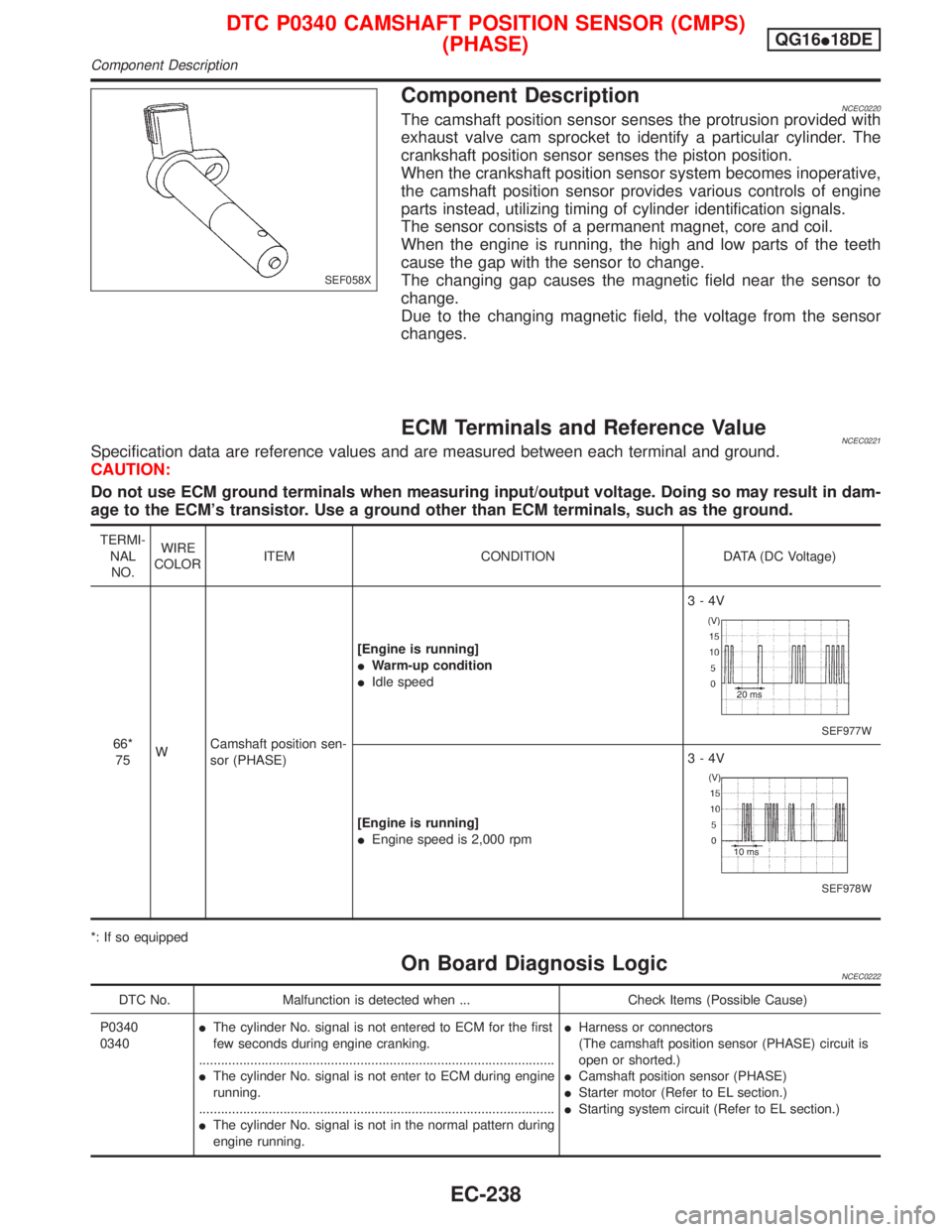
Component DescriptionNCEC0220The camshaft position sensor senses the protrusion provided with
exhaust valve cam sprocket to identify a particular cylinder. The
crankshaft position sensor senses the piston position.
When the crankshaft position sensor system becomes inoperative,
the camshaft position sensor provides various controls of engine
parts instead, utilizing timing of cylinder identification signals.
The sensor consists of a permanent magnet, core and coil.
When the engine is running, the high and low parts of the teeth
cause the gap with the sensor to change.
The changing gap causes the magnetic field near the sensor to
change.
Due to the changing magnetic field, the voltage from the sensor
changes.
ECM Terminals and Reference ValueNCEC0221Specification data are reference values and are measured between each terminal and ground.
CAUTION:
Do not use ECM ground terminals when measuring input/output voltage. Doing so may result in dam-
age to the ECM's transistor. Use a ground other than ECM terminals, such as the ground.
TERMI-
NAL
NO.WIRE
COLORITEM CONDITION DATA (DC Voltage)
66*
75WCamshaft position sen-
sor (PHASE)[Engine is running]
IWarm-up condition
IIdle speed3-4V
SEF977W
[Engine is running]
IEngine speed is 2,000 rpm3-4V
SEF978W
*: If so equipped
On Board Diagnosis LogicNCEC0222
DTC No. Malfunction is detected when ... Check Items (Possible Cause)
P0340
0340IThe cylinder No. signal is not entered to ECM for the first
few seconds during engine cranking.
.................................................................................................
IThe cylinder No. signal is not enter to ECM during engine
running.
.................................................................................................
IThe cylinder No. signal is not in the normal pattern during
engine running.IHarness or connectors
(The camshaft position sensor (PHASE) circuit is
open or shorted.)
ICamshaft position sensor (PHASE)
IStarter motor (Refer to EL section.)
IStarting system circuit (Refer to EL section.)
SEF058X
DTC P0340 CAMSHAFT POSITION SENSOR (CMPS)
(PHASE)QG16I18DE
Component Description
EC-238
Page 686 of 2267

DescriptionNCEC0227SYSTEM DESCRIPTIONNCEC0227S01
Sensor Input Signal to ECMECM func-
tionActuator
Crankshaft position sensor Engine speed
EGR control EGR volume control valve Mass air flow sensor Amount of intake air
Engine coolant temperature sensor Engine coolant temperature
Ignition switch Start signal
Throttle position sensor Throttle position
Vehicle speed sensor or ABS actuator and
electric unit (control unit)Vehicle speed
Battery Battery voltage
This system controls flow rate of EGR led from exhaust manifold
to intake manifold. The opening of the EGR by-pass passage in the
EGR volume control valve changes to control the flow rate. A
built-in step motor moves the valve in steps corresponding to the
ECM output pulses. The opening of the valve varies for optimum
engine control. The optimum value stored in the ECM is determined
by considering various engine conditions. The EGR volume control
valve remains closed under the following conditions.
ILow engine coolant temperature
IEngine starting
IHigh-speed engine operation
IExtremely light load engine operation
IEngine idling
IExcessively high engine coolant temperature
IWide open throttle
IMass air flow sensor malfunction
ILow battery voltage
COMPONENT DESCRIPTIONNCEC0227S02EGR Volume Control ValveNCEC0227S0201The EGR volume control valve uses a step motor to control the flow
rate of EGR from exhaust manifold. This motor has four winding
phases. It operates according to the output pulse signal of the
ECM. Two windings are turned ON and OFF in sequence. Each
time an ON pulse is issued, the valve opens or closes, changing
the flow rate. When no change in the flow rate is needed, the ECM
does not issue the pulse signal. A certain voltage signal is issued
so that the valve remains at that particular opening.
SEF551W
SEF552W
DTC P0400 EGR FUNCTION (CLOSE) (IF SO EQUIPPED)QG16I18DE
Description
EC-244