sensor NISSAN PRIMERA 1999 Electronic Repair Manual
[x] Cancel search | Manufacturer: NISSAN, Model Year: 1999, Model line: PRIMERA, Model: NISSAN PRIMERA 1999Pages: 2267, PDF Size: 35.74 MB
Page 1916 of 2267
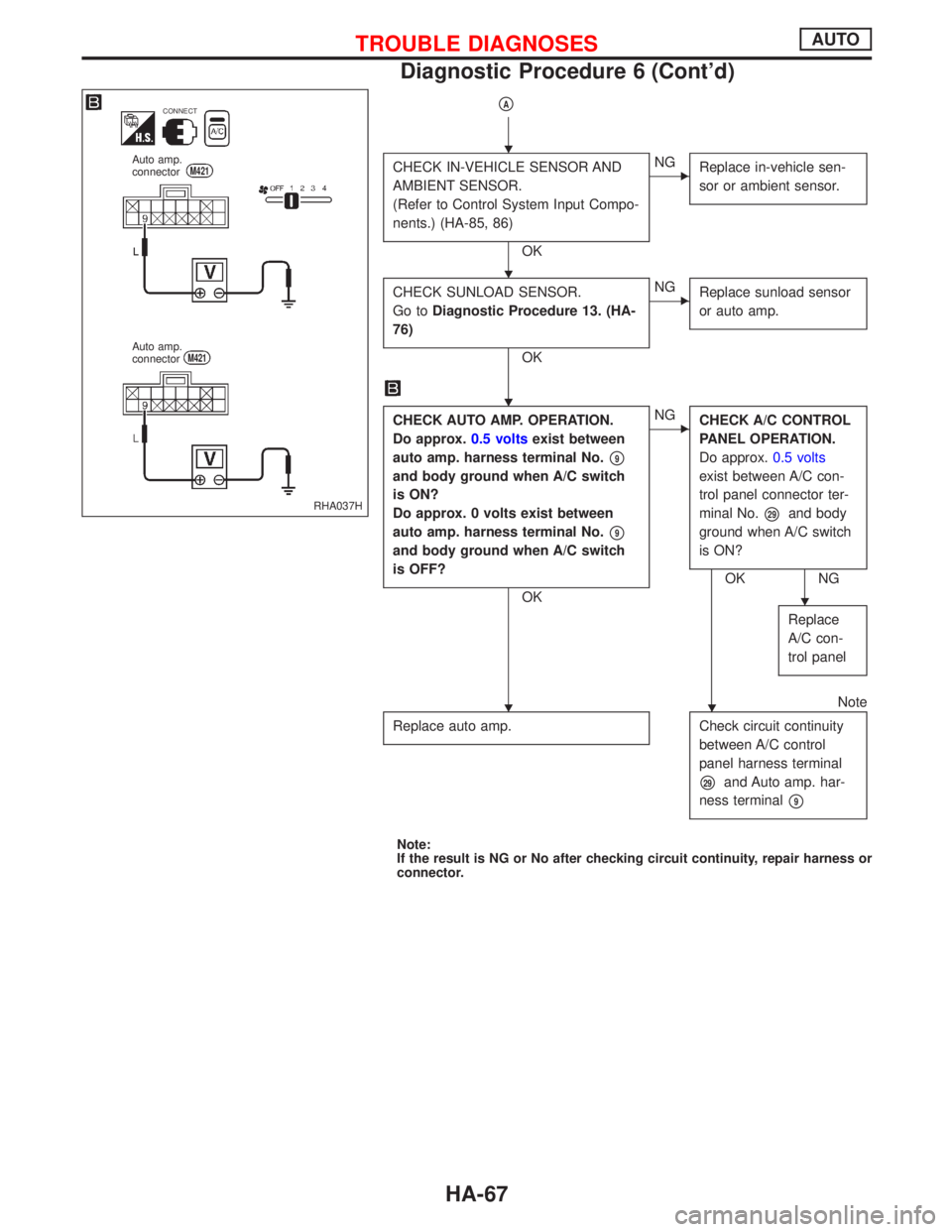
pA
CHECK IN-VEHICLE SENSOR AND
AMBIENT SENSOR.
(Refer to Control System Input Compo-
nents.) (HA-85, 86)
OK
ENG
Replace in-vehicle sen-
sor or ambient sensor.
CHECK SUNLOAD SENSOR.
Go toDiagnostic Procedure 13. (HA-
76)
OK
ENG
Replace sunload sensor
or auto amp.
CHECK AUTO AMP. OPERATION.
Do approx.0.5 voltsexist between
auto amp. harness terminal No.
p9
and body ground when A/C switch
is ON?
Do approx. 0 volts exist between
auto amp. harness terminal No.
p9
and body ground when A/C switch
is OFF?
OK
ENG
CHECK A/C CONTROL
PANEL OPERATION.
Do approx.0.5 volts
exist between A/C con-
trol panel connector ter-
minal No.
p29and body
ground when A/C switch
is ON?
OK NG
Replace
A/C con-
trol panel
Replace auto amp.
Note
Check circuit continuity
between A/C control
panel harness terminal
p29and Auto amp. har-
ness terminal
p9
Note:
If the result is NG or No after checking circuit continuity, repair harness or
connector.
RHA037H
CONNECT
Auto amp.
connectorM421
Auto amp.
connectorM421
H
H
HH
H
HH
TROUBLE DIAGNOSESAUTO
Diagnostic Procedure 6 (Cont'd)
HA-67
Page 1917 of 2267
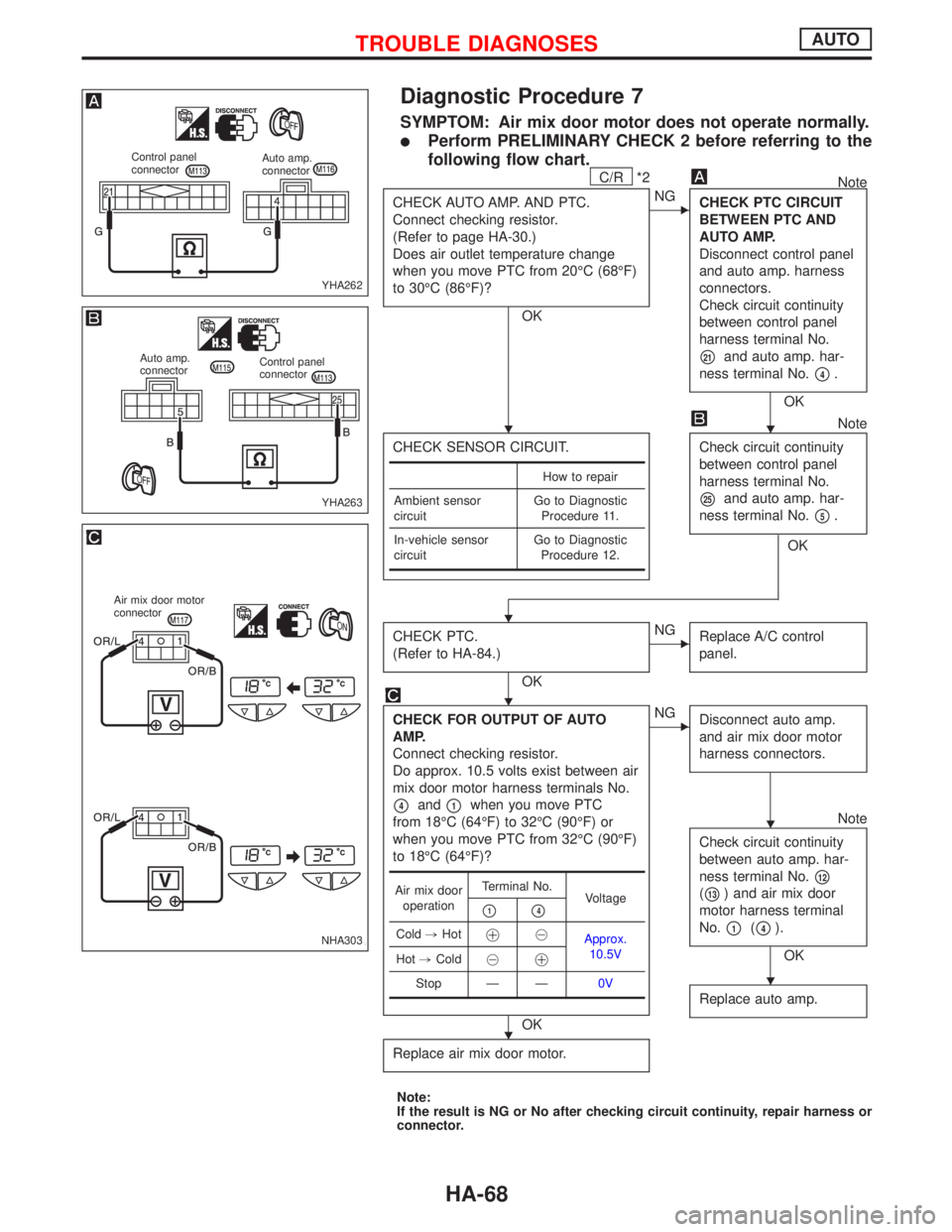
Diagnostic Procedure 7
SYMPTOM: Air mix door motor does not operate normally.
lPerform PRELIMINARY CHECK 2 before referring to the
following flow chart.
C/R*2Note
CHECK AUTO AMP. AND PTC.
Connect checking resistor.
(Refer to page HA-30.)
Does air outlet temperature change
when you move PTC from 20ÉC (68ÉF)
to 30ÉC (86ÉF)?
OK
ENG
CHECK PTC CIRCUIT
BETWEEN PTC AND
AUTO AMP.
Disconnect control panel
and auto amp. harness
connectors.
Check circuit continuity
between control panel
harness terminal No.
p21and auto amp. har-
ness terminal No.
p4.
OK
CHECK SENSOR CIRCUIT.
Note
Check circuit continuity
between control panel
harness terminal No.
p25and auto amp. har-
ness terminal No.
p5.
OK
CHECK PTC.
(Refer to HA-84.)
OK
ENG
Replace A/C control
panel.
CHECK FOR OUTPUT OF AUTO
AMP.
Connect checking resistor.
Do approx. 10.5 volts exist between air
mix door motor harness terminals No.
p4andp1when you move PTC
from 18ÉC (64ÉF) to 32ÉC (90ÉF) or
when you move PTC from 32ÉC (90ÉF)
to 18ÉC (64ÉF)?
OK
ENG
Disconnect auto amp.
and air mix door motor
harness connectors.
Note
Check circuit continuity
between auto amp. har-
ness terminal No.
p12
(p13) and air mix door
motor harness terminal
No.
p1(p4).
OK
Replace auto amp.
Replace air mix door motor.
Note:
If the result is NG or No after checking circuit continuity, repair harness or
connector.
How to repair
Ambient sensor
circuitGo to Diagnostic
Procedure 11.
In-vehicle sensor
circuitGo to Diagnostic
Procedure 12.
Air mix door
operationTerminal No.
Voltage
p1p4
Cold,Hot!@
Approx.
10.5V
Hot,Cold@
!
Stop Ð Ð0V
YHA262
Control panel
connectorAuto amp.
connector
YHA263
Auto amp.
connectorControl panel
connector
NHA303
Air mix door motor
connector
HH
H
H
H
H
H
TROUBLE DIAGNOSESAUTO
HA-68
Page 1922 of 2267
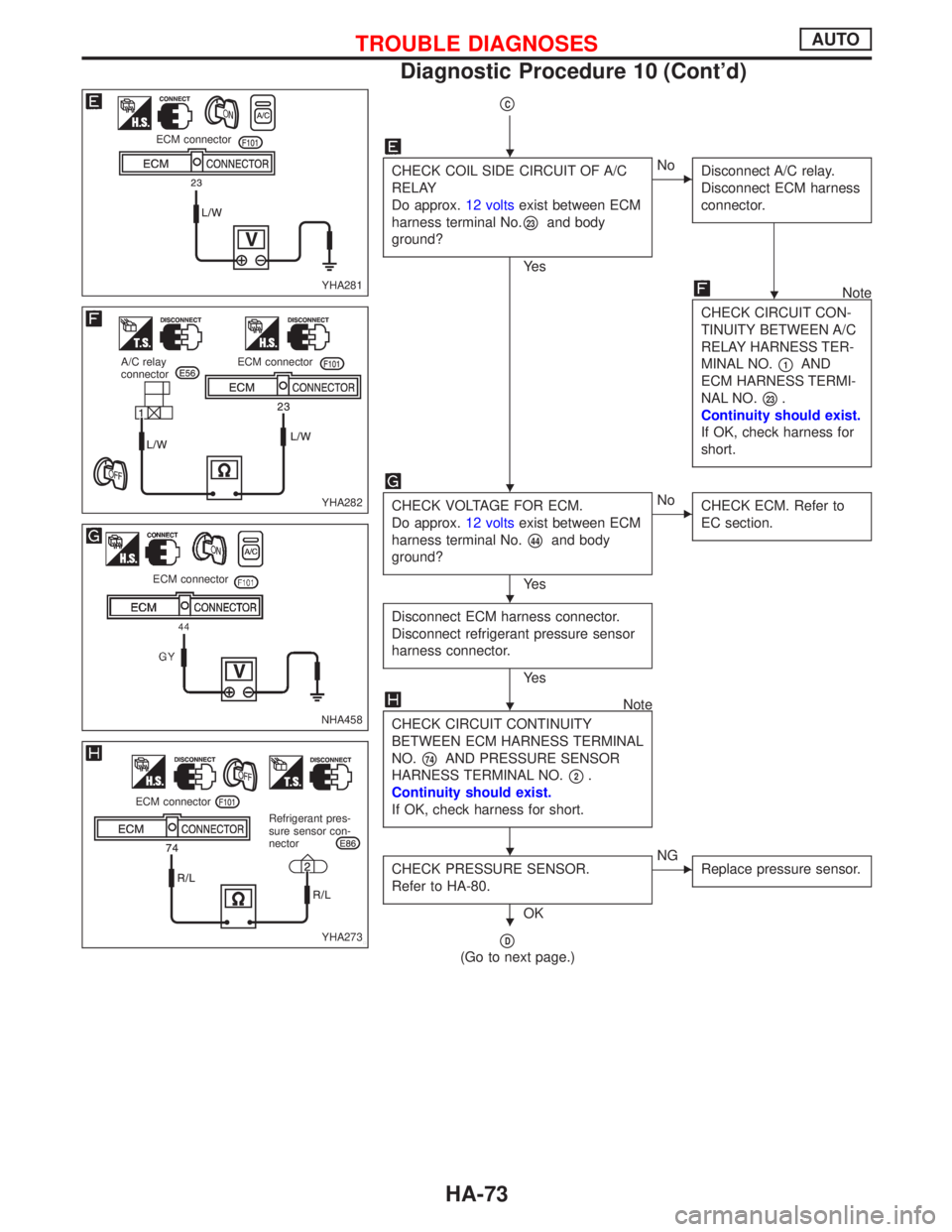
pC
CHECK COIL SIDE CIRCUIT OF A/C
RELAY
Do approx.12 voltsexist between ECM
harness terminal No.
p23and body
ground?
Ye s
ENo
Disconnect A/C relay.
Disconnect ECM harness
connector.
Note
CHECK CIRCUIT CON-
TINUITY BETWEEN A/C
RELAY HARNESS TER-
MINAL NO.
p1AND
ECM HARNESS TERMI-
NAL NO.
p23.
Continuity should exist.
If OK, check harness for
short.
CHECK VOLTAGE FOR ECM.
Do approx.12 voltsexist between ECM
harness terminal No.
p44and body
ground?
Ye s
ENo
CHECK ECM. Refer to
EC section.
Disconnect ECM harness connector.
Disconnect refrigerant pressure sensor
harness connector.
Ye s
Note
CHECK CIRCUIT CONTINUITY
BETWEEN ECM HARNESS TERMINAL
NO.
p74AND PRESSURE SENSOR
HARNESS TERMINAL NO.
p2.
Continuity should exist.
If OK, check harness for short.
CHECK PRESSURE SENSOR.
Refer to HA-80.
OK
ENG
Replace pressure sensor.
pD
(Go to next page.)
YHA281
ECM connector
YHA282
A/C relay
connectorECM connector
NHA458
ECM connector
YHA273
ECM connector
Refrigerant pres-
sure sensor con-
nector
H
H
H
H
H
H
H
TROUBLE DIAGNOSESAUTO
Diagnostic Procedure 10 (Cont'd)
HA-73
Page 1923 of 2267
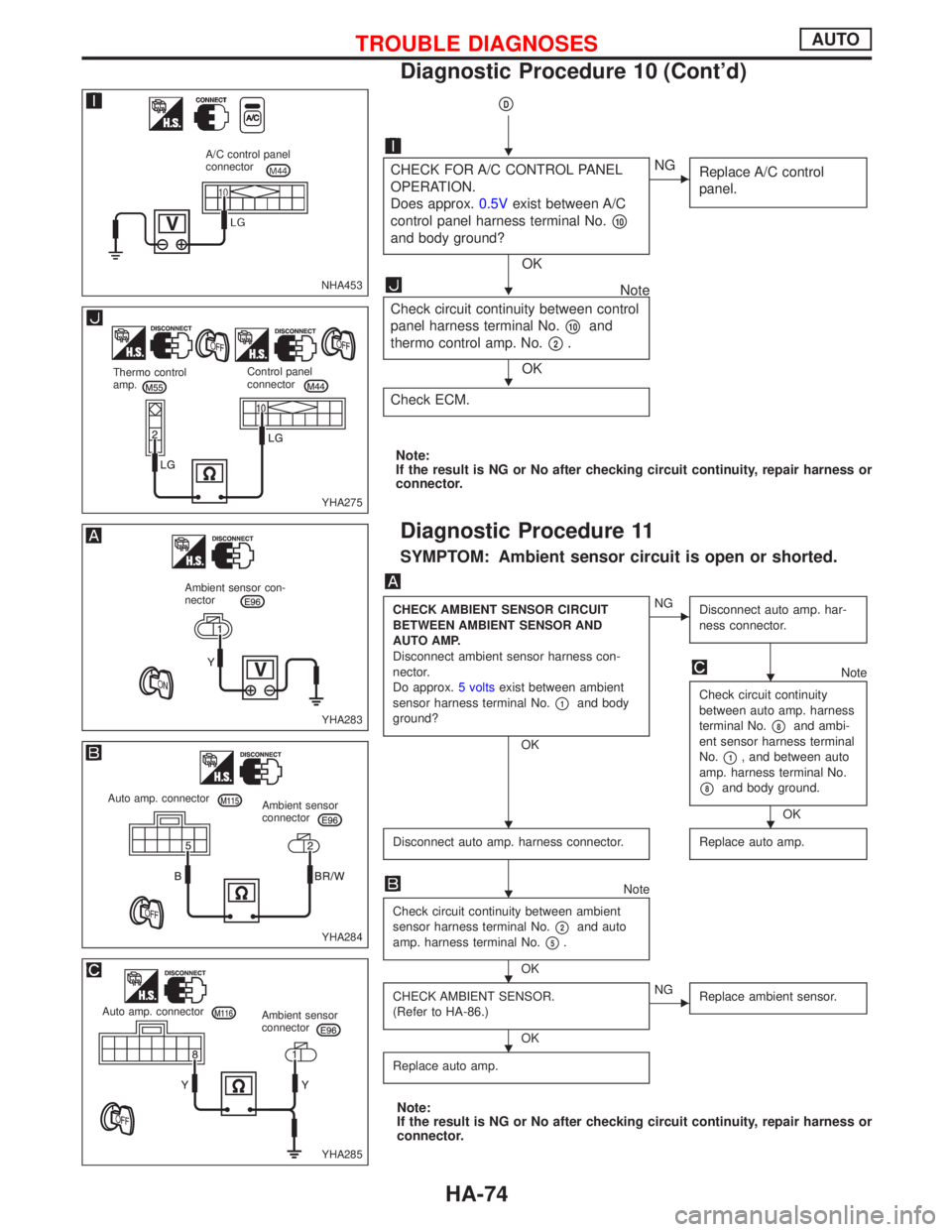
pD
CHECK FOR A/C CONTROL PANEL
OPERATION.
Does approx.0.5Vexist between A/C
control panel harness terminal No.
p10
and body ground?
OK
ENG
Replace A/C control
panel.
Note
Check circuit continuity between control
panel harness terminal No.
p10and
thermo control amp. No.
p2.
OK
Check ECM.
Note:
If the result is NG or No after checking circuit continuity, repair harness or
connector.
Diagnostic Procedure 11
SYMPTOM: Ambient sensor circuit is open or shorted.
CHECK AMBIENT SENSOR CIRCUIT
BETWEEN AMBIENT SENSOR AND
AUTO AMP.
Disconnect ambient sensor harness con-
nector.
Do approx.5 voltsexist between ambient
sensor harness terminal No.
p1and body
ground?
OK
ENG
Disconnect auto amp. har-
ness connector.
Note
Check circuit continuity
between auto amp. harness
terminal No.
p8and ambi-
ent sensor harness terminal
No.
p1, and between auto
amp. harness terminal No.
p8and body ground.
OK
Disconnect auto amp. harness connector.
Replace auto amp.
Note
Check circuit continuity between ambient
sensor harness terminal No.
p2and auto
amp. harness terminal No.
p5.
OK
CHECK AMBIENT SENSOR.
(Refer to HA-86.)
OK
ENG
Replace ambient sensor.
Replace auto amp.
Note:
If the result is NG or No after checking circuit continuity, repair harness or
connector.
NHA453
A/C control panel
connector
YHA275
Thermo control
amp.Control panel
connector
YHA283
Ambient sensor con-
nector
YHA284
Auto amp. connector
Ambient sensor
connector
YHA285
Auto amp. connector
Ambient sensor
connector
H
H
H
H
HH
H
H
H
TROUBLE DIAGNOSESAUTO
Diagnostic Procedure 10 (Cont'd)
HA-74
Page 1924 of 2267
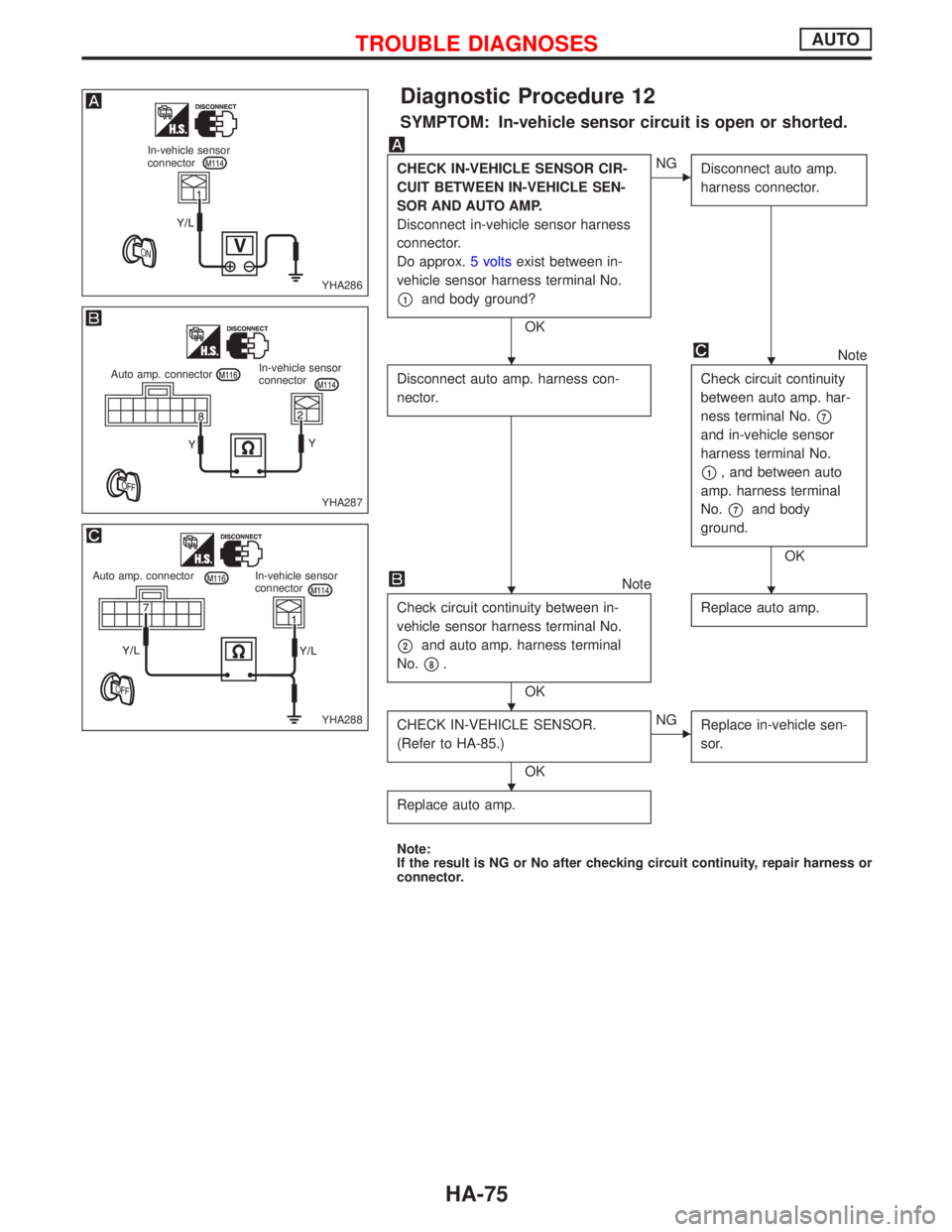
Diagnostic Procedure 12
SYMPTOM: In-vehicle sensor circuit is open or shorted.
CHECK IN-VEHICLE SENSOR CIR-
CUIT BETWEEN IN-VEHICLE SEN-
SOR AND AUTO AMP.
Disconnect in-vehicle sensor harness
connector.
Do approx.5 voltsexist between in-
vehicle sensor harness terminal No.
p1and body ground?
OK
ENG
Disconnect auto amp.
harness connector.
Disconnect auto amp. harness con-
nector.
Note
Check circuit continuity
between auto amp. har-
ness terminal No.
p7
and in-vehicle sensor
harness terminal No.
p1, and between auto
amp. harness terminal
No.
p7and body
ground.
OK
Note
Check circuit continuity between in-
vehicle sensor harness terminal No.
p2and auto amp. harness terminal
No.
p8.
OKReplace auto amp.
CHECK IN-VEHICLE SENSOR.
(Refer to HA-85.)
OK
ENG
Replace in-vehicle sen-
sor.
Replace auto amp.
Note:
If the result is NG or No after checking circuit continuity, repair harness or
connector.
YHA286
In-vehicle sensor
connector
YHA287
Auto amp. connectorIn-vehicle sensor
connector
YHA288
Auto amp. connector In-vehicle sensor
connector
HH
HH
H
H
TROUBLE DIAGNOSESAUTO
HA-75
Page 1925 of 2267
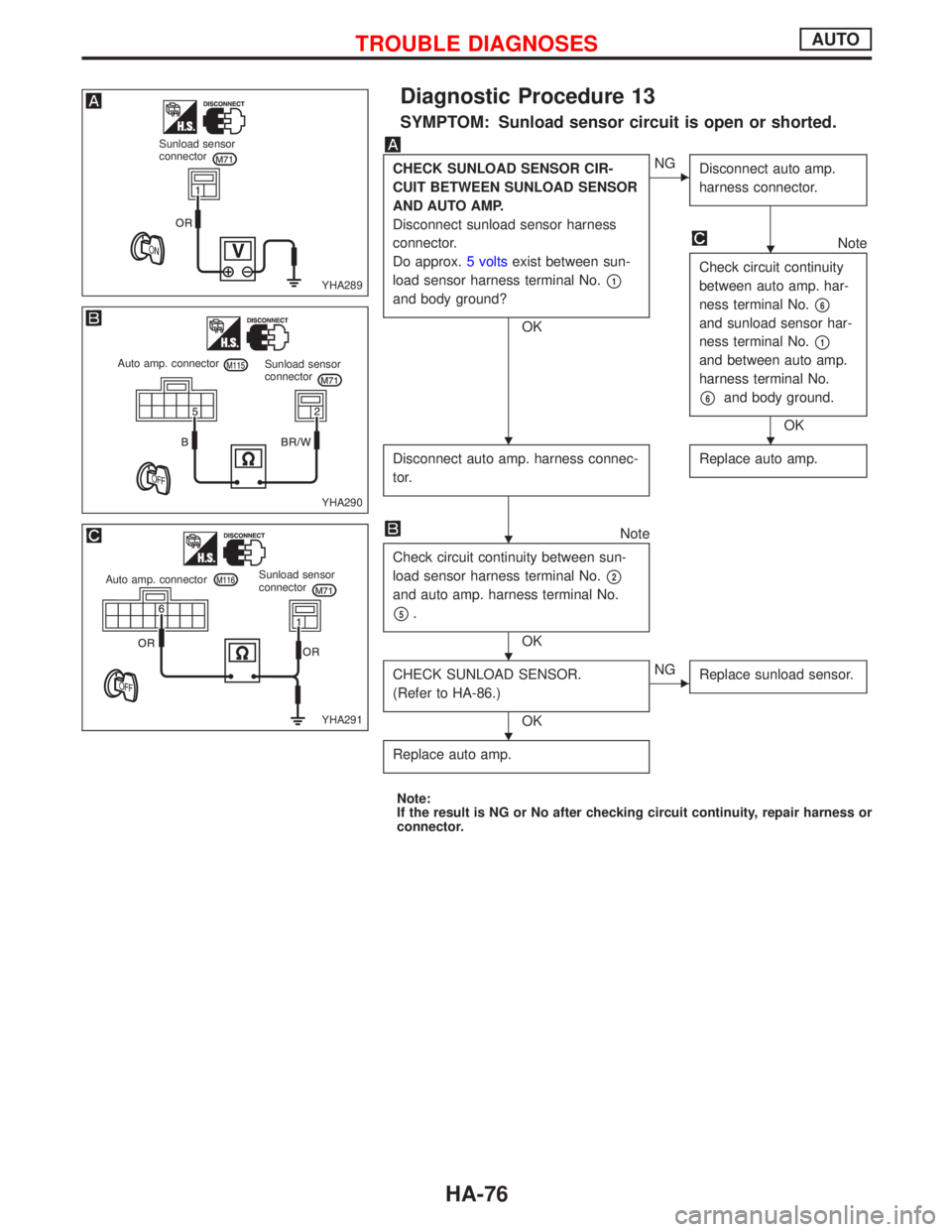
Diagnostic Procedure 13
SYMPTOM: Sunload sensor circuit is open or shorted.
CHECK SUNLOAD SENSOR CIR-
CUIT BETWEEN SUNLOAD SENSOR
AND AUTO AMP.
Disconnect sunload sensor harness
connector.
Do approx.5 voltsexist between sun-
load sensor harness terminal No.
p1
and body ground?
OK
ENG
Disconnect auto amp.
harness connector.
Note
Check circuit continuity
between auto amp. har-
ness terminal No.
p6
and sunload sensor har-
ness terminal No.
p1
and between auto amp.
harness terminal No.
p6and body ground.
OK
Disconnect auto amp. harness connec-
tor.
Replace auto amp.
Note
Check circuit continuity between sun-
load sensor harness terminal No.
p2
and auto amp. harness terminal No.
p5.
OK
CHECK SUNLOAD SENSOR.
(Refer to HA-86.)
OK
ENG
Replace sunload sensor.
Replace auto amp.
Note:
If the result is NG or No after checking circuit continuity, repair harness or
connector.
YHA289
Sunload sensor
connector
YHA290
Auto amp. connector
Sunload sensor
connector
YHA291
Auto amp. connectorSunload sensor
connector
H
HH
H
H
H
TROUBLE DIAGNOSESAUTO
HA-76
Page 1929 of 2267
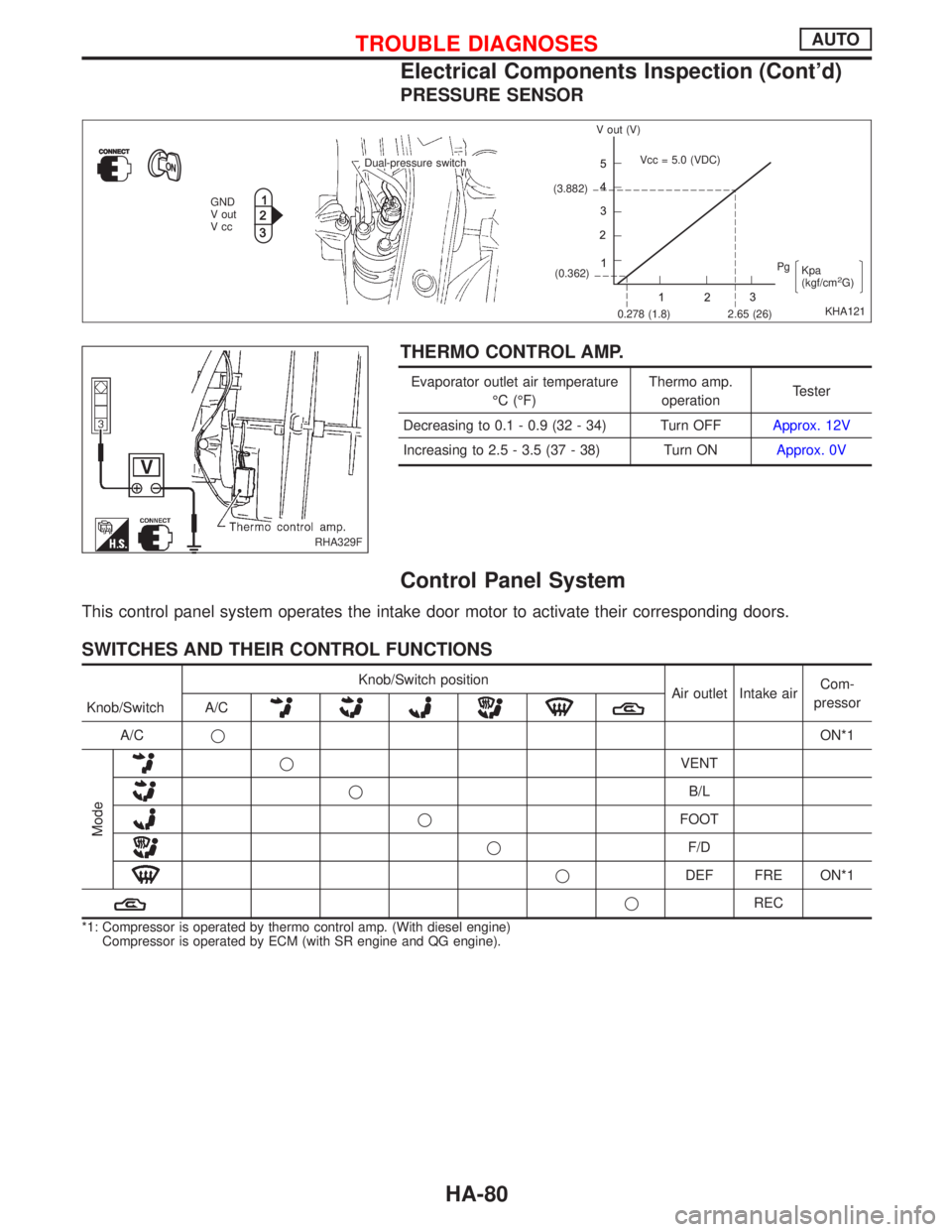
PRESSURE SENSOR
THERMO CONTROL AMP.
Evaporator outlet air temperature
ÉC (ÉF)Thermo amp.
operationTester
Decreasing to 0.1 - 0.9 (32 - 34) Turn OFFApprox. 12V
Increasing to 2.5 - 3.5 (37 - 38) Turn ONApprox. 0V
Control Panel System
This control panel system operates the intake door motor to activate their corresponding doors.
SWITCHES AND THEIR CONTROL FUNCTIONS
Knob/Switch position
Air outlet Intake airCom-
pressor
Knob/Switch A/C
A/CqON*1
Mode
qVENT
qB/L
qFOOT
qF/D
qDEF FRE ON*1
qREC
*1: Compressor is operated by thermo control amp. (With diesel engine)
Compressor is operated by ECM (with SR engine and QG engine).
KHA121 Dual-pressure switch
GND
V out
VccV out (V)
(3.882)
(0.362)Vcc = 5.0 (VDC)
0.278 (1.8) 2.65 (26)Pg
Kpa
(kgf/cm
2G)
RHA329F
TROUBLE DIAGNOSESAUTO
Electrical Components Inspection (Cont'd)
HA-80
Page 1933 of 2267
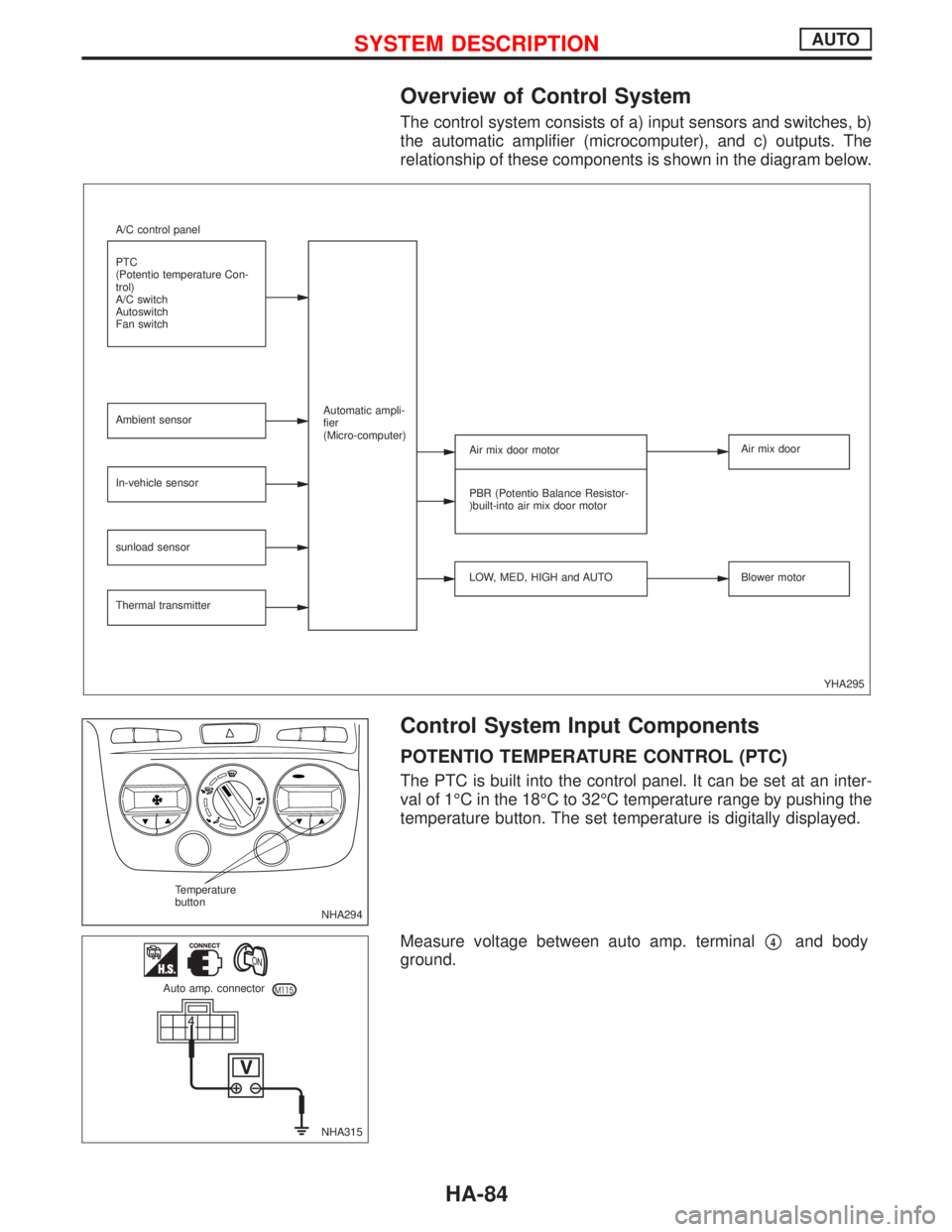
Overview of Control System
The control system consists of a) input sensors and switches, b)
the automatic amplifier (microcomputer), and c) outputs. The
relationship of these components is shown in the diagram below.
Control System Input Components
POTENTIO TEMPERATURE CONTROL (PTC)
The PTC is built into the control panel. It can be set at an inter-
val of 1ÉC in the 18ÉC to 32ÉC temperature range by pushing the
temperature button. The set temperature is digitally displayed.
Measure voltage between auto amp. terminal
p4and body
ground.
YHA295 A/C control panel
PTC
(Potentio temperature Con-
trol)
A/C switch
Autoswitch
Fan switch
Ambient sensor
In-vehicle sensor
sunload sensor
Thermal transmitterAutomatic ampli-
fier
(Micro-computer)
Air mix door motor
PBR (Potentio Balance Resistor-
)built-into air mix door motor
LOW, MED, HIGH and AUTOAir mix door
Blower motor
NHA294 Temperature
button
NHA315 Auto amp. connector
SYSTEM DESCRIPTIONAUTO
HA-84
Page 1934 of 2267
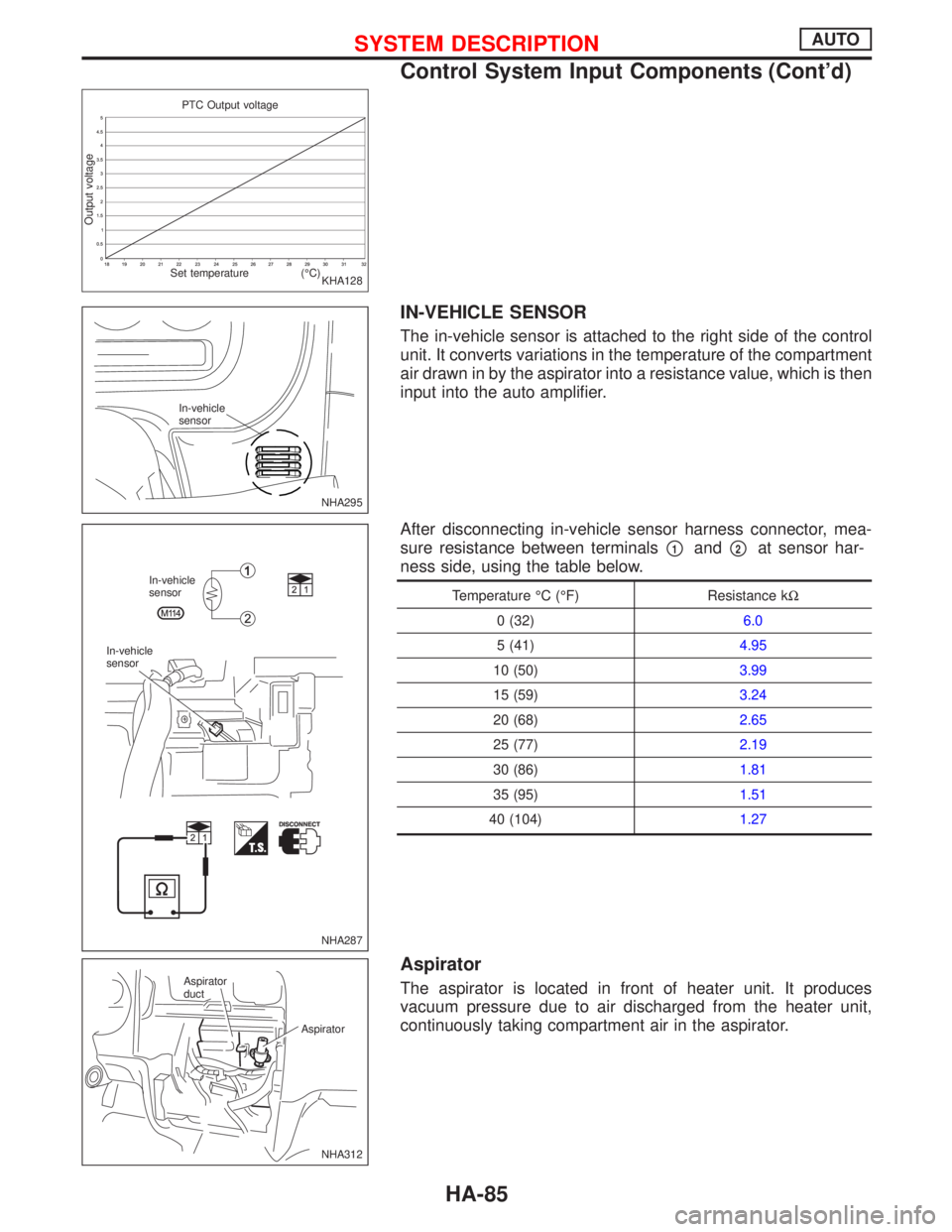
IN-VEHICLE SENSOR
The in-vehicle sensor is attached to the right side of the control
unit. It converts variations in the temperature of the compartment
air drawn in by the aspirator into a resistance value, which is then
input into the auto amplifier.
After disconnecting in-vehicle sensor harness connector, mea-
sure resistance between terminals
p1andp2at sensor har-
ness side, using the table below.
Temperature ÉC (ÉF) Resistance kW
0 (32)6.0
5 (41)4.95
10 (50)3.99
15 (59)3.24
20 (68)2.65
25 (77)2.19
30 (86)1.81
35 (95)1.51
40 (104)1.27
Aspirator
The aspirator is located in front of heater unit. It produces
vacuum pressure due to air discharged from the heater unit,
continuously taking compartment air in the aspirator.
KHA128 PTC Output voltage
Set temperature (ÉC)
Output voltage
NHA295 In-vehicle
sensor
NHA287 In-vehicle
sensor
In-vehicle
sensor
NHA312 Aspirator
duct
Aspirator
SYSTEM DESCRIPTIONAUTO
Control System Input Components (Cont'd)
HA-85
Page 1935 of 2267
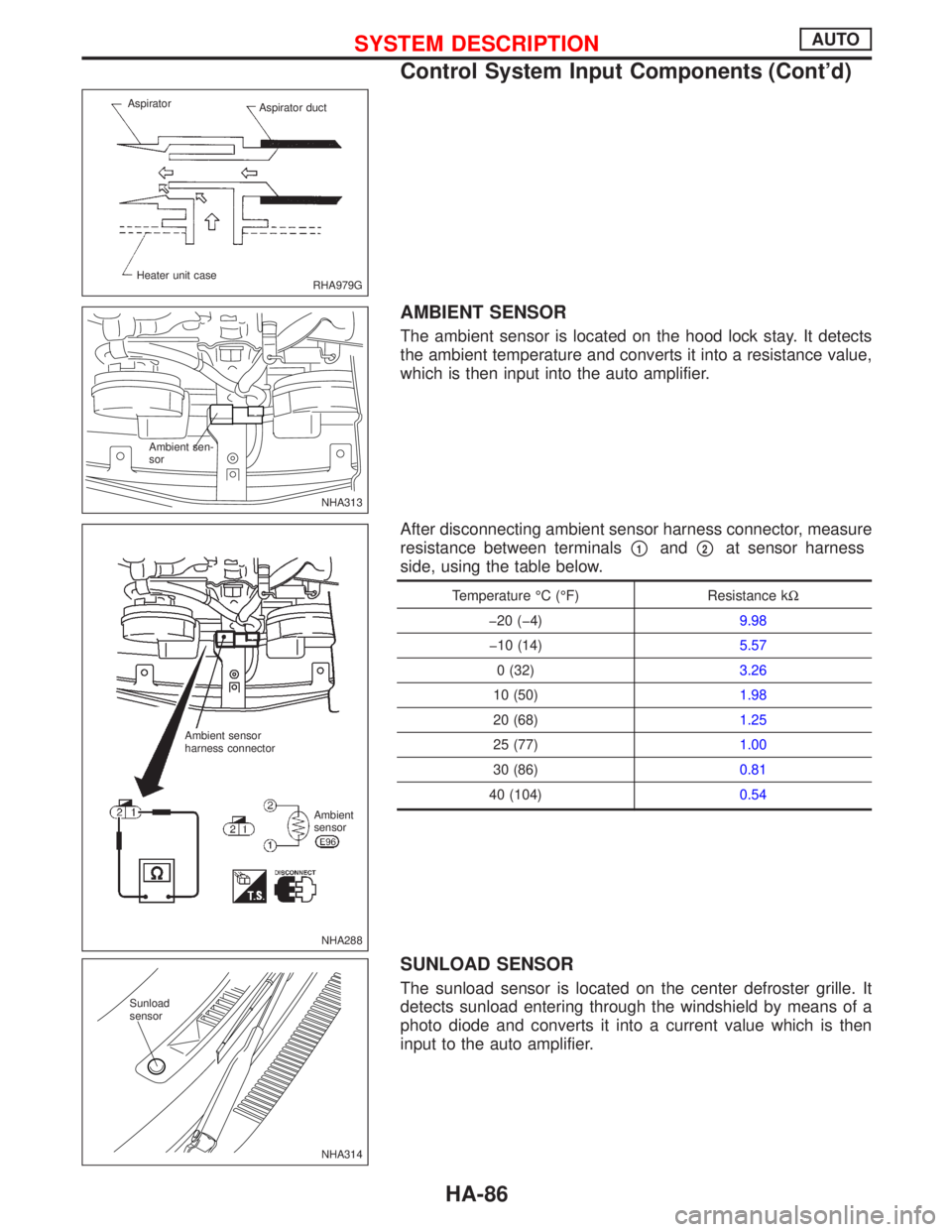
AMBIENT SENSOR
The ambient sensor is located on the hood lock stay. It detects
the ambient temperature and converts it into a resistance value,
which is then input into the auto amplifier.
After disconnecting ambient sensor harness connector, measure
resistance between terminals
p1andp2at sensor harness
side, using the table below.
Temperature ÉC (ÉF) Resistance kW
þ20 (þ4)9.98
þ10 (14)5.57
0 (32)3.26
10 (50)1.98
20 (68)1.25
25 (77)1.00
30 (86)0.81
40 (104)0.54
SUNLOAD SENSOR
The sunload sensor is located on the center defroster grille. It
detects sunload entering through the windshield by means of a
photo diode and converts it into a current value which is then
input to the auto amplifier.
RHA979G Aspirator
Aspirator duct
Heater unit case
NHA313 Ambient sen-
sor
NHA288 Ambient sensor
harness connector
Ambient
sensor
NHA314 Sunload
sensor
SYSTEM DESCRIPTIONAUTO
Control System Input Components (Cont'd)
HA-86