sensor NISSAN PRIMERA 1999 Electronic Repair Manual
[x] Cancel search | Manufacturer: NISSAN, Model Year: 1999, Model line: PRIMERA, Model: NISSAN PRIMERA 1999Pages: 2267, PDF Size: 35.74 MB
Page 1607 of 2267
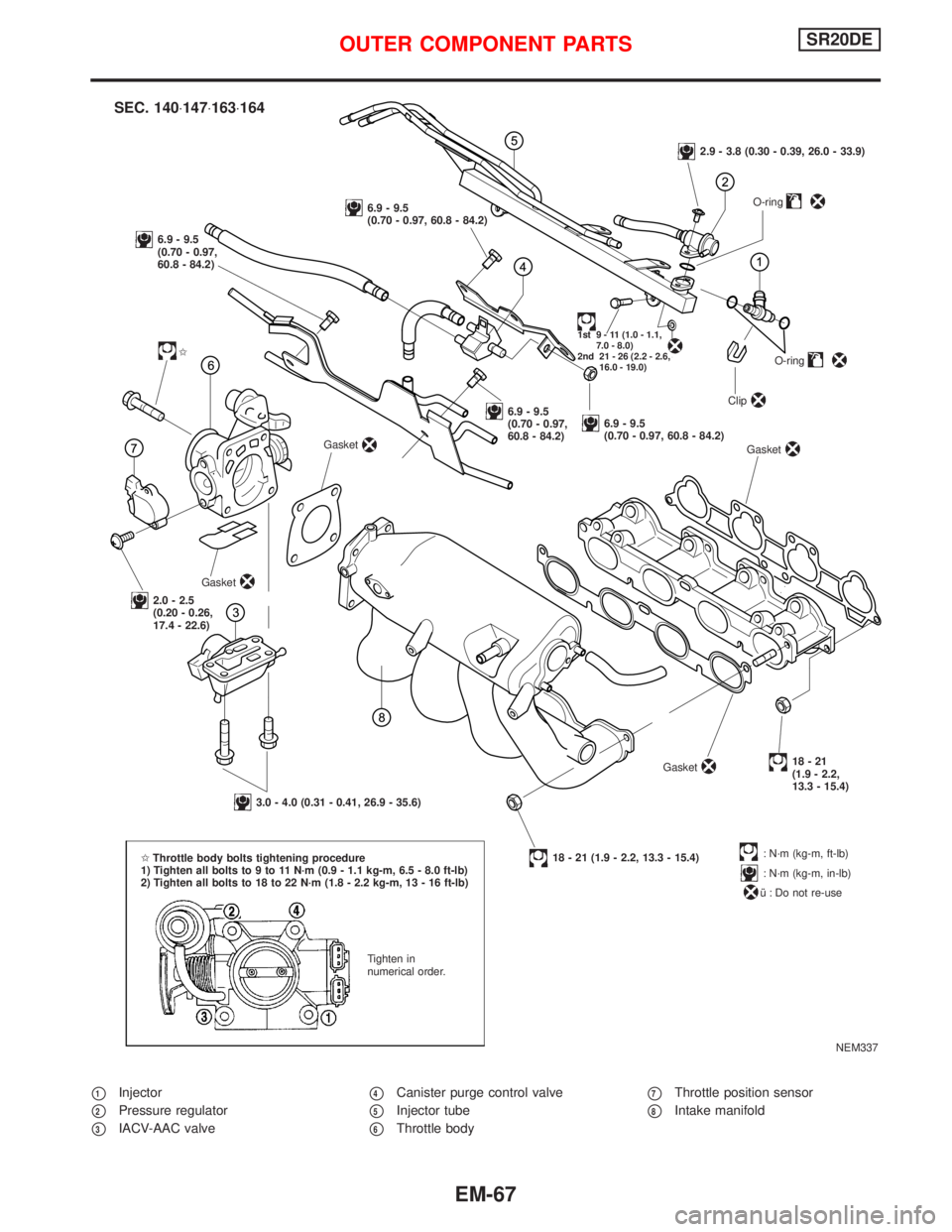
p1Injector
p2Pressure regulator
p3IACV-AAC valve
p4Canister purge control valve
p5Injector tube
p6Throttle body
p7Throttle position sensor
p8Intake manifold
NEM337
.
SEC. 140×147×163×164
6.9 - 9.5
(0.70 - 0.97,
60.8 - 84.2)
6.9 - 9.5
(0.70 - 0.97, 60.8 - 84.2)
2.9 - 3.8 (0.30 - 0.39, 26.0 - 33.9)
O-ring
1st 9 - 11 (1.0 - 1.1,
7.0 - 8.0)
2nd 21 - 26 (2.2 - 2.6,
16.0 - 19.0)
I
Gasket
6.9 - 9.5
(0.70 - 0.97,
60.8 - 84.2)6.9 - 9.5
(0.70 - 0.97, 60.8 - 84.2)O-ring
Clip
Gasket
2.0 - 2.5
(0.20 - 0.26,
17.4 - 22.6)Gasket
3.0 - 4.0 (0.31 - 0.41, 26.9 - 35.6)
18 - 21 (1.9 - 2.2, 13.3 - 15.4)Gasket
18-21
(1.9 - 2.2,
13.3 - 15.4)
: N´m (kg-m, ft-lb)
: N´m (kg-m, in-lb)
î : Do not re-use IThrottle body bolts tightening procedure
1) Tighten all bolts to 9 to 11 N´m (0.9 - 1.1 kg-m, 6.5 - 8.0 ft-lb)
2) Tighten all bolts to 18 to 22 N´m (1.8 - 2.2 kg-m, 13 - 16 ft-lb)
Tighten in
numerical order.
OUTER COMPONENT PARTSSR20DE
EM-67
Page 1608 of 2267
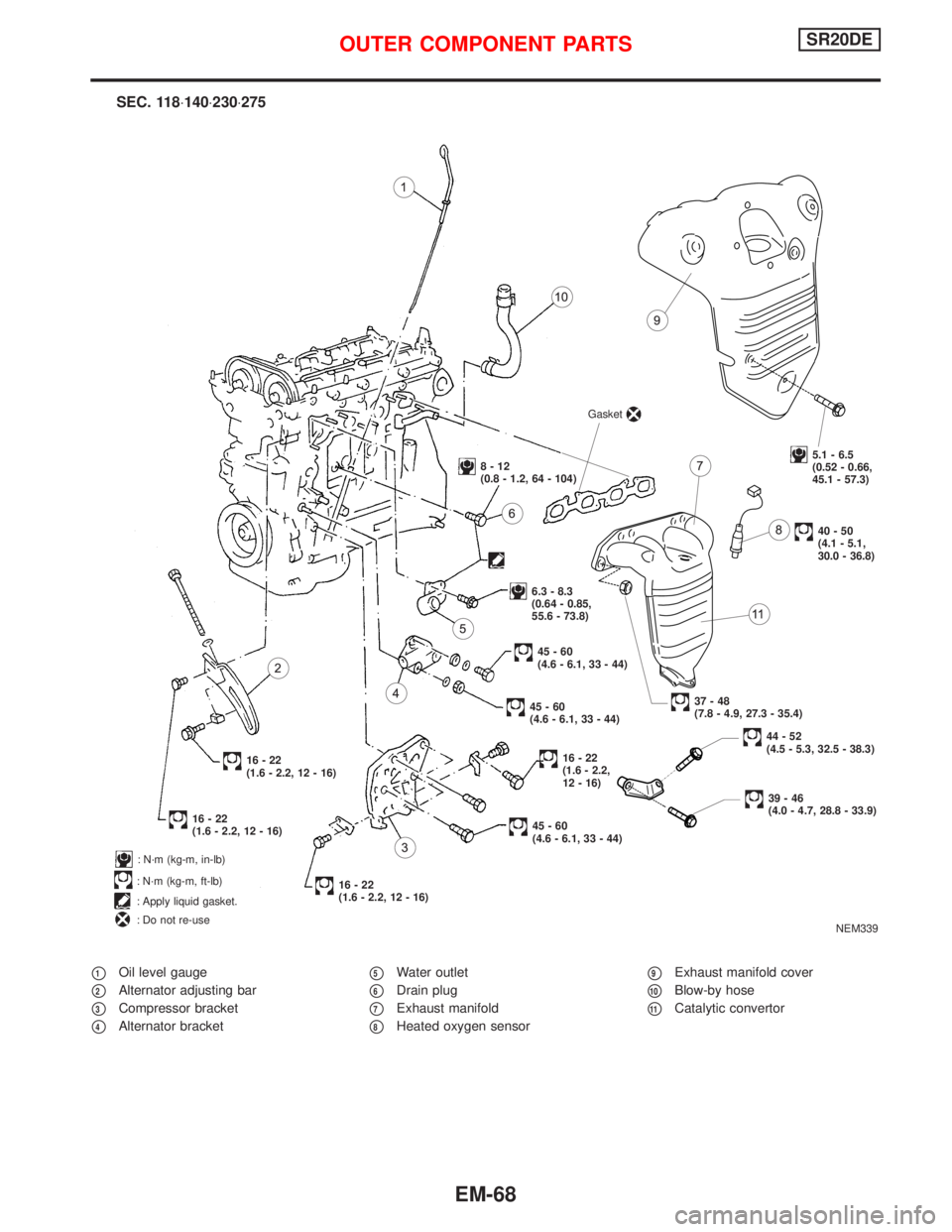
p1Oil level gauge
p2Alternator adjusting bar
p3Compressor bracket
p4Alternator bracket
p5Water outlet
p6Drain plug
p7Exhaust manifold
p8Heated oxygen sensor
p9Exhaust manifold cover
p10Blow-by hose
p11Catalytic convertor
NEM339
: N´m (kg-m, in-lb)
: N´m (kg-m, ft-lb)
: Apply liquid gasket.
: Do not re-use
SEC. 118×140×230×275
Gasket
5.1 - 6.5
(0.52 - 0.66,
45.1 - 57.3)
40-50
(4.1 - 5.1,
30.0 - 36.8)
8-12
(0.8 - 1.2, 64 - 104)
6.3 - 8.3
(0.64 - 0.85,
55.6 - 73.8)
37-48
(7.8 - 4.9, 27.3 - 35.4)
45-60
(4.6 - 6.1, 33 - 44)
45-60
(4.6 - 6.1, 33 - 44)
16-22
(1.6 - 2.2, 12 - 16)
16-22
(1.6 - 2.2, 12 - 16)
16-22
(1.6 - 2.2,
12 - 16)
45-60
(4.6 - 6.1, 33 - 44)
16-22
(1.6 - 2.2, 12 - 16)
44-52
(4.5 - 5.3, 32.5 - 38.3)
39-46
(4.0 - 4.7, 28.8 - 33.9)
OUTER COMPONENT PARTSSR20DE
EM-68
Page 1614 of 2267
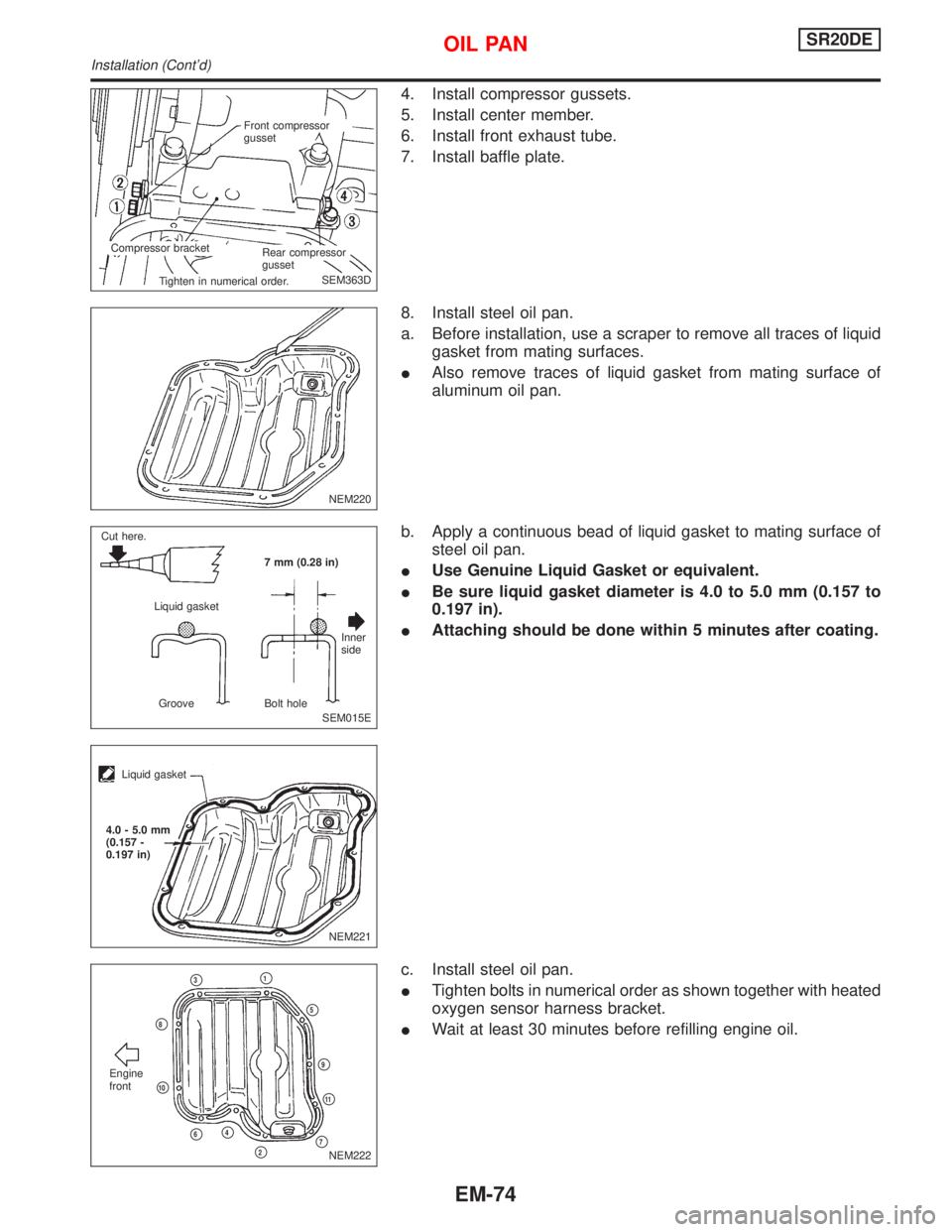
4. Install compressor gussets.
5. Install center member.
6. Install front exhaust tube.
7. Install baffle plate.
8. Install steel oil pan.
a. Before installation, use a scraper to remove all traces of liquid
gasket from mating surfaces.
IAlso remove traces of liquid gasket from mating surface of
aluminum oil pan.
b. Apply a continuous bead of liquid gasket to mating surface of
steel oil pan.
IUse Genuine Liquid Gasket or equivalent.
IBe sure liquid gasket diameter is 4.0 to 5.0 mm (0.157 to
0.197 in).
IAttaching should be done within 5 minutes after coating.
c. Install steel oil pan.
ITighten bolts in numerical order as shown together with heated
oxygen sensor harness bracket.
IWait at least 30 minutes before refilling engine oil.
SEM363D Front compressor
gusset
Compressor bracket
Rear compressor
gusset
Tighten in numerical order.
NEM220
SEM015E Cut here.
Liquid gasket7 mm (0.28 in)
Inner
side
Groove Bolt hole
NEM221
Liquid gasket
4.0 - 5.0 mm
(0.157 -
0.197 in)
NEM222p7
Engine
front
p3p1
p5
p9
p11
p2
p4p6
p10
p8
OIL PANSR20DE
Installation (Cont'd)
EM-74
Page 1751 of 2267
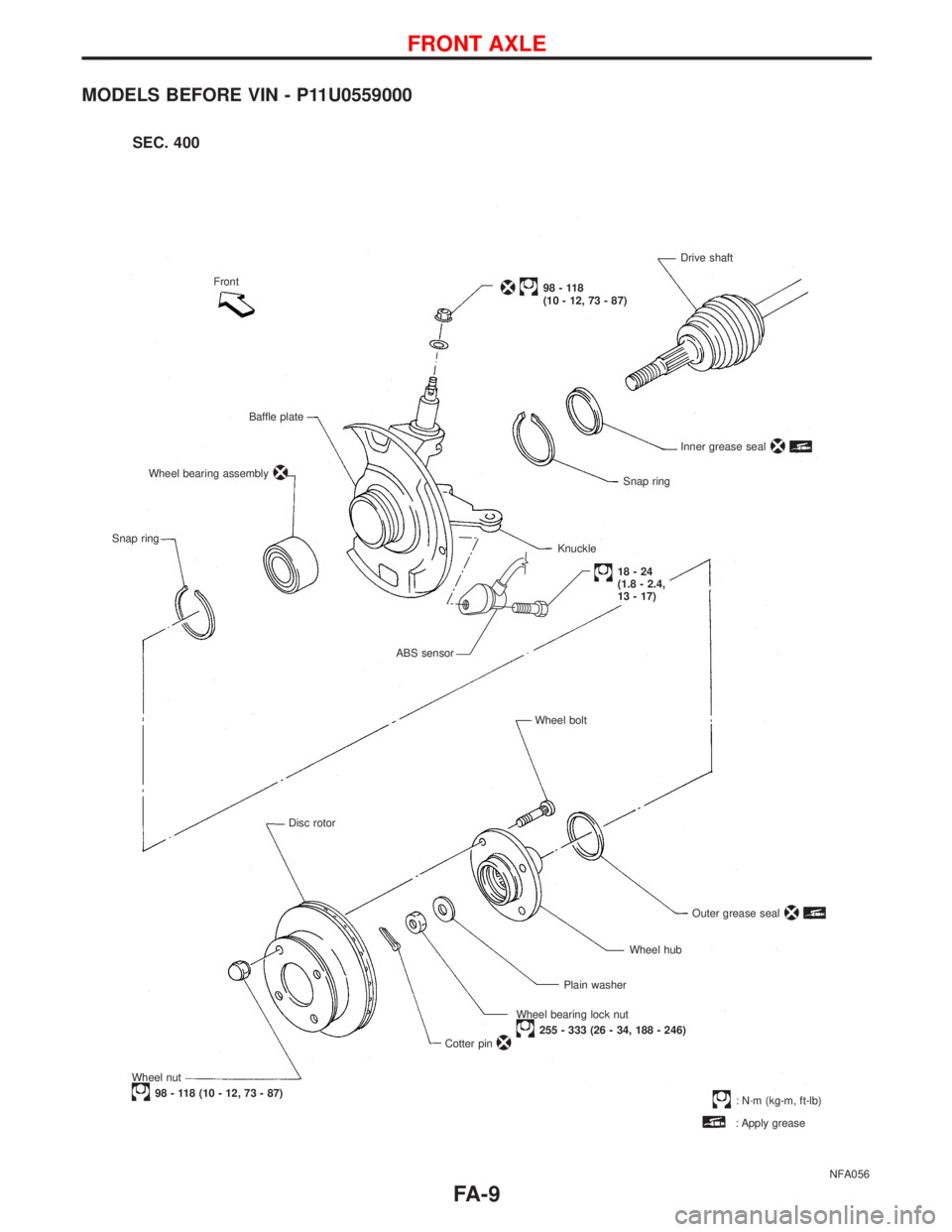
MODELS BEFORE VIN - P11U0559000
NFA056 Front
98-118
(10 - 12, 73 - 87)Drive shaft
Baffle plate
Wheel bearing assembly
Snap ringInner grease seal
Snap ring
Knuckle
Wheel bolt
Disc rotor
Outer grease seal
Wheel hub
Plain washer
Wheel bearing lock nut
255 - 333 (26 - 34, 188 - 246)
Cotter pin
Wheel nut
98 - 118 (10 - 12, 73 - 87): N´m (kg-m, ft-lb)
: Apply grease
SEC. 400
.18-24
(1.8 - 2.4,
13 - 17)
ABS sensor
FRONT AXLE
FA-9
Page 1753 of 2267
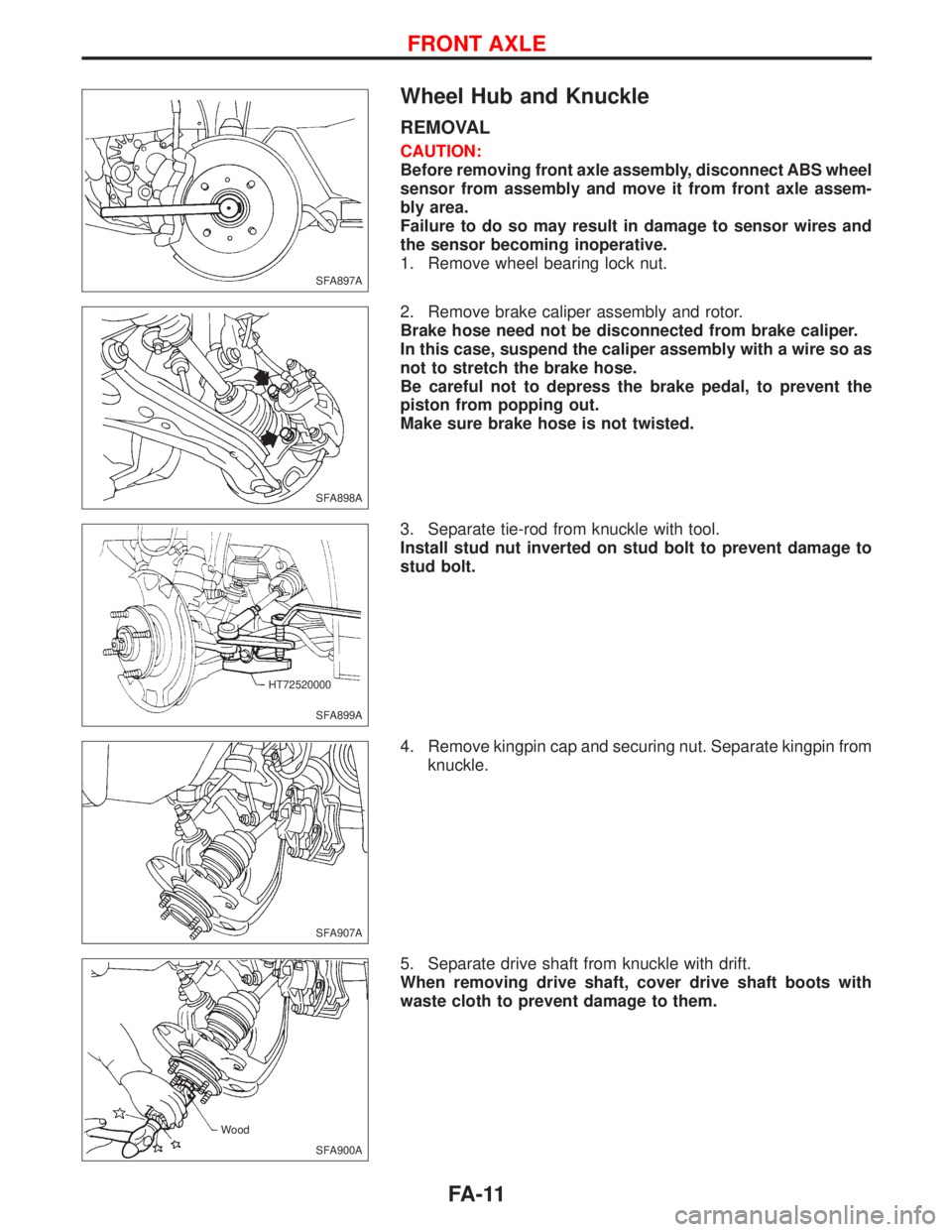
Wheel Hub and Knuckle
REMOVAL
CAUTION:
Before removing front axle assembly, disconnect ABS wheel
sensor from assembly and move it from front axle assem-
bly area.
Failure to do so may result in damage to sensor wires and
the sensor becoming inoperative.
1. Remove wheel bearing lock nut.
2. Remove brake caliper assembly and rotor.
Brake hose need not be disconnected from brake caliper.
In this case, suspend the caliper assembly with a wire so as
not to stretch the brake hose.
Be careful not to depress the brake pedal, to prevent the
piston from popping out.
Make sure brake hose is not twisted.
3. Separate tie-rod from knuckle with tool.
Install stud nut inverted on stud bolt to prevent damage to
stud bolt.
4. Remove kingpin cap and securing nut. Separate kingpin from
knuckle.
5. Separate drive shaft from knuckle with drift.
When removing drive shaft, cover drive shaft boots with
waste cloth to prevent damage to them.
SFA897A
SFA898A
SFA899A HT72520000
SFA907A
SFA900A Wood
FRONT AXLE
FA-11
Page 1774 of 2267
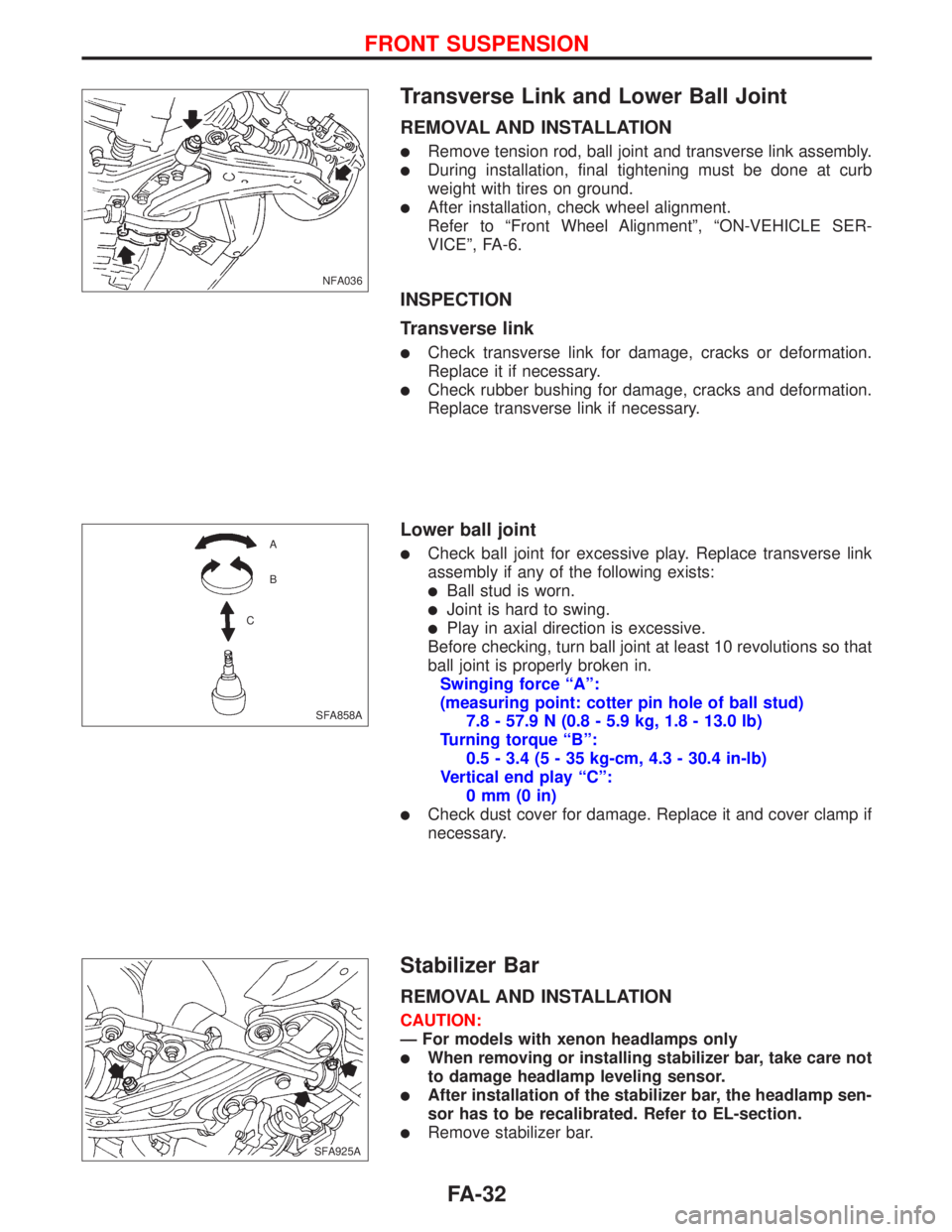
Transverse Link and Lower Ball Joint
REMOVAL AND INSTALLATION
lRemove tension rod, ball joint and transverse link assembly.
lDuring installation, final tightening must be done at curb
weight with tires on ground.
lAfter installation, check wheel alignment.
Refer to ªFront Wheel Alignmentº, ªON-VEHICLE SER-
VICEº, FA-6.
INSPECTION
Transverse link
lCheck transverse link for damage, cracks or deformation.
Replace it if necessary.
lCheck rubber bushing for damage, cracks and deformation.
Replace transverse link if necessary.
Lower ball joint
lCheck ball joint for excessive play. Replace transverse link
assembly if any of the following exists:
lBall stud is worn.
lJoint is hard to swing.
lPlay in axial direction is excessive.
Before checking, turn ball joint at least 10 revolutions so that
ball joint is properly broken in.
Swinging force ªAº:
(measuring point: cotter pin hole of ball stud)
7.8 - 57.9 N (0.8 - 5.9 kg, 1.8 - 13.0 lb)
Turning torque ªBº:
0.5 - 3.4 (5 - 35 kg-cm, 4.3 - 30.4 in-lb)
Vertical end play ªCº:
0mm(0in)
lCheck dust cover for damage. Replace it and cover clamp if
necessary.
Stabilizer Bar
REMOVAL AND INSTALLATION
CAUTION:
Ð For models with xenon headlamps only
lWhen removing or installing stabilizer bar, take care not
to damage headlamp leveling sensor.
lAfter installation of the stabilizer bar, the headlamp sen-
sor has to be recalibrated. Refer to EL-section.
lRemove stabilizer bar.
NFA036
SFA858A A
B
C
.SFA925A
FRONT SUSPENSION
FA-32
Page 1783 of 2267
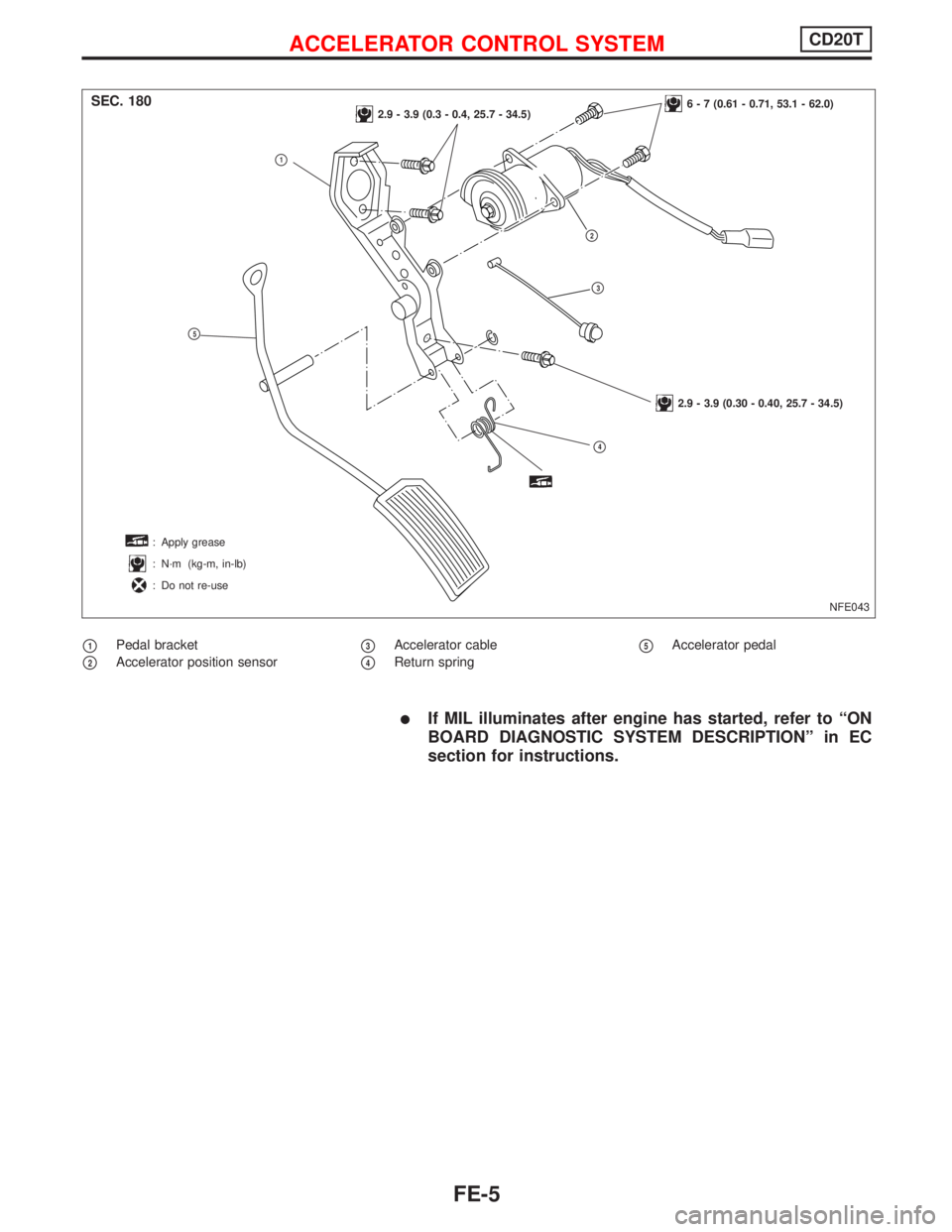
p1Pedal bracket
p2Accelerator position sensorp3Accelerator cable
p4Return springp5Accelerator pedal
lIf MIL illuminates after engine has started, refer to ªON
BOARD DIAGNOSTIC SYSTEM DESCRIPTIONº in EC
section for instructions.
NFE043
p1
p5
6 - 7 (0.61 - 0.71, 53.1 - 62.0)
p4
p3
p2
2.9 - 3.9 (0.30 - 0.40, 25.7 - 34.5)
SEC. 180
: Apply grease
: N´m (kg-m, in-lb)
: Do not re-use
2.9 - 3.9 (0.3 - 0.4, 25.7 - 34.5)
ACCELERATOR CONTROL SYSTEMCD20T
FE-5
Page 1798 of 2267
Observe the following precautions to ensure safe and
proper servicing.
Supplemental Restraint System (SRS) ªAIR
BAGº and ªSEAT BELT PRE-TENSIONERº
The Supplemental Restraint System ªAir Bagº and ªSeat Belt
Pre-tensionerº, used along with a seat belt, help to reduce the
risk or severity of injury to the driver and front passenger in a
frontal collision. The Supplemental Restraint System consists of
air bag modules (located in the center of the steering wheel and
on the instrument panel on the passenger side), seat belt pre-
tensioners, a diagnosis sensor unit, warning lamp, wiring har-
ness and spiral cable.
If the vehicle is equipped with side air bag as the Supplemental
Restraint System, the side air bag used along with the seat belt
helps to reduce the risk or severity of injury to the driver and front
passenger in a side collision. The side air bag consists of air bag
modules (located in the outer side of front seats), satellite sensor,
diagnosis sensor unit (which is one of components of air bags for
a frontal collision), wiring harness, warning lamp (which is one of
components of air bags for a frontal collision).
WARNING:
lTo avoid rendering the SRS inoperative, (which could
increase the risk of personal injury or death in the event
of a collision which would result in air bag inflation) all
maintenance must be performed by an authorized
NISSAN dealer.
lImproper maintenance, including incorrect removal and
installation of the SRS, can lead to personal injury
caused by unintentional activation of the system.
lDo not use electrical test equipment on any circuit
related to the SRS unless instructed to do so in this
Service Manual. SRS wiring harnesses are covered with
yellow insulation (either just before the harness connec-
tors or for the complete harness), for easy identification.
Precautions for NATS
NATS (Nissan Anti-Theft System)
NATS will immobilize the engine if someone tries to start it with-
out the registered key of NATS.
Both of the originally supplied ignition key IDs have been NATS
registered.
The NATS security indicator is located on the instrument panel.
The indicator flashes when the ignition switch is in ªLOCKº or
ªAccº position. Therefore, NATS warns outsiders that the vehicle
is equipped with the anti-theft system.
lWhen NATS detects trouble, the malfunction indicator (MI)
flashes.
This flashing indicates that the anti-theft is not functioning, so
prompt service is required.
lWhen servicing NATS (trouble diagnoses, system initialisa-
tion and additional registration of other NATS ignition key
IDs), CONSULT-II hardware and CONSULT-II NATS soft-
ware is necessary.
SGI916
PRECAUTIONS
GI-3
Page 1801 of 2267
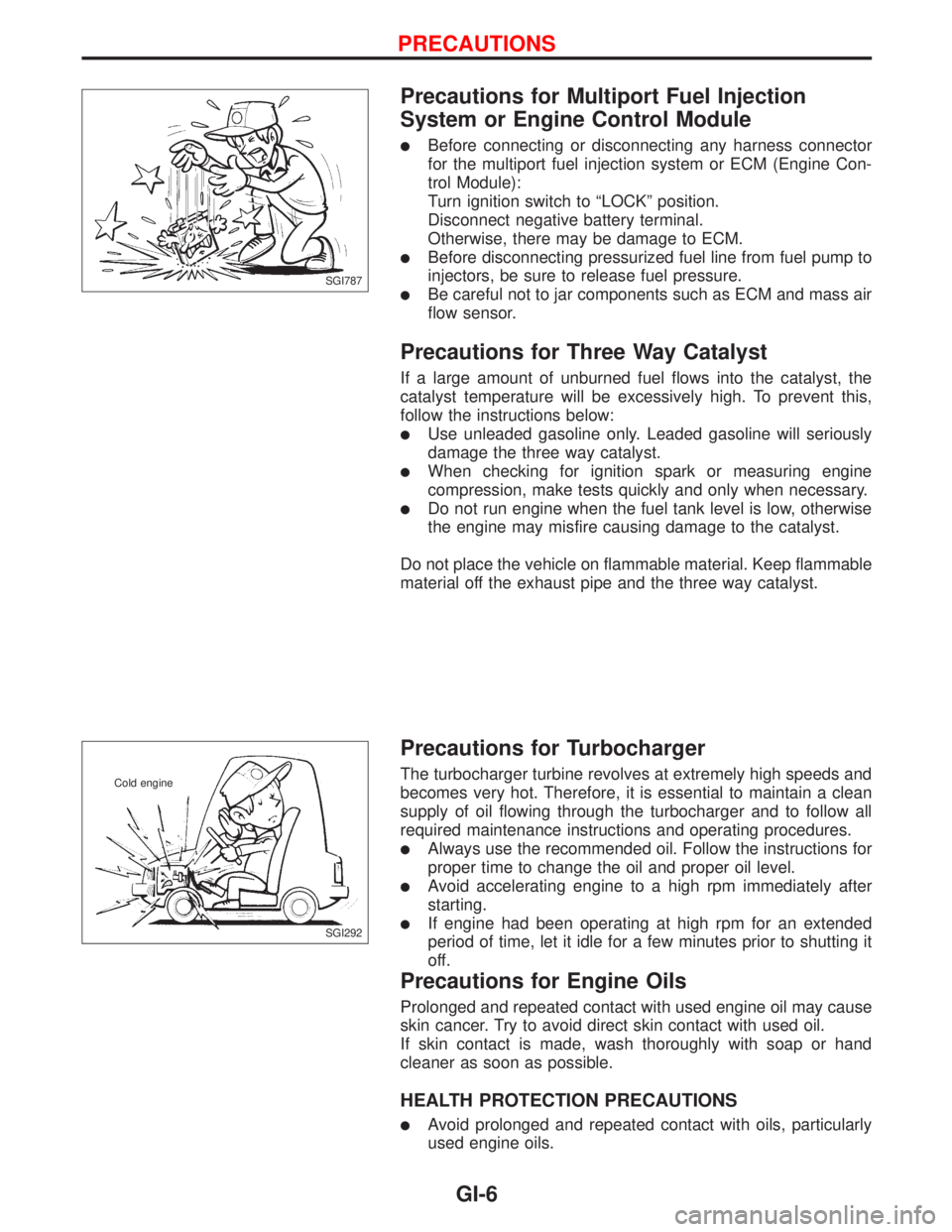
Precautions for Multiport Fuel Injection
System or Engine Control Module
lBefore connecting or disconnecting any harness connector
for the multiport fuel injection system or ECM (Engine Con-
trol Module):
Turn ignition switch to ªLOCKº position.
Disconnect negative battery terminal.
Otherwise, there may be damage to ECM.
lBefore disconnecting pressurized fuel line from fuel pump to
injectors, be sure to release fuel pressure.
lBe careful not to jar components such as ECM and mass air
flow sensor.
Precautions for Three Way Catalyst
If a large amount of unburned fuel flows into the catalyst, the
catalyst temperature will be excessively high. To prevent this,
follow the instructions below:
lUse unleaded gasoline only. Leaded gasoline will seriously
damage the three way catalyst.
lWhen checking for ignition spark or measuring engine
compression, make tests quickly and only when necessary.
lDo not run engine when the fuel tank level is low, otherwise
the engine may misfire causing damage to the catalyst.
Do not place the vehicle on flammable material. Keep flammable
material off the exhaust pipe and the three way catalyst.
Precautions for Turbocharger
The turbocharger turbine revolves at extremely high speeds and
becomes very hot. Therefore, it is essential to maintain a clean
supply of oil flowing through the turbocharger and to follow all
required maintenance instructions and operating procedures.
lAlways use the recommended oil. Follow the instructions for
proper time to change the oil and proper oil level.
lAvoid accelerating engine to a high rpm immediately after
starting.
lIf engine had been operating at high rpm for an extended
period of time, let it idle for a few minutes prior to shutting it
off.
Precautions for Engine Oils
Prolonged and repeated contact with used engine oil may cause
skin cancer. Try to avoid direct skin contact with used oil.
If skin contact is made, wash thoroughly with soap or hand
cleaner as soon as possible.
HEALTH PROTECTION PRECAUTIONS
lAvoid prolonged and repeated contact with oils, particularly
used engine oils.
SGI787
SGI292 Cold engine
PRECAUTIONS
GI-6
Page 1812 of 2267
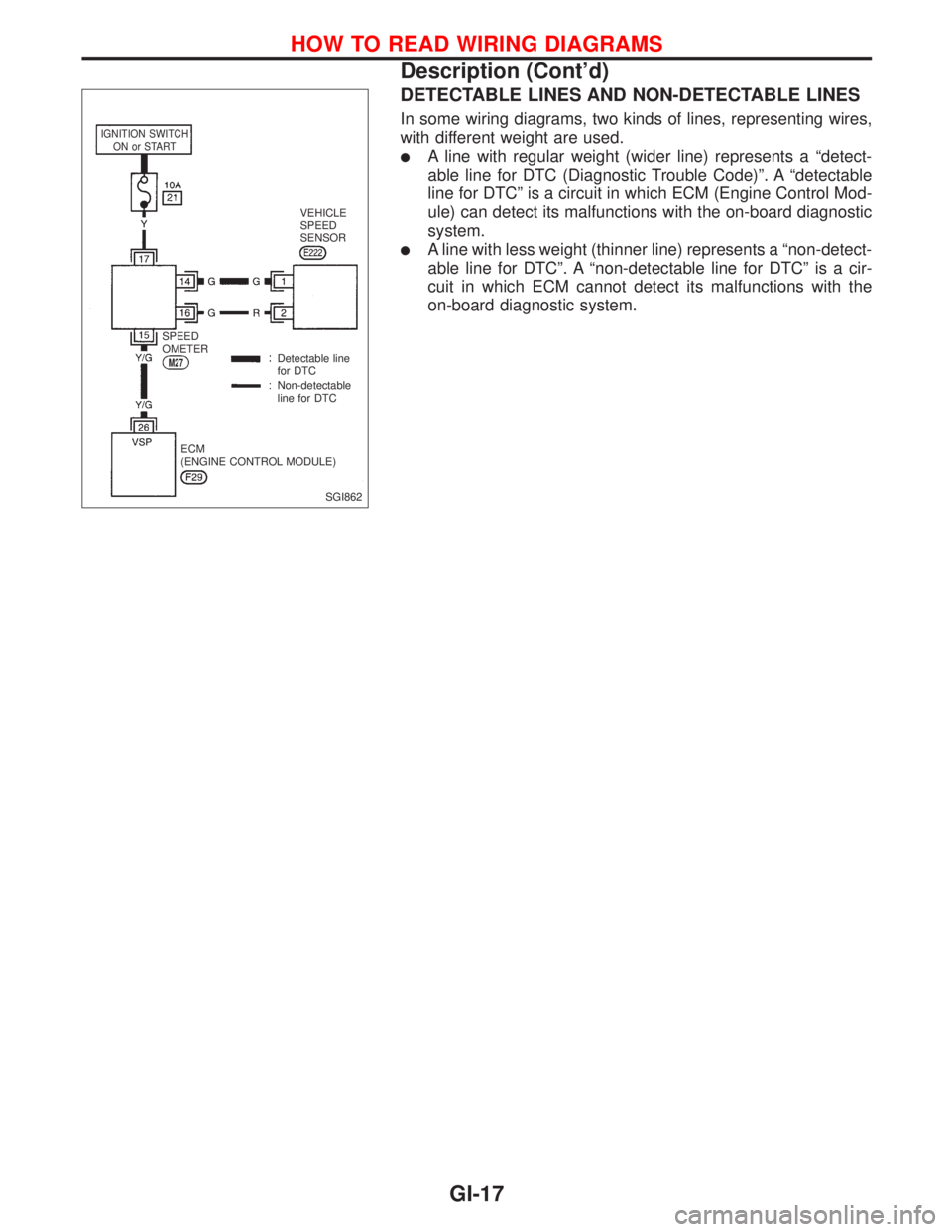
DETECTABLE LINES AND NON-DETECTABLE LINES
In some wiring diagrams, two kinds of lines, representing wires,
with different weight are used.
lA line with regular weight (wider line) represents a ªdetect-
able line for DTC (Diagnostic Trouble Code)º. A ªdetectable
line for DTCº is a circuit in which ECM (Engine Control Mod-
ule) can detect its malfunctions with the on-board diagnostic
system.
lA line with less weight (thinner line) represents a ªnon-detect-
able line for DTCº. A ªnon-detectable line for DTCº is a cir-
cuit in which ECM cannot detect its malfunctions with the
on-board diagnostic system.
SGI862
IGNITION SWITCH
ON or START
VEHICLE
SPEED
SENSOR
SPEED
OMETER
M27Detectable line
for DTC
Non-detectable
line for DTC
ECM
(ENGINE CONTROL MODULE)
HOW TO READ WIRING DIAGRAMS
Description (Cont'd)
GI-17