ECU NISSAN PULSAR 1987 Workshop Manual
[x] Cancel search | Manufacturer: NISSAN, Model Year: 1987, Model line: PULSAR, Model: NISSAN PULSAR 1987Pages: 238, PDF Size: 28.91 MB
Page 219 of 238
Electrical System 219
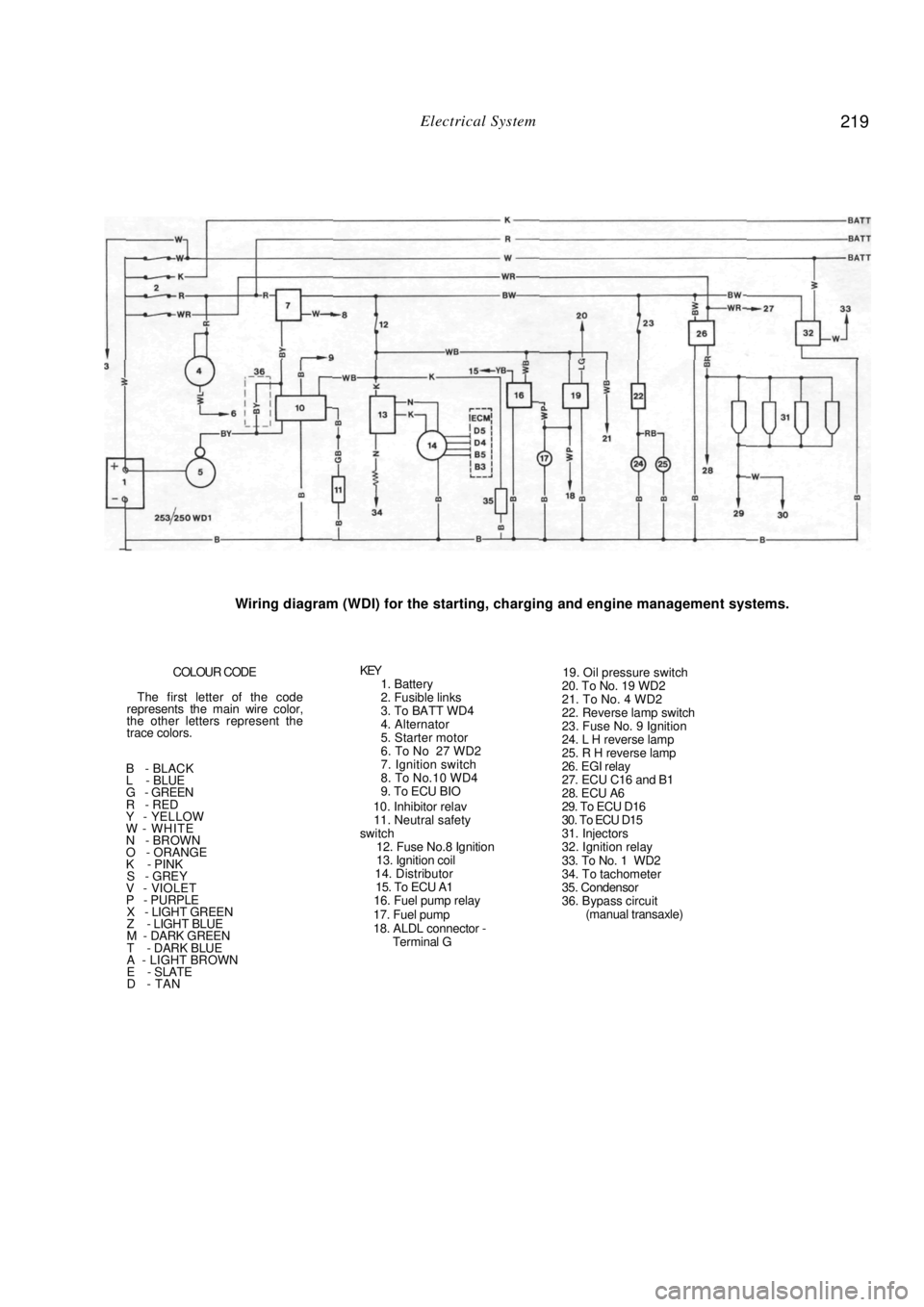
Wiring diagram (WDI) for the starting, charging and engine management systems.
COLOUR CODE
The first letter of the code
represents the main wire color,
the other letters represent the
trace colors.
B - BLACK
L - BLUE
G - GREEN
R - RED
Y - YELLOW
W - WHITE
N - BROWN
O - ORANGE
K - PINK
S - GREY V - VIOLET
P - PURPLE X - LIGHT GREEN
Z - LIGHT BLUE
M - DARK GREEN
T - DARK BLUE
A - LIGHT BROWN
E - SLATE
D - TAN
KEY 1. Battery
2. Fusible links
3. To BATT WD4
4. Alternator
5. Starter motor
6. To No 27 WD2
7. Ignition switch
8. To No.10 WD4
9. To ECU BIO
10. Inhibitor relav
11. Neutral safety
switch
12. Fuse No.8 Ignition
13. Ignition coil
14. Distributor
15. To ECU A1
16. Fuel pump relay
17. Fuel pump
18. ALDL connector - Terminal G
19. Oil pressure switch
20. To No. 19 WD2
21. To No. 4 WD2
22. Reverse lamp switch
23. Fuse No. 9 Ignition
24. L H reverse lamp
25. R H reverse lamp
26. EGI relay
27. ECU C16 and B1
28. ECU A6
29. To ECU D16
30. To ECU D15
31. Injectors
32. Ignition relay
33. To No. 1 WD2
34. To tachometer
35. Condensor
36. Bypass circuit (manual transaxle)
Page 220 of 238
220 Electrical System
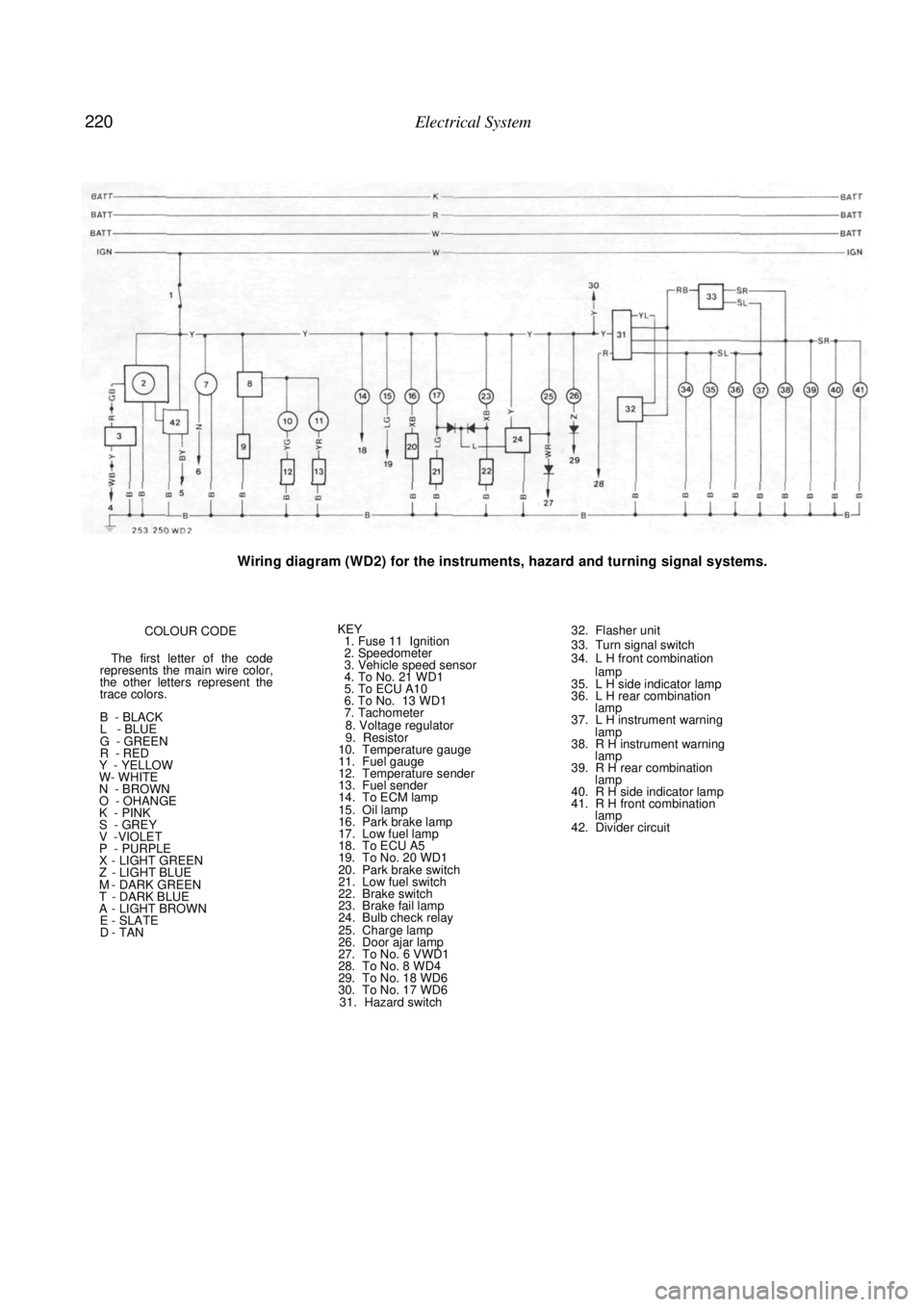
Wiring diagram (WD2) for the instruments, hazard and turning signal systems.
COLOUR CODE
The first letter of the code
represents the main wire color,
the other letters represent the
trace colors.
B - BLACK
L - BLUE
G - GREEN
R - RED
Y - YELLOW
W- WHITE
N - BROWN
O - OHANGE
K - PINK
S - GREY V -VIOLET
P - PURPLE X - LIGHT GREEN Z - LIGHT BLUE M - DARK GREEN T - DARK BLUE A - LIGHT BROWN E - SLATE D - TAN
KEY 1. Fuse 11 Ignition
2. Speedometer
3. Vehicle speed sensor
4. To No. 21 WD1
5. To ECU A10
6. To No. 13 WD1
7. Tachometer
8. Voltage regulator
9. Resistor
10. Temperature gauge
11. Fuel gauge
12. Temperature sender
13. Fuel sender
14. To ECM lamp
15. Oil lamp
16. Park brake lamp
17. Low fuel lamp
18. To ECU A5
19. To No. 20 WD1
20. Park brake switch
21. Low fuel switch
22. Brake switch
23. Brake fail lamp
24. Bulb check relay
25. Charge lamp
26. Door ajar lamp
27. To No. 6 VWD1
28. To No. 8 WD4
29. To No. 18 WD6
30. To No. 17 WD6 31. Hazard switch
32. Flasher unit
33. Turn signal switch
34. L H front combination
lamp
35. L H side indicator lamp
36. L H rear combination lamp
37. L H instrument warning
lamp
38. R H instrument warning lamp
39. R H rear combination lamp
40. R H side indicator lamp
41. R H front combination lamp
42. Divider circuit
Page 221 of 238
Electrical System 221
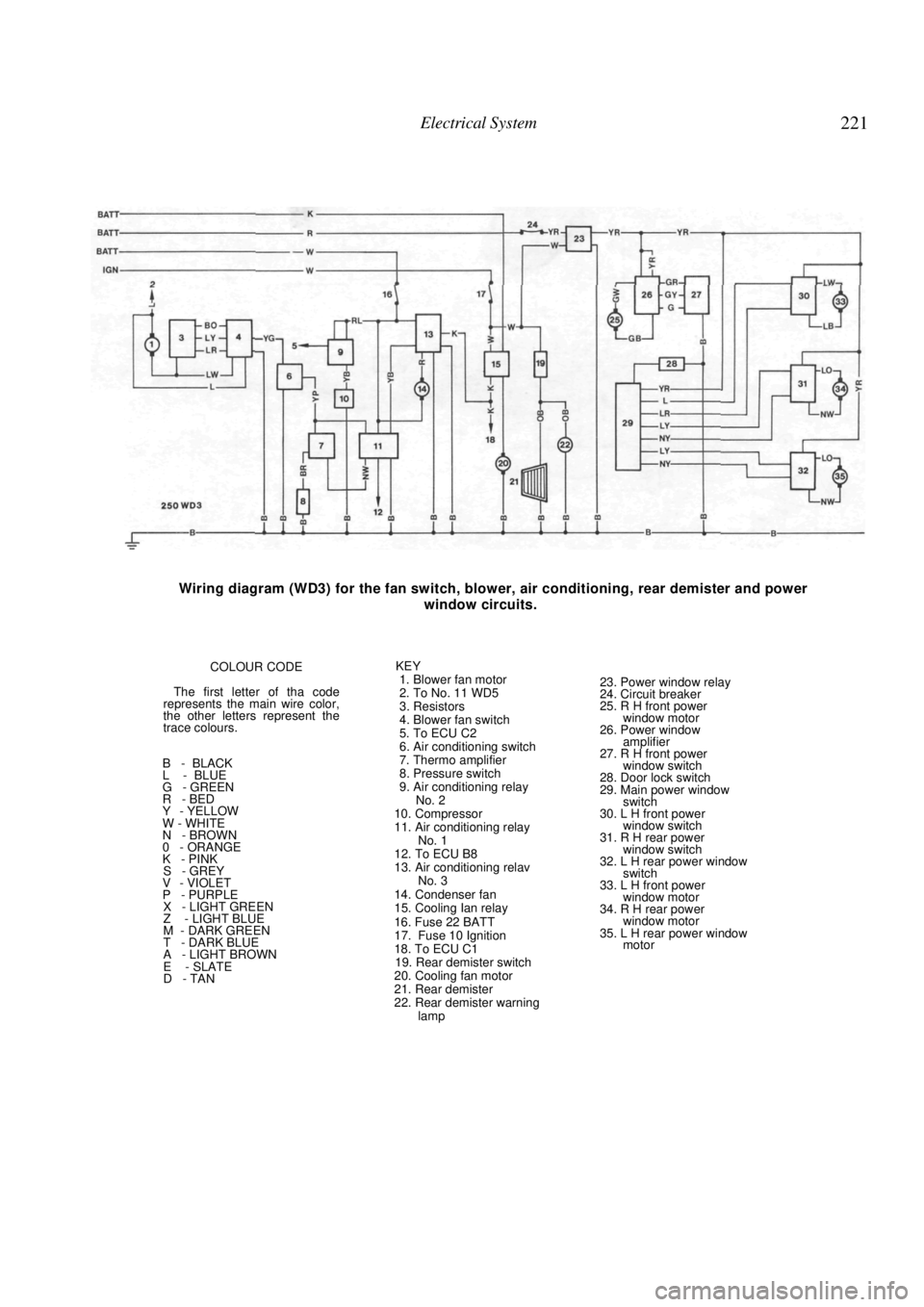
Wiring diagram (WD3) for the fan switch, blower, air conditioning, rear demister and power
window circuits.
COLOUR CODE
The first letter of tha code
represents the main wire color,
the other letters represent the
trace colours.
B - BLACK
L - BLUE
G - GREEN
R - BED
Y - YELLOW
W - WHITE
N - BROWN
0 - ORANGE
K - PINK
S - GREY
V - VIOLET
P - PURPLE
X - LIGHT GREEN
Z - LIGHT BLUE
M - DARK GREEN
T - DARK BLUE
A - LIGHT BROWN
E - SLATE
D - TAN KEY
1. Blower fan motor
2. To No. 11 WD5
3. Resistors
4. Blower fan switch
5. To ECU C2
6. Air conditioning switch
7. Thermo amplifier
8. Pressure switch
9. Air conditioning relay No. 2
10. Compressor
11. Air conditioning relay No. 1
12. To ECU B8
13. Air conditioning relav No. 3
14. Condenser fan
15. Cooling Ian relay
16. Fuse 22 BATT
17. Fuse 10 Ignition
18. To ECU C1
19. Rear demister switch
20. Cooling fan motor
21. Rear demister
22. Rear demister warning lamp
23. Power window relay
24. Circuit breaker
25. R H front power
window motor
26. Power window amplifier
27. R H front power window switch
28. Door lock switch
29. Main power window switch
30. L H front power
window switch
31. R H rear power window switch
32. L H rear power window switch
33. L H front power
window motor
34. R H rear power window motor
35. L H rear power window motor
Page 226 of 238
226 Body
Remove the screws retaining the speaker to
the trim panel, withdraw the speaker slightly and
disconnect the wiring connector at the rear. Place the
speaker to one side clear of the work area.
On models with a step lamp located in the
door trim panel, remove the screws, withdraw the step
lamp and disconnect the wiring connector. Using a broad bladed screwdriver, carefully
lever the trim panel outwa rds and disengage all the
retaining clips. When all the clips have been disen-
gaged maneuver the trim panel from the door. Remove the screw retaining the speaker
water deflector to the inner door panel and withdraw
the water deflector.
Carefully remove the plastic sealing sheet from
the inner door panel.
Installation is a reversal of the removal procedure
with attention to the following points:
Ensure that the plastic sealing sheet is cor-
rectly installed and not torn or damaged.
Check the trim panel retaining clips and
renew any damaged clips as necessary. On models with manual windows, wind the
door glass to the closed position, install the
retaining
clip to the regulator handle and install the regulator
handle to correspond with the regulator handle on the
opposite door.
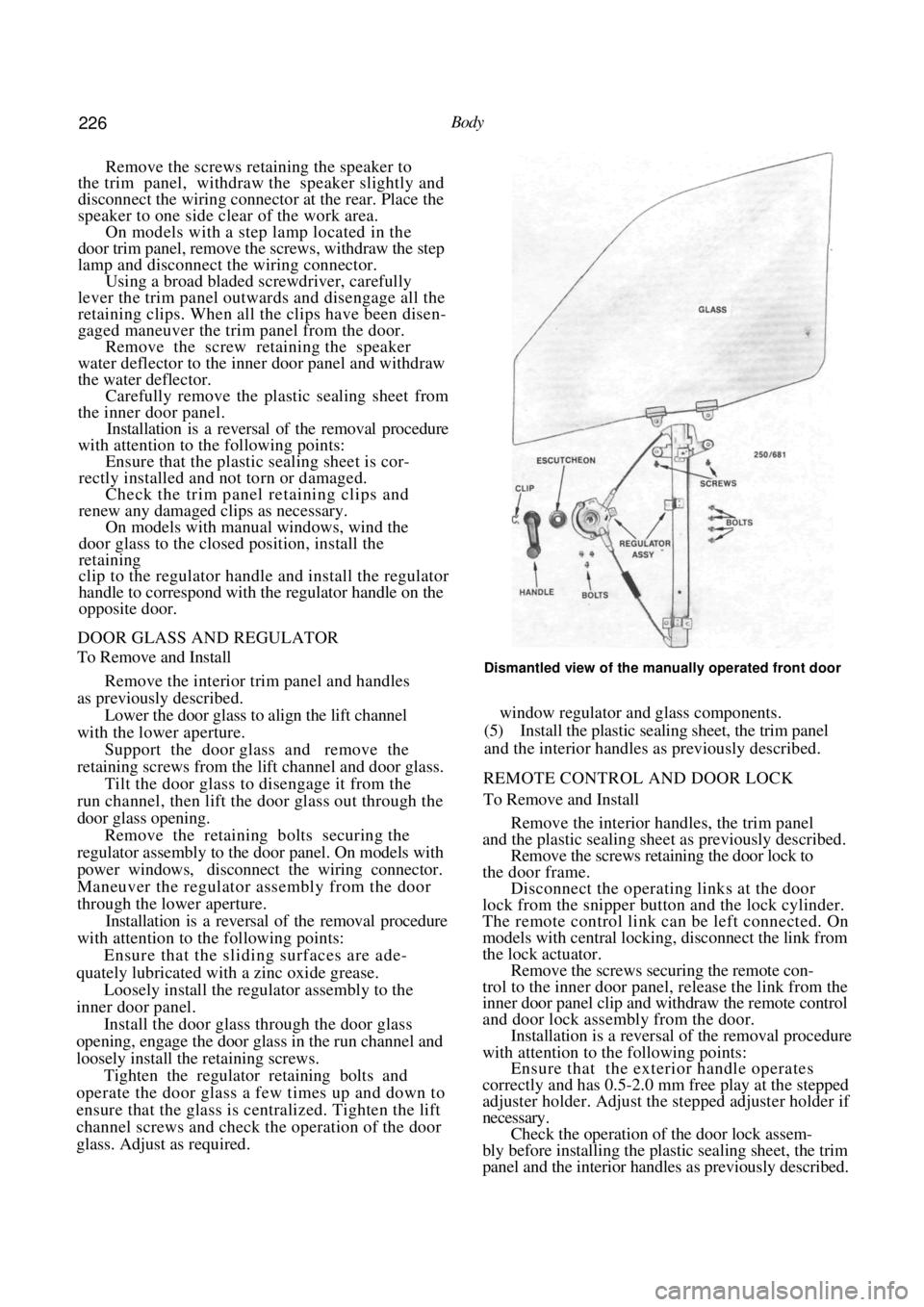
DOOR GLASS AND REGULATOR
To Remove and Install
Remove the interior trim panel and handles
as previously described. Lower the door glass to align the lift channel
with the lower aperture. Support the door glass and remove the
retaining screws from the lift channel and door glass. Tilt the door glass to disengage it from the
run channel, then lift the door glass out through the
door glass opening. Remove the retaining bolts securing the
regulator assembly to the door panel. On models with
power windows, disconnect the wiring connector.
Maneuver the regulator assembly from the door
through the lower aperture. Installation is a reversal of the removal procedure
with attention to the following points:
Ensure that the sliding surfaces are ade-
quately lubricated with a zinc oxide grease.
Loosely install the regulator assembly to the
inner door panel. Install the doo r glass through the door glass
opening, engage the door glass in the run channel and
loosely install the retaining screws.
Tighten the regulator retaining bolts and
operate the door glass a few times up and down to
ensure that the glass is centralized. Tighten the lift
channel screws and check the operation of the door
glass. Adjust as required.
Dismantled view of the manually operated front door
window regulator and glass components.
(5) Install the plastic sealing sheet, the trim panel
and the interior handles as previously described.
REMOTE CONTROL AND DOOR LOCK
To Remove and Install
Remove the interior handles, the trim panel
and the plastic sealing sheet as previously described.
Remove the screws retaining the door lock to
the door frame. Disconnect the operating links at the door
lock from the snipper button and the lock cylinder.
The remote control link can be left connected. On
models with central locking, disconnect the link from
the lock actuator.
Remove the screws securing the remote con-
trol to the inner door panel, release the link from the
inner door panel clip and w ithdraw the remote control
and door lock assembly from the door. Installation is a reversal of the removal procedure
with attention to the following points:
Ensure that the exterior handle operates
correctly and has 0.5-2.0 mm free play at the stepped
adjuster holder. Adjust the stepped adjuster holder if
necessary. Check the operation of the door lock assem-
bly before installing the plastic sealing sheet, the trim
panel and the interior handles as previously described.
Page 228 of 238
228 Body
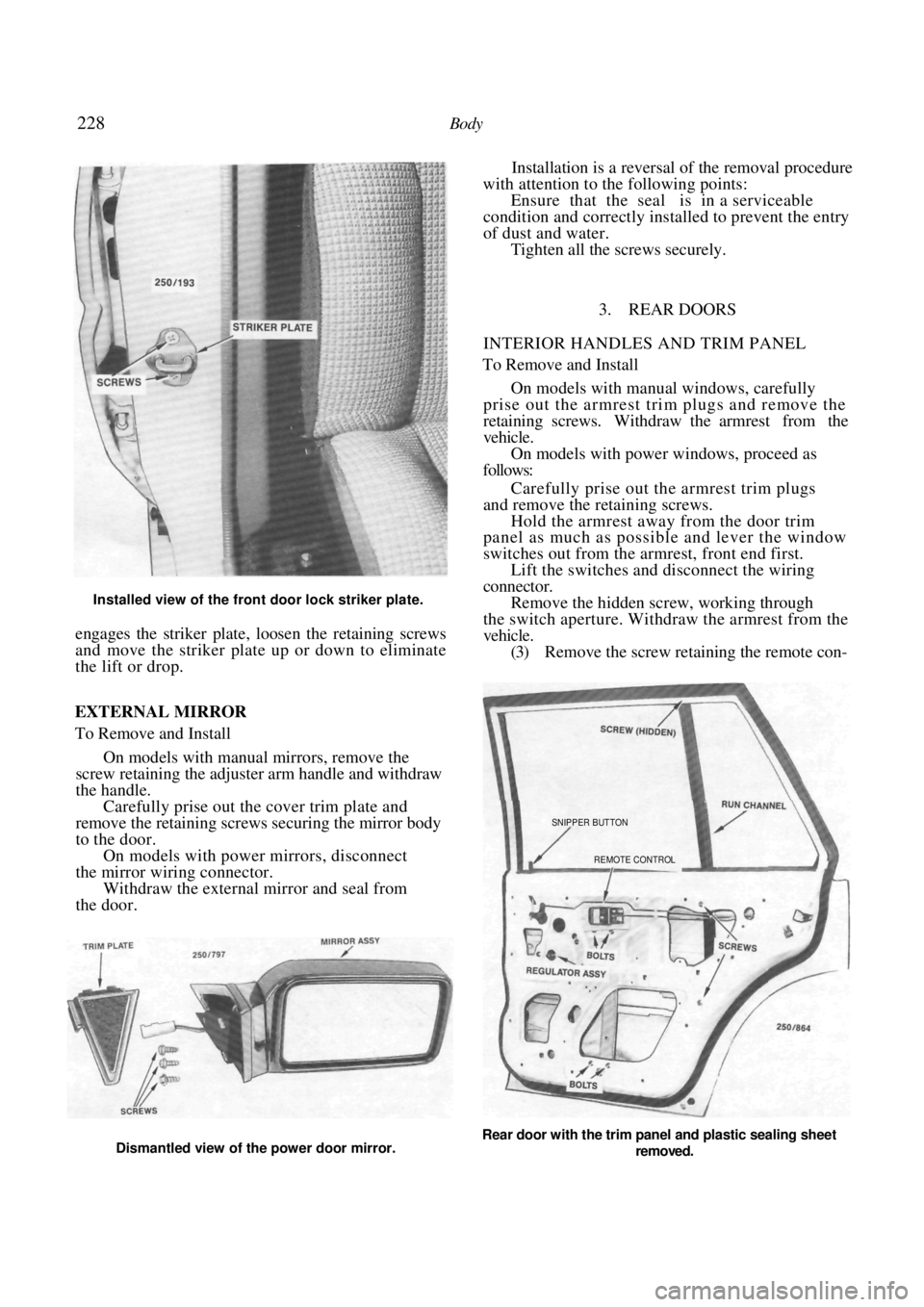
Installed view of the front door lock striker plate.
engages the striker plate, loosen the retaining screws
and move the striker plate up or down to eliminate
the lift or drop.
Installation is a reversal of the removal procedure
with attention to the following points:
Ensure that the seal is in a serviceable
condition and correctly installed to prevent the entry
of dust and water. Tighten all the screws securely.
3. REAR DOORS
INTERIOR HANDLES AND TRIM PANEL
To Remove and Install
On models with manual windows, carefully
prise out the armrest trim plugs and remove the
retaining screws. Withdraw the armrest from the
vehicle. On models with power windows, proceed as
follows:
Carefully prise out the armrest trim plugs
and remove the retaining screws. Hold the armrest away from the door trim
panel as much as possible and lever the window
switches out from the armrest, front end first.
Lift the switches and disconnect the wiring
connector. Remove the hidden screw, working through
the switch aperture. Withdraw the armrest from the
vehicle. (3) Remove the screw retaining the remote con-
EXTERNAL MIRROR
To Remove and Install
On models with manual mirrors, remove the
screw retaining the adjuster arm handle and withdraw
the handle. Carefully prise out the cover trim plate and
remove the retaining screws securing the mirror body
to the door. On models with power mirrors, disconnect
the mirror wiring connector. Withdraw the external mirror and seal from
the door.
Rear door with the trim panel and plastic sealing sheet
removed.
SNIPPER BUTTON
REMOTE CONTROL
Dismantled view of the power door mirror.
Page 232 of 238

232 Body
leaving the ends of the string protruding from the
tailgate. Untie the string.
NOTE: The string will be used to pull the
wiring through the tailgate on installation.
If the wiring is pulled from the tailgate
without the string attached, installation will
be very difficult.
With the aid of an assistant supporting the
tailgate, prise out the ball joint stud snap locks from
each upper strut ball joint using a small screwdriver.
Remove the bolts retaining the hinges to the
tailgate and carefully withdraw the tailgate from the
vehicle.
To Install and Adjust
With the aid of an assistant, install the
tailgate in position on the hinges according to the
marks made on removal and install the retaining bolts.
Install the tailgate support struts and retain
the ball joints with the snap locks. Pull the tailgate wiring through using the
piece of string. Connect the wiring and install
the
tailgate trim panel. Close the tailgate and check the vertical and
lateral alignment of the tailgate in relation to the
body. If adjustment is required, loosen the tailgate
hinge retaining bolts one hi nge at a time and adjust
the tailgate as required. If vertical adjustment is required, it will be
necessary to remove or install washers under the
tailgate hinges. If required, adjust the striker plate using the
procedure that follows.
STRIKER PLATE
To Remove, Install and Adjust
Using a flat bladed screwdriver, prise out the
trim plugs and remove the trim plate from above the
striker.
Using a soft lead pencil, scribe a line around
the striker plate.
Remove the striker plate retaining bolts and
partially remove the striker plate. Disconnect the remote tailgate release cable
from the striker plate and remove the striker plate
from the vehicle. Inspect the striker plate for wear and renew
it if necessary. Installation is a reversal of the removal procedure
with attention to the following points:
Install the striker plate ensuring that it is in
the position marked on dismantling and that the
remote tailgate release cable is connected. Tighten the
retaining bolts. Close the tailgate ensuring that the striker
has actuated the locking mechanism. Check the alignment of the tailgate in its
opening and adjust the locking action by moving the
striker plate in the requir ed direction. Tighten the
retaining bolts securely.
LOCK AND LOCK CYLINDER
To Remove and Install
Prise out the tailgate trim panel retaining
clips and carefully maneuver the tailgate interior
trim panel from the tailgate.
Disconnect the actuati ng rod from the lock
cylinder assembly. Disconnect the interior lamp switch wiring
connector.
Installed view of the striker plate assembly. Hatchback
models. Dismantled view of the Hatchback lock and lock cylin-
der.
Page 233 of 238

Body 233
Remove the lock assembly retaining bolts
and withdraw the lock assembly, insulator and link
from the tailgate.
Using a suitable screwdriver, remove the
lock cylinder retaining clip and withdraw the lock
cylinder from the vehicle. Installation is a reversal of the removal procedure
with attention to the following points:
Ensure that the positioning of the lock is
correct in relation to the striker plate.
Ensure that the interior lamp switch wiring
connector is connected.
6. LUGGAGE COMPARTMENT LID
AND LOCK — SEDAN
LUGGAGE COMPARTMENT LID
To Remove
Raise the luggage compartment lid and place
protective covers over the surrounding paintwork.
Using a soft lead pencil, mark around the
luggage compartment lid hi nges to aid assembly.
With the aid of an assistant supporting the
lid, remove the hinge retaining bolts and withdraw the
luggage compartment lid from the vehicle.
To Install and Adjust
With the aid of an assistant, install the
luggage compartment lid in position on the hinges
according to the marks made on removal. Install the
retaining bolts. Close the lid and check the vertical and
lateral alignment of the l i d in relation to the body.
If adjustment is necessary, loosen the l i d
hinge retaining bolts on one hinge at a time and adjust
the lid as required.
If vertical adjustment is required, loosen the
lid hinge retaining bolts and increase or decrease the
number of washers under the bolts. If required, adjust the striker plate using the
procedure that follows.
STRIKER PLATE
To Remove, Install and Adjust
Fold back the trim material from inside the
luggage compartment.
Using a soft lead pencil, scribe a line around
the outside of each striker plate retaining bolt washer. Remove the striker plate bolts and washers
and the screw retaining the remote release cable
bracket.
Installed view of the luggage compartment lid striker
with the trim material folded back.
(4) Slide the striker assembly towards the right
hand side of the vehicle and disconnect the remote
release cable. Withdraw the striker plate from the
vehicle.
Installation is a reversal of the removal procedure
with attention to the following points:
(1) Install the remote release cable to the striker
plate and install the striker plate retaining bolts and
washers to the lines made on dismantling.
Tighten the retaining bolts to just over finger
tight.
Close the lid ensuring that the striker has
actuated the locking mechanism. Check the alignment of the luggage compart-
ment lid in its opening an d adjust the locking action
by moving the striker plate. Tighten the retaining
bolts securely.
When the striker plate is adjusted correctly
pull the remote release ca ble towards the right hand
side of the vehicle until the cable end has 0.5-1.5 mm
clearance and tighten the re taining screws. Check the
operation of the remote release cable and readjust if
necessary.
Installed view of the luggage compartment lid hinge.
Page 236 of 238

236 Body
top of the dashboard rearwards and maneuver the
dashboard through the front door opening.
Installation is a reversal of the removal procedure
with attention to the following points:
With the aid of an assistant, ensure that the
outer edges of the dashboard engage properly with the
door pillar brackets.
Hold the dashboard in position and loosely
install all retaining bolts. Align the dashboard
and
tighten all screws and bolts securely.
10. SEAT BELTS
The front and outer rear seats are equipped with
lap/sash inertia reel seat belts, which are designed to
lock with any sudden change in vehicle motion.
The centre rear seat is equipped with a manually
adjustable lap seat belt.
Child restraint anchorages are located on the
parcel shelf behind the rear seat on Sedan models and
at the rear of the lugg age compartment floor on
Hatchback models. These anchorages must be used if
a child's seat or capsule is installed to the vehicle. The
anchorages should not be used for adult scat bells or
harnesses.
The seat belts should be periodically inspected as
described below. Any seat belt assembly that is worn
or damaged, or has been subjected to abnormal
loadings in a collision, should be renewed as a
complete assembly.
Only mild soap and water should be used to clean
the webbing. Contamination wi th polish, oil, bleaches
and other chemicals should be avoided.
TO INSPECT
(1) Check the seat belt webbing for fraying, cuts,
burns or other damage. On inertia reel belts, slowly
pull the belt from the reel to allow the entire length to
be examined. If the webbing is damaged or worn,
renew the seat belt assembly.
Check the seat belt webbing for fraying, cuts, burns or
other damage.
Ensure that the belts are not twisted.
Check all retaining nuts and bolts for secu-
rity.
Inspect the belt buckles for correct and
secure engagement. If the buckles are damaged or do
not function correctly, renew the seat belt assembly. On inertia reel seat belts, check the retractor
mechanism as follows:
Pull the belt slowly from the reel and check
for smooth operation. Release the belt and ensure that
it retracts fully.
Pull the belt rapidly from the reel. The reel
should lock.
Drive the vehicle at walking pace and at-
tempt to withdraw the belt slowly while braking
sharply. The reel should lock. If the retractor mechanism does not function
correctly, renew the seat belt assembly.
11. SEATS
FRONT SEAT
To Remove and Install
Adjust the seat to the most forward position.
Remove the mounting bolts from the rear of
the seat.
Adjust the seat to allow access to the mount-
ing bolts at the front of the seat. Remove the mounting bolts and withdraw
the seat from the vehicle.
Installed view of the fron t seat belt with the door pillar
trim removed showing the mounting points.
Page 237 of 238

Body 237
Installed view of the front seat mounting bolts.
Installation is a reversal of the removal procedure
with attention to the following points:
Lubricate the seat slides with multi-purpose
grease prior to installation of the seat.
Install all mounting bolts by hand prior to
tightening the mounting bolts securely.
REAR SEAT CUSHION
To Remove and Install
Firmly bump the lower front of the seat
cushion rearwards and up lo release the retaining clips
from the vehicle floor panel.
With the retaining clips released, lift the
front of the seat cushion and release the rear mounting
wires. (3) Lift the rear seat cushion out of the vehicle.
Installation is a reversal of the removal procedure
with attention to the following points:
Position the centre seat belts on top of the
rear seat cushion prior to in stallation of the cushion.
Ensure that the clips at the forward edge of
the seat cushion are proper ly engaged in the floor
panel.
REAR SEAT BACKREST
To Remove and Install
Fold the rear seat backrest forward.
Remove the outer seat backrest hinge bolts.
Pull each backrest to wards the door and off
the centre hinge pins. Remove the rear seat backrest from the
vehicle. Installation is a reversal of the removal procedure.
12. VEHICLE CLEANING
CLEANING THE EXTERIOR
In order to remove dirt and road grime and thus
preserve paint finish, vehicles in continuous use
should be washed at least once a week.
Before washing the paintwork, it is good policy to
first hose all dirt from the underbody and clean out
the drain holes in the doors and sill panels.
Hose the vehicle to remove as much grit as
possible and wash using a clean chamois or sponge,
ensuring that the chamois or sponge is free from dirt
or grit which could scratch the paint surface.
Avoid washing the vehicle in bright sunlight with
high temperature as this will give the paintwork a
streaky watermarked finish.
If necessary, wash the vehicle using a reputable
brand Wash and Wax liquid. The Wash and Wax
liquid will restore the paint luster and leave the
paintwork with a protective coating of wax.
After a period it may become necessary to polish
the vehicle in order to remove built up foreign matter
and give the paintwork maximum protection from
industrial fall-out and salt from sea air etc. Before
polishing the paintwork, always wash the surface to
remove as much road grime as possible. When
polishing follow the polishing instructions which come
with the polish.
NOTE: Grease, oil or tar on the paint
surface can be removed with a little kerosene
or white spirits. To prevent staining, wash
and polish the affected area as soon as the
grease, oil or tar is removed.
CLEANING VINYL TRIM
To maintain the vinyl interior trim in good
condition it should be regularly vacuumed to remove
loose dirt and then wiped with a dry or damp cloth.
If the trim is soiled or stained, the following
cleaning procedure is recommended:
Using warm water, cheese cloth and a mild
soap, thoroughly wash the affected areas.
Repeat the operation using damp cheese
cloth only.
To complete the cleaning operation wipe the
trim over with a dry piece of cheese cloth.
NOTE: If the interior trim is badly soiled or
stained, wash with a reputable brand of
upholstery cleaner care fully following the
makers instructions.
CLEANING CLOTH TRIM
Loose dirt and dust on cloth trim should be
removed with a vacuum cleaner or a very soft brush.
Do not use a whisk brush or any other type of coarse
brush or damage to the cloth could result. If the fabric
is soiled the following cl eaning procedure is recom-
mended.
Sponge the fabric ligh tly with warm water
containing a little detergen t and household ammonia.
After sponging, rub the fabric lightly. If
soiling is still apparent, re peat the sponging operation.
Use a clean dry cloth to soak up excess fluid.