ECU NISSAN PULSAR 1987 Repair Manual
[x] Cancel search | Manufacturer: NISSAN, Model Year: 1987, Model line: PULSAR, Model: NISSAN PULSAR 1987Pages: 238, PDF Size: 28.91 MB
Page 139 of 238
Manual Transaxle and Drive Shafts 139
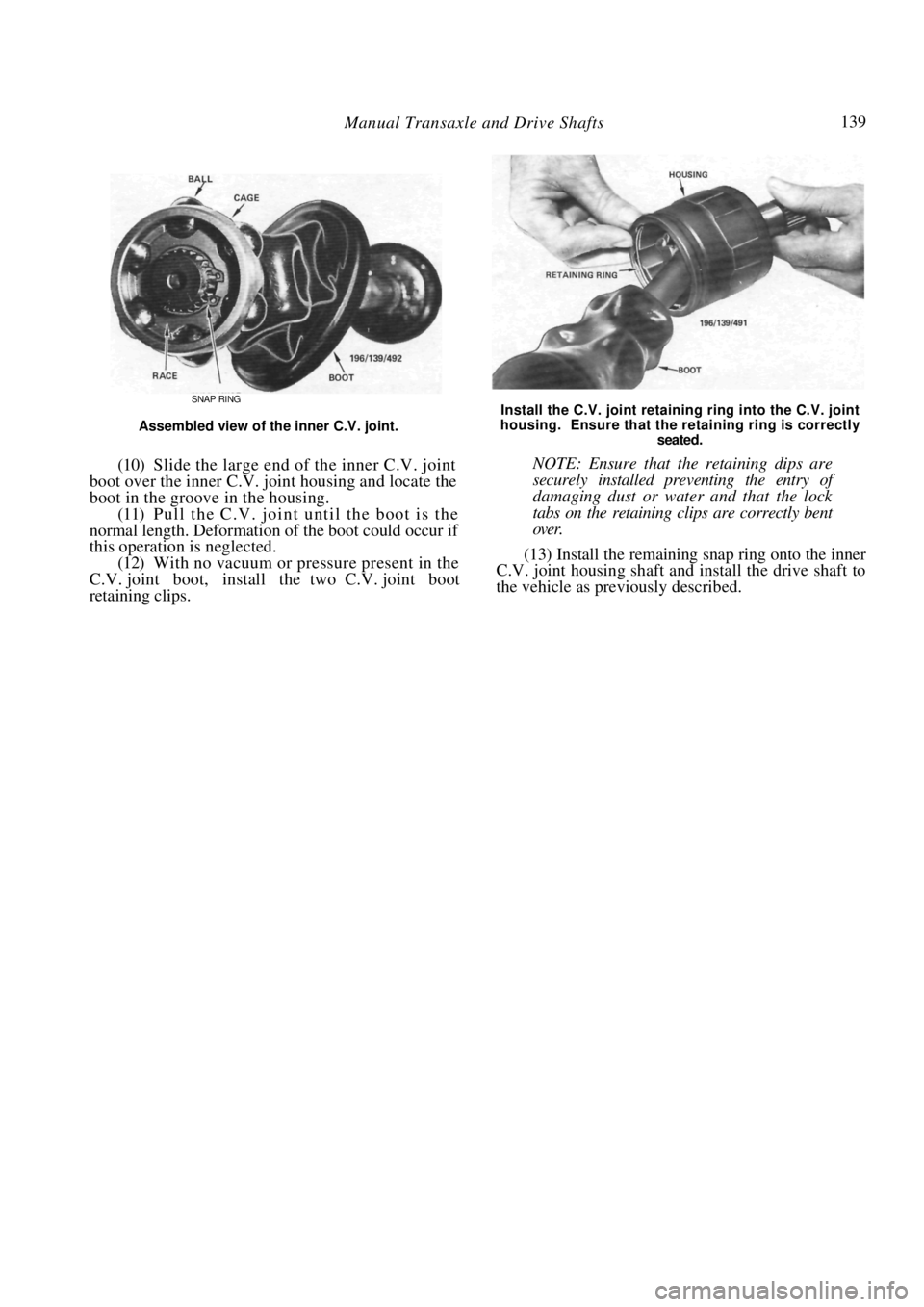
SNAP RING
Assembled view of the inner C.V. joint.
(10) Slide the large end of the inner C.V. joint
boot over the inner C.V. joint housing and locate the
boot in the groove in the housing.
(11) Pull the C.V. joint until the boot is the
normal length. Deformation of the boot could occur if
this operation is neglected. (12) With no vacuum or pressure present in the
C.V. joint boot, install the two C.V. joint boot
retaining clips.
Install the C.V. joint retain ing ring into the C.V. joint
housing. Ensure that the retaining ring is correctly
seated.
NOTE: Ensure that the retaining dips are
securely installed preven ting the entry of
damaging dust or water and that the lock
tabs on the retaining clips are correctly bent
over.
(13) Install the remaining snap ring onto the inner
C.V. joint housing shaft and install the drive shaft to
the vehicle as previously described.
Page 142 of 238
142 Automatic Transaxle
(8) Install the dipstick and start the engine and
recheck the fluid level.
NOTE; Do not overfill the transaxle or
foaming and unsatisfactory operation of the
transaxle will result.
TO DRAIN AND REFILL
This is not a normal maintenance and lubrication
procedure. It is only necessary to drain the complete
system, including the torq ue converter and the oil
cooler, when the transaxle assembly is removed for
overhaul or the renewal of transaxle components such
as bearings, clutches or as semblies. When this condi-
tion arises, the torque converter and the cooler should
be cleaned and flushed to remove any dirt or sludge.
After transaxle overhaul, install approximately 6
liters of new transaxle fluid, and top up as previously
described.
4. BRAKE BAND
Band adjustment is not a normal maintenance
procedure.
The adjustment entails removal of the valve body
and for this reason the vehicle should be taken to an
authorized dealer.
5. KICKDOWN CABLE
TO ADJUST
(1) On models with a 1.6 liter engine, remove
the air cleaner assembly. (2) With the aid of an assistant, ensure that the
throttle valve is fully open when the throttle pedal is
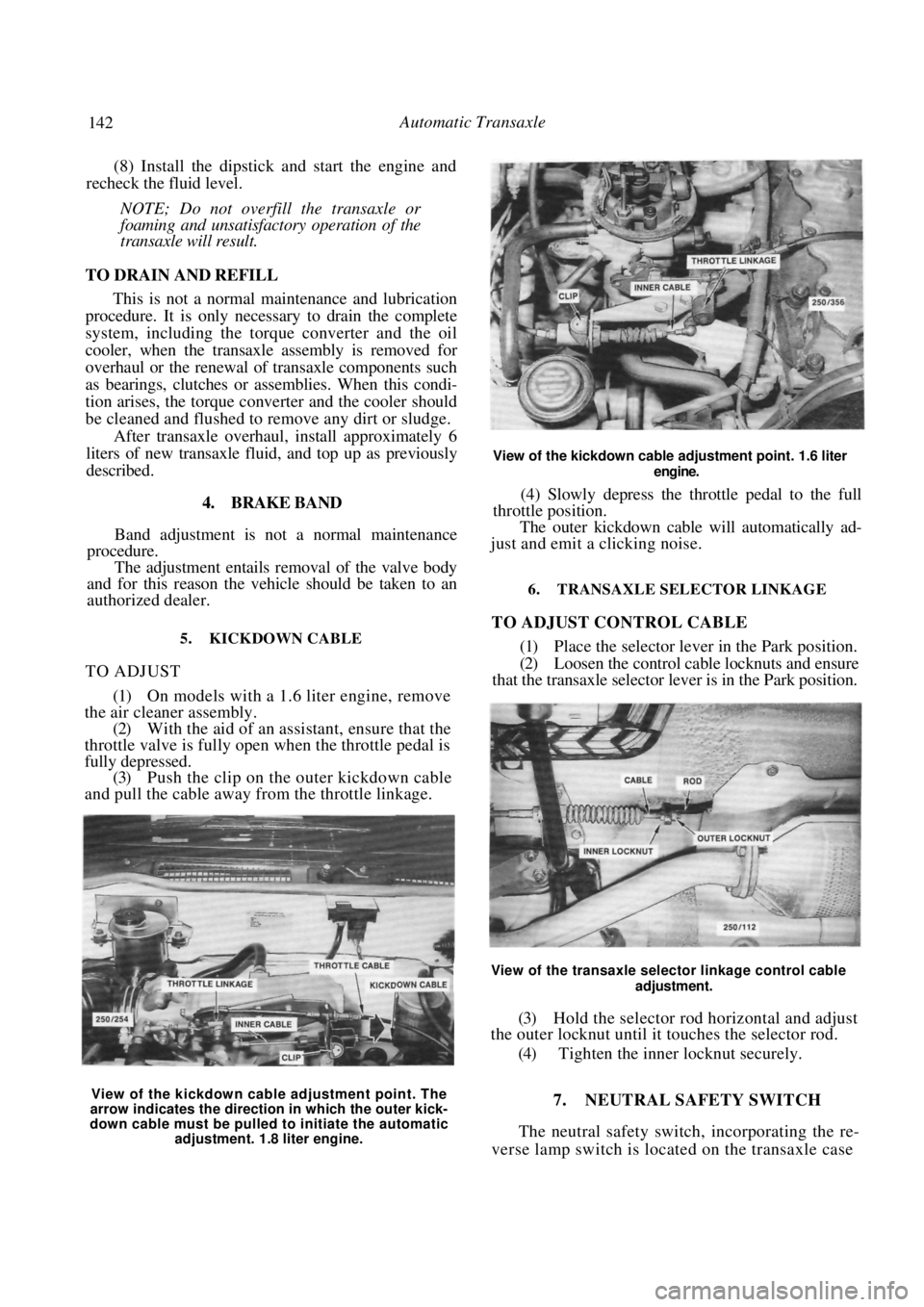
fully depressed. (3) Push the clip on the outer kickdown cable
and pull the cable away from the throttle linkage.
View of the kickdown cable adjustment point. 1.6 liter
engine.
(4) Slowly depress the throttle pedal to the full
throttle position.
The outer kickdown cable will automatically ad-
just and emit a clicking noise.
6. TRANSAXLE SELECTOR LINKAGE
TO ADJUST CONTROL CABLE
(1) Place the selector lever in the Park position.
(2) Loosen the control cable locknuts and ensure
that the transaxle selector lever is in the Park position.
View of the transaxle selector linkage control cable
adjustment.
(3) Hold the selector rod horizontal and adjust
the outer locknut until it touches the selector rod.
(4) Tighten the inner locknut securely.
7. NEUTRAL SAFETY SWITCH
The neutral safety switch, incorporating the re-
verse lamp switch is located on the transaxle case
View of the kickdown cable adjustment point. The
arrow indicates the direction in which the outer kick-
down cable must be pulled to initiate the automatic adjustment. 1.8 liter engine.
Page 143 of 238
Automatic Transaxle 143
facing towards the radiator support panel at the front
of the vehicle.
The neutral safety switch allows electrical current
to pass to the starter circ uit only when the selector
lever is in the Park or Neutral position. The switch is
adjustable but non-repairable.
TO TEST
(1) Disconnect the neutral safety switch wiring
connector.
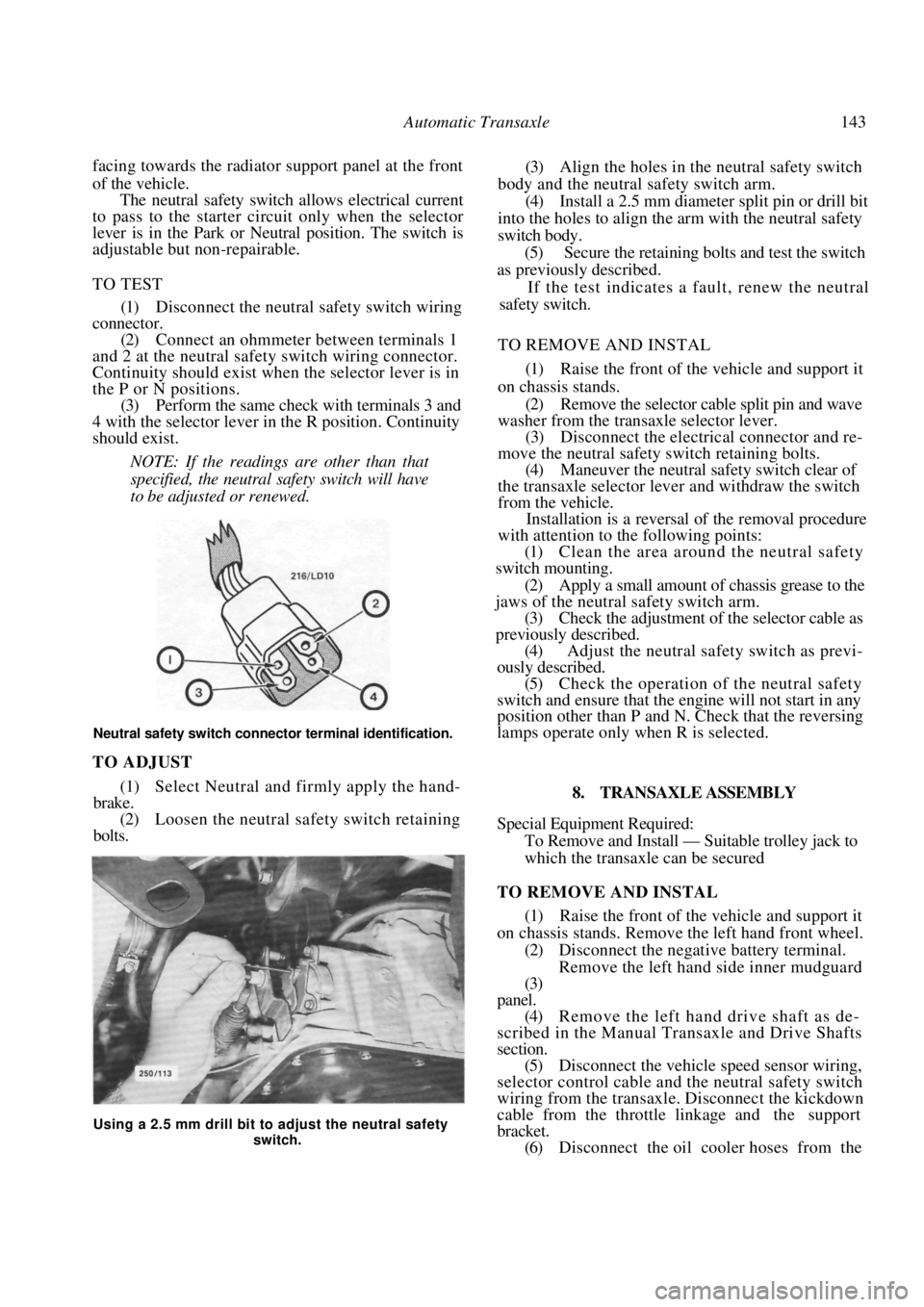
(2) Connect an ohmmeter between terminals 1
and 2 at the neutral safety switch wiring connector.
Continuity should exist when the selector lever is in
the P or N positions. (3) Perform the same check with terminals 3 and
4 with the selector lever in the R position. Continuity
should exist.
NOTE: If the readings are other than that
specified, the neutral safety switch will have
to be adjusted or renewed.
Neutral safety switch connector terminal identification.
TO ADJUST
(1) Select Neutral and firmly apply the hand-
brake. (2) Loosen the neutral safety switch retaining
bolts.
(3) Align the holes in the neutral safety switch
body and the neutral safety switch arm. (4) Install a 2.5 mm diameter split pin or drill bit
into the holes to align the arm with the neutral safety
switch body. (5) Secure the retaining bolts and test the switch
as previously described.
If the test indicates a fault, renew the neutral
safety switch.
TO REMOVE AND INSTAL
(1) Raise the front of the vehicle and support it
on chassis stands. (2) Remove the selector cable split pin and wave
washer from the transaxle selector lever.
(3) Disconnect the electric al connector and re-
move the neutral safety switch retaining bolts. (4) Maneuver the neutral safety switch clear of
the transaxle selector lever and withdraw the switch
from the vehicle. Installation is a reversal of the removal procedure
with attention to the following points:
(1) Clean the area around the neutral safety
switch mounting.
(2) Apply a small amount of chassis grease to the
jaws of the neutral safety switch arm. (3) Check the adjustment of the selector cable as
previously described. (4) Adjust the neutral safety switch as previ-
ously described.
(5) Check the operation of the neutral safety
switch and ensure that the engine will not start in any
position other than P and N. Check that the reversing
lamps operate only when R is selected.
8. TRANSAXLE ASSEMBLY
Special Equipment Required:
To Remove and Install — Suitable trolley jack to
which the transaxle can be secured
TO REMOVE AND INSTAL
(1) Raise the front of the vehicle and support it
on chassis stands. Remove the left hand front wheel.
(2) Disconnect the negative battery terminal. Remove the left hand side inner mudguard
(3)
panel.
(4) Remove the left hand drive shaft as de-
scribed in the Manual Tran saxle and Drive Shafts
section. (5) Disconnect the vehicle speed sensor wiring,
selector control cable and the neutral safety switch
wiring from the transaxle. Disconnect the kickdown
cable from the throttle linkage and the support
bracket. (6) Disconnect the oil cooler hoses from the
Using a 2.5 mm drill bit to adjust the neutral safety
switch.
Page 144 of 238
144 Automatic Transaxle
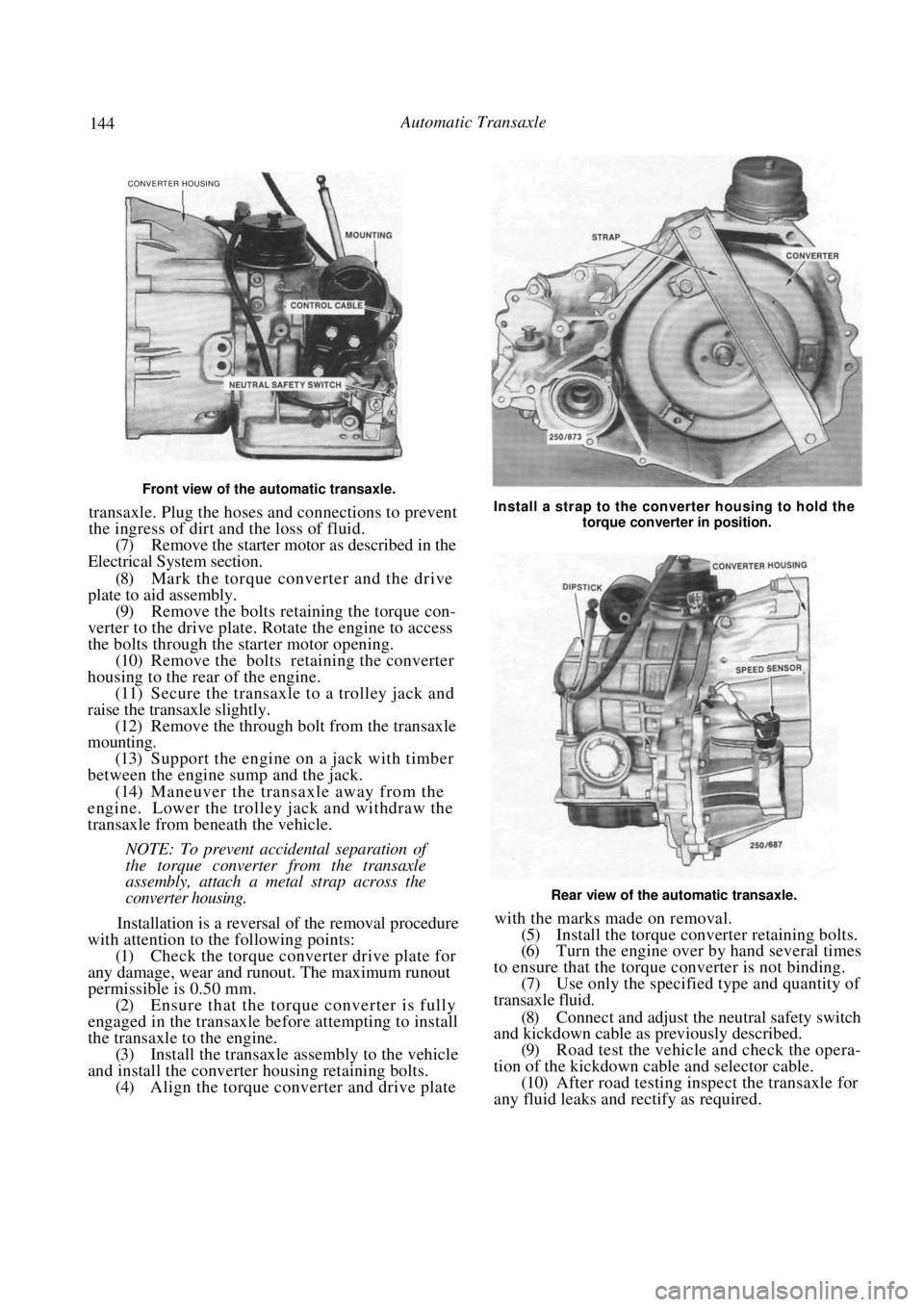
Front view of the automatic transaxle.
transaxle. Plug the hoses and connections to prevent
the ingress of dirt and the loss of fluid.
(7) Remove the starter motor as described in the
Electrical System section.
(8) Mark the torque converter and the drive
plate to aid assembly.
(9) Remove the bolts retaining the torque con-
verter to the drive plate. Rotate the engine to access
the bolts through the starter motor opening. (10) Remove the bolts retaining the converter
housing to the rear of the engine. (11) Secure the transaxle to a trolley jack and
raise the transaxle slightly. (12) Remove the through bolt from the transaxle
mounting.
(13) Support the engine on a jack with timber
between the engine sump and the jack. (14) Maneuver the transaxle away from the
engine. Lower the trolley jack and withdraw the
transaxle from beneath the vehicle.
NOTE: To prevent accidental separation of
the torque converter from the transaxle
assembly, attach a metal strap across the
converter housing.
Installation is a reversal of the removal procedure
with attention to the following points:
(1) Check the torque converter drive plate for
any damage, wear and runout. The maximum runout
permissible is 0.50 mm.
(2) Ensure that the torque converter is fully
engaged in the transaxle be fore attempting to install
the transaxle to the engine. (3) Install the transaxle assembly to the vehicle
and install the converter housing retaining bolts. (4) Align the torque converter and drive plate
Install a strap to the converter housing to hold the
torque converter in position.
Rear view of the automatic transaxle.
with the marks made on removal.
(5) Install the torque converter retaining bolts.
(6) Turn the engine over by hand several times
to ensure that the torque converter is not binding. (7) Use only the specified type and quantity of
transaxle fluid.
(8) Connect and adjust the neutral safety switch
and kickdown cable as previously described.
(9) Road test the vehicle and check the opera-
tion of the kickdown cable and selector cable. (10) After road testing inspect the transaxle for
any fluid leaks and rectify as required.
CONVERTER HOUSING
Page 146 of 238
146 Steering — Part 1
STEERING PULLS TO ONE SIDE
(1) Uneven tire wear or pressures: Check the
condition of the tires and inflate to the recommended
pressures.
(2) Incorrect front wheel alignment: Check and
align the front end.
(3) Dragging brakes: Check each wheel for drag-
ging brakes. Overhaul the brakes as necessary. (4) Damaged suspension or crossmember: In-
spect and renew the damaged components. (5) Faulty power steering gear assembly: Re-
move the power steering gear for overhaul.
FRONT WHEEL WOBBLE OR SHIMMY
(1) Uneven tire wear or incorrect tire pressures;
Check the condition of the tires and inflate to the
recommended pressures. (2) Tire or wheel imbalance: Check and balance
as necessary (3) Worn or badly adjusted hub bearings: Check
the condition and adjust the front hub bearings.
(4) Faulty or worn suspension, units: Check and
overhaul or renew as a pair.
NOTE: Check the steering linkage as previ-
ously described. Raise the front of the vehi-
cle and check the adjustment of the hub
bearings by moving the road wheel in and
out at the top and bottom. No movement in
the bearings should be felt. Check the sus-
pension units as outlined in the Front Sus-
pension section.
STEERING ERRATIC OR WANDERING
(1) Incorrect or uneven wheel alignment setting:
Check and adjust th e steering geometry.
(2) Smooth front tires: Check and renew the
tires as necessary.
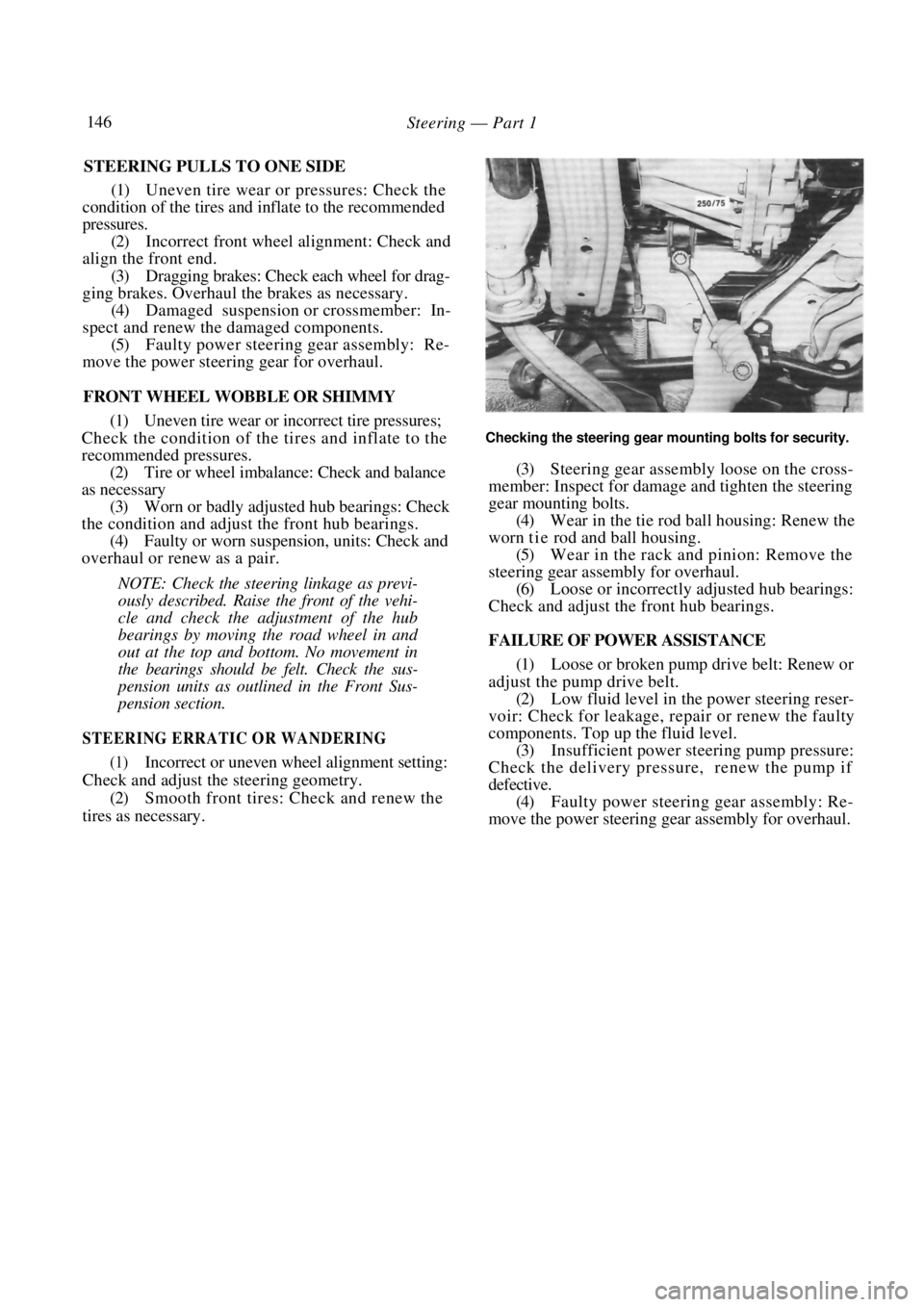
Checking the steering gear mounting bolts for security.
(3) Steering gear assembly loose on the cross-
member: Inspect for damage and tighten the steering
gear mounting bolts.
(4) Wear in the tie rod ball housing: Renew the
worn t i e rod and ball housing. (5) Wear in the rack and pinion: Remove the
steering gear assembly for overhaul. (6) Loose or incorrectly adjusted hub bearings:
Check and adjust the front hub bearings.
FAILURE OF POWER ASSISTANCE
(1) Loose or broken pump drive belt: Renew or
adjust the pump drive belt.
(2) Low fluid level in the power steering reser-
voir: Check for leakage, repair or renew the faulty
components. Top up the fluid level. (3) Insufficient power steering pump pressure:
Check the delivery pressure, renew the pump if
defective. (4) Faulty power steering gear assembly: Re-
move the power steering gear assembly for overhaul.
Page 148 of 238
148 Steering — Part 2
3. STEERING COLUMN
Special Equipment Required:
To Remove Steering Wheel — Steering wheel
puller
TO REMOVE AND INSTAL
(1) Disconnect the negative battery terminal.
(2) Working in the engine compartment, mark
the relationship between the steering shaft universal
coupling joint and the steering gear pinion shaft. (3) Remove the pinch bolts from the universal
joint. (4) Working inside the vehi cle, remove the steer-
ing wheel as previously described. (5) Remove the steering column shroud screws,
unclip the lower and upper covers and remove them
from the steering column. (6) Disconnect all the steering column wiring
connectors. (7) Remove the lower trim from underneath the
steering column.
(8) Fold back the insulator and remove the nuts
from the steering colu mn floor bracket.
(9) Remove the nuts from the lower steering
column bracket. (10) Remove the bolts from the tilt bracket
assembly. (11) Maneuver the steering column from the
vehicle.
Installation is a reversal of the removal procedure
with attention to the following points:
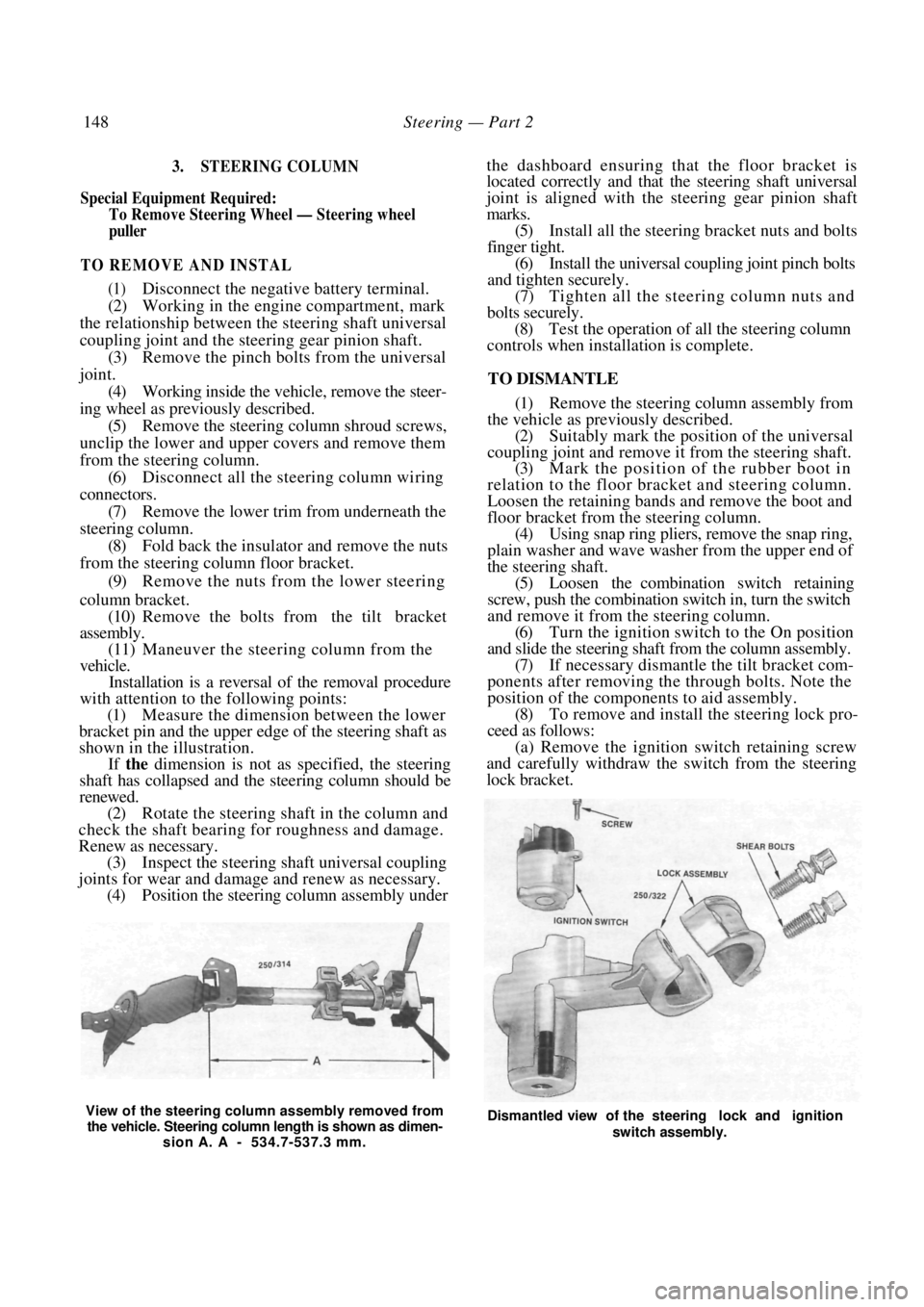
(1) Measure the dimension between the lower
bracket pin and the upper edge of the steering shaft as
shown in the illustration.
If the dimension is not as specified, the steering
shaft has collapsed and the steering column should be
renewed.
(2) Rotate the steering shaft in the column and
check the shaft bearing for roughness and damage.
Renew as necessary. (3) Inspect the steering shaft universal coupling
joints for wear and damage and renew as necessary. (4) Position the steering column assembly under
the dashboard ensuring that the floor bracket is
located correctly and that the steering shaft universal
joint is aligned with the steering gear pinion shaft
marks.
(5) Install all the steering bracket nuts and bolts
finger tight. (6) Install the universal coupling joint pinch bolts
and tighten securely.
(7) Tighten all the stee ring column nuts and
bolts securely. (8) Test the operation of all the steering column
controls when installation is complete.
TO DISMANTLE
(1) Remove the steering column assembly from
the vehicle as previously described. (2) Suitably mark the position of the universal
coupling joint and remove it from the steering shaft. (3) Mark the position of the rubber boot in
relation to the floor bracket and steering column.
Loosen the retaining bands and remove the boot and
floor bracket from th e steering column.
(4) Using snap ring pliers, remove the snap ring,
plain washer and wave washer from the upper end of
the steering shaft. (5) Loosen the combination switch retaining
screw, push the combination switch in, turn the switch
and remove it from the steering column. (6) Turn the ignition switch to the On position
and slide the steering shaft from the column assembly. (7) If necessary dismantle the tilt bracket com-
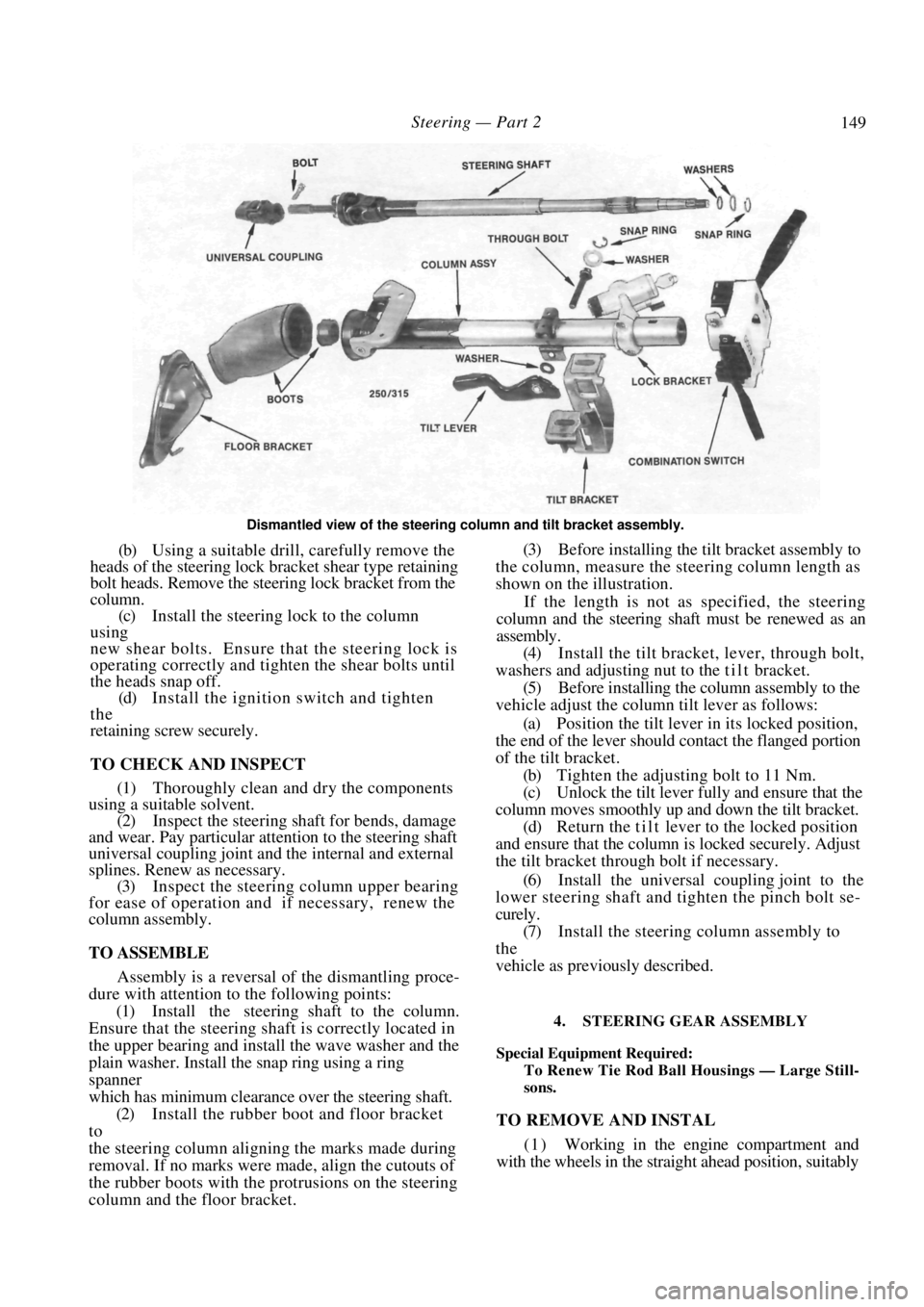
ponents after removing the through bolts. Note the
position of the components to aid assembly. (8) To remove and install the steering lock pro-
ceed as follows: (a) Remove the ignition switch retaining screw
and carefully withdraw the switch from the steering
lock bracket.
View of the steering column assembly removed from
the vehicle. Steering column length is shown as dimen- sion A. A - 534.7-537.3 mm. Dismantled view of the steering lock and ignition
switch assembly.
Page 149 of 238
Steering — Part 2 149
Dismantled view of the steering column and tilt bracket assembly.
(b) Using a suitable drill, carefully remove the
heads of the steering lock br acket shear type retaining
bolt heads. Remove the steering lock bracket from the
column.
(c) Install the steering lock to the column
using
new shear bolts. Ensure that the steering lock is
operating correctly and tigh ten the shear bolts until
the heads snap off.
(d) Install the ignition switch and tighten
the
retaining screw securely.
TO CHECK AND INSPECT
(1) Thoroughly clean and dry the components
using a suitable solvent.
(2) Inspect the steering shaft for bends, damage
and wear. Pay particular attention to the steering shaft
universal coupling joint and the internal and external
splines. Renew as necessary. (3) Inspect the steering column upper bearing
for ease of operation and if necessary, renew the
column assembly.
TO ASSEMBLE
Assembly is a reversal of the dismantling proce-
dure with attention to the following points:
(1) Install the steering shaft to the column.
Ensure that the steering shaft is correctly located in
the upper bearing and insta ll the wave washer and the
plain washer. Install the snap ring using a ring
spanner
which has minimum clearan ce over the steering shaft.
(2) Install the rubber boot and floor bracket
to
the steering column aligning the marks made during
removal. If no marks were made, align the cutouts of
the rubber boots with the protrusions on the steering
column and the floor bracket. (3) Before installing the tilt bracket assembly to
the column, measure the steering column length as
shown on the illustration.
If the length is not as specified, the steering
column and the steering shaft must be renewed as an
assembly.
(4) Install the tilt bracket, lever, through bolt,
washers and adjusting nu t to the t i l t bracket.
(5) Before installing the column assembly to the
vehicle adjust the column tilt lever as follows:
(a) Position the tilt lever in its locked position,
the end of the lever should contact the flanged portion
of the tilt bracket.
(b) Tighten the adjusting bolt to 11 Nm.
(c) Unlock the tilt lever fully and ensure that the
column moves smoothly up and down the tilt bracket. (d) Return the tilt lever to the locked position
and ensure that the column is locked securely. Adjust
the tilt bracket thro ugh bolt if necessary.
(6) Install the universal coupling joint to the
lower steering shaft and tighten the pinch bolt se-
curely.
(7) Install the steering column assembly to
the
vehicle as previously described.
4. STEERING GEAR ASSEMBLY
Special Equipment Required:
To Renew Tie Rod Ball Housings — Large Still-
sons.
TO REMOVE AND INSTAL
( 1 ) Working in the engine compartment and
with the wheels in the straight ahead position, suitably
Page 150 of 238
150 Steering — Part 2
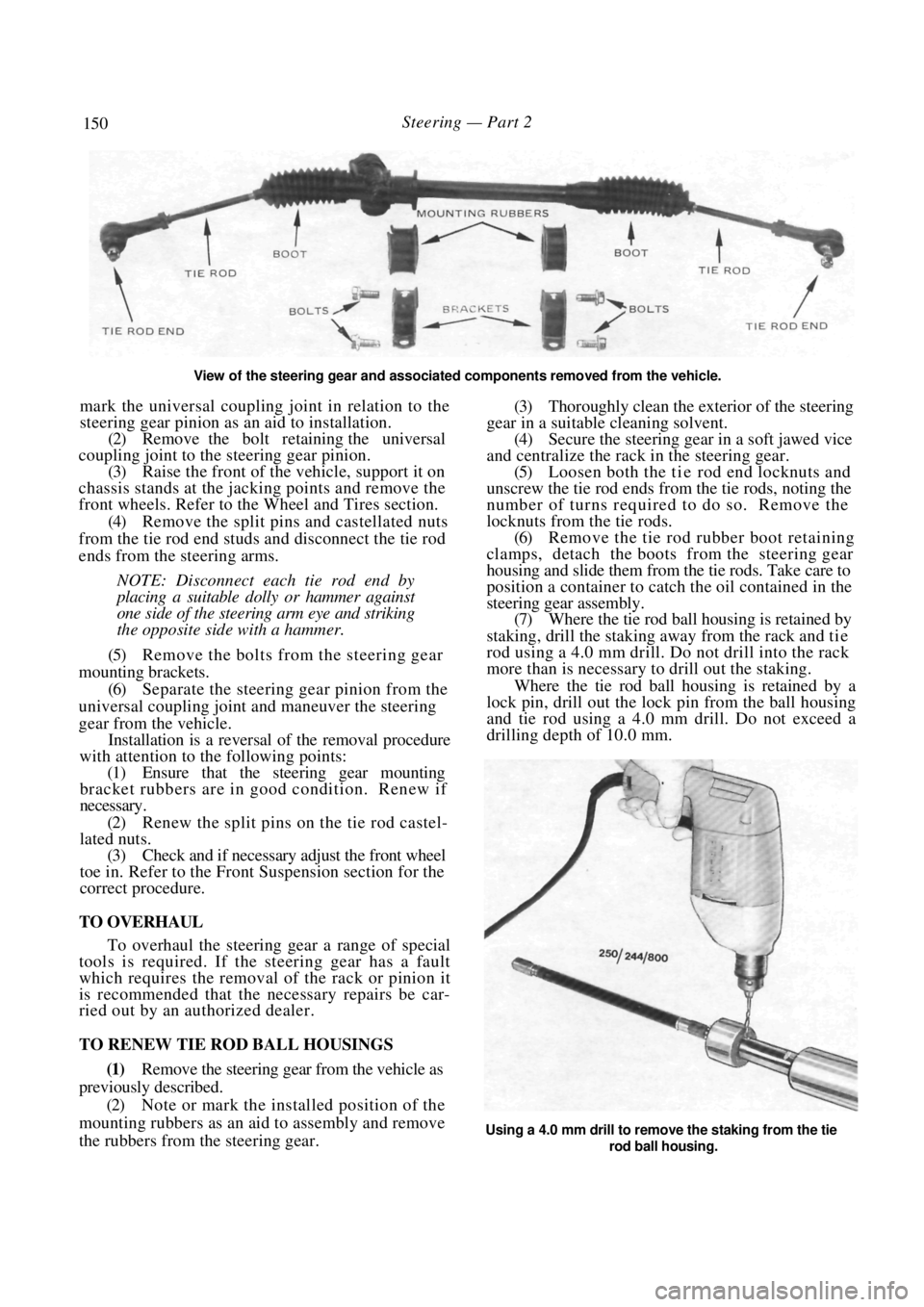
View of the steering gear and associated components removed from the vehicle.
mark the universal coupling joint in relation to the
steering gear pinion as an aid to installation.
(2) Remove the bolt retaining the universal
coupling joint to the steering gear pinion. (3) Raise the front of the vehicle, support it on
chassis stands at the jack ing points and remove the
front wheels. Refer to the Wheel and Tires section.
(4) Remove the split pins and castellated nuts
from the tie rod end studs and disconnect the tie rod
ends from the steering arms.
NOTE: Disconnect each tie rod end by
placing a suitable dolly or hammer against
one side of the steer ing arm eye and striking
the opposite side with a hammer.
(5) Remove the bolts from the steering gear
mounting brackets. (6) Separate the steering gear pinion from the
universal coupling joint and maneuver the steering
gear from the vehicle. Installation is a reversal of the removal procedure
with attention to the following points:
(1) Ensure that the steering gear mounting
bracket rubbers are in good condition. Renew if
necessary.
(2) Renew the split pins on the tie rod castel-
lated nuts.
(3) Check and if necessary adjust the front wheel
toe in. Refer to the Front Suspension section for the
correct procedure.
TO OVERHAUL
To overhaul the steering gear a range of special
tools is required. If the steering gear has a fault
which requires the removal of the rack or pinion it
is recommended that the necessary repairs be car-
ried out by an authorized dealer.
TO RENEW TIE ROD BALL HOUSINGS
(1) Remove the steering gear from the vehicle as
previously described.
(2) Note or mark the installed position of the
mounting rubbers as an aid to assembly and remove
the rubbers from the steering gear.
(3) Thoroughly clean the exterior of the steering
gear in a suitable cleaning solvent.
(4) Secure the steering gear in a soft jawed vice
and centralize the rack in the steering gear. (5) Loosen both the ti e rod end locknuts and
unscrew the tie rod ends from the tie rods, noting the
number of turns required to do so. Remove the
locknuts from the tie rods. (6) Remove the tie rod rubber boot retaining
clamps, detach the boot s from the steering gear
housing and slide them from the tie rods. Take care to
position a container to catch the oil contained in the
steering gear assembly. (7) Where the tie rod ball housing is retained by
staking, drill the staking away from the rack and t i e
rod using a 4.0 mm drill. Do not drill into the rack
more than is necessary to drill out the staking.
Where the tie rod ball housing is retained by a
lock pin, drill out the lock pin from the ball housing
and tie rod using a 4.0 mm drill. Do not exceed a
drilling depth of 10.0 mm.
Using a 4.0 mm drill to remove the staking from the tie
rod ball housing.
Page 151 of 238

Steering — Part 2 151
(8) Slide the rack out of the housing slightly so
that an adjustable spanner can be used to hold the
rack. (9) Using a Stillsons wrench, unscrew the ball
housings in turn using care not to allow the rack to
rotate. Keep all the tie rod parts in order. (10) Inspect the rack boots for cracks and deteri-
oration and renew as necessary. (11) Inspect the tie rod ends for wear and damage
and renew as necessary.
Dismantled view of the tie rod ball housing and the tie
rod end assemblies removed from the steering gear.
Assembly is a reversal of the dismantling proce-
dure with attention to the following points:
(1) Using large Stillsons and a large adjustable
spanner, install the tie rod and ball housing
assemblies
to the rack. Tighten the ball housings to the specified
torque.
NOTE: To avoid damage to the rack or
pinion the adjustable spanner must be
firmly tightened over the rack teeth and the
rack must not be allowed to rotate when
installing the ball housings.
(2) Measure a point 9 mm in from the rear face
of the ball housing of the rack and at 90 deg to the
rack teeth. Centre punch this point.
(3) At this point drill a 4 mm hole, 10 mm deep
through the rack and into the ball housing thread.
(4) Place a locking pin above the hole and drive
it into position.
(5) Lubricate the rack, rack teeth and t i e rod
boot groove with suitable EPL 1 grease. (6) Install the rack boots and secure with the
clamps. Renew the clamps if necessary. (7) Install the tie rod end locknuts and then the
tie rod ends, ensuring that they are screwed on the
same number of turns as was necessary to remove
them.
(8) Tighten the locknuts to the specified torque.
(9) Install the mounting rubbers and brackets
to
the steering gear as noted on removal. (10) Install the steering gear assembly to
the
vehicle as previously described. (11) Check and if necessary adjust the front wheel toe in as described in the Front Suspension section
under the appropriate heading.
TO RENEW TIE ROD END
(1)
Raise the front of the vehicle and support it
on chassis stands. (2) Remove the relevant front wheel.
(3) Loosen the tie rod end locknut and remove
the tie rod end castellated nut. Disconnect the tie rod
from the steering arm by plac ing a suitable dolly or
hammer against one side of the steering arm eye and
striking the opposite side with a hammer. (4) Unscrew the tie rod end from the tie rod,
noting the number of turns necessary to remove it.
(5) Screw the new tie rod end onto the t i e rod
the same number of turn s noted during removal.
(6) Connect the t i e rod to the steering arm and
install the castellated nut. Tighten the nut to the
specified torque and secure it with a new split pin.
(7) Install the front wheel and lower the vehicle
to the ground. (8) Check and if necessary, adjust the front
wheel toe in as described in the Front Suspension
section. Ensure that the rubber boots are not distorted
or twisted on the tie rod when the adjustment is
completed.
TO RENEW RUBBER BOOT
(1) Raise the front of the vehicle and support it
on chassis stands. (2) Remove the relevant t i e rod end as previ-
ously described. (3) Release the clamps securi ng the boot to the
tie rod and steering gear housing. (4) Unscrew and remove the locknut from the
tie rod. (5) Remove the rubber boot together with the
outer retaining clamp from the t i e rod. (6) Sparingly lubricate th e tie rod boot groove
with EPL 1 grease, install the new boot to the t i e
rod
and push it onto the steering gear rack housing. Install
and secure the inner and outer retaining clamps.
(7) Install the tie rod end locknut and screw
the
tie rod end onto the tie ro d the same number of turns
noted during removal. (8) Connect the tie rod to the steering arm and
install the castellated nut. Tighten the nut to the
specified torque and secure it with a new split pin. (9) Install the wheel and lower the vehicle to the
ground. (10) Check and if necessary, adjust the front
wheel toe in as described in the Front Suspension
section. Ensure that the rubber boots are not distorted
or twisted when the adjustment is completed.
Page 154 of 238

154 Steering —
(2) Remove the air inlet duct from the air
cleaner and throttle body. (3) Position a container or a piece of cloth
beneath the steering pump reservoir and disconnect
the fluid return and power steering pump supply hose
from the reservoir.
(4) Loosen the steering pump drive belt as
described in the Engi ne Tune-up section.
(5) Loosen the return hose clamp and the supply
union and disconnect the hoses from the power
steering pump. Plug the hoses to prevent the loss of
fluid.
(6) Loosen the retaining bolts and withdraw the
pump. (7) Thoroughly clean the exterior of the steering
pump and inspect it for cracks, damage and signs of
leakage.
Installation is a reversal of the removal procedure
with attention to the following points:
(1) Install the pump and retaining bolts.
(2) Install the drive belt and adjust it as de-
scribed in the Engine Tune-up section. (3) Install the hoses to the power steering pump
and tighten securely. (4) Top up the pump reservoir and purge the
power steering system of air as previously described.
TO OVERHAUL
As specialist knowledge and equipment arc re-
quired to overhaul the power steering pump, it is
recommended that this operation be performed by an
authorized dealer or steering specialist.
6. POWER STEERING GEAR ASSEMBLY
Special Equipment Required:
To Renew Tie Rod Ball Housings — Large Still-
sons
TO REMOVE AND INSTAL
The procedures for removing and installing the
power steering gear are similar to those carried out in
the Manual Steering section under the Steering Gear
Assembly heading except fo r the following differences.
(1) Place a container under the pressure and
return pipes that are conn ected to the steering gear
valve housing. Remove the pipes and allow the fluid
to drain into the container. (2) Suitably seal the pipes and the steering gear
to prevent the entry of di rt whilst the pipes are
removed.
(3) Upon removal of the power steering gear,
thoroughly clean the steering gear except the tie rod
ends in a suitable solvent. Be careful not to allow the
solvent to enter the apertu res where the pressure and
return pipes were removed. (4) Check the pipes and co nnections for cracks,
damage or obstructions and renew as necessary.
Installed view of the power steering gear with the
engine removed.
Installation is a reversal of the removal procedure
with attention to the following points:
(1) Install the pressure and return pipes to the
steering gear valve housing and tighten securely. (2) Fill the power steering reservoir to the cor-
rect level and bleed the system as described previously
under the heading In Car Adjustments. Checks and
Minor Repairs. (3) Check all power steering pipe connections
for leaks and repair as necessary. (4) Check, and if necessary, adjust the front
wheel toe in as described in the Front Suspension
section. After adjustment ensure that the rubber boots
are not distorted or twisted and the rubber boot
clamps and clips are facing downward.
TO OVERHAUL
As specialist knowledge and equipment are re-
quired to overhaul the power steering gear, it is rec-
ommended that this opera tion be performed by an
authorized dealer or steering specialist.
TO RENEW TIE ROD BALL HOUSINGS
TRW Steering Gear
The renewal of the tie rod ball housings is the
same as for the manual steering gear. Refer to Part 2.
Manual Steering section.
PR24SA Steering Gear
(1) Remove the power steering gear assembly
from the vehicle as previously described.
(2) Carefully mount the power steering gear in a
vice equipped with soft jaws. Loosen the tie rod end
locknuts without disturbing the location of the tie rod
ends and unscrew the tie rod ends, taking note of the
number of turns required to remove them. Unscrew
and remove the locknuts from the tie rod. (3) Remove the clamps from the rubber boots
and remove the boots.