battery location NISSAN PULSAR 1987 User Guide
[x] Cancel search | Manufacturer: NISSAN, Model Year: 1987, Model line: PULSAR, Model: NISSAN PULSAR 1987Pages: 238, PDF Size: 28.91 MB
Page 109 of 238
Fuel and Engine Management 109
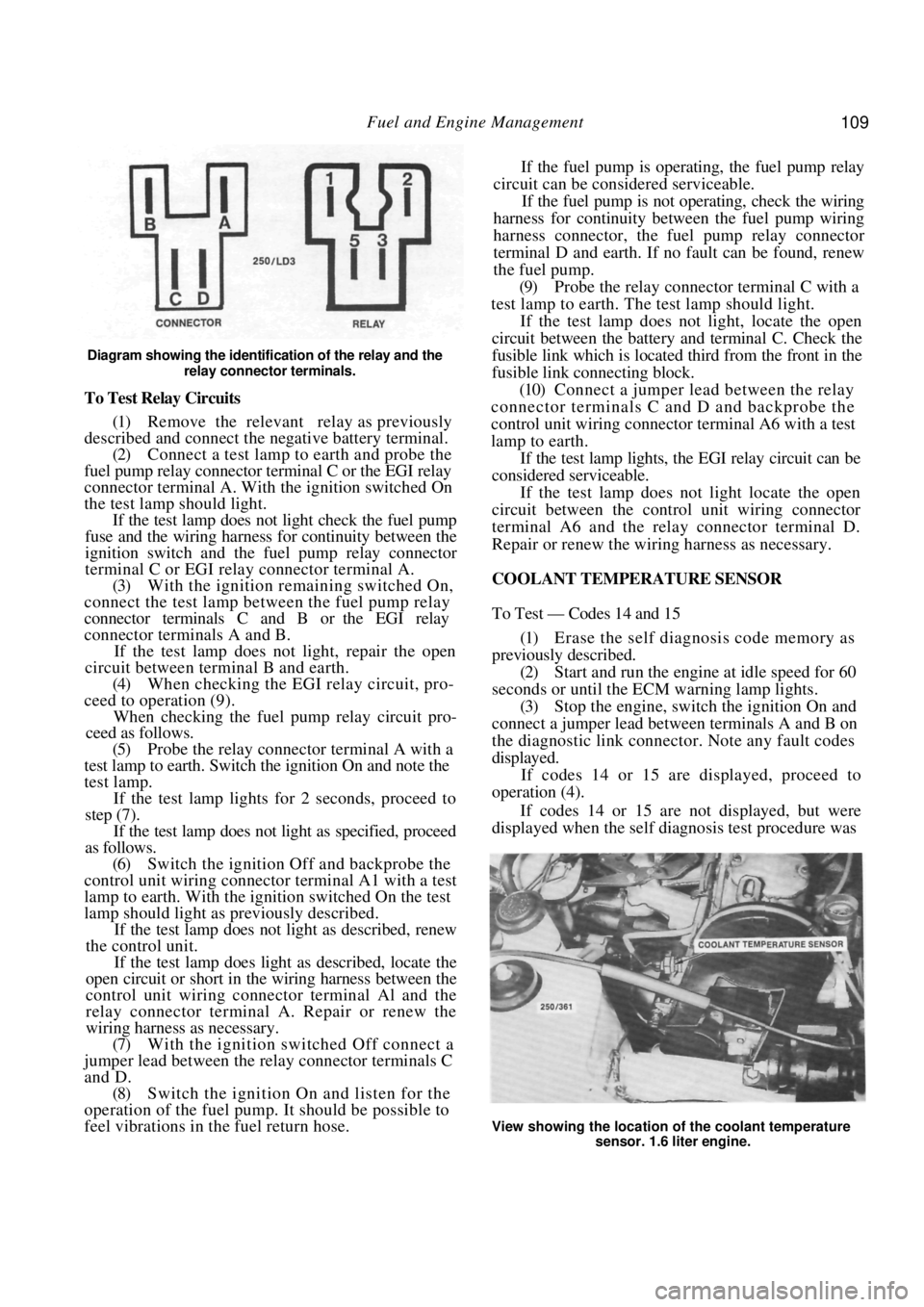
Diagram showing the identification of the relay and the relay connector terminals.
To Test Relay Circuits
(1) Remove the relevant relay as previously
described and connect the ne gative battery terminal.
(2) Connect a test lamp to earth and probe the
fuel pump relay connector terminal C or the EGI relay
connector terminal A. With the ignition switched On
the test lamp should light. If the test lamp does not light check the fuel pump
fuse and the wiring harness for continuity between the
ignition switch and the fuel pump relay connector
terminal C or EGI rela y connector terminal A.
(3) With the ignition remaining switched On,
connect the test lamp between the fuel pump relay
connector terminals C and B or the EGI relay
connector terminals A and B.
If the test lamp does not light, repair the open
circuit between terminal B and earth.
(4) When checking the EGI relay circuit, pro-
ceed to operation (9).
When checking the fuel pu mp relay circuit pro-
ceed as follows.
(5) Probe the relay connector terminal A with a
test lamp to earth. Switch the ignition On and note the
test lamp.
If the test lamp lights for 2 seconds, proceed to
step (7).
If the test lamp does not light as specified, proceed
as follows.
(6) Switch the ignition Off and backprobe the
control unit wiring connector terminal A1 with a test
lamp to earth. With the ignition switched On the test
lamp should light as previously described.
If the test lamp does not light as described, renew
the control unit.
If the test lamp does light as described, locate the
open circuit or short in the wiring harness between the
control unit wiring connector terminal Al and the
relay connector terminal A. Repair or renew the
wiring harness as necessary.
(7) With the ignition switched Off connect a
jumper lead between the relay connector terminals C
and D. (8) Switch the ignition On and listen for the
operation of the fuel pump. It should be possible to
feel vibrations in the fuel return hose. If the fuel pump is operating, the fuel pump relay
circuit can be considered serviceable.
If the fuel pump is not operating, check the wiring
harness for continuity between the fuel pump wiring
harness connector, the fuel pump relay connector
terminal D and earth. If no fault can be found, renew
the fuel pump.
(9) Probe the relay connector terminal C with a
test lamp to earth. The test lamp should light.
If the test lamp does not light, locate the open
circuit between the battery and terminal C. Check the
fusible link which is located third from the front in the
fusible link connecting block.
(10) Connect a jumper lead between the relay
connector terminals C and D and backprobe the
control unit wiring connector terminal A6 with a test
lamp to earth.
If the test lamp lights, the EGI relay circuit can be
considered serviceable.
If the test lamp does not light locate the open
circuit between the contro l unit wiring connector
terminal A6 and the relay connector terminal D.
Repair or renew the wiring harness as necessary.
COOLANT TEMPERATURE SENSOR
To Test — Codes 14 and 15
(1) Erase the self diagnosis code memory as
previously described. (2) Start and run the engine at idle speed for 60
seconds or until the ECM warning lamp lights.
(3) Stop the engine, switch the ignition On and
connect a jumper lead between terminals A and B on
the diagnostic link connect or. Note any fault codes
displayed. If codes 14 or 15 are displayed, proceed to
operation (4).
If codes 14 or 15 are not displayed, but were
displayed when the self diagnosis test procedure was
View showing the location of the coolant temperature
sensor. 1.6 liter engine.
Page 111 of 238
Fuel and Engine Management 111
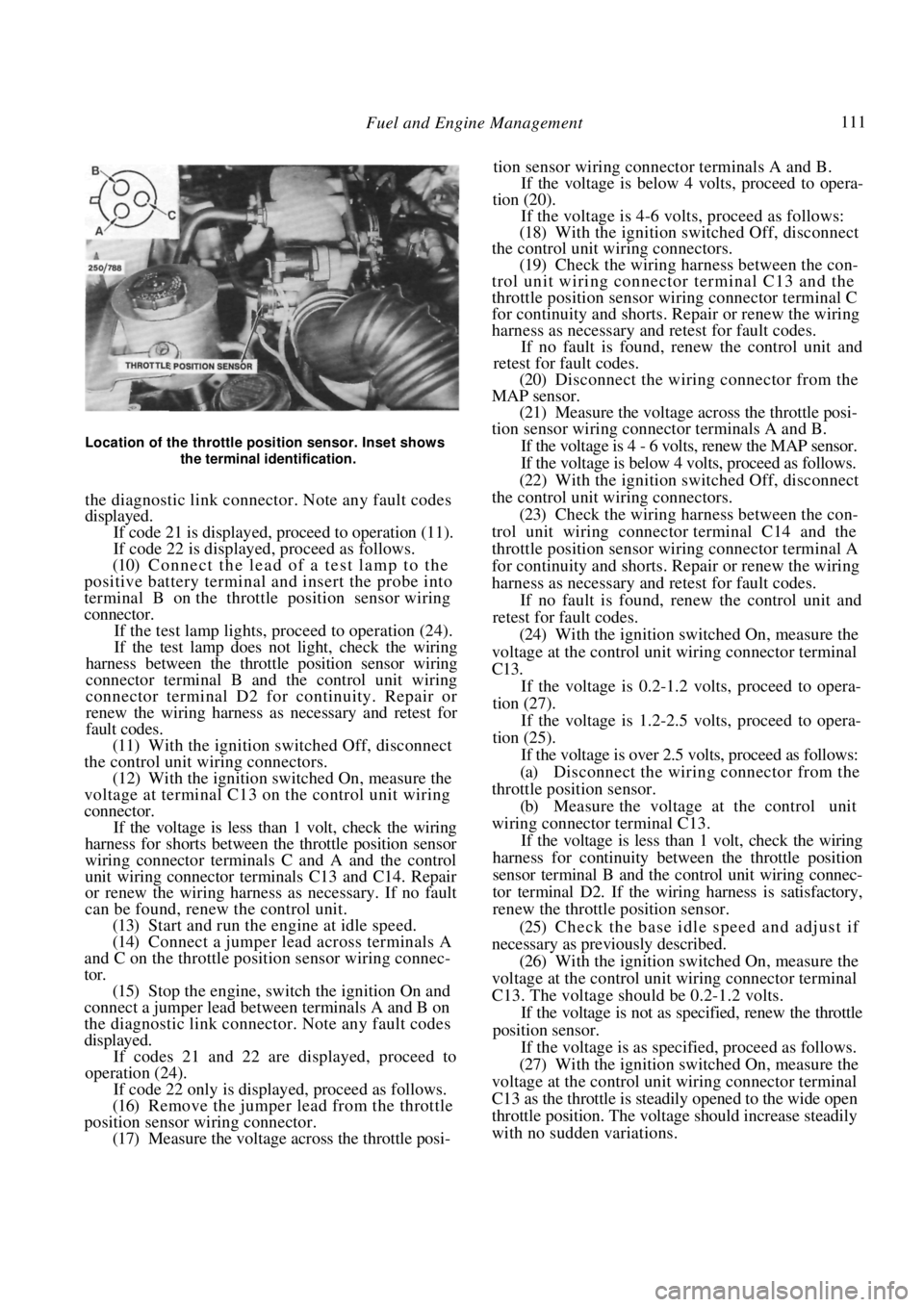
Location of the throttle position sensor. Inset shows the terminal identification.
the diagnostic link connector. Note any fault codes
displayed.
If code 21 is displayed, proceed to operation (11).
If code 22 is displayed, proceed as follows.
(10) Connect the lead of a test lamp to the
positive battery terminal and insert the probe into
terminal B on the throttle position sensor wiring
connector.
If the test lamp lights, pr oceed to operation (24).
If the test lamp does not light, check the wiring
harness between the throt tle position sensor wiring
connector terminal B and the control unit wiring
connector terminal D2 fo r continuity. Repair or
renew the wiring harness as necessary and retest for
fault codes.
(11) With the ignition switched Off, disconnect
the control unit wiring connectors. (12) With the ignition switched On, measure the
voltage at terminal C13 on the control unit wiring
connector.
If the voltage is less than 1 volt, check the wiring
harness for shorts between the throttle position sensor
wiring connector terminals C and A and the control
unit wiring connector terminals C13 and C14. Repair
or renew the wiring harness as necessary. If no fault
can be found, renew the control unit.
(13) Start and run the engine at idle speed.
(14) Connect a jumper lead across terminals A
and C on the throttle position sensor wiring connec-
tor. (15) Stop the engine, switch the ignition On and
connect a jumper lead between terminals A and B on
the diagnostic link connector . Note any fault codes
displayed. If codes 21 and 22 are displayed, proceed to
operation (24).
If code 22 only is displayed, proceed as follows.
(16) Remove the jumper lead from the throttle
position sensor wiring connector. (17) Measure the voltage across the throttle posi- tion sensor wiring connector terminals A and B.
If the voltage is below 4 volts, proceed to opera-
tion (20).
If the voltage is 4-6 volts, proceed as follows:
(18) With the ignition switched Off, disconnect
the control unit wiring connectors.
(19) Check the wiring harness between the con-
trol unit wiring connector terminal C13 and the
throttle position sensor wiring connector terminal C
for continuity and shorts. Repair or renew the wiring
harness as necessary and retest for fault codes. If no fault is found, renew the control unit and
retest for fault codes.
(20) Disconnect the wiring connector from the
MAP sensor. (21) Measure the voltage across the throttle posi-
tion sensor wiring connector terminals A and B.
If the voltage is 4 - 6 volts, renew the MAP sensor.
If the voltage is below 4 volts, proceed as follows.
(22) With the ignition switched Off, disconnect
the control unit wiring connectors. (23) Check the wiring harness between the con-
trol unit wiring connecto r terminal C14 and the
throttle position sensor wiring connector terminal A
for continuity and shorts. Repair or renew the wiring
harness as necessary and retest for fault codes. If no fault is found, renew the control unit and
retest for fault codes.
(24) With the ignition switched On, measure the
voltage at the control unit wiring connector terminal
C13.
If the voltage is 0.2-1.2 volts, proceed to opera-
tion (27).
If the voltage is 1.2-2.5 volts, proceed to opera-
tion (25).
If the voltage is over 2.5 volts, proceed as follows:
(a) Disconnect the wiring connector from the
throttle position sensor. (b) Measure the voltage at the control unit
wiring connector terminal C13. If the voltage is less than 1 volt, check the wiring
harness for continuity between the throttle position
sensor terminal B and the control unit wiring connec-
tor terminal D2. If the wiring harness is satisfactory,
renew the throttle position sensor.
(25) Check the base idle sp eed and adjust if
necessary as previously described. (26) With the ignition switched On, measure the
voltage at the control unit wiring connector terminal
C13. The voltage should be 0.2-1.2 volts. If the voltage is not as specified, renew the throttle
position sensor.
If the voltage is as specified, proceed as follows.
(27) With the ignition switched On, measure the
voltage at the control unit wiring connector terminal
C13 as the throttle is steadily opened to the wide open
throttle position. The voltage should increase steadily
with no sudden variations.
Page 216 of 238
216 Electrical System
NOTE: While checking the operation of the
fusible link, loosely connect the battery-
terminal only, to safeguard against damage
to the wiring harness.
(5) If the circuit is still inoperative or the fusible
link burns out again, refer the problem to an auto-
motive electrician.
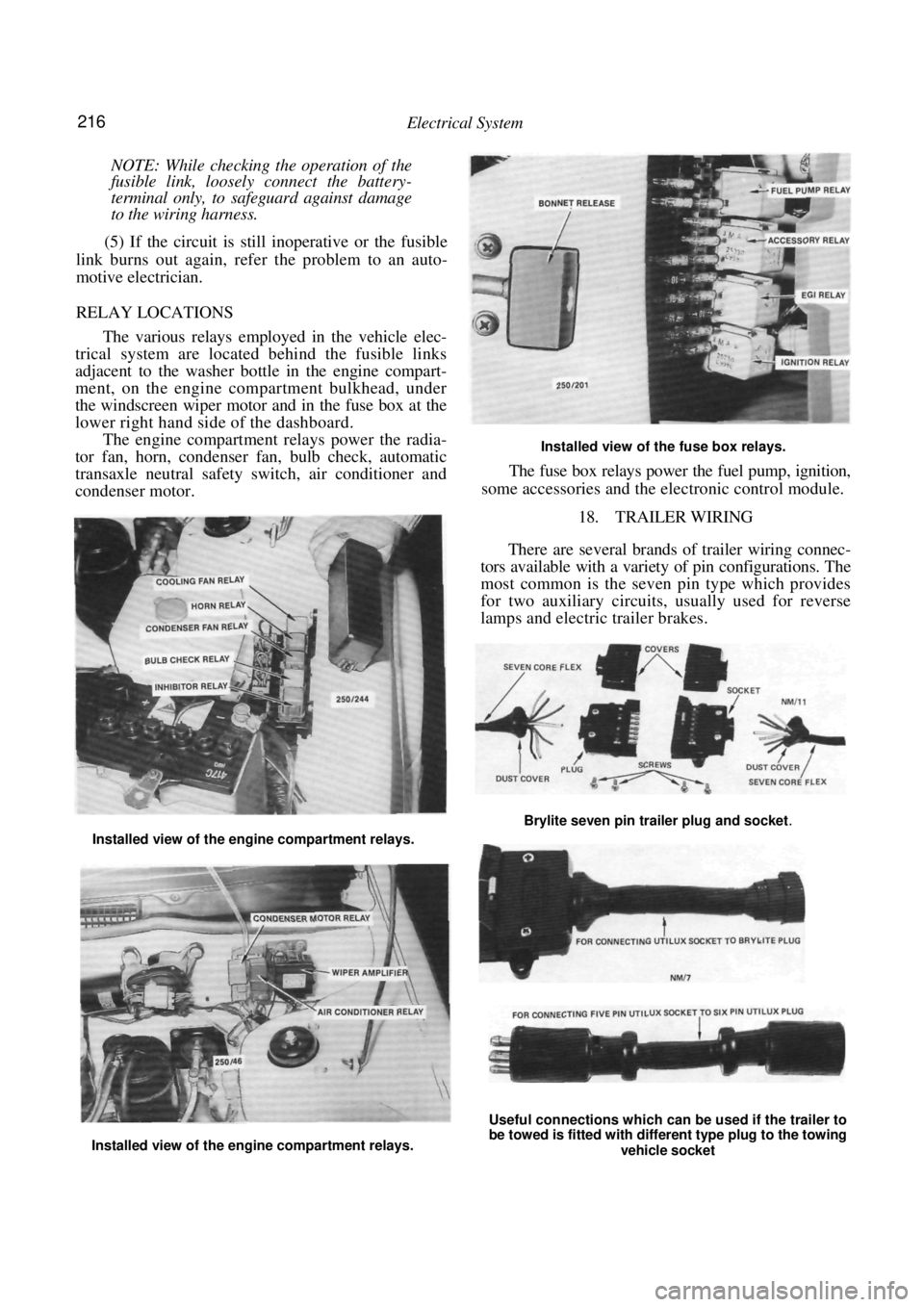
RELAY LOCATIONS
The various relays employed in the vehicle elec-
trical system are located behind the fusible links
adjacent to the washer bottle in the engine compart-
ment, on the engine compartment bulkhead, under
the windscreen wiper motor and in the fuse box at the
lower right hand side of the dashboard.
The engine compartment relays power the radia-
tor fan, horn, condenser fan, bulb check, automatic
transaxle neutral safety switch, air conditioner and
condenser motor.
Installed view of the fuse box relays.
The fuse box relays power the fuel pump, ignition,
some accessories and the el ectronic control module.
18. TRAILER WIRING
There are several brands of trailer wiring connec-
tors available with a variet y of pin configurations. The
most common is the seven pin type which provides
for two auxiliary circuits, usually used for reverse
lamps and electric trailer brakes.
Installed view of the engine compartment relays.
Installed view of the engine compartment relays.
Useful connections which can be used if the trailer to
be towed is fitted with different type plug to the towing
vehicle socket
Brylite seven pin trailer plug and socket.
Page 235 of 238

Body 235
lever and remove the screws underneath. Withdraw
the rear console.
On manual transaxle models, unscrew the
gear lever knob and prise out the gear lever rubber
boot. On automatic transaxle models, prise out the
panel around the selector lever and maneuver the
panel over the lever. Remove the screws retaining the front of the
console to the floor panel and withdraw the console
from the vehicle. Installation is a reversal of the removal procedure.
9, DASHBOARD
TO REMOVE AND INSTAL
Disconnect the negative battery terminal.
Remove the centre console as previously
described in this section. Remove the steering wheel as described in
the Steering section. Remove the upper and lower steering col-
umn shrouds and remove the combination switch.
Refer to the Electrical System section if necessary. Remove the retaining screws and withdraw
the lower trim panel from underneath the steering
column. Remove the screws from underneath the
bonnet lock handle and slide the bonnet lock handle
downwards out of the dashboard. Remove the screws retaining the centre fas-
cia panel, two upper and two lower, withdraw the
fascia panel slightly and disconnect the wiring to the
cigarette lighter.
Dismantled view of the centre console assembly. Au-
tomatic transaxle model.
Remove the radio/cassette bracket retaining
screws. Disconnect the aerial and the wiring and
withdraw the radio/cassette from the centre bracket. Remove the heater control knobs and re-
move the heater fascia panel screws. Carefully remove
the heater fascia panel leaving the heater controls in
place.
Loosen the bolt retaining the large wiring
connector at the lower right hand side of the dash-
board. As the bolt is loosened it will force the
connector apart. Using a screwdriver, carefully prise out the
demister ducts from th e top of the dashboard.
Using a suitable socket, remove the bolts
from underneath the demister ducts. Remove the bolts from the outer lower edges
and the lower part of th e centre bracket assembly.
NOTE: Refer to the illustration for the
location of the dashboard retaining bolts.
(14) With the aid of an assistant lift the dash-
board straight up at the door pillar brackets. Tilt the
View of the dashboard removed from the vehicle. The arrows indicate the location of the retaining bolts.