brake NISSAN PULSAR 1987 User Guide
[x] Cancel search | Manufacturer: NISSAN, Model Year: 1987, Model line: PULSAR, Model: NISSAN PULSAR 1987Pages: 238, PDF Size: 28.91 MB
Page 63 of 238
Engine
edge of the bearing cap to cylinder block joint. Install
the bearing cap bolts and tighten to the specified
torque.
(17) Lubricate the l i p of the new oil seal with
lithium grease and carefully install the seal into
position over the crankshaft . Insert the seal as far as
possible using finger pressure and then fully install the
sea! using a tubular drift. Ensure that the seal is not
damaged during installation and that the seal is
mounted square to the block face.
(18) Install the remainder of the engine
compo-
nents by referring to the relevant headings in
this
section.
TO RENEW CRANKSHAFT OIL SEALS
Front
(1) Remove the camshaft drive belt as previ-
ously described.
(2) Disconnect the lower radiator hose and drain
the cooling system. (3) Select fifth gear on manual transaxle models
and firmly apply the handbrake. (4) On automatic transaxle models, remove the
torque converter inspection cover to allow access to
the ring gear. Have an assi stant hold the ring gear
using a suitable lever. (5) Remove the crankshaft timing gear retaining
bolt and discard. (6) Remove the crankshaft timing gear from the
crankshaft. It may be necessary to lever the gear from
the crankshaft using two screwdrivers. Remove the
key and spacer from the crankshaft. (7) Using a centre punch, tap a small hole in the
front face of the oil seal. (8) Insert a self tapping screw into the hole.
(9) Remove the seal from the oil pump by
gripping and pulling the end of the screw with a pair
of pliers. (10) Coat the l i p of a new seal with multi-purpose
grease. (11) Install the oil seal to the oil pump using a
tubular drift. Ensure that the lip of the oil seal faces
the inside of the housing.
(12) Install the remaining components in the re-
verse order of removal, usi ng a new crankshaft timing
gear retaining bolt and referring to the relevant
headings in this section as necessary.
Rear
(1) Remove the automatic transaxle or manual
transaxle as described in the appropriate section. (2) Remove the flywheel/drive plate as described
under the following heading. (3) Lever the oil seal from the rear of the
crankcase being careful not to damage the crankshaft.
(4) Coat the lip of a new seal with Lithium
grease.
(5) Install the oil seal over the crankshaft. Ensure
that the li p of the oil sea l faces towards the engine.
(6) Insert the seal as far as possible using finger
pressure, and then fully seat the seal using a tubular
drift. (7) Install the remaining components in the
re-
verse order of removal, referring to the relevant
headings in this section as necessary.
12. FLYWHEEL/DRIVE PLATE
Special Equipment Required:
To Renew Ring Gear — Suitable heat source
TO REMOVE
(1) Remove the transaxle from the vehicle as
described in the Manual or Automatic Transaxle
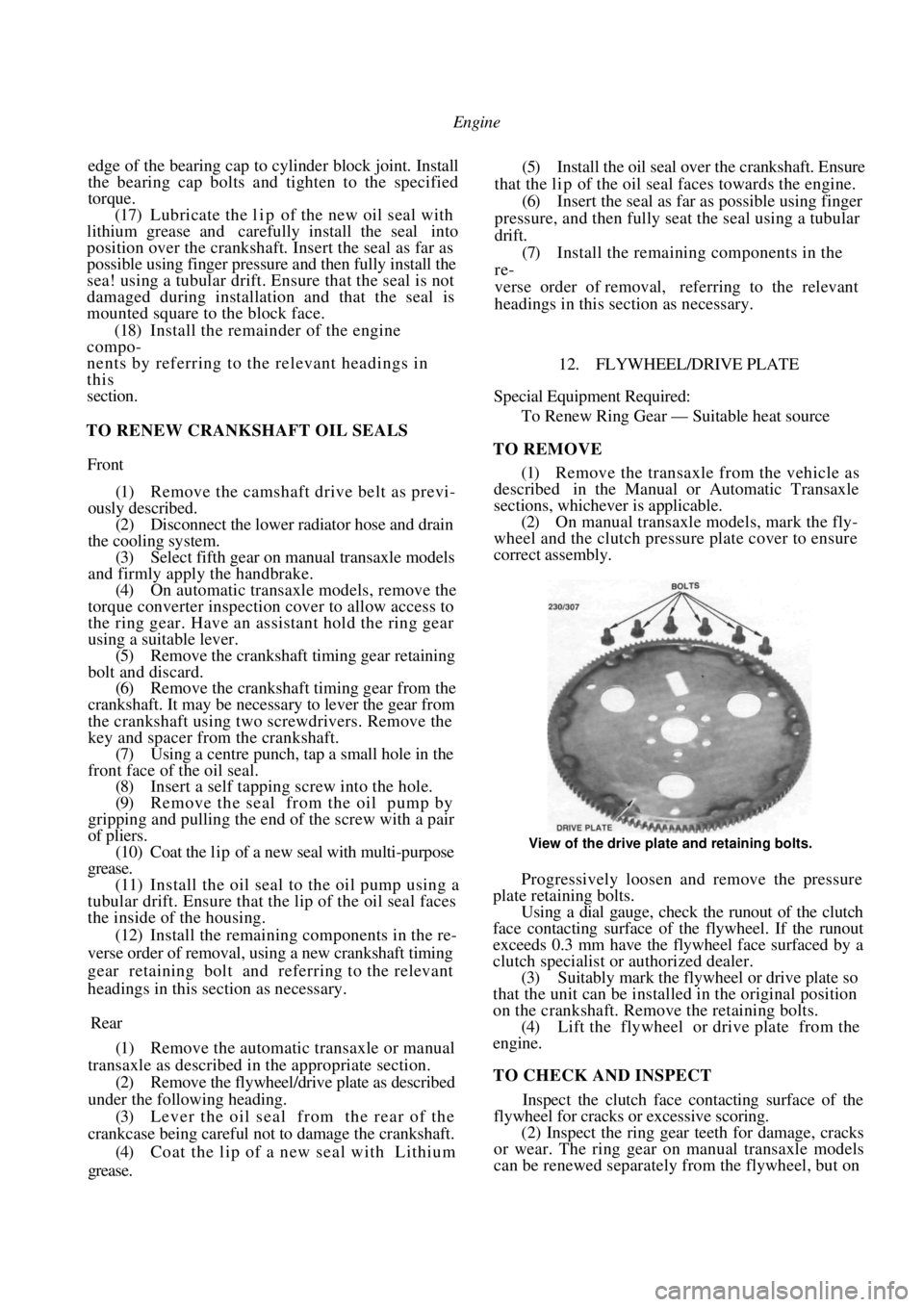
sections, whichever is applicable. (2) On manual transaxle models, mark the fly-
wheel and the clutch pressure plate cover to ensure
correct assembly.
View of the drive plate and retaining bolts.
Progressively loosen and remove the pressure
plate retaining bolts.
Using a dial gauge, check the runout of the clutch
face contacting surface of the flywheel. If the runout
exceeds 0.3 mm have the flywheel face surfaced by a
clutch specialist or authorized dealer.
(3) Suitably mark the flywheel or drive plate so
that the unit can be installed in the original position
on the crankshaft. Remove the retaining bolts. (4) Lift the flywheel or drive plate from the
engine.
TO CHECK AND INSPECT
Inspect the clutch face contacting surface of the
flywheel for cracks or excessive scoring.
(2) Inspect the ring gear teeth for damage, cracks
or wear. The ring gear on manual transaxle models
can be renewed separately from the flywheel, but on
Page 66 of 238
66 Engine
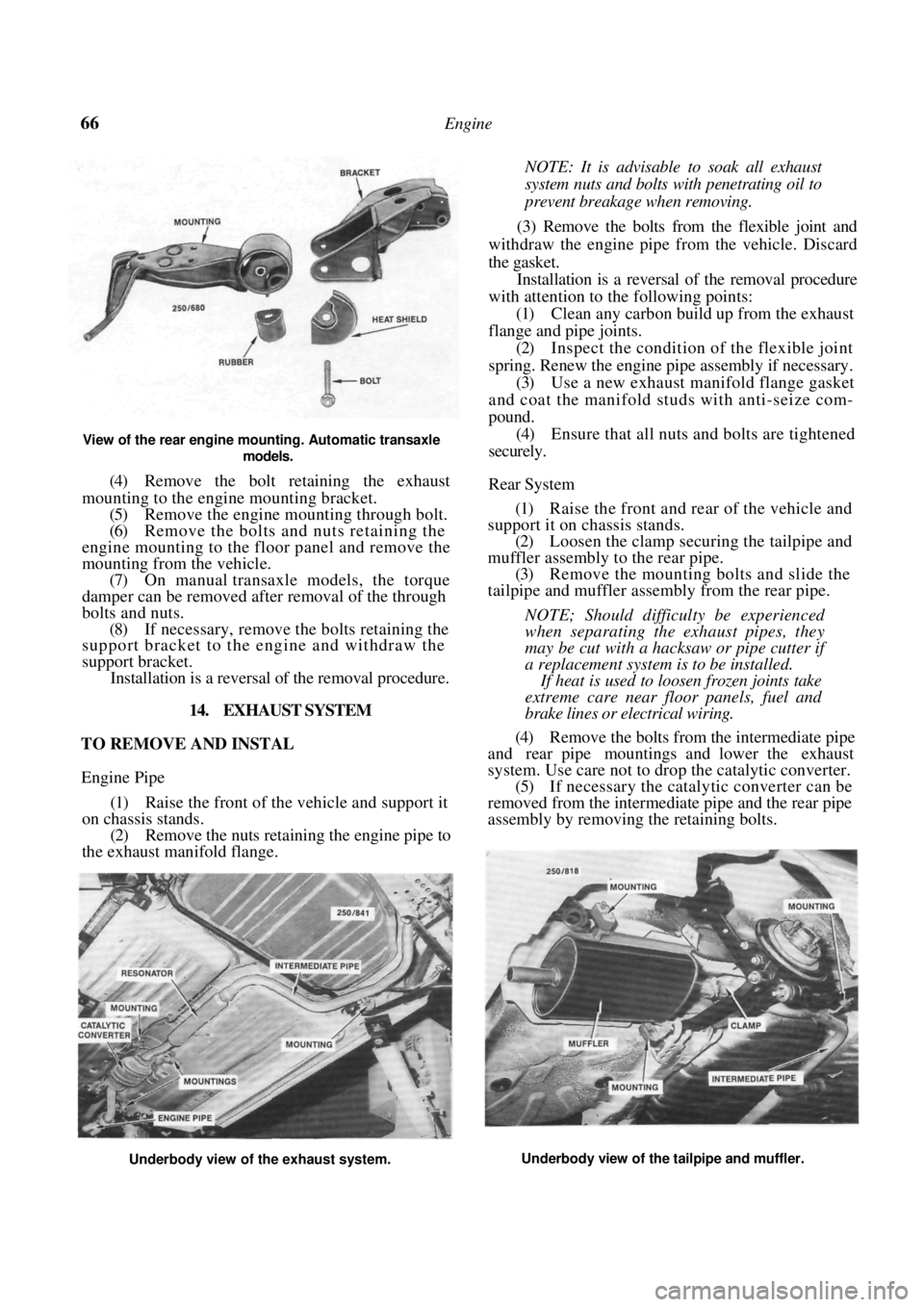
View of the rear engine mounting. Automatic transaxle models.
(4) Remove the bolt retaining the exhaust
mounting to the engine mounting bracket. (5) Remove the engine mounting through bolt.
(6) Remove the bolts and nuts retaining the
engine mounting to the floor panel and remove the
mounting from the vehicle.
(7) On manual transaxle models, the torque
damper can be removed after removal of the through
bolts and nuts. (8) If necessary, remove the bolts retaining the
support bracket to the engine and withdraw the
support bracket.
Installation is a reversal of the removal procedure.
14. EXHAUST SYSTEM
TO REMOVE AND INSTAL
Engine Pipe
(1) Raise the front of the vehicle and support it
on chassis stands. (2) Remove the nuts retaining the engine pipe to
the exhaust manifold flange.
NOTE: It is advisable to soak all exhaust
system nuts and bolts wi th penetrating oil to
prevent breakage when removing.
(3) Remove the bolts from the flexible joint and
withdraw the engine pipe from the vehicle. Discard
the gasket.
Installation is a reversal of the removal procedure
with attention to the following points:
(1) Clean any carbon build up from the exhaust
flange and pipe joints. (2) Inspect the condition of the flexible joint
spring. Renew the engine pipe assembly if necessary. (3) Use a new exhaust manifold flange gasket
and coat the manifold studs with anti-seize com-
pound. (4) Ensure that all nuts and bolts are tightened
securely.
Rear System
(1) Raise the front and rear of the vehicle and
support it on chassis stands. (2) Loosen the clamp securing the tailpipe and
muffler assembly to the rear pipe. (3) Remove the mounting bolts and slide the
tailpipe and muffler assembly from the rear pipe.
NOTE; Should difficulty be experienced
when separating the exhaust pipes, they
may be cut with a hacksaw or pipe cutter if
a replacement system is to be installed.
If heat is used to loosen frozen joints take
extreme care near floor panels, fuel and
brake lines or electrical wiring.
(4) Remove the bolts from the intermediate pipe
and rear pipe mountings and lower the exhaust
system. Use care not to drop the catalytic converter.
(5) If necessary the cataly tic converter can be
removed from the intermediate pipe and the rear pipe
assembly by removing the retaining bolts.
Underbody view of the exhaust system. Underbody view of the tailpipe and muffler.
Page 69 of 238
Cooling and Heating Systems 69
the cylinder head or cylinder block and renew the
cylinder head gasket.
(2) Crack in the cylinder head or cylinder block:
Repair or renew as necessary.
NOTE; Check the engine for internal leak-
age by withdrawing the dipstick and inspect-
ing for emulsified oil. Run the engine and
check for excessive steam at the exhaust
pipe which would indi cate coolant leakage
into the combustion chamber.
COOLANT LOSS BY OVERFLOW
(1) Overfull system: Drain the excess coolant
from the system.
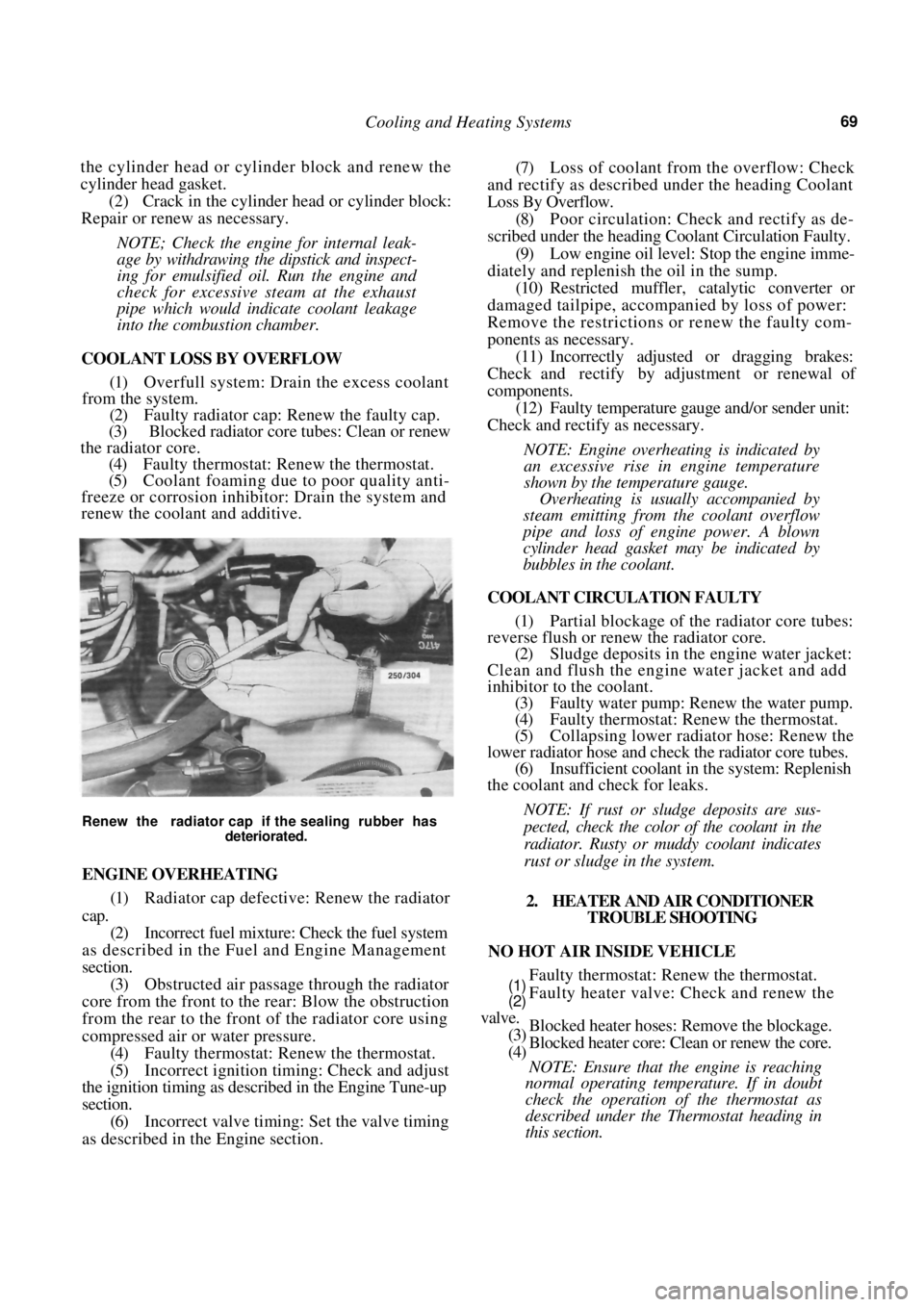
(2) Faulty radiator cap: Renew the faulty cap.
(3) Blocked radiator core tubes: Clean or renew
the radiator core.
(4) Faulty thermostat: Renew the thermostat.
(5) Coolant foaming due to poor quality anti-
freeze or corrosion inhibitor: Drain the system and
renew the coolant and additive.
Renew the radiator cap if the sealing rubber has
deteriorated.
ENGINE OVERHEATING
(1) Radiator cap defective: Renew the radiator
cap.
(2) Incorrect fuel mixture: Check the fuel system
as described in the Fuel and Engine Management
section. (3) Obstructed air passage through the radiator
core from the front to the rear: Blow the obstruction
from the rear to the front of the radiator core using
compressed air or water pressure. (4) Faulty thermostat: Renew the thermostat.
(5) Incorrect ignition timing: Check and adjust
the ignition timing as described in the Engine Tune-up
section. (6) Incorrect valve timing: Set the valve timing
as described in th e Engine section.
(7) Loss of coolant from the overflow: Check
and rectify as described under the heading Coolant
Loss By Overflow.
(8) Poor circulation: Check and rectify as de-
scribed under the heading Coolant Circulation Faulty.
(9) Low engine oil level: Stop the engine imme-
diately and replenish the oil in the sump. (10) Restricted muffler, catalytic converter or
damaged tailpipe, accompanied by loss of power:
Remove the restrictions or renew the faulty com-
ponents as necessary.
(11) Incorrectly adjusted or dragging brakes:
Check and rectify by adjustment or renewal of
components. (12) Faulty temperature gauge and/or sender unit:
Check and rectify as necessary.
NOTE: Engine overheating is indicated by
an excessive rise in engine temperature
shown by the temperature gauge.
Overheating is usually accompanied by
steam emitting from the coolant overflow
pipe and loss of engine power. A blown
cylinder head gasket may be indicated by
bubbles in the coolant.
COOLANT CIRCULATION FAULTY
(1) Partial blockage of the radiator core tubes:
reverse flush or renew the radiator core.
(2) Sludge deposits in the engine water jacket:
Clean and flush the engine water jacket and add
inhibitor to the coolant. (3) Faulty water pump: Renew the water pump.
(4) Faulty thermostat: Renew the thermostat.
(5) Collapsing lower radiator hose: Renew the
lower radiator hose and check the radiator core tubes. (6) Insufficient coolant in the system: Replenish
the coolant and check for leaks.
NOTE: If rust or sludge deposits are sus-
pected, check the color of the coolant in the
radiator. Rusty or muddy coolant indicates
rust or sludge in the system.
2. HEATER AND AIR CONDITIONER TROUBLE SHOOTING
NO HOT AIR INSIDE VEHICLE
Faulty thermostat: Renew the thermostat.
Faulty heater valve: Check and renew the
Blocked heater hoses: Remove the blockage.
Blocked heater core: Clean or renew the core.
NOTE: Ensure that the engine is reaching
normal operating temperature. If in doubt
check the operation of the thermostat as
described under the Thermostat heading in
this section.
(1)
(2)
valve.
(3)
(4)
Page 91 of 238
Fuel and Engine Management 91
components, erase the self diagnosis memory as
described under the following heading.
(7) Repeat the self diagnosis test procedure and
ensure that code 12 is displayed.
To Erase Memory
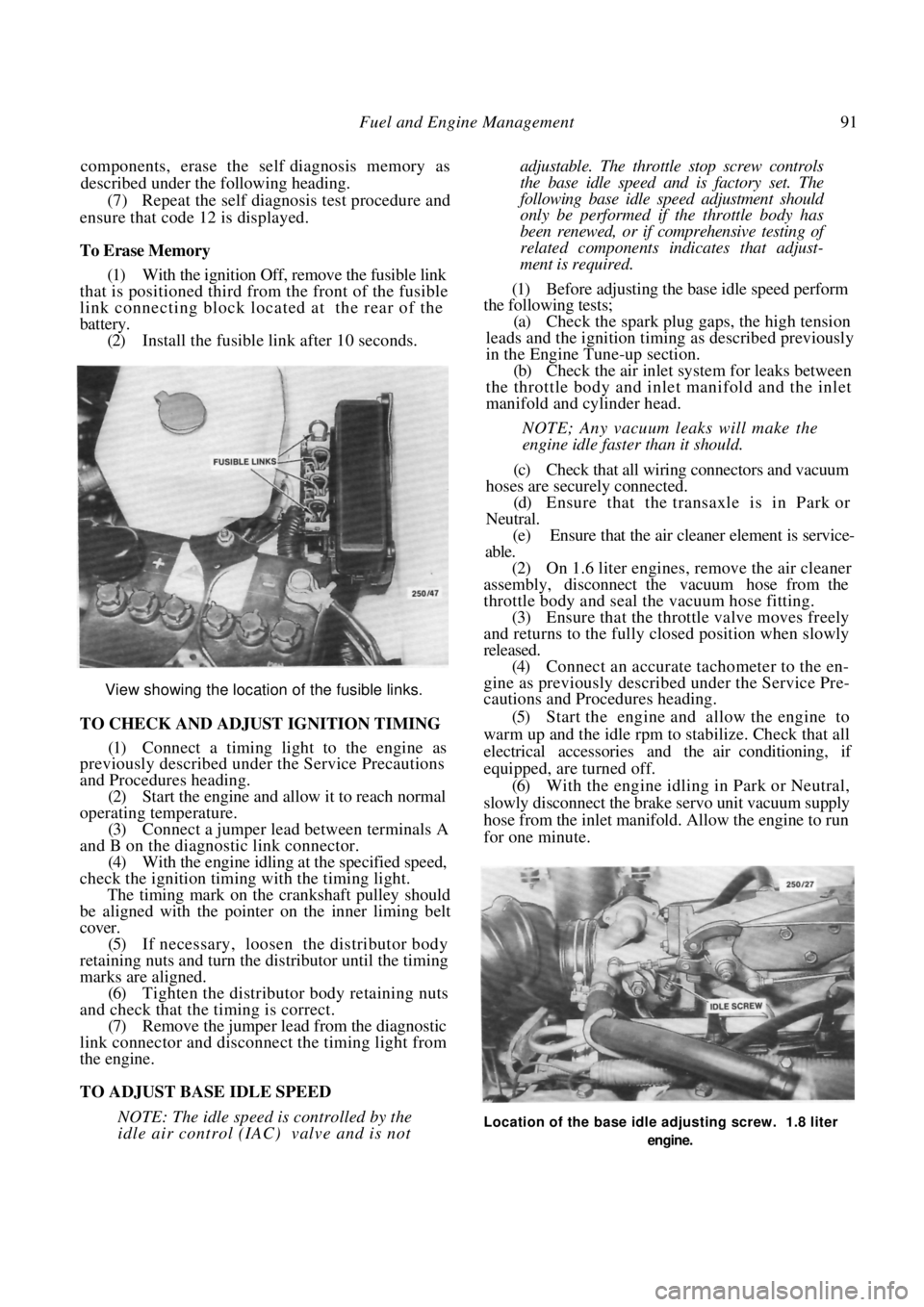
(1) With the ignition Off, remove the fusible link
that is positioned third from the front of the fusible
link connecting block located at the rear of the
battery. (2) Install the fusible link after 10 seconds.
View showing the location of the fusible links.
TO CHECK AND ADJUST IGNITION TIMING
(1) Connect a timing light to the engine as
previously described under the Service Precautions
and Procedures heading.
(2) Start the engine and allow it to reach normal
operating temperature. (3) Connect a jumper lead between terminals A
and B on the diagnostic link connector. (4) With the engine idling at the specified speed,
check the ignition timing with the timing light.
The timing mark on the crankshaft pulley should
be aligned with the pointer on the inner liming belt
cover.
(5) If necessary, loosen the distributor body
retaining nuts and turn the distributor until the timing
marks are aligned. (6) Tighten the distributor body retaining nuts
and check that the timing is correct. (7) Remove the jumper lead from the diagnostic
link connector and disconnect the timing light from
the engine.
TO ADJUST BASE IDLE SPEED
NOTE: The idle speed is controlled by the
idle air control (IAC) valve and is not
adjustable. The throttle stop screw controls
the base idle speed a nd is factory set. The
following base idle speed adjustment should
only be performed if the throttle body has
been renewed, or if comprehensive testing of
related components indicates that adjust-
ment is required.
(1) Before adjusting the base idle speed perform
the following tests;
(a) Check the spark plug gaps, the high tension
leads and the ignition timin g as described previously
in the Engine Tune-up section.
(b) Check the air inlet syst em for leaks between
the throttle body and inlet manifold and the inlet
manifold and cylinder head.
NOTE; Any vacuum leaks will make the
engine idle faster than it should.
(c) Check that all wiring connectors and vacuum
hoses are securely connected. (d) Ensure that the transaxle is in Park or
Neutral. (e) Ensure that the air cleaner element is service-
able.
(2) On 1.6 liter engines, remove the air cleaner
assembly, disconnect the vacuum hose from the
throttle body and seal the vacuum hose fitting.
(3) Ensure that the throttle valve moves freely
and returns to the fully closed position when slowly
released. (4) Connect an accurate tachometer to the en-
gine as previously descri bed under the Service Pre-
cautions and Procedures heading.
(5) Start the engine and allow the engine to
warm up and the idle rpm to stabilize. Check that all
electrical accessories and the air conditioning, if
equipped, are turned off. (6) With the engine idling in Park or Neutral,
slowly disconnect the brake servo unit vacuum supply
hose from the inlet manifold. Allow the engine to run
for one minute.
Location of the base idle adjusting screw. 1.8 liter
engine.
Page 97 of 238
Fuel and Engine Management 97
circuitry do not immerse it in cleaning
solvent as this may result in irreparable
damage.
Installation is a reversal of the removal procedure
with attention to the following points:
(1) Lubricate the new O ring seals with auto-
matic transmission fluid prior to installing them to the
injector. If removed, ensure that the lower filter screen
is installed. (2) Firmly push the injector into the throttle
body assembly until it is fully seated, ensuring that the
injector connection terminals face towards the rear of
the vehicle.
(3) Apply Loctite 262 to the injector retaining
plate screw and tighten securely.
(4) Start the engine and check for fuel leaks as
previously described.
(5) Install the air cleaner and tighten the retain-
ing nuts securely.
FUEL METER ASSEMBLY - 1.6 LITRE
ENGINE
To Remove and Install
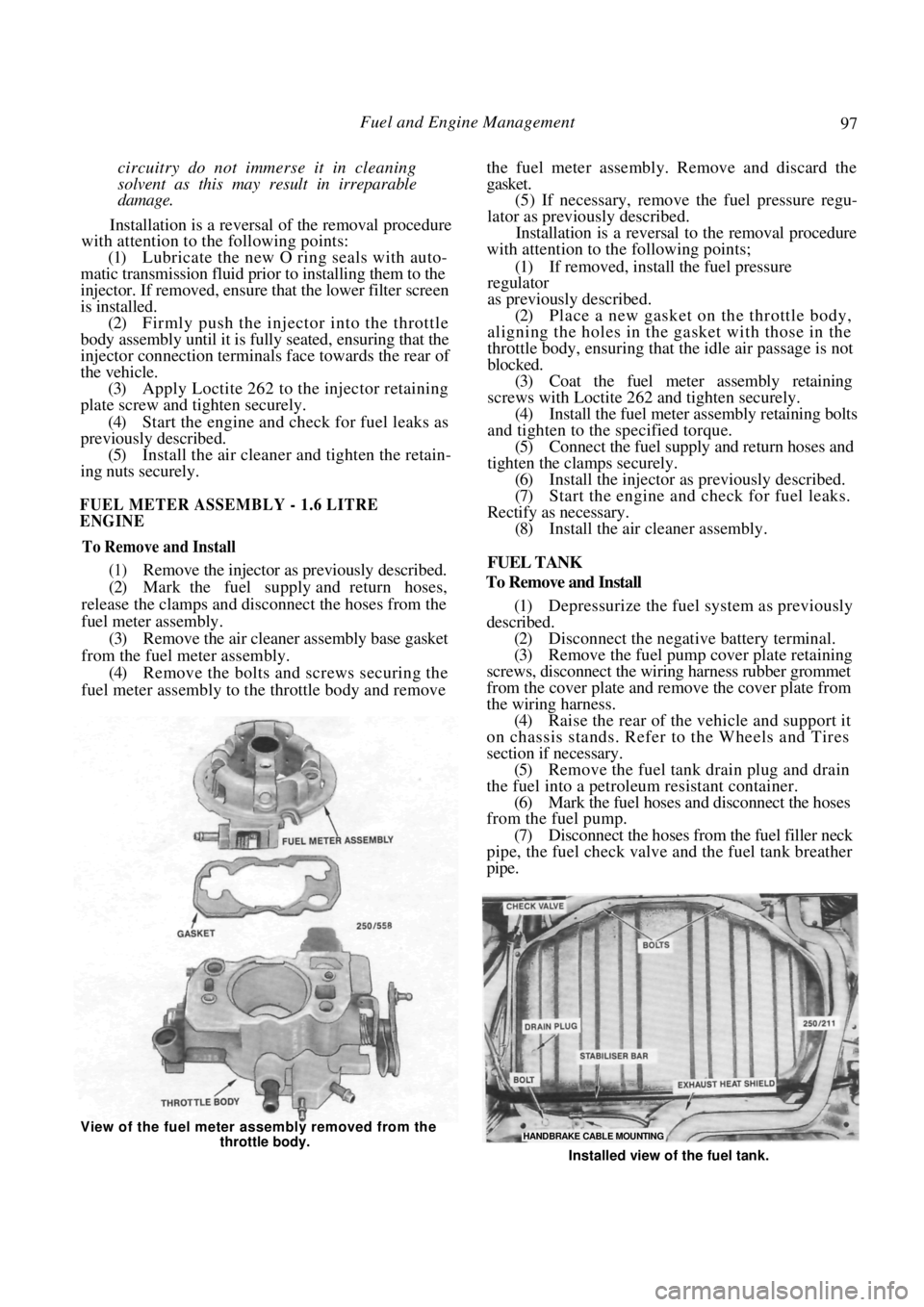
(1) Remove the injector as previously described.
(2) Mark the fuel supp ly and return hoses,
release the clamps and disconnect the hoses from the
fuel meter assembly.
(3) Remove the air cleaner assembly base gasket
from the fuel meter assembly. (4) Remove the bolts and screws securing the
fuel meter assembly to the throttle body and remove the fuel meter assembly. Remove and discard the
gasket.
(5) If necessary, remove the fuel pressure regu-
lator as previously described.
Installation is a reversal to the removal procedure
with attention to the following points;
(1) If removed, install the fuel pressure
regulator
as previously described.
(2) Place a new gasket on the throttle body,
aligning the holes in the gasket with those in the
throttle body, ensuring that the idle air passage is not
blocked. (3) Coat the fuel meter assembly retaining
screws with Loctite 26 2 and tighten securely.
(4) Install the fuel meter assembly retaining bolts
and tighten to the specified torque.
(5) Connect the fuel supply and return hoses and
tighten the clamps securely. (6) Install the injector as previously described.
(7) Start the engine and check for fuel leaks.
Rectify as necessary. (8) Install the air cleaner assembly.
FUEL TANK
To Remove and Install
(1) Depressurize the fuel system as previously
described.
(2) Disconnect the negative battery terminal.
(3) Remove the fuel pump cover plate retaining
screws, disconnect the wi ring harness rubber grommet
from the cover plate and remove the cover plate from
the wiring harness. (4) Raise the rear of the vehicle and support it
on chassis stands. Refer to the Wheels and Tires
section if necessary. (5) Remove the fuel tank drain plug and drain
the fuel into a petroleum resistant container. (6) Mark the fuel hoses and disconnect the hoses
from the fuel pump.
(7) Disconnect the hoses from the fuel filler neck
pipe, the fuel check valve and the fuel tank breather
pipe.
View of the fuel meter assembly removed from the
throttle body. HANDBRAKE CABLE MOUNTING
Installed view of the fuel tank.
Page 98 of 238
Fuel and Engine Management
(8) Remove the bolts retaining the intermediate
exhaust pipe to the rear of the catalytic converter,
remove the bolt securing the exhaust mounting to the
underbody and slightly lower the intermediate exhaust
pipe. Support the intermediate pipe to prevent the
tailpipe fouling the lower bumper panel.
(9) Remove the bolts retaining the stabilizer bar
mounting brackets to the underbody and allow the
stabilizer bar to drop.
(10) Remove the bolts retaining the exhaust heat
shield to the underbody, located at the front of the
fuel tank. (11) Remove the handbrake cable mounting
bracket retaining nuts and remove the mounting
brackets from the mounting studs. (12) Remove the fuel tank retaining bolts and
maneuver the fuel tank from the vehicle. Installation is a reversal of the removal procedure
with attention to the following points:
(1) When installing the fuel tank, ensure that the
fuel pump wiring harness is directed through the
aperture in the floor. (2) Install the stabilizer bar mounting
bracket
bolts and tighten to the specified torque. Refer to the
Rear Suspension section.
(3) Using a new gasket, install the intermediate
exhaust pipe to the catalyti c converter ensuring that
the earth wire terminal is installed and tighten the
bolts securely. (4) Connect the fuel filler neck hose, the fuel
check valve hose and the breat her hose ensuring that
they are secured firmly. (5) Tighten the fuel tank drain plug to the
specified torque. (6) Connect the fuel hoses to the fuel pump,
using the marks made during removal to ensure
correct installation. (7) Install the fuel pump wiring harness and the
rubber grommet to the fuel pump cover plate. Install
the cover plate and tighten the retaining bolts se-
curely.
(8) Connect the fuel pump wiring connector
securely. (9) Check for fuel leaks as previously described.
6. AIR FLOW COMPONENTS
NOTE: Before proceeding with any of the
operations in this section, refer to the Ser-
vice Precautions and Procedures heading.
AIR CLEANER ASSEMBLY
To Renew Element
The procedure for renewing the air cleaner ele-
ment is covered in the Engine Tune-up section.
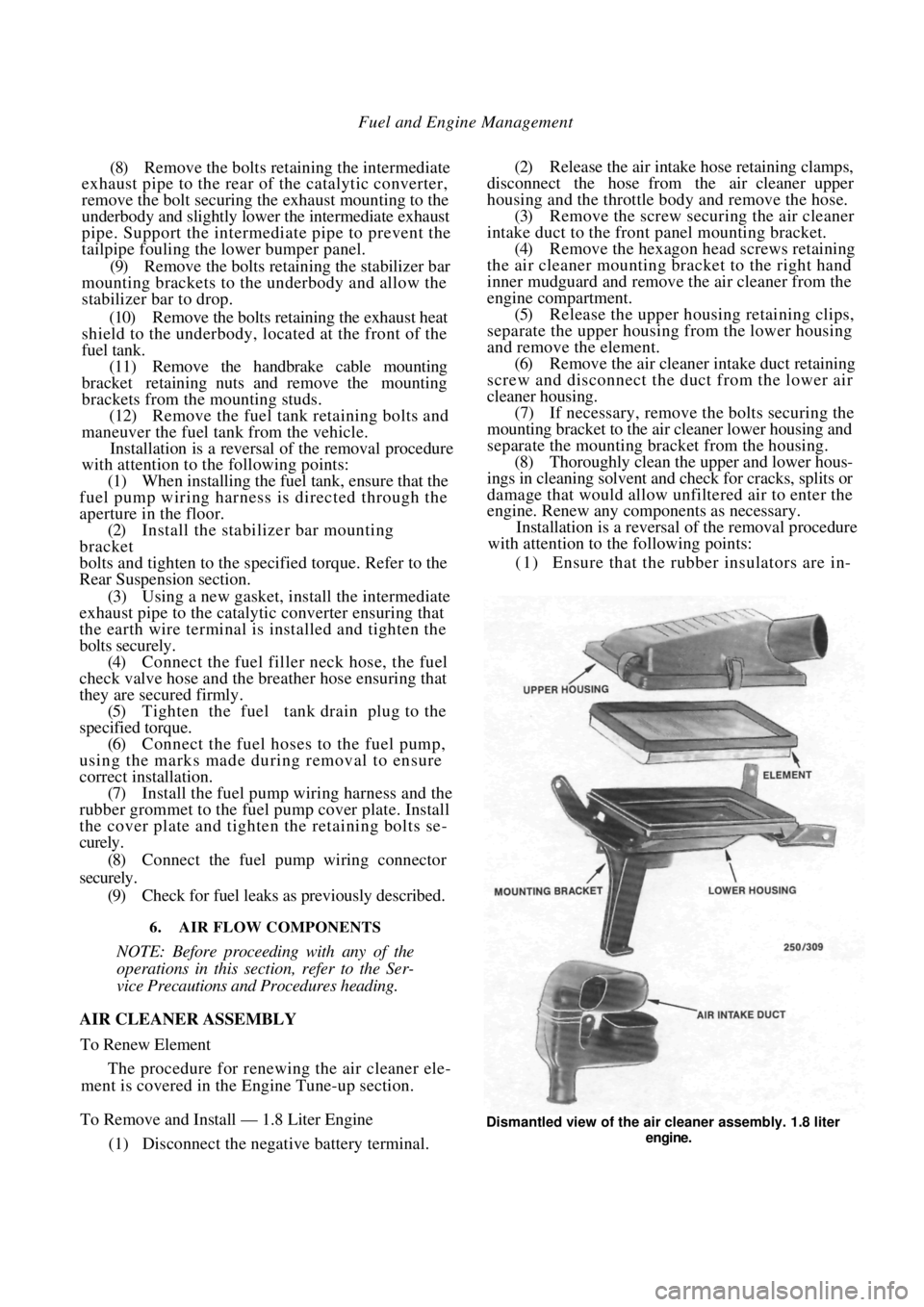
To Remove and Install — 1.8 Liter Engine
(1) Disconnect the negative battery terminal.
(2) Release the air intake hose retaining clamps,
disconnect the hose from the air cleaner upper
housing and the throttle body and remove the hose. (3) Remove the screw securing the air cleaner
intake duct to the front panel mounting bracket. (4) Remove the hexagon head screws retaining
the air cleaner mounting bracket to the right hand
inner mudguard and remove the air cleaner from the
engine compartment. (5) Release the upper housing retaining clips,
separate the upper housing from the lower housing
and remove the element. (6) Remove the air cleaner intake duct retaining
screw and disconnect the duct from the lower air
cleaner housing. (7) If necessary, remove the bolts securing the
mounting bracket to the ai r cleaner lower housing and
separate the mounting bracket from the housing. (8) Thoroughly clean the upper and lower hous-
ings in cleaning solvent and check for cracks, splits or
damage that would allow unfiltered air to enter the
engine. Renew any components as necessary.
Installation is a reversal of the removal procedure
with attention to the following points:
(1) Ensure that the r ubber insulators are in-
Dismantled view of the ai r cleaner assembly. 1.8 liter
engine.
Page 121 of 238
121
CLUTCH
SPECIFICATIONS
Type................................................... Single dry plate
Operation................................................... Mechanical
Pressure plate type .................................... Diaphragm
Release bearing type .......................Prelubri cated ball
Driven plate:
Outside diameter .................................... 215 mm
Rivet depth limit ....................................0.3 mm
Runout limit .........................................0.5 mm
Maximum spline backlash ...................0.7 mm
Pressure plate:
Diaphragm spring height
(installed) ...................................... 30.5-32.5 mm
Spring finger vari ation limit.....................0.5 mm
Clutch pedal:
Height .............................................. 175-185 mm
Free play ....................................... 12.5-17.5 mm
Release lever free play............................ 2.5-3.5 mm
Flywheel machining limit ...............................0.3 mm
TORQUE WRENCH SETTINGS
Pressure plate bolts.......................................... 29 Nm
Pedal pivot pin nut ......................................... 22 Nm
Cable loc knut.................................................... 4 Nm
Lower clutch housing to engine bolts.............. 21 Nm
Centre and upper clutch housing
to engine bolts .................................................. 49 Nm
1. CLUTCH TROUBLE SHOOTING
CLUTCH SLIPPING
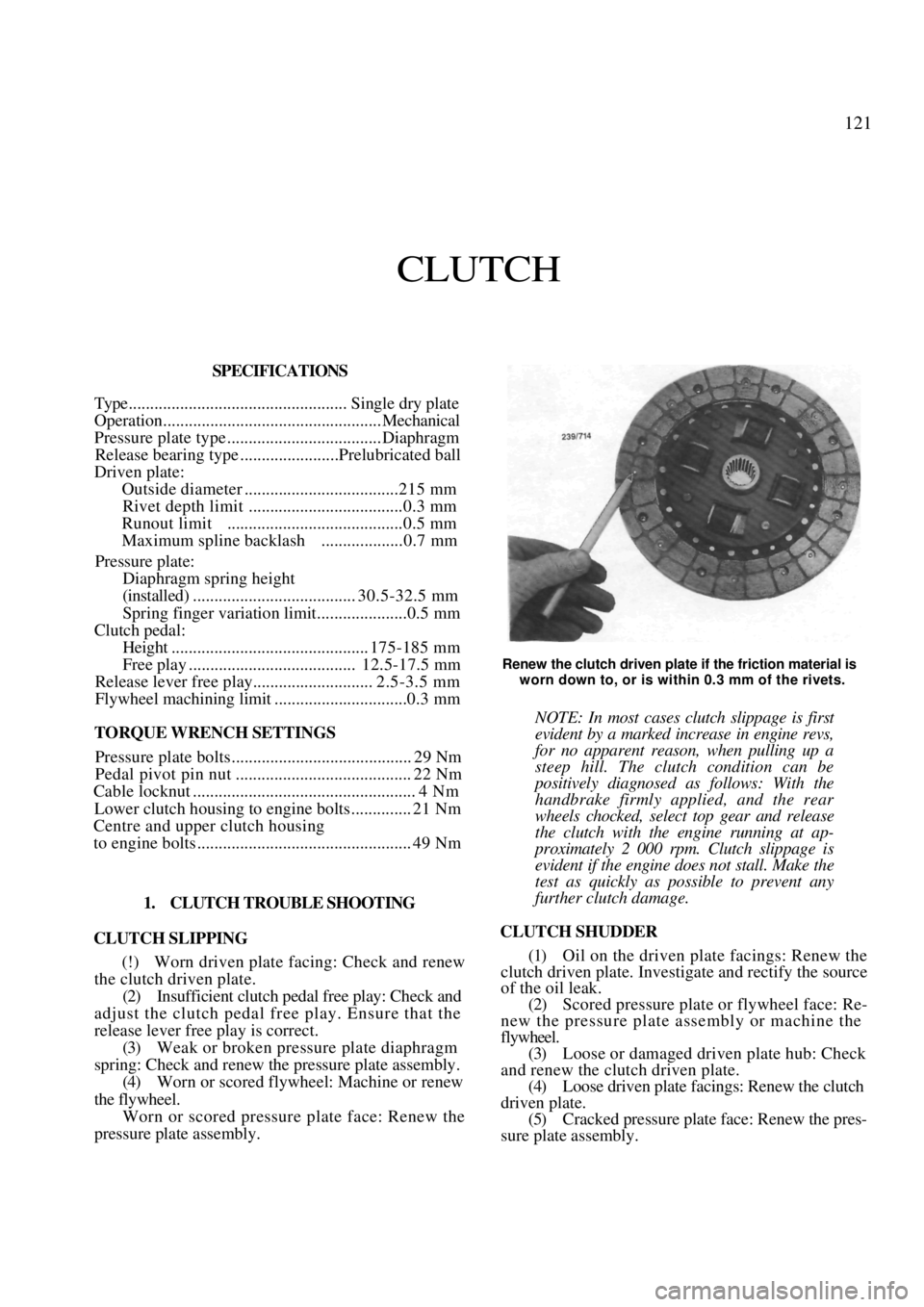
(!) Worn driven plate facing: Check and renew
the clutch driven plate.
(2) Insufficient clutch pedal free play: Check and
adjust the clutch pedal free play. Ensure that the
release lever free play is correct.
(3) Weak or broken pressure plate diaphragm
spring: Check and renew the pressure plate assembly. (4) Worn or scored flywh eel: Machine or renew
the flywheel. Worn or scored pressure plate face: Renew the
pressure plate assembly.
Renew the clutch driven plate if the friction material is
worn down to, or is within 0.3 mm of the rivets.
NOTE: In most cases clutch slippage is first
evident by a marked increase in engine revs,
for no apparent reason, when pulling up a
steep hill. The clutch condition can be
positively diagnosed as follows: With the
handbrake firmly applied, and the rear
wheels chocked, select top gear and release
the clutch with the engine running at ap-
proximately 2 000 rpm. Clutch slippage is
evident if the engine does not stall. Make the
test as quickly as possible to prevent any
further clutch damage.
CLUTCH SHUDDER
(1) Oil on the driven plate facings: Renew the
clutch driven plate. Invest igate and rectify the source
of the oil leak.
(2) Scored pressure plate or flywheel face: Re-
new the pressure plate assembly or machine the
flywheel. (3) Loose or damaged driven plate hub: Check
and renew the clutch driven plate. (4) Loose driven plate facings: Renew the clutch
driven plate. (5) Cracked pressure plate face: Renew the pres-
sure plate assembly.
Page 137 of 238
Manual Transaxle and Drive Shafts 137
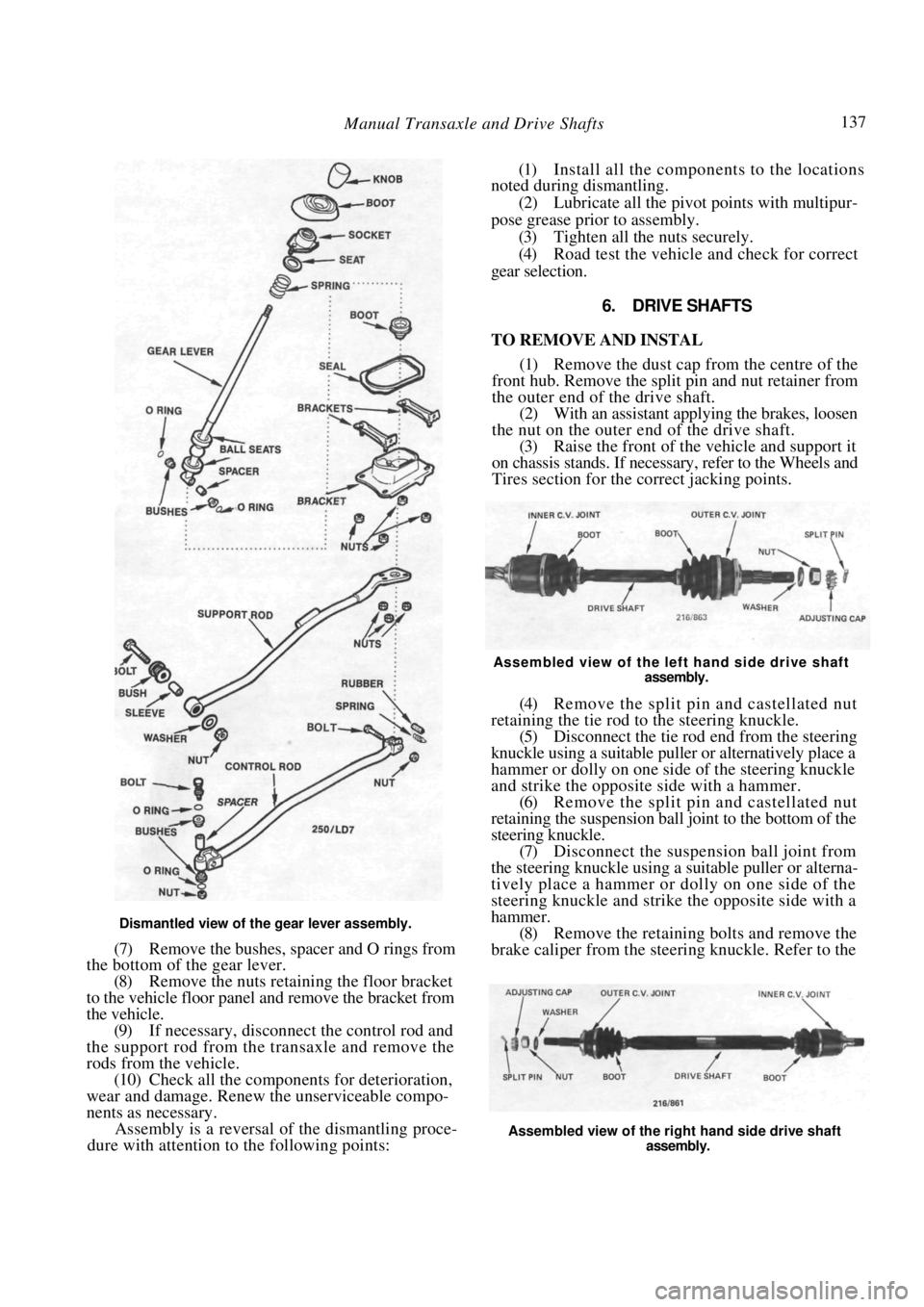
Dismantled view of the gear lever assembly.
(7) Remove the bushes, spacer and O rings from
the bottom of the gear lever.
(8) Remove the nuts retaining the floor bracket
to the vehicle floor panel and remove the bracket from
the vehicle. (9) If necessary, disconnect the control rod and
the support rod from the transaxle and remove the
rods from the vehicle. (10) Check all the components for deterioration,
wear and damage. Renew the unserviceable compo-
nents as necessary. Assembly is a reversal of the dismantling proce-
dure with attention to the following points:
(1) Install all the components to the locations
noted during dismantling.
(2) Lubricate all the pivot points with multipur-
pose grease prior to assembly. (3) Tighten all the nuts securely.
(4) Road test the vehicle and check for correct
gear selection.
6. DRIVE SHAFTS
TO REMOVE AND INSTAL
(1) Remove the dust cap from the centre of the
front hub. Remove the split pin and nut retainer from
the outer end of the drive shaft. (2) With an assistant applying the brakes, loosen
the nut on the outer end of the drive shaft.
(3) Raise the front of the vehicle and support it
on chassis stands. If necessary, refer to the Wheels and
Tires section for the correct jacking points.
Assembled view of the left hand side drive shaft
assembly.
(4) Remove the split pin and castellated nut
retaining the tie rod to the steering knuckle. (5) Disconnect the tie rod end from the steering
knuckle using a suitable puller or alternatively place a
hammer or dolly on one side of the steering knuckle
and strike the opposite side with a hammer.
(6) Remove the split pin and castellated nut
retaining the suspension ball joint to the bottom of the
steering knuckle. (7) Disconnect the suspension ball joint from
the steering knuckle using a suitable puller or alterna-
tively place a hammer or dolly on one side of the
steering knuckle and strike the opposite side with a
hammer. (8) Remove the retaining bolts and remove the
brake caliper from the stee ring knuckle. Refer to the
Assembled view of the right hand side drive shaft
assembly.
Page 138 of 238
138 Manual Transaxle and Drive Shafts
Brakes section if necessary. Suspend the caliper with
wire or cord attached to the coil spring.
(9) Hold the steering knuckle and hub assembly
and tap the drive shaft out of the hub using a soft
faced hammer.
(10) Drain the oil from the transaxle into a
container.
(11) Prise the drive shaft out of the transaxle and
remove the drive shaft from the vehicle.
Installation is a reversal of the removal procedure
with attention to the following points:
(1) Ensure that the drive sh aft is firmly attached
to the differential side gear by attempting to pull the
shaft out of the gear. (2) Tighten all nuts securely and install new split
pins. (3) Fill the transaxle with the specified grade and
quantity of oil.
TO DISMANTLE AND ASSEMBLE
(1) Remove the drive shaft from the vehicle as
previously described.
(2) Remove and discard both the inner C.V.
joint boot retaining clips from the inner C.V. joint. (3) Roll back the large en d of the inner C.V.-
joint boot using a thin blade screwdriver, prise out the
C.V. joint retaining ring.
(4) Withdraw the C.V. joint housing from the
drive shaft and ball assembly. (5) Remove the inner snap ring retaining the ball
assembly to the drive shaft and withdraw the ball
assembly. (6) Remove the remaining inner C.V. joint re-
taining snap ring and the C.V. joint boot from the
drive shaft. (7) Noting their installed positions remove the
cage and ball assembly off the inner race and press the
balls out of the cage. (8) Remove and discard the clips retaining the
outer C.V. joint boot to the drive shaft and remove
the C.V. joint boot.
NOTE: The outer C.V. joint cannot be
dismantled.
(9) Wash all parts in a suitable solvent and blow
dry with compressed air.
(10) Inspect the ball contact faces of the inner ball
race and C.V. joint housing for pitting and wear.
(11) Inspect the ball cage and the balls for wear
and damage. (12) Rotate the drive shaft with the outer C.V.
joint at a sharp angle and inspect the internal
components of the outer C.V. joint for wear and
damage. Renew if necessary by tapping the C.V. joint
from the drive shaft.
NOTE: Do not reuse the retaining snap ring
if the C. V. joint is removed from the drive
shaft.
(13) Check the C.V. joint boots for damage and
deterioration. (14) Renew all worn or damaged components as
necessary. Assembly is a reversal of the dismantling proce-
dure with attention to the following points:
(1) Thoroughly pack the outer C.V. joint with
molybdenum disulphide grease. (2) Install the outer C.V. joint boot and retain in
position using new retaining clips. Ensure that the
boot and the clips ar e correctly seated.
(3) Install the inner C.V. joint boot, small
end
first, onto the drive shaft and pull it well down the
shaft. (4) Install the outer snap ri ng for the inner C.V.
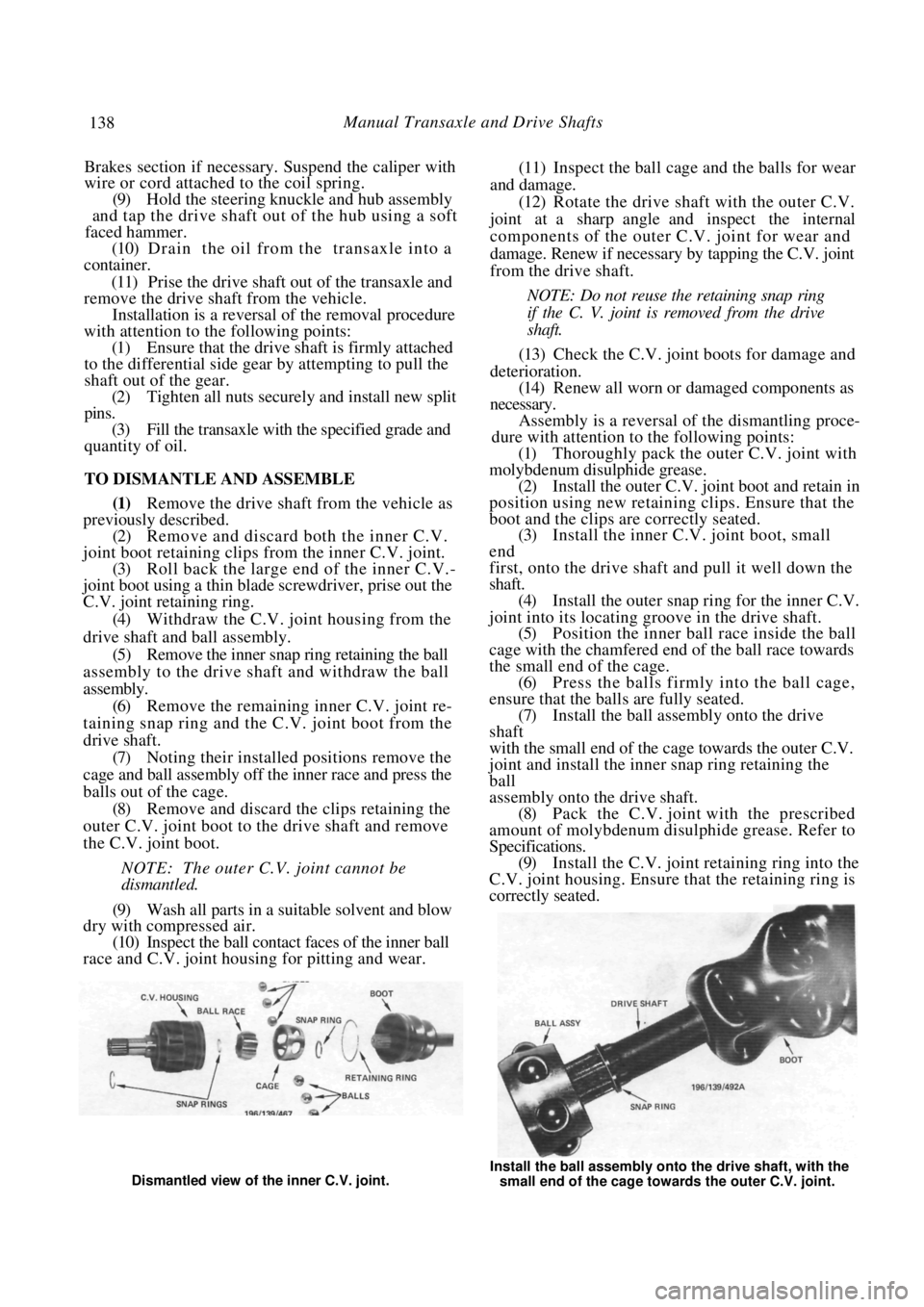
joint into its locating groove in the drive shaft. (5) Position the inner ball race inside the ball
cage with the chamfered end of the ball race towards
the small end of the cage. (6) Press the balls firmly into the ball cage,
ensure that the balls are fully seated. (7) Install the ball assem bly onto the drive
shaft
with the small end of the cage towards the outer C.V.
joint and install the inner snap ring retaining the
ball
assembly onto the drive shaft.
(8) Pack the C.V. joint with the prescribed
amount of molybdenum disul phide grease. Refer to
Specifications. (9) Install the C.V. joint retaining ring into the
C.V. joint housing. Ensure that the retaining ring is
correctly seated.
Dismantled view of the inner C.V. joint. Install the ball assembly onto the drive shaft, with the
small end of the cage towards the outer C.V. joint.
Page 141 of 238
Automatic Transaxle 141
(2) Incorrectly adjusted kickdown cable: Check
and adjust or renew the kickdown cable as required.
NOTE: Check and adjust the throttle cable
before adjusting the kickdown cable.
ENGINE WILL NOT START IN P OR N
RANGE OR WILL START IN ANY RANGE
(1) Neutral safety switch faulty: Adjust or renew
the neutral safety switch. (2) Incorrectly adjusted selector cable: Check
and adjust the selector cable as detailed.
2. DESCRIPTION
The automatic transaxle combines a fluid coup-
ling or torque converter with a fully automatic three
speed epicyclic gear system.
The transaxle provides th ree forward ratios and
one reverse. The hydraulic system consists of a single
pump and valv e arrangement.
The final drive or differential and the transaxle
use a common lubricant. The transaxle oil pan and
final drive drain plug will have to be removed to drain
the transaxle completely. Topping up or refilling is
done through the dipstick tube.
The gear selector lever is floor mounted and
connected to the transaxle by an adjustable cable. The
selector quadrant adjacent to the base of the lever is
marked P, R, N, D, 2, 1.
It is necessary for the selector lever to be in P or
N before the engine can be started. When testing or
tuning the engine, the handbrake must be firmly
applied and the selector lever placed in the P position,
otherwise the vehicle could move forward or back-
wards as the engine speed is increased.
For long distance towing the vehicle should be
towed with the front end raised.
It is not possible to start the engine by either
towing or pushing the vehicle.
The transaxle can be removed from the vehicle
without engine removal.
NOTE: As extensive knowledge and equip-
ment is required to overhaul the automatic
transaxle assembly, it is therefore not a
worthwhile repair proposition for the aver-
age person. However if the transaxle must
be overhauled by a specialist or be replaced
with a reconditioned unit, the removal and
installation procedure is fully described at
the end of this section.
3. TRANSAXLE FLUID
Only use the recommended transaxle fluid speci-
fied by the manufacturer when topping up or changing
the fluid in the system.
TO CHECK AND TOP UP
NOTE: The fluid level should be checked
after approximately 5 minutes driving on
the road when the engine has achieved its
normal operating temperature of approxi-
mately 65 deg C.
(1) Place the vehicle on a level floor and open
the engine bonnet.
NOTE: When working on the automatic
transaxle cleanliness is very important. Do
not reuse transaxle fluid and do not allow
foreign matter to enter the filler opening.
(2) Clean around the top of the dipstick to
ensure that no dirt or foreign matter can enter the
dipstick tube.
(3) Place the selector in the P position and
firmly apply the handbrake. (4) Move the selector thro ugh each gear return-
ing it to the P position.
(5) Check the fluid level with the engine running
at idle. Install the dipstick fully into the dipstick tube.
NOTE: If the vehicle has been driven at high
speed, or has been towing a load, or driven
through heavy city traffic in hot weather, a
period of about 30 minutes should be
allowed to permit the transaxle to cool
before checking the fluid level.
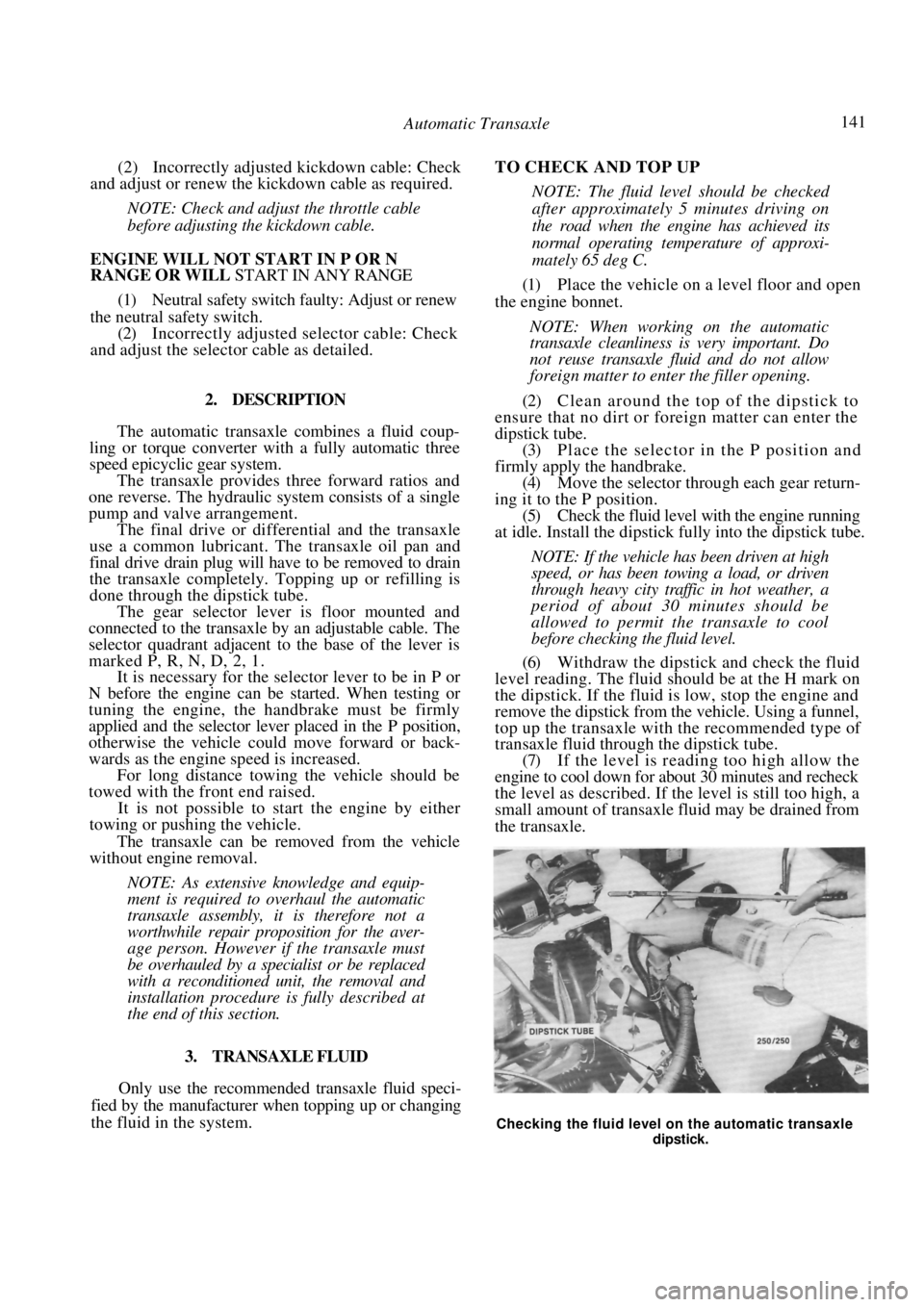
(6) Withdraw the dipstick and check the fluid
level reading. The fluid should be at the H mark on
the dipstick. If the fluid is low, stop the engine and
remove the dipstick from the vehicle. Using a funnel,
top up the transaxle with the recommended type of
transaxle fluid through the dipstick tube. (7) If the level is reading too high allow the
engine to cool down for about 30 minutes and recheck
the level as described. If the level is still too high, a
small amount of transaxle fluid may be drained from
the transaxle.
Checking the fluid level on the automatic transaxle
dipstick.